
Buddhism: A Deep Study study guide · Lesson 9 of 13
Councils & the Great Schism
The Three Councils · Schism and the Rise of Mahayana · Councils by the Numbers
This is the lesson's study guide from the FlashFeed app, plus its key facts and a self-test.
What you'll be able to do
- Identify the First, Second, and Third Buddhist Councils and their purposes.
- Explain how the First Council preserved the canon through recitation (Mahakassapa leading, Upali reciting the Vinaya, Ananda the Suttas).
- Contrast the conservative Sthaviras with the Mahasanghika and their link to the later rise of Mahayana.
- Recall the approximate dates and figures of the three councils.
The Three Councils
The early councils of Buddhism were crucial in preserving the teachings of the Buddha and addressing emerging disputes among followers. These gatherings played a significant role in establishing the Vinaya and the Suttas, which form the foundation of Buddhist practice and doctrine.
The First Council: Saving the Words
Soon after the Buddha's death, the First Council was convened to preserve his teachings in the absence of written texts. This gathering of approximately 500 arahants at Rajagriha aimed to consolidate their memories into a coherent canon. The urgency stemmed from the fear that differing recollections could lead to fragmentation of the teachings. Mahakassapa's leadership was crucial, as he guided the monks in this foundational effort, ensuring that the essence of the Buddha's message was not lost to time.
Two Recitations
During the First Council, the canon was reconstructed through oral recitation. Upali, known for his expertise in monastic discipline, recited the Vinaya, which outlines the rules governing the conduct of monks and nuns. Meanwhile, Ananda, the Buddha’s devoted attendant, recited the Suttas, which capture the discourses of the Buddha. This method of transmission was vital, as it laid the groundwork for the Tripitaka, the sacred scripture that would guide future generations of Buddhists.
The Second Council: A Dispute Over Rules
The Second Council convened about a century later at Vesali to address a significant dispute regarding monastic discipline. The Vajjian monks introduced ten disputed points of the Vinaya, including the controversial practice of accepting gold and silver from laypeople. This council highlighted the tensions between conservative and more progressive interpretations of the Vinaya, ultimately leading to Buddhism's first major schism. The decisions made here would influence the development of different Buddhist schools and their practices.
The Third Council Under Ashoka
The Third Council, held around c. 250 BCE in Pataliputra, was pivotal in shaping the future of Buddhism under the auspices of King Ashoka. After his conversion to Buddhism post-Kalinga War, Ashoka sought to resolve doctrinal disputes among various Buddhist sects. This council is credited with finalizing the Pali Canon, which became the authoritative scripture for the Theravada tradition. Ashoka's efforts also included sending missionaries to spread Buddhism beyond India, with tradition crediting his son Mahinda with bringing Buddhism to Sri Lanka, and his own edicts naming Hellenistic rulers, including Ptolemy II of Egypt, among those he sought to reach with his message of Dhamma.
The First Three Councils
The First Three Councils were instrumental in establishing the canonical texts and addressing early disputes within Buddhism over approximately two centuries. These gatherings not only preserved the Buddha's teachings but also set the stage for the development of the Vinaya and the Suttas, which continue to be central to Buddhist practice and ethics today.
Schism and the Rise of Mahayana
The emergence of Mahayana Buddhism marked a significant evolution in Buddhist thought, stemming from the first schism that arose from the Second Council. This section explores the complexities of this schism and the gradual development of Mahayana Buddhism, highlighting key figures and philosophical advancements.
The First Schism
According to tradition, the fallout from the Second Council produced Buddhism's first schism; modern scholars debate when and why the split between the two factions actually occurred. The conservative faction, the Sthaviras ("Elders"), insisted on strict adherence to the original rules established by the Buddha, emphasizing monastic discipline and meditation. In contrast, the Mahasanghika ("Great Community") embraced a more flexible interpretation, allowing for a broader understanding of the teachings. This division not only set the stage for the evolution of Theravada from the Sthaviras but also paved the way for the Mahayana tradition, which would later introduce more accessible paths to enlightenment for laypeople.
Mahayana: Not a Clean Break
Despite the tidy story of a single split, Mahayana ("Great Vehicle") was not one clean schism but a gradual development over centuries. From around the 1st century BCE, new sutras began circulating, claiming to offer a deeper understanding of the Buddha's teachings, believed to be revealed only when practitioners were ready. These texts introduced distinctive concepts such as the bodhisattva ideal, which emphasizes the aspiration to attain enlightenment not just for oneself but for all beings, and sunyata (emptiness), which challenges the inherent existence of all phenomena. This gradual evolution allowed Mahayana to differentiate itself from earlier schools while remaining rooted in Buddhist principles.
A Tradition Comes of Age
By the 4th century CE, Mahayana had matured into a fully developed philosophical tradition. Nagarjuna, a pivotal figure, systematized the philosophy of sunyata in his Madhyamaka school, articulating the idea that all things are empty of inherent existence, which reshaped Buddhist metaphysics. Meanwhile, Asanga and Vasubandhu further advanced the Yogacara ("mind-only") school, emphasizing the role of consciousness in the construction of reality. What began as scattered new scriptures evolved into a sophisticated intellectual movement, establishing Mahayana as a major force in the landscape of Buddhism, with lasting influence on its practices and teachings.
This section highlights the significance of the Mahasanghika faction in the development of Mahayana and the foundational contributions of the Sthaviras, answering key quiz questions about the early divisions in Buddhism.
Key terms
- Vinaya
- The collection of monastic rules governing the conduct of monks and nuns; recited by Upali at the First Council.
- Mahasanghika
- "Great Community" — the majority faction at the first schism whose lineage later helped shape Mahayana Buddhism.
- Sthaviras
- "Elders" — the conservative faction at the first schism that defended strict monastic rules and evolved into Theravada.
Key concepts
The First Council
- A gathering convened soon after the Buddha's death to preserve his teachings before they could be lost.
- Held at Rajagriha, it assembled about 500 arahants under Mahakassapa's leadership.
- Here Upali recited the Vinaya and Ananda recited the Suttas, rebuilding the canon entirely from memory.
The Second Council
- A gathering held about a century after the Buddha's death to settle a dispute over monastic discipline.
- It met at Vesali, where Vajjian monks had raised ten disputed points of the Vinaya.
- A key flashpoint was whether monks could accept gold and silver, and its fallout produced Buddhism's earliest major division.
The Third Council
- A gathering held around 250 BCE to resolve doctrinal disputes among rival Buddhist sects.
- Convened at Pataliputra under the patronage of King Ashoka after his conversion.
- It is credited with finalizing the Pali Canon, the authoritative scripture of the Theravada tradition.
The First Schism
- The earliest major division within Buddhism, splitting the community into two rival factions.
- It grew out of the fallout from the Second Council's disputes over monastic discipline.
- It set the conservative Sthaviras ('Elders') against the more flexible Mahasanghika ('Great Community').
Key facts
Two Recitations
At the First Council the canon was reconstructed by recitation. Upali, the monk most expert in monastic discipline, recited the Vinaya — the rules for monks and nuns. Ananda, the Buddha's personal attendant and famed memorizer, recited the Suttas — the discourses. Their spoken texts became the seed of the Tripitaka.
The Second Council: A Dispute Over Rules
About a century later, around c. 383 BCE, monks met at Vesali to settle a quarrel over monastic discipline. A group of monks from the Vajjian region were practicing ten disputed points of Vinaya — most notoriously, accepting gold and silver from laypeople. Conservative elders condemned the relaxations; the dispute set the stage for Buddhism's first lasting split.
The Third Council Under Ashoka
Around c. 250 BCE, a council convened at Pataliputra under the patronage of King Ashoka, the emperor who had turned to Buddhism after the bloody Kalinga War. It sorted out doctrinal disputes among competing schools and is credited with finalizing the Pali Canon used by Theravada. Afterward Ashoka dispatched missionaries as far as Sri Lanka, Greece, and Egypt.
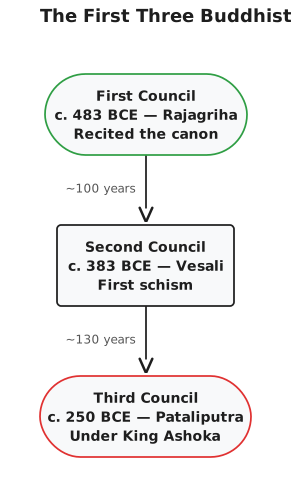
The First Three Councils
The early councils that fixed the canon and saw the first schism — across roughly two centuries.
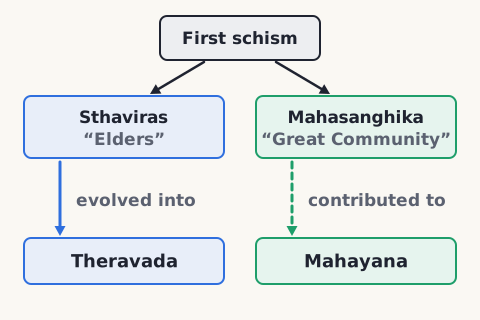
The First Schism
The fallout from the Second Council produced Buddhism's first schism. The conservative faction, the Sthaviras ("Elders"), insisted on the strict rules; the larger faction, the Mahasanghika ("Great Community"), refused to accept the elders' verdict. The Sthaviras eventually evolved into Theravada, while the Mahasanghika later contributed to the development of Mahayana.
Mahayana: Not a Clean Break
Despite the tidy story of a single split, Mahayana ("Great Vehicle") was not one clean schism but a gradual development over centuries. From around the 1st century BCE, new sutras began circulating that claimed to preserve a higher teaching of the Buddha — one supposedly held back until students were ready for it. Its distinctive ideas, like the bodhisattva ideal and sunyata (emptiness), slowly set it apart from the older schools.
A Tradition Comes of Age
By the 4th century CE Mahayana had matured into a fully developed philosophical tradition. Nagarjuna systematized the philosophy of sunyata (emptiness) in his Madhyamaka school, while Asanga and Vasubandhu built the Yogacara ("mind-only") school. What began as scattered new scriptures had become a sophisticated intellectual movement.
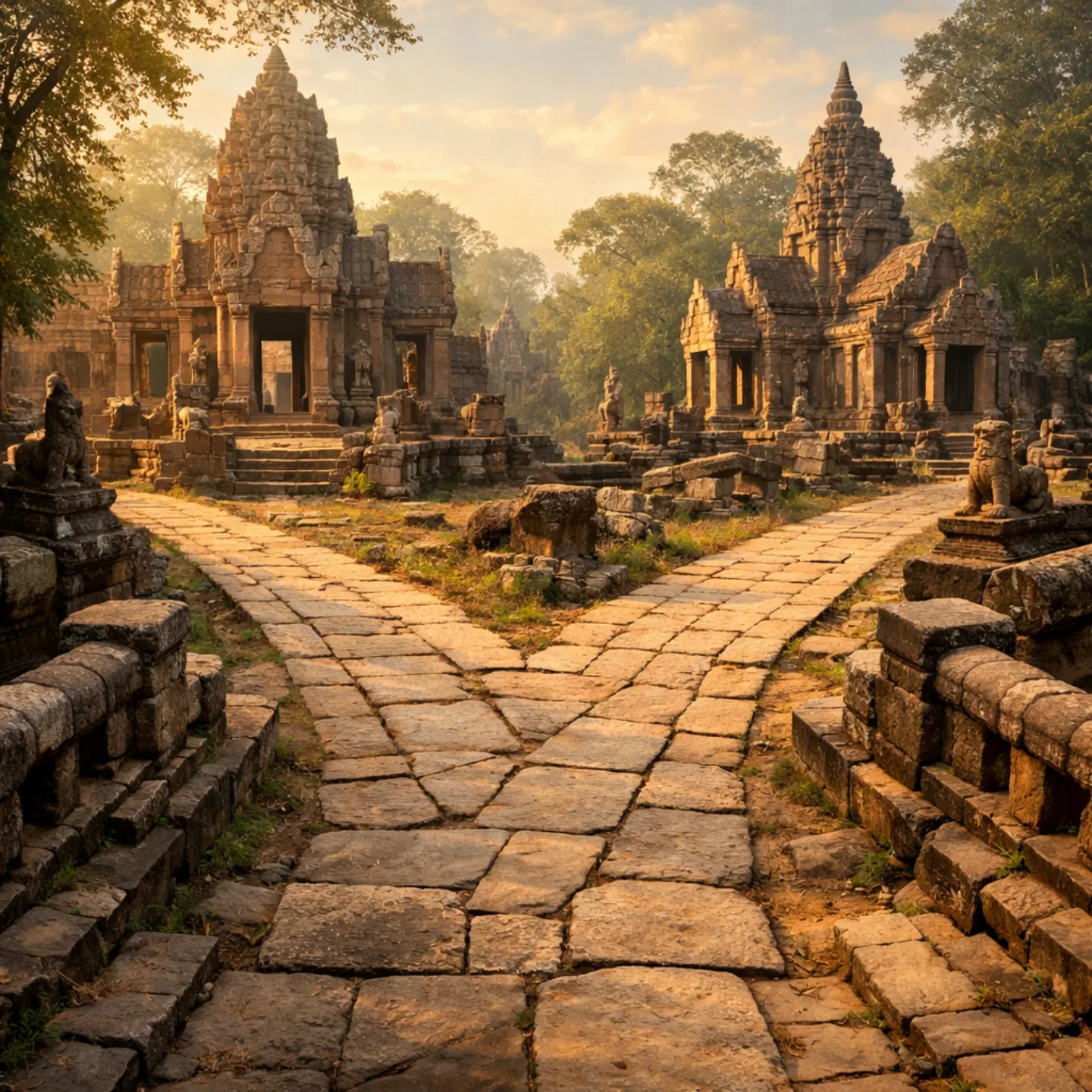
Mahasanghika Roots Of Mahayana
The Mahasanghika, an early Buddhist faction, is traditionally seen as contributing to the later development of Mahayana, while the more conservative Sthaviras evolved into Theravada.
Mahasanghika Means Great Community
The name of the early Buddhist faction Mahasanghika means "Great Community" — distinct from the Sthaviras, or "Elders," the rival faction at Buddhism's first schism.
By the numbers
- Approximate year of the First Buddhist Council at Rajagriha (BCE)
- 483 BCE
- Approximate year of the Second Buddhist Council at Vesali (BCE)
- 383 BCE
- Approximate year of the Third Buddhist Council at Pataliputra (BCE)
- 250 BCE
- Approximate number of arahant monks who attended the First Council
- 500 monks
- Number of disputed points of monastic discipline debated at the Second Council
- 10 points
- Approximate number of years after the Buddha's death that the Second Council was held
- 100 years
Step by step
The first three Buddhist councils in chronological order
- First Council (c. 483 BCE), Rajagriha — under Mahakassapa, ~500 arahants recite the Vinaya and Suttas to fix the canon.
- Second Council (c. 383 BCE), Vesali — the ten disputed points of discipline trigger the first schism.
- Third Council (c. 250 BCE), Pataliputra — under King Ashoka, the Pali Canon is finalized and missionaries are sent out.
All dates are traditional and approximate; modern scholars debate them.
Self-test
Answer each question from memory, then check your work against the answer key.
1. Where was the Second Buddhist Council held to settle the dispute over monastic discipline?
- AVesali
- BSri Lanka
- CPataliputra
- DRajagriha
2. The Third Council, held under King Ashoka at Pataliputra, is credited with finalizing which scripture?
- AThe Vinaya alone
- BThe Yogacara treatises
- CThe Pali Canon
- DThe Mahayana sutras
3. Which of these was NOT a purpose or outcome of one of the first three councils?
- AFinalizing the Pali Canon under Ashoka
- BPreserving the Buddha's teachings by recitation
- CSettling the ten disputed points of Vinaya
- DSystematizing sunyata in the Madhyamaka school
4. What triggered the convening of the Second Council at Vesali?
- AThe circulation of new Mahayana sutras
- BA dispute over ten relaxed points of monastic discipline
- CThe Buddha's death and the loss of his words
- DAshoka's conversion after the Kalinga War
5. Which council was convened soon after the Buddha's death, chiefly to preserve his teachings before recollections could drift?
- AThe Second Council
- BThe First Council
- CThe Third Council
- DThe Fourth Council
6. At the First Council, the canon was reconstructed by recitation. Who recited the Suttas — the Buddha's discourses?
- AKing Ashoka
- BUpali
- CMahakassapa
- DAnanda
7. At the First Council, who recited the Vinaya — the rules governing monks and nuns?
- AAnanda
- BKing Ashoka
- CUpali
- DMahakassapa
8. Which senior monk led the First Council at Rajagriha?
- AMahakassapa
- BNagarjuna
- CUpali
- DAnanda
9. What is the Vinaya, as recited by Upali at the First Council?
- AThe Buddha's discourses to lay and monastic audiences
- BA list of the ten disputed points of discipline
- CThe collection of monastic rules for monks and nuns
- DThe philosophy of emptiness (sunyata)
10. Why was the canon reconstructed through oral recitation at the First Council?
- AThe monks disagreed over gold and silver
- BThe teachings survived only in memory and had to be pooled
- CAshoka had ordered the texts burned
- DWriting was forbidden by the Vinaya
11. Which early faction is generally seen as contributing to the later development of Mahayana?
- AThe Mahasanghika
- BAshoka's missionaries to Sri Lanka
- CThe Sthaviras
- DThe Yogacara monks of the First Council
12. The conservative Sthaviras faction eventually evolved into which surviving tradition?
- AMadhyamaka
- BMahayana
- CYogacara
- DTheravada
13. At the first schism, which faction insisted on strict adherence to the original monastic rules?
- AThe Yogacara
- BThe Vajjian laypeople
- CThe Sthaviras
- DThe Mahasanghika
14. What does the name of the faction 'Mahasanghika' mean?
- A"Great Vehicle"
- B"Mind-Only"
- C"Elders"
- D"Great Community"
15. Which statement about the rise of Mahayana is accurate?
- AIt emerged gradually over several centuries
- BIt broke off instantly at the First Council
- CIt descended directly from the Sthaviras
- DIt was founded by Mahakassapa at Rajagriha
16. Which lists the three councils' host cities in chronological order?
- AVesali, then Rajagriha, then Pataliputra
- BRajagriha, then Vesali, then Pataliputra
- CPataliputra, then Vesali, then Rajagriha
- DRajagriha, then Pataliputra, then Vesali
17. Approximately how many arahant monks attended the First Council at Rajagriha?
- A100
- B250
- C500
- D1000
18. How many disputed points of monastic discipline were debated at the Second Council?
- A500
- B10
- C100
- D5
19. What is the approximate year of the Third Buddhist Council at Pataliputra?
- Ac. 250 BCE
- Bc. 383 BCE
- Cc. 200 BCE
- Dc. 483 BCE
20. About how many years after the Buddha's death was the Second Council held?
- A10
- B500
- C250
- D100
Go deeper
Answer key
- 1. A VesaliThe Second Council met at Vesali about a century after the Buddha's death. Rajagriha hosted the First Council; Pataliputra the Third under Ashoka.
- 2. C The Pali CanonThe Third Council (c. 250 BCE) finalized the Pali Canon used by Theravada. The Mahayana sutras and Yogacara texts arose centuries later.
- 3. D Systematizing sunyata in the Madhyamaka schoolSystematizing sunyata was Nagarjuna's later work (c. 4th century CE), not a council outcome. The other three were purposes of the First, Second, and Third Councils.
- 4. B A dispute over ten relaxed points of monastic disciplineThe Second Council addressed the Vajjian monks' ten disputed points of Vinaya, such as accepting gold and silver. The Buddha's death prompted the First Council; Ashoka the Third.
- 5. B The First CouncilThe First Council met c. 483 BCE at Rajagriha to pool memories into a canon. The Second settled the Vinaya dispute; the Third finalized the Pali Canon under Ashoka.
- 6. D AnandaAnanda, the Buddha's personal attendant and famed memorizer, recited the Suttas (discourses). Upali, the expert in monastic discipline, recited the Vinaya; Mahakassapa presided over the council.
- 7. C UpaliUpali, the monk most expert in monastic discipline, recited the Vinaya. Ananda recited the Suttas; Mahakassapa presided.
- 8. A MahakassapaMahakassapa, the senior monk, guided the First Council. Upali and Ananda recited the Vinaya and Suttas respectively; Nagarjuna lived centuries later.
- 9. C The collection of monastic rules for monks and nunsThe Vinaya is the body of monastic rules governing conduct. The discourses are the Suttas (recited by Ananda); sunyata is a later Mahayana concept.
- 10. B The teachings survived only in memory and had to be pooledWith no written texts, the monks pooled their memories orally before recollections could drift. The gold-and-silver dispute belonged to the Second Council.
- 11. A The MahasanghikaThe Mahasanghika ("Great Community") lineage is traditionally linked to the rise of Mahayana, while the Sthaviras evolved into Theravada.
- 12. D TheravadaThe Sthaviras ("Elders") evolved into Theravada. The Mahasanghika lineage is linked to Mahayana; Yogacara and Madhyamaka are later Mahayana schools.
- 13. C The SthavirasThe Sthaviras ("Elders") defended strict discipline, while the larger Mahasanghika ("Great Community") rejected the elders' verdict.
- 14. D "Great Community"Mahasanghika means "Great Community." "Elders" is the Sthaviras; "Great Vehicle" is Mahayana; "Mind-Only" is Yogacara.
- 15. A It emerged gradually over several centuriesMahayana developed gradually from around the 1st century BCE, not as a single split. Its lineage is linked to the Mahasanghika, not the Sthaviras.
- 16. B Rajagriha, then Vesali, then PataliputraThe First Council met at Rajagriha soon after the Buddha's death, the Second at Vesali about a century later, and the Third at Pataliputra under King Ashoka.
- 17. C 500Roughly 500 enlightened monks (arahants) gathered at the First Council. The figure 100 refers to years between councils; 250 to the Third Council's date.
- 18. B 10The Vajjian monks practiced ten disputed points of Vinaya. 500 was the number of arahants at the First Council; 100 the years between the Buddha's death and the Second Council.
- 19. A c. 250 BCEBy tradition the Third Council met c. 250 BCE at Pataliputra under King Ashoka. c. 483 BCE and c. 383 BCE are the traditional dates of the First and Second Councils (modern chronologies place them somewhat later); c. 200 BCE is too late, decades after the Third Council is said to have convened.
- 20. D 100The Second Council convened about a century (100 years) after the Buddha's death, around c. 383 BCE. 10 is the disputed points; 500 the arahants at the First Council.
Sources
- SuttaCentral — Mahasamghika, Mahayana, Sthaviravada, Theravada: the origin of the split — discourse.suttacentral.net/t/mahasamghika-mahayana-sthavirava-theravada-the-origin-of-the-split/6742
- World History Encyclopedia — Buddhism timeline — www.worldhistory.org/timeline/buddhism/
Image credits
- The First Three Councils: FlashFeed original diagram · CC-BY-4.0
- The First Schism: FlashFeed original diagram · CC-BY-4.0
- Mahasanghika Roots Of Mahayana: AI-generated (gpt-image-1.5)