
Astronomy & Space
From why stars twinkle to why Pluto was reclassified: the Sun, the planets, comets, the Milky Way and the tools astronomers use to measure it all.
459 cards13 lessons39 video lessonsFree
Already have FlashFeed?Open this pack
Get this pack on your phone
Scan with your phone's camera.
flashfeedlearningapp.com/packs/astronomy-and-space
Part of the Curious Minds collection.


13 lessons.
Each lesson has a study guide to read and objectives you can test yourself on. Its cards and games show up in your feed. Try one of its cards right here. Play a few of its games here too. Every lesson has a short video.
-
 Wikimedia Commons · NASA/Roscosmos · Public domain ↗01
What You Are Actually Looking At
Points and Discs · Things That Move · How Bright Is Bright
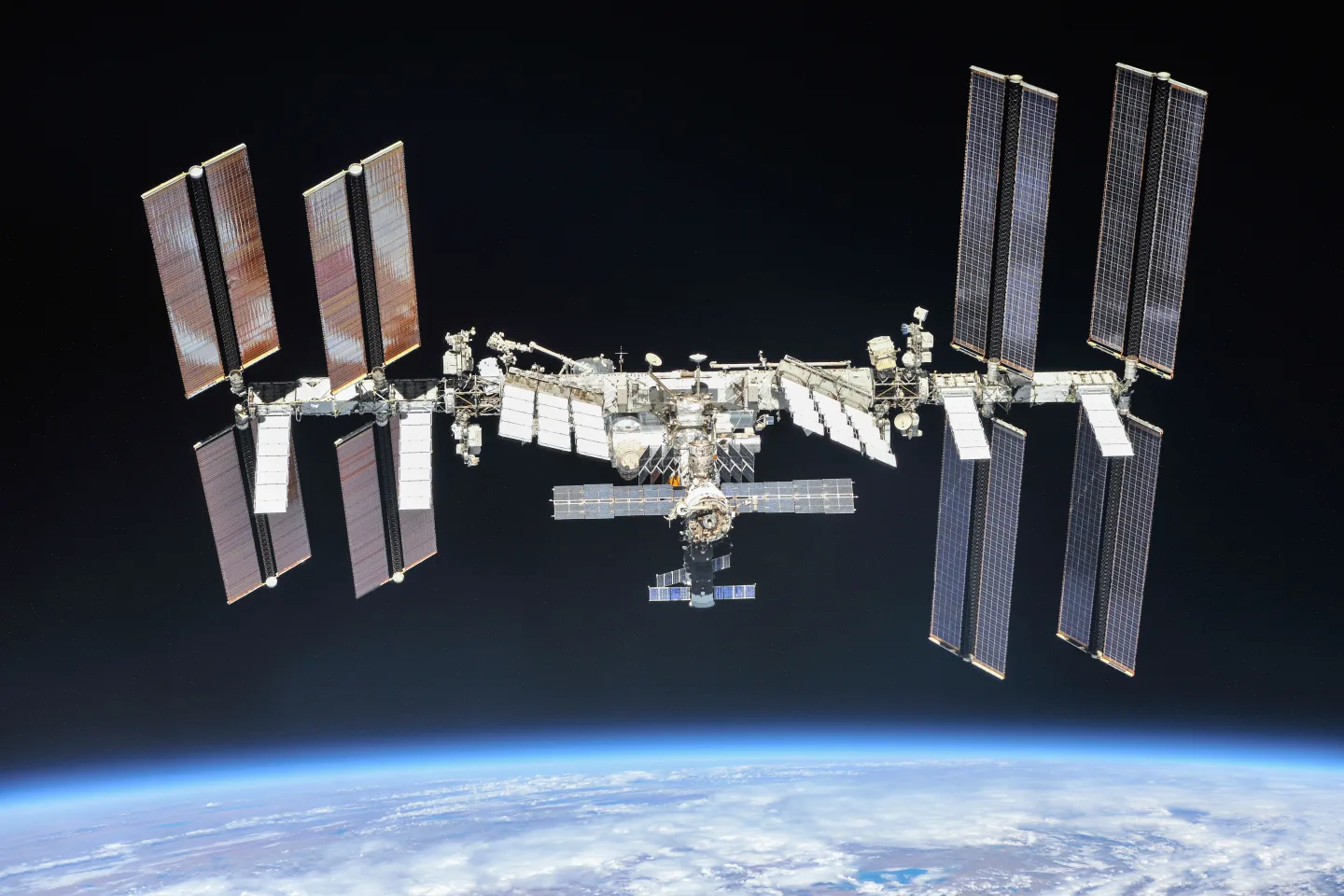
Lesson 1 · 8 cardsWikimedia Commons · NASA/Roscosmos · Public domain ↗A Mirror, Not a Lamp
The International Space Station is visible for the same reason the Moon is: it reflects sunlight. You see it only while it is still sunlit and you are already in darkness, so a pass can end mid-sky as it slides into Earth's shadow. Nothing has switched off; it has run out of daylight.
 FlashFeed original diagram · CC-BY-4.0
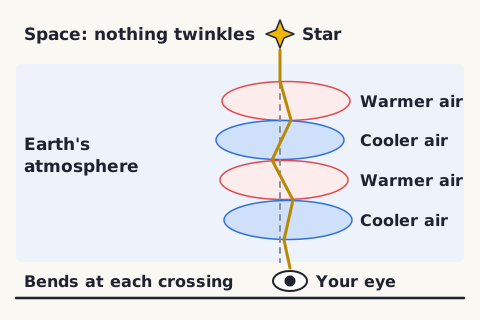
The Flicker Is Our Air
Scintillation — twinkling — happens entirely in Earth's atmosphere. A ray of starlight bends slightly each time it crosses between warmer and cooler pockets of air; the pockets keep moving, and the narrow beam wanders in and out of your eye. Seen from space, nothing twinkles. The flicker is a measurement of our own air, not of the star.
 Wikimedia Commons · NASA/STSCI (S.T.A.R.S) · Public domain ↗
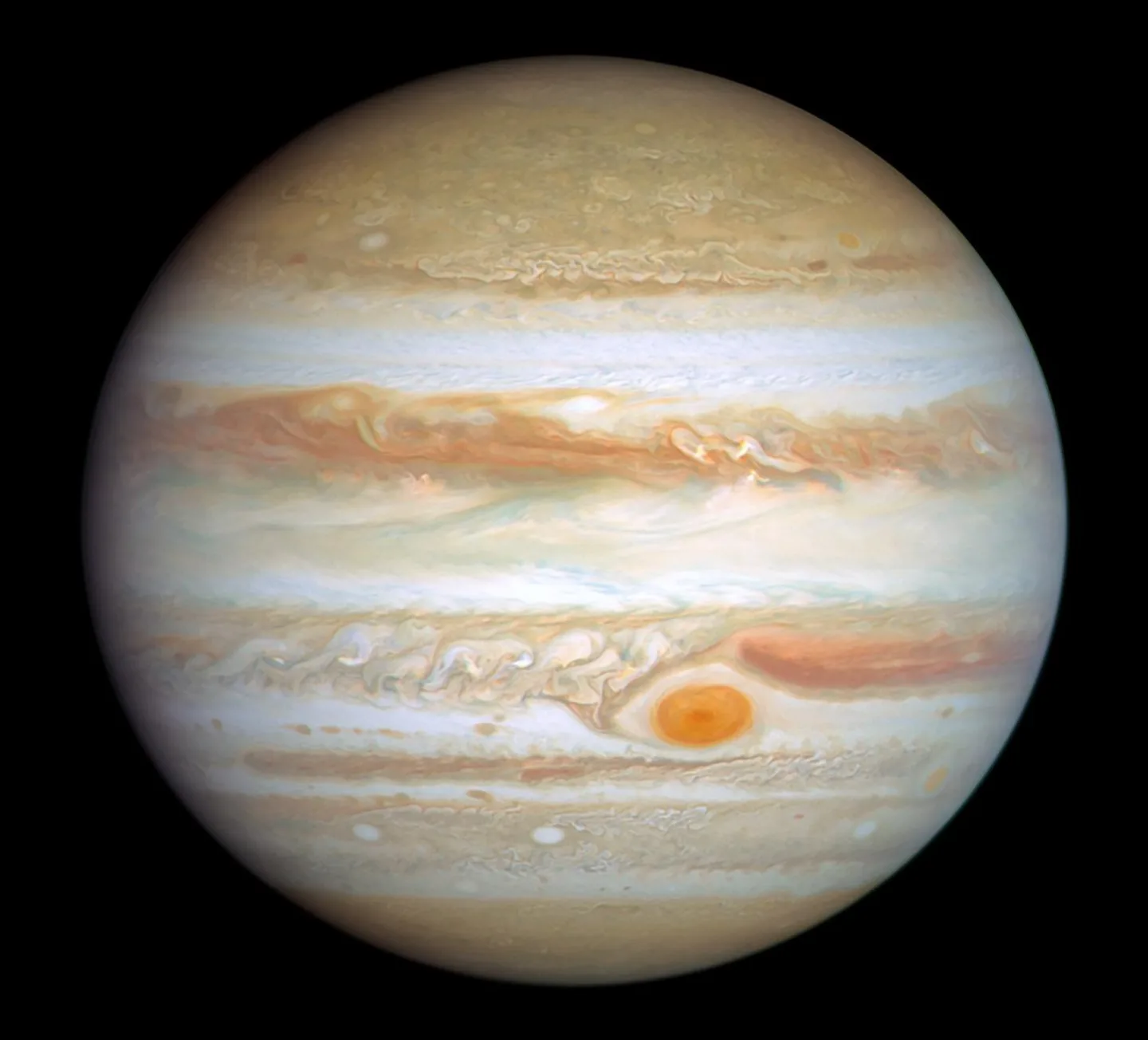
Why a Disc Holds Steady
A planet is close enough to be a real disc: the naked-eye planets span roughly 10 to 50 arcseconds. Light from one edge is bent one way while light from the other edge is bent the other way at the same instant, so the wobbles average out before the light reaches you. Many independent paths cannot all dim at once.
 Skatebiker · CC BY-SA 4.0 ↗
A Disc You Cannot See
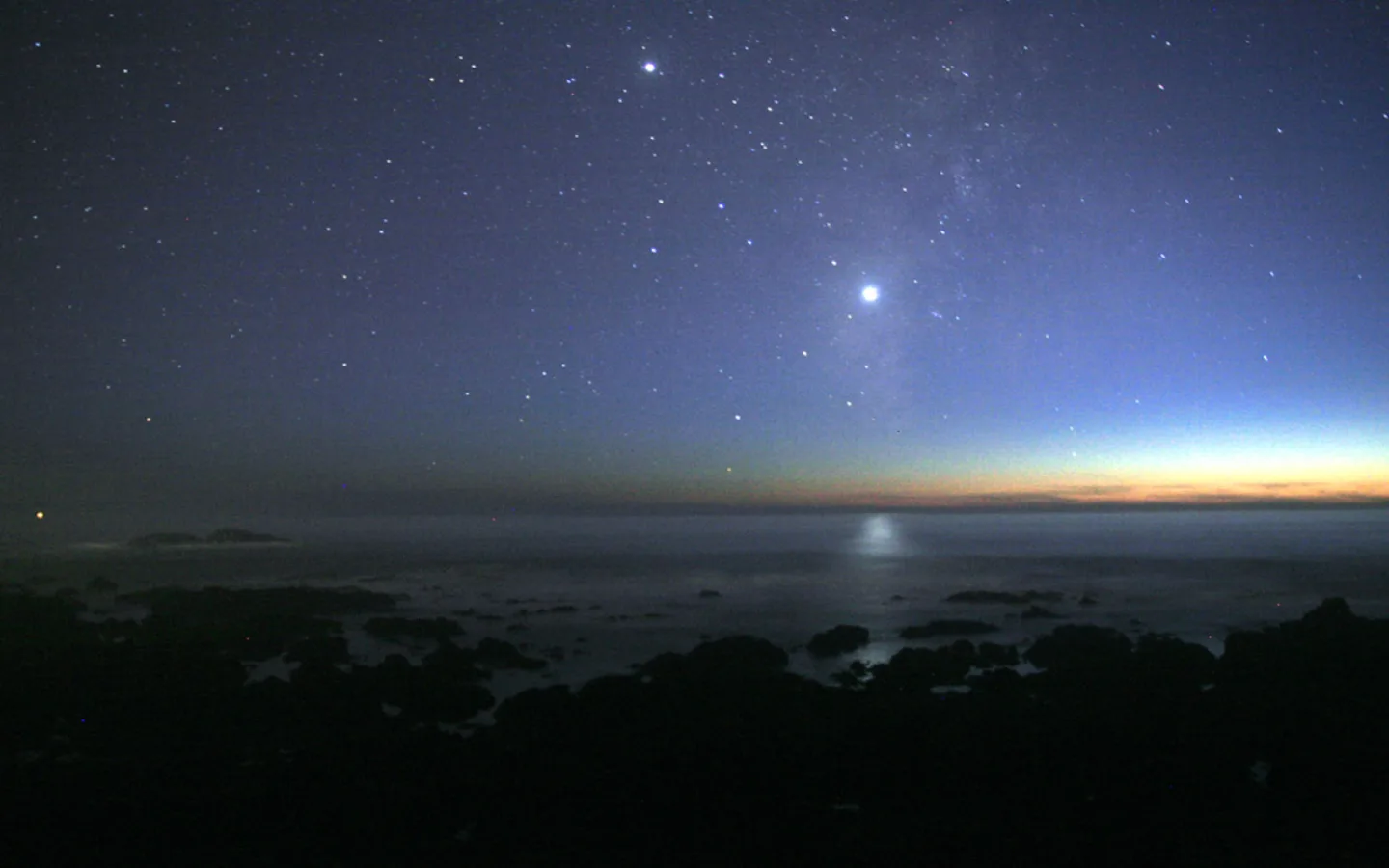
Your eye separates detail only about one arcminute — 60 arcseconds — apart, so a planet's 10-to-50-arcsecond disc is still a dot to you. For scale, the Moon and the Sun are each about half a degree across: 30 arcminutes, or 1,800 arcseconds. The averaging that stops the twinkle happens in the light before it arrives, not in your eye.
 Brocken Inaglory · CC BY-SA 3.0 ↗
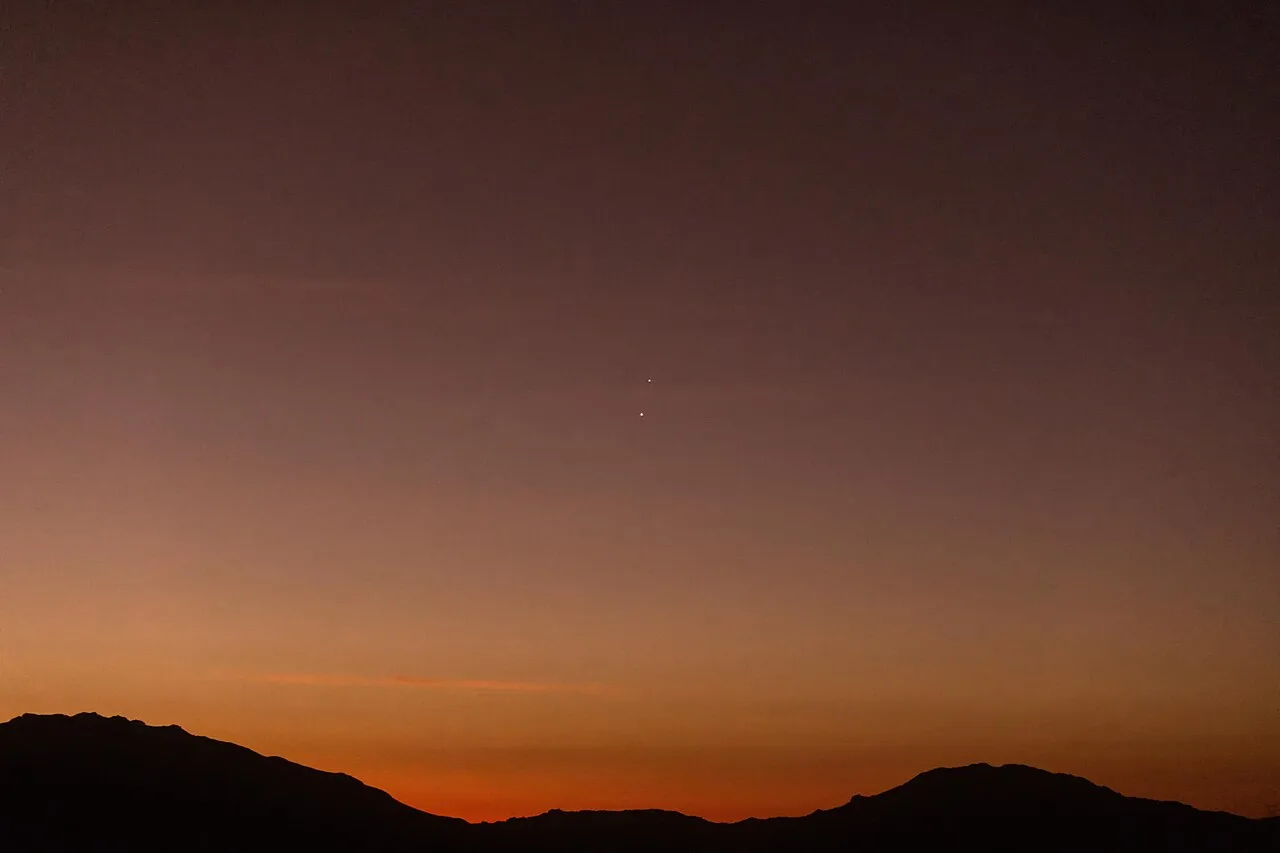
The Rule's Horizon Exception
Looking low in the sky means looking through more air: the airmass is 1 straight up and 2 at sixty degrees from vertical. A long enough path overwhelms the averaging a small disc gives you, so a planet near the horizon can twinkle — Venus low in the west often scintillates violently. Bright stars down there flash colors too, as the long air path splits their light like a prism.
 Pexels · Achraf Alan · Pexels License ↗
Over in a Second
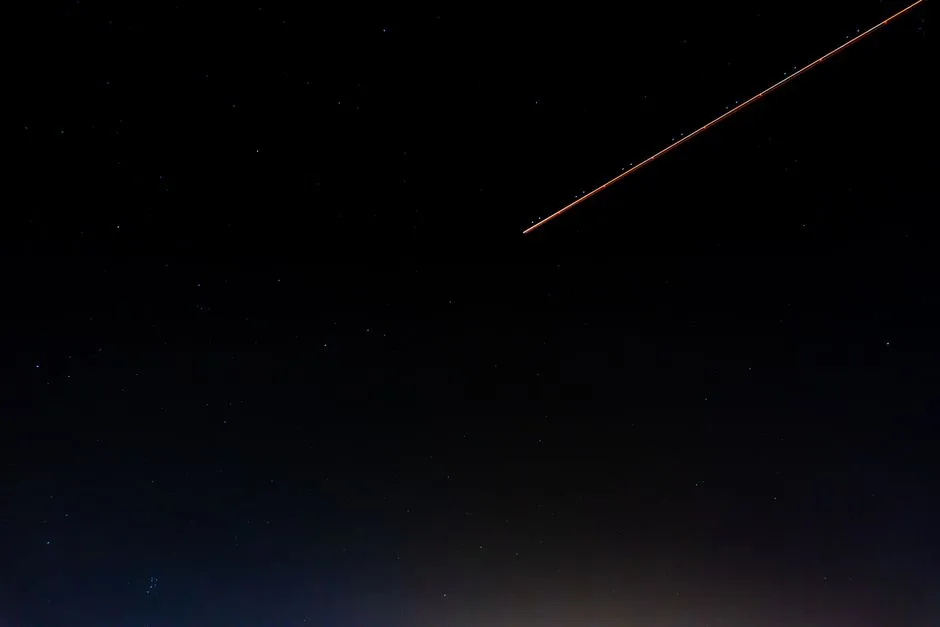
A meteor is a grain of dust or a small rock meeting the atmosphere at between 11 and 72 kilometers per second, burning about 80 to 120 kilometers up. It is over in a few seconds — usually less — and that duration is what separates it from every other moving light. Most shooting stars are sand-grain debris that burns away entirely; only a rare, larger one drops anything to the ground.
 International Gemini Observatory/NOIRLab/NSF/AURA/J. Warner (Openverse) · by 4.0 ↗
Forty Thousand Tracked Objects
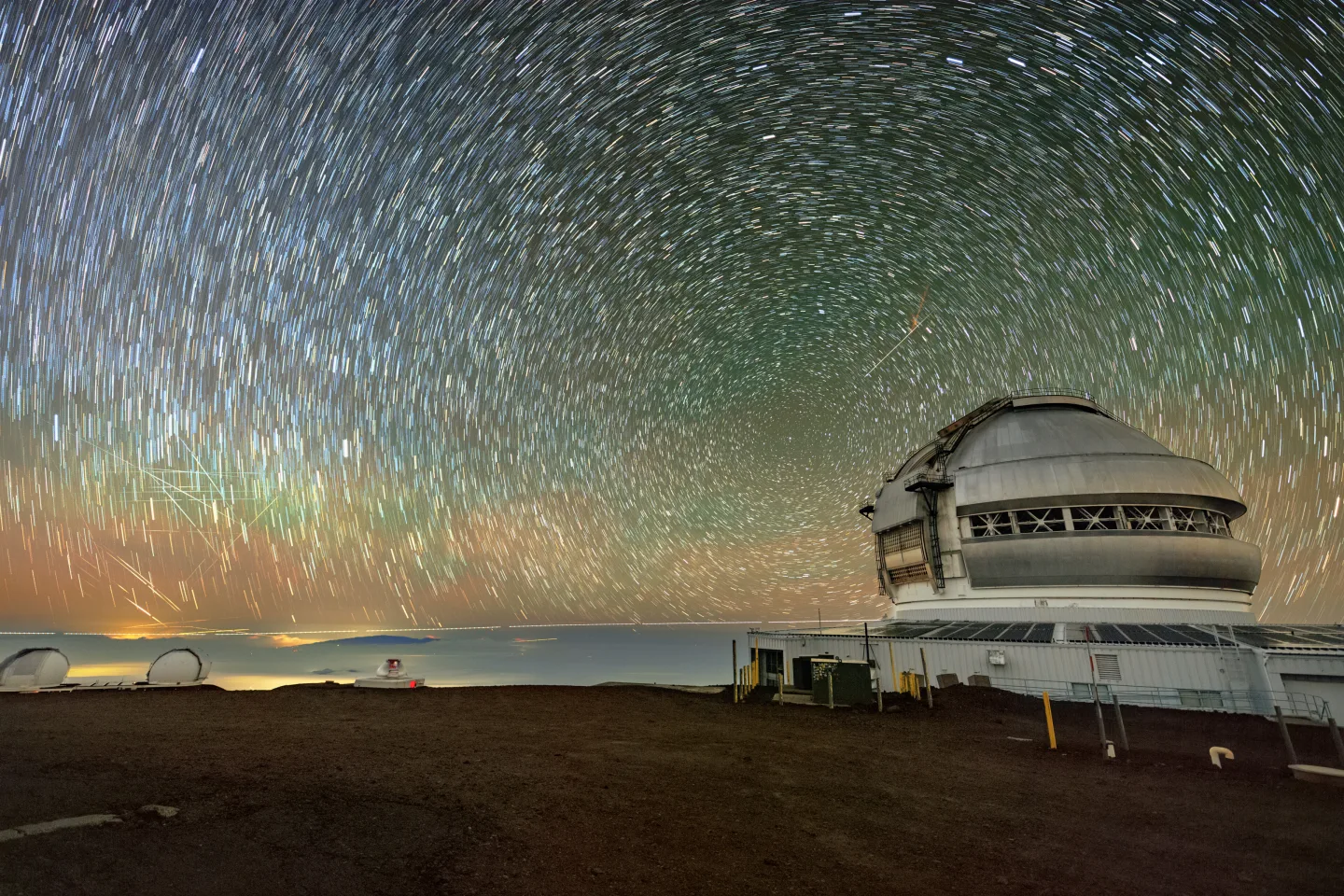
Space surveillance networks track about 40,000 objects in Earth orbit, of which roughly 11,000 are working payloads. Seeing several moving points in an hour is no longer unusual — under a dark sky it is the normal experience. The count keeps climbing, so treat these figures as dated rather than fixed.
 Pexels · Stunning long-exposure capture of star trails illuminating the night sky over a colorful horizon. ↗
One Line, One Daily Turn
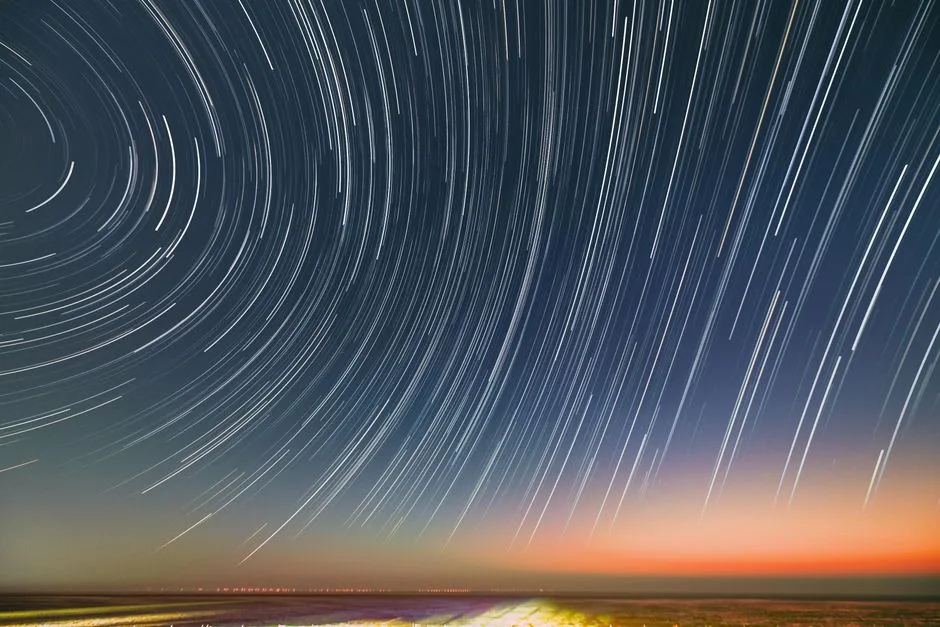
The whole sky drifts east to west at about 15 degrees an hour — 360 degrees in 24 hours — and that is Earth turning, not the sky. The Sun traces a path called the ecliptic: the plane of Earth's orbit, tilted 23.4 degrees to the celestial equator. The planets orbit near that plane, and the Moon's orbit is tipped only about 5 degrees, so they all appear along one broad line.
1 / 8Why does one light in the night sky flicker while another holds steady?
A point sends one narrow beam, which moving air bends in and out of your eye; a disc sends many, and they cannot all dim at once. Burning versus reflecting is a real difference but not this one. Brighter and hotter change nothing: a faint planet still holds steady.
Lesson 1 has 35 cards. Keep going in the free app.
Question
Why Stars Twinkle 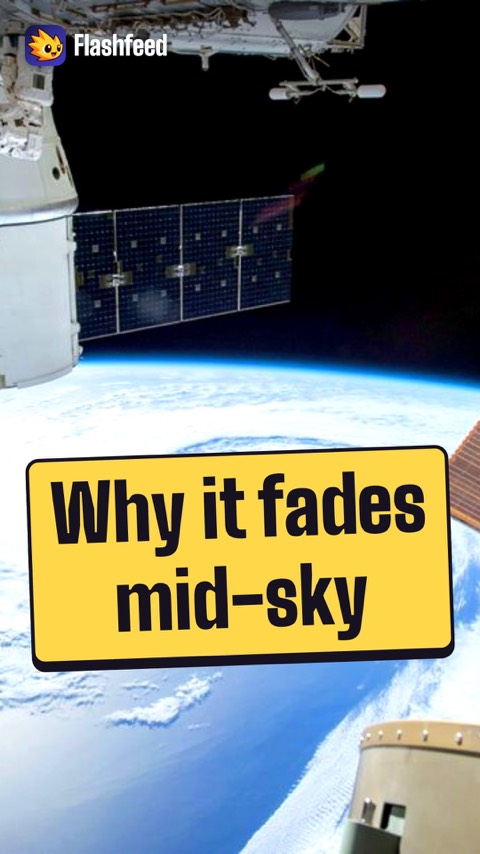
The Station That Fades Mid-Sky 
Brighter Means Smaller All 26 clips on YouTube ↗Transcripts
Why Stars Twinkle
Stars twinkle. Planets mostly don't. The twinkling happens in Earth's air, not in the star.
Warm and cool pockets of air bend starlight differently, so the beam wanders on its way down.
A star is so far away that it's only a point. Even the nearest one is 4.25 light-years away. A planet is close enough to be a tiny disc.
Light from each edge of that disc flickers differently, and the flickers average out.
The Station That Fades Mid-Sky
A steady light crosses the sky in a straight line. It takes a couple of minutes. That's a satellite.
The brightest is the International Space Station. It orbits about 400 km up, at roughly 28,000 km/h. It circles the Earth in about 90 minutes.
You see it because it reflects sunlight. So a pass often ends with the station fading out mid-sky.
Nothing has switched off. It has simply run out of daylight.
Brighter Means Smaller
Astronomers rate brightness on a scale that runs backwards. The smaller the number, the brighter the object.
Sirius, the brightest night star, is −1.46. The full Moon is −12.6. The Sun is −26.7.
The scale is also logarithmic. Five magnitudes is a factor of exactly 100 in brightness.
Under a dark sky, your eye reaches about +6. That's only a few thousand stars in view.
-
 Pexels · Zelch Csaba · Pexels License ↗02
The Earth, Moon and Sun
Why the Moon Has Phases · Why Eclipses Are Rare · Seasons and Tides
Lesson 2 · 10 cardsPexels · Zelch Csaba · Pexels License ↗The Shadow's Narrow Strip
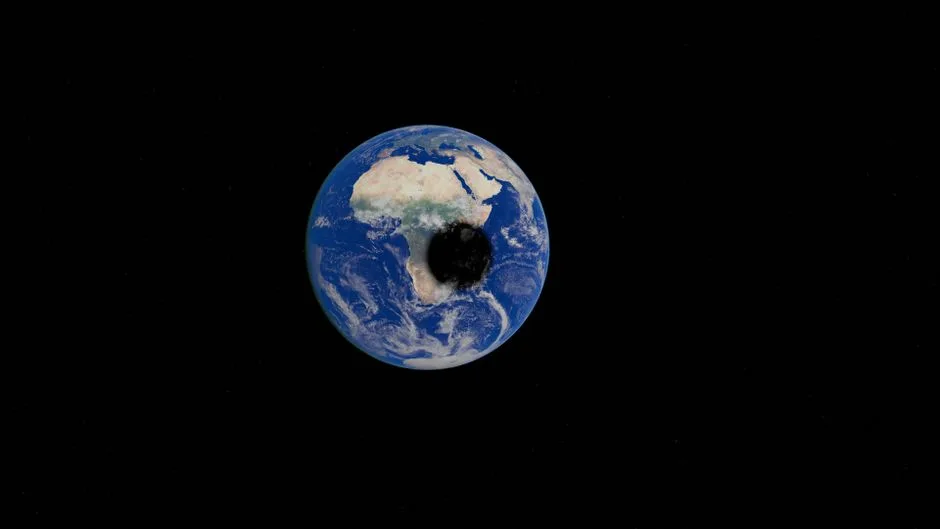
A shadow has two parts: an umbra, where the light is completely blocked, and a penumbra, where it is only partly blocked. In a solar eclipse the umbra lands on Earth as a narrow strip — the path of totality. Stand inside it and the eclipse is total; stand anywhere in the surrounding penumbra and it is partial. Totality is geography, not luck.
 FlashFeed original diagram · CC-BY-4.0
Half Lit, Always
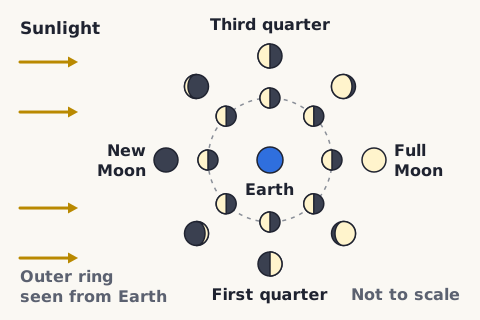
The Sun lights exactly half the Moon at every moment — one hemisphere in daylight, one in darkness, no exceptions. A phase is simply how much of that permanently lit half is turned toward you. Earth's shadow has nothing to do with it: the shadow reaches the Moon only during a lunar eclipse, and those do not happen every month. Phases do.
 FlashFeed original diagram · CC-BY-4.0
Two Months, One Orbit
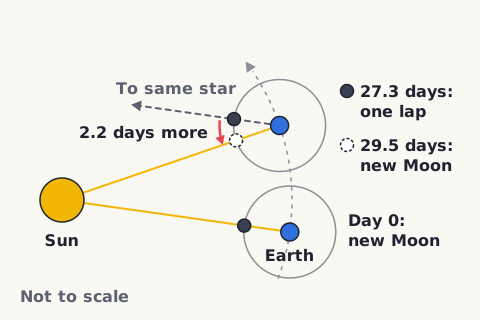
One lap of the Moon against the background stars takes 27.322 days — the sidereal month, its true orbital period. New Moon to new Moon takes 29.530589 days, about 2.2 days longer. Phases are measured against the Sun, and Earth carries the Moon along its own orbit meanwhile, so after one full lap the Moon still has further to travel before it lines up with the Sun again.
 Wikimedia Commons · NASA · Public domain ↗
The Far Side Is Sunlit
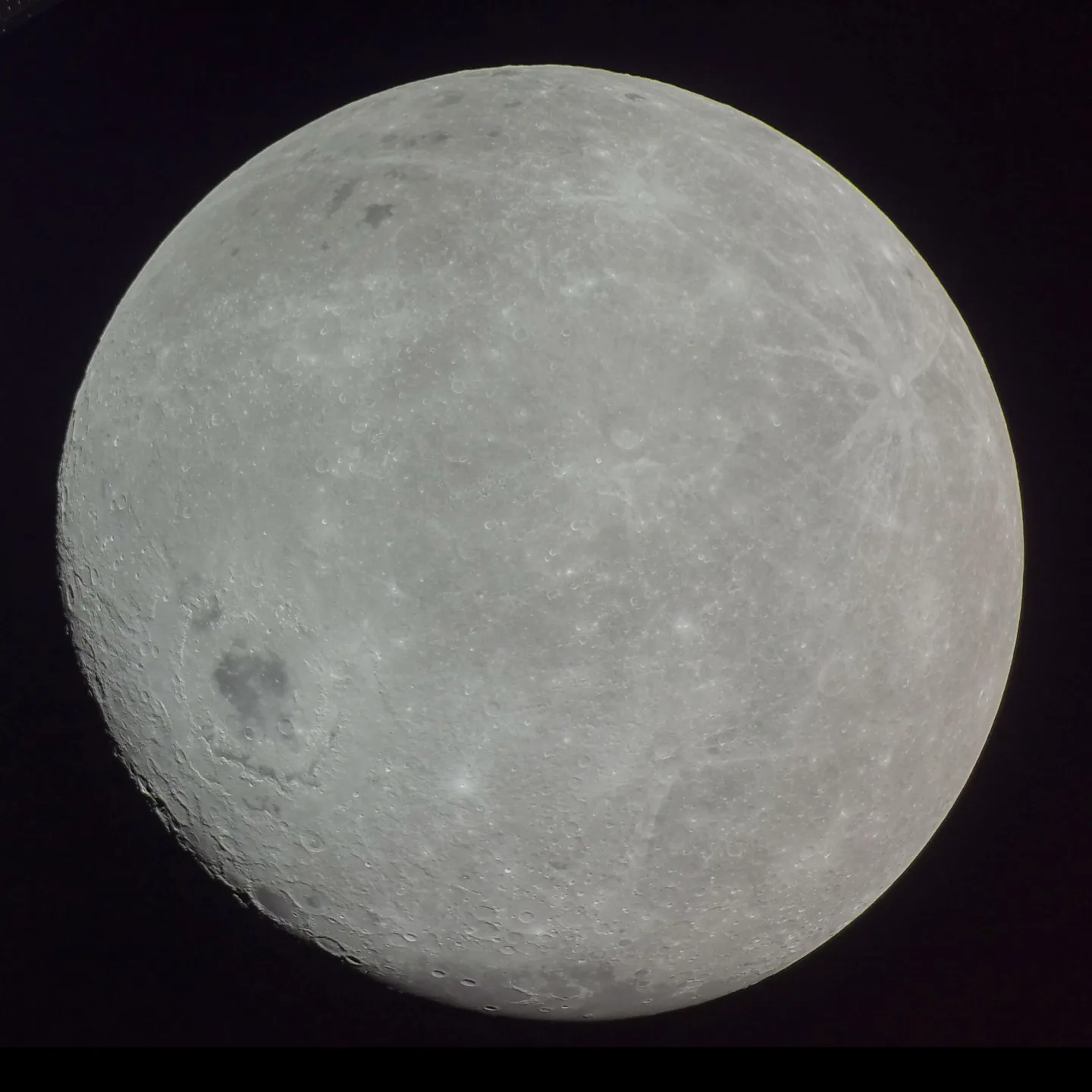
The Moon is tidally locked: it turns once on its axis for every orbit of Earth, which is exactly why the same face stays pointed at us. It is rotating, not frozen. And the far side is not a dark side — it gets as much sunlight as the near side does. We simply never see it from here.
 Pexels · Stunning image of total solar eclipse showing the sun's corona against a dark sky. ↗
Totality Never Lasts
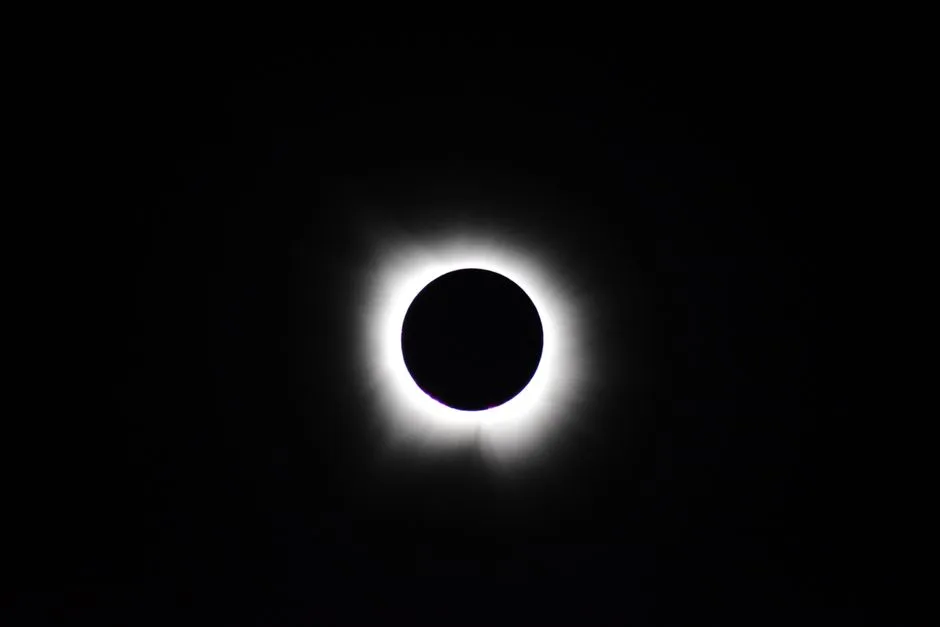
A total solar eclipse gives between about 10 seconds and 7.5 minutes of totality, and no more. The umbra sweeps across the ground at more than a thousand kilometers an hour, so no single spot stays inside it for long. The partial phases either side of it last hours; totality does not. Totality is the one and only phase that is safe to watch unfiltered — the moment the bright disc returns, the filter must be back on.
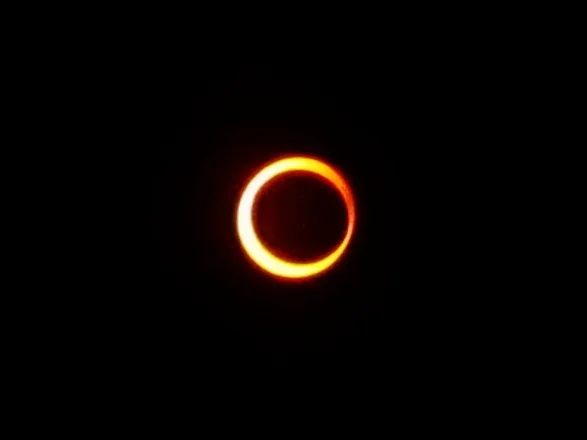 Ken Lund from Reno, Nevada, USA · CC BY-SA 2.0 ↗
Four Hundred by Four Hundred
The Sun's diameter is about 400 times the Moon's — and the Sun happens to sit about 400 times farther away. The two ratios cancel, so the discs look almost exactly the same size from Earth, which is why totality lasts minutes rather than hours, and why a Moon near apogee leaves a ring instead. Nothing in physics requires the match.
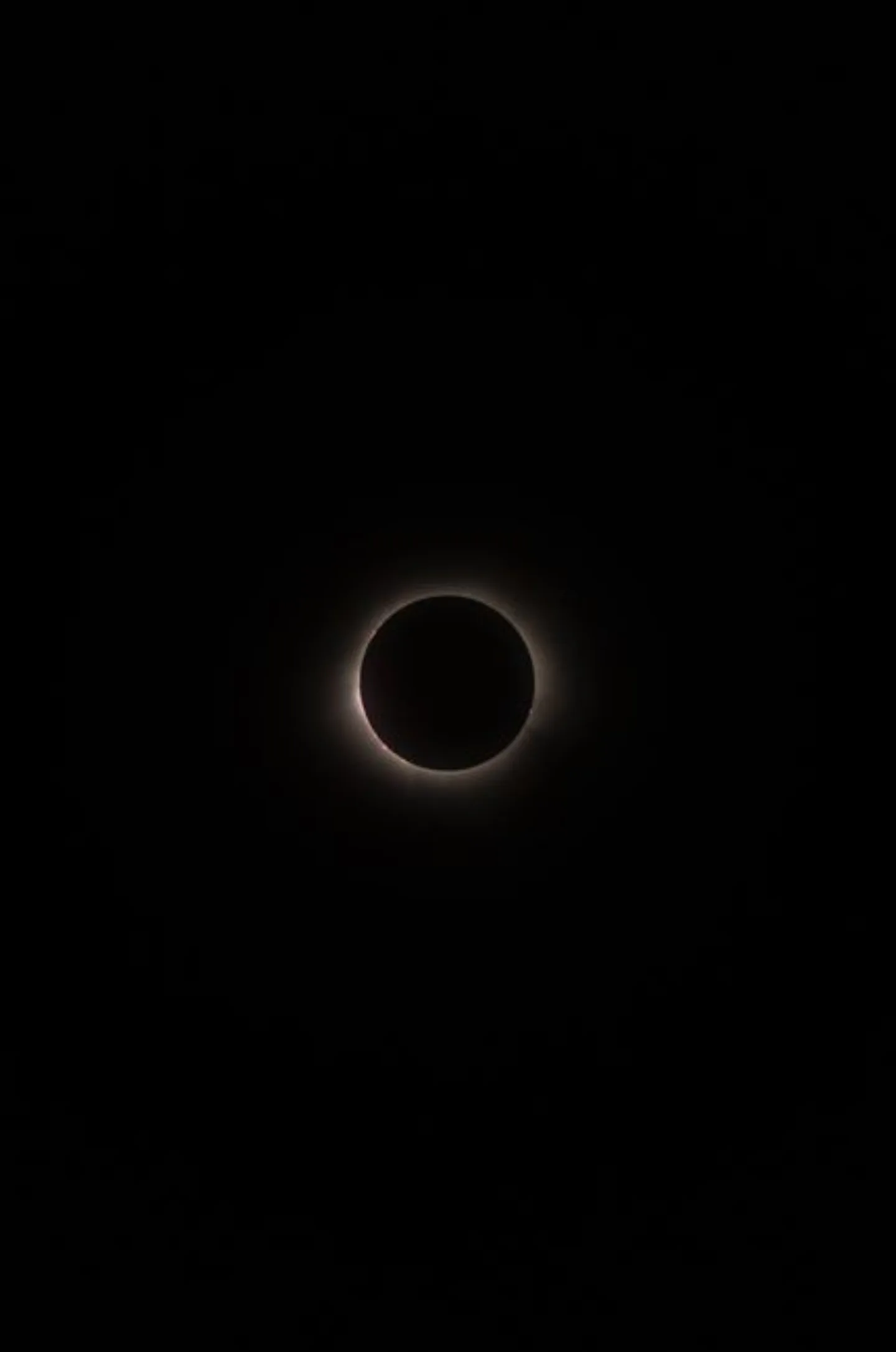 Pexels · Dramatic total solar eclipse with visible corona against a dark sky. ↗
Predicted Without Computers
Two lunar clocks run at slightly different speeds: the synodic month of 29.530589 days, and the draconic month — node to node — of 27.212221 days. They come back into step after 223 synodic months, which is also 242 draconic months: the saros, about 6,585.3 days, or 18 years, 11 days and 8 hours. Those extra 8 hours turn Earth a further 120 degrees, so each repeat lands a third of the way around the planet.
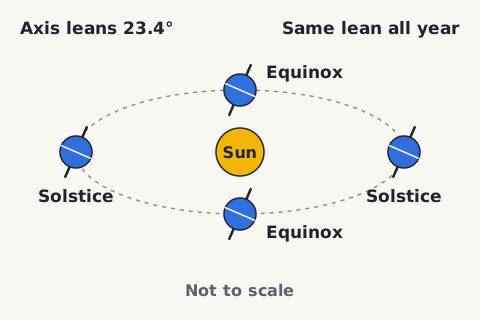 FlashFeed original diagram · CC-BY-4.0
Sunlight at an Angle
Seasons come from axial tilt: Earth's rotation axis leans 23.4 degrees away from the perpendicular to its orbital plane. That lean changes the angle at which sunlight strikes the ground and the length of the day, concentrating the same sunlight into a smaller area or spreading it thin. Its extremes are the solstices, the longest and shortest days — the extreme of sunlight, not of heat, which lags by weeks.
1 / 10At first quarter, how much of the Moon's visible face is lit?
The name counts the orbit, not the disc: one quarter of the cycle is complete while exactly half the face is lit. A quarter-lit face and a three-quarter-lit face are the crescent and gibbous phases, and a fully lit face is the full Moon.
Lesson 2 has 33 cards. Keep going in the free app.
Question
It's Not Earth's Shadow 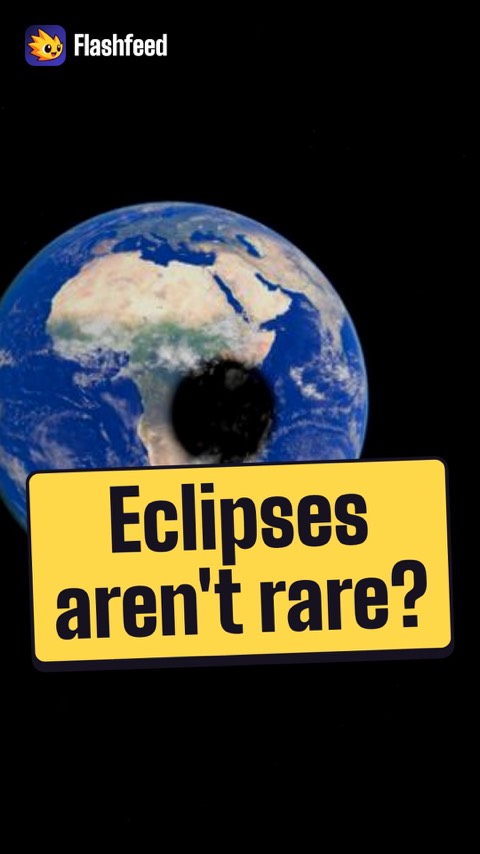
Totality Is Geography 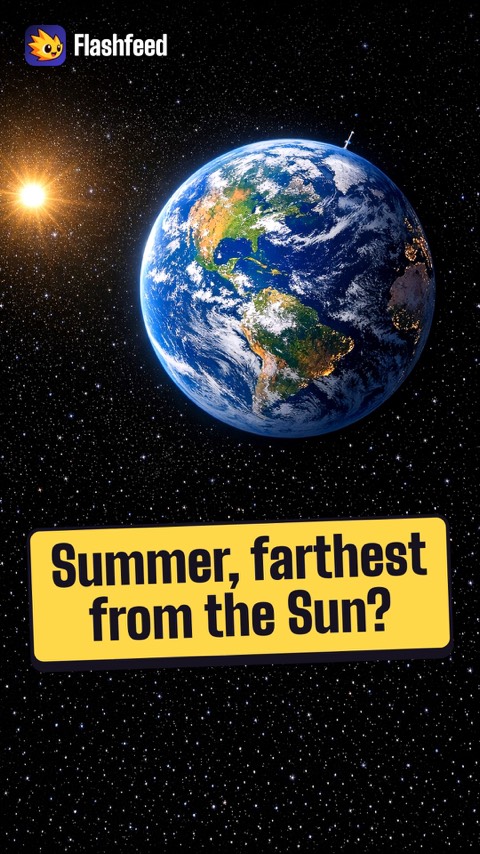
Summer, Farthest from the Sun All 26 clips on YouTube ↗Transcripts
It's Not Earth's Shadow
Many people think the Moon's phases come from Earth's shadow. But that shadow touches the Moon only during a lunar eclipse. Phases happen every month.
The Sun always lights exactly half the Moon. A phase is how much of that lit half faces you.
Nothing about the Moon changes during the month. Your line of sight does.
And the far side isn't dark. It gets as much sunlight as the near side.
Totality Is Geography
Eclipses aren't rare: 4 to 7 in a typical year, solar and lunar together. What's rare is standing in the right place.
In a total solar eclipse, the Moon's darkest shadow is a narrow strip: the path of totality.
It sweeps the ground at over 1,000 kilometers an hour, so totality lasts 7.5 minutes at most.
The Sun and Moon look the same size by coincidence. The Sun is about 400 times wider than the Moon, and 400 times farther away.
Summer, Farthest from the Sun
Summer isn't when Earth is closest to the Sun. Earth is farthest from the Sun in early July, in northern summer.
The distance changes by only about 3%. Seasons come from Earth's tilt: 23.4°.
The tilt changes the angle of sunlight, and the length of the day.
Tides have a twist too. The Moon raises two bulges: one toward it, and one on the far side. So coasts get two high tides every 24 h 50 min.
-
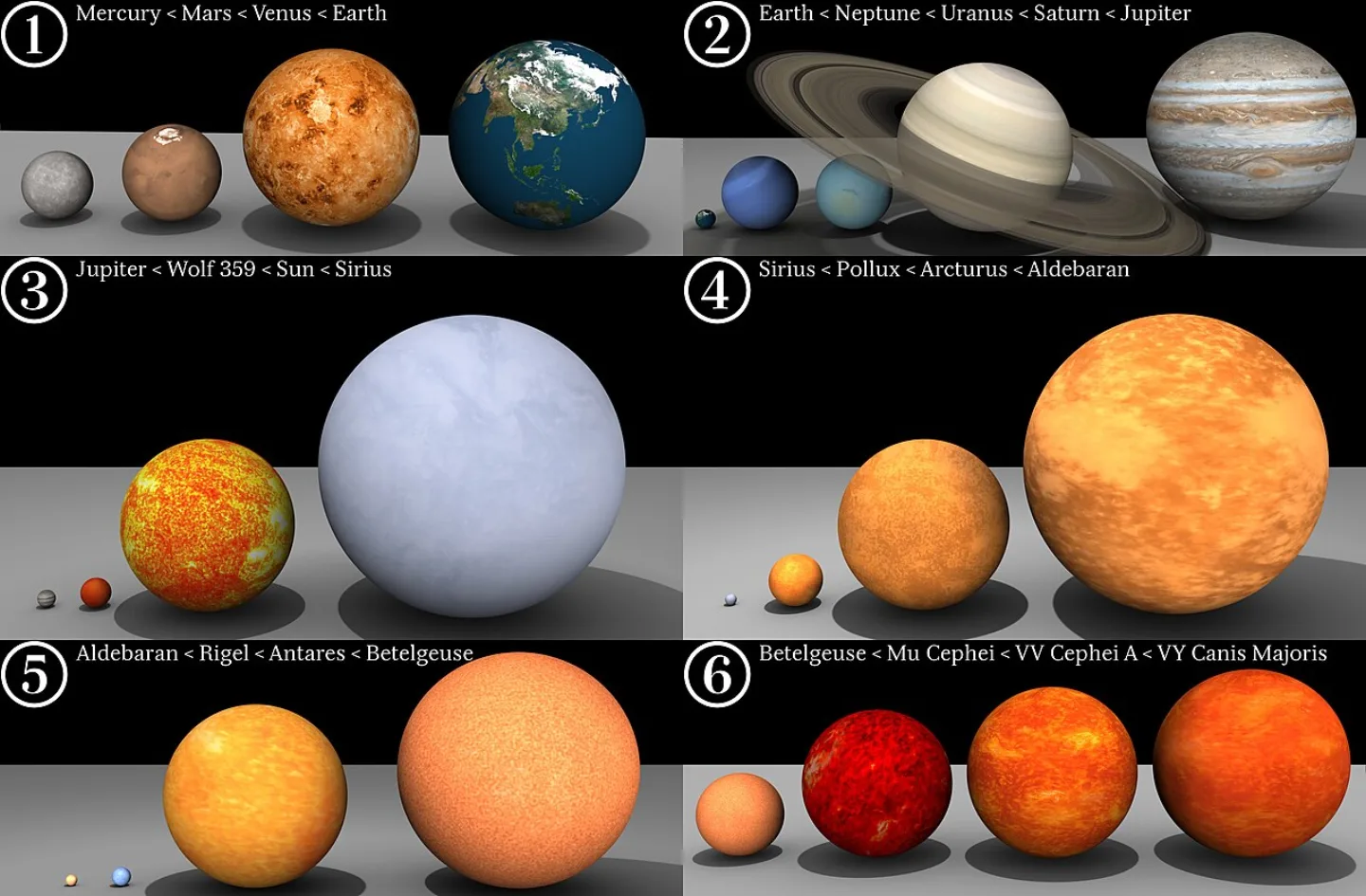 Wikimedia Commons · Jcpag2012 and Dave Jarvis · CC BY-SA 4.0 ↗03
The Sun
Inside the Sun · The Sun's Weather · Reach and Consequence
Lesson 3 · 10 cardsWikimedia Commons · Jcpag2012 and Dave Jarvis · CC BY-SA 4.0 ↗Ten Jupiters Across
The Sun is about 1.4 million kilometers wide — 109 Earths laid side by side, and roughly ten times wider than Jupiter. It would take about 330,000 Earths to match its mass. The Sun is not a big planet; it is a different category of object, and its size is the first evidence.
 Unsplash · Foto Micha · Unsplash License ↗
Not a Fire, a Standoff
A star is not burning. Combustion is chemistry, and no chemical reaction could run the Sun for billions of years — it runs on nuclear fusion. Nor is it an explosion: the outward pressure of that fusion balances the inward pull of its own gravity almost exactly. That standoff is hydrostatic equilibrium, and it is what holds a main sequence star steady. Every later stage of a star's life is the balance being lost.
 FlashFeed original diagram · CC-BY-4.0
Fusion Only in the Core
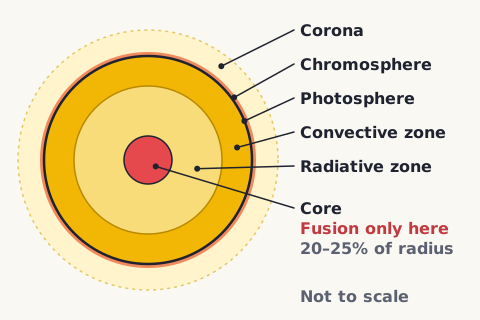
From the middle outward the Sun is layered: core, radiative zone, convective zone, the visible photosphere, then an atmosphere of chromosphere, a thin transition region, and the corona. Fusion happens only in the core — the innermost 20 to 25 percent of the radius. The Sun does not fuse hydrogen throughout its volume; everything outside the core is a delivery system.
 FlashFeed original diagram · CC-BY-4.0
Average, and Half Done
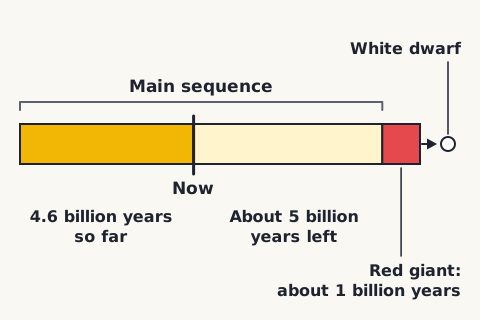
By class the Sun is a G2 V star: photosphere about 5,500 °C, core about 15 million °C, age about 4.6 billion years. It is average for its class and outnumbered by dimmer stars. Roughly 5 billion years of main sequence life remain, then about a billion as a red giant, ending as a white dwarf. Nothing about that is sudden — the Sun cannot go out or explode without warning.
 FlashFeed original diagram · CC-BY-4.0
A 170,000-Year Journey Out
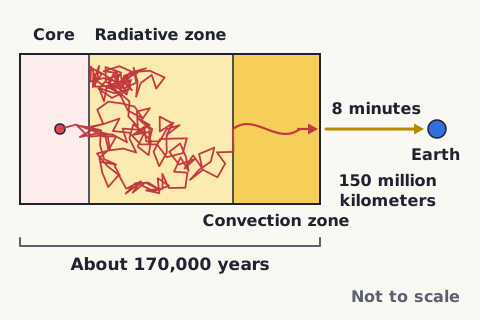
Energy made in the core does not fly straight out. In the radiative zone it is absorbed and re-emitted so many times that reaching the top of the convection zone takes something like 170,000 years — an order-of-magnitude estimate, since published figures vary widely, not a measurement. The light on your face was released before the last ice age ended, and only then crossed the final 150 million kilometers in eight minutes.
 Wikimedia Commons · NSO/NSF/AURA · CC BY 4.0 ↗
A Pot at Rolling Boil
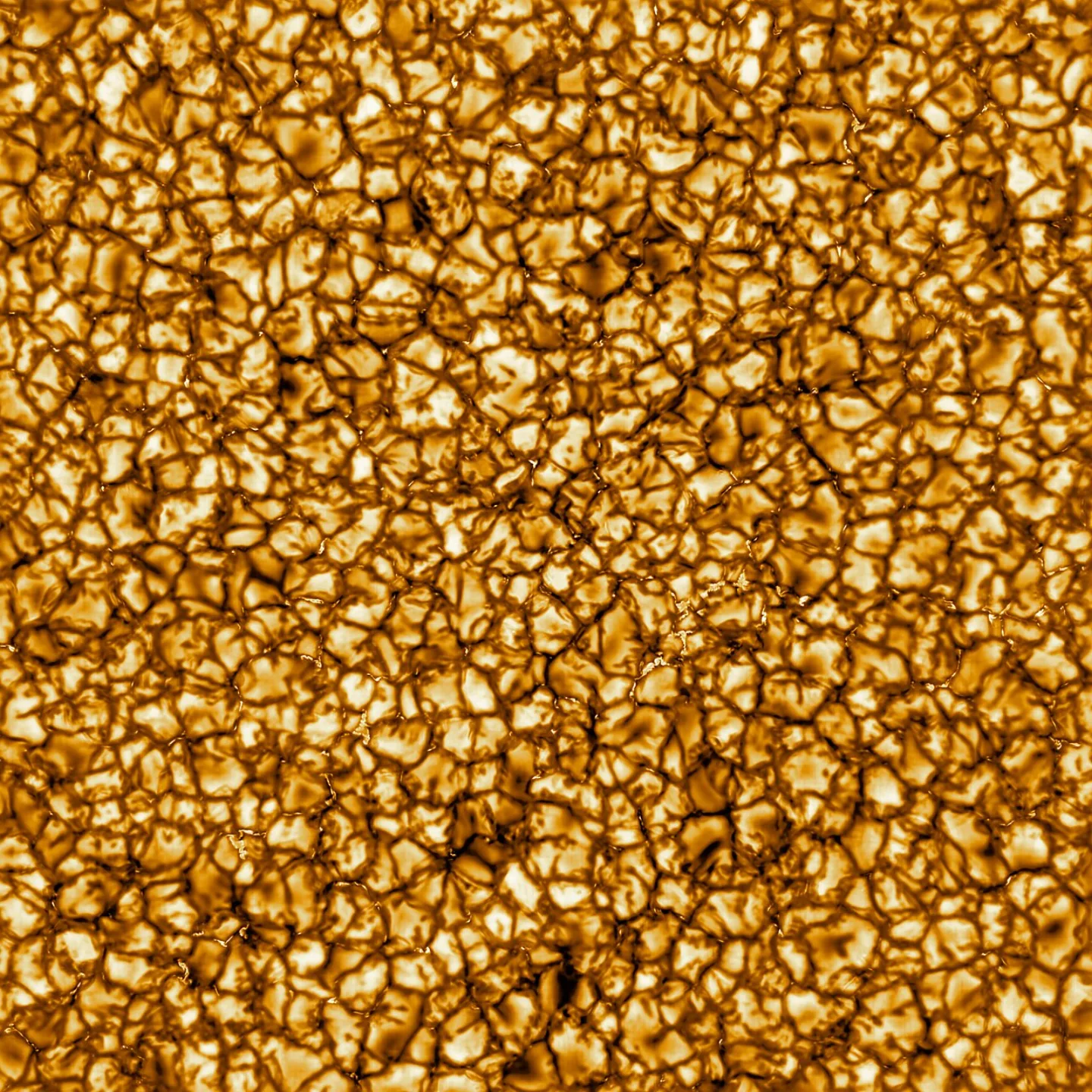
The outer 200,000 kilometers of the solar interior carry heat by boiling rather than by radiation. Granulation is that boil seen from outside: bright cells of rising plasma about 1,500 km across — roughly the width of Texas — each lasting 8 to 20 minutes, with cooler plasma sinking in the dark lanes between them. The Sun's surface is not a still, uniform ball of light.
 NASA's Scientific Visualization Studio - KBR Wyle Services, LLC/Scott Wiessinger · Public domain ↗
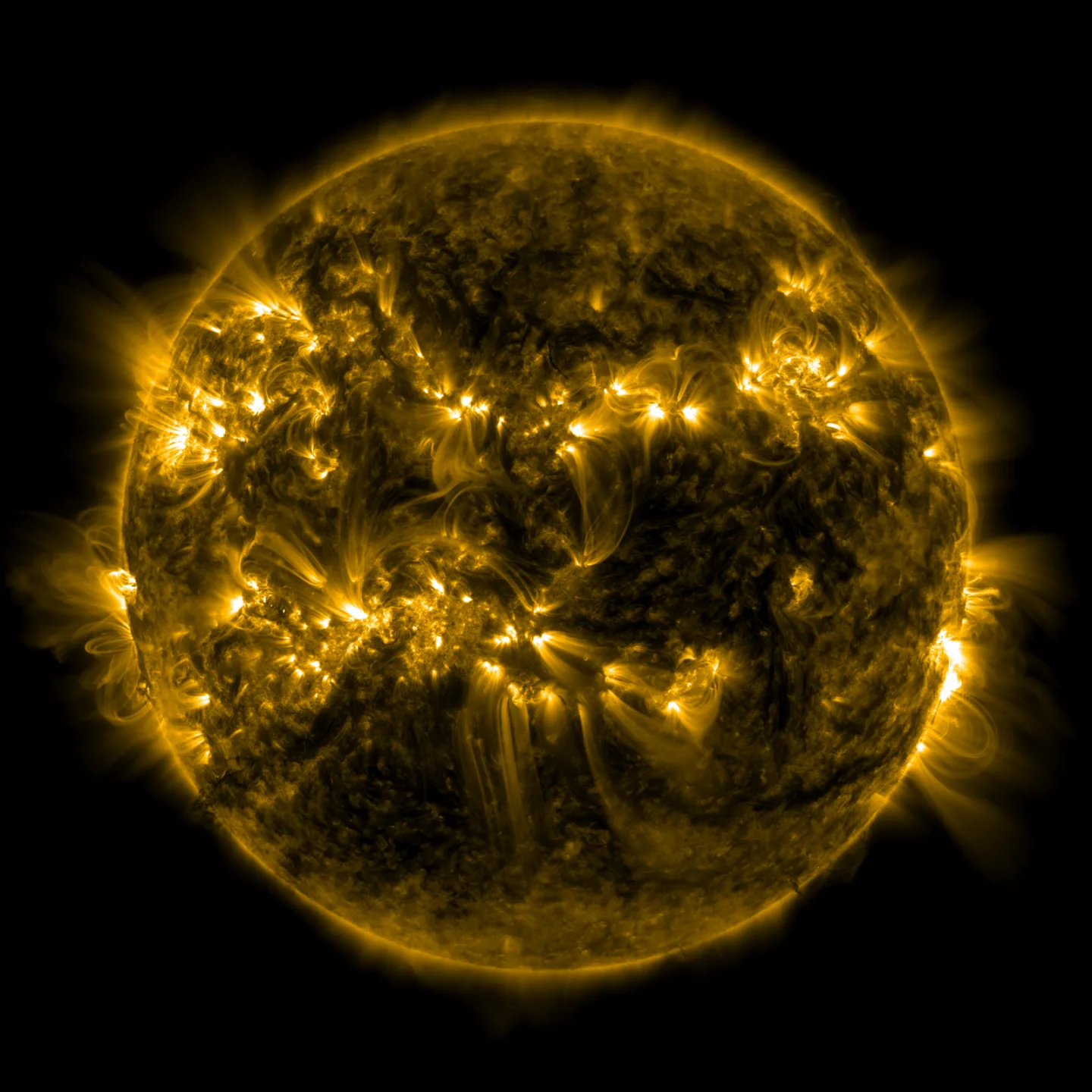
Hotter Farther From the Furnace
Through the chromosphere, only 3,000 to 5,000 km deep, temperature climbs outward from about 6,000 to about 20,000 degrees — NASA's own pages give those numbers in °C on one and K on another. Higher still, NASA puts the corona at up to 2 million °C against a 5,500 °C surface, while ESA quotes around 1 million °C and calls it more than 150 times hotter. Move away from the furnace and it gets hundreds of times hotter. This is the coronal heating problem.
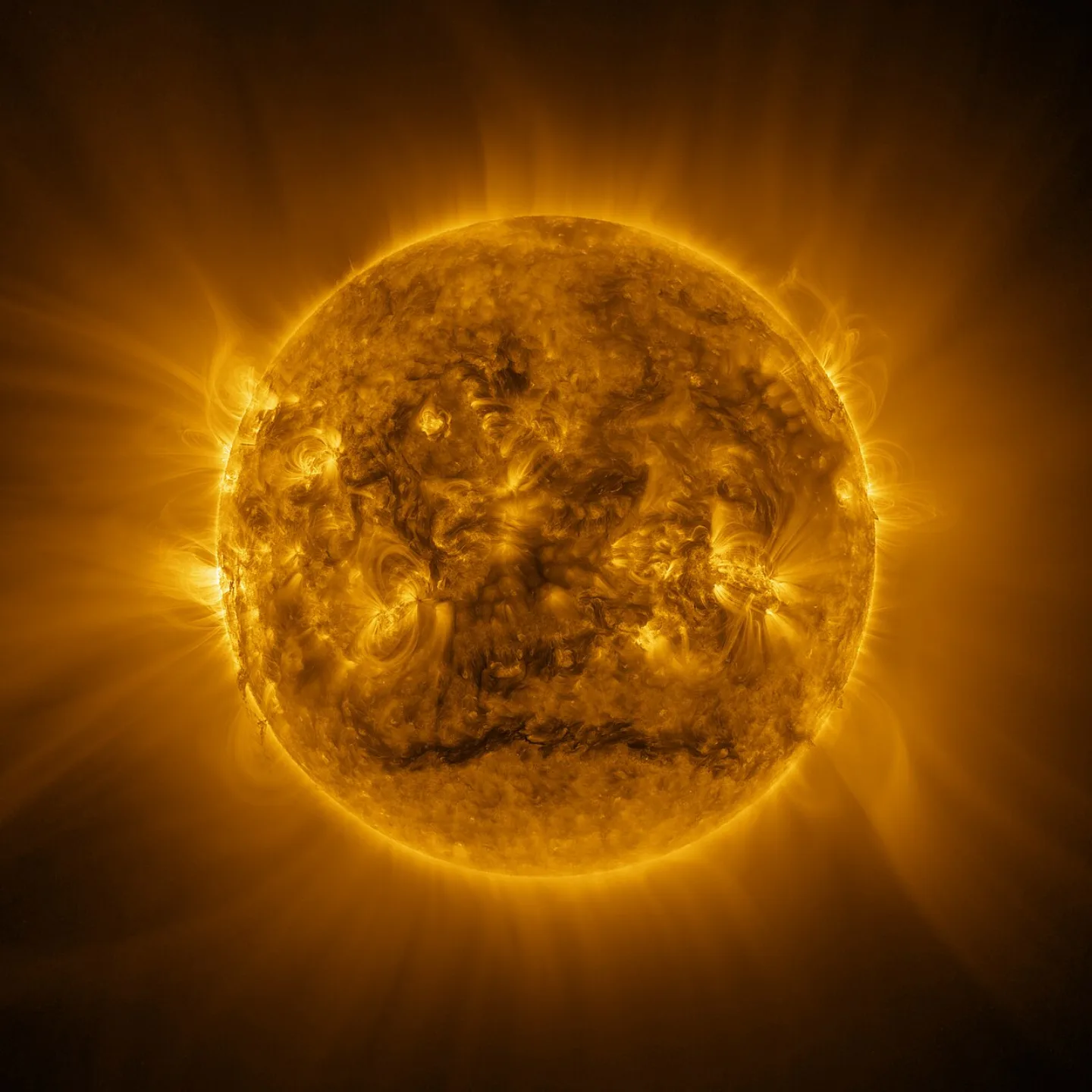 European Space Agency · CC BY-SA 3.0 igo ↗
Two Suspects, No Verdict
The coronal heating problem is unsolved. Two mechanisms lead: Alfvén waves carrying magnetic energy outward from the interior, and nanoflares, small explosive releases of magnetic energy across the surface — with turbulence a related candidate ESA's Solar Orbiter is testing. Neither is settled and both may operate together. Recent missions narrowed the options rather than closing the question.
 Pexels · Jay Brand · Pexels License ↗
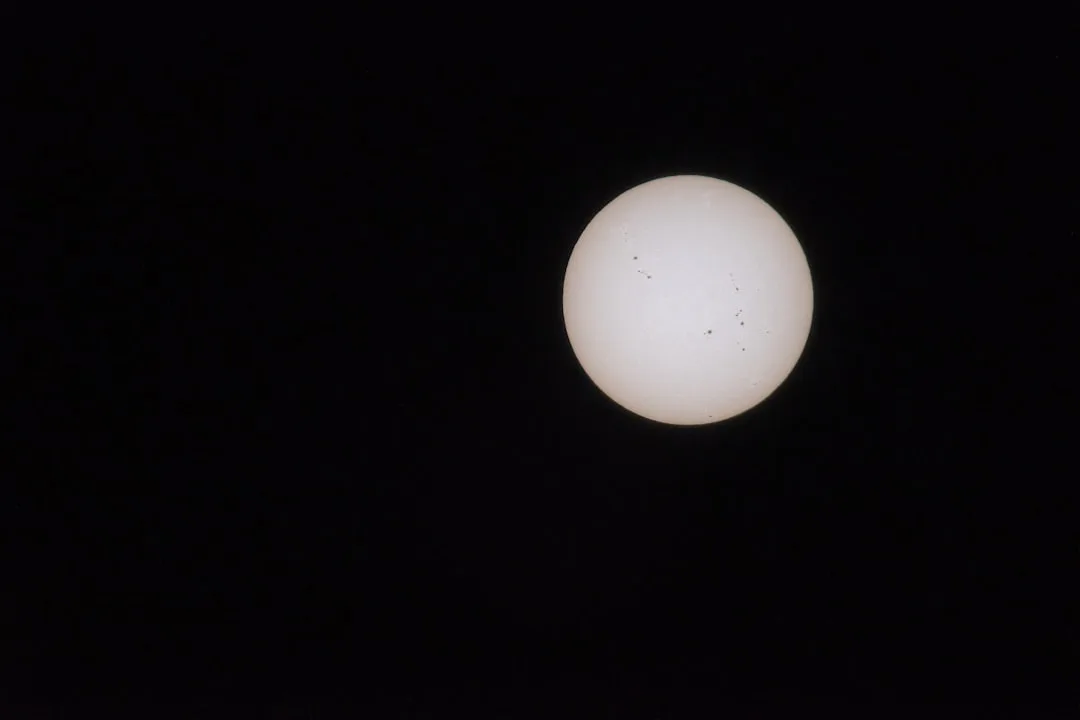
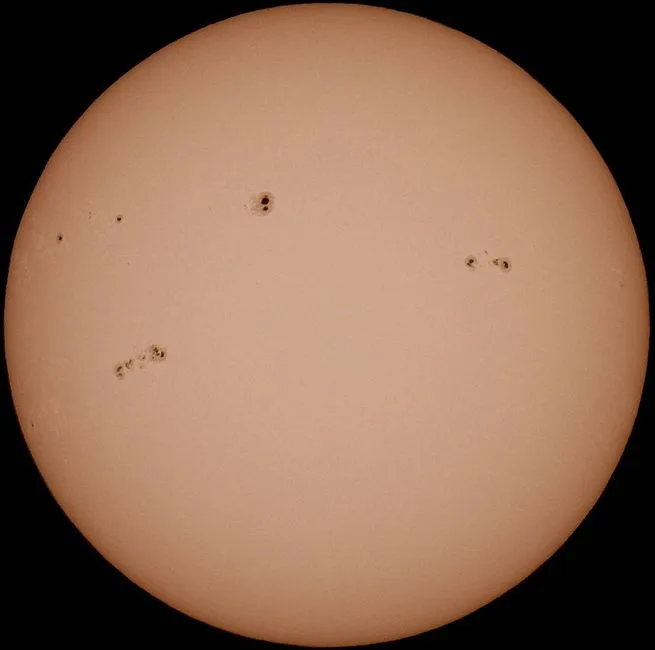
The Decades Spots Vanished
Between about 1645 and 1715 sunspots nearly disappeared — the Maunder Minimum. Fewer than 50 were recorded in the 28 years from 1672 to 1699, against the 40,000 to 50,000 a comparable modern span would show. It fell inside the Little Ice Age, but the cooling had begun earlier and volcanism is thought the main cause, so that link is not settled. The 11-year cycle is a habit, not a law.
 SOHO (ESA & NASA) · Public domain ↗
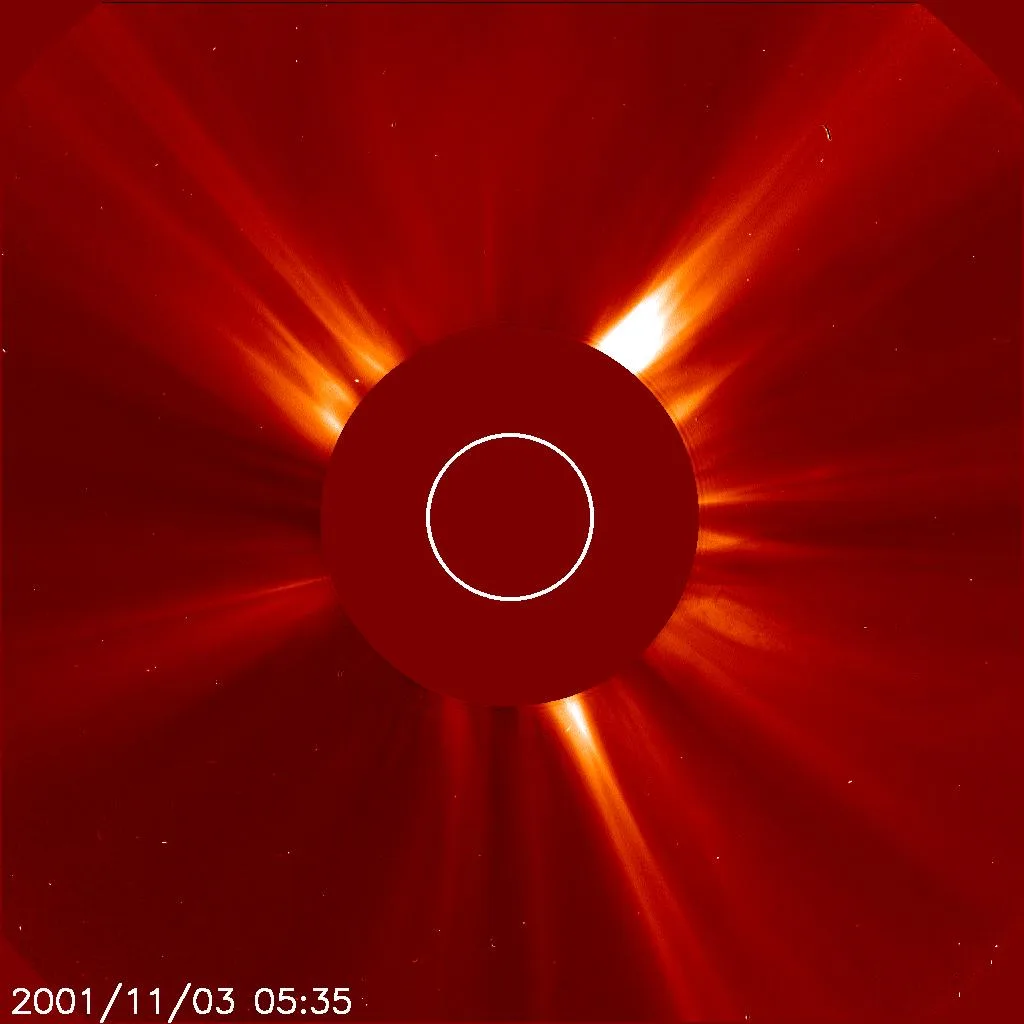
Space Is Not Empty
The Sun is not sealed. Its corona escapes continuously as the solar wind, a plasma of protons and electrons. A slow stream of roughly 300 to 500 km/s comes from coronal streamers near the equator; a fast stream of roughly 500 to 800 km/s pours out of coronal holes, where the magnetic field opens to interplanetary space. Earth sits inside that outflow permanently, not only during storms.
1 / 10What holds a main sequence star up against its own gravity?
Combustion is chemistry — no chemical reaction could run a star for billions of years. Rotation does not support a star, and the Sun has no solid core: it is plasma throughout. Steadiness comes from fusion pressure balancing gravity almost exactly.
Lesson 3 has 34 cards. Keep going in the free app.
Question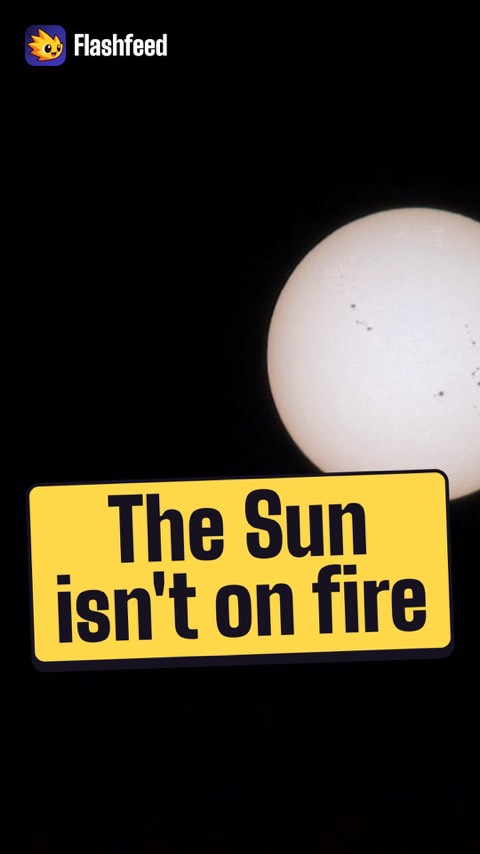
The Sun Is Not on Fire 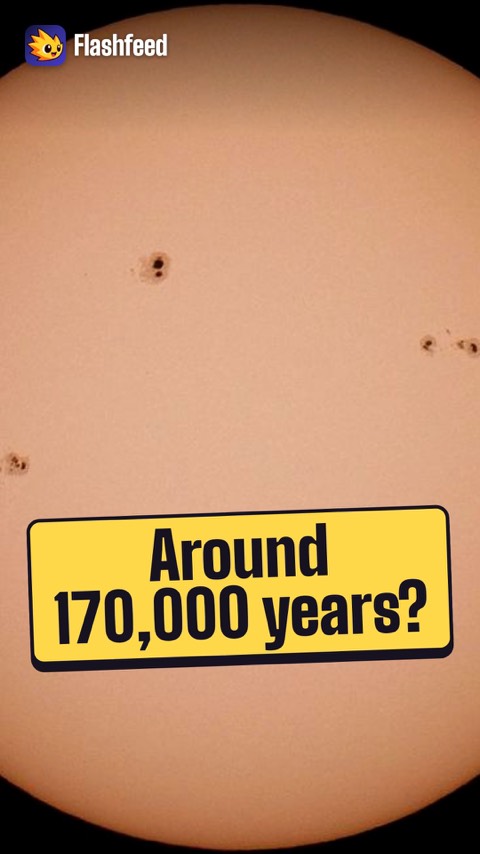
Sunlight's Long Way Out 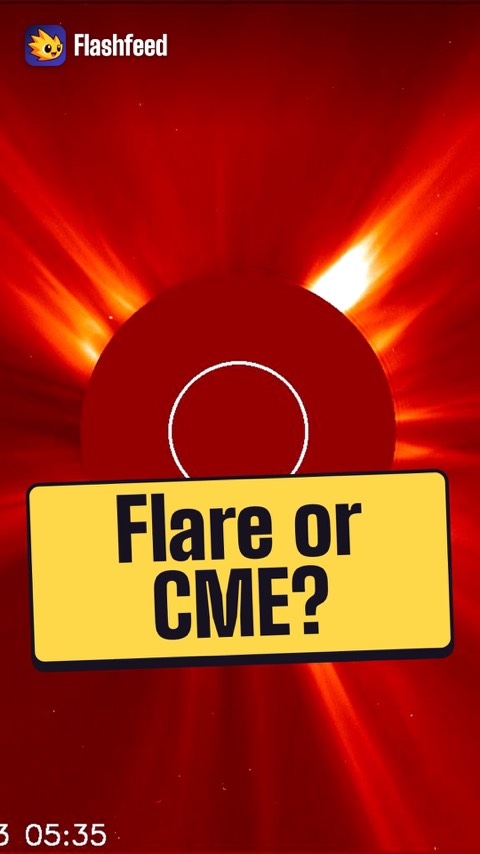
Light in Minutes, Storms in Hours All 26 clips on YouTube ↗Transcripts
The Sun Is Not on Fire
The Sun is not on fire. No chemical reaction could run a star for billions of years. It runs on nuclear fusion.
In its core, 4 hydrogen nuclei end up as 1 helium nucleus. Fusion happens only in the core.
The Sun is 109 Earths wide. It holds about 99.8% of all the mass in the Solar System.
Its light reaches us in 8 minutes. So you never see the Sun as it is right now.
Sunlight's Long Way Out
Energy made in the Sun's core doesn't fly straight out. It's absorbed and re-emitted, again and again.
By one rough estimate, it takes around 170,000 years to reach the outer layers. Then the light crosses to Earth in 8 minutes.
Above the surface, it gets stranger. The corona is the Sun's outer atmosphere. It's hundreds of times hotter than the surface.
This is still unsolved. It's called the coronal heating problem.
Light in Minutes, Storms in Hours
A solar flare is light. It reaches Earth in 8 minutes.
A coronal mass ejection is matter: billions of tons of magnetized plasma. A fast one arrives in 15 to 18 hours.
In 1859, the Carrington Event hit. Telegraph systems across Europe and North America failed. Aurorae were seen from Cuba and Hawaii.
Today the risk is to long conductors, like power grids and satellites. It's not a risk to people outdoors.
-
 NASA/Johns Hopkins University Applied Physics Laboratory/Carnegie Institution of · Public domain ↗04
Mercury and Venus
Mercury, the Extreme Small World · Venus, the Runaway · Why Neither Kept Water
Lesson 4 · 10 cardsNASA/Johns Hopkins University Applied Physics Laboratory/Carnegie Institution of · Public domain ↗Ice Closest to the Sun
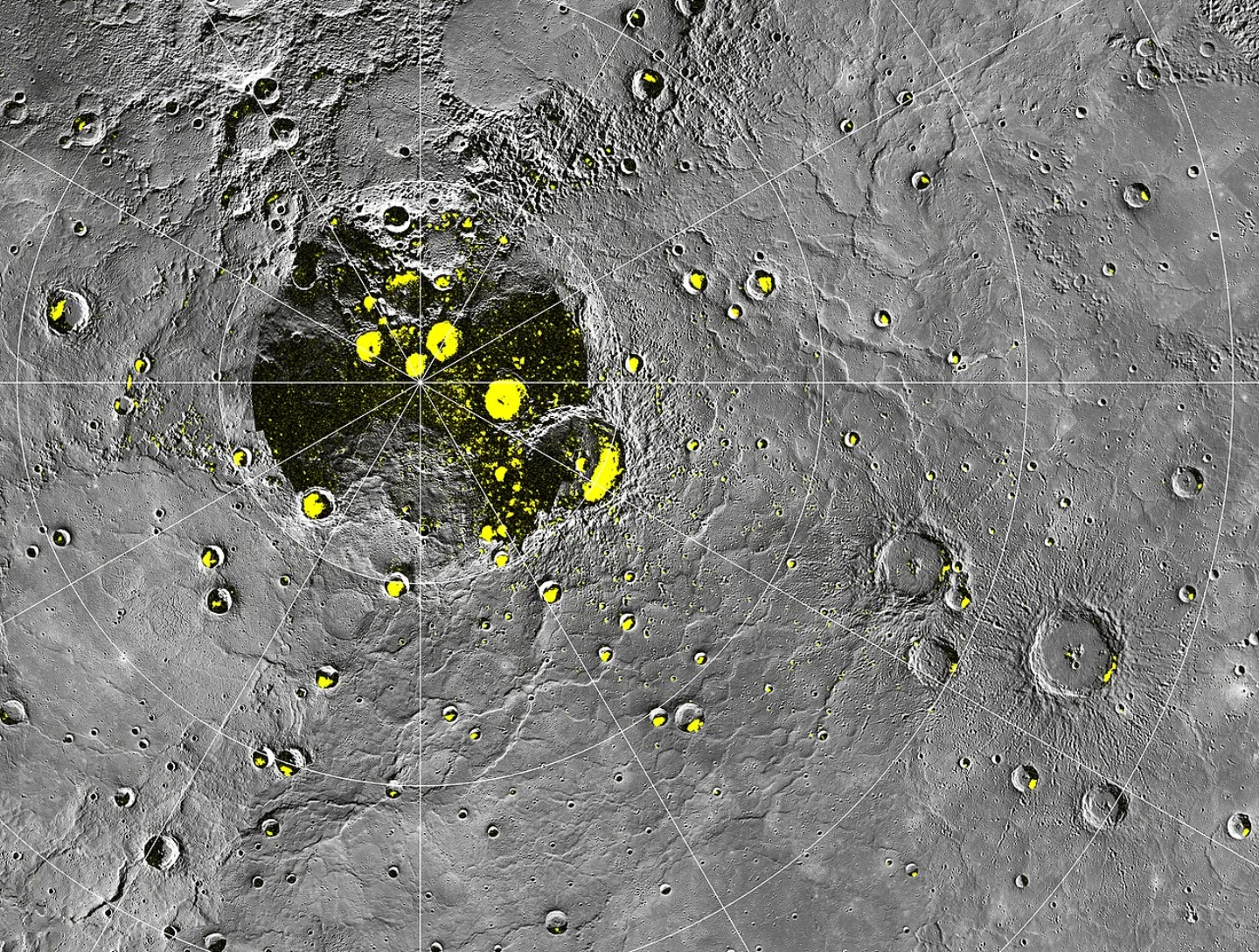
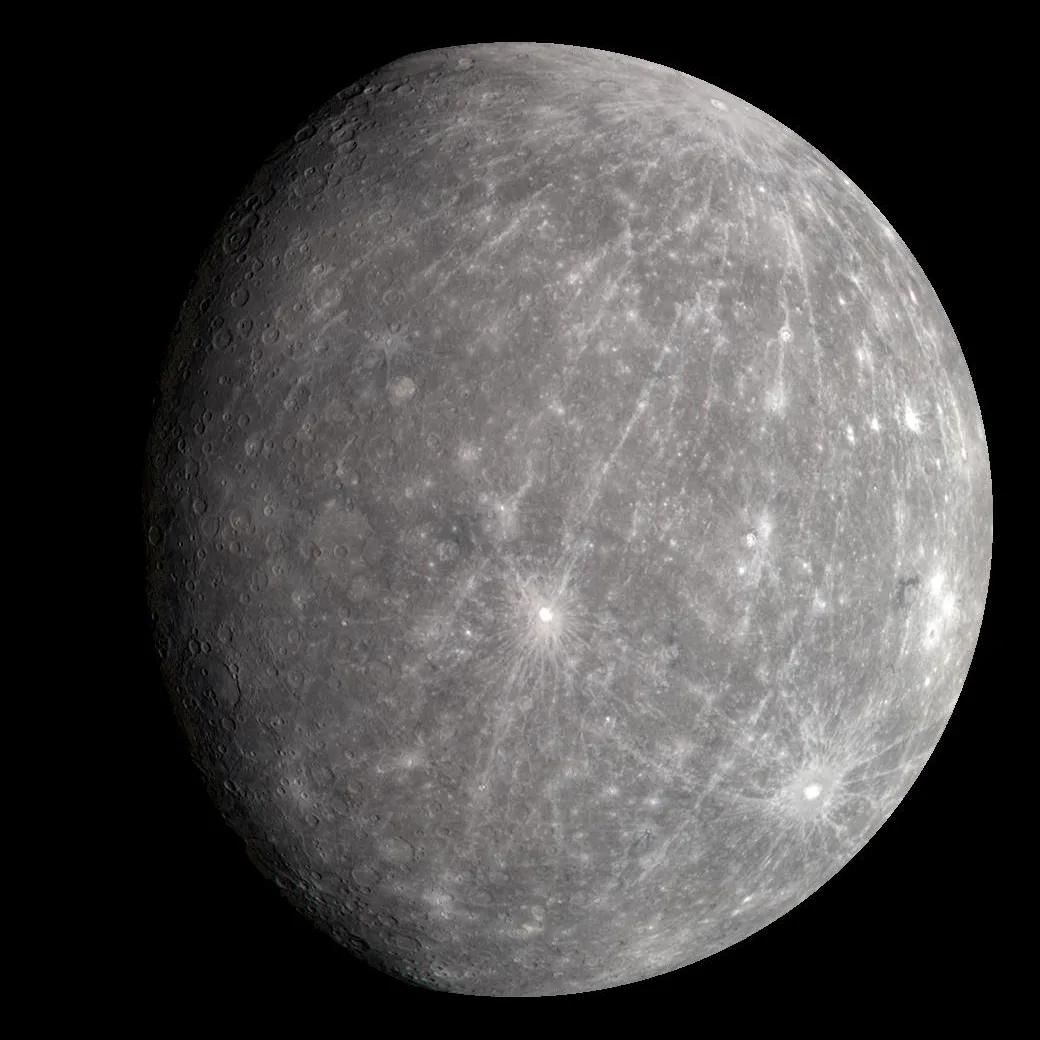
Mercury's spin axis is almost exactly upright, so the floors of deep polar craters never see sunlight. MESSENGER found those permanently shadowed floors hold water ice — on the same world whose sunlit surface reaches 430 °C.
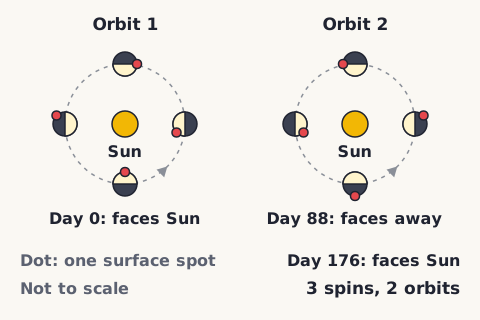 FlashFeed original diagram · CC-BY-4.0
Mercury's 176-Day Day
Mercury turns exactly three times on its axis for every two trips around the Sun — a 3:2 spin-orbit resonance. One rotation takes 58.65 Earth days, but because the planet is also racing along its orbit, sunrise to sunrise takes 176 Earth days. A day on Mercury lasts two of its years.
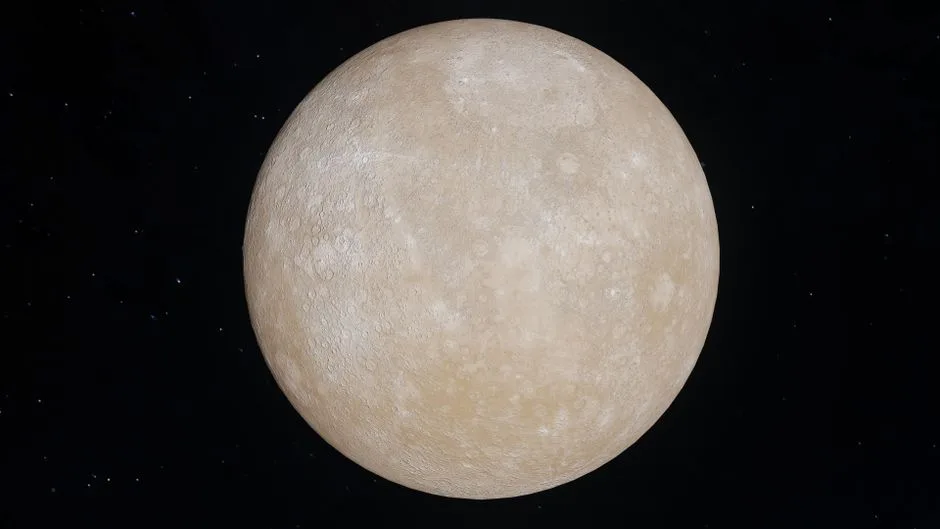 Pexels · Detailed view of Mercury, showcasing the planet's surface in outer space. ↗
A Core Wearing a Planet
Mercury's iron core has a radius of about 2,074 km inside a planet whose own radius is 2,439 km. The core reaches roughly 85 percent of the way to the surface, leaving a rocky shell only a few hundred kilometers thick. By mass Mercury is about 70 percent metal — proportionally far more than any other planet.
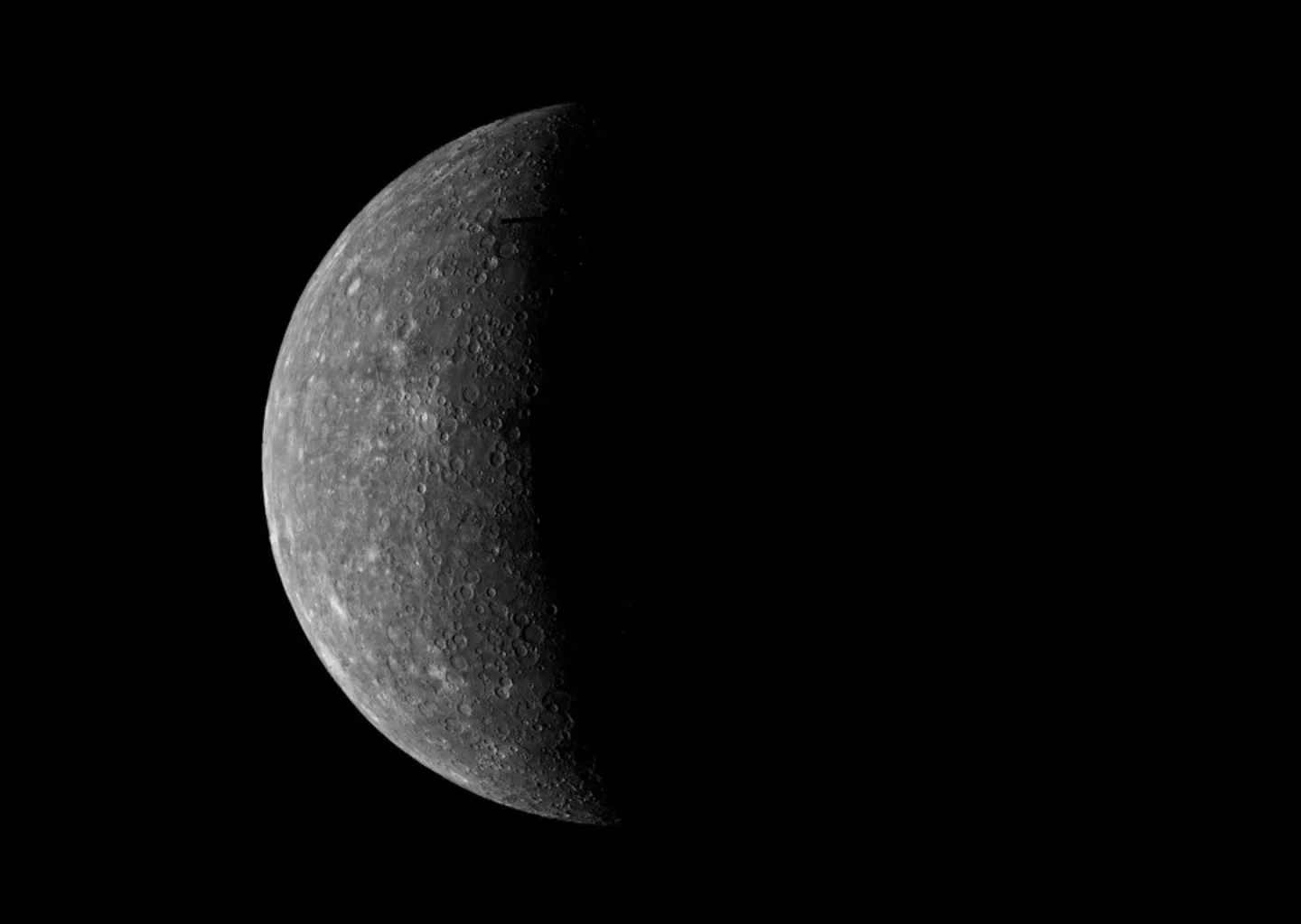 Unsplash · NASA · Unsplash License ↗
Six Hundred Degrees of Swing
Mercury's surface reaches about 430 °C in daylight and falls to about −180 °C at night — a swing of roughly 610 °C. Nothing holds the heat: Mercury has no atmosphere to move warmth around, so the night side becomes one of the coldest surfaces in the inner Solar System.
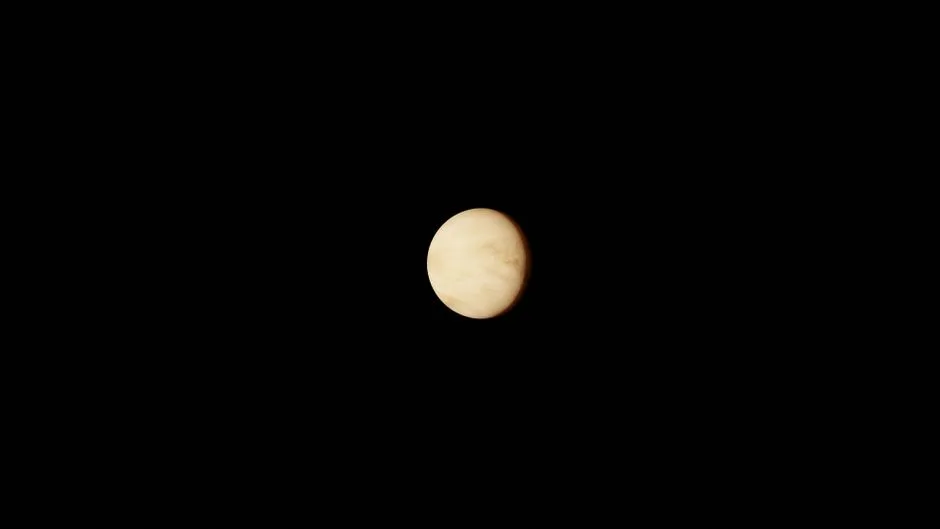 Pexels · Image of planet Venus against a black space background, highlighting its atmospheric details. ↗
Sunrise in the West
Venus turns once every 243 Earth days, and it turns backwards — from the surface the Sun would rise in the west. Its year is only 225 Earth days, so one turn on its axis takes longer than one trip around the Sun. But sunrise to sunrise is just 117 Earth days, half the rotation period: a backwards spin and a forward orbit add together instead of partly canceling as they do on Earth.
 Pexels · Detailed view of the planet Venus with a dark cosmic background. ↗
A Deck of Acid
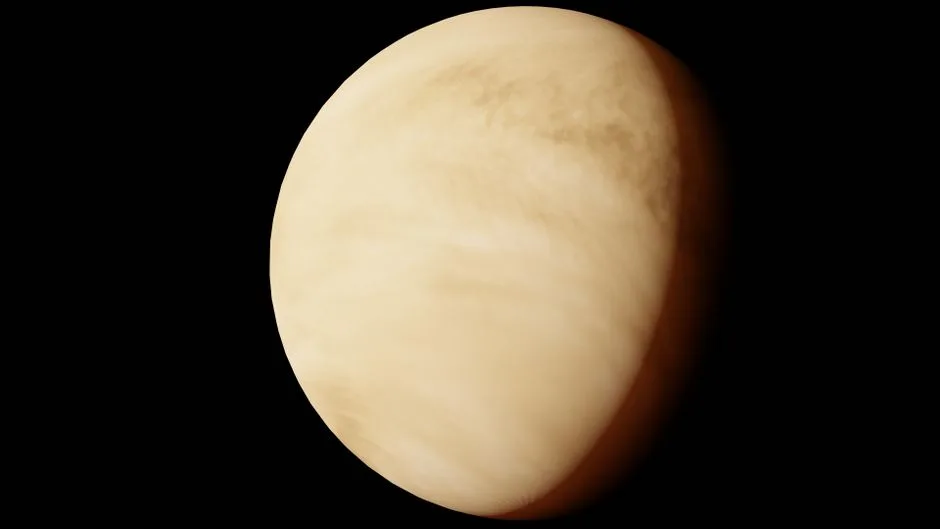
Venus is the brightest planet in our sky, and the reason sits on top of it. Its geometric albedo is 0.65 — a measure of how brightly it shines back at us, not the share of sunlight it absorbs — against Mercury's 0.106, bare rock about as dark as worn asphalt. The reflector is a deck of sulphuric acid droplets between about 45 and 70 km up.
 NASA/JPL · Public domain ↗
No Camera Can See It
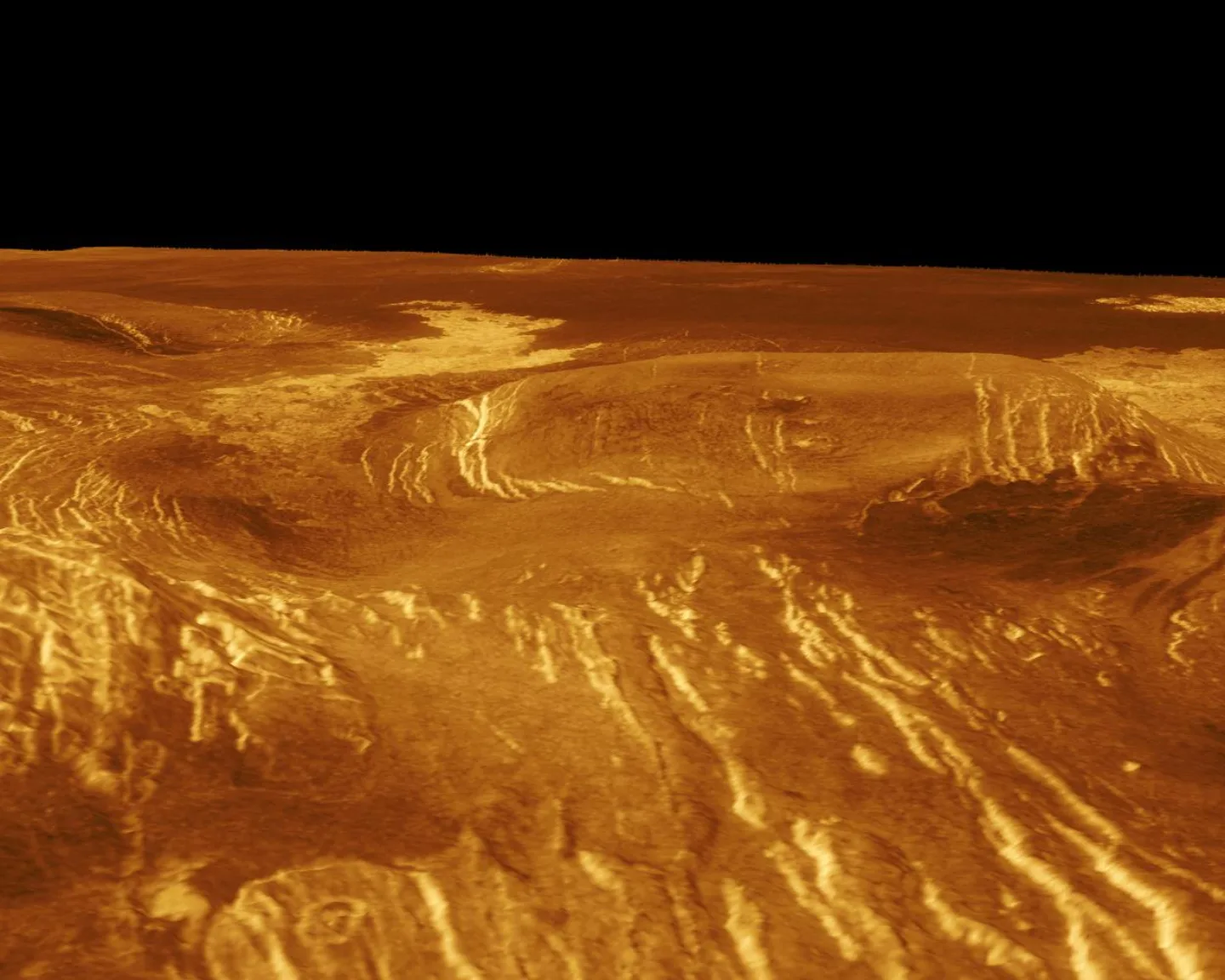
The cloud deck is opaque, so no camera can photograph the ground. Venus's surface had to be mapped by radar, which passes straight through cloud and bounces off rock. NASA's Magellan orbiter flew synthetic-aperture radar from 1990 to 1994 and took coverage to 98 percent. Every image you have seen of that surface is a radar map, not a photograph.
 Wikimedia Commons · NASA/JHUAPL/Arizona State University/Carnegie Institution of Washington · Public domain ↗
Never Had a Chance
Mercury loses the escape race twice over. It has the lowest escape velocity of the four rocky planets at 4.25 km/s, and its dayside reaches about 430 °C — and heat is molecular motion, so its gas moves fastest exactly where the grip is weakest. Weak gravity with a hot surface is the worst combination available. The solar wind did not blow Mercury's atmosphere away; Mercury could never hold one.
 FlashFeed original diagram · CC-BY-4.0
Water Left First
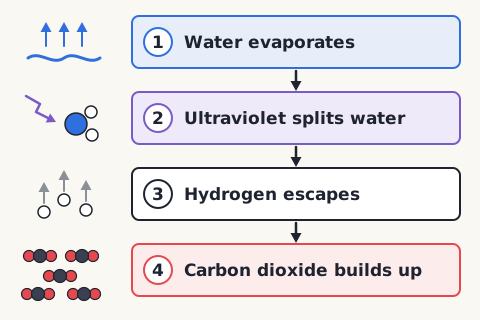
Sunlight evaporated Venus's surface water. Ultraviolet light broke the water molecules apart. Hydrogen, the lightest thing there is, escaped to space. And with no liquid water left to lock carbon into rock, carbon dioxide piled up with nothing to remove it — a runaway greenhouse. Read the chain in that order: losing the water is what disabled Venus's ability to bury its own carbon, which is why Venus is hotter than Mercury while orbiting nearly twice as far from the Sun.
1 / 10Why does Mercury's night side get so cold?
Mercury has no atmosphere to redistribute warmth. Its ice sits only in shadowed polar craters and warms nothing; its rotation is slow, not fast, at 58.65 days; and it is the closest planet to the Sun, not the farthest.
Lesson 4 has 34 cards. Keep going in the free app.
Question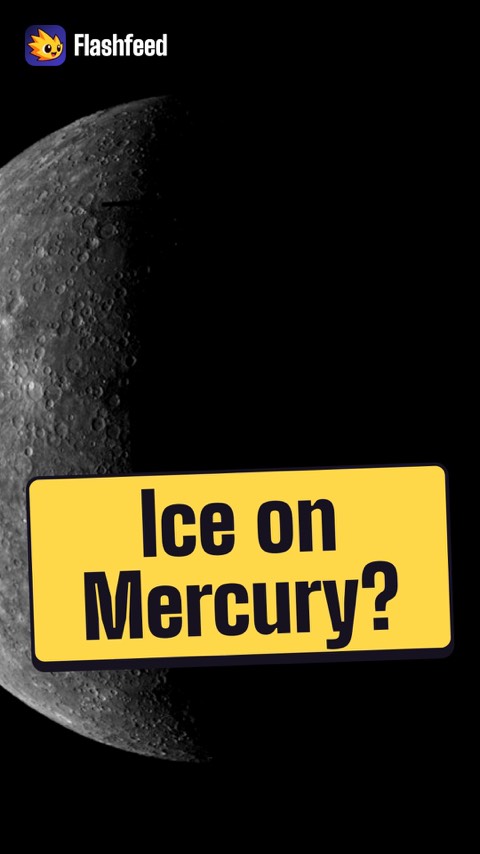
Ice on the Planet Nearest the Sun 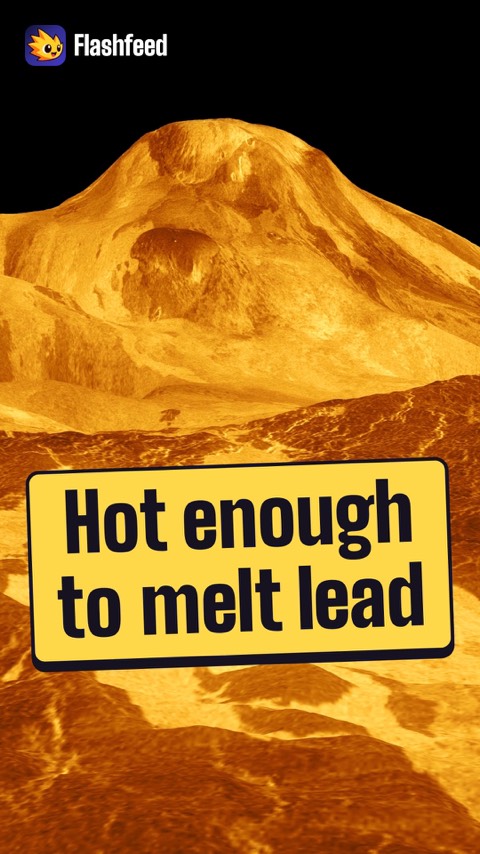
Earth's Size, Furnace Heat 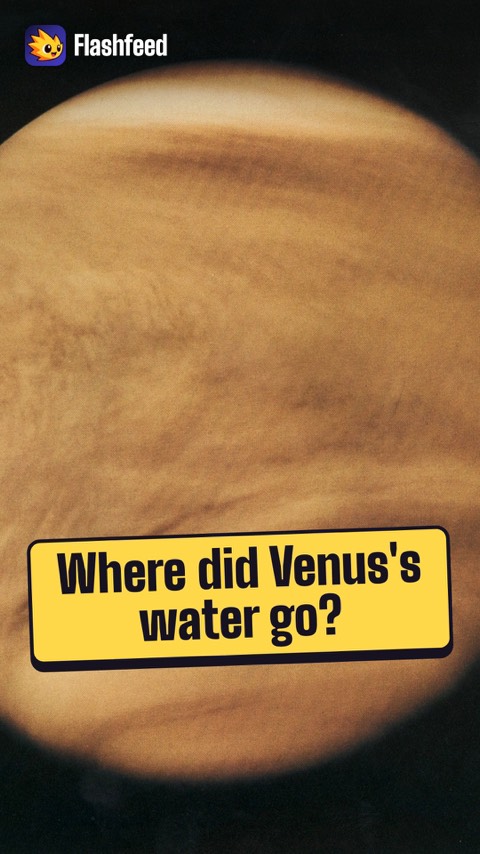
Venus Lost Its Water First All 26 clips on YouTube ↗Transcripts
Ice on the Planet Nearest the Sun
Mercury is the closest planet to the Sun. Its days reach about 430 °C. Its nights fall to about −180.
With no air to hold the heat, the ground just follows the sunlight.
But its spin axis is almost upright. So the floors of deep craters at its poles never see the Sun.
NASA's MESSENGER orbiter found deposits there that are mostly water ice. ESA still treats that as an open question.
Earth's Size, Furnace Heat
Venus is almost Earth's twin in size: 95% as wide.
But its surface averages about 465 °C. That's hot enough to melt lead, day and night, pole to equator.
The air pressure is about 93 times Earth's. That's like being more than 900 meters underwater.
The cause is carbon dioxide, the same greenhouse gas as on Earth. Venus simply holds about 154,000 times more of it.
Venus Lost Its Water First
Mercury could never hold an atmosphere. Its gravity is weak, and its dayside is near 430°. Hot gas escapes easily.
Venus has almost Earth's escape velocity. It kept its air, but it lost its water.
Sunlight evaporated the water. Ultraviolet light broke the molecules apart, and the hydrogen escaped to space.
With no water to lock carbon into rock, carbon dioxide built up. That's the runaway greenhouse.
-
 Wikimedia Commons · Hannes Grobe/AWI · CC BY-SA 4.0 ↗05
Earth and Mars
Earth as a Planet · Mars, the World That Dried Out · What Made the Difference
Lesson 5 · 10 cards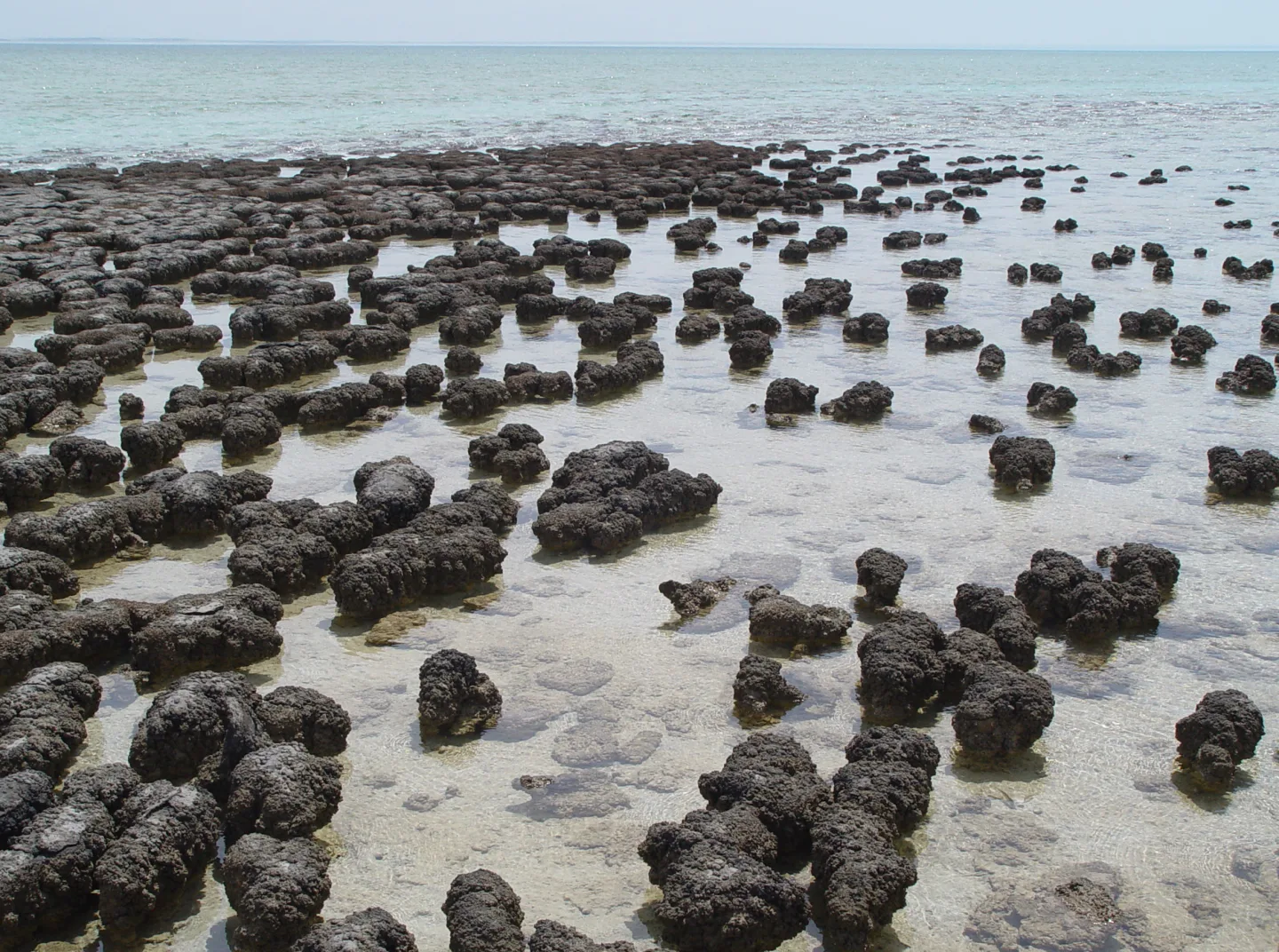 Wikimedia Commons · Paul Harrison · CC BY-SA 3.0 ↗
Air Made by Life
Earth's air is 78 percent nitrogen, 21 percent oxygen and about 1 percent everything else — the only rocky-planet atmosphere that is not mostly carbon dioxide. The oxygen is not left over from formation: NASA states plainly that plants continuously produce it by photosynthesis. Before the Great Oxidation Event, roughly 2.4 billion years ago, the atmosphere was oxygen-poor.
Wikimedia Commons · Hannes Grobe/AWI · CC BY-SA 4.0 ↗The Only Crust That Moves
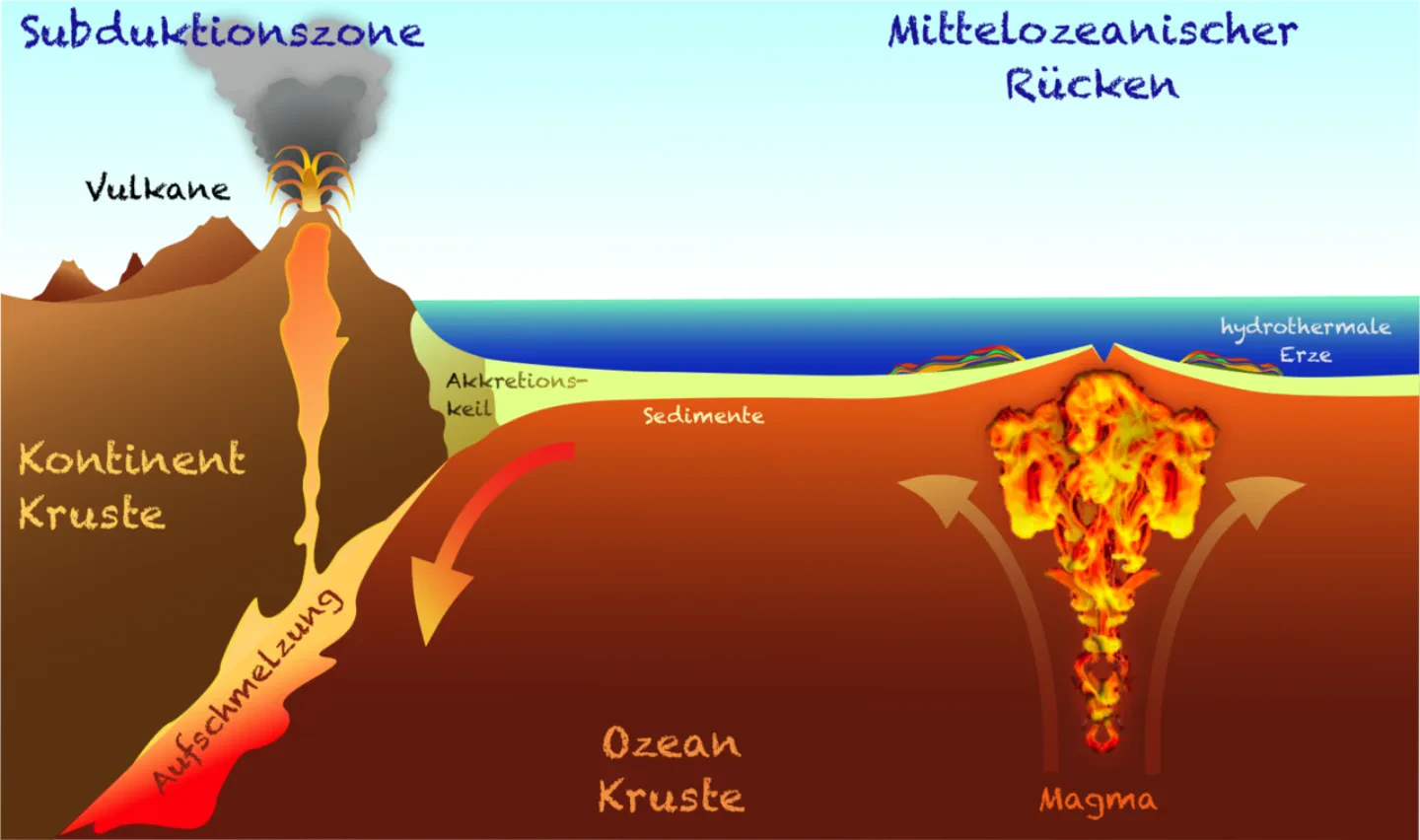
Earth's lithosphere — crust plus upper mantle — is broken into plates that constantly shift, with new crust made at ocean ridges and old crust carried back down at subduction zones. The USGS states that Earth is the only planetary body in the Solar System exhibiting plate tectonics in action. Venus's crust, by contrast, is all one piece, with no evidence of subduction. Drifting continents are not standard equipment on a rocky planet.
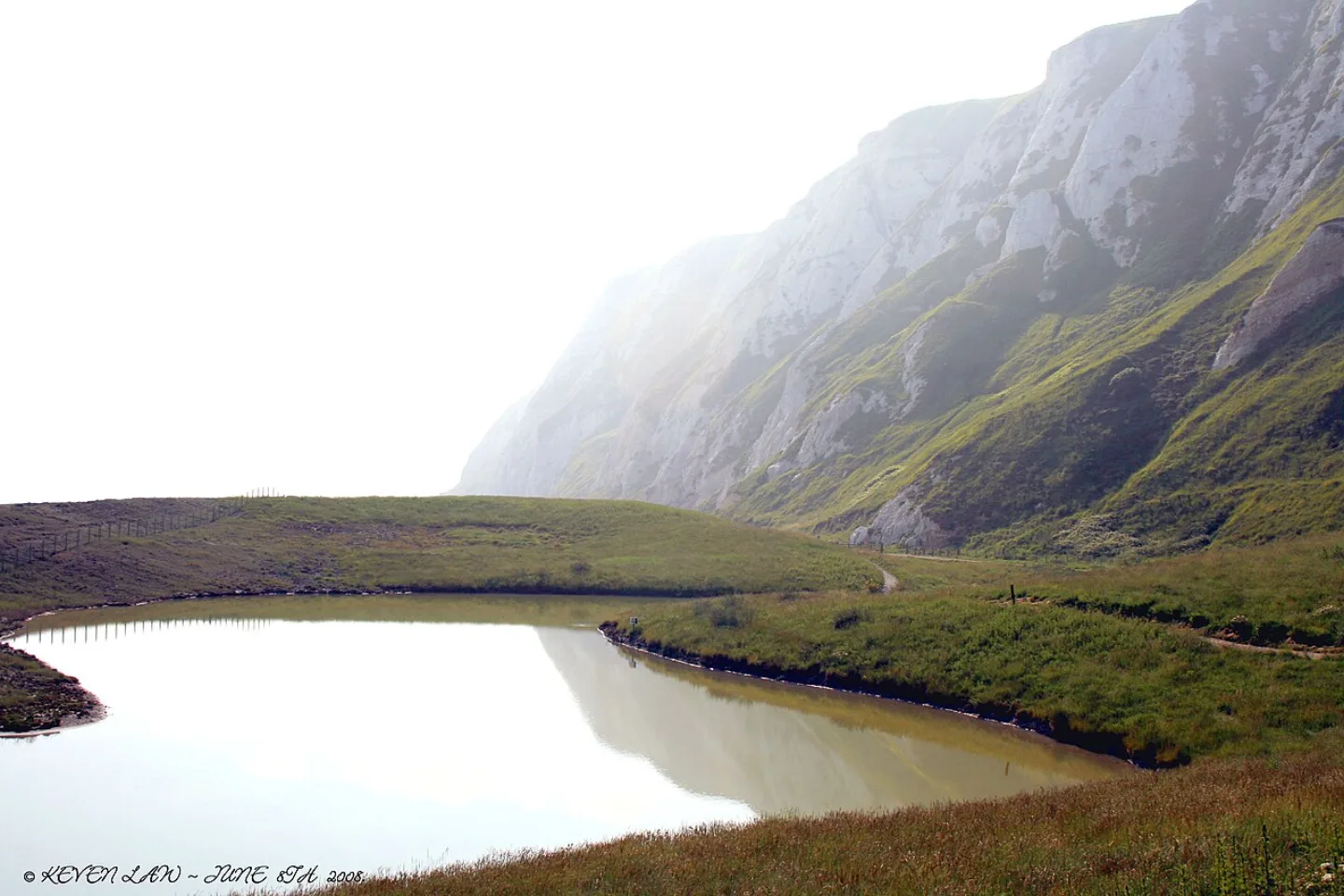 Wikimedia Commons · Keven Law from Los Angeles, USA · CC BY-SA 2.0 ↗
Rain Files Carbon Into Rock
Liquid water covers 71 percent of Earth's surface, and that water runs a thermostat. In the slow carbon cycle, warmth brings more rain, rain carrying carbonic acid dissolves rock faster, and the products bury carbon on the ocean floor — a self-correcting loop. NASA notes that with no greenhouse gases Earth would be a frozen −18 °C, and with too many it would be like Venus. The greenhouse effect is not a fault; the question is how much.
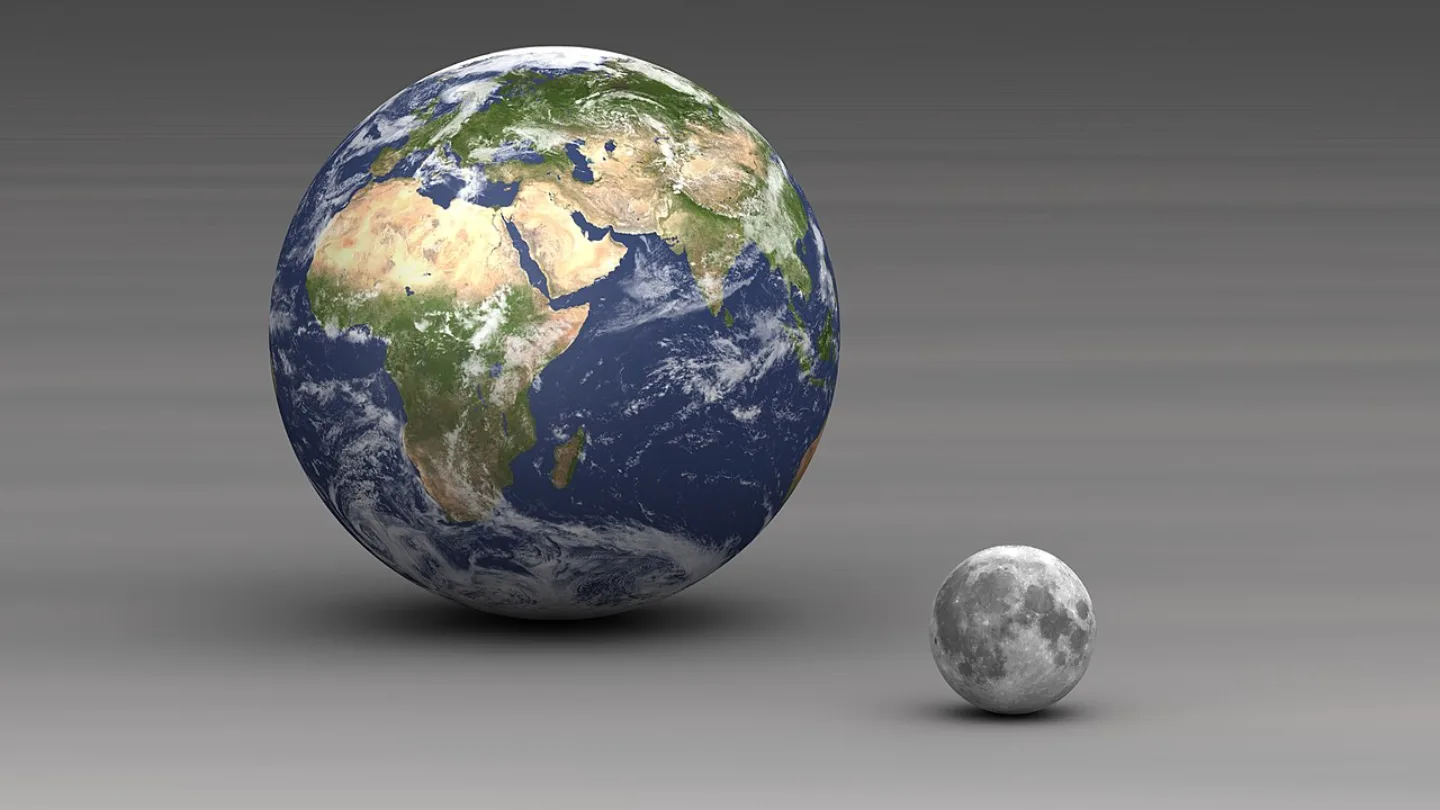 Wikimedia Commons · Lsmpascal · CC BY-SA 3.0 ↗
A Moon Too Big
The Moon's radius is 1,738 km — more than a quarter of Earth's width, and the fifth largest moon in the Solar System after Ganymede, Titan, Callisto and Io. Earth is also the only planet with exactly one moon; among the rocky worlds it is that single enormous moon that is the anomaly, since Mercury and Venus have none. It is widely held to steady Earth's tilt inside a narrow 22.1 to 24.5 degree band, though how strong that effect really is remains debated.
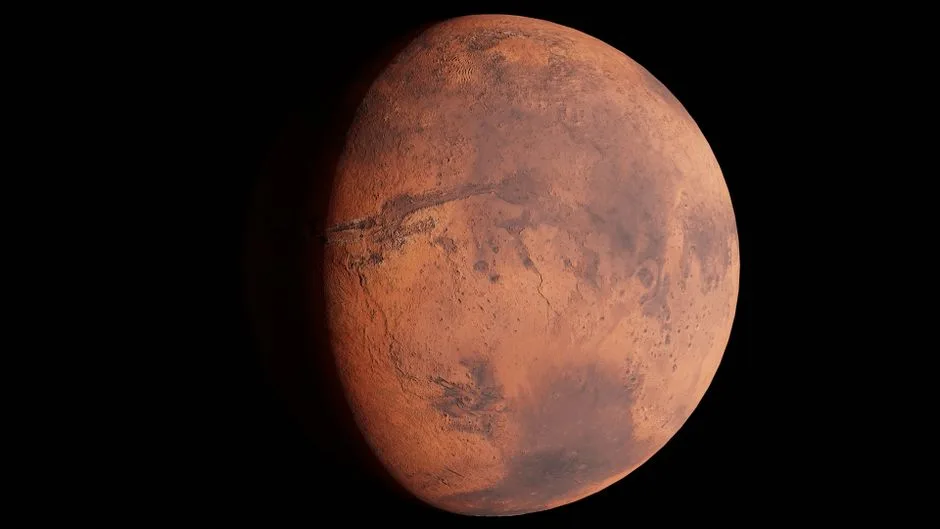 Pexels · A high-resolution image capturing Mars with its surface details visible in space. ↗
Mars Keeps Earth's Clock
A Martian solar day — a sol — lasts 24 hours 39 minutes 35 seconds, only about 3 percent longer than a day on Earth, which is why rover teams can live on Mars time. Its axis is tilted about 25 degrees, near enough Earth's 23.4 to give it the same kind of seasons. Of everything that makes Mars uninhabitable, the length of the day is not on the list.
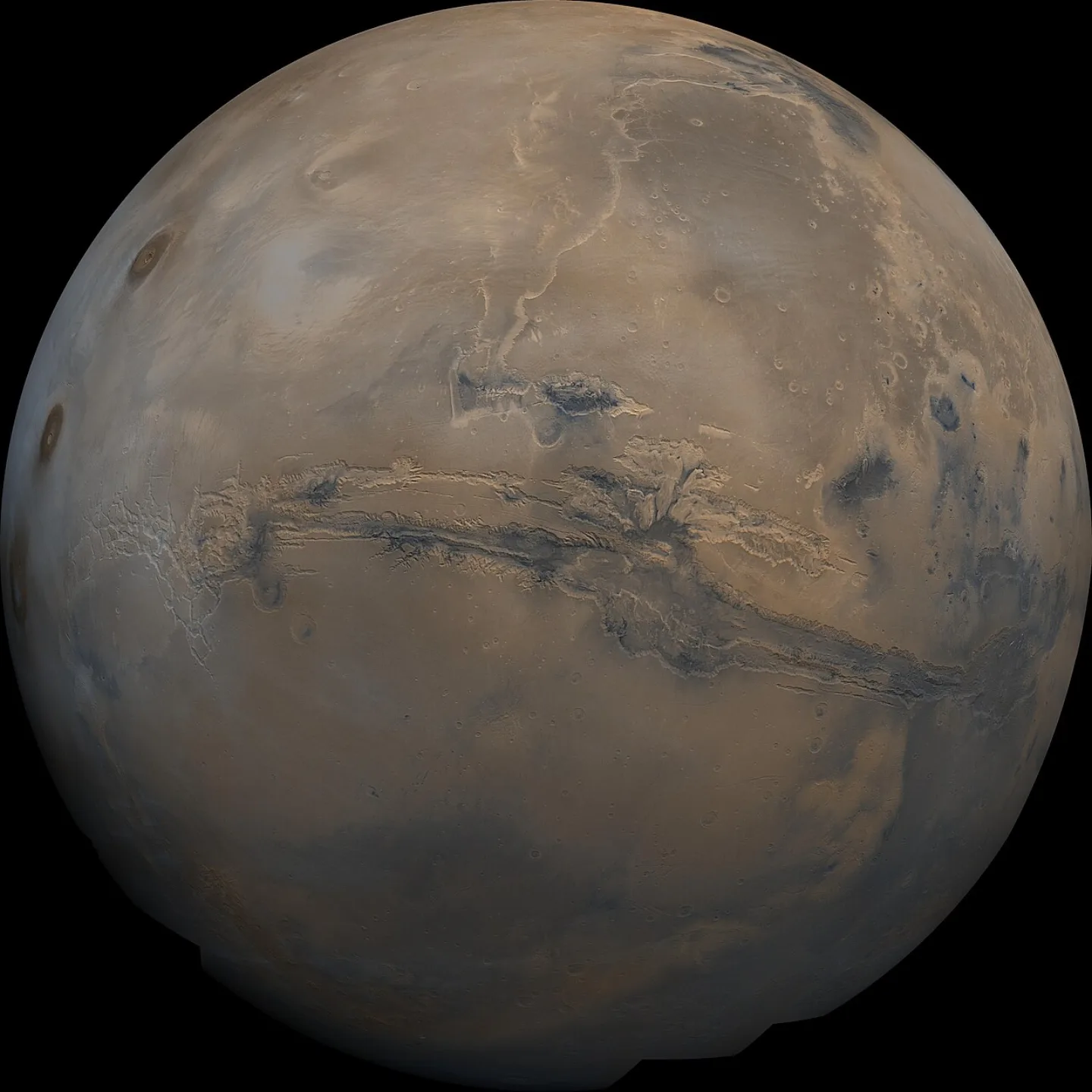 Wikimedia Commons · NASA/USGS · Public domain ↗
A Rift, Not a River
Valles Marineris is the largest canyon in the Solar System: about 3,870 km long, up to 600 km across at its widest and 9.3 km deep from rim to floor. It is not a river canyon like the Grand Canyon. It is chiefly a tectonic rift — crust pulled apart — later widened by landslides and water. Mars has a tenth of Earth's mass and still carries the biggest scar, because nothing ever came along to erase it.
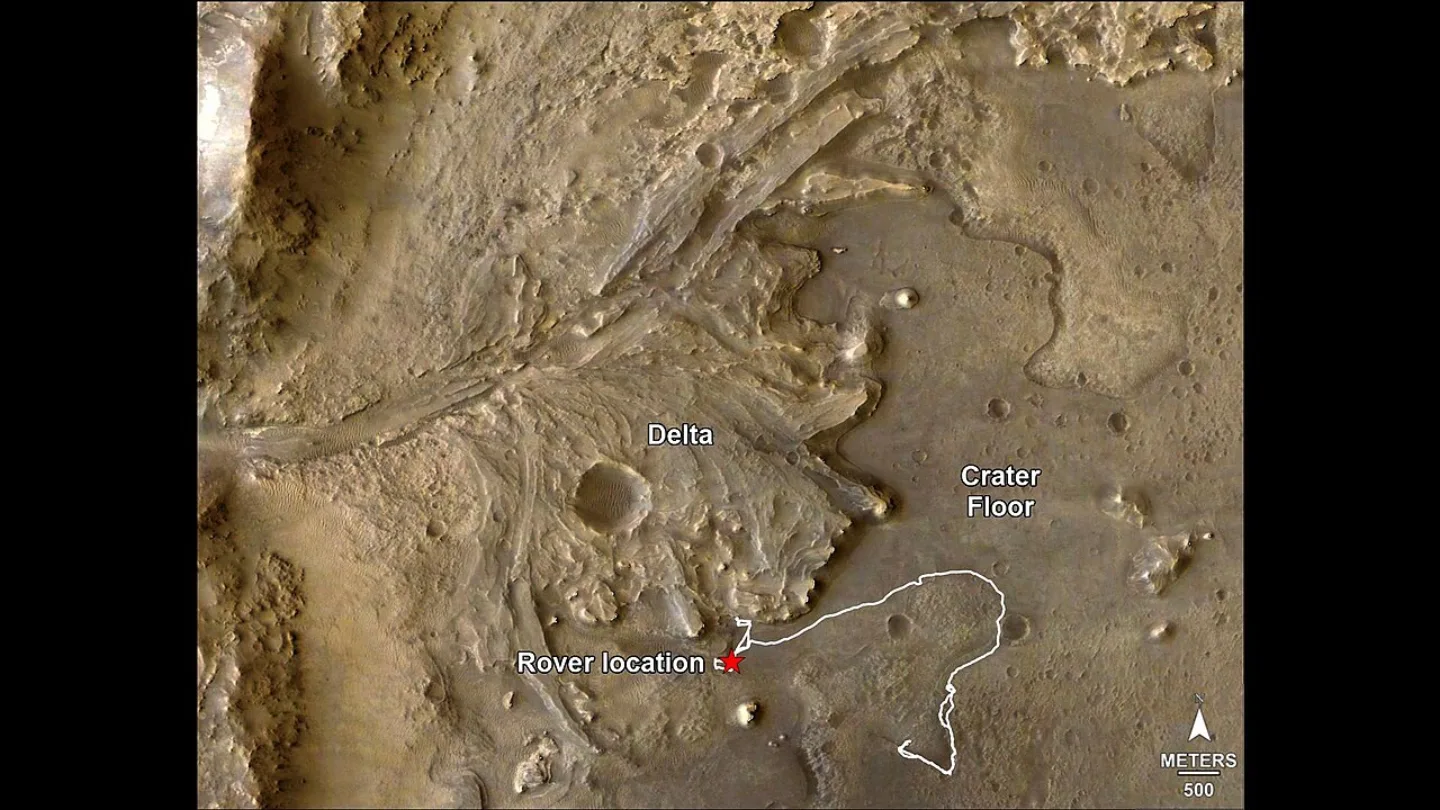 NASA/JPL-Caltech/University of Arizona/USGS/JHU-APL ↗
Three Kinds of Evidence
The case that Mars was once wet rests on three independent kinds of evidence. Outflow channels such as Ares Vallis were cut by catastrophic floods of released groundwater. Jezero Crater holds a delta and lakebed, filled more than 3.5 billion years ago when river channels spilled over its rim. And gray crystalline hematite covers up to 20 percent of the surface at Meridiani Planum — a mineral that on Earth forms mostly in the presence of liquid water. Landforms, sediments and minerals all point the same way.
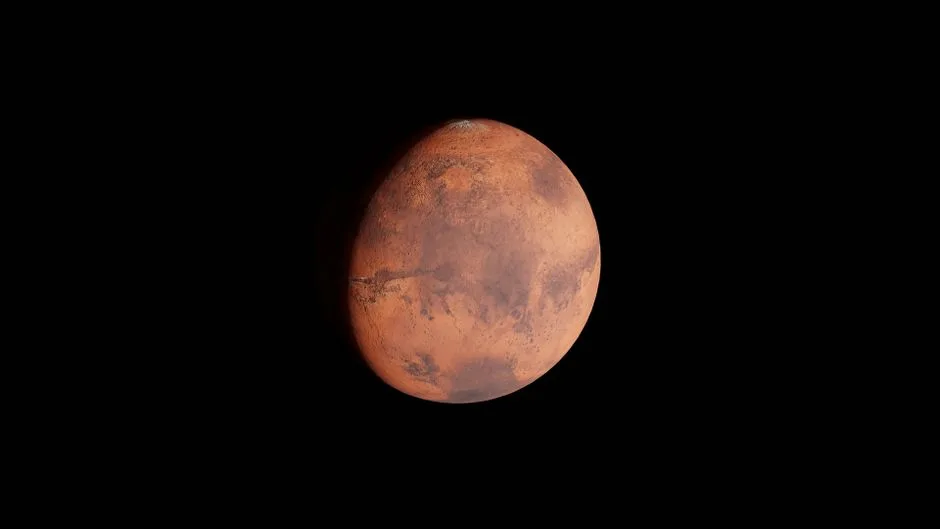 Pexels · Detailed view of Mars showcasing its surface features against a dark sky backdrop. ↗
Twenty Degrees, Then Lethal
Mars reaches about 20 °C at its warmest and falls to about −153 °C at its coldest. NASA pages put the average between about −53 and −63 °C — they disagree, so carry the range rather than a single figure. It is not uniformly frozen; it is a world that can be shirtsleeve-warm at noon and lethal hours later, because the air is far too thin to move heat around or store it.
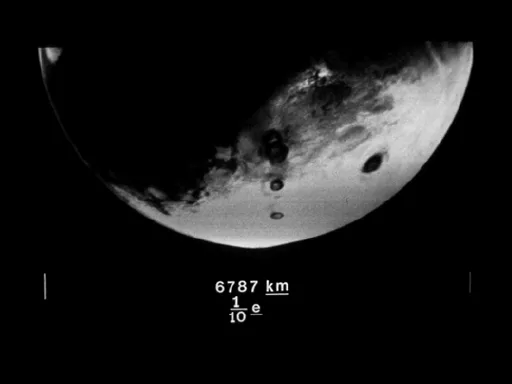 Wikimedia Commons · Voyager Golden Record (Internet Archive) · Public domain ↗
A Tenth, Not a Half
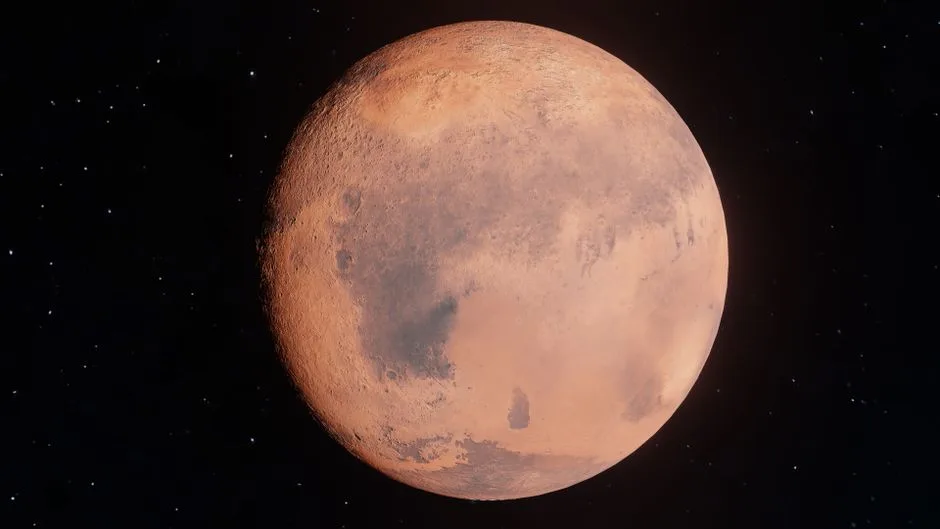
Mars is roughly half Earth's width, which makes it sound like half a planet. It is not. Mars carries about a tenth of Earth's mass — 0.642 against 5.972 × 10^24 kg — because volume goes as the cube of the radius. Mass, not width, is what sets how hard a world grips its air, and across the four rocky planets it spans a factor of eighteen.
 Pexels · High-resolution image of Mars shining in the vast universe, showcasing its surface details. ↗
Same Gas, Different Amount
Mars's air is 95.3 percent carbon dioxide, with nitrogen at 2.7 and argon at 1.6 — chemically the same recipe as Venus's. The difference between a freezer and an oven is quantity, not kind: Martian surface pressure is less than one hundredth of Earth's average. Being half again further out, at 1.524 au, sets how much sunlight arrives, but does not by itself fix a surface temperature.
1 / 10Why is a fifth of the air you breathe oxygen?
NASA states the oxygen is there because plants continuously produce it by photosynthesis. Before the Great Oxidation Event about 2.4 billion years ago the atmosphere was oxygen-poor, so it was not there from the start — and NASA names plants, not volcanoes or sunlight on ice.
Lesson 5 has 37 cards. Keep going in the free app.
Question
Three Things That Make Earth Odd 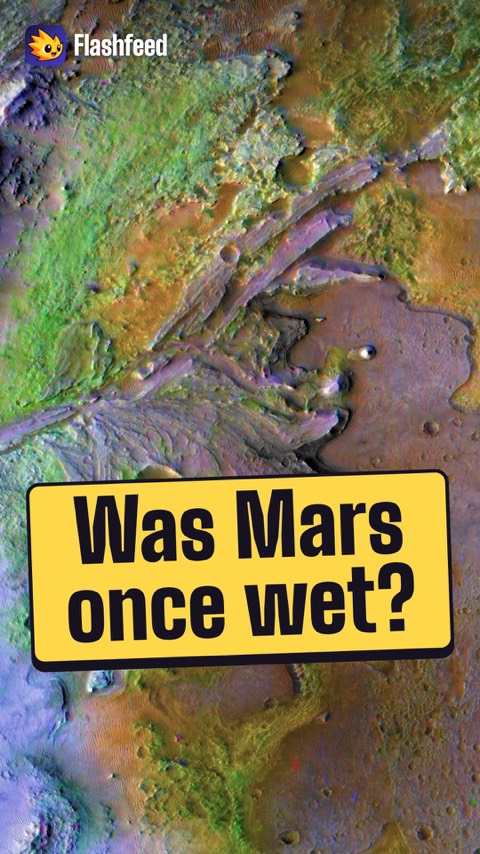
Mars Was Once Wet 
A Slow Drip of Air All 26 clips on YouTube ↗Transcripts
Three Things That Make Earth Odd
Seen from outside, Earth looks ordinary. Three things stand out.
First, the crust moves. The USGS says Earth is the only planetary body in the Solar System with plate tectonics in action.
Second, the air: 78% nitrogen and 21% oxygen. The oxygen is there because plants keep making it.
Third, the Moon is huge for its planet: more than a quarter of Earth's width.
Mars Was Once Wet
A day on Mars lasts 24 hours and 39 minutes, about 3% longer than ours.
Then the surface stops being familiar. Olympus Mons is the largest volcano in the Solar System, more than 600 kilometers across.
And Mars was once wet. Floods cut its outflow channels. Jezero Crater holds an old delta and lakebed.
Gray hematite covers parts of Mars. On Earth, that mineral forms mostly in water.
A Slow Drip of Air
Mars has about a tenth of Earth's mass. So leaving Mars takes about a quarter of the energy.
The MAVEN orbiter measured the solar wind stripping gas from Mars at about 100 grams every second.
MAVEN also found that about 65% of the argon Mars ever had is gone, lost to space.
Not one catastrophe. A slow drip, over billions of years, still going.
- Take the lessons with you. Free, no account.Download on the App Store ↗Get it on Google Play ↗
-
 Wikimedia Commons · Kevin Gill from Los Angeles, CA, United States · CC BY 2.0 ↗06
Jupiter
The Giant Itself · Storms and Magnetism · The Galilean Moons
Lesson 6 · 10 cards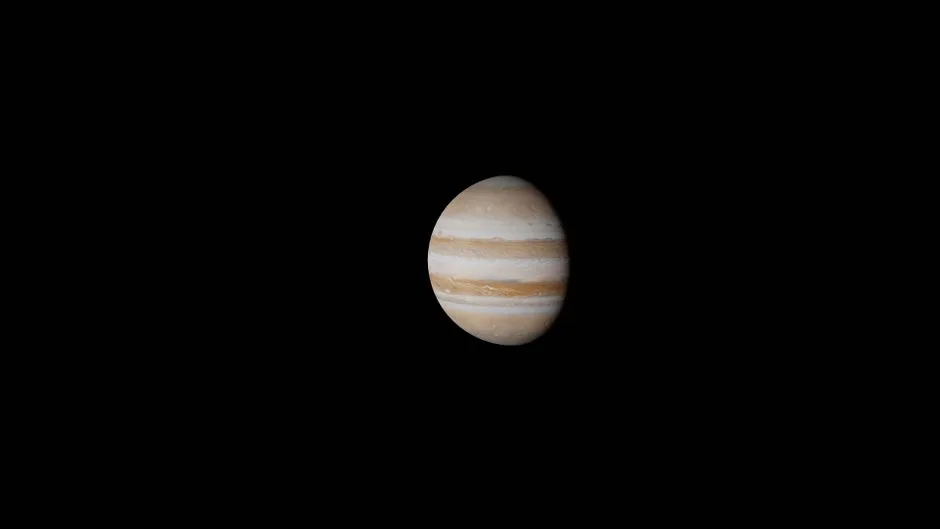 Pexels · High-resolution image of Jupiter showcasing its beautiful bands and clouds. ↗
Eleven Wide, Thousand Deep
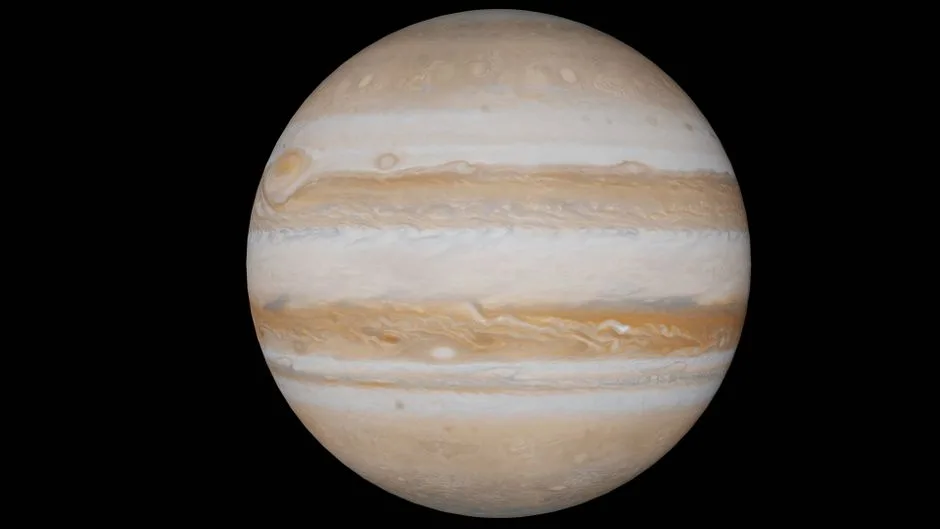
Jupiter's mean radius is 69,911 km, about 11 times Earth's. Eleven times wider is not eleven times bigger: volume scales as the cube, so eleven cubed leaves well over a thousand Earths' worth of room inside. The planet also bulges — the equatorial radius is 71,492 km — so even "the radius" is a choice of which one you mean.
 FlashFeed original diagram · CC-BY-4.0
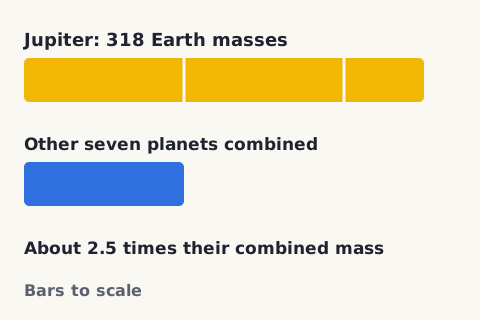
Jupiter Plus Debris
Jupiter carries about 318 times Earth's mass. NASA puts that at more than twice the combined material of the other bodies orbiting the Sun; against the other seven planets alone the ratio is close to 2.5 times their combined mass. So the eight planets are not eight comparable objects that happen to differ in size. After the Sun, the Solar System is Jupiter plus debris — and Earth is in the debris. It sits 5.2 astronomical units out.
 Pexels · Zelch Csaba · Pexels License ↗
Nowhere to Land
Jupiter has no true surface. There is no boundary where atmosphere stops and ground begins; the gas simply thickens with depth into hot, dense liquid, so nothing lands on it. Every radius and temperature quoted for Jupiter therefore belongs to an agreed pressure depth — the 1-bar level — rather than to any ground. At the cloud tops it is about minus 145 °C, while the interior runs to thousands of degrees. A planet like this has no single temperature.
 FlashFeed original diagram · CC-BY-4.0
Star Ingredients, Never Lit
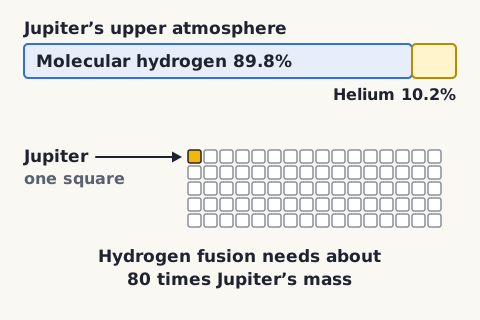
The upper atmosphere is 89.8 percent molecular hydrogen and 10.2 percent helium, with methane and ammonia as traces — close to stellar proportions. The colors are trace compounds sitting on plain hydrogen and helium, not exotic chemistry. Same ingredients as a star, and it never lit. Not nearly: hydrogen fusion needs roughly 80 times Jupiter's mass. "Failed star" is a slogan, not a near miss.
 NASA, ESA, H. Weaver and E. Smith (STScI) and J. Trauger and R. Evans (NASA's Je · Public domain ↗
Twenty-One Fragments
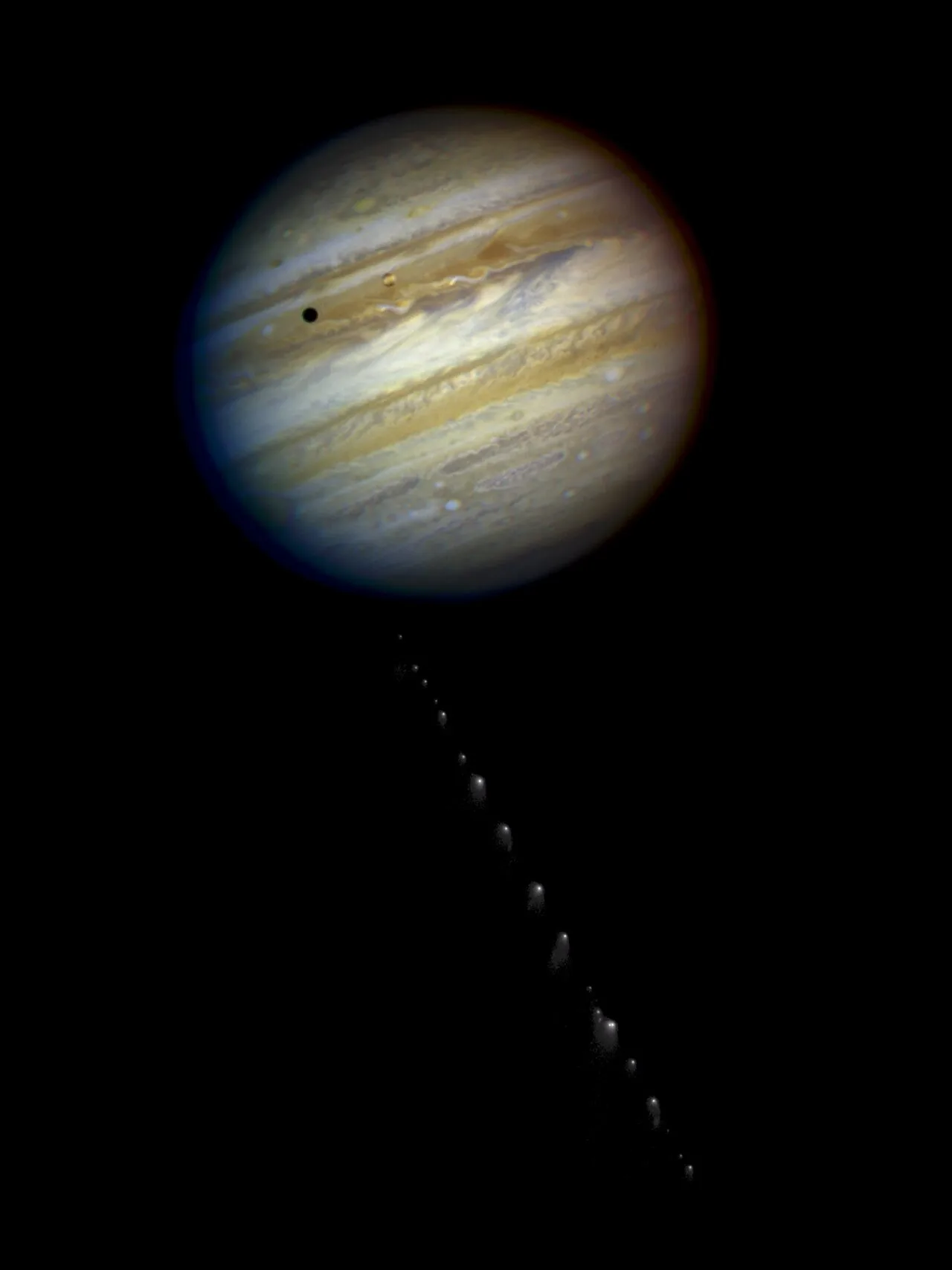
In July 1994 comet Shoemaker-Levy 9 broke into some 21 pieces that struck Jupiter over six days — the first collision between two Solar System bodies humanity was able to watch happen. Whether that reach shields Earth is genuinely unsettled: simulations by Horner and Jones found a giant planet can significantly enhance Earth's asteroid impact rate, while the same authors found the Oort-cloud comet rate falling as the giant's mass rises.
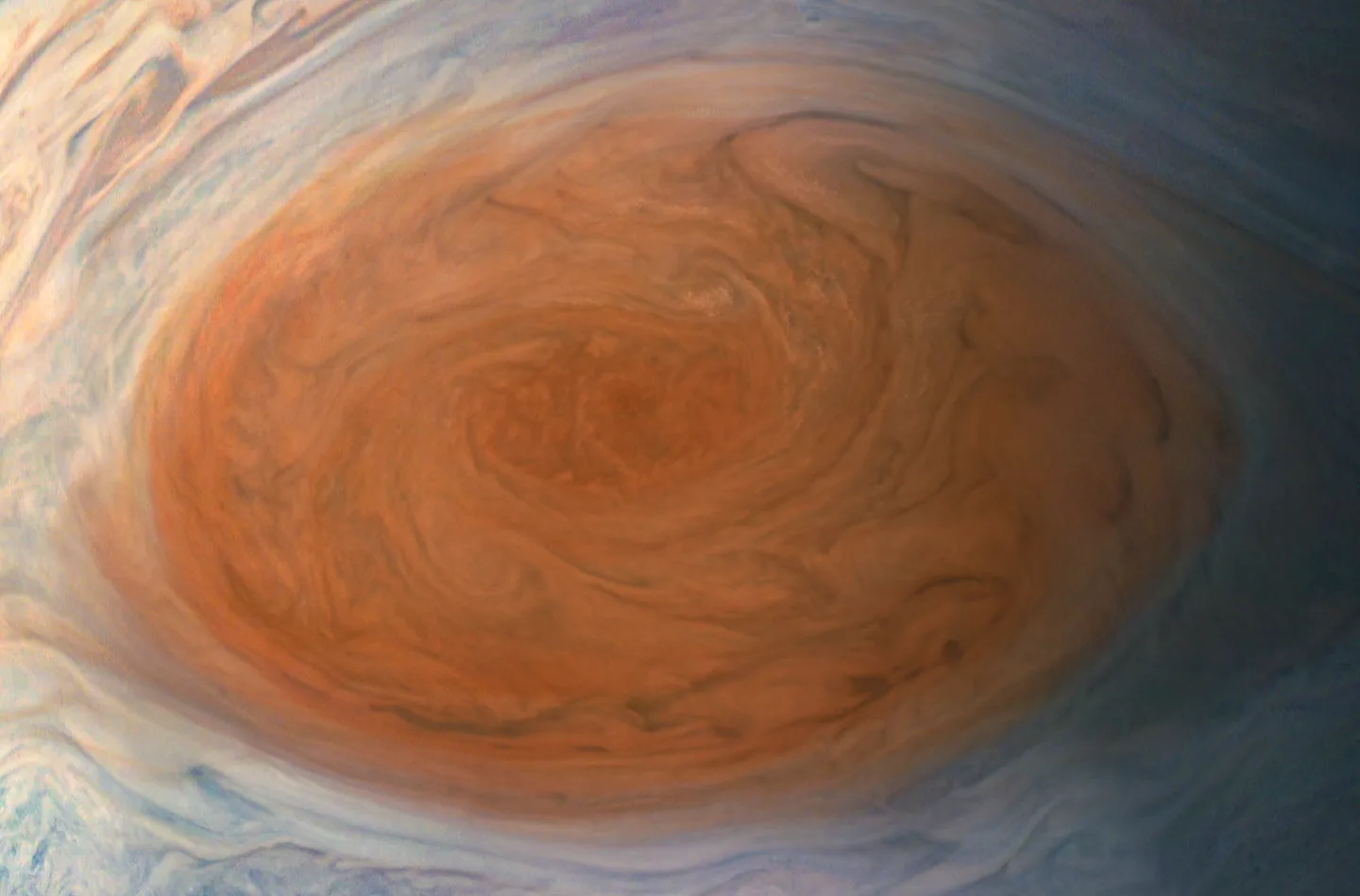
Wikimedia Commons · Kevin Gill from Los Angeles, CA, United States · CC BY 2.0 ↗Three Centuries of Storm
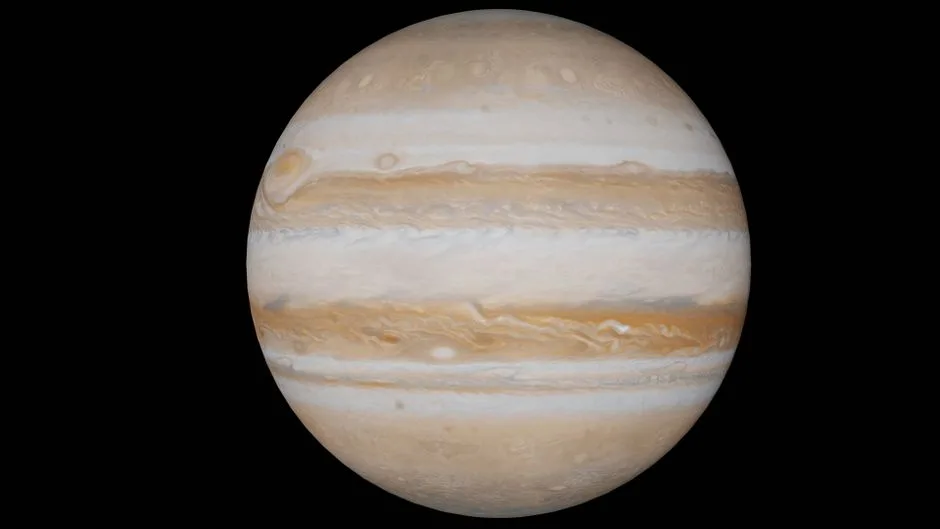
The Great Red Spot is a single storm watched for more than 300 years and still wider than the Earth. With no continents and no ocean surface to drain its energy, a Jovian storm can outlive every human who has observed it. It is also shrinking: observations from the late 1800s put its long axis near 25,500 miles, Voyager measured 14,500 in 1979, and Hubble measured about 10,250 miles in 2014 — the smallest ever measured to that date. Any single size is a dated snapshot.
 Pexels · Zelch Csaba · Pexels License ↗
Spin Made Visible
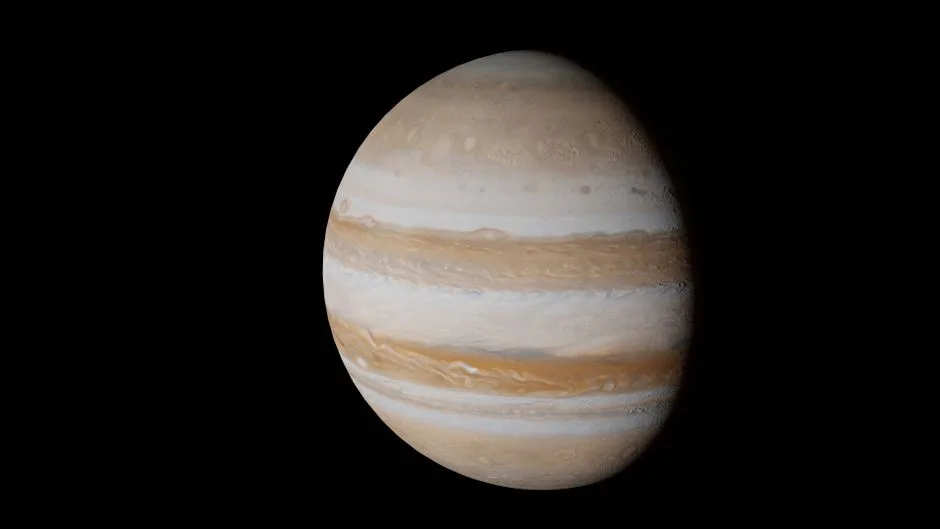
Jupiter's equatorial radius is 71,492 km against a polar radius of 66,854 km — an ellipticity of 0.06487, about twenty times Earth's flattening. That 4,638 km bulge is the fast spin made visible, and it is large enough to see through an amateur telescope. A fast-spinning fluid body is not a sphere but a measurably squashed ellipsoid.
 Pexels · High-resolution image of Jupiter adorned with its iconic bands against a black background. ↗
The Stripes Are Weather
The pale bands are zones, the dark ones belts. On the simplest interpretation zones are where gas rises and is topped with bright ammonia-ice cloud, while belts are where it sinks and deeper, darker cloud shows through. Treat that as a cloud-top picture only: Juno's microwave sounding indicates the circulation is stacked and can reverse with depth. Either way the bands are not paint — belts and zones change appearance from year to year.
 NASA, ESA & John T. Clarke (Univ. of Michigan) · Public domain ↗
A Dynamo Without Iron
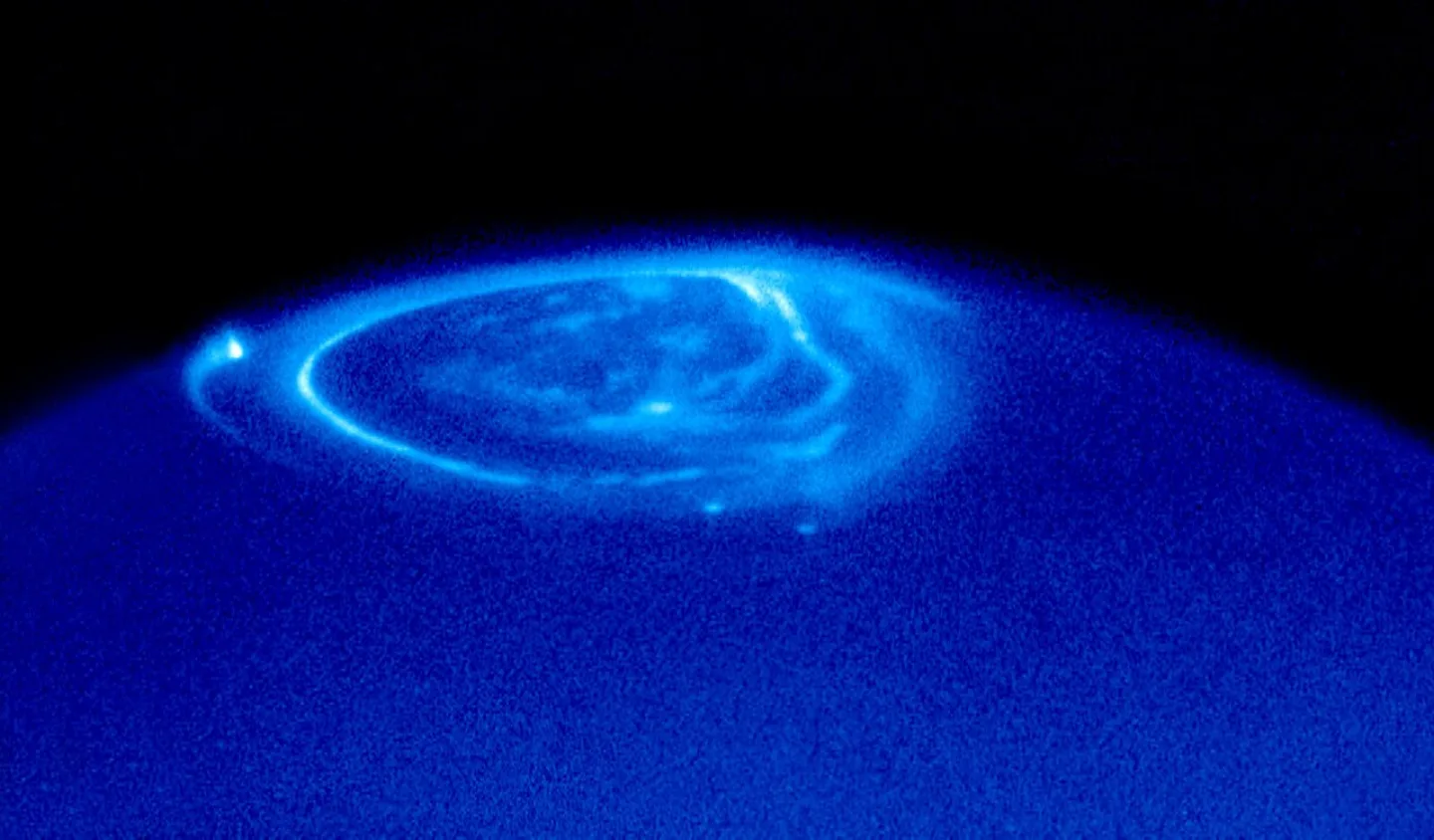
Circulating metallic hydrogen makes a dynamo, and this one is the strongest in the Solar System — NASA puts Jupiter's field at 16 to 54 times as powerful as Earth's. No iron core is involved; a planet does not need one. The field inflates a magnetosphere about 5.3 million km across on average, about 38 times Jupiter’s own diameter and nearly four times the width of the Sun, with a tail streaming downwind far beyond the orbits of the big moons.
 Wikimedia Commons · NASA/JPL/Cornell University · Public domain ↗
Rings, and a Moving Count
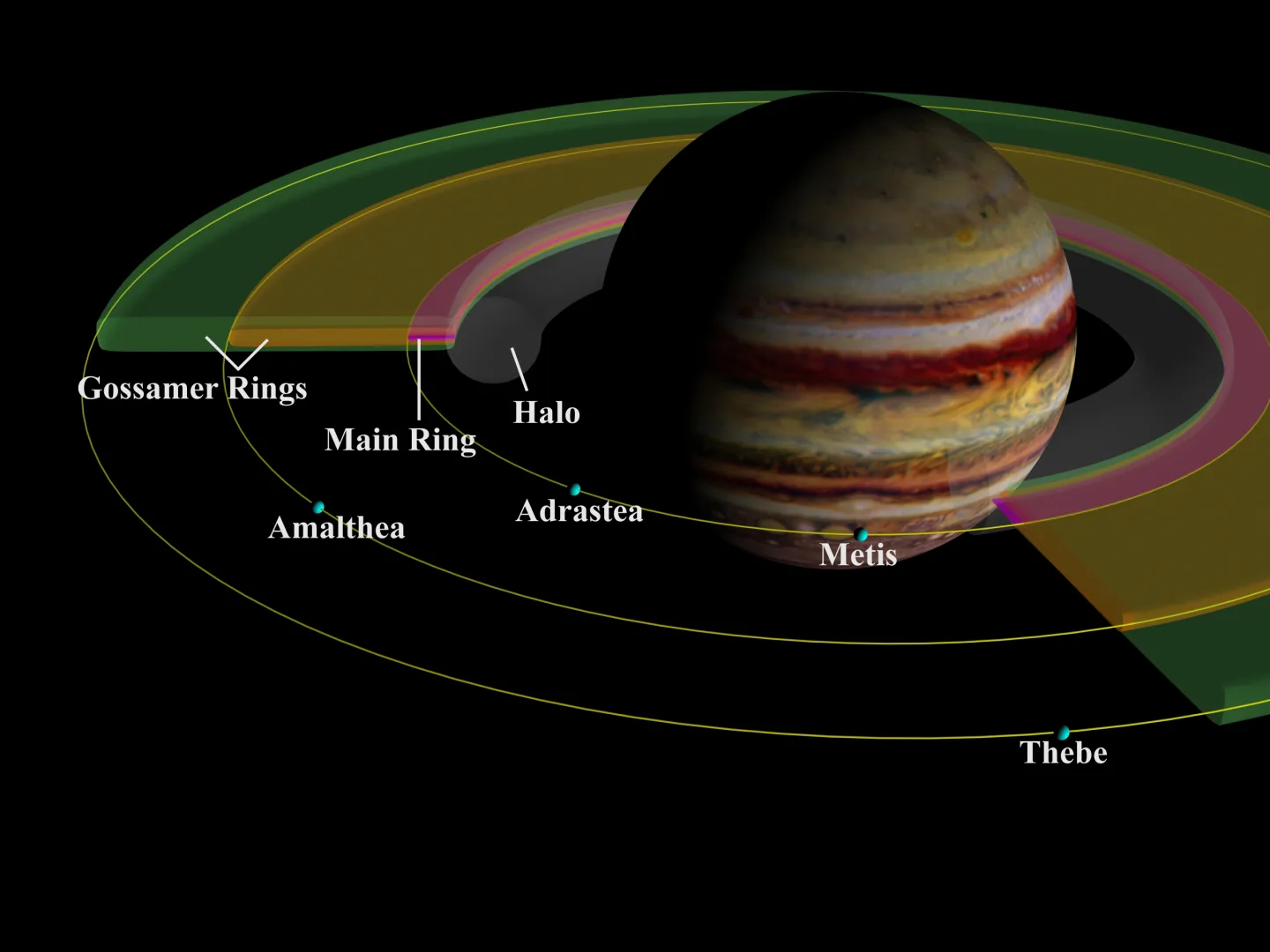
Jupiter has rings, found by Voyager 1 in 1979 — faint, mostly small dark dust, arranged as an inner halo, a thin main ring and two broad gossamer rings. Saturn's are exceptional for being bright and icy, not for existing. The moon count moves too: NASA lists 101 moons recognized by the IAU as of March 2026, while confirmed-detection catalogs listed 115 as of April 2026. Any figure here needs a date attached to it.
1 / 10How much more massive would Jupiter have to be before hydrogen fusion could begin?
Fusion needs roughly 80 Jupiter masses, so Jupiter falls short by a factor of about 80 — not by a little. At 2, 8 or 25 times its mass it would still be a planet or a brown dwarf and never a star. "Failed star" is a slogan, not a near miss.
Lesson 6 has 34 cards. Keep going in the free app.
Question
Jupiter Plus Debris 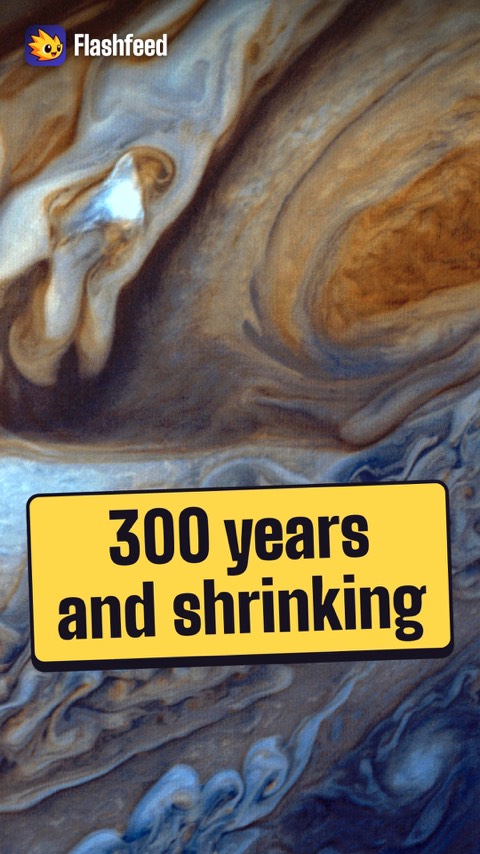
The Storm Watched for 300 Years 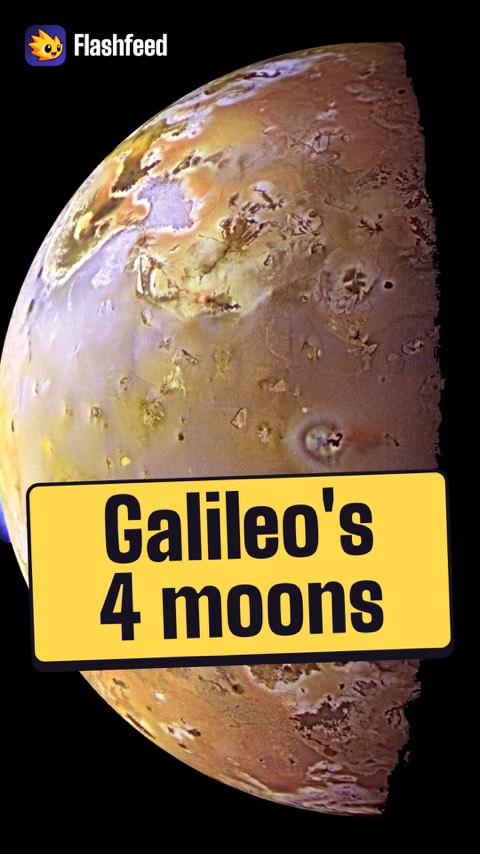
Galileo's Four Moons All 26 clips on YouTube ↗Transcripts
Jupiter Plus Debris
Jupiter carries about 318 times Earth's mass: about 2.5 times all the other planets combined.
After the Sun, the Solar System is Jupiter plus debris. Earth is in the debris.
Jupiter has no true surface. The gas just thickens with depth into hot, dense liquid.
And it was never close to becoming a star. Fusion would need roughly 80 times Jupiter's mass.
The Storm Watched for 300 Years
The Great Red Spot is one storm, watched for more than 300 years. It's still wider than Earth.
With no continents or ocean surface to drain its energy, it can outlive everyone who has watched it.
But it's shrinking. In 1979, Voyager measured 14,500 miles across. In 2014, Hubble measured about 10,250.
“Twice as wide as Earth” is a decades-old description.
Galileo's Four Moons
In 1610, Galileo saw 4 moons circling Jupiter. Not everything goes around us.
Io is the most volcanically active world in the Solar System, with over 400 active volcanoes. Tidal heating powers it, not sunlight.
Europa is thought to hide an ocean with twice the water of all Earth's oceans.
Ganymede is bigger than Mercury. And Callisto is the most heavily cratered object in the Solar System.
-
 NASA/JPL-Caltech/Space Science Institute ↗07
Saturn
The Planet That Would Float · The Rings · The Moons of Saturn
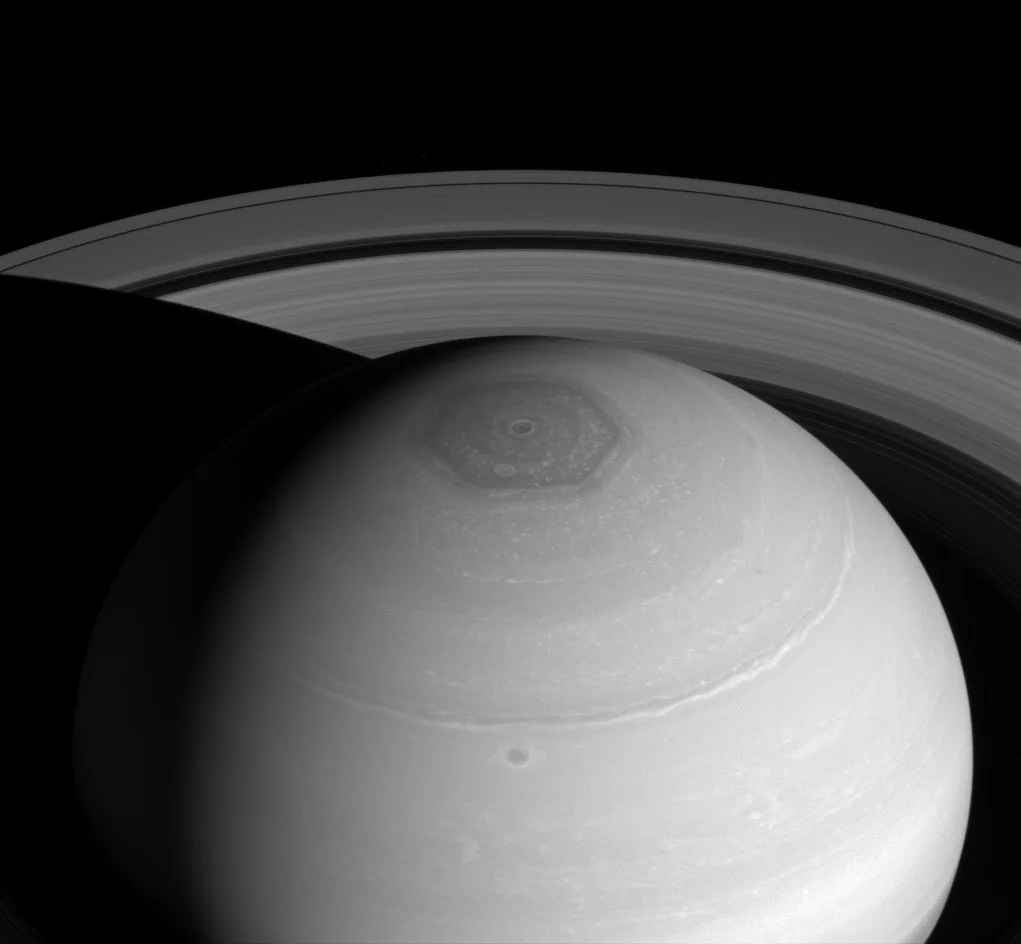
Lesson 7 · 10 cardsNASA/JPL-Caltech/Space Science Institute ↗A Six-Sided Jet Stream
A hexagon about 30,000 km across sits over Saturn's north pole, with winds near 200 miles per hour and a rotating storm at its center. It is not an object and not a rendering artifact but a fast river of air whose wave pattern closes into six sides — and it has held that shape for decades. JPL notes there is no weather feature consistently like it anywhere else.
 Unsplash · NASA Hubble Space Telescope · Unsplash License ↗
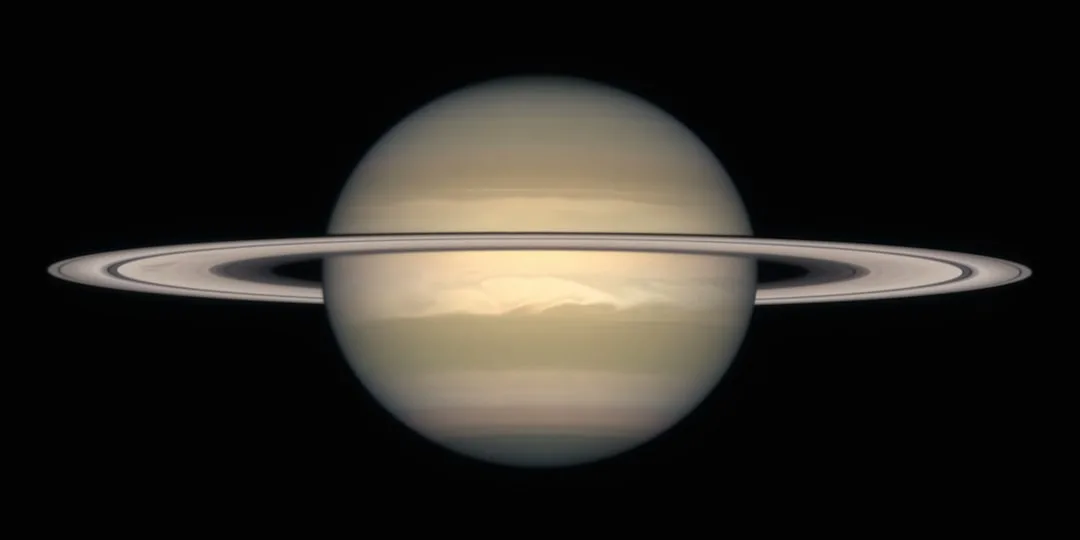
No Ground To Land On
Saturn has no true surface. The atmosphere thickens downward into liquid with no sharp boundary, then into a shell of liquid metallic hydrogen — which NASA's interior model credits with generating the magnetic field — wrapped around a dense core of heavy elements. There is no hidden rocky floor waiting under the clouds for a probe to stand on.
 Wikimedia Commons · RidingWithRobots · CC BY-SA 2.0 ↗
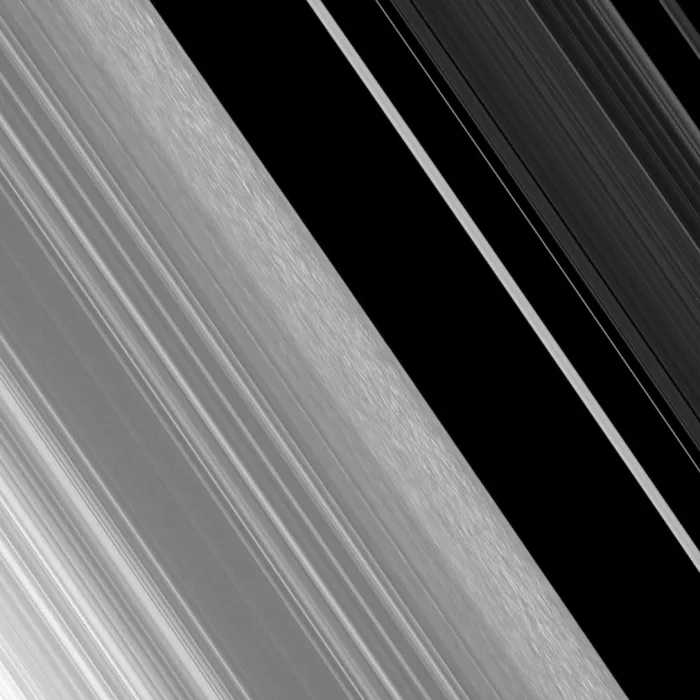
Billions Of Separate Orbits
Saturn's rings are almost entirely water ice — billions of separate chunks, from grains smaller than sand up to boulders the size of houses. Nothing is joined: every particle keeps its own orbit around the planet. That near-purity is why the rings throw back roughly 60 percent of the light that hits them, against about 5 percent for the sooty rings of Uranus and Neptune.
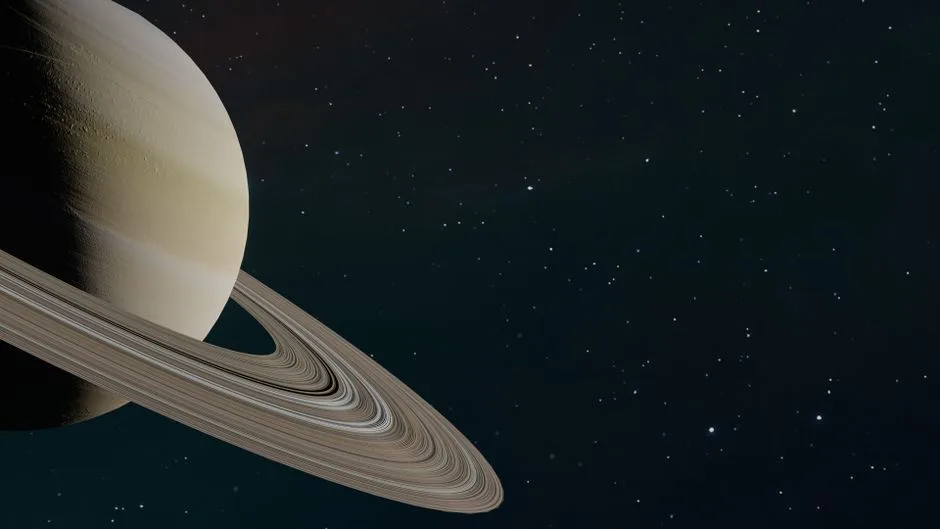 Pexels · Stunning visual of Saturn and its iconic rings against the backdrop of space. ↗
Ten Meters Of Ice
The main rings span about 280,000 km edge to edge — some 140,000 km from Saturn's center to the F ring — while they are of the order of 10 meters thick: a sheet tens of millions of times wider than it is deep. Scaled to a sheet of paper 0.1 mm thick, it would stretch nearly 3 km edge to edge. Published figures disagree — NASA about 10 m, OpenStax an average of 20 m, NASA's own rings page under 100 m in most places — so hold the order of magnitude, not a value.
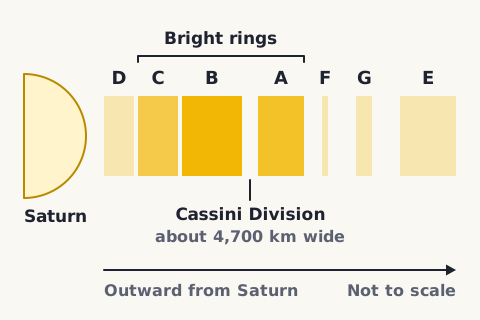 FlashFeed original diagram · CC-BY-4.0
Lettered By Discovery
The seven main rings carry letters in the order they were found, not by position, which is why the sequence looks scrambled: outward from Saturn they run D, C, B, A, F, G and E. A, B and C are the bright ones. The Cassini Division, about 4,700 km wide, is the largest gap, separating B from A — not an empty vacuum, though what fills it is not settled here — and named for the 17th-century astronomer who first glimpsed it in 1675, not for the spacecraft.
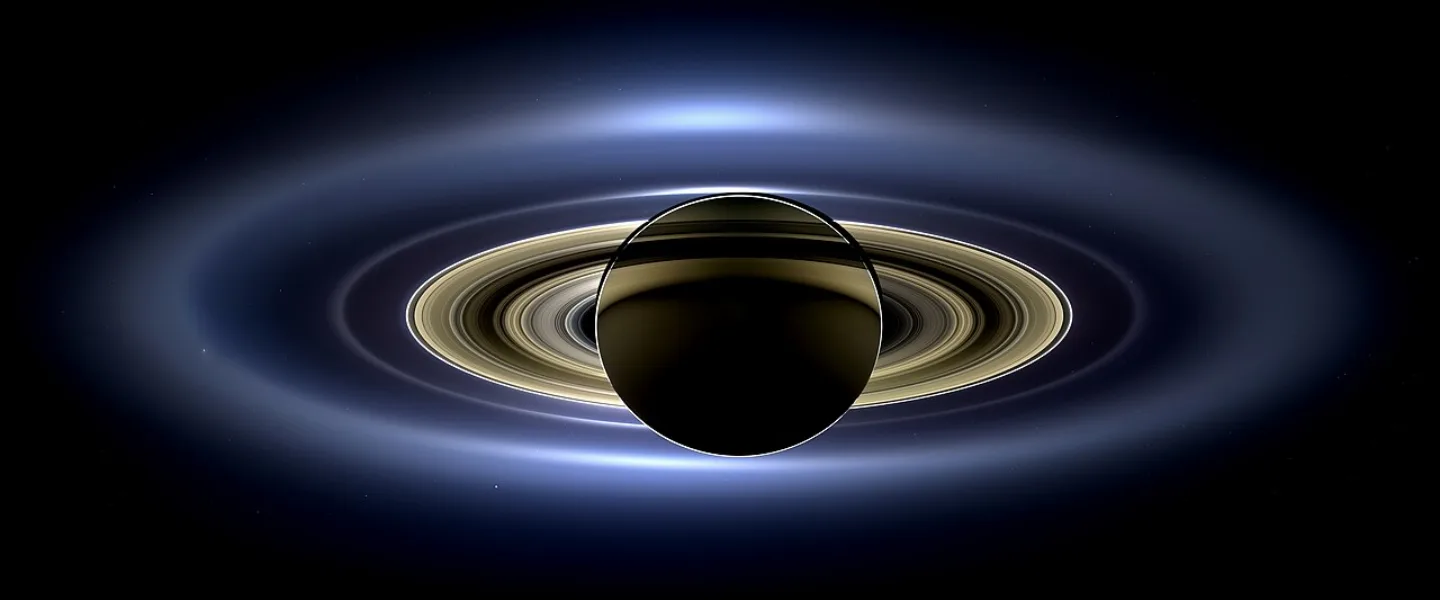 NASA / JPL-Caltech / Space Science Institute · Public domain ↗
Younger Than The Planet?
Cassini's Grand Finale weighed the rings at about 1.54 × 10¹⁹ kg, roughly 0.41 times the mass of the small moon Mimas. Interplanetary dust darkens ice at a roughly known rate, so rings this bright and this light cannot have sat there for 4.5 billion years: the modeled age is 10 to 100 million years. Crida and colleagues argued in 2019 that some unknown process may be cleaning the rings, making genuinely ancient ones look young. Treat the age as an inference, not a measurement.
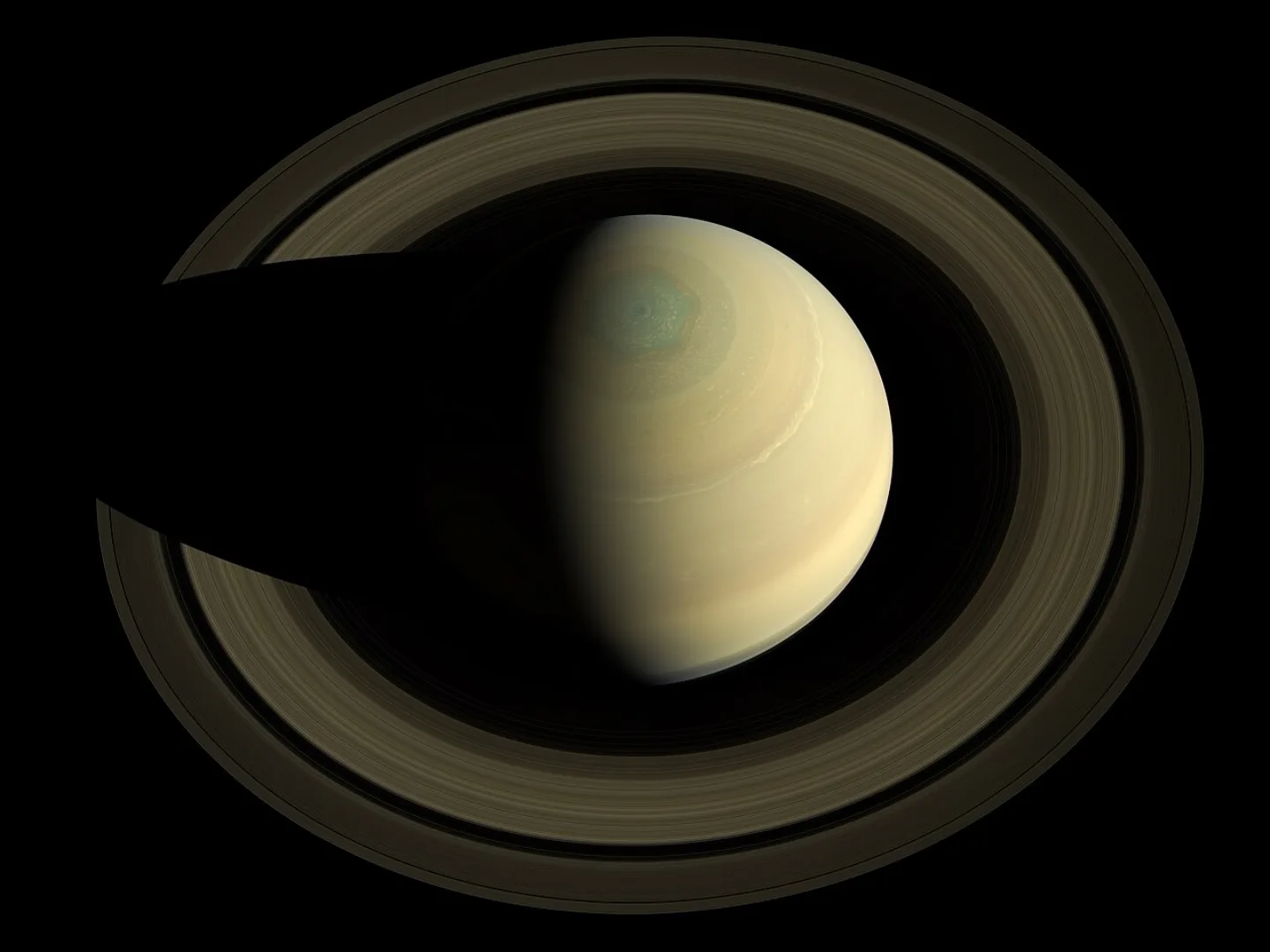 Wikimedia Commons · NASA / JPL-Caltech / SSI / Cornell · Public domain ↗
A Count With A Date
NASA records 274 confirmed moons as of March 2025, after the Minor Planet Center recognized 128 in one announcement that month; 11 more followed in March 2026. Date the figure whenever you use it — it tracks telescope sensitivity and confirmation backlog, not Saturn, and published counts disagree because their definitions differ. Almost all are irregular fragments a few kilometers across.
 FlashFeed original diagram · CC-BY-4.0
One Rung Above The Rest
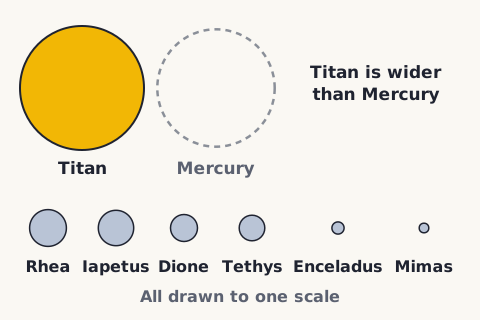
Saturn itself is about 60,250 km in radius. Its large round moons line up by mean radius: Titan 2,575 km, then Rhea 764, Iapetus 734, Dione 561, Tethys 531, Enceladus 252 and Mimas 198. Cube those and Titan holds roughly 14 times the volume of the other six put together — and Titan is wider than the planet Mercury. It is not merely first in the list; it is in a different class.
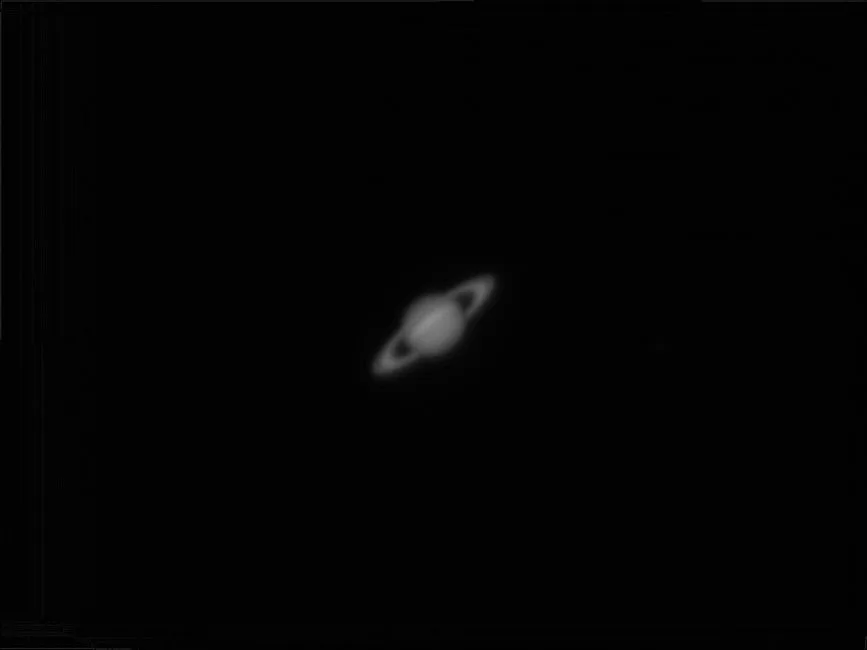 Pexels · A captivating black and white photograph of Saturn showcasing its iconic rings. ↗
Found From The Ground
Every one of Saturn's nine best-known moons was found from Earth, the first of them three and a half centuries before a spacecraft arrived. Christiaan Huygens found Titan in 1655; Giovanni Cassini found Iapetus, Rhea, Tethys and Dione between 1671 and 1684; William Herschel added Mimas and Enceladus in 1789; Hyperion came in 1848, and Phoebe — the first moon anywhere found by photography — in 1898-99.
1 / 10Saturn takes 29.4 Earth years to circle the Sun. How long does it take to spin once?
Ring seismology gives 10 h 33 m and the older Voyager figure 10 h 39 m; NASA's own fact page rounds this to about 10.7 hours. The 24-hour option is Earth's, borrowed by habit; 10.7 Earth days and 29 Earth days both assume a long year forces a long day. The two are unrelated.
Lesson 7 has 43 cards. Keep going in the free app.
Question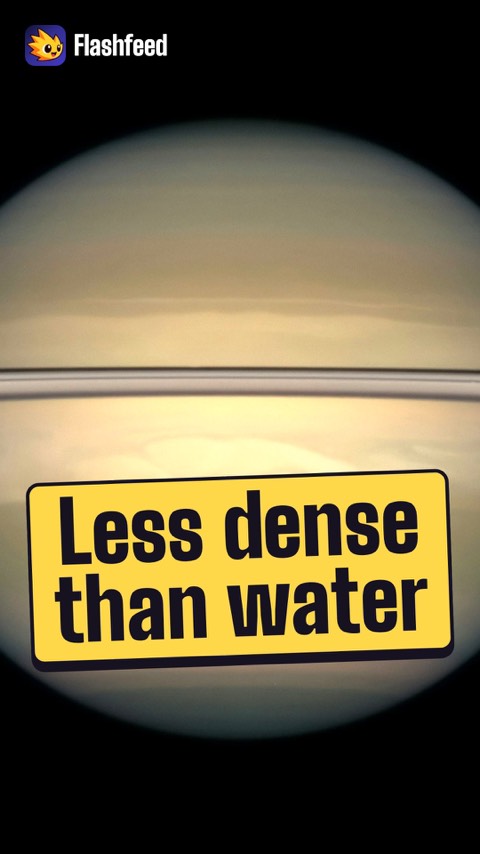
Less Dense Than Water 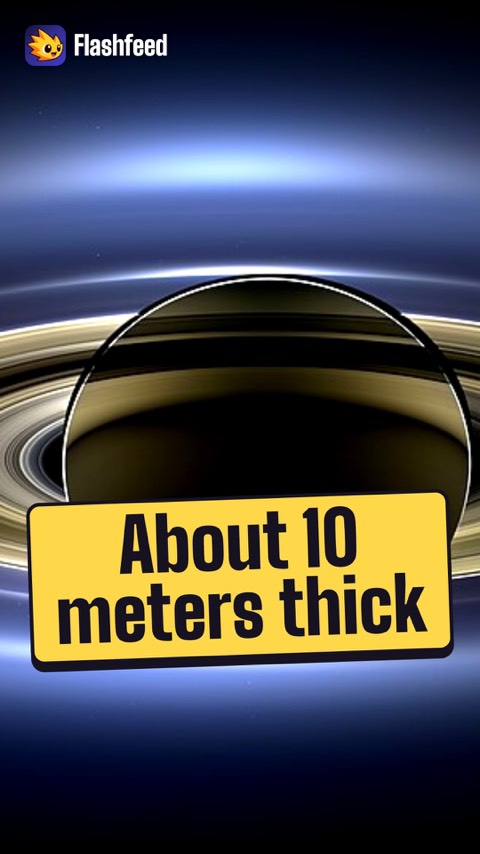
280,000 Kilometers Wide, 10 Meters Thick 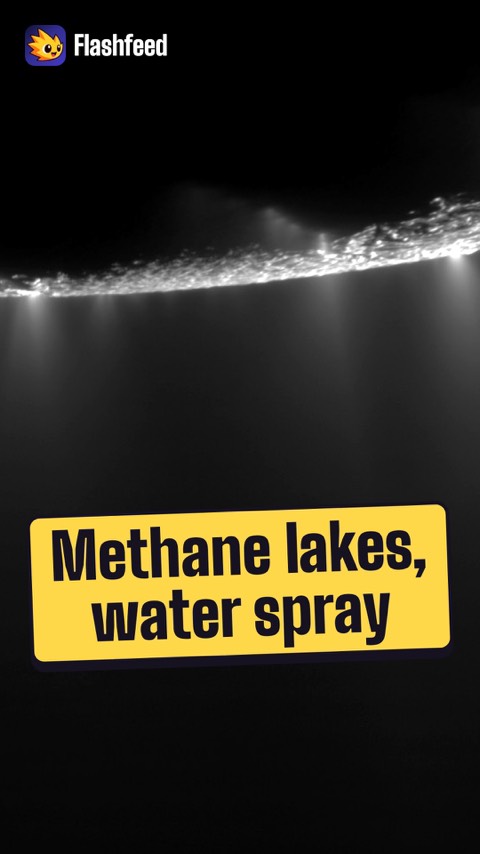
Lakes on Titan, Spray on Enceladus All 26 clips on YouTube ↗Transcripts
Less Dense Than Water
Saturn's average density is about 0.69 grams per cubic centimeter: about 30% less than water.
It's the only planet less dense than water. It's 9.4 times Earth's width, but only 95 times Earth's mass.
That doesn't mean it would float in a bathtub. Its deep interior is squeezed far denser than water.
And there's nothing to float on. Saturn has no true surface.
280,000 Kilometers Wide, 10 Meters Thick
Saturn's rings are almost entirely water ice: billions of separate chunks, from tiny grains to boulders the size of houses.
The main rings span about 280,000 kilometers, edge to edge.
But they're only around 10 meters thick. Published figures differ, so take the order of magnitude.
And the rings are draining away as ring rain. NASA says it's enough water to fill an Olympic pool every half hour.
Lakes on Titan, Spray on Enceladus
Saturn has 274 confirmed moons, as of March 2025. Two stand out.
Titan has a substantial nitrogen atmosphere, and lakes of methane and ethane. It's the only world besides Earth with standing surface liquid.
Enceladus vents water vapor from its south pole, fed by a global ocean under its crust.
Most of the spray falls back as fresh ice. That's why Enceladus is the most reflective body in the Solar System.
-
 NASA / Jet Propulsion Lab / U.S. Geological Survey · Public domain ↗08
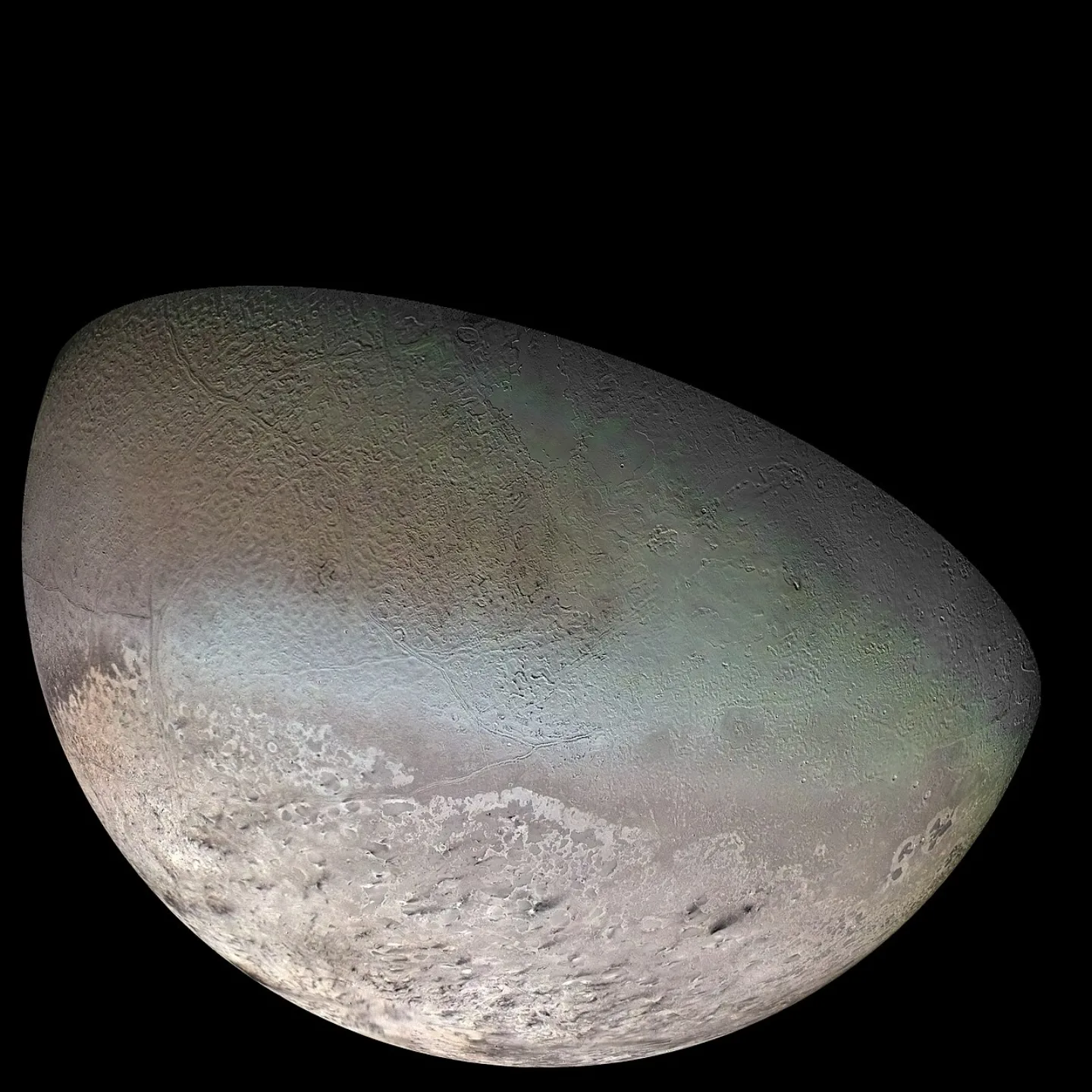
Uranus and Neptune
Why Ice Giant Is a Real Category · The Tipped World · Neptune, Found With Mathematics
Lesson 8 · 10 cards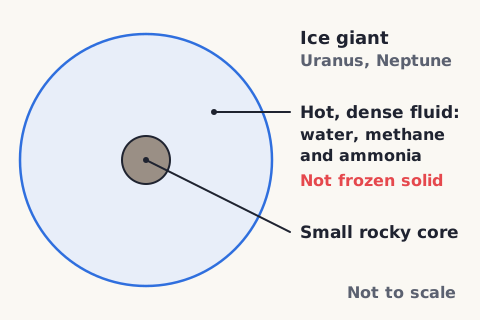 FlashFeed original diagram · CC-BY-4.0
Ices That Are Not Frozen
Jupiter and Saturn are gas giants, mostly hydrogen and helium — the same material as the Sun. Uranus and Neptune are ice giants: a hot, dense fluid of water, methane and ammonia over a small rocky core. Those compounds are called ices because out here they are normally frozen, not because they are solid inside the planet.
 Pexels · Zelch Csaba · Pexels License ↗
The Smaller, Heavier Twin
Then the ordering flips. Uranus holds 14.5 Earth masses, Neptune 17.1 — more matter in the smaller ball. What flips it is bulk density: Neptune is the densest of the four giants at 1.638 g/cm3, ahead of Jupiter at 1.326, Uranus at 1.270 and Saturn at 0.687. Note what the ladder does not say — Uranus is not denser than Jupiter despite being icier, because Jupiter's own weight squeezes its hydrogen to a comparable density.
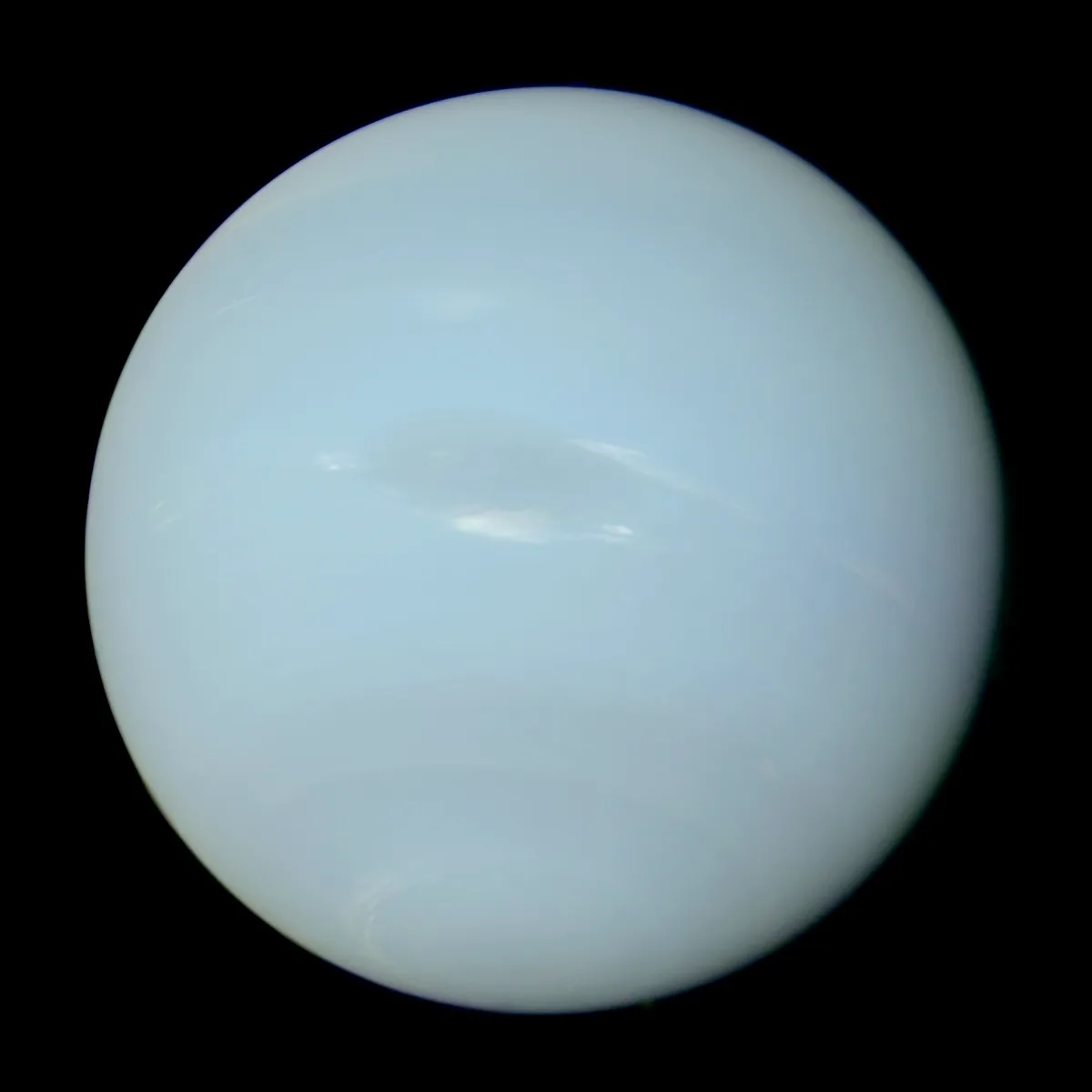 Wikimedia Commons · NASA / Voyager 2 / PDS / OPUS / Ardenau4 · CC0 ↗
One Orbit Since Discovery
Uranus orbits at about 19 astronomical units, Neptune at about 30 — the distance that also marks the inner edge of the Kuiper Belt. Uranus's year runs 84 Earth years, so a single season lasts about 21 of ours. Neptune's runs 164.79: discovered in 1846, it completed its first circuit since discovery only on 12 July 2011.
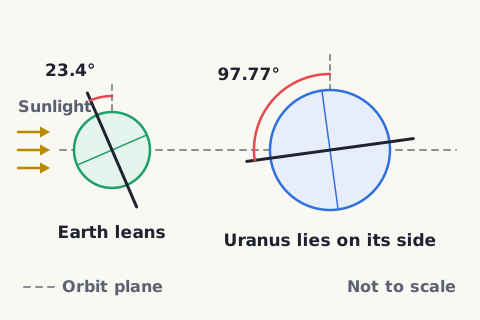 FlashFeed original diagram · CC-BY-4.0
A Planet On Its Side
Uranus's axis is tilted 97.77 degrees, against 23.4 for Earth and 28 for Neptune. Past 90 degrees the geometry changes in kind, not in degree: Uranus does not stand upright and lean, it rolls along its orbit like a barrel, poles pointing roughly at and away from the Sun. Each pole receives more sunlight across an orbit than the equator does, though measured temperatures do not follow that simply — and any tilt past 90 degrees is retrograde by definition, so the backwards spin needs no second explanation.
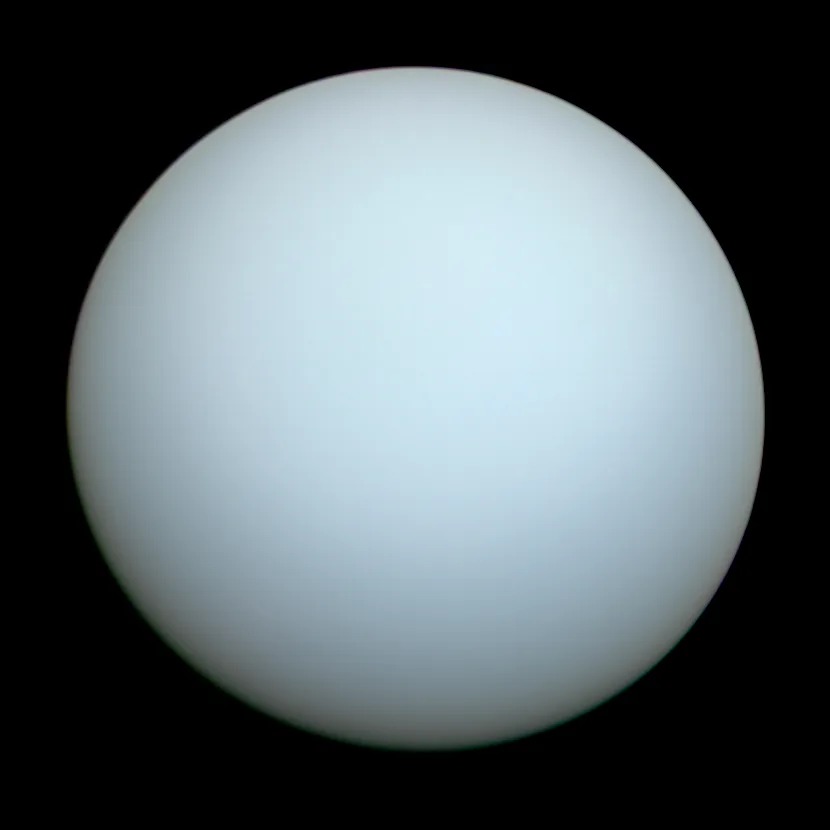 Wikimedia Commons · Ardenau4 · CC0 ↗
Why One Blue Is Paler
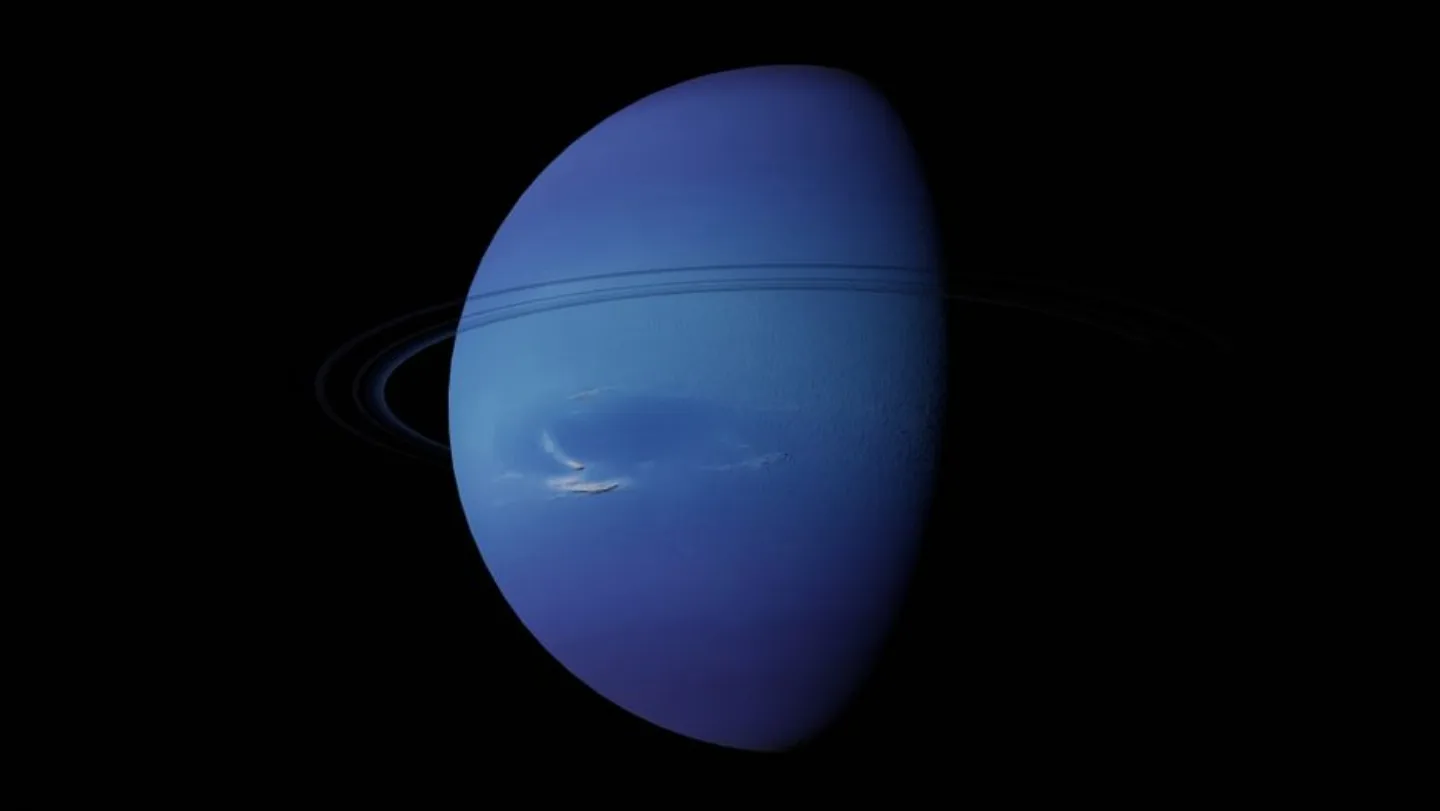
Both planets look blue-green because methane absorbs red light and lets blue and green scatter back out — gas absorption, not water, and there is no ocean to see. Yet Uranus is the paler, milkier cyan, and the two hold almost the same methane. The current explanation is haze: the layer thickens in Uranus's sluggish air, while Neptune's more turbulent atmosphere churns methane into it, where it condenses onto the particles and drags them down as methane snow.
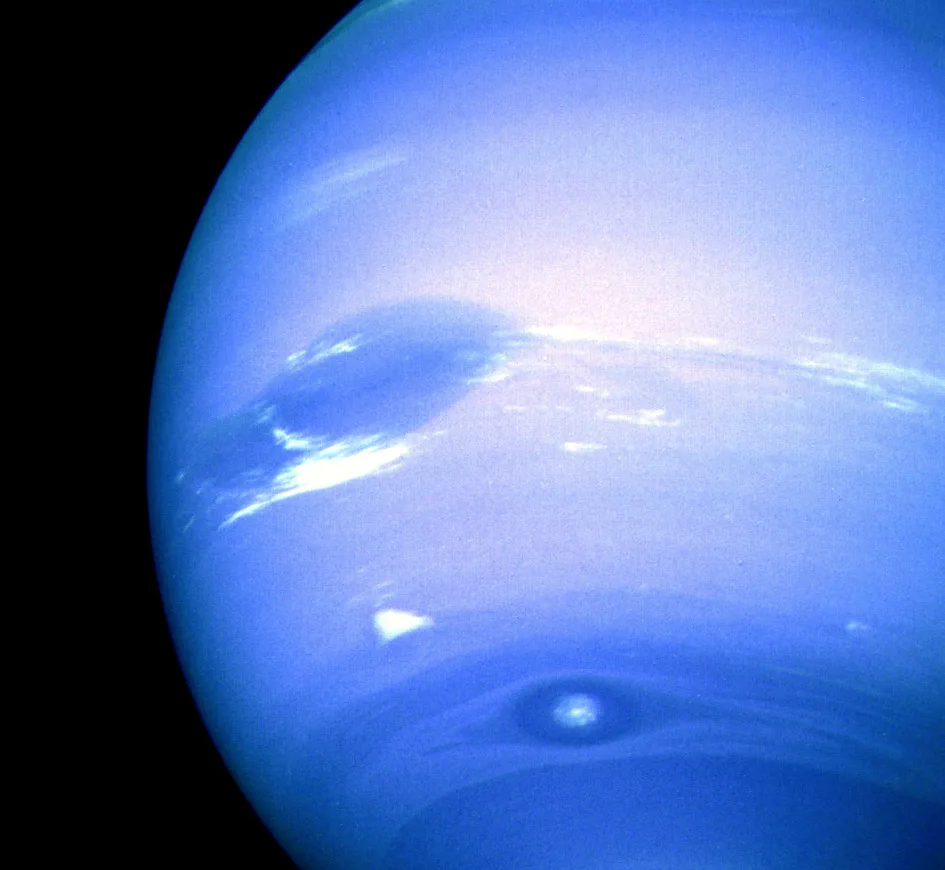 Wikimedia Commons · NASA/Voyager 2 Team · Public domain ↗
A Storm That Left
Voyager 2 photographed an Earth-sized storm in Neptune's southern hemisphere in 1989 — the Great Dark Spot, about 13,000 by 6,600 km. When Hubble looked in 1994 it had vanished. Neptune's dark storms last only a few years each, and the later ones have been separate, short-lived storms; Jupiter's Great Red Spot has persisted for well over a century.
 User Magnus Manske on en.wikipedia · Public domain ↗
Found On Paper First
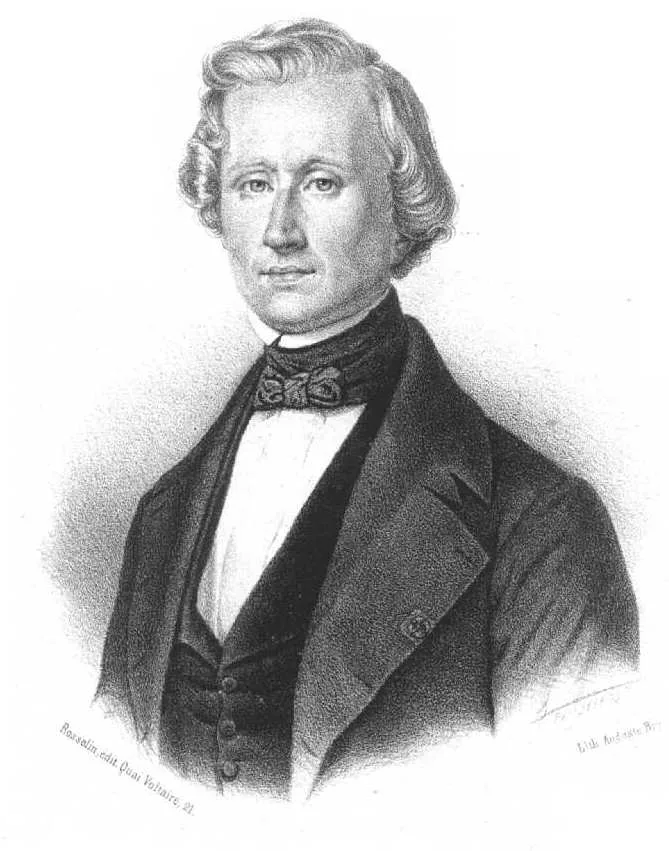
Uranus was found by accident: William Herschel spotted it on 13 March 1781 and first took it for a comet. Neptune was found the other way round. Uranus's orbit misbehaved, so Urbain Le Verrier in France and, independently, John Couch Adams in England calculated where an unseen planet must be. Johann Galle in Berlin turned a telescope on Le Verrier's figure on 23 September 1846 and found it that first night, within about a degree of the prediction.
 NASA · Public domain ↗
Rings Found By Blinking Starlight
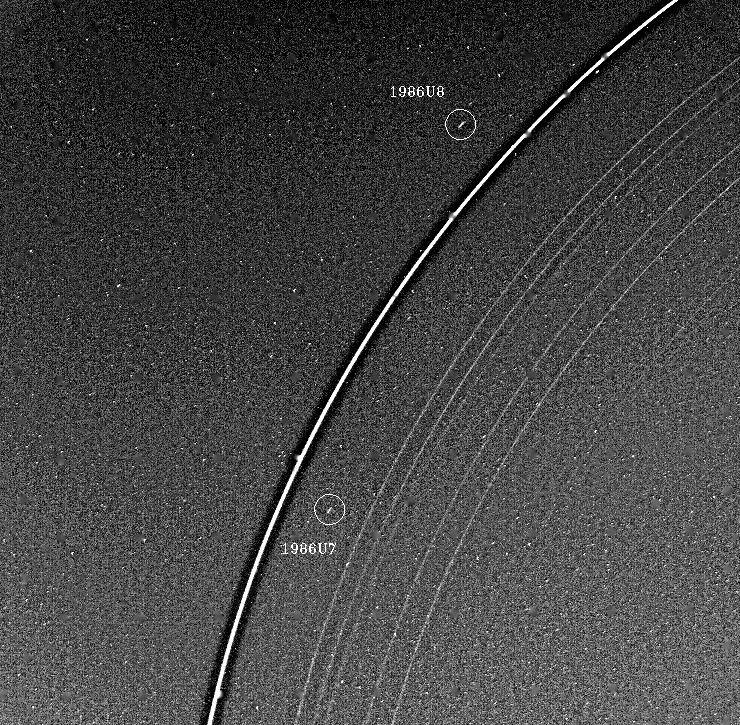
On 10 March 1977 astronomers watched Uranus pass in front of the star SAO 158687. The starlight blinked out several times before and after the planet itself covered it — Uranus has rings. They are extremely dark and very narrow, and the count is unsettled: NASA describes nine inner rings plus two outer ones, while Wikipedia lists thirteen. The telescope was airborne, and nine years early for Voyager 2.
1 / 10Neptune is narrower than Uranus yet denser. What does that say about it?
Neptune is 1.638 g/cm3 against Uranus's 1.270 — the densest of the four giants. More mass in less volume means a larger share of heavy elements, which is what separates an ice giant from a gas giant. Spin flattens a planet rather than compacting it.
Lesson 8 has 28 cards. Keep going in the free app.
Question
Ice Giants Aren't Frozen 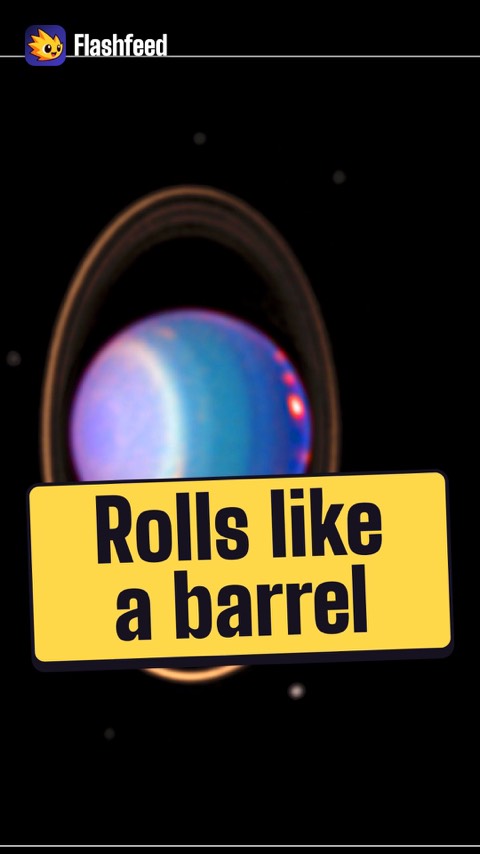
The Planet That Rolls 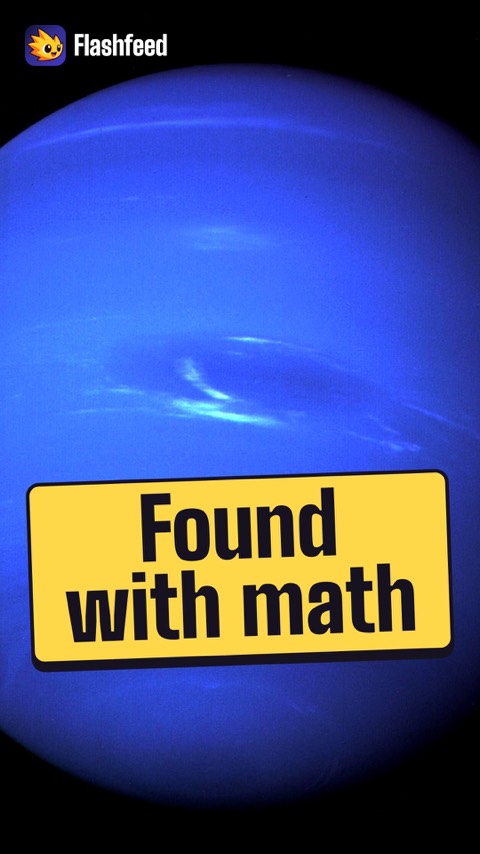
Found With Mathematics All 26 clips on YouTube ↗Transcripts
Ice Giants Aren't Frozen
Uranus and Neptune aren't gas giants. They're ice giants.
Jupiter and Saturn are mostly hydrogen and helium. The ice giants are a hot, dense fluid of water, methane and ammonia, over a small rocky core.
Nothing in there is frozen. They're called ices because those compounds normally freeze this far out.
And Neptune is the smaller of the two, but it holds more mass.
The Planet That Rolls
Uranus is tilted almost 98°. It rolls along its orbit like a barrel.
So its poles become the hottest places, not its equator. Each pole gets a long, unbroken day, then a long, unbroken night.
What tipped it? NASA says the tilt may be the result of a collision, with an impactor of at least about 2 Earth masses in simulations.
The case rests on those simulations, not on any trace of the impactor.
Found With Mathematics
Uranus was found by accident, in 1781. Neptune was found with mathematics.
Uranus's orbit didn't behave as it should. Urbain Le Verrier calculated where an unseen planet must be. John Couch Adams did the same in England.
On September 23, 1846, Johann Galle aimed a telescope at Le Verrier's spot. He found Neptune on his first night, within about a degree.
Gravity had become a prediction.
-
 Wikimedia Commons · Unknown author · Public domain ↗09
Asteroids, Meteors and Dwarf Planets
The Asteroid Belt · Meteoroid, Meteor, Meteorite · Dwarf Planets and the 2006 Vote
Lesson 9 · 10 cardsWikimedia Commons · Unknown author · Public domain ↗An Unfinished Planet
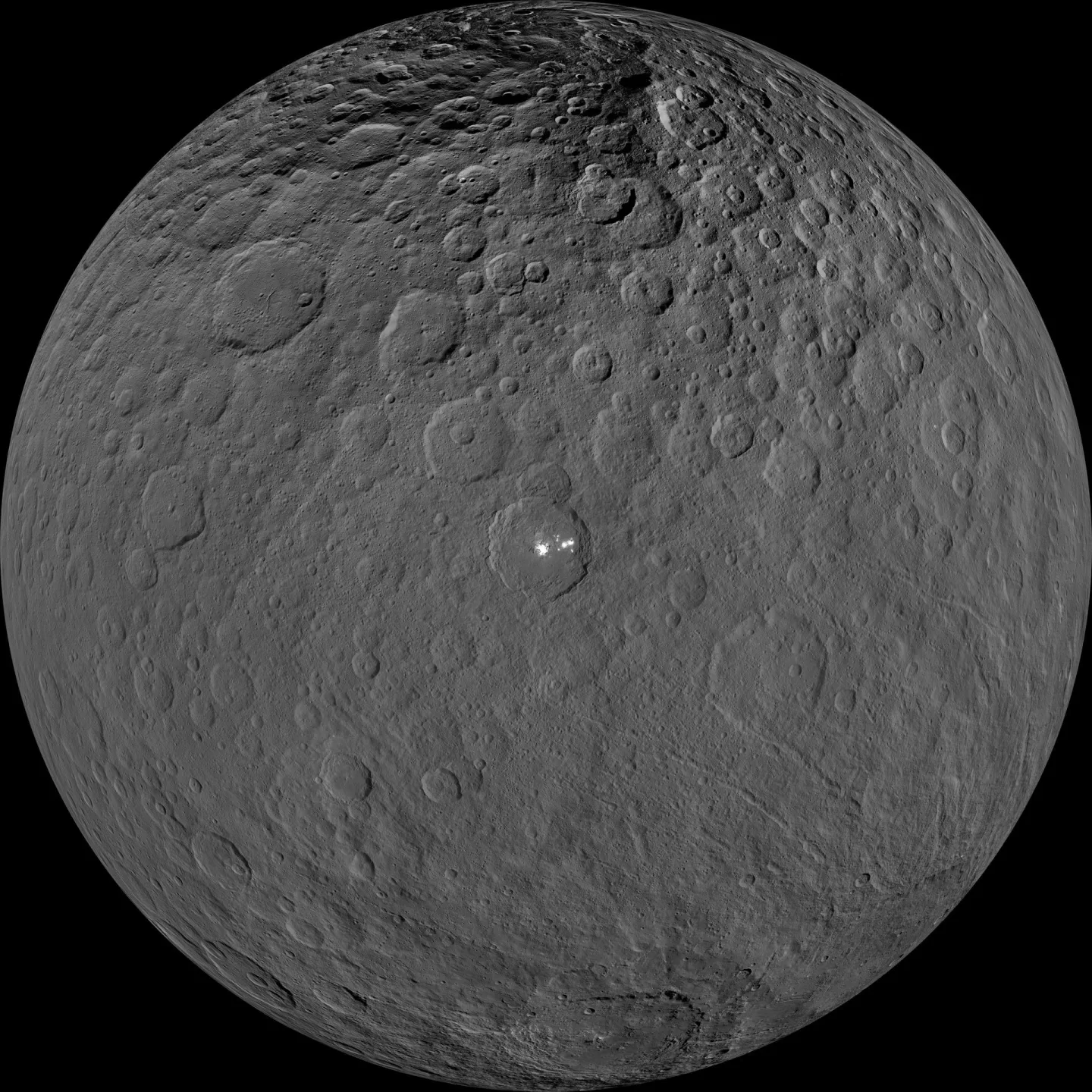
No planet formed between Mars and Jupiter because Jupiter's gravity kept the local planetesimals agitated — instead of merging they collided and fragmented, and those fragments are the asteroids. The belt is an unfinished planet, not a broken one, and the arithmetic agrees: everything in it put together weighs less than Earth's Moon, with Ceres alone holding about 25 percent of that total.
 FlashFeed original diagram · CC-BY-4.0
Emptier Than It Looks
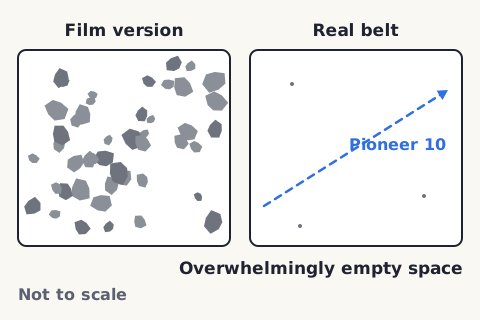
The main belt holds an estimated 1.1 to 1.9 million asteroids larger than 1 km and is still overwhelmingly empty space. Spacecraft cross it with virtually no chance of a collision: Pioneer 10 entered the belt on 15 July 1972 and emerged in February 1973. The film version has it backwards — reaching even one asteroid takes deliberate aim.
 Wikimedia Commons · NASA / JPL / MPS / DLR / IDA / Björn Jónsson · Public domain ↗
The Asteroid That Melted
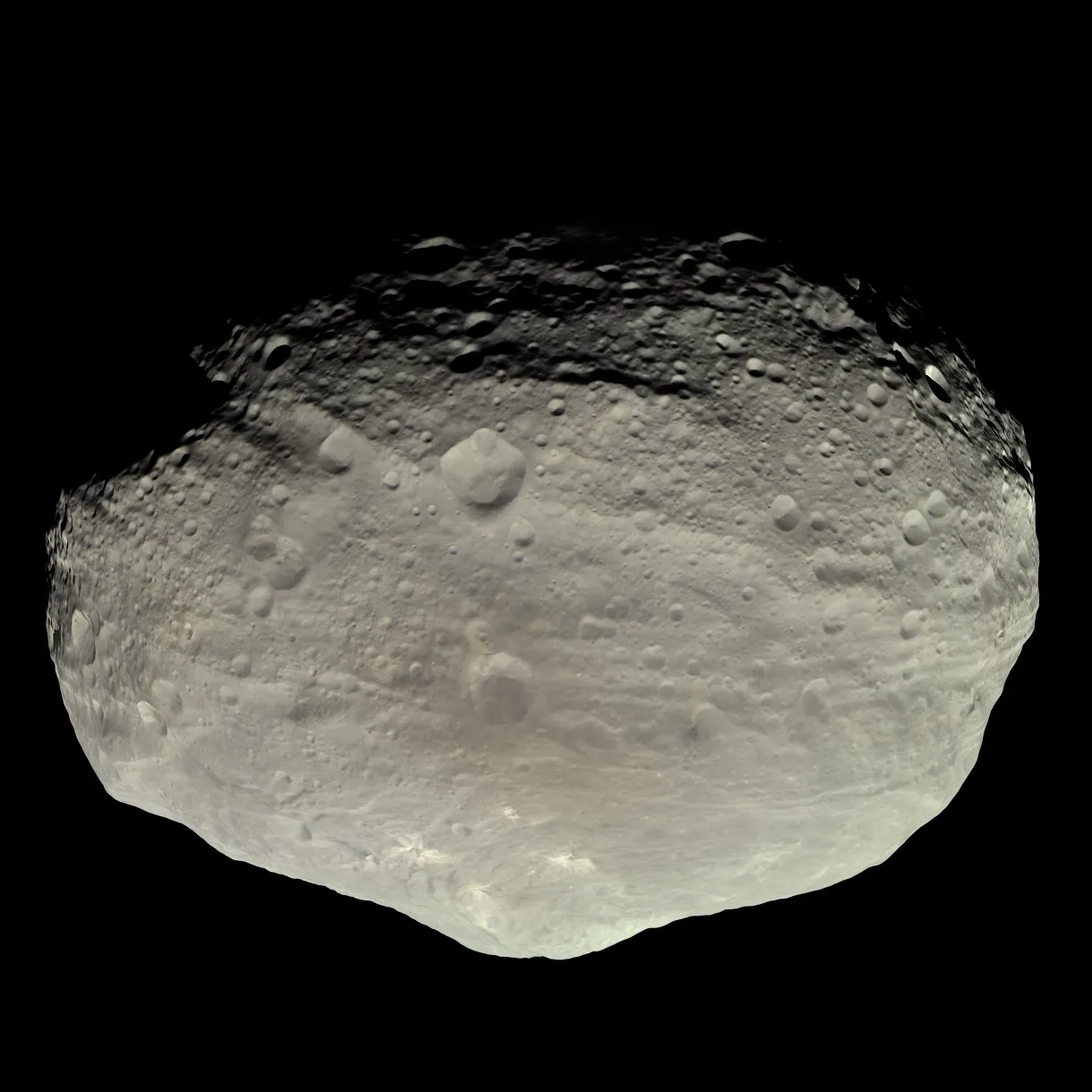
Vesta, about 523 km across, is the largest asteroid and the odd one out. Most asteroids are unprocessed rubble; Vesta is differentiated — it melted early and separated into crust, mantle and core, like a small planet. NASA's Dawn orbited it from 16 July 2011 to 5 September 2012 before flying on to Ceres — the one body in the belt more massive still, and the reason Vesta holds the title of largest asteroid at all: at 939 km Ceres was reclassified as a dwarf planet in 2006 and stopped counting as one.
 FlashFeed original diagram · CC-BY-4.0
Parking Spaces at Sixty Degrees
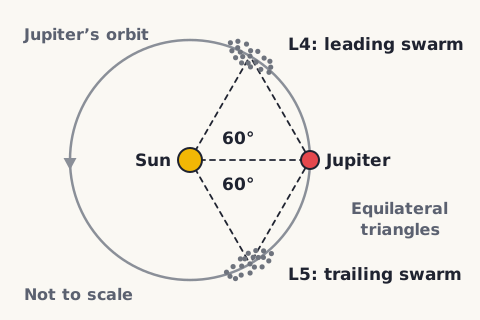
Jupiter's Trojan asteroids do not orbit Jupiter. They share its orbit around the Sun in two swarms that lead and trail the planet by 60 degrees, at the L4 and L5 Lagrange points — each swarm sitting at the third corner of an equilateral triangle with Jupiter and the Sun. Together the swarms may rival the main belt in number; the largest Trojan is about 250 km wide. NASA's Lucy, launched 16 October 2021, is the first mission to visit them.
 FlashFeed original diagram · CC-BY-4.0
Three Words, Three Places
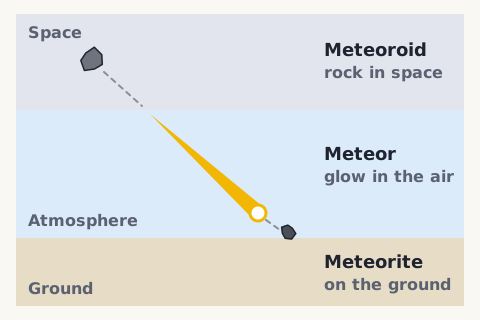
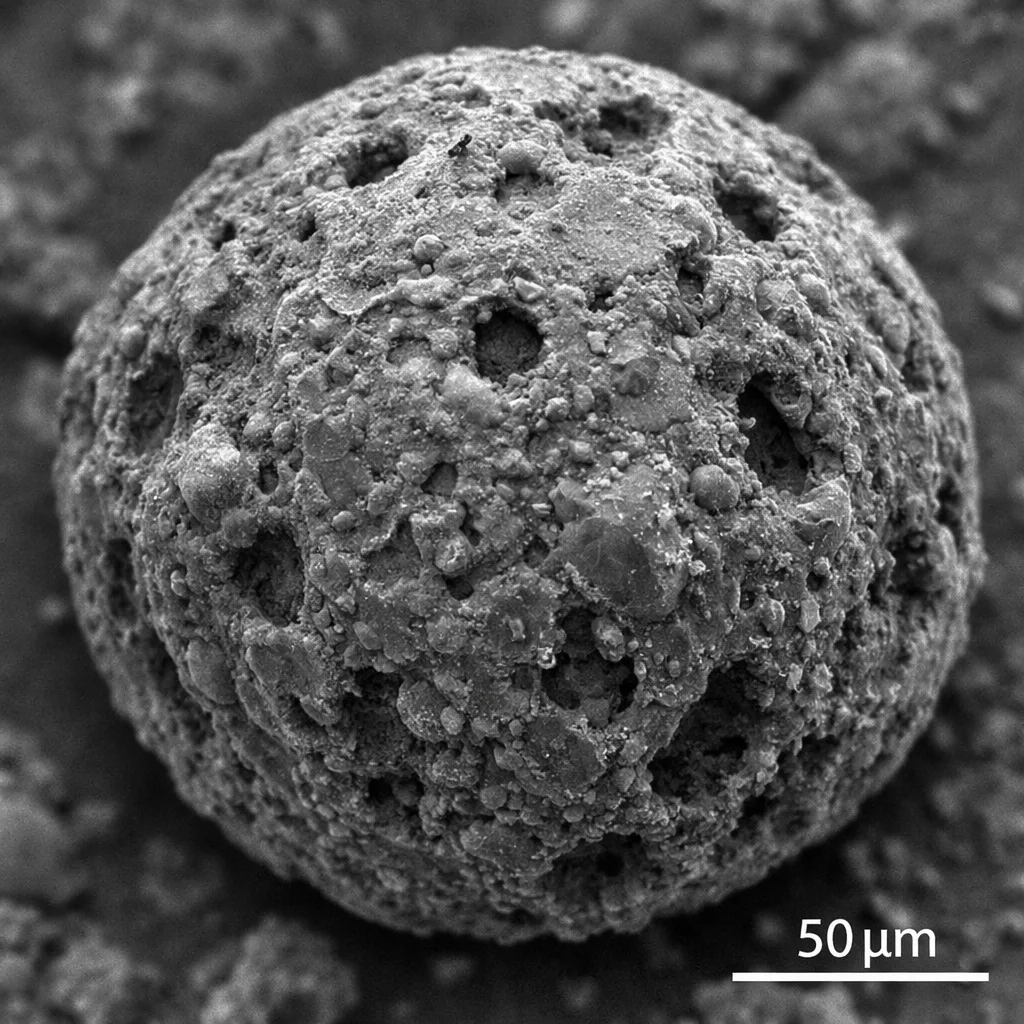
A meteoroid is the rock while it is still in space — anything from a dust grain to a small asteroid. A meteor is the streak of light made when that rock enters the atmosphere at speed and burns up. A meteorite is what is left if a fragment survives the fall and reaches the ground. The middle word is the one that trips people: a meteor is not an object at all, it is the glow of heated air and vaporized rock.
 AI-generated (gpt-image-1.5)
Forty-Four Tonnes a Day
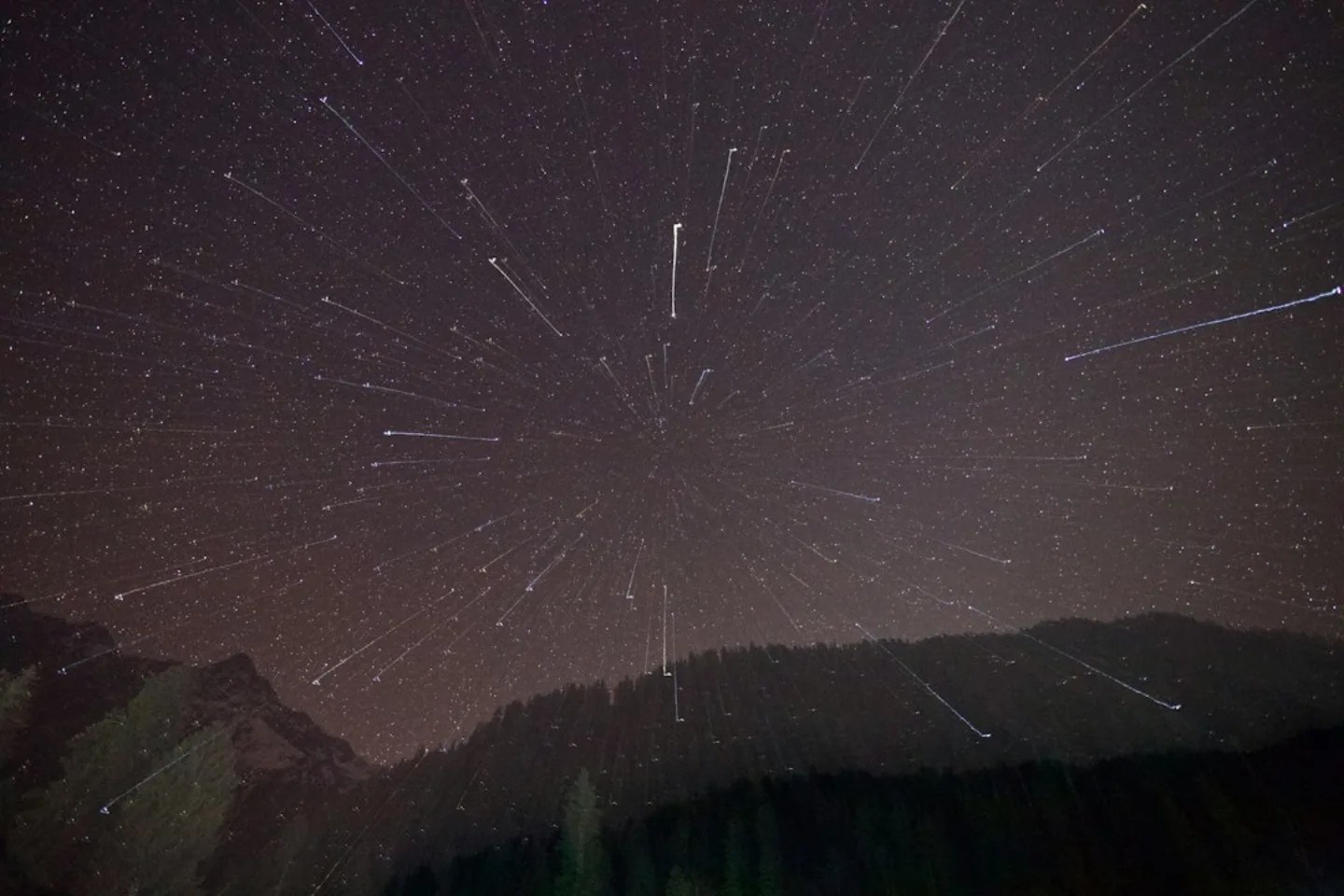
NASA estimates that about 44 tonnes of meteoritic material falls on Earth every day, and almost all of it is dust too small to notice. Treat that as an estimate rather than a measurement: Royal Museums Greenwich quotes about 14 tonnes a day for space dust specifically, and published figures span roughly 5 to 50 tonnes depending on which particle sizes get counted.
 Unsplash · Shreshth Gupta · Unsplash License ↗
Named for a Perspective
An annual meteor shower is Earth crossing a stream of dusty debris shed along the orbit of a comet — or, more rarely, an asteroid, which is why the same showers return on the same dates. The Perseids peak on 12–13 August, and every Perseid is a fragment of comet 109P/Swift-Tuttle, whose nucleus is about 26 km across. A shower is named for its radiant, the constellation the meteors appear to stream from — a perspective effect, not an origin.
 H. Raab (User:Vesta) · CC BY-SA 3.0 ↗
Stony Falls, Iron Finds
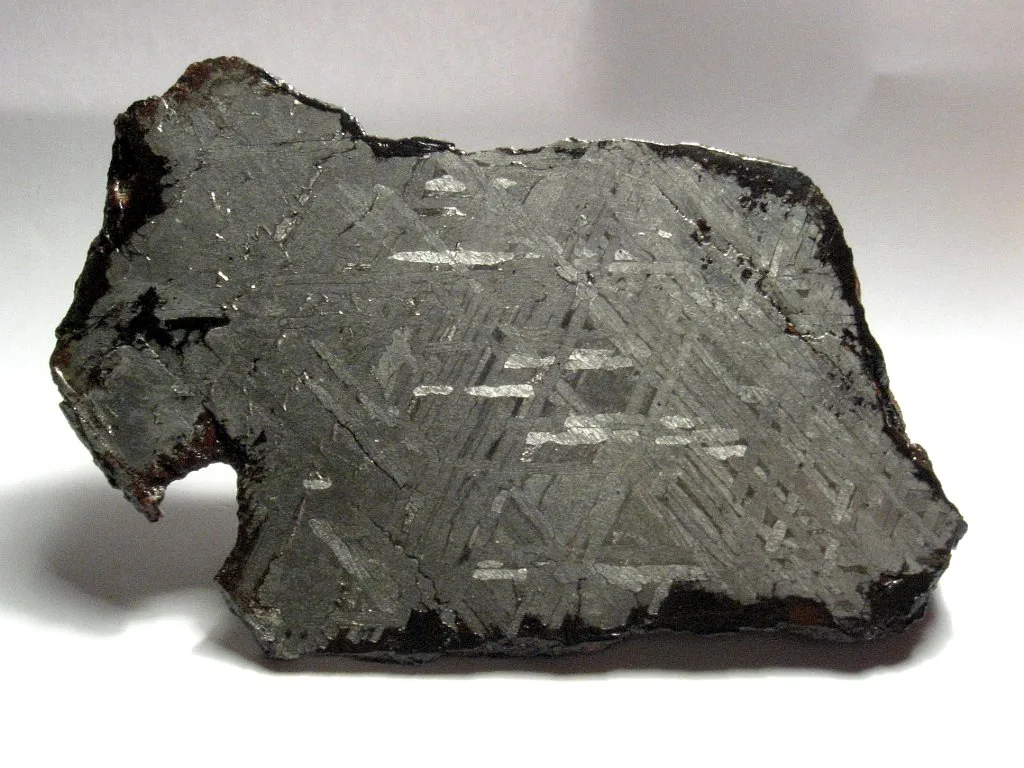
What lands comes in three kinds: stony meteorites are mainly silicate rock, iron mainly iron-nickel metal, stony-iron roughly equal parts of both. More than 95 percent of meteorites seen to fall are stony. Irons are over-represented in collections because they weather slowly and look nothing like Earth rock, so they keep being picked up as finds long after landing.
 FlashFeed original diagram · CC-BY-4.0
The Test That Decides
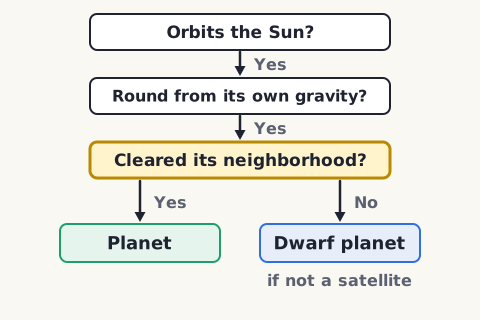
The International Astronomical Union's 2006 definition sets three tests. A planet orbits the Sun. It has enough mass for its own gravity to pull it into a nearly round shape — hydrostatic equilibrium. And it has cleared the neighborhood around its orbit. A body that passes the first two, fails the third and is not a satellite is a dwarf planet. The third test is not about size: it asks whether a body gravitationally dominates its orbital zone.
 Wikimedia Commons · NASA, ESA, and M. Brown (California Institute of Technology) · Public domain ↗
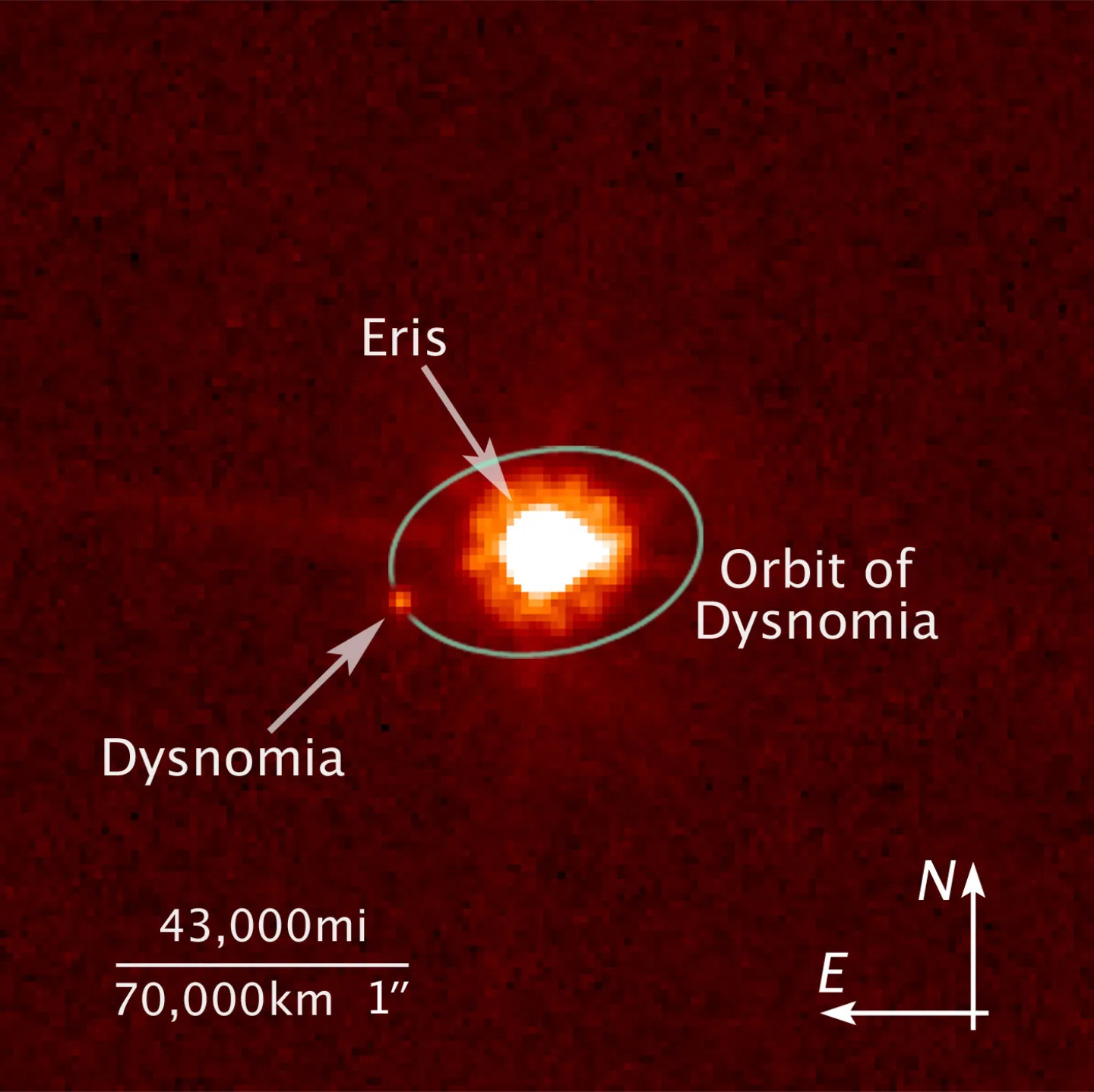
The Object That Forced It
In January 2005 Mike Brown, Chad Trujillo and David Rabinowitz identified Eris on images taken two years earlier. Timing its moon showed Eris is about 27 percent more massive than Pluto — a body beyond Neptune that outweighed the ninth planet. Either Eris was a planet too, or the word needed a definition. The IAU chose the definition in 2006.
1 / 10Why is there no planet in the main asteroid belt?
Everything in the belt together weighs less than Earth's Moon, so no planet was ever blown apart to supply it — and neither the Sun nor a passing star is involved. Jupiter's pull kept the planetesimals colliding and fragmenting instead of merging.
Lesson 9 has 35 cards. Keep going in the free app.
Question
Mostly Empty 
Three Words, Three Places 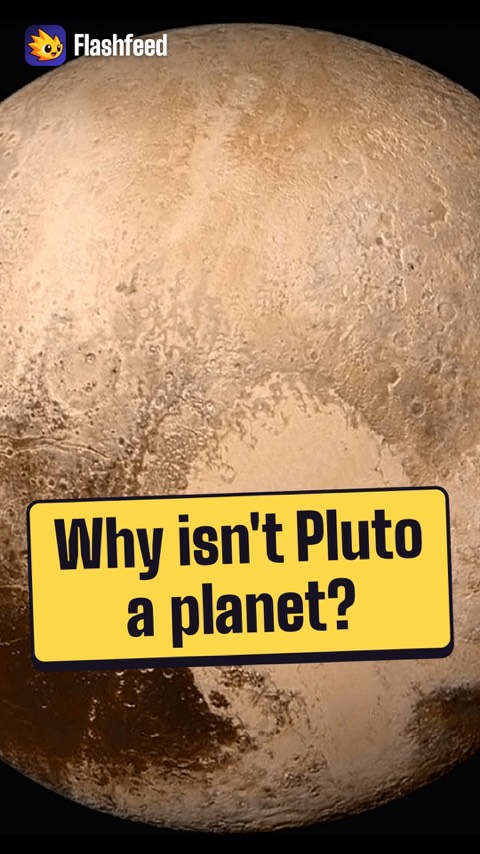
The Third Test All 26 clips on YouTube ↗Transcripts
Mostly Empty
In films, the asteroid belt is a crowded field of rock. The real one is mostly empty.
An estimated 1.1 to 1.9 million asteroids larger than a kilometer spread through a huge volume. Pioneer 10 crossed it in 1972 and 1973 with no trouble.
And it was never a planet that exploded. Everything in the belt weighs less than Earth's Moon.
Jupiter's gravity kept the pieces from ever merging into a planet.
Three Words, Three Places
Three words for three places. A meteoroid is the rock while it's still in space.
A meteor is the streak of light when the rock burns up in the atmosphere. It isn't an object at all.
A meteorite is what's left if a piece reaches the ground.
NASA estimates that about 44 tonnes of this material falls on Earth every day, nearly all of it dust. Published figures run from about 5 to 50 tonnes.
The Third Test
In 2005, astronomers found Eris: about as wide as Pluto, and about 27% more massive.
So in 2006, the IAU wrote 3 tests for a planet. It orbits the Sun. Its gravity pulls it nearly round. And it has cleared its orbital neighborhood.
Pluto fails the third test. It shares its zone with other Kuiper Belt objects.
There's no size test at all. Nothing about Pluto changed. What changed was what turned up next door.
-
 Wikimedia Commons · NASA/Johns Hopkins University Applied Physics Laboratory/Southwest Research Inst · Public domain ↗10
The Kuiper Belt, Comets and the Outer Edge
The Kuiper Belt · Comets · Where Does the Solar System End?
Lesson 10 · 10 cards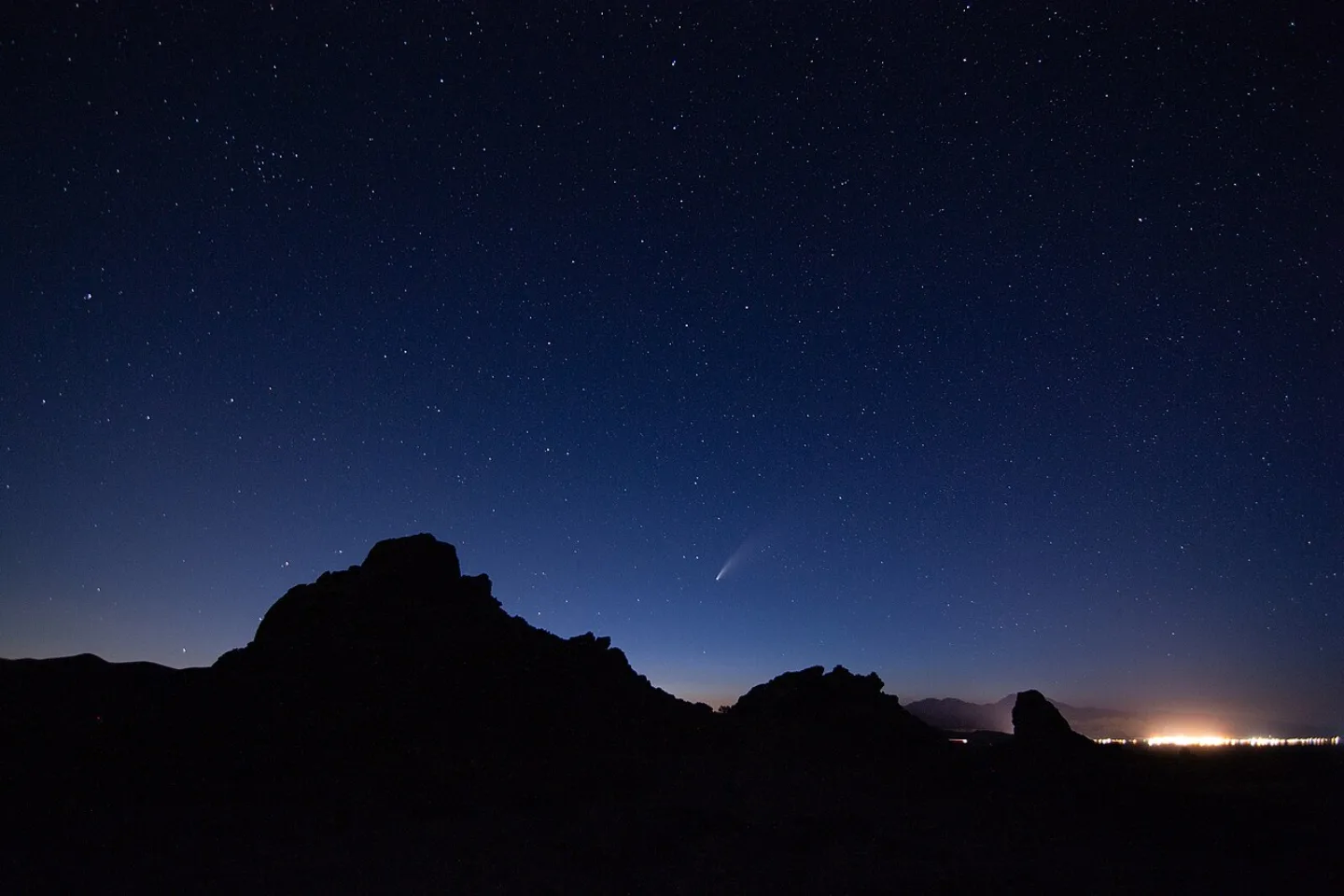 Wikimedia Commons · RuggyBearLA · CC BY 2.0 ↗
Nothing About It Burns
A comet is a cosmic snowball of frozen gases, rock and dust. Nothing about it is on fire: the glow is sunlight scattered and re-emitted, not combustion. Because a comet spends nearly all of its orbit in deep freeze far from the Sun, its material still holds the composition of the disc the planets formed from — each one is a 4.6-billion-year-old sample that delivers itself to the inner Solar System.
 FlashFeed original diagram · CC-BY-4.0
Ice, Twenty Times Out
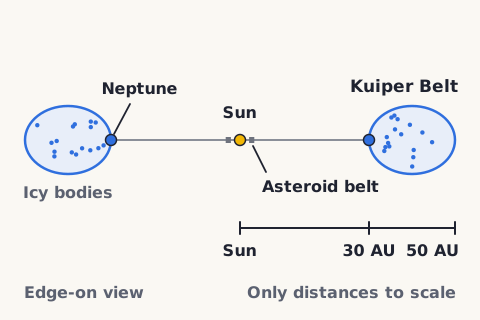
Beyond Neptune the disc of the Solar System does not stop — it thins. The Kuiper Belt is a thick, doughnut-shaped ring of icy leftovers whose main region runs from about 30 to 50 AU: the asteroid belt's idea, twenty times further out and built of ice rather than rock. It is not a thin flat band, and it is not the Oort Cloud. For all that reach, NASA puts the whole belt's mass at no more than about a tenth of Earth's.
 NASA/JHUAPL/SwRI · Public domain ↗
Pluto Has Neighbors
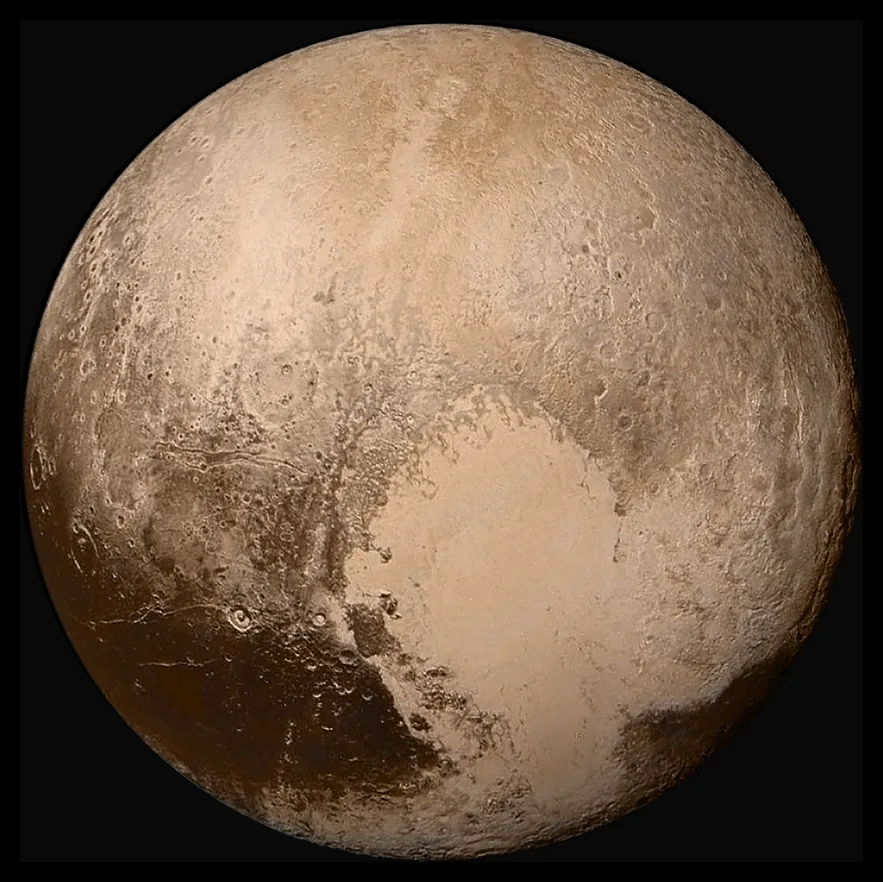
Pluto was the first Kuiper Belt object ever discovered, in 1930, though nobody could have known it then. NASA now describes it as a member of the belt: 2,377 km across, averaging 39 AU from the Sun, 248 years to a lap. The 2006 reclassification was not a demotion invented by committee — it was the recognition that Pluto has company. Eris, about 2,400 km at 68 AU, is so close in size that NASA's own pages leave the two effectively tied.
Wikimedia Commons · NASA/Johns Hopkins University Applied Physics Laboratory/Southwest Research Inst · Public domain ↗Two Lobes, Touching
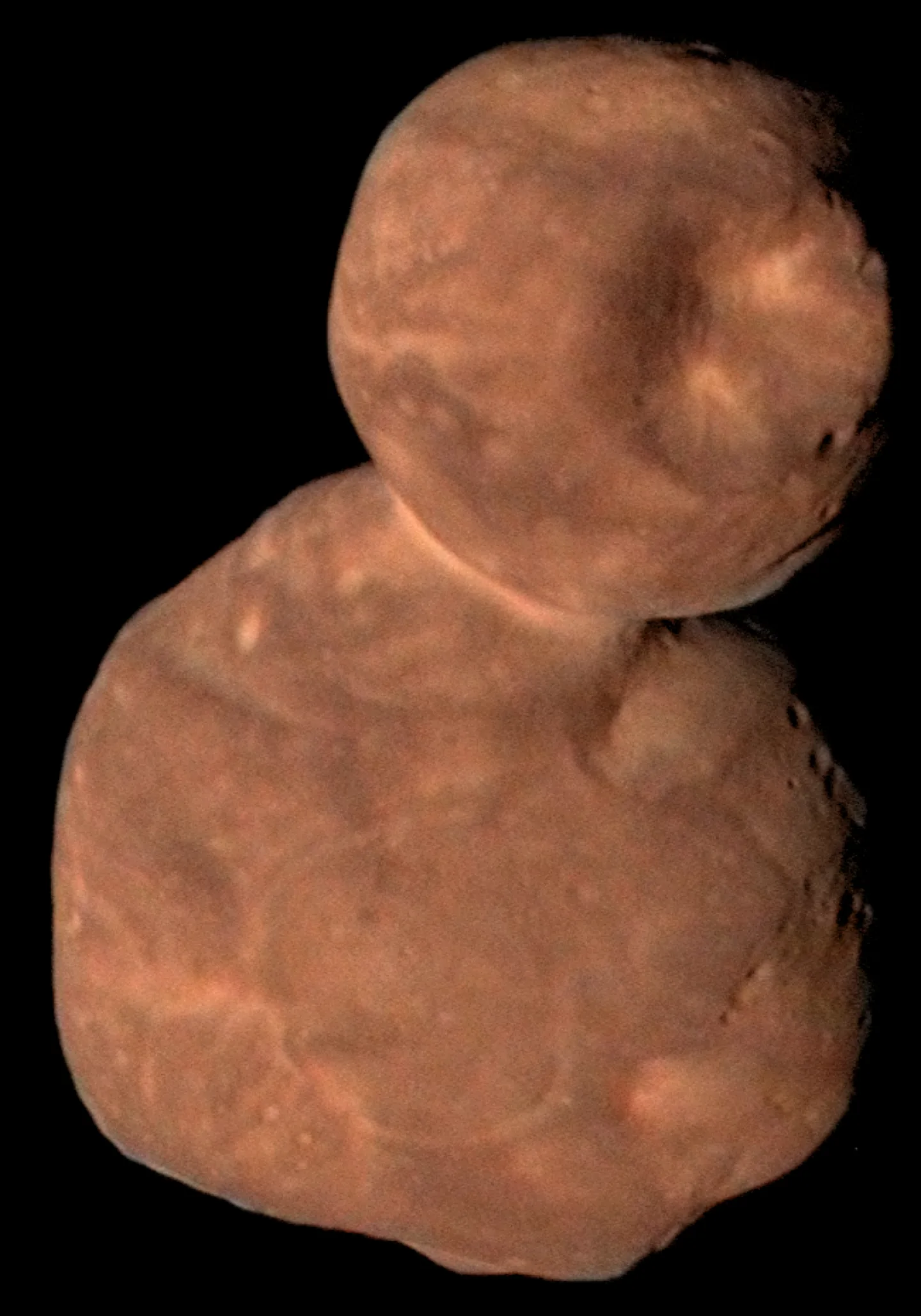
On 1 January 2019 New Horizons passed within 3,538 km of Arrokoth, a Kuiper Belt body about 35 km end to end — the most distant object any spacecraft has reached. It is a contact binary: two rounded lobes resting against each other, poles and equators aligned. That alignment reads as a co-orbiting pair that merged gently at low speed, offered as support for the pebble-cloud collapse model of planet-building rather than a history of high-speed crashes. It is a model fitted to evidence.
 FlashFeed original diagram · CC-BY-4.0
Bigger Than Most Planets
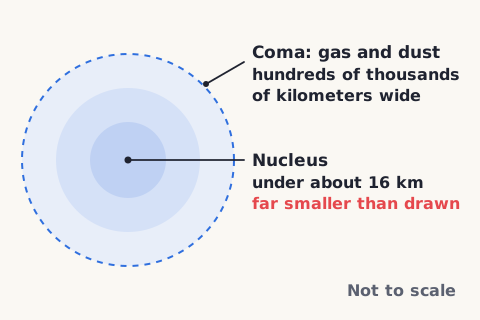
The comet proper is the nucleus, usually under about 16 km across — a frozen block the size of a town. What you see is not that. Sunlight drives gas and dust off the nucleus into a coma, a glowing head that can swell to hundreds of thousands of kilometers, larger than most planets. The bright fuzzy object in the sky is almost entirely material that has already left the comet.
 Wikimedia Commons · E. Kolmhofer, H. Raab; Johannes-Kepler-Observatory, Linz, Austria · CC BY-SA 3.0 ↗
Two Tails, Two Forces
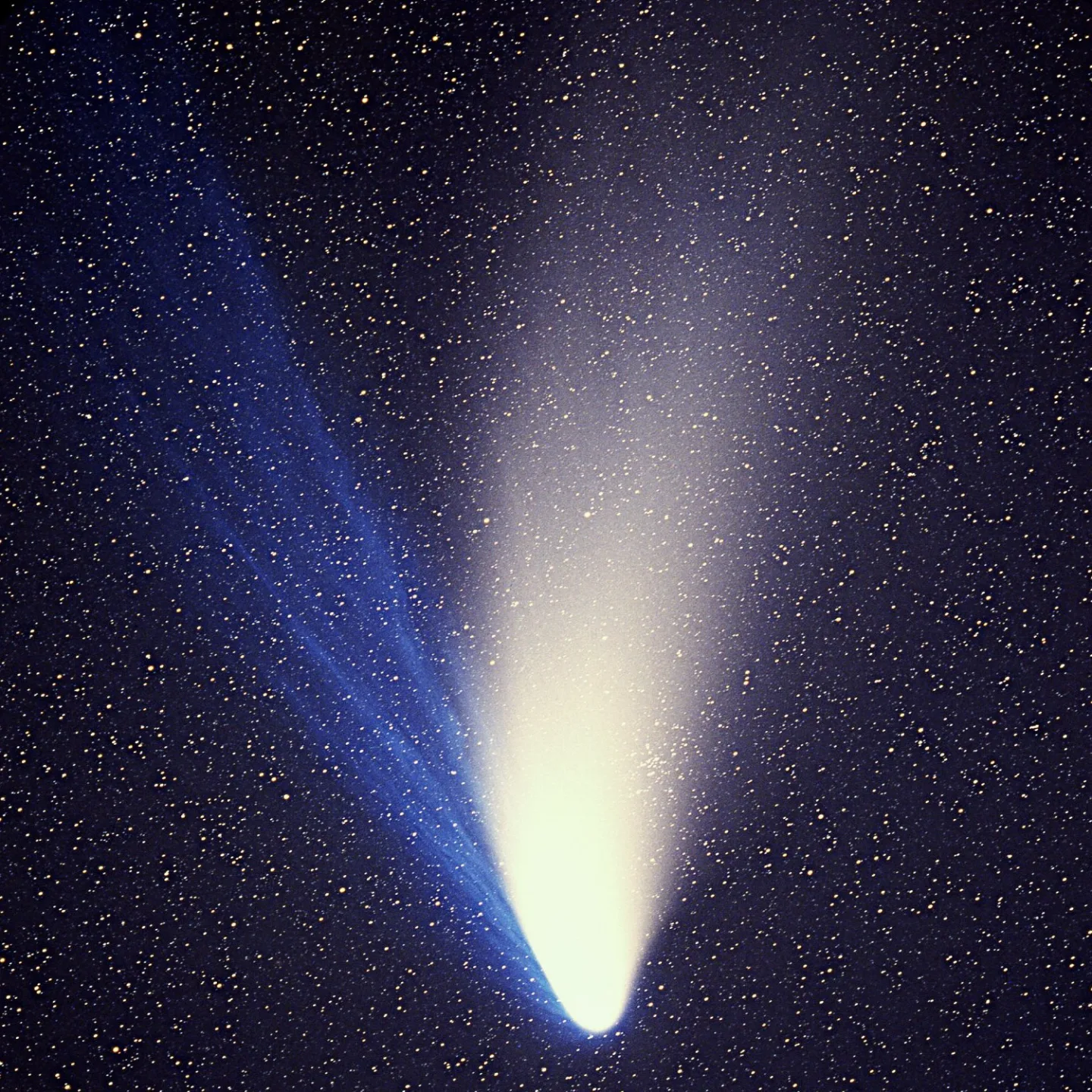
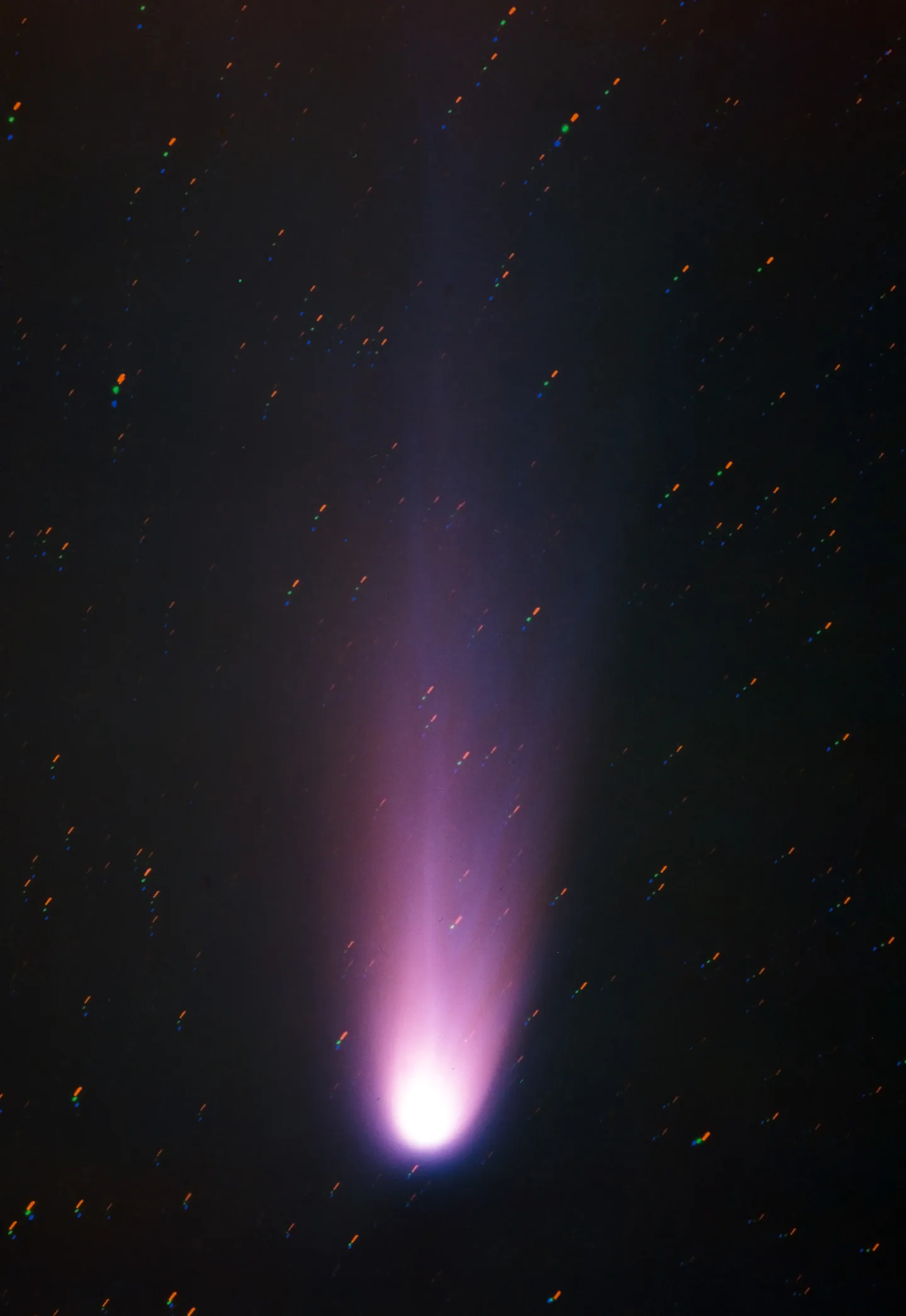
Bright comets show two tails. The bluish ion tail is charged gas swept out by the solar wind and points directly away from the Sun. The whitish dust tail is heavier grains pushed by the pressure of sunlight; they keep some of the comet's orbital motion, so that tail lags and curves. Neither is a wake. The direction is set by the Sun, not by the comet's travel — which is why on the outbound leg a comet moves tail-first.
 ESO (Openverse) · by 4.0 ↗
An Average, Not a Timetable
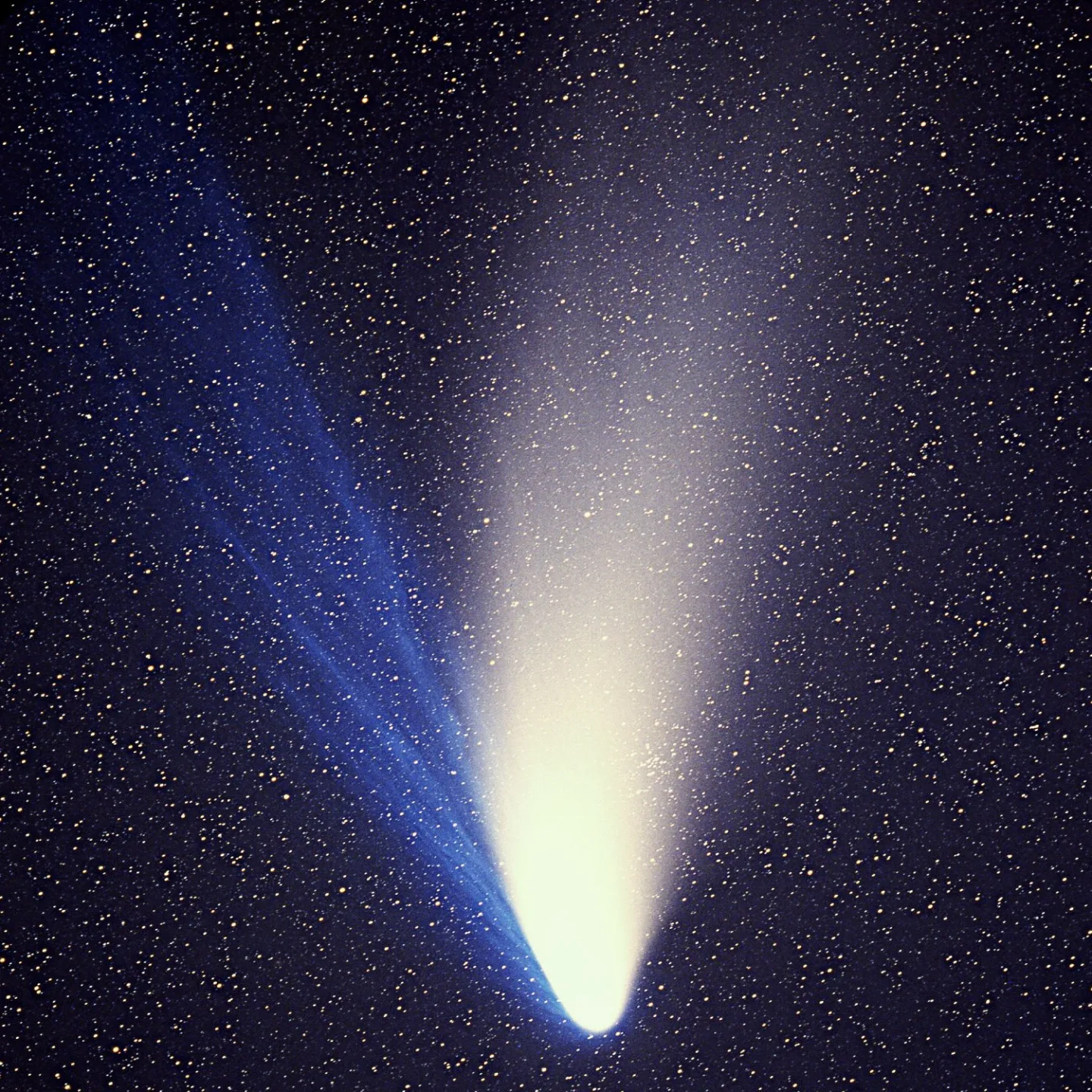
Halley's Comet returns on average every 76 years — an average, not a schedule: the giant planets tug the orbit and the real gap has run from 74 to 80 years. Its first certain record is from 240 BCE, it last rounded the Sun in February 1986, and it returns in 2061. Its shed dust rings the whole orbit, and Earth's path cuts that ring twice a year: the Eta Aquarids in May and the Orionids in October. A meteor shower does not mean a comet is nearby.
 Wikimedia Commons · E. Kolmhofer, H. Raab; Johannes-Kepler-Observatory, Linz, Austria · CC BY-SA 3.0 ↗
Big Nucleus, Long Show
Hale-Bopp stayed visible to the naked eye for 18 months across 1996 and 1997 — not because it came close to Earth, but because its nucleus is around 60 km across, roughly four times Halley's. A great comet can be made by size and activity rather than by proximity — Hyakutake, in the same decade, was the other way round. NEOWISE, whose nucleus is about 5 km, was found only three months before it brightened in 2020. That is normal: a long-period comet stays dark and tiny until the Sun heats it.
1 / 10Pluto's orbit crosses inside Neptune's. What timing keeps the two apart?
Pluto goes round the Sun twice for every three Neptune orbits, so it always reaches the crossing point when Neptune is somewhere else. Tilt alone would not hold that pattern, size has nothing to do with whether two orbits meet, and gravity attracts.
Lesson 10 has 38 cards. Keep going in the free app.
Question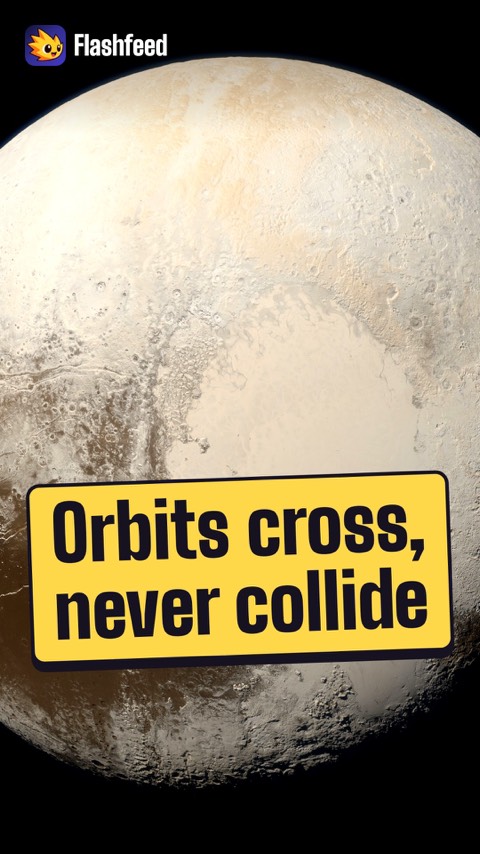
The 3:2 Resonance 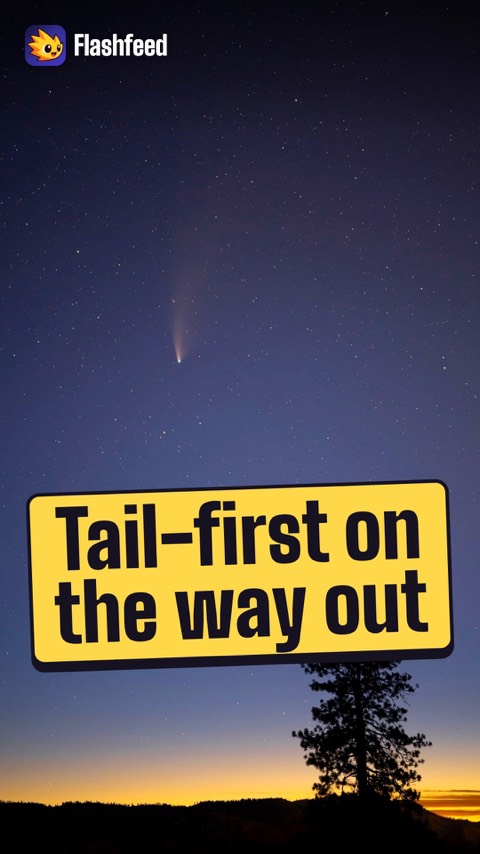
Tail-First 
Three Edges All 26 clips on YouTube ↗Transcripts
The 3:2 Resonance
Pluto's orbit crosses inside Neptune's. Yet the two can never collide.
They're locked in a 3 to 2 resonance. Pluto goes around the Sun twice for every 3 Neptune orbits.
So Pluto always reaches the crossing point when Neptune is somewhere else.
Pluto was the first Kuiper Belt object found, in 1930. NASA estimates the belt holds hundreds of thousands of bodies wider than 100 kilometers.
Tail-First
A comet's tail isn't a trail behind it. The Sun sets its direction.
The bluish ion tail points straight away from the Sun. The whitish dust tail curves, because heavier grains lag behind.
So on its way out, a comet travels tail-first.
The glowing head is the coma. It can swell larger than most planets. The solid nucleus is usually under about 16 kilometers across.
Three Edges
Voyager 1 crossed the heliopause in 2012. That's where the gas between the stars stops the solar wind.
But it hasn't left the Solar System. Both Voyagers are still held by the Sun's gravity.
The Kuiper Belt thins out near 50 astronomical units. The heliopause is near 120.
NASA puts the edge beyond the Oort Cloud, a theorized shell estimated to reach 10,000 to 100,000 astronomical units.
-
 NASA, ESA, CSA, STScI · CC BY 4.0 ↗11
How the Solar System Formed
From Cloud to Disc · Building Planets · Reading the Evidence
Lesson 11 · 10 cardsNASA, ESA, CSA, STScI · CC BY 4.0 ↗Caught In The Act
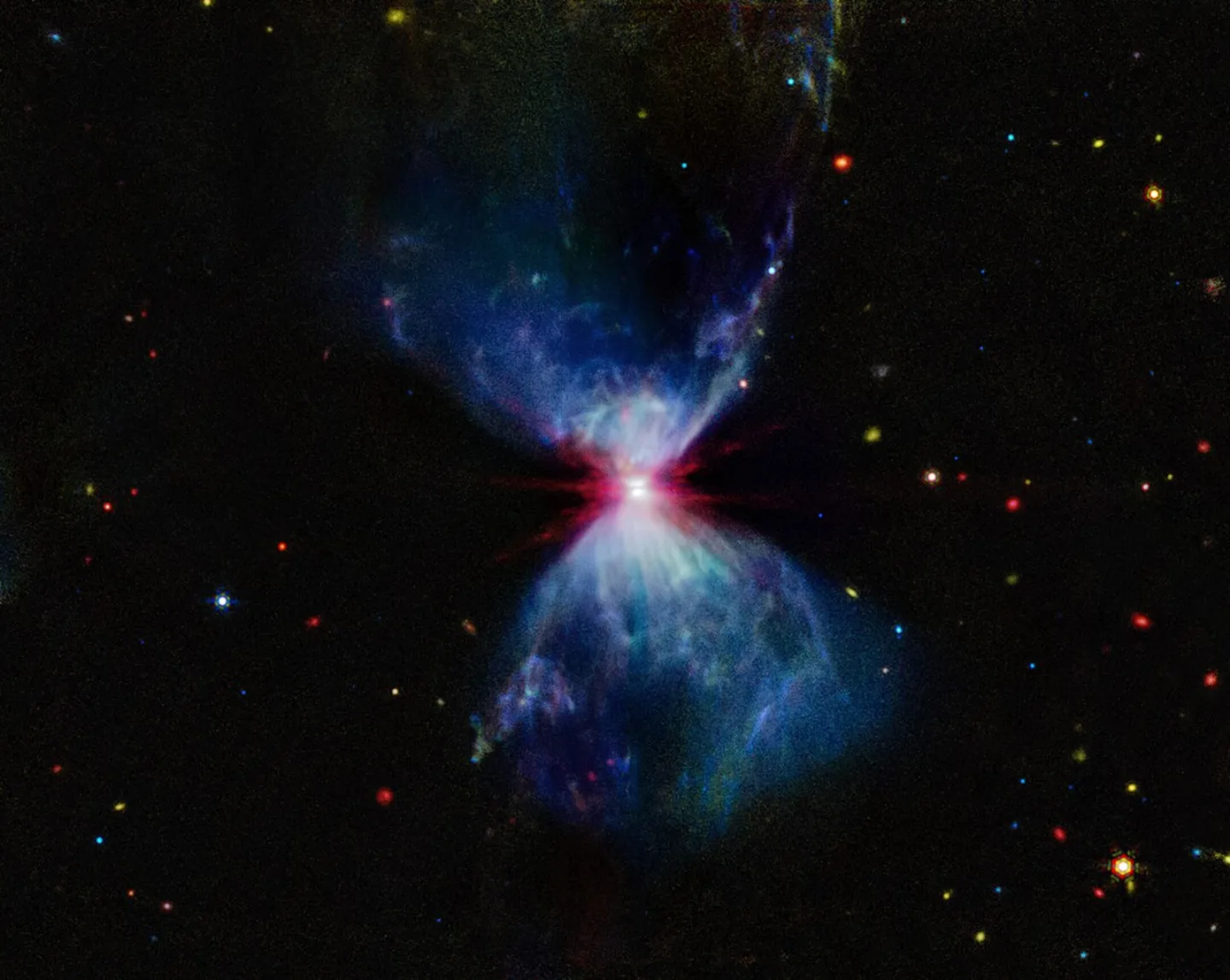
Theory puts the flattening of cloud into disc at roughly the first 100,000 years — and telescopes agree. L1527, a protostar in Taurus imaged by NASA's Webb telescope, is only about 100,000 years old and already carries a dark accretion disc about the size of our Solar System. You do not have to take the disc on trust: the model's first step is something we can watch happening elsewhere right now.
 Wikimedia Commons · ESO · CC BY 4.0 ↗
One Cloud, One Birthday
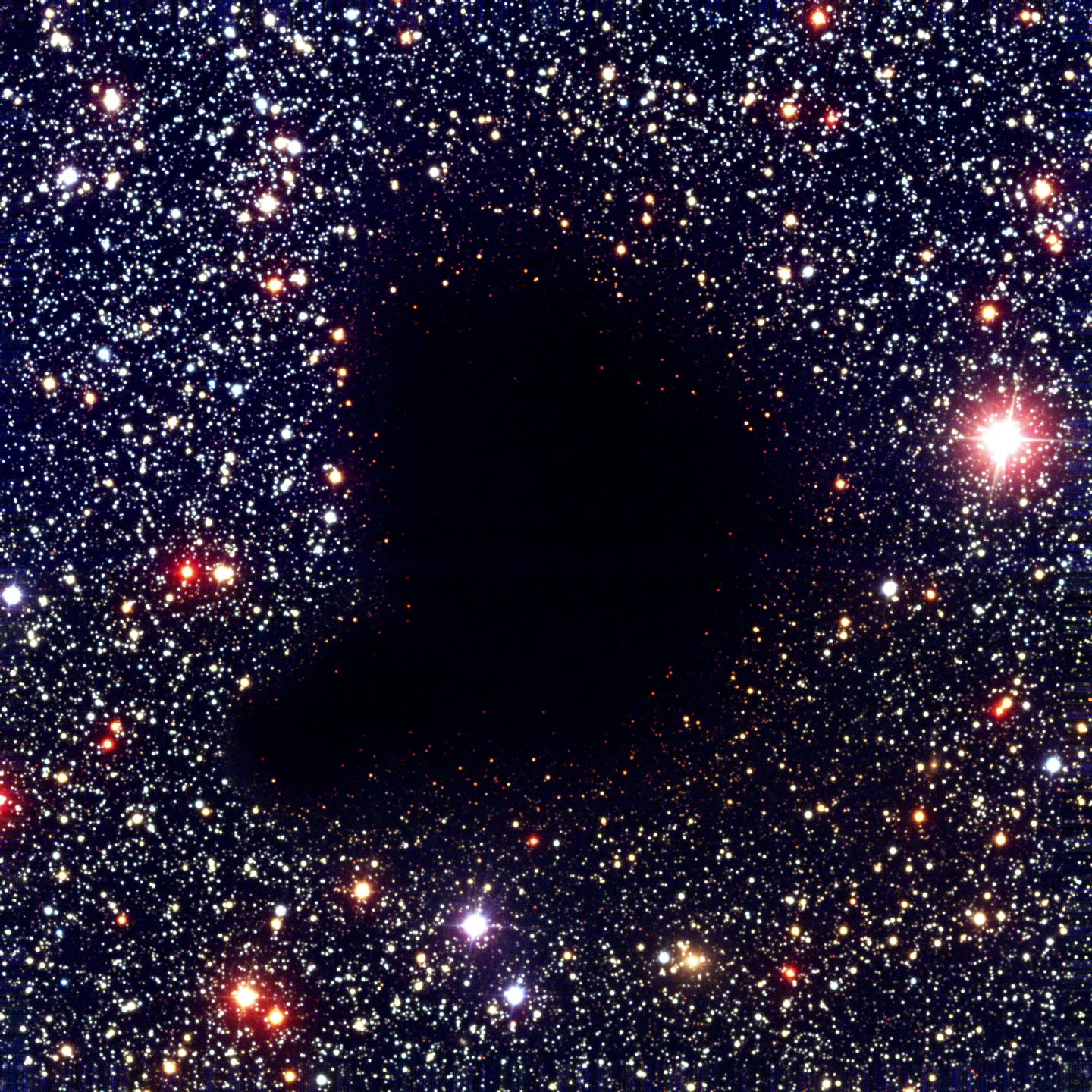
The Sun, the planets, the moons, the asteroids and the comets all date from a single event about 4.6 billion years ago, when a dense cloud of interstellar gas and dust collapsed under its own gravity. The Sun did not form first and then gather up planets that were already wandering about — everything here condensed out of the same collapse.
 FlashFeed original diagram · CC-BY-4.0
Why The Orbits Line Up
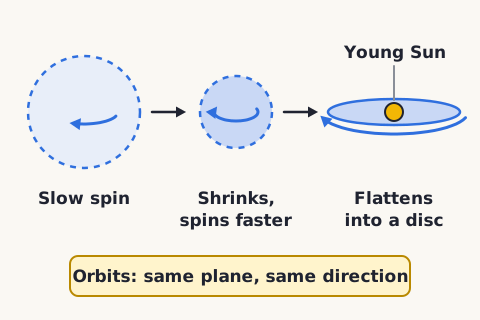
A cloud rotating even slightly spins faster as it shrinks, and a spinning collapsing cloud flattens. The result was the solar nebula: a disc of gas and dust around the young Sun. That is why the planets today all orbit in nearly the same plane and in the same direction — they were assembled from a spinning plate and still carry its motion. Randomly tilted, randomly directed orbits were never on the table.
 Pexels · A detailed image of a supernova remnant showcasing intricate cosmic patterns and celestial beauty. ↗
Isotopes With A Deadline
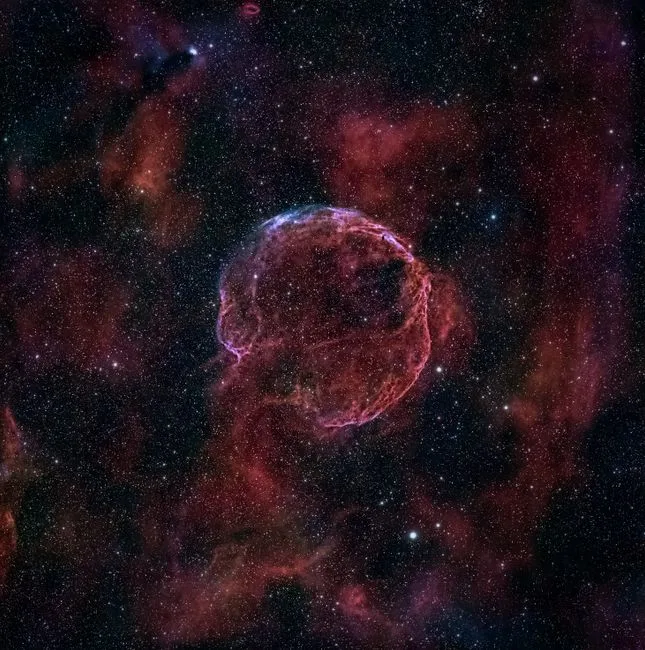
A cold cloud can sit for a very long time without collapsing, so something probably pushed. The evidence for a dying star nearby is chemical: the oldest meteorites hold the decay products of aluminum-26 and iron-60. Iron-60's half-life is 2.60 million years — far too short to have survived from the early universe, so it must have been made shortly before the Solar System's first solids froze. It is made in quantity essentially only inside massive stars. A strong argument, not an eyewitness.
 Pexels · Detailed image of the sun showing visible sunspots on its surface. ↗
One Star, Plus Debris
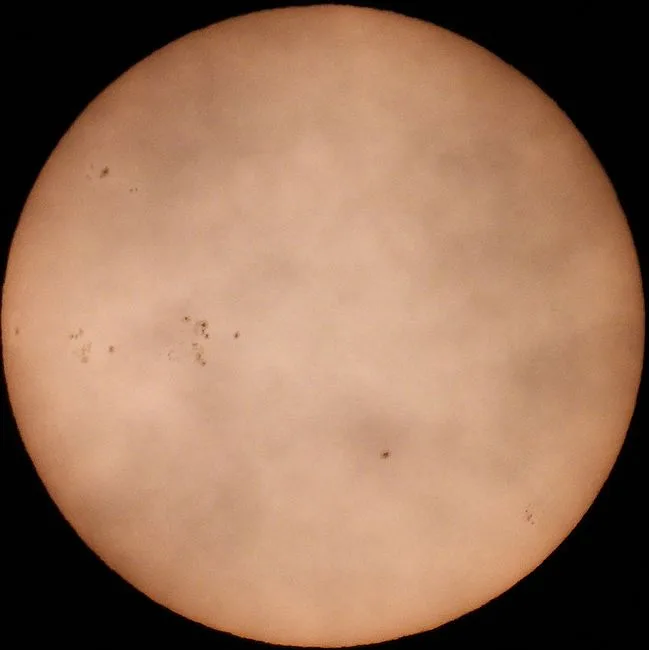
The Sun holds 99.8 per cent of the Solar System's mass. Every planet, every moon, the asteroid belt, the Kuiper Belt and all the comets together make up the remaining fifth of one per cent. Jupiter, the largest planet, is about a thousandth of the Sun's mass. That single number is why the Sun's gravity, and not any planet's, governs almost every orbit in the system.
 ALMA (ESO/NAOJ/NRAO) · CC BY 4.0 ↗
Three Million Years, Then Nothing
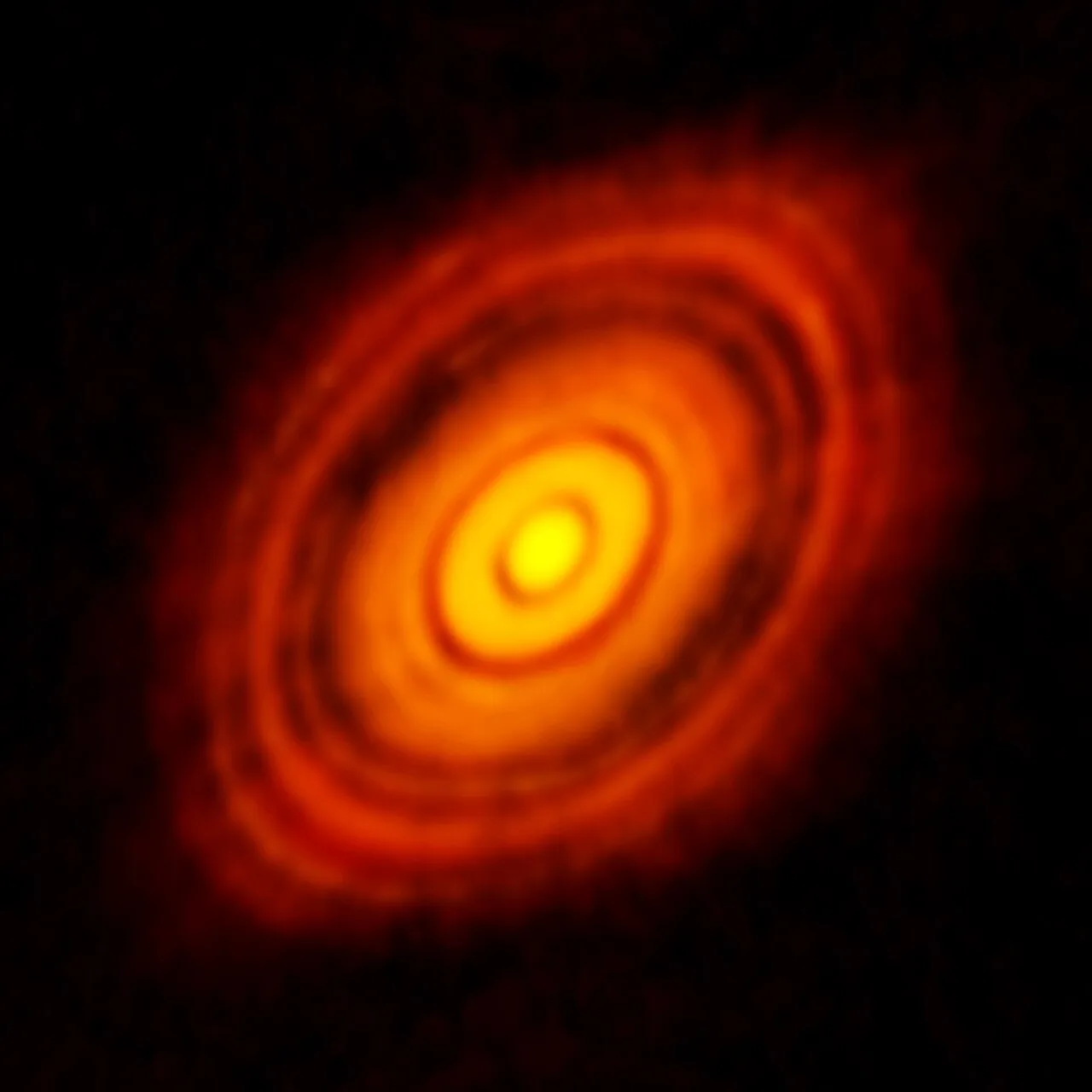
Dating of meteorite grains shows the disc was making solids for only about 3 million years, and the young Sun's wind and radiation had cleared the remaining gas within roughly 3 to 10 million years. The Atacama Large Millimeter Array (ALMA)'s picture of HL Tauri — a star no more than a million years old, already carved into concentric rings separated by gaps — shows how fast the process runs. That deadline is why there are only four giants: anything that grew large later found nothing left to grab.
 FlashFeed original diagram · CC-BY-4.0
Jupiter Went First
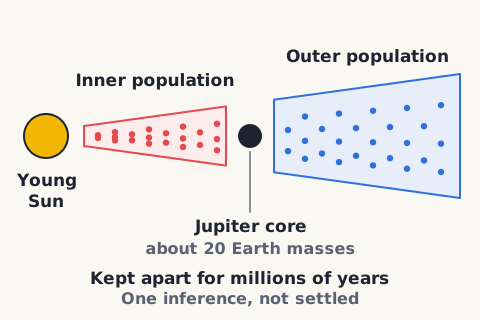
An isotopic study of iron meteorites by Kruijer and colleagues (2017) found two chemically distinct populations that stayed separated for millions of years. The simplest explanation is a large body already massive enough to keep them apart: Jupiter's core reaching about 20 Earth masses within the first million years, splitting the disc in two. That is one research group's inference, not settled history — but on this reading the planets did not form in the order they orbit.
 Pexels · A detailed photograph of a full moon in the night sky, captured from Israel. ↗
Wreckage That Became A Moon
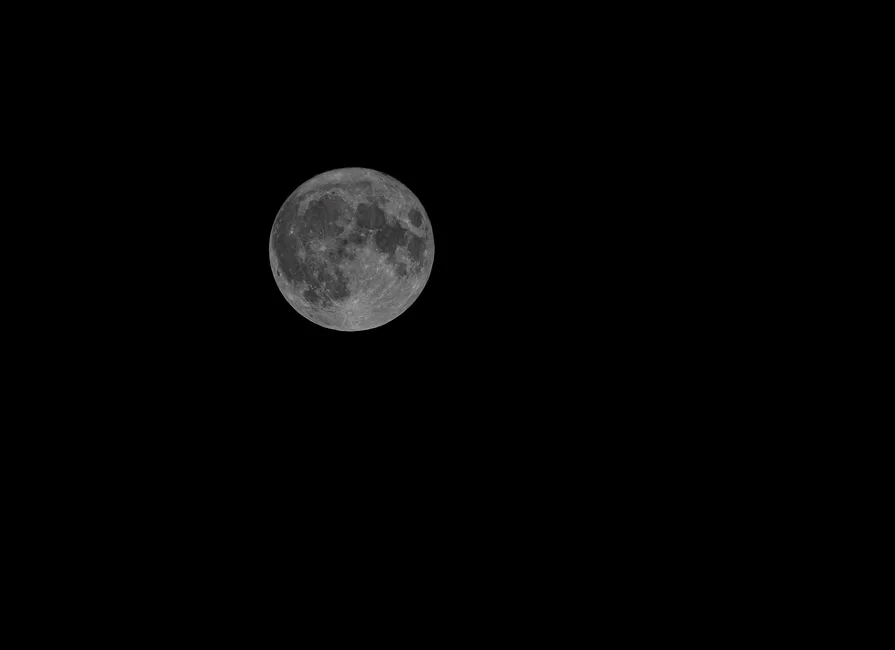
NASA's account is that around 4.5 billion years ago something roughly the size of Mars — or a series of objects — struck the young Earth and threw enough molten and vaporized debris into orbit to build the Moon, about 60 million years after the Solar System began forming. The Apollo rocks agree: lunar basalts closely resemble Earth's mantle basalts, and lunar rock is depleted in the elements that boil off when heated. Similar, not identical — the best explanation, not a closed case.
1 / 10Why are the planets nearest the Sun so small?
Inside the frost line only rock and metal stayed solid, so there was very little to build with. They had the same time as everyone else; the solar wind strips atmospheres rather than rock; and ice was abundant beyond that boundary rather than scarce everywhere.
Lesson 11 has 31 cards. Keep going in the free app.
Question
A Spinning Plate 
Wreckage 
Not the Default All 26 clips on YouTube ↗Transcripts
A Spinning Plate
About 4.6 billion years ago, a cloud of gas and dust collapsed under its own gravity.
A rotating cloud spins faster as it shrinks. And a spinning, collapsing cloud flattens into a disc.
That's why the planets orbit in nearly the same plane, in the same direction. They were built from a spinning plate.
And the Sun still holds 99.8% of the Solar System's mass.
Wreckage
The oldest solids we have are tiny white specks inside primitive meteorites. They date to 4.567 billion years.
Earth is slightly younger, at about 4.5 billion years.
The Moon is thought to be wreckage. In NASA's account, something roughly the size of Mars struck the young Earth, and the debris came together.
Moon and Earth rocks are chemically very similar. Similar, not identical. So it's the best explanation, not a closed case.
Not the Default
In October 1995, Michel Mayor and Didier Queloz found 51 Pegasi b: the first planet orbiting a Sun-like star.
More than 6,000 thousand confirmed planets later, our arrangement isn't the default.
Hot Jupiters are giant planets orbiting closer than Mercury. They weren't supposed to exist. Finding them made planet migration a serious idea.
One model, the Grand Tack, has Jupiter drifting inward and then back out. It's a model, not a record.
-
 NASA, ESA, and The Hubble Heritage Team (STScI/AURA) · Public domain ↗12
The Lives of Stars
How Stars Are Born · Mass Decides Everything · How Stars Die
Lesson 12 · 10 cardsNASA, ESA, and The Hubble Heritage Team (STScI/AURA) · Public domain ↗The Coldest Nurseries
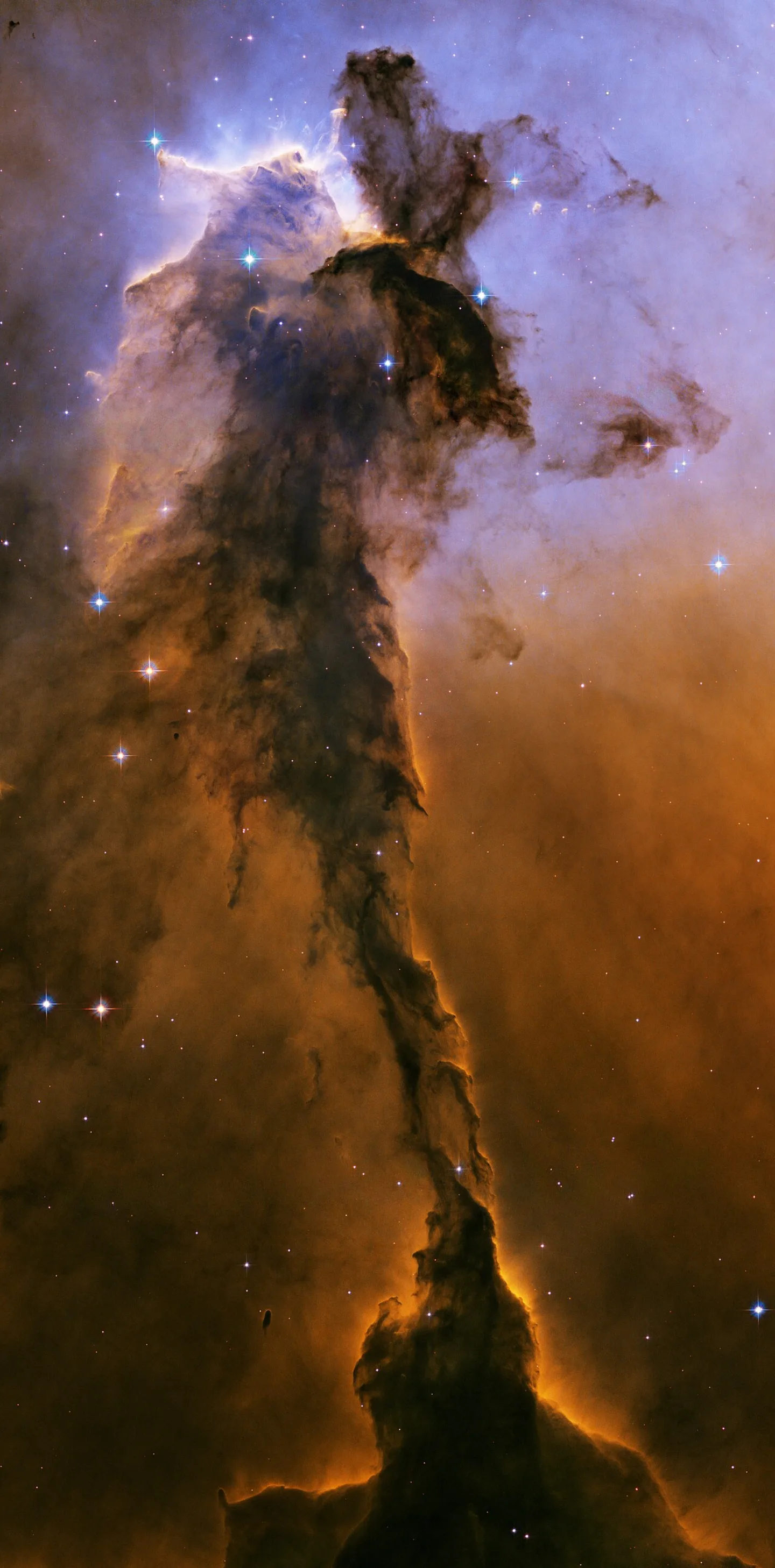
Stars condense out of molecular clouds — the coldest and densest parts of the interstellar medium, at only 10 to 20 kelvin, roughly −263 to −253 °C. A single cloud holds between 1,000 and 10 million times the mass of the Sun. Star formation does not begin with something hot. It begins with gas cold enough that its own pressure cannot resist gravity.
 ESA/Webb, NASA, CSA, T. Ray (Dublin Institute for Advanced Studies) (Openverse) · by 4.0 ↗
Gravity Lights It First
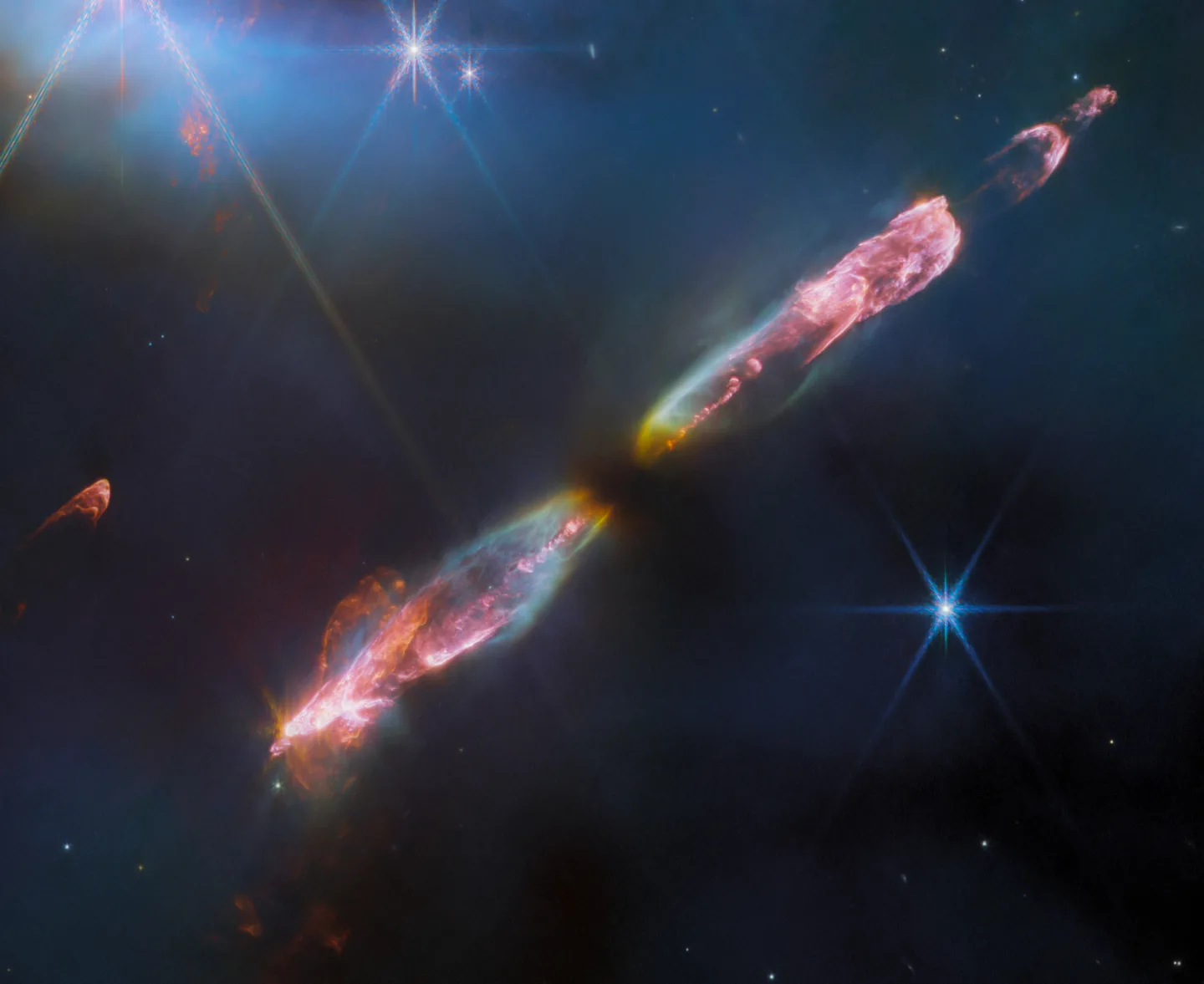
Gravity pulls the densest clumps of a cloud inward, and the infalling material heats as it is compressed. The hot contracting ball at the center is a protostar — already at 2,000 to 3,000 K with no fusion at all — hot enough to glow red, though the dust cocoon around it blocks that light, so protostars are found in the infrared rather than by eye. Birth is not gentle: only about 10 percent of protostars survive their birth region, the rest disrupted by nearby radiation and outflows. Gravity does the heating first; nuclear physics takes over later.
 FlashFeed original diagram · CC-BY-4.0
Color Is a Thermometer
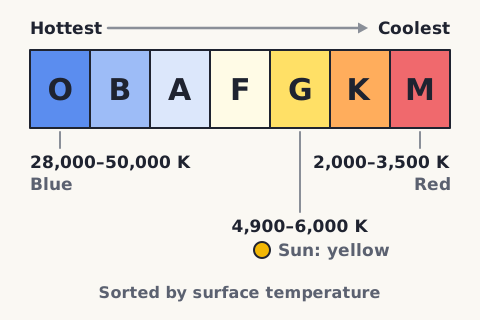
Sort stars by surface temperature and they fall into a sequence: O, B, A, F, G, K, M. O-class stars run 28,000–50,000 K and burn blue. G-class, the Sun's class, sits at 4,900–6,000 K and looks yellow. M-class bottoms out around 2,000 K and glows red. Taps and warning lights have trained you backwards: in stars, blue is the hot end and red is the cool one.
 Smithsonian Institution from United States · No restrictions ↗
A Fossil of Its History
The letters are out of alphabetical order for an entirely human reason. Edward Pickering first ranked stars A, B, C by the strength of their hydrogen lines. Annie Jump Cannon later realized the same stars could be sorted by temperature instead, reordered the surviving classes, and kept the old labels. OBAFGKM is not a random jumble, and the letters stand for nothing — the sequence is a fossil of its own history.
 FlashFeed original diagram · CC-BY-4.0
Live Fast, Die Young
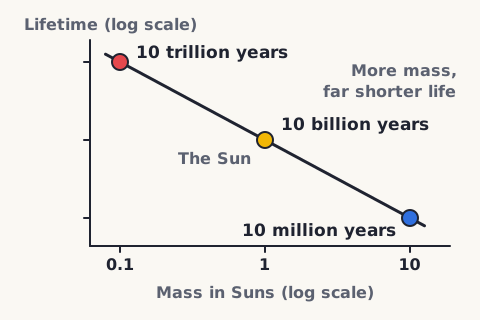
Because luminosity rises far faster than mass, a heavier star spends its fuel disproportionately fast: main sequence lifetime falls as roughly mass to the power −2.5 to −3 — sources give both. A star ten times the Sun’s mass lasts somewhere between 316 and 1,000 times less long, not ten times. Ten solar masses buys roughly 10 million years; the Sun gets about 10 billion; a 0.1-solar-mass red dwarf, on the order of 10 trillion. Six orders of magnitude of lifetime out of two orders of magnitude of mass.
 Wikimedia Commons · ESA/Webb, NASA, CSA, M. Barlow, N. Cox, R. Wesson · CC BY 4.0 ↗
The Quiet Ending
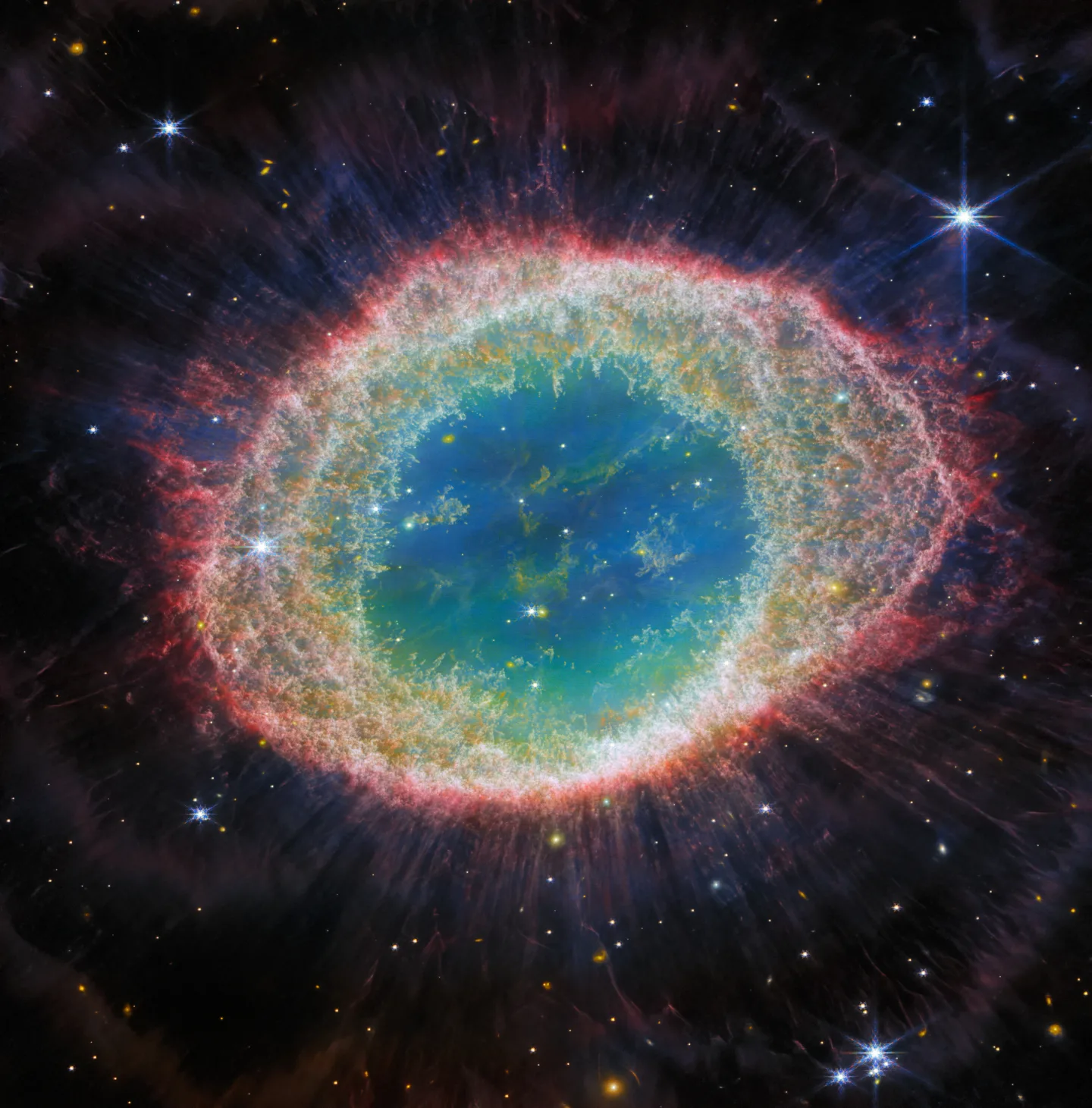
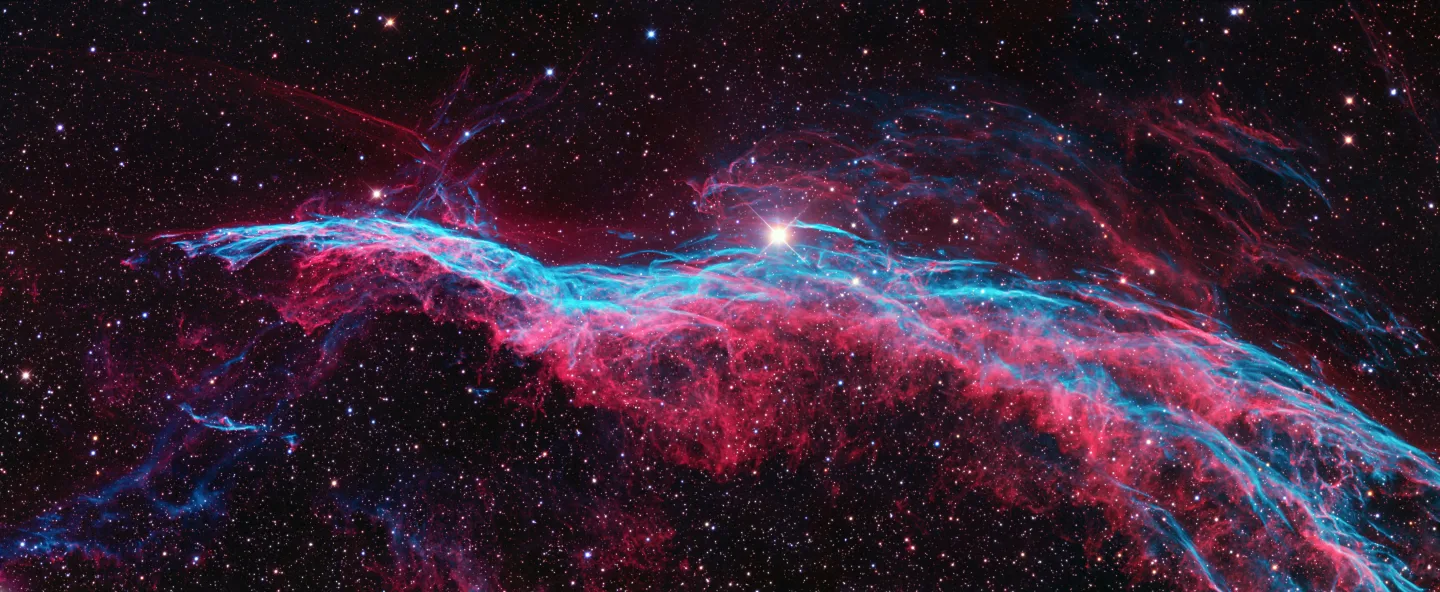
A red giant sheds its outer layers as a planetary nebula, which glows for only about 20,000 years before dispersing — a flicker, which is why so few exist at any moment. The name is an eighteenth-century telescope error; these have nothing whatever to do with planets. What is left is the exposed core: a white dwarf, roughly Earth-sized, about a billion kilograms per cubic meter, with no fusion at all, cooling for tens to hundreds of billions of years.
 Wikimedia Commons · Ken Crawford · CC BY-SA 3.0 ↗
The Light Is Leftover
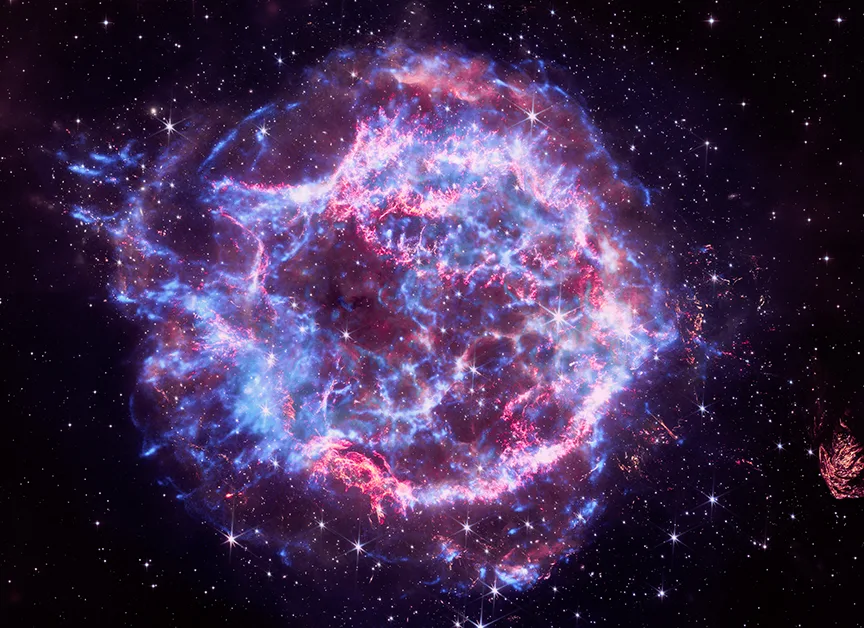
A core-collapse supernova releases about 10^46 joules in a matter of seconds — some 50 times more than the Sun will put out in 10 billion years. About 99 percent of that leaves as neutrinos, in a burst roughly ten seconds long; twenty-five of them were caught on Earth from SN 1987A. The blinding light is the remaining one percent. It is the leftover, not the explosion.
 Wikimedia Commons · NASA/CXC/SAO; NASA/ESA/CSA/STScI · Public domain ↗
Where Fusion Stops Paying
A massive star builds heavier elements in shells until it makes iron, and there the engine stops: because of iron's nuclear structure, fusing it yields no net energy. Around 10 billion K the iron itself comes apart, the support under the star's outer layers vanishes, and the core falls inward at tens of thousands of kilometers per second. The star does not explode because it ran out of fuel. It explodes because its remaining fuel would cost energy to burn.
1 / 10What temperature is the gas that star formation starts in?
Molecular clouds are the coldest, densest part of the interstellar medium. 2,000 to 3,000 K is the protostar once it is already contracting, and 15 million is the core at ignition — both come later. 300 K is about room temperature, far too warm for gravity to win.
Lesson 12 has 44 cards. Keep going in the free app.
Question
Born Cold 
A Thousandth as Long 
A Billion Tons All 26 clips on YouTube ↗Transcripts
Born Cold
Stars form in the coldest places around: molecular clouds at 10 to 20 kelvin.
Gravity pulls the densest clumps inward. The hot, contracting ball at the center is a protostar. It glows red long before it's a star.
Only about 10% of protostars survive their birth region.
At about 15 million degrees, hydrogen fusion begins. Fusion pressure pushing out then balances gravity pulling in.
A Thousandth as Long
A star 10 times the Sun's mass doesn't last a tenth as long. It lasts about a thousandth as long.
Heavier stars burn through their fuel disproportionately fast.
A Sun-like star lives about 10 billion years.
A star with a tenth of the Sun's mass lives about 10 trillion.
Those red dwarfs make up around 75% of the Milky Way. They'll still be burning long after every Sun-like star has finished.
A Billion Tons
Stars that begin above roughly 8 times the Sun's mass end in a core-collapse supernova.
The core builds heavier elements until it makes iron. Fusing iron yields no net energy, so the core collapses.
About 99% of the energy leaves as neutrinos. The light show is the leftover.
What's left can be a neutron star: more than the Sun's mass, about 20 kilometers across.
A sugar cube of it would weigh about 1 billion tons.
-
 NASA/ESA · Public domain ↗13
Galaxies, Distance and Spacetime
The Milky Way · Measuring the Universe · Gravity, Spacetime and Expansion
Lesson 13 · 10 cards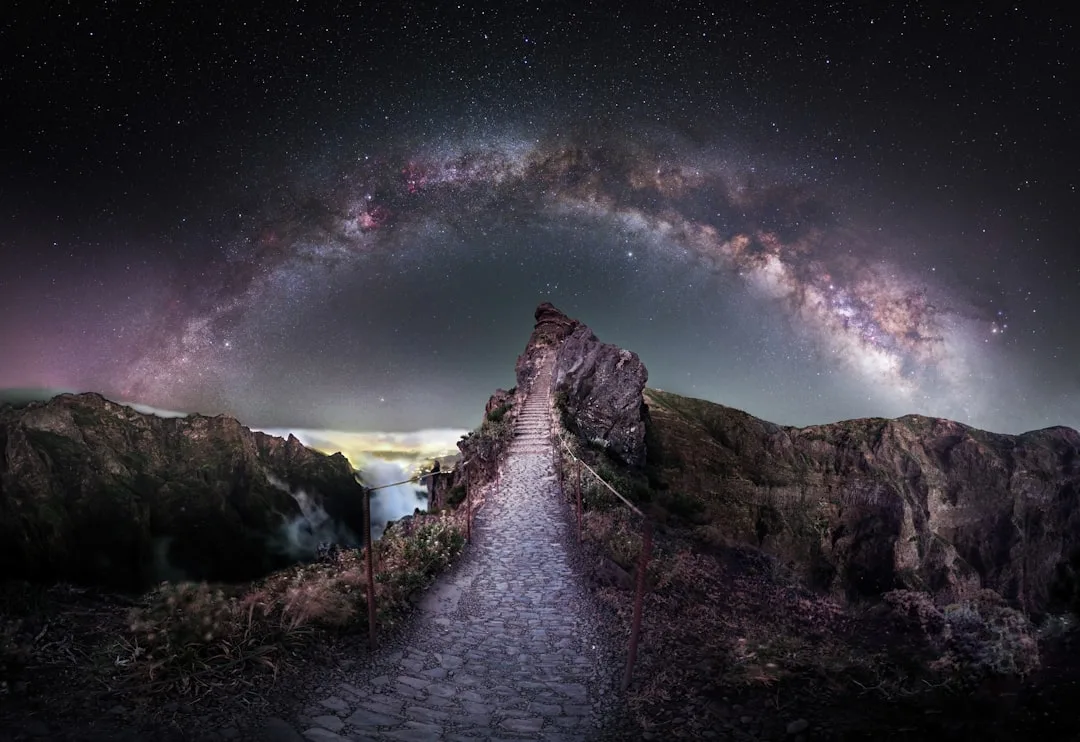 Unsplash · Sebastian Knoll · Unsplash License ↗
Nobody Has Counted Them
The Milky Way holds on the order of one hundred billion stars — and reputable sources stretch that to a few hundred billion. The range is not caution for its own sake. Nobody has counted them: the total is inferred from the galaxy's mass and its light, which is why careful sources disagree with each other by a factor of a few and none of them can do better.
 FlashFeed original diagram · CC-BY-4.0
A Hundred Times Wider
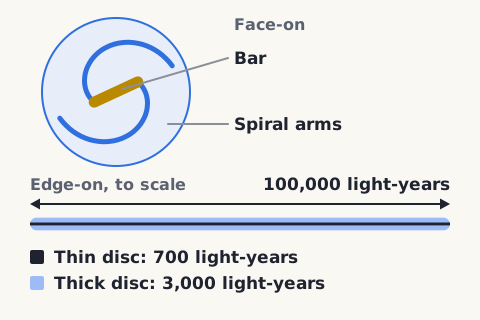
We live inside a barred spiral: a flat disc of stars with spiral arms and a straight bar of stars crossing the center. About two-thirds of spirals are barred, so a bar is the normal condition, not a curiosity. The disc runs about 100,000 light-years across but is astonishingly shallow — a thin disc some 700 light-years high sitting inside a thick disc about 3,000 light-years high. Roughly a hundred times wider than it is deep, which is why the galaxy shows up as a narrow band across the sky rather than a glow in every direction.
 FlashFeed original diagram · CC-BY-4.0
Halfway Out, Still Turning
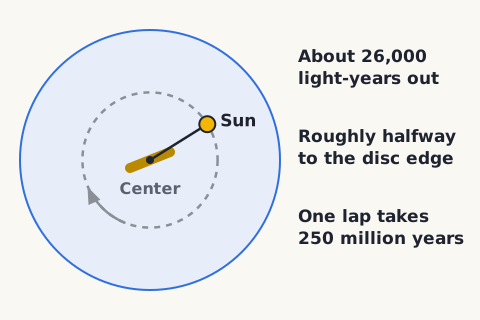
The Sun is not at the center and not on the rim. It sits about 26,000 light-years from the galactic middle — published values run from 25,000 to 27,000 — roughly halfway out to the edge of the disc. And it is not parked there. One lap around the galactic center takes about 250 million years, longer than the entire history of the dinosaurs. Stars are not fixed while only planets move: the whole disc turns, and we turn with it.
 FlashFeed original diagram · CC-BY-4.0
Four Million Suns
At the center sits Sagittarius A, a supermassive black hole of about four million solar masses. That mass was measured the way a planet's is — from the orbits of things around it. The star S2 goes round every 16 years, and at closest approach its light is stretched to longer wavelengths by exactly the amount general relativity* predicts. Four million Suns is still a small share of a galaxy of a hundred billion stars, and the Sun orbits it as calmly as Earth orbits the Sun.
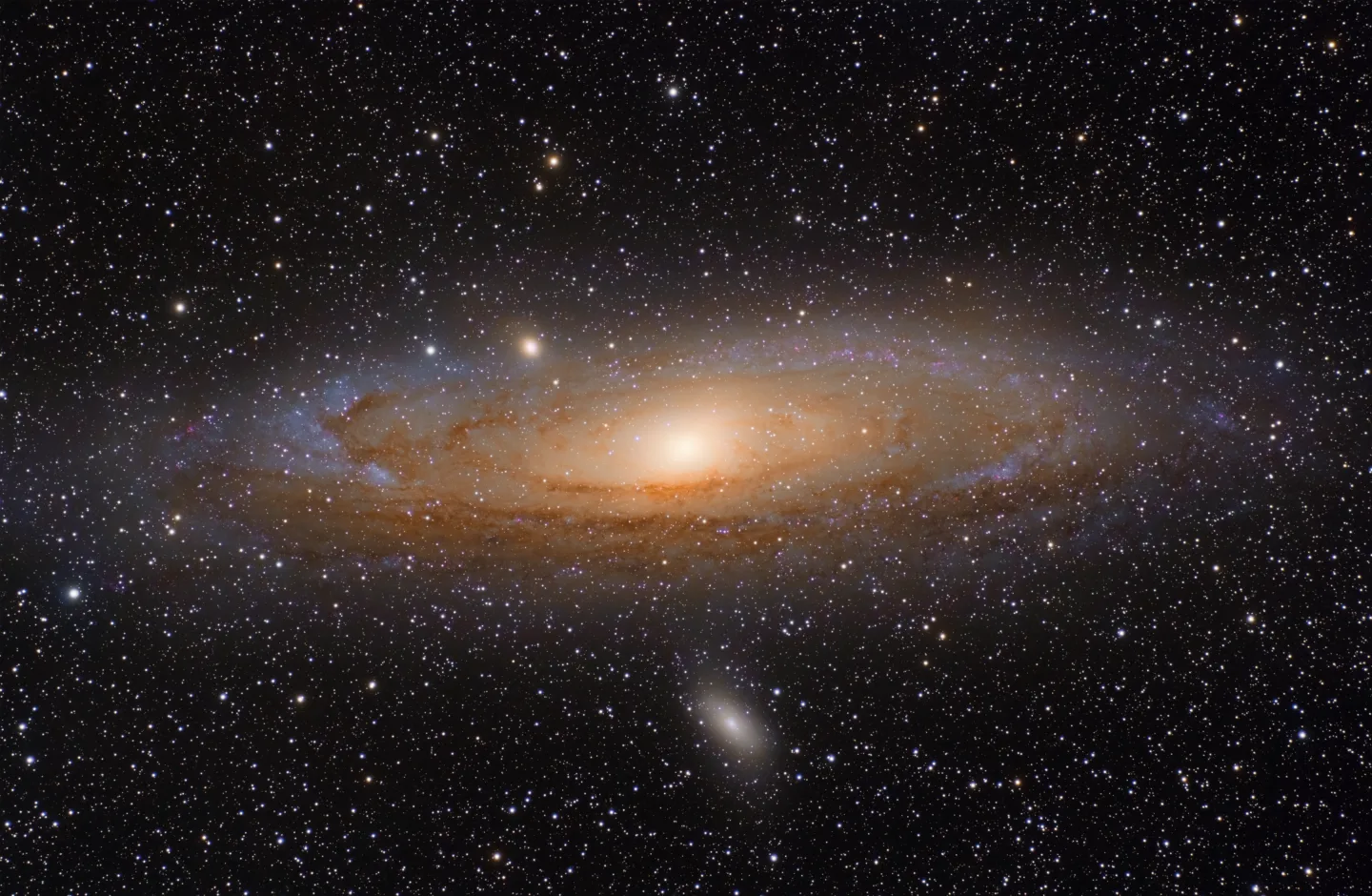 Wikimedia Commons · Brody Wesner · CC0 ↗
The Galaxy Coming Toward Us
Almost every galaxy is receding. Andromeda is not. It lies about 2.5 million light-years away and is closing at roughly 250,000 miles per hour, so its spectral lines sit at shorter wavelengths — blueshifted, which is unusual among galaxies. Both belong to the Local Group, a gravitationally bound crowd of more than 30 galaxies spread across some 10 million light-years, and inside a bound group local gravity beats cosmic expansion.
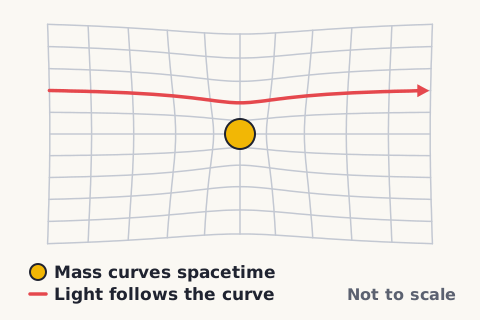 FlashFeed original diagram · CC-BY-4.0
Straight Lines Through Bent Space
General relativity does away with gravity as a force. Mass and energy curve spacetime, and everything — including light, which has no mass — simply follows the curvature. Earth is not held on an invisible rope by the Sun; it is traveling as straight as it can through a region that is bent. That is also why a photon is deflected near a massive object: nothing tugs on it, because there is nothing to tug on. The geometry it crosses is what is bent.
NASA/ESA · Public domain ↗Arcs of a Single Galaxy
Gravitational lensing is the prediction you can photograph. A massive foreground object — typically a galaxy cluster — curves spacetime enough to bend, distort and magnify the light of whatever lies behind it, sometimes producing several images of one background galaxy, and in perfect alignment a complete Einstein ring. The arcs are not separate objects and not a telescope artifact. They are one galaxy, imaged more than once by the mass sitting in front of it.
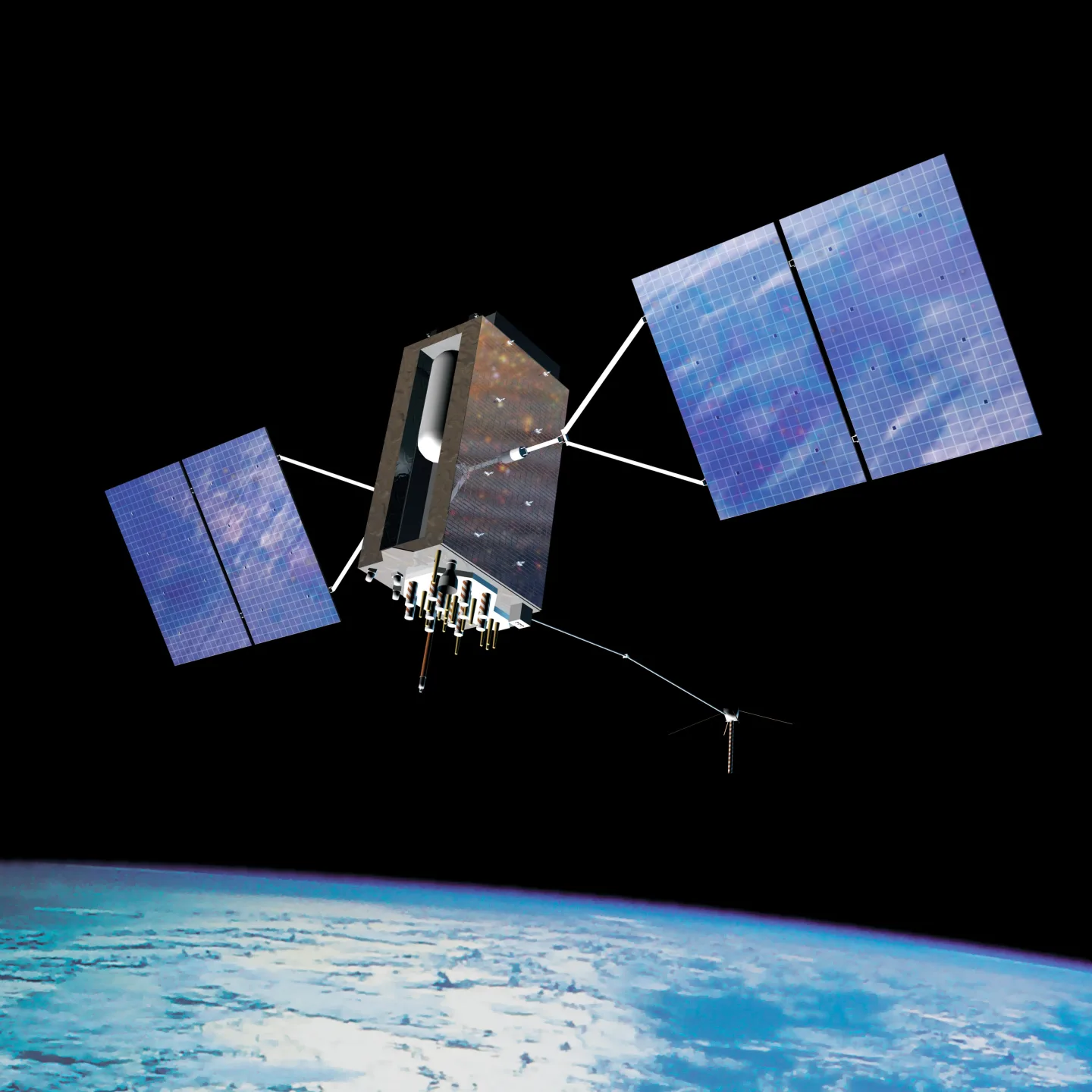 Wikimedia Commons · U.S. Air Force · Public domain ↗
Relativity in Your Pocket
A GPS satellite clock runs about 45 microseconds a day fast because it sits in weaker gravity, and about 7 microseconds a day slow because of its orbital speed — a net gain near 38 microseconds a day. The two effects pull in opposite directions and the system corrects for both. Left uncorrected, positions would drift by roughly 10 kilometers a day. Relativity is not confined to black holes; it is a working engineering correction in hardware you carry around.
1 / 10What does the 2022 image of the Milky Way's center actually show?
A black hole emits no light, so it cannot be photographed. The Event Horizon Telescope assembled real 2017 data from eight radio observatories linked into one Earth-sized instrument — neither an impression nor a simulation. The dark center is a silhouette.
Lesson 13 has 33 cards. Keep going in the free app.
Question
250 Million Years 
Andromeda 
Relativity in Your Pocket All 26 clips on YouTube ↗Transcripts
250 Million Years
The Sun takes about 250 million years to circle the Milky Way once. The Solar System has gone around perhaps 18 times.
We sit about 26,000 light-years from the center, roughly halfway out.
The galaxy is a barred spiral, about 100,000 light-years across, and astonishingly thin.
At its center: Sagittarius A*, a black hole of about 4 million solar masses.
Andromeda
Will Andromeda collide with the Milky Way? The popular answer is out of date.
Andromeda is about 2.5 million light-years away, and approaching.
In 2012, Hubble measurements predicted a merger in about 4 billion years.
More recent analysis puts it closer to even odds that no merger happens within 10 billion years.
And stars would almost certainly not hit each other.
Relativity in Your Pocket
General relativity is in your pocket. A GPS satellite clock runs about 45 microseconds a day fast, because it sits in weaker gravity.
Its speed slows it by about 7 microseconds a day. The system corrects for both.
Without those corrections, satellite navigation would drift out of usefulness within hours.
Gravity isn't a pull. Mass curves spacetime, and clocks feel it.


What you'll be able to do 13 objectives, from the pack's lessons
- Tell a planet, a star, a satellite and the ISS apart, and say what each difference reveals
- Explain phases, eclipses, seasons and tides from the geometry of two orbits
- Describe the Sun's structure and how its energy and weather reach Earth
- Contrast Mercury and Venus, and say why neither kept liquid water
- Compare Earth and Mars, and explain why only one stayed habitable
- Characterize Jupiter and its major moons
- Characterize Saturn, explain its rings, and place Titan and Enceladus
- Distinguish the ice giants from the gas giants, and say why Uranus is tipped over
- Place the asteroid belt, meteors and dwarf planets, and apply the IAU planet definition
- Place the Kuiper Belt, comets and the Oort Cloud, and order the outer Solar System
- Trace how the Solar System formed and why the frost line sorted it
- Classify a star by mass and color, and predict whether it ends as a dwarf, neutron star or black hole
- Order cosmic distances and explain how gravity and spacetime shape what is there.
Study guide.
The same study guide as in the app, one page for each lesson, with its key facts and a self-test.
- 01What You Are Actually Looking At
- 02The Earth, Moon and Sun
- 03The Sun
- 04Mercury and Venus
- 05Earth and Mars
- 06Jupiter
- 07Saturn
- 08Uranus and Neptune
- 09Asteroids, Meteors and Dwarf Planets
- 10The Kuiper Belt, Comets and the Outer Edge
- 11How the Solar System Formed
- 12The Lives of Stars
- 13Galaxies, Distance and Spacetime
Built from 212 sources.
455 of its 459 cards cite a source. These are the eight it cites most.
- Planetary Physical Parameters ↗
- Kuiper Belt Facts ↗
- Mercury: Facts ↗
- Jupiter Facts ↗
- Spectral Classification ↗
- 2006 General Assembly: Result of the IAU Resolution votes (iau0603) ↗
- umbra ↗
- Apparent Magnitude ↗
See all 212 sources
- Planetary Physical Parameters ↗
- Kuiper Belt Facts ↗
- Mercury: Facts ↗
- Jupiter Facts ↗
- Spectral Classification ↗
- 2006 General Assembly: Result of the IAU Resolution votes (iau0603) ↗
- umbra ↗
- Apparent Magnitude ↗
- Climate Modeling Suggests Venus May Have Been Habitable ↗
- Sun: Facts ↗
- Catling & Kasting, Atmospheric Evolution on Inhabited and Lifeless Worlds, Ch. 5 (Cambridge University Press, 2017) ↗
- Giant Molecular Clouds and Protostars ↗
- Earth Facts ↗
- Moon Phases ↗
- Jupiter Fact Sheet (Radio JOVE Project) ↗
- Milky Way Galaxy ↗
- Saturn Facts ↗
- Uranus Facts ↗
- Voyager Interstellar Mission ↗
- This Dynamic Planet: Using the Diagram to Discuss How Plate Tectonics Works ↗
- The Magnitude Scale ↗
- The Death of Stars II: High-Mass Stars ↗
- All Things Neutrino: Supernova Neutrinos ↗
- 4 Vesta (physical parameters) ↗
- Magnetosphere ↗
- Mars24 Sunclock: Technical Notes on Mars Solar Time ↗
- Periodicity of Solar Eclipses ↗
- Background: Life Cycles of Stars ↗
- Comet Facts ↗
- Exoplanets ↗
- Galaxy Types ↗
- Geminids ↗
- Io ↗
- Neptune Facts ↗
- Uranus: Exploration timeline ↗
- Fast and Slow Solar Wind ↗
- Solar Flares (Radio Blackouts) ↗
- Calibrating Photometric Data ↗
- Stellar Outburst Brings Water Snow Line Into View ↗
- Saturn ↗
- Eclipse Safety ↗
- Hubble Shows Milky Way is Destined for Head-On Collision ↗
- The Carbon Cycle ↗
- Ask an Astrophysicist: relativity ↗
- Asteroid Facts ↗
- Cassini FAQ ↗
- Meteors and Meteorites ↗
- Miranda ↗
- Oort Cloud Facts ↗
- Planets ↗
- Star Types ↗
- Stars ↗
- The Sun Spot blog: Layers of the Sun ↗
- Titan Facts ↗
- Venus: Facts ↗
- How Did the Solar System Form? ↗
- What Is a Comet? ↗
- The Mass-Luminosity Relationship ↗
- What was the bright object I saw in the sky last night? ↗
- The Sun's Vital Statistics ↗
- Fireball (meteor), citing the IAU definition ↗
- Illusory Late Heavy Bombardments ↗
- The Dwarf Planet Known as Eris is More Massive than Pluto ↗
- Nuclear Reactions in Stars ↗
- Scales and Angular Measurement ↗
- Absolute chronology of solids in the solar protoplanetary disk ↗
- Asteroids ↗
- What is 'red shift'? ↗
- Cosmic distances ↗
- Gravitational lensing ↗
- Astronomers reveal first image of the black hole at the heart of our galaxy (eso2208) ↗
- Planetary Satellite Mean Elements ↗
- 415 Years Ago: Astronomer Galileo Discovers Jupiter's Moons ↗
- MAVEN Reveals Most of Mars' Atmosphere Was Lost to Space (30 Mar 2017) ↗
- Spot the Station Frequently Asked Questions ↗
- What are Meteorites? ↗
- The Life Cycles of Stars ↗
- Planetary Satellite Physical Parameters ↗
- 10 Things: Planetary Atmospheres ↗
- C/1995 O1 (Hale-Bopp) ↗
- Callisto ↗
- Cassini at Enceladus ↗
- Cassini: Saturn Rings ↗
- Enceladus ↗
- How the Moon Formed ↗
- Mars: Facts ↗
- Oxygen on Exoplanets Isn't Proof of Life ↗
- Olympus Mons ↗
- NASA's Voyager 2 Probe Enters Interstellar Space ↗
- Star Lifecycle ↗
- The Sun and Sunspots ↗
- Nailing the half-life of iron-60 (Wallner et al. 2015) ↗
- Why do stars appear to twinkle in the night sky? ↗
- Mercury (planet), Rotation ↗
- Position light system installation ↗
- Solar Eclipse Eye Safety ↗
- Nature press release on CNO neutrino detection ↗
- What do the initials of OBAFGKM mean? ↗
- The Death of Stars I: Solar-Mass Stars ↗
- How high up are meteors when they begin to glow? ↗
- Comets and how the Solar System formed ↗
- Getting to know Rosetta's comet ↗
- Space Environment Report 2025 ↗
- Venus's surface ↗
- Where is the International Space Station? ↗
- Anatomy of the Milky Way ↗
- Parallax ↗
- Cosmic distance ladder ↗
- Planetary Nebula ↗
- The Hubble tuning fork: classification of galaxies ↗
- Day and Night on Mercury ↗
- Hertzsprung-Russell Diagram ↗
- The Biggest Star in the Sky (eso9706) ↗
- NASA's Cassini Data Show Saturn's Rings Relatively New ↗
- NASA's Cassini Spacecraft Obtains Best Views of Saturn Hexagon ↗
- 1 Ceres ↗
- 15760 Albion (1992 QB1) ↗
- 2 Pallas (physical and orbital parameters) ↗
- 90377 Sedna (2003 VB12) ↗
- giant impacts on early Uranus ↗
- Proton-Proton Chain ↗
- Chang'E-6 lunar far-side samples ↗
- Streaming Instability and Turbulence: Conditions for Planetesimal Formation ↗
- How Many Stars Can I See at Night? ↗
- Basics of Space Flight, Chapter 2: Reference Systems ↗
- Eclipse Frequently Asked Questions ↗
- Eclipses and the Moon ↗
- Mission Reveals Speed of Solar Wind Stripping Martian Atmosphere (5 Nov 2015) ↗
- Parker Solar Probe and the curious case of the hot corona ↗
- Saturnian Rings Fact Sheet ↗
- Total Solar Eclipse 2024: The Moon's Moment in the Sun ↗
- Types of Solar Eclipses ↗
- Why Do Eclipses Happen? ↗
- Why the Sun Won't Become a Black Hole ↗
- Local Group galaxies ↗
- Neutron Stars ↗
- The Nearest Star ↗
- Ask an Astrophysicist: Earth ↗
- InSight Landing Press Kit: Mars at a Glance ↗
- The Apollo Experiment That Keeps on Giving ↗
- 1P/Halley ↗
- Arrokoth Facts ↗
- Cassini mission ↗
- Cassini's Grand Finale: Overview ↗
- Comets ↗
- Crash of the Titans: Andromeda Galaxy and the Milky Way Collision ↗
- Deimos ↗
- Dione ↗
- Dwarf Planets ↗
- Earth's Magnetosphere: Protecting Our Planet from Harmful Space Energy (3 Aug 2021) ↗
- Europa ↗
- Europa Clipper ↗
- Exoplanet Catalog: 51 Pegasi b ↗
- Ganymede ↗
- Haumea ↗
- Hubble Constant and Tension ↗
- Hyperion ↗
- Iapetus ↗
- Juno ↗
- Jupiter Facts ↗
- Leonids ↗
- Magellan mission page ↗
- Makemake ↗
- Mimas ↗
- NASA Research Reveals Saturn is Losing Its Rings at 'Worst-Case-Scenario' Rate ↗
- Neptune Facts ↗
- Neptune Moons ↗
- Pan ↗
- Parker Solar Probe ↗
- Perseids ↗
- Phobos ↗
- Phoebe ↗
- Pluto Facts ↗
- Rhea ↗
- Saturn's Rings ↗
- Scientists Finally Know What Time It Is on Saturn ↗
- Solar System Facts ↗
- Tethys ↗
- The Changing Ice Cap of Mars ↗
- The Lasting Impacts of Comet Shoemaker-Levy 9 ↗
- Three Steps to the Hubble Constant ↗
- Triton ↗
- Valles Marineris: The Grand Canyon of Mars ↗
- Venus: Facts ↗
- Voyager 2 ↗
- What is a light-year? ↗
- Hubble Tracks the Lifecycle of Giant Storms on Neptune ↗
- Webb Catches Fiery Hourglass as New Star Forms ↗
- Ares Valles ↗
- Gravity, Inertia, and the Two Bulges ↗
- Tidal Variations: the Influence of Position and Distance ↗
- What Causes Tides? ↗
- When Solar Storms Attack: Space Weather and our Infrastructure ↗
- Aurora ↗
- Coronal Mass Ejections ↗
- NOAA Space Weather Scales ↗
- Sunspots/Solar Cycle ↗
- Real-World Relativity: The GPS Navigation System ↗
- Planetary Rings ↗
- The Magnitude System ↗
- Constraining the maximum mass of neutron stars (ApJL 852, L25) ↗
- Main Asteroid Belt ↗
- Jupiter is the oldest planet of the Solar System (Kruijer et al. 2017) ↗
- Origin of the Solar System ↗
- Geologic Age: Using Radioactive Decay to Determine Geologic Age ↗
- Earth's Seasons and Apsides, 2026 ↗
- Asteroid belt / C-type asteroid (retrieved 2026-08-09) ↗
- Atmosphere of Jupiter ↗
- Atmospheric escape ↗
- Carrington Event ↗
- Io (moon) ↗
- Lunar chronology model with the Chang'e-6 farside samples ↗
Hover over a photo, or tap its i, to see where it came from. All 18:
- Lesson 1: Wikimedia Commons · NASA/Roscosmos · Public domain ↗
- Lesson 2: Pexels · Zelch Csaba · Pexels License ↗
- Lesson 3: Wikimedia Commons · Jcpag2012 and Dave Jarvis · CC BY-SA 4.0 ↗
- Lesson 4: NASA/Johns Hopkins University Applied Physics Laboratory/Carnegie Institution of · Public domain ↗
- Lesson 5: Wikimedia Commons · Hannes Grobe/AWI · CC BY-SA 4.0 ↗
- Lesson 5: Wikimedia Commons · Paul Harrison · CC BY-SA 3.0 ↗
- Lesson 6: Wikimedia Commons · Kevin Gill from Los Angeles, CA, United States · CC BY 2.0 ↗
- Lesson 6: Pexels · High-resolution image of Jupiter showcasing its beautiful bands and clouds. ↗
- Lesson 7: NASA/JPL-Caltech/Space Science Institute ↗
- Lesson 8: NASA / Jet Propulsion Lab / U.S. Geological Survey · Public domain ↗
- Lesson 8: FlashFeed original diagram · CC-BY-4.0
- Lesson 9: Wikimedia Commons · Unknown author · Public domain ↗
- Lesson 10: Wikimedia Commons · NASA/Johns Hopkins University Applied Physics Laboratory/Southwest Research Inst · Public domain ↗
- Lesson 10: Wikimedia Commons · RuggyBearLA · CC BY 2.0 ↗
- Lesson 11: NASA, ESA, CSA, STScI · CC BY 4.0 ↗
- Lesson 12: NASA, ESA, and The Hubble Heritage Team (STScI/AURA) · Public domain ↗
- Lesson 13: NASA/ESA · Public domain ↗
- Lesson 13: Unsplash · Sebastian Knoll · Unsplash License ↗
- Cards
- 459
- Lessons
- 13
- Version
- 0.3.39
- Language
- English
The whole pack is one file. Read the pack file ↗
FlashFeed is on the App Store and Google Play.
FlashFeed is free on iPhone and Android, and needs no account.