
Astronomy & Space study guide · Lesson 3 of 13
The Sun
Inside the Sun · The Sun's Weather · Reach and Consequence
This is the lesson's study guide from the FlashFeed app, plus its key facts and a self-test.
What you'll be able to do
- Describe the Sun's structure and how its energy and weather reach Earth
One star can be studied as an object rather than as a dot. This lesson is about ours: how it makes energy, how long that energy takes to escape, and how far its reach extends.
Inside the Sun
A star is not on fire. Combustion is chemistry, and no chemical reaction could run a star for billions of years; the Sun runs on nuclear fusion. Nor is it an explosion, because the outward pressure of that fusion balances the inward pull of its own gravity almost exactly. That standoff, hydrostatic equilibrium, is what holds a main sequence star steady — and every later stage of a star's life is the balance being lost.
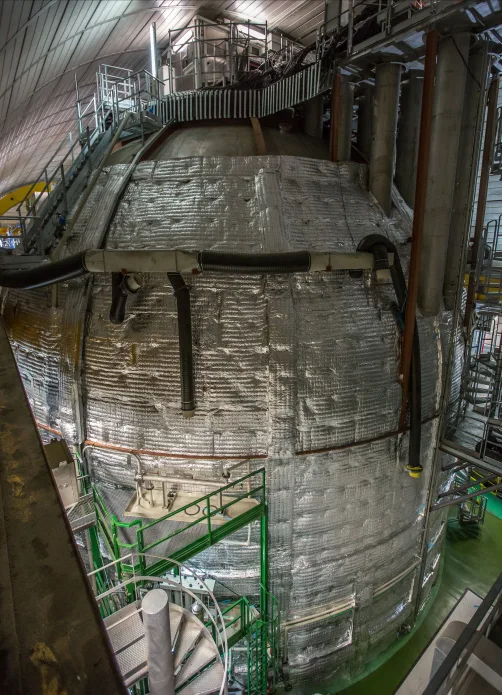
The reaction is specific. In the proton-proton chain, four hydrogen nuclei end up as one helium-4 nucleus by way of deuterium and helium-3: a sequence, not a single step, and the first step is the slow one. It dominates in cores around 15 million K and below, ours among them. The CNO cycle runs here too but supplies only about one percent of the output — a share the Borexino detector measured directly in 2020, and gave only to order of magnitude.
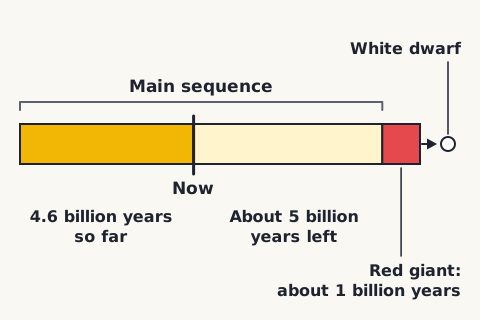
By class the Sun is a G2 V star: photosphere about 5,500 °C, core about 15 million °C, age about 4.6 billion years. Average, and outnumbered by dimmer stars. Some 5 billion years of main sequence life remain, then roughly a billion as a red giant, ending as a white dwarf. Nothing about that is sudden.
Scale is where it stops being ordinary. The Sun is about 1.4 million kilometers across — 109 Earths side by side, ten times wider than Jupiter — and holds about 99.8 percent of all the mass in the Solar System. Every planet, moon and comet shares under a fifth of one percent. Its own mass, 1.99 × 10³⁰ kg, is the unit every other star is quoted in: one solar mass. By mass it is roughly three quarters hydrogen and about a quarter helium — sources differ in the first decimal — with everything heavier under two percent. It is not burning gas. It is plasma.
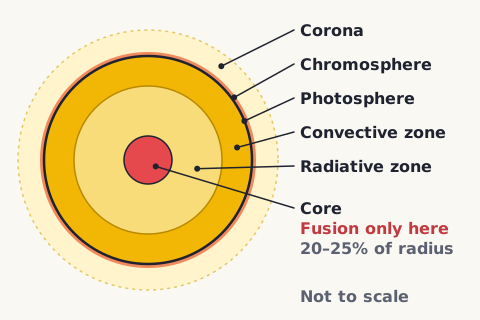
Inside, the Sun is layered: core, radiative zone, convective zone, the visible photosphere, then an atmosphere of chromosphere, a thin transition region, and the corona. Fusion happens only in the core, the innermost 20 to 25 percent of the radius. Everything outside it is a delivery system.
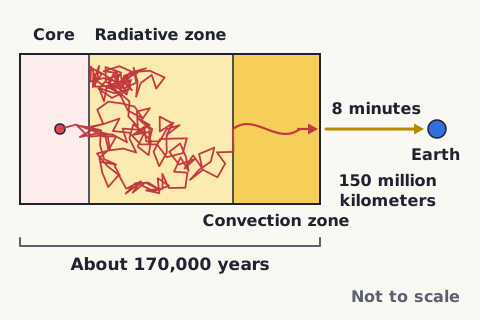
The Sun sits 150 million kilometers away and its light crosses that gap in eight minutes, so you never see it as it is. Eight minutes is the quick part of the journey.
The Sun's Weather
Energy made in the core does not fly straight out. In the radiative zone it is absorbed and re-emitted so many times that reaching the top of the convection zone takes something like 170,000 years — an order-of-magnitude estimate, since published figures vary widely, not a measurement. The light on your face was released before the last ice age ended, then crossed the final 150 million kilometers in eight minutes.
The outer 200,000 kilometers carry heat by boiling instead. Granulation is that boil seen from outside: cells of rising plasma about 1,500 km across, each lasting 8 to 20 minutes, with cooler plasma sinking in the dark lanes between.
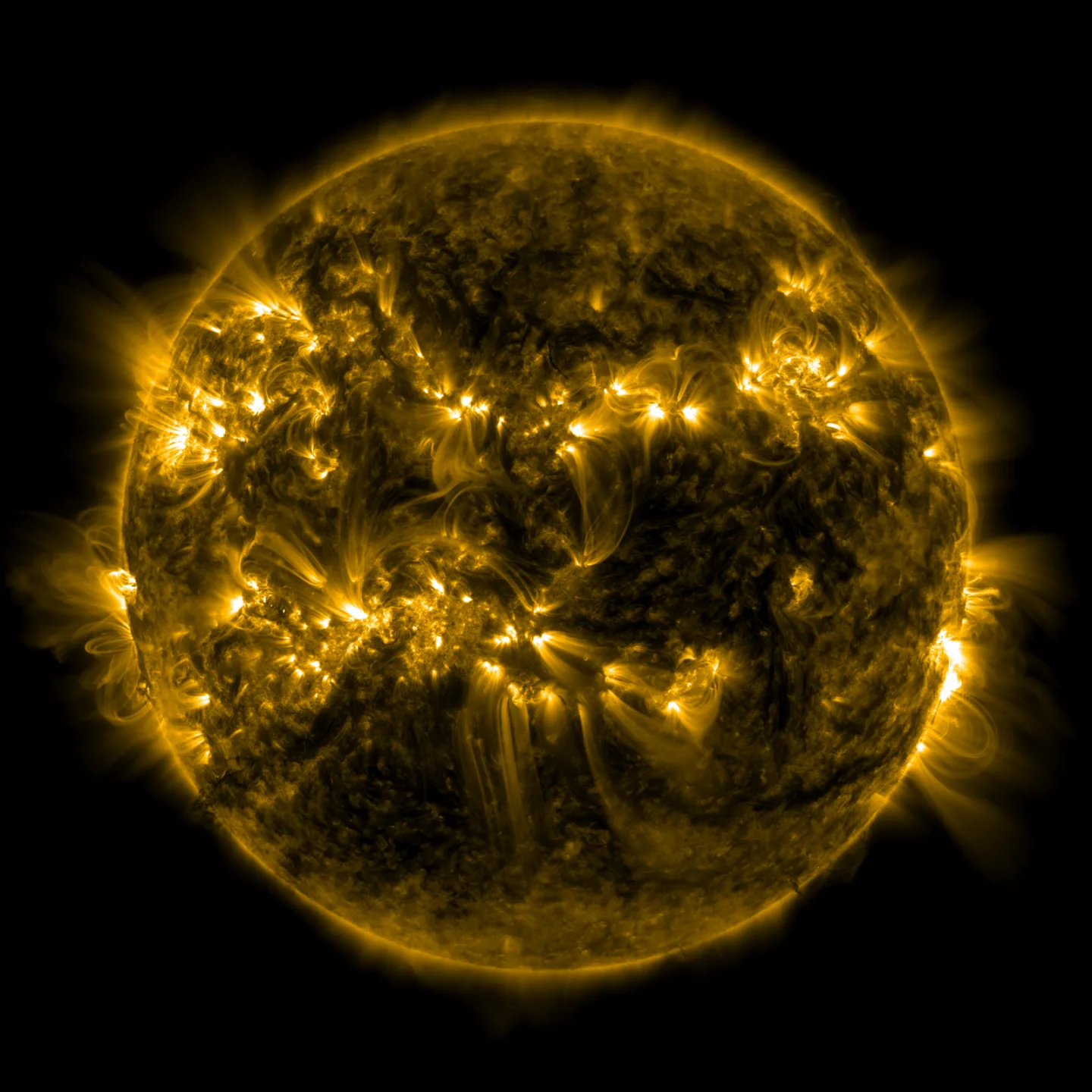
Above the surface, temperature does something it has no business doing. Through the chromosphere, only 3,000 to 5,000 km deep, it climbs outward from about 6,000 to about 20,000 degrees — NASA's own pages give those numbers in °C on one and K on another. Higher still, NASA puts the corona at up to 2 million °C against a 5,500 °C surface, while ESA quotes around 1 million °C and calls it more than 150 times hotter. Move away from the furnace and it gets hundreds of times hotter.
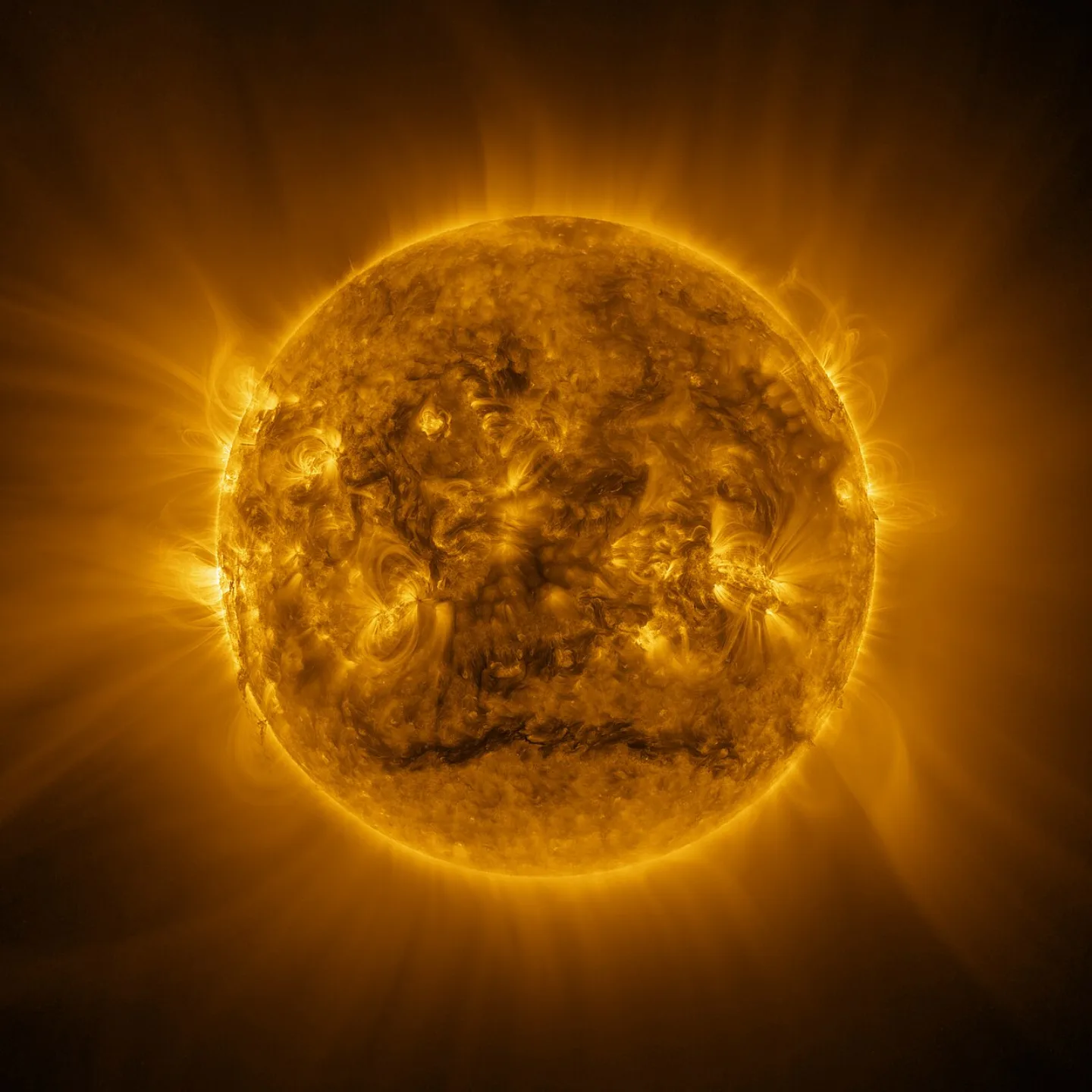
This is the coronal heating problem, and it is unsolved. Two mechanisms lead: Alfvén waves carrying magnetic energy outward, and nanoflares, small explosive releases of magnetic energy across the surface, with turbulence a related candidate Solar Orbiter is testing. Neither is settled and both may operate. Recent missions narrowed the options rather than closing the question.
The visible activity is driven by rotation. Because the Sun is plasma, each latitude turns at its own rate — NASA gives about 25 Earth days at the equator against about 36 at the poles, and other methods differ. This differential rotation winds the magnetic field up like a spring.
A sunspot is that field made visible: a patch where concentrated magnetism chokes off convection, leaving it around 3,482 °C against roughly 5,500 °C around it. Spots are not holes, and not objects passing in front. They look black only by contrast; one alone would still be dazzling.
Their number rises and falls on a cycle of roughly 11 years, and at each maximum the magnetic poles swap over, making the full magnetic cycle about 22 years. The habit can break. In the Maunder Minimum, about 1645 to 1715, spots nearly vanished — fewer than 50 recorded between 1672 and 1699, against the tens of thousands a modern span would show. It fell inside the Little Ice Age, but the cooling began earlier and volcanism is thought the main cause, so that link is not settled.
A solar flare is a burst of electromagnetic radiation lasting minutes to hours. It travels at light speed, so its effect on Earth's sunlit upper atmosphere begins the moment it is seen. Flares are graded A, B, C, M and X by X-ray flux, each letter ten times the one below: an X1 is a hundred times a C1.
Reach and Consequence
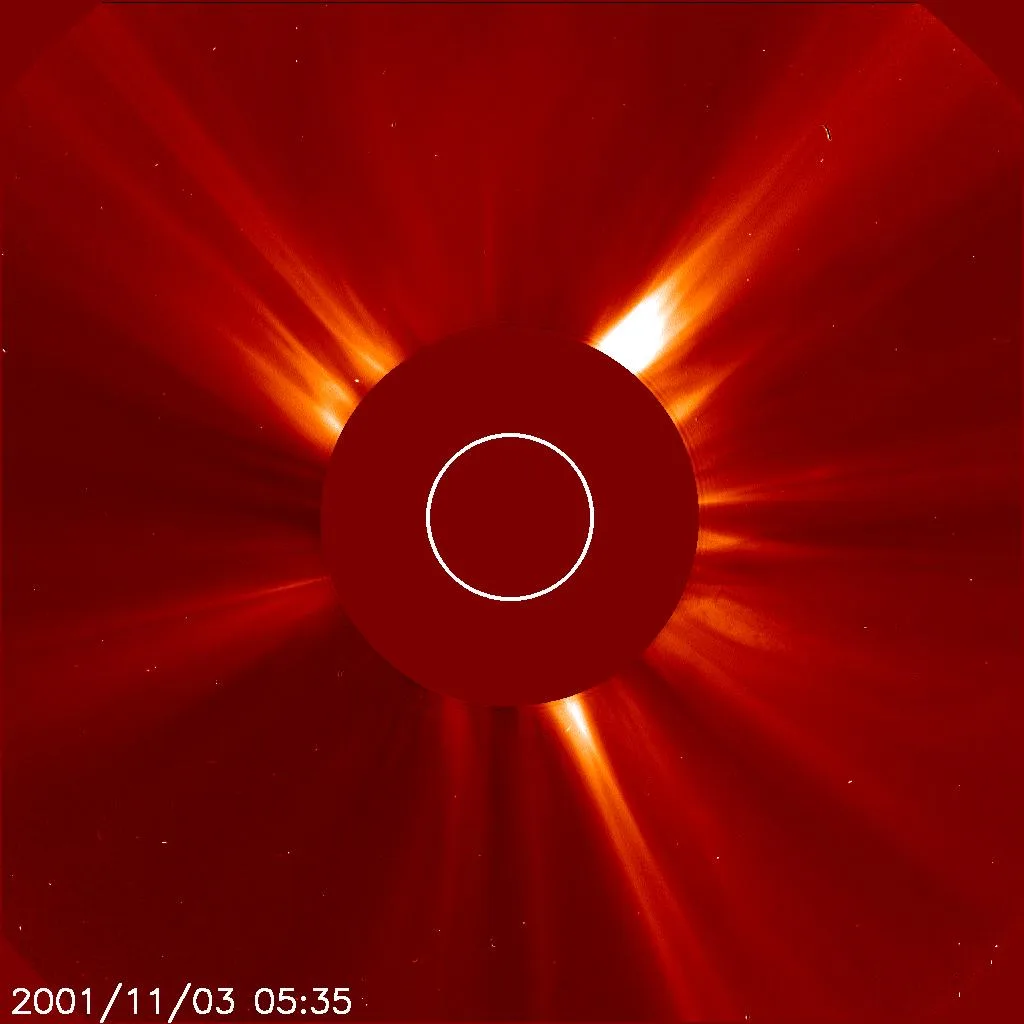
The Sun is not sealed. The corona escapes continuously as the solar wind, a plasma of protons and electrons: 300 to 500 km/s from streamers near the equator, 500 to 800 km/s from coronal holes, where the magnetic field opens to interplanetary space. Space between the planets is not empty, and Earth sits inside that outflow permanently.
The wind inflates a bubble, the heliosphere, whose outer edge — the heliopause — is where the interstellar medium finally stops it. Voyager 1 crossed on 25 August 2012 at about 122 AU, roughly 18 billion km, and Voyager 2 on 5 November 2018, at a distance NASA gives only in kilometers — slightly more than 18 billion km, with no AU figure. The Sun's domain ends there, not at the outermost planet.
Occasionally the Sun throws mass instead of leaking it. A coronal mass ejection expels billions of tons of magnetized plasma at anything from under 250 to near 3,000 km/s; a fast Earth-directed one arrives in 15 to 18 hours, a slow one in days. That is the distinction to hold: a flare is light and takes eight minutes, a CME is matter and takes hours to days. Most are not aimed at us, and those hours are the entire warning window forecasting works inside.
Aurorae are the visible end of the chain — electrons accelerated in the tail of Earth's magnetosphere slamming into oxygen and nitrogen 80 to 500 km up and making them glow. Atmospheric gas emitting its own light, not sunlight reflecting off anything. Earth's own field steers them into two ovals centered on the magnetic poles. NOAA grades the storms G1 minor through G5 extreme; G5 is expected about four times per 11-year cycle and can bring grid collapse, satellite trouble, and aurora as far south as Florida and southern Texas.
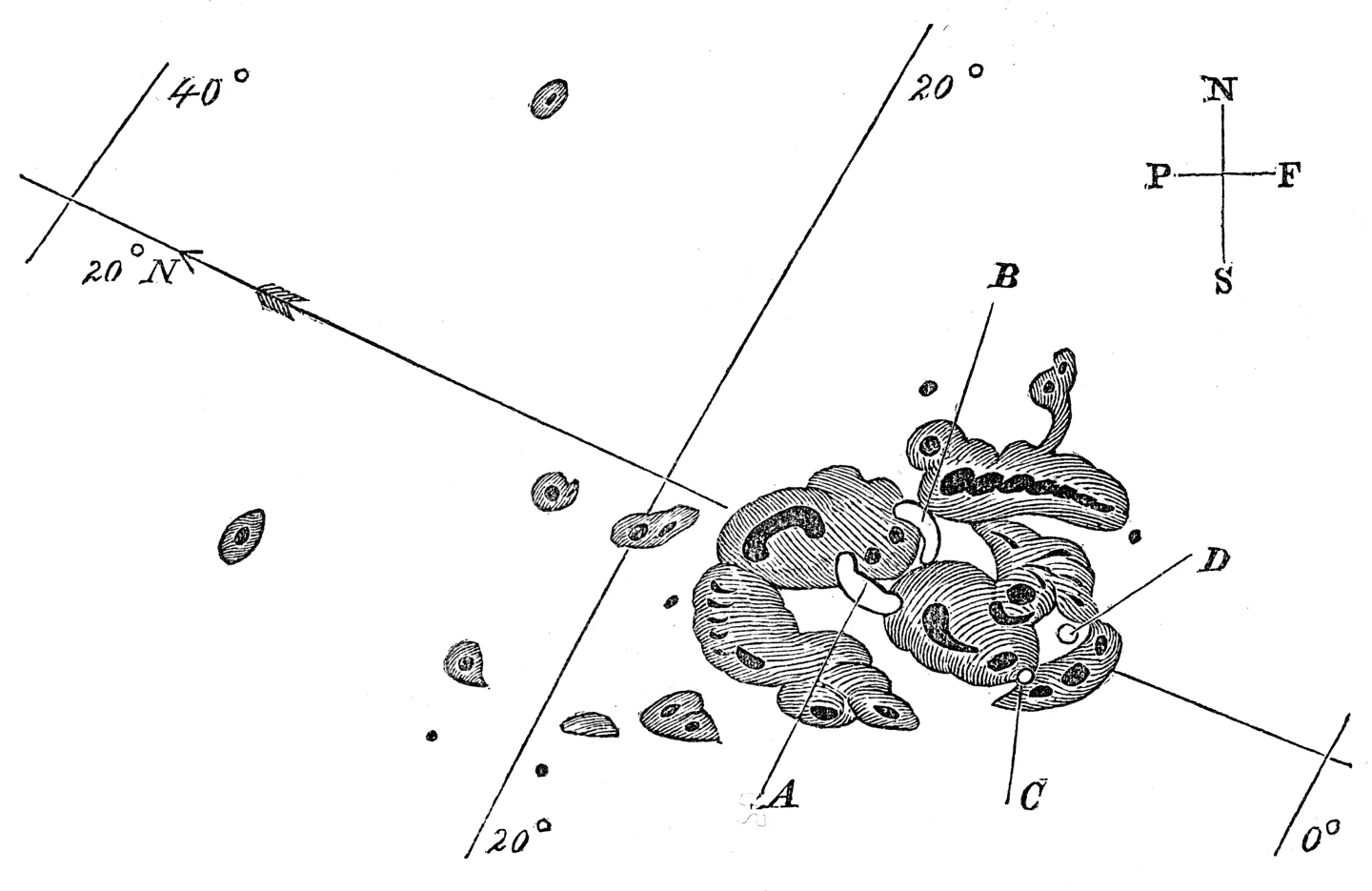
The benchmark is not hypothetical. On 1 September 1859 Richard Carrington and Richard Hodgson independently recorded the first solar flare ever observed. The CME behind it crossed in about seventeen hours; telegraph systems across Europe and North America failed with sparking equipment and fires, and aurorae were seen from Cuba, Hawaii and Colombia. The Carrington Event wrecked the only electrical network then in existence.
What the same storm would cost now is a model output, not a measurement. NOAA cites a National Academies estimate of nearly $2 trillion, with 20 to 40 million Americans at risk of an outage lasting 16 days to two years; other estimates run from about 0.6 to 2.6 trillion. A far smaller storm on 13 March 1989 cut power to six million people in Quebec within 90 seconds. The hazard is to long conductors — grids, pipelines, satellites, radio and GPS — not to people outdoors.
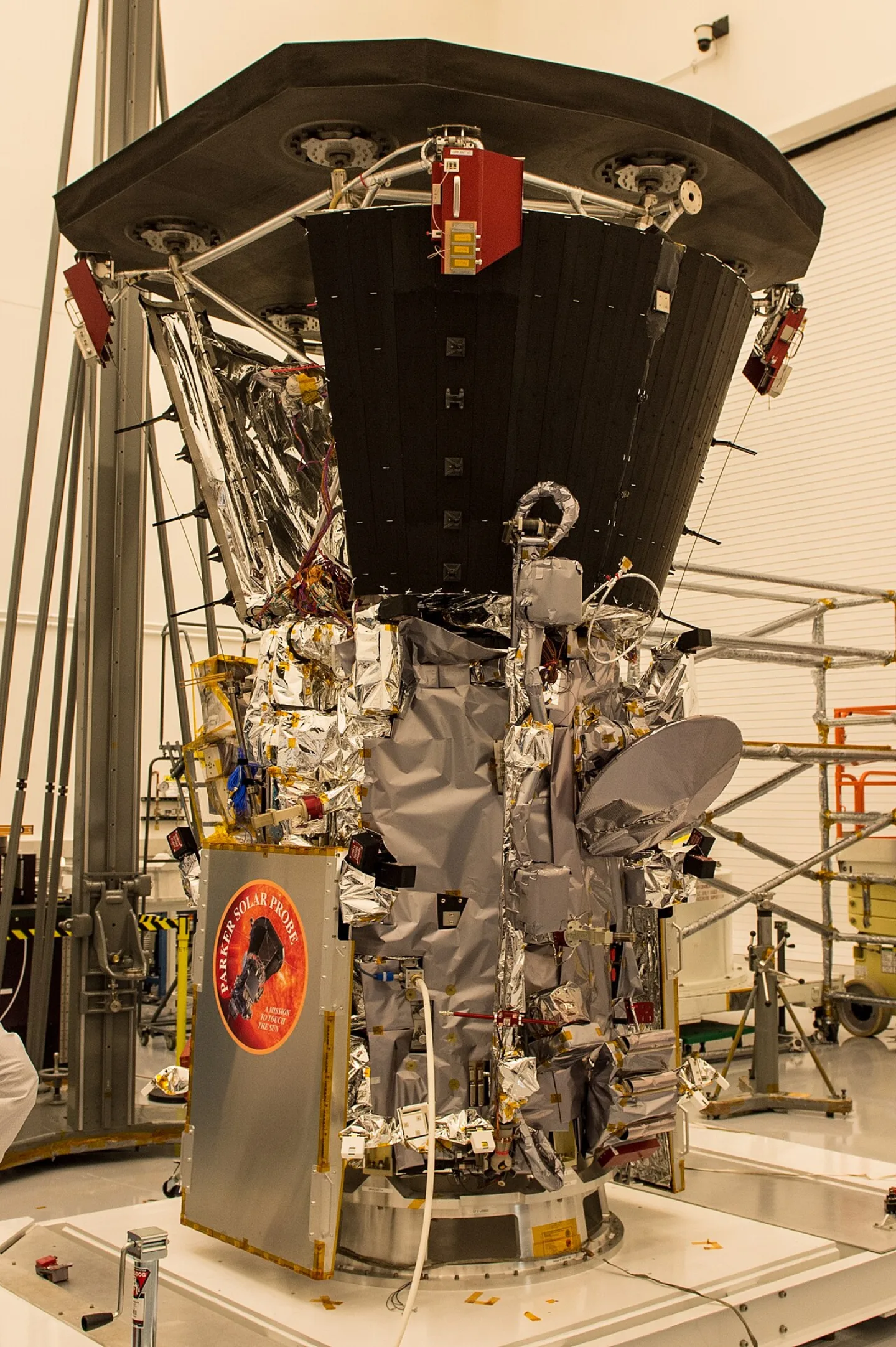
Parker Solar Probe has flown within about 6.1 to 6.2 million km of the surface at around 430,000 mph, and NASA announced on 14 December 2021 that it had passed through the corona itself. The corona is ferociously hot but extremely thin, which is what makes that survivable.
One rule is absolute. Except during the brief total phase of a total solar eclipse, it is never safe to look at the Sun without eye protection made specifically for solar viewing; eclipse glasses and handheld viewers should comply with ISO 12312-2, sunglasses do not count, and there is no treatment for the resulting retinal injury. Never look through a camera lens, telescope or binoculars while wearing eclipse glasses — the optic concentrates the light and burns through the filter. The damage is often painless, and symptoms may not be noticed for four to six hours.
Key terms
- Solar mass
- The Sun's own mass, about 1.99 × 10^30 kg, adopted as the yardstick every other star is quoted against — stellar masses are quoted in Suns, not in kilograms
- Solar flare
- A minutes-to-hours burst of electromagnetic radiation from the Sun's atmosphere, graded by X-ray flux — light on its way to us, never matter
- Coronal hole
- A region where the Sun's magnetic field opens to interplanetary space, letting plasma pour out at 500 to 800 km/s instead of the slower 300 to 500
Key facts
Not a Fire, a Standoff
A star is not burning. Combustion is chemistry, and no chemical reaction could run the Sun for billions of years — it runs on nuclear fusion. Nor is it an explosion: the outward pressure of that fusion balances the inward pull of its own gravity almost exactly. That standoff is hydrostatic equilibrium, and it is what holds a main sequence star steady. Every later stage of a star's life is the balance being lost.
Four Hydrogens, One Helium
Fusion in the Sun is a specific sequence, not one collision. In the proton-proton chain, four hydrogen nuclei end up as one helium-4 nucleus by way of deuterium and helium-3 — and the first step is the slow one. It dominates in cores around 15 million K and below, ours among them. The CNO cycle runs here too but supplies only about one percent of the output, a share the Borexino detector measured directly in 2020.
Fusion Only in the Core
From the middle outward the Sun is layered: core, radiative zone, convective zone, the visible photosphere, then an atmosphere of chromosphere, a thin transition region, and the corona. Fusion happens only in the core — the innermost 20 to 25 percent of the radius. The Sun does not fuse hydrogen throughout its volume; everything outside the core is a delivery system.
Average, and Half Done
By class the Sun is a G2 V star: photosphere about 5,500 °C, core about 15 million °C, age about 4.6 billion years. It is average for its class and outnumbered by dimmer stars. Roughly 5 billion years of main sequence life remain, then about a billion as a red giant, ending as a white dwarf. Nothing about that is sudden — the Sun cannot go out or explode without warning.
A 170,000-Year Journey Out
Energy made in the core does not fly straight out. In the radiative zone it is absorbed and re-emitted so many times that reaching the top of the convection zone takes something like 170,000 years — an order-of-magnitude estimate, since published figures vary widely, not a measurement. The light on your face was released before the last ice age ended, and only then crossed the final 150 million kilometers in eight minutes.
Hotter Farther From the Furnace
Through the chromosphere, only 3,000 to 5,000 km deep, temperature climbs outward from about 6,000 to about 20,000 degrees — NASA's own pages give those numbers in °C on one and K on another. Higher still, NASA puts the corona at up to 2 million °C against a 5,500 °C surface, while ESA quotes around 1 million °C and calls it more than 150 times hotter. Move away from the furnace and it gets hundreds of times hotter. This is the coronal heating problem.
Two Suspects, No Verdict
The coronal heating problem is unsolved. Two mechanisms lead: Alfvén waves carrying magnetic energy outward from the interior, and nanoflares, small explosive releases of magnetic energy across the surface — with turbulence a related candidate ESA's Solar Orbiter is testing. Neither is settled and both may operate together. Recent missions narrowed the options rather than closing the question.
The Decades Spots Vanished
Between about 1645 and 1715 sunspots nearly disappeared — the Maunder Minimum. Fewer than 50 were recorded in the 28 years from 1672 to 1699, against the 40,000 to 50,000 a comparable modern span would show. It fell inside the Little Ice Age, but the cooling had begun earlier and volcanism is thought the main cause, so that link is not settled. The 11-year cycle is a habit, not a law.
Space Is Not Empty
The Sun is not sealed. Its corona escapes continuously as the solar wind, a plasma of protons and electrons. A slow stream of roughly 300 to 500 km/s comes from coronal streamers near the equator; a fast stream of roughly 500 to 800 km/s pours out of coronal holes, where the magnetic field opens to interplanetary space. Earth sits inside that outflow permanently, not only during storms.
Telegraphs on Fire, 1859
On 1 September 1859 Richard Carrington and Richard Hodgson independently recorded the first solar flare ever observed. The coronal mass ejection behind it crossed to Earth in about seventeen hours; telegraph systems across Europe and North America failed, with operators reporting sparking equipment and fires, and aurorae were seen from Cuba, Hawaii and Colombia. The Carrington Event wrecked the only electrical network then in existence.
Inside the Corona
Parker Solar Probe has flown within about 6.1 to 6.2 million km of the Sun's surface at around 430,000 mph, which makes it the fastest object humans have built. NASA announced on 14 December 2021 that an earlier flyby, in April 2021 and far more distant, had already carried it through the corona itself and sampled the particles and magnetic fields there. Nothing melted: the corona is ferociously hot but extremely thin, and the pass is fast and brief.
Matched pairs
Each item on the left goes with the one on the right.
- Sun's spectral class
- G2 V — a yellow dwarf, mid-range on the spectral sequence
- The Sun's ingredients
- About three quarters hydrogen, one quarter helium — by mass
- Differential rotation
- 25 days at the equator, about 36 at the poles
- Sunspot cycle length
- About 11 years; polarity returns to where it began after 22
- How long a CME takes
- 15 to 18 hours if fast, several days if slow
- NOAA's top storm grade
- G5 extreme — about four per 11-year cycle
Self-test
Answer each question from memory, then check your work against the answer key.
1. What holds a main sequence star up against its own gravity?
- AOutward pressure from fusion
- BThe speed of its rotation
- CChemical burning of its fuel
- DA dense solid core
2. How much of the Sun's energy output comes from the CNO cycle?
- AAbout 40 percent
- BAbout 99 percent
- CAbout 1 percent
- DAbout 15 percent
3. Why does a sunspot look black?
- AIts magnetism blocks the light
- BIt is cooler than the rest
- CIt is an object passing by
- DIt is a hole in the surface
4. An X1 flare is how much stronger than a C1 flare?
- A5 times
- B10 times
- C1,000 times
- D100 times
5. Except during totality, what makes it safe to look at the Sun?
- ABinoculars used while wearing eclipse glasses
- BTwo pairs of sunglasses stacked together
- CEclipse glasses that meet ISO 12312-2
- DA phone screen held up in front of your eyes
6. Geomagnetic storms drive currents through conductors. What is most at risk?
- ACar electronics
- BHandheld radios
- CHousehold wiring
- DContinent-scale power grids
Go deeper
- WatchThe Sun Is Not on Fire The Sun is not on fire. No chemical reaction could run a star for billions of years. It runs on nuclear fusion.
- WatchSunlight's Long Way Out Energy made in the Sun's core doesn't fly straight out. It's absorbed and re-emitted, again and again.
- WatchLight in Minutes, Storms in Hours A solar flare is light. It reaches Earth in 8 minutes.
- StudyAstronomy & Space in the FlashFeed app
Answer key
- 1. A Outward pressure from fusionCombustion is chemistry — no chemical reaction could run a star for billions of years. Rotation does not support a star, and the Sun has no solid core: it is plasma throughout. Steadiness comes from fusion pressure balancing gravity almost exactly.
- 2. C About 1 percentBorexino measured the CNO share directly in 2020 and put it at order 1 percent; the proton-proton chain supplies the rest. The 99 percent option swaps the two routes, and 15 or 40 percent would need a core far hotter than 15 million K.
- 3. B It is cooler than the restA sunspot sits near 3,482 °C against a 5,500 °C background, so alone it would still be dazzling. It is not a hole, and the Sun has no crust to cool — it is a patch where concentrated magnetism chokes off convection, and nothing passes in front.
- 4. D 100 timesEach letter is ten times the one below, so C to M is one factor of ten and M to X another — a hundred in all. Ten times is a single letter step, a thousand would need three, and five treats a logarithmic scale as if it were linear.
- 5. C Eclipse glasses that meet ISO 12312-2Stacked sunglasses and a phone screen are not solar filters and block none of the damage. Binoculars concentrate the light and burn through the filter — it must sit in front of the optic, never behind it. Retinal injury is painless and untreatable.
- 6. D Continent-scale power gridsThe hazard is to long conductors: grids, pipelines, satellites, radio and GPS. A 1989 storm cut power to six million people in Quebec in 90 seconds. Bodies outdoors, aircraft structure and equatorial buildings are not what the induced currents couple into.
Sources
- NASA/Webb — Star Lifecycle — science.nasa.gov/mission/webb/star-lifecycle/
- NASA Science — Sun: Facts — science.nasa.gov/sun/facts/
- Lawrence Berkeley National Laboratory — Proton-Proton Chain — aether.lbl.gov/www/tour/elements/stellar/pp.html
- NASA Science — The Sun Spot blog: Layers of the Sun — science.nasa.gov/blogs/the-sun-spot/2023/09/26/layers-of-the-sun/
- Stanford Solar Center — The Sun's Vital Statistics; Stanford Solar Center — The Sun's Vital Statistics (solar mass); apparent magnitude and Hipparchus per Las Cumbres Observatory — What is Apparent Magnitude? — solar-center.stanford.edu/vitalstats
- Borexino Collaboration (INFN Gran Sasso) — Nature press release on CNO neutrino detection — borex.lngs.infn.it/nature-cno-press-release/
- NASA — Parker Solar Probe and the curious case of the hot corona — www.nasa.gov/science-research/heliophysics/nasas-parker-solar-probe-and-the-curious-case-of-the-hot-corona
- NOAA National Weather Service (Sioux Falls) — The Sun and Sunspots — www.weather.gov/fsd/sunspots
- NOAA Space Weather Prediction Center — Sunspots/Solar Cycle — www.spaceweather.gov/phenomena/sunspotssolar-cycle
- NOAA Space Weather Prediction Center — Solar Flares (Radio Blackouts) — www.spaceweather.gov/phenomena/solar-flares-radio-blackouts
- NASA Scientific Visualization Studio — Fast and Slow Solar Wind — svs.gsfc.nasa.gov/20347/
- NOAA Space Weather Prediction Center — Aurora — www.spaceweather.gov/phenomena/aurora
- Wikipedia — Carrington Event — en.wikipedia.org/wiki/Carrington_Event
- NASA Science — Parker Solar Probe — science.nasa.gov/mission/parker-solar-probe/
- NOAA Space Weather Prediction Center — Coronal Mass Ejections — www.spaceweather.gov/phenomena/coronal-mass-ejections
- NOAA Space Weather Prediction Center — NOAA Space Weather Scales — www.spaceweather.gov/noaa-scales-explanation
- NASA Science — Eclipse Safety — science.nasa.gov/eclipses/safety/
- NOAA NESDIS — When Solar Storms Attack: Space Weather and our Infrastructure — www.nesdis.noaa.gov/news/when-solar-storms-attack-space-weather-and-our-infrastructure
Image credits
- Four Hydrogens, One Helium: Wikimedia Commons · Borexino Collaboration · Public domain — commons.wikimedia.org/wiki/File:Laboratori_Nazionali_del_Gran_Sasso,_Borexino_detector.png
- Fusion Only in the Core: FlashFeed original diagram · CC-BY-4.0
- Average, and Half Done: FlashFeed original diagram · CC-BY-4.0
- A 170,000-Year Journey Out: FlashFeed original diagram · CC-BY-4.0
- Hotter Farther From the Furnace: NASA's Scientific Visualization Studio - KBR Wyle Services, LLC/Scott Wiessinger · Public domain — commons.wikimedia.org/wiki/File:Continuing_Strong_Solar_Flares-_May_15-16,_2024_(SVS14593_-_SDO_171_5-15-2024_0846UT).png
- Two Suspects, No Verdict: European Space Agency · CC BY-SA 3.0 igo — commons.wikimedia.org/wiki/File:Solar_Orbiter%E2%80%99s_widest_high-res_view_of_the_Sun_ESA508430.jpg
- Space Is Not Empty: SOHO (ESA & NASA) · Public domain — commons.wikimedia.org/wiki/File:Solar_maximum_coronal_streamers_from_SOHO_LASCO_C2.jpg
- Telegraphs on Fire, 1859: Wikimedia Commons · Richard Christopher Carrington · Public domain — commons.wikimedia.org/wiki/File:Carrington_Richard_drawing_of_1859_sunspots.jpeg
- Inside the Corona: NASA Goddard Space Flight Center · CC BY 2.0 — commons.wikimedia.org/wiki/File:Parker_Solar_Probe_Gets_Its_Revolutionary_Heat_Shield.jpg


