
Education Theory & Learning Technology
From Pavlov to Khanmigo: a complete tour of how humans learn — the foundational learning theories (behaviorism, cognitivism, constructivism), Bloom's taxonomy and the 2 Sigma Problem, the cognitive science of memory and flow, instructional-design frameworks, Sal Khan's AI vision, the modern EdTech landscape, and the field's essential vocabulary.
776 cards10 lessonsFree
Already have FlashFeed?Open this pack
Get this pack on your phone
Scan with your phone's camera.
flashfeedlearningapp.com/packs/learning-theory
Part of the Curious Minds collection.
 FlashFeed original diagram · CC-BY-4.0
 Pexels · Andy Barbour ↗
 Pexels · Close-up portrait of a bearded senior man with eyeglasses indoors. ↗
10 lessons.
Each lesson has a study guide to read and objectives you can test yourself on. Its cards and games show up in your feed. Try one of its cards right here. Play a few of its games here too.
-
Pexels · Andy Barbour ↗01
How Humans Learn
Three modes of learning · The forgetting curve & spaced repetition · Retrieval practice (the testing effect)
Lesson 1 · 10 cardsPexels · Andy Barbour ↗The testing effect
Actively retrieving information from memory produces far stronger long-term retention than passively re-reading or re-watching. This is the testing effect, also called retrieval practice or the production effect — one of the most robust findings in cognitive psychology.
 Pexels · Google DeepMind ↗
Neurons that fire together, wire together
Learning is biological. At the cellular level, acquiring knowledge means forming and strengthening synaptic connections between neurons — the principle summarized as "neurons that fire together, wire together," known as Hebbian learning.
 FlashFeed original diagram · CC-BY-4.0
Exposure, retrieval, application
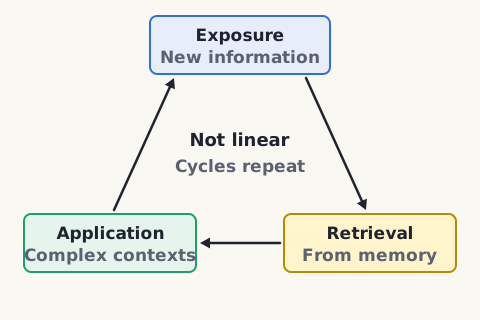
Effective learning requires three stages of engagement: exposure to new information, retrieval of that information from memory, and application in progressively complex contexts. It isn't linear — strong learning cycles through these repeatedly.
 Pexels · Tannishq Giri · Pexels License ↗
Re-reading Isn't Studying
Re-reading a chapter you've already highlighted counts as passive learning, not active or interactive — flashcards count as active retrieval, while teaching or debating the material counts as interactive.
 FlashFeed original diagram · CC-BY-4.0
The forgetting curve (Ebbinghaus, 1885)
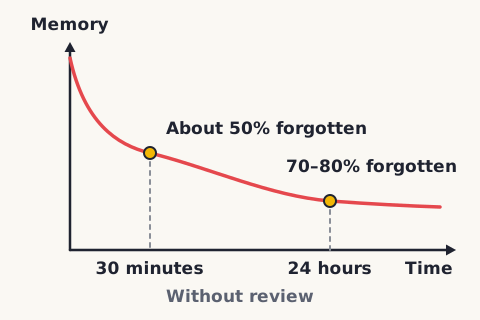
German psychologist Hermann Ebbinghaus was among the first to study memory decay scientifically. Without review, we forget about 50% of new information within 30 minutes and 70–80% within 24 hours. This exponential decay is the forgetting curve.
 Pexels · A person's hand writing in a notebook on a sunny day, showing detailed cursive notes. ↗
A Day Without Review
Left unreviewed, about 75% of newly learned information is gone within 24 hours — the forgetting curve's decay continues well past the first half hour.
 AI-generated (gpt-image-1.5)
Time Your First Review
Because the forgetting curve drops fastest right after learning, your first review is most valuable when it happens soon afterward — timing matters as much as total study time, and it's the basis for spaced repetition's expanding intervals.
1 / 10Which pair of activities defines the interactive mode of learning?
Interactive learning — teaching, debating, contributing — forces the deepest retrieval and negotiates your schema against other mental models.
Lesson 1 has 74 cards. Keep going in the free app.
Question -
 Pexels · Beata Dudová ↗02
Learning Theories: Behaviorism to Constructivism
Behaviorism · Cognitivism · Constructivism
Lesson 2 · 10 cardsPexels · Beata Dudová ↗Behaviorism, gamified
Behaviorist principles underpin today's gamification — point systems, badges, streaks (Duolingo), and immediate feedback loops are reinforcement by another name. The ADDIE instructional-design model's military origins even trace back to Skinnerian operant conditioning.
 Pexels · Nothing Ahead ↗
Behaviorism
Behaviorism holds that learning is observable behavior change produced by stimulus-response conditioning, reinforcement, and punishment. Its early-20th-century champions — B.F. Skinner, Ivan Pavlov, and John Watson — treated internal mental states as irrelevant: only what you can see and measure counts.
 FlashFeed original diagram · CC-BY-4.0
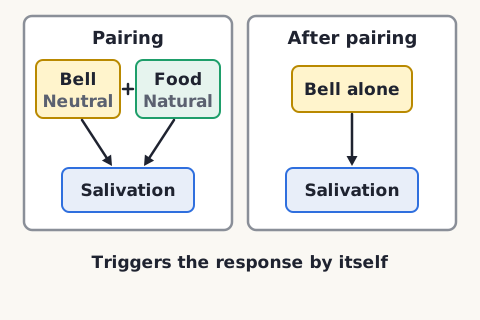
Pavlov's Bell and Drool
Pavlov paired a bell with food until dogs salivated at the bell alone — demonstrating classical conditioning, in which a neutral stimulus paired with a natural one comes to trigger the response by itself.
 Pexels · meo ↗
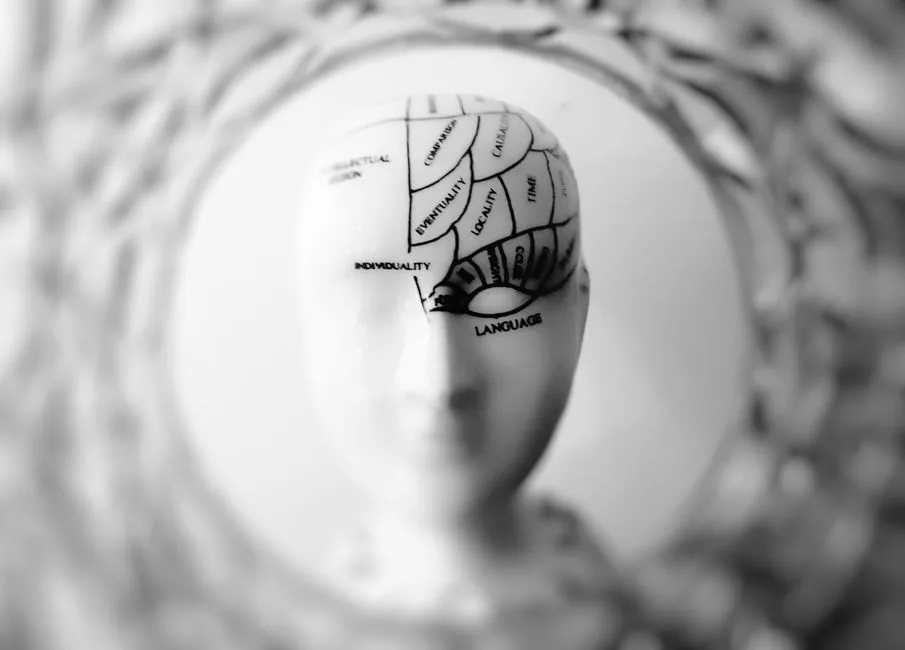
Cognitivism
Cognitivism put the mind back in the picture. Where behaviorism saw a black box, cognitivists — Jean Piaget, Jerome Bruner, Albert Bandura, George Miller — studied the internal processes: schemas, attention, encoding, storage, retrieval. The mind actively constructs understanding.
 Pexels · A child and a dog on rocky terrain pointing towards majestic mountains under a clear sky. ↗
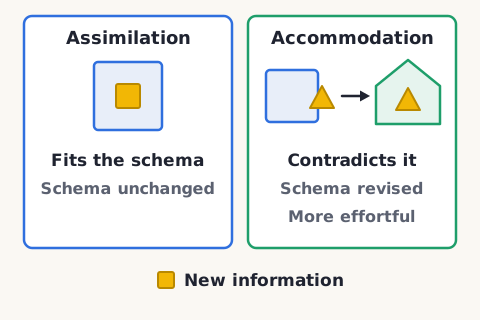
Assimilation: Same Old Schema
When a child who already knows 'dog' sees a new breed and simply calls it a dog too, that's assimilation — fitting new information into an existing schema without changing it.
 FlashFeed original diagram · CC-BY-4.0
Accommodation: Schema Under Revision
Accommodation is the opposite move: when new information contradicts an existing schema, the schema itself gets revised to fit it — a more effortful process than simply assimilating.
 Pexels · A detailed close-up of a hand holding small, colorful pebbles on a rocky ground. ↗
Working Memory's Hard Limit
George Miller's landmark 1956 paper established that working memory holds only about 7 plus-or-minus 2 chunks at once — a hard capacity limit that has shaped instructional design ever since.
 Pexels · Diva Plavalaguna · Pexels License ↗
Four Digits Become One Chunk
Turning the digits 1-4-9-2 into the single meaningful unit '1492' is chunking: it frees up working-memory slots by grouping raw items into one chunk instead of several.
1 / 10Which behaviorism founder is correctly paired with his contribution?
Skinner is credited with operant conditioning — behavior shaped by its consequences — and with the insight that reinforcement schedules matter. Pavlov demonstrated classical conditioning with dogs; Watson extended conditioning to humans, treating all behavior as conditioned reflexes.
Lesson 2 has 82 cards. Keep going in the free app.
Question -
 Wikimedia Commons · Gorkaazk · CC0 ↗03
Bloom's Taxonomy & Mastery Learning
Bloom's taxonomy · The verb ladder · The 2 Sigma Problem & mastery learning
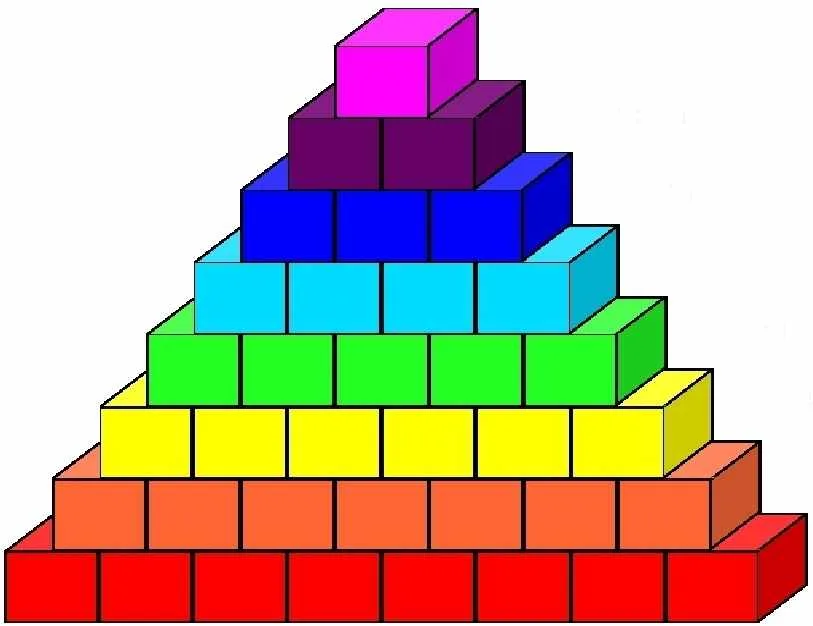
Lesson 3 · 9 cardsWikimedia Commons · Gorkaazk · CC0 ↗Bloom's Taxonomy
Bloom's Taxonomy (Benjamin Bloom and colleagues, University of Chicago, 1956) sorts cognitive skills into six levels, from lower-order recall up to higher-order thinking. It's the backbone of how we write learning objectives, design assessments, and calibrate difficulty.
 Pexels · Yan Krukau · Pexels License ↗
The Affective Domain
A second handbook (1964) covered the affective domain — attitudes, values, and motivations — across five levels: Receiving, Responding, Valuing, Organizing, Characterizing. Less discussed in edtech than the cognitive domain, but central to engagement design.
 FlashFeed original diagram · CC-BY-4.0
The 2 Sigma Problem
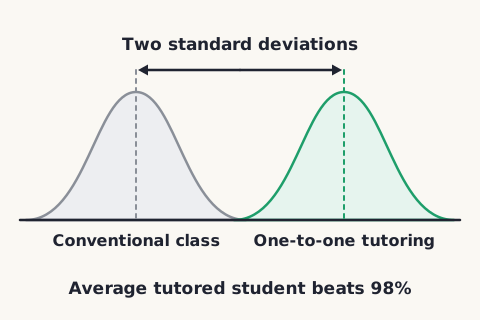
In 1984, Bloom reported that students tutored one-to-one with mastery techniques scored two standard deviations higher than conventionally taught peers — the average tutored student beat 98% of the control class. The catch: 1:1 tutoring doesn't scale.
 FlashFeed original diagram · CC-BY-4.0
Instructional Gap, Not Deficit
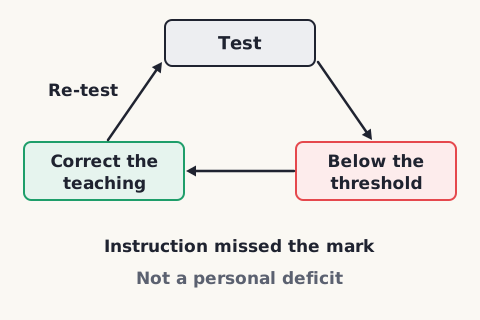
In mastery learning, a student who doesn't reach the threshold is treated as evidence the instruction missed the mark, not as a personal deficit — the fix is to correct the teaching and re-test.
 Pexels · Teacher and student sharing a high-five over a desk in a bright classroom, fostering a positive learning environment. ↗
Reinforcement's 1.2 Sigma
Among Bloom's ranked alterable variables, reinforcement placed second at 1.2 sigma — well behind one-to-one tutoring's top effect size of 2 sigma.
 Pexels · A teenager in a hoodie studying with books and notes on a table, focused on learning indoors. ↗
Two Ways to 1 Sigma
Two of Bloom's alterable variables each produced a 1-sigma effect: mastery learning built on feedback-corrective cycles, and simply increasing a student's time on task.
1 / 9Which mapping from a 1956 level to its 2001 counterpart is correct?
Synthesis was renamed Create and moved to the summit. Each wrong pairing slips one rung too high: Knowledge became Remember, Comprehension became Understand, and Analysis became Analyze.
Lesson 3 has 72 cards. Keep going in the free app.
Question -
 FlashFeed original diagram · CC-BY-4.004
The Cognitive Science of Learning
Flow & dual coding · Connectivism & Gagné's events · UDL & memory techniques · Cognitive load
Lesson 4 · 10 cardsFlashFeed original diagram · CC-BY-4.0The challenge-skill balance
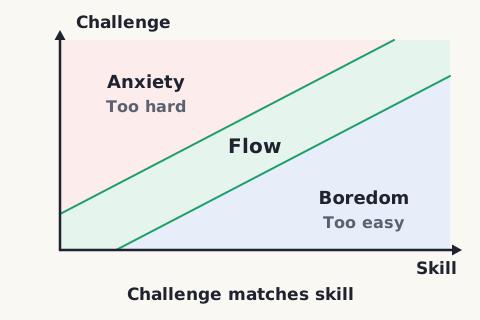
Mihaly Csikszentmihalyi described flow in 1975. Its condition is precise: task challenge must match the learner's skill. Too easy breeds boredom; too hard breeds anxiety; the balance produces flow.
 Pexels · Teenager practicing piano in a bright, serene room, adding to a calm and focused atmosphere. ↗
Flow Is Autotelic
Flow theory calls an activity 'autotelic' when it's pursued purely because doing it is rewarding, with no outside payoff — like a student who keeps practicing piano long after the assignment is finished, simply because playing itself feels good.
 Pexels · Artem Podrez · Pexels License ↗
Verbal Plus Visual
Dual Coding Theory holds that humans operate with two interconnected memory systems: a verbal system for language, text, and narrative, and a visual system for imagery and spatial layout.
 Pexels · A man in eyeglasses and suit surrounded by floating books in a dramatic, dimly lit setting. ↗
Know-where beats know-that
Connectivism holds that knowing where to find information matters more than what you currently know. Knowledge is distributed across networks — people, books, databases, AI — not stored only in one mind. Prescient for the LLM era.
 Pexels · Modern digital spheres interconnected by glowing lines, showcasing a futuristic network concept. ↗
Learning Outside the Mind
Connectivism's founders argued that behaviorism, cognitivism, and constructivism all locate learning inside the individual mind — missing the learning that happens in networks, organizations, and digital systems.
 Pexels · Futuristic robotic hand touching a digital network on a blue background. ↗
Connectivism's Two Founders
George Siemens and Stephen Downes developed connectivism, 'the learning theory for the digital age,' around 2004–05 — after Gagné's 1965 Conditions of Learning and Sweller's 1988 load theory.
1 / 10In flow theory, what happens when a task's challenge far exceeds the learner's skill?
Challenge above skill produces anxiety; challenge below skill produces boredom. Flow lives in the balance between the two.
Lesson 4 has 97 cards. Keep going in the free app.
Question -
FlashFeed original diagram · CC-BY-4.005
Instructional Design Frameworks
The ADDIE model · ID frameworks & the Socratic method
Lesson 5 · 10 cardsFlashFeed original diagram · CC-BY-4.0Evaluate Never Stops
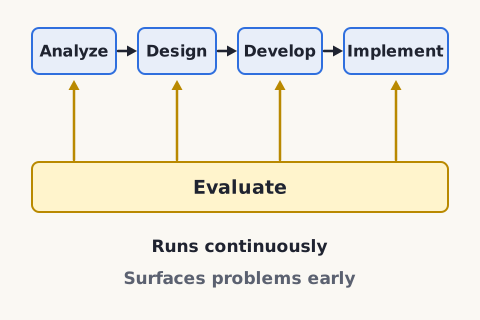
ADDIE's Evaluate phase isn't a final gate — it runs continuously through Analyze, Design, Develop, and Implement, surfacing problems early instead of waiting until after delivery.
 Pexels · Colleagues collaborating at a business meeting, analyzing graphs on a whiteboard. ↗
ADDIE Starts With Analyze
ADDIE's front-end Analyze phase is where a team identifies goals, audience, prior knowledge, and constraints — before Design sets objectives, assessment, and sequencing.
 Pexels · Sleek home office desk with ultrawide monitor for video editing, keyboard, and smartphone. ↗
ADDIE's Build Phase
In ADDIE's Develop phase, a team produces the actual videos, activities, and quiz items planned during Design — turning objectives and sequencing into finished material.
 AI-generated (gpt-image-1.5)
Khanmigo, by design
Sal Khan built Khanmigo to embody Socratic principles: it guides students through their learning rather than just handing over answers. That operationalizes a constructivist insight — knowledge a learner builds is more durable than knowledge merely received.
 AI-generated (gpt-image-1.5)
ADDIE's Agile Answer
SAM — Michael Allen's Successive Approximation Model (2012) — is the iterative counterpoint to ADDIE, built on rapid, agile prototyping and short revision cycles.
 Pexels · Close-up photo of hands using a pen to practice shading techniques on paper. ↗
Merrill's First Principles
Merrill's Principles of Instruction (2002) offer task-centered 'first principles' of design — problem-centered, activation, demonstration, application, and integration — rather than a systems view of instruction.
1 / 10Which organization commissioned the work that produced ADDIE?
The U.S. Army commissioned ADDIE to bring engineering-style rigor to training production. The other services were not the commissioning body.
Lesson 5 has 68 cards. Keep going in the free app.
Question - Take the lessons with you. Free, no account.Download on the App Store ↗Get it on Google Play ↗
-
 AI-generated (gpt-image-1.5)06
Brave New Words: AI & Education
Khan's vision · Khanmigo & the debate
Lesson 6 · 10 cardsAI-generated (gpt-image-1.5)AI as equity engine
Khan argues AI can address historical education inequity by giving students in under-resourced communities access to individualized tutoring equivalent to what wealthy families buy in private instruction. This directly targets Bloom's 2 Sigma Problem — the gap between tutored and classroom learners.
 AI-generated (gpt-image-1.5)
What a Tutor Must Know
Khan argues an effective tutor must understand four things about a learner: where they are, what they know, how they learn, and what engages them.
 AI-generated (gpt-image-1.5)
Khan + conmigo
Khanmigo is a play on "Khan" and the Spanish word conmigo — "with me." The pun captures the pitch: a tutor that learns alongside the student rather than lecturing at them. It was built on GPT-4 with OpenAI as Khan Academy's proof of concept.
 AI-generated (gpt-image-1.5)
The contrarian review
Reception was mixed. John Warner, writing in Engaged Education, argues the book "makes no real attempt to grapple with the implications of its own argument" — leaning on faith in technology rather than rigorous evidence. The tension between technology optimism and pedagogical rigor sits at the center of today's edtech debates.
 AI-generated (gpt-image-1.5)
Built on GPT-4
Khanmigo was built on GPT-4 in partnership with OpenAI, serving as Khan Academy's proof of concept for the book's thesis.
1 / 10Which work supplies Khan's image of personalized, challenge-driven simulation learning?
Ender's Game supplies the challenge-driven simulation model. The Diamond Age supplies the AI-tutor-as-equalizer image, and 'The Fun They Had' the exotic-classroom image; Snow Crash is not a touchstone at all.
Lesson 6 has 50 cards. Keep going in the free app.
Question -
 Pexels · Students in a Japanese classroom using tablets for learning. Modern educational technology in Tokyo. ↗07
The Modern EdTech Landscape
The AI platform taxonomy · Platform deep-dives · Does AI tutoring work? · The adaptive-learning market
Lesson 7 · 10 cardsPexels · Students in a Japanese classroom using tablets for learning. Modern educational technology in Tokyo. ↗Mapping the AI-in-education space
The AI-in-education landscape splits by function: AI tutors (1:1 conversational instruction), teacher tools (lesson planning, grading), language learning, research assistants, enterprise/workforce upskilling, assessment & analytics, micro/game learning, and LMS infrastructure. Each category has its own leading players.
 Pexels · Glasses and documents on a desk with a laptop, representing a busy workspace. ↗
Research Assistants category
Google NotebookLM ingests documents to build a research-grounded knowledge base, placing it in the Research Assistants category alongside Perplexity.
 Pexels · Young woman using a drawing tablet with headphones, smiling in a cozy home setting. ↗
AI Tutors category
AI Tutors is the category defined as adaptive, conversational one-to-one instruction — the closest digital analog to a personal teacher.
 NEC Corporation of America (Openverse) · by 2.0 ↗
Khanmigo
Khanmigo is Khan Academy's AI tutor, powered by GPT-4. It uses the Socratic method — it refuses to hand over answers directly. It's the only AI tool integrated with Khan Academy's full content library across math, humanities, coding, and social studies, and is positioned as a teacher assistant, not a replacement.
 Pexels · Discover the Kazakh language learning app on a smartphone next to a classic fountain pen and notebook. ↗
Duolingo: BirdBrain and Max
Duolingo's proprietary BirdBrain model orchestrates, sequences, and personalizes lessons from a learner's performance history. The freemium Duolingo Max tier (GPT-4 powered) adds roleplay and 'Explain My Answer', plus a Lily chat feature that recreates dynamic conversation practice. AI also lets Duolingo scale its language library without the human-content bottleneck.
 Pexels · Young girl in pajamas using a tablet with headphones, nestled in cozy bedroom environment. ↗
Synthesis
Synthesis was built for the SpaceX employee school and founded by Chrisman Frank. It's an adaptive K-6 math platform with a voice-guided interface and visual math representations, favoring conceptual understanding over rote drilling. A family subscription runs ~$99/year. It's on pace for $10M+ revenue in 2025, with subscribed students up 4.5x year-over-year.
 Pexels · Adult man focused on documents while working remotely at home with laptop and headphones. ↗
Google NotebookLM
NotebookLM ingests documents — PDFs, YouTube, web pages — and builds a research-grounded knowledge base for chat, synthesis, and multi-modal output (text, audio podcasts, slides). Its key trait: outputs are grounded in the provided sources, which reduces hallucination for domain-specific synthesis. Builders use it to spin up custom learning assistants without fine-tuning a model.
1 / 10Which category does Google NotebookLM belong to?
NotebookLM ingests documents to build a research-grounded knowledge base — a research assistant, alongside Perplexity.
Lesson 7 has 85 cards. Keep going in the free app.
Question -
 Pexels · Viktorya Sergeeva 🫂 · Pexels License ↗08
LMS, Standards & Gamification
LMS history & leaders · Interoperability standards · Gamification & motivation
Lesson 8 · 10 cardsPexels · Viktorya Sergeeva 🫂 · Pexels License ↗LMS history, in sequence
The LMS timeline runs Pressey's machine (1924), then PLATO (1960), then SCORM (2001), then Moodle (2002) — SCORM arrives decades after PLATO, not before it.
 Pexels · Close-up view of an illuminated office building exterior at night, showcasing modern architecture. ↗
Canvas's maker: Instructure
Canvas is built by Instructure — not to be confused with Blackboard Inc., which makes the rival product, or Moodle, which came from Martin Dougiamas.
 Pexels · Close-up of retro arcade game controls with joystick and buttons ↗
Older than the buzzword
Nick Pelling coined gamification in 2002, but its educational roots are older: Thomas Malone's 1980 study on intrinsically motivating computer games asked what actually makes games engaging. Jesse Schell's 2010 DICE talk predicted game elements would invade everyday life; Jane McGonigal's Reality Is Broken (2011) argued we should harness gamer motivation for real-world problems.
 Pexels · fauxels · Pexels License ↗
SDT's three core needs
Self-Determination Theory names autonomy, competence, and relatedness as its three basic psychological needs — not points and badges, which are surface mechanics, not needs.
 FlashFeed original diagram · CC-BY-4.0
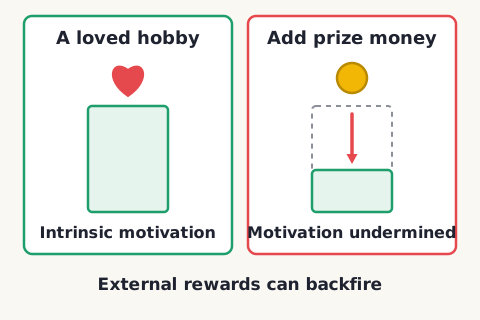
The overjustification effect
Adding prize money to a hobby someone already loves can backfire — the overjustification effect describes how external rewards for an already-intrinsically-motivating task can undermine that intrinsic motivation.
1 / 10Which LMS is noted for being instruction-friendly and gaining market share from Blackboard?
Canvas is instruction-friendly and has been taking market share from Blackboard. Moodle is the open-source global leader; Brightspace is another current leader.
Lesson 8 has 74 cards. Keep going in the free app.
Question -
Pexels · Close-up portrait of a bearded senior man with eyeglasses indoors. ↗09
Who's Who & What's What of Learning
The theorists · The frameworks · Right or Wrong: spot the better practice
Lesson 9 · a questionWhat was Lev Vygotsky's contribution to learning theory?
Vygotsky, who argued that learning is social, defined the gap between solo and supported performance — the Zone of Proximal Development. The stages of cognitive development are Piaget's, the separate coding of words and images is Paivio's, and "learn by doing" is Dewey's.
Lesson 9 has 43 cards. Keep going in the free app.
-
10
Essential Vocabulary & Quick Recall
AI & adaptive-systems terms · Generative AI & system infrastructure terms · Pedagogy & instruction terms · Learning-science terms · Assessment, data & standards terms · Quick recall (mixed)
Lesson 10 · a questionAlgorithm-Based Sequencing runs a repeating loop. Which step is NOT part of that loop?
The loop is observe, update state, select next item, repeat. Timer-based certificates are the opposite of algorithmic sequencing, which selects items from the predicted knowledge state.
Lesson 10 has 154 cards. Keep going in the free app.

What you'll be able to do 48 objectives, from the pack's lessons
- Explain Hebbian learning: how repeated co-activation strengthens synaptic connections
- Distinguish passive, active, and interactive learning, and identify which mode forces the deepest retrieval and schema negotiation.
- Describe Ebbinghaus's forgetting curve and quantify how much unreviewed information is lost within 30 minutes and 24 hours.
- Explain spaced repetition over expanding intervals and how SRS tools like Anki schedule reviews at the optimal moment.
- Explain retrieval practice (the testing effect), cite its key studies, and state the practical implication for frequent low-stakes quizzing.
- Identify behaviorism's founders (Skinner, Pavlov, Watson) and match each to their stimulus-response contribution.
- Explain operant conditioning and how shaping reinforces successive approximations toward a target behavior.
- Distinguish assimilation, accommodation, and equilibration as Piaget's schema-change processes, and why mild surprise aids memory.
- Define a schema and explain how chunking works within George Miller's 7±2 working-memory limit.
- Explain constructivism through the Zone of Proximal Development, scaffolding, and the roles of Vygotsky and Dewey.
- Explain Bloom's Taxonomy and the 2001 revision, including the renaming to verbs and the Synthesis→Create swap at the summit.
- Identify the five levels of Bloom's affective domain (Receiving, Responding, Valuing, Organizing, Characterizing).
- Match the revised Bloom levels to their action verbs and identify Create as the highest level.
- Explain the 2 Sigma Problem and mastery learning, including why the result was economically unscalable and how a student's failure is reframed.
- Rank Bloom's alterable instructional variables by effect size, from one-to-one tutoring down to classroom morale.
- Explain flow and the challenge-skill balance — including boredom, anxiety, autotelic engagement, and its 1975 origin.
- Explain Paivio's Dual Coding Theory and its two interconnected verbal and visual memory systems.
- Explain Sweller's Cognitive Load Theory: working memory's limit, the three load types of the 1998 formulation, and the 2010 recasting of germane load.
- Explain connectivism's 'know-where' claim and the gap it named, plus Gagné's five learning outcomes and first event of instruction.
- Explain UDL's three principles and the mnemonic techniques (Method of Loci, Keyword Method) that exploit dual coding.
- Identify ADDIE's origin and sequence its five phases, matching Analyze, Design, and Develop to their functions.
- Explain how the Evaluate phase threads through all of ADDIE rather than acting as a final gate.
- Match the major instructional-design frameworks (Dick & Carey, SAM, Merrill, UbD) to their defining approach.
- Distinguish backward design (Wiggins & McTighe's UbD) from Cathy Moore's Action Mapping.
- Explain the Socratic method and how Khanmigo embodies it through guided questioning rather than direct answers.
- Explain the personalization problem that Khan argues AI tutoring can finally solve.
- Match Khan's three sci-fi inspirations to their educational vision and identify the work that is NOT an inspiration.
- Explain Khanmigo — its GPT-4/OpenAI basis, Socratic design, and the 'conmigo' pun behind its name.
- Recognize the book's stakes beyond K-12 and John Warner's contrarian critique of technology optimism.
- Classify AI-in-education products into the seven functional categories by what each actually does.
- Describe how the flagship platforms work — Khanmigo's Socratic method and scale, Duolingo BirdBrain, Synthesis's origin — and define adaptive learning.
- Evaluate the RCT evidence for AI tutoring, comparing LearnLM, human-tutor, and static-hint success rates and who benefits most.
- Quantify the adaptive-learning market and the major 2025 EdTech deals and investment.
- Match each named platform (Khanmigo, Duolingo, MagicSchool, Synthesis, NotebookLM) to its edtech category.
- Sequence the milestone years of LMS evolution — Pressey's machine, PLATO, SCORM, and Moodle.
- Recognize the major LMS platforms (PLATO, Moodle, Canvas, Blackboard) and Canvas's rise over Blackboard.
- Distinguish SCORM from xAPI and explain the role of the Learning Record Store, including xAPI's Actor-Verb-Object statements.
- Define gamification and match its key thinkers to their works, including the mechanic that reframes failure as information.
- Explain Self-Determination Theory's three needs and autotelic, intrinsic motivation.
- Recognize the behaviorist and constructivist theorists (Skinner, Pavlov, Piaget, Vygotsky, Dewey) from their ideas.
- Recognize the memory researchers and modern figures (Ebbinghaus, Bloom, Csikszentmihalyi, Siemens, Khan), including Bloom's 1984 tutoring finding.
- Recognize the memory frameworks — Forgetting Curve, Spaced Repetition, Testing Effect, ZPD — and the most durable study strategy.
- Recognize the cognitive and instructional-design frameworks (Bloom's Taxonomy, Flow, Cognitive Load, Dual Coding, Connectivism, ADDIE).
- Define the adaptive-systems and knowledge-tracing terms (ALS, ITS, Cognitive Tutor, Knowledge State, BKT, DKT, algorithm-based sequencing).
- Define the generative-AI and infrastructure terms (GenAI, Agentic AI, zero-shot learning, prompt engineering, HITL, affective computing, ontology).
- Define the pedagogy and instruction terms (metacognition, differentiated vs personalized learning, microlearning, multimodal, PBL, scaffolded curriculum).
- Define the core learning-science terms (working memory, chunking, transfer, PCK, EdTech) and SDT's three needs.
- Define the assessment, data, and standards terms (formative vs summative assessment, learner analytics, Kirkpatrick, xAPI, MOOC, syllabus).
Study guide.
The same study guide as in the app, one page for each lesson, with its key facts and a self-test.
- 01How Humans Learn
- 02Learning Theories: Behaviorism to Constructivism
- 03Bloom's Taxonomy & Mastery Learning
- 04The Cognitive Science of Learning
- 05Instructional Design Frameworks
- 06Brave New Words: AI & Education
- 07The Modern EdTech Landscape
- 08LMS, Standards & Gamification
- 09Who's Who & What's What of Learning
- 10Essential Vocabulary & Quick Recall
Built from 8 sources.
9 of its 778 cards cite a source. These are the sources it cites.
- Sweller, van Merriënboer & Paas (1998), Cognitive Architecture and Instructional Design, Educational Psychology Review 10:251-296 ↗
- Wikipedia (citing Siemens 2005, 'Connectivism: A Learning Theory for the Digital Age') ↗
- Miller (1956), The Magical Number Seven, Plus or Minus Two, Psychological Review 63(2):81-97 ↗
- Flow Theory (Autotelic Experience) ↗
- official theory overview ↗
- Sweller (1988), Cognitive Science ↗
- Sweller (2010), Element Interactivity and Intrinsic, Extraneous, and Germane Cognitive Load, Educational Psychology Review 22:123-138 ↗
- xAPI overview (Rustici Software, xapi.com) ↗
Hover over a photo, or tap its i, to see where it came from. All 9:
- Lesson 1: Pexels · Andy Barbour ↗
- Lesson 2: Pexels · Beata Dudová ↗
- Lesson 3: Wikimedia Commons · Gorkaazk · CC0 ↗
- Lesson 4: FlashFeed original diagram · CC-BY-4.0
- Lesson 5: FlashFeed original diagram · CC-BY-4.0
- Lesson 6: AI-generated (gpt-image-1.5)
- Lesson 7: Pexels · Students in a Japanese classroom using tablets for learning. Modern educational technology in Tokyo. ↗
- Lesson 8: Pexels · Viktorya Sergeeva 🫂 · Pexels License ↗
- Lesson 9: Pexels · Close-up portrait of a bearded senior man with eyeglasses indoors. ↗
- Cards
- 776
- Lessons
- 10
- Version
- 1.0.32
- Language
- English
The whole pack is one file. Read the pack file ↗
FlashFeed is on the App Store and Google Play.
FlashFeed is free on iPhone and Android, and needs no account.