
Ham Radio Technician License
Prepares adults for the Technician license exam, in the question pool's own order.
1,179 cards15 lessons30 video lessons15 podcast episodesFree
Already have FlashFeed?Open this pack
Get this pack on your phone
Scan with your phone's camera.
flashfeedlearningapp.com/packs/ham-radio-technician
Part of the Test Prep collection.


15 lessons.
Each lesson has a study guide to read and objectives you can test yourself on. Its cards and games show up in your feed. Try one of its cards right here. Play a few of its games here too. Every lesson has a short video. Every lesson has a podcast episode.
Technician exam
35 questions. Pass at 26. Like the Technician exam. Free, in your browser.
-
 Wikimedia Commons · NASA Johnson Space Center · Public domain ↗01
The Rules: Licenses, Bands and Call Signs
Purpose, license grants and key terms · Frequency allocations, modes and power · License classes, call signs and terms
Lesson 1 · 10 cardsWikimedia Commons · NASA Johnson Space Center · Public domain ↗Calling the Space Station
Any amateur with a Technician class or higher license may contact the International Space Station (ISS) on very high frequency (VHF) bands, which span 30 to 300 megahertz (MHz).
 FlashFeed original diagram · CC-BY-4.0
Beacons on Ten Meters
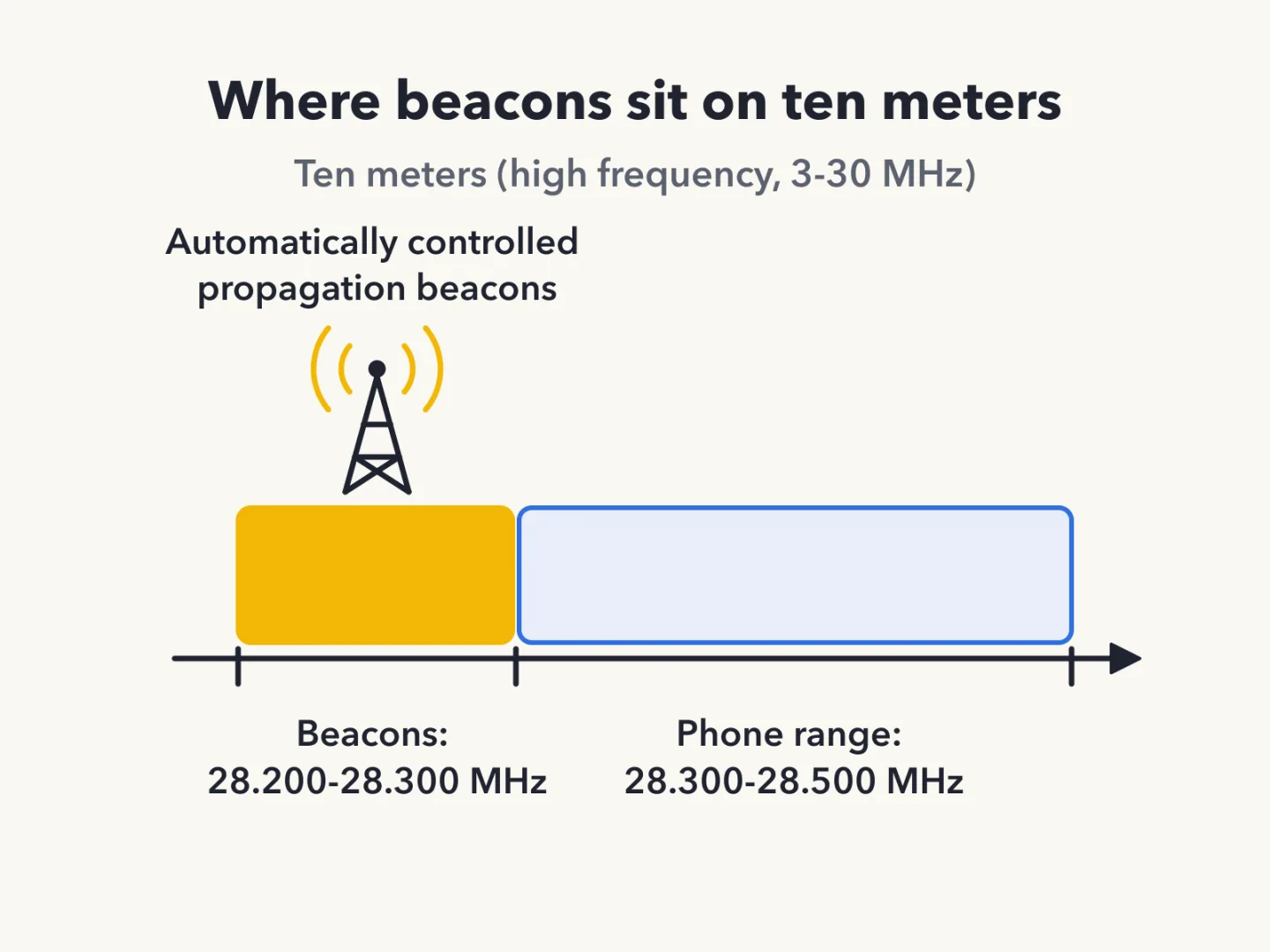
The rules allow a beacon to be automatically controlled on certain segments. Among the high frequency (HF) bands, the range of 3-30 megahertz (MHz), automatically controlled amateur propagation beacons are found on ten meters, from 28.200 MHz to 28.300 MHz.
 FlashFeed original diagram · CC-BY-4.0
Who Picks Repeater Channels
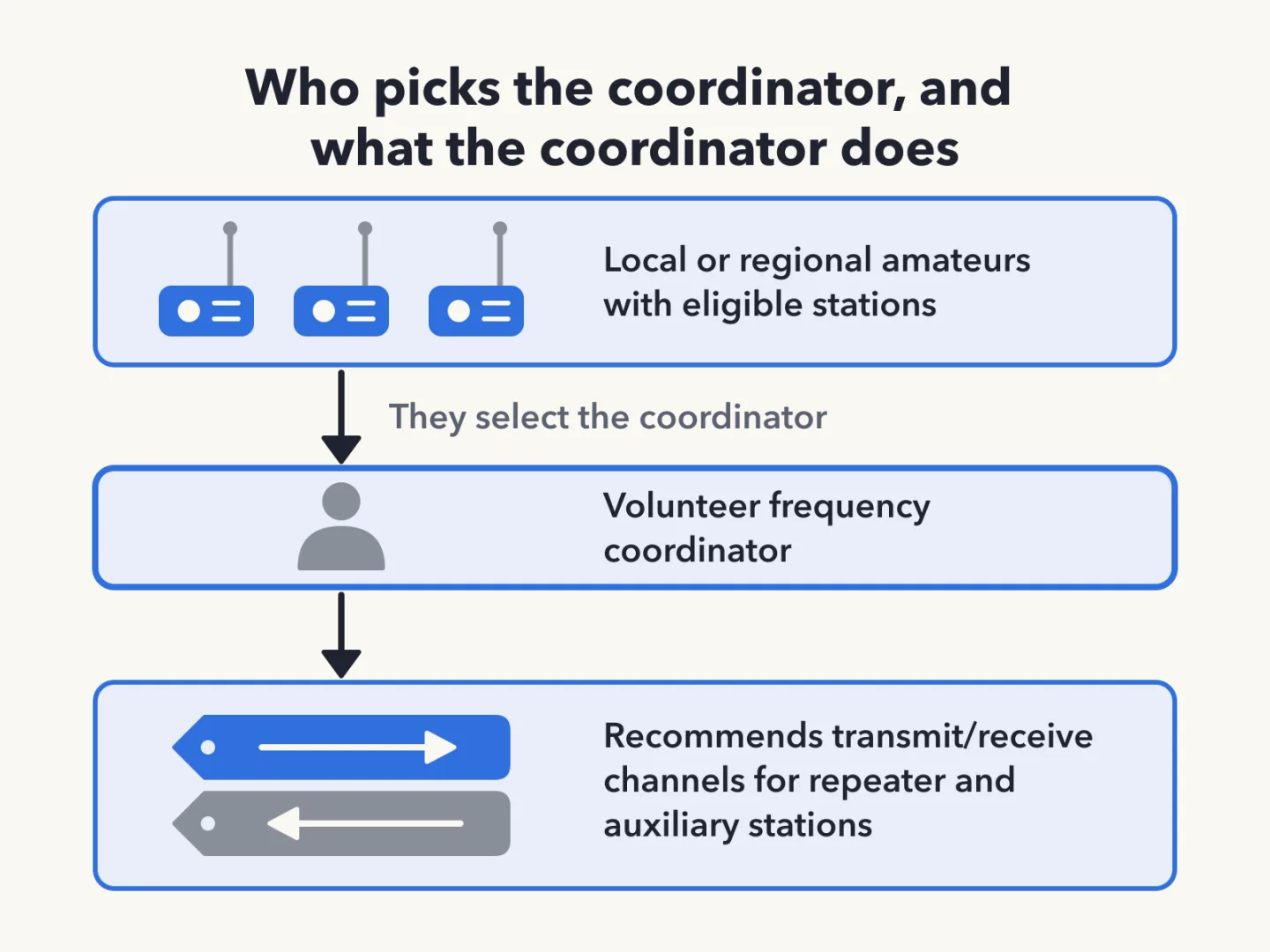
A frequency coordinator recommends transmit/receive channels for repeater and auxiliary stations, to avoid or minimize potential interference. Amateur operators in the local or regional area whose stations are eligible select the coordinator.
 FlashFeed original diagram · CC-BY-4.0
HF Phone Only on 10 Meters
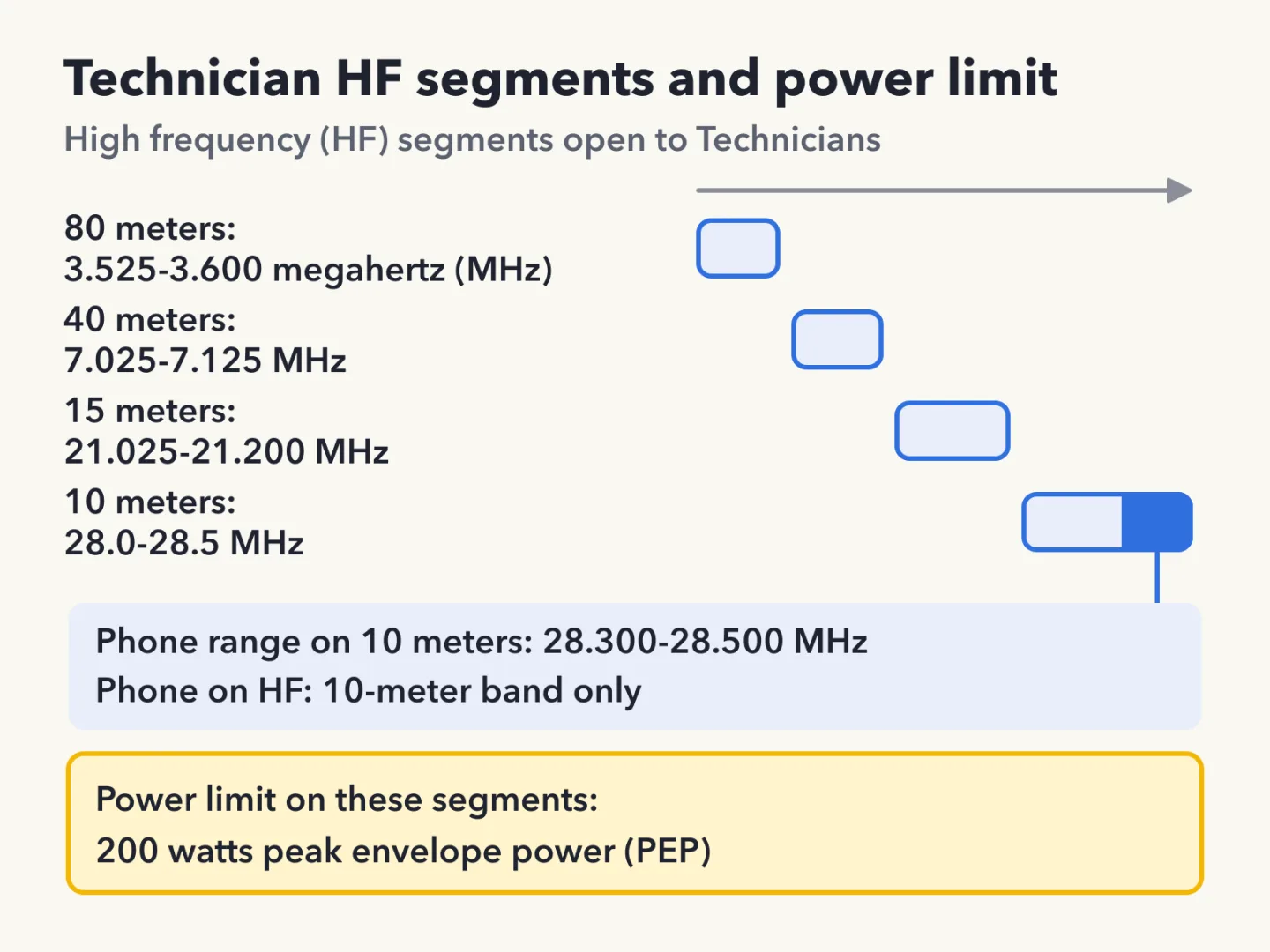
Technician licensees have phone privileges on high frequency (HF) only on the 10-meter band. The phone range available to them is 28.300 megahertz (MHz) to 28.500 MHz.
1 / 10A new repeater needs channels that avoid or minimize interference. Who recommends them?
A Volunteer Frequency Coordinator recognized by local amateurs recommends repeater channels, to avoid or minimize potential interference.
Lesson 1 has 91 cards. Keep going in the free app.
Question
Technician Phone on High Frequency 
Expired License and the Grace Period All 4 clips on YouTube ↗Transcripts
Technician Phone on High Frequency
A Technician can use high frequency (HF) radio on a few segments. But how many of those bands allow phone?
Only one: the 10-meter band, between 28.300 and 28.500 megahertz.
In their HF segments, Technician operators may not exceed 200 watts of peak envelope power.
Digital modes are allowed in the 10-meter, 6-meter and 2-meter bands.
Expired License and the Grace Period
Your amateur radio license expired yesterday. Can you still transmit while you renew it?
No. The grace period lasts 2 years, but a licensee may not transmit during that time.
Unless and until the license grant is renewed, no privileges are conferred to the licensee, even during the grace period.
So the renewal application must be received before that 2-year grace period ends.
Episode 17:57
What can you do with a Technician license, which bands can you use, and how do call signs work?
-
 FlashFeed original diagram · CC-BY-4.002
The Rules: Operating a Station
Authorized and prohibited transmissions · The control operator and control types · Identification, repeaters and third parties
Lesson 2 · 10 cardsFlashFeed original diagram · CC-BY-4.0Broadcasting Is the Banned One-Way Use
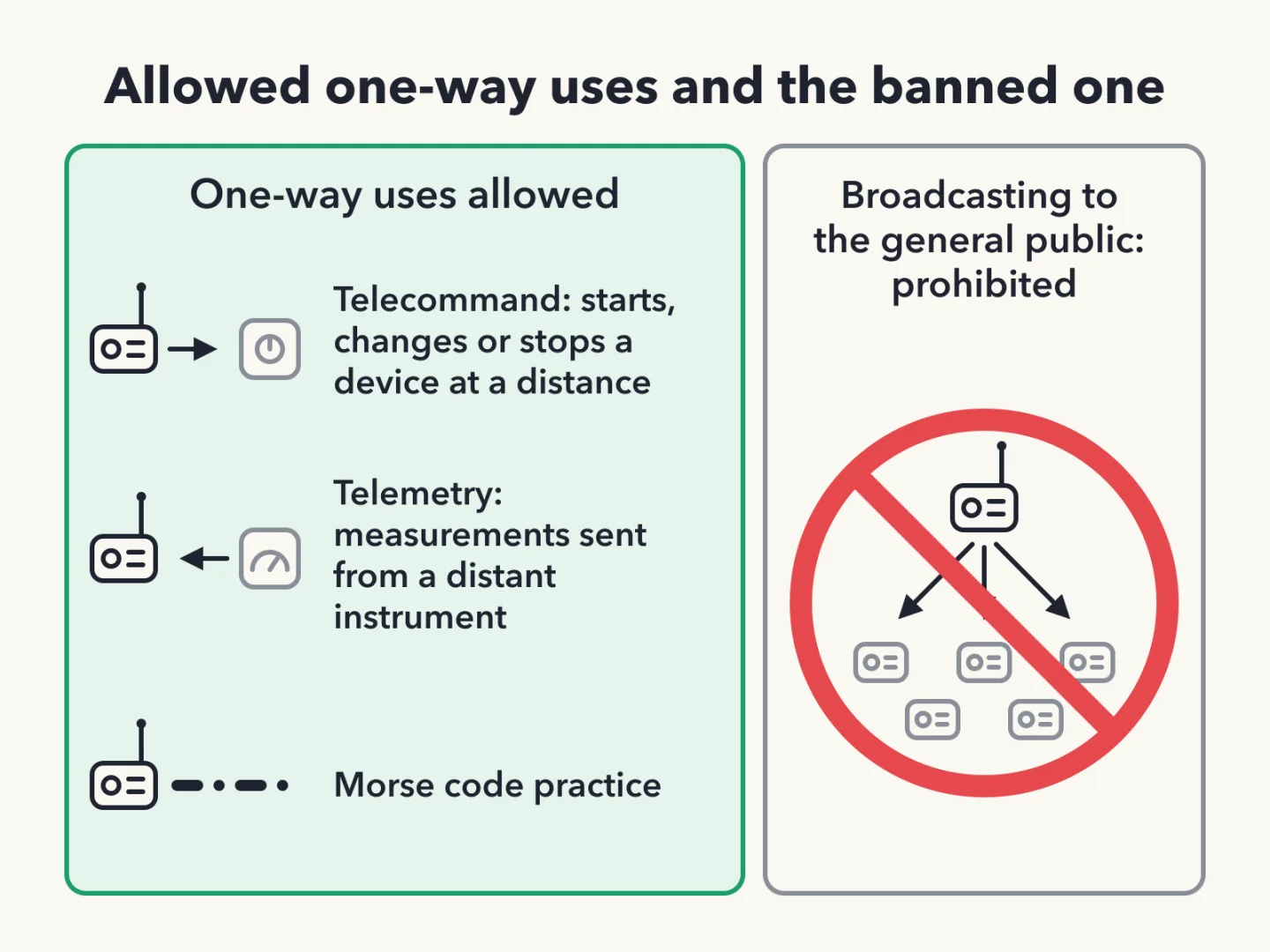
An amateur station may not send one-way communications except where the rules provide. Allowed one-way uses include brief adjustment transmissions, Morse code practice, telecommand and telemetry. Broadcasting stays prohibited even though these other one-way uses are allowed.
 FlashFeed original diagram · CC-BY-4.0
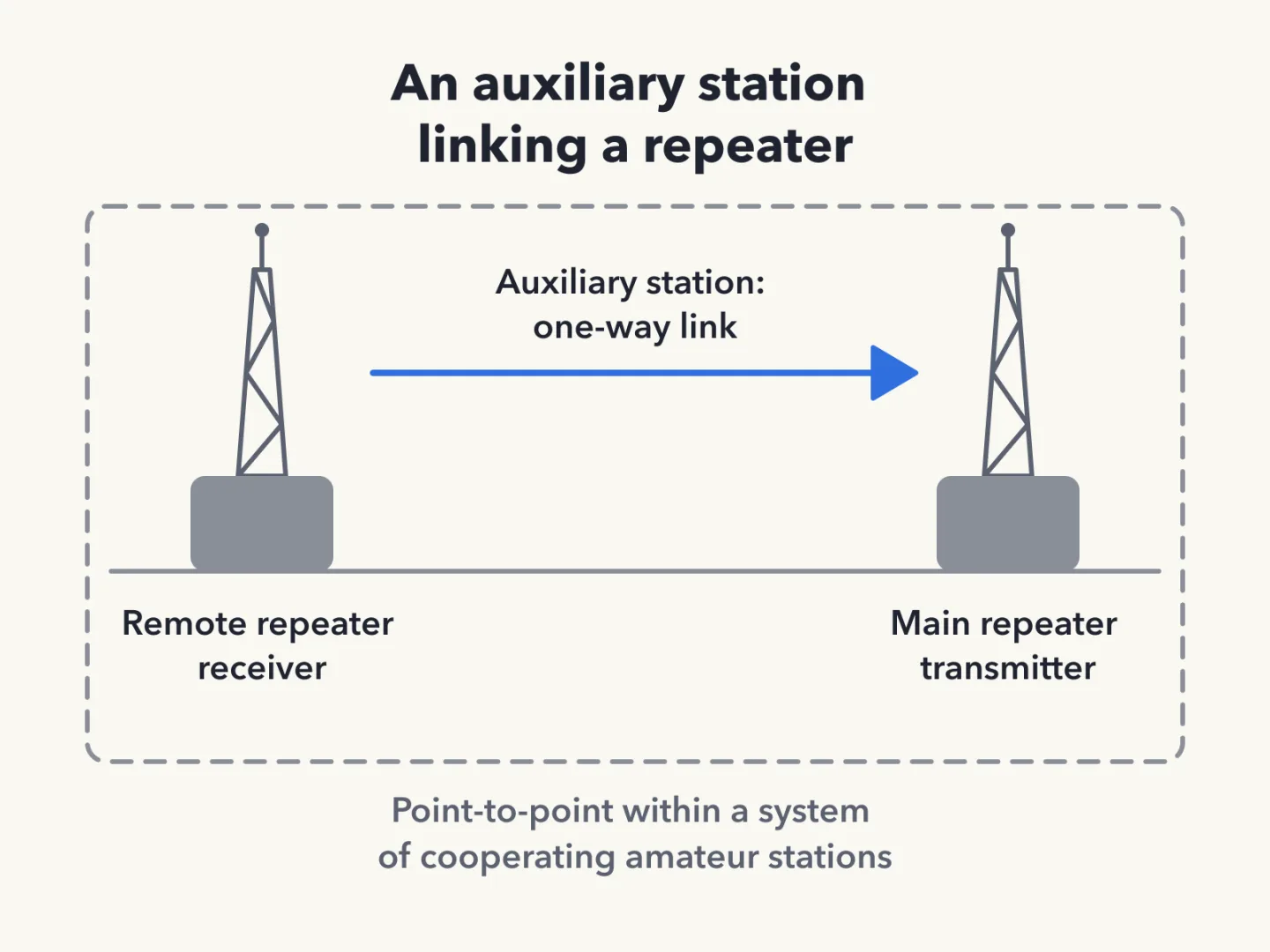
An Example of an Auxiliary Station
An auxiliary station transmits point-to-point within a system of cooperating amateur stations. One example is a station sending one-way transmissions between a remote repeater receiver and the main repeater transmitter.
1 / 10A licensee wants to announce on the air that a radio is for sale. When is that allowed?
Sale or trade notices are allowed when not made on a regular basis. Profit and ownership do not decide it, and the rule is not a flat ban.
Lesson 2 has 98 cards. Keep going in the free app.
Question
When a Ham Station Can Skip Identifying 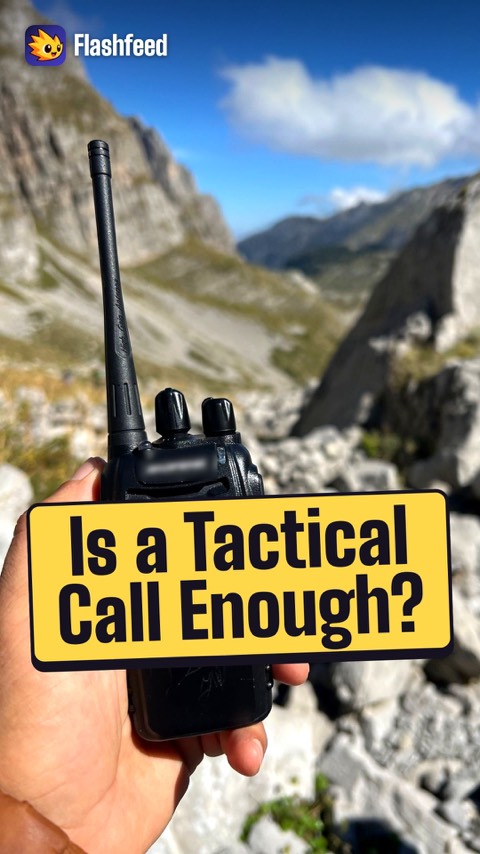
Tactical Calls and the Call Sign All 4 clips on YouTube ↗Transcripts
When a Ham Station Can Skip Identifying
Ham stations must give their call sign on the air. So when can a station skip it?
Identification is not required for signals directed only to a model craft.
2 conditions: a label with the call sign, name and address on the transmitter, and power no higher than 1 W.
Test transmissions on the air must identify the station; model craft control is 1 exception.
Tactical Calls and the Call Sign
A station signs on as Race Headquarters and never gives its own call sign. Is that enough?
No. A tactical call such as Race Headquarters is not sufficient alone.
At least every 10 minutes during a communication, the station must give its call sign, and again at its end.
On a phone transmission, the identification must be in the English language.
Episode 27:06
What are you not allowed to transmit on ham radio, and when do you have to give your call sign?
-
 FlashFeed original diagram · CC-BY-4.003
Operating Procedures
Choosing frequencies and making calls · Repeater operating and access tones · Public service and emergency operation
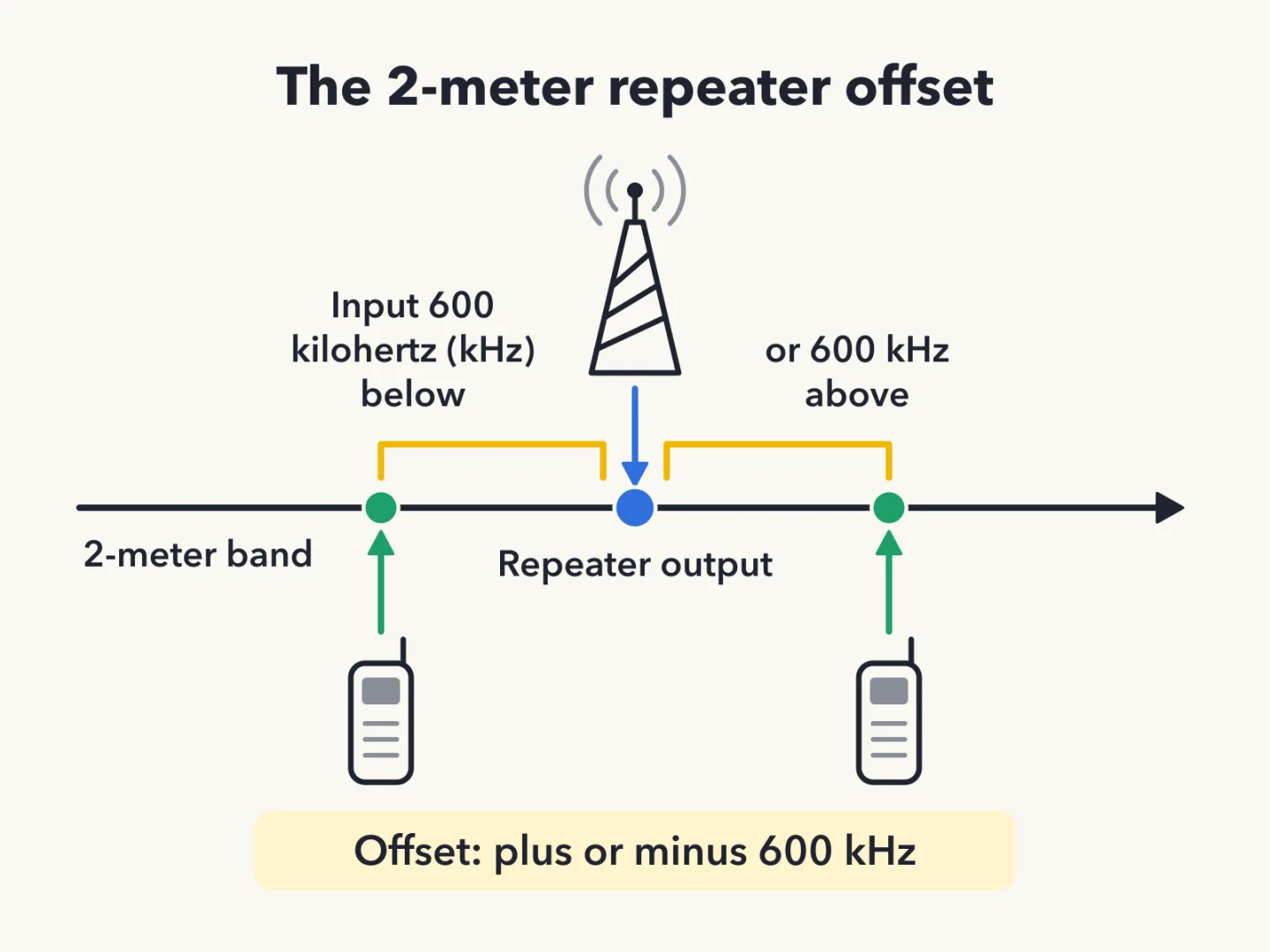
Lesson 3 · 10 cardsFlashFeed original diagram · CC-BY-4.02-Meter Repeater Offset
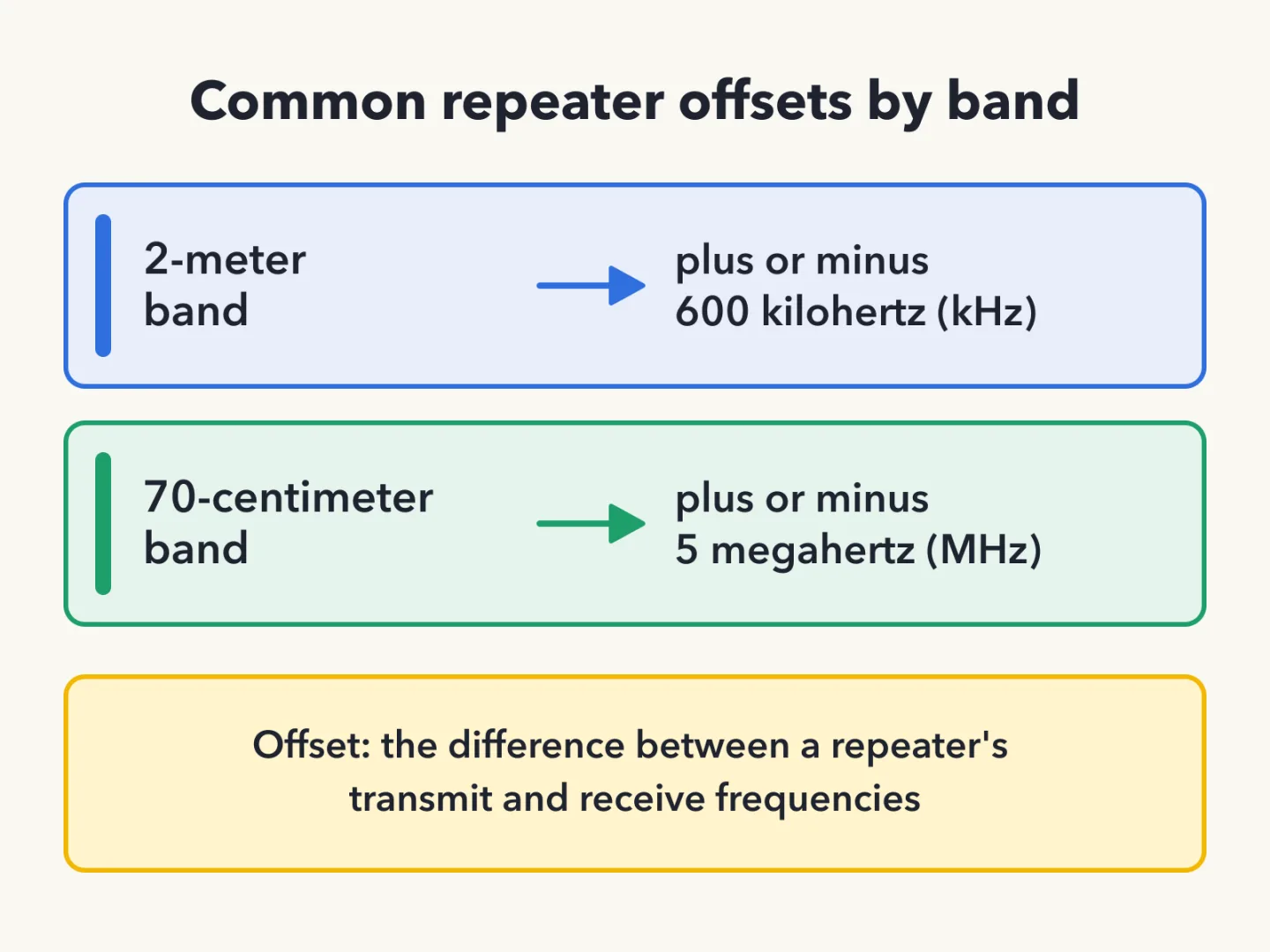
A common repeater offset in the 2-meter band is plus or minus 600 kilohertz (kHz).
 FlashFeed original diagram · CC-BY-4.0
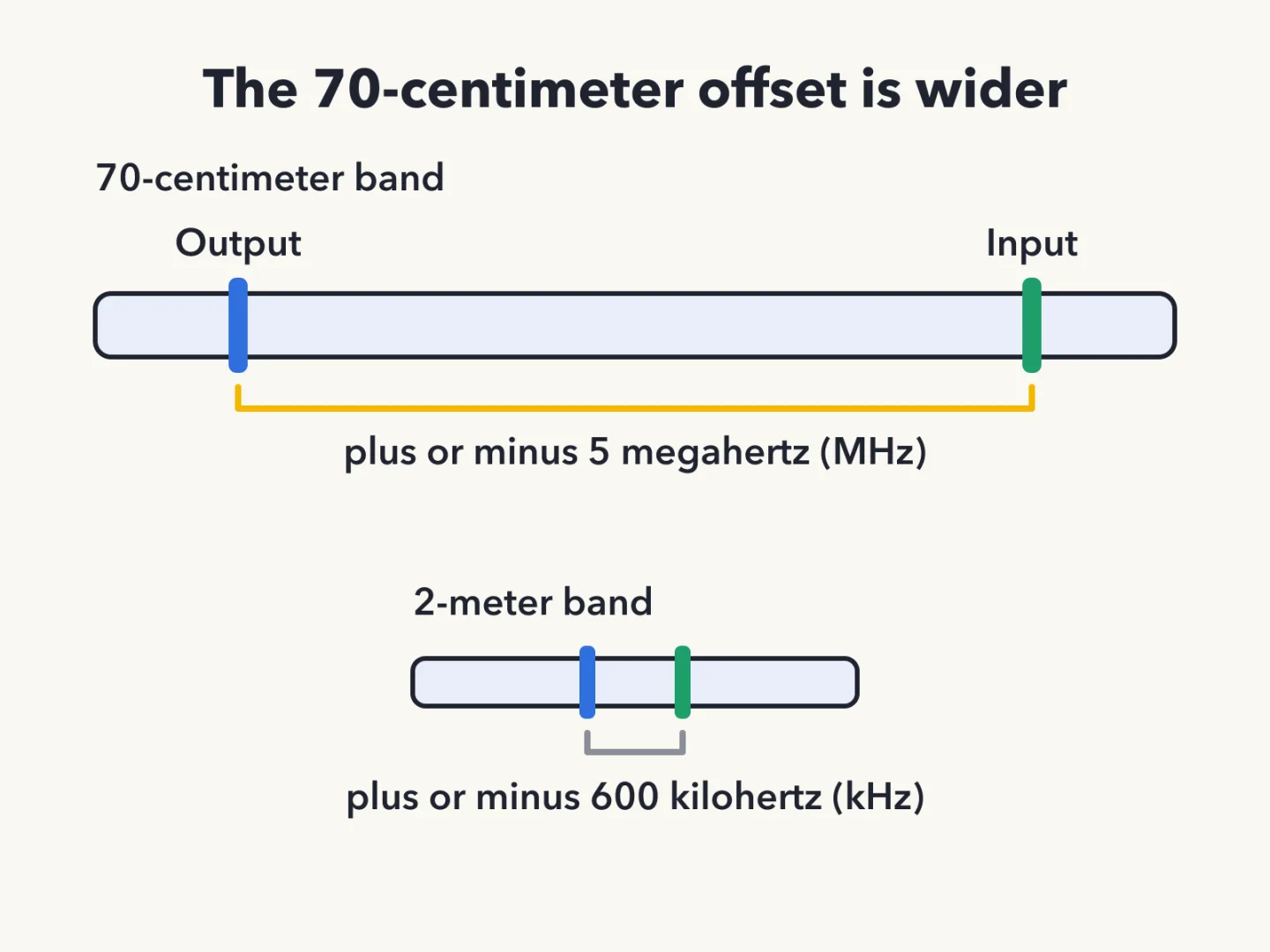
70-Centimeter Repeater Offset
A common repeater offset in the 70-centimeter band is plus or minus 5 megahertz (MHz). The plus or minus 600 kilohertz (kHz) offset belongs to the 2-meter band instead.
 FlashFeed original diagram · CC-BY-4.0
What a Repeater Offset Is
A repeater offset is the difference between a repeater's transmit and receive frequencies. A repeater listens on one frequency and retransmits on another, and the gap between the two is the offset.
 FlashFeed original diagram · CC-BY-4.0
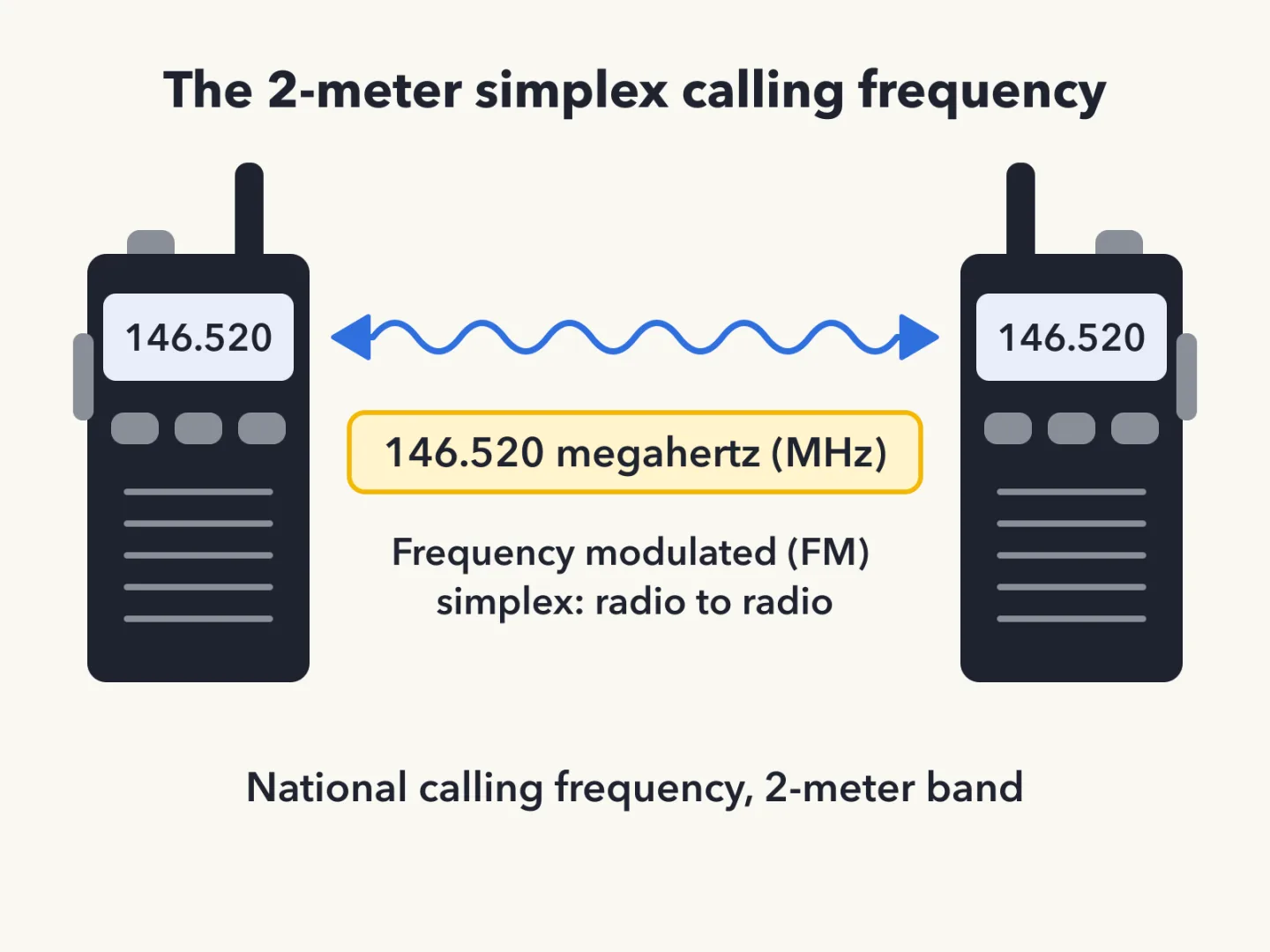
2-Meter Simplex Calling Frequency
The national calling frequency for frequency modulated (FM) simplex operation in the 2-meter band is 146.520 megahertz (MHz). A new licensee who wants a first simplex contact can start there.
 FlashFeed original diagram · CC-BY-4.0
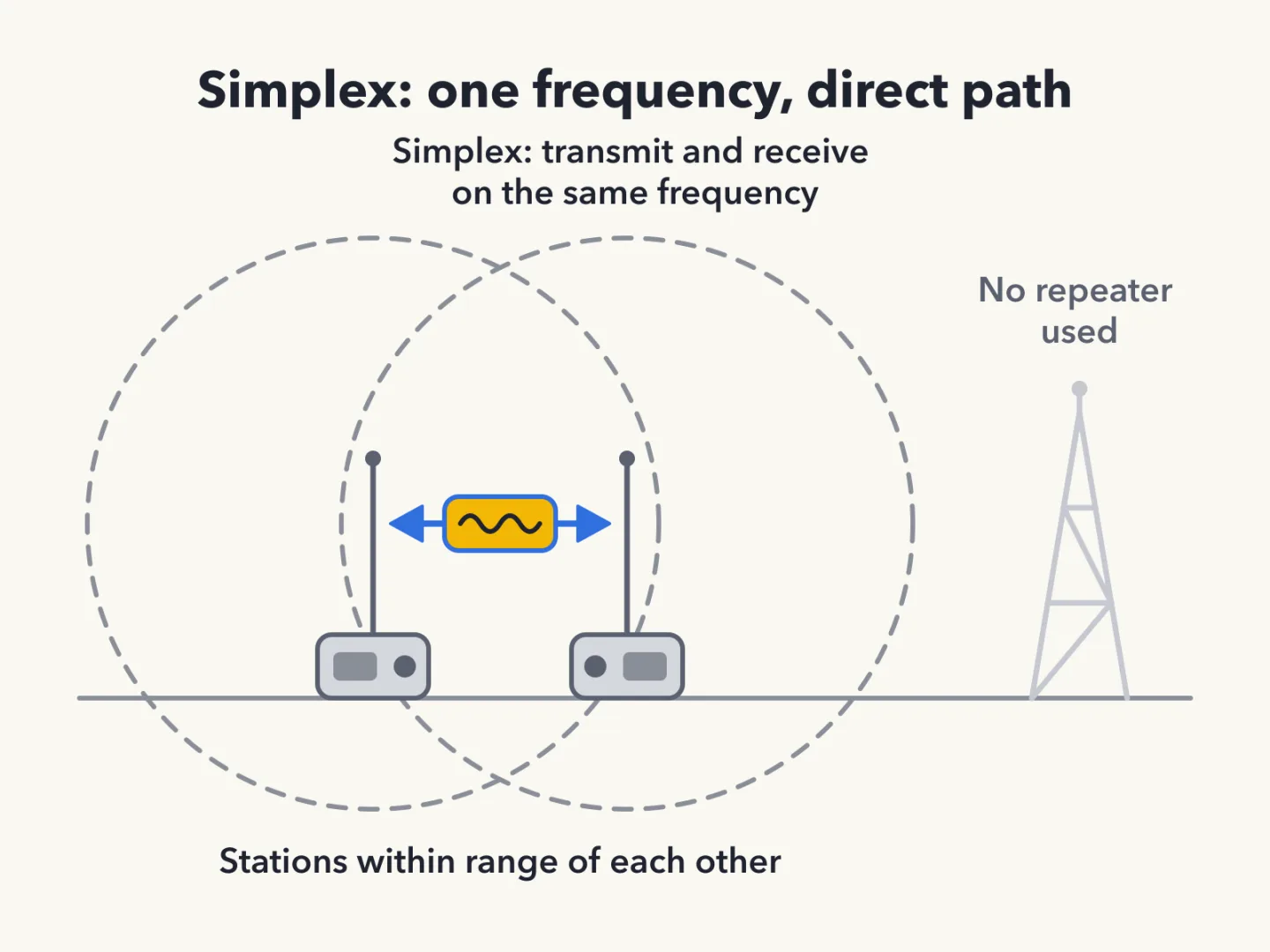
Simplex Operation
A station that transmits and receives on the same frequency is operating simplex. Nothing is retransmitted, so only stations within range of each other can talk.
 FlashFeed original diagram · CC-BY-4.0
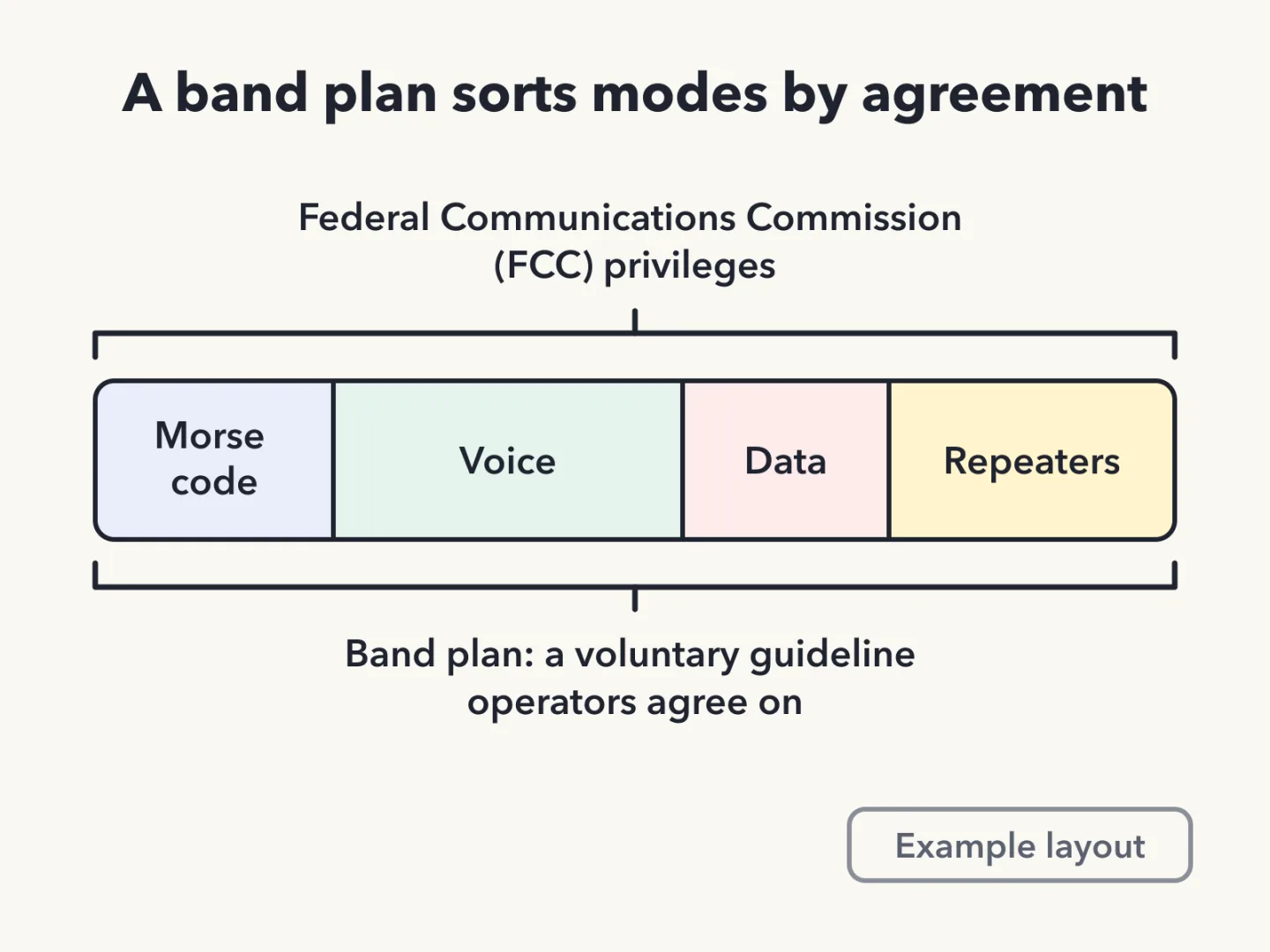
What a Band Plan Is
A band plan is a voluntary guideline for using different modes or activities within an amateur band. It goes beyond the privileges the Federal Communications Commission (FCC) establishes, and it is a courtesy agreement among operators.
1 / 10A licensee hears a station calling CQ and wants to answer. What does the licensee transmit?
The other station's call sign comes first, then the responder's own. Repeating CQ would call everyone again, and no signal report is needed first.
Lesson 3 has 105 cards. Keep going in the free app.
Question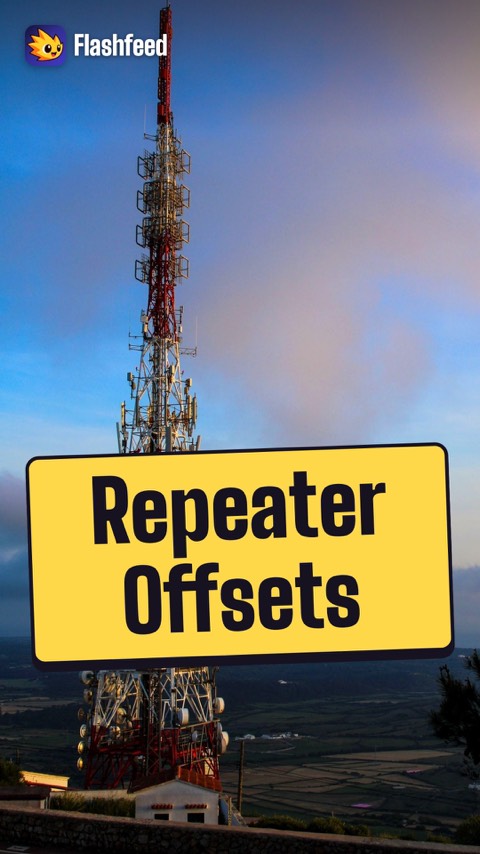
Repeater Offsets on Two Bands 
Emergencies Don't Switch Off the Rules All 4 clips on YouTube ↗Transcripts
Repeater Offsets on Two Bands
A repeater listens on one frequency and retransmits on another. How far apart are the two?
That gap is the repeater offset, and each band has a common one.
600 kHz, plus or minus, is a common offset on the 2-meter band.
5 MHz, plus or minus, is a common offset on the 70-centimeter band.
Emergencies Don't Switch Off the Rules
In an emergency, do the amateur radio rules switch off at all?
No. The Federal Communications Commission's amateur radio rules always apply to an amateur station.
They still apply when a station works under emergency-service rules, too.
One narrow exception: a control operator may work outside their license class's frequency privileges, but only for immediate safety of human life or protection of property.
Episode 37:00
How do you use a repeater, what does CQ mean, and how does ham radio help in an emergency?
-
 FlashFeed original diagram · CC-BY-4.004
How Radio Waves Travel
How radio signals travel · Wavelength, frequency and radio waves · Propagation modes and the radio horizon
Lesson 4 · 10 cardsFlashFeed original diagram · CC-BY-4.0Why Signals Change Over Feet
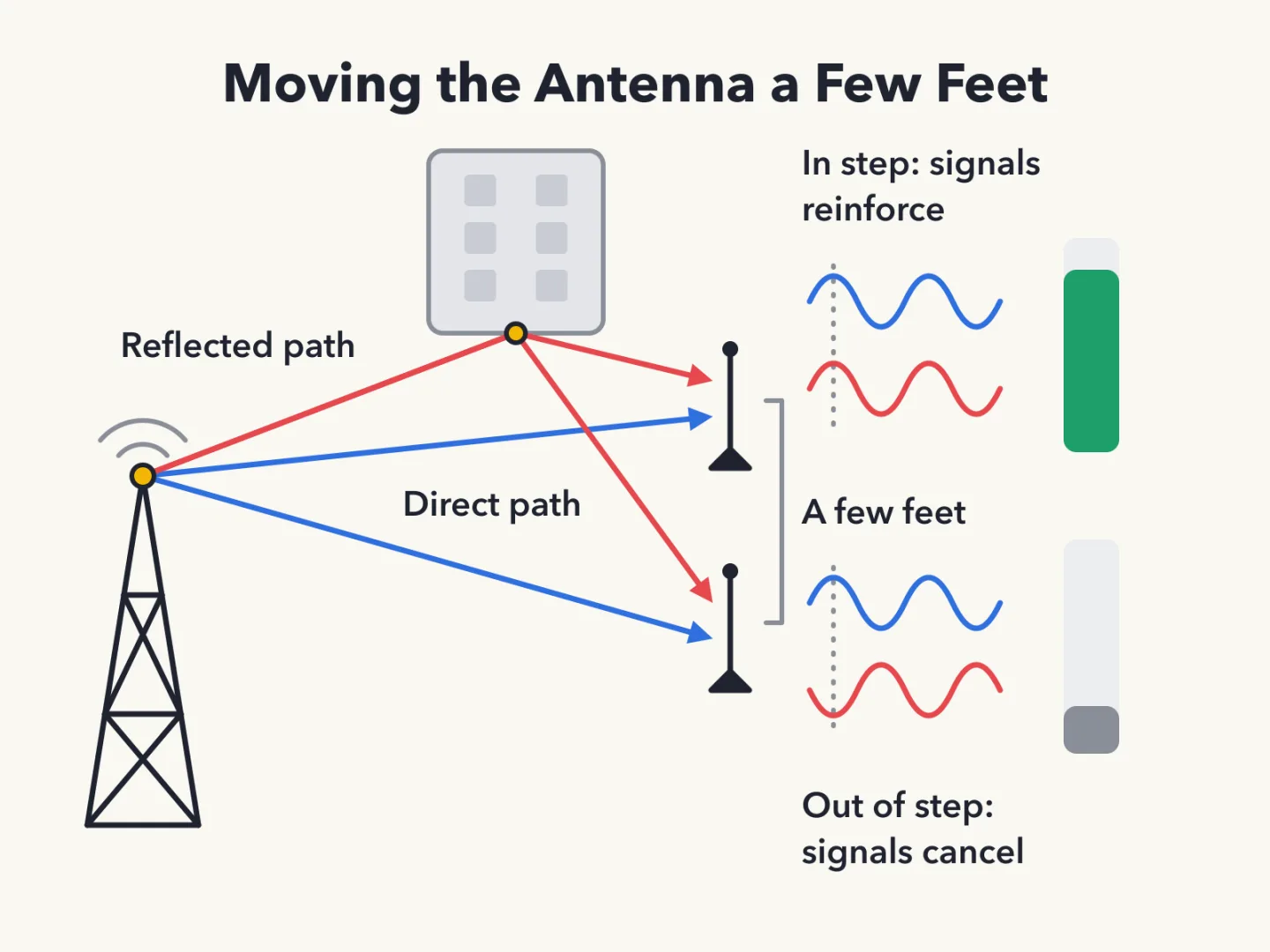
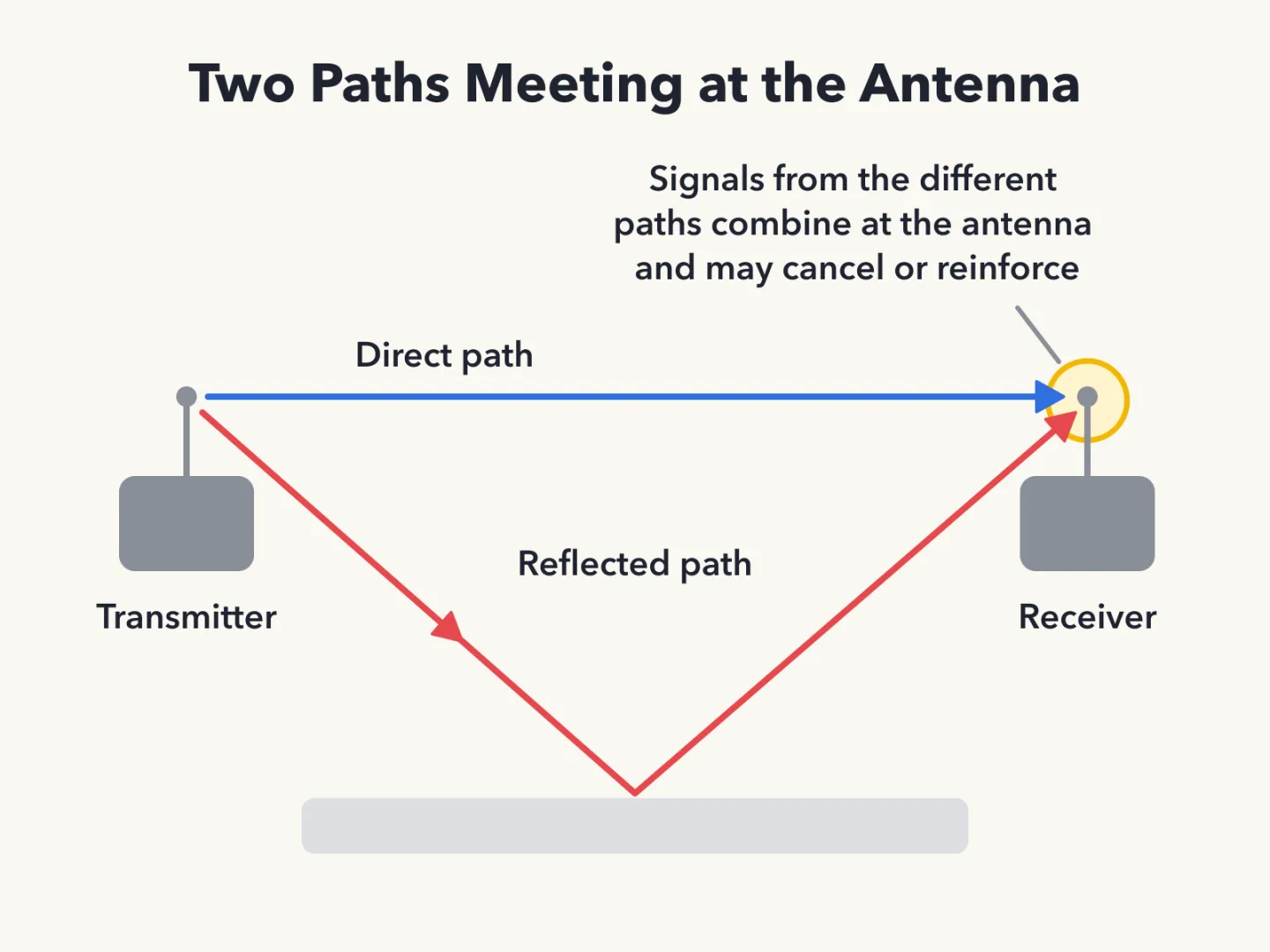
Multipath propagation means a signal reaches the receiver by more than one path. The signals from the different paths combine at the antenna, and they cancel or reinforce each other. That is why very high frequency (VHF) signal strength can vary greatly when an antenna is moved only a few feet.
 FlashFeed original diagram · CC-BY-4.0
Vegetation and Microwave Signals
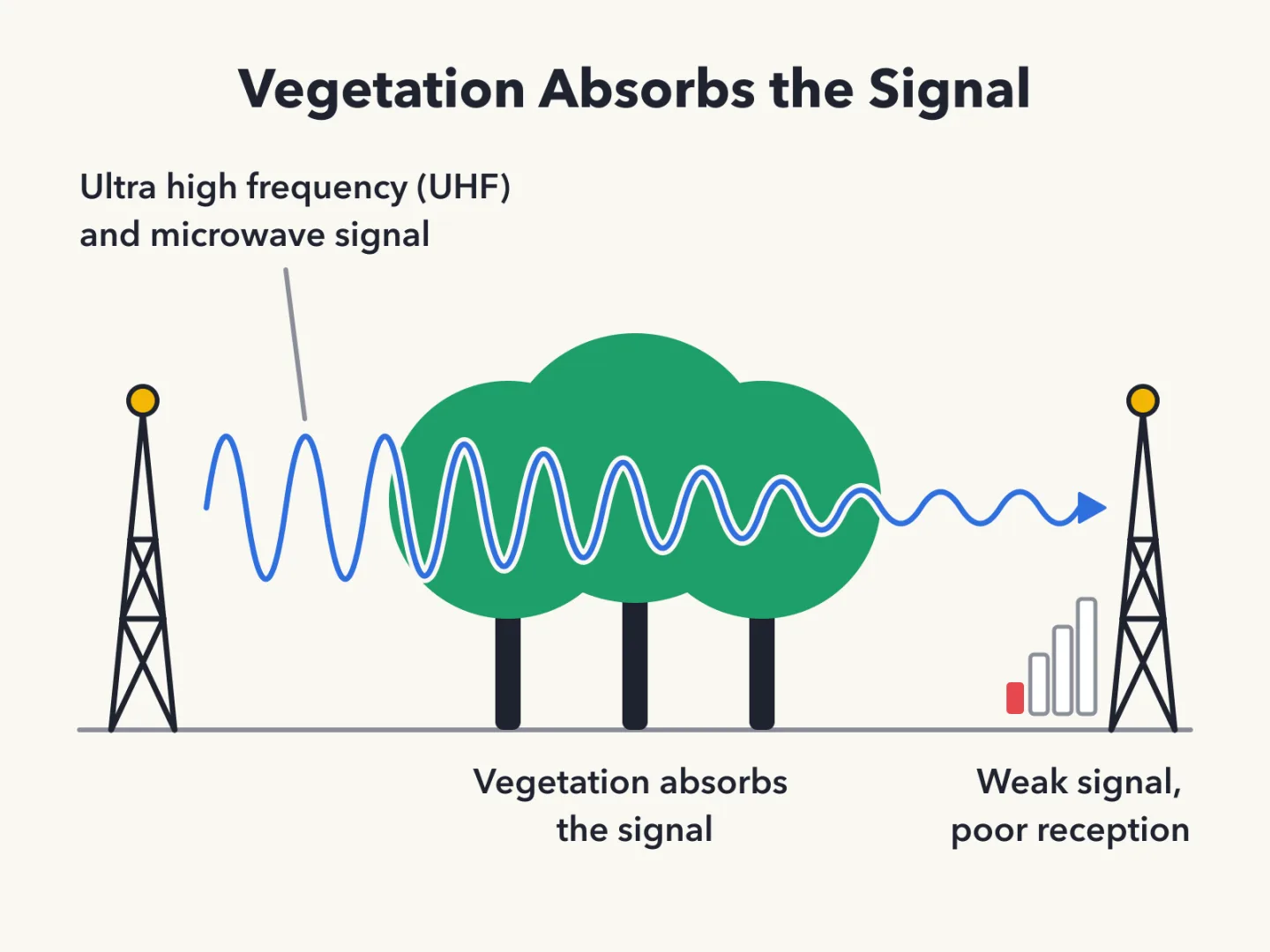
Vegetation absorbs ultra high frequency (UHF) and microwave signals. The result is poor reception of weak signals.
 FlashFeed original diagram · CC-BY-4.0
Cost of Cross-Polarization
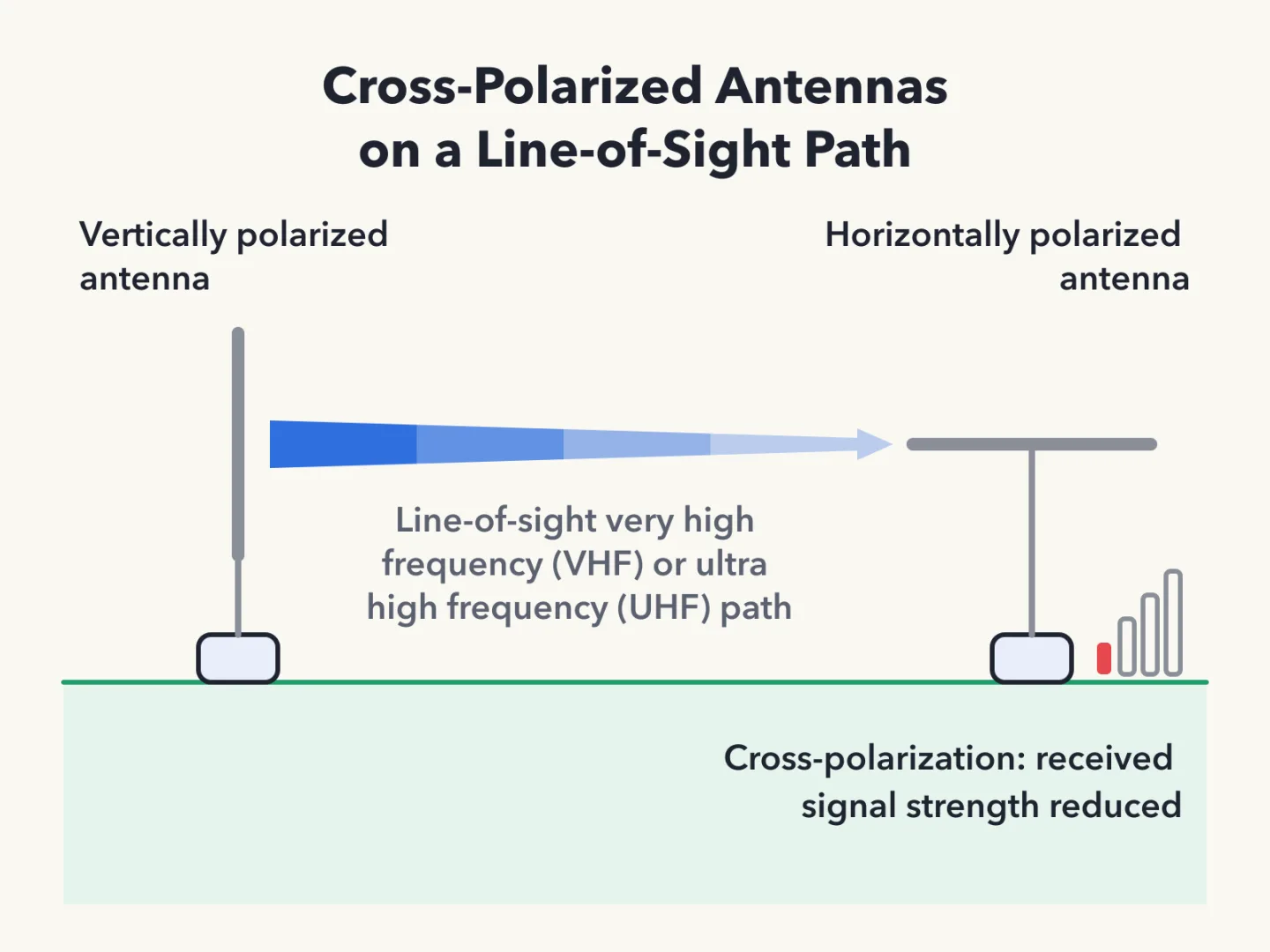
Cross-polarization of the antennas over a line-of-sight very high frequency (VHF) or ultra high frequency (UHF) path reduces received signal strength.
 FlashFeed original diagram · CC-BY-4.0
Reaching a Repeater Around Obstacles
A station with a directional antenna may be blocked from a distant repeater by buildings or other obstructions. That station can try to find a reflected path that carries signals to the repeater.
 FlashFeed original diagram · CC-BY-4.0
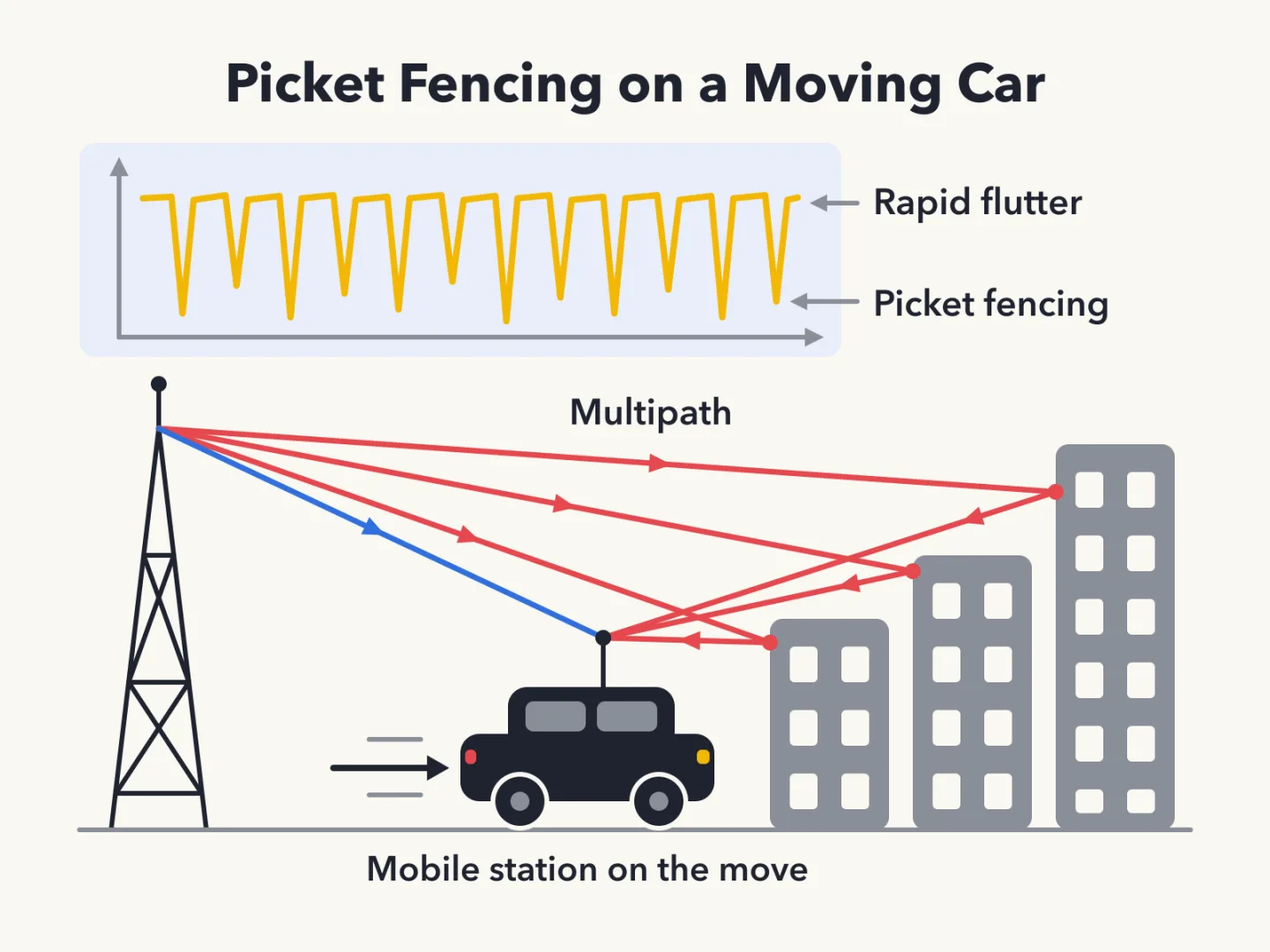
Picket Fencing on Mobile Signals
Picket fencing is the rapid flutter heard on mobile signals due to multipath propagation.
 FlashFeed original diagram · CC-BY-4.0
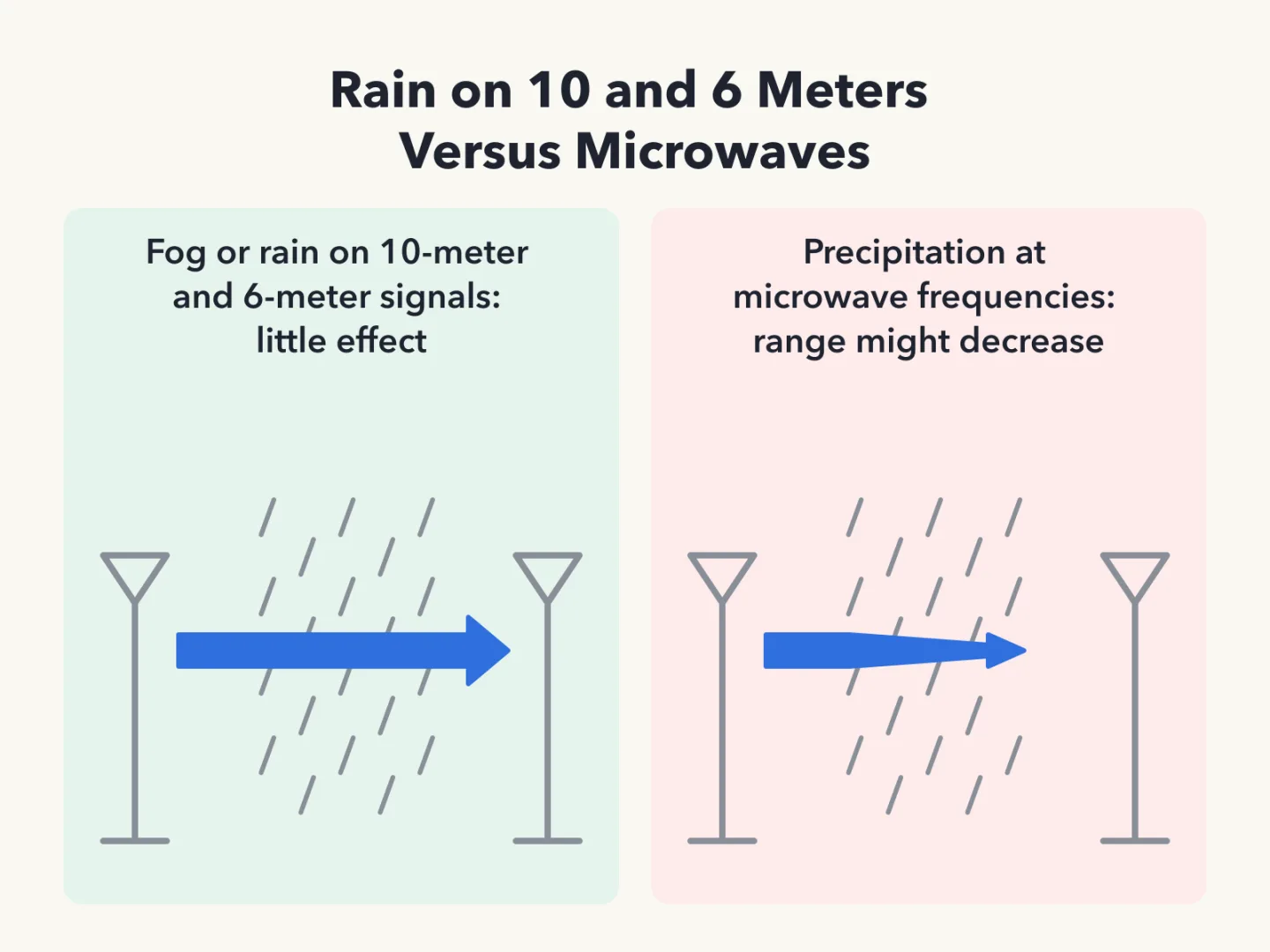
Weather That Shortens Microwave Range
Precipitation might decrease range at microwave frequencies.
 FlashFeed original diagram · CC-BY-4.0
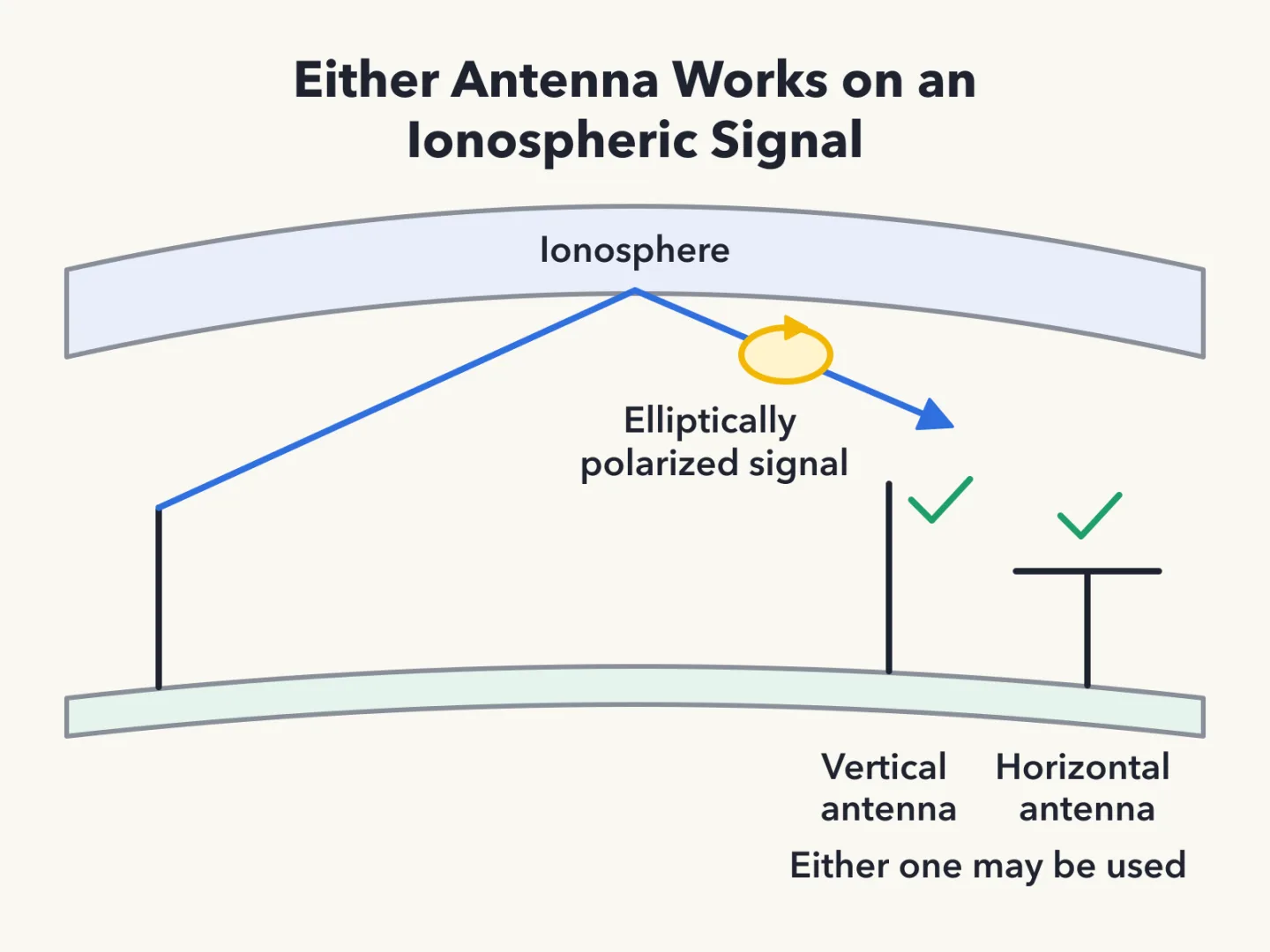
Ionospheric Signals Are Elliptically Polarized
Signals propagated by the ionosphere are elliptically polarized. As a result, either vertically or horizontally polarized antennas may be used for transmission or reception.
1 / 10How does vegetation affect UHF and microwave signals?
Vegetation absorbs ultra high frequency (UHF) and microwave signals, so weak signals are received poorly. It does not amplify them.
Lesson 4 has 96 cards. Keep going in the free app.
Question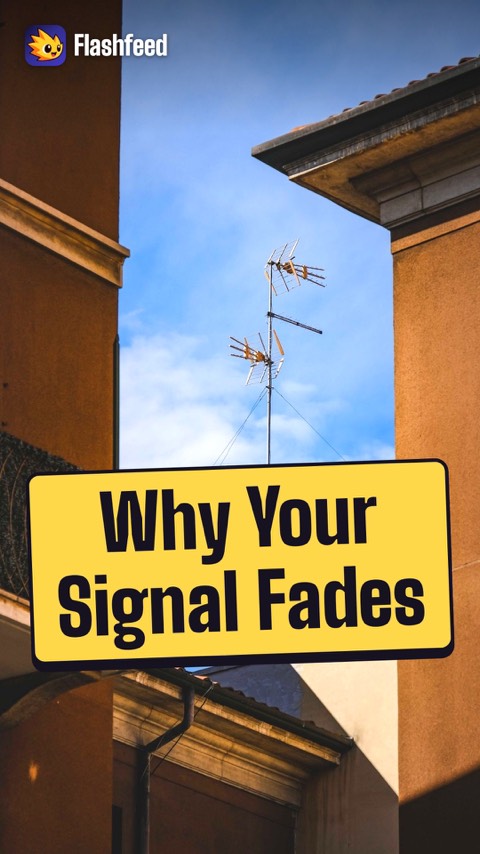
Move the Antenna, Change the Signal 
The Mode That Reaches Past the Horizon All 4 clips on YouTube ↗Transcripts
Move the Antenna, Change the Signal
Move an antenna just a few feet, and a very high frequency signal can vary greatly.
The reason is multipath. It means the signal reaches the antenna by more than one path.
Those paths combine at the antenna, and they can cancel out or reinforce each other.
That is why a move of a few feet can change the signal so much.
The Mode That Reaches Past the Horizon
300 miles, over the horizon: how can a radio signal get that far?
The answer is a mode called tropospheric ducting. It carries very high and ultra high frequency signals over the horizon.
It does this on a regular basis, for contacts at ranges of approximately 300 miles between stations.
Tropospheric ducting is caused by temperature inversions in the atmosphere.
Episode 47:11
How do radio waves travel, and how far can VHF and UHF signals reach past the horizon?
-
 Wikimedia Commons · 魔私利戸 · CC BY-SA 4.0 ↗05
Setting Up and Running a Station
Setting up a station · Operating controls on a radio
Lesson 5 · 10 cardsWikimedia Commons · 魔私利戸 · CC BY-SA 4.0 ↗Frequency and Power Decide
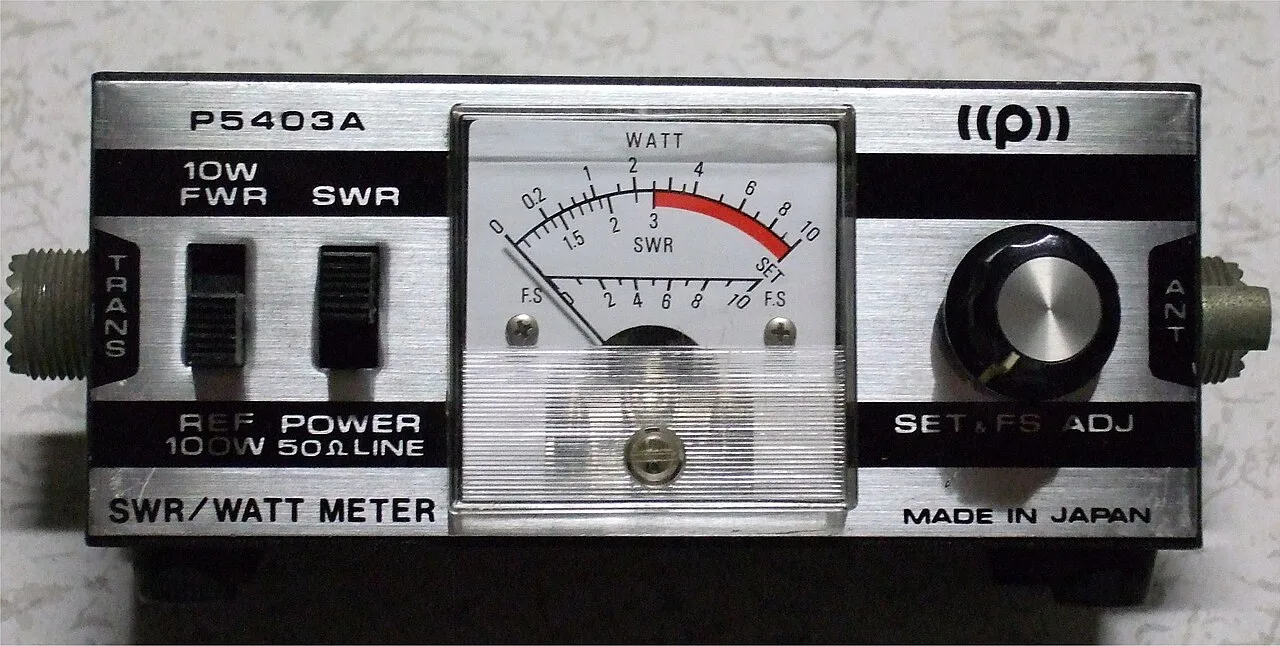
When choosing an accessory standing wave ratio (SWR) meter, consider the frequency and power level at which the measurements will be made.
 FlashFeed original diagram · CC-BY-4.0
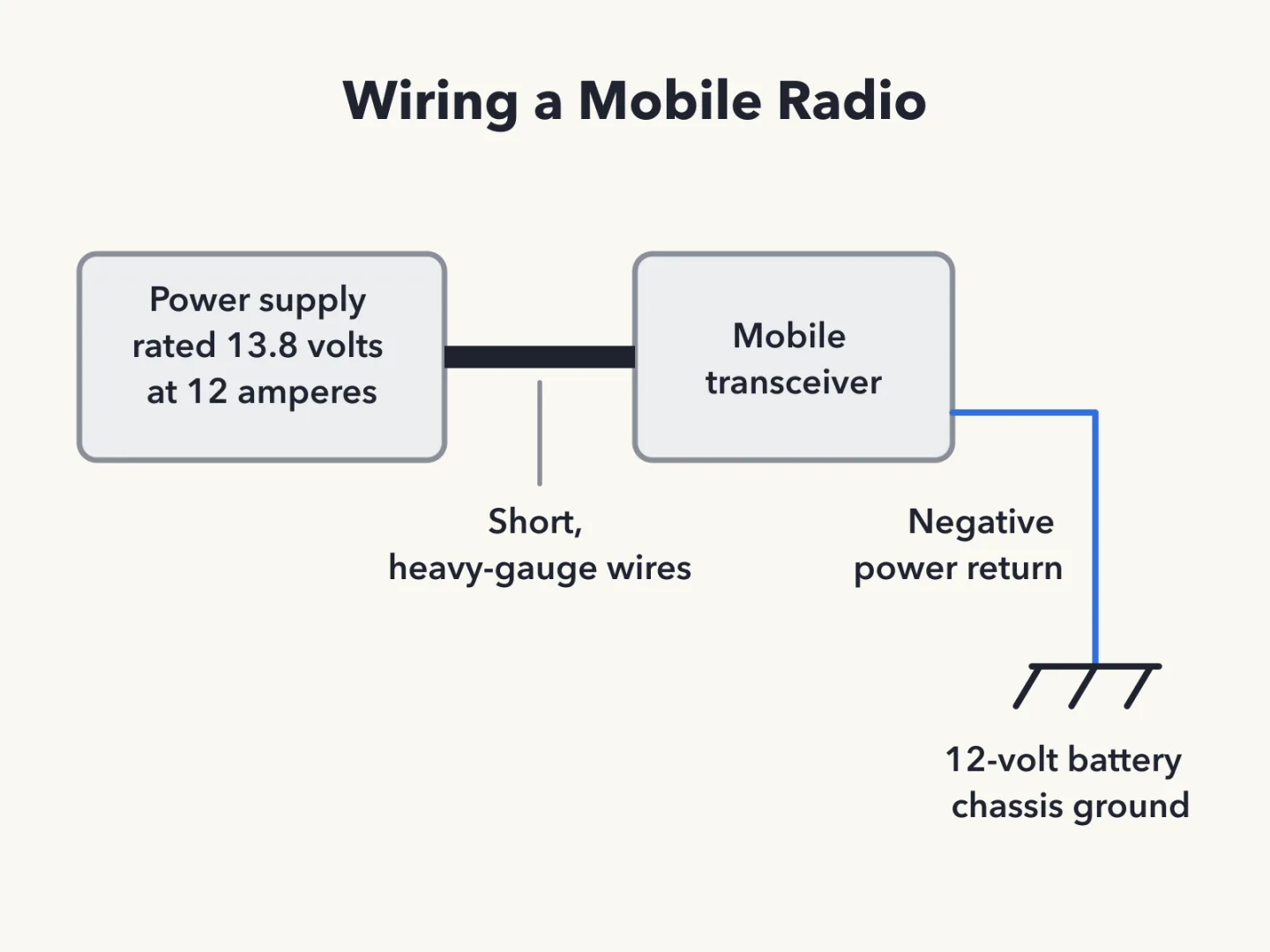
Mobile Radio Power Supply Rating
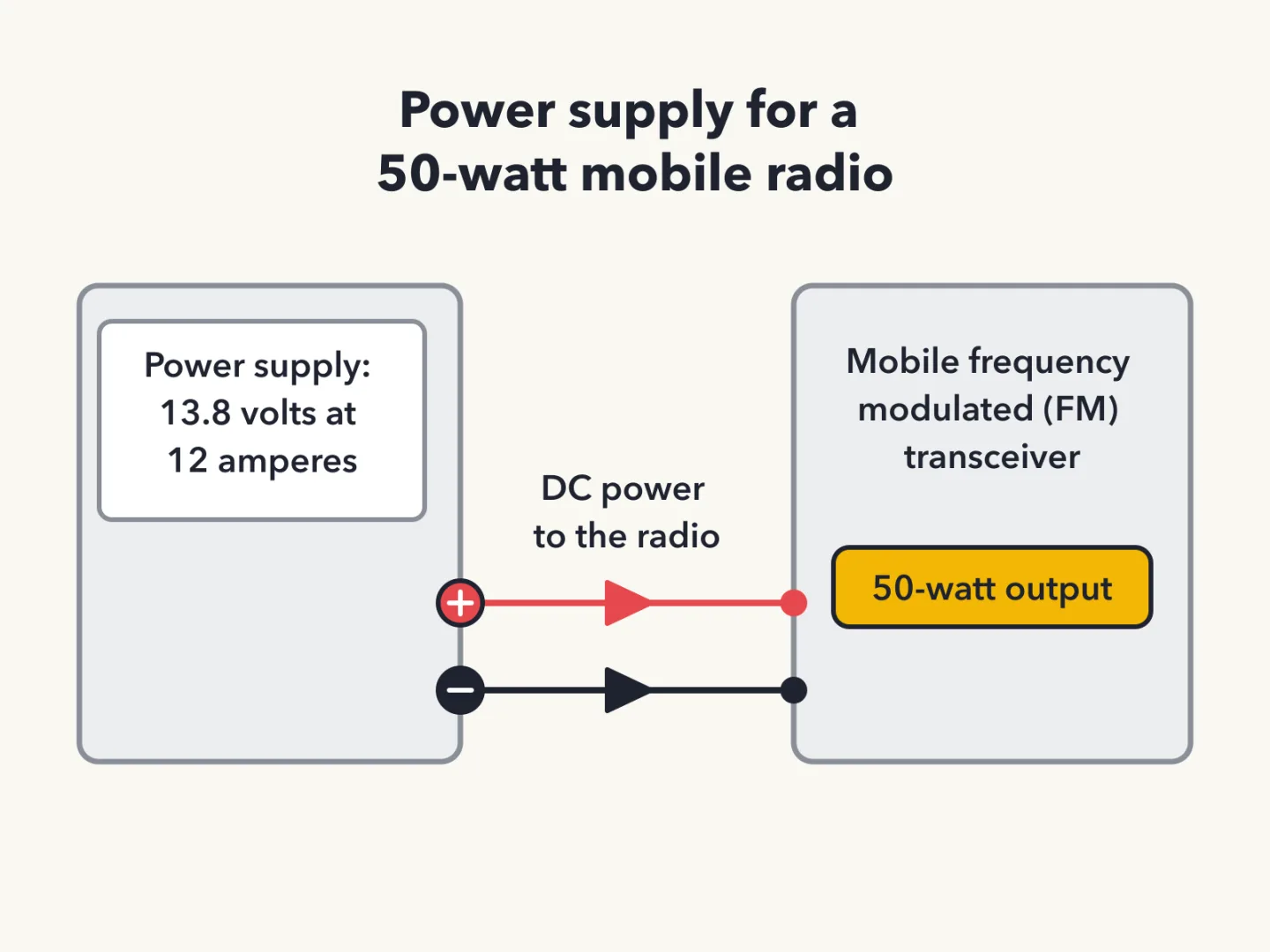
A typical 50-watt output mobile frequency modulated (FM) transceiver is powered from a supply rated 13.8 volts at 12 amperes.
Wikimedia Commons · 魔私利戸 · CC BY-SA 4.0 ↗Choosing an SWR Meter
An accessory standing wave ratio (SWR) meter is chosen by considering the frequency and power level at which the measurements will be made.
 FlashFeed original diagram · CC-BY-4.0
Why Short, Heavy Power Wires
A transceiver's direct current (DC) power connection uses short, heavy-gauge wires. They are used to minimize voltage drop when transmitting.
 FlashFeed original diagram · CC-BY-4.0
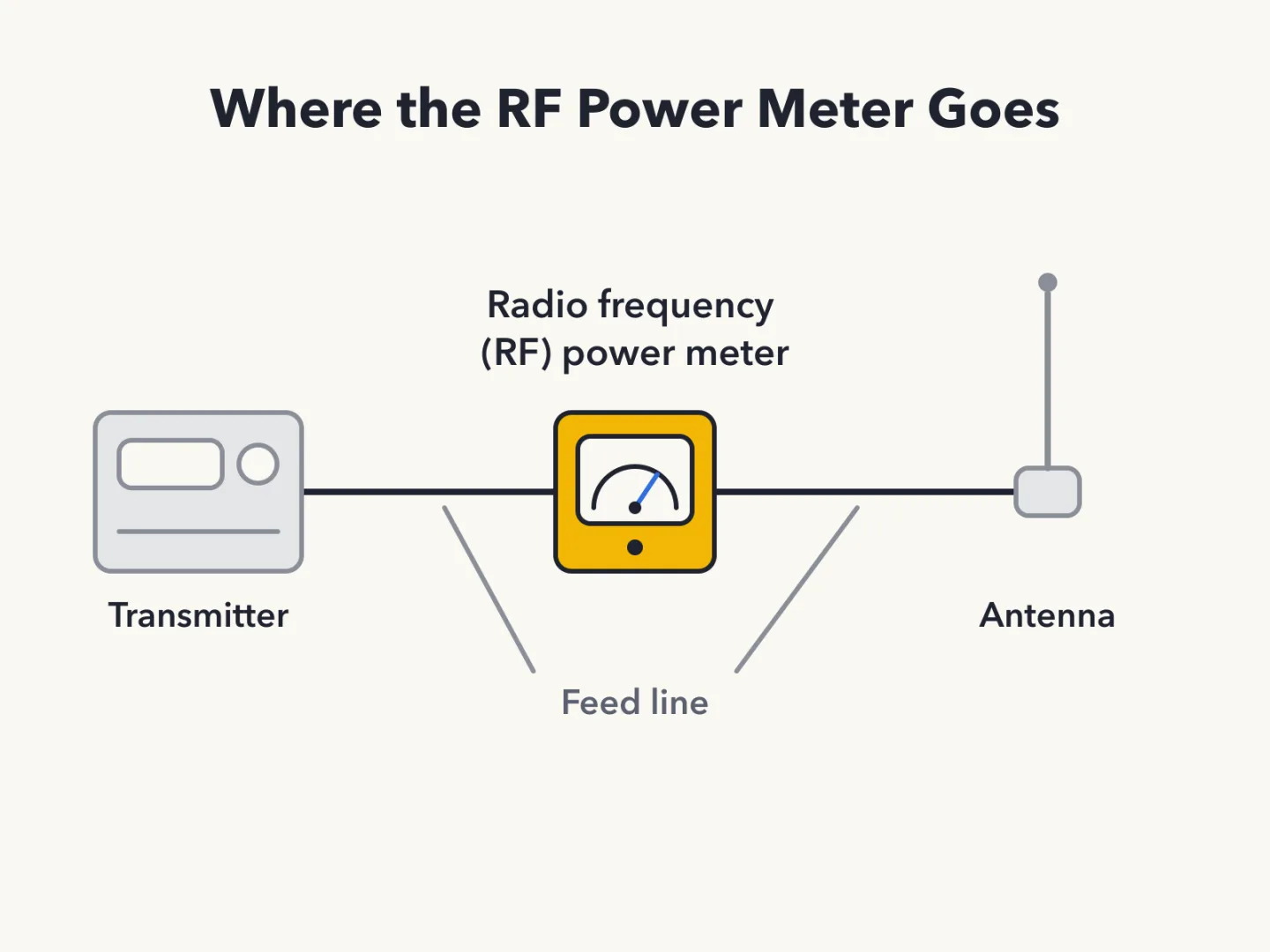
Where the Power Meter Goes
A radio frequency (RF) power meter is installed in the feed line, between the transmitter and the antenna.
 FlashFeed original diagram · CC-BY-4.0
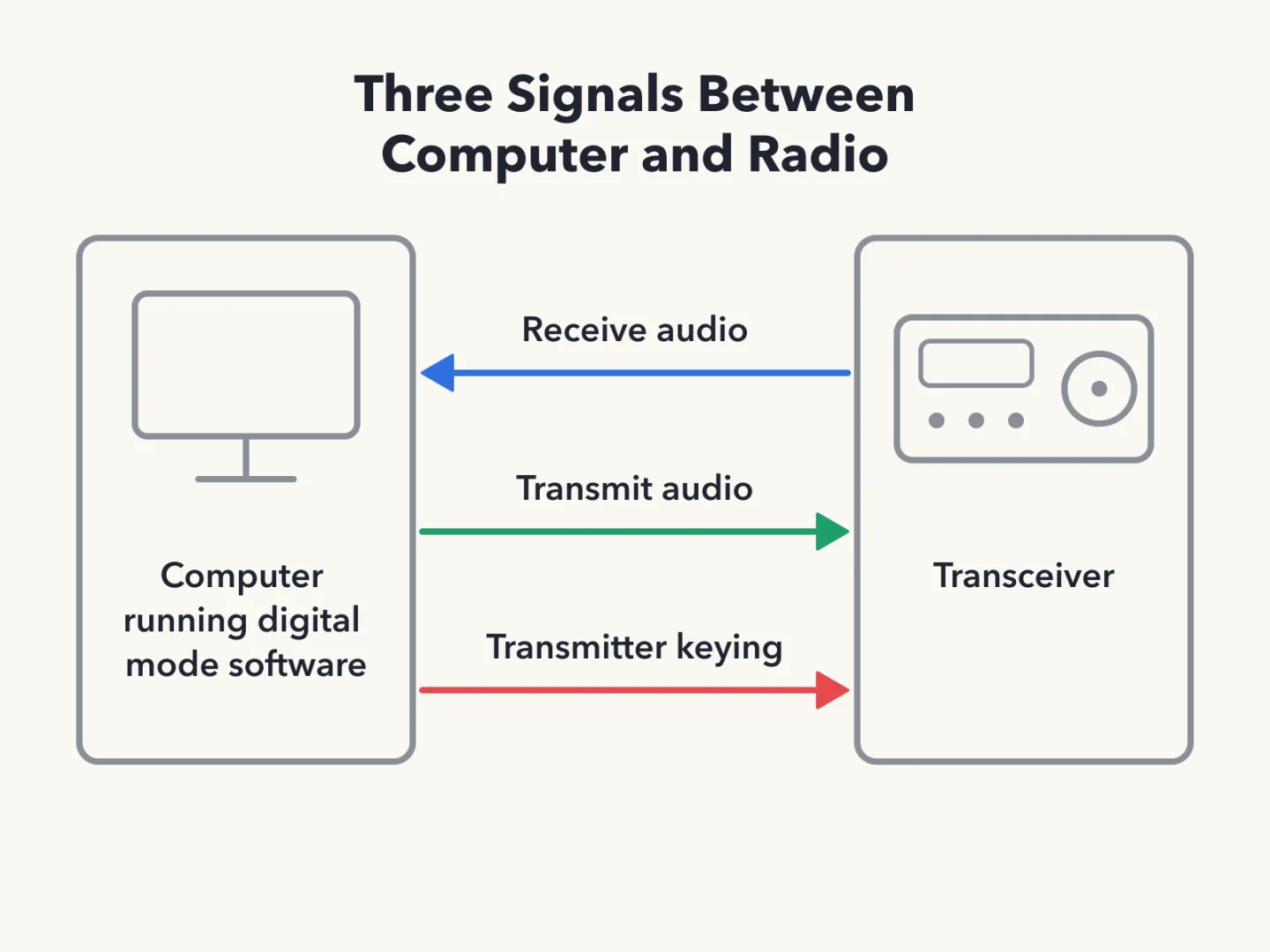
Three Signals in a Digital Interface
A computer-radio interface for digital modes carries three signals: receive audio, transmit audio and transmitter keying.
 FlashFeed original diagram · CC-BY-4.0
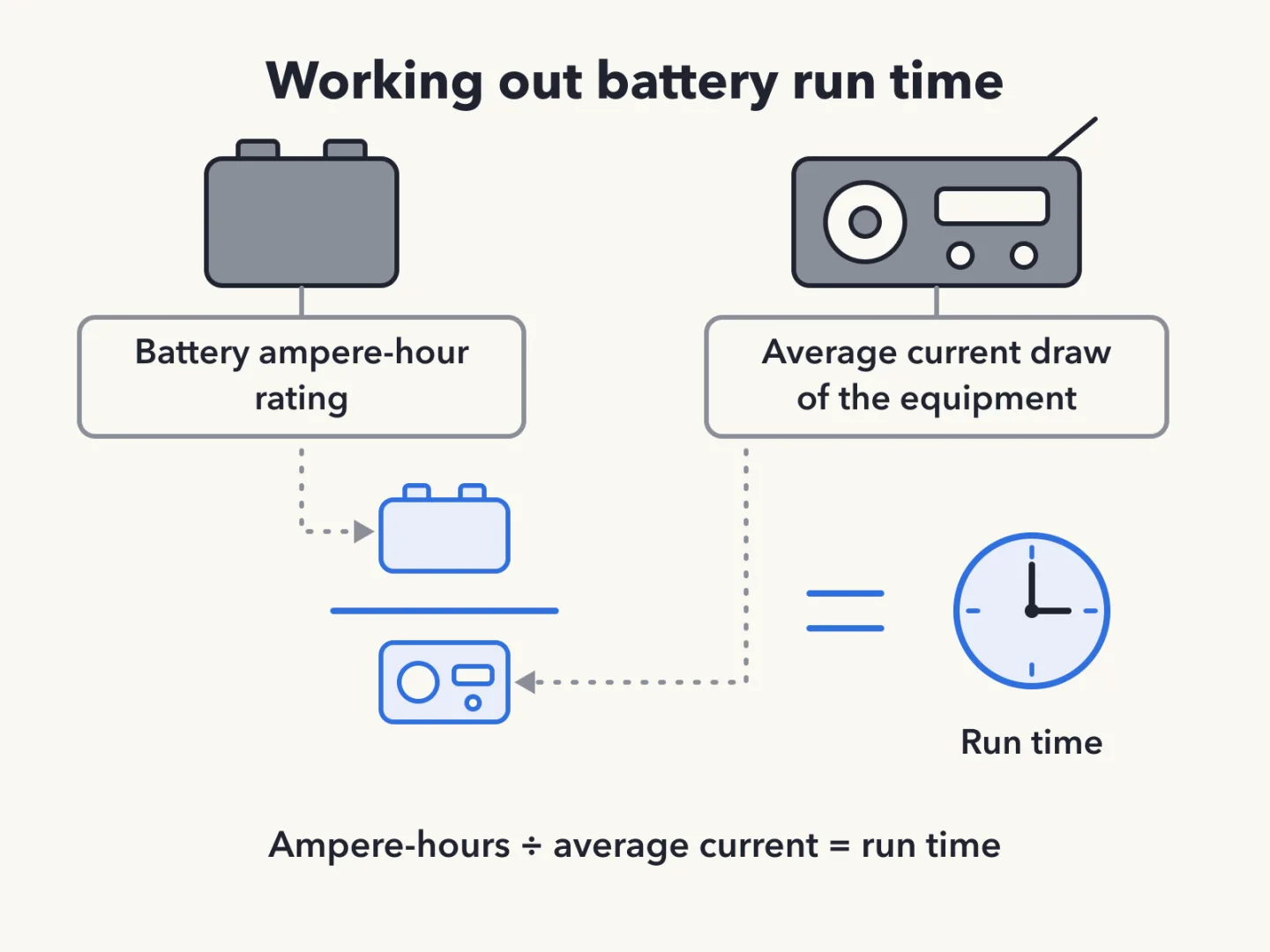
Battery Run Time
To find how long a battery can power equipment, divide the battery's ampere-hour rating by the average current draw of the equipment.
1 / 10A new licensee wires a mobile rig into a car. Where does the negative power lead go?
The negative return belongs at the 12-volt battery chassis ground. A random metal part, the bracket or the connector shell is not the correct point.
Lesson 5 has 67 cards. Keep going in the free app.
Question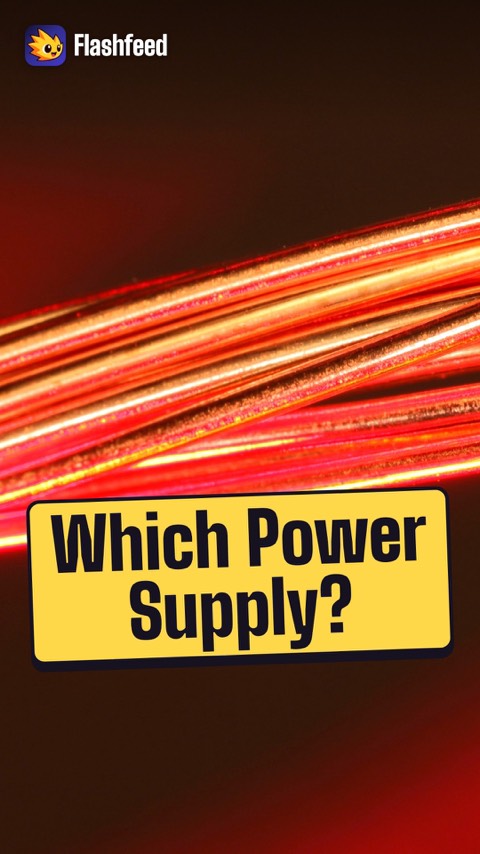
Powering a Mobile Radio 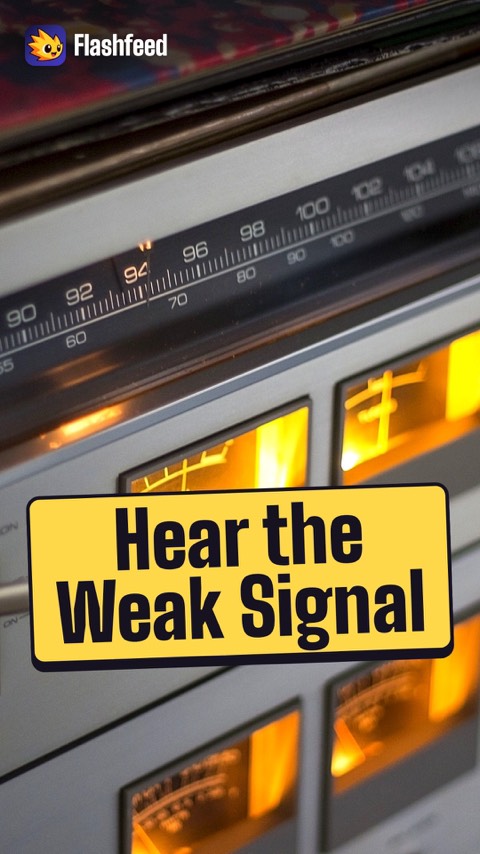
Hearing a Weak Signal All 4 clips on YouTube ↗Transcripts
Powering a Mobile Radio
A typical fifty-watt mobile radio needs a power supply. What should that supply be rated?
It is powered from a supply rated 13.8 volts at 12 amperes.
Short, heavy-gauge wires carry that power. They are used to minimize voltage drop when transmitting.
In a vehicle, the negative power return goes to the twelve-volt battery chassis ground.
Hearing a Weak Signal
A weak frequency modulated (FM) signal is on the air. The radio stays quiet, and nothing can be heard.
To hear a weak FM signal, the squelch threshold is the setting to adjust.
That threshold is set so that receiver output audio is on all the time.
With the audio on all the time, the weak signal can then be heard.
Episode 56:51
How do you set up a ham radio station and tune in a signal clearly?
- Take the lessons with you. Free, no account.Download on the App Store ↗Get it on Google Play ↗
-
 Wikimedia Commons · Bill "Hemingray" Meier at English Wikipedia · Public domain ↗06
Electrical Principles: Current, Voltage and Units
Current, voltage and conductors · Unit conversions and decibels
Lesson 6 · 10 cardsWikimedia Commons · Bill "Hemingray" Meier at English Wikipedia · Public domain ↗Glass keeps current out
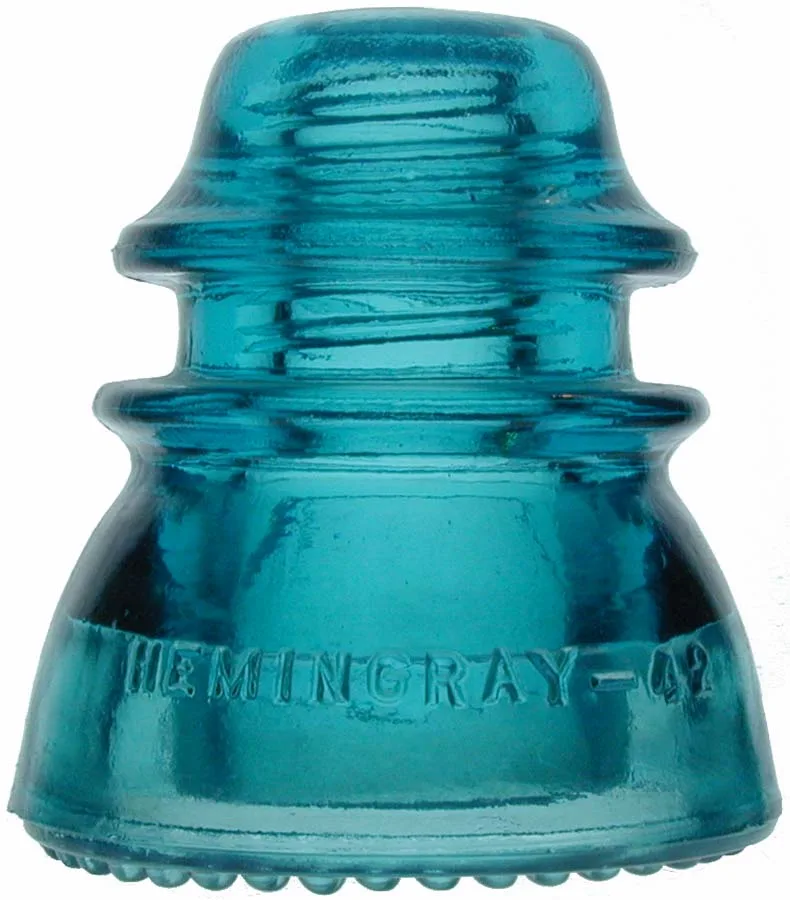
Glass is a good electrical insulator, so a piece of glass suits the job of keeping current out.
 FlashFeed original diagram · CC-BY-4.0
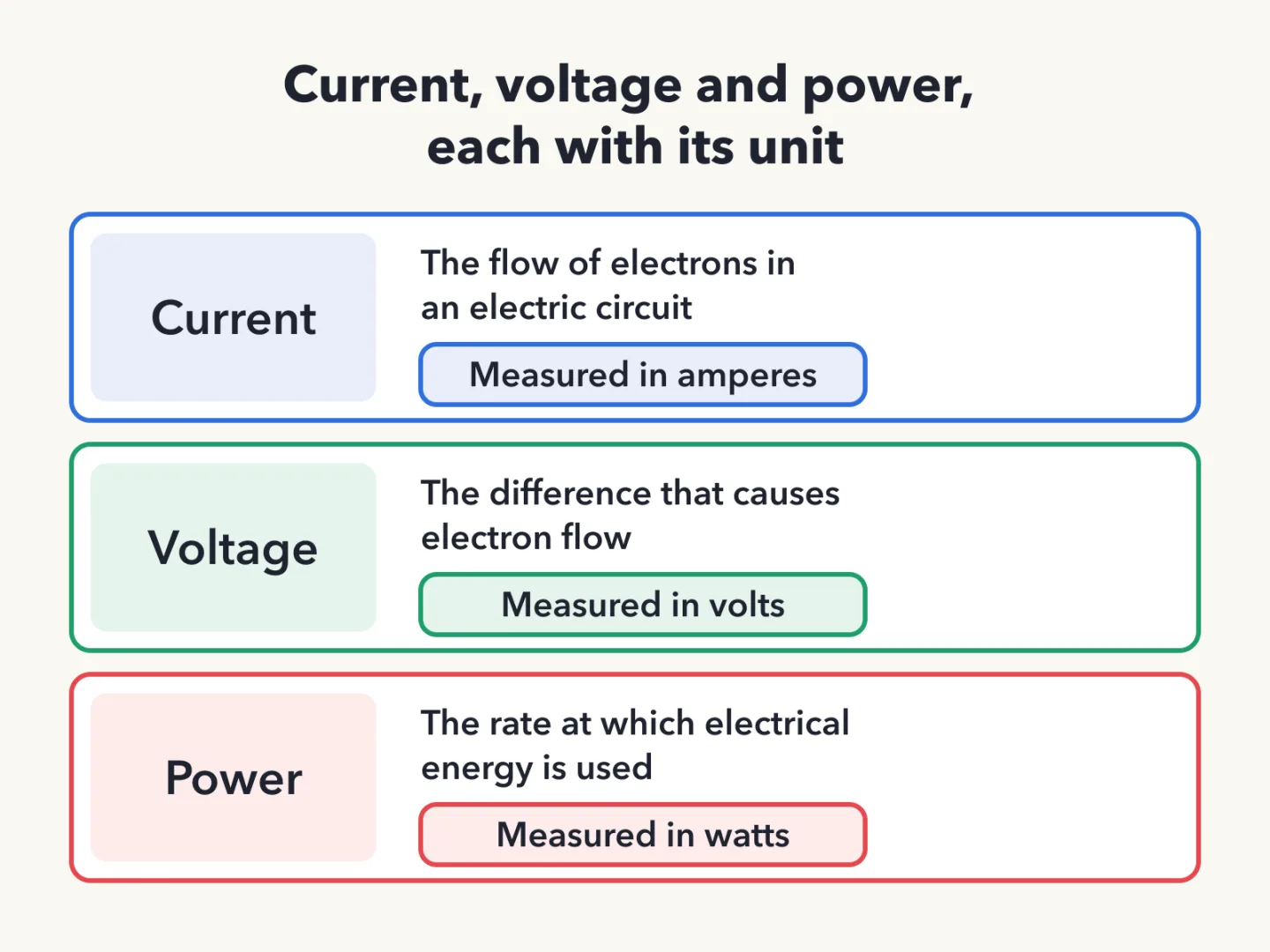
Current: the flow of electrons
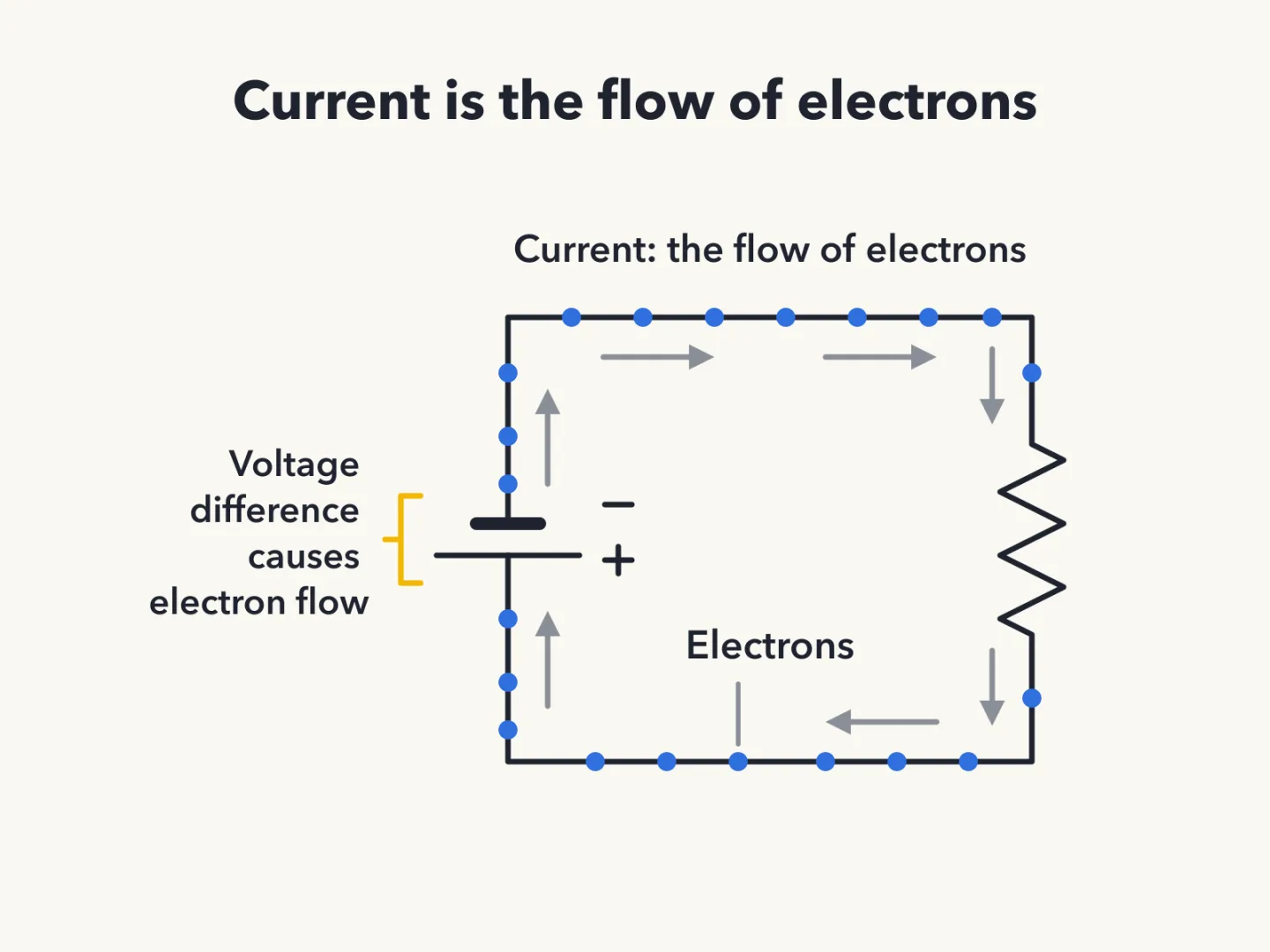
The flow of electrons in an electric circuit is called current.
 FlashFeed original diagram · CC-BY-4.0
Voltage difference moves electrons
A difference in voltage causes electron flow. Voltage is counted in volts.
 FlashFeed original diagram · CC-BY-4.0
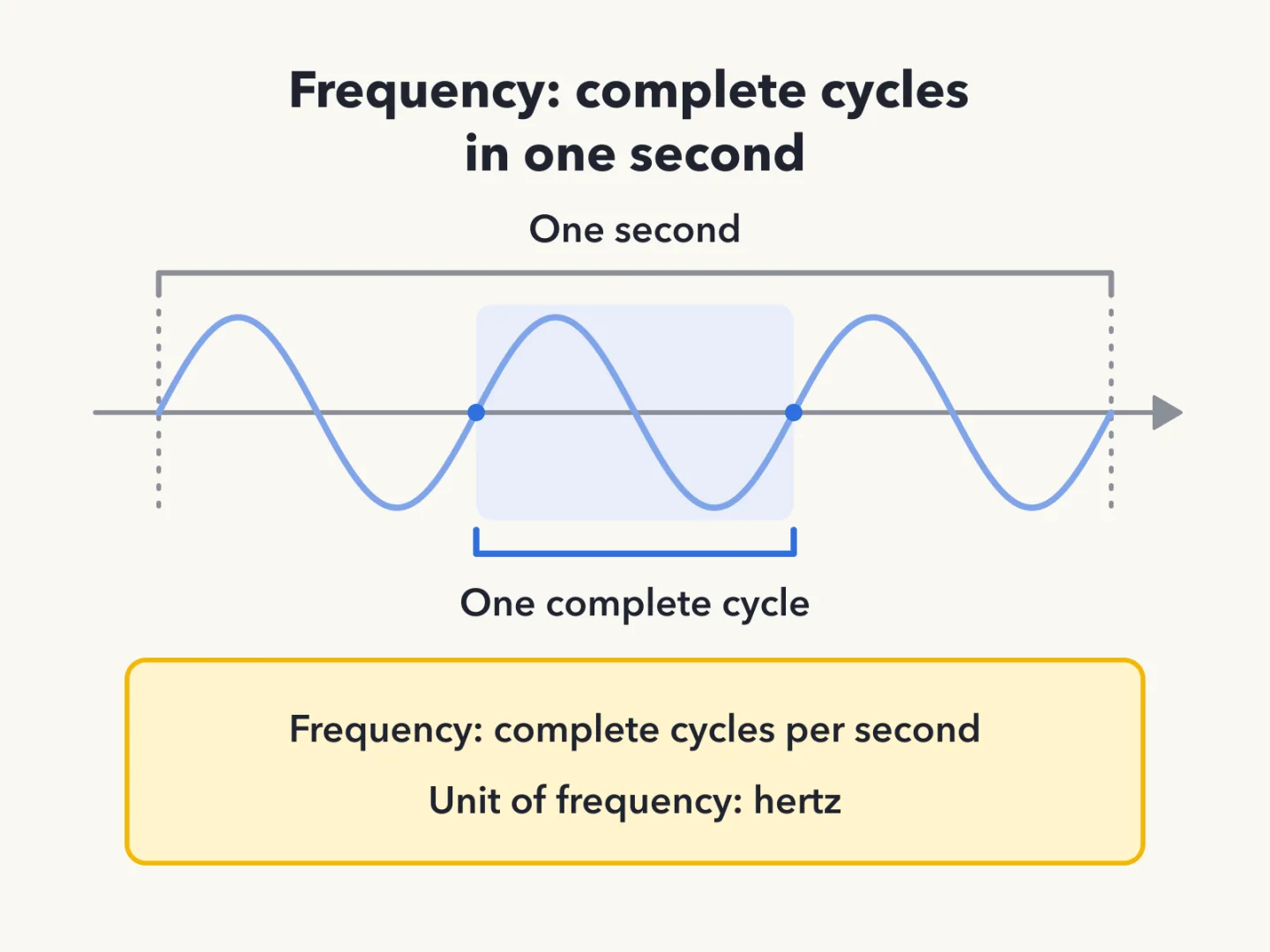
Hertz is the unit of frequency
The hertz is the unit of frequency. Frequency is the number of times per second that an alternating current makes a complete cycle.
 FlashFeed original diagram · CC-BY-4.0
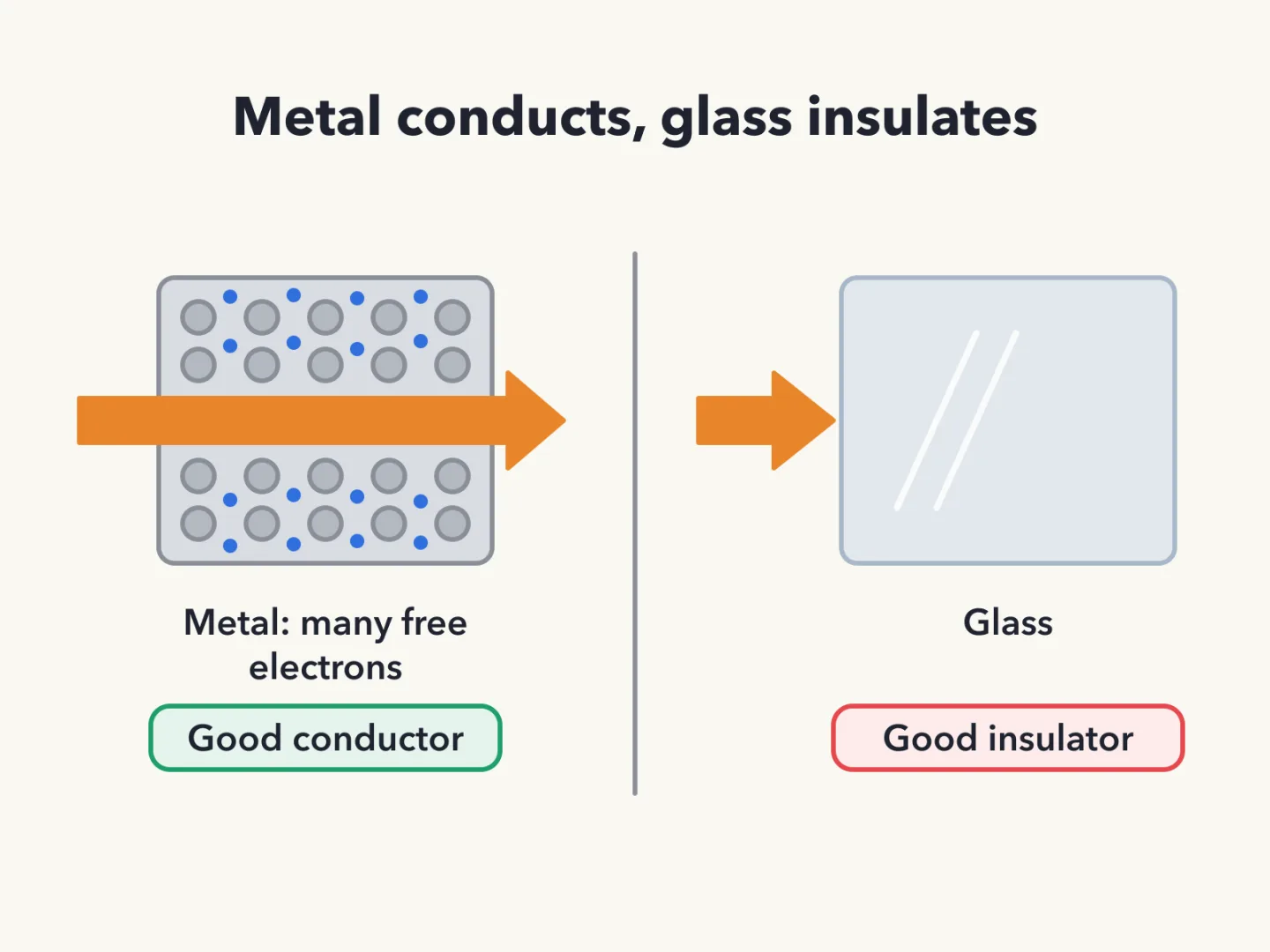
Why metals conduct well
Metals are generally good conductors of electricity because they have many free electrons.
Wikimedia Commons · Bill "Hemingray" Meier at English Wikipedia · Public domain ↗Glass is a good insulator
Glass is a good electrical insulator. A piece of glass suits the job of keeping current out.
 FlashFeed original diagram · CC-BY-4.0
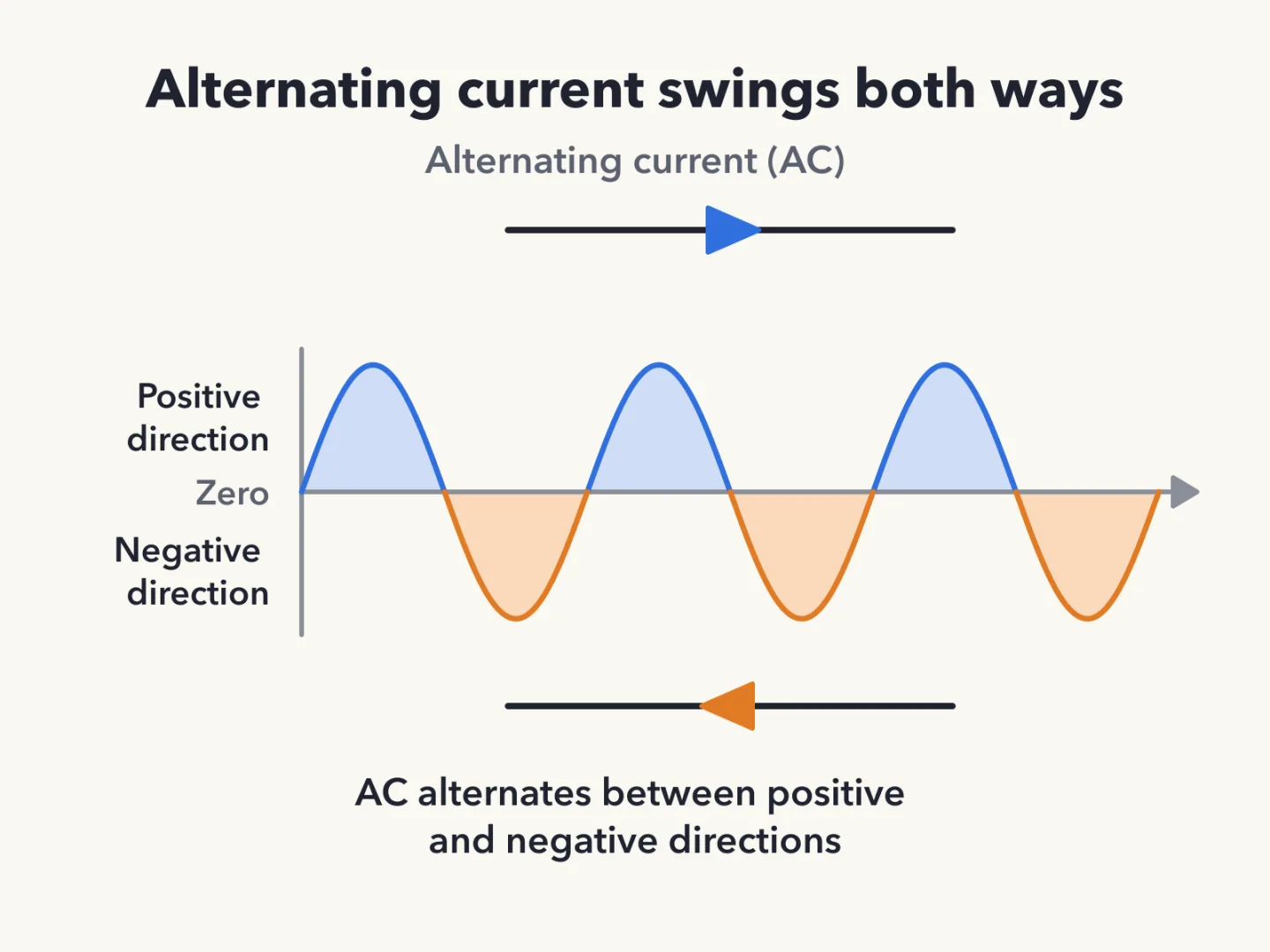
What alternating current does
In alternating current (AC), the current alternates between positive and negative directions.
1 / 10On a power supply label, which quantity does the ampere rating give?
The ampere is the unit of current. Power goes with the watt rating and voltage with the volt rating, so the ampere rating is never a power or voltage figure.
Lesson 6 has 68 cards. Keep going in the free app.
Question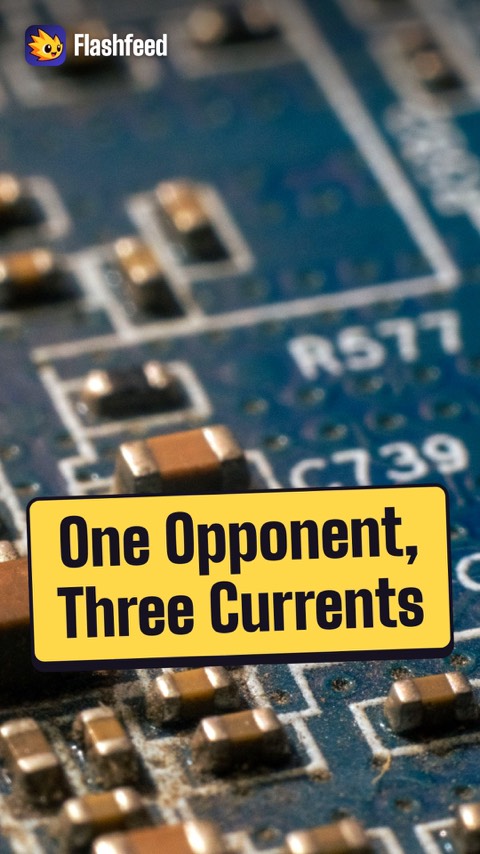
What Resistance Opposes 
Doubling Power in Decibels All 4 clips on YouTube ↗Transcripts
What Resistance Opposes
3 kinds of current all meet the same opponent.
That opponent is resistance. It opposes direct current, alternating current, and radio frequency current.
Resistance is the opposition that a current meets while it flows, whatever form the current takes.
Power is something else entirely. It is the rate at which electrical energy is used, and its unit is the watt.
Doubling Power in Decibels
Imagine a radio's power doubles, from 5 watts to 10 watts. How many decibels does that add?
About 3. A decibel value is a way to describe a change in power.
A rise in power gives a positive number, and a fall in power gives a negative one.
3 decibels is about the increase whenever power doubles, which makes it easy to remember.
Episode 66:38
What are volts, amps and watts, and how do you convert milliamps, megahertz and decibels?
-
 FlashFeed original diagram · CC-BY-4.007
Electrical Principles: Impedance, Power and Ohm's Law
Capacitance, inductance, impedance and power · Ohm's law, series and parallel
Lesson 7 · 10 cardsFlashFeed original diagram · CC-BY-4.0Inductance Stores Magnetic-Field Energy
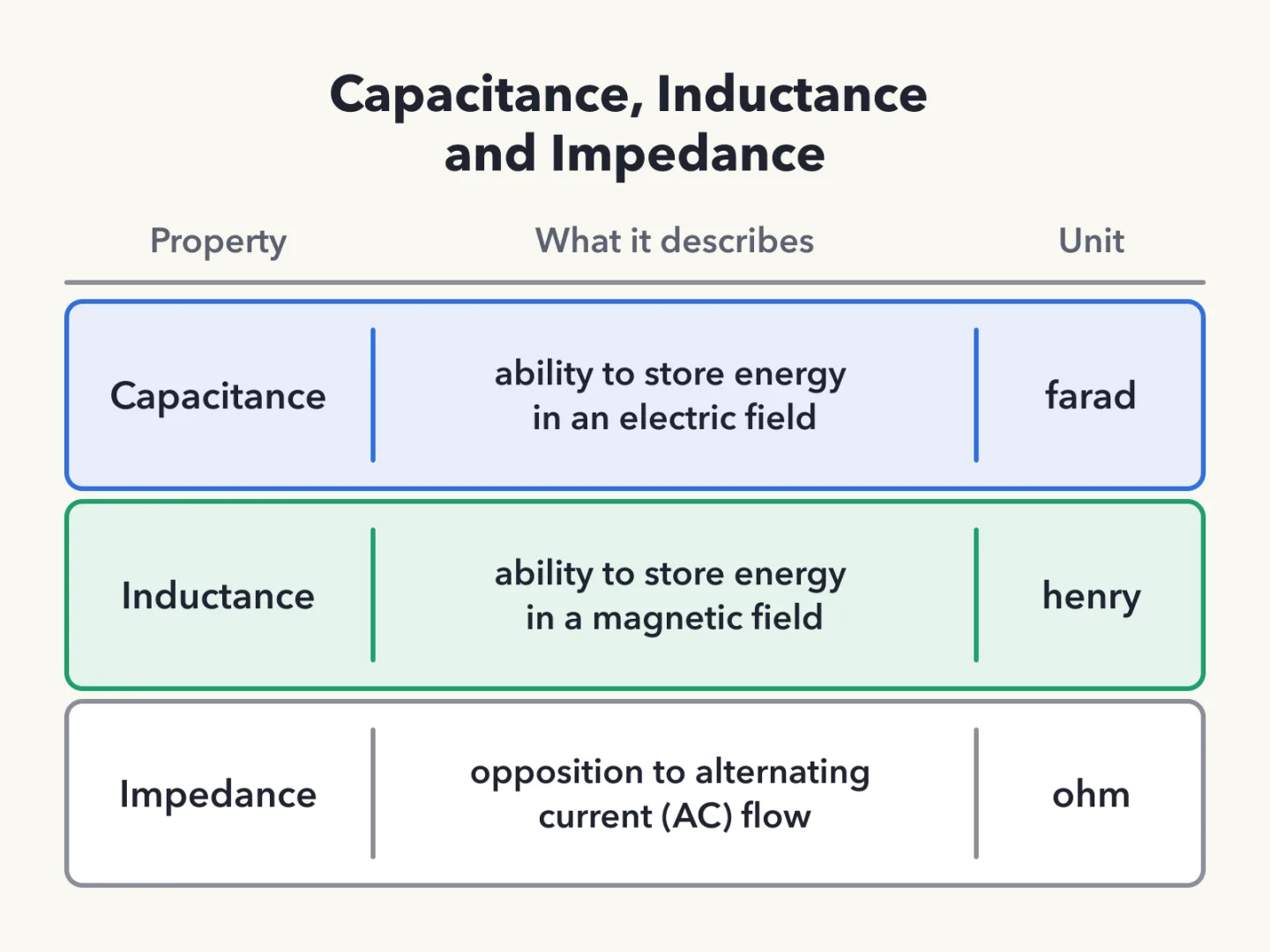
Inductance describes the ability to store energy in a magnetic field. Magnetic field goes with inductance, and electric field goes with capacitance.
 FlashFeed original diagram · CC-BY-4.0
Writing Kilohertz Correctly
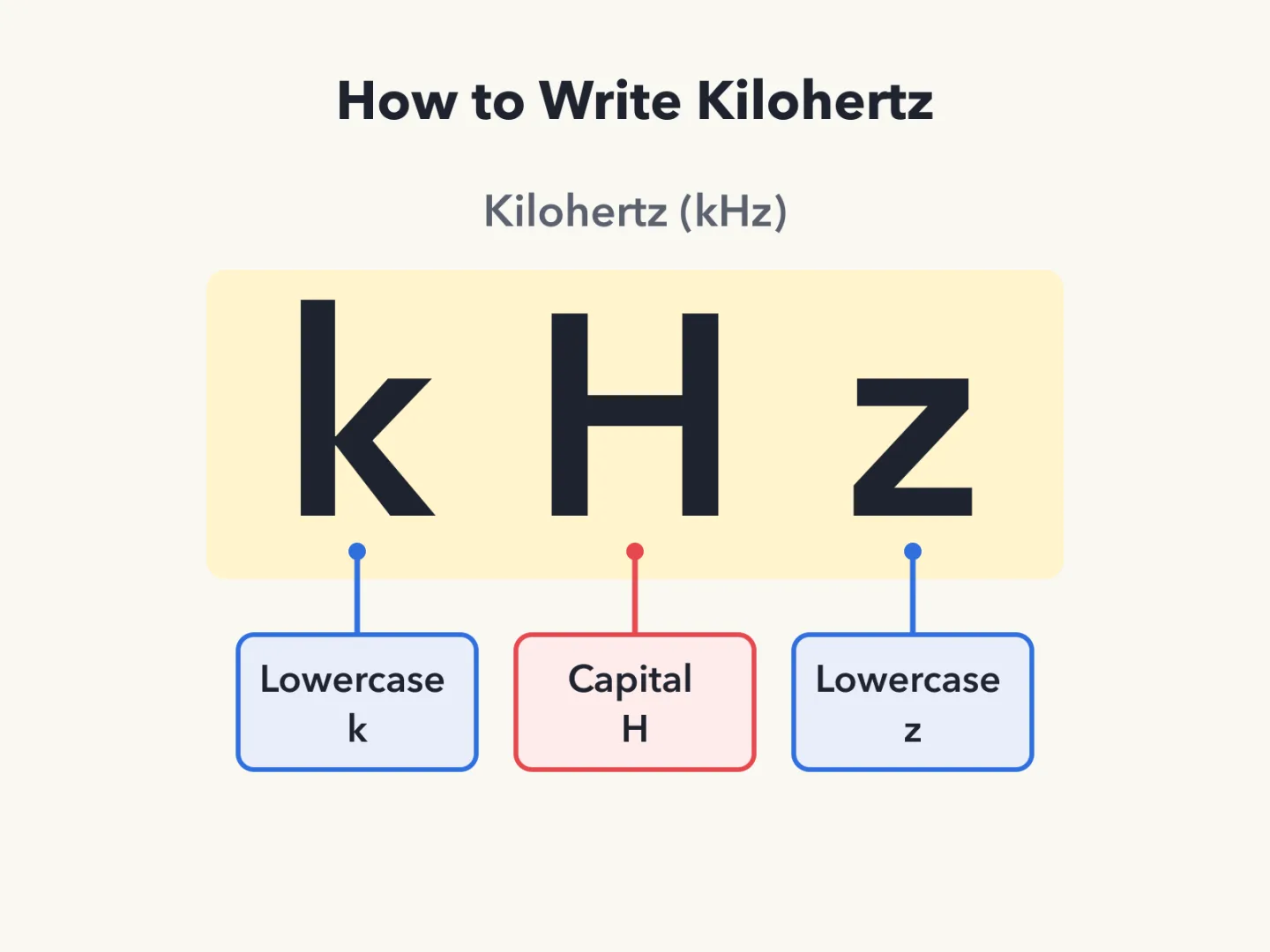
Kilohertz is written kHz: a lowercase k, a capital H and a lowercase z.
 FlashFeed original diagram · CC-BY-4.0
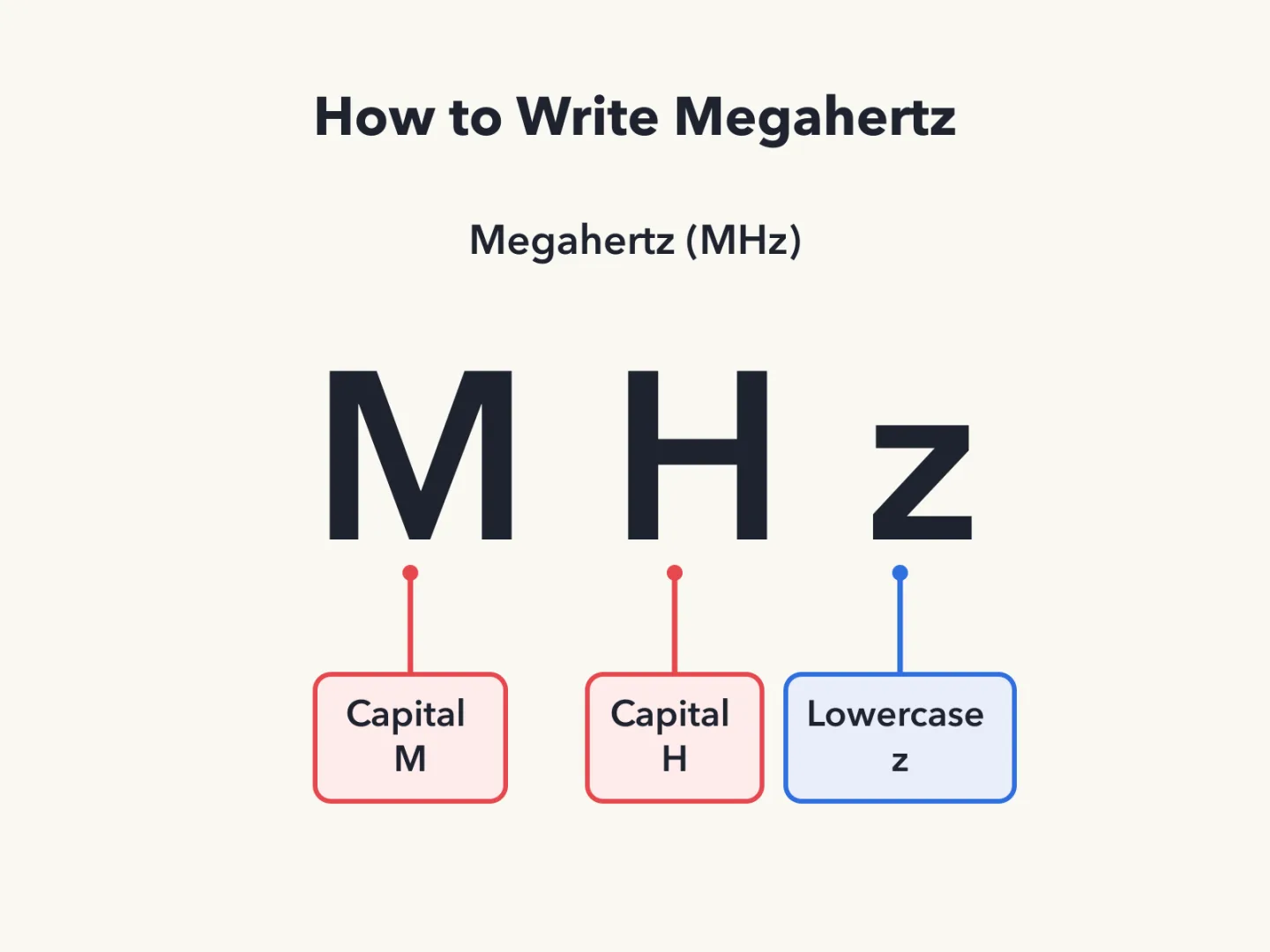
Writing Megahertz Correctly
Megahertz is written MHz: a capital M, a capital H and a lowercase z.
 FlashFeed original diagram · CC-BY-4.0
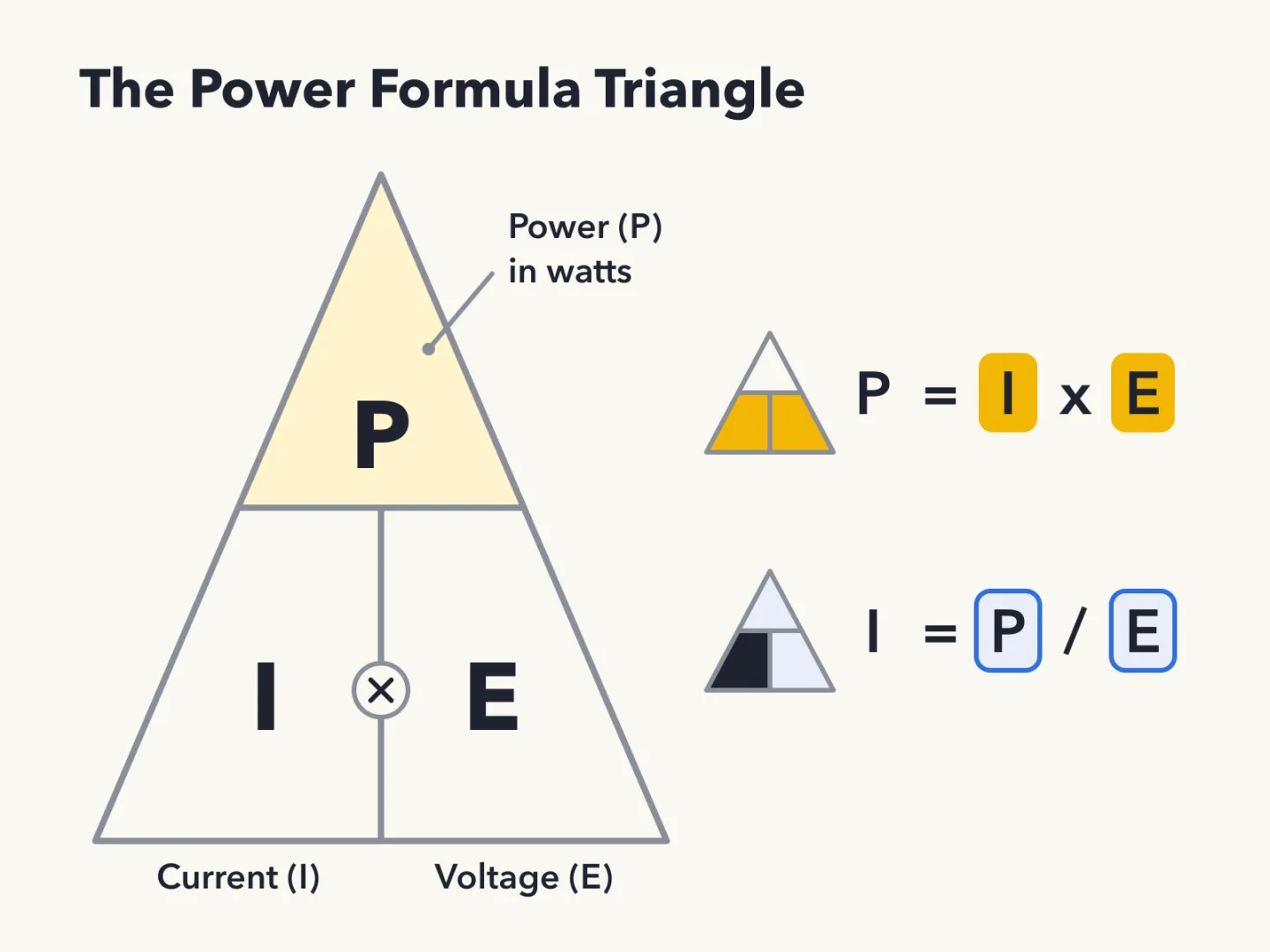
The Power Formula
In a direct current (DC) circuit, electrical power (P) is current (I) multiplied by voltage (E): P = I x E. Power is measured in watts.
 FlashFeed original diagram · CC-BY-4.0
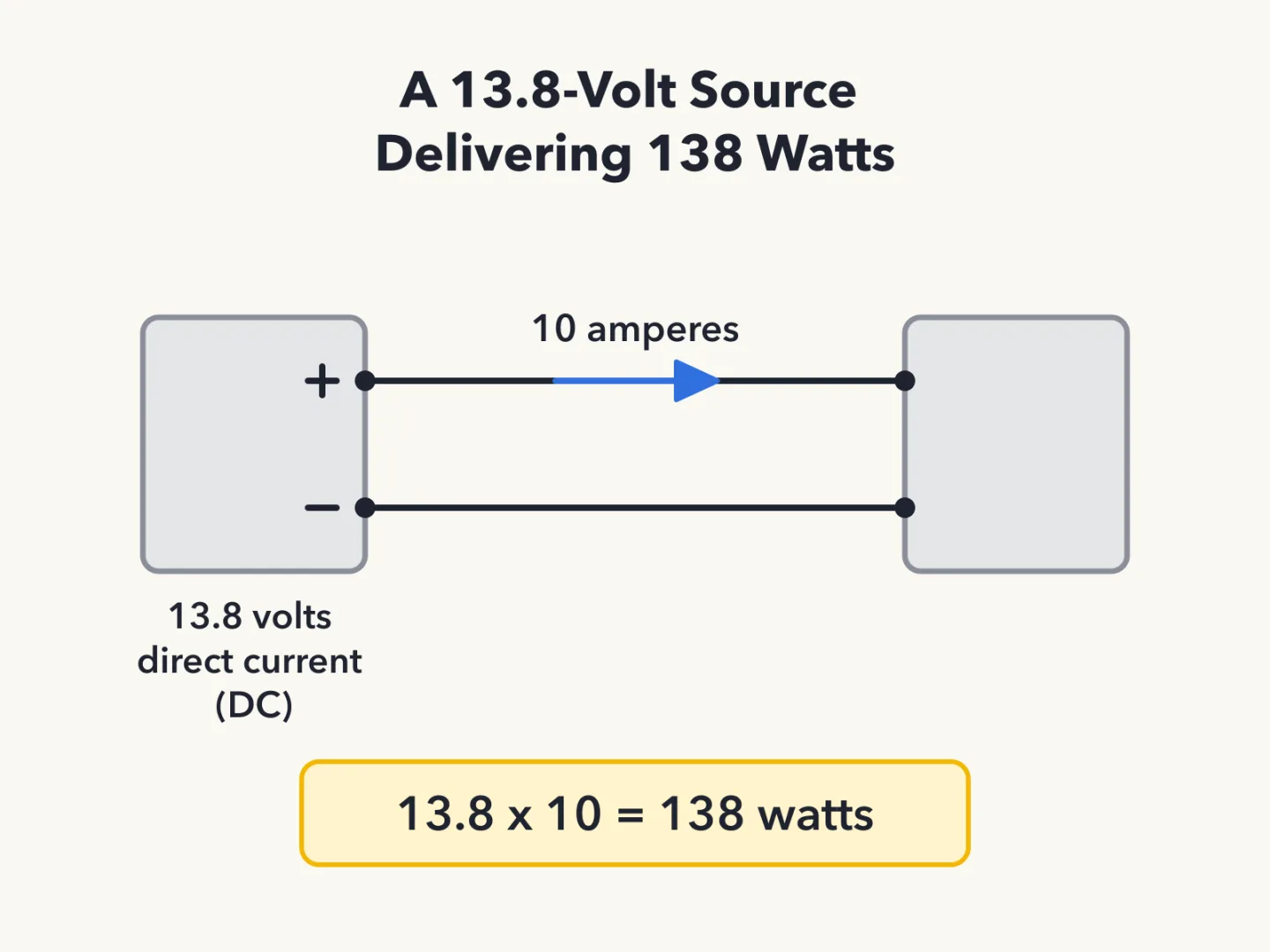
13.8 Volts at 10 Amperes
A voltage of 13.8 volts of direct current (DC) and a current of 10 amperes deliver 138 watts, because 13.8 x 10 is 138. A 13.8 volt supply feeding a radio that draws 10 amperes is a realistic case of this formula.
 FlashFeed original diagram · CC-BY-4.0
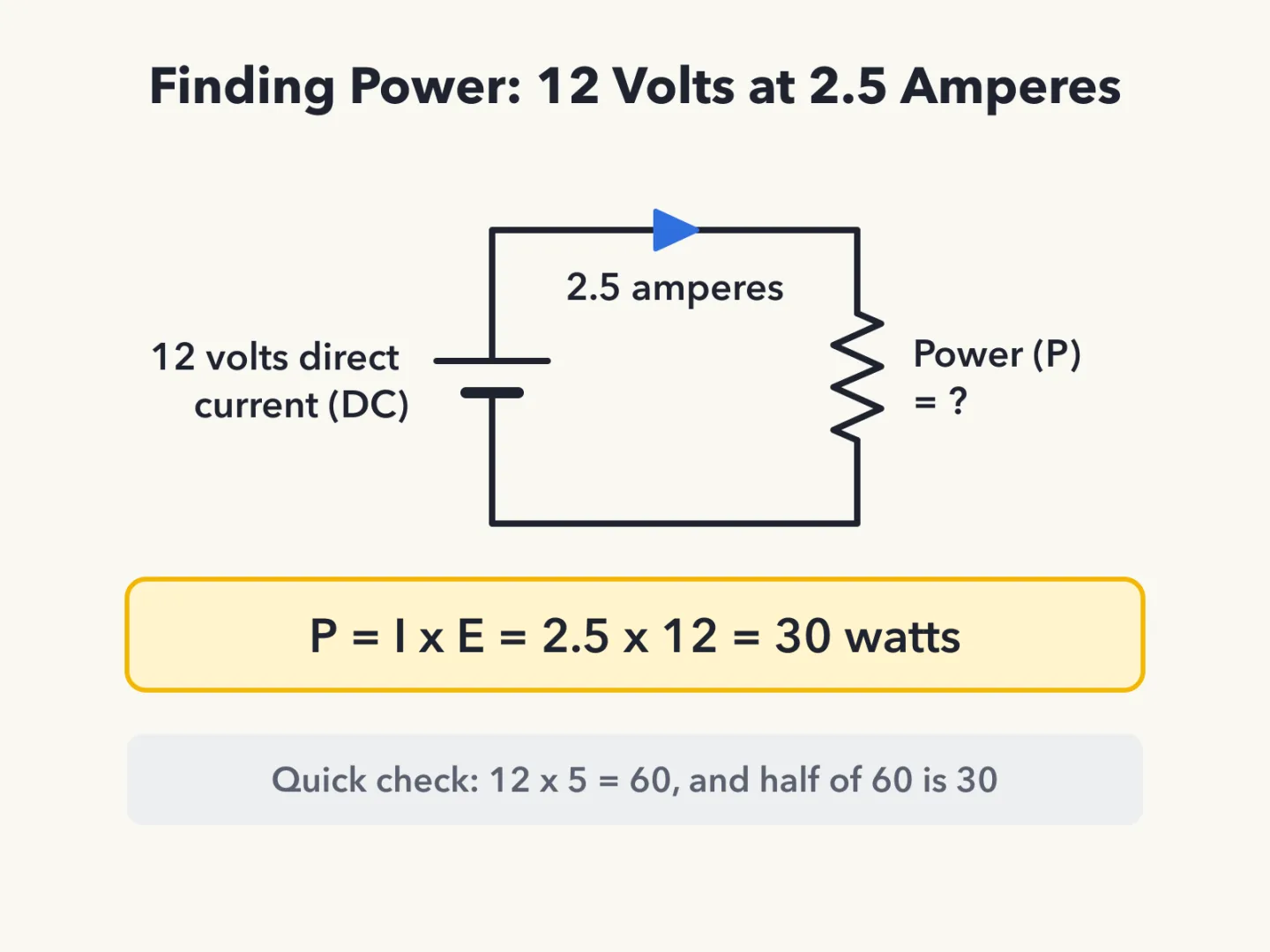
12 Volts at 2.5 Amperes
A voltage of 12 volts of direct current (DC) and a current of 2.5 amperes deliver 30 watts, because 12 x 2.5 is 30. A quick check: 12 x 5 is 60, so half of that, 30, fits.
 FlashFeed original diagram · CC-BY-4.0
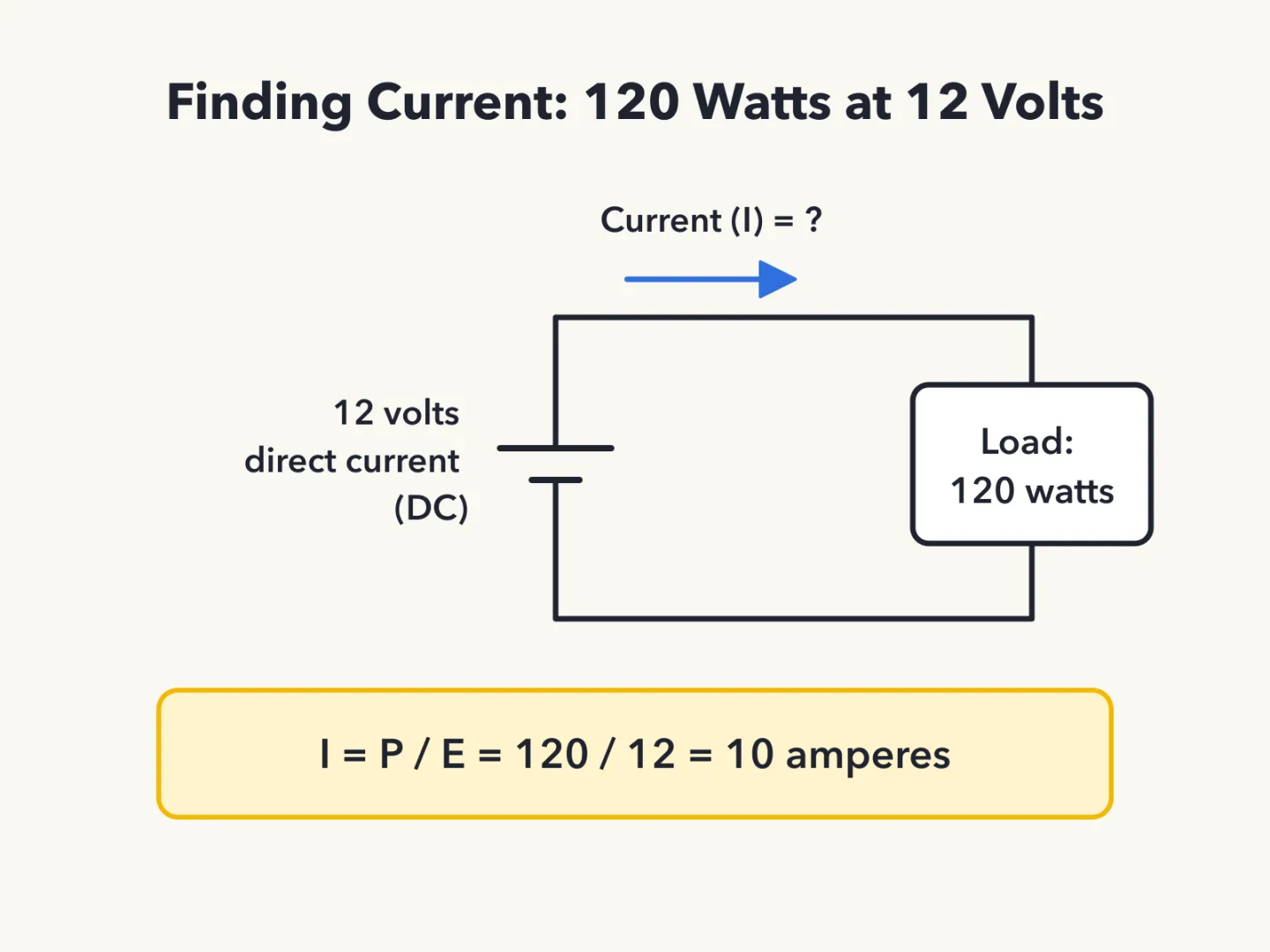
Finding Current from Power
Delivering 120 watts at 12 volts of direct current (DC) takes 10 amperes. Since power equals current times voltage, the current is the power divided by the voltage: 120 divided by 12 is 10.
1 / 10Capacitance pairs with the electric field. Which property pairs with the magnetic field?
Inductance is the ability to store energy in a magnetic field. Impedance is opposition to alternating current (AC) flow, and admittance and resistance are not field-storage properties either.
Lesson 7 has 74 cards. Keep going in the free app.
Question
Power From a 13.8 Volt Radio 
Finding Current With Ohm's Law All 4 clips on YouTube ↗Transcripts
Power From a 13.8 Volt Radio
A radio on a 13.8 volt supply draws 10 amperes. How much power does it use?
In a direct current circuit, power equals current times voltage, measured in watts.
It uses 138 watts: 10 amperes times 13.8 volts.
Rounding helps check it: 13.8 is a little under 14, and 14 times 10 is 140, which is close.
Finding Current With Ohm's Law
Put 200 volts across a resistor of 100 ohms. How many amperes flow through it?
Ohm's law gives current as voltage divided by resistance. For this circuit that is one simple division.
That gives 2: 200 volts divided by 100 ohms.
Knowing any two of voltage, current and resistance gives the third. A result of thousands of amperes means the two were multiplied, so divide.
Episode 77:45
How does Ohm's law work, and how do you calculate power from voltage and current?
-
 Wikimedia Commons · Evan-Amos · Public domain ↗08
Electronic Components: Parts and Semiconductors
Resistors, capacitors, inductors and batteries · Semiconductors: diodes and transistors
Lesson 8 · 10 cardsWikimedia Commons · Evan-Amos · Public domain ↗Adjusting the Volume
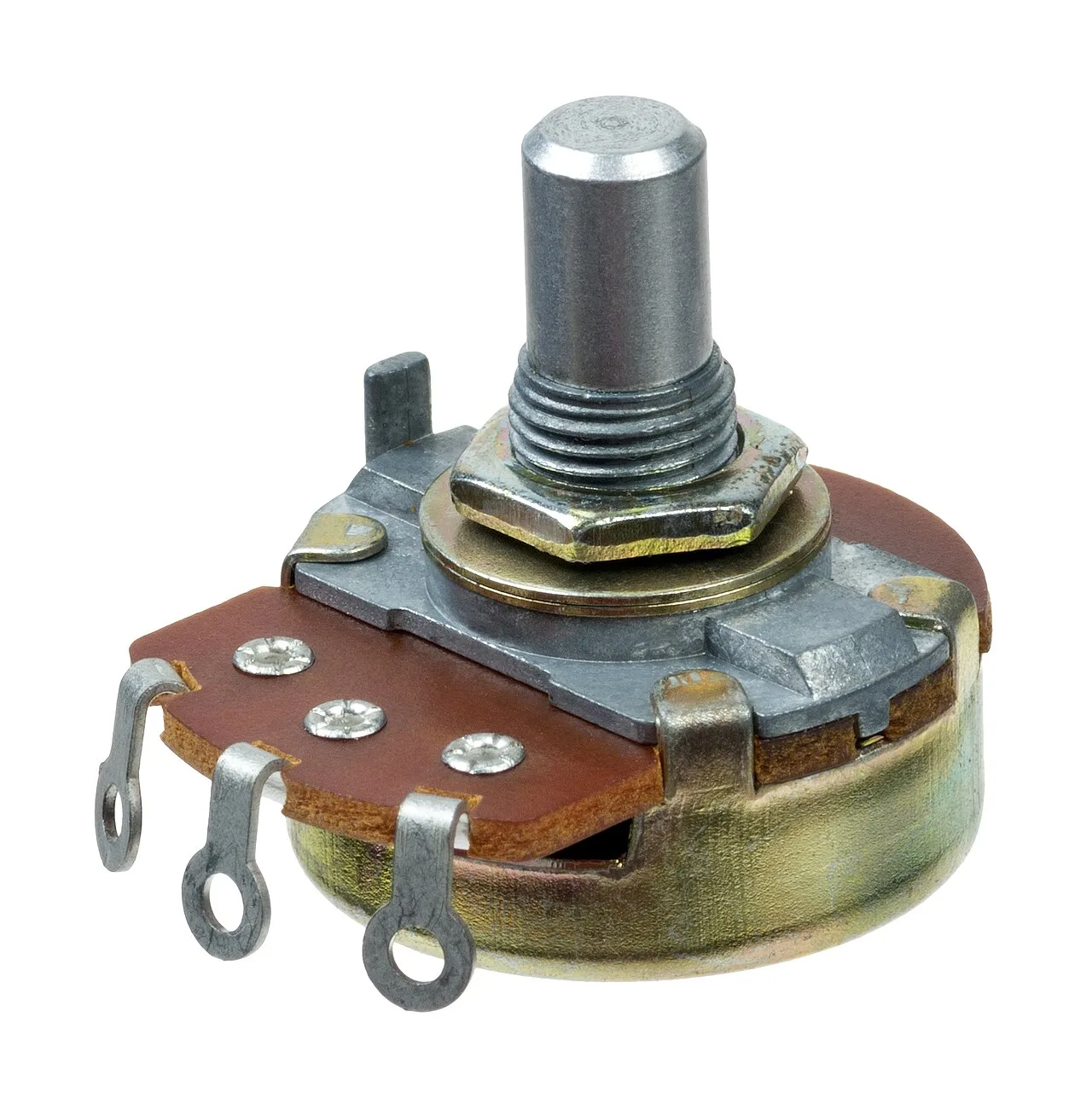
When a circuit needs an adjustable volume control, the part often used is a potentiometer.
 Wikimedia Commons · Evan-Amos · Public domain ↗
The Resistor Opposes Current
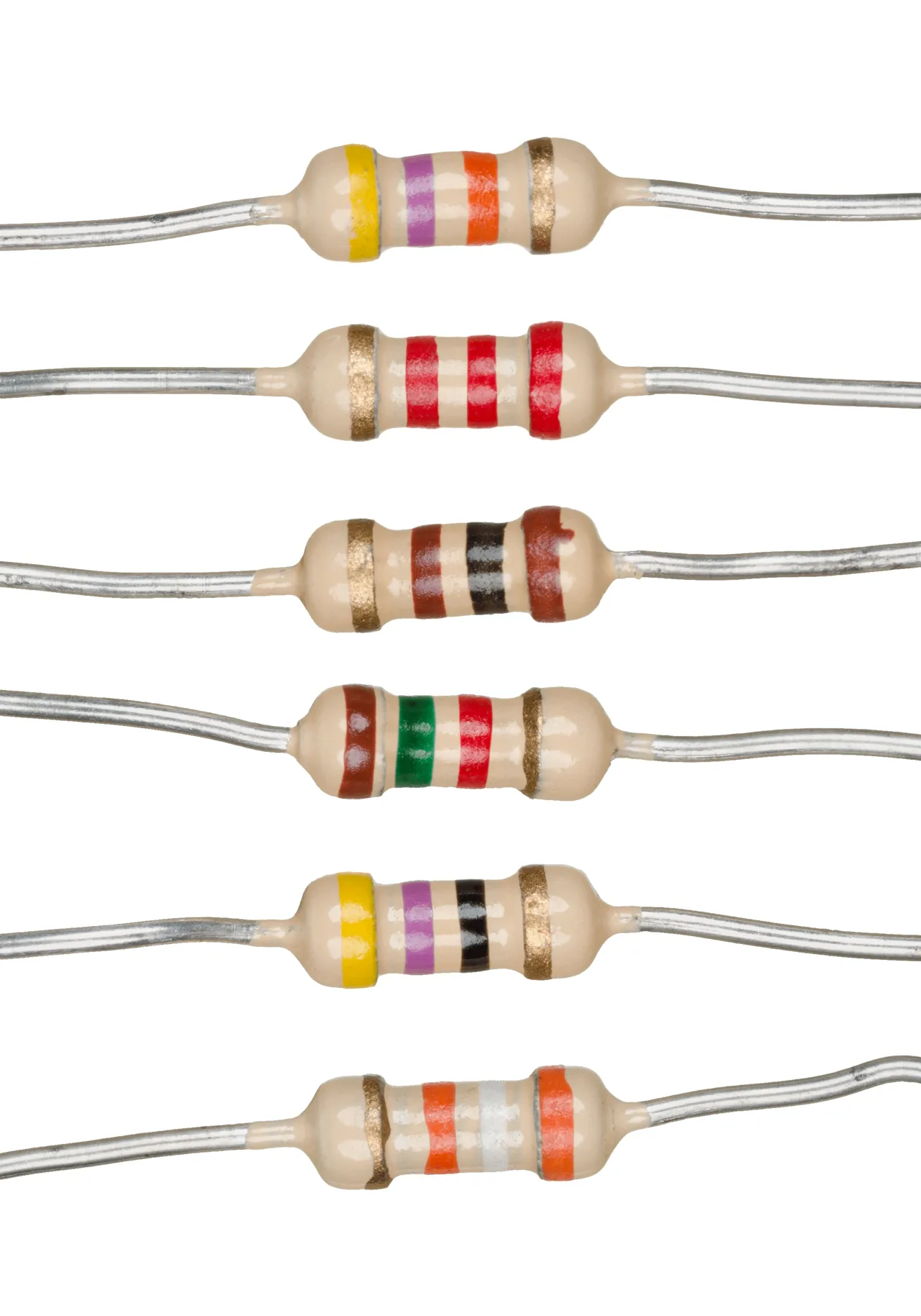
A resistor is the component that opposes the flow of current in a direct current (DC) circuit.
Wikimedia Commons · Evan-Amos · Public domain ↗Potentiometer as Volume Control
A potentiometer is the part often used as an adjustable volume control.
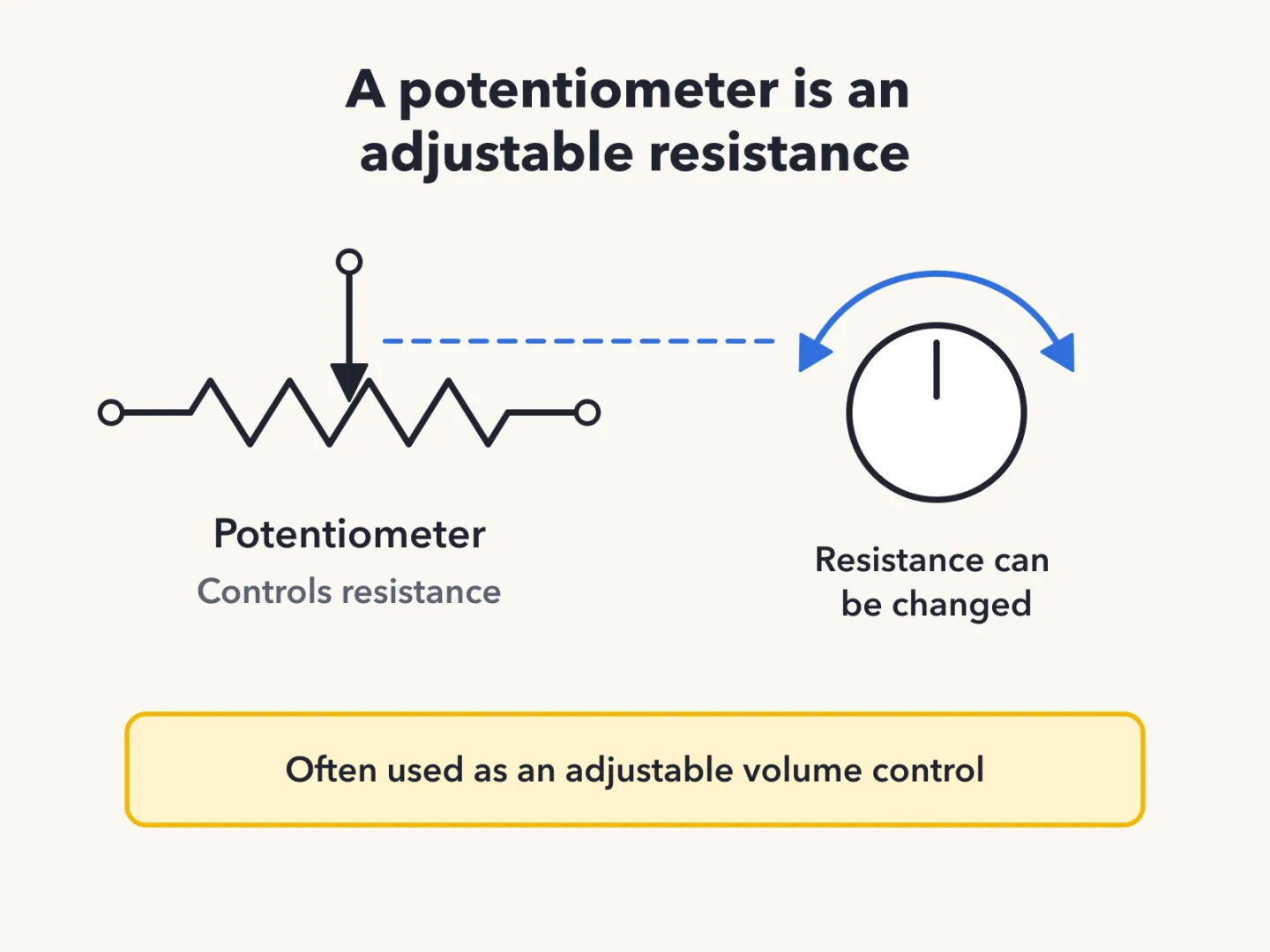 FlashFeed original diagram · CC-BY-4.0
What a Potentiometer Controls
A potentiometer controls resistance. An adjustable volume control is a part whose resistance can be changed.
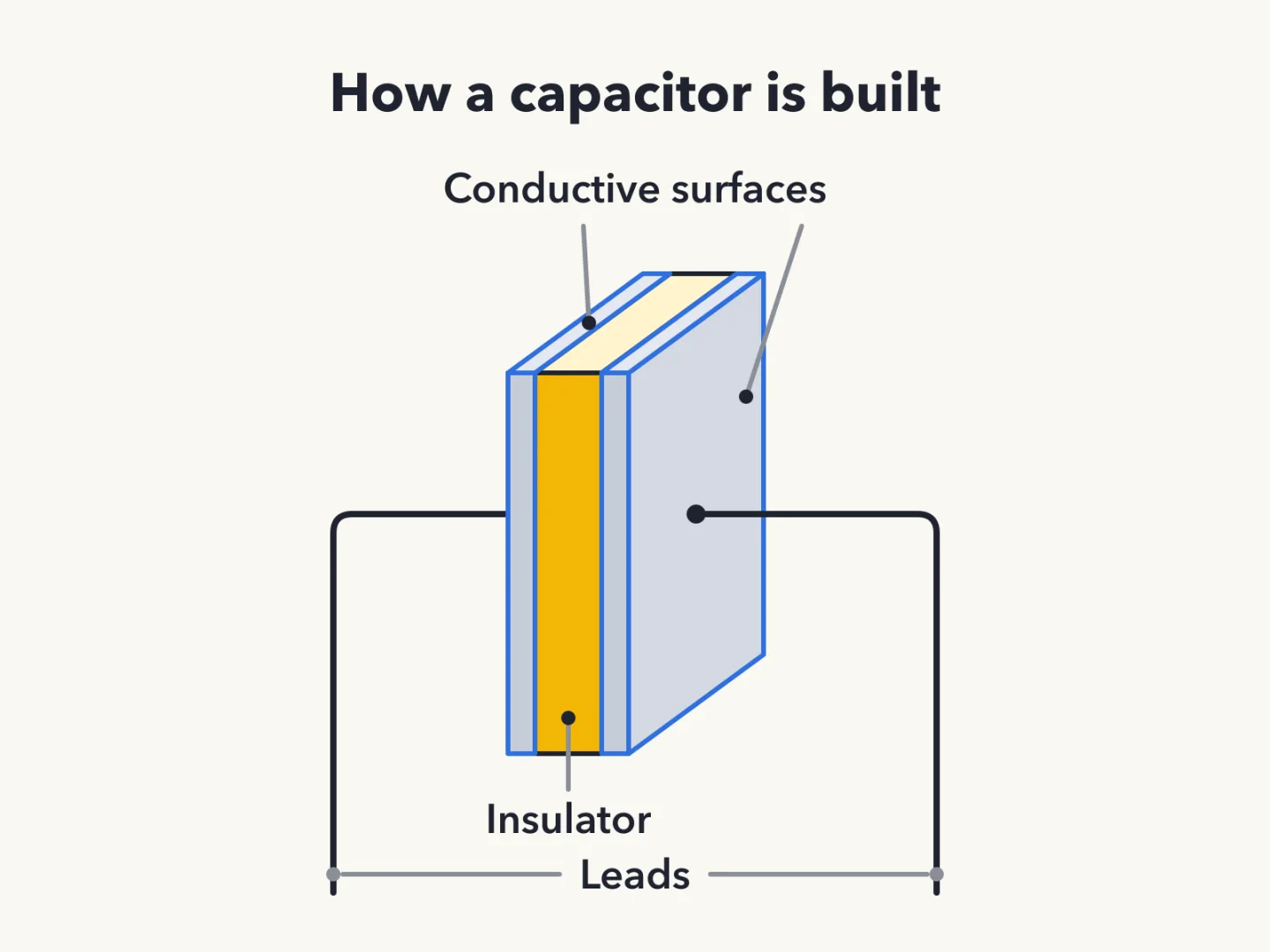 FlashFeed original diagram · CC-BY-4.0
How a Capacitor Is Built
A capacitor consists of conductive surfaces separated by an insulator.
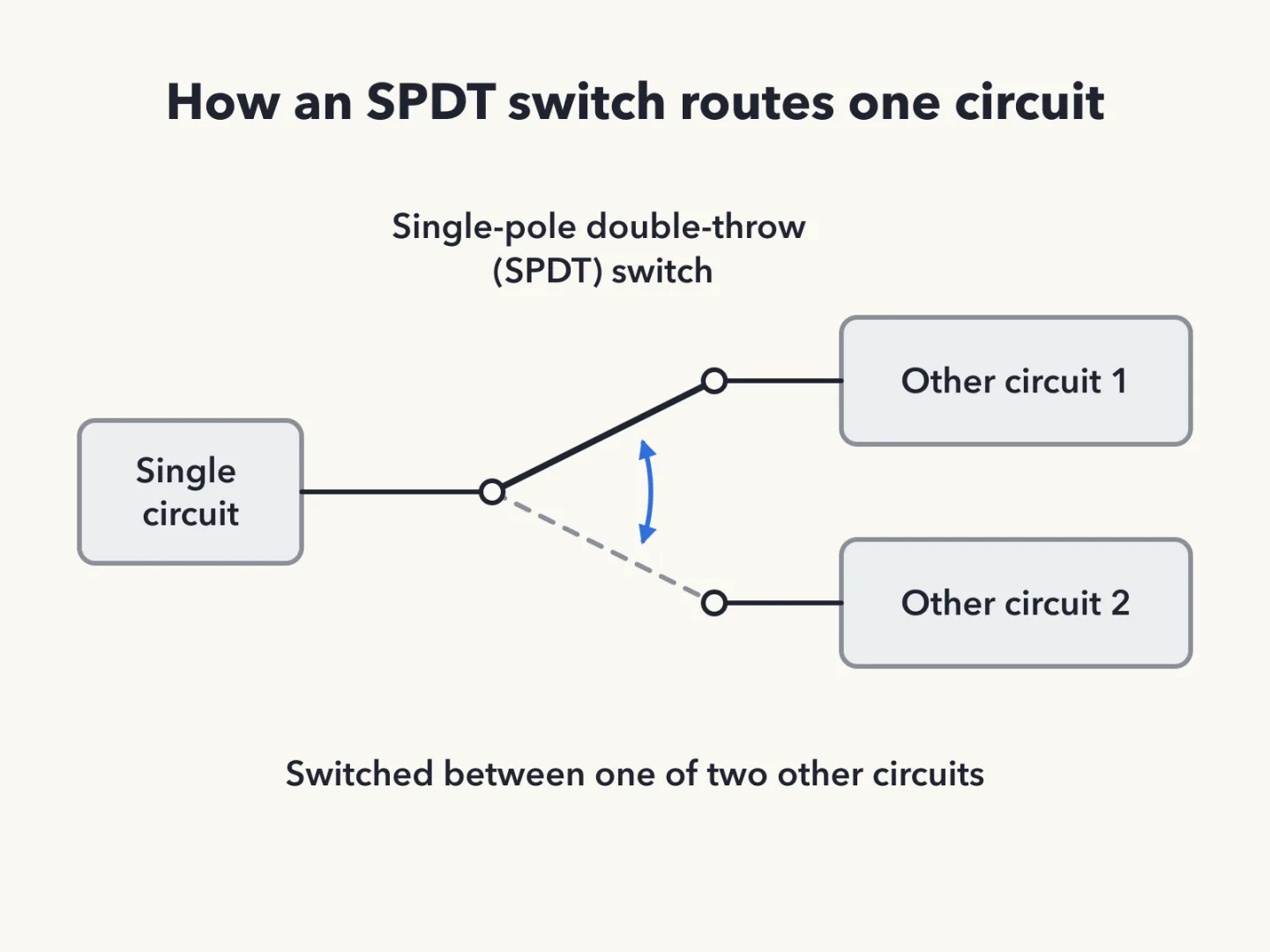 FlashFeed original diagram · CC-BY-4.0
What an SPDT Switch Does
A single-pole double-throw (SPDT) switch switches a single circuit between one of two other circuits.
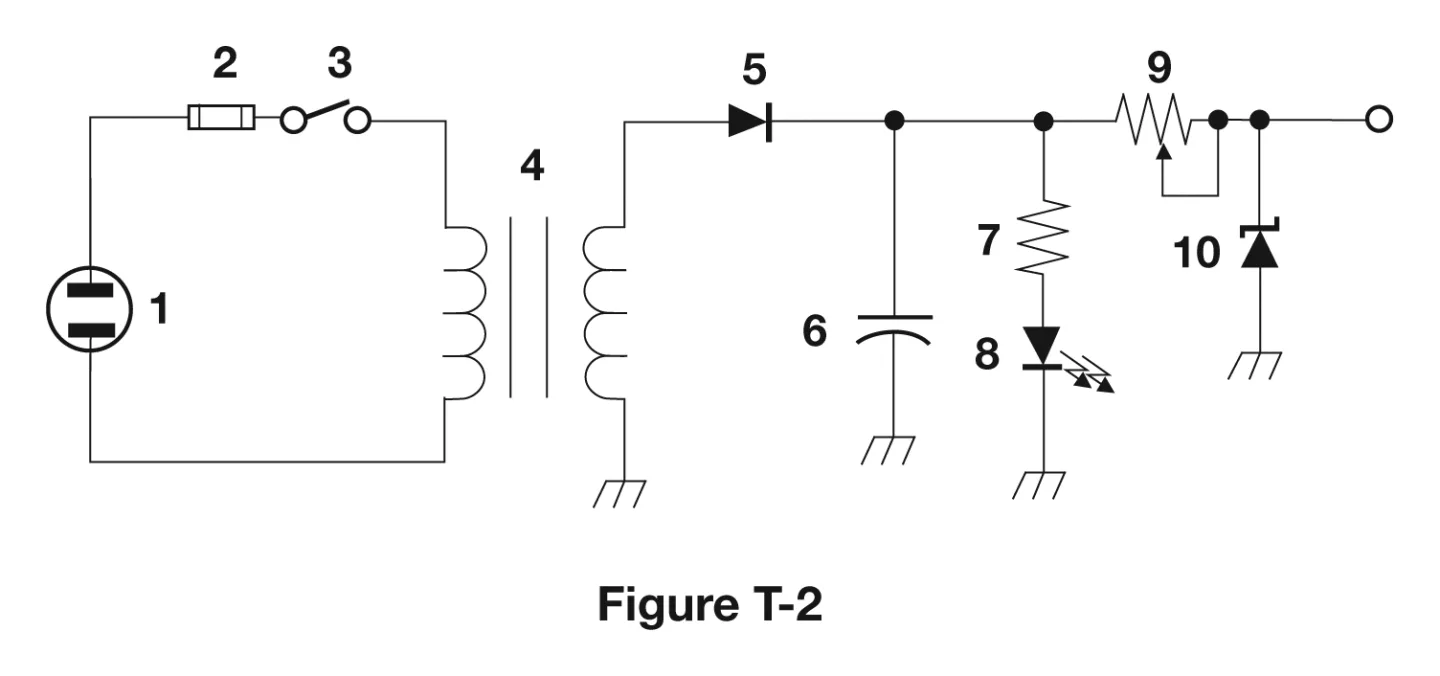 NCVEC Question Pool Committee · Public domain ↗
Reading Switch Type on Figure T-2
In the reference schematic labeled figure T-2, component 3 is a single-pole single-throw switch.
 Wikimedia Commons · RAIL P (RAIL.PHOTOGRAPHY) · CC0 ↗
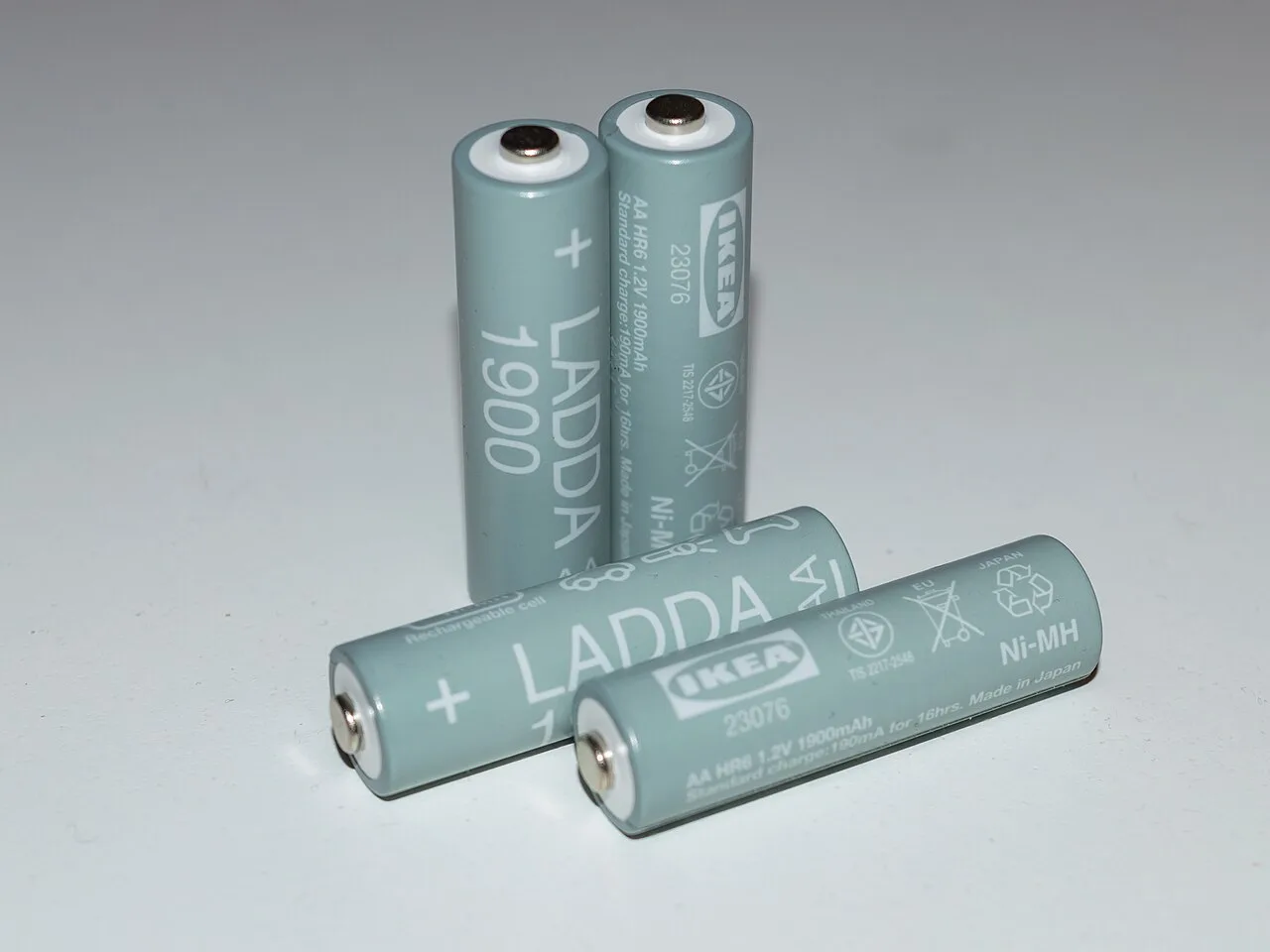
Rechargeable Battery Chemistries
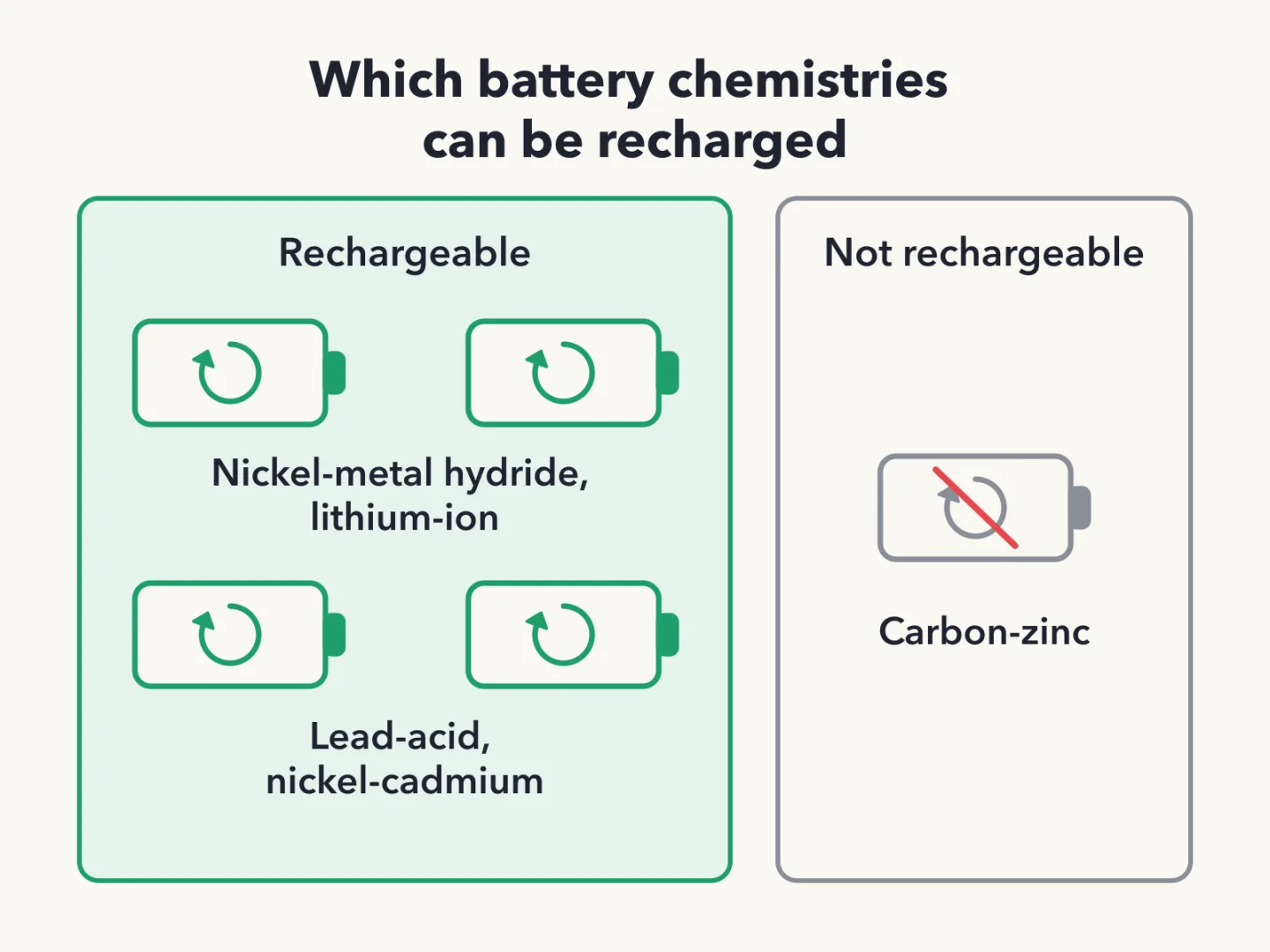
Nickel-metal hydride, lithium-ion and lead-acid batteries can all be recharged. Nickel-cadmium can be recharged as well.
 FlashFeed original diagram · CC-BY-4.0
Carbon-Zinc Is Not Rechargeable
Carbon-zinc batteries cannot be recharged. Nickel-metal hydride, lithium-ion, lead-acid and nickel-cadmium batteries can all be recharged.
 FlashFeed original diagram · CC-BY-4.0
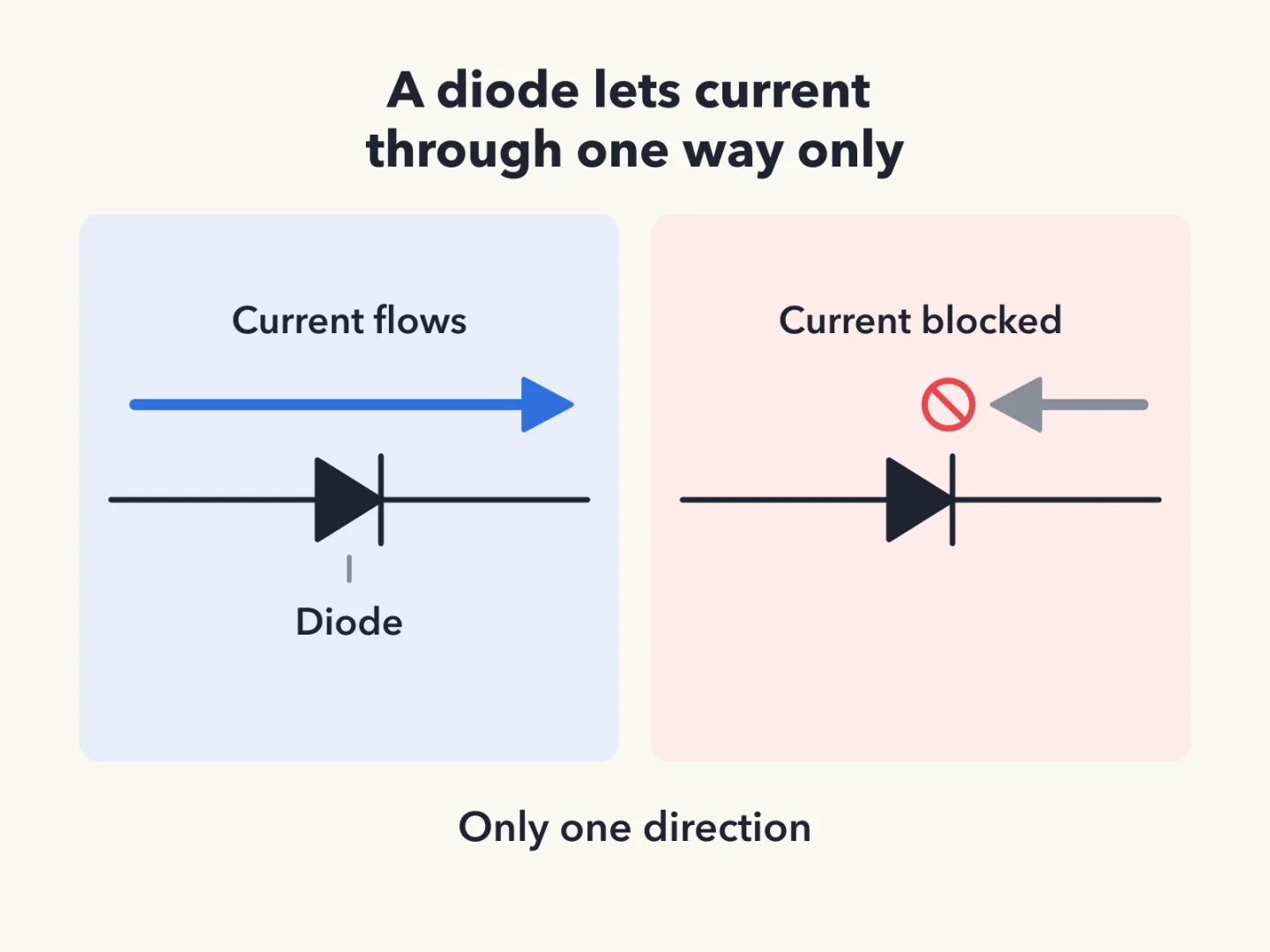
The Diode Passes Current One Way
A diode is the electronic component that allows current to flow in only one direction.
1 / 10Which part is made of conductive surfaces separated by an insulator?
A capacitor is built from conductive surfaces with an insulator between them. An inductor is a coil of wire instead, and a resistor opposes current.
Lesson 8 has 65 cards. Keep going in the free app.
Question
Rechargeable or Not 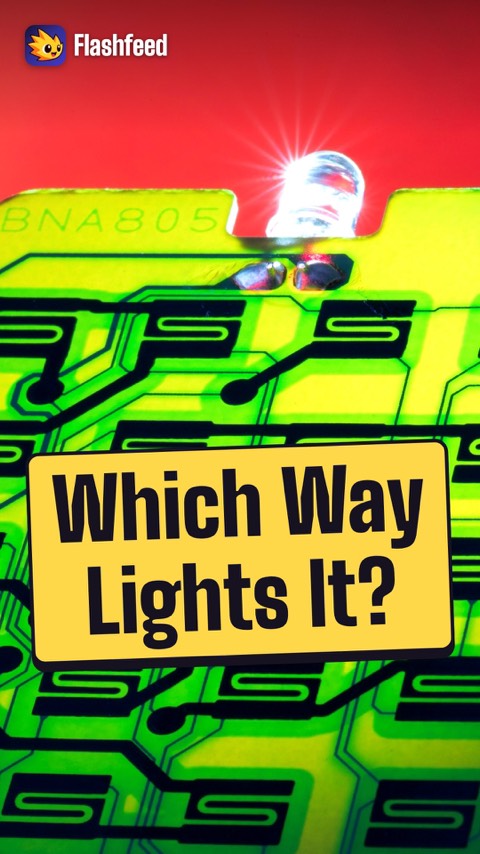
Which Way Current Flows All 4 clips on YouTube ↗Transcripts
Rechargeable or Not
Which common battery chemistry can never be recharged? Some can be recharged, and some cannot.
Nickel-metal hydride, lithium-ion and lead-acid batteries can all be recharged.
That chemistry is carbon-zinc. A carbon-zinc battery cannot be recharged, and the other chemistries named here can.
A builder choosing a power source for a portable station can sort the chemistries by that 1 fact.
Which Way Current Flows
Which way does current have to flow for a light-emitting diode (LED) to light up?
A diode is the component that allows current to flow in only 1 direction.
Forward current is what causes an LED to emit light, and an LED is a diode.
A stripe on the package often marks the cathode lead of a diode.
Episode 86:48
What do resistors, capacitors, diodes and transistors do?
-
 Wikimedia Commons · Retired electrician · CC0 ↗09
Electronic Components: Schematics and Circuits
Schematic diagrams and symbols · Component functions and resonant circuits
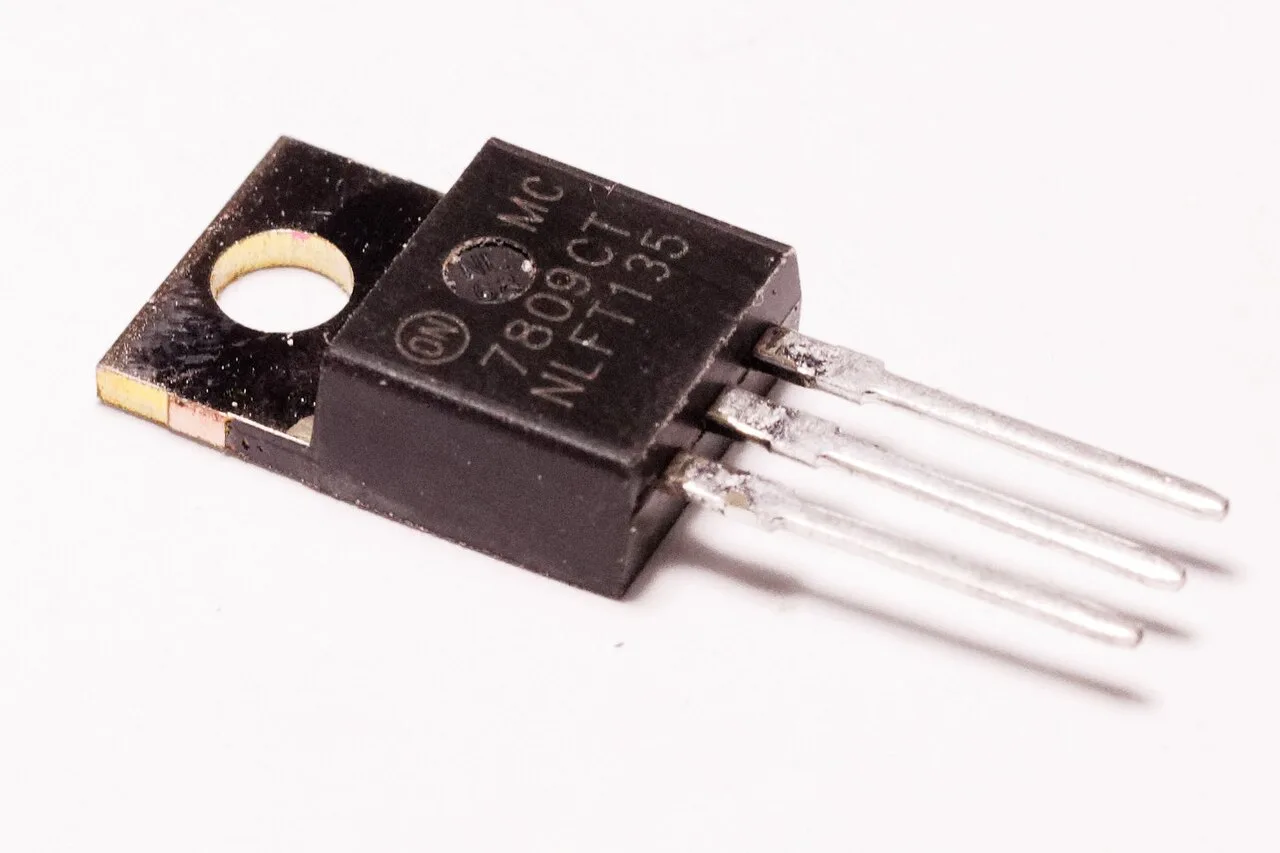
Lesson 9 · 10 cardsWikimedia Commons · Retired electrician · CC0 ↗Controlling Voltage
A regulator is the type of circuit that controls the amount of voltage from a power supply.
 FlashFeed original diagram · CC-BY-4.0
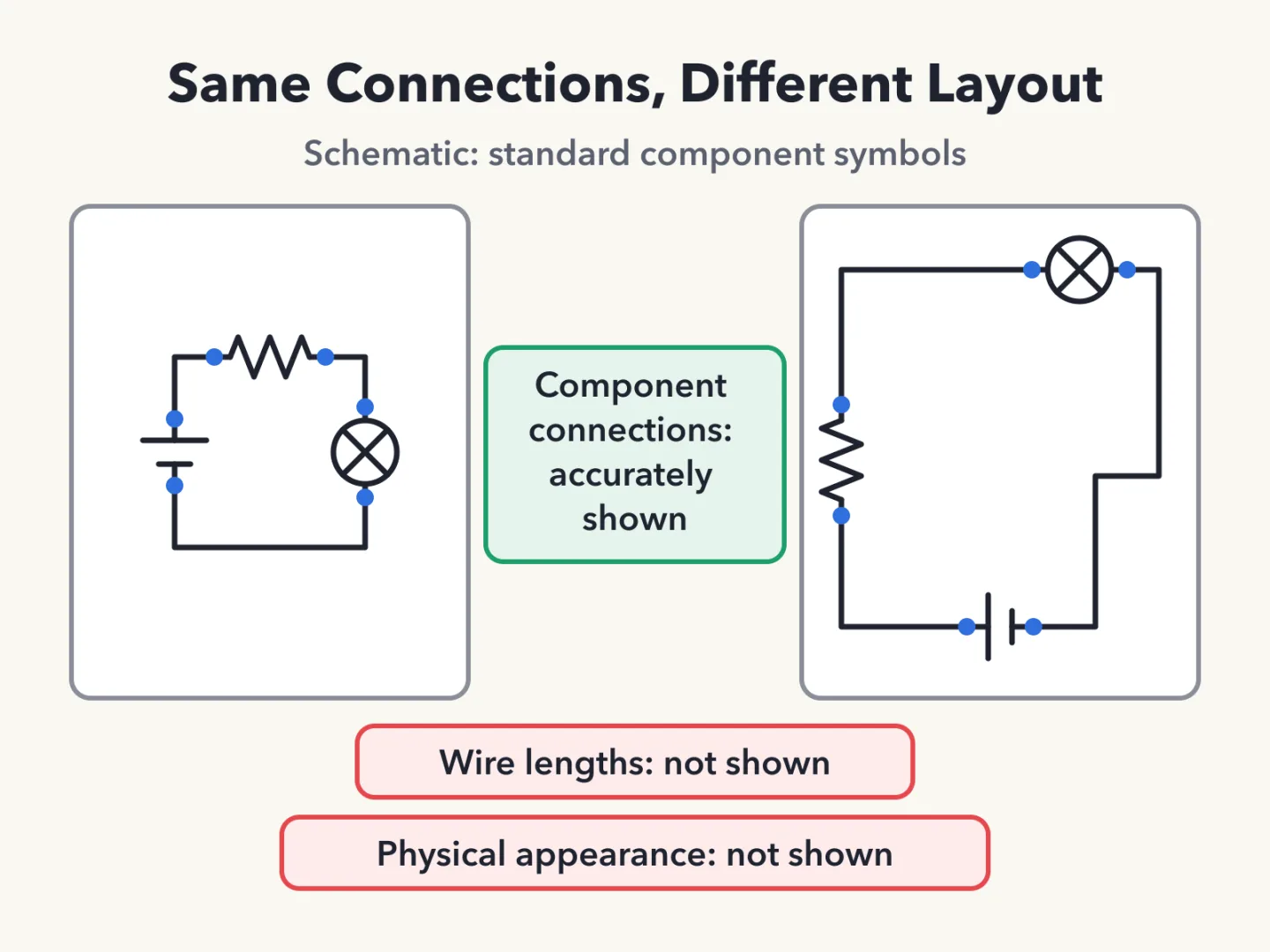
What a Schematic Is
An electrical diagram that uses standard component symbols is called a schematic. Each part is drawn with its own agreed symbol.
 FlashFeed original diagram · CC-BY-4.0
What a Schematic Shows
A schematic accurately represents the component connections. Only the connections between the symbols can be trusted.
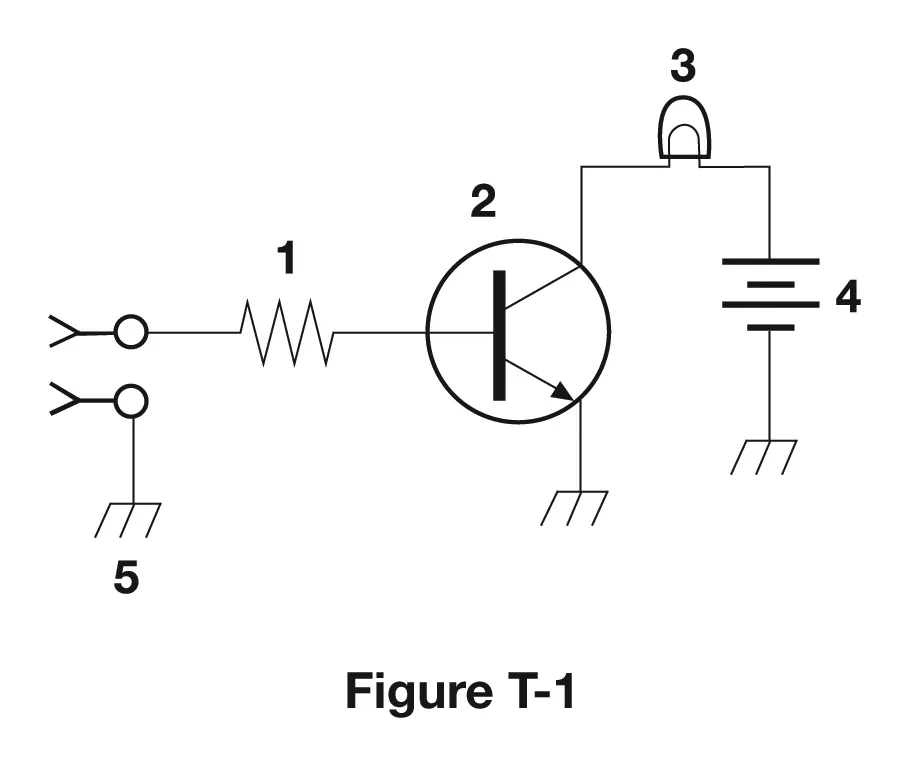 NCVEC Question Pool Committee · Public domain ↗
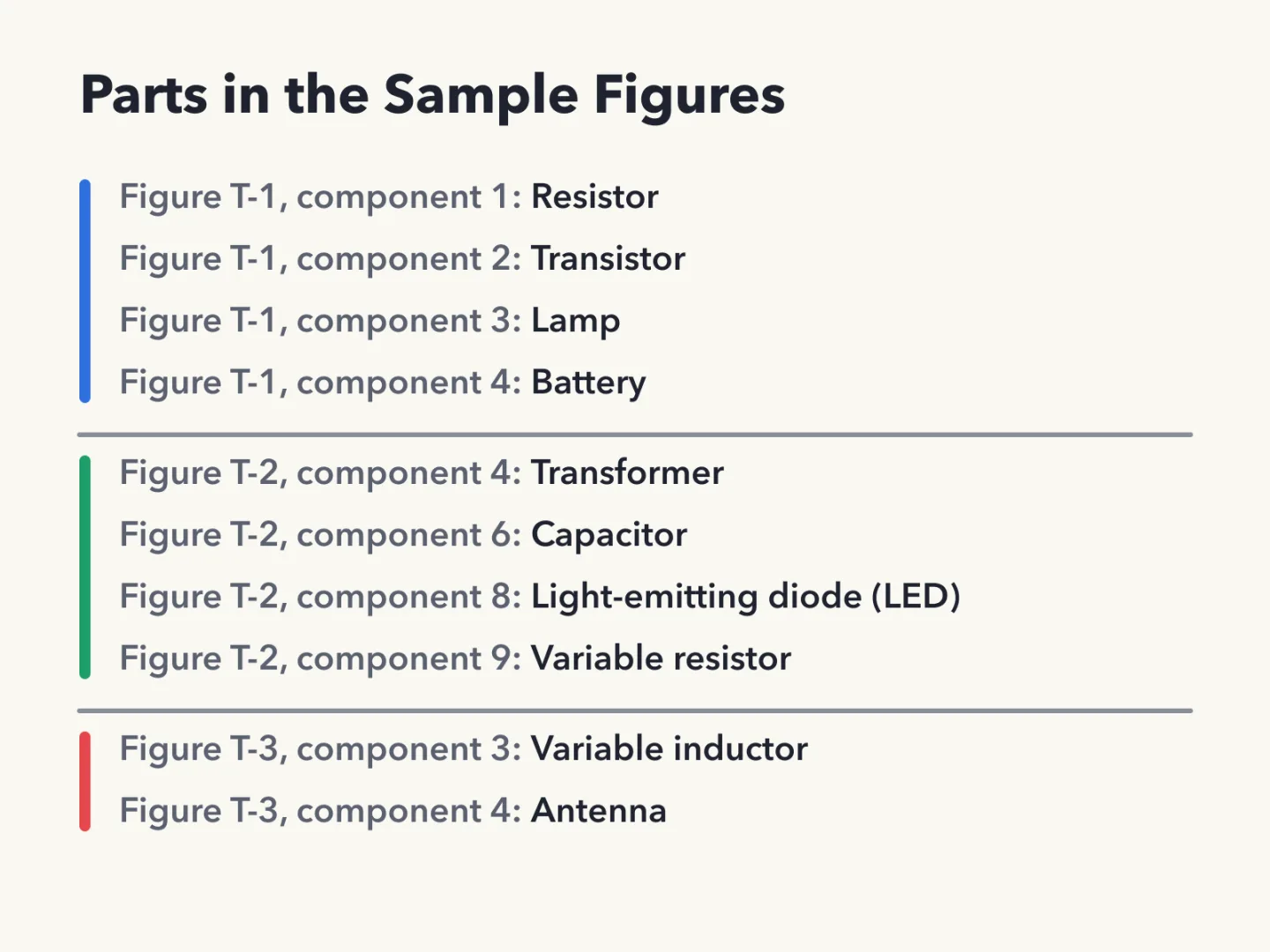
Component 1 in Figure T-1
Figure T-1 is a simple circuit whose parts are numbered. Component 1 is a resistor.
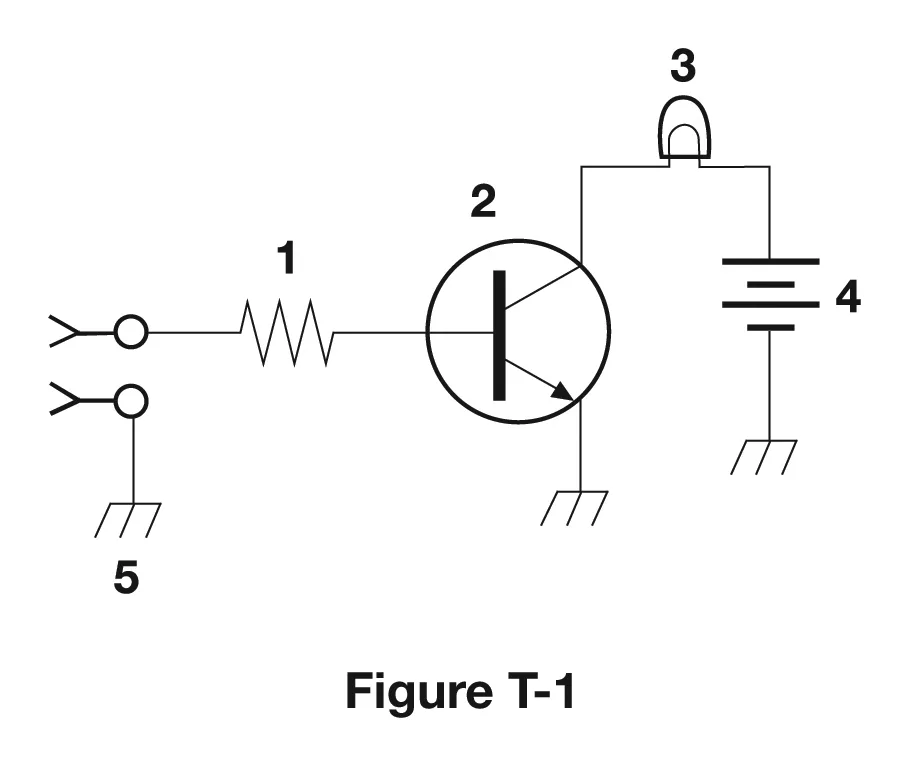 NCVEC Question Pool Committee · Public domain ↗
Component 2 in Figure T-1
In figure T-1, component 2 is a transistor. The resistor and the transistor are separate symbols with separate jobs.
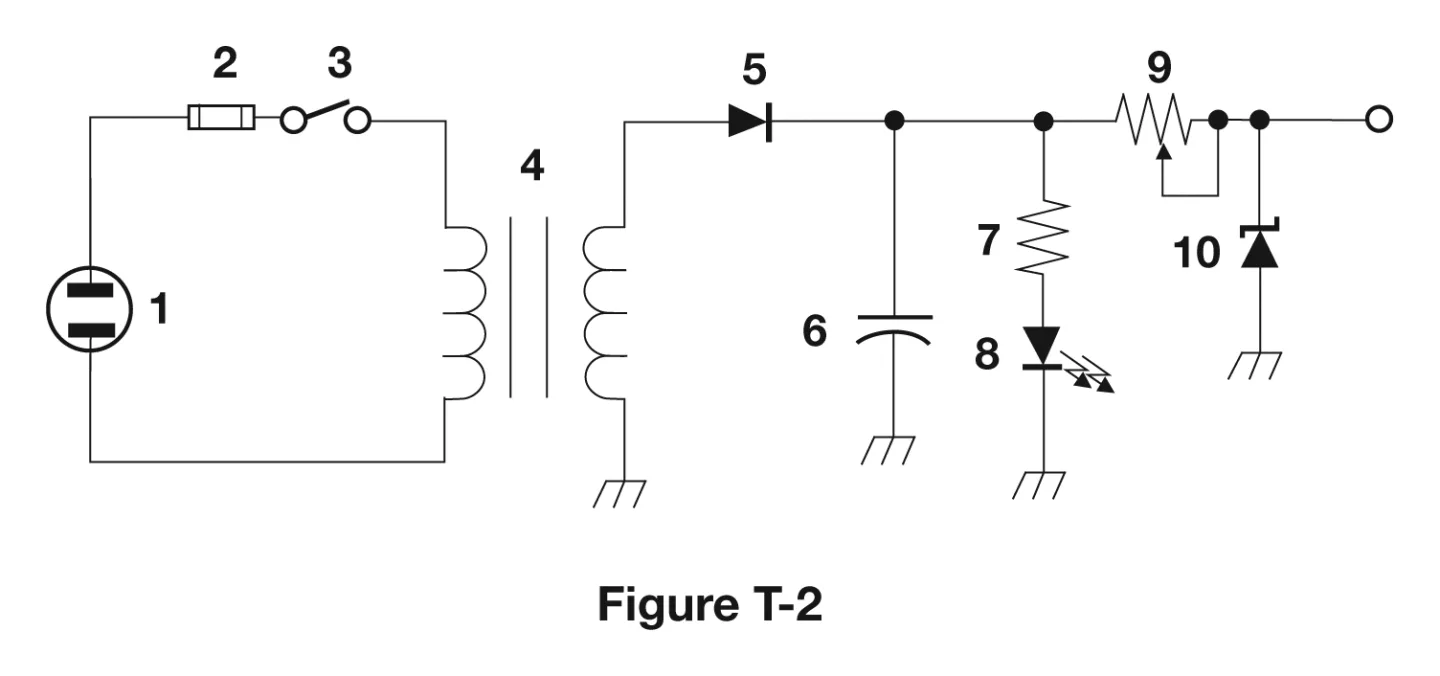 NCVEC Question Pool Committee · Public domain ↗
Component 6 in Figure T-2
Figure T-2 numbers its parts separately from figure T-1. In figure T-2, component 6 is a capacitor.
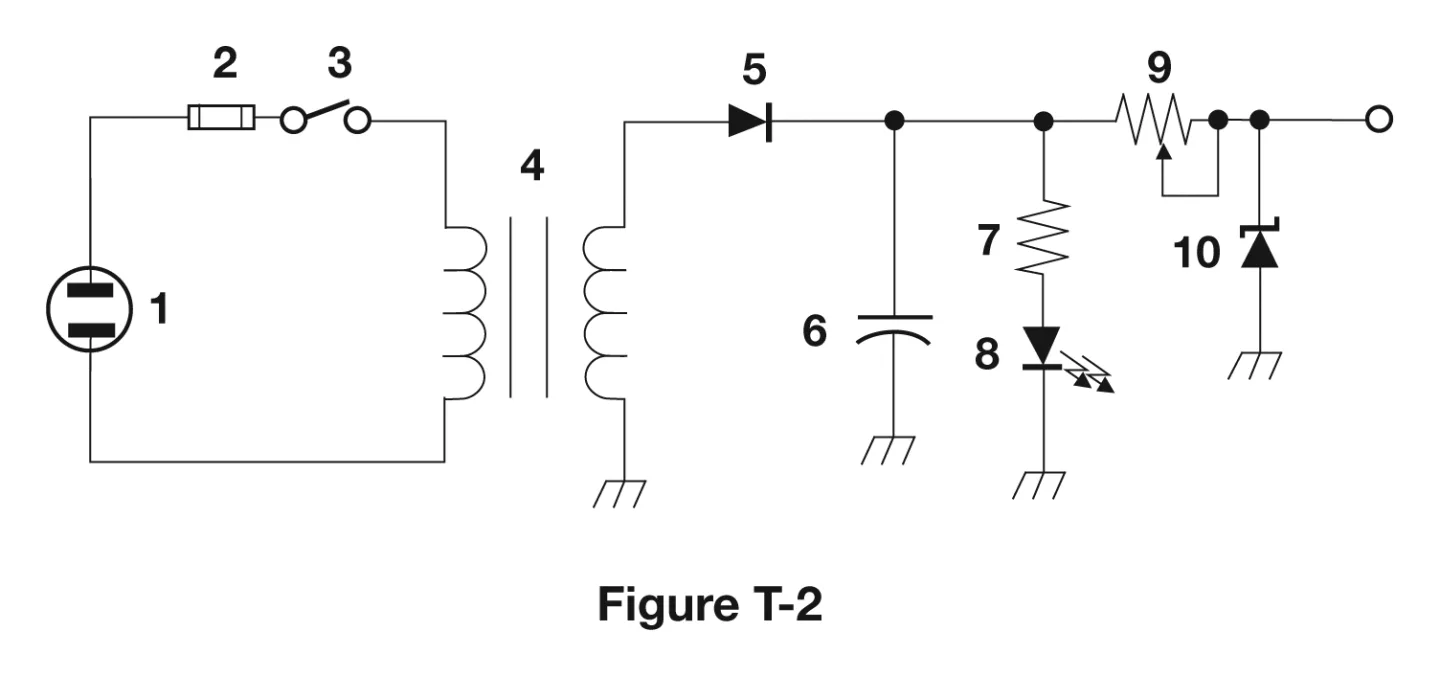 NCVEC Question Pool Committee · Public domain ↗
Component 8 in Figure T-2
In figure T-2, component 8 is a light emitting diode (LED).
 NCVEC Question Pool Committee · Public domain ↗
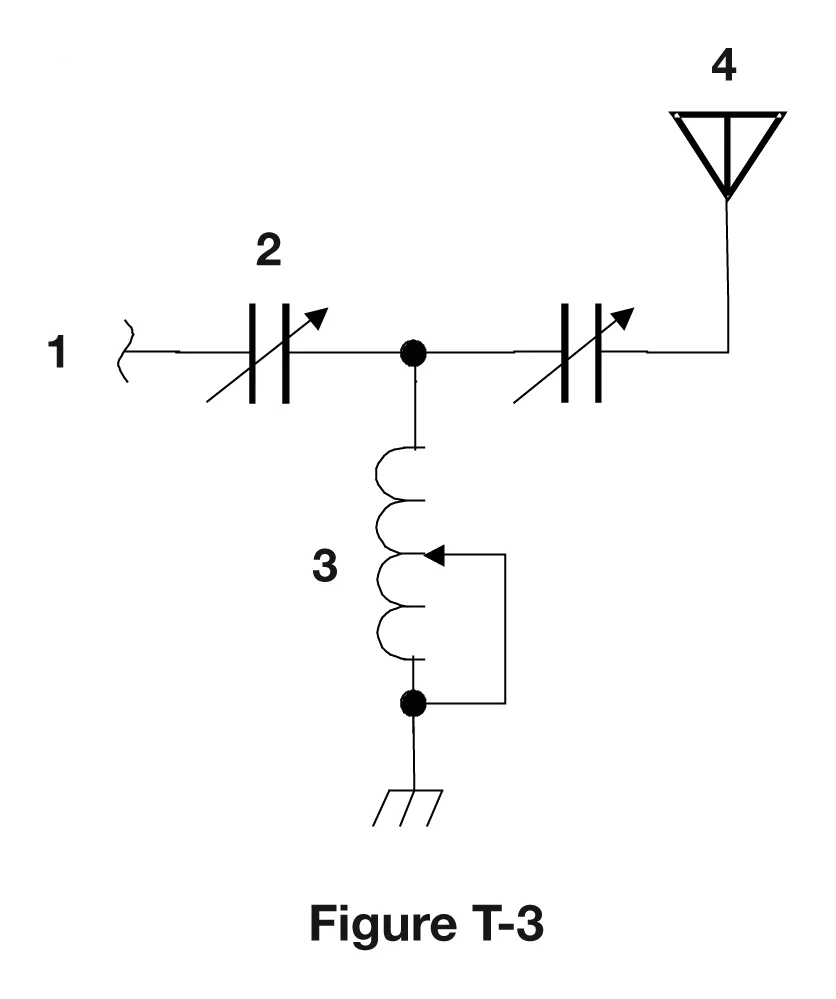
Component 4 in Figure T-3
In figure T-3, component 4 is an antenna. Component 4 is a different part in each of the three figures, so numbers only have meaning inside their own diagram.
 FlashFeed original diagram · CC-BY-4.0
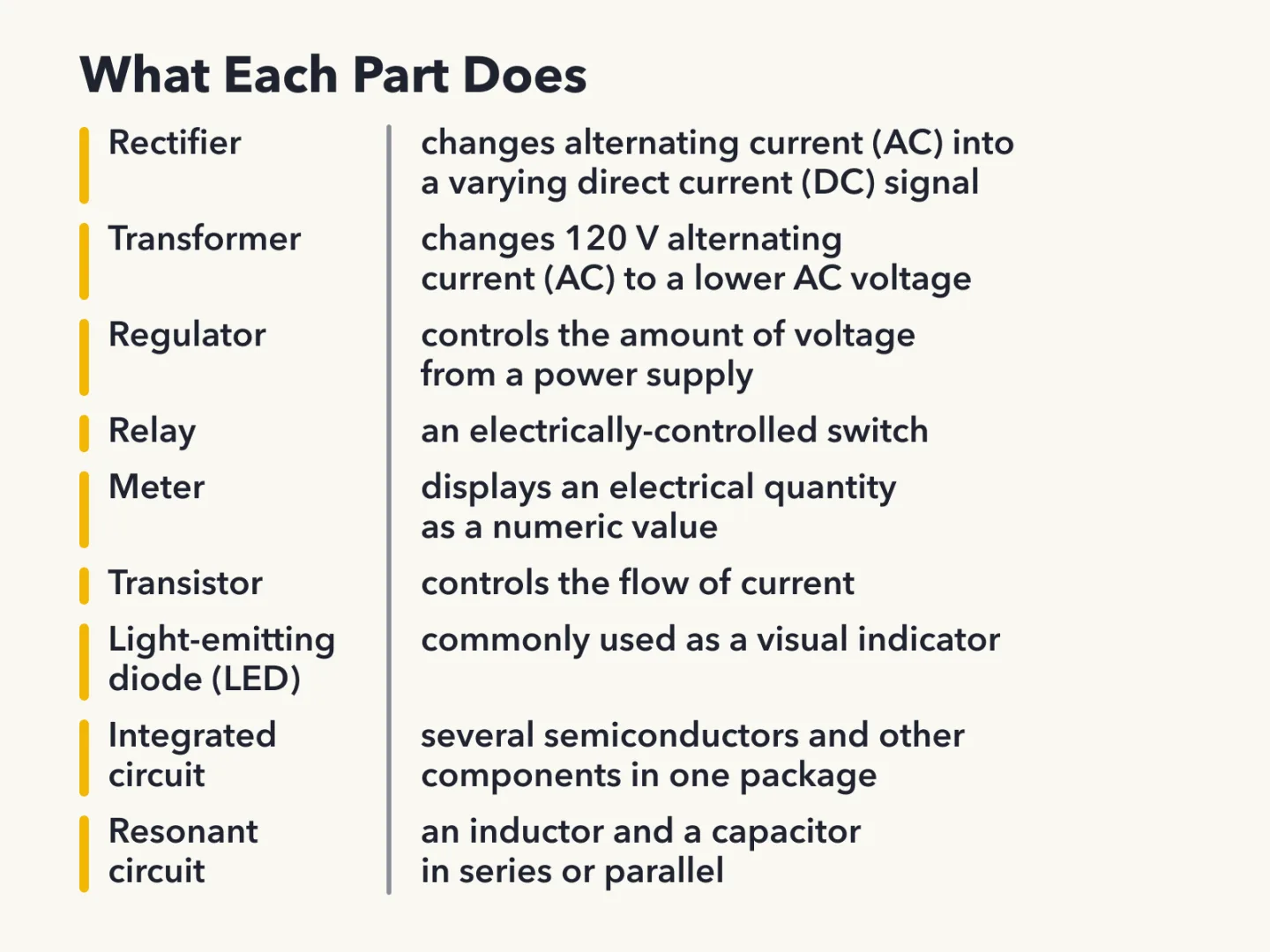
Rectifier Changes AC to DC
A rectifier changes alternating current (AC) into a varying direct current (DC) signal.
 FlashFeed original diagram · CC-BY-4.0
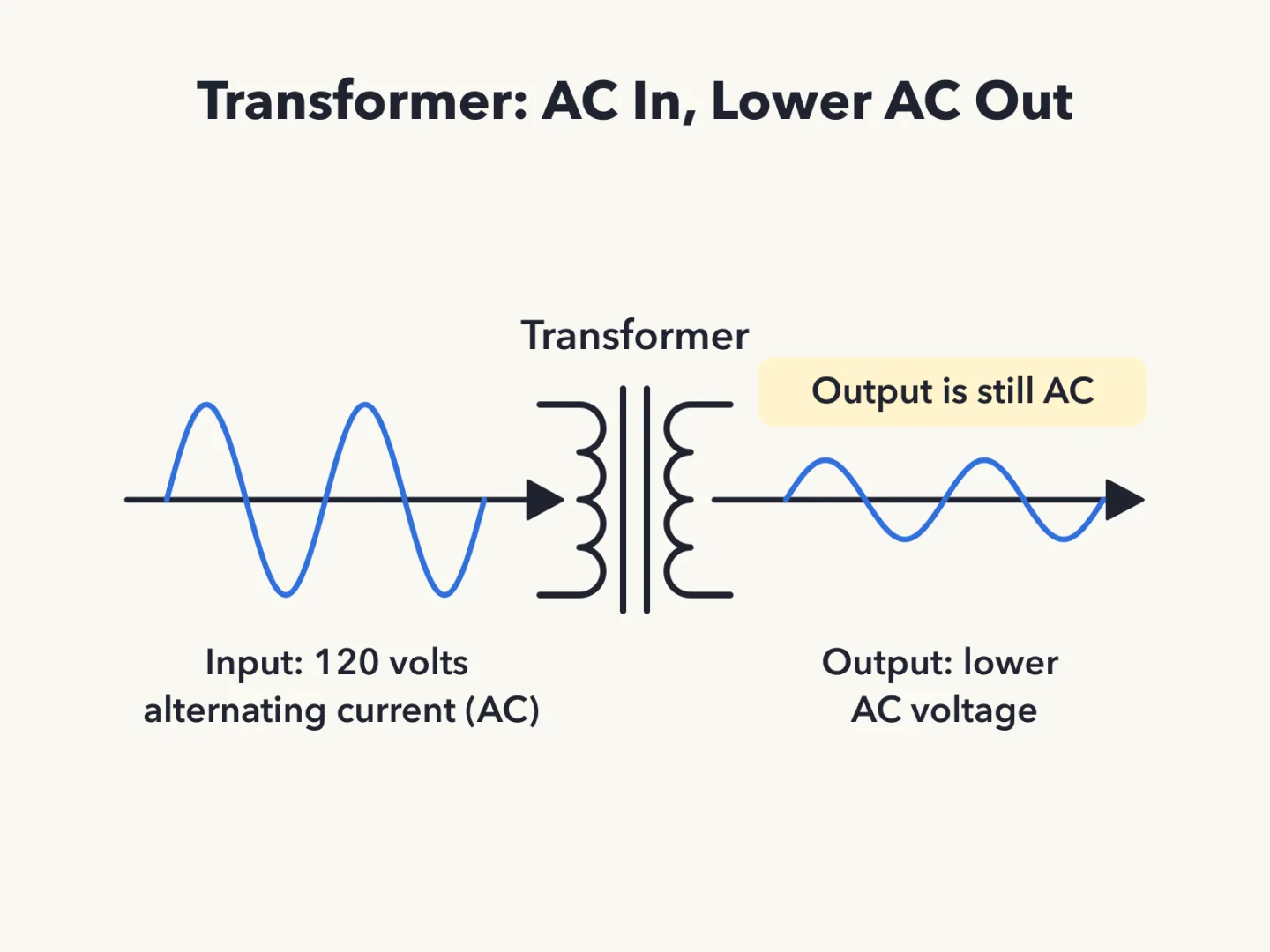
Transformer Lowers AC Voltage
A transformer changes 120 V alternating current (AC) to a lower AC voltage for other uses. The output is still AC.
1 / 10A learner studies a schematic. Which thing can be trusted on the page?
A schematic accurately shows component connections. Wire lengths and the physical appearance of parts are not accurately represented.
Lesson 9 has 69 cards. Keep going in the free app.
Question
What a Schematic Leaves Out 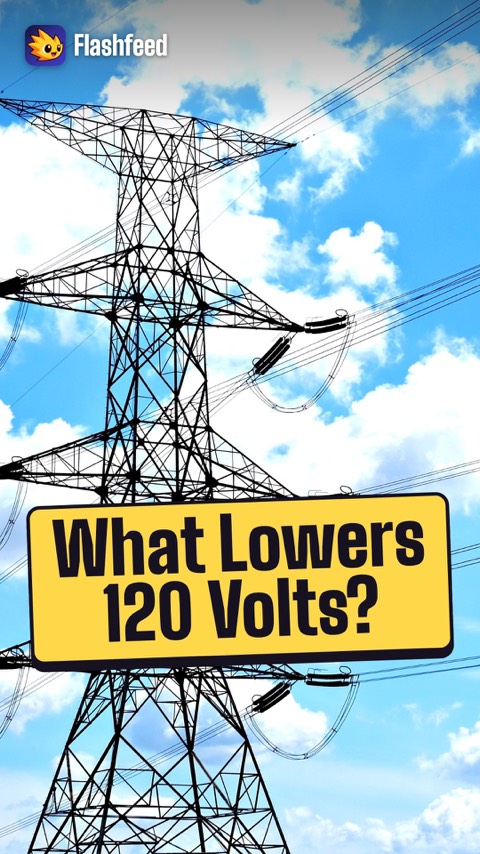
Lowering 120 Volts in a Power Supply All 4 clips on YouTube ↗Transcripts
What a Schematic Leaves Out
A circuit diagram can draw a big part as a small symbol, and a long wire as a short line.
A schematic accurately represents the component connections. It shows which part is joined to which.
That is the information a circuit diagram exists to give.
So trust the connections between the symbols, not the sizes or lengths on the page.
Lowering 120 Volts in a Power Supply
Which part takes 120 volts of alternating current and lowers its voltage?
A transformer does that. It keeps the current alternating but lowers the voltage.
A rectifier is the device or circuit that changes alternating current into a varying direct current.
A regulator controls the amount of voltage from a power supply. A small supply can use all three parts.
Episode 96:39
How do you read a schematic, and what do the common circuit symbols mean?
-
 Wikimedia Commons · Hp.Baumeler · CC BY-SA 4.0 ↗10
Practical Circuits: Radios and Their Common Problems
Station equipment and receiver concepts · Transmitter and receiver problems
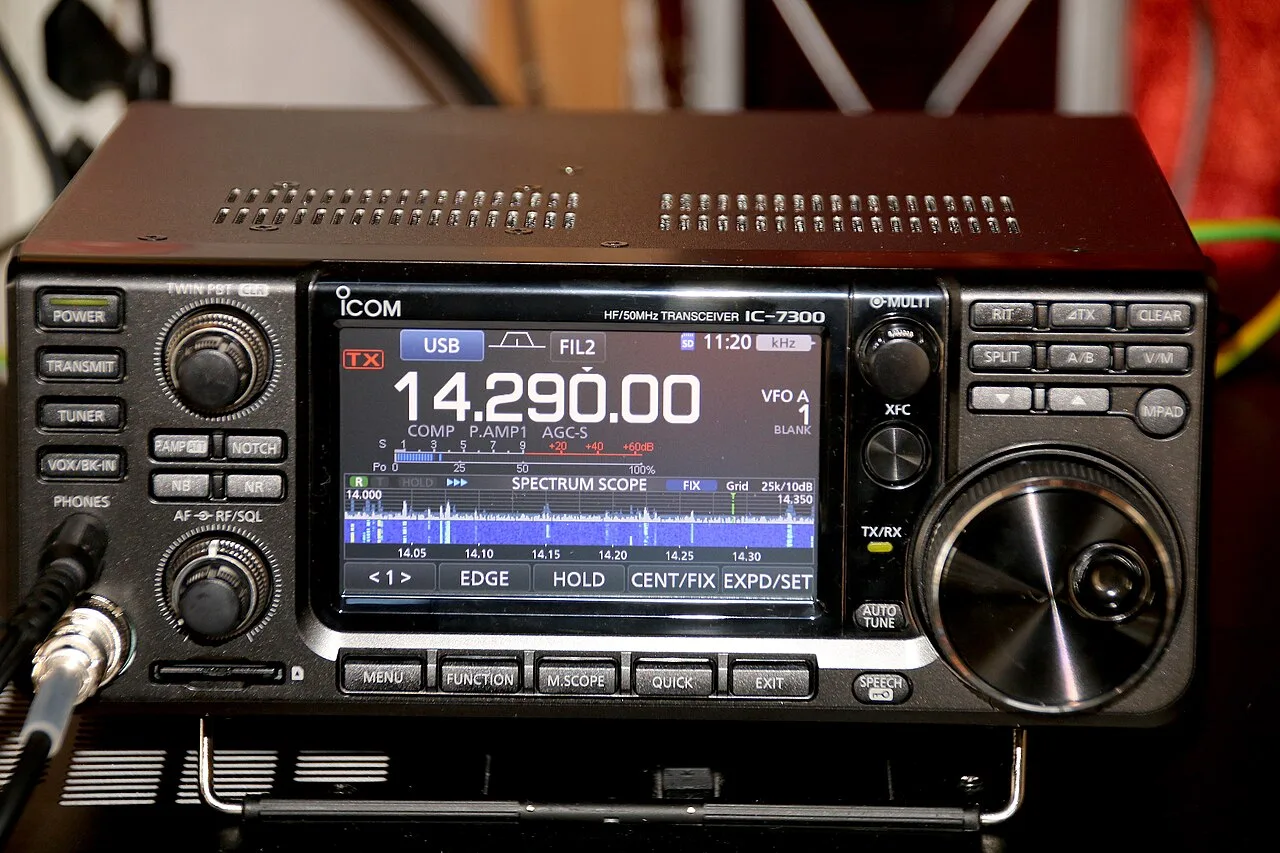
Lesson 10 · 10 cardsWikimedia Commons · Hp.Baumeler · CC BY-SA 4.0 ↗Receiver Plus Transmitter
A transceiver is one device that combines a receiver and a transmitter.
 FlashFeed original diagram · CC-BY-4.0
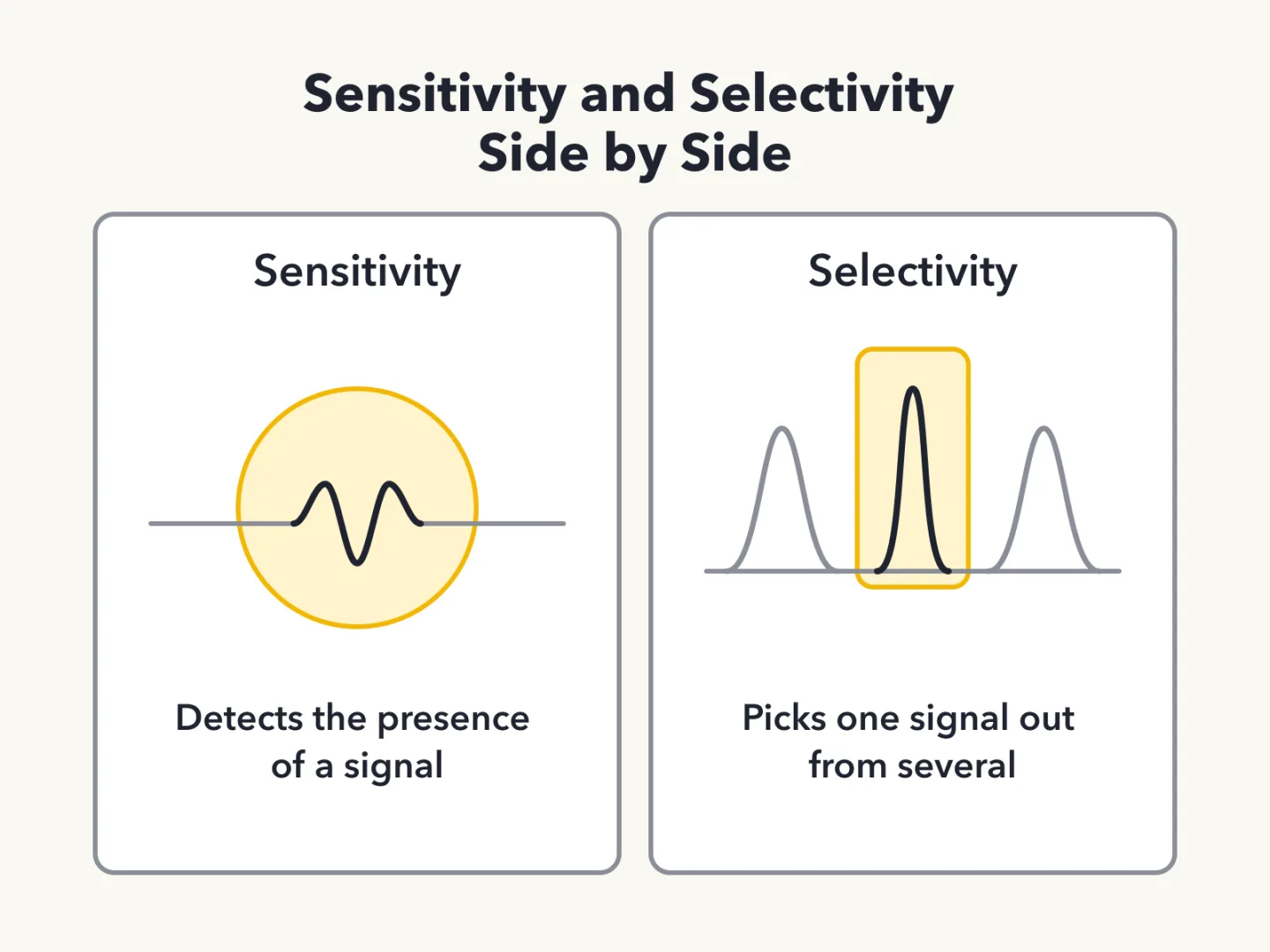
Sensitivity: Detecting a Signal
Sensitivity is the ability of a receiver to detect the presence of a signal.
 FlashFeed original diagram · CC-BY-4.0
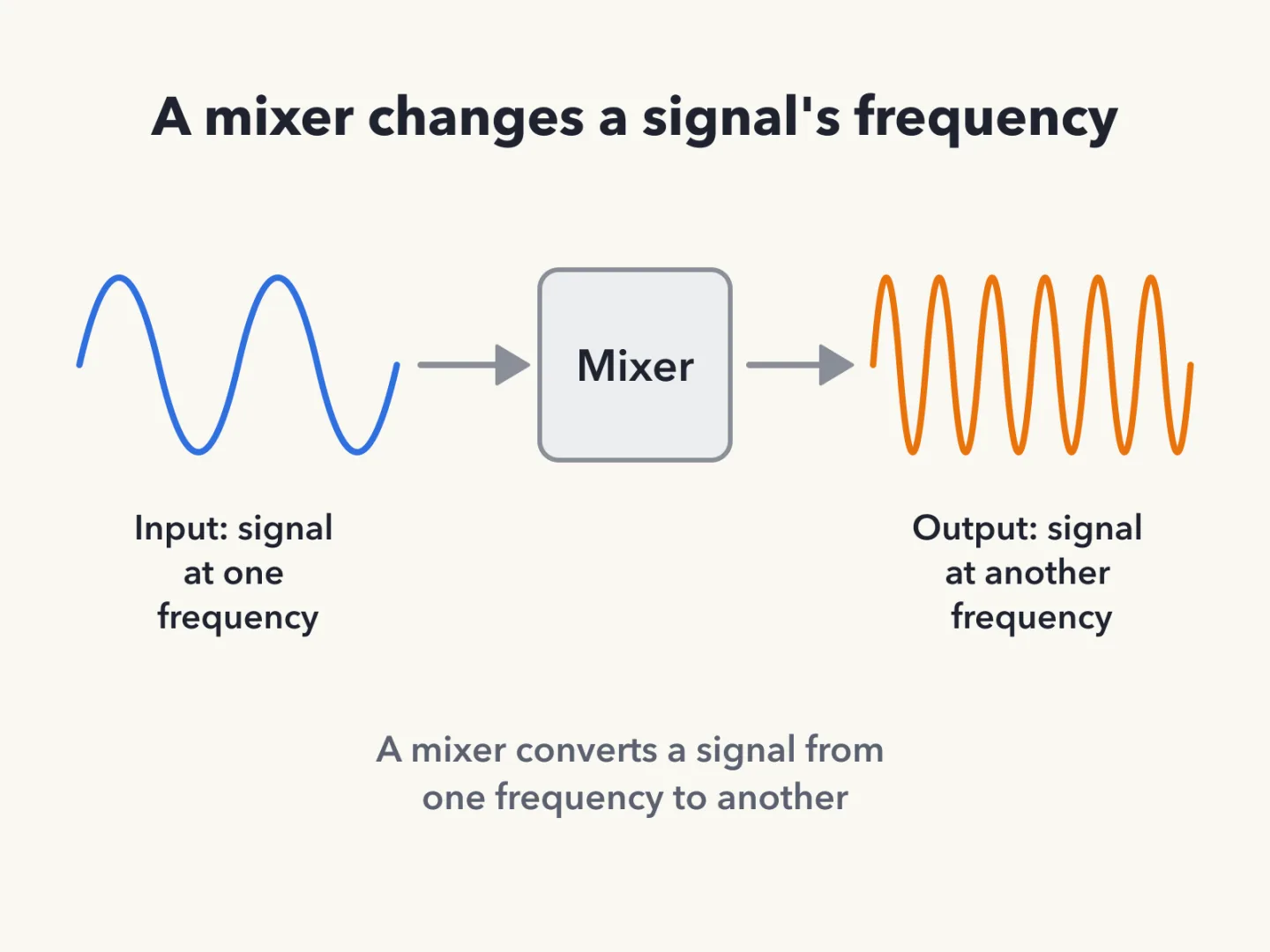
The Mixer Changes Frequency
A mixer converts a signal from one frequency to another.
 FlashFeed original diagram · CC-BY-4.0
What the VFO Does
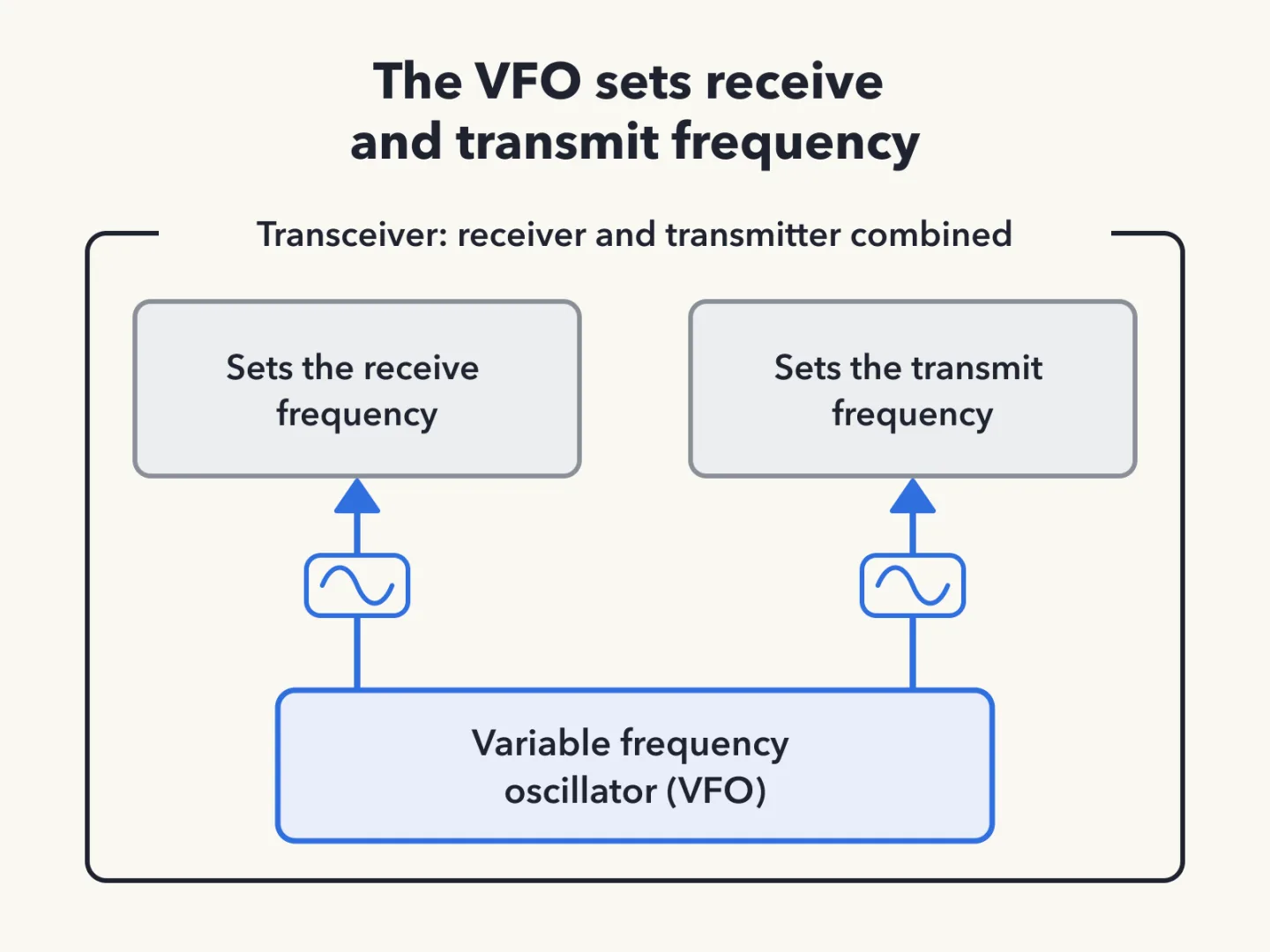
The variable frequency oscillator (VFO) in a transceiver sets the receive and transmit frequency.
 FlashFeed original diagram · CC-BY-4.0
Modulation Puts Speech on a Carrier
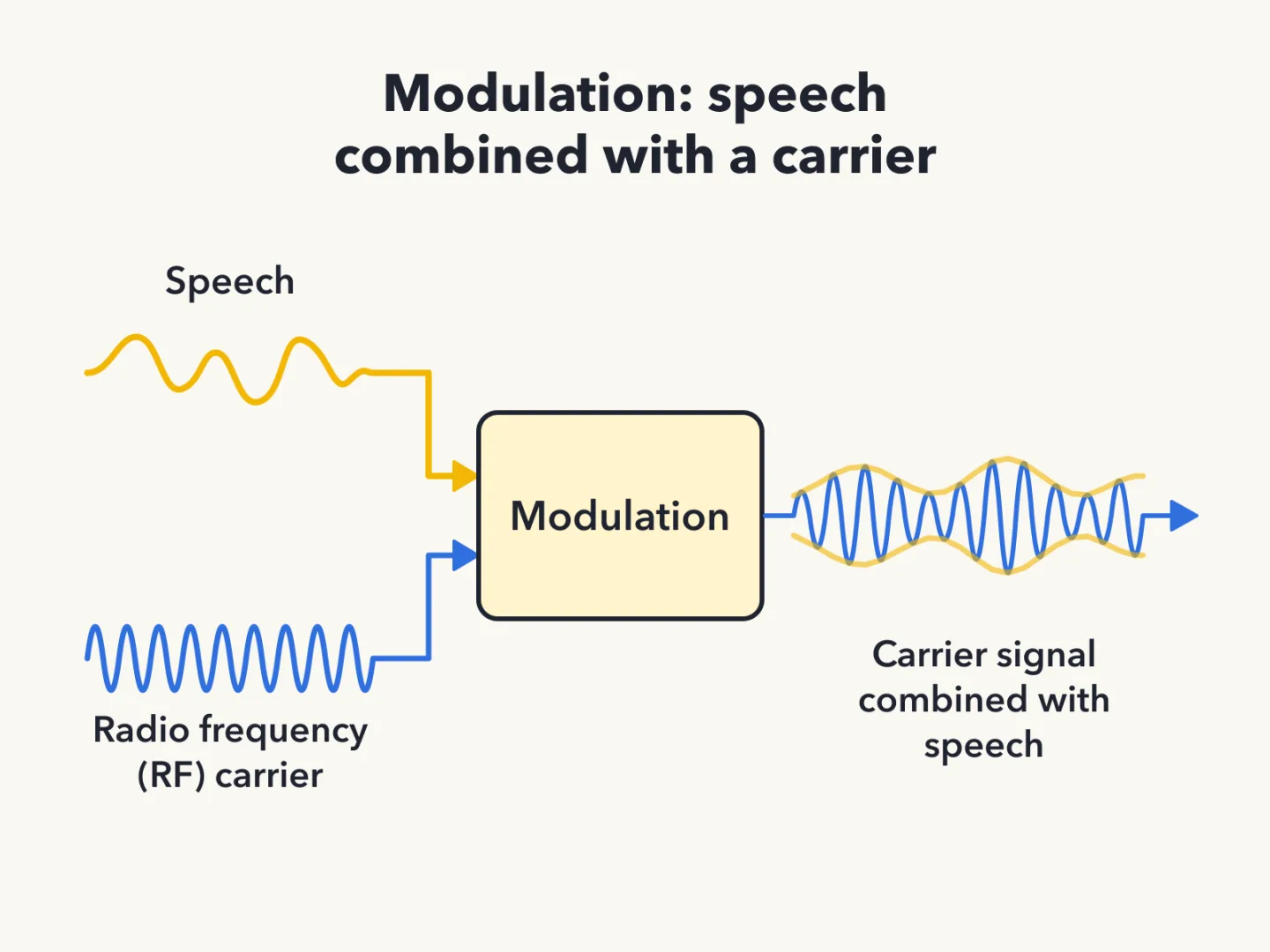
Modulation is combining speech with a radio frequency (RF) carrier signal.
Wikimedia Commons · Hp.Baumeler · CC BY-SA 4.0 ↗A Transceiver Is Two Radios in One
A transceiver is a device that combines a receiver and a transmitter.
 FlashFeed original diagram · CC-BY-4.0
A Transverter Shifts Bands
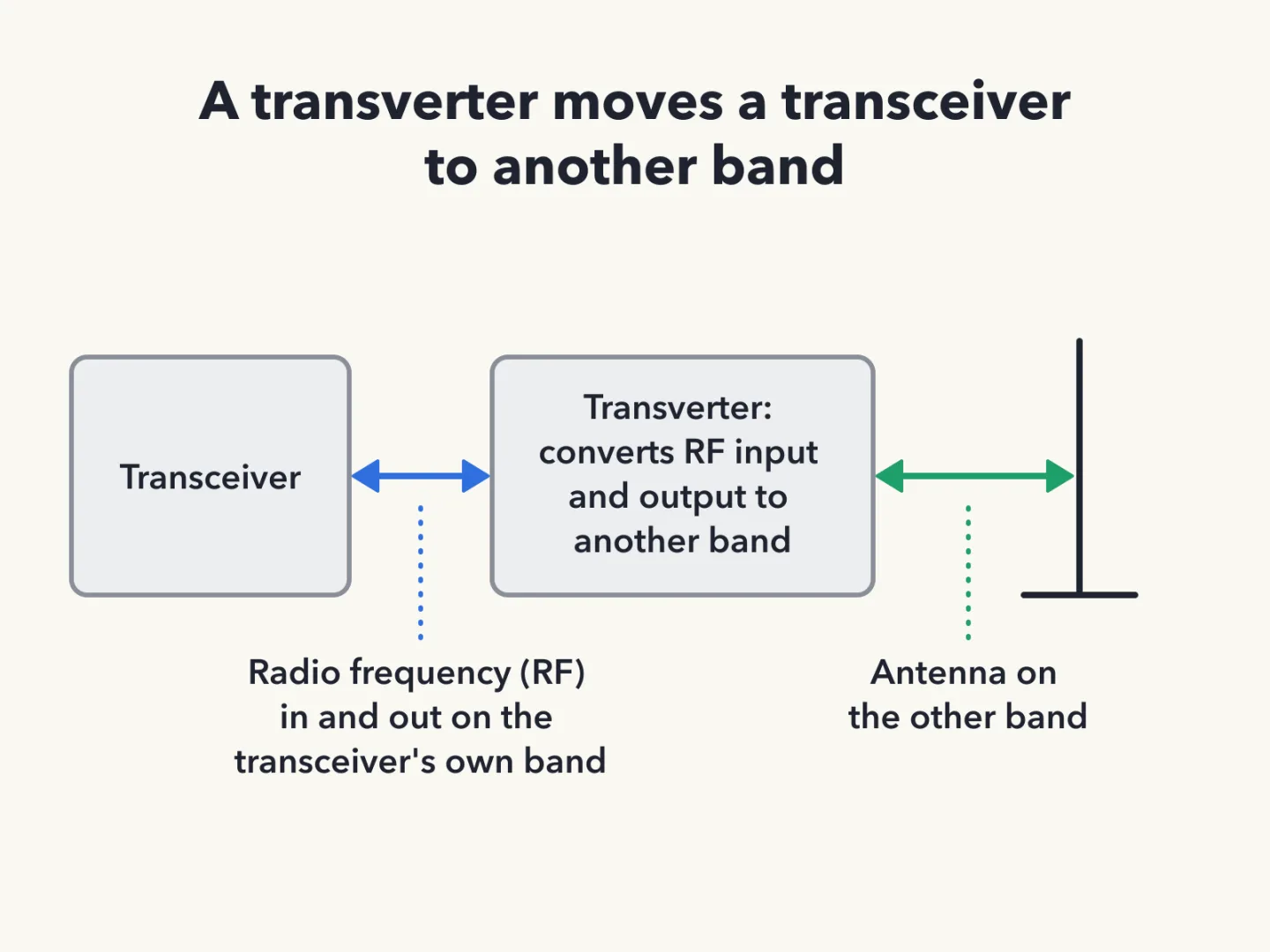
A transverter is the device that converts the radio frequency (RF) input and output of a transceiver to another band. That is how a transceiver can work on a band it does not cover itself.
 FlashFeed original diagram · CC-BY-4.0
The PTT Input Switches to Transmit
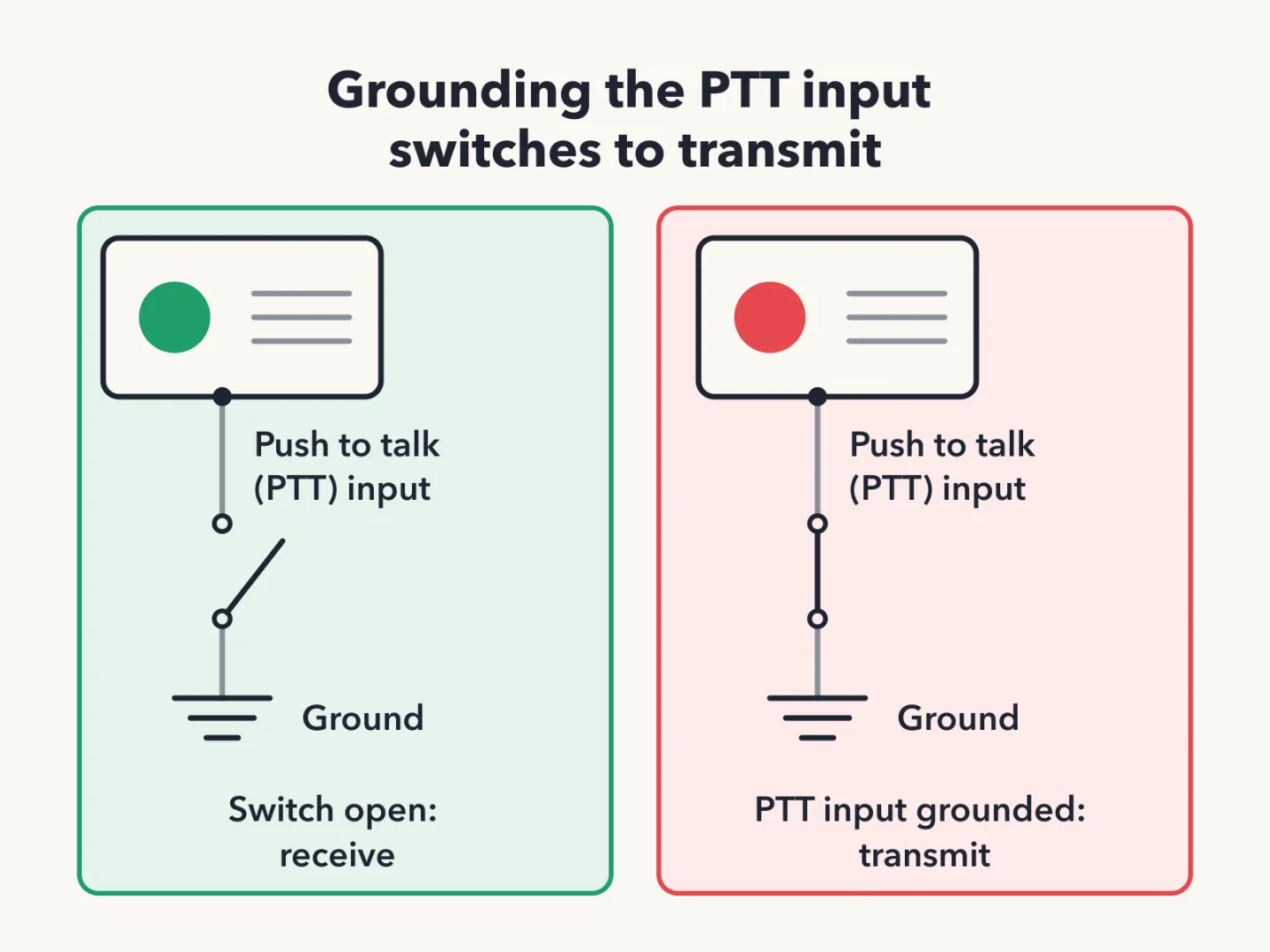
A transceiver's push to talk (PTT) input switches the transceiver from receive to transmit when it is grounded.
1 / 10Which circuit creates a signal at one chosen frequency inside a radio?
An oscillator generates a signal at a specific frequency. A mixer only converts a signal from one frequency to another.
Lesson 10 has 69 cards. Keep going in the free app.
Question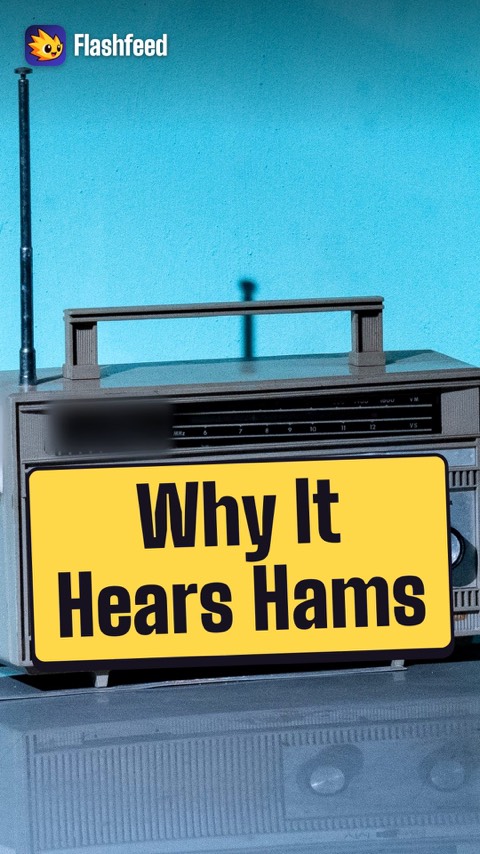
Why a Broadcast Radio Picks Up a Ham 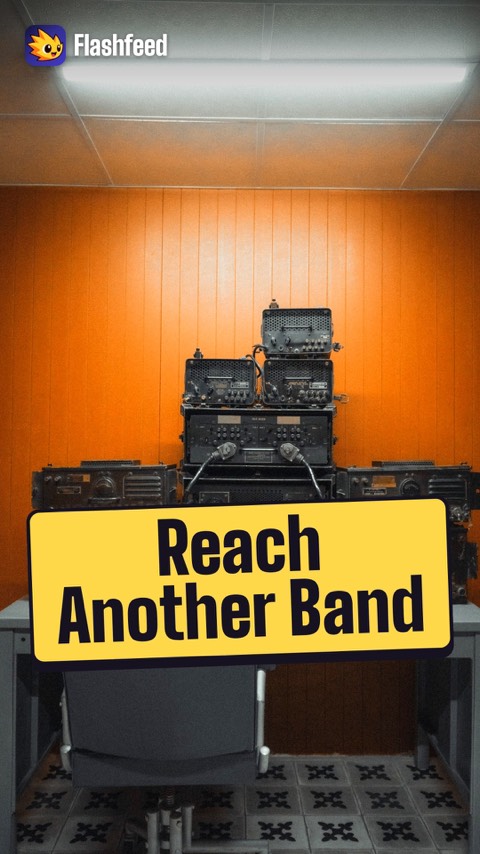
How a Transceiver Reaches Another Band All 4 clips on YouTube ↗Transcripts
Why a Broadcast Radio Picks Up a Ham
Imagine an amateur station is on the air, and a broadcast radio picks up its signal. Nobody meant it to happen.
The receiver is the weak point here. It is unable to reject strong signals outside its broadcast band.
Radio frequency interference can also come from fundamental overload, harmonics and spurious emissions.
A filter at the antenna input of the affected receiver can help block the amateur signal.
How a Transceiver Reaches Another Band
A transceiver covers certain bands on its own. Could it work a band it does not cover?
The device is a transverter. It converts the radio frequency input and output of a transceiver to another band.
A transceiver is a device that combines a receiver and a transmitter.
That is how a transceiver can work a band it does not cover itself.
Episode 106:46
What does a transceiver do, and how do you fix interference and distorted audio?
-
 Wikimedia Commons · Karl-Martin Skontorp from Norway · CC BY 2.0 ↗11
Practical Circuits: Measuring and Testing
Measuring and troubleshooting antennas and lines · Test meters and soldering
Lesson 11 · 10 cardsWikimedia Commons · Karl-Martin Skontorp from Norway · CC BY 2.0 ↗A Resistor on a Heat Sink
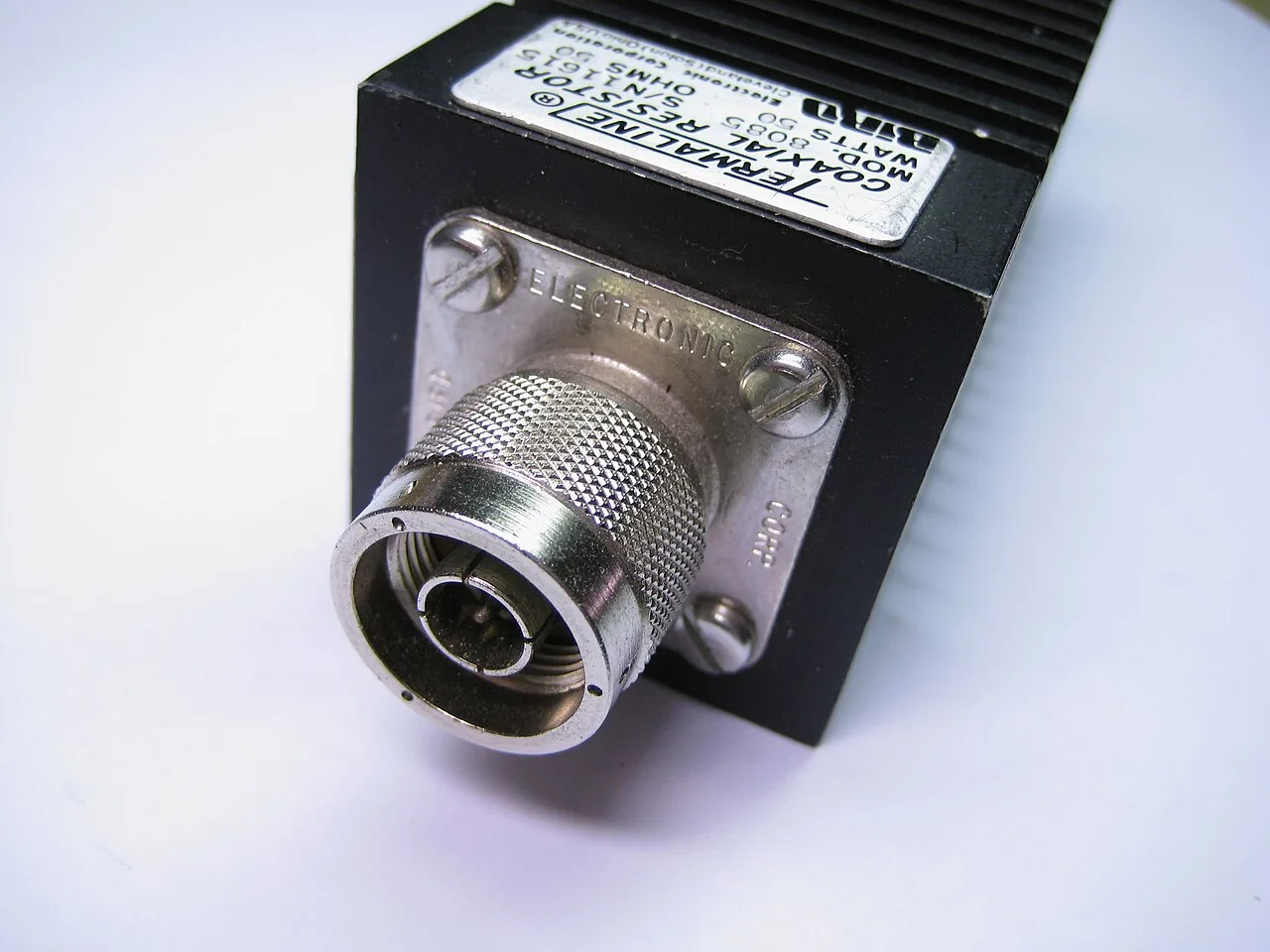
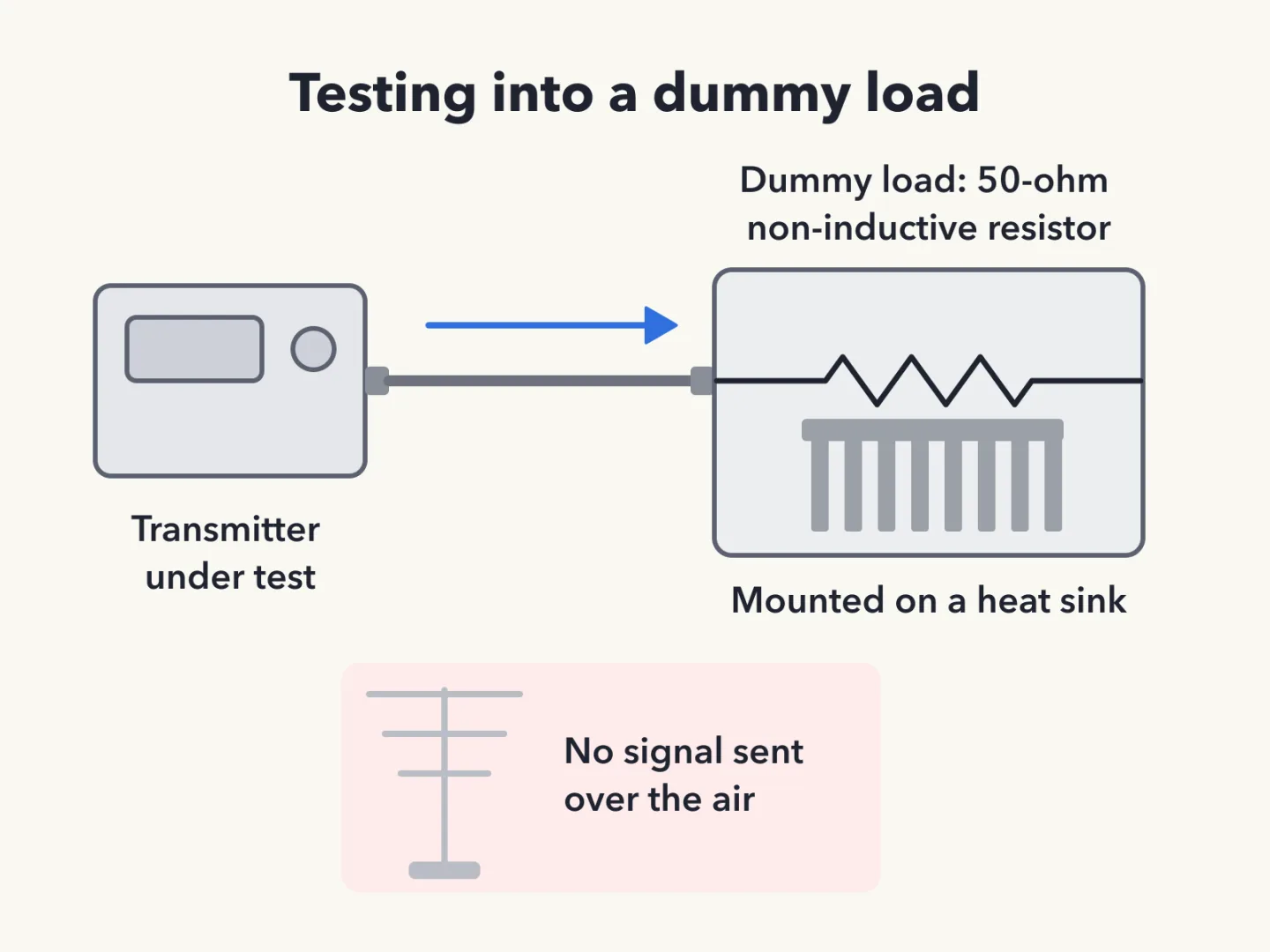
A typical radio frequency (RF) dummy load is a 50-ohm non-inductive resistor mounted on a heat sink.
 FlashFeed original diagram · CC-BY-4.0
Why Use a Dummy Load
A dummy load lets a transmitter be tested without putting a signal on the air. Its primary purpose is to prevent transmitting signals over the air when making tests.
 Wikimedia Commons · しまでん · CC BY-SA 3.0 ↗
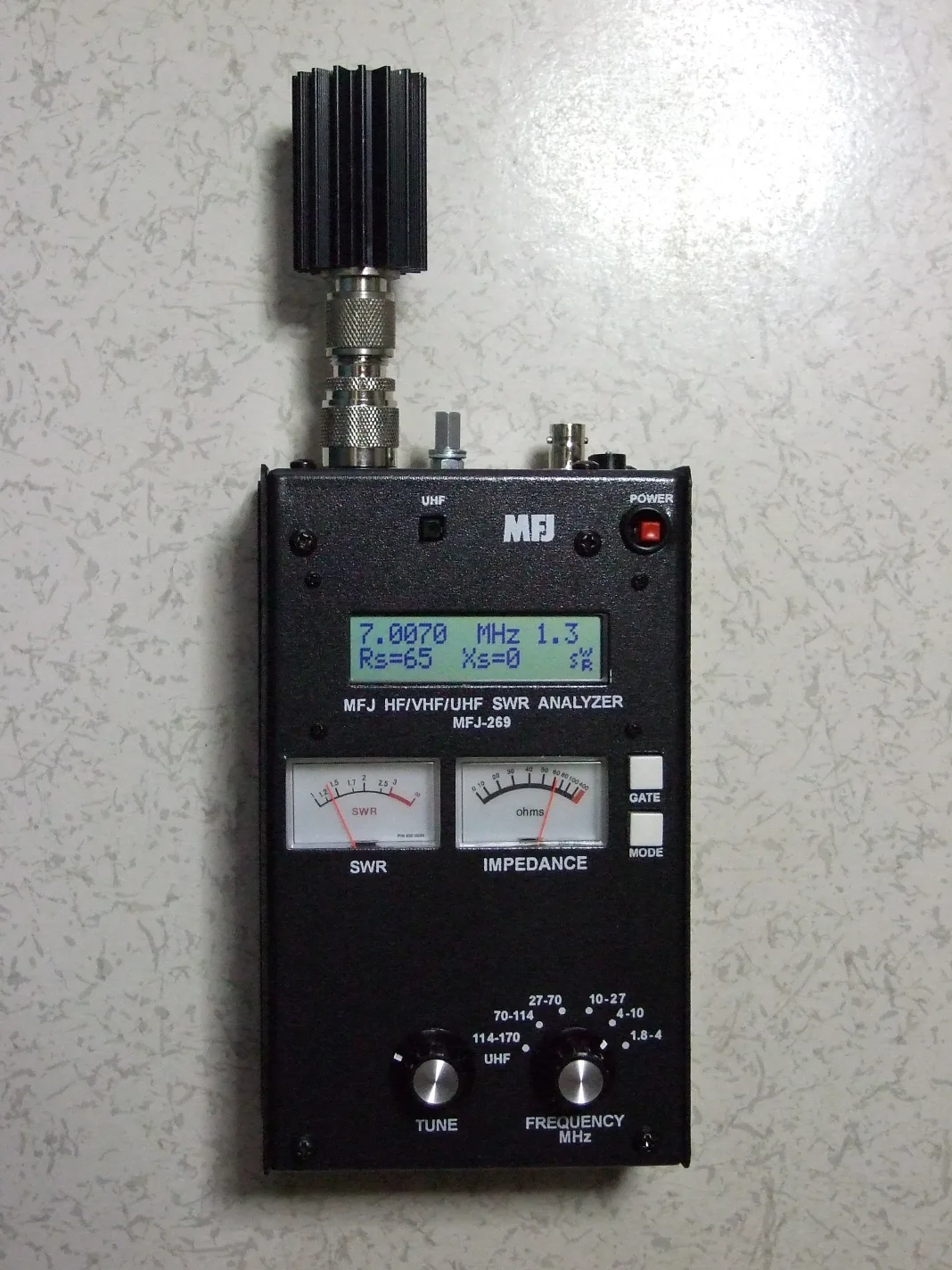
Checking Antenna Resonance
An antenna analyzer is the instrument used to determine whether an antenna is resonant at the desired operating frequency.
Wikimedia Commons · Karl-Martin Skontorp from Norway · CC BY 2.0 ↗What a Dummy Load Is Made Of
A typical radio frequency (RF) dummy load consists of a 50-ohm non-inductive resistor mounted on a heat sink.
 FlashFeed original diagram · CC-BY-4.0
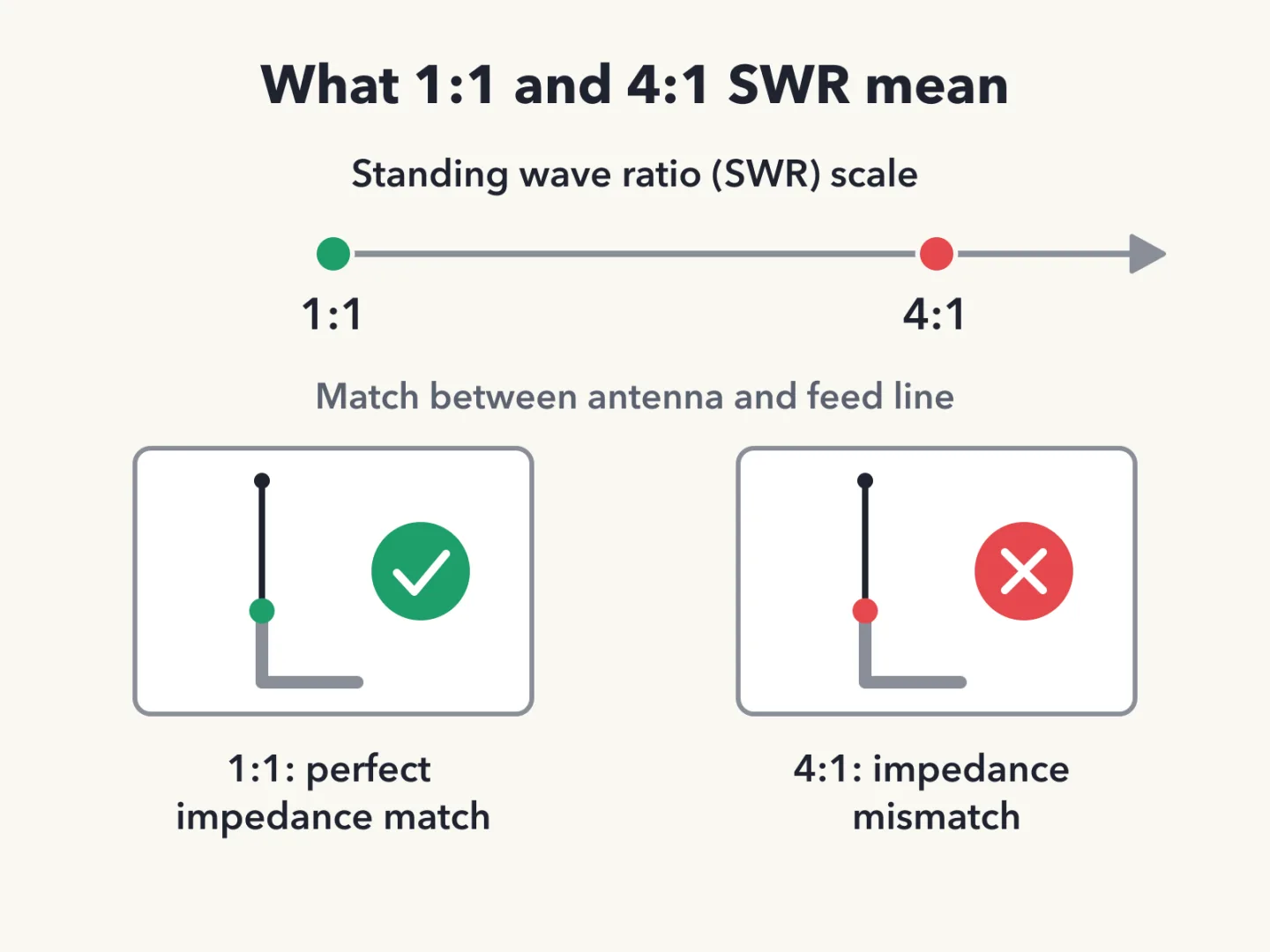
SWR of 1:1 Means a Match
The standing wave ratio (SWR) is read on an SWR meter as a ratio. A reading of 1:1 indicates a perfect impedance match between the antenna and the feed line.
 FlashFeed original diagram · CC-BY-4.0
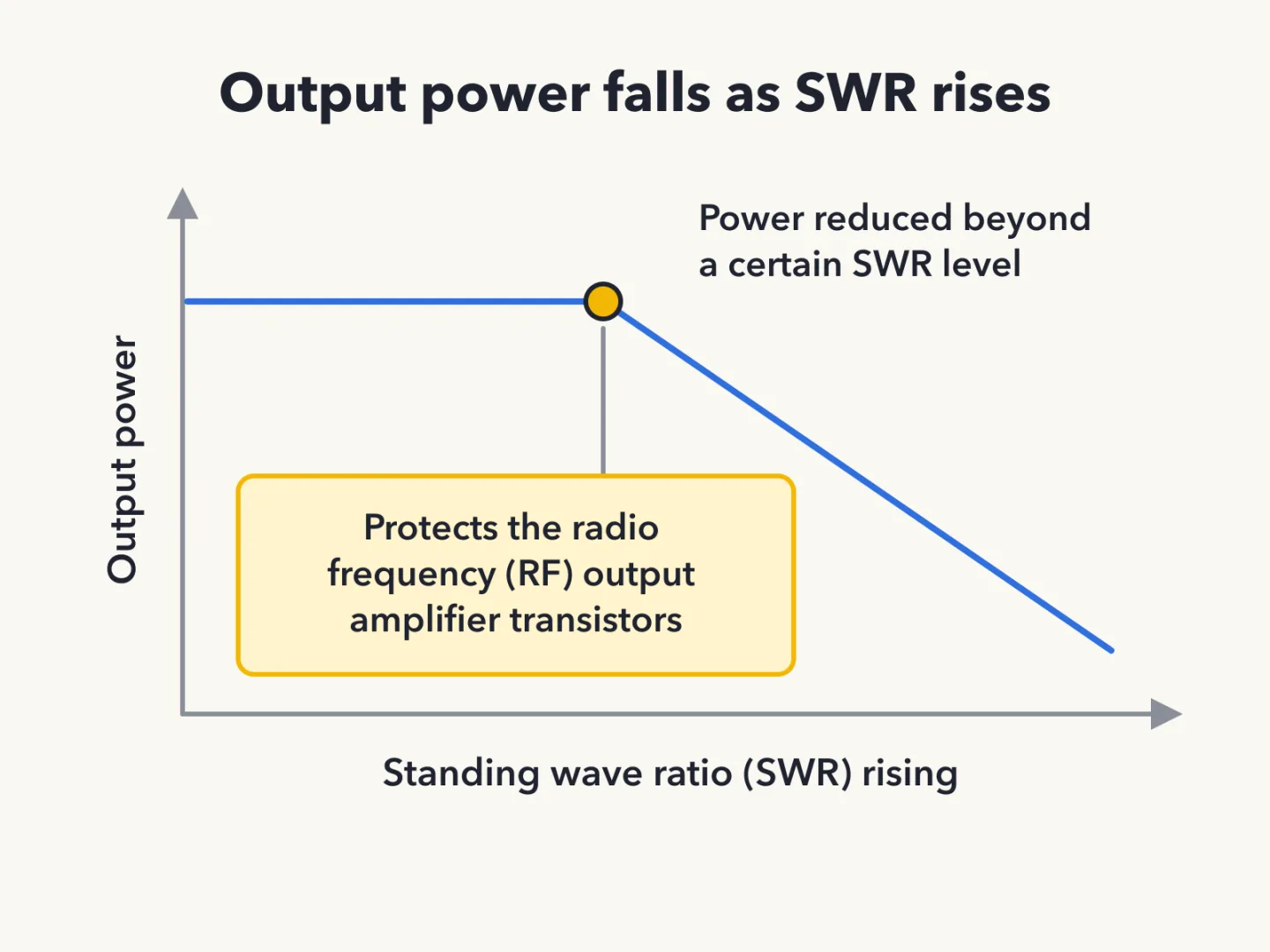
Why Transmitters Cut Power
Most solid-state transmitters reduce output power as standing wave ratio (SWR) increases beyond a certain level. The reduction protects the radio frequency (RF) output amplifier transistors.
 Wikimedia Commons · Theonlysilentbob at English Wikipedia · CC BY-SA 3.0 ↗
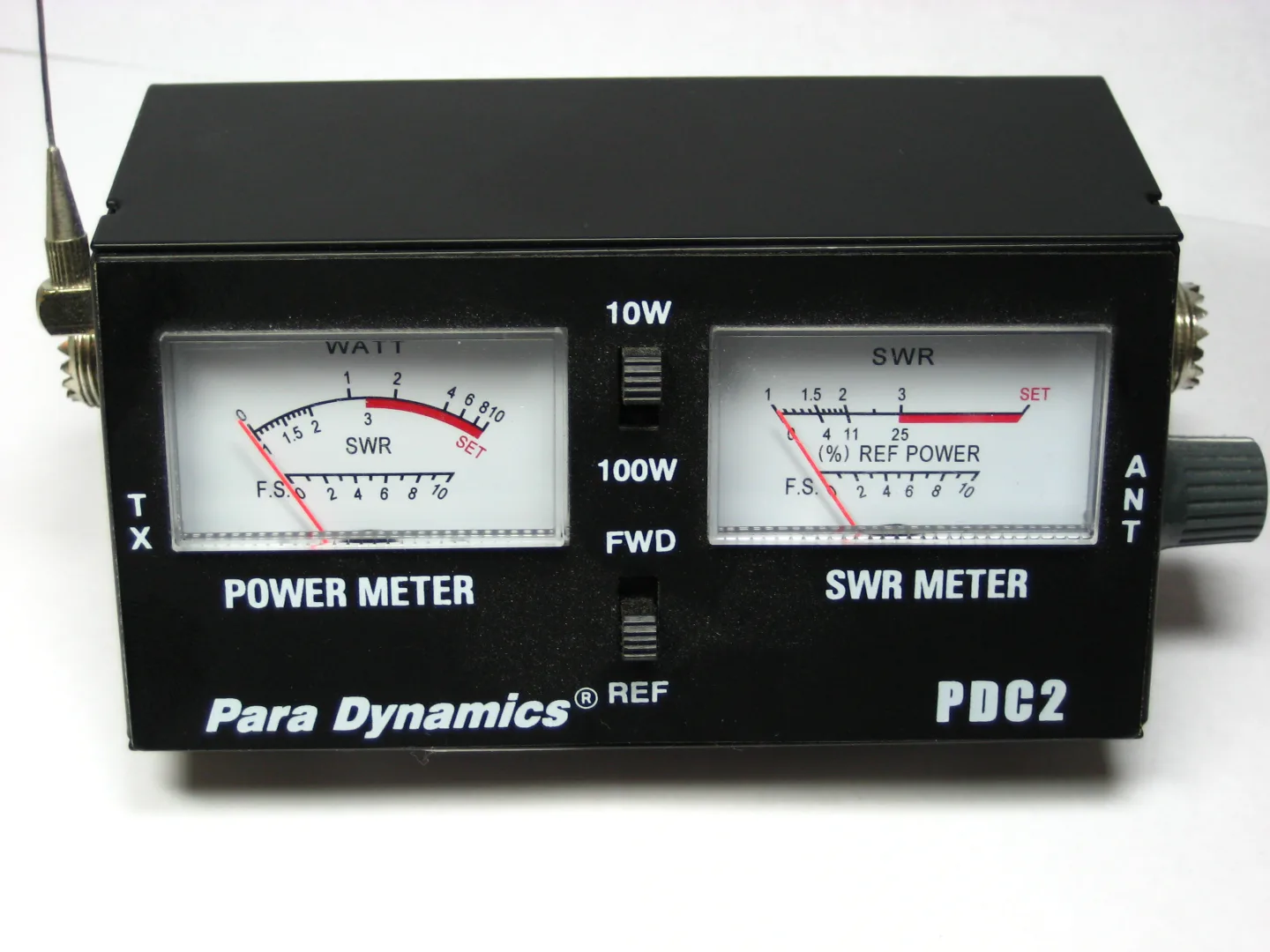
Instrument That Finds SWR
A directional wattmeter can be used to determine standing wave ratio (SWR).
 FlashFeed original diagram · CC-BY-4.0
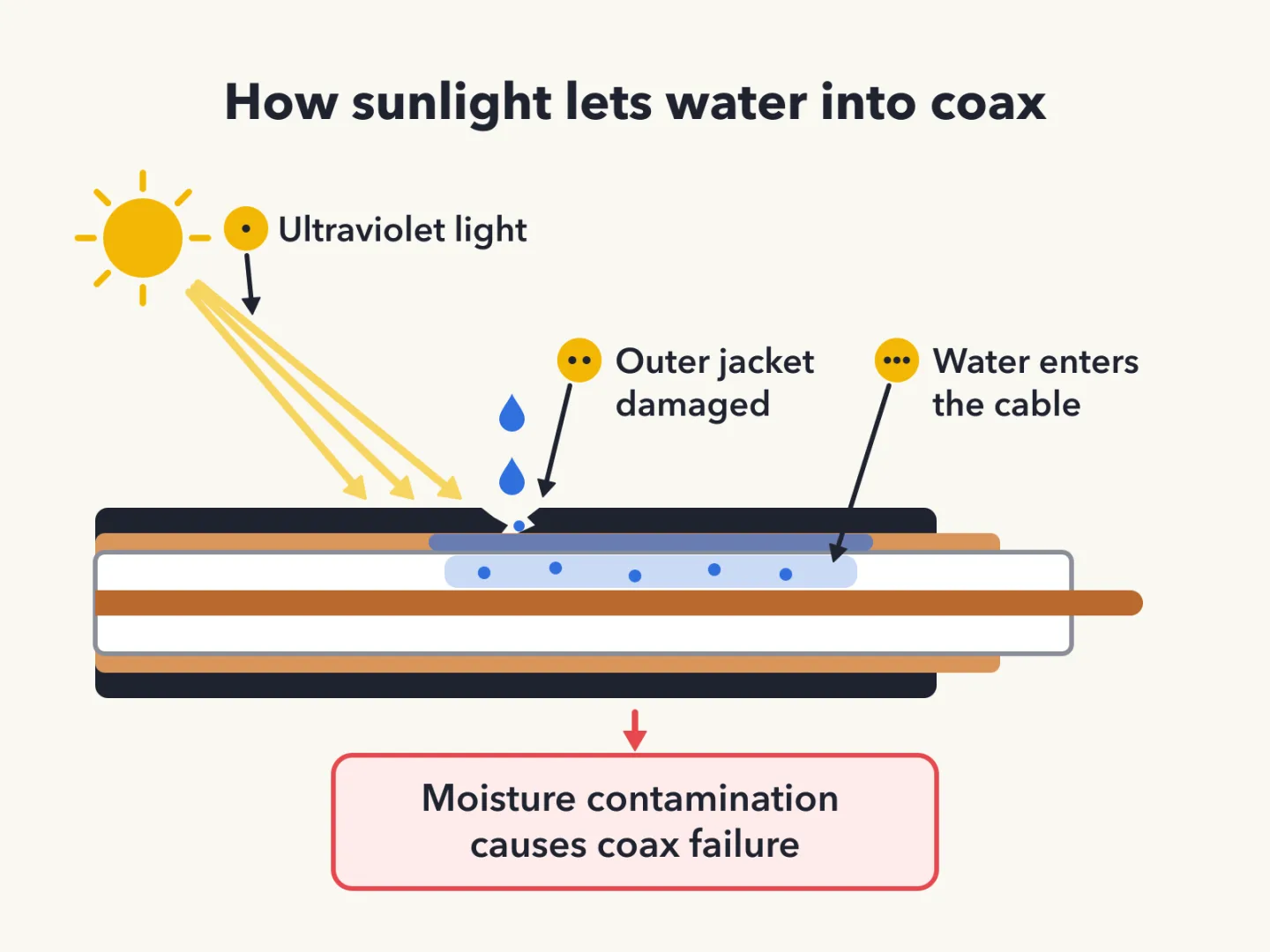
Why Coax Jackets Resist Sunlight
The outer jacket of coaxial cable should be resistant to ultraviolet light. Ultraviolet light can damage the jacket and allow water to enter the cable.
1 / 10What does a typical RF dummy load consist of?
A typical radio frequency (RF) dummy load is a 50-ohm non-inductive resistor on a heat sink, not a power supply with a relay or an inductive reactance. AC stands for alternating current and DC stands for direct current.
Lesson 11 has 66 cards. Keep going in the free app.
Question
Why Transmitters Cut Their Own Power 
Which Setting Can Damage a Multimeter All 4 clips on YouTube ↗Transcripts
Why Transmitters Cut Their Own Power
Why would a transmitter turn its own power down, even while it is still on the air?
Most solid-state transmitters reduce their output once the standing wave ratio (SWR) climbs past a certain level.
They do it to protect the transistors in the radio frequency output amplifier.
A reading of one to one means a perfect impedance match between the antenna and the feed line.
Which Setting Can Damage a Multimeter
Which simple mistake can damage a multimeter when it is being used?
The damaging mistake is attempting to measure voltage when the meter is on the resistance setting.
When resistance is measured inside a circuit, the circuit must not be powered.
An ohmmeter measures the resistance of a circuit or component by applying a small current and measuring the resulting voltage.
Episode 116:18
What is SWR, and how do you use a multimeter and an antenna analyzer?
-
 FlashFeed original diagram · CC-BY-4.012
Signals and Emissions: Modes and Satellites
Modulation modes and bandwidth · Amateur satellite operation
Lesson 12 · 10 cardsFlashFeed original diagram · CC-BY-4.0FM or PM for Packet and Repeaters
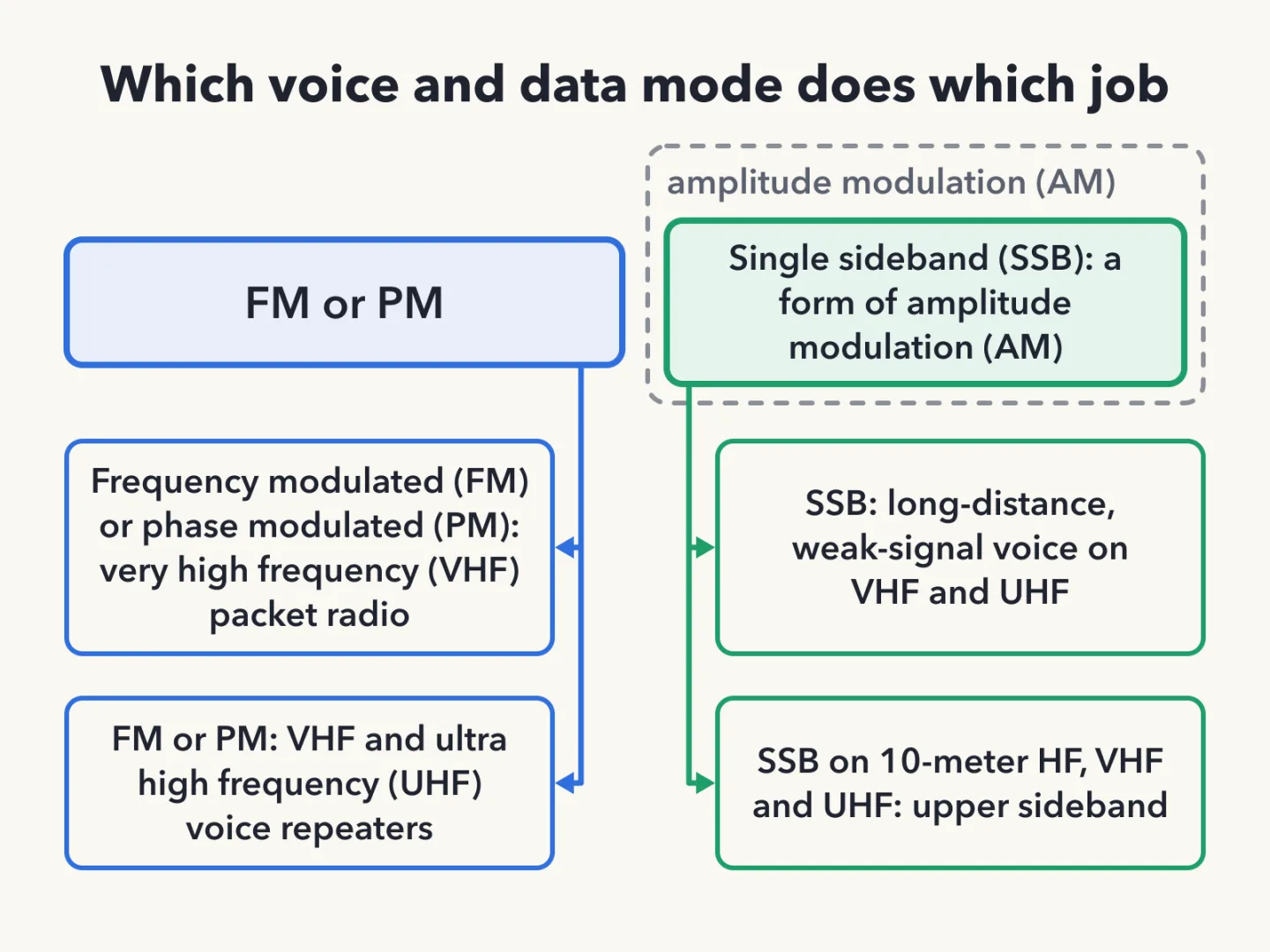
FM or PM is the modulation commonly used for two jobs: very high frequency (VHF) packet radio, and VHF and ultra high frequency (UHF) voice repeaters. Here FM means frequency modulated and PM means phase modulated.
 FlashFeed original diagram · CC-BY-4.0
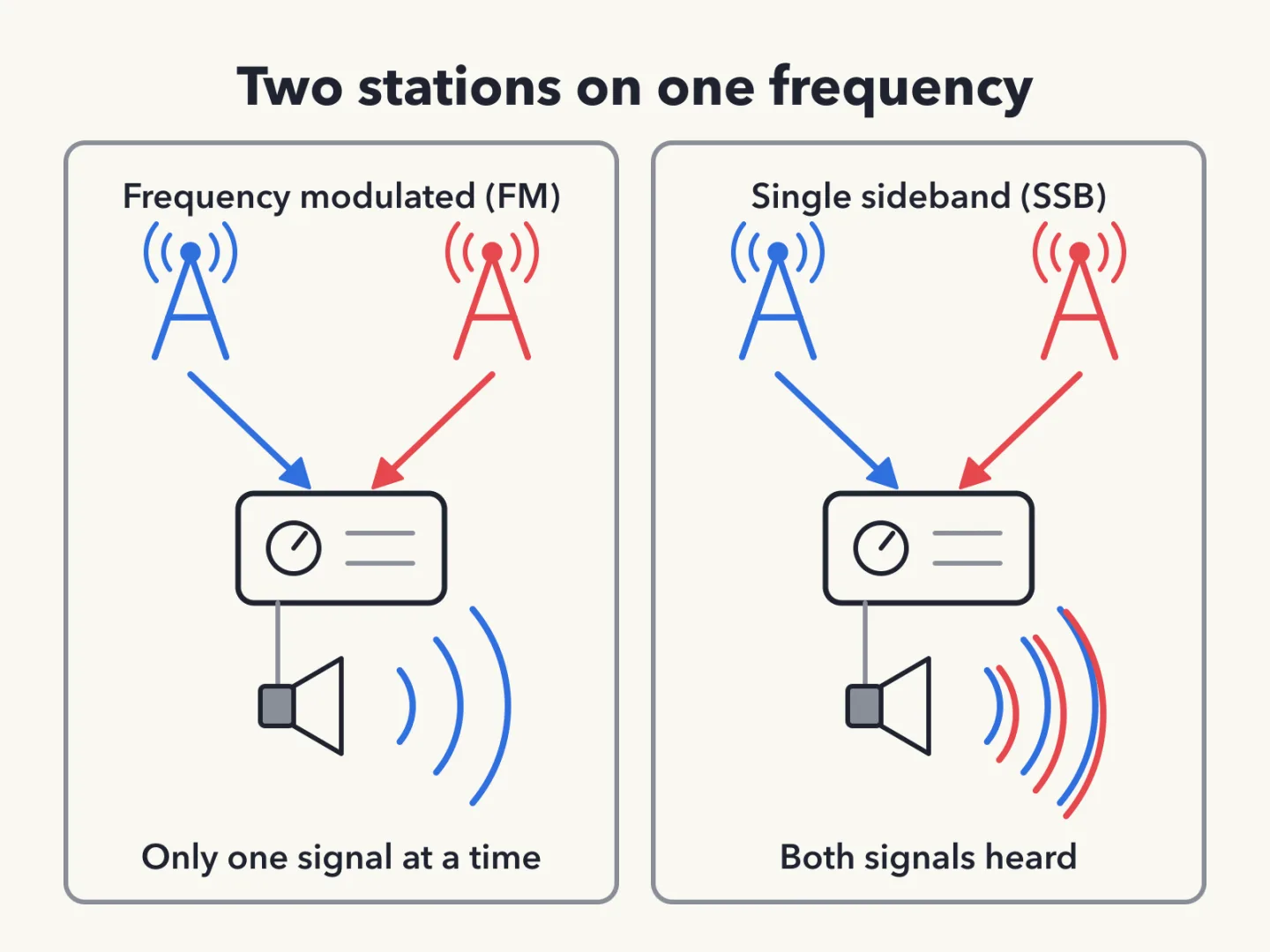
The Drawback of FM
A disadvantage of frequency modulated (FM) compared with single sideband is that only one signal can be received at a time.
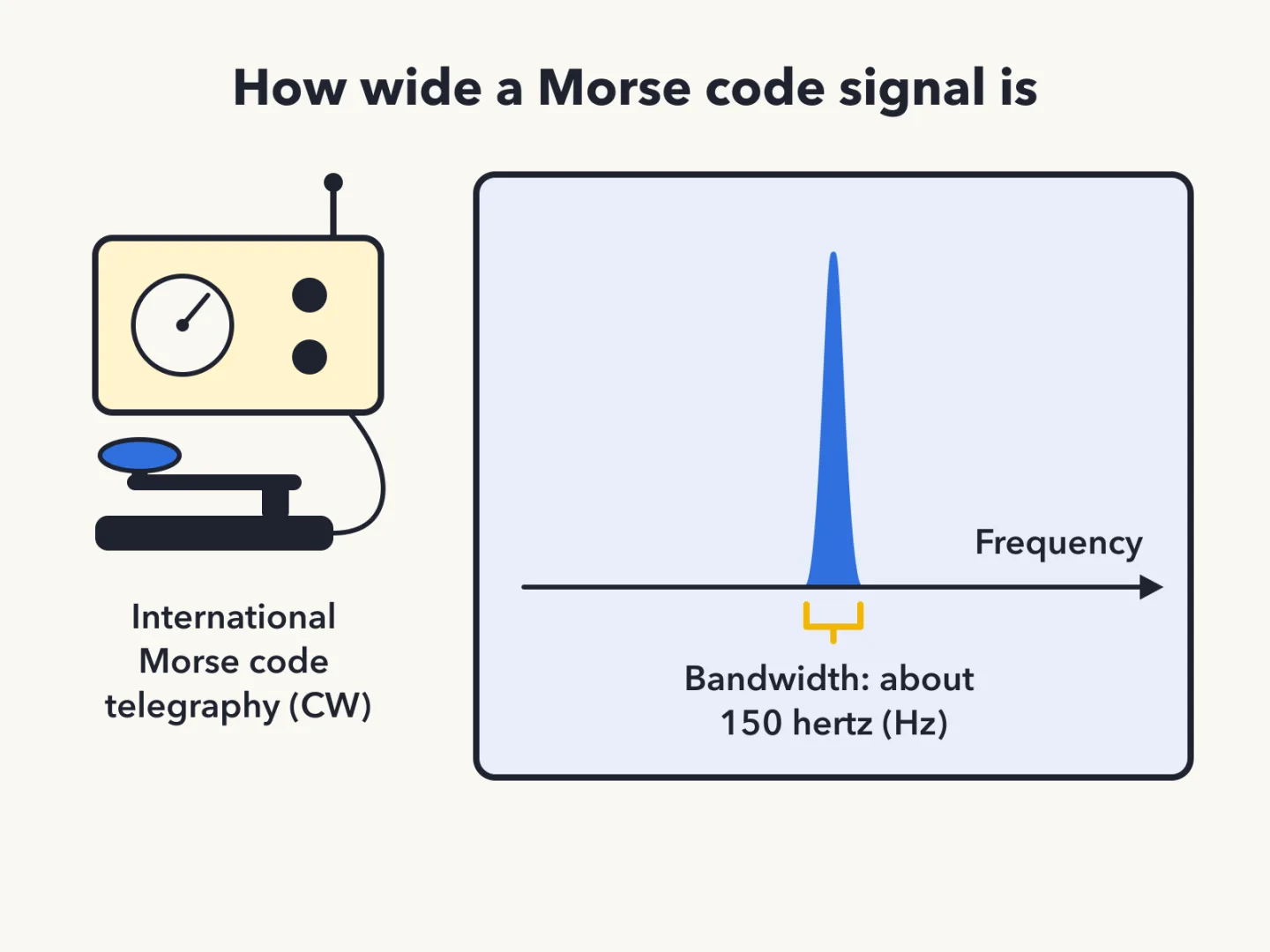 FlashFeed original diagram · CC-BY-4.0
CW Bandwidth: About 150 Hz
An international Morse code telegraphy (CW) signal needs about 150 hertz (Hz) of bandwidth.
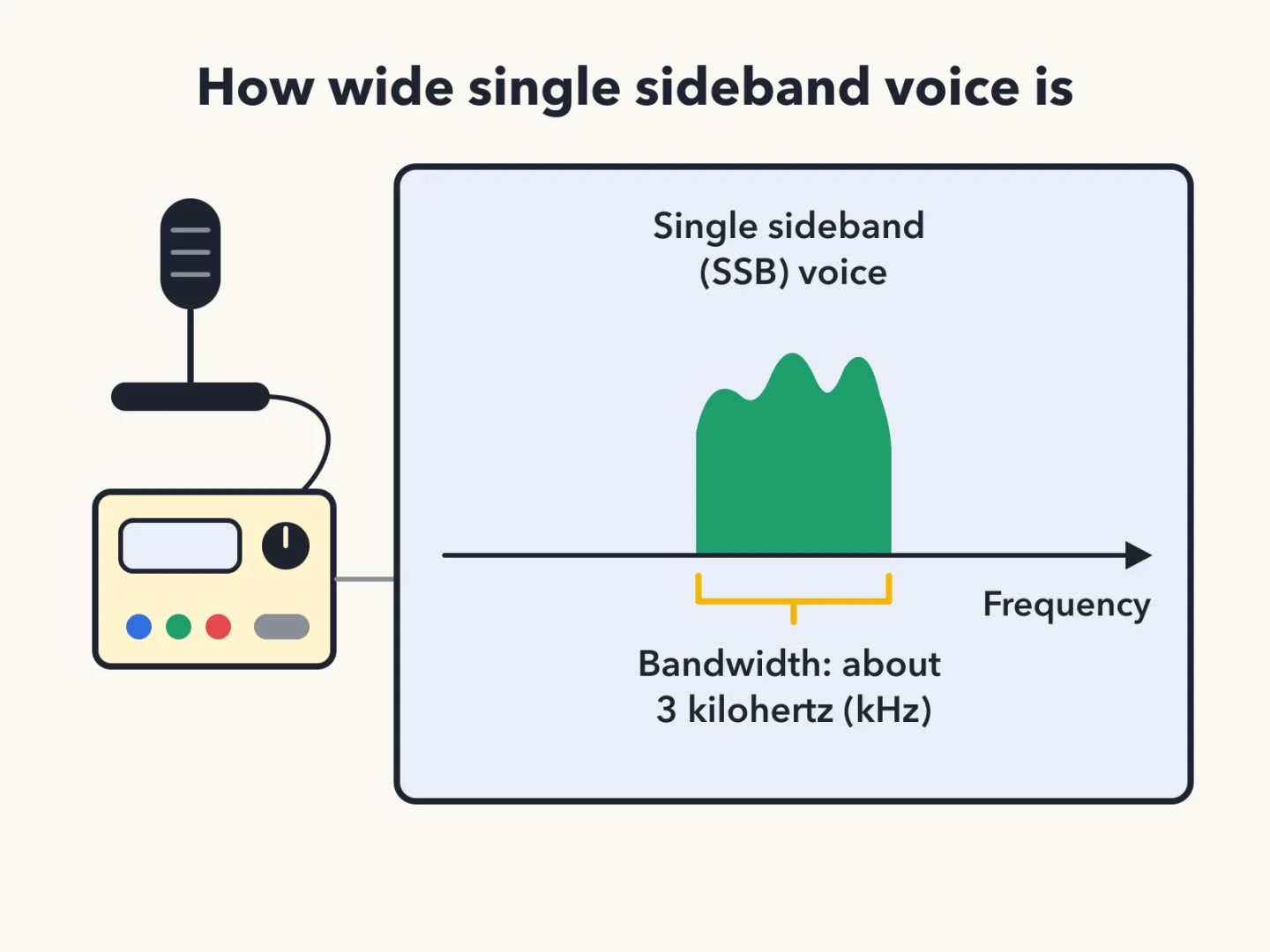 FlashFeed original diagram · CC-BY-4.0
SSB Voice Is About 3 kHz
A typical single sideband (SSB) voice signal is about 3 kilohertz (kHz) wide.
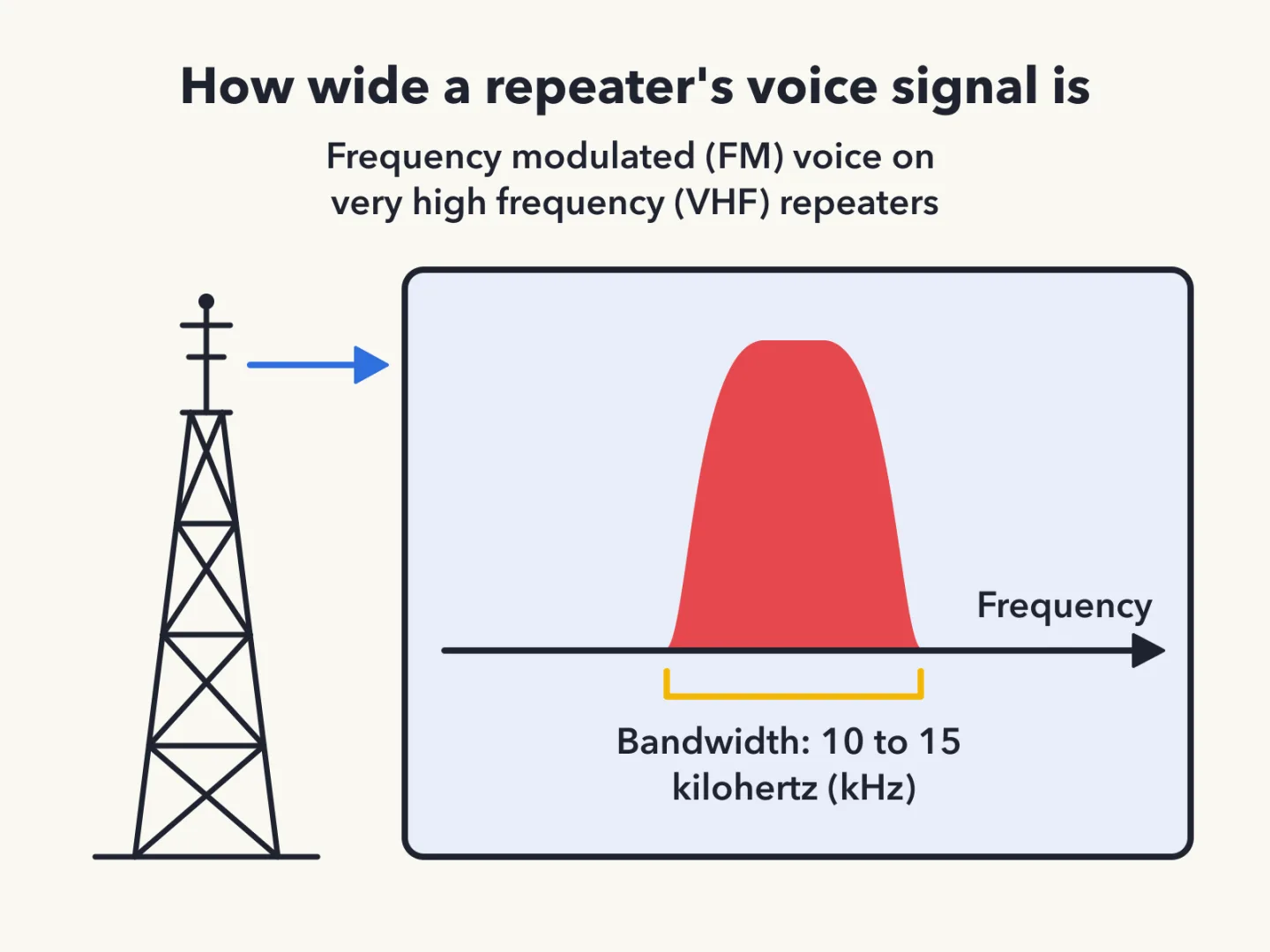 FlashFeed original diagram · CC-BY-4.0
FM Repeater Voice Is 10–15 kHz
A frequency modulated (FM) voice signal on very high frequency (VHF) repeaters is between 10 and 15 kilohertz (kHz) wide.
1 / 10Which signal type takes up roughly 6 megahertz (MHz) of a band?
Amplitude modulated (AM) fast-scan TV is about 6 MHz wide. Single sideband voice is about 3 kilohertz, and Morse code telegraphy needs far less.
Lesson 12 has 72 cards. Keep going in the free app.
Question
Morse Code or Fast-Scan TV: Which Takes More Room? 
Why Too Much Satellite Power Hurts Others All 4 clips on YouTube ↗Transcripts
Morse Code or Fast-Scan TV: Which Takes More Room?
Which takes more room on a band: a Morse code signal, or a fast-scan TV signal?
A fast-scan TV signal is about 6 wide.
A Morse code signal, also called continuous wave (CW), needs about 150 hertz, the narrowest of the signals compared.
A typical single sideband (SSB) voice signal takes about 3 kilohertz. Frequency modulated (FM) repeater voice takes 10 to 15 kilohertz.
Why Too Much Satellite Power Hurts Others
More power is not always better on a satellite uplink.
Using excessive effective radiated power (ERP) on a satellite uplink blocks access by other users.
On a linear transponder satellite, correct uplink power leaves the operator's downlink about as strong as the beacon signal.
So the operator sets uplink power by matching the beacon, and other users keep their access.
Episode 127:23
How do single sideband (SSB) and FM differ, and how do you make contacts through an amateur radio satellite?
-
 Wikimedia Commons · Lz1adf · CC BY-SA 3.0 ↗13
Signals and Emissions: Contests, Linking and Digital Modes
Direction finding, contests and internet linking · Digital and non-voice modes
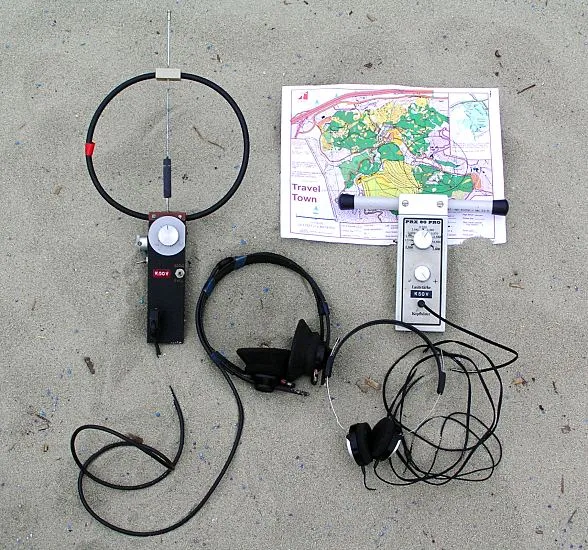
Lesson 13 · 10 cardsWikimedia Commons · Lz1adf · CC BY-SA 3.0 ↗Hunting a Transmitter
In a hidden transmitter hunt, operators search for a transmitter that has been concealed. For the search, the useful item is a directional antenna.
 FlashFeed original diagram · CC-BY-4.0
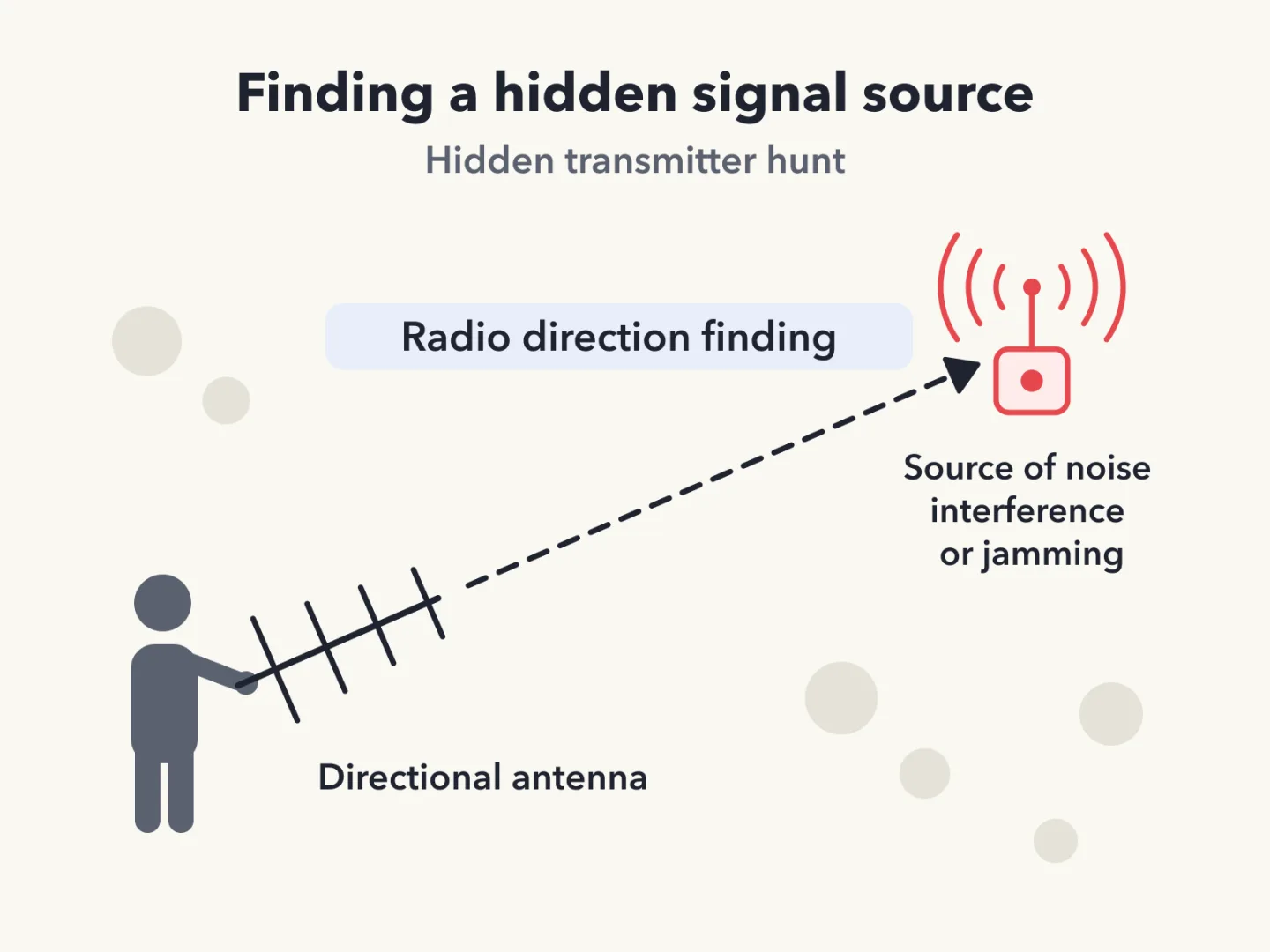
Radio Direction Finding
Radio direction finding is the method used to locate sources of noise interference or jamming.
Wikimedia Commons · Lz1adf · CC BY-SA 3.0 ↗Gear for a Transmitter Hunt
In a hidden transmitter hunt, operators search for a transmitter that has been concealed. The useful item for the hunt is a directional antenna.
 FlashFeed original diagram · CC-BY-4.0
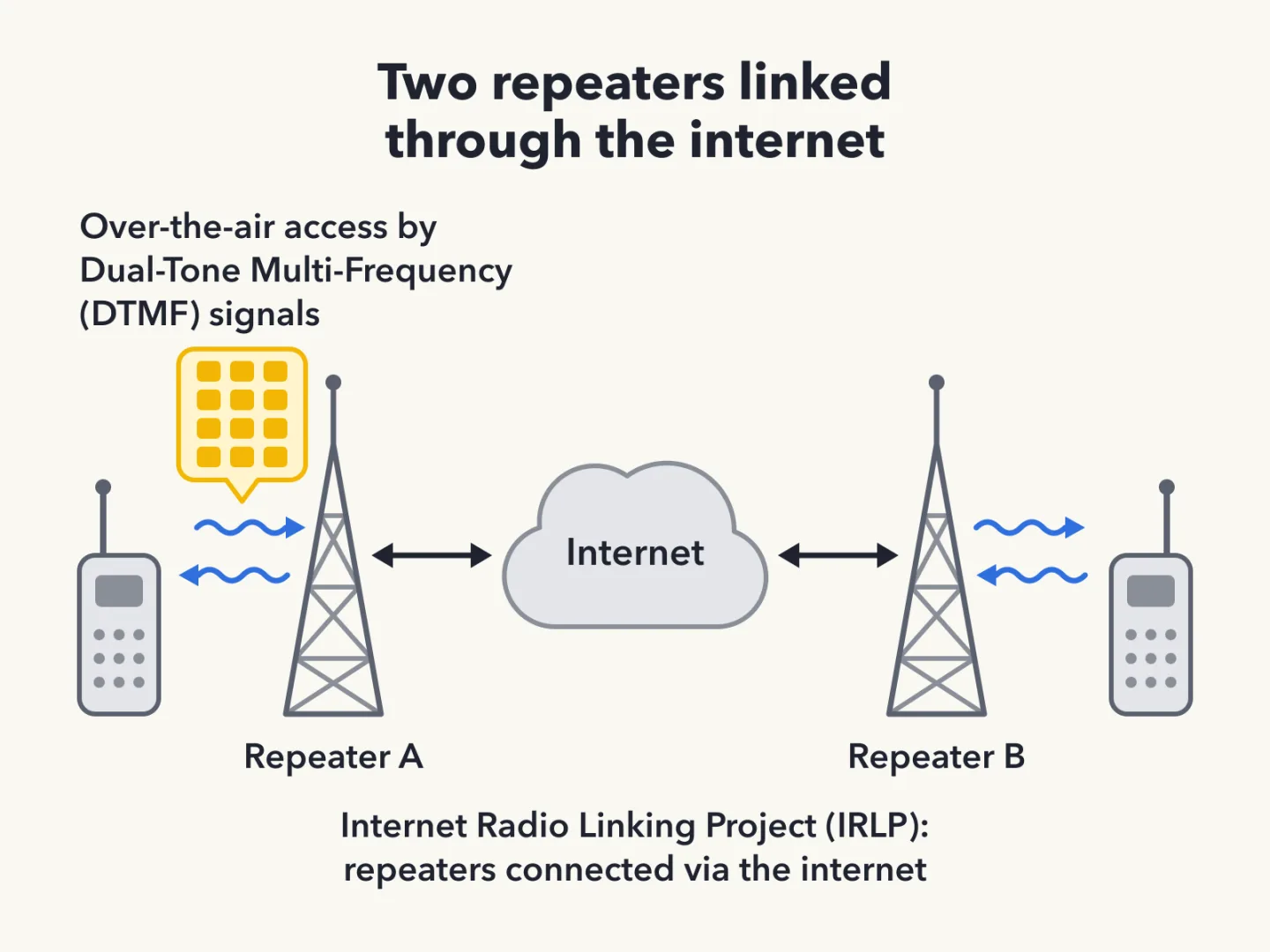
Reaching IRLP Nodes
Over-the-air access to Internet Radio Linking Project (IRLP) nodes is accomplished by using Dual-Tone Multi-Frequency (DTMF) signals.
1 / 10A new Technician licensee wants to start using EchoLink. What is needed first?
EchoLink needs a registered call sign and proof of license. It requires no training, no purchased software license and no General Class license, so a Technician licensee can register.
Lesson 13 has 68 cards. Keep going in the free app.
Question
Why Contest Stations Send Less 
How Radio Packets Fix Errors All 4 clips on YouTube ↗Transcripts
Why Contest Stations Send Less
In a radio contest, sending less can be the smarter move.
A contest aims to contact as many stations as possible in a set period of time.
Good practice in a contest contact is to send only the minimum information needed for proper identification and the contest exchange.
So each contact carries just what identification and the contest exchange need.
How Radio Packets Fix Errors
How does a digital radio message deal with an error on the way?
Packet radio transmissions include a checksum. It permits the receiving station to detect errors.
When the receiving station detects an error, it sends a request for the data to be sent again.
The method is called automatic repeat request (ARQ), and it is an error correction method.
Episode 137:04
What are FT8, APRS and EchoLink, and how do ham radio contests work?
Also on Spotify ↗Apple Podcasts ↗
-
 Wikimedia Commons · Adityamadhav83 · CC BY-SA 4.0 ↗14
Antennas and Feed Lines
Antenna types, polarization and gain · Feed lines, standing waves and connectors
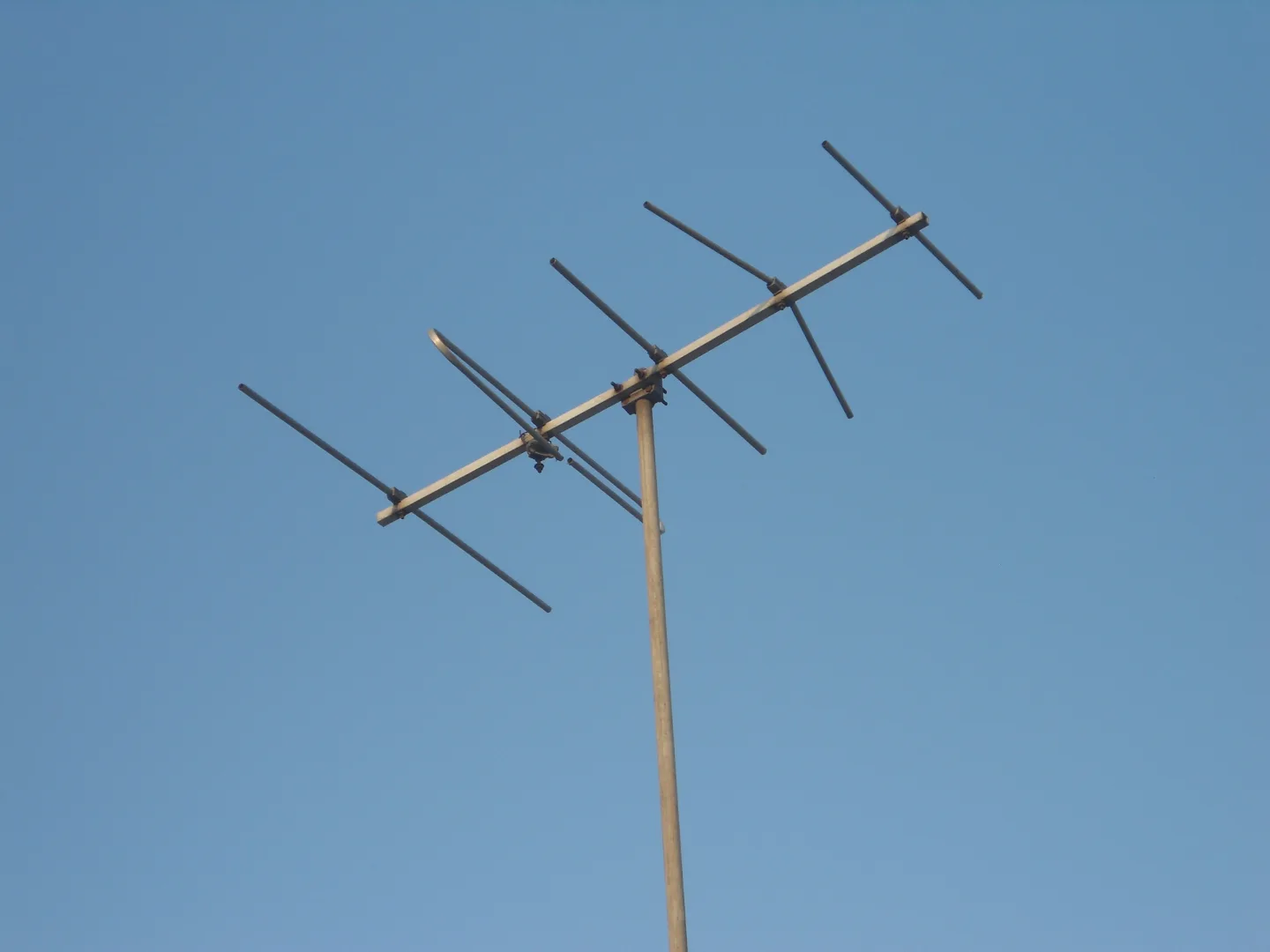
Lesson 14 · 10 cardsWikimedia Commons · Adityamadhav83 · CC BY-SA 4.0 ↗Yagi antennas lead in gain
Compared with a 5/8 wave vertical, an isotropic antenna and a J pole, a Yagi has the greatest gain. That makes it the choice for putting the most signal toward a distant station.
 Wikimedia Commons · UnifiedFunctionality · CC BY-SA 3.0 ↗
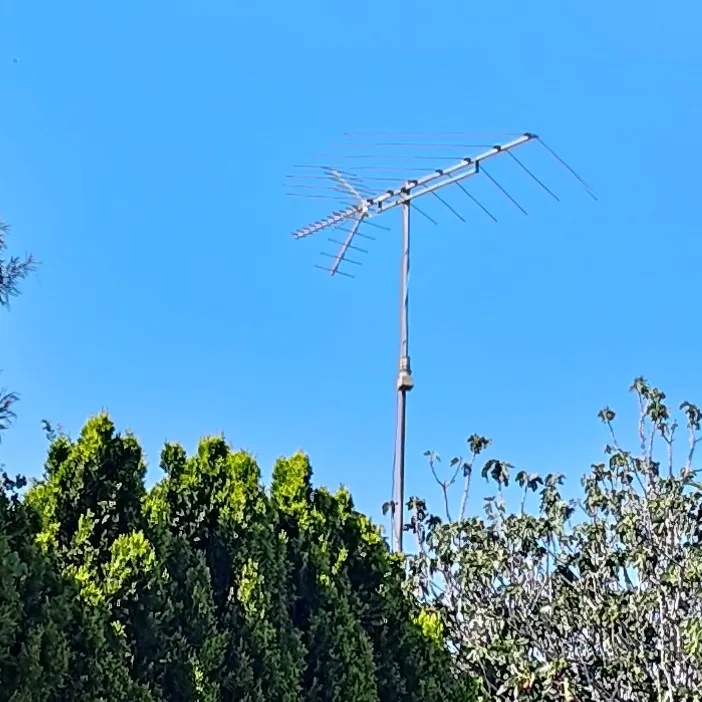
What a beam antenna does
A beam antenna concentrates signals in one direction. It favors one direction over the others.
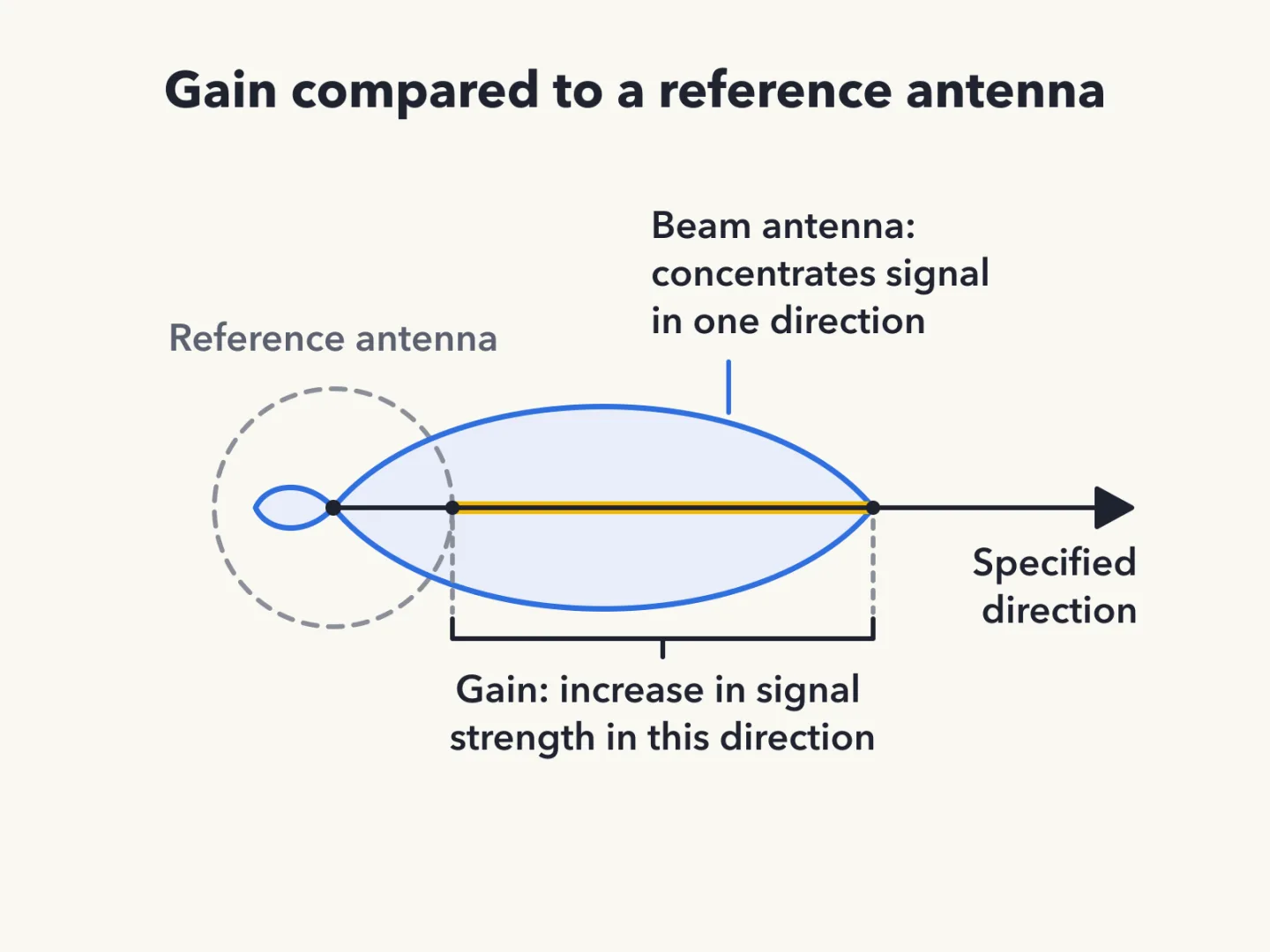 FlashFeed original diagram · CC-BY-4.0
Antenna gain defined
Antenna gain is the increase in signal strength in a specified direction compared to a reference antenna. It describes how much stronger the signal is in a chosen direction.
Wikimedia Commons · Adityamadhav83 · CC BY-SA 4.0 ↗The Yagi has the most gain
Among a 5/8 wave vertical, an isotropic antenna, a J pole and a Yagi, the Yagi offers the greatest gain. It is the pick for the most signal toward a distant station.
 FlashFeed original diagram · CC-BY-4.0
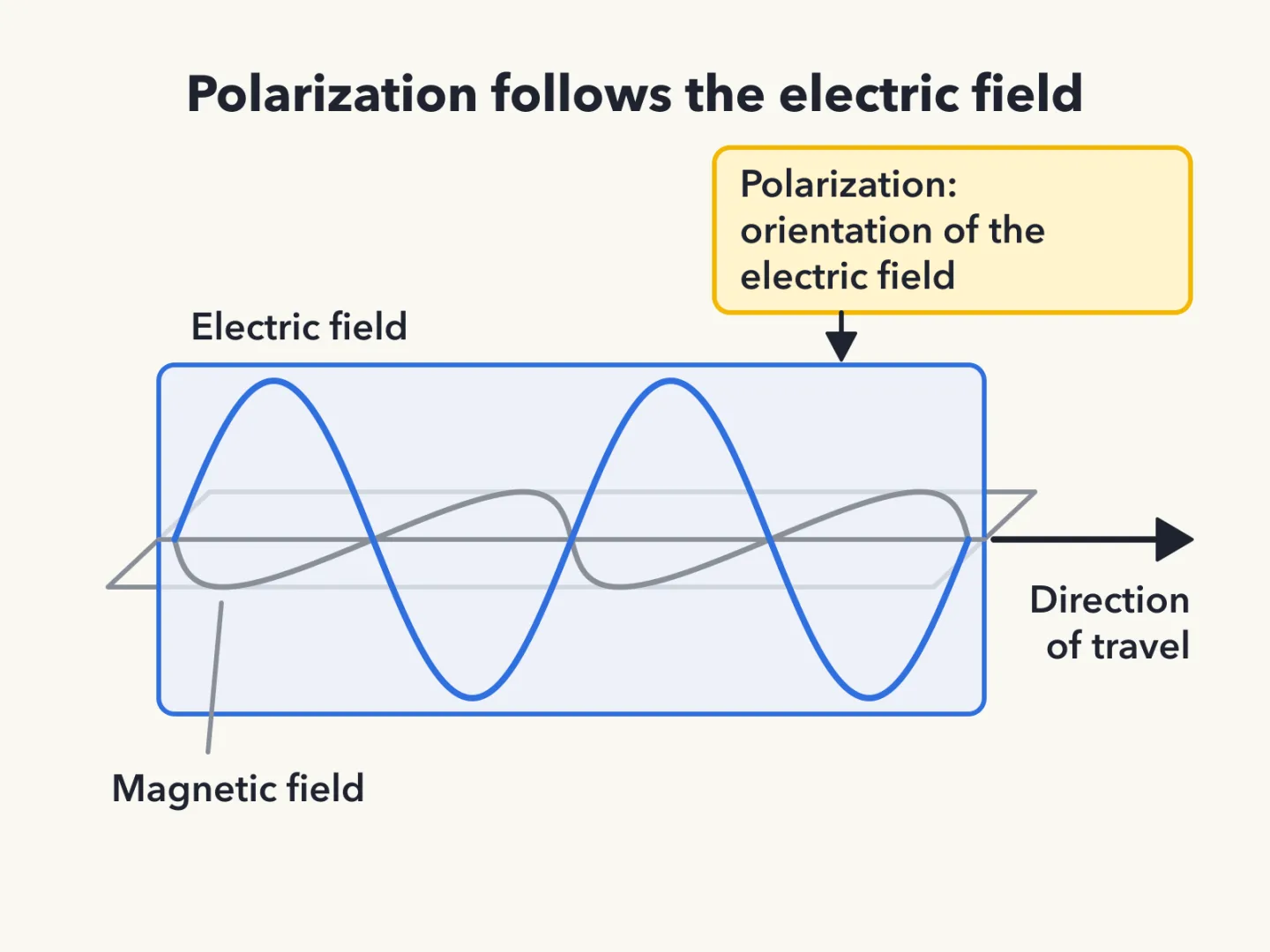
How polarization is described
The polarization of an antenna is described by the orientation of its electric field.
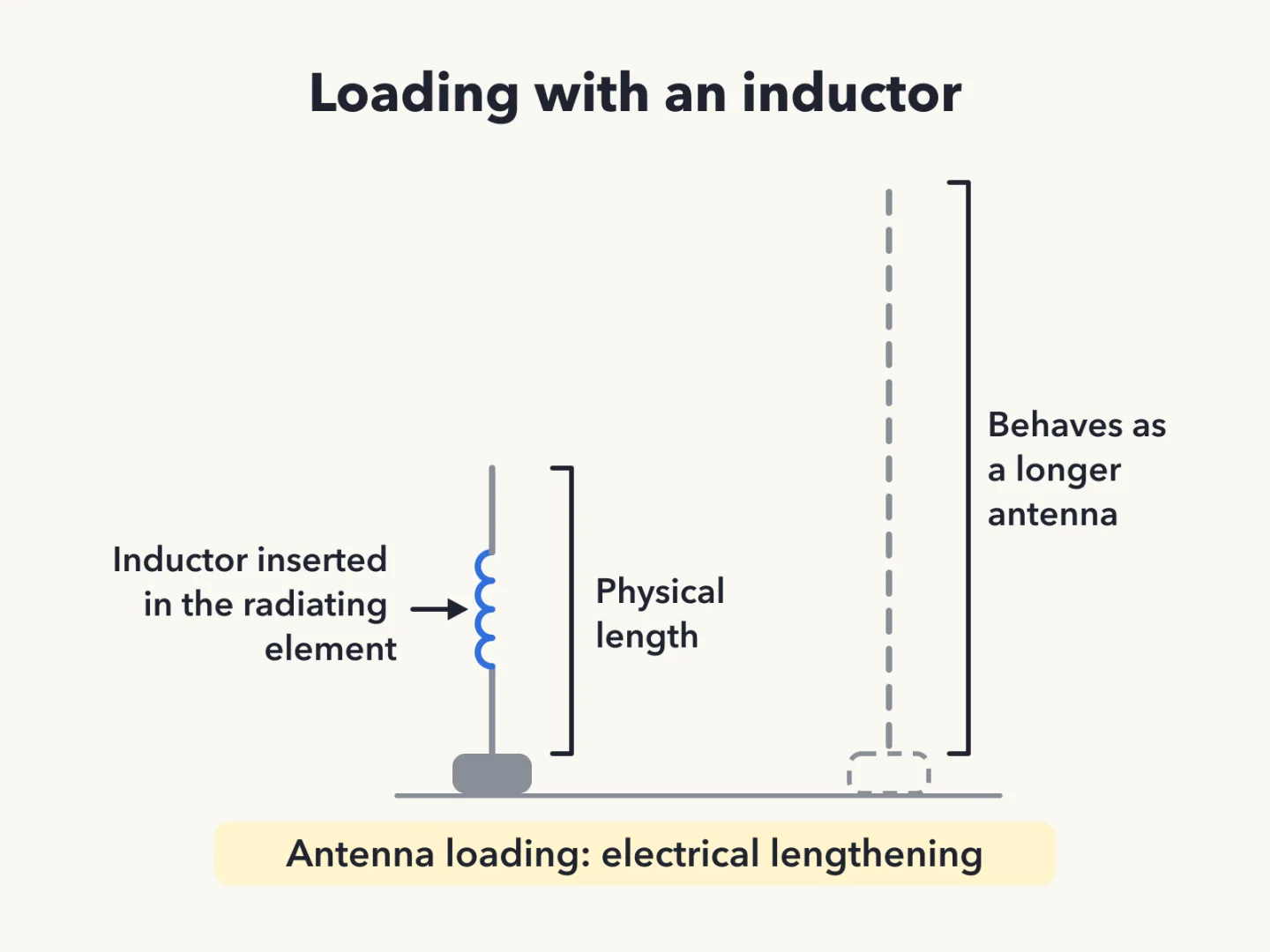 FlashFeed original diagram · CC-BY-4.0
Antenna loading explained
Antenna loading is a way of electrically lengthening an antenna by inserting inductors in its radiating elements. The antenna then behaves as though it were longer than its physical size.
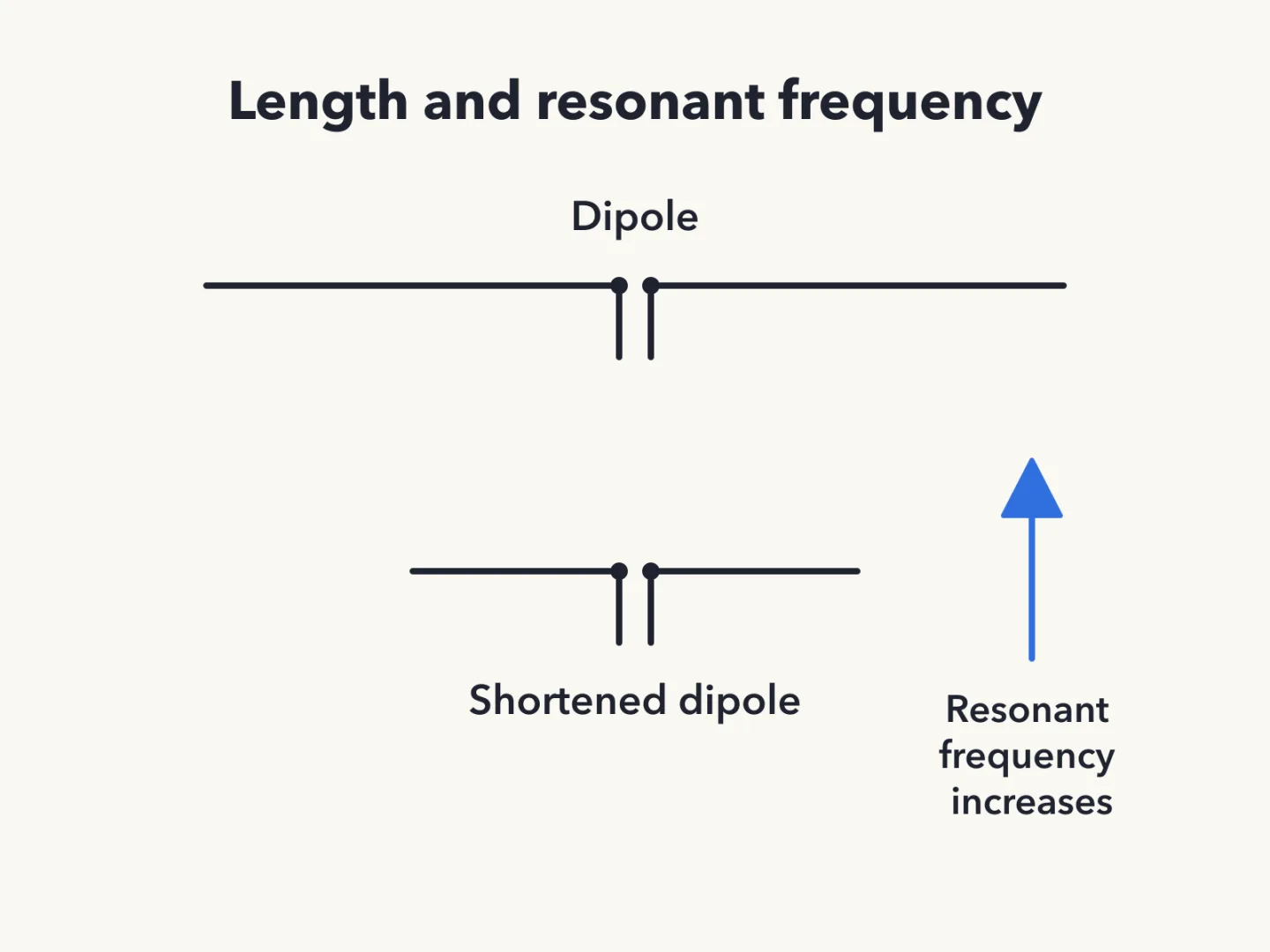 FlashFeed original diagram · CC-BY-4.0
Shorter dipole, higher frequency
Shortening a dipole antenna increases its resonant frequency.
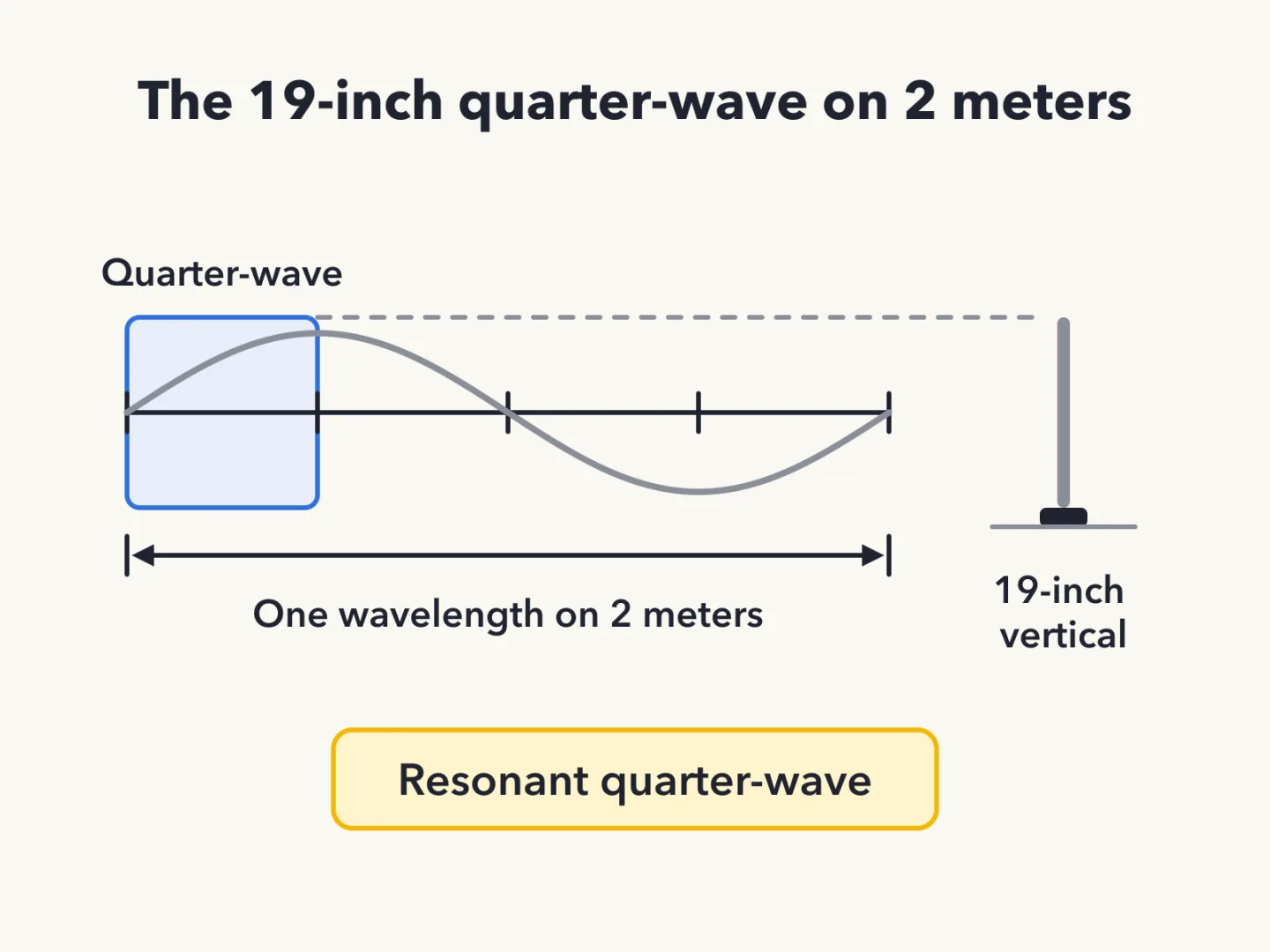 FlashFeed original diagram · CC-BY-4.0
The 19-inch 2-meter vertical
A 19-inch-long vertical antenna is often used on 2 meters because it is a resonant quarter-wave.
 Wikimedia Commons · Jakez · CC BY-SA 3.0 ↗
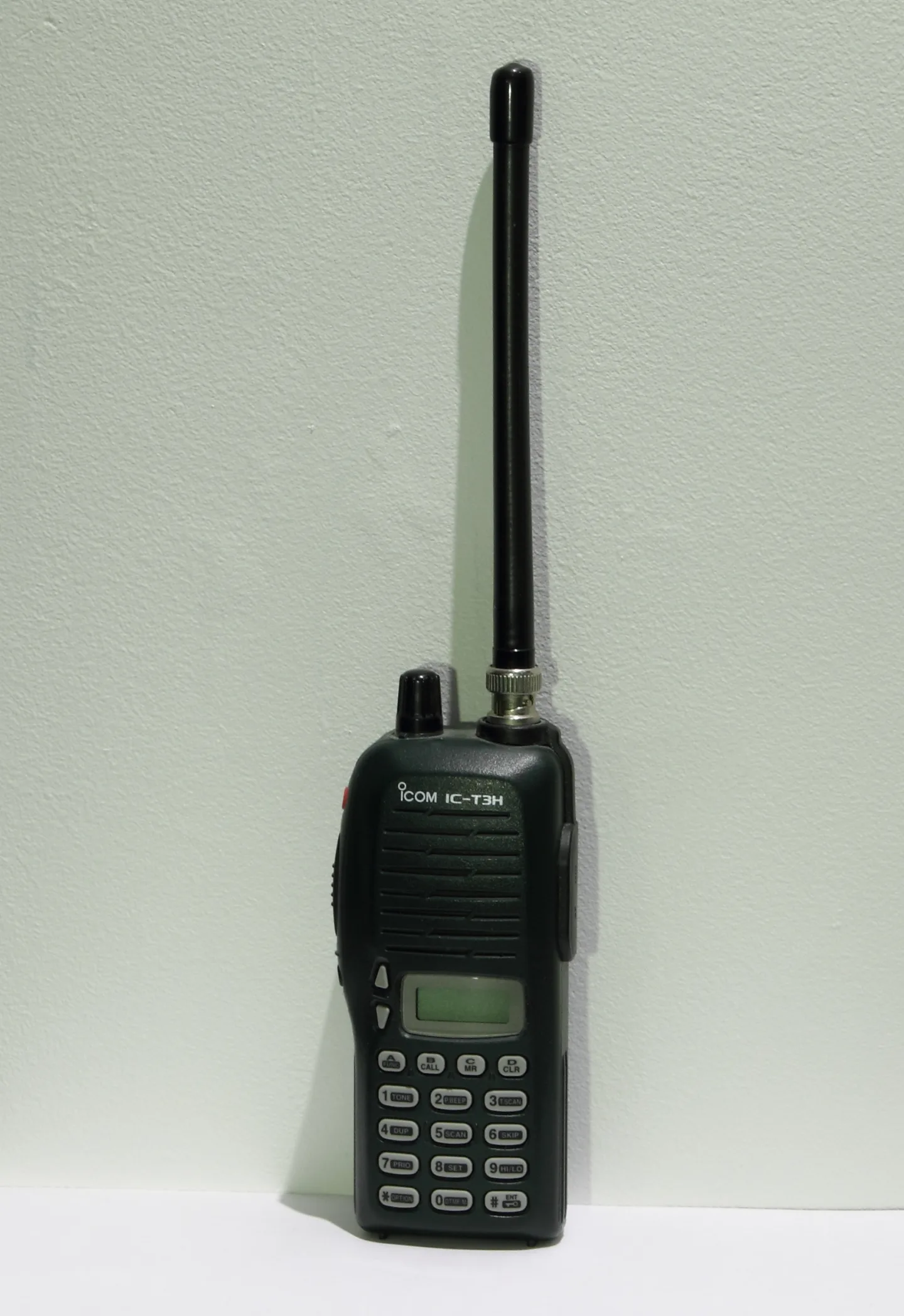
The handheld's short antenna
A handheld transceiver's short flexible antenna has low efficiency compared with a full-sized quarter-wave antenna.
Wikimedia Commons · Jakez · CC BY-SA 3.0 ↗Shorter, less efficient
The short flexible antenna on a handheld transceiver has low efficiency compared with a full-sized quarter-wave antenna.
1 / 10A builder wants a dipole to resonate on a higher frequency. Which change does that?
A shorter dipole resonates higher. Lengthening, series coils and end loading do not raise the resonant frequency.
Lesson 14 has 67 cards. Keep going in the free app.
Question
A 19-Inch Antenna on 2 Meters 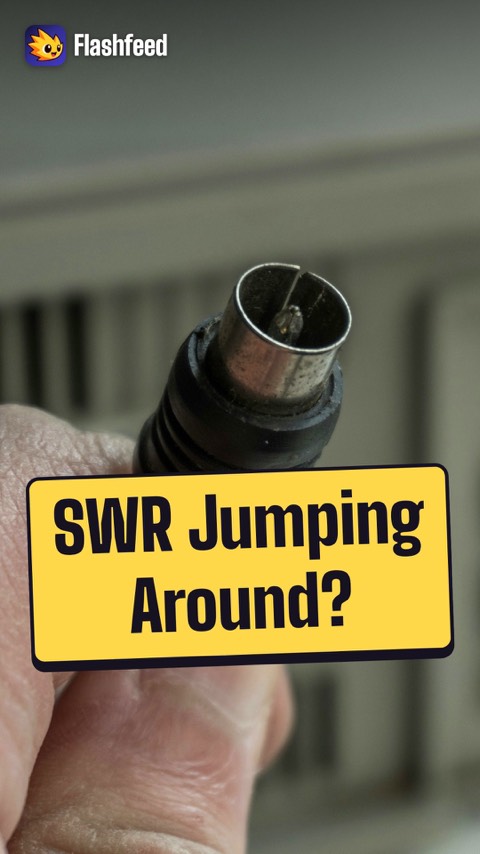
When Your Standing Wave Ratio Jumps Around All 4 clips on YouTube ↗Transcripts
A 19-Inch Antenna on 2 Meters
A 19-inch vertical antenna is often used on 2 meters. Why does such a short antenna work?
It works there because it is a resonant quarter-wave.
Length and resonant frequency are tied together. Shorten a dipole antenna, and its resonant frequency goes up.
Loading is a way to make an antenna electrically longer. Inductors in its radiating elements make it behave as though it were longer than its physical size.
When Your Standing Wave Ratio Jumps Around
Your standing wave ratio, usually called S-W-R, keeps jumping around.
A loose connection in the antenna or feed line can cause erratic changes in S-W-R.
Standing wave ratio is a measure of how well a load is matched to a transmission line.
When the reading jumps around, the connections in the antenna and feed line are the place to look.
Episode 146:49
Which antennas give the most gain, and why is coax the most common feed line?
Also on Spotify ↗Apple Podcasts ↗
-
 Wikimedia Commons · André Karwath aka Aka · CC BY-SA 2.5 ↗15
Safety
Electrical hazards and battery safety · Antenna and tower safety · Radio frequency exposure
Lesson 15 · 10 cardsWikimedia Commons · André Karwath aka Aka · CC BY-SA 2.5 ↗Cutting Power on Overload
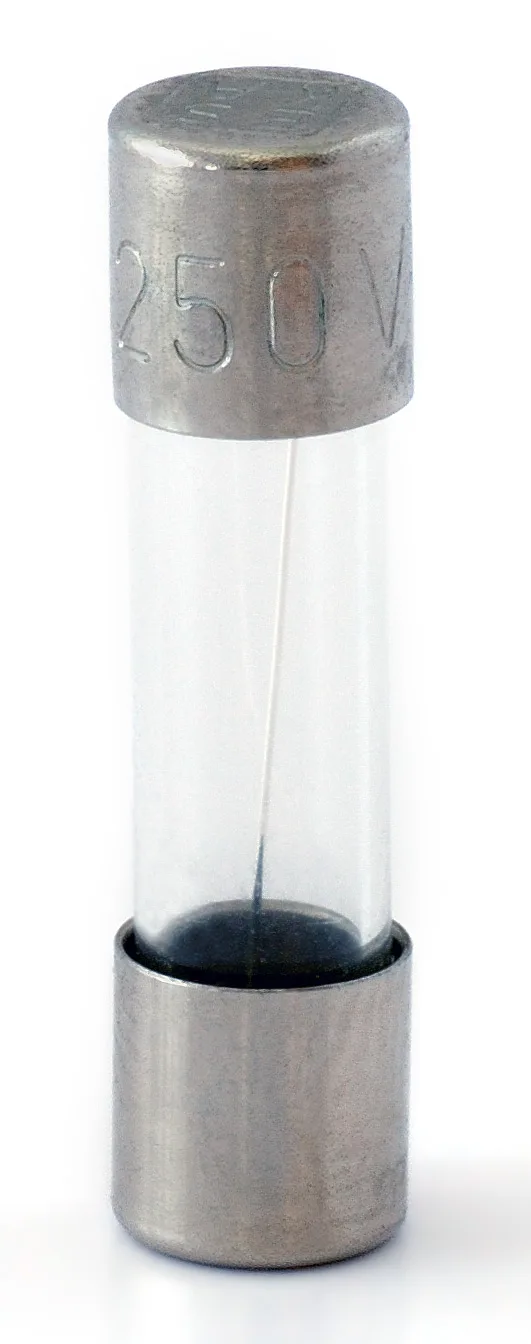
The purpose of a fuse is to remove power in case of an overload.
 Wikimedia Commons · Shaddack · Public domain ↗
Shorted Battery Terminals
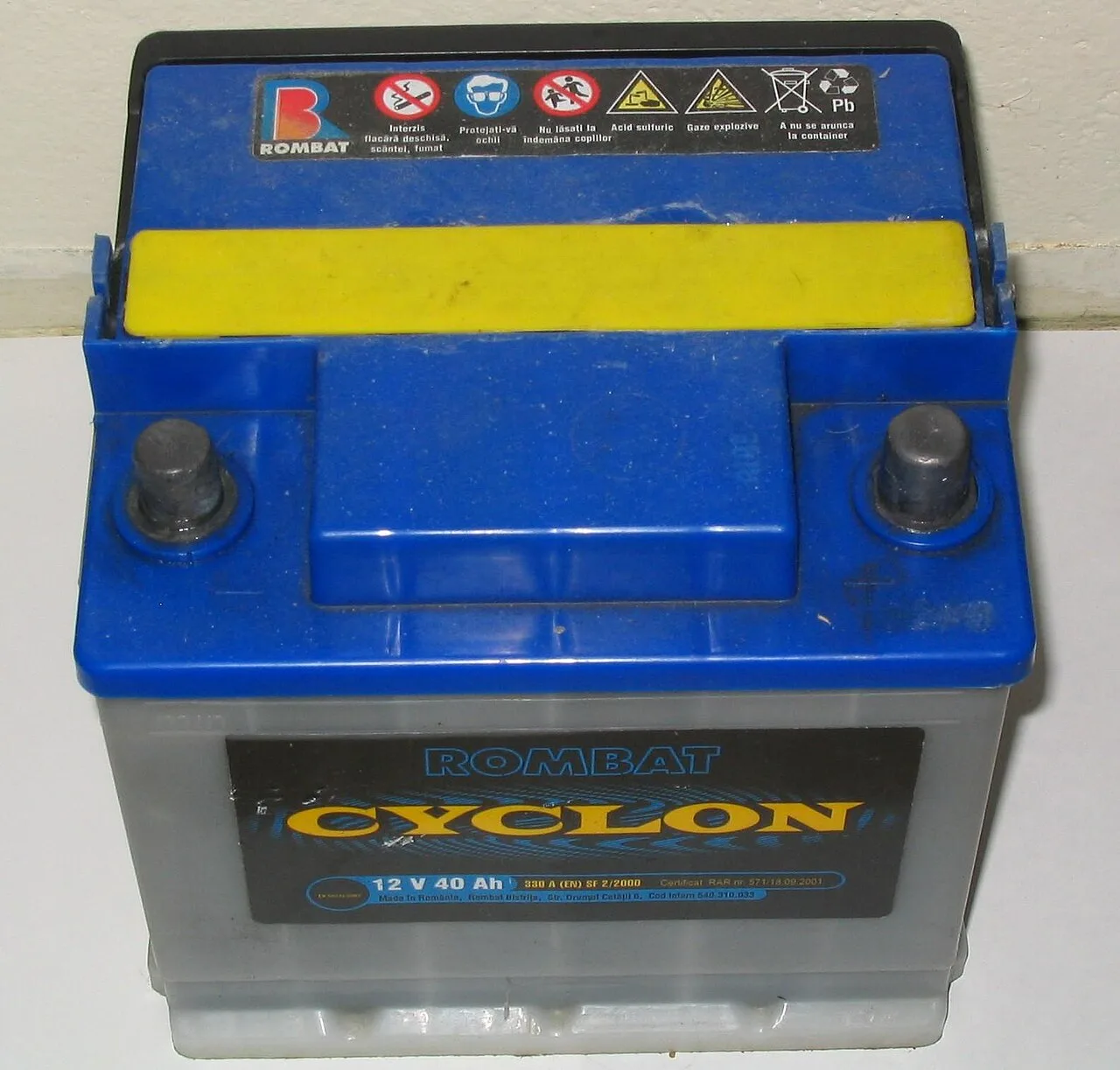
A 12-volt storage battery that lacks internal protection circuitry is a hazard. Shorting the terminals can cause burns, fire, or an explosion.
 FlashFeed original diagram · CC-BY-4.0
Fast Charging Hazard
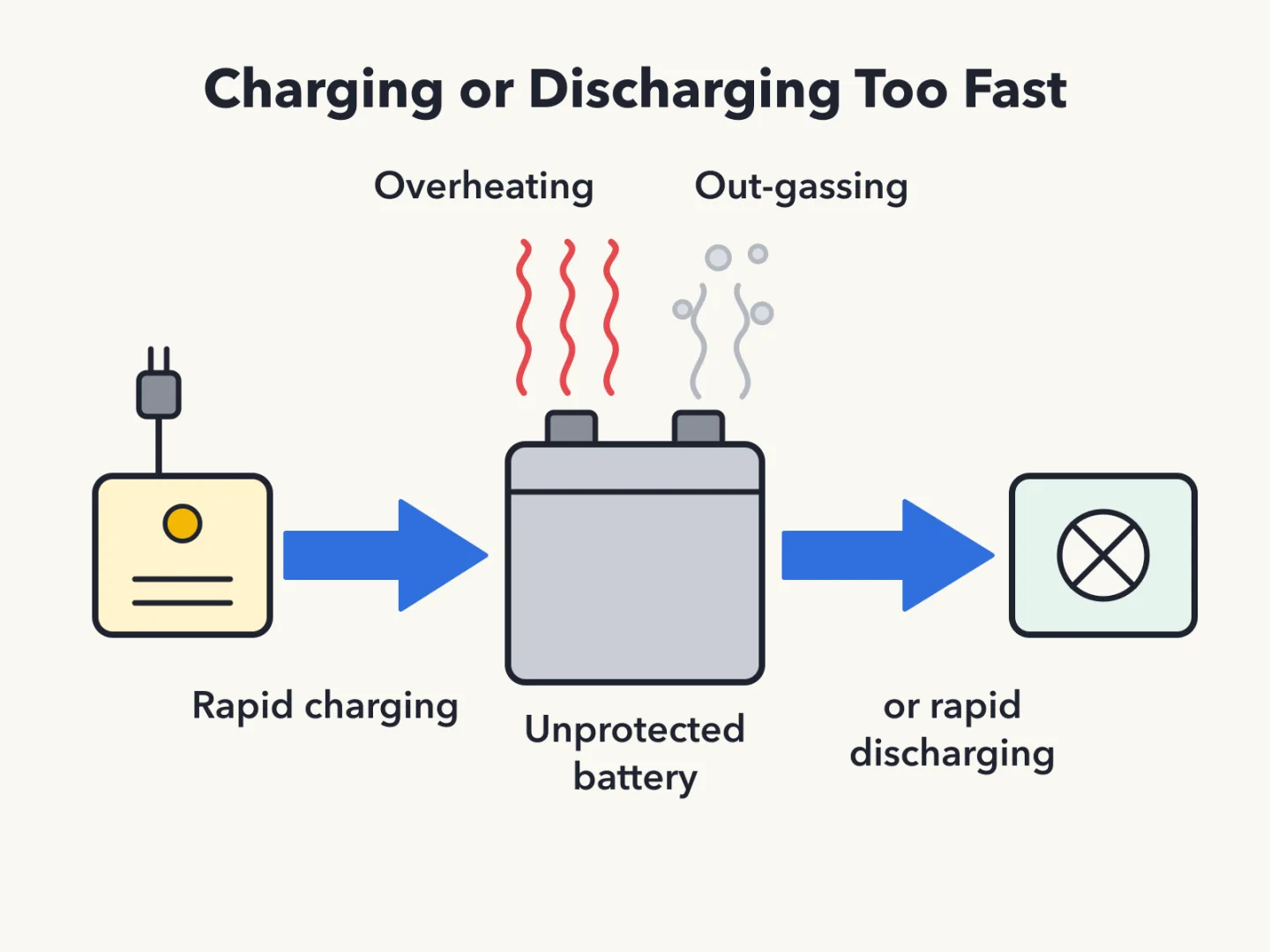
Rapidly charging or discharging an unprotected battery carries a hazard of overheating or out-gassing. It is a related risk to shorting the terminals.
 FlashFeed original diagram · CC-BY-4.0
Three Ways to Guard Against Shock
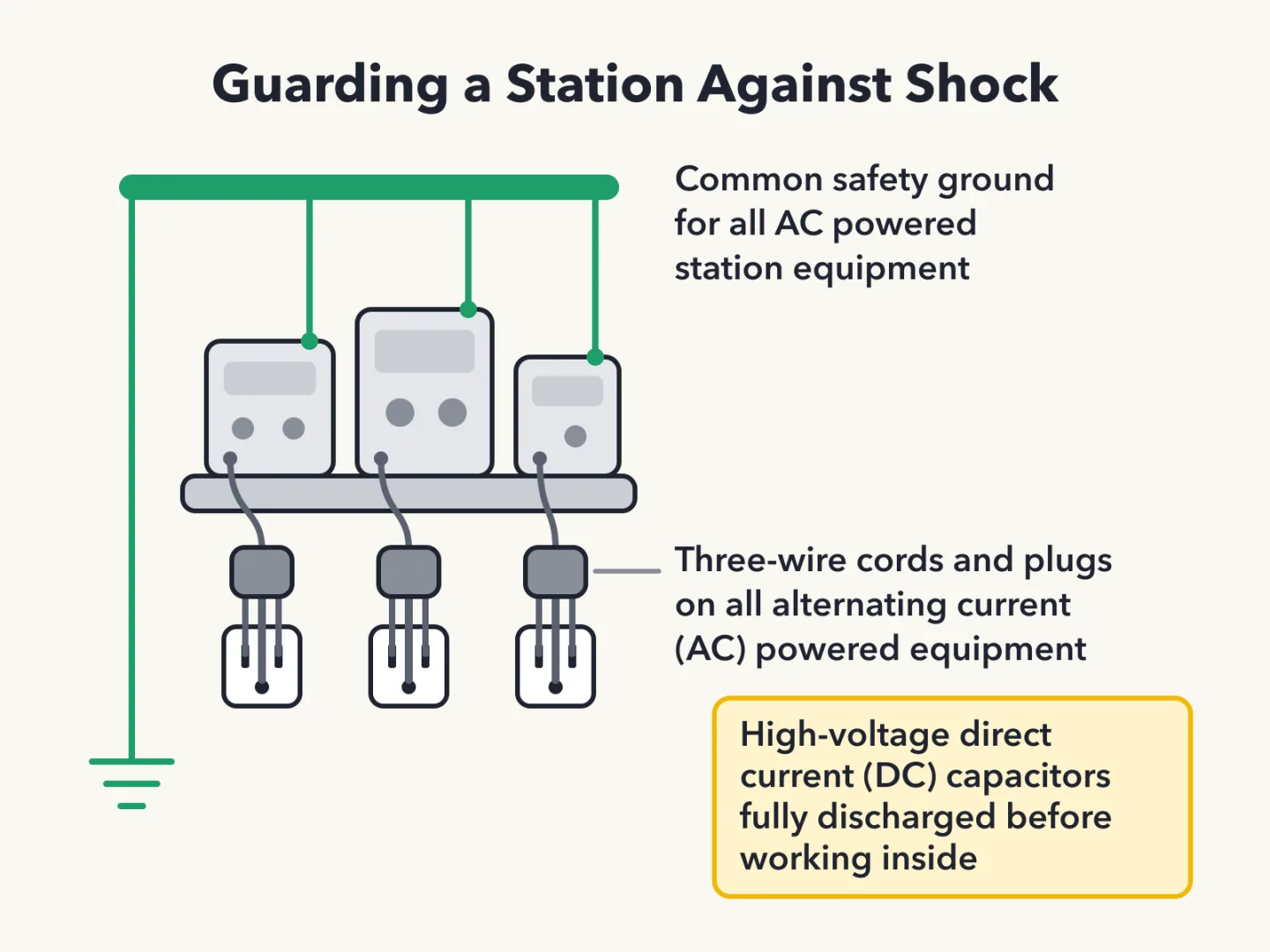
Use three-wire cords and plugs for all alternating current (AC) powered equipment. Connect all AC powered station equipment to a common safety ground. Ensure that capacitors used for high-voltage direct current (DC) are fully discharged before working inside equipment.
 FlashFeed original diagram · CC-BY-4.0
Danger After Power-Off
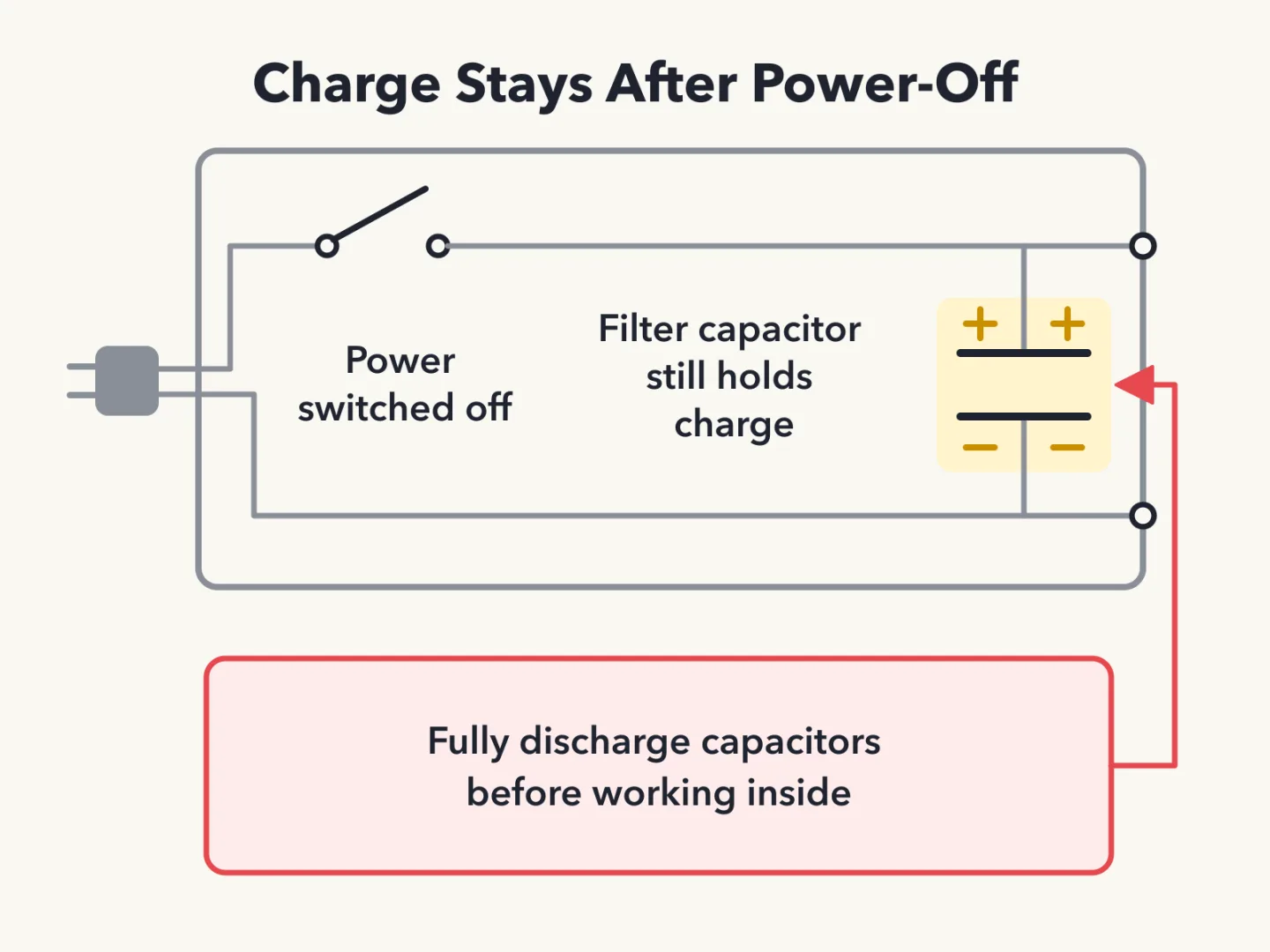
A power supply is not safe the instant it is turned off. The hazard that remains is charge stored in its filter capacitors. Capacitors must be fully discharged before anyone works inside the equipment.
 Wikimedia Commons · havarhen · CC BY-SA 3.0 ↗
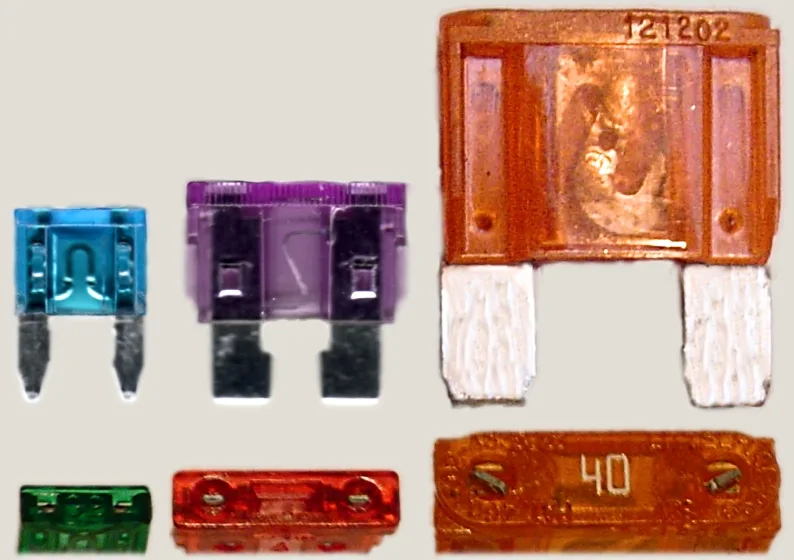
Never Upsize a Fuse
A 5-ampere fuse should never be replaced with a 20-ampere fuse, because excessive current could cause a fire. The larger fuse allows more current than the circuit was protected for.
 FlashFeed original diagram · CC-BY-4.0
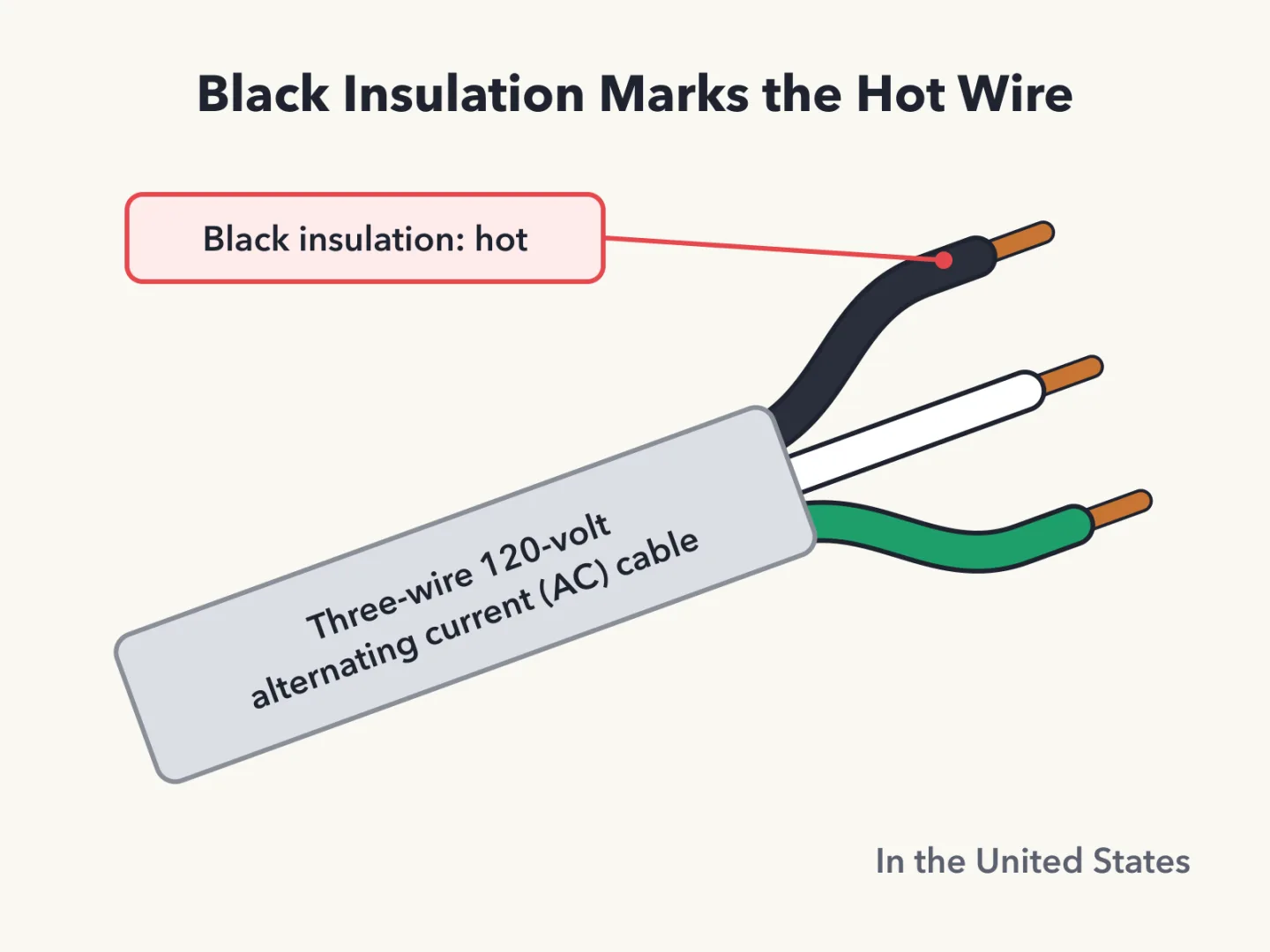
Black Wire Is Hot
In the United States, black wire insulation in a three-wire 120-volt alternating current (AC) cable indicates the hot circuit.
 FlashFeed original diagram · CC-BY-4.0
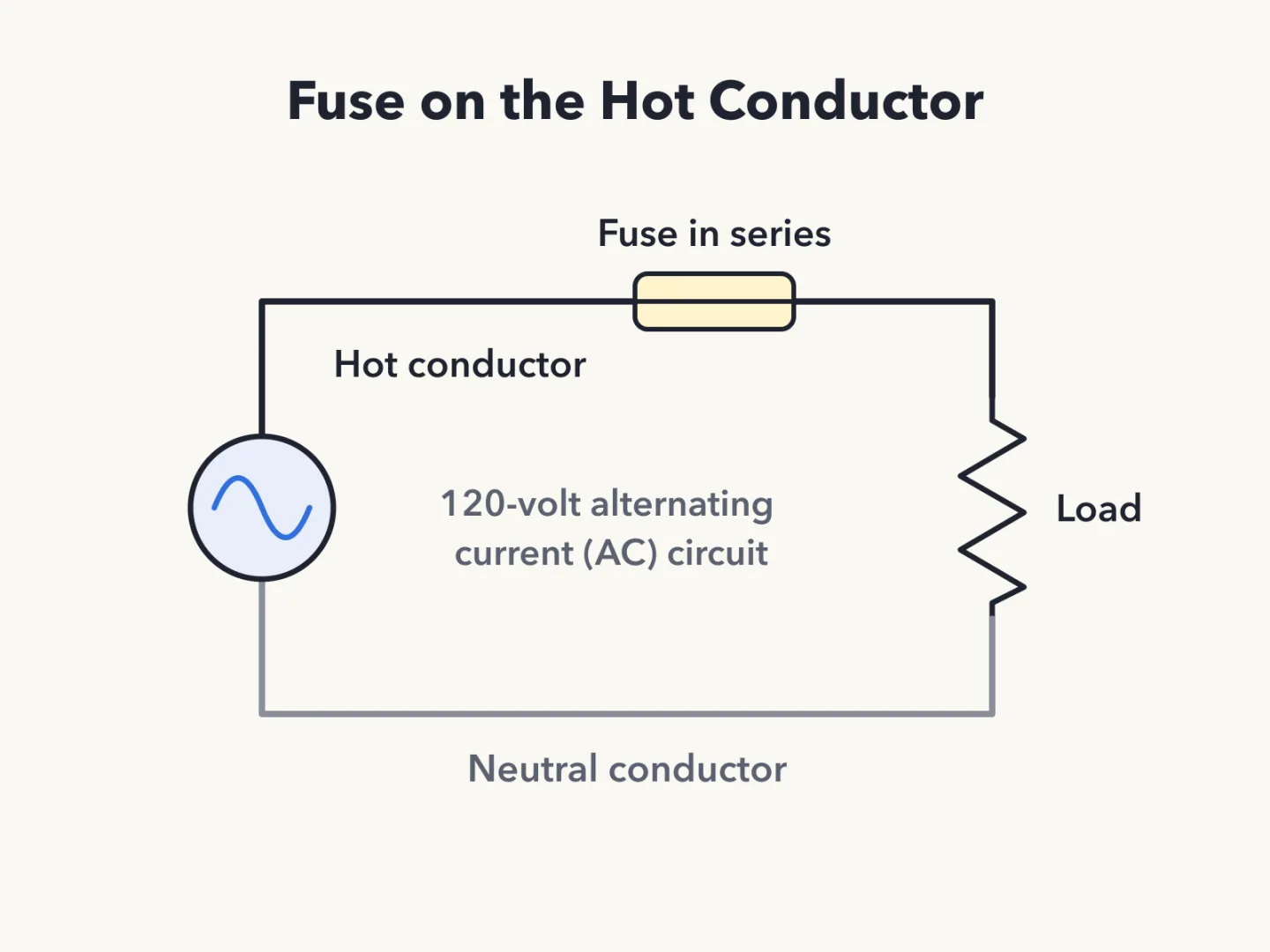
Where to Fuse 120-Volt AC
A fuse or circuit breaker in a 120-volt alternating current (AC) power circuit goes in series with the hot conductor only.
1 / 10A licensee adds a lightning arrester to a coaxial feed line. Where does it belong?
The arrester goes on a grounded panel near where the feed lines enter the building. The transceiver, feed point and power panel are not the spot.
Lesson 15 has 104 cards. Keep going in the free app.
Question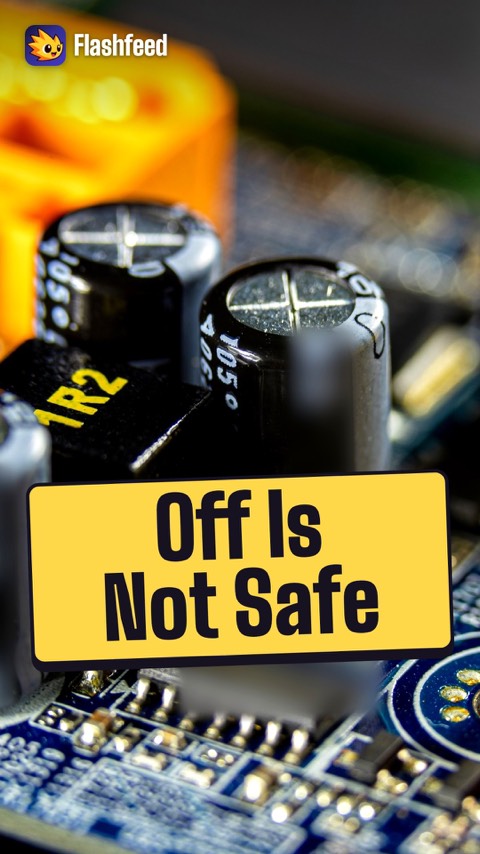
Stored Charge After Switch-Off 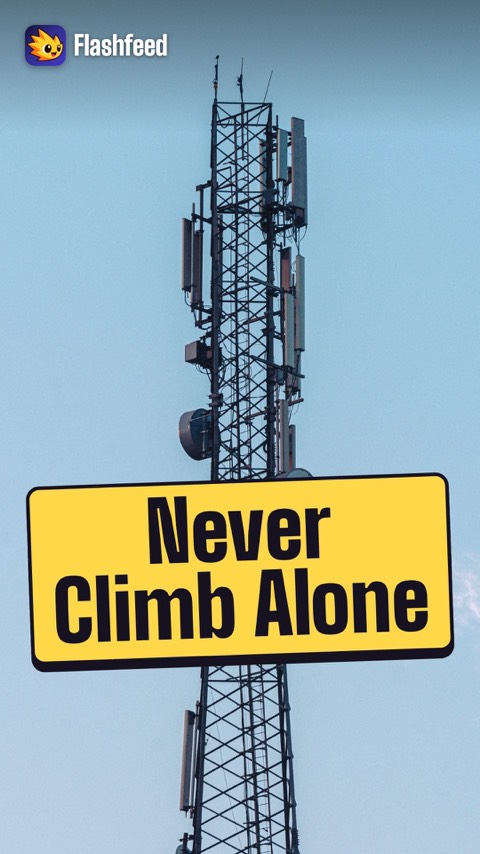
The Helper Rule for Tower Climbs All 4 clips on YouTube ↗Transcripts
Stored Charge After Switch-Off
You switch off a power supply and assume it is safe to open. It isn't, not yet.
Inside, its filter capacitors can still hold charge. That stored charge is the hazard that remains.
Turning the supply off does not remove that charge. A supply is not safe the instant it is turned off.
So its capacitors must be fully discharged before anyone works inside the equipment.
The Helper Rule for Tower Climbs
Could you climb a tower alone, if the job is small? Never. Not without a helper.
A job no more than 20 feet up still needs a helper or observer.
The rule holds even when no electrical work or no mechanical work is being done.
A safe climb also needs training, an approved harness, and tie-off to the tower at all times.
Episode 157:06
How do you stay safe from shock, lightning and RF exposure at a ham radio station?
Also on Spotify ↗Apple Podcasts ↗


What you'll be able to do 70 objectives, from the pack's lessons
- Explain the purpose of the Amateur Radio Service, who regulates it, what it prohibits or encourages, and what counts as a space station
- Describe how a license grant is issued and proven, and how beacons, frequency coordinators and RACES operation work
- Identify the bands and band segments where a Technician may operate, including phone, digital and ISS contacts
- Explain CW-only segments, secondary allocations, band-edge practice, SSB use and the power limits for Technicians
- Identify the license classes the FCC issues, vanity and valid call signs, and the rules for international contacts and operating on vessels
- Explain when a new licensee may transmit, the license term, renewal and its grace period, and what follows if the FCC can't reach a licensee by email
- Identify which communications an amateur station may not transmit, including broadcasting, coded messages, music and indecent language
- Explain when a station may be used for sale of equipment, paid operation or news support, what an auxiliary station does, and when it must identify
- Explain who must be the control operator of a station, who designates one, and who is responsible for its operation
- Describe how license class sets privileges, what a control point is, and how automatic and remote control differ
- Explain when, how and in what language a station must identify, and when it must be open for FCC inspection
- Describe third-party communications, repeater responsibility and the requirement for a club station license
- Identify common repeater offsets, the 2-meter FM simplex calling frequency, and what simplex, repeater offset and band plans mean
- Explain what CQ means and how an operator answers one, calls a known station, or announces listening, on a repeater or without one
- Explain how repeater access works, including tones, squelch, reverse and offset, and how to fix common access and audio problems
- Describe DMR talkgroups and color codes, how to share frequencies and simplex channels, and what common Q signals mean
- Describe net operation and formal message handling: net control duties, net practice, traffic, preambles, check and phonetics
- Explain emergency operation: how FCC rules apply, what RACES and ARES are, and how Winlink relays messages by email
- Explain how multipath, vegetation and weather change signals on very high, ultra high and microwave frequencies along a path
- Describe how polarization, the ionosphere and multipath affect signal strength, fading and data errors
- Describe the nature of a radio wave: its electric and magnetic fields, polarization and speed in free space
- Relate wavelength to frequency and identify the HF, VHF and UHF ranges
- Explain the radio horizon, why long-distance ionospheric paths are common on HF, and when the F region carries 10-meter and 6-meter signals
- Identify the scatter, diffraction and tropospheric ducting modes that carry VHF and UHF signals past obstructions or the horizon, and ionospheric sporadic E
- Explain how to power a mobile transceiver and place meters and grounds correctly in a station
- Describe how to connect a computer to a transceiver, how to choose a standing wave ratio (SWR) meter, and what hotspots and electronic keyers do
- Use frequency entry, scanning, squelch, the RIT or clarifier and SSB filter width to find and tune in stations clearly
- Explain microphone gain, filter bandwidth and the setup of DMR and D-STAR digital radios
- Identify the units and terms for current, power, voltage and frequency, and what causes electron flow
- Explain why metals conduct and glass insulates, and describe alternating current, its frequency and resistance
- Convert between metric prefixes for amperes, volts, watts and farads using milli, micro, kilo and pico
- Convert between hertz, kilohertz, megahertz and gigahertz and estimate decibel changes in power
- Identify the terms and units for capacitance, inductance and impedance, and define impedance
- Write frequency unit abbreviations and calculate DC power from voltage and current
- Choose the Ohm's law formula for current, voltage or resistance and calculate resistance
- Calculate current and voltage with Ohm's law and tell series from parallel circuits
- Identify resistors, potentiometers, capacitors and inductors by function, construction and the energy they store
- Describe inductor construction, SPDT and other switch types, and which battery chemistries can be recharged
- Explain how diodes work, how their leads are marked and named, and how LEDs light, and name a component that can act as an electronic switch
- Identify transistor types and electrodes, the FET abbreviation, and what gain means in amplifiers
- Identify a schematic and the basic parts shown in a simple circuit diagram, such as resistors, transistors, lamps and batteries
- Identify the symbols for capacitors, inductors, LEDs, transformers, variable parts and antennas on a schematic
- Explain what rectifiers, relays, regulators, transformers, transistors and meters do in a circuit
- Describe resonant circuits, shielded wire, LED indicators and integrated circuits and what each is used for
- Explain basic receiver and circuit terms: sensitivity, selectivity, mixers, oscillators, VFOs and modulation
- Identify station equipment (transceivers, transverters, amplifiers) and describe what each does and how PTT and mode switches work
- Explain why a station causes interference to broadcast, TV and other receivers and how to reduce it
- Identify causes and cures of over-deviation, distorted audio, RF feedback on a microphone cable, low power from high SWR and interference
- Explain how dummy loads, antenna analyzers and directional wattmeters are used, and what SWR readings such as 1:1 and 4:1 mean
- Describe the effects of high SWR, where feed line loss goes, why coaxial cable fails, and the advantage of foam-dielectric coax
- Identify the meters for voltage, current and resistance, how each connects to a circuit, and how an ohmmeter measures resistance
- Explain safe multimeter and ohmmeter use, what an ohmmeter shows across a capacitor, and how to choose solder and judge joints
- Identify the modulation used for SSB, FM, packet and repeaters, the sideband for weak-signal VHF and UHF work, and how SSB compares with FM
- Compare the bandwidths of CW, SSB, FM voice and fast-scan TV, and name a disadvantage of FM versus SSB
- Explain what satellite beacons, telemetry and tracking programs provide, and how to set uplink power properly
- Describe satellite modes, bands, orbits, Doppler shift and spin fading, and who may receive telemetry
- Explain how direction finding, contests and grid locators are used in operating activities, including good contest practice
- Describe how IRLP, EchoLink, VoIP and gateways link amateur stations over the internet, and how to access them
- Identify common digital and non-voice modes and terms, including FT8, WSJT-X, PSK, CW and NTSC
- Describe how APRS, packet radio, ARQ, DMR and mesh networks send and protect data
- Explain antenna polarization, gain and loading, and identify which antenna types give the most gain
- Describe how length sets resonant frequency and how common portable, mobile and dipole antennas perform
- Identify the usual impedance of coax and why it is the most common feed line, the main connectors and their weatherproofing, and how feed lines compare
- Explain SWR, feed line loss and the role of an antenna tuner, and name causes of loss and SWR changes
- Identify battery hazards, how current through the body harms it, and how to guard against shock and stored charge in station equipment
- Explain what fuses do and how they are sized, how AC wiring is fused and colored, and how grounds and lightning arresters protect a station
- Describe safe practices for climbing towers, and for keeping antennas clear of power lines and off utility poles
- Explain how to ground a tower for lightning protection, and why guy-line turnbuckles are secured with safety wire
- Explain why RF radiation is non-ionizing, what affects exposure and can cause RF burns, and why exposure limits vary with frequency
- Describe how duty cycle affects RF exposure and how a licensee shows and keeps RF safety compliance
Study guide.
The same study guide as in the app, one page for each lesson, with its key facts and a self-test.
- 01The Rules: Licenses, Bands and Call Signs
- 02The Rules: Operating a Station
- 03Operating Procedures
- 04How Radio Waves Travel
- 05Setting Up and Running a Station
- 06Electrical Principles: Current, Voltage and Units
- 07Electrical Principles: Impedance, Power and Ohm's Law
- 08Electronic Components: Parts and Semiconductors
- 09Electronic Components: Schematics and Circuits
- 10Practical Circuits: Radios and Their Common Problems
- 11Practical Circuits: Measuring and Testing
- 12Signals and Emissions: Modes and Satellites
- 13Signals and Emissions: Contests, Linking and Digital Modes
- 14Antennas and Feed Lines
- 15Safety
Built from 30 sources.
Every one of its 1,179 cards cites a source. These are the eight it cites most.
- 2026–2030 Technician question pool ↗
- 47 CFR § 97.3 Definitions ↗
- 47 CFR § 97.113 Prohibited transmissions ↗
- 47 CFR § 97.119 Station identification ↗
- 47 CFR § 97.301 Authorized frequency bands ↗
- 47 CFR § 97.103 Station licensee responsibilities ↗
- 47 CFR § 97.5 Station license required ↗
- 47 CFR § 97.305 Authorized emission types ↗
See all 30 sources
- 2026–2030 Technician question pool ↗
- 47 CFR § 97.3 Definitions ↗
- 47 CFR § 97.113 Prohibited transmissions ↗
- 47 CFR § 97.119 Station identification ↗
- 47 CFR § 97.301 Authorized frequency bands ↗
- 47 CFR § 97.103 Station licensee responsibilities ↗
- 47 CFR § 97.5 Station license required ↗
- 47 CFR § 97.305 Authorized emission types ↗
- 47 CFR § 97.1 Basis and purpose ↗
- 47 CFR § 97.111 Authorized transmissions ↗
- 47 CFR § 97.313 Transmitter power standards ↗
- 47 CFR § 97.101 General standards ↗
- 47 CFR § 97.109 Station control ↗
- 47 CFR § 97.11 Stations aboard ships or aircraft ↗
- 47 CFR § 97.17 Application for new license grant ↗
- 47 CFR § 97.203 Beacon station ↗
- 47 CFR § 97.205 Repeater station ↗
- 47 CFR § 97.21 Application for a modified or renewed license grant ↗
- 47 CFR § 97.215 Telecommand of model craft ↗
- 47 CFR § 97.23 Mailing and email addresses ↗
- 47 CFR § 97.303 Frequency sharing requirements ↗
- 47 CFR § 97.407 Radio amateur civil emergency service ↗
- 47 CFR § 97.7 Control operator required ↗
- 47 CFR § 1.949 Application for renewal of authorization ↗
- 47 CFR § 97.115 Third party communications ↗
- 47 CFR § 97.117 International communications ↗
- 47 CFR § 97.19 Application for a vanity call sign ↗
- 47 CFR § 97.201 Auxiliary station ↗
- 47 CFR § 97.211 Space telecommand station (see also §§ 97.113 Prohibited transmissions and 97.215 Telecommand of model craft) ↗
- 47 CFR § 97.25 License term ↗
Hover over a photo, or tap its i, to see where it came from. All 15:
- Lesson 1: Wikimedia Commons · NASA Johnson Space Center · Public domain ↗
- Lesson 2: FlashFeed original diagram · CC-BY-4.0
- Lesson 3: FlashFeed original diagram · CC-BY-4.0
- Lesson 4: FlashFeed original diagram · CC-BY-4.0
- Lesson 5: Wikimedia Commons · 魔私利戸 · CC BY-SA 4.0 ↗
- Lesson 6: Wikimedia Commons · Bill "Hemingray" Meier at English Wikipedia · Public domain ↗
- Lesson 7: FlashFeed original diagram · CC-BY-4.0
- Lesson 8: Wikimedia Commons · Evan-Amos · Public domain ↗
- Lesson 9: Wikimedia Commons · Retired electrician · CC0 ↗
- Lesson 10: Wikimedia Commons · Hp.Baumeler · CC BY-SA 4.0 ↗
- Lesson 11: Wikimedia Commons · Karl-Martin Skontorp from Norway · CC BY 2.0 ↗
- Lesson 12: FlashFeed original diagram · CC-BY-4.0
- Lesson 13: Wikimedia Commons · Lz1adf · CC BY-SA 3.0 ↗
- Lesson 14: Wikimedia Commons · Adityamadhav83 · CC BY-SA 4.0 ↗
- Lesson 15: Wikimedia Commons · André Karwath aka Aka · CC BY-SA 2.5 ↗
- Cards
- 1,179
- Lessons
- 15
- Version
- 1.0.11
- Language
- English
The whole pack is one file. Read the pack file ↗
FlashFeed is on the App Store and Google Play.
FlashFeed is free on iPhone and Android, and needs no account.