
Ham Radio Technician License study guide · Lesson 4 of 15
How Radio Waves Travel
How radio signals travel · Wavelength, frequency and radio waves · Propagation modes and the radio horizon
This is the lesson's study guide from the FlashFeed app, plus its key facts and a self-test.
What you'll be able to do
- Explain how multipath, vegetation and weather change signals on very high, ultra high and microwave frequencies along a path
- Describe how polarization, the ionosphere and multipath affect signal strength, fading and data errors
- Describe the nature of a radio wave: its electric and magnetic fields, polarization and speed in free space
- Relate wavelength to frequency and identify the HF, VHF and UHF ranges
- Explain the radio horizon, why long-distance ionospheric paths are common on HF, and when the F region carries 10-meter and 6-meter signals
- Identify the scatter, diffraction and tropospheric ducting modes that carry VHF and UHF signals past obstructions or the horizon, and ionospheric sporadic E
This lesson explains how a radio signal gets from one antenna to another. It covers what a radio wave is made of and how its wavelength relates to its frequency. It also covers the paths a signal can take: straight across, bounced off obstacles, reflected by the upper atmosphere or bent past the horizon. A new licensee who knows these paths can choose a band, an antenna and a time of day that suit the contact.
How radio signals travel
Radio signals rarely take one clean path. Buildings, trees, weather and the upper atmosphere all change what a receiver hears. The facts below are grouped by cause.
Multipath and fading
Multipath propagation means a signal reaches the receiver by more than one path. The signals from the different paths combine at the antenna, and multipath propagation cancels or reinforces signals. For this reason, very high frequency (VHF) signal strength can vary greatly when an antenna is moved only a few feet.
Picket fencing is the rapid flutter heard on mobile signals due to multipath propagation.
A reflected path can also be useful. A station with a directional antenna may be blocked from a distant repeater by buildings or other obstructions. That station can try to find a path that reflects signals to the repeater.
Multipath also explains fading on longer paths. A likely cause of irregular fading of signals propagated by the ionosphere is random combining of signals arriving via different paths.
Multipath matters for data as well. Multipath propagation makes error rates likely to increase on data transmissions.
The ionosphere
The ionosphere is the region of the atmosphere that can reflect high frequency (HF) radio waves.
Absorption by vegetation and weather
Vegetation absorbs ultra high frequency (UHF) and microwave signals, which leads to poor reception of weak signals.
Weather matters as well. Precipitation might decrease range at microwave frequencies.
The 10-meter and 6-meter bands differ. Fog or rain has little effect on 10-meter and 6-meter band signals.
Antenna polarization
The polarization of a radio wave is the way its electric field is oriented. The next section looks at this more closely. Antenna polarization is a choice, and it matters on some paths more than others. The two modes named below are CW (international Morse code telegraphy) and single sideband (SSB).
For long-distance CW and SSB contacts on the VHF and UHF bands, horizontal polarization is normally used.
Mismatched polarization costs signal. Cross-polarization of the antennas over a line-of-sight VHF or UHF path reduces received signal strength.
Ionospheric paths are more forgiving. Signals propagated by the ionosphere are elliptically polarized. As a result, either vertically or horizontally polarized antennas may be used for transmission or reception.
Sources
Wavelength, frequency and radio waves
A radio wave is an electromagnetic wave. Its parts, its speed and the link between its frequency and its length are the foundation for the band names a licensee uses every day.
What a radio wave is made of
A radio wave has two components: electric and magnetic fields. The two fields are at right angles to each other.
Polarization is defined by the orientation of the electric field. Over a line-of-sight VHF or UHF path, antennas of crossed polarization reduce received signal strength.
How fast radio waves travel
In free space, a radio wave travels at the speed of light. That is approximately 300,000,000 meters per second. Every radio frequency travels at the same velocity in free space.
Wavelength and frequency
The wavelength of a wave is related to its frequency. Wavelength gets shorter as frequency increases.
To convert a frequency to an approximate wavelength, divide 300 by the frequency in megahertz (MHz). The result is the wavelength in meters. A signal at 30 MHz therefore has a wavelength of about 10 meters. A signal at 300 MHz has a wavelength of about 1 meter. The higher frequency gives the shorter wavelength.
This link explains how amateur bands are named. In addition to frequency, the approximate wavelength in meters identifies a band. That is why a licensee speaks of "the 2-meter band" or "10 meters".
HF, VHF and UHF
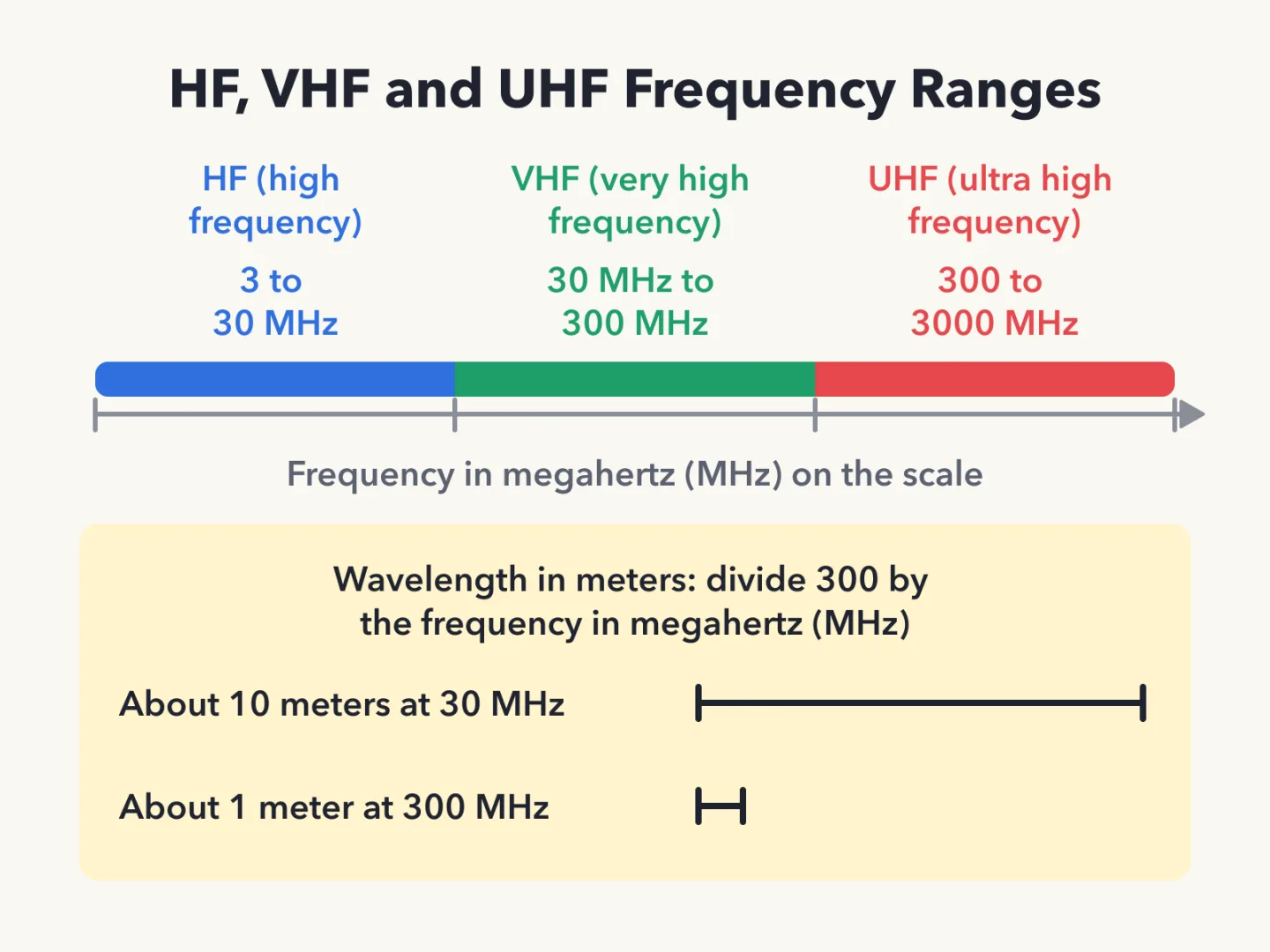
Three frequency ranges come up constantly. Each runs from one figure to ten times that figure:
- HF (high frequency): 3 to 30 MHz.
- VHF (very high frequency): 30 MHz to 300 MHz.
- UHF (ultra high frequency): 300 to 3000 MHz.
All three ranges are measured in megahertz. The ranges also line up with the formula above. As frequency rises from HF through VHF to UHF, wavelength shortens.
Sources
Propagation modes and the radio horizon
Beyond the direct path, signals can reach farther by several modes. Which one applies depends on the band, the time of day and conditions in the atmosphere. Each mode has its own signature.
The radio horizon
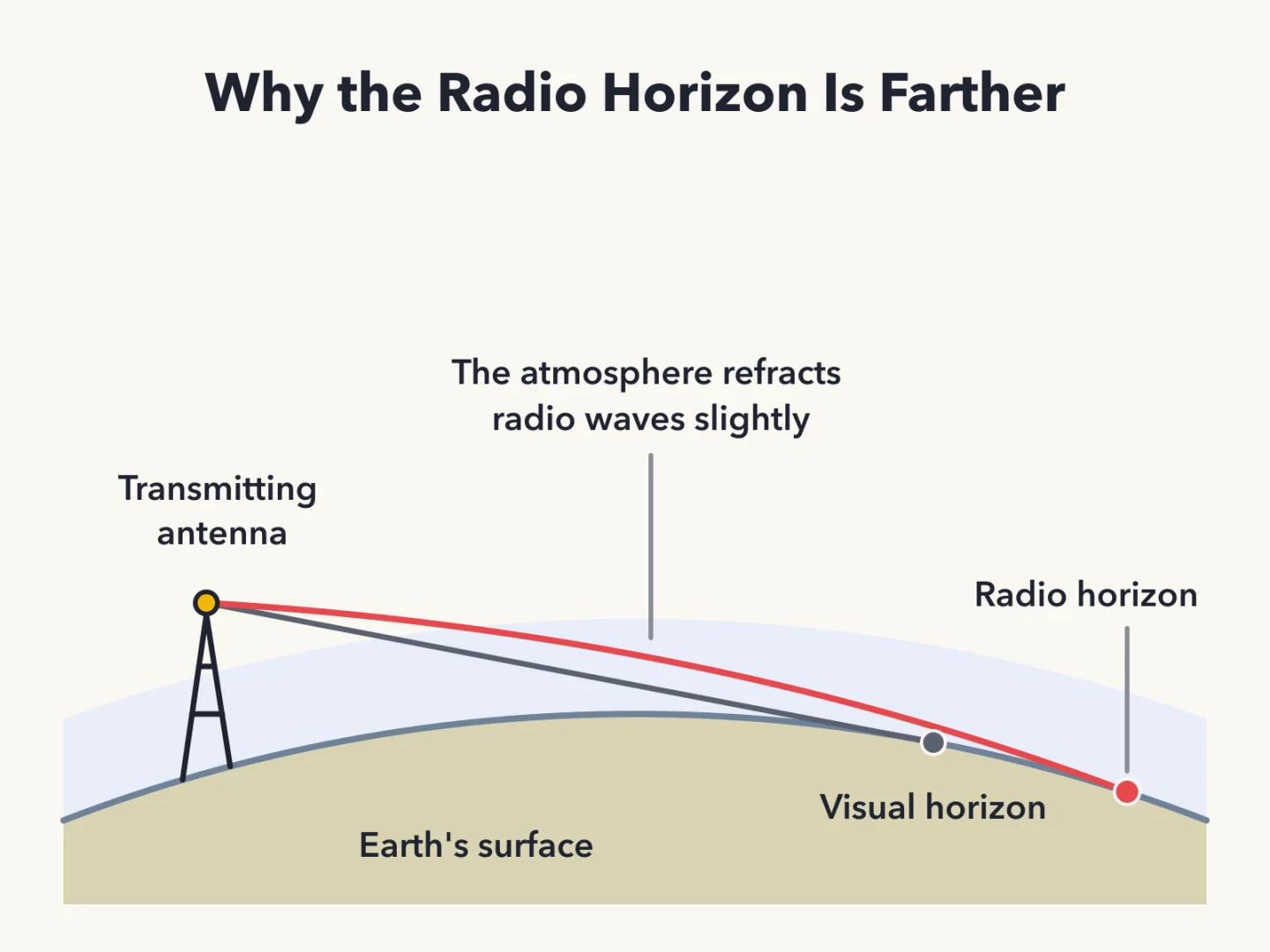
The radio horizon for VHF and UHF signals is more distant than the visual horizon. The reason is that the atmosphere refracts radio waves slightly.
UHF signals are usually not propagated by the ionosphere, so simplex UHF signals are rarely heard beyond their radio horizon.
HF and the F region
Long-distance ionospheric propagation is far more common on HF than on VHF and higher frequencies.
A term defined in the Federal Communications Commission (FCC) rules (47 CFR § 97.3, as of 2026) is bandwidth, which is the width of a frequency band outside of which the mean power of the transmitted signal is attenuated at least 26 dB below the mean power of the transmitted signal within the band.
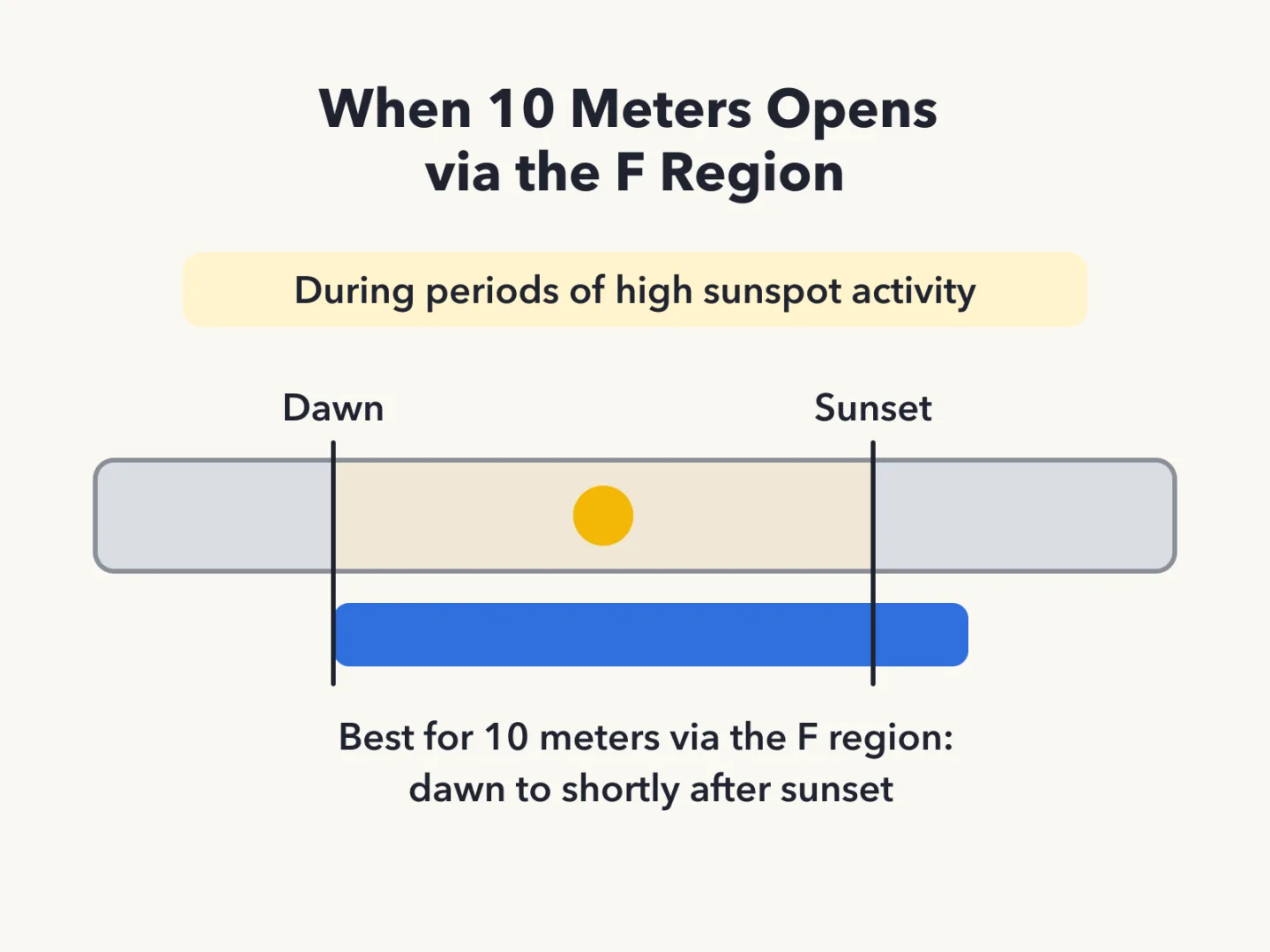
The best time for long-distance 10-meter band propagation via the F region of the ionosphere is from dawn to shortly after sunset during periods of high sunspot activity.
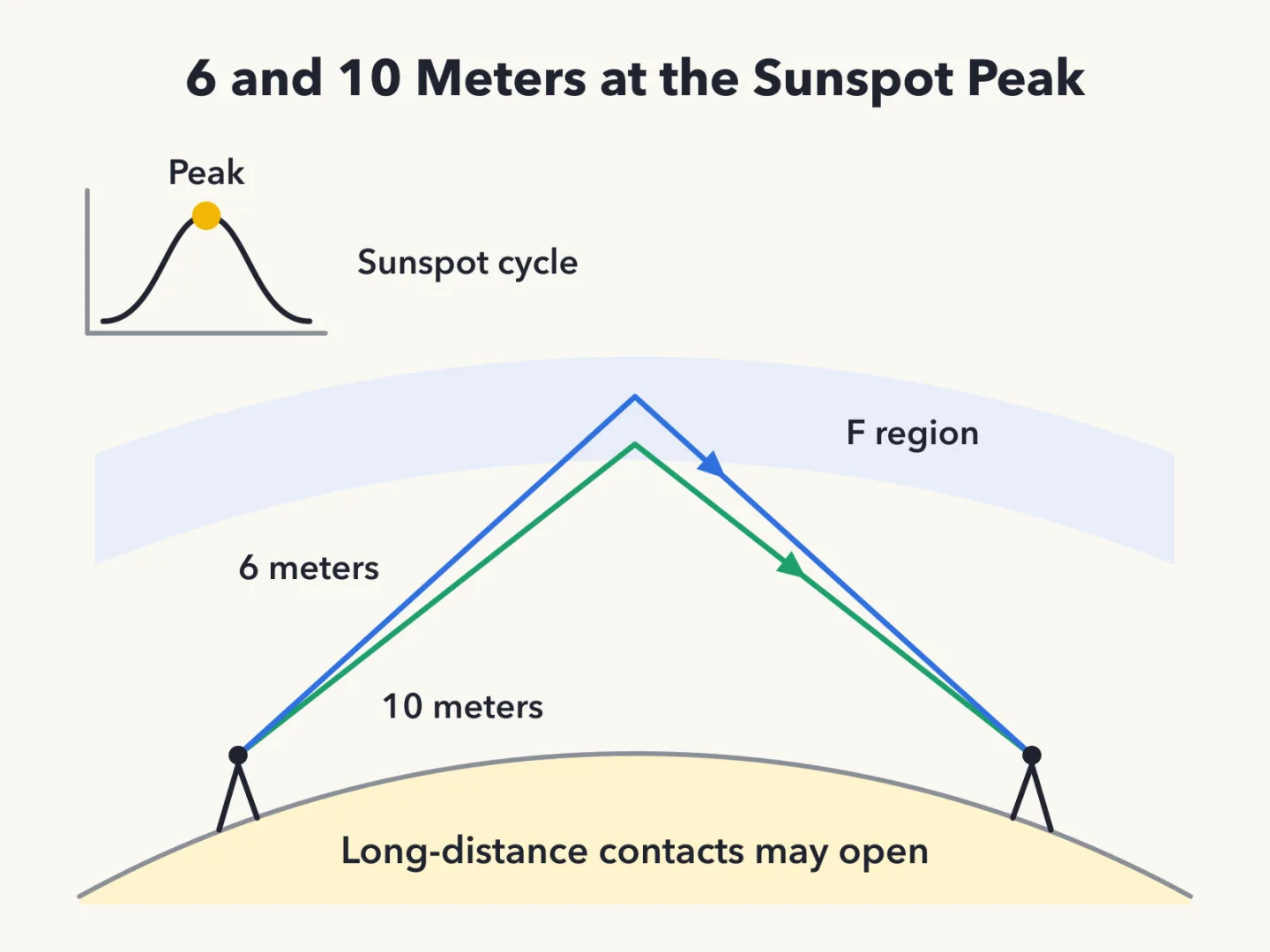
At the peak of the sunspot cycle, the 6-meter and 10-meter bands may provide long-distance communications via the F region.
Scatter modes and sporadic E
In auroral backscatter, VHF signals are distorted, with a characteristic raspy sound.
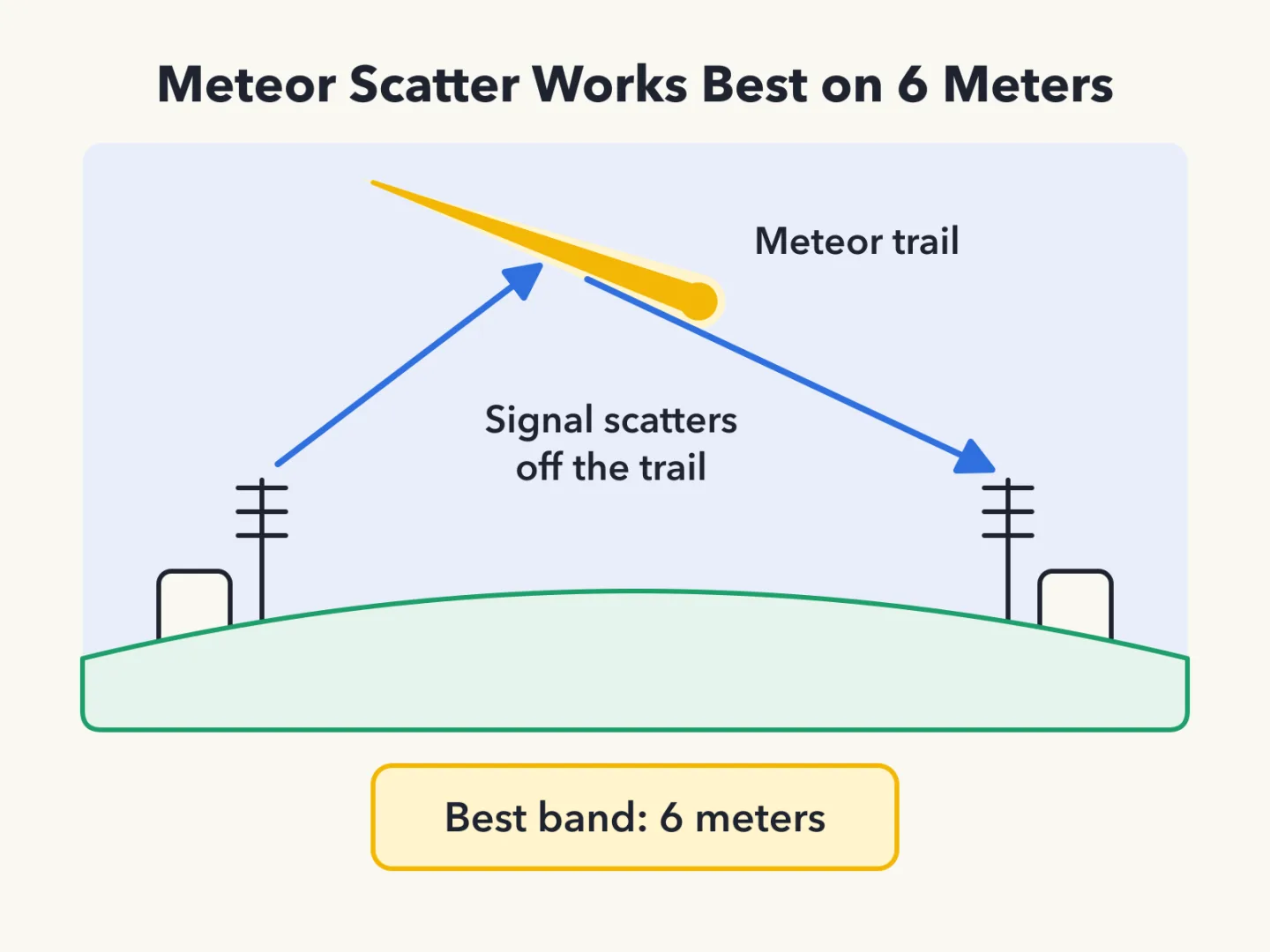
Meteor scatter is best suited to the 6-meter band.
Sporadic E is the type of propagation most commonly associated with occasional strong signals on the 10-, 6- and 2-meter bands from beyond the radio horizon.
Diffraction and ducting
Knife-edge diffraction may allow radio signals to travel beyond obstructions between the transmitting and receiving stations.
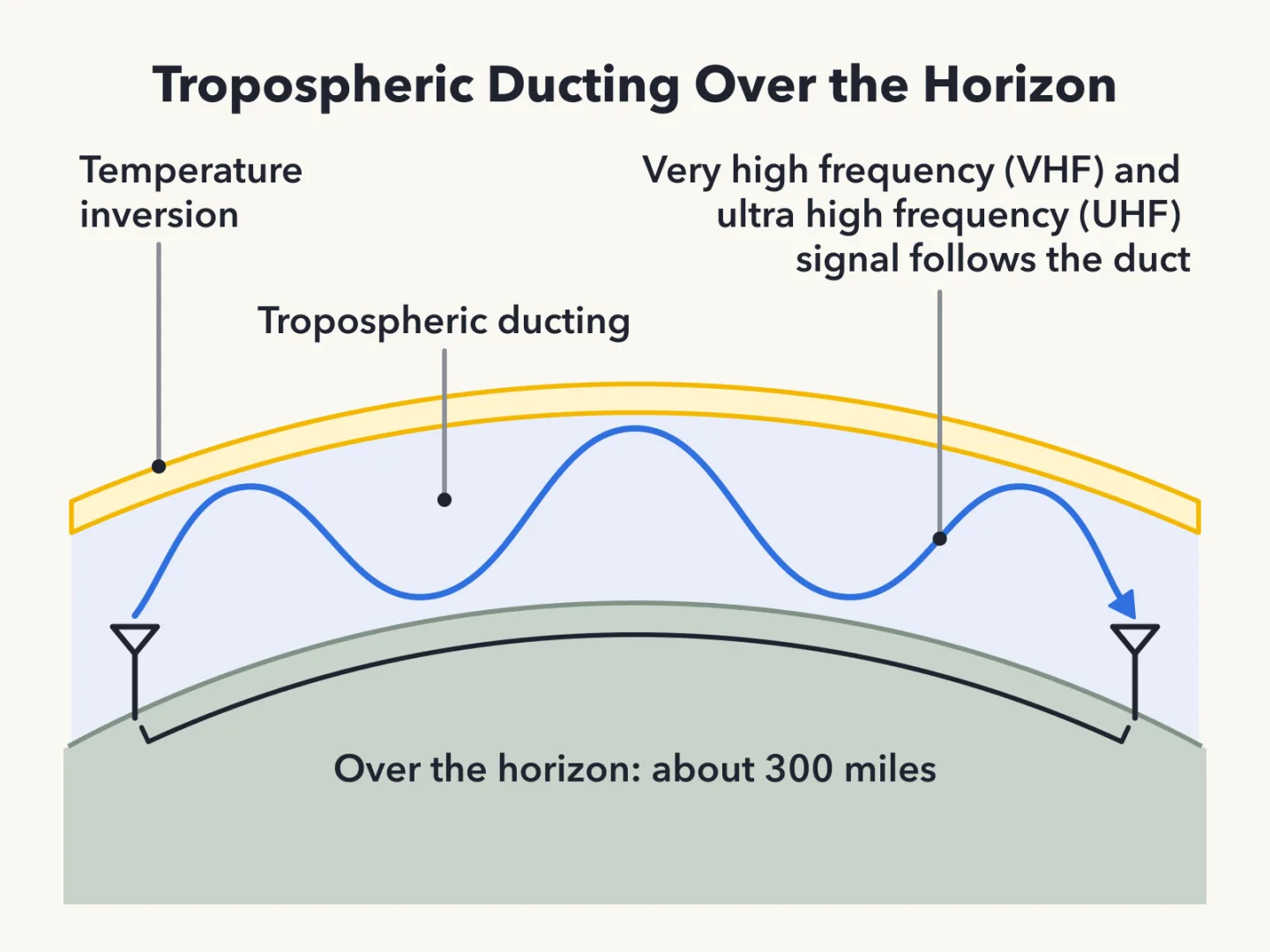
Tropospheric ducting is responsible for over-the-horizon VHF and UHF communications to ranges of approximately 300 miles on a regular basis.
Tropospheric ducting is caused by temperature inversions in the atmosphere.
Sources
Key terms
- Bandwidth
- Span of frequencies outside which a transmitted signal's mean power is attenuated at least 26 dB below its mean power inside that span
Key facts
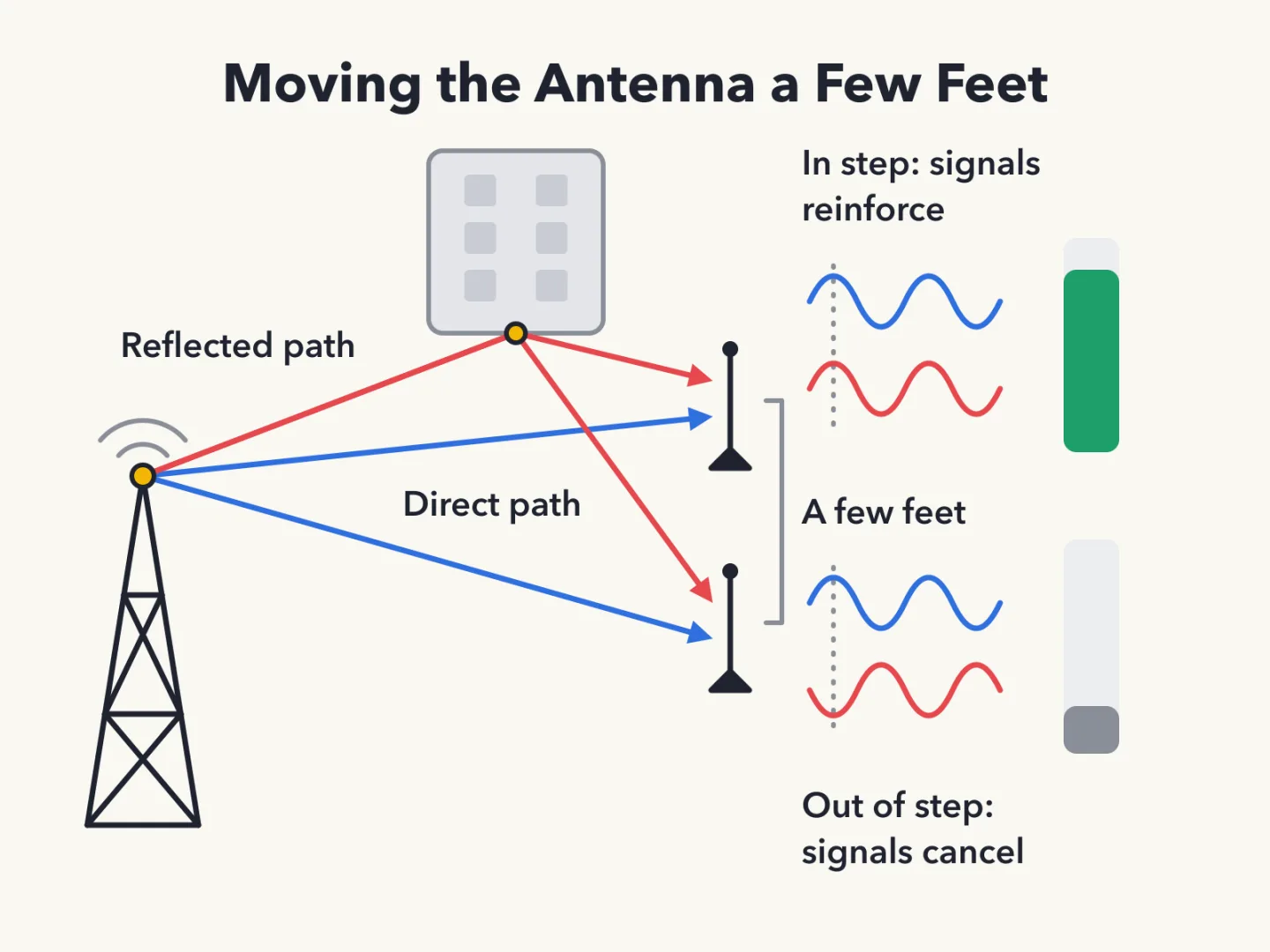
Why Signals Change Over Feet
Multipath propagation means a signal reaches the receiver by more than one path. The signals from the different paths combine at the antenna, and they cancel or reinforce each other. That is why very high frequency (VHF) signal strength can vary greatly when an antenna is moved only a few feet.
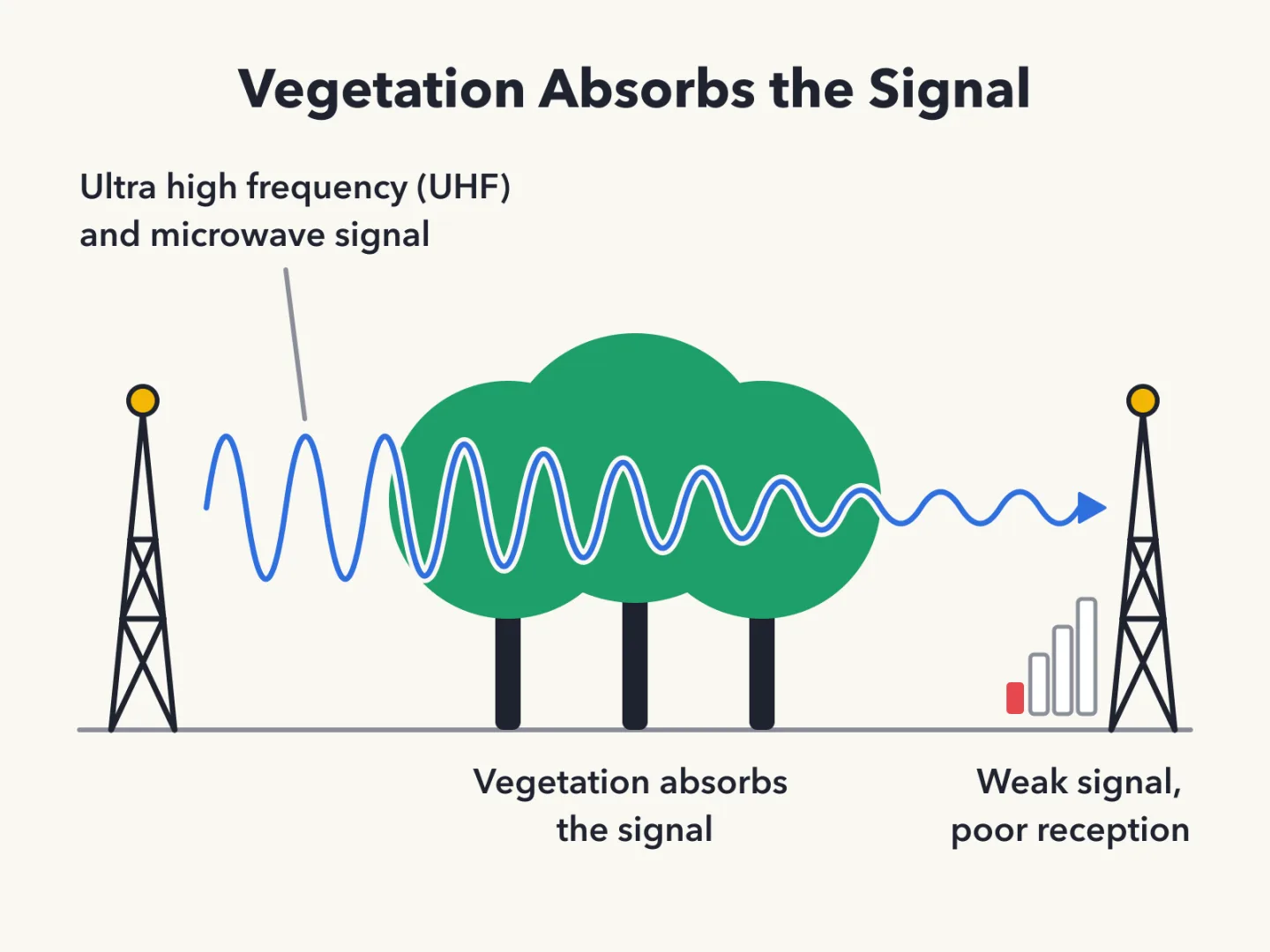
Vegetation and Microwave Signals
Vegetation absorbs ultra high frequency (UHF) and microwave signals. The result is poor reception of weak signals.
Polarization for Long-Distance Contacts
Long-distance contacts by CW (international Morse code telegraphy) and single sideband (SSB) on the very high frequency (VHF) and ultra high frequency (UHF) bands normally use horizontal polarization.
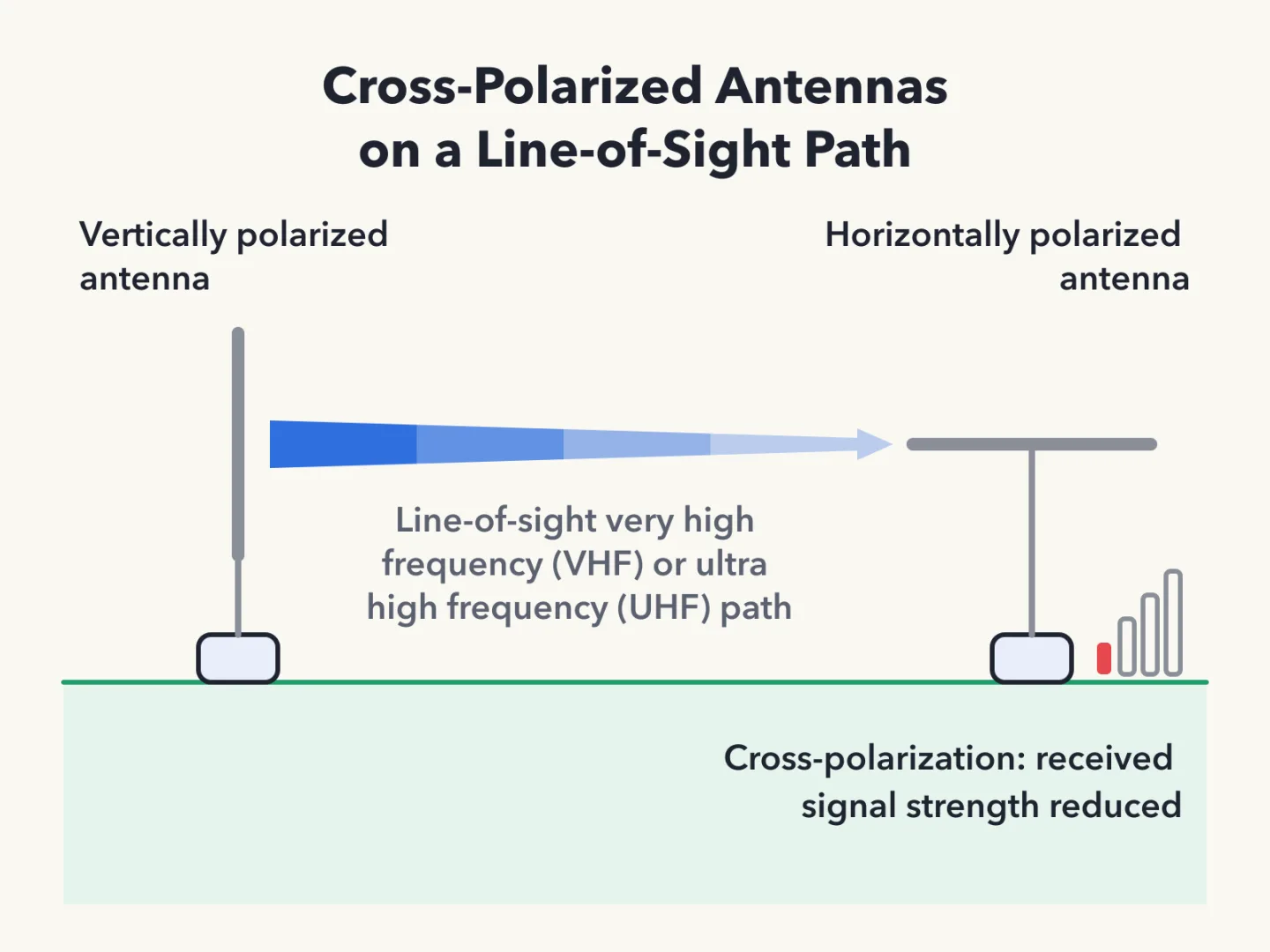
Cost of Cross-Polarization
Cross-polarization of the antennas over a line-of-sight very high frequency (VHF) or ultra high frequency (UHF) path reduces received signal strength.
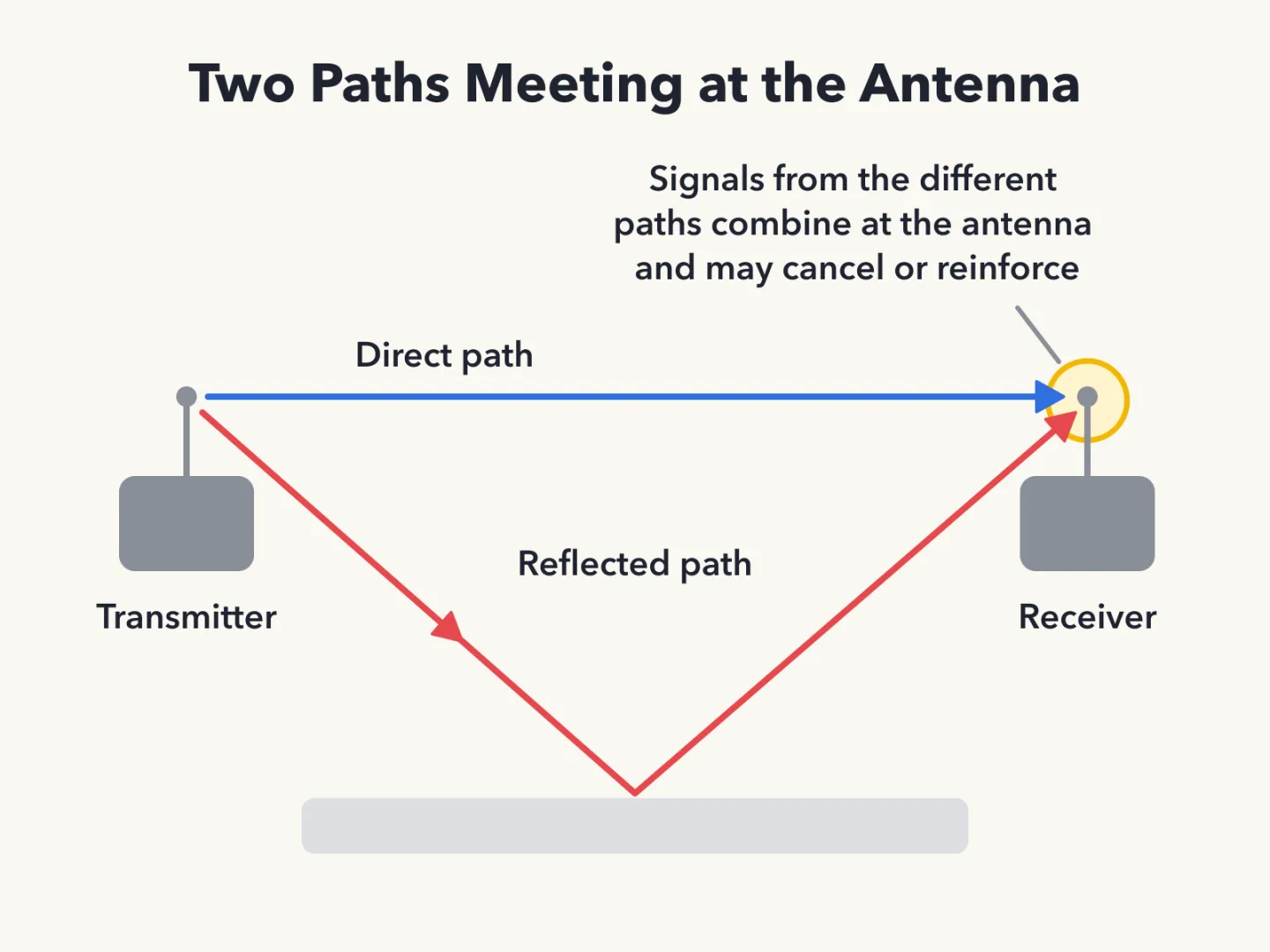
Reaching a Repeater Around Obstacles
A station with a directional antenna may be blocked from a distant repeater by buildings or other obstructions. That station can try to find a reflected path that carries signals to the repeater.
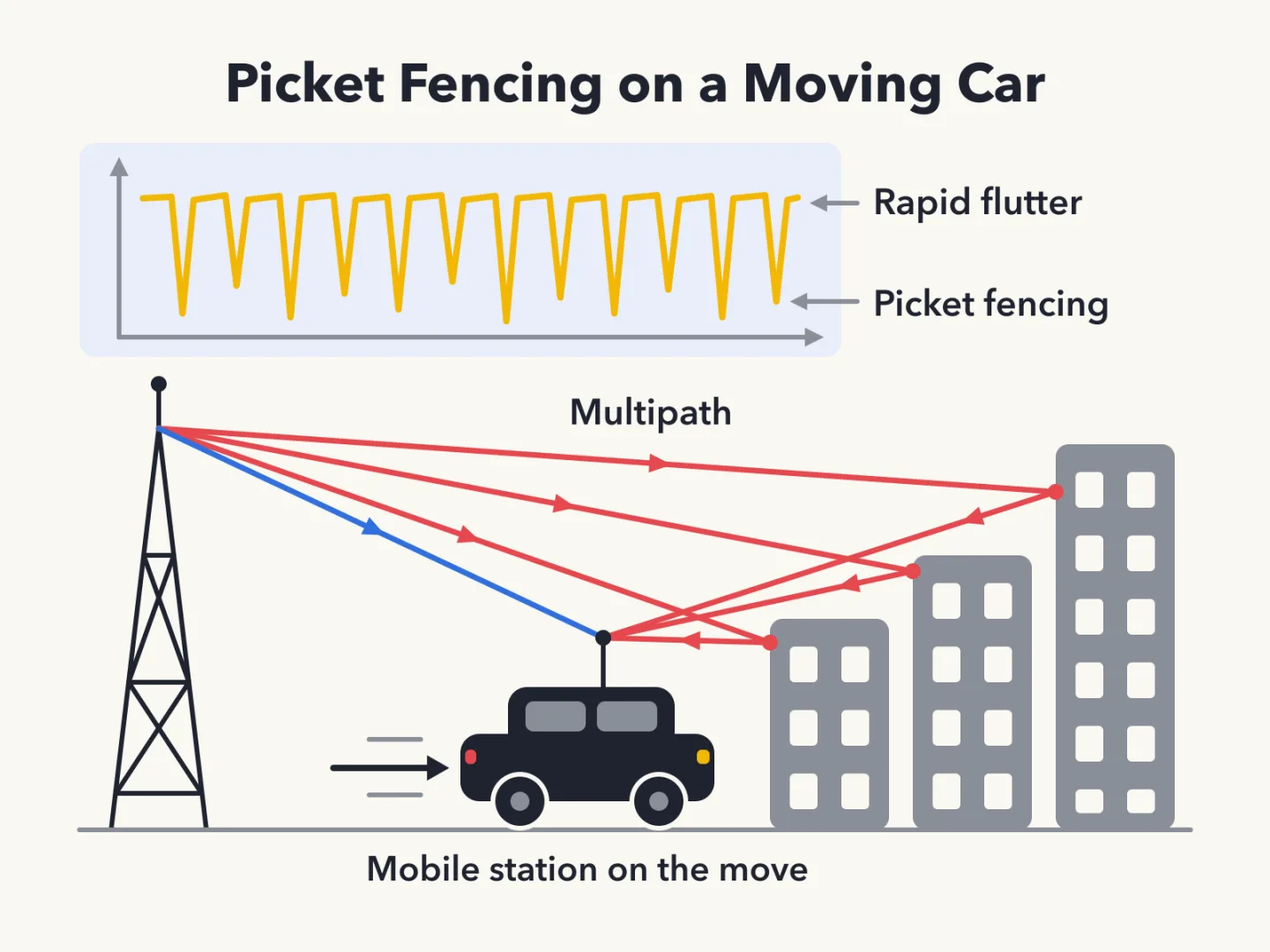
Picket Fencing on Mobile Signals
Picket fencing is the rapid flutter heard on mobile signals due to multipath propagation.
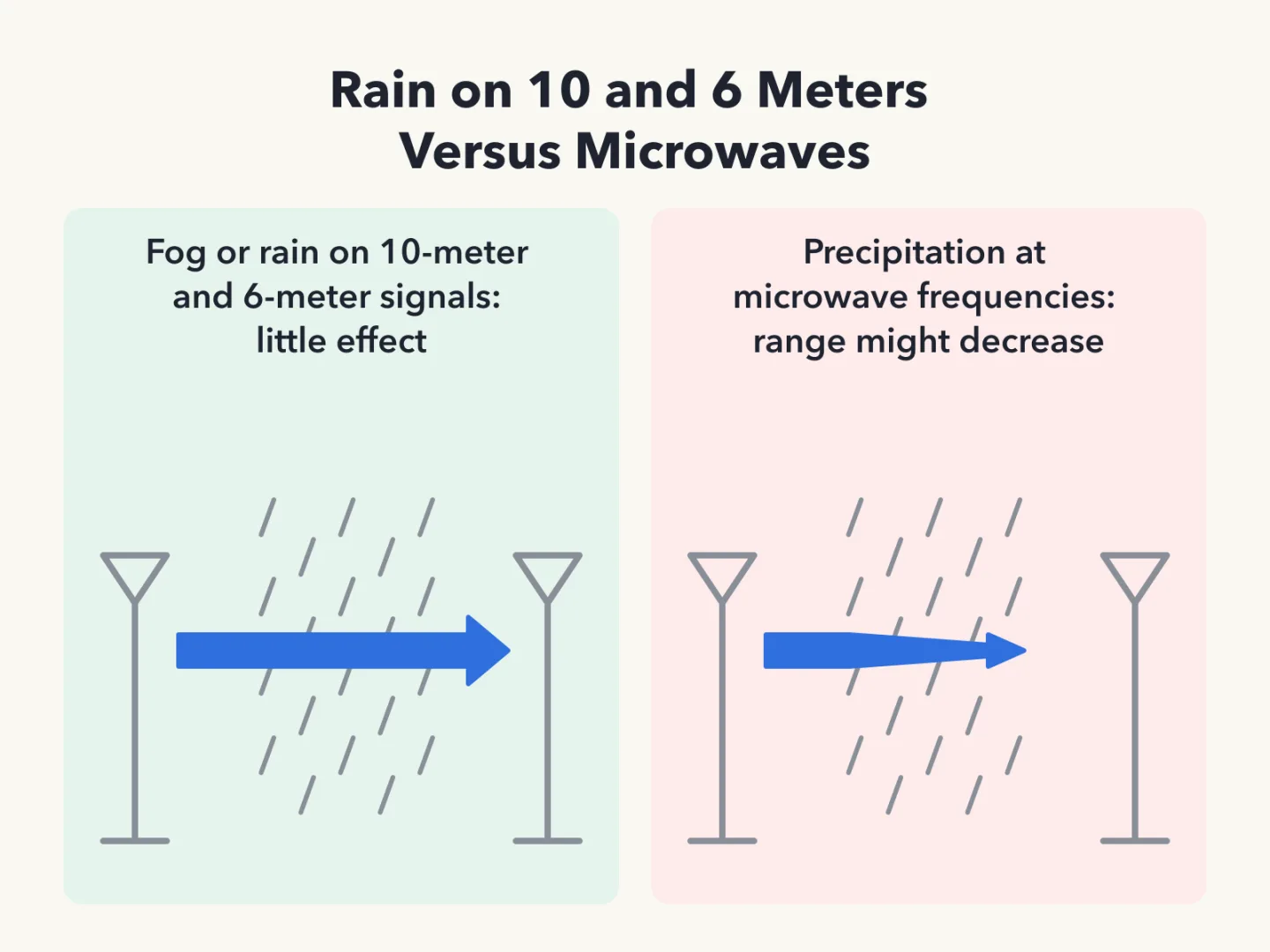
Weather That Shortens Microwave Range
Precipitation might decrease range at microwave frequencies.
Irregular Fading on Ionospheric Paths
A likely cause of irregular fading of signals propagated by the ionosphere is random combining of signals arriving via different paths.
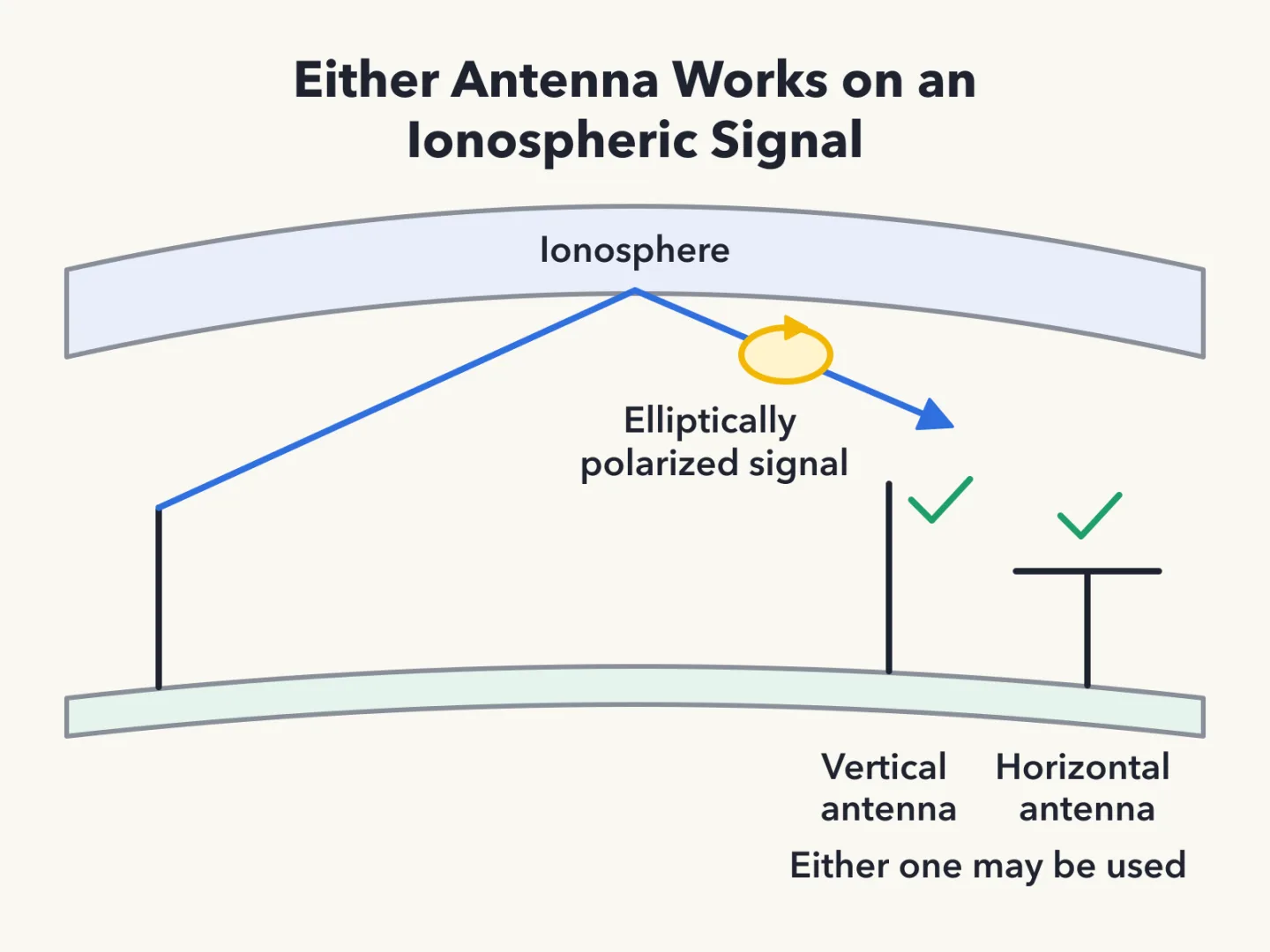
Ionospheric Signals Are Elliptically Polarized
Signals propagated by the ionosphere are elliptically polarized. As a result, either vertically or horizontally polarized antennas may be used for transmission or reception.
Multipath and Data Errors
Multipath propagation makes error rates likely to increase on data transmissions.
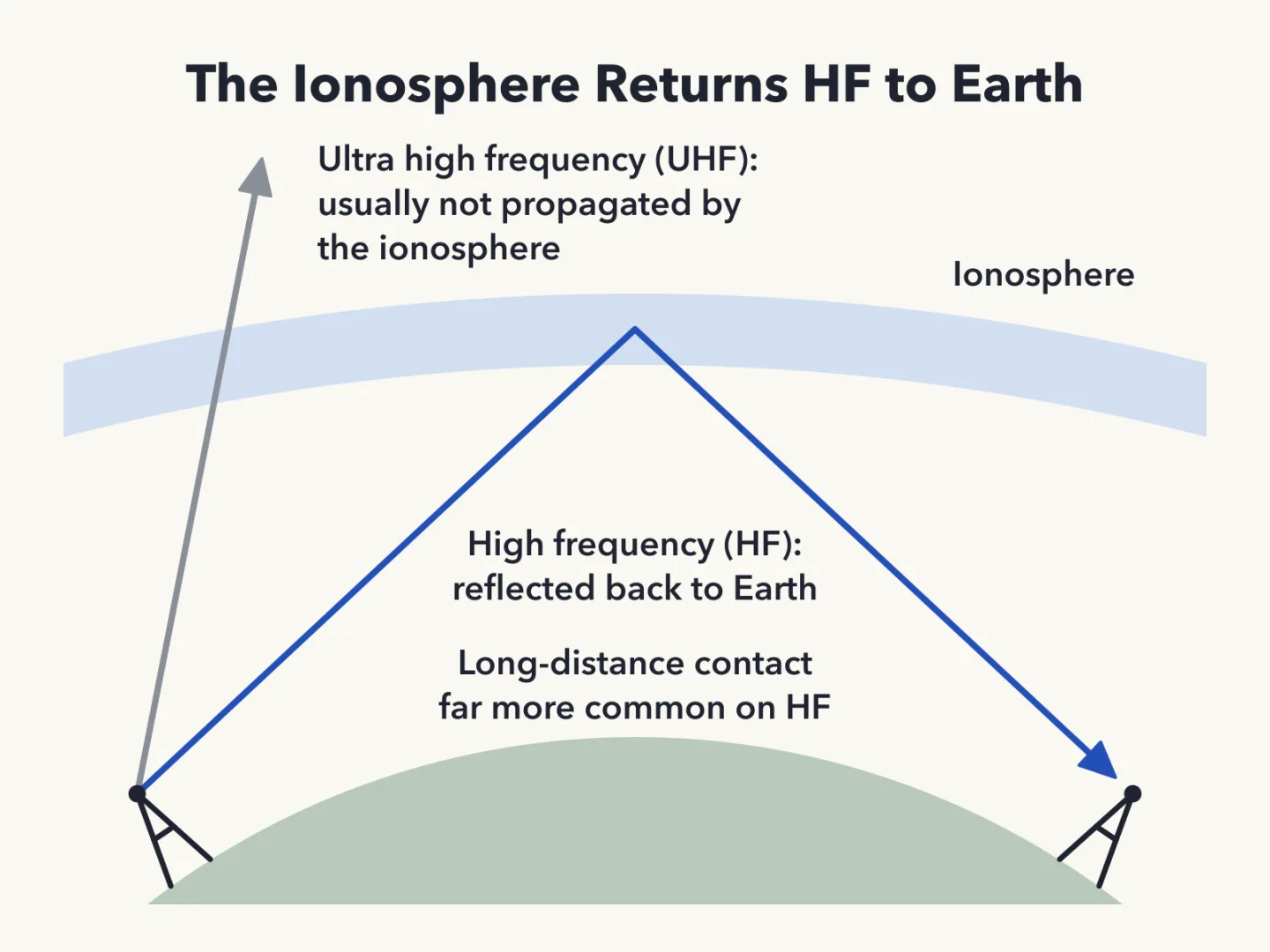
The Region That Reflects HF
The ionosphere is the region of the atmosphere that can reflect high frequency (HF) radio waves.
Fog and Rain on 10 and 6 Meters
Fog or rain has little effect on 10-meter and 6-meter band signals.
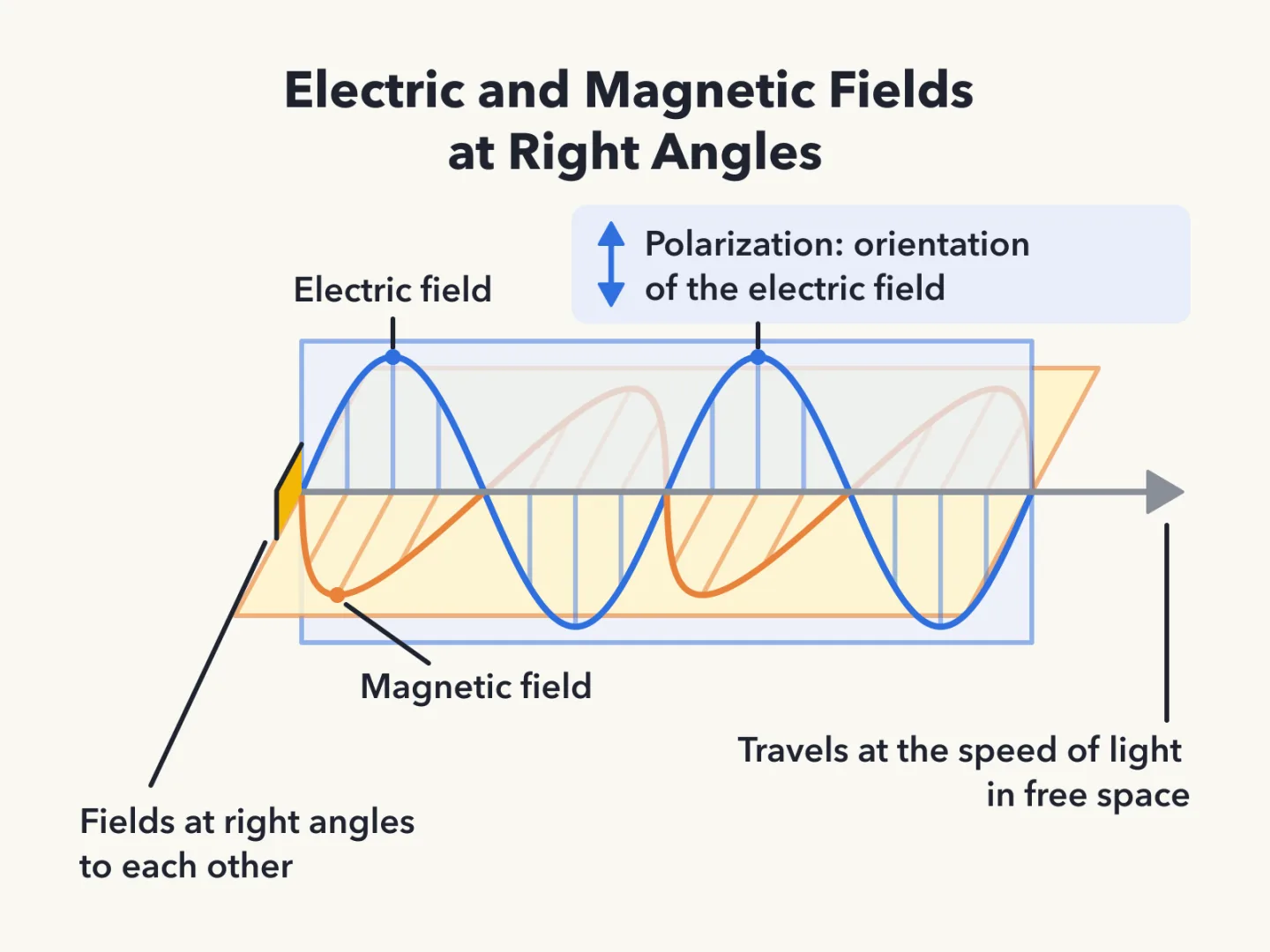
Fields at Right Angles
The electric and magnetic fields of a radio wave are at right angles to each other.
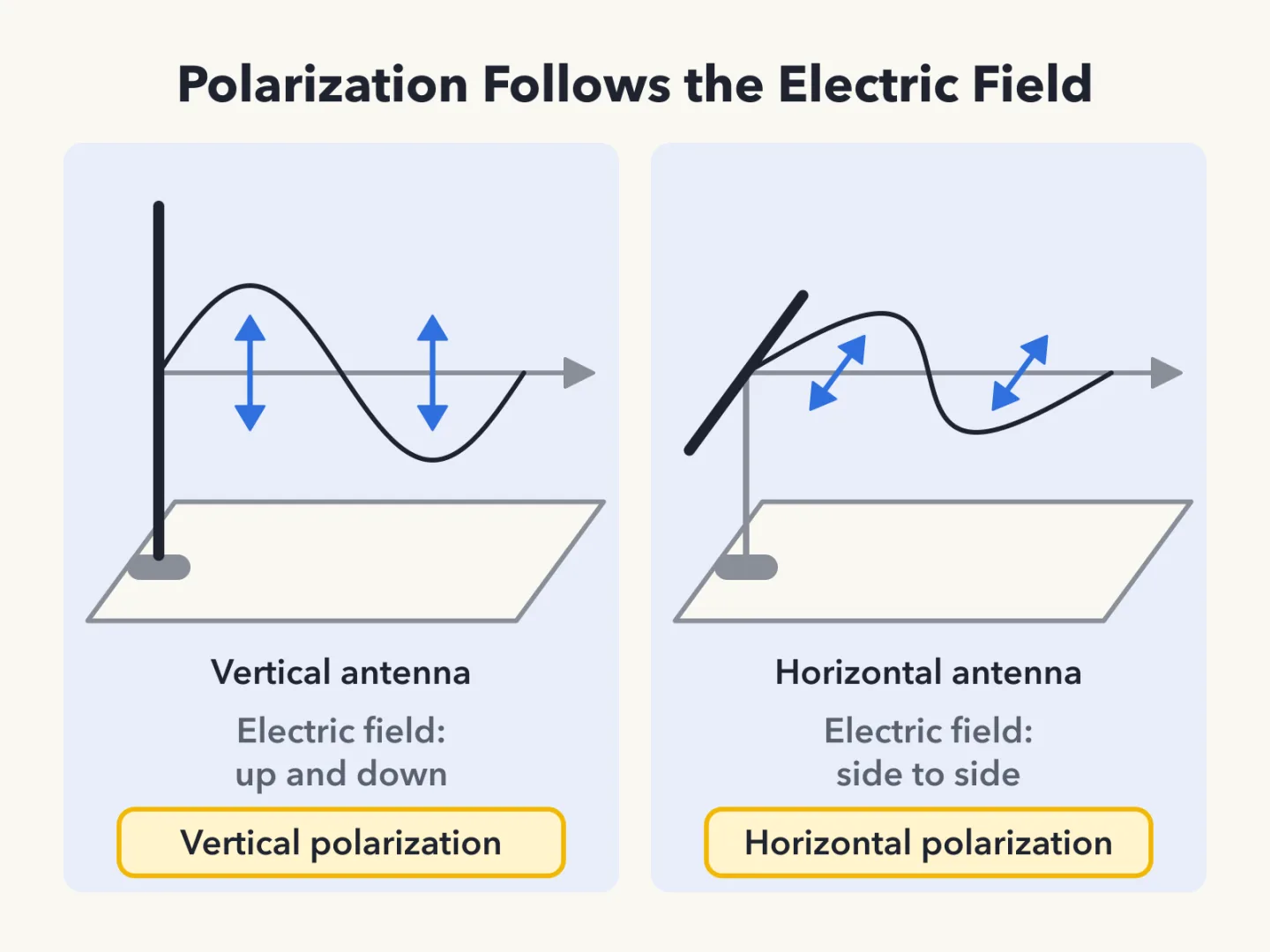
What Defines Polarization
Polarization is defined by the orientation of the electric field.
Two Parts of a Radio Wave
A radio wave has two components: electric and magnetic fields.
Radio Waves Move at Light Speed
In free space, a radio wave travels at the speed of light.
Higher Frequency, Shorter Wavelength
The wavelength of a wave is related to its frequency. Wavelength gets shorter as frequency increases.
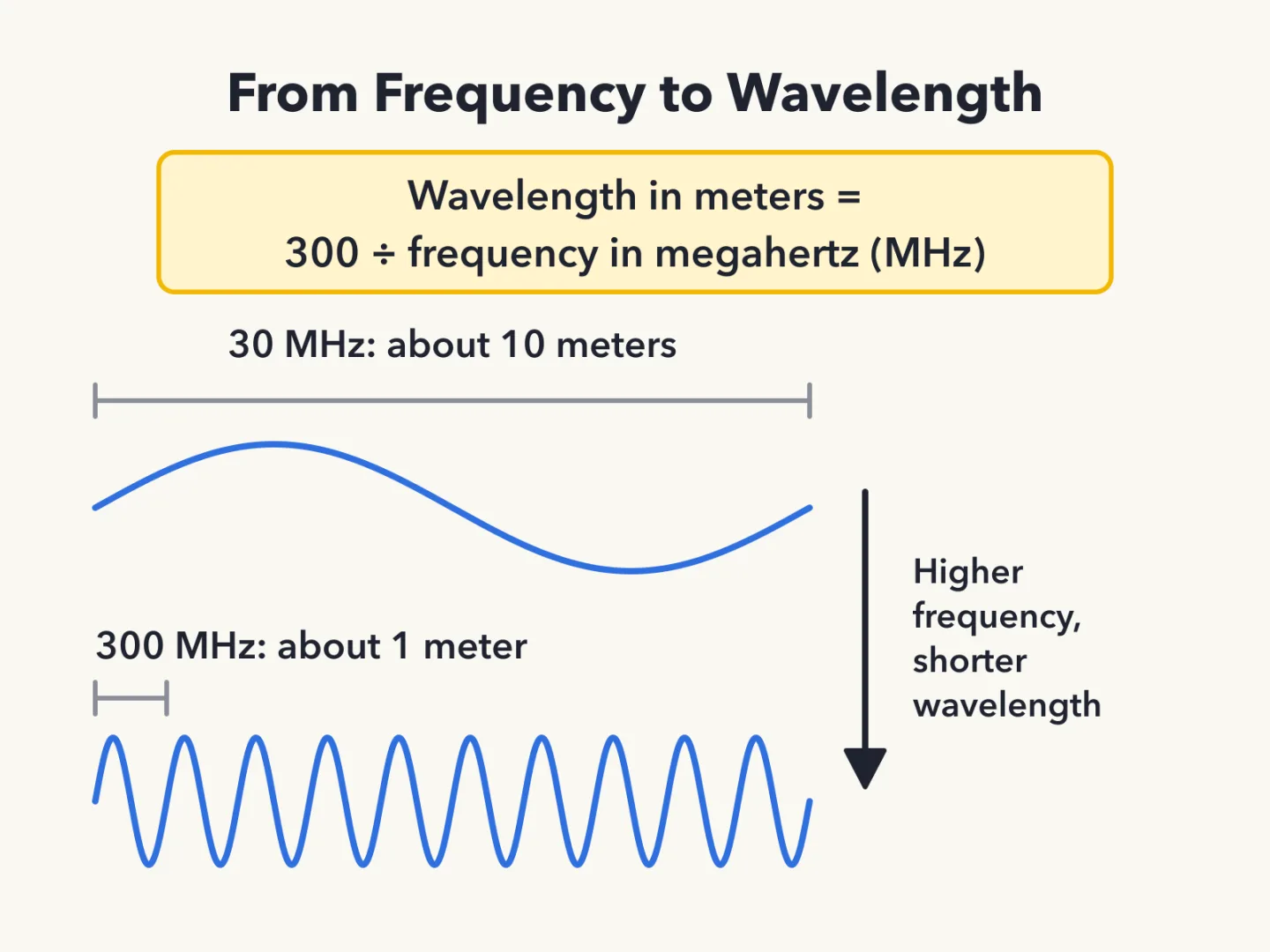
Converting Frequency to Wavelength
To convert a frequency to an approximate wavelength, divide 300 by the frequency in megahertz (MHz). The result is the wavelength in meters. A signal at 30 MHz has a wavelength of about 10 meters, and one at 300 MHz about 1 meter.
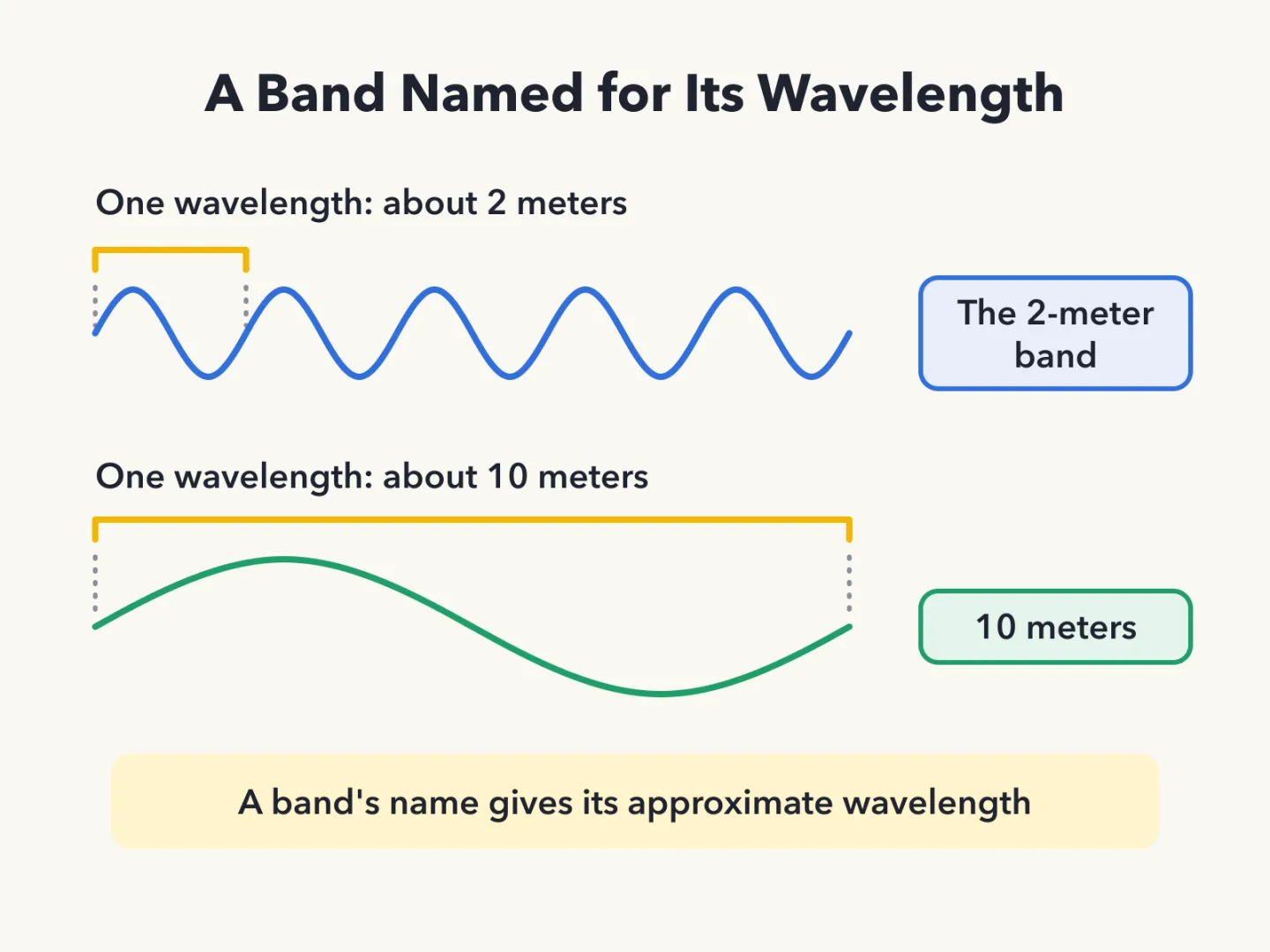
Naming Bands by Wavelength
In addition to frequency, the approximate wavelength in meters identifies an amateur radio band. That is why a licensee speaks of the "2-meter band" or "10 meters".
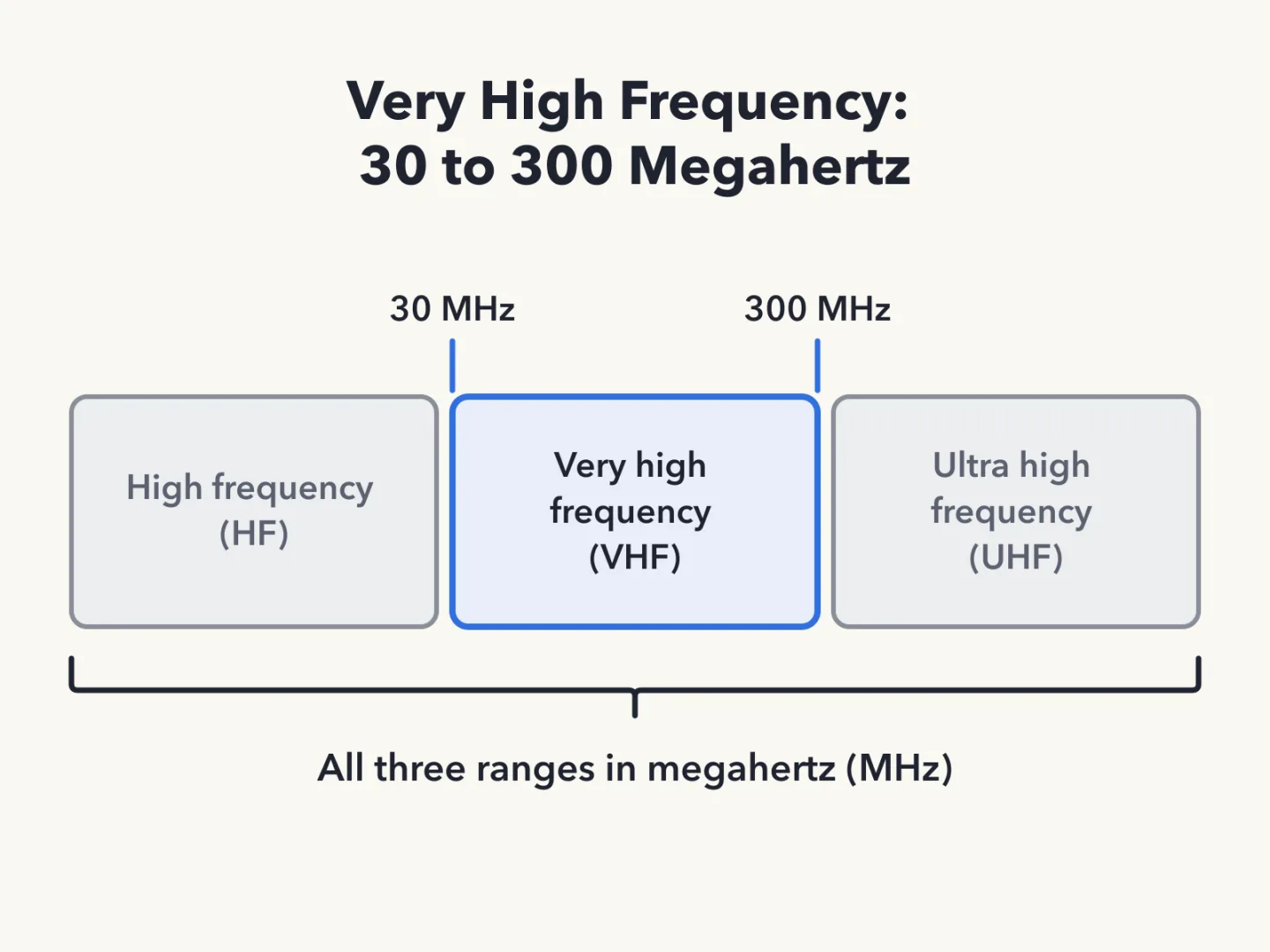
The Very High Frequency Range
Very high frequency (VHF) covers 30 megahertz (MHz) to 300 MHz. All three ranges, high frequency (HF), VHF and ultra high frequency (UHF), are measured in megahertz.
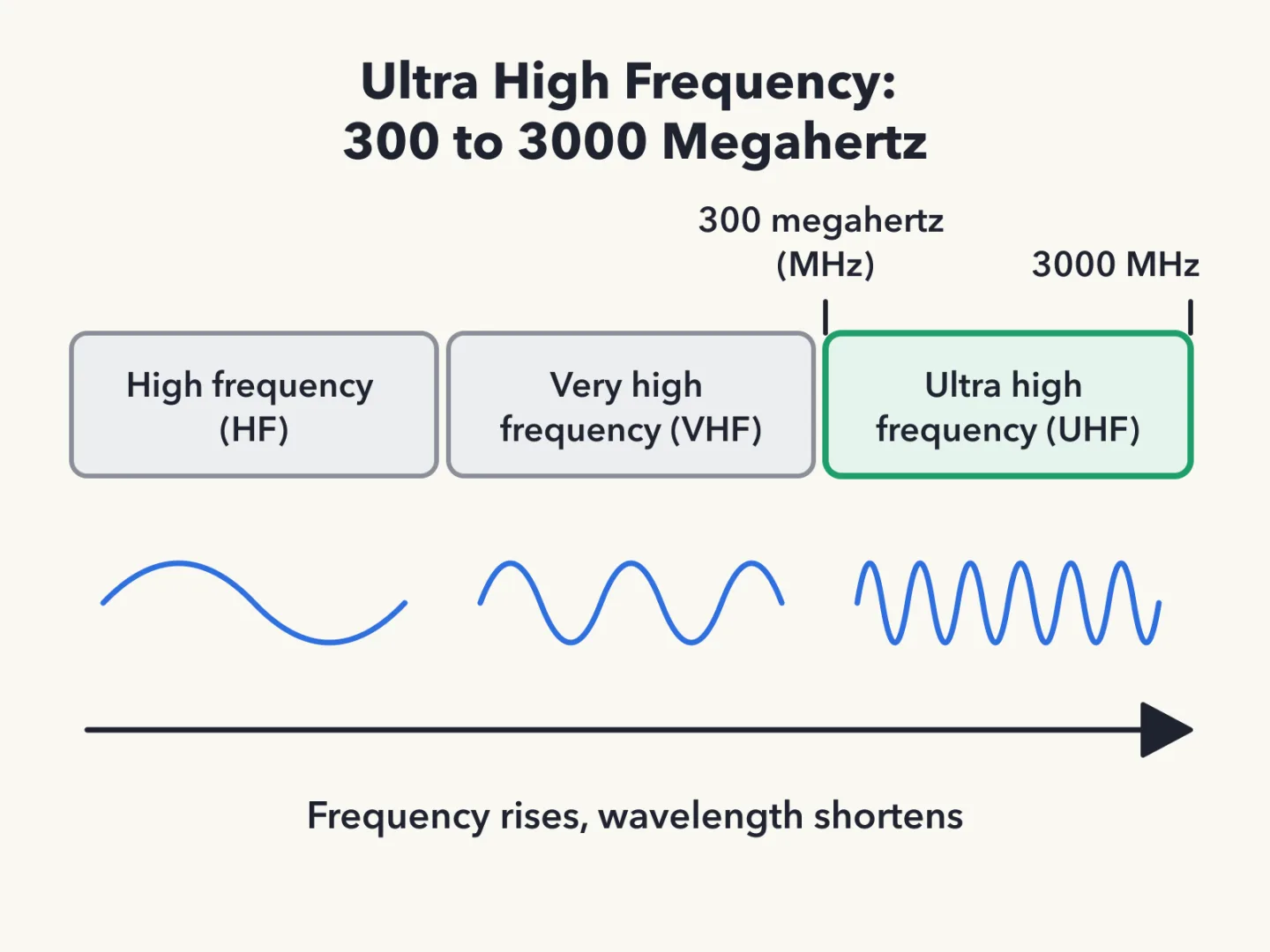
The Ultra High Frequency Range
Ultra high frequency (UHF) covers 300 to 3000 megahertz (MHz). As frequency rises from high frequency (HF) through very high frequency (VHF) to UHF, wavelength shortens.
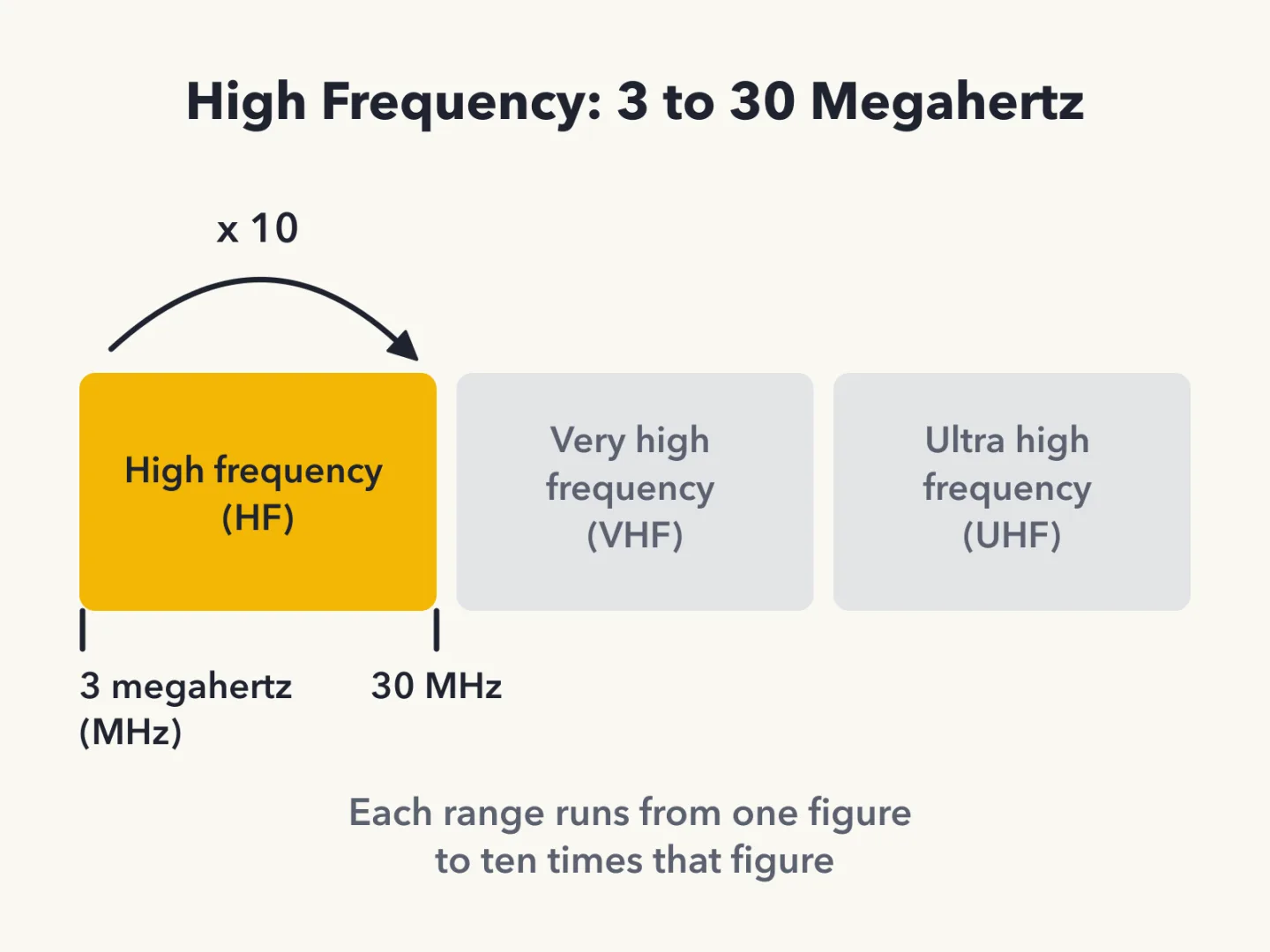
The High Frequency Range
High frequency (HF) covers 3 to 30 megahertz (MHz). Each of the three ranges, HF, very high frequency (VHF) and ultra high frequency (UHF), runs from one figure to ten times that figure.
Free-Space Speed in Meters
The speed of light, and so of a radio wave in free space, is approximately 300,000,000 meters per second.
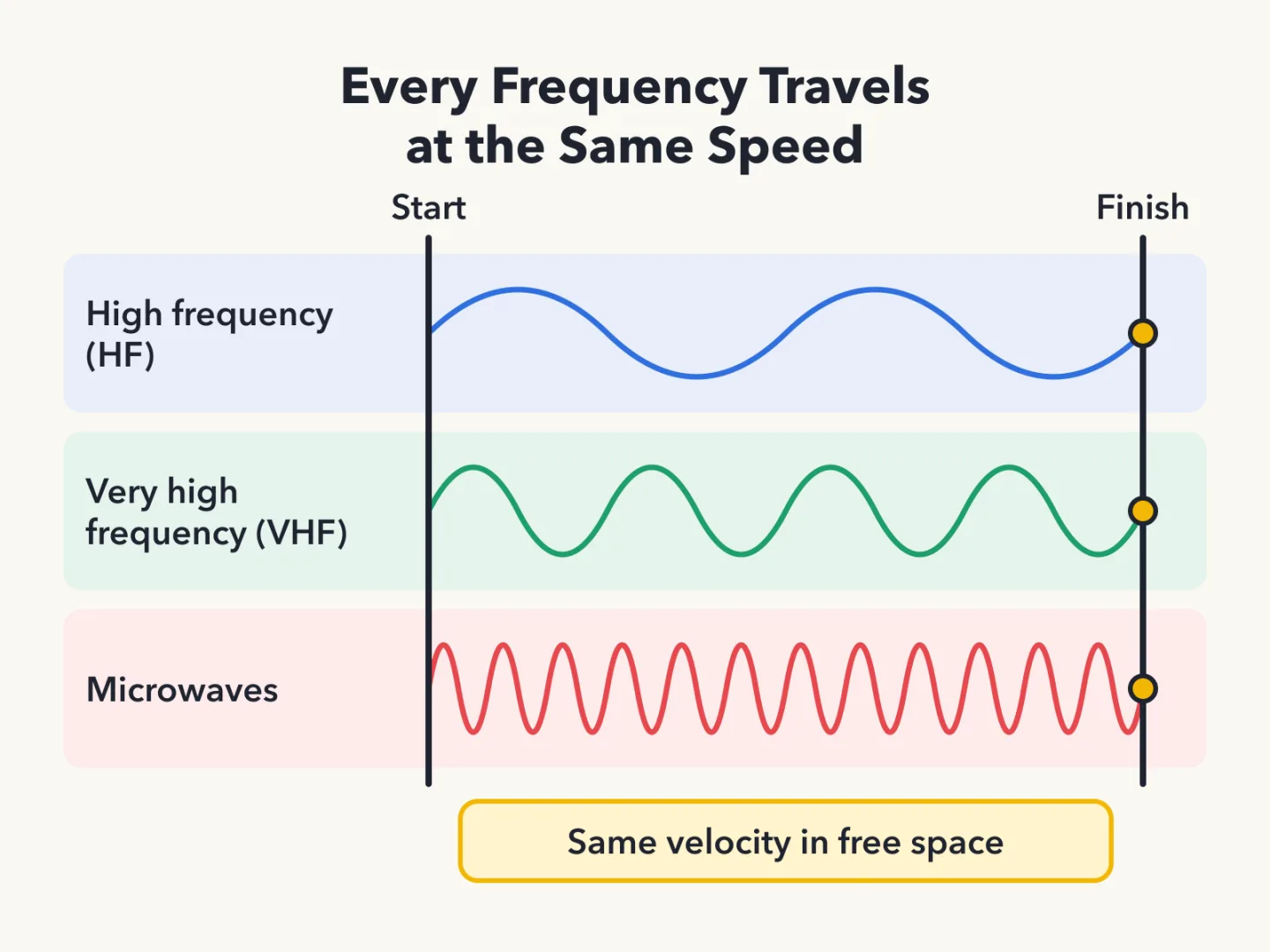
Every Frequency, Same Speed
Every radio frequency travels at the same velocity in free space.
Why UHF Stays Near the Horizon
Ultra high frequency (UHF) signals are usually not propagated by the ionosphere, so simplex UHF signals are rarely heard beyond their radio horizon.
HF Carries Farthest
Long-distance ionospheric propagation is far more common on high frequency (HF) than on very high frequency (VHF) and higher frequencies.
The Sound of Auroral Backscatter
In auroral backscatter, very high frequency (VHF) signals are distorted, with a characteristic raspy sound.
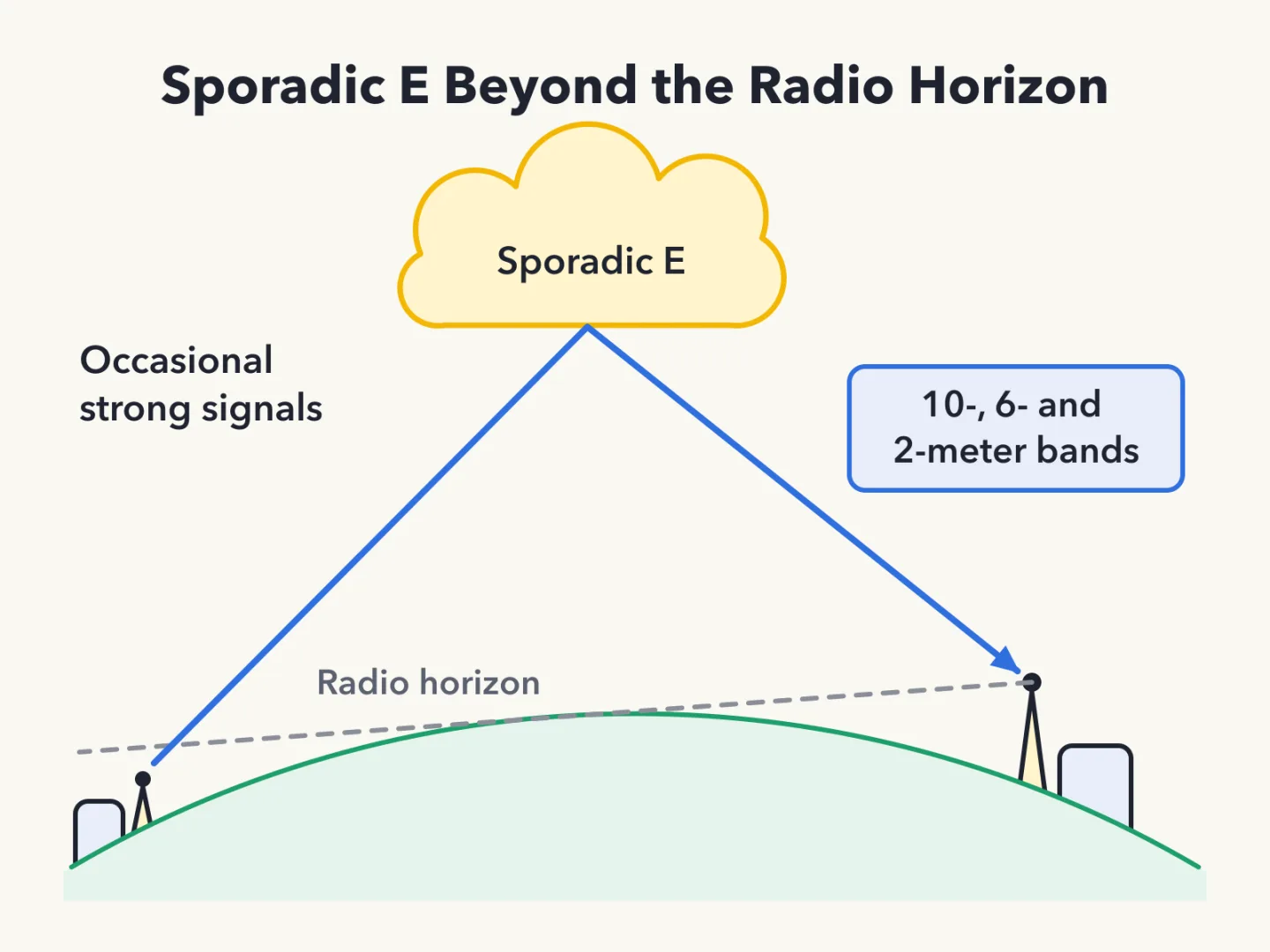
Sporadic E Surprises
Sporadic E is the type of propagation most commonly associated with occasional strong signals on the 10-, 6- and 2-meter bands from beyond the radio horizon.
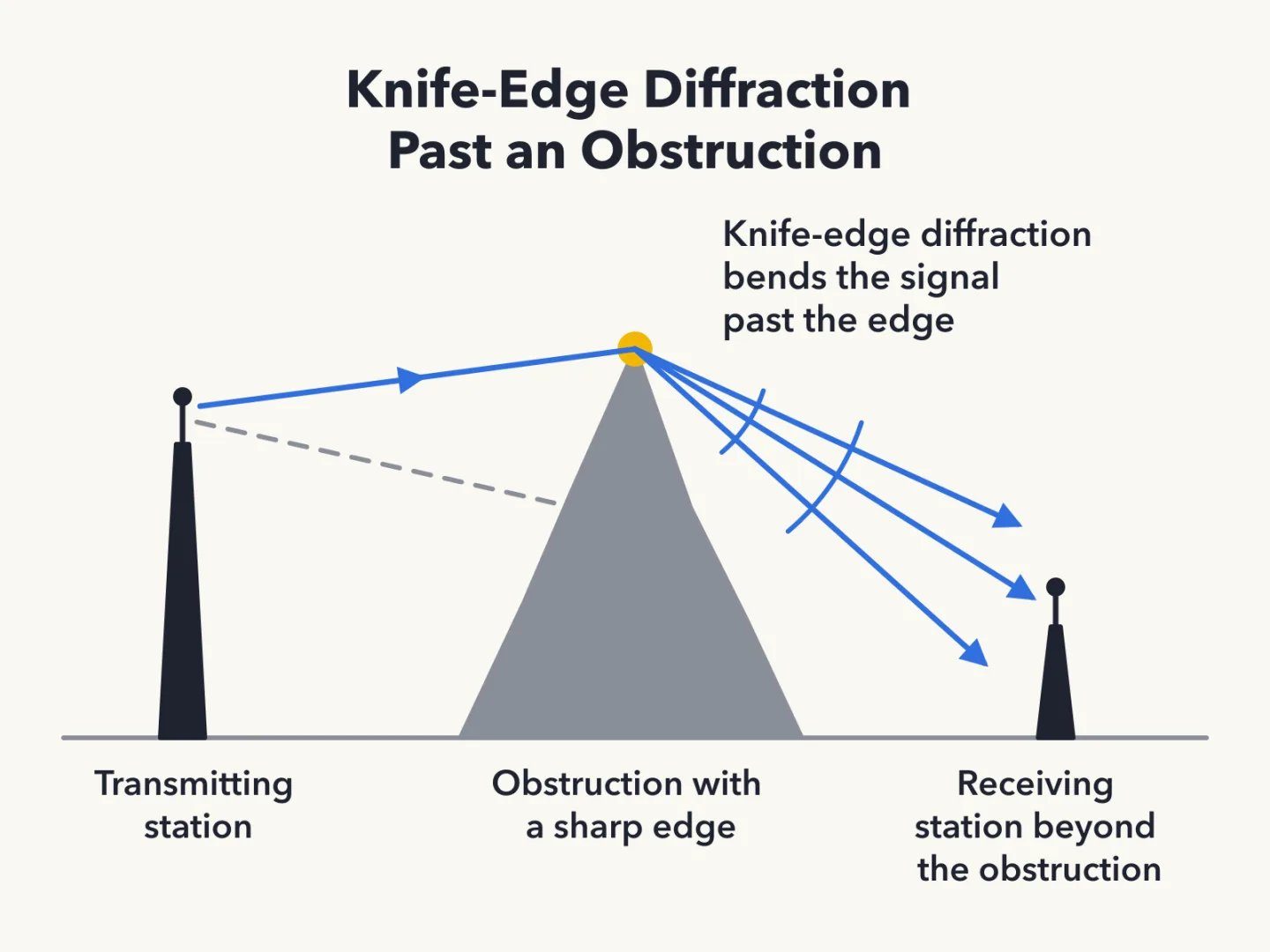
Knife-Edge Diffraction Past Obstructions
Knife-edge diffraction may allow radio signals to travel beyond obstructions between the transmitting and receiving stations.
Tropospheric Ducting Range
Tropospheric ducting is responsible for over-the-horizon very high frequency (VHF) and ultra high frequency (UHF) communications to ranges of approximately 300 miles on a regular basis.
Best Band for Meteor Scatter
Meteor scatter is best suited to the 6-meter band.
What Causes Ducting
Tropospheric ducting is caused by temperature inversions in the atmosphere.
Best Time for 10 Meters
The best time for long-distance 10-meter band propagation via the F region of the ionosphere is from dawn to shortly after sunset during periods of high sunspot activity.
Bands That Use the F Region
At the peak of the sunspot cycle, the 6-meter and 10-meter bands may provide long-distance communications via the F region.
Why the Radio Horizon Is Farther
The radio horizon for very high frequency (VHF) and ultra high frequency (UHF) signals is more distant than the visual horizon. The reason is that the atmosphere refracts radio waves slightly.
Matched pairs
Each item on the left goes with the one on the right.
- Picket fencing
- Rapid flutter on mobile signals from multipath
- HF (high frequency)
- 3 to 30 megahertz (MHz)
- Radio horizon
- Farther than the visual horizon
Self-test
Answer each question from memory, then check your work against the answer key.
1. Why do VHF signal strengths sometimes vary greatly when the antenna is moved only a few feet?
- AMultipath propagation cancels or reinforces signals
- BThe signal path encounters different concentrations of water vapor
- CThe Doppler effect causes slight frequency shifts that change signal strength
- DVHF ionospheric propagation is very sensitive to path length
2. When using a directional antenna, how might your station be able to communicate with a distant repeater if buildings or obstructions are blocking the direct line of sight path?
- AIncrease the antenna SWR
- BTry to find a path that reflects signals to the repeater
- CChange from vertical to horizontal polarization
- DTry the long path
3. What is the meaning of the term “picket fencing”?
- AA type of ground system used with vertical antennas
- BAlternating transmissions during a net operation
- CInterference from cable TV in the form of carriers at fixed intervals across the band
- DRapid flutter on mobile signals due to multipath propagation
4. How does vegetation affect UHF and microwave signals?
- AAmplifies signals, improving reception of weak signals
- BCauses knife-edge diffraction, distorting voice peaks
- CAbsorbs signals, leading to poor reception of weak signals
- DHas no effect
5. What weather condition might decrease range at microwave frequencies?
- AHigh winds
- BPrecipitation
- CColder temperatures
- DLow barometric pressure
6. What effect does fog or rain have on 10-meter and 6-meter band signals?
- ALittle effect
- BAbsorption
- CDeflection
- DIncreased range
7. What antenna polarization is normally used for long-distance CW and SSB contacts on the VHF and UHF bands?
- ARight-hand circular
- BLeft-hand circular
- CHorizontal
- DVertical
8. What is the effect of antenna cross-polarization over a line-of-sight VHF or UHF path?
- AModulation sidebands might become inverted
- BNothing significant will happen
- CSignals have an echo effect
- DReceived signal strength is reduced
9. Which of the following results from the fact that signals propagated by the ionosphere are elliptically polarized?
- AFM voice is unusable
- BEither vertical or horizontal antennas may be used to transmit or receive
- CDigital modes are unusable
- DBoth the transmitting and receiving antennas must be of the same polarization
10. What is a likely cause of irregular fading of signals propagated by the ionosphere?
- AFrequency shift due to Faraday rotation
- BInterference from thunderstorms
- CRandom combining of signals arriving via different paths
- DIntermodulation distortion
11. What effect does multi-path propagation have on data transmissions?
- ANo significant changes will occur if the signals are transmitted using FM
- BTransmission rates must be increased by a factor equal to the number of paths observed
- CTransmission rates must be decreased by a factor equal to the number of paths observed
- DError rates are likely to increase
12. Which region of the atmosphere can reflect HF radio waves?
- AThe ionosphere
- BThe troposphere
- CThe stratosphere
- DThe electrosphere
13. What is the relationship between the electric and magnetic fields of an electromagnetic wave?
- AThey travel at different speeds
- BThey are in parallel
- CThey revolve in opposite directions
- DThey are at right angles
14. What property of a radio wave defines its polarization?
- AThe orientation of the magnetic field
- BThe orientation of the electric field
- CThe ratio of the velocity to the wavelength
- DThe ratio of the energy in the magnetic field to the energy in the electric field
15. What are the two components of a radio wave?
- AVoltage and current
- BImpedance and reactance
- CElectric and magnetic fields
- DIonizing and non-ionizing radiation
16. What is the velocity of a radio wave traveling through free space?
- ASpeed of light
- B1.86 times the speed of sound
- CSpeed of sound
- D0.86 times the speed of light
17. What is the approximate velocity of a radio wave in free space?
- A300,000,000 meters per second
- B150,000,000 meters per second
- C300,000,000 miles per hour
- D150,000,000 miles per hour
18. Which of these frequencies travels at the highest velocity in free space?
- AMicrowaves
- BUHF
- CAll radio frequencies travel at the same velocity
- DVHF
19. What is the relationship between wavelength and frequency?
- AWavelength gets longer as frequency increases
- BWavelength is constant at all frequencies
- CWavelength and frequency increase as path length increases
- DWavelength gets shorter as frequency increases
20. What is the formula for converting frequency to approximate wavelength in meters?
- AWavelength in meters equals frequency in megahertz divided by 300
- BWavelength in meters equals 300 divided by frequency in megahertz
- CWavelength in meters equals frequency in hertz multiplied by 300
- DWavelength in meters equals frequency in hertz divided by 300
21. In addition to frequency, which of the following is used to identify amateur radio bands?
- AAll these choices are correct
- BTraditional letter/number designators
- CThe approximate wavelength in meters
- DChannel numbers
22. What frequency range is referred to as VHF?
- A300 MHz to 3000 MHz
- B300 kHz to 3000 kHz
- C30 kHz to 300 kHz
- D30 MHz to 300 MHz
23. What frequency range is referred to as UHF?
- A300 to 3000 kHz
- B300 to 3000 MHz
- C30 to 300 MHz
- D30 to 300 kHz
24. What frequency range is referred to as HF?
- A3 to 30 MHz
- B30 to 300 MHz
- C300 to 3000 MHz
- D300 to 3000 kHz
25. Why are simplex UHF signals rarely heard beyond their radio horizon?
- AUHF signals are absorbed by the ionospheric D region
- BFCC regulations prohibit them from going more than 50 miles
- CUHF signals are usually not propagated by the ionosphere
- DThey are too weak to go very far
26. Why is the radio horizon for VHF and UHF signals more distant than the visual horizon?
- ARadio signals move somewhat faster than the speed of light
- BRadio waves are blocked by dust particles
- CRadio waves are not blocked by dust particles
- DThe atmosphere refracts radio waves slightly
27. What is a characteristic of HF communication compared with communications on VHF and higher frequencies?
- ALong-distance ionospheric propagation is far more common on HF
- BHF accommodates wider bandwidth signals
- CHF antennas are generally smaller
- DThere is less atmospheric interference (static) on HF
28. What is generally the best time for long-distance 10-meter band propagation via the F region?
- AFrom shortly after sunset to dawn during periods of low sunspot activity
- BFrom dawn to shortly after sunset during periods of high sunspot activity
- CFrom dawn to shortly after sunset during periods of low sunspot activity
- DFrom shortly after sunset to dawn during periods of high sunspot activity
29. Which of the following bands may provide long-distance communications via the ionosphere’s F region during the peak of the sunspot cycle?
- A23 centimeters
- B70 centimeters and 1.25 meters
- CAll these choices are correct
- D6 and 10 meters
30. What is one characteristic of VHF signals received via auroral backscatter?
- AThey are often received from 10,000 miles or more
- BThey are distorted, with a characteristic raspy sound
- CThey occur only during winter nighttime hours
- DThey are generally strongest when your antenna is aimed west
31. Which of the following types of propagation is most commonly associated with occasional strong signals on the 10-, 6-, and 2-meter bands from beyond the radio horizon?
- ABackscatter
- BD region absorption
- CSporadic E
- DGray-line propagation
32. What band is best suited for communicating via meteor scatter?
- A6 meters
- B33 centimeters
- C2 meters
- D70 centimeters
33. Which of the following effects may allow radio signals to travel beyond obstructions between the transmitting and receiving stations?
- AQuantum tunneling
- BDoppler shift
- CKnife-edge diffraction
- DFaraday rotation
34. What type of propagation is responsible for allowing over-the-horizon VHF and UHF communications to ranges of approximately 300 miles on a regular basis?
- AD region refraction
- BF2 region refraction
- CFaraday rotation
- DTropospheric ducting
35. What causes tropospheric ducting?
- ATemperature inversions in the atmosphere
- BUpdrafts from hurricanes and tornadoes
- CDischarges of lightning during electrical storms
- DSunspots and solar flares
Go deeper
- ListenLesson 4 episode
- WatchMove the Antenna, Change the Signal Move an antenna just a few feet, and a very high frequency signal can vary greatly.
- WatchThe Mode That Reaches Past the Horizon 300 miles, over the horizon: how can a radio signal get that far?
- StudyHam Radio Technician License in the FlashFeed app
Answer key
- 1. A Multipath propagation cancels or reinforces signalsSignals arriving by several paths combine at the antenna and cancel or reinforce each other, so moving a few feet changes strength. VHF stands for very high frequency.
- 2. B Try to find a path that reflects signals to the repeaterWhen buildings block the direct path, the station can try to find a path that reflects signals to the repeater. SWR stands for standing wave ratio.
- 3. D Rapid flutter on mobile signals due to multipath propagationPicket fencing is the rapid flutter on mobile signals caused by multipath propagation.
- 4. C Absorbs signals, leading to poor reception of weak signalsVegetation absorbs ultra high frequency (UHF) and microwave signals, so weak signals are received poorly. It does not amplify them.
- 5. B PrecipitationPrecipitation might decrease range at microwave frequencies. Wind, low pressure and cold are not the conditions that do this.
- 6. A Little effectFog or rain has little effect on 10-meter and 6-meter signals: no significant absorption or deflection, and no added range.
- 7. C HorizontalHorizontal polarization is normally used for long-distance continuous wave (CW) and single sideband (SSB) contacts on very high frequency (VHF) and ultra high frequency (UHF).
- 8. D Received signal strength is reducedCross-polarized antennas over a line-of-sight path reduce received signal strength. They do not invert sidebands or cause an echo. VHF stands for very high frequency and UHF stands for ultra high frequency.
- 9. B Either vertical or horizontal antennas may be used to transmit or receiveIonospheric signals are elliptically polarized, so either vertical or horizontal antennas may be used. FM stands for frequency modulated.
- 10. C Random combining of signals arriving via different pathsIrregular fading of ionospheric signals is likely caused by random combining of signals arriving via different paths.
- 11. D Error rates are likely to increaseMultipath makes error rates likely to increase on data transmissions. No fixed rate change is required, and frequency modulated (FM) operation does not cure it.
- 12. A The ionosphereThe ionosphere is the atmospheric region that can reflect high frequency (HF) radio waves. The stratosphere and troposphere are not.
- 13. D They are at right anglesThe electric and magnetic fields of a radio wave are at right angles to each other.
- 14. B The orientation of the electric fieldPolarization is defined by the orientation of the electric field, not the magnetic field or any ratio.
- 15. C Electric and magnetic fieldsA radio wave has two components: electric and magnetic fields.
- 16. A Speed of lightIn free space a radio wave travels at the speed of light, not the speed of sound.
- 17. A 300,000,000 meters per secondThe speed of light is approximately 300,000,000 meters per second. The 150,000,000 figure and miles per hour figures are wrong.
- 18. C All radio frequencies travel at the same velocityEvery radio frequency travels at the same velocity in free space, so none is faster than another. UHF stands for ultra high frequency and VHF stands for very high frequency.
- 19. D Wavelength gets shorter as frequency increasesWavelength gets shorter as frequency increases.
- 20. B Wavelength in meters equals 300 divided by frequency in megahertzWavelength in meters equals 300 divided by the frequency in megahertz.
- 21. C The approximate wavelength in metersBesides frequency, the approximate wavelength in meters identifies a band, as in the 2-meter band.
- 22. D 30 MHz to 300 MHzVery high frequency (VHF) runs from 30 MHz to 300 MHz. Kilohertz ranges are wrong.
- 23. B 300 to 3000 MHzUltra high frequency (UHF) runs from 300 to 3000 MHz. A range in kilohertz is not UHF.
- 24. A 3 to 30 MHzHigh frequency (HF) runs from 3 to 30 MHz.
- 25. C UHF signals are usually not propagated by the ionosphereSimplex ultra high frequency (UHF) signals are rarely heard beyond the radio horizon because UHF signals are usually not propagated by the ionosphere. FCC stands for Federal Communications Commission.
- 26. D The atmosphere refracts radio waves slightlyThe radio horizon is farther than the visual horizon because the atmosphere refracts radio waves slightly. VHF stands for very high frequency and UHF stands for ultra high frequency.
- 27. A Long-distance ionospheric propagation is far more common on HFLong-distance ionospheric propagation is far more common on high frequency (HF) than on very high frequency (VHF) and higher frequencies.
- 28. B From dawn to shortly after sunset during periods of high sunspot activityThe best time for long-distance 10-meter F region paths is from dawn to shortly after sunset during high sunspot activity.
- 29. D 6 and 10 metersAt the sunspot peak the 6-meter and 10-meter bands may provide long-distance F region communications. The other bands listed do not.
- 30. B They are distorted, with a characteristic raspy soundVery high frequency (VHF) signals received by auroral backscatter are distorted, with a characteristic raspy sound.
- 31. C Sporadic ESporadic E is most commonly associated with occasional strong signals on 10, 6 and 2 meters from beyond the radio horizon.
- 32. A 6 metersMeteor scatter is best suited to the 6-meter band.
- 33. C Knife-edge diffractionKnife-edge diffraction may let signals travel beyond obstructions between stations. Faraday rotation, quantum tunneling and Doppler shift do not.
- 34. D Tropospheric ductingTropospheric ducting regularly carries very high frequency (VHF) and ultra high frequency (UHF) signals over the horizon to about 300 miles.
- 35. A Temperature inversions in the atmosphereTropospheric ducting is caused by temperature inversions in the atmosphere, not lightning, sunspots or storm updrafts.
Sources
- NCVEC Question Pool Committee — 2026–2030 Technician question pool — ncvec.org/index.php/2026-2030-technician-question-pool
- FCC — 47 CFR § 97.3 Definitions — www.ecfr.gov/current/title-47/section-97.3
Image credits
- Why Signals Change Over Feet: FlashFeed original diagram · CC-BY-4.0
- Vegetation and Microwave Signals: FlashFeed original diagram · CC-BY-4.0
- Cost of Cross-Polarization: FlashFeed original diagram · CC-BY-4.0
- Reaching a Repeater Around Obstacles: FlashFeed original diagram · CC-BY-4.0
- Picket Fencing on Mobile Signals: FlashFeed original diagram · CC-BY-4.0
- Weather That Shortens Microwave Range: FlashFeed original diagram · CC-BY-4.0
- Ionospheric Signals Are Elliptically Polarized: FlashFeed original diagram · CC-BY-4.0
- The Region That Reflects HF: FlashFeed original diagram · CC-BY-4.0
- Fields at Right Angles: FlashFeed original diagram · CC-BY-4.0
- What Defines Polarization: FlashFeed original diagram · CC-BY-4.0
- Higher Frequency, Shorter Wavelength: FlashFeed original diagram · CC-BY-4.0
- Converting Frequency to Wavelength: FlashFeed original diagram · CC-BY-4.0
- Naming Bands by Wavelength: FlashFeed original diagram · CC-BY-4.0
- The Very High Frequency Range: FlashFeed original diagram · CC-BY-4.0
- The Ultra High Frequency Range: FlashFeed original diagram · CC-BY-4.0
- The High Frequency Range: FlashFeed original diagram · CC-BY-4.0
- Every Frequency, Same Speed: FlashFeed original diagram · CC-BY-4.0
- Why UHF Stays Near the Horizon: FlashFeed original diagram · CC-BY-4.0
- Sporadic E Surprises: FlashFeed original diagram · CC-BY-4.0
- Knife-Edge Diffraction Past Obstructions: FlashFeed original diagram · CC-BY-4.0
- Tropospheric Ducting Range: FlashFeed original diagram · CC-BY-4.0
- Best Band for Meteor Scatter: FlashFeed original diagram · CC-BY-4.0
- Best Time for 10 Meters: FlashFeed original diagram · CC-BY-4.0
- Bands That Use the F Region: FlashFeed original diagram · CC-BY-4.0