
Never Split the Difference: Negotiating As If Your Life Depended On It
Chris Voss draws on his kidnapping negotiations for tactical empathy, mirroring and calibrated questions, the Ackerman bargaining system, spotting deception through the 7-38-55 rule, and uncovering the Black Swans that change a deal.
248 cards8 lessonsFree
Already have FlashFeed?Open this pack
Get this pack on your phone
Scan with your phone's camera.
flashfeedlearningapp.com/packs/never-split-the-difference

8 lessons.
Each lesson has a study guide to read and objectives you can test yourself on. Its cards and games show up in your feed. Try one of its cards right here. Play a few of its games here too.
-
 Pexels · Flat lay of Daniel Kahneman's book with a planner and laptop on a dark desk. ↗01
The New Rules & Active Listening Foundations
From Harvard to Hostage Negotiations: The Emotion Revolution · Tone and Mirroring: The Voice of Calm Control
Lesson 1 · 8 cardsPexels · Flat lay of Daniel Kahneman's book with a planner and laptop on a dark desk. ↗System 2 thinking is slow, del
When individuals experience stress, fear, or conflict, System 2 disengages, leaving the irrational and reactive System 1 in total control of behavioral decisions.
 Pexels · MART PRODUCTION · Pexels License ↗
Summary: The fundamental goal of initia
The fundamental goal of initial active listening is to disarm the counterpart's fight-or-flight survival response and establish communication bandwidth. Until a stressed counterpart feels safe and unthreatened, their neurobiology prevents them from absorbing new information or engaging in creative problem-solving.
 Unsplash · Videodeck .co · Unsplash License ↗
The Late-Night FM DJ Voice
The Late-Night FM DJ Voice is a deep, calm, slow, and downward-inflecting vocal tone that triggers psychological reassurance and de-escalates tension. Speaking with a slow, downward inflection activates neurochemical calming mechanisms in the listener, neutralizing panic and aggressive defensiveness.
 Unsplash · Elisa Photography · Unsplash License ↗
In FBI tactical verbal negotia
Repeating the counterpart's exact key words prompts them to elaborate and clarify without feeling interrogated or challenged.
 Unsplash · Salvus · Unsplash License ↗
Compare tactical execution versus conventional bargaining:
Tactical Empathy — Dynamic silence—the disciplined pause after a mirror or label—is a powerful conversational tool that forces the counterpart to process and speak.
Conventional Bargaining — Relying on rigid positions, positional bargaining, and premature compromises. Pexels · Mizuno K · Pexels License ↗
Summary: Mirroring effectively dismantl
Mirroring effectively dismantles aggressive demands by holding up a verbal mirror that makes the speaker hear how their own words sound in real time. Mirroring deflects attacks without direct resistance, allowing the counterpart to voluntarily soften unreasonable demands upon hearing them repeated.
1 / 8According to Voss, what is emotion's real role in reaching an agreement?
Voss argues emotion isn't an obstacle to logic-driven dealmaking; it's the actual medium through which people weigh value and reach agreement, so skilled negotiators work with it, not against it.
Lesson 1 has 33 cards. Keep going in the free app.
Question -
 Pexels · Mikhail Nilov · Pexels License ↗02
Tactical Empathy & Affect Labeling
Tactical Empathy and Rapport-Building · Affect Labeling and the Accusations Audit
Lesson 2 · 7 cardsPexels · Mikhail Nilov · Pexels License ↗Tactical empathy
Tactical empathy is the deliberate practice of perceiving, understanding, and articulating the counterpart's emotional landscape to gain strategic influence. Tactical empathy turns emotional observation into an operational tool, allowing the negotiator to guide the conversation by accurately reading the counterpart's feelings.
 Unsplash · Kaleidico · Unsplash License ↗
Summary: Tactical empathy transforms ad
Tactical empathy transforms adversarial confrontations into collaborative joint problem-solving sessions. Validating the other party's perspective eliminates their need to defend their dignity, freeing them to work alongside you against the shared problem.
 Pexels · Ann H · Pexels License ↗
Affect labeling
Affect labeling is the technique of putting feelings into words by using neutral, third-person phrasing such as 'It seems like...', 'It sounds like...', or 'It looks like...'. Using 'It seems like...' keeps the focus on external observation, whereas saying 'I hear that you feel...' triggers ego defensiveness and debate.
 AI-generated (gpt-image-1.5)
The Accusations Audit is the p
By courageously voicing the counterpart's worst thoughts about you upfront, you disarm their ammunition and make their unstated fears look exaggerated.
 AI-generated (gpt-image-1.5)
Compare tactical execution versus conventional bargaining:
Tactical Empathy — Labeling unspoken fears exposes them to daylight, where their irrationality beco
Conventional Bargaining — Relying on rigid positions, positional bargaining, and premature compromises. Pexels · cottonbro studio · Pexels License ↗
Summary: A mislabel (an intentionally o
A mislabel (an intentionally or unintentionally inaccurate label) can be tactically advantageous by prompting the counterpart to correct and clarify their true stance. People hate being misunderstood even more than they love being validated; correcting a slight mislabel leads them to spell out their real position.
1 / 7How does Voss define tactical empathy in relation to sympathy or agreement?
Voss treats tactical empathy as an objective diagnostic tool for reading motives, not as sympathy or agreement, so a negotiator can fully understand a position without endorsing it.
Lesson 2 has 31 cards. Keep going in the free app.
Question -
 Unsplash · Nadine E · Unsplash License ↗03
Mastering 'No' & The 'That's Right' Epiphany
Mastering No: Autonomy, Safety, and Counterfeit Yes · The That's Right Epiphany and the Summary Protocol
Lesson 3 · 8 cardsUnsplash · Nadine E · Unsplash License ↗The word 'No'
The word 'No' is not the failure of a negotiation, but the true starting point where genuine communication and boundary-setting begin. Saying 'No' makes the counterpart feel secure and in control, clearing the way for honest exploration of terms.
 Pexels · A serene view of white clouds against a clear blue sky on a summer day, perfect for nature themes. ↗
A Confirmation Yes Is a Reflexive Acknowledgment
Getting someone to agree that 'the sky is blue' or 'you value saving money' is a meaningless confirmation that creates zero commercial leverage.
 Pexels · Hand holding smartphone with email app open, surrounded by books and laptop. ↗
Tactical Empathy vs. Conventional Bargaining
Tactical Empathy — The one-sentence email 'Have you given up on this project?' triggers the counterpart's loss aversion and desire for autonomy, reviving stalled deals.
Conventional Bargaining — Relying on rigid positions, positional bargaining, and premature compromises. Pexels · Kindel Media · Pexels License ↗
Summary: Master Negotiators Steer Toward 'No'
Master negotiators deliberately steer questions so the counterpart can answer 'No', thereby preserving their perceived power while advancing the deal. Questions like 'Are you opposed to trying this framework?' or 'Is it unreasonable to review the draft?' make agreement painless through a 'No'.
 Pexels · Pavel Danilyuk · Pexels License ↗
Hearing 'You're right'
Hearing 'You're right' is a polite conversational dismissal indicating that the counterpart wants you to stop talking while conceding nothing. 'You're right' means 'I agree with your facts in theory, now go away'; it is the death knell of meaningful behavioral alignment.
 Pexels · Ron Lach · Pexels License ↗
Articulating the Counterpart's Position
Demonstrating mastery over their subjective reality proves that you are not an ignorant adversary, but an attuned and formidable partner.
 Pexels · RDNE Stock project · Pexels License ↗
Tactical Empathy vs. Conventional Bargaining
Tactical Empathy — If a counterpart responds with 'You're right' instead of 'That's right', the negotiator must immediately regroup and apply deeper labeling to find the missing gap.
Conventional Bargaining — Relying on rigid positions, positional bargaining, and premature compromises.1 / 8Why does letting a counterpart say 'No' actually help a negotiation move forward?
Letting a counterpart say 'No' gives them a felt sense of safety, autonomy, and control, which lowers their defenses instead of pushing them into a corner.
Lesson 3 has 29 cards. Keep going in the free app.
Question -
 Pexels · From above of hourglass with black sand near heap of paper money with image of president and official seal with numbers ↗04
Bending Reality & Psychological Framing
Prospect Theory and Loss Aversion in Deals · Anchoring, Extreme Ranges, and Non-Monetary Value
Lesson 4 · 8 cardsPexels · From above of hourglass with black sand near heap of paper money with image of president and official seal with numbers ↗Deadlines in negotiations are usually arbitrary
Recognizing that deadlines are malleable illusions prevents negotiators from caving into artificial time pressure during closing stages.
 Pexels · Diana ✨ · Pexels License ↗
Compare tactical execution versus conventional bargaining:
Tactical Empathy — The 'F-word' in negotiation—'Fair'—is a manipulative emotional weapon used to destabilize the other party and force defensive concessions.
Conventional Bargaining — Relying on rigid positions, positional bargaining, and premature compromises. Pexels · Alena Darmel · Pexels License ↗
Summary: Bending reality requires ancho
Bending reality requires anchoring the counterpart's emotional baseline before presenting quantitative figures or commercial terms. Warning a seller that 'You are going to hate this proposal and think I'm crazy' makes a lowball number feel like a relief when delivered.
 Unsplash · Walter Martin · Unsplash License ↗
Anchoring
Anchoring is the cognitive bias where initial figures or concepts establish a mental reference point that heavily distorts all subsequent estimates. The human brain anchors on the first number placed on the table, evaluating every counteroffer as a deviation from that starting landmark.
 Unsplash · Denis Bayer · Unsplash License ↗
Using non-round, precise, odd
A round number invites aggressive bargaining because it looks like a ballpark estimate, whereas a specific odd number signals that you have reached your limit.
 Pexels · SHVETS production · Pexels License ↗
Compare tactical execution versus conventional bargaining:
Tactical Empathy — Negotiators should never accept an opponent's initial extreme anchor, but instead neutralize it with an immediate label, mirror, or calibrated pushback.
Conventional Bargaining — Relying on rigid positions, positional bargaining, and premature compromises. Pexels · Close-up of a hand holding several hundred dollar bills, representing wealth and finance. ↗
Summary: Chris Voss demonstrated realit
Chris Voss demonstrated reality-bending in kidnapping cases by systematically anchoring kidnappers with tiny, odd-number ransom increments. Offering exact odd amounts (like $4,751) convinced kidnappers that the victim's family had exhausted every penny down to the piggy bank.
1 / 8What's the risk of hiding your own real deadline from the other side?
Hiding your real deadline keeps the other side from pacing their concessions to it, which raises the risk of an accidental impasse rather than a timely deal.
Lesson 4 has 32 cards. Keep going in the free app.
Question -
 Unsplash · Bernd 📷 Dittrich · Unsplash License ↗05
Calibrated Questions & The Illusion of Control
The Architecture of Calibrated Questions · The 'How Am I Supposed to Do That?' Pivot
Lesson 5 · 7 cardsUnsplash · Bernd 📷 Dittrich · Unsplash License ↗Calibrated questions introduce forced empathy
Asking 'How are we supposed to meet that delivery timeline?' forces the counterpart to confront your reality and propose realistic compromises.
 Pexels · Kampus Production · Pexels License ↗
Summary: When facing aggressive demands
When facing aggressive demands, a calibrated question buys valuable time and redirects emotional energy back toward the aggressor. Instead of reacting with counter-aggression, asking a calibrated question forces the attacker to pause and explain their reasoning.
 Pexels · Will Oliveira · Pexels License ↗
'How am I supposed to do that?'
'How am I supposed to do that?' is the most powerful calibrated question in high-stakes negotiation, delivering a gentle refusal that invites joint problem-solving. This single question halts unreasonable demands in their tracks without inciting anger, forcing the other side to come up with a workable alternative.
 Pexels · Atlantic Ambience · Pexels License ↗
Step 1 of the calibrated refusal ladder
This initial test separates soft, negotiable posturing from hard, non-negotiable redlines without causing offense.
 Pexels · Erik Mclean · Pexels License ↗
Compare tactical execution versus conventional bargaining:
Tactical Empathy — Step 4 of the calibrated refusal ladder culminates in a direct, unadorned, but polite 'No' delivered with the Late-Night FM DJ Voice.
Conventional Bargaining — Relying on rigid positions, positional bargaining, and premature compromises.1 / 7According to Voss, which pair of question-starters should calibrated questions use?
Voss's calibrated questions open with 'How' or 'What' to draw out thoughtful answers, unlike closed questions ('Can', 'Is', 'Do') that invite one-word replies or defensiveness.
Lesson 5 has 30 cards. Keep going in the free app.
Question - Take the lessons with you. Free, no account.Download on the App Store ↗Get it on Google Play ↗
-
 Wikimedia Commons · 2007_distance_attraction.PNG : Daniel Rodet derivative work: Copyleft… · CC BY-SA 3.0 ↗06
Guaranteeing Execution & Detecting Tells
The 7-38-55 Rule and the Rule of Three · Spotting Deception and The Pinocchio Effect
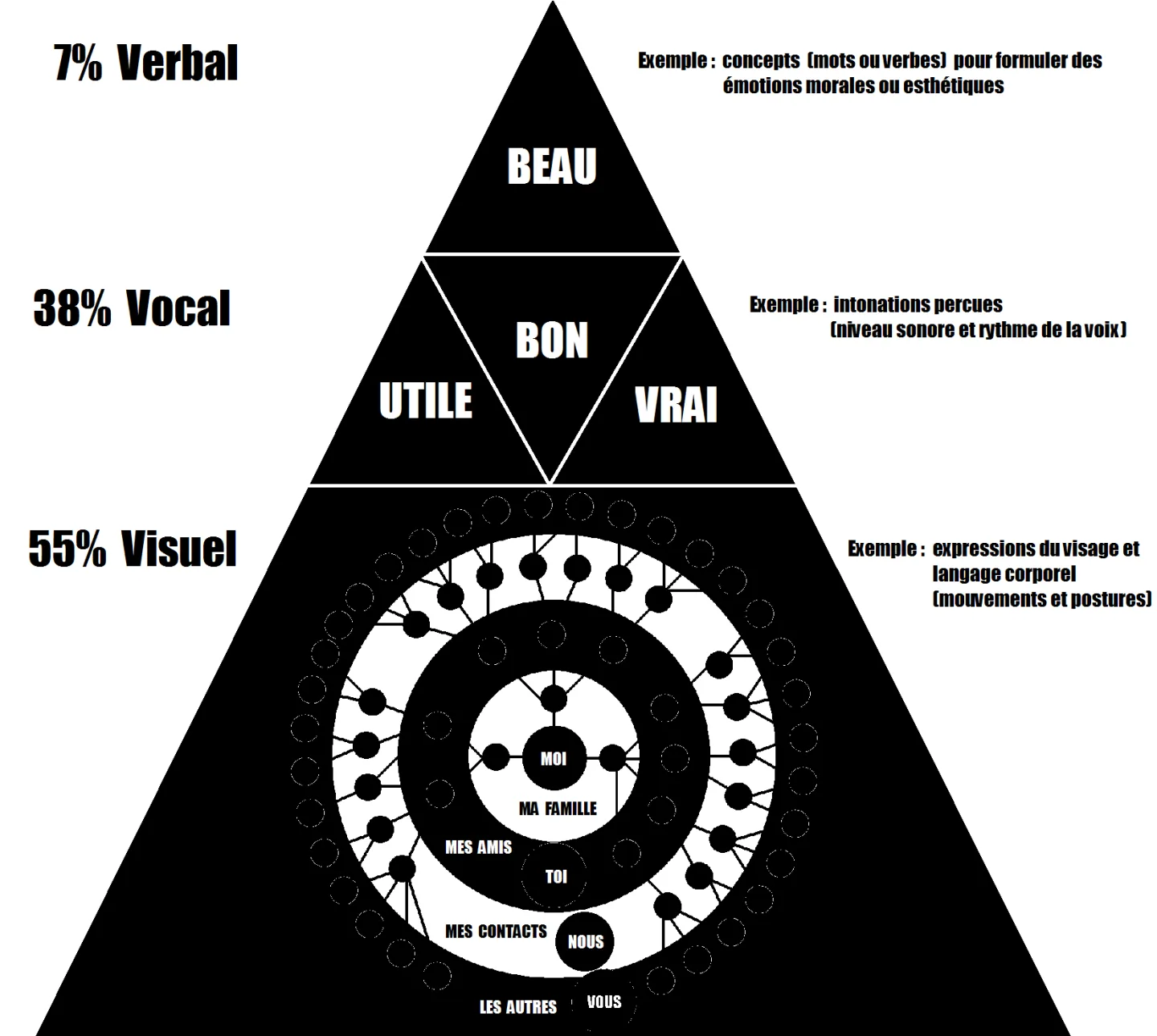
Lesson 6 · 8 cardsWikimedia Commons · 2007_distance_attraction.PNG : Daniel Rodet derivative work: Copyleft… · CC BY-SA 3.0 ↗Albert Mehrabian's 7-38-55 Rule sta
Albert Mehrabian's 7-38-55 Rule states that in emotional communication, only 7% of meaning is conveyed by words, 38% by vocal tone, and 55% by body language. Focusing solely on what someone says while ignoring how they sound and move blinds negotiators to 93% of the real message.
 Pexels · Gustavo Fring · Pexels License ↗
Compare tactical execution versus conventional bargaining:
Tactical Empathy — The third confirmation in the Rule of Three is secured when the counterpart explains how they will overcome internal obstacles or achieve execution.
Conventional Bargaining — Relying on rigid positions, positional bargaining, and premature compromises. Unsplash · Bluestonex · Unsplash License ↗
Summary: Asking calibrated questions ab
Asking calibrated questions about implementation (e.g., 'How will this affect the rest of your team?') uncovers hidden stakeholders and internal friction. These questions help your counterpart sell the agreement internally to their colleagues and bosses, ensuring smooth execution.
 Pexels · A vintage wooden Pinocchio marionette doll displayed in a window, reflecting whimsical charm. ↗
The Pinocchio Effect
The Pinocchio Effect refers to the behavioral phenomenon where individuals who are lying or being deceptive use significantly more words and elaborate sentence structures. Liars feel an unconscious compulsion to over-explain and fabricate details in an effort to appear convincing.
 Pexels · RDNE Stock project · Pexels License ↗
Using your own name in convers
It is easy to abuse an anonymous representative; it is psychologically painful to mistreat 'Chris' or 'Sarah' once a human connection is made.
 Pexels · Alexander Suhorucov · Pexels License ↗
Compare tactical execution versus conventional bargaining:
Tactical Empathy — Spotting deception is not about pointing fingers, but about asking calibrated questions that lead the deceptive party back to verifiable reality.
Conventional Bargaining — Relying on rigid positions, positional bargaining, and premature compromises. Unsplash · Scott Graham · Unsplash License ↗
Summary: Ensuring execution requires co
Ensuring execution requires confirming that the counterpart has both the organizational authority and the technical capability to deliver on promises. A deal is only as good as the counterpart's operational capacity; verifying internal alignment prevents post-signing disasters.
1 / 8What marks the FIRST confirmation in Voss's Rule of Three?
This initial agreement sets the baseline; the Rule of Three then requires two more confirmations before Voss trusts the commitment is real.
Lesson 6 has 32 cards. Keep going in the free app.
Question -
 Pexels · Christina Morillo · Pexels License ↗07
Negotiator Types & The Ackerman Bargaining System
The Three Negotiator Archetypes: Analyst, Accommodator, Assertive · The 6-Step Ackerman Bargaining Protocol
Lesson 7 · 8 cardsPexels · Christina Morillo · Pexels License ↗Human negotiators fall into three p
Human negotiators fall into three primary behavioral archetypes: Analysts, Accommodators, and Assertives. Understanding your own natural archetype and diagnosing your counterpart's style is essential for choosing the right tactics.
 Pexels · Liliana Drew · Pexels License ↗
When negotiating with an Accom
Because Accommodators hate delivering bad news, negotiators must proactively invite their concerns to prevent unfulfilled promises.
 Pexels · Patricio Nahuelhual · Pexels License ↗
Compare tactical execution versus conventional bargaining:
Tactical Empathy — A negotiator's greatest blind spot is assuming that their counterpart shares their own natural communication style and values.
Conventional Bargaining — Relying on rigid positions, positional bargaining, and premature compromises. Pexels · kaboompics.com · Pexels License ↗
Summary: Self-awareness of your own arc
Self-awareness of your own archetype prevents you from falling into natural behavioral traps when under intense pressure. Knowing that you tend to concede prematurely (Accommodator), over-analyze (Analyst), or attack (Assertive) allows you to consciously self-correct.
 Library of Congress · Aerial view of CIA headquarters, Langley, Virginia · No known restrictions (verify at source) ↗
The Ackerman Bargaining System
The Ackerman Bargaining System is an offer-counteroffer method based on diminishing percentage increments and non-round numbers. Created by former CIA officer Mike Ackerman, this system provides a predictable roadmap for hard-nosed price bargaining.
 Pexels · Yazid N · Pexels License ↗
Step 4 of the Ackerman protoco
Never give a concession easily; make the counterpart work for every dollar so they perceive immense value in the final settlement.
 Unsplash · Towfiqu barbhuiya · Unsplash License ↗
Compare tactical execution versus conventional bargaining:
Tactical Empathy — The psychological power of diminishing increments convinces the counterpart that they have squeezed every possible drop of value out of you.
Conventional Bargaining — Relying on rigid positions, positional bargaining, and premature compromises.1 / 8In Voss's negotiator archetypes, what best describes an Analyst?
Analysts hate surprises, prize data, and need time to think it through; rushing one triggers instant skepticism and withdrawal.
Lesson 7 has 31 cards. Keep going in the free app.
Question -
 Wikimedia Commons · joelogon · CC BY-SA 2.0 ↗08
Uncovering Black Swans & Ultimate Leverage
Finding Black Swans: The Unknown Unknowns · Overcoming Paradoxes and the Negotiation Mindset
Lesson 8 · 7 cardsWikimedia Commons · joelogon · CC BY-SA 2.0 ↗A Black Swan in negotiation
A Black Swan in negotiation is a piece of unknown-unknown information that, once discovered, completely transforms the balance of power and the outcome. The term is borrowed from Nassim Nicholas Taleb, who popularized 'black swan' as a label for rare, high-impact events; in negotiation, Black Swans are hidden truths that neither side openly discusses but dictate the entire deal.
 Unsplash · Alexander Hafemann · Unsplash License ↗
When a counterpart appears com
Dismissing an opponent as 'crazy' is an intellectual cop-out; master negotiators assume internal logic and search for the hidden driver.
 Pexels · Irshad Ahmad · Pexels License ↗
Compare tactical execution versus conventional bargaining:
Tactical Empathy — Uncovering Black Swans requires maintaining a beginner's mind, remaining flexible, and being willing to abandon preconceived theories.
Conventional Bargaining — Relying on rigid positions, positional bargaining, and premature compromises. AI-generated (gpt-image-1.5)
There are three foundational types
There are three foundational types of leverage in negotiation: Positive Leverage, Negative Leverage, and Normative Leverage. Leverage is the ability to inflict pain or provide gain; understanding its three forms allows negotiators to wield influence responsibly.
 Pexels · ArtHouse Studio · Pexels License ↗
Uncovering a counterpart's 're
Negotiations stall when proposals violate a counterpart's sacred identity; aligning with their worldview makes agreement natural.
 Unsplash · Vardan Papikyan · Unsplash License ↗
Compare tactical execution versus conventional bargaining:
Tactical Empathy — Negotiation is not a battle to be won, but a process of discovery designed to uncover hidden value, truth, and optimal solutions.
Conventional Bargaining — Relying on rigid positions, positional bargaining, and premature compromises.1 / 7What are Voss's three categories of negotiation information?
Amateur negotiators focus on known facts, but Voss says master negotiators hunt for the unknown unknowns, or Black Swans, that decide the outcome.
Lesson 8 has 31 cards. Keep going in the free app.
Question

What you'll be able to do 16 objectives, from the pack's lessons
- Explain how Attica and the Munich Olympics led to crisis negotiation units, and why System 1 research makes emotion the medium of agreement.
- Use the Late-Night FM DJ voice, mirroring (isopraxism), and dynamic silence to calm a defensive counterpart, and contrast them with the direct, assertive voice.
- Define tactical empathy as a neutral tool for diagnosing motives, and explain why emotions must be validated before logic, citing the fMRI findings on labeling.
- Phrase affect labels neutrally ("It seems like..."), then stay silent, and open with an Accusations Audit voicing the other side's worst thoughts.
- Explain why hearing "No" gives a counterpart safety and control, ask questions that invite it, and tell Counterfeit, Confirmation, and Commitment Yes apart.
- Tell "That's right" from "You're right" as a sign of genuine understanding, and build a Summary that combines affect labeling with paraphrase.
- Explain how Prospect Theory and loss aversion (a loss hurts about twice as much as an equal gain) let you frame an offer as protection against loss.
- Explain how anchoring works, set a range with your real target at the bottom, and use precise odd numbers, contrast, and non-monetary trades to shape the deal.
- Build calibrated questions starting with "How" or "What" rather than closed starters or "Why", and explain how they create an illusion of control.
- Halt an unreasonable demand by asking "How am I supposed to do that?" with genuine deference, and use the calibrated refusal ladder to say no four times.
- Apply the 7-38-55 Rule to trust tone and body language over words, label incongruence, and use the Rule of Three to filter out insincere agreement.
- Spot deception through the Pinocchio Effect, third-person pronouns, and signals that contradict a verbal promise, and read a modest 'we' as real authority.
- Identify the Analyst, Accommodator, and Assertive negotiator types by their traits, adapt to each, and avoid assuming the counterpart shares your style.
- Apply the six-step Ackerman system when buying: open at 65% of target, raise to 85%, 95%, 100%, end on a precise odd number, and add a non-monetary concession.
- Define a Black Swan as hidden information that shifts outcomes, name Voss's three information categories, and explain why listening beats direct questions.
- Distinguish positive, negative, and normative leverage, and explain why Voss rejects splitting the difference and names fear of conflict the greatest obstacle.
Study guide.
The same study guide as in the app, one page for each lesson, with its key facts and a self-test.
- 01The New Rules & Active Listening Foundations
- 02Tactical Empathy & Affect Labeling
- 03Mastering 'No' & The 'That's Right' Epiphany
- 04Bending Reality & Psychological Framing
- 05Calibrated Questions & The Illusion of Control
- 06Guaranteeing Execution & Detecting Tells
- 07Negotiator Types & The Ackerman Bargaining System
- 08Uncovering Black Swans & Ultimate Leverage
Its cards name 3 sources.
248 of its 248 cards name their source. These are the sources named.
- Never Split the Difference (Chris Voss & Tahl Raz)
- Never Split the Difference: Negotiating As If Your Life Depended On It
- Never Split the Difference
Hover over a photo, or tap its i, to see where it came from. All 8:
- Lesson 1: Pexels · Flat lay of Daniel Kahneman's book with a planner and laptop on a dark desk. ↗
- Lesson 2: Pexels · Mikhail Nilov · Pexels License ↗
- Lesson 3: Unsplash · Nadine E · Unsplash License ↗
- Lesson 4: Pexels · From above of hourglass with black sand near heap of paper money with image of president and official seal with numbers ↗
- Lesson 5: Unsplash · Bernd 📷 Dittrich · Unsplash License ↗
- Lesson 6: Wikimedia Commons · 2007_distance_attraction.PNG : Daniel Rodet derivative work: Copyleft… · CC BY-SA 3.0 ↗
- Lesson 7: Pexels · Christina Morillo · Pexels License ↗
- Lesson 8: Wikimedia Commons · joelogon · CC BY-SA 2.0 ↗
- Never Split the Difference by Chris Voss, Tahl Raz · on Amazon ↗
These are affiliate links: if you buy a book through one, FlashFeed may earn a small commission at no extra cost to you. The commission helps pay for FlashFeed's servers.
As an Amazon Associate we earn from qualifying purchases.
Independent study notes, not affiliated with the author or publisher.
- Cards
- 248
- Lessons
- 8
- Version
- 1.0.21
- Language
- English
The whole pack is one file. Read the pack file ↗
FlashFeed is on the App Store and Google Play.
FlashFeed is free on iPhone and Android, and needs no account.