
Mindset: The New Psychology of Success
Carol Dweck on the fixed and growth mindsets — believing ability is set versus believing it can be developed — and how each shows up in the classroom, in sports with Michael Jordan and Muhammad Ali, in leadership, and in praise.
302 cards6 lessons12 video lessons6 podcast episodesFree
Already have FlashFeed?Open this pack
Get this pack on your phone
Scan with your phone's camera.
flashfeedlearningapp.com/packs/mindset
Part of the Habits & Mindset collection.


6 lessons.
Each lesson has a study guide to read and objectives you can test yourself on. Its cards and games show up in your feed. Try one of its cards right here. Play a few of its games here too. Every lesson has a short video. Every lesson has a podcast episode.
-
 Wikimedia Commons · Satheesh Gopalan · CC BY-SA 3.0 ↗01
Foundations: The Two Mindsets and Human Potential
The Two Mindsets: Fixed vs. Growth · Inside the Mindsets: Effort, Failure, and Meaning
Lesson 1 · 10 cardsWikimedia Commons · Satheesh Gopalan · CC BY-SA 3.0 ↗The Foundational Mindset Dichotomy
Human achievement is filtered through implicit self-theories: the Fixed Mindset treats human qualities as static biological givens, while the Growth Mindset views qualities as malleable competencies cultivated through deliberate effort.
 Wikimedia Commons · Unidentified photographer · Public domain ↗
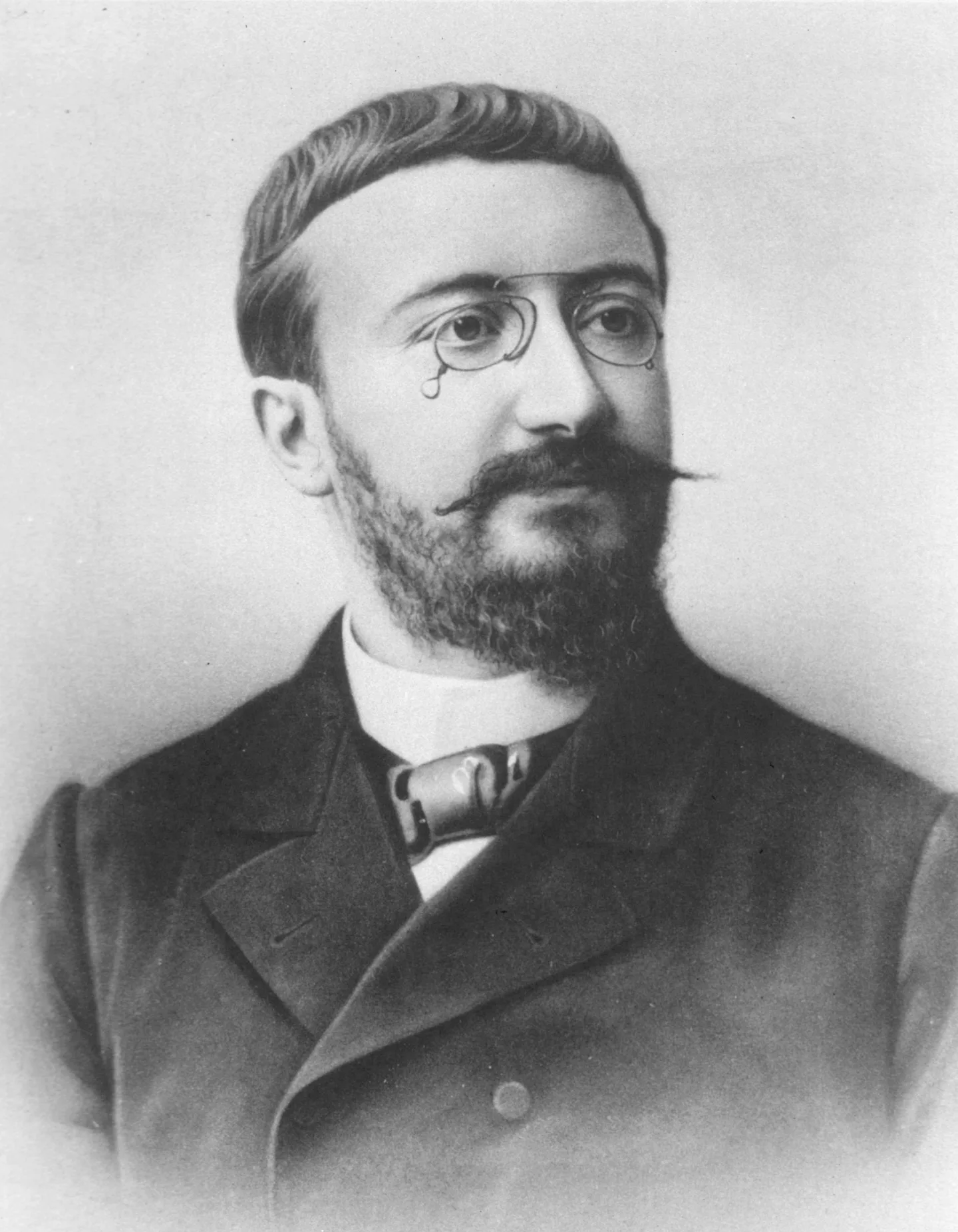
Alfred Binet and the Real Purpose of the IQ Test
French psychologist Alfred Binet invented the first practical intelligence scale (the Binet-Simon Scale) in Paris in the early twentieth century — not to rank children by a fixed genetic ceiling, but to identify students who were struggling in French public classrooms so targeted remedial teaching could accelerate their learning. Binet condemned the "brutal pessimism" of theorists who claimed intelligence is a fixed quantity, insisting that with practice, training, and method, children become literally more intelligent than they were before.
 Unknown author · Public domain ↗
Robert Sternberg on What Really Builds Expertise
Intelligence researcher Robert Sternberg wrote that the major factor in whether people achieve expertise "is not some fixed prior ability, but purposeful engagement."
 Pexels · Gelgas Airlangga · Pexels License ↗
Entity Theory vs. Incremental Theory
Dweck's two mindsets carry formal academic names. The Entity Theory of Intelligence (the fixed mindset) treats ability as a static biological endowment that must be constantly re-proven. The Incremental Theory of Intelligence (the growth mindset) treats competence as a dynamic repertoire of skills expanded through structured practice, and frames current ability as only a launchpad — a person's true ceiling can only be revealed after years of focused labor.
 Pexels · Ron Lach · Pexels License ↗
Dweck's Preschool Puzzle Experiment
In an early laboratory study, Carol Dweck gave four-year-olds a moderately challenging jigsaw puzzle, then let each child choose between repeating the puzzle they had just solved or trying a harder, new one. Children with a fixed mindset overwhelmingly chose to repeat the easy puzzle, seeking the guaranteed validation of a success they already knew they could achieve. Children with a growth mindset were baffled that anyone would want to redo a solved puzzle, and eagerly chose the harder one to expand their skills.
 Wikimedia Commons · MikeRoscopy · CC BY 4.0 ↗
Neuroplasticity: The Brain Changes Through Challenge
Modern neuroscience validates the growth mindset through neuroplasticity: when people grapple with challenging problems and correct their errors, neurons fire, forge new synaptic connections, and wrap axons in denser myelin, literally expanding the brain's processing capacity. Struggling with hard material isn't a sign the brain is inadequate; it's the mechanism by which the brain grows.
 Pexels · Ghaith Asaad · Pexels License ↗
Mindsets Are Domain-Specific, Not Monolithic
A mindset isn't a single fixed personality trait that applies identically everywhere. Individuals often hold domain-specific mindsets — for example, a growth mindset toward programming or athletics, paired with a paralyzing fixed mindset toward artistic creativity, public speaking, or relationships. The same person can believe ability is malleable in one arena and fixed in another.
 Pexels · Andy Barbour · Pexels License ↗
The Fixed Mindset's Need to Prove Itself
A fixed mindset creates an exhausting, ongoing psychological imperative: prove your innate brilliance and hide every flaw. Because entity theorists believe intelligence is a fixed quota, they systematically avoid challenging tasks — not out of laziness, but because struggling in public threatens to expose what they fear is a permanent, underlying lack of talent.
 Pexels · RDNE Stock project · Pexels License ↗
Effort as the Engine of Mastery
In the fixed mindset, effort feels like proof that you lack natural ability. In the growth mindset, effort is what turns ability into real skill and accomplishment.
1 / 10Why did Alfred Binet create the Binet-Simon Scale?
Binet designed the scale to spot struggling students so schools could target remediation, not to rank innate genetic ceilings or single out the gifted.
Lesson 1 has 51 cards. Keep going in the free app.
Question
The Harder Puzzle 
Tuned Out Transcripts
The Harder Puzzle
Give four-year-olds a choice: do the same easy puzzle again, or try a harder one. Some children want the easy one again.
Psychologist Carol Dweck linked that choice to a belief. In a fixed mindset, ability is set at birth, so every test must prove it.
In a growth mindset, ability can grow with effort, good strategies and help from others.
Those children chose the harder puzzle. To them, the challenge was the point.
Tuned Out
At Columbia University, students answered hard questions while an EEG recorded their brain activity.
Students with a fixed mindset reacted strongly when they learned they were wrong.
Then, when the screen showed the correct answer, their learning-related brain activity was lower. They tuned out the lesson.
Students with a growth mindset stayed engaged through the explanation. On a retest, they corrected more of their errors.
Episode 17:23
What are the fixed and growth mindsets, why did Alfred Binet create the first intelligence test, and what does a child's puzzle choice show?
Also on Spotify ↗Apple Podcasts ↗
-
 Pexels · Jean-Rene Chazottes · Pexels License ↗02
Ability, Achievement, and the Classroom
The Truth About Ability, Potential, and Achievement · High Standards, Nurturing Environments, and Stereotype Threat
Lesson 2 · 10 cardsPexels · Jean-Rene Chazottes · Pexels License ↗Difficulty Is a Cue to Try Harder, Not Failure
In Dweck's studies, students with a growth mindset who hit a hard problem didn't see it as failure or proof they lacked ability — they read it as a sign to apply more effort. That reframing kept them engaged instead of giving up.
 Pexels · Yan Krukau · Pexels License ↗
Junior High Academic Trajectory Divergence
In a longitudinal study of students entering junior high school, Blackwell, Trzesniewski, and Dweck (2007) found that students with similar earlier math achievement diverged: fixed-mindset grades stayed flat while growth-mindset grades climbed.
 Pexels · kaboompics.com · Pexels License ↗
Rote Memorization vs. Deep Conceptual Learning
Fixed-mindset students tend to rely on passively rereading notes and rote memorization, assuming repetition alone is enough without testing real comprehension. Deep Conceptual Learning takes the opposite approach: actively extracting underlying principles, synthesizing complex ideas, and self-testing understanding rather than just re-reading.
 Unsplash · Vitaly Gariev · Unsplash License ↗
The University of Hong Kong English Course Study
At the University of Hong Kong, where all instruction is in English, many incoming freshmen had weak English skills that jeopardized their degrees. Asked whether they would take a course to improve their English if the university offered one, fixed-mindset freshmen were much less willing, apparently because admitting a deficiency felt threatening. Growth-mindset freshmen were much more willing, seeing English as a learnable skill.
 FlashFeed original diagram · CC-BY-4.0
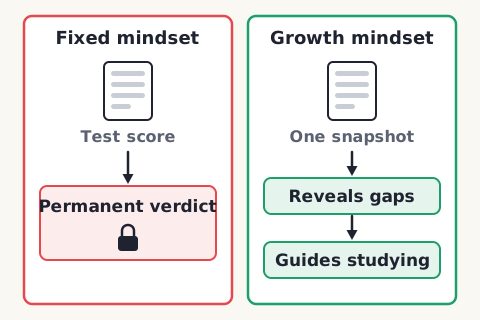
A Test Is One Snapshot, Not a Final Verdict
A growth mindset treats a test or evaluation as one snapshot of current understanding — a tool that reveals knowledge gaps and guides the next round of studying. A fixed mindset instead treats a test score as a permanent verdict on a person's intellectual capacity.
 Pexels · Charlotte May · Pexels License ↗
Organic Chemistry: Two Ways to Handle a Bad Grade
Pre-med students in a notoriously difficult organic chemistry course diverged sharply after a disappointing first exam. Fixed-mindset students lost interest and abandoned their study routines entirely, letting their motivation and grades collapse. Growth-mindset students instead diagnosed their passive reading and rote memorization as ineffective, then rebuilt their approach around active conceptual synthesis, drawing out reaction pathways, and forming study groups — ultimately earning high final grades.
 Pexels · Yan Krukau · Pexels License ↗
The Brain-as-Muscle Metaphor Boosts Motivation
When educators explicitly teach students that the brain works like a muscle — that struggling with difficult problems makes neural synapses grow denser and fire faster — student motivation and academic performance rise significantly. Framing intellectual struggle as productive exercise, rather than proof of inadequacy, changes how students respond to difficulty.
 Pexels · Andy Barbour · Pexels License ↗
A Standardized Test Score Is Not a Permanent Ceiling
A standardized test measures a student's accumulated knowledge and current test-taking strategy at one isolated moment — nothing more. It reveals nothing about what that person could achieve after years of dedicated instruction and curiosity, which is why treating an early test score as a permanent ceiling on ability is a fundamental misconception.
 Pexels · Monstera Production · Pexels License ↗
The Danger of the 'Gifted' Label
Labeling a child "gifted" early on can backfire. Praise for effortless brilliance can create a fragile, perfectionist fixed mindset: the child becomes terrified of undertaking ambitious projects that might puncture their reputation for genius, so they avoid the very challenges that would help them grow.
1 / 10How did growth-mindset students in Dweck's studies interpret hitting a hard problem?
Growth-mindset students read a hard problem as a cue to work harder, not as evidence they lacked the ability to succeed.
Lesson 2 has 50 cards. Keep going in the free app.
Question
Same Start, Different Paths 
Welcome to Success Transcripts
Same Start, Different Paths
Two groups of students started junior high with almost the same math scores. Over two years, their grades pulled apart.
Students with a fixed mindset tended to read harder work as a sign of low ability. Their grades stayed flat.
Students with a growth mindset saw the same work as a challenge. They changed how they studied, and their grades rose.
Same scores, same new challenge. The difference was what each student believed about ability.
Welcome to Success
In Chicago, Marva Collins opened Westside Preparatory School for children the public schools had written off.
She paired high standards with warmth. She is remembered for telling her students that none of them had failed, and that school may have failed them.
By her account, her students were soon reading well above grade level, including classic authors such as Shakespeare.
In her class, a mistake was part of learning, never a cause for shame.
Episode 27:33
Why do some students stumble in junior high, why did one walk past free English lessons, and how can a stereotype lower a test score?
Also on Spotify ↗Apple Podcasts ↗
-
 Wikimedia Commons · Associated Students of the University of California at Los Angeles · Public domain ↗03
Sports and Athletic Excellence: The Mindset of a Champion
Natural Talent vs. Character and Work Ethic in Athletics · Handling Setbacks, Slumps, and Team Cultures
Lesson 3 · 10 cardsWikimedia Commons · Associated Students of the University of California at Los Angeles · Public domain ↗John Wooden's Definition of Success
John Wooden won 10 NCAA National Championships in 12 years at UCLA by defining success not by the scoreboard, but as peace of mind derived from knowing you made the effort to do your absolute best to become the best you are capable of becoming.
 Joshua Massel. Cropped by en:User:Quadzilla99 · CC BY-SA 2.0 ↗
Debunking the Myth of the Natural Athlete
The sports world romanticizes the natural athlete as an effortless superhero. However, icons like Michael Jordan—who did not make his high school varsity team as a sophomore—achieved supremacy through relentless practice and years of grueling off-season training.
 Pexels · RUN 4 FFWPU · Pexels License ↗
Athletic Character vs. the Talent Entitlement Trap
Athletic Character is the psychological fortitude to dig deep, maintain discipline, and execute a game plan when the body is exhausted and the scoreboard is against you. Athletes who lack it can fall into the Talent Entitlement Trap — assuming their natural gifts excuse them from fundamental conditioning. When these natural prodigies eventually face superior competition, their fragile self-image shatters, because they never built the habits of grit and tactical self-correction that character requires.
 Wikimedia Commons · Ira Rosenberg · Public domain ↗
Muhammad Ali: Winning Through Preparation, Not Just Power
Three-time heavyweight champion Muhammad Ali was the underdog against harder-hitting rivals like Sonny Liston and George Foreman. Ali won through rigorous tactical study of his opponents, unconventional footwork, and supreme mental conditioning: as boxing wisdom has it, a fight is won in training long before the bout.
 Wikimedia Commons · Lindeboom, Henk / Anefo · CC BY-SA 3.0 nl ↗
Wilma Rudolph's Path from Illness to Olympic Gold
Wilma Rudolph had polio and scarlet fever as a child. Polio left her left leg weak and partly paralyzed, and she wore a metal leg brace. Her family massaged her leg several times a day, and her mother took her to Nashville for weekly treatment. She was walking without the brace by about age twelve, and she went on to win three Olympic gold medals in track and field at the 1960 Rome Games.
 Wikimedia Commons · Irwin, La Broad, & Pudlin · Public domain ↗
Babe Ruth: Embracing Strikeouts as the Cost of Power
Babe Ruth held the major league record for career home runs for decades — and simultaneously held the record for career strikeouts. Rather than seeing this as a flaw, Ruth maintained a growth-mindset composure about it, treating strikeouts as the necessary statistical cost of swinging with maximum power.
 Pexels · Thirdman · Pexels License ↗
Process Over Outcome: How Champions Practice and Self-Evaluate
Growth-mindset champions treat daily practice as the joyful core craft of self-mastery, not a humiliating chore reserved for the untalented. That same orientation shapes how they judge their own performance afterward: rather than fixating on the scoreboard, they evaluate themselves by whether they prepared completely, executed the fundamentals, and gave their absolute best effort.
 Theflowerbar · CC BY-SA 4.0 ↗
Tiger Woods Rebuilt His Swing at the Top
While ranked world number one and already a major champion, Tiger Woods identified mechanical inconsistencies in his golf swing that risked long-term strain and inaccuracy, and dismantled it completely from scratch, twice, despite heavy media criticism. He endured short-term tournament slumps while ingraining the new mechanics, in pursuit of longevity at the top of the sport.
 Dave Gilbert · CC BY-SA 2.0 ↗
Nadia Comaneci's Perfect 10 Was Built, Not Born
Romanian gymnast Nadia Comaneci scored the first perfect 10.0 in modern Olympic history, on the uneven bars at the 1976 Montreal Games, and observers rushed to call her an effortless natural. In reality, coach Béla Károlyi picked her for his gymnastics school at age six, and she trained under him for years, drilling her routines day after day until they were automatic.
 Wikimedia Commons · Erik van Leeuwen · GFDL ↗
Jackie Joyner-Kersee's Love of the Daily Process
Heptathlon champion Jackie Joyner-Kersee, named the greatest female athlete of the 20th century, attributed her dominance across seven grueling track-and-field events to one thing: falling in love with the daily process of conditioning and technical refinement, rather than fixating on scores or medals.
1 / 10As a high school sophomore, what happened to Michael Jordan that fueled his work ethic?
Jordan did not make varsity as a sophomore (he is often said to have been cut; he was placed on junior varsity), and it became fuel for his relentless practice habits, not proof of effortless talent.
Lesson 3 has 56 cards. Keep going in the free app.
Question
Brace to Gold 
Socks First Transcripts
Brace to Gold
As a child, she wore a metal leg brace. In 1960, she won three Olympic gold medals.
Wilma Rudolph had scarlet fever and polio when she was young. Polio left her left leg weak and partly paralyzed.
For years, her family helped with her treatment at home. By age 12, she was walking without the brace.
She became a college track star, then won 3 golds in Rome. Her speed took years of work.
Socks First
John Wooden's UCLA teams won 10 national titles in 12 seasons. He never talked to his players about winning.
At the first practice of each season, he taught them how to put on their socks and lace their shoes, to prevent blisters.
He defined success as peace of mind: knowing you made the effort to become the best you can be.
To Wooden, winning came from full preparation. Watching the scoreboard only caused anxiety.
Episode 37:27
Are great athletes born or built, and how do champions think about character, the scoreboard and slumps?
Also on Spotify ↗Apple Podcasts ↗
-
 Pexels · Andrea Piacquadio · Pexels License ↗04
Leadership, Corporate Culture, and Organizational Mindsets
CEO Mindsets: Hubris vs. Level 5 Leadership · Organizational Mindset: Groupthink, Psychological Safety, and Innovation
Lesson 4 · 10 cardsPexels · Andrea Piacquadio · Pexels License ↗Where Level 5 Leaders Put Their Ambition
Jim Collins found that every great company he studied was led by a Level 5 Leader. Rather than building a personal monument or projecting infallible brilliance, these leaders channel their ambition into the company instead of themselves, building lasting enterprise capability and setting up their successors for even greater success.
 Unsplash · Alan Rostovtev · Unsplash License ↗
Enron's Talent Cult and Rank-and-Yank
Enron executives Ken Lay and Jeffrey Skilling built a corporate "talent cult" around McKinsey's "War for Talent" philosophy, hiring elite MBA graduates on perceived pedigree and paying huge bonuses to reinforce their genius status. To enforce it, Enron instituted Rank and Yank: a twice-yearly review that forced managers to rank employees on a rigid curve and pushed out the bottom 15% — a culture so afraid of admitting mistakes that employees hid trading losses and falsified records, contributing to what was then the largest corporate bankruptcy in US history (December 2001).
 Wikimedia Commons · Kenneth C. Zirkel · CC BY-SA 3.0 ↗
Lou Gerstner's Turnaround of IBM
Lou Gerstner took command of a crumbling IBM in 1993 and rejected its culture of arrogant intellectual elitism. He reoriented the company's workforce around client collaboration and integrated enterprise services, turning the company around.
 FlashFeed original diagram · CC-BY-4.0
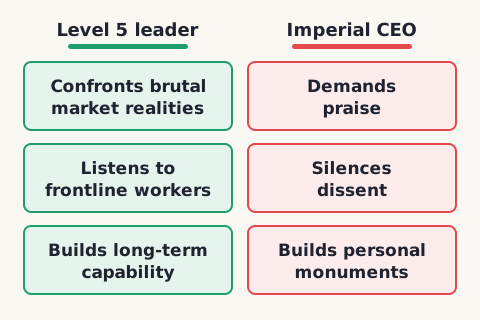
Level 5 Leaders vs. Imperial CEOs
A Level 5 growth-mindset CEO confronts brutal market realities, listens to frontline workers, and builds long-term institutional capability. An imperial, fixed-mindset CEO instead demands sycophantic praise, silences dissent, and spends company resources on personal monuments. Selecting a CEO purely for flamboyant charisma is a dangerous governance trap for the same reason: charismatic leaders often chase personal prestige over the unglamorous work of building lasting institutions.
 Hamilton83 · CC BY-SA 3.0 ↗
Jack Welch's Boundaryless Organization
Jack Welch transformed General Electric by tearing down corporate bureaucracy and instituting the "Boundaryless Organization" — a structure that empowered assembly-line workers to share operational improvements directly with senior management, rather than having ideas get lost in a rigid hierarchy. Dweck holds him up as a growth-minded leader, though his own forced ranking of employees, which marked the lowest-rated tenth for dismissal, cut the other way.
 Library of Congress · Lee Iacocca [Chrysler] · No known restrictions (verify at source) ↗
Lee Iacocca's Fall Into Hubris at Chrysler
Lee Iacocca engineered a brilliant government-backed turnaround of Chrysler in the early 1980s. But he later became absorbed in his own celebrity, appearing constantly on talk shows and writing bestselling autobiographies, while Chrysler's engineering quality slipped and Japanese competitors introduced better, more fuel-efficient models.
 Pexels · cottonbro studio · Pexels License ↗
Weak Succession vs. Strong Succession Stewardship
A fixed-mindset CEO often leaves weak successors, whether by design or neglect, and the company falters after they leave. Level 5 growth leaders do the opposite, investing years in mentoring genuinely strong successors so the organization keeps thriving for decades after they're gone.
1 / 10What primary criteria do growth-mindset organizations emphasize when promoting executive leaders?
Growth-mindset firms promote leaders based on talent development, knowledge sharing, and cultivating psychological safety.
Lesson 4 has 50 cards. Keep going in the free app.
Question
Humble and Fierce 
More Errors, Better Teams Transcripts
Humble and Fierce
What did the great companies in Jim Collins's research have in common? Each was led by what he called a Level 5 leader.
These leaders mix deep personal humility with a fierce will to succeed.
They are not celebrity bosses. They develop talent, face hard facts and build a company that lasts.
They also train strong successors, so the company keeps doing well after they leave.
More Errors, Better Teams
In Amy Edmondson's hospital research, the best-rated teams reported more errors, not fewer.
Her explanation: they probably did not make more mistakes. They felt safe enough to speak up, so errors came out into the open.
Edmondson called this psychological safety. People can ask simple questions and admit mistakes without fear of humiliation.
Where people feel safe to speak up, problems can be raised and fixed early.
Episode 47:43
What makes a Level 5 leader, how does worshipping talent hurt a company, and why did the best hospital teams report more errors?
Also on Spotify ↗Apple Podcasts ↗
-
 Pexels · Ketut Subiyanto · Pexels License ↗05
Relationships, Parenting, and the Perils of Praise
Mindsets in Love: Romantic Partnerships and Social Dynamics · Where Mindsets Come From: Praise, Criticism, and Mentorship
Lesson 5 · 10 cardsPexels · Ketut Subiyanto · Pexels License ↗Shyness Is a Learnable Skill Gap, Not a Life Sentence
Shyness need not be a permanent trait. In a growth mindset, social skills and conversational assertiveness are treated as learnable competencies that improve with practice, the same way any other skill would.
 Unsplash · Vitaly Gariev · Unsplash License ↗
The Fallacy of Effortless Harmony in Love
In romantic relationships, a fixed mindset generates the destructive fallacy that if two people are true soulmates, their relationship should require no effort, communication, or conflict resolution ('If we have to work at it, it wasn't meant to be').
 Pexels · cottonbro studio · Pexels License ↗
Two More Fixed-Mindset Relationship Fallacies
Beyond the fallacy of effortless harmony, the fixed mindset produces two more destructive relationship beliefs. The Mind-Reading Fallacy is the unrealistic expectation that a loving partner should automatically anticipate every emotional need without being told, which breeds resentment and silent withdrawal. The Fixed Partner Fallacy is the conviction that a partner's communication habits or personality quirks are permanent character defects that can never change, which breeds chronic contempt.
 Unsplash · tania calderon · Unsplash License ↗
Processing Heartbreak: Growth Mindset vs. Fixed Mindset
A fixed-mindset person experiencing heartbreak feels permanently branded as unlovable and often obsesses over vindictive revenge to restore their wounded pride. A growth-mindset person instead follows a healthier recovery process: fully feeling the grief, examining their own communication habits and relationship dynamics for real lessons, forgiving their former partner, and staying open to future intimacy.
 Pexels · Andrea Piacquadio · Pexels License ↗
Bullying Is a Fixed-Mindset Dynamic
Bullies use harassment to assert a rigid social hierarchy, labeling victims as permanently inferior. Victims who hold a fixed mindset are especially vulnerable, internalizing the bully's cruelty as proof of a permanent personal defect, which is linked to more depressive symptoms and a stronger wish for revenge. In one high-school study, students taught that personalities can grow and change responded to bullying with less aggression.
 Pexels · KATRIN BOLOVTSOVA · Pexels License ↗
Conflict as an Intimacy Catalyst
In a growth mindset, interpersonal conflict isn't a red flag — it's a vital intimacy catalyst, an opportunity to deepen mutual empathy and practice honest communication with a partner.
 Unsplash · Michiel Annaert · Unsplash License ↗
Reacting to a Friend's Success: Envy vs. Empowering Friendship
A fixed-mindset person who watches a close friend land a big promotion or achievement often feels acute envy and diminished self-worth, subtly undermining the friend rather than celebrating them. Growth-mindset friends instead practice Empowering Friendship Dynamics: actively rejoicing in a friend's milestones, learning from their strategies, and offering unwavering support during hard times.
 Unsplash · Tahsin Labib · Unsplash License ↗
The Mueller and Dweck Landmark Praise Study
In a landmark series of experiments with hundreds of fifth-graders, Claudia Mueller and Carol Dweck showed that praising children's intelligence ('You are smart') undermines motivation, creates risk-aversion, degrades test scores, and induces score lying, whereas process praise builds resilience.
 Pexels · RDNE Stock project · Pexels License ↗
Process Praise: What It Sounds Like
Process Praise focuses on a child's active strategies, concentration, persistence, and iterative refinement rather than innate talent — for example: "I admire how you tested three different outlining strategies until your argument became clear and strong." It targets the specific approach a child took, not a fixed label like "smart."
1 / 10How does a fixed-mindset person typically respond to being dumped or betrayed?
Fixed-mindset individuals feel permanently unlovable and chase revenge to restore wounded pride, while growth-minded partners grieve, forgive, and stay open to future intimacy.
Lesson 5 has 51 cards. Keep going in the free app.
Question
Meant to Be? 
One Sentence of Praise Transcripts
Meant to Be?
If we have to work at it, it wasn't meant to be. That belief can end good relationships.
In a fixed mindset, conflict looks like proof of a bad match. A partner's flaws look permanent.
In a growth mindset, conflict is a normal part of getting closer, and a chance to learn to talk.
What matters is whether you treat disagreements as proof of a bad match, or as work you can do together.
One Sentence of Praise
One sentence of praise changed how children handled hard work.
In a 1998 study, fifth graders solved puzzles. Some heard they must be smart. Others heard they must have worked hard.
Most children praised as smart then picked a task to look smart. Most praised for effort picked one to learn from.
After a hard round with failure, the smart group's scores on a final set dropped. The effort group's scores rose.
Episode 57:50
What three traps does a fixed mindset set in love, and why does praising a child's intelligence backfire when praising effort helps?
Also on Spotify ↗Apple Podcasts ↗
-
 Pexels · kaboompics.com · Pexels License ↗06
Cultivating Growth: The Journey to Changing Mindsets
Recognizing Triggers and The Four-Step Persona Roadmap · Concrete Action Plans, The Power of 'Yet', and Lifelong Growth
Lesson 6 · 10 cards Unsplash · Christian Velitchkov · Unsplash License ↗
No One Is 100% Growth Mindset
No one holds a pure growth mindset in every situation: Dweck notes we are all a mixture of fixed and growth mindsets, and an internal fixed-mindset persona gets triggered whenever competence is questioned or pride is wounded. She cautions that the path to a growth mindset is a journey, not a proclamation. Claiming a 'pure' growth mindset can blind a person to their own triggers and block genuine self-reflection.
Pexels · kaboompics.com · Pexels License ↗The False Growth Mindset: Praising Effort Without Strategy
A widespread misunderstanding called the False Growth Mindset equates growth mindset with simply praising unguided effort ("good job trying!") while ignoring actual strategy, mentorship, and real competence. True growth mindset instead pairs sustained perseverance with the agile willingness to abandon a dead-end tactic, analyze exactly why an approach failed, and test new methods. Carol Dweck warned about the false version: praising effort that isn't leading to learning may make students feel good in the moment while they still aren't learning.
 Unsplash · sidath vimukthi · Unsplash License ↗
Recognizing Your Fixed Mindset Triggers
A Fixed Mindset Trigger is an environmental stressor — a daunting new responsibility, sharp criticism, an unexpected failure, or watching a peer excel — that activates the defensive fixed persona, for example turning envy at a colleague's promotion into a feeling of personal inadequacy. Building this awareness means noticing the physical and emotional signs as they happen: a tightening stomach, tensed shoulders, or self-talk like "they're going to find out you're a fraud" — catching the fixed persona in the act before it drives your behavior.
 FlashFeed original diagram · CC-BY-4.0
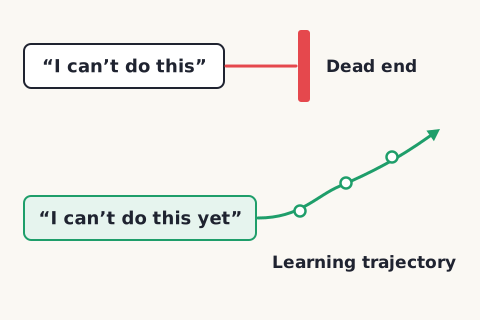
The Power of Yet
The Power of Yet is a linguistic cognitive tool that converts the defeatist statement 'I can't do this' into the actionable learning trajectory 'I can't do this yet', instantly transforming a static dead end into an active developmental continuum.
 FlashFeed original diagram · CC-BY-4.0
Implementation Intentions: If-Then Growth Plans
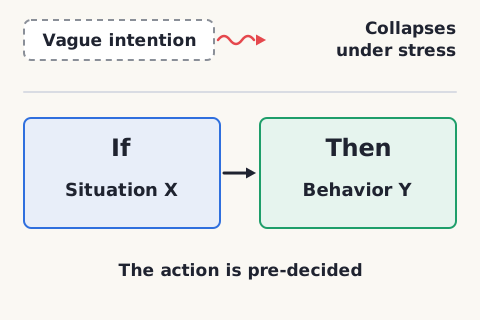
Cognitive psychologist Peter Gollwitzer formulated Implementation Intentions: concrete plans in the format "If [Situation X occurs], then [I will execute Behavior Y]." Under stress or fatigue, vague intentions like "I'm going to stay positive and study hard" tend to collapse into fixed-mindset avoidance, while a specific if-then plan — such as "If I encounter a programming bug that takes more than 20 minutes to solve, then I will take a five-minute walk, diagram the logic on paper, and consult the documentation before asking a peer" — pre-decides the action and automates it.
 Pexels · Andy Barbour · Pexels License ↗
Replacing 'F' With 'Not Yet'
In her TED talk, Carol Dweck describes a high school in Chicago where students who did not pass a course got the grade "Not Yet" instead of a failing grade. The grade signals that they are on a learning curve, not permanently failed.
 Pexels · Gu Ko · Pexels License ↗
Brainology and the Growth-Mindset Workshop
Brainology is a computer-based program built by Dweck and colleagues from their growth-mindset workshop. In the original in-person workshop for seventh graders (Blackwell, Trzesniewski and Dweck, 2007), teaching students that the brain grows with effort reversed a decline in their math grades.
 Pexels · BOOM 💥 Photography · Pexels License ↗
Growth Mindset Doesn't Promise Identical Outcomes
A growth mindset does not claim everyone starts with identical genetic gifts, or that anyone can effortlessly become a genius in any field. It acknowledges that people differ in their initial talents and temperaments — its real claim is narrower and still powerful: that a person's ultimate potential is an unknown quantity that can only be revealed through years of sustained, focused effort, not predicted in advance.
 Pexels · Pranavsinh suratia · Pexels License ↗
From Judge-and-Be-Judged to Learn-and-Help-Learn
Shifting to a growth mindset transforms life from a judge-and-be-judged framework into a learn-and-help-learn framework, turning every obstacle into fuel for growth instead of a threat to one's status. Every difficult moment presents a daily choice: take the fixed path of ego-defense and comfort, or the growth path of challenge and continuous renewal. Over a lifetime, this reorientation transforms struggle from a painful threat into the very core of a meaningful life.
 Pexels · Yan Krukau · Pexels License ↗
Process Focus Under Pressure
When facing a high-stakes evaluation — a standardized exam, an executive board meeting — growth-mindset individuals practice Process Focus Under Pressure: concentrating entirely on present tactical execution and preparation, and letting the outcome take care of itself rather than agonizing over it.
1 / 10Which of the following is NOT identified as a Fixed Mindset Trigger?
Routine, already-mastered tasks don't provoke defensiveness; daunting challenges, sharp criticism, and peer success do.
Lesson 6 has 44 cards. Keep going in the free app.
Question
Good Job Trying? 
Not Yet Transcripts
Good Job Trying?
Good job trying. It sounds like a growth mindset, but it can miss the point.
Dweck warned about a false growth mindset: praising effort that isn't leading to learning.
Real growth joins effort with strategy. When something fails, look at why, drop the method that did not work, and test new ones.
And most people are a mix of both mindsets. Everyone has fixed-mindset triggers, like harsh criticism or a sudden failure.
Not Yet
One Chicago high school replaced a failing grade with two words: not yet.
That grade tells students they are on a learning curve. They keep practicing until they meet the standard.
The same word works in everyday speech. I can't code in Python becomes I can't code in Python yet.
One small word turns a dead end into a path you are still walking.
Episode 67:22
How do you change your mindset: four steps, spotting a false growth mindset, the power of yet and if-then plans?
Also on Spotify ↗Apple Podcasts ↗


What you'll be able to do 12 objectives, from the pack's lessons
- Distinguish between the entity (fixed) and incremental (growth) theories of human intelligence and brain plasticity.
- Analyze how fixed and growth mindsets diverge in internal monologues, EEG brainwave focus, and interpretation of failure.
- Examine how mindsets determine academic trajectories in junior high, remedial language adoption, and pre-med performance.
- Evaluate how high educator standards and growth framing counteract stereotype threat in underrepresented students.
- Contrast natural athletic talent mythology with character-driven preparation exemplified by Michael Jordan and Muhammad Ali.
- Apply John Wooden's definition of success and contrast constructive setback processing with fixed mindset excuses.
- Differentiate fixed-mindset CEO talent cults (Enron) from growth-mindset Level 5 leadership (Lou Gerstner, Anne Mulcahy).
- Formulate organizational strategies that eliminate Groupthink and establish psychological safety for continuous innovation.
- Diagnose the three fixed-mindset relationship fallacies and contrast vengeful responses to rejection with constructive repair.
- Evaluate the experimental findings of the Mueller-Dweck praise study and contrast process praise with intelligence praise.
- Sequence the four-step roadmap to tame fixed-mindset personas and avoid false growth mindset traps.
- Implement the Power of 'Yet' and if-then implementation intentions to sustain lifelong behavioral growth.
Study guide.
The same study guide as in the app, one page for each lesson, with its key facts and a self-test.
- 01Foundations: The Two Mindsets and Human Potential
- 02Ability, Achievement, and the Classroom
- 03Sports and Athletic Excellence: The Mindset of a Champion
- 04Leadership, Corporate Culture, and Organizational Mindsets
- 05Relationships, Parenting, and the Perils of Praise
- 06Cultivating Growth: The Journey to Changing Mindsets
Built from 13 sources.
161 of its 302 cards cite a source. These are the eight it cites most.
- Carol S. Dweck, Mindset, Chapter 5: Business: Mindset and Leadership ↗
- Carol S. Dweck, Mindset, Chapter 3: Ability and Achievement ↗
- Mueller & Dweck (1998), Journal of Personality and Social Psychology 75(1) ↗
- Amy C. Edmondson, 'Learning from Mistakes Is Easier Said Than Done', Journal of Applied Behavioral Science (1996) ↗
- Carol S. Dweck, 'Carol Dweck Revisits the Growth Mindset', Education Week, September 2015 ↗
- Carol S. Dweck, 'The power of believing that you can improve', TED talk ↗
- Irving Janis, Victims of Groupthink (1972) ↗
- Mangels, Butterfield, Lamb, Good & Dweck (2006), Social Cognitive and Affective Neuroscience ↗
See all 13 sources
- Carol S. Dweck, Mindset, Chapter 5: Business: Mindset and Leadership ↗
- Carol S. Dweck, Mindset, Chapter 3: Ability and Achievement ↗
- Mueller & Dweck (1998), Journal of Personality and Social Psychology 75(1) ↗
- Amy C. Edmondson, 'Learning from Mistakes Is Easier Said Than Done', Journal of Applied Behavioral Science (1996) ↗
- Carol S. Dweck, 'Carol Dweck Revisits the Growth Mindset', Education Week, September 2015 ↗
- Carol S. Dweck, 'The power of believing that you can improve', TED talk ↗
- Irving Janis, Victims of Groupthink (1972) ↗
- Mangels, Butterfield, Lamb, Good & Dweck (2006), Social Cognitive and Affective Neuroscience ↗
- Nadia Comăneci (Wikipedia) ↗
- Carol S. Dweck, 'What Having a Growth Mindset Actually Means', Harvard Business Review, January 2016 ↗
- Marva Collins (Wikipedia) ↗
- The Gottman Institute, Predicting Divorce ↗
- Wilma Rudolph (Wikipedia) ↗
Hover over a photo, or tap its i, to see where it came from. All 7:
- Lesson 1: Wikimedia Commons · Satheesh Gopalan · CC BY-SA 3.0 ↗
- Lesson 2: Pexels · Jean-Rene Chazottes · Pexels License ↗
- Lesson 3: Wikimedia Commons · Associated Students of the University of California at Los Angeles · Public domain ↗
- Lesson 4: Pexels · Andrea Piacquadio · Pexels License ↗
- Lesson 5: Pexels · Ketut Subiyanto · Pexels License ↗
- Lesson 6: Pexels · kaboompics.com · Pexels License ↗
- Lesson 6: Unsplash · Christian Velitchkov · Unsplash License ↗
- Mindset by Carol S. Dweck · on Amazon ↗
These are affiliate links: if you buy a book through one, FlashFeed may earn a small commission at no extra cost to you. The commission helps pay for FlashFeed's servers.
As an Amazon Associate we earn from qualifying purchases.
Independent study notes, not affiliated with the author or publisher.
- Cards
- 302
- Lessons
- 6
- Version
- 1.0.38
- Language
- English
The whole pack is one file. Read the pack file ↗
FlashFeed is on the App Store and Google Play.
FlashFeed is free on iPhone and Android, and needs no account.