
Mindset: The New Psychology of Success study guide · Lesson 5 of 6
Relationships, Parenting, and the Perils of Praise
Mindsets in Love: Romantic Partnerships and Social Dynamics · Where Mindsets Come From: Praise, Criticism, and Mentorship
Unofficial study guide for Mindset: The New Psychology of Success by Carol S. Dweck. FlashFeed is not affiliated with the author or publisher.
This is the lesson's study guide from the FlashFeed app, plus its key facts and a self-test.
What you'll be able to do
- Diagnose the three fixed-mindset relationship fallacies and contrast vengeful responses to rejection with constructive repair.
- Evaluate the experimental findings of the Mueller-Dweck praise study and contrast process praise with intelligence praise.
Lesson 5: Relationships, Parenting, and the Perils of Praise
Mindsets in Love: Romantic Partnerships and Social Dynamics
The psychological mindsets that govern academic, athletic, and professional achievement exert an equally profound influence on romantic partnerships, family life, and social relationships. When two individuals form a romantic partnership, their implicit self-theories dictate how they interpret disagreements, navigate flaws, and respond to emotional vulnerability. In romantic relationships, the Fixed Mindset feeds three destructive beliefs, labeled here as fallacies, that undermine intimacy and lead to unnecessary relationship dissolution:
- The Fallacy of Effortless Harmony: The romanticized, fairy-tale belief that if two people are truly soulmates, their relationship should require no effort, communication, or conflict resolution ("If we have to work at it, it wasn't meant to be"). Entity theorists view relationship friction as proof of fundamental incompatibility rather than a normal developmental stage of intimacy.
- The Mind-Reading Fallacy: The unrealistic expectation that an ideal partner should automatically anticipate all emotional needs, desires, and thoughts without verbal communication ("If I have to tell you what I need, it doesn't count"). This expectation inevitably produces bitter resentment and silent withdrawal.
- The Fixed Partner Fallacy: The conviction that a partner’s personality flaws, communication habits, or emotional quirks are permanent character defects that can never change, breeding chronic contempt and emotional detachment.
In sharp contrast, the Growth Mindset recognizes that deep, enduring intimacy is not an effortless fairy tale, but a dynamic, cultivated craft. Growth-oriented partners understand that disagreements and friction are natural opportunities to deepen mutual empathy, align core values, and practice communication skills. Even good relationships take continuing effort, because the forces that hold partners together always have to be weighed against the ones that can pull them apart. Disagreements are normal. What matters is whether a couple treats them as proof of a bad match or as work they can do together.
The psychologist John Gottman has spent decades studying what makes marriages last or fail, much of it in his research lab at the University of Washington, nicknamed the "Love Lab." His team videotaped couples as they tried to resolve a disagreement, and how partners handled that conflict helped predict which marriages would last. That fits the growth-mindset view of relationships: what matters is how partners work through problems together.
The divergence between mindsets becomes especially stark when confronting romantic rejection or heartbreak. For individuals with a fixed mindset, being dumped or betrayed is experienced as a permanent brand of unworthiness ("I am unlovable and damaged"). Entity theorists obsess over seeking vindictive revenge against their ex-partner to restore their wounded pride. Growth-mindset individuals process emotional heartbreak by experiencing the grief fully, forgiving their former partner, extracting valuable relationship lessons, and opening their hearts to future intimacy.
In social dynamics and school environments, the fixed mindset fuels the psychology of Bullying. Bullies use harassment to assert social superiority, labeling victims as permanently inferior. Victims of bullying who hold a fixed mindset internalize the abuse, concluding there is something inherently defective about them, which is linked to more depressive symptoms and a stronger wish for revenge. Carol Dweck and her colleagues found that teaching adolescents a growth mindset reduced their aggressive responses to peer victimization and exclusion, helping children realize that personality traits and social standing are developable rather than fixed destinies. Similarly, debilitating shyness is alleviated when individuals realize social skills are learnable competencies that improve with practice. Embracing a growth mindset allows human beings to build authentic, forgiving, and deeply resilient social connections.
The fixed mindset also causes severe distortions in how individuals navigate close friendships, family dynamics, and social circles. When an individual operating with a fixed mindset witnesses a close friend receive a major career promotion, purchase a beautiful home, or achieve personal acclaim, they experience acute envy and diminished self-worth. In the fixed paradigm, life is a zero-sum hierarchy of talent; another person's milestone is perceived as an indictment of one's own standing. This produces passive-aggressive behavior, sarcastic undermining, or emotional withdrawal. In contrast, friends with a Growth Mindset practice Empowering Friendship Dynamics, actively rejoicing in their friends' accomplishments and seeking to learn from their strategies while offering unwavering emotional support during seasons of struggle.
In adolescent social dynamics, the fixed mindset provides the psychological engine that drives schoolyard Bullying. Bullies often rely on social dominance to establish a rigid status hierarchy, labeling vulnerable peers as permanently weak or deficient. When victims of bullying internalize a fixed mindset, they conclude that the bully's cruel insults reflect permanent personal flaws, which is linked to more depressive symptoms and a stronger wish for revenge. In one study of ninth and tenth graders at a high school, students who were taught that personalities can grow and change over time showed fewer aggressive, retaliatory responses to being bullied or excluded than classmates in a comparison group. Students learn that social friction and awkwardness are normal developmental hurdles that can be navigated with empathy, assertiveness, and communication training.
Where Mindsets Come From: Praise, Criticism, and Mentorship
Where do mindsets originate? Parents, educators, and coaches communicate powerful mindset messages through everyday praise, criticism, and feedback. In an influential study, Dr. Claudia Mueller and Dr. Carol S. Dweck (1998) investigated the effects of praise on hundreds of fifth-grade children in a series of experiments. The researchers presented children with an initial set of 10 moderately challenging nonverbal IQ puzzles. After completing the puzzles, all children received their scores along with a single sentence of praise:
- Intelligence Praise Group: Children were told they had done very well, then praised for ability ("You must be smart at these problems").
- Process Praise Group: Children got the same good-score feedback, then were praised for effort ("You must have worked hard at these problems").
The single sentence of praise produced radical divergence across subsequent testing:
- Task Choice: Children chose between tasks that would let them look smart and a task they would learn a lot from, even if they looked less smart (performance goals versus a learning goal). In the first experiment, 67% of children praised for intelligence chose a performance goal, protecting their label of brilliance. In contrast, 92% of children praised for effort chose the learning goal. A second experiment found the same pattern (69% and 88%).
- Resilience under Setback: When presented with a subsequent set of extremely difficult problems that ended in failure, intelligence-praised children enjoyed the problems less and more often put their poor results down to low ability. Process-praised children enjoyed the problems more and more often put the failure down to low effort rather than low ability.
- Subsequent Performance: On a final set equal in difficulty to the first, after the hard round, the scores of intelligence-praised children dropped (by about 0.9 problems on average), whereas the scores of process-praised children rose (by about 1.2 problems).
- Honesty and Integrity: When asked to report their scores confidentially to a child at another school, 38% of intelligence-praised children overstated their scores, compared with 13% of children praised for effort.
Process Praise focuses on the child’s active strategies, concentration, persistence, and iterative refinement ("I really admire how you tried three different methods until you solved that equation"). In contrast, praising innate brilliance or speed ("You finished that math worksheet so fast, you're a genius!") teaches children that speed equals intelligence and that slow, deep, arduous learning is a sign of stupidity.
In his landmark study Developing Talent in Young People, educational researcher Dr. Benjamin Bloom investigated 120 world-class concert pianists, sculptors, Olympic athletes, and research mathematicians. Bloom discovered that very few elite performers exhibited child-prodigy traits. Crucially, their initial childhood mentors were extraordinarily warm, kind, and encouraging, making early practice playful and joyful before introducing rigorous technical discipline in adolescence. Effective parents and mentors respond to low grades not with punitive anxiety, but with constructive curiosity: "What did this test teach you about your study methods, and how can we adjust your strategies for next time?" Cultivating a growth mindset in young people requires celebrating the courage to tackle hard problems and providing actionable tools for strategic mastery.
The profound findings of the Mueller and Dweck Praise Experiments extend directly into classroom grading policies and athletic coaching. When teachers praise children for speed or effortless performance ("You finished that advanced math problem in thirty seconds, you're a natural genius!"), they inadvertently condition students to despise difficult, slow, and complex intellectual work. The child internalizes the toxic rule: Speed equals intelligence; struggling slowly means I am dumb. Consequently, when these students encounter university-level physics or advanced literature that cannot be mastered in thirty seconds, they experience acute anxiety and abandon the subject. Effective educators utilize Process Praise, targeting persistence, focus, and strategy: "I noticed how carefully you drafted multiple outlines and verified your sources before writing this essay; that systematic process is why your argument is so compelling."
In his landmark study Developing Talent in Young People, Dr. Benjamin Bloom investigated the developmental trajectories of world-renowned concert pianists, sculptors, Olympic swimmers, and mathematicians. Bloom found that few of these elite performers had been child prodigies who dominated their fields effortlessly. In their early childhood, their parents and mentors focused entirely on making the craft joyful, playful, and emotionally rewarding. Only after the children had developed deep intrinsic love and curiosity for the discipline did their mentors introduce rigorous technical drills and deliberate practice. Parents and educators who nurture enduring mastery avoid premature sorting and judgment, creating an environment where high standards, constructive curiosity, and unconditional emotional support empower young minds to flourish.
Key terms
- Mind-Reading Fallacy
- The unrealistic expectation that a loving partner should automatically anticipate all emotional needs without open verbal communication.
- Process Praise
- Feedback that targets the child's active learning strategies, persistence, concentration, and iterative improvement rather than innate talent.
Key concepts
Dr. John Gottman
- Pioneering relationship psychologist and founder of the Love Lab
- Known for decades of research on what makes marriages last or fail
- His videotaped studies of couples resolving disagreements found that how partners handle conflict helps predict whether a marriage lasts
Dr. Benjamin Bloom
- Pioneering educational researcher who authored 'Developing Talent in Young People'
- Surveyed 120 world-class concert pianists, Olympic swimmers, sculptors, and mathematicians
- Discovered elite performers were nurtured by warm, playful early mentors rather than harsh judges
Bloom Early Mentorship Stage
- The initial phase of elite talent development identified by Benjamin Bloom
- Mentors focus on making early practice playful, joyful, and deeply encouraging
- Builds intrinsic love for the craft before rigorous technical discipline is introduced in adolescence
Key facts
The Fallacy of Effortless Harmony in Love
In romantic relationships, a fixed mindset generates the destructive fallacy that if two people are true soulmates, their relationship should require no effort, communication, or conflict resolution ('If we have to work at it, it wasn't meant to be').
Two More Fixed-Mindset Relationship Fallacies
Beyond the fallacy of effortless harmony, the fixed mindset produces two more destructive relationship beliefs. The Mind-Reading Fallacy is the unrealistic expectation that a loving partner should automatically anticipate every emotional need without being told, which breeds resentment and silent withdrawal. The Fixed Partner Fallacy is the conviction that a partner's communication habits or personality quirks are permanent character defects that can never change, which breeds chronic contempt.
Processing Heartbreak: Growth Mindset vs. Fixed Mindset
A fixed-mindset person experiencing heartbreak feels permanently branded as unlovable and often obsesses over vindictive revenge to restore their wounded pride. A growth-mindset person instead follows a healthier recovery process: fully feeling the grief, examining their own communication habits and relationship dynamics for real lessons, forgiving their former partner, and staying open to future intimacy.
Bullying Is a Fixed-Mindset Dynamic
Bullies use harassment to assert a rigid social hierarchy, labeling victims as permanently inferior. Victims who hold a fixed mindset are especially vulnerable, internalizing the bully's cruelty as proof of a permanent personal defect, which is linked to more depressive symptoms and a stronger wish for revenge. In one high-school study, students taught that personalities can grow and change responded to bullying with less aggression.
Reacting to a Friend's Success: Envy vs. Empowering Friendship
A fixed-mindset person who watches a close friend land a big promotion or achievement often feels acute envy and diminished self-worth, subtly undermining the friend rather than celebrating them. Growth-mindset friends instead practice Empowering Friendship Dynamics: actively rejoicing in a friend's milestones, learning from their strategies, and offering unwavering support during hard times.
The Mueller and Dweck Landmark Praise Study
In a landmark series of experiments with hundreds of fifth-graders, Claudia Mueller and Carol Dweck showed that praising children's intelligence ('You are smart') undermines motivation, creates risk-aversion, degrades test scores, and induces score lying, whereas process praise builds resilience.
Process Praise: What It Sounds Like
Process Praise focuses on a child's active strategies, concentration, persistence, and iterative refinement rather than innate talent — for example: "I admire how you tested three different outlining strategies until your argument became clear and strong." It targets the specific approach a child took, not a fixed label like "smart."
Benjamin Bloom: Elite Talent Starts Playful, Not Prodigious
Educational researcher Benjamin Bloom studied 120 world-class concert pianists, sculptors, Olympic athletes, and mathematicians and found that very few of them were child prodigies. Instead, their earliest mentors made initial practice warm, playful, and joyful, building deep intrinsic love for the craft, and only introduced rigorous technical discipline later, in adolescence.
The Mueller-Dweck Study: Praise Changes What Kids Choose
After a single sentence of praise, fifth-graders in the Mueller-Dweck study diverged sharply in what they wanted from their next task. They could choose a task that would show off their ability, or one they would learn a lot from even if they looked less smart. In the first experiment, 67% of children praised for intelligence ("you must be smart") chose to show off ability, while 92% of children praised for effort chose to learn something new.
The Mueller-Dweck Study: Praise and Honesty
When fifth-graders in the Mueller-Dweck study were asked to report their scores confidentially to an anonymous child at another school, 38% of children who had been praised for intelligence reported a higher score than they had earned. Only 13% of children praised for effort did the same.
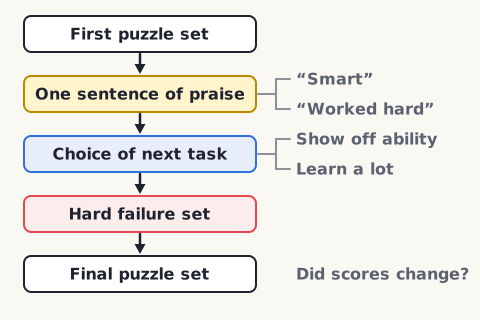
The Mueller-Dweck Praise Experiment, Step by Step
Claudia Mueller and Carol Dweck's landmark study followed a precise sequence: give fifth-graders an initial set of 10 moderately challenging nonverbal IQ puzzles, deliver one sentence of praise (either "you must be smart" or "you must have worked hard"), offer a choice between a task that would show off their ability and one they could learn a lot from, then administer a hard failure set followed by a final set of equal difficulty to the first, to see how scores changed.
The Speed-Praise Trap
Praising a child for finishing schoolwork quickly ("you're a genius!") teaches a dangerous lesson: that speed equals intelligence, and that slow, effortful learning is a sign of stupidity. That belief later causes real trouble, since children conditioned this way come to dread any subject that can't be mastered in thirty seconds.
The Mueller-Dweck Study: Setbacks and Final Scores
When the Mueller-Dweck fifth-graders hit a set of genuinely difficult problems, intelligence-praised children enjoyed the problems less and more often put their poor results down to low ability. On a final set equal in difficulty to the very first, children praised for effort solved about one more problem than before (up 1.21 on average), while children praised for intelligence solved about one fewer (down 0.92).
Matched pairs
Each item on the left goes with the one on the right.
- Fixed Partner Fallacy
- Views a partner's annoying communication quirks as immutable character defects that can never change
- Growth Mindset Response to Heartbreak
- Forgives the partner, extracts constructive relationship lessons, and maintains an open heart for future intimacy
- Task Choice under Intelligence Praise
- About two-thirds (67%) chose a task to show off their ability over one to learn from
- Task Choice under Process Praise
- 92% chose a task to learn from, even if they might look less smart
Step by step
Growth Mindset Heartbreak Recovery Process
- Acknowledge emotional grief and pain without repressing feelings or numbing reality
- Refrain from internalizing romantic rejection as a permanent verdict of personal unworthiness
- Examine personal communication habits and relationship dynamics to extract actionable lessons
- Forgive the former partner and open emotional capacity to future healthy romantic intimacy
Mueller-Dweck Praise Experimental Sequence
- Administer initial set of 10 moderately challenging Raven's matrices to fifth-grade students
- Deliver one sentence of experimental praise: intelligence ("You must be smart at these problems") or effort ("You must have worked hard at these problems")
- Offer a choice of next task: one that shows off ability or one to learn a lot from
- Administer difficult failure set, followed by final equal-difficulty set to measure the change in scores
Self-test
Answer each question from memory, then check your work against the answer key.
1. Which fixed-mindset belief holds that an ideal partner should sense all your emotional needs without being told?
- AMind-Reading Fallacy
- BFallacy of Instant Chemistry
- CFixed Partner Fallacy
- DFallacy of Effortless Harmony
2. In this lesson, which label is given to the fixed-mindset belief that true soulmates need no effort, communication, or conflict resolution?
- AMind-Reading Fallacy
- BFallacy of Total Acceptance
- CFallacy of Effortless Harmony
- DFixed Partner Fallacy
3. Which of these is NOT one of the three fixed-mindset relationship fallacies described in the lesson?
- AFixed Partner Fallacy
- BMind-Reading Fallacy
- CFallacy of Effortless Harmony
- DFallacy of Mutual Growth
4. How does a fixed-mindset person typically respond to being dumped or betrayed?
- ANormal intimacy milestone
- BUnlovable, seeks revenge
- CGrieves fully, forgives
- DAvoids relationships out of fear
5. Why does teaching adolescents a growth mindset significantly reduce retaliatory aggression and bullying in schools?
- ABecause it encourages peer mediation programs where students negotiate formal truce agreements.
- BBecause it teaches students that their classmates' social status is fixed and can never change.
- CBecause it pairs the lessons with stricter disciplinary codes that punish bullies more harshly.
- DBecause students realize that social status and personality traits are developable rather than fixed destinies
6. Why did intelligence-praised children lose their enjoyment when encountering difficult puzzles in the Mueller-Dweck study?
- ABecause the researchers gave them far less time to complete the harder set of puzzles.
- BBecause the harder puzzles required teamwork, and these children preferred working alone.
- CBecause encountering difficulty led them to conclude that they were not actually smart after all
- DBecause they were told the harder puzzles would not count toward their final grade at all.
7. In the first experiment of the 1998 Mueller-Dweck study of fifth-graders, what share of children praised for intelligence chose a task to look smart on over one to learn from?
- A67%
- B50%
- C38%
- D92%
8. Which outcome in a 1998 study of fifth-graders went with PROCESS praise rather than intelligence praise?
- AEnjoyment collapsed under difficulty
- BScores rose on final test
- CChose a task to look smart
- DAlmost 40% lied about scores
9. A teacher tells a student 'You solved that so fast, you're a genius!' What lesson does this teach the child?
- AAccuracy matters more than speed
- BSpeed equals intelligence
- CDifficulty means a task is worth trying
- DIntelligence grows through effort
10. In a 1998 study of fifth-graders, what share of children praised for intelligence reported a higher score than they had earned to a child at another school?
- ARoughly 15%
- BNearly 65%
- CAlmost 40%
- DAbout 90%
Go deeper
- ListenLesson 5 episode
- WatchMeant to Be? If we have to work at it, it wasn't meant to be. That belief can end good relationships.
- WatchOne Sentence of Praise One sentence of praise changed how children handled hard work.
- ReadMindset by Carol S. Dweck · on Amazon ↗
- StudyMindset: The New Psychology of Success in the FlashFeed app
These are affiliate links: if you buy a book through one, FlashFeed may earn a small commission at no extra cost to you. The commission helps pay for FlashFeed's servers.
As an Amazon Associate we earn from qualifying purchases.
Answer key
- 1. A Mind-Reading FallacyThe Mind-Reading Fallacy expects a partner to anticipate needs without verbal communication, breeding silent resentment; the other options name different (or invented) relationship fallacies.
- 2. C Fallacy of Effortless HarmonyThe Fallacy of Effortless Harmony treats friction as proof a couple wasn't meant to be, unlike a growth view, in which conflict is a normal, ongoing part of intimacy.
- 3. D Fallacy of Mutual GrowthThe three named fallacies are Effortless Harmony, Mind-Reading, and Fixed Partner. 'Fallacy of Mutual Growth' is not one of them.
- 4. B Unlovable, seeks revengeFixed-mindset individuals feel permanently unlovable and chase revenge to restore wounded pride, while growth-minded partners grieve, forgive, and stay open to future intimacy.
- 5. D Because students realize that social status and personality traits are developable rather than fixed destiniesTeaching that people can change reduces hostile attribution bias, helping adolescents de-escalate social conflicts.
- 6. C Because encountering difficulty led them to conclude that they were not actually smart after allWhen intelligence-praised children hit difficulty, they immediately deduced that their intelligence was a sham, destroying motivation.
- 7. A 67%In the first experiment, 67% of intelligence-praised children chose the task that would make them look smart (69% in the second). 38% is the share who overstated their scores, and 92% is the share of effort-praised children who chose to learn.
- 8. B Scores rose on final testProcess-praised children's scores rose on the final set. The other three outcomes describe the intelligence-praise group instead.
- 9. B Speed equals intelligencePraising speed teaches that fast equals smart and that slow, effortful learning signals stupidity, the opposite lesson of process praise.
- 10. C Almost 40%38% of intelligence-praised children reported a higher score than they had earned, compared with 13% of effort-praised children. About 90% is far above either rate.
Sources
- Mindset: The New Psychology of Success — Carol S. Dweck
- Carol S. Dweck, Mindset, Chapter 6: Relationships: Mindsets in Love
- Carol S. Dweck, Mindset, Chapter 6: Relationships: Mindsets in Love; Carol S. Dweck, Mindset, Chapter 7: Parents, Teachers, Coaches — www.penguinrandomhouse.com/books/44337/mindset-by-carol-s-dweck-phd/
- The Gottman Institute, Predicting Divorce — www.gottman.com/blog/predicting-divorce/
- Carol S. Dweck, Mindset, Chapter 6; Yeager, Trzesniewski & Dweck (2013), Child Development: implicit theories and adolescent aggression — www.penguinrandomhouse.com/books/44330/mindset-by-carol-s-dweck-phd/
- Carol S. Dweck, Mindset, Chapter 7: Parents, Teachers, Coaches
- Mueller & Dweck (1998), Journal of Personality and Social Psychology 75(1) — doi.org/10.1037/0022-3514.75.1.33
Image credits
- The Mueller-Dweck Praise Experiment, Step by Step: FlashFeed original diagram · CC-BY-4.0