
The Psychology of Money
Timeless lessons on wealth, greed, and happiness exploring behavioral finance, the mathematics of compounding, the roles of luck and risk, time autonomy as wealth's highest dividend, and the psychology of reasonable over rational decisions.
267 cards6 lessonsFree
Already have FlashFeed?Open this pack
Get this pack on your phone
Scan with your phone's camera.
flashfeedlearningapp.com/packs/the-psychology-of-money
Part of the Master Your Money collection.
 Pexels · Los Muertos Crew · Pexels License ↗
 Wikimedia Commons · Wikideas1 · CC0 ↗

 FlashFeed original diagram · CC-BY-4.0
6 lessons.
Each lesson has a study guide to read and objectives you can test yourself on. Its cards and games show up in your feed. Try one of its cards right here. Play a few of its games here too.
-
Wikimedia Commons · Wikideas1 · CC0 ↗01
Individual Perspectives & The Roles of Luck and Risk
Diverse Financial Realities & The No One's Crazy Principle · Luck, Risk, and the Peril of Extreme Outliers
Lesson 1 · 9 cardsWikimedia Commons · Wikideas1 · CC0 ↗Depression Generation
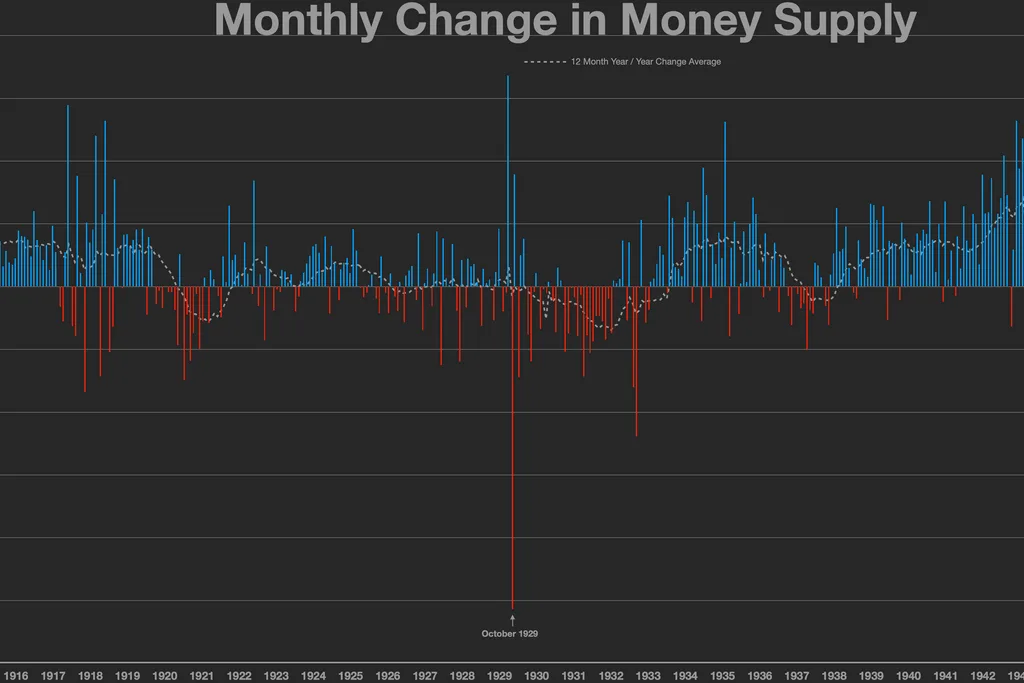
Depression babies view stock markets with visceral fear of total loss, whereas 1990s investors view equities as effortless compounding engines.
 Library of Congress · Dog, running · No known restrictions (verify at source) ↗
The Internal Logic of Financial Decisions
Every financial choice makes complete intuitive sense to the person making it based on the unique mental model formed from their life experiences.
 Wikimedia Commons · Master Jean de Mauléon · Public domain ↗
The Visceral Reality Gap
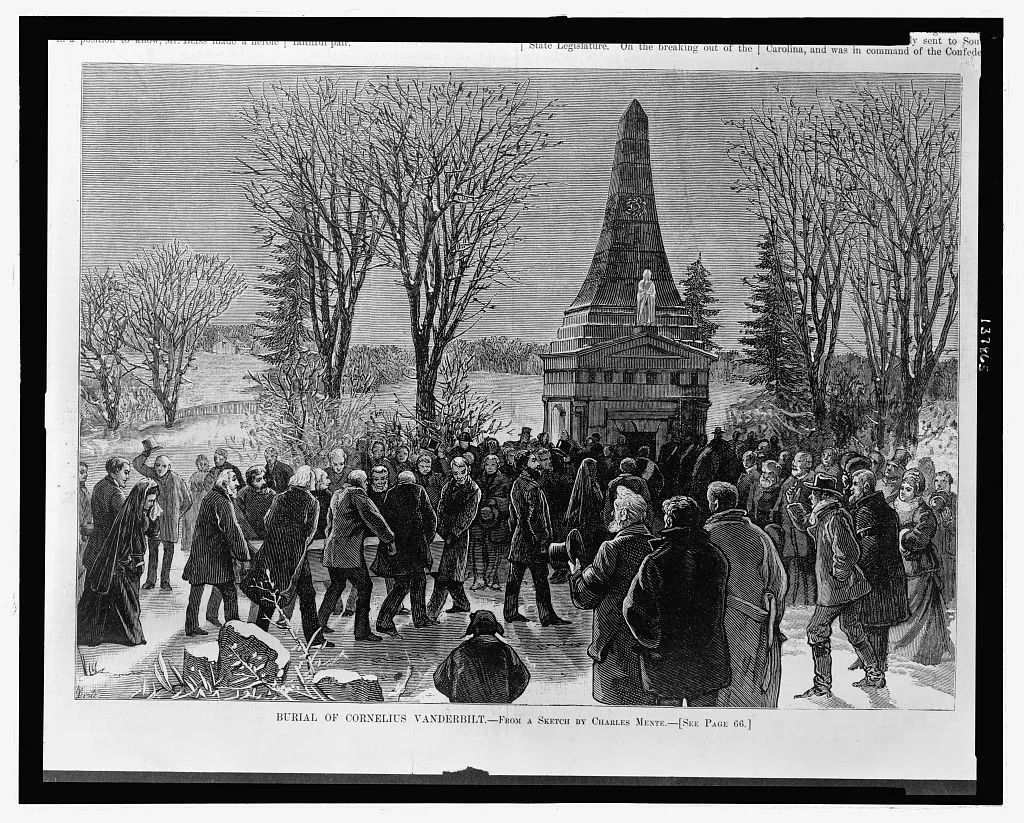
The profound gulf between observing historical drawdowns on a chart and experiencing the gut-wrenching dread of real financial loss.
 Library of Congress · Burial of Cornelius Vanderbilt · No known restrictions (verify at source) ↗
The Fallacy of Calling Others Crazy
Dismissing someone else's financial choices as irrational is an analytical error caused by failing to understand their formative life lessons.
 FlashFeed original diagram · CC-BY-4.0
The Twin Forces of Randomness
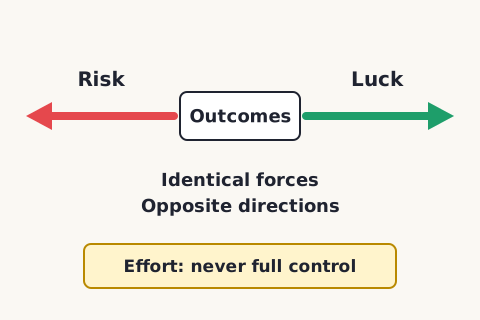
Luck and risk are identical forces operating in opposite directions, proving that individual effort never controls 100% of outcomes.
 Library of Congress · Bernard Madoff, going to jail post plea · No known restrictions (verify at source) ↗
Broad Pattern Superiority
Focusing on universal behaviors (frugality, diversification, cash reserves) provides far more reliable guidance than copying outlier biographies.
 Wikimedia Commons · Bogdan Hoyaux / European Union · CC BY 4.0 ↗
Gates's Acknowledgment of Lakeside Luck
Bill Gates explicitly noted that without the rare luck of attending Lakeside School in 1968, Microsoft would never have existed.
1 / 9In what year was the 401(k) plan created?
The 401(k) was created accidentally in 1978 via a tax code amendment. 1976 is when Bogle launched index funds; 1929 and 1990 refer to other events.
Lesson 1 has 44 cards. Keep going in the free app.
Question -
 Unsplash · Elvis Liang · Unsplash License ↗02
Ambition, Sufficiency, and Compounding Mechanics
The Danger of Never Enough & Modern Financial Envy · Confounding Compounding: The Exponential Power of Time
Lesson 2 · 10 cardsUnsplash · Elvis Liang · Unsplash License ↗The Irreplaceable Asset Rule
Never risk what is important and irreplaceable (freedom, family, reputation) for what is superfluous and unneeded.
 Wikimedia Commons · US-gov · Public domain ↗
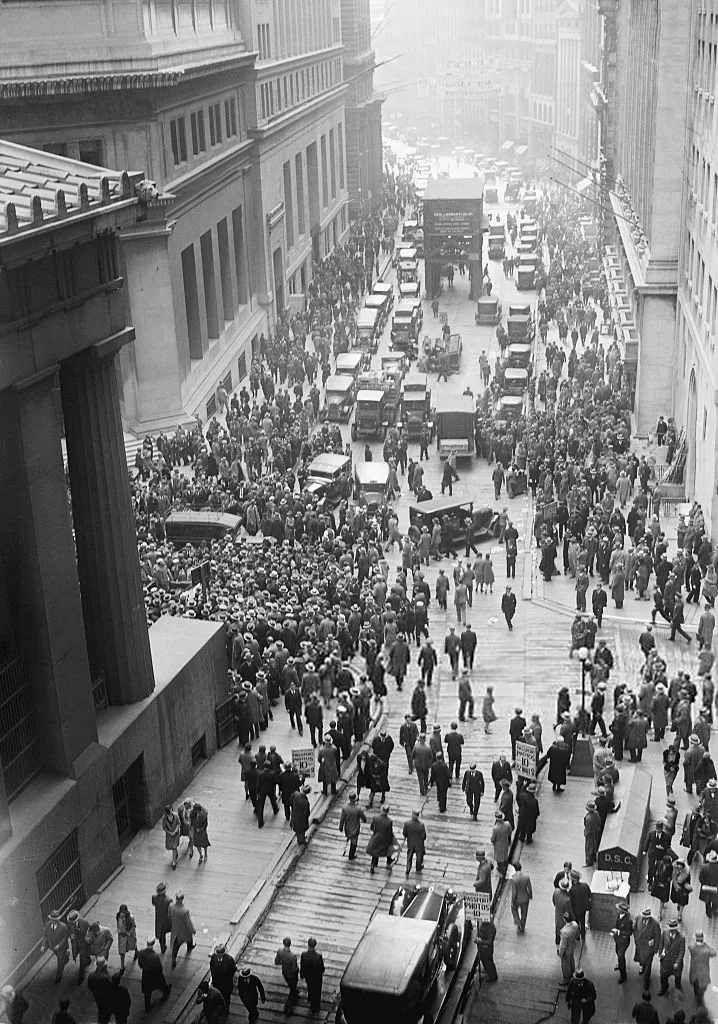
The Irreversibility of Forfeited Freedom
Personal freedom and time autonomy can never be bought back once surrendered to debt, high leverage, or criminal conviction.
 Unsplash · Andre Taissin · Unsplash License ↗
Capitalism's Envy Engine
Capitalism is masterfully designed to generate wealth and envy in equal measure, requiring conscious resistance to endless upward comparison.
 Pexels · Andrea Piacquadio · Pexels License ↗
The Attainment of Financial Peace
True financial peace occurs when the desire to impress others is replaced by contentment with what has already been achieved.
 Wikimedia Commons · USA International Trade Administration · Public domain ↗
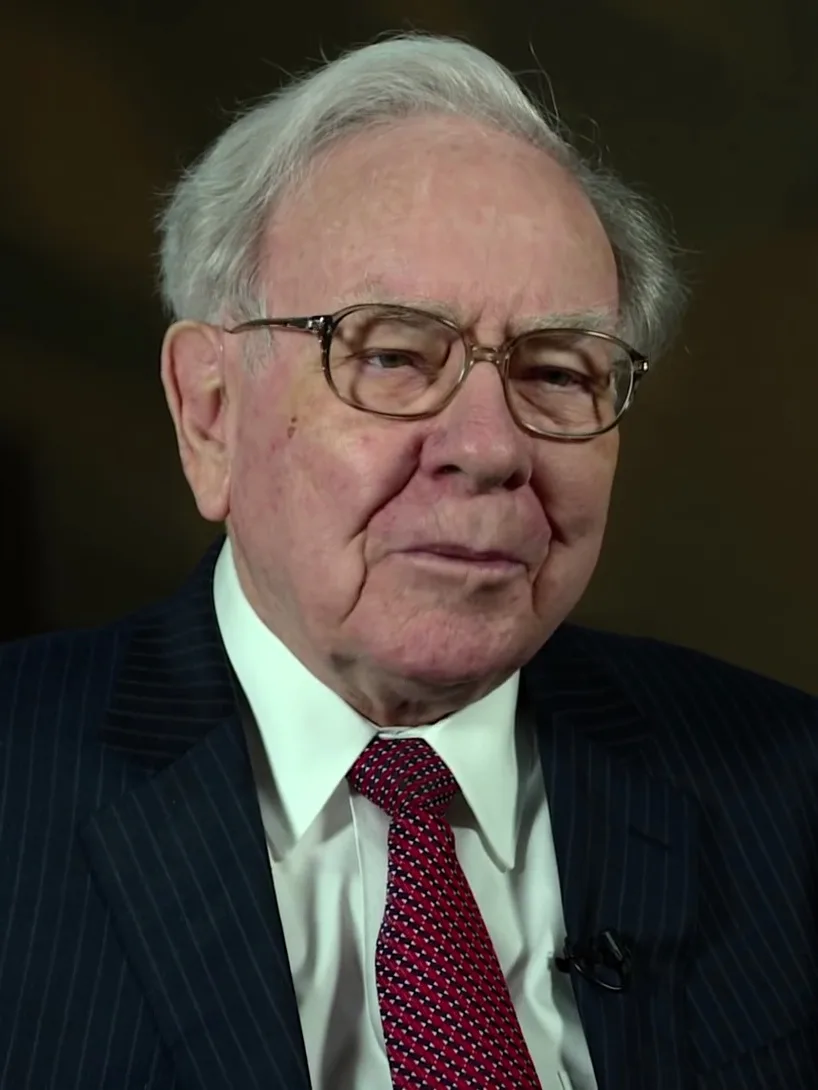
The 99.9% Duration Deficit
If Buffett had started investing at age 30 with $25,000 and retired at 60, his net worth would have been $11.9 million—99.9% less than his actual fortune.
 Pexels · AlphaTradeZone · Pexels License ↗
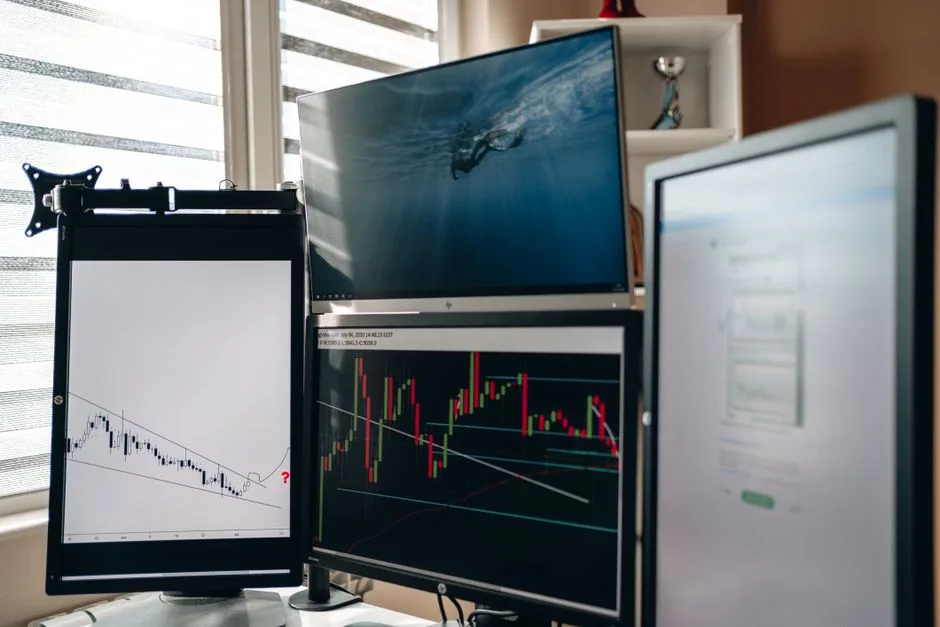
The Superiority of Good Sustainable Returns
Good, sustainable investment returns compounded across decades consistently beat spectacular short-term returns accompanied by high ruin risk.
 Unsplash · Steve Harvey · Unsplash License ↗
The Peril of Return Maximization
Pushing an investment strategy to maximize short-term annual percentage gains frequently increases the risk of ruin, interrupting compounding.
 FlashFeed original diagram · CC-BY-4.0
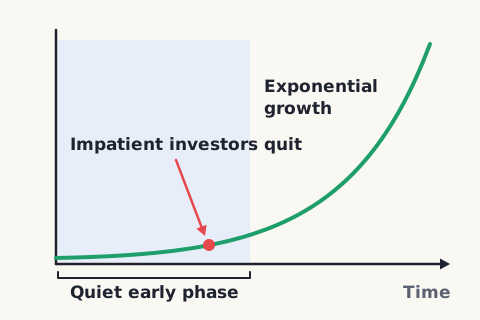
The Quiet Early Phase of Compounding
Exponential growth is deceptively quiet in its early phases, causing impatient investors to abandon winning long-term plans.
1 / 10Before joining Goldman Sachs' board, Rajat Gupta was managing director of which firm?
Gupta rose to managing director of McKinsey & Company before his Goldman board seat and eventual insider-trading conviction.
Lesson 2 has 44 cards. Keep going in the free app.
Question -
Pexels · Los Muertos Crew · Pexels License ↗03
Wealth Preservation and the Power of Asymmetric Tails
Getting Wealthy vs. Staying Wealthy & The Survival Mindset · Long Tails, Rare Events, and the Law of Large Outcomes
Lesson 3 · 10 cardsPexels · Los Muertos Crew · Pexels License ↗Getting Wealthy
Getting Wealthy requires aggressive risk-taking and optimism, whereas Staying Wealthy requires humility, paranoia, and fear of ruin.
 Unsplash · Josh Redd · Unsplash License ↗
Survival as the Supreme Prerequisite
Survival is the foundational prerequisite of compounding: any strategy that does not guarantee survival carries a terminal return of zero.
 Unsplash · kam myers · Unsplash License ↗
Planning for Reality vs. Optimization
A financial plan is only useful if it can survive reality: plans must incorporate large buffers for severe recessions and emergencies.
 Pexels · KoolShooters · Pexels License ↗
Cash as Psychological Insurance
Cash earning modest interest is not a drag on performance; it is the insurance policy that prevents panic-selling equities at market bottoms.
 Unsplash · Prydumano Design · Unsplash License ↗
Insulating from Emotional Panic
True wealth protection means insulating your financial plan from being destroyed by your own emotional panic during downturns.
 FlashFeed original diagram · CC-BY-4.0
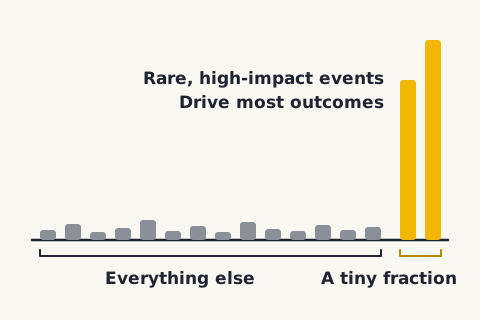
The Law of Long Tails
In business, investing, and economics, long tails—the tiny fraction of rare, high-impact events—drive the vast majority of all outcomes.
 Good-investing · CC0 ↗
Buffett's 10 Core Winners
Warren Buffett owned 400 to 500 stocks in his lifetime, but made the vast majority of his fortune on just 10 of them.
 Pexels · Jan van der Wolf · Pexels License ↗
Being Wrong Half the Time and Winning
You can be wrong half the time (or more) and still build an immense fortune if your winning tail investments are allowed to compound.
 Wikimedia Commons · Nick · CC BY 2.0 ↗
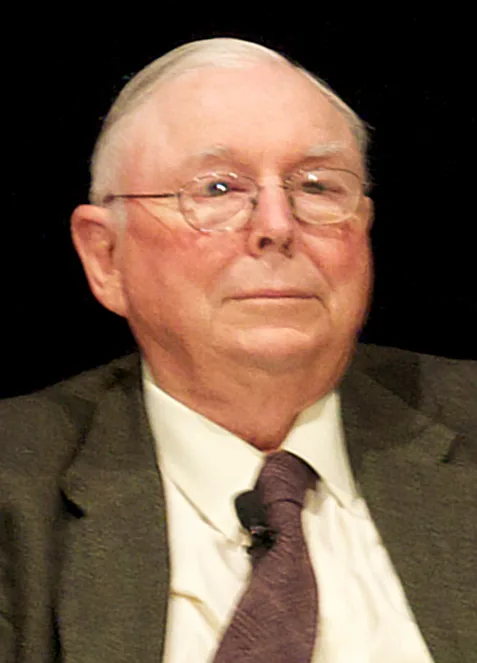
Charlie Munger on Berkshire's Averages
Charlie Munger noted that removing just a few top investments leaves Berkshire Hathaway's multi-decade track record looking average.
 Pexels · wal_ 172619 · Pexels License ↗
The Normality of Small Mistakes
In a tail-driven world, experiencing frequent small losses and setbacks is normal, expected, and mathematically necessary.
1 / 10What does 'Getting Wealthy' require, in contrast to 'Staying Wealthy'?
Getting Wealthy demands risk-taking optimism; the other options describe the opposite trait set needed to Stay Wealthy.
Lesson 3 has 44 cards. Keep going in the free app.
Question -
 Pexels · RUN 4 FFWPU · Pexels License ↗04
The True Value of Wealth: Autonomy and Invisible Capital
Freedom, Time Autonomy, and the Highest Dividend · The Man in the Car Paradox & Invisible Wealth
Lesson 4 · 10 cardsPexels · RUN 4 FFWPU · Pexels License ↗The Primacy of Time Control Over Income
Control over your daily calendar has a greater positive impact on life satisfaction than salary level, house square footage, or luxury cars.
 Pexels · SHAHBAZ ZAMAN · Pexels License ↗
1950s Industrial Labor
Factory labor ended physically at the factory gate at 5 PM, whereas knowledge workers carry mental fatigue constantly inside their smartphones.
 Pexels · Vika Glitter · Pexels License ↗
The Modern Knowledge Work Trap
Cognitive workers never truly leave their jobs in digital economies unless they establish financial independence and firm boundaries.
 Pexels · Mo Eid · Pexels License ↗
Money's Highest Dividend
Money's greatest intrinsic value—and its highest dividend—is its ability to grant you control over your time and daily calendar.
 Pexels · Mike van Schoonderwalt · Pexels License ↗
The High-Income Burnout Trap
Earning a massive salary while sacrificing 80 hours a week to work you dislike creates high consumption paired with low life satisfaction.
 Pexels · Pixabay · Pexels License ↗
Independence as a Life Shock Absorber
Wealth provides independence, which is the ultimate buffer against life's inevitable surprises, economic downturns, and career disruptions.
 Pexels · Hakan Bıçak · Pexels License ↗
The Status Symbol Illusion
People spend money on luxury status symbols to gain respect, yet observers use the goods merely as benchmarks for their own fantasies.
 flickr.com · CC BY 2.0 ↗
Wealth is What You Do Not See
Wealth is unspent income: the sports cars not purchased, first-class upgrades declined, and capital left compounding in investment accounts.
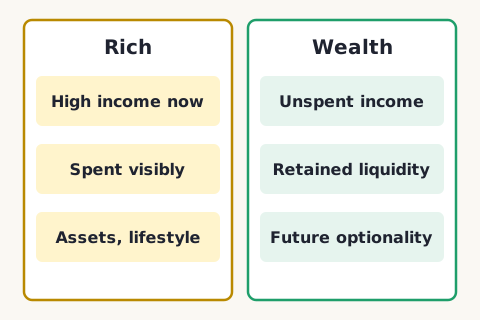 FlashFeed original diagram · CC-BY-4.0
Rich
Rich is current high income spent visibly on assets and lifestyle, whereas Wealth is unspent income, retained liquidity, and future optionality.
 Unsplash · Kyle Bushnell · Unsplash License ↗
The Visibility Bias of Wealth
Society idolizes visible consumption because outward spending is easy to see, while invisible wealth compounding in accounts remains hidden.
1 / 10Angus Campbell's 1981 study on well-being was conducted at which university?
Campbell's landmark 1981 study, The Sense of Well-Being in America, was based on research at the University of Michigan.
Lesson 4 has 44 cards. Keep going in the free app.
Question -
 Unsplash · Andre Taissin · Unsplash License ↗05
Behavioral Efficiency: Savings, Reasonableness, and Error Margins
The Efficiency of Saving & Reasonable vs. Rational Decisions · Room for Error, Margin of Safety, and Long-Term Evolution
Lesson 5 · 10 cardsUnsplash · Andre Taissin · Unsplash License ↗The Savings Rate Imperative
You can build wealth on a modest income with a high savings rate, but cannot build wealth on high income if spending matches earnings.
 Unsplash · Towfiqu barbhuiya · Unsplash License ↗
Saving for the Sake of Saving
You do not need a specific goal to save money; saving for the sake of saving buys unallocated flexibility, optionality, and liquidity.
 Unsplash · Alexander Grey · Unsplash License ↗
The Competitive Advantage of Liquid Cash
In an unpredictable global economy, liquid savings provide a competitive edge by enabling patience and avoiding forced liquidation.
 Unsplash · Thomas T · Unsplash License ↗
The Brittleness of Cold Rationality
Coldly rational financial models ignore human emotion and family dynamics, making them brittle and difficult to sustain during panics.
 Pexels · A glass clinical thermometer on a plain white background, symbolizing healthcare and medical precision. ↗
Market Volatility as an Economic Fever
Market drawdowns are an uncomfortable but unavoidable part of investing; trying to eliminate them entirely, like suppressing a healthy fever, can do more harm than good.
 Otis Historical Archives, National Museum of Health and Medicine · Public domain ↗
The Historian's Fallacy
Historians make poor prophets because unprecedented black swan events (pandemics, wars, breakthroughs) drive most historical shifts.
 Pexels · Roger Brown · Pexels License ↗
Room for Error as an Active Weapon
Room for error is not a conservative compromise; it is an active mechanism that prevents unexpected shocks from ending your ability to play.
1 / 10According to Housel, which factor matters most for building wealth?
Housel argues savings rate matters more than returns or income: a high income with matching spending builds no wealth, while a modest income with a high savings rate can.
Lesson 5 has 46 cards. Keep going in the free app.
Question -
FlashFeed original diagram · CC-BY-4.006
Market Psychology, Narrative Fallacies, and Personal Philosophy
The Volatility Fee, Game Clashes, and Pessimism's Seduction · Financial Narratives, Postscript Consumer History, and Core Rules
Lesson 6 · 10 cardsFlashFeed original diagram · CC-BY-4.0Market Volatility as a Fine
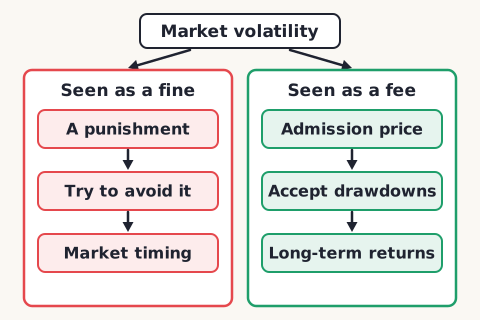
Viewing volatility as a fine treats market crashes as punishments to avoid through market timing. Viewing it as a fee means accepting drawdowns as the unavoidable admission price for long-term equity returns.
 Unsplash · Marcus Reubenstein · Unsplash License ↗
The Fine-Framing Trap
When you view market crashes as a fine, you try to avoid paying it through market timing, which usually leads to buying high and selling low.
 Pexels · AlphaTradeZone · Pexels License ↗
The Relativism of Price Rationality
An asset price that is completely rational for a short-term momentum trader can be toxic and destructive for a 30-year retirement saver.
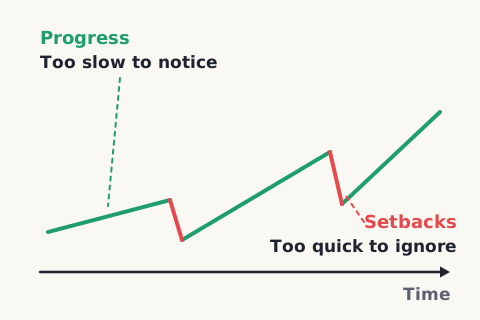 FlashFeed original diagram · CC-BY-4.0
The Velocity Asymmetry of Progress
Progress happens too slowly to notice through daily compounding, while setbacks happen too quickly to ignore through sudden crises.
 Wikimedia Commons · Unknown author · Public domain ↗
The 1950s Egalitarian Baseline
Between 1945 and 1980, average Americans lived in similar modest homes and drove similar cars, making keeping up with peers easily achievable.
 Pexels · A spacious, modern indoor shopping mall with escalators and an American flag. ↗
1950-1970 Consumer Era
From 1950 to 1970, Americans benchmarked their lifestyle against modest neighborhood peers who earned similar wages. After 1980, that benchmark shifted to top-tier luxury lifestyles sustained by cheap consumer credit rather than comparable income.
1 / 10Chapter 15 argues market volatility should be understood as what kind of price?
Housel frames volatility as the fee paid to access long-term returns, not a fine for doing something wrong.
Lesson 6 has 45 cards. Keep going in the free app.
Question


What you'll be able to do 12 objectives, from the pack's lessons
- Explain the 'No One's Crazy' principle regarding personal financial histories and evaluate the role of Luck and Risk in extreme outliers.
- Explain how luck and risk drive extreme outliers like Bill Gates and Kent Evans, and why attribution bias hides their role.
- Explain the danger of 'Never Enough' — how envy and the moving goalpost drove Gupta and Madoff to risk everything they had.
- Explain why compounding is exponential, not linear, using Buffett's late-life wealth surge and the Milankovitch ice-age analogy.
- Distinguish getting wealthy from staying wealthy: why survival, Berkshire's cash fortress, and barbell paranoia beat Livermore's one bad year.
- Explain the Law of Long Tails: how a rare 1% of bets, like Berggruen's art and Disney's Snow White, drive nearly all returns.
- Explain why Housel calls control over your time money's highest dividend, citing Angus Campbell's study and Pillemer's survey of 1,000 elderly Americans.
- Explain the Man in the Car Paradox, why spending to look rich leaves you with less money (Rihanna), and why invisible wealth is capital compounding quietly.
- Explain why saving money is an efficiency of spending, and distinguish being Reasonable from strictly Rational financial models.
- Apply Graham's margin of safety (the Russian roulette bet, lower-return planning, cash savings), and spot the End of History Illusion and the sunk cost fallacy.
- Analyze market volatility as an admission fee rather than a fine, and identify the seductive psychological pull of financial pessimism.
- Explain how comforting narratives blinded banks to the 2008 crisis, how the GI Bill and post-1980 debt shaped spending, and why Housel paid off his mortgage.
Study guide.
The same study guide as in the app, one page for each lesson, with its key facts and a self-test.
- 01Individual Perspectives & The Roles of Luck and Risk
- 02Ambition, Sufficiency, and Compounding Mechanics
- 03Wealth Preservation and the Power of Asymmetric Tails
- 04The True Value of Wealth: Autonomy and Invisible Capital
- 05Behavioral Efficiency: Savings, Reasonableness, and Error Margins
- 06Market Psychology, Narrative Fallacies, and Personal Philosophy
Its cards name 22 sources.
231 of its 267 cards name their source. These are the eight named most.
- The Psychology of Money
- Morgan Housel, The Psychology of Money, Chapter 3
- Morgan Housel, The Psychology of Money, Chapter 1
- Morgan Housel, The Psychology of Money, Chapter 4
- Morgan Housel, The Psychology of Money, Chapter 5
- Morgan Housel, The Psychology of Money, Chapter 6
- Morgan Housel, The Psychology of Money, Chapter 7
- Morgan Housel, The Psychology of Money, Chapter 2
See all 22 sources
- The Psychology of Money
- Morgan Housel, The Psychology of Money, Chapter 3
- Morgan Housel, The Psychology of Money, Chapter 1
- Morgan Housel, The Psychology of Money, Chapter 4
- Morgan Housel, The Psychology of Money, Chapter 5
- Morgan Housel, The Psychology of Money, Chapter 6
- Morgan Housel, The Psychology of Money, Chapter 7
- Morgan Housel, The Psychology of Money, Chapter 2
- Morgan Housel, The Psychology of Money, Chapter 9
- Morgan Housel, The Psychology of Money, Chapter 11
- Morgan Housel, The Psychology of Money, Chapter 13
- Morgan Housel, The Psychology of Money, Chapter 10
- Morgan Housel, The Psychology of Money, Chapter 14
- Morgan Housel, The Psychology of Money, Chapter 17
- Morgan Housel, The Psychology of Money, Chapter 15
- Morgan Housel, The Psychology of Money, Chapter 19
- Morgan Housel, The Psychology of Money, Chapter 16
- Morgan Housel, The Psychology of Money, Postscript
- Morgan Housel, The Psychology of Money, Chapter 18
- Morgan Housel, The Psychology of Money, Chapter 8
- Morgan Housel, The Psychology of Money, Chapter 12
- Morgan Housel, The Psychology of Money, Chapter 20
Hover over a photo, or tap its i, to see where it came from. All 6:
- Lesson 1: Wikimedia Commons · Wikideas1 · CC0 ↗
- Lesson 2: Unsplash · Elvis Liang · Unsplash License ↗
- Lesson 3: Pexels · Los Muertos Crew · Pexels License ↗
- Lesson 4: Pexels · RUN 4 FFWPU · Pexels License ↗
- Lesson 5: Unsplash · Andre Taissin · Unsplash License ↗
- Lesson 6: FlashFeed original diagram · CC-BY-4.0
- The Psychology of Money by Morgan Housel · on Amazon ↗
These are affiliate links: if you buy a book through one, FlashFeed may earn a small commission at no extra cost to you. The commission helps pay for FlashFeed's servers.
As an Amazon Associate we earn from qualifying purchases.
Independent study notes, not affiliated with the author or publisher.
- Cards
- 267
- Lessons
- 6
- Version
- 1.0.21
- Language
- English
The whole pack is one file. Read the pack file ↗
FlashFeed is on the App Store and Google Play.
FlashFeed is free on iPhone and Android, and needs no account.