
The Psychology of Money study guide · Lesson 2 of 6
Ambition, Sufficiency, and Compounding Mechanics
The Danger of Never Enough & Modern Financial Envy · Confounding Compounding: The Exponential Power of Time
Unofficial study guide for The Psychology of Money: Timeless lessons on wealth, greed, and happiness by Morgan Housel. FlashFeed is not affiliated with the author or publisher.
This is the lesson's study guide from the FlashFeed app, plus its key facts and a self-test.
What you'll be able to do
- Explain the danger of 'Never Enough' — how envy and the moving goalpost drove Gupta and Madoff to risk everything they had.
- Explain why compounding is exponential, not linear, using Buffett's late-life wealth surge and the Milankovitch ice-age analogy.
Lesson 2: Ambition, Sufficiency, and Compounding Mechanics
Welcome to Lesson 2 of The Psychology of Money. This lesson investigates the destructive psychology of endless financial envy, the vital skill of defining sufficiency, and the counter-intuitive mathematics of exponential compounding.
The Danger of Never Enough & Modern Financial Envy
Chapter 3 explores the psychology of greed through the tragic downfalls of Rajat Gupta and Bernie Madoff. Rajat Gupta was born in Kolkata, orphaned as a teenager, and rose through sheer intellect and discipline to become managing director of McKinsey & Company, a board member of Goldman Sachs, and a philanthropist with a net worth exceeding $100 million. By any sane metric, Gupta had achieved extraordinary financial freedom, global influence, and institutional prestige.
Yet Gupta was surrounded by tech billionaires and private equity titans whose wealth dwarfed his own. Consumed by the burning desire to join the exclusive billionaire class, Gupta received confidential boardroom information in September 2008 that Warren Buffett was investing $5 billion into Goldman Sachs to stabilize the bank during the height of the global financial crisis. Seconds after the board call disconnected, Gupta tipped hedge fund manager Raj Rajaratnam, who bought Goldman shares before the public announcement. Gupta was convicted of insider trading and sent to federal prison, destroying his reputation, career, and freedom.
Bernie Madoff presented a similar tragedy. Before his massive Ponzi scheme collapsed, Madoff was a legitimate pioneer in electronic trading whose market-making firm earned tens of millions of dollars in lawful profits every year. Madoff was already ultra-wealthy and universally respected. Yet he fabricated a giant criminal facade because he could not bear the prospect of looking ordinary or admitting that his investment returns might fluctuate with natural market cycles.
Gupta and Madoff violated the most critical rule of financial survival: risking what is important and irreplaceable (reputation, freedom, family, integrity) for what is superfluous and unneeded.
The hardest financial skill is getting the Moving Goalpost to stop moving. When expectations rise in lockstep with income, every salary increase or portfolio gain is instantly consumed by new desires. If financial success only produces an insatiable appetite for more, you remain perpetually insecure regardless of your net worth. The feeling of never having enough pushes otherwise brilliant individuals to take catastrophic risks.
Social Comparison is an unwinnable battle. Modern digital culture and social media bombard individuals with curated luxury highlights. There will always be someone with a larger yacht, a more lavish home, or higher status. The only way to win the comparison game is to refuse to play. The novelist Kurt Vonnegut recounted a conversation with Joseph Heller at a party hosted by a billionaire hedge fund manager on Shelter Island. Vonnegut noted that their host made more money in a single day than Heller had made from his entire classic novel Catch-22. Heller calmly replied: "Yes, but I have something he will never have: enough."
Having Enough does not mean living in ascetic deprivation or abandoning healthy ambition. It means recognizing that an unchecked appetite for more will eventually push you past your risk tolerance into catastrophe. Reputation is an asymmetric asset: it takes decades of impeccable character to build and can be permanently obliterated in five minutes of compromised ethics. Knowing when to walk away from excessive risk and protecting what you already have is the foundation of true wealth.
The Moving Goalpost and Social Hedonic Treadmills
The psychological pathology of Never Enough stems from what psychologists term the Hedonic Treadmill combined with upward Social Comparison. When an individual achieves a long-sought financial milestone (such as a six-figure salary, a million-dollar net worth, or a prestigious executive title), the emotional satisfaction is intensely fleeting. Within weeks, the new wealth level is normalized as the baseline reality, and attention immediately shifts to peers who possess even greater status.
In the cases of Rajat Gupta and Bernie Madoff, this insatiable status comparison overpowered their intellectual faculties. Despite having amassed wealth that placed them in the top 0.001% of global society, they felt inadequate when comparing themselves to multi-billionaires. True wealth mastery requires setting an internal definition of sufficiency—an anchor of Enough—that cannot be destabilized by external peer display. Protecting irreplaceable assets like freedom, family, and reputation must always take absolute precedence over chasing incremental luxury.
Confounding Compounding: The Exponential Power of Time
Compounding is the most powerful force in finance, yet human intuition struggles to grasp its exponential nature. Human minds evolved to think linearly: walking 30 linear steps takes you 30 meters, whereas taking 30 exponential steps (doubling distance each step) takes you around the Earth multiple times. This intuitive linear bias leads investors to systematically underestimate the role of time in wealth creation, constantly chasing quick annual yields rather than focusing on longevity.
Consider the fortune of Warren Buffett. When The Psychology of Money was written, Buffett's net worth exceeded 84 billion. But here is the critical reality that most people overlook: over 99% of Warren Buffett's wealth was accumulated after his 50th birthday. More than 81.5 billion came after he qualified for Social Security in his mid-60s.
Buffett is undeniably a brilliant capital allocator, but the true secret of his success is Longevity. Buffett began serious investing at age 10. By age 30, he had accumulated 1 million (9.3 million inflation-adjusted). If Warren Buffett had lived a conventional life—working a corporate career, starting to invest at age 30 with 25,000, and retiring at age 60—even if he achieved the exact same 22% annualized return, his net worth at retirement would have been roughly 11.9 million. That is 99.9% less than his actual multi-billion-dollar fortune.
Compare Buffett to Jim Simons, the founder of Renaissance Technologies. Simons achieved an unmatched 66% annualized return from 1988 to 2018—a record that dwarfs Buffett's 22% annual return. Yet Jim Simons possessed a net worth of $21 billion, roughly a quarter of Buffett's wealth, because Simons only discovered his trading edge in his 50s, compounding for fewer than half as many years.
Geologists discovered an identical compounding mechanism when investigating the origins of Ice Ages. For centuries, scientists assumed ice ages were caused by brutally frigid winters. But in the 1920s, Serbian mathematician Milutin Milankovitch proved that ice ages are triggered by slightly cooler summers. When summers are not warm enough to melt the previous winter's accumulated snow, the remaining ice reflects solar radiation (the albedo effect), cooling the atmosphere further and allowing more ice to accumulate the following year. A tiny initial layer of unmelted snow compounded over thousands of years eventually covers entire continents in ice sheets.
In computer technology, hard drive storage capacity expanded by a factor of 30 million from 1956 to 2020 through compounding engineering advancements. The practical takeaway for personal wealth is profound: the most critical variable in wealth creation is not financial IQ or chasing peak annual yields; it is Uninterrupted Duration. Sustainable, good returns compounded over vast stretches of time will always beat spectacular short-term returns that carry the risk of ruin. Never interrupt compounding unnecessarily: resisting the urge to tinker, trade, or panic during market corrections preserves exponential momentum.
The Mechanics of Long-Term Compounding Longevity
To harness the true exponential power of Compounding, an investor must adopt a long-term mindset that values duration over peak annual yield. Consider the mathematical difference between compounding over 30 years versus 50 years: at a 10% annual return, 10,000 grows to approximately 174,000 in 30 years, but explodes to over $1.17 million in 50 years. The vast majority of the wealth is created in the final decades of the compounding curve.
This explains why Warren Buffett's primary competitive advantage is not superior trading speed or complex derivative strategies, but uninterrupted consistency. By starting early and refusing to panic during market drawdowns, Buffett allowed the exponential curve to do the heavy lifting. Investors who constantly tinker with their portfolios, attempt to time short-term market tops and bottoms, or chase speculative hot trends inevitably interrupt the compounding process, destroying decades of potential exponential growth.
Key terms
- The Madoff Delusion
- The destructive pride that drove an ultra-wealthy market maker to run a massive Ponzi scheme rather than admit investment fluctuations.
- The Comparison Trap
- The perpetual treadmill of perceived inadequacy created by constantly measuring personal wealth against richer peers.
- Asymmetric Reputation Risk
- The reality that an impeccable standing takes decades to build and can be permanently obliterated in five minutes of compromised ethics.
- The Senior Compounding Surge
- The reality that over $81.5 billion of Warren Buffett's wealth arrived after he qualified for Social Security in his mid-60s.
- The Milankovitch Ice Age Analogy
- The scientific discovery that slightly cooler summers, not colder winters, leave snow unmelted, compounding over millennia into continent-covering sheets.
- The 10-Year-Old Investor Advantage
- Buffett's decision to begin investing at age 10, providing eight consecutive decades of compound interest runway.
Key facts
The Irreplaceable Asset Rule
Never risk what is important and irreplaceable (freedom, family, reputation) for what is superfluous and unneeded.
External Social Comparison
Social comparison anchors satisfaction in peer spending, creating endless envy, whereas internal sufficiency defines an unshakeable ceiling of enough.
The True Definition of Enough
Having enough does not mean living in poverty; it means recognizing that an unchecked appetite for more will eventually lead to ruin.

The Irreversibility of Forfeited Freedom
Personal freedom and time autonomy can never be bought back once surrendered to debt, high leverage, or criminal conviction.
Capitalism's Envy Engine
Capitalism is masterfully designed to generate wealth and envy in equal measure, requiring conscious resistance to endless upward comparison.
The Attainment of Financial Peace
True financial peace occurs when the desire to impress others is replaced by contentment with what has already been achieved.
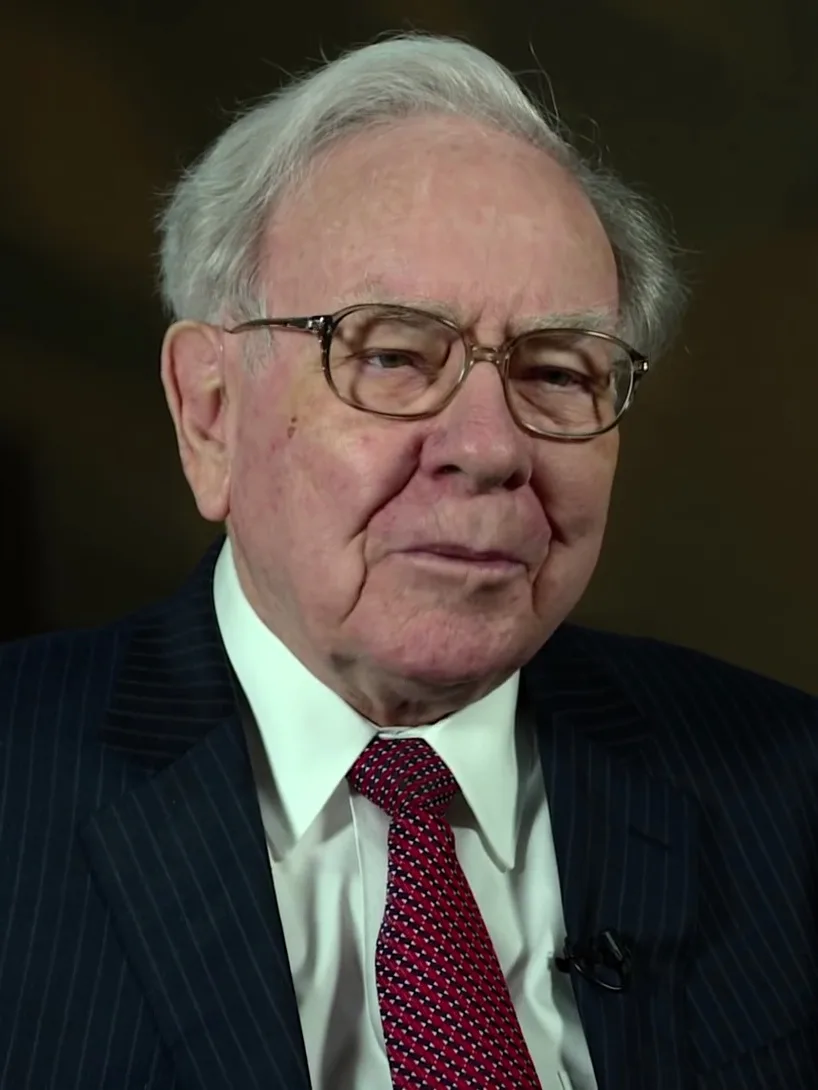
The 99.9% Duration Deficit
If Buffett had started investing at age 30 with 25,000 and retired at 60, his net worth would have been 11.9 million—99.9% less than his actual fortune.
The Superiority of Good Sustainable Returns
Good, sustainable investment returns compounded across decades consistently beat spectacular short-term returns accompanied by high ruin risk.
The Peril of Return Maximization
Pushing an investment strategy to maximize short-term annual percentage gains frequently increases the risk of ruin, interrupting compounding.
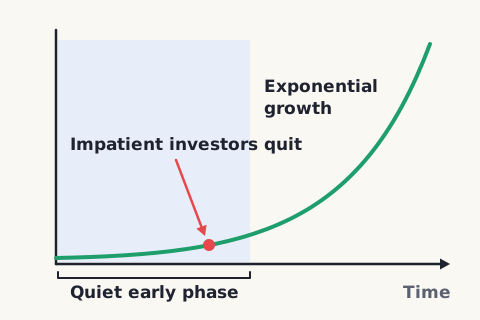
The Quiet Early Phase of Compounding
Exponential growth is deceptively quiet in its early phases, causing impatient investors to abandon winning long-term plans.
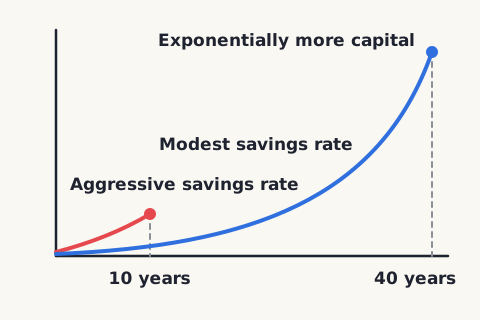
40-Year Modest Savings
A modest savings rate compounded over 40 years generates exponentially more terminal capital than an aggressive savings rate sustained for only 10 years.
The First Rule of Compounding
Never interrupt compounding unnecessarily: resisting tinkering, market timing, or panic selling preserves exponential momentum.
Step by step
Establishing an Internal Ceiling of Sufficiency
- Audit core personal values to define what lifestyle genuinely brings happiness and health
- Set clear fixed financial milestone targets and refuse to increase them when income expands
- Eliminate social media consumption that triggers competitive upward status benchmarking
- Decline high-stakes opportunities that introduce severe reputational or solvency risks
Maximizing Investment Longevity and Compounding
- Select a low-cost, globally diversified asset allocation that you can understand and trust
- Establish an automatic monthly investment schedule that operates regardless of market headlines
- Construct cash reserves to eliminate any possibility of forced equity liquidation during drawdowns
- Commit to remaining invested across multiple decades, letting the exponential curve do the work
Self-test
Answer each question from memory, then check your work against the answer key.
1. Before joining Goldman Sachs' board, Rajat Gupta was managing director of which firm?
- ABain & Company
- BBooz Allen Hamilton
- CMcKinsey & Company
- DBoston Consulting Group
2. An investor's salary doubles, but she instantly upgrades her lifestyle and feels no more secure than before. This illustrates which failure?
- AThe Comparison Trap
- BThe Moving Goalpost
- CAsymmetric Reputation Risk
- DThe Madoff Delusion
3. In September 2008, Rajat Gupta leaked that Warren Buffett was investing how much into Goldman Sachs?
- A$5 billion
- B$25 billion
- C$10 billion
- D$500 million
4. Which of the following is NOT identified as an irreplaceable asset that should never be risked for superfluous gain?
- AFreedom
- BReputation
- CFamily
- DHealth
5. When a billionaire hedge fund host outspent him, what did novelist Joseph Heller say he had that the host never would?
- AReputation
- BFreedom
- CPeace of mind
- DEnough
6. Which figure represents the amount of Warren Buffett's wealth that arrived after he qualified for Social Security in his mid-60s?
- A$50 billion
- B$81.5 billion
- C$84 billion
- D$21 billion
7. What term describes how human intuition naturally processes growth, making multi-decade compounding feel unnatural?
- ALinearly
- BLogarithmically
- CExponentially
- DCyclically
8. Which of the following is NOT true about Warren Buffett's investment record?
- AInvesting since age 10
- B$1 million net worth by 30
- C66% annualized return
- D99% of wealth after age 50
9. Milutin Milankovitch proved in the 1920s that ice ages are actually triggered by which factor?
- AReduced year-round sunlight
- BSlightly cooler summers
- CMuch colder winters
- DIncreased volcanic activity
10. Buffett earned 22% annualized returns versus Jim Simons's 66%, yet Buffett's fortune ended up far larger. What best explains this?
- AMore favorable tax treatment
- BHigher annualized return
- CLonger compounding duration
- DGreater use of leverage
Go deeper
- ReadThe Psychology of Money by Morgan Housel · on Amazon ↗
- StudyThe Psychology of Money in the FlashFeed app
These are affiliate links: if you buy a book through one, FlashFeed may earn a small commission at no extra cost to you. The commission helps pay for FlashFeed's servers.
As an Amazon Associate we earn from qualifying purchases.
Answer key
- 1. C McKinsey & CompanyGupta rose to managing director of McKinsey & Company before his Goldman board seat and eventual insider-trading conviction.
- 2. B The Moving GoalpostThe Moving Goalpost describes expectations rising in lockstep with income, so gains never produce lasting satisfaction.
- 3. A $5 billionGupta tipped Raj Rajaratnam within seconds of learning of Buffett's $5 billion investment during the 2008 crisis.
- 4. D HealthThe irreplaceable assets identified are freedom, family, reputation, and integrity; health, while important, isn't part of this specific list.
- 5. D EnoughHeller told Vonnegut he had 'enough,' capturing the internal ceiling that ends the comparison game.
- 6. B $81.5 billionMore than $81.5 billion of Buffett's fortune arrived after his mid-60s, out of his roughly $84 billion total net worth.
- 7. A LinearlyHumans evolved to think linearly, so the exponential nature of long-term compounding consistently defies intuition.
- 8. C 66% annualized returnThe 66% annualized return belongs to Jim Simons; Buffett's own annualized return was 22%.
- 9. B Slightly cooler summersMilankovitch showed cooler summers, not colder winters, leave snow unmelted so ice accumulates via the albedo effect.
- 10. C Longer compounding durationBuffett compounded for decades longer than Simons, proving duration matters more than peak annual returns.
Sources
- The Psychology of Money — Morgan Housel
- Morgan Housel, The Psychology of Money, Chapter 3
- Morgan Housel, The Psychology of Money, Chapter 4
Image credits
- The Irreversibility of Forfeited Freedom: Wikimedia Commons · US-gov · Public domain — commons.wikimedia.org/wiki/File:Crowd_outside_nyse.jpg
- The 99.9% Duration Deficit: Wikimedia Commons · USA International Trade Administration · Public domain — commons.wikimedia.org/wiki/File:Warren_Buffett_at_the_2015_SelectUSA_Investment_Summit_(cropped).jpg
- The Quiet Early Phase of Compounding: FlashFeed original diagram · CC-BY-4.0
- 40-Year Modest Savings: FlashFeed original diagram · CC-BY-4.0

