
Tips for Living Your Best Life
The distilled wisdom of 18 of the world's most influential self-help books — Atomic Habits, Deep Work, Thinking Fast and Slow, 7 Habits, Never Split the Difference, Rich Dad Poor Dad, Man's Search for Meaning, Can't Hurt Me and more — organized by life domain: mindset, habits, focus, career, money, negotiation, relationships, resilience, and everyday application.
915 cards12 lessons2 video lessonsFree
Already have FlashFeed?Open this pack
Get this pack on your phone
Scan with your phone's camera.
flashfeedlearningapp.com/packs/best-life
Part of the Habits & Mindset collection.
12 lessons.
Each lesson has a study guide to read and objectives you can test yourself on. Its cards and games show up in your feed. Try one of its cards right here. Play a few of its games here too. 2 lessons have a short video.
-
 Pexels · David Kouakou ↗01
Mindset & Mental Performance
Growth mindset & two systems · Finding your why (Frankl) · Values & present-moment awareness
Lesson 1 · 10 cardsPexels · David Kouakou ↗Breath is the anchor
Whenever you feel overwhelmed, take three slow breaths and return attention to physical sensation — the simplest, most accessible meditation there is. You can extend it: washing dishes, walking, driving — any activity normally treated as a means to an end becomes a presence practice when you bring full attention to the sensations involved.
— The Power of Now, Eckhart Tolle Wikimedia Commons · No machine-readable author provided. MPF assumed (based on copyright… · CC BY 2.5 ↗
The most useful word: "yet"
Swap "I can't do this" for "I can't do this yet." That single word turns a closed verdict into an open trajectory — improvement becomes possible and imminent. Pair it with praising process over outcome: judge your work by strategy, effort, and progress, not the raw result.
— Mindset, Carol S. Dweck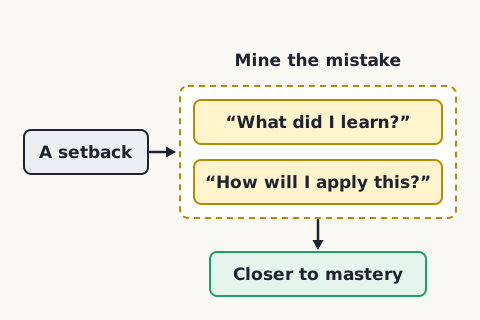 FlashFeed original diagram · CC-BY-4.0
Failure is data, not a verdict
Every mistake moves you closer to mastery — if you mine it. After a setback, ask two questions: What did I learn? How will I apply this next time? People with a growth mindset also seek uncomfortable situations on purpose, because growth happens at the edge of the comfort zone, not inside it.
— Mindset, Carol S. Dweck Pexels · Artem Podrez ↗
Sleep on it
Most daily errors come from letting System 1, your fast and intuitive thinking, handle problems that need System 2, your slow and deliberate thinking. The fix is cheap: before any significant decision — financial, relational, or career — delay your answer by at least one night. The pause gives slow, deliberate thinking time to catch what intuition missed.
— Thinking, Fast and Slow, Daniel Kahneman Pexels · Adult and child bonding while solving a puzzle on a wooden table. ↗
The praise experiment
Psychologist Carol Dweck's research found that children praised for their effort, strategy, and progress went on to choose harder problems and recover better from setbacks than children praised for being clever. Praising the process builds a growth mindset; praising raw ability doesn't.
— Mindset, Carol S. Dweck Wikimedia Commons · Zeynoxxx · CC BY-SA 4.0 ↗
System 1
Kahneman calls this System 1: fast, intuitive, automatic, and emotional, and it runs most of the day. System 2 is the opposite — slow, deliberate, effortful, and logical.
 AI-generated (gpt-image-1.5)
Decision fatigue is real
Every minor choice you make drains the mental energy available for important ones. Kahneman's practical move: standardize the trivial. Pre-decide meals, outfits, and your morning routine so System 2 is rested when a decision that matters actually arrives. And anchor prices mindfully — a listed number skews your sense of value, so research before any negotiation.
— Thinking, Fast and Slow, Daniel Kahneman AI-generated (gpt-image-1.5)
"He who has a Why..."
"He who has a Why to live for can bear almost any How." Nietzsche's line, quoted by Frankl, is the spine of Man's Search for Meaning. Frankl survived four Nazi concentration camps on a single insight: meaning — not conditions — determines whether a person endures.
— Man's Search for Meaning, Viktor Frankl1 / 10Which book-author pairing is INCORRECT?
The Power of Now was written by Eckhart Tolle, not Daniel Kahneman (who wrote Thinking, Fast and Slow). The other three pairings are correct.
Lesson 1 has 71 cards. Keep going in the free app.
Question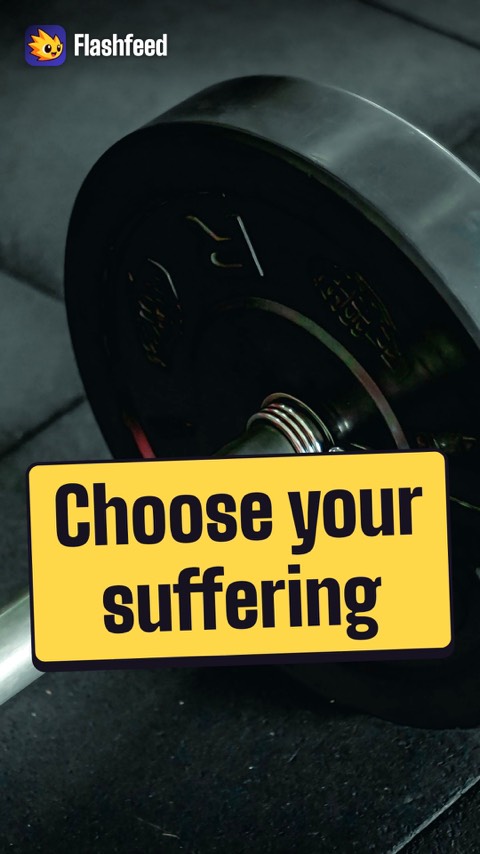
What Are You Willing to Suffer For? All 2 clips on YouTube ↗Transcript
The body you want comes with the gym. The business comes with risk and long hours.
Almost everyone wants the reward. So Mark Manson swaps the question. Not what do I want, but what am I willing to suffer for?
Pick the struggle you will genuinely accept, and the goal sorts itself out. Refuse it, and the want was never real.
Every worthwhile goal comes packaged with difficulty. So choose your suffering.
-
 Pexels · @marcuschanmedia | IG ↗02
Habits & Daily Routines
The Atomic Habits system · The habit loop (Duhigg) · Getting Things Done
Lesson 2 · 10 cardsPexels · @marcuschanmedia | IG ↗Willpower is a muscle
Duhigg's research treats willpower as a muscle — finite, and depleted by use through the day. So protect it: schedule your most demanding work in the morning, when the reserve is full. And accountability groups beat going solo — belief in change is easier inside a community. — The Power of Habit, Charles Duhigg
 Wikimedia Commons · Duesseljan · CC0 ↗
You fall to your systems
James Clear's central claim: you don't rise to the level of your goals — you fall to the level of your systems. Goals set direction; systems are what actually carry you there. A 1% improvement every day compounds into a result roughly 37.78x better over a single year. — Atomic Habits, James Clear
 Wikimedia Commons · L rempe - Dr. Lasse Rempe · CC BY 3.0 ↗
37 times better
Improving just 1 percent each day compounds to roughly 37.78 times better after a year. A 1 percent daily decline, by the same math, compounds down toward zero.
 AI-generated (gpt-image-1.5)
Make it Attractive
James Clear's 'Make it Attractive' law works through temptation bundling — pairing a new habit with something you already enjoy. That's different from 'Make it Satisfying,' which rewards you immediately after the habit instead.
 Pexels · Beyzanur K. ↗
Make it Satisfying
Clear's 'Make it Satisfying' law means the reward for a habit should come immediately, not weeks later. Pairing the habit with something enjoyable beforehand is a separate law, 'Make it Attractive.'
 FlashFeed original diagram · CC-BY-4.0
The Golden Rule of Habit Change
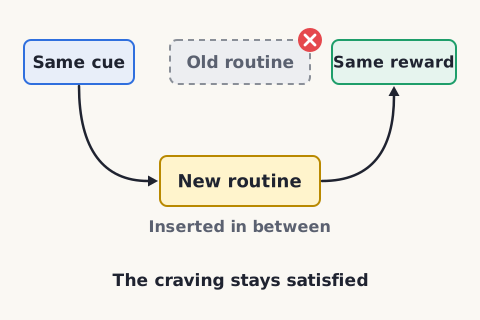
You can't erase a bad habit — but you can rewire it. Duhigg's Golden Rule: keep the same cue and the same reward, and insert a new routine in between. The craving stays satisfied; the behavior changes. — The Power of Habit, Charles Duhigg
 AI-generated (gpt-image-1.5)
What keeps the loop spinning
In Duhigg's habit loop, it's the craving that drives the cycle to repeat. The cue simply triggers the routine that delivers the reward the craving is actually after.
1 / 10In Atomic Habits, the two-minute rule is the practical tool for which of the four laws?
The two-minute rule scales a habit down so starting is effortless, removing the activation barrier — that is exactly the third law, Make it Easy.
Lesson 2 has 86 cards. Keep going in the free app.
Question
Why Open Loops Nag You All 2 clips on YouTube ↗Transcript
Your brain keeps saying "call the dentist." That is storage, not thinking.
David Allen calls these open loops: tasks and half-formed ideas the brain keeps re-surfacing, because they aren't captured anywhere reliable.
The first move is the Mind Sweep. In one session, write down every task, idea and worry, and put it all into one outside system.
Once the brain trusts nothing will be forgotten, it stops re-running the list.
-
 Pexels · Oktay Köseoğlu ↗03
Focus & Deep Work
Deep work vs. shallow work · The four rules · Putting it into practice
Lesson 3 · 10 cardsPexels · Oktay Köseoğlu ↗The focus superpower
In the knowledge economy, the ability to concentrate without distraction is a genuine competitive edge — and it's getting rarer. Cal Newport's Deep Work argues that the few who can still do hard, focused work will pull away from everyone else. — Deep Work, Cal Newport
 AI-generated (gpt-image-1.5)
Shallow work
Answering routine email and sitting through logistical meetings are classic examples of shallow work — logistical tasks that are easily replicated and doable even while distracted.
 Pexels · kaboompics.com ↗
The distraction difference
Work that can be done while distracted and creates little lasting value is shallow work — the opposite of deep work, which is distraction-free, pushes your abilities, and creates real value.
 Pexels · University students in a diverse classroom engaging in a discussion with their professor. ↗
Where the term began
Cal Newport, a Georgetown computer science professor, coined the term deep work in his 2016 book of the same name.
 FlashFeed original diagram · CC-BY-4.0
The four rules of deep work
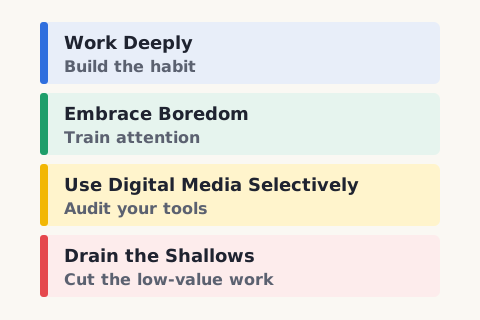
Newport's program is four rules: Work Deeply (build the habit), Embrace Boredom (train attention), Use Digital Media Selectively (audit your tools), and Drain the Shallows (cut the low-value work). — Deep Work, Cal Newport
 Pexels · Pixabay ↗
The monastic approach
Newport's monastic scheduling philosophy eliminates or radically minimizes shallow work to protect long stretches of deep work, unlike philosophies that alternate, schedule, or opportunistically fit deep work in around everything else.
 Pexels · A close-up of a hand closing a laptop in a clean and minimal office setting, symbolizing the end of a work session. ↗
The shutdown ritual
Newport's shutdown ritual is a fixed end-of-workday routine that finishes with saying 'Shutdown complete' out loud, acting as a circuit-breaker so work stops bleeding into the rest of the evening.
 Unsplash · harsh patel · Unsplash License ↗
The any-benefit fallacy
The craftsman approach to tools rejects the 'any benefit' fallacy — the idea that a tool deserves a place in your life just because it helps somehow. A tool must have a positive impact that substantially outweighs its negatives.
1 / 10What does the Deep Work Hypothesis claim about the ability to do deep work?
Newport's hypothesis pairs rising scarcity with rising value: because most workers are losing the capacity to focus, the few who keep it hold a durable edge.
Lesson 3 has 76 cards. Keep going in the free app.
Question -
 Pexels · Artem Podrez ↗04
Work & Career
Covey's 7 Habits · Essentialism · Think and Grow Rich · Prioritizing your work
Lesson 4 · 10 cardsPexels · Artem Podrez ↗Sleep is an Essentialist act
McKeown frames sleep as the keystone protection mechanism for your highest contribution. You are your own most important asset — the tool you use for everything — so underinvesting in your health, mind, and energy directly reduces your output. It's not laziness; it's prioritization. — Essentialism, Greg McKeown
 Pexels · A serene forest path with stone steps ascending through lush green trees in springtime. ↗
The arc of the 7 Habits
Covey's framework moves through three stages: private victory (habits 1–3, mastering yourself), public victory (habits 4–6, working with others), and renewal (habit 7, keeping the saw sharp). You earn the public wins by securing the private ones first. — The 7 Habits of Highly Effective People, Stephen Covey
 FlashFeed original diagram · CC-BY-4.0
Circle of influence
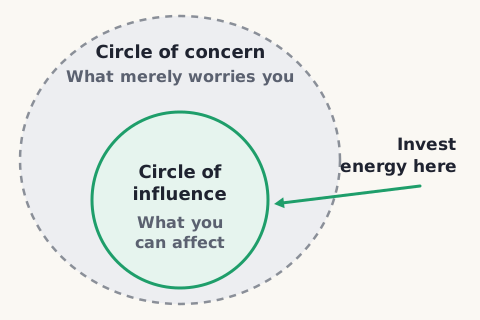
Covey's Habit 1, Be Proactive, means investing your energy in your circle of influence — what you can actually affect — rather than your circle of concern, the wider set of things that merely worry you.
 Pexels · A tidy home office space with a wooden desk, laptop, and ambient lighting. Perfect for remote work. ↗
Quadrant II
In Covey's framework, Quadrant II covers work that's important but not yet urgent — planning, relationships, self-development. Habit 3, Put First Things First, means living there deliberately before those things turn into crises.
 Pexels · Diva Plavalaguna · Pexels License ↗
Synergize
Habit 6, Synergize, means combining differences between people to reach solutions that neither party could have reached alone.
 Pexels · A person carefully removing a block from a jenga tower indoors. ↗
Subtract before you add
Before taking on any new project or role, identify what you will stop doing to make room for it. Energy is finite; a yes without a corresponding no just thins out everything you already do. — Essentialism, Greg McKeown
 AI-generated (gpt-image-1.5)
Two different speeds
McKeown advises Essentialists to handle incoming requests with a slow yes and a fast no — reserving deliberate agreement for the genuine few, while giving most requests a brief, decisive no.
1 / 10In Covey's Habit 1 (Be Proactive), where should you focus your energy?
Being proactive means investing energy in your circle of influence (what you can actually affect) rather than your circle of concern (what merely worries you).
Lesson 4 has 86 cards. Keep going in the free app.
Question -
 Wikimedia Commons · Ledetian · Public domain ↗05
Finance & Wealth Building
The Rich Dad mindset · Directed desire (Hill) · Avoiding money traps
Lesson 5 · 10 cardsWikimedia Commons · Ledetian · Public domain ↗House as liability
Robert Kiyosaki calls the home you live in a liability, not an asset, because it drains money through payments and upkeep while generating no rental income. His test is about the direction cash flows, not the home's appreciation in value.
 Pexels · Intriguing play of light and shadow with a slightly open door revealing a patterned floor. ↗
The affordability reframe
Kiyosaki advises replacing the thought-stopping phrase 'I can't afford it' with the question 'How can I afford it?' The shift keeps the brain actively problem-solving instead of shutting down — a small linguistic change with a large psychological effect.
 Wikimedia Commons · Pistilla · CC BY-SA 4.0 ↗
The Rich Dad distinction
Kiyosaki's central Rich Dad distinction is that the middle class works for money while the rich make money work for them instead. He frames the gap between the two as philosophical before it is financial.
 Wikimedia Commons · MarvinBikolano · CC BY-SA 4.0 ↗
The highest-return investment
Kiyosaki calls financial education — understanding accounting, investing, and markets — the highest-return investment available, best acquired before deploying any capital. He says the rich prioritize it while the credential-focused often skip it.
 Pexels · An arrow perfectly hits the bullseye of a multicolored archery target, highlighting precision and accuracy. ↗
Directed desire
Napoleon Hill's Think and Grow Rich isn't about greed — it's about directed desire with organized action. Vague wishes do nothing; a precise target, a deadline, and a circle of sharp people turn desire into a plan.
— Think and Grow Rich, Napoleon Hill Pexels · Aerial view of a blue car on a pink background symbolizing a fork in the road. ↗
The most expensive habit
Hill found that wealthy people decide quickly and change their minds slowly. Procrastination is the most expensive financial habit there is — delaying your investments by even five years carries an enormous compound-interest cost.
— Think and Grow Rich, Napoleon Hill Wikimedia Commons · Chenspec · CC BY-SA 3.0 ↗
The Master Mind principle
Napoleon Hill's Master Mind principle describes a deliberate group of complementary specialists whose combined intelligence — a 'third mind' — exceeds what any individual member could produce alone.
1 / 10You buy a rental condo, but its mortgage, taxes, and upkeep cost more each month than the rent it brings in. Under Kiyosaki's cash-flow test, what is it right now?
Kiyosaki's test looks only at cash direction, not category. A rental that drains more than it earns is a liability right now — real estate isn't automatically an asset, and paying it off later doesn't change today's negative cash flow.
Lesson 5 has 71 cards. Keep going in the free app.
Question - Take the lessons with you. Free, no account.Download on the App Store ↗Get it on Google Play ↗
-
 Pexels · Bia Limova ↗06
Negotiation & Influence
Tactical empathy, mirroring & labeling · Calibrated questions & No is Power · The FM DJ voice & Black Swans
Lesson 6 · 10 cardsPexels · Bia Limova ↗Negotiation is emotional, not rational
Chris Voss spent 24 years as the FBI's lead international kidnapping negotiator. His central insight rewrites the business-school playbook: negotiation is not a rational process — it is an emotional one. Treat it as pure logic and you leave value on the table.
— Never Split the Difference, Chris Voss Pexels · Anna Shvets ↗
Compromise is the trap
The title is the lesson: compromise is the worst possible outcome. Meeting in the middle of two unsatisfying extremes leaves both sides unhappy. The goal isn't a halfway deal — it's a solution that fully works.
— Never Split the Difference, Chris Voss Unsplash · Zuzana Ruttkay · Unsplash License ↗
Tactical empathy
In Chris Voss's negotiation framework, tactical empathy means demonstrating that you understand the other person's perspective before attempting to influence them. It's acknowledgment, not agreement, and it disarms defensiveness.
 Unsplash · Михаил Секацкий ↗
Mirroring
In Voss's negotiation method, mirroring means repeating the last few words the other person said and then staying quiet. The silence invites them to keep talking and elaborate further.
 Unsplash · Markus Winkler · Unsplash License ↗
Labeling
The purpose of labeling in Voss's negotiation framework is to name an emotion you sense in the other person out loud. Making an unnamed feeling visible like this drains its grip on the conversation.
 Pexels · A welcoming open sign hanging on a glass door, inviting customers to enter. ↗
The calibrated question
A calibrated question is a genuinely open 'How' or 'What' question that hands your problem to the other side to help solve — it engages their problem-solving mind and replaces accusatory 'Why' questions.
 FlashFeed original diagram · CC-BY-4.0
Label first, then ask
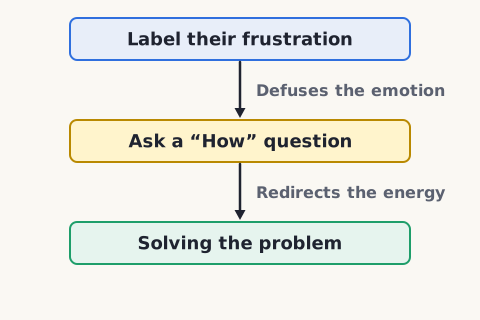
Voss's reliable sequence for handling a difficult colleague is to label their frustration first, defusing the emotion, and then follow up with a 'How' question that redirects the energy toward solving the problem.
1 / 10Voss's rule of thumb is to mirror by repeating how many of the other person's words?
The 1-3 word rule keeps the mirror light: enough to signal attention and draw them out without revealing your own position.
Lesson 6 has 82 cards. Keep going in the free app.
Question -
 Pexels · Vintage portrait of a young boy in a detailed golden frame on a wall. ↗07
Relationships & Social Life
Carnegie's principles · Communication techniques (Lowndes) · The 5 Love Languages · The Four Agreements & Let Them
Lesson 7 · 10 cardsPexels · Vintage portrait of a young boy in a detailed golden frame on a wall. ↗The friendliest book ever written
Dale Carnegie's How to Win Friends & Influence People has sold over 30 million copies because the fundamentals of human psychology don't change. The whole thing reduces to one move: stop trying to be interesting, and become genuinely interested in the other person.
— How to Win Friends & Influence People, Dale Carnegie Pexels · George Pak · Pexels License ↗
The sweetest sound
A person's name is, to that person, the sweetest and most important sound in any language. Remember it and use it. Forget it, or mangle it, and you've quietly told them they don't matter.
— How to Win Friends & Influence People, Dale Carnegie AI-generated (gpt-image-1.5)
Admit it first, fast
When you're wrong, admit it quickly and emphatically. Nothing disarms resistance like owning your error before anyone else can name it. The opposite move — saying 'you're wrong' — only triggers defensiveness and closes the other person's mind.
— How to Win Friends & Influence People, Dale Carnegie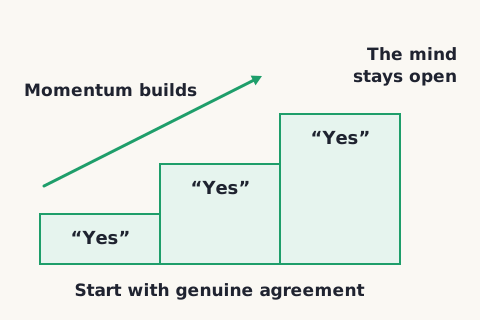 FlashFeed original diagram · CC-BY-4.0
The yes-yes technique
Carnegie's 'get the other person saying yes, yes' technique works by starting with points of genuine agreement and building momentum from there. Agreement keeps a mind open, while confrontation closes it.
 AI-generated (gpt-image-1.5)
How to talk to anyone
Leil Lowndes' How to Talk to Anyone packs 92 practical techniques for charisma and connection — most of them tiny, deliberate adjustments to how you smile, look, and listen.
— How to Talk to Anyone, Leil Lowndes Pexels · Yaroslav Shuraev · Pexels License ↗
Echoing them back
Lowndes' Echoing technique repeats back the last three to five words a speaker just said. It signals that you're listening and invites them to keep going, without you having to invent a response.
1 / 10According to Carnegie, the foundational move for being liked is to:
Carnegie's first rule is to be genuinely interested, not performatively interesting: 'To be interesting, be interested.' Trying to be entertaining or flattering reads as short-term manipulation.
Lesson 7 has 104 cards. Keep going in the free app.
Question -
 Pexels · Torsten Kellermann ↗08
Health, Energy & Mental Toughness
Sharpen the saw (renewal) · Can't Hurt Me (Goggins) · Frankl's resilience
Lesson 8 · 10 cardsPexels · Torsten Kellermann ↗Sharpen the Saw
Covey's seventh habit is the one everyone skips first when life gets busy — and it's the keystone that keeps the other six running. Sharpen the Saw means scheduling deliberate renewal across four dimensions so you don't grind yourself to a stump. — The 7 Habits of Highly Effective People, Stephen Covey
 Pexels · Close-up of athletic sneakers on a wooden bridge, capturing a runner's morning exercise routine. ↗
The keystone habit
A 'keystone habit,' as Duhigg defines it, is a single habit that sets off a chain reaction of other positive changes. Exercise is the classic example: start exercising, and sleep, diet, and self-discipline often improve too.
 Pexels · Gritty trail runner in forest race showcasing endurance and determination. ↗
Can't Hurt Me
David Goggins went from an abused, overweight young man to a Navy SEAL, Army Ranger, and world-record ultra-endurance athlete — arguably the most extreme case of self-built mental toughness in print. His toolkit isn't motivation; it's a set of repeatable practices. — Can't Hurt Me, David Goggins
 Unsplash · Braden Collum · Unsplash License ↗
The Cookie Jar
Goggins' Cookie Jar is a mental catalog of past victories and hard moments you've already survived. When the urge to quit fires early, reaching into it supplies evidence that pushes you past that false ceiling.
 Wikimedia Commons · Wallco26 · CC BY-SA 4.0 ↗
The 40% Rule
Goggins' 40% Rule holds that the feeling of being completely done actually means you've tapped only around 40% of your real capacity. It's a signal to push past, not a verdict that you're truly finished.
 Unsplash · Ashley Smith · Unsplash License ↗
What is this asking of me?
When a project fails or a relationship strains, Frankl's logotherapy offers a single pivot: stop asking "Why is this happening to me?" and ask "What is this asking of me?" The reframe moves you from victim to participant. — Man's Search for Meaning, Viktor Frankl
1 / 10Which renewal habit is the classic example of a keystone habit?
Exercise is the classic keystone habit, Charles Duhigg's term for one routine that sets off a cascade of other gains: start working out, and sleep, eating and self-discipline often improve too.
Lesson 8 has 79 cards. Keep going in the free app.
Question -
 Pexels · Back view of a traveler with suitcase in Kolkata airport terminal. ↗09
Applying It to Daily Life
Smart shopping & consumption · Travel & vacations · Family & parenting · Social intelligence & networking
Lesson 9 · 10 cardsPexels · Back view of a traveler with suitcase in Kolkata airport terminal. ↗Travel disables your cues
Novelty breaks habit loops. Away from your usual triggers — the kitchen at 9pm, the commute, the desk — your automatic cues are temporarily switched off. That makes a week away the ideal moment to audit your routines and decide which ones to rebuild on return. — The Power of Habit, Duhigg
 FlashFeed original diagram · CC-BY-4.0
The asset/liability test
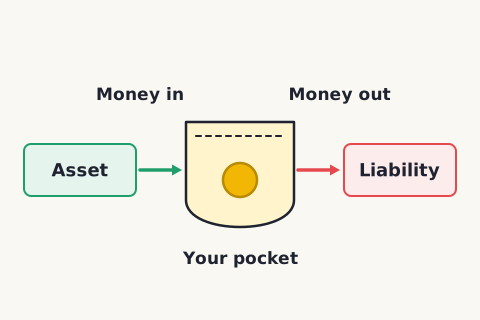
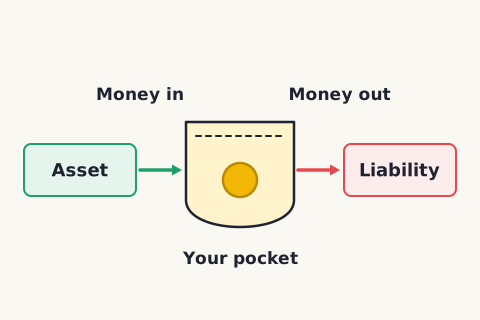
Before any purchase, ask Kiyosaki's question: "Will this put money in my pocket, or take money out?" Assets feed you; liabilities feed on you. Most of what we buy is the second kind dressed up as the first. — Rich Dad Poor Dad, Kiyosaki
 AI-generated (gpt-image-1.5)
Kill the cue, kill the habit
Retail emails aren't messages — they're cues engineered to trigger a shopping habit loop. Unsubscribe and you remove the trigger before it ever fires. The cheapest way to spend less is to stop being reminded to spend. — Atomic Habits, Clear
 Pexels · Close-up of a shopping bag with a Black Friday 50% discount tag and denim jeans visible. ↗
Retail anchoring
Retail anchoring is the pricing trick behind a tag like 'Was $500, now $200': the higher first number sets your sense of value, so the discount feels like a deal even if $200 is still overpriced. The fix is to research the fair value independently instead of trusting the markdown.
 AI-generated (gpt-image-1.5)
Begin with the end in mind
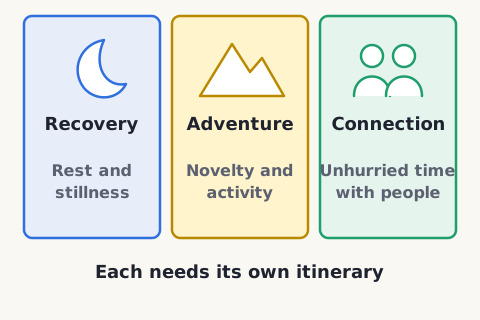
Before you book anything, decide what this trip must deliver: adventure, recovery, or connection? A recovery trip and an adventure trip look nothing alike. Define the purpose first, then build the itinerary to serve it — not the other way round. — 7 Habits of Highly Effective People, Covey
 FlashFeed original diagram · CC-BY-4.0
Three kinds of trips
Trips have three distinct purposes — recovery (rest and stillness), adventure (novelty and activity), and connection (unhurried time with people) — and a recovery trip should look nothing like the other two. Each purpose calls for its own itinerary.
1 / 10You feel a sudden urge to buy something non-essential online. What's the System-1-proof move?
Impulse buying is pure System 1. A one-day delay — the 24-hour rule — lets System 2 catch up and kills most of the urge.
Lesson 9 has 85 cards. Keep going in the free app.
Question -
 FlashFeed original diagram · CC-BY-4.010
The Master Principles
The 18 master principles · The 18 books & their authors · Where to start
Lesson 10 · 10 cardsFlashFeed original diagram · CC-BY-4.0Assets in, liabilities out
The wealthy think in cash flow: assets put money in your pocket; liabilities take it out. Buy assets first; let them pay for the liabilities you want. — Rich Dad, Poor Dad, Think and Grow Rich
 Pexels · Kindel Media ↗
Choose your suffering
Every worthwhile thing has a cost. The question isn't whether you'll struggle — it's which struggle you'll choose. Your values decide what pain is worth enduring, and you needn't take others' behavior personally along the way. — The Subtle Art of Not Giving a F\ck, The Four Agreements*
 Pexels · Close-up of a small green sprout pushing through a concrete crack, symbolizing resilience. ↗
Growth mindset
Ability isn't fixed at birth. A growth mindset treats effort and strategy as the real engine — so praise effort and improvement, not innate ability. Talent is a starting point, not a ceiling. — Mindset, How to Win Friends
 Wikimedia Commons · Krishnavelip · CC BY 4.0 ↗
Protect your focus
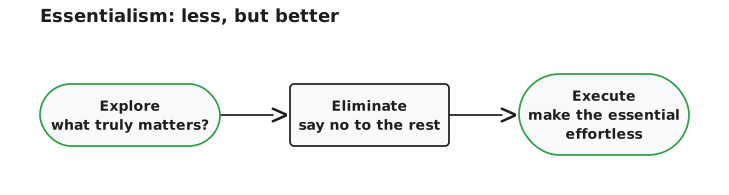
Attention is your scarcest asset. Deep, focused work beats shallow busyness — and less but better beats doing everything. Guard your concentration the way you'd guard money. — Deep Work, Essentialism, Getting Things Done
 AI-generated (gpt-image-1.5)
You're only at 40%
When your mind says you're done, you're really at about 40% of your capacity. Most limits are self-imposed — there's a reserve tank you rarely touch. — Can't Hurt Me
1 / 10According to the 'assets in, liabilities out' principle, an asset is best defined as something that:
Kiyosaki's test is cash-flow direction: assets put money in your pocket, liabilities take it out. Ownership, appreciation, and financing are not his defining criteria.
Lesson 10 has 83 cards. Keep going in the free app.
Question -
 Wikimedia Commons · Satheesh Gopalan · CC BY-SA 3.0 ↗11
Who's Who & What's What
Authors I · Authors II · The big frameworks · Right or Wrong: spot the wiser move
Lesson 11 · a questionCarol Dweck, the Stanford psychologist in this set, is best known for which idea?
Dweck split the 'fixed' view of talent from a trainable, growth-oriented one and urged praising effort over smarts. The other options belong to Kahneman, Newport, and Covey. — Mindset
Lesson 11 has 52 cards. Keep going in the free app.
-
 FlashFeed original diagram · CC-BY-4.012
Essential Vocabulary & Quick Recall
Mind & habit terms · Focus & work terms · Money & toughness terms · People & negotiation terms · Quick recall (mixed)
Lesson 12 · a questionIn Kahneman's framework, which describes System 2 thinking?
System 2 is the slow, effortful, logical mode you want for big decisions. The fast, intuitive, automatic mode is System 1 — the source of most everyday errors.
Lesson 12 has 90 cards. Keep going in the free app.


What you'll be able to do 56 objectives, from the pack's lessons
- Distinguish a growth mindset from a fixed mindset and identify how to reinforce it (praise process/effort, add "yet").
- Distinguish Kahneman's System 1 (fast, intuitive) from System 2 (slow, deliberate) thinking and recognize substitution bias.
- Explain Frankl's logotherapy and the three concrete avenues through which meaning is found.
- Apply Tolle's pain body and Manson's three questions to direct attention toward what matters.
- Match the landmark mindset books to their authors (Dweck, Kahneman, Manson).
- Define an atomic habit and the two-minute rule, and explain how 1% daily gains compound over a year.
- Match Clear's four laws of behavior change to their tactics (Make it Attractive, Make it Satisfying).
- Explain the cue-routine-reward habit loop, rewire a habit via Duhigg's Golden Rule, and define a keystone habit.
- Identify the five categories of cue that trigger a habit and match each to an example.
- Explain GTD's premise, open loops, the Mind Sweep, and the two-minute rule for next actions.
- Distinguish deep work from shallow work and state the Deep Work Hypothesis about its rising value.
- Match Newport's four depth-scheduling philosophies (monastic, bimodal, rhythmic, journalistic) to their descriptions.
- Define the shutdown ritual, productive meditation, and the craftsman approach to tools.
- Recall the practical numbers of Newport's starter kit: daily deep-work capacity, block lengths, and the social-media embargo.
- Explain Covey's private-victory habits (proactivity, Quadrant II, Eisenhower Matrix) and match Habits 2, 5, and 6.
- Define essentialism and apply its "if you don't prioritize, someone else will" logic to incoming requests.
- Explain Hill's core success principles: Definiteness of Purpose, the Master Mind, and Desire vs Decision.
- Recall the scope of Hill's research behind Think and Grow Rich (years, people, steps).
- Apply the Eisenhower Matrix and Manson's values test to prioritize which work is worth your effort.
- Distinguish an asset from a liability using Kiyosaki's cash-flow test.
- Apply the "pay yourself first" discipline and the Rich Dad money-mindset shifts.
- Explain Hill's directed desire: definiteness of purpose, naming the exact number, the Master Mind, and deciding quickly.
- Identify the cognitive money traps (loss aversion, availability heuristic) and the 24-hour rule that counters them.
- Define Voss's tactical empathy, mirroring, and labeling, including the 1-3 word mirroring rule.
- Match each empathy tool to its purpose and explain why compromise is the worst outcome.
- Use calibrated "How/What" questions and understand why inviting a comfortable "No" builds cooperation.
- Define the Late-Night FM DJ voice and the Black Swan, and apply Black Swan tactics to a real negotiation.
- Apply Carnegie's principles: become genuinely interested, make others feel important, and admit fault quickly.
- Define Lowndes' Flooding Smile and Sticky Eyes and recall the 92-technique premise of How to Talk to Anyone.
- Apply Lowndes' conversation moves: echoing, baring the Hot Button, and big talk over small talk.
- Identify Chapman's five love languages and the prescription to speak your partner's language, not your own.
- Recall the Four Agreements and explain the Let Them theory's release-and-respond mantra.
- Match Covey's four renewal dimensions and explain why physical renewal is a keystone habit.
- Define Goggins' mental-toughness tools: the 40% Rule, Accountability Mirror, mental calluses, Cookie Jar, and the Governor.
- Apply Goggins' tools by reading the urge to quit as a signal and reaching into the Cookie Jar for evidence.
- Recall the toughness and renewal numbers: the 40%/60% capacity split and the 7–8 hour sleep range.
- Apply Frankl's reframe from "Why is this happening to me?" to "What is this asking of me?" to find meaning in difficulty.
- Apply the 24-hour rule, asset/liability test, awareness of retail anchoring, decluttering, and a regular subscription audit to smart shopping decisions.
- Travel with purpose: "begin with the end in mind," Essentialist packing, choosing your suffering, presence over documentation, not taking things personally.
- Apply love languages, labeling, Let Them, empathic listening, and a family keystone habit to family and parenting situations.
- Use social-intelligence tactics: the Hot Button technique, prompt follow-up, giving before taking, mirroring, win-win thinking, and appeals to nobler motives.
- Recognize the recurring cross-book principles: small actions compound, be interested, assets over liabilities, find your why, protect focus.
- Attribute signature principles to their source books (Find your Why to Frankl; empathy over logic to Voss).
- Match the curriculum's landmark books to their authors.
- Recall the publication years of the core books in the curriculum.
- Explain the recommended reading sequence: Atomic Habits first, Power of Now as the ongoing practice.
- Recognize the foundational authors on mind and work: Clear, Dweck, Covey, Kahneman, Frankl, and Newport.
- Recognize the authors on people, money, and grit: Voss, Carnegie, Kiyosaki, Goggins, Robbins, and Hill.
- Recognize the productivity and mind frameworks: Growth Mindset, Habit Loop, GTD, Deep Work, Eisenhower Matrix, and the 40% Rule.
- Recognize the people-and-priorities frameworks: Five Love Languages, Let Them Theory, Tactical Empathy, and Essentialism, and recall the GTD five steps.
- Explain why praising a child as "smart" can backfire in Dweck's research and identify the wiser, effort-focused move.
- Recall the core mindset, thinking, and habit vocabulary (mindsets, System 1/2, habit loop, keystone habit, Golden Rule).
- Recall the focus and prioritizing vocabulary (deep/shallow work, shutdown ritual, time-blocking, Quadrant II, essentialism, Hell Yes or No).
- Recall the money and toughness vocabulary (asset/liability, pay yourself first, loss aversion, availability heuristic, 40% Rule, Accountability Mirror).
- Recall the negotiation and relationship vocabulary: tactical empathy, mirroring, labeling, calibrated questions, Black Swan, love languages.
- Rapidly recall mixed facts, author matches, and terms drawn from across the whole curriculum.
Study guide.
The same study guide as in the app, one page for each lesson, with its key facts and a self-test.
- 01Mindset & Mental Performance
- 02Habits & Daily Routines
- 03Focus & Deep Work
- 04Work & Career
- 05Finance & Wealth Building
- 06Negotiation & Influence
- 07Relationships & Social Life
- 08Health, Energy & Mental Toughness
- 09Applying It to Daily Life
- 10The Master Principles
- 11Who's Who & What's What
- 12Essential Vocabulary & Quick Recall
Its cards name 3 sources.
341 of its 917 cards name their source. These are the sources named.
- Tips for Living Your Best Life
- The Ultimate Knowledge Pack: Productivity Tips & Life Hacks (18 books) — research compilation
- The Ultimate Knowledge Pack: 18 books — research compilation
Hover over a photo, or tap its i, to see where it came from. All 12:
- Lesson 1: Pexels · David Kouakou ↗
- Lesson 2: Pexels · @marcuschanmedia | IG ↗
- Lesson 3: Pexels · Oktay Köseoğlu ↗
- Lesson 4: Pexels · Artem Podrez ↗
- Lesson 5: Wikimedia Commons · Ledetian · Public domain ↗
- Lesson 6: Pexels · Bia Limova ↗
- Lesson 7: Pexels · Vintage portrait of a young boy in a detailed golden frame on a wall. ↗
- Lesson 8: Pexels · Torsten Kellermann ↗
- Lesson 9: Pexels · Back view of a traveler with suitcase in Kolkata airport terminal. ↗
- Lesson 10: FlashFeed original diagram · CC-BY-4.0
- Lesson 11: Wikimedia Commons · Satheesh Gopalan · CC BY-SA 3.0 ↗
- Lesson 12: FlashFeed original diagram · CC-BY-4.0
Books this pack draws on
- Essentialism by Greg McKeown · on Amazon ↗
- Can't Hurt Me by David Goggins · on Amazon ↗
- The Power of Now by Eckhart Tolle · on Amazon ↗
- Atomic Habits by James Clear · on Amazon ↗
- The Power of Habit by Charles Duhigg · on Amazon ↗
- Deep Work by Cal Newport · on Amazon ↗
- The 7 Habits of Highly Effective People by Stephen R. Covey · on Amazon ↗
- Thinking, Fast and Slow by Daniel Kahneman · on Amazon ↗
- The Subtle Art of Not Giving a F*ck by Mark Manson · on Amazon ↗
- How to Talk to Anyone by Leil Lowndes · on Amazon ↗
- The 5 Love Languages by Gary Chapman · on Amazon ↗
- The Four Agreements by Don Miguel Ruiz · on Amazon ↗
- The Let Them Theory by Mel Robbins, Sawyer Robbins · on Amazon ↗
- Mindset by Carol S. Dweck · on Amazon ↗
- Man's Search for Meaning by Viktor E. Frankl · on Amazon ↗
These are affiliate links: if you buy a book through one, FlashFeed may earn a small commission at no extra cost to you. The commission helps pay for FlashFeed's servers.
As an Amazon Associate we earn from qualifying purchases.
Independent study notes, not affiliated with the author or publisher.
- Cards
- 915
- Lessons
- 12
- Version
- 1.0.36
- Language
- English
The whole pack is one file. Read the pack file ↗
FlashFeed is on the App Store and Google Play.
FlashFeed is free on iPhone and Android, and needs no account.