
Tips for Living Your Best Life study guide · Lesson 9 of 12
Applying It to Daily Life
Smart shopping & consumption · Travel & vacations · Family & parenting · Social intelligence & networking
This is the lesson's study guide from the FlashFeed app, plus its key facts and a self-test.
What you'll be able to do
- Apply the 24-hour rule, asset/liability test, awareness of retail anchoring, decluttering, and a regular subscription audit to smart shopping decisions.
- Travel with purpose: "begin with the end in mind," Essentialist packing, choosing your suffering, presence over documentation, not taking things personally.
- Apply love languages, labeling, Let Them, empathic listening, and a family keystone habit to family and parenting situations.
- Use social-intelligence tactics: the Hot Button technique, prompt follow-up, giving before taking, mirroring, win-win thinking, and appeals to nobler motives.
Smart shopping & consumption
Every purchase is a small financial decision, and small decisions compound. Two complementary frameworks — one from accounting, one from behavioral psychology — give you a two-step filter for almost any buying impulse.
The asset/liability test
Robert Kiyosaki's core distinction in Rich Dad Poor Dad is deceptively simple: an asset puts money in your pocket; a liability takes money out. A rental property that generates income is an asset. A second car you rarely drive is a liability dressed as a necessity. The test is most useful at the point of temptation — before you commit. Ask the question cold: "Will this make me money or cost me money over time?" Most consumer goods, and nearly all impulse purchases, fail on impact. Retail anchoring — the pricing trick where "Was 500, now 200" makes 200 feel like a win even when 200 is overpriced — works precisely because most people skip this question and anchor on the discount instead.
The 24-hour rule is the behavioral complement: impose a one-day delay on any non-essential purchase. This single intervention is System-1-proof. The emotional spike that makes a purchase feel urgent almost always dissipates by the next morning. If you still want the item after sleeping on it, the desire has a better chance of being genuine need rather than engineered impulse. For big purchases you are only half-sure about, the rule is especially valuable — a day of reflection surfaces doubts that urgency suppresses.
Run a subscription audit every six months. A home full of things you rarely use is just physical debt; subscriptions are its digital equivalent. Most people underestimate how much they bleed on forgotten recurring charges — often around $300 a year. Cancel anything that hasn't been used since the last audit. The cheapest purchase is the one you don't make.
Clutter also carries an attention cost. In a 2011 study from the Princeton Neuroscience Institute, Stephanie McMains and Sabine Kastner found that multiple stimuli in view at the same time compete for neural representation in the visual cortex, a sign of its limited processing capacity (Journal of Neuroscience). The study measured images in a lab, not homes, but it gives McKeown's less but better a physical reading: fewer objects in view leave fewer things competing for attention.
Kill the cue, kill the habit
Charles Duhigg's The Power of Habit establishes that every habit runs on a loop: cue → routine → reward. Retail email is engineered purely to be a cue. It exists to trigger the browsing routine that ends in a purchase reward. Unsubscribing removes the cue before the loop can start — no willpower required because no temptation was presented. This is upstream intervention: fixing the environment rather than fighting the urge. Clear's Atomic Habits makes the same point — the most reliable way to break a bad habit is to make the cue invisible.
Travel & vacations
Most people plan a trip around logistics and never decide what the trip is actually for. Two ideas — one from Covey, one from Duhigg — reframe travel as a deliberate tool rather than a default escape.
Begin with the end in mind
Stephen Covey's Habit 2 in The 7 Habits of Highly Effective People is to begin with the end in mind: start every project from a clear picture of what a successful outcome looks like. Applied to travel, this means deciding before you book what the trip must deliver. Recovery trips (rest, stillness, minimal decisions) look nothing like adventure trips (novelty, activity, stimulation) or connection trips (unhurried time with people you value). Without a declared purpose, itineraries default to a generic checklist — tourist sites, restaurant queues, packed days — that often produces exhaustion rather than restoration.
Vacation financial stress is a common recovery-killer. Covey's principle applied here: pre-decide a daily spend cap by category before you leave. Stress about money is incompatible with genuine rest, and most overspending happens in reactive moments rather than from deliberate choice. Greg McKeown's Essentialism supplies the packing equivalent: ask "What is the minimum I actually need?" instead of "What might I need?" Overpacking is a symptom of undefined purpose — when you know what the trip is for, you know what to bring.
Travelers who return transformed rather than just rested are typically those who brought a clear intention and measured the trip against it on return.
Travel disables your cues
Charles Duhigg's The Power of Habit explains that habit loops depend on environmental cues — the kitchen at 9pm triggers snacking; the commute triggers phone-checking. Travel temporarily dismantles those cues. Away from your usual setting, automatic routines lose their triggers and become visible for the first time.
This makes the first few days of a trip an ideal moment for a habit audit: which routines do you want to rebuild when you return, and which should you leave behind? The disruption is involuntary but useful. Travelers who use it deliberately — journaling, reflecting, deciding what to keep — extract a second return on the same trip. Filming a sunset to post later instead of watching it is the anti-pattern: importing a home habit into a context that had temporarily suspended it.
Family & parenting
Parenting and family life are where abstract frameworks meet their hardest tests. Two habits — one about listening, one about financial culture — have outsized returns when practised consistently at home.
Seek first to understand
Covey's Habit 5 from The 7 Habits of Highly Effective People is "Seek first to understand, then to be understood." It is the most frequently violated rule in family life because the instinct in close relationships is to fix, advise, or correct rather than genuinely hear. A child who acts out for no obvious reason, or one about to melt down in frustration, almost always needs to feel heard before any intervention lands. Covey's distinction is between empathic listening — attending to what the other person actually means — and autobiographical listening, where you filter everything through your own frame and prepare your reply while they are still speaking.
In practice: when a family member is upset, resist the urge to solve and instead ask one clarifying question, then reflect back what you heard before responding. This slows the loop that escalates conflict. For children, being understood is often the whole point of the outburst — the behavior stops when the feeling is named. Wanting to shield a child from every small mistake is the same instinct applied to outcomes; both underestimate the child's need to feel capable of navigating their own experience.
A family keystone habit — a recurring ritual such as weekly dinners, Sunday mornings, or an annual tradition — quietly creates belonging, identity, and stability. Duhigg's keystone-habit concept applies here: the right repeated ritual crowds out dysfunction by reinforcing that the family is a coherent unit.
Talk money at the dinner table
George Clason's The Richest Man in Babylon and Carol Dweck's Mindset converge on the same insight from different directions: the beliefs children inherit about money and capability shape their adult behavior more than any single lesson. Making money a normal dinner-table topic — budgeting, saving, assets versus liabilities — builds fluency rather than fear or taboo. Kids raised in a household where money is discussed openly arrive at adulthood with a working vocabulary for financial decisions rather than anxiety about them.
Dweck's growth mindset intervention is equally concrete: when a child says "I can't do this," add "yet" and mean it. The word shifts the frame from fixed ability to developing skill. Teaching this explicitly, and modelling it yourself, is one of the highest-return parenting habits — the belief that effort produces improvement governs how a child responds to difficulty for decades.
Social intelligence & networking
Networking literature often focuses on technique over disposition. The most durable finding across the genre is simpler: genuine curiosity outperforms every tactic.
Be interested, not interesting
Leil Lowndes' How to Win Friends and Influence People-adjacent advice in How to Talk to Anyone and Dale Carnegie's foundational work share the same counter-intuitive core: the most magnetic people in a room are not the most interesting — they are the most interested. Asking a thoughtful question and actually listening to the answer generates more goodwill than any clever anecdote you could tell, because people's favorite subject is themselves.
The Hot Button technique is the operational form of this principle: research someone you want to meet and prepare one thoughtful question about something they genuinely care about. A single well-researched question signals that you paid attention before the conversation began — a rare and disarming move. The window to follow up after meeting someone is short; a brief note within 24 hours referencing something specific from your conversation converts an introduction into a connection.
Mirroring, as described by Chris Voss in Never Split the Difference, is the habit of repeating the last few words someone said in a neutral, curious tone. It signals attention and encourages the other person to continue. It is especially useful when you want to ask a new contact for a favor — understanding their priorities before stating your own removes the zero-sum framing that makes networking feel transactional.
Carnegie's advice to "appeal to nobler motives" is often misread as flattery. In practice it means framing a request in terms of the other person's values and identity — not what the favor costs them, but what it says about them that they are the kind of person who would help. This is most effective when the motive is genuinely true and recognizable to them. Worrying about what everyone at the party thinks of you is the internal state that blocks all of the above: self-consciousness is interest pointed the wrong direction.
Key terms
- The 24-hour rule
- A self-imposed one-day delay on any non-essential purchase. Impulse buying is pure System 1 — a single day of waiting kills most of it.
- Retail anchoring
- The pricing trick where 'Was $500, now $200' feels like a deal even when $200 is still overpriced. The first number anchors your sense of value. Research fair value independently. — Thinking, Fast and Slow, Kahneman
- Family keystone habit
- A recurring family ritual — weekly dinners, Sunday mornings, an annual tradition — that quietly creates belonging, identity, and stability. One habit that anchors the whole family's culture. — The Power of Habit, Duhigg
- The Hot Button technique
- Researching someone you want to meet and preparing one thoughtful question about something they genuinely care about. You arrive ready to talk about what lights them up, not yourself.
Key concepts
The Asset/Liability Test
- Robert Kiyosaki's filter from Rich Dad Poor Dad for almost any buying impulse.
- Its core distinction: one kind of thing puts money in your pocket, the other takes money out.
- At the point of temptation, ask cold — 'Will this make me money or cost me money over time?'
The 24-Hour Rule
- A behavioral filter that imposes a short delay on any non-essential purchase.
- It's 'System-1-proof': the emotional spike that makes a buy feel urgent almost always fades by the next morning.
- Sleep one night on it; if you still want the item, the desire is likelier a genuine need than an engineered impulse.
Retail Anchoring
- A pricing trick that works precisely because most people skip the asset/liability question.
- 'Was $500, now $200' makes $200 feel like a win even when $200 is overpriced.
- Shoppers fixate on the size of the discount instead of judging whether the price itself is fair.
The Subscription Audit
- A twice-yearly review that stops silent money leaks before they pile up.
- Most people bleed around $300 a year on forgotten recurring charges.
- Every six months, cancel anything you haven't used since the last review — the digital version of physical debt.
Key facts
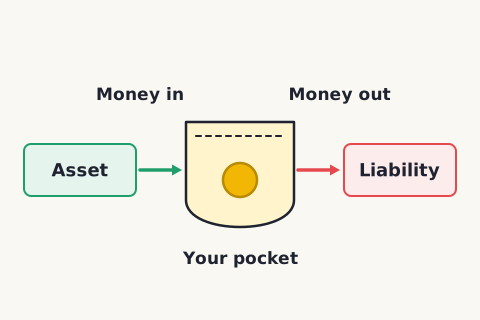
The asset/liability test
Before any purchase, ask Kiyosaki's question: "Will this put money in my pocket, or take money out?" Assets feed you; liabilities feed on you. Most of what we buy is the second kind dressed up as the first. — Rich Dad Poor Dad, Kiyosaki

Kill the cue, kill the habit
Retail emails aren't messages — they're cues engineered to trigger a shopping habit loop. Unsubscribe and you remove the trigger before it ever fires. The cheapest way to spend less is to stop being reminded to spend. — Atomic Habits, Clear
The 24-hour rule
When a sudden urge to buy something non-essential hits, waiting 24 hours before purchasing lets the impulse fade. Impulse buying runs on fast, automatic thinking, and a one-day delay gives your slower, deliberate thinking time to catch up.
Retail anchoring
Retail anchoring is the pricing trick behind a tag like 'Was 500, now 200': the higher first number sets your sense of value, so the discount feels like a deal even if $200 is still overpriced. The fix is to research the fair value independently instead of trusting the markdown.
The subscription audit
Running a subscription audit every six months surfaces recurring charges you've forgotten about, often adding up to around $300 a year. Anything unused since the last audit is a candidate to cancel.

Begin with the end in mind
Before you book anything, decide what this trip must deliver: adventure, recovery, or connection? A recovery trip and an adventure trip look nothing alike. Define the purpose first, then build the itinerary to serve it — not the other way round. — 7 Habits of Highly Effective People, Covey
Transformed, not just rested
Travelers who return transformed rather than just rested are typically those who brought a clear intention and measured the trip against it on return. Applied to travel, Covey's 'begin with the end in mind' means deciding before you book what the trip must deliver.
Essentialist packing
Essentialism's packing rule is to ask what's the minimum you actually need, rather than everything you might conceivably use. Overpacking is usually a symptom of a trip whose purpose was never defined.
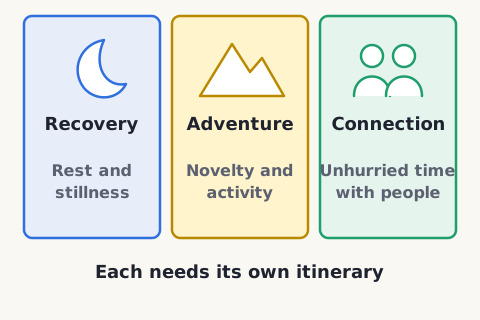
Three kinds of trips
Trips have three distinct purposes — recovery (rest and stillness), adventure (novelty and activity), and connection (unhurried time with people) — and a recovery trip should look nothing like the other two. Each purpose calls for its own itinerary.
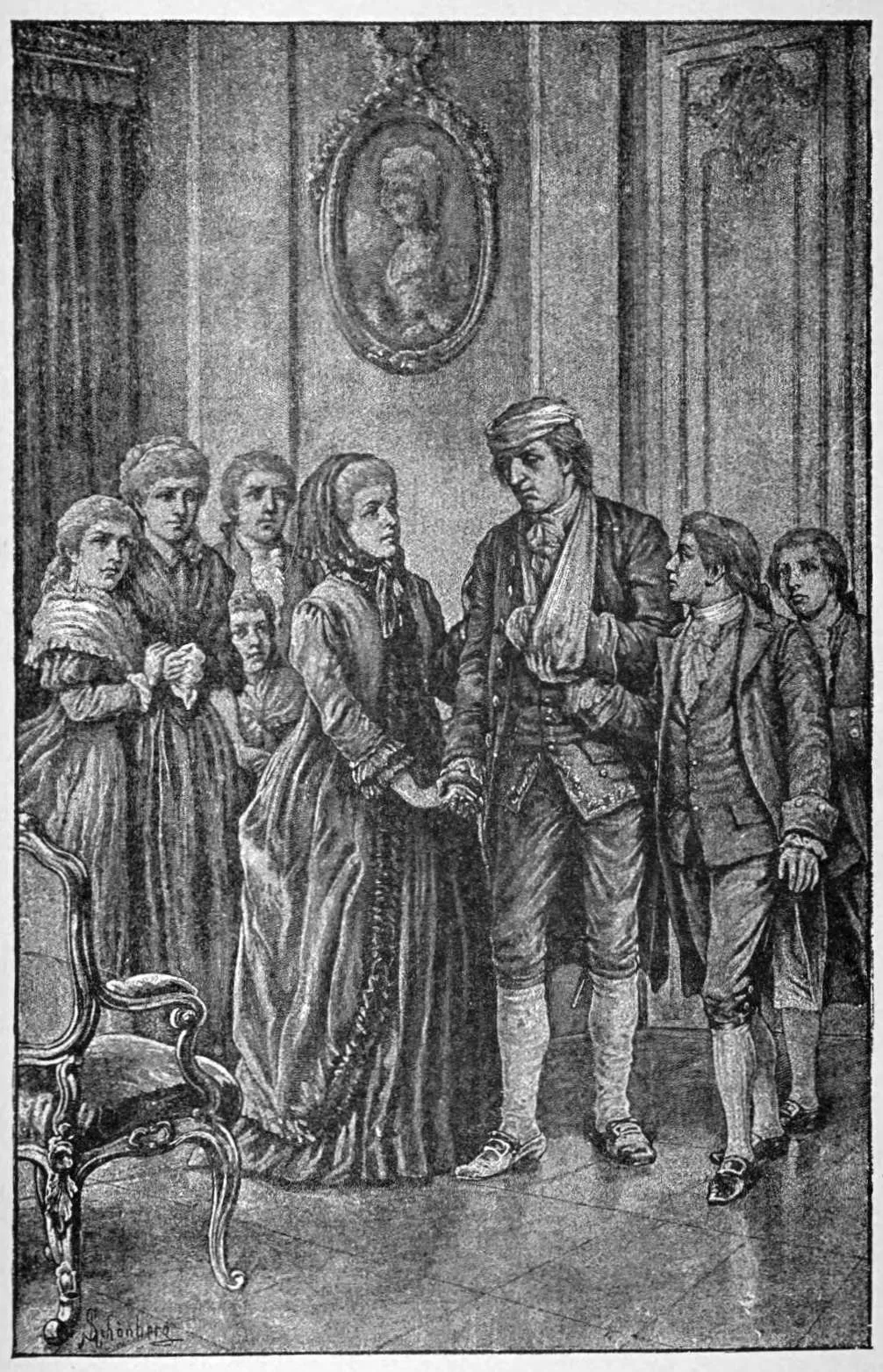
Seek first to understand
Covey's Habit 5 is the most violated rule in family life: we listen to reply, not to understand. Before you advise, correct, or fix — truly hear the other person out. In a family, being understood is often the whole point. — 7 Habits of Highly Effective People, Covey
Talk money at the dinner table
Build a family financial-education culture by making money a normal dinner-table topic: budgeting, saving, assets vs. liabilities. Kids who grow up hearing these conversations inherit fluency instead of fear. And teach growth mindset explicitly — when a child says 'I can't,' add 'yet' and mean it. — The Richest Man in Babylon & Mindset
Labeling a meltdown
Voss's labeling technique advises naming the feeling out loud — 'It seems like you're frustrated about...' — before a child fully melts down. Naming the emotion defuses it, while ordering them to stop or arguing the point only fuels it.
Let Them as a parent
Applied to parenting, 'Let Them' means allowing age-appropriate choices and natural consequences instead of shielding a child from every small mistake. Kids need to feel capable, and over-shielding can undercut that.
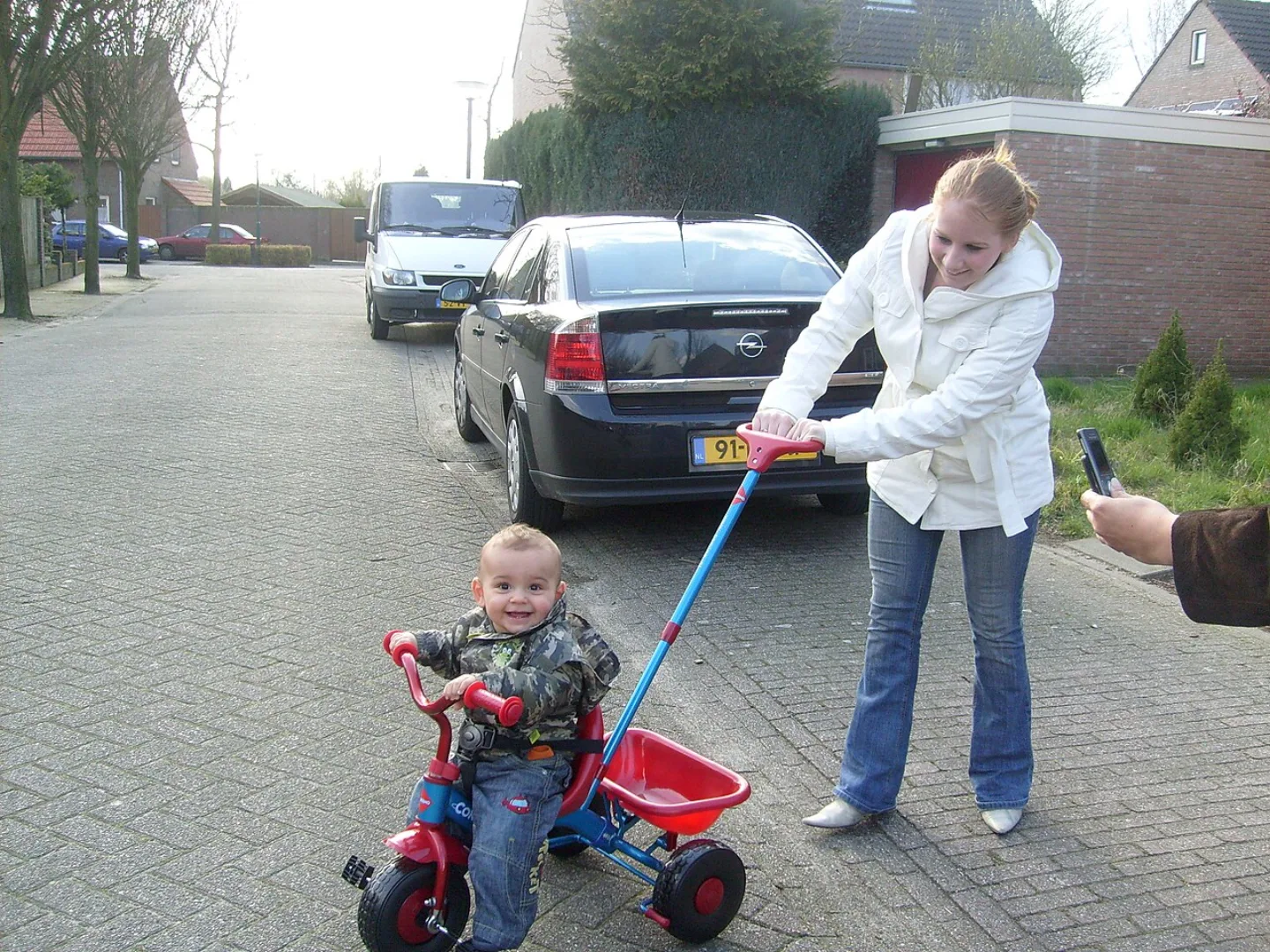
Their love language
When a child keeps acting out for no obvious reason, the love-languages approach suggests identifying their primary love language first. Feeling loved in the language that matters to them tends to improve behavior everywhere, addressing the cause rather than just the symptom.

Be interested, not interesting
The most magnetic people in a room aren't the most interesting — they're the most interested. Genuine curiosity about others does more for your likability than any clever story you could tell. Ask, then actually listen. — How to Talk to Anyone, Lowndes
Nobler motives
Carnegie's advice to appeal to nobler motives means framing a request around dignity, fairness, or legacy — the 'good reason' behind someone's private 'real reason' — so they have a way to say yes that they can feel proud of.
One well-prepared question
The Hot Button technique means arriving at a conversation with a single well-prepared question about what the other person truly cares about — a signal that you paid attention before the conversation even began.
The follow-up note
Sending a brief note within 24 hours that references something specific from the conversation is what turns a first introduction into a real connection.
Trust before the ask
Before asking a new contact for a favor, share resources and introductions first so trust has a chance to build — leading with the ask short-circuits that trust.
By the numbers
- How much most people waste each year on forgotten subscriptions
- 300 USD
- How often to run a subscription audit and cancel anything unused
- 6 months
- The window to follow up after meeting someone, with a one-line note referencing your conversation
- 24 hours
Matched pairs
Each item on the left goes with the one on the right.
- A home full of stuff you rarely use
- Own less, better — clutter competes for your limited attention, and unused stuff is physical debt
- Vacation financial stress ruining your recovery
- Pre-decide a daily spend cap by category before you leave
- Packing for a trip
- Ask 'What's the minimum I need?' not 'What might I need?' (Essentialism)
- Delays, jet lag, and unfamiliar food on the road
- Choose your suffering — you signed up for this; reframing discomfort as part of the trip improves it (Manson)
- A rude waiter or a curt stranger abroad
- Don't take anything personally — Agreement 2 (The Four Agreements, Ruiz)
- Filming a sunset to post later instead of watching it
- Practice the Power of Now — be present in the experience, not documenting it (Tolle)
- A child who acts out for no obvious reason
- Identify their love language — a child who feels loved in their primary language performs better everywhere (Chapman)
- A child about to melt down in frustration
- Label the emotion: 'It seems like you're frustrated about...' — it deactivates flooding before it escalates (Voss)
- Wanting to shield a child from every small mistake
- Apply 'Let Them' — age-appropriate choices and natural consequences build self-efficacy (Robbins)
- Wanting to ask a new contact for a favor
- Give before you take — share resources and introductions first; trust builds before requests are made
- Mirroring (Voss)
- Repeat the last three words someone said — it costs nothing and signals profound attention
- Zero-sum thinking in a negotiation
- Think Win-Win — abundance thinking builds bridges; zero-sum burns them (Covey)
- Worrying what everyone at the party thinks of you
- Apply 'Let Them' — let people think what they think; show up authentically, don't manage perceptions (Robbins)
Self-test
Answer each question from memory, then check your work against the answer key.
1. You feel a sudden urge to buy something non-essential online. What's the System-1-proof move?
- ABuy now while it's on sale before the deal ends
- BWait 24 hours before buying — most of the urge will pass
- CAdd three more items to qualify for free shipping
- DTrust the gut feeling — it's usually right
2. Before any purchase, what question does Kiyosaki's asset/liability test tell you to ask?
- AWill this put money in my pocket, or take money out?
- BWill it hold its resale value?
- CIs it on sale right now?
- DCan I afford the monthly payment?
3. What is the pricing trick called where 'Was $500, now $200' makes $200 feel like a win even if it is overpriced?
- ADecoy pricing
- BThe endowment effect
- CRetail anchoring
- DLoss aversion
4. How often does the lesson recommend running a subscription audit to cancel unused recurring charges?
- AOnce a year
- BEvery two years
- CEvery month
- DEvery six months
5. Which of these is NOT a recommended smart-shopping habit?
- AAsk whether a purchase is an asset or a liability
- BImpose a 24-hour delay on non-essential purchases
- CUnsubscribe from retail emails to remove the cue
- DAnchor your sense of value on the advertised discount
6. A jacket is tagged 'Was $500, Now $200.' What does retail anchoring warn about this price tag?
- AThe $500 price reflects the jacket's true worth
- BAnchoring only affects luxury purchases
- CThe $500 anchors your sense of value unfairly
- DAny 50%-plus markdown is automatically fair
7. What's the recommended defense against falling for retail anchoring?
- AWait for an even steeper markdown
- BAsk if it'll make or cost you money, not the discount
- CTrust the 'original' price wasn't inflated
- DNegotiate off the discounted price
8. You're eyeing a second car you'll rarely drive. Per Kiyosaki's asset/liability test, how should you classify it?
- AA liability — it only takes money out
- BAn asset — it holds resale value
- CNeutral — vehicles aren't covered
- DAn asset — it saves you time
9. A rental property generating steady monthly income passes Kiyosaki's asset/liability test as what?
- AAn asset only once the mortgage is paid off
- BExempt — real estate isn't covered
- CA liability, because it needs upkeep
- DAn asset, because it puts money in your pocket
10. What separates travelers who return transformed from those who just return rested?
- AThey packed for everything they might possibly need on the trip
- BThey brought a clear intention and measured the trip against it on return
- CThey filmed the best moments so they could share and relive them back home
- DThey filled every day with the major sights and restaurants
11. Applying Covey's 'begin with the end in mind' to a trip means doing what before you book?
- ASetting the budget only after you arrive
- BBooking the return flight before the outbound one
- CDeciding what the trip must deliver — recovery, adventure, or connection
- DPlanning the final day's activities first
12. What packing question does Essentialism recommend you ask?
- AWhat's the minimum I actually need?
- BWhat did I pack on my last trip?
- CWhat might I need, just in case?
- DWhat would fill the largest bag I own?
13. A recovery trip looks nothing like which two other kinds of trip?
- AConnection and sightseeing
- BAdventure and connection
- CAdventure and budget
- DBusiness and luxury
14. What does a trip's itinerary default to when you never decide what the trip is for?
- AA generic checklist of sites and queues that leaves you exhausted
- BA cheaper trip with fewer commitments
- CA spontaneous adventure full of novelty
- DA restful, low-decision recovery break
15. In Covey's Habit 5, what defines empathic listening?
- AJumping in to fix or advise as soon as you grasp the problem
- BPreparing your reply while they're still speaking
- CAttending to what the other person actually means, before responding
- DCorrecting the facts in what they're saying
16. A child is about to melt down in frustration. What does Voss's labeling technique advise?
- ADistract them immediately with a treat
- BTell them firmly to calm down and stop
- CExplain why their reaction is unreasonable
- DName the emotion: 'It seems like you're frustrated about...'
17. How does 'Let Them' apply to a parent who wants to shield a child from every small mistake?
- APrevent every possible error before it happens
- BAllow age-appropriate choices and natural consequences
- CPunish mistakes firmly so they aren't repeated
- DMake the child's decisions until they're grown
18. A child keeps acting out for no obvious reason. What does the love-languages approach suggest first?
- AIdentify their primary love language so they feel loved
- BIncrease discipline until the behavior stops
- CGive them the rewards you'd personally want
- DIgnore the behavior so it fades on its own
19. When a family member is upset, which response reflects empathic listening rather than autobiographical listening?
- AOffer your solution right away
- BPrepare your rebuttal while they're still talking
- CAsk a clarifying question, then reflect back what you heard
- DShare a similar story from your own life
20. Carnegie says to 'appeal to nobler motives.' What does that mean in practice?
- AOffer the largest possible cash incentive
- BThreaten consequences if they refuse
- CFlatter people until they agree with you
- DAppeal to dignity, legacy, and fairness — the good reason behind the real reason
21. What is the Hot Button technique?
- APressing an emotional weak spot to win an argument
- BMemorizing clever anecdotes to share on cue
- CSteering every conversation back to your own achievements
- DResearching someone and preparing one question about what they truly care about
22. Within how long should you send a brief follow-up note referencing your conversation?
- AThree days
- BOne month
- C24 hours
- DOne week
23. You want to ask a new contact for a favor. What does 'give before you take' advise?
- AAsk right away while the meeting is fresh
- BShare resources and introductions first, so trust builds before requests
- COffer to pay them for the favor up front
- DWait until they already owe you something
24. Covey's 'Think Win-Win' is the antidote to what kind of thinking?
- AZero-sum thinking, where one person's gain is another's loss
- BAbundance thinking
- CLong-term strategic thinking
- DGrowth-mindset thinking
Go deeper
Answer key
- 1. B Wait 24 hours before buying — most of the urge will passImpulse buying is pure System 1. A one-day delay — the 24-hour rule — lets System 2 catch up and kills most of the urge.
- 2. A Will this put money in my pocket, or take money out?The asset/liability test asks whether a purchase will feed you (asset) or feed on you (liability). Affordability and resale value dodge the real question. — Rich Dad Poor Dad, Kiyosaki
- 3. C Retail anchoringRetail anchoring uses the first (higher) number to set your sense of value, so the discount feels like a deal. The fix is to research fair value independently. — Thinking, Fast and Slow, Kahneman
- 4. D Every six monthsA subscription audit every six months catches forgotten recurring charges — often around $300 a year. Cancel anything unused since the last audit.
- 5. D Anchor your sense of value on the advertised discountAnchoring on the discount is a trap to avoid — it makes overpriced items feel like wins. The other three (24-hour rule, asset/liability test, killing the cue) are the recommended habits.
- 6. C The $500 anchors your sense of value unfairlyRetail anchoring works because the first number ($500) skews your sense of value, so the discounted price can feel like a win even if it's still overpriced.
- 7. B Ask if it'll make or cost you money, not the discountAnchoring works because people 'skip this question and anchor on the discount instead' — asking whether the item will make or cost you money over time (the asset/liability question) breaks the anchor's hold.
- 8. A A liability — it only takes money outKiyosaki's test asks whether something puts money in your pocket or takes it out. A rarely-driven car only costs money, making it a liability.
- 9. D An asset, because it puts money in your pocketKiyosaki: an asset puts money in your pocket. Income-generating property does exactly that, making it an asset.
- 10. B They brought a clear intention and measured the trip against it on returnTravelers who return transformed rather than just rested brought a clear intention and measured the trip against it on return. A generic checklist of sights tends to exhaust, overpacking is a symptom of undefined purpose, and filming a moment to post later is the anti-pattern.
- 11. C Deciding what the trip must deliver — recovery, adventure, or connectionHabit 2 means defining a successful outcome first. Deciding the trip's purpose up front keeps the itinerary from defaulting to a generic, exhausting checklist. — 7 Habits, Covey
- 12. A What's the minimum I actually need?Essentialist packing asks for the minimum you actually need, not everything you might need. Overpacking is a symptom of an undefined trip purpose. — Essentialism, McKeown
- 13. B Adventure and connectionThe three declared purposes are recovery (rest, stillness), adventure (novelty, activity), and connection (unhurried time with people). Each demands a different itinerary.
- 14. A A generic checklist of sites and queues that leaves you exhaustedWithout a declared purpose, itineraries default to tourist sites, restaurant queues, and packed days — producing exhaustion rather than restoration. Begin with the end in mind to avoid it. — 7 Habits, Covey
- 15. C Attending to what the other person actually means, before respondingEmpathic listening means genuinely hearing what someone means, not filtering it through your own frame (autobiographical listening) or rushing to fix, advise, or correct. For an upset child, feeling heard is often the whole point.
- 16. D Name the emotion: 'It seems like you're frustrated about...'Labeling names the feeling out loud, which deactivates emotional flooding before it escalates. Ordering them to stop or arguing the point only fuels the meltdown. — Voss
- 17. B Allow age-appropriate choices and natural consequences'Let Them' means letting age-appropriate choices and natural consequences build self-efficacy. Shielding a child from every mistake underestimates their need to feel capable. — Robbins
- 18. A Identify their primary love language so they feel lovedA child who feels loved in their primary love language performs better everywhere. Identifying that language addresses the cause rather than just punishing the symptom. — Chapman
- 19. C Ask a clarifying question, then reflect back what you heardEmpathic listening attends to what the other person means. Filtering through your own frame, rushing to solve, or planning your reply are all autobiographical listening. — Covey, Habit 5
- 20. D Appeal to dignity, legacy, and fairness — the good reason behind the real reasonPeople have a 'real reason' and a 'good reason' for what they do. Appeal to the noble one — dignity, fairness, legacy — and you give them a way to say yes they can feel proud of. — How to Win Friends and Influence People, Carnegie
- 21. D Researching someone and preparing one question about what they truly care aboutThe Hot Button technique means arriving with one well-researched question about what lights the other person up — a disarming signal that you paid attention before the conversation began.
- 22. C 24 hoursThe window to follow up is short — a note within 24 hours referencing something specific converts an introduction into a real connection.
- 23. B Share resources and introductions first, so trust builds before requestsGive before you take: share resources and introductions first so trust is established before any request is made. Leading with the ask short-circuits that trust.
- 24. A Zero-sum thinking, where one person's gain is another's loss'Think Win-Win' counters zero-sum (scarcity) thinking. Abundance thinking builds bridges; zero-sum burns them. Abundance thinking is the win-win mindset itself, not its opposite. — Covey
Sources
- McMains & Kastner (2011), Interactions of Top-Down and Bottom-Up Mechanisms in Human Visual Cortex, Journal of Neuroscience 31(2):587-597 — pmc.ncbi.nlm.nih.gov/articles/PMC3072218/
Image credits
- The asset/liability test: FlashFeed original diagram · CC-BY-4.0
- Kill the cue, kill the habit: AI-generated (gpt-image-1.5)
- Begin with the end in mind: AI-generated (gpt-image-1.5)
- Three kinds of trips: FlashFeed original diagram · CC-BY-4.0
- Seek first to understand: Wikimedia Commons · Johann Nepomuk Schönberg (1844-1913) · Public domain — commons.wikimedia.org/wiki/File:02_The_Marquis_returns_to_his_family-Illust_by_Johan_Schonberg_for_In_the_Reign_of_Terror_by_G_A_Henty.jpg
- Labeling a meltdown: Wikimedia Commons · Jean-Pierre Dalbéra from Paris, France · CC BY 2.0 — commons.wikimedia.org/wiki/File:Famille_d%27Orl%C3%A9ans.jpg
- Their love language: Wikimedia Commons · Hildewagelmans · Public domain — commons.wikimedia.org/wiki/File:Afbeelding_372.jpg
- Be interested, not interesting: AI-generated (gpt-image-1.5)


