
Deep Work
Cal Newport on deep work versus shallow work: the Monastic, Bimodal, Rhythmic and Journalistic scheduling philosophies, shutdown rituals to end the workday, productive meditation, and the time-blocked days that drain the shallows.
314 cards6 lessonsFree
Already have FlashFeed?Open this pack
Get this pack on your phone
Scan with your phone's camera.
flashfeedlearningapp.com/packs/deep-work
6 lessons.
Each lesson has a study guide to read and objectives you can test yourself on. Its cards and games show up in your feed. Try one of its cards right here. Play a few of its games here too.
-
 Pexels · Tara Winstead · Pexels License ↗01
The Deep Work Hypothesis and High-Value Knowledge Economy
The Deep Work Imperative and Deliberate Practice · Attention Residue and the High-Productivity Law
Lesson 1 · 10 cardsPexels · Tara Winstead · Pexels License ↗The Work That Fills the Day
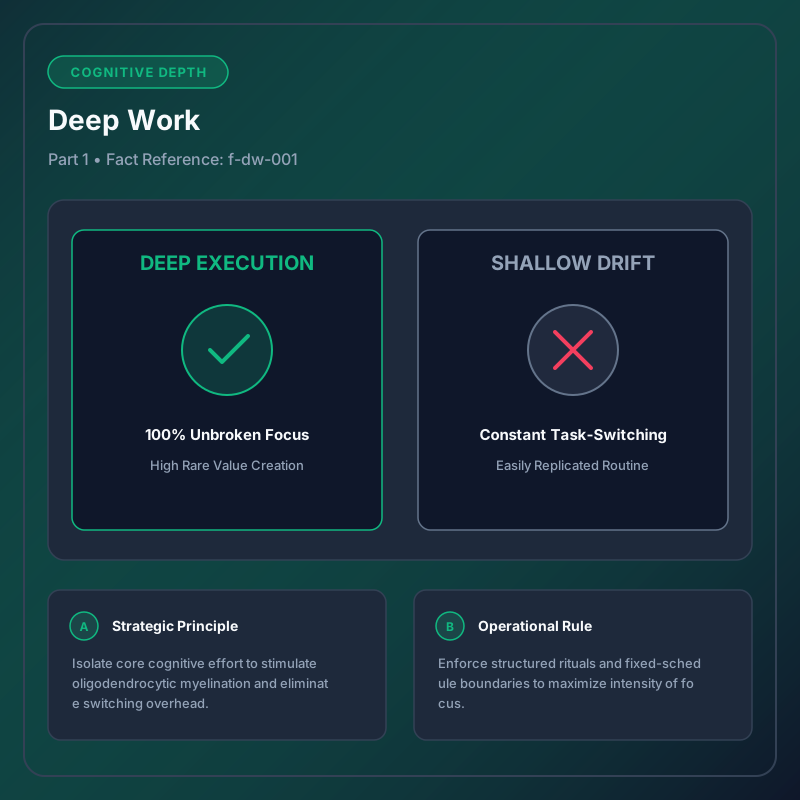
Shallow work is the logistical, cognitively undemanding work of office life, like routine email. It keeps an organization running, but letting it dominate a career blocks building rare, valuable skills and leaves you economically vulnerable.
 FlashFeed · CC-BY-4.0
Deep Work
Deep Work is professional activity performed in a state of distraction-free concentration that pushes cognitive limits, creating new value, improving skill, and proving hard to replicate.
Pexels · Tara Winstead · Pexels License ↗Shallow Work
Shallow Work covers the non-cognitively demanding, logistical, administrative, or communicative tasks that fill a modern office day — routine email, status meetings without decision rights, scheduling logistics, and standard reporting forms. These tasks are often performed while distracted, create little new value, and are easy to replicate. Shallow work isn't something to abolish — it's necessary to keep an organization running — but letting it dominate a career blocks the acquisition of rare, valuable skills and leaves a professional economically vulnerable.
 Pexels · Nube · Pexels License ↗
The Deep Work Hypothesis
Cal Newport's central claim is The Deep Work Hypothesis: the ability to perform deep work is becoming increasingly rare in the economy at exactly the same time it is becoming increasingly valuable. Workplace culture and digital distraction make sustained concentration scarcer, while economic restructuring keeps raising the premium on elite cognitive craftsmanship. Newport's conclusion follows directly: the few people who cultivate deep work as the core of their working life will thrive.
 Pexels · panumas nikhomkhai · Pexels License ↗
The Three Winning Groups
Drawing on economists Erik Brynjolfsson and Andrew McAfee (Race Against the Machine), Newport argues the digital economy is polarizing into three groups that capture outsized rewards. High-Skilled Workers master and creatively deploy increasingly complex intelligent machines and data systems. Superstars are elite performers who use global digital connectivity to capture the lion's share of winner-take-all markets. Owners are the capital investors and entrepreneurs who fund and scale the technology platforms themselves.
 Pexels · Yan Krukau · Pexels License ↗
Deliberate Practice
Deliberate Practice, the research program pioneered by cognitive psychologist K. Anders Ericsson at Florida State University, is Newport's explanation for how elite skill gets built. Ericsson found that elite performance in chess, music, athletics, and mathematics comes not from innate talent but from thousands of hours of a specific kind of practice, made up of two components: directing attention tightly and relentlessly at a specific sub-skill, and receiving immediate, precise, corrective feedback.
 Малишко Анастасія · CC BY 4.0 ↗
Myelination
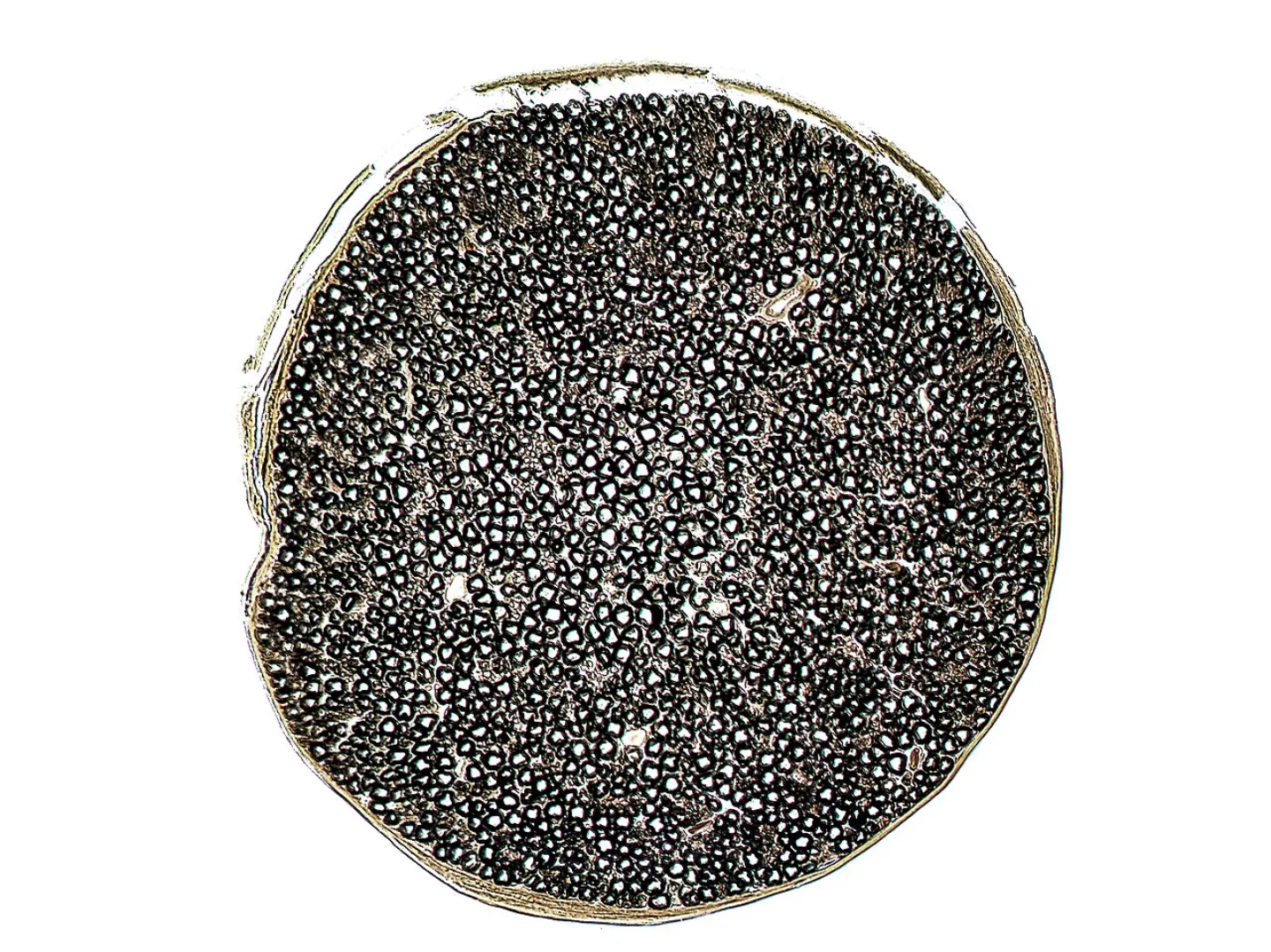
Deliberate practice physically reshapes the brain through myelination. As science writer Daniel Coyle describes in The Talent Code, when a neural circuit fires in focused repetition, glial cells called oligodendrocytes wrap layers of fatty myelin around the active axons. Myelin insulates the fibers, increasing the speed, bandwidth, and precision of the signal — the thicker the sheath, the more effortless and accurate the skill becomes. Fragmented, distracted attention dilutes the signal across many circuits at once, which is why multitasking undermines this process.
Малишко Анастасія · CC BY 4.0 ↗Practice Builds Insulation
When a neural circuit fires in focused, repeated practice, cells called oligodendrocytes wrap fatty myelin around its axons. Thicker myelin carries the signal faster and more precisely. Distraction dilutes it across many circuits.
 Pexels · Asad Photo Maldives · Pexels License ↗
Jason Benn's Career Transformation
Jason Benn was stuck in a low-mobility financial consulting job built on shallow spreadsheet work when he decided to become a software engineer — despite having never written a line of code. Rather than rely on casual evening tutorials, he bought computer-architecture textbooks and locked himself in a room with no internet access for hours a day, forcing his focus back to the material whenever it wandered. Benn went on to graduate at the top of his class at Dev Bootcamp and land a software engineering role, showing that deep work is a learnable engine for real socioeconomic mobility.
 Pexels · Mazin Omron · Pexels License ↗
The Two Core Abilities
To become a High-Skilled Worker or Superstar, Newport argues you need two abilities, and both depend on deep work. The first is the ability to quickly master hard things — rapidly acquiring complex skills via deliberate practice and myelination as the technological landscape keeps shifting. The second is the ability to produce at an elite level — translating that mastery into tangible, high-quality, high-speed output, since knowing how to do something is worthless without shipping it.
1 / 10What neurological substance wraps around active axons to accelerate neural signal transmission?
Myelin is the microscopic fatty sheath produced by oligodendrocytes that insulates active neural circuits.
Lesson 1 has 55 cards. Keep going in the free app.
Question -
 Pexels · Mikhail Nilov · Pexels License ↗02
The Scarcity, Psychology, and Philosophical Meaning of Focus
The Metric Black Hole and the Cult of Busyness · Neurological, Psychological, and Philosophical Meaning
Lesson 2 · 10 cardsPexels · Mikhail Nilov · Pexels License ↗Looking Busy Isn't Output
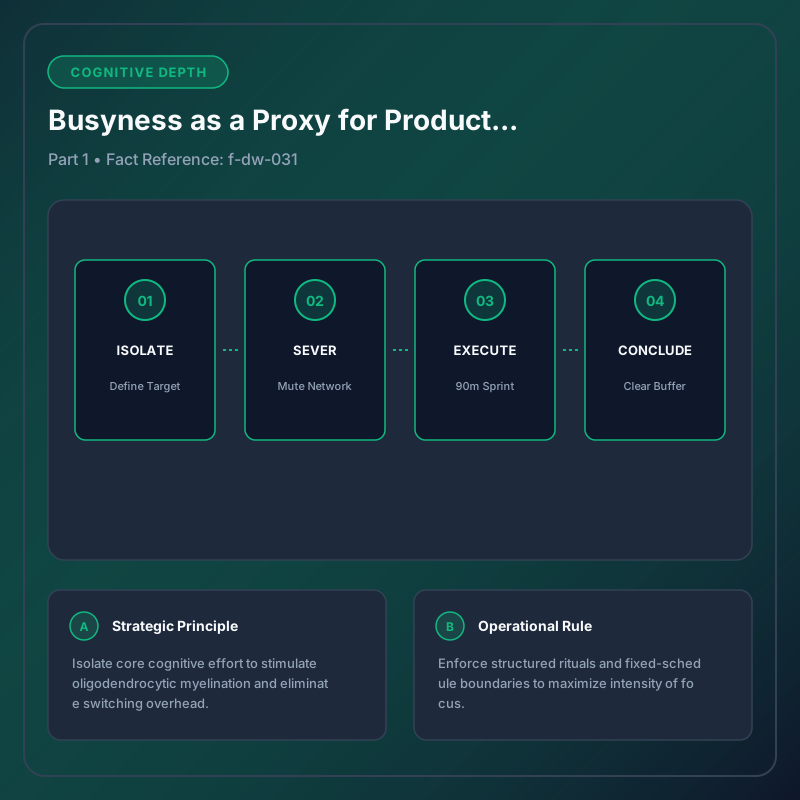
When real cognitive output can't be measured, visible activity becomes the stand-in. Four quiet hours on an essential algorithm draw suspicion, while forty superficial chat replies get praised as dedicated collaboration.
 FlashFeed · CC-BY-4.0
The Metric Black Hole
The Metric Black Hole describes the profound difficulty of directly measuring the bottom-line financial impact of knowledge work habits, interruptions, and collaborative tools.
 Pexels · khezez | خزاز · Pexels License ↗
The Principle of Least Resistance
Because knowledge work sits in a metric black hole, workplace culture defaults to The Principle of Least Resistance: without clear feedback on what helps the bottom line, people gravitate toward whatever is easiest in the moment. Constant Slack and email access is the clearest example — it lets employees skip planning ahead, trading a sender's momentary convenience for a disproportionate disruption to the recipient's attention. Overcoming this takes deliberate counter-measures: identifying reactive channels, setting fixed windows for handling them, and stating turnaround expectations.
Pexels · Mikhail Nilov · Pexels License ↗The Busyness Proxy
When true cognitive output can't be measured, workers and managers reach for a substitute signal: Busyness as a Proxy for Productivity — doing lots of visible stuff to look diligent. Sending hundreds of emails, attending continuous meetings, and staying constantly present on chat creates an illusion of hard work even as substantive output stagnates, because visible responsiveness is an easy stand-in for value that's hard to measure. The result: four quiet hours on an essential algorithm draw suspicion, while forty superficial chat replies get praised as dedicated collaboration.
 Pexels · dumitru B · Pexels License ↗
Technopoly
Social critic Neil Postman coined the term Technopoly in his 1992 book Technopoly: The Surrender of Culture to Technology to describe a culture that unconditionally assumes any new technology is beneficial, without weighing its trade-offs. In the modern office this shows up as instant messaging, open-plan social intranets, and collaborative wikis being celebrated uncritically while their toll on deep concentration goes unexamined. Escaping Technopoly means judging a tool by its net cognitive contribution, not its technological novelty.
 Pexels · contact me +923323219715 · Pexels License ↗
Peopleware and Interruption
Software engineering pioneers Tom DeMarco and Timothy Lister documented the hidden cost of interruption in their 1987 management classic Peopleware: Productive Projects and Teams. Their research showed that quiet, protected space is vital to software engineer productivity — a finding that anticipated the metric black hole problem, since organizations still struggle to put a dollar figure on an interrupted hour versus an uninterrupted morning of focus.
 FlashFeed · CC-BY-4.0
Neurology of Attention
Science writer Winifred Gallagher proved that subjective reality is defined by what we pay attention to: 'Who you are, what you think, feel, and do, what you love—is the sum of what you focus on.'
 Pexels · Brett Sayles · Pexels License ↗
Flow
Psychologist Mihaly Csikszentmihalyi developed the concept of Flow: a state of intense, effortless absorption in an activity that stretches one's skills to their limits. Flow requires a clear, challenging task — one demanding enough to engage fully without tipping into overwhelming anxiety — plus clear goals and immediate feedback. Deep work is, in Newport's framing, the direct operational gateway to experiencing flow regularly in intellectual life.
 Pexels · Daniel Reche · Pexels License ↗
The Sacredness of Craftsmanship
Philosophers Hubert Dreyfus and Sean Dorrance Kelly argue that post-Enlightenment secularism stripped daily life of inherent sacredness, and that Craftsmanship is the way back: the practitioner doesn't impose arbitrary will on the world, but cultivates the discernment to draw out the quality already latent in the task itself. Newport extends this to knowledge work directly — approaching a problem with a craftsman's reverence and mastery restores a sense of sacredness to programming, writing, or research that would otherwise feel like a stressful logistical grind.
1 / 10Which of these is NOT a form of visible busyness used as a proxy for productivity?
Emails, meetings, and chat presence are visible busyness signals; quietly crafting an algorithm for hours is deep, invisible work viewed with suspicion instead.
Lesson 2 has 54 cards. Keep going in the free app.
Question -
 Pexels · Magda Ehlers · Pexels License ↗03
Rule #1: The Four Deep Work Philosophies and Execution Rituals
The Four Scheduling Philosophies and Environmental Rituals · 4DX Execution Architecture and Shutdown Rituals
Lesson 3 · 10 cardsPexels · Magda Ehlers · Pexels License ↗Tallying Deep Work Hours
A prominent, physical scoreboard tallying cumulative deep work hours gives immediate emotional feedback. A weekly review then checks the scoreboard, looks at what worked and what didn't, and commits to concrete actions for the next week.
 FlashFeed · CC-BY-4.0
Monastic Depth Philosophy
The Monastic Philosophy completely eliminates or radically minimizes all shallow obligations, cutting off digital connectivity to dedicate 100% of working time to deep efforts.
 Pexels · Zak Mir · Pexels License ↗
The Bimodal Philosophy
The Bimodal Philosophy divides time into clearly segregated blocks: long, unbroken stretches of monastic-style deep work, alternating with periods reserved for shallow obligations. Psychoanalyst Carl Jung practiced this by retreating periodically to his stone tower in Bollingen, without electricity, to write his psychological treatises, while maintaining an active clinical practice in Zurich. Wharton professor Adam Grant applies the same logic per semester, batching all teaching into one term so the alternate term is reserved exclusively for research.
 Pexels · MART PRODUCTION · Pexels License ↗
The Journalistic Philosophy
The Journalistic Philosophy means shifting into deep work mode spontaneously, the moment a free window opens in the schedule — no ritual, no warm-up. Biographer Walter Isaacson exemplified this rare discipline, fitting substantive writing into whatever brief gaps his journalism career left open rather than waiting for a dedicated block. Newport flags this approach as highly demanding and not recommended for beginners, since it requires a level of mental discipline most people haven't built yet.
 Pexels · Markus Spiske · Pexels License ↗
Monastic Exemplars: Knuth and Stephenson
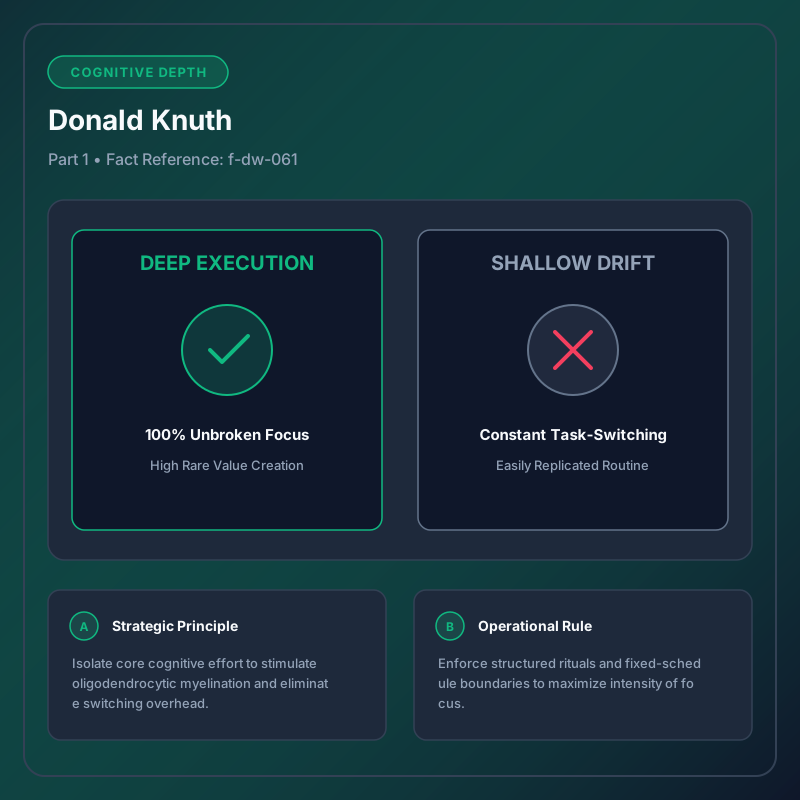
Two figures show what full monastic commitment looks like in practice. Computer science pioneer Donald Knuth eliminated his personal email address in 1990 so he could focus entirely on writing The Art of Computer Programming. Novelist Neal Stephenson wrote the essay 'Why I Am a Bad Correspondent' to explain why he rejects email and social correspondence altogether, protecting the concentration his novel-writing demands.
 Pexels · Arina Krasnikova · Pexels License ↗
The Grand Gesture
When ordinary routines fail to break through inertia, Newport recommends The Grand Gesture: a radical, high-cost investment of time, money, or effort that signals to the subconscious that a task matters enormously. J.K. Rowling checked into a suite at Edinburgh's 5-star Balmoral Hotel to finish Deathly Hallows away from home distractions. Bill Gates ran semi-annual, week-long 'Think Weeks' alone in a lakeside cottage with stacks of papers. Peter Shankman booked a round-trip business-class flight to Tokyo solely to write a manuscript in 30 hours of high-altitude focus.
 Pexels · Letícia Alvares · Pexels License ↗
Designing a Deep Work Ritual
Because willpower depletes across the day, Newport has practitioners lock in a Ritual before they ever sit down to focus: where they'll work and for how long, how they'll work once they start (banning internet access, silencing phones, setting concrete milestones), and how they'll support the work (coffee, snacks, and reference materials ready in advance). Deciding these logistics ahead of time removes the in-the-moment willpower cost of choosing whether to resist distraction.
 FlashFeed · CC-BY-4.0
4DX Framework
The 4 Disciplines of Execution (4DX) framework translates deep work into daily habit: 1) Focus on the Wildly Important, 2) Act on Lead Measures, 3) Keep a Scoreboard, 4) Create a Cadence of Accountability.
 Pexels · Walls.io · Pexels License ↗
Focus on the Wildly Important
The first discipline of Newport's adapted 4 Disciplines of Execution (4DX) framework, drawn from Chris McChesney, Sean Covey, and Jim Huling, is to identify a small number of ambitious, high-leverage Wildly Important Goals (WIGs) rather than juggling dozens of diffuse priorities. As the original authors put it, the more you try to do, the less you actually accomplish — so execution starts by ruthlessly narrowing the target.
1 / 10Which deep work scheduling philosophy completely eliminates email and shallow obligations?
The monastic philosophy seeks to eliminate or radically minimize all non-deep obligations.
Lesson 3 has 55 cards. Keep going in the free app.
Question -
 Pexels · Markus Spiske · Pexels License ↗04
Rule #2: Cognitive Training, Roosevelt Dashes, and Productive Meditation
Training Focus and Embracing Boredom · Productive Meditation and Structured Memory Mechanics
Lesson 4 · 10 cardsPexels · Markus Spiske · Pexels License ↗Racing a Visible Countdown
In a Roosevelt Dash, you pick a demanding task, radically compress its deadline, and set a visible countdown timer. Then you work with total intensity to beat the clock, without careless errors.
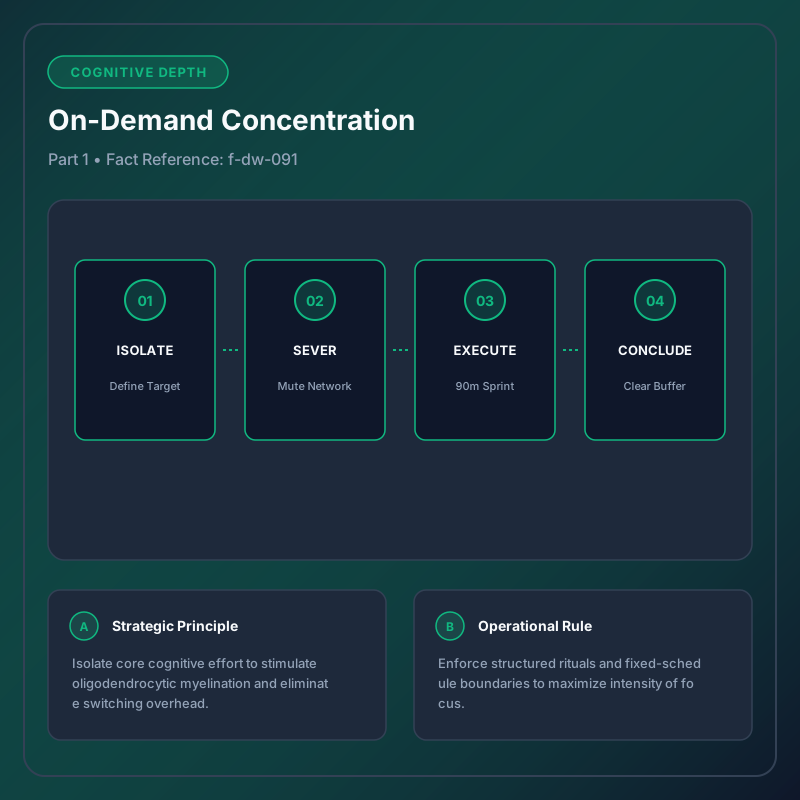 FlashFeed · CC-BY-4.0
Focus as a Muscle
Newport argues that attentional control works like a physical muscle: seeking novelty at every hint of boredom weakens your capacity for sustained concentration.
 Pexels · Michelle Leman · Pexels License ↗
The Cost of Multitasking
Stanford communications professor Dr. Clifford Nass expected his landmark 2009 study of heavy media multitaskers to reveal superior cognitive filtering. Instead, he found the opposite: chronic multitaskers were worse at filtering out irrelevant distractors, worse at managing working memory, and worse at task-switching itself. Newport takes this as a warning: once your brain grows used to on-demand distraction, it is hard to shake the habit even when you want to concentrate.
Pexels · Markus Spiske · Pexels License ↗The Theodore Roosevelt Dash
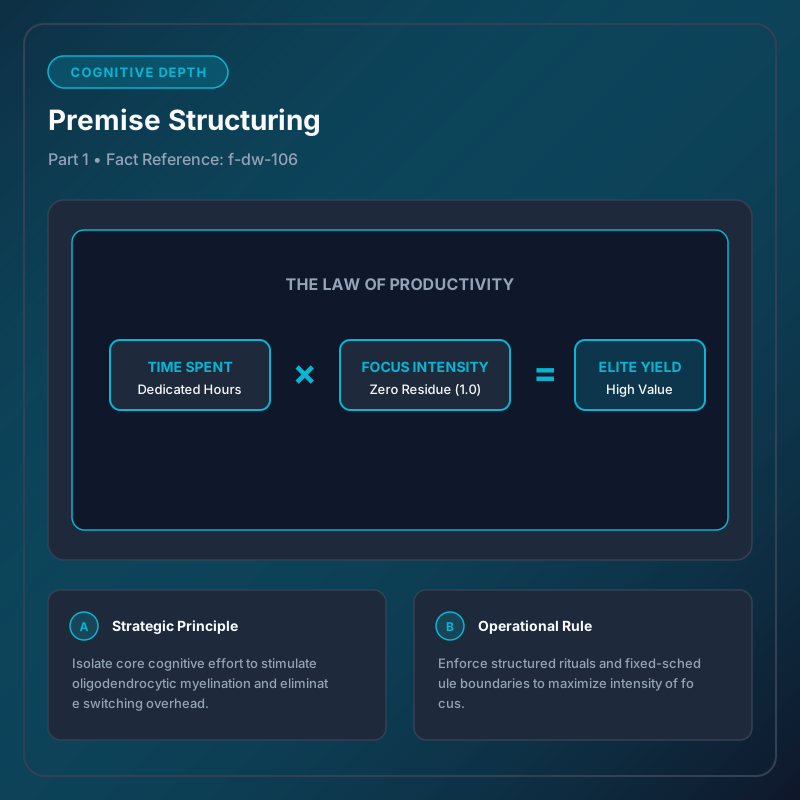
As a Harvard undergraduate, Theodore Roosevelt juggled boxing, naturalism, and writing alongside stellar grades by slashing his study time and forcing himself to work with blistering intensity to beat the clock. Newport turns this into a drill, the Roosevelt Dash: pick a demanding task, radically compress its deadline (say, cutting a 2-hour task to 50 minutes), set a visible countdown timer, and work with total intensity to beat it.
 FlashFeed · CC-BY-4.0
Productive Meditation
Productive Meditation is the practice of focusing attention entirely on a single, well-defined professional problem while occupied physically with routine transit like walking or driving.
 Pexels · Masood Aslami · Pexels License ↗
Productive Meditation vs. Mindfulness Meditation
Productive Meditation differs sharply from traditional mindfulness practice. Where mindfulness asks you to clear the mind and observe breath and sensation, productive meditation directs intense, active conscious thought toward solving one specific professional problem — during a period when you're physically occupied (walking, driving, showering) but not mentally occupied. It borrows the setting of meditation but not its passive-observation goal.
 Pexels · Barbara Olsen · Pexels License ↗
Productive Meditation in Four Steps
Newport's advice for productive meditation, summarized here as four steps: define the target problem clearly (a chapter outline, a software module's architecture, a proof), hold focus on it while watching for the looping and distraction traps, structure the thinking by reviewing known premises toward the unknown, and consolidate your gains: once you reach an answer, review it clearly in your mind before moving on to the next question.
Pexels · Barbara Olsen · Pexels License ↗Structured Deep Thinking
Productive meditation means holding one problem in focus while walking or driving: watch for distraction and looping, structure your thinking toward an answer, and once you reach it, review it clearly to consolidate your gains.
 Pexels · Mary Taylor · Pexels License ↗
Looping and Distraction
Two failure modes threaten a productive meditation session. Looping is replaying facts you already know in a repetitive, unproductive circle instead of advancing the analysis — the fix is redirecting attention to the next logical step. Distraction is letting the mind wander into unrelated personal anxieties, chores, or daydreaming; the fix there is simply acknowledging it and gently returning to the problem.
1 / 10What rule does Newport propose in place of periodic digital detoxes?
Newport inverts common advice: stay off distraction by default and only take scheduled breaks from focused work, rather than occasional detoxes.
Lesson 4 has 51 cards. Keep going in the free app.
Question -
 Pexels · Fotoğrafınruhu . · Pexels License ↗05
Rule #3: The Craftsman Approach to Tools and Intentional Leisure
The Craftsman Approach vs The Any-Benefit Mindset · The Network Tool Elimination Test and Structured Leisure
Lesson 5 · 10 cardsPexels · Fotoğrafınruhu . · Pexels License ↗Tools Must Clear a High Bar
Under Newport's craftsman approach, adopt a tool only if its positive impact on the core factors of your professional and personal success and happiness substantially outweighs its negative impact. That a tool might help is not enough.
Pexels · Fotoğrafınruhu . · Pexels License ↗The Craftsman Approach
Against the Any-Benefit Mindset, Newport proposes The Craftsman Approach to Tool Selection: identify the core factors that determine success and happiness in your professional and personal life, and adopt a tool only if its positive impact on those factors substantially outweighs its negative impact. Where the any-benefit mindset asks only whether a tool could help, the craftsman approach asks whether it clears a much higher bar — genuinely, substantially advancing your top goals.
 Pexels · Pixabay · Pexels License ↗
The Law of Vital Few
The theoretical backbone of the craftsman approach is The Law of the Vital Few — quality-management pioneer Joseph Juran's name for the 80/20 pattern that Italian economist Vilfredo Pareto first observed: in many disciplines, roughly 80% of the desired results come from just 20% of the contributing activities. Applied to tools, this means most of a knowledge worker's value comes from a small set of high-leverage activities — everything else is a candidate for elimination.
 Pexels · RDNE Stock project · Pexels License ↗
Auditing Tools Against Goals
To apply the Law of the Vital Few, Newport's protocol is: articulate your top 2–3 professional and personal goals, list the 2–3 highest-leverage activities that drive each one, then audit every tool you use against that list. A tool that offers only minor, peripheral benefit while degrading a high-leverage activity through distraction should be eliminated — goal-activity alignment, not habit or convenience, decides what stays.
 Pexels · Viralyft · Pexels License ↗
Attention Merchants and Engineered Addiction
Social media platforms aren't neutral public utilities: Newport argues they are commercial products built on what the media scholar Tim Wu (in a separate book) termed the 'attention merchant' model, a business that relies on maximizing user screen time and engineering behavioral addiction. Treating these engineered distraction machines as indispensable professional tools is an act of cognitive self-sabotage.
Pexels · Viralyft · Pexels License ↗Apps Built to Hold Attention
Newport argues that social media platforms are commercial products built to maximize screen time. Treating them as indispensable work tools works against your capacity for deep work.
1 / 10What does Newport's Any-Benefit Mindset assume justifies using a network tool?
The Any-Benefit Mindset justifies use if ANY benefit exists. The other options are the real tests from the Craftsman Approach, Digital Essentialism, and the tool-audit protocol.
Lesson 5 has 51 cards. Keep going in the free app.
Question -
 Pexels · Antoni Shkraba · Pexels License ↗06
Rule #4: Draining the Shallows, Time Blocking, and Fixed-Schedule Productivity
Time Blocking, Shallow Work Auditing, and Budgets · Fixed-Schedule Productivity and Process-Centric Communication
Lesson 6 · 10 cardsPexels · Antoni Shkraba · Pexels License ↗Sorting Deep from Shallow Work
Ask how many months it would take to train a smart recent college graduate with no specialized background in your field to do a task. Days or weeks of training means shallow work. Years of specialized expertise or creative synthesis means deep work.
Pexels · Antoni Shkraba · Pexels License ↗The College Graduate Test
To sort deep work from shallow work in your own responsibilities, Newport suggests asking how long it would take, in months, to train a smart recent college graduate with no specialized training in your field to complete a task; this lesson calls it The College Graduate Test. A task learnable in days or weeks, such as status decks, scheduling emails or standard reports, is shallow work; a task requiring years of specialized expertise or creative synthesis is deep work.
 Pexels · Walls.io · Pexels License ↗
The Shallow Work Budget
Left unchecked, shallow administrative work tends to expand until it crowds out deep work. Newport's countermeasure is negotiating an explicit Shallow Work Budget with your manager: asking directly what percentage of time should go to shallow tasks versus deep, high-value projects. Most managers will suggest a target between 30% and 50% shallow work, and once that number is agreed, it becomes a managerial-backed, defensible boundary for declining unnecessary meetings and protecting deep work hours.
 Pexels · cottonbro studio · Pexels License ↗
Time Blocking vs. To-Do
A plain to-do list fosters reactive task-hopping across an unstructured day, because it says what to do but never when. Time blocking fixes this by assigning each intention its own dedicated temporal container — maintaining deliberate authority over how every working hour is spent instead of reacting passively to whatever feels most pressing.
1 / 10How does Newport's Time Blocking method start each workday?
Time blocking begins with a physical notebook grid dividing the day into blocks, not a digital timer or a calendar-only review.
Lesson 6 has 48 cards. Keep going in the free app.
Question

What you'll be able to do 12 objectives, from the pack's lessons
- Distinguish high-value deep work from cognitively undemanding shallow work and explain how deliberate practice drives skill mastery.
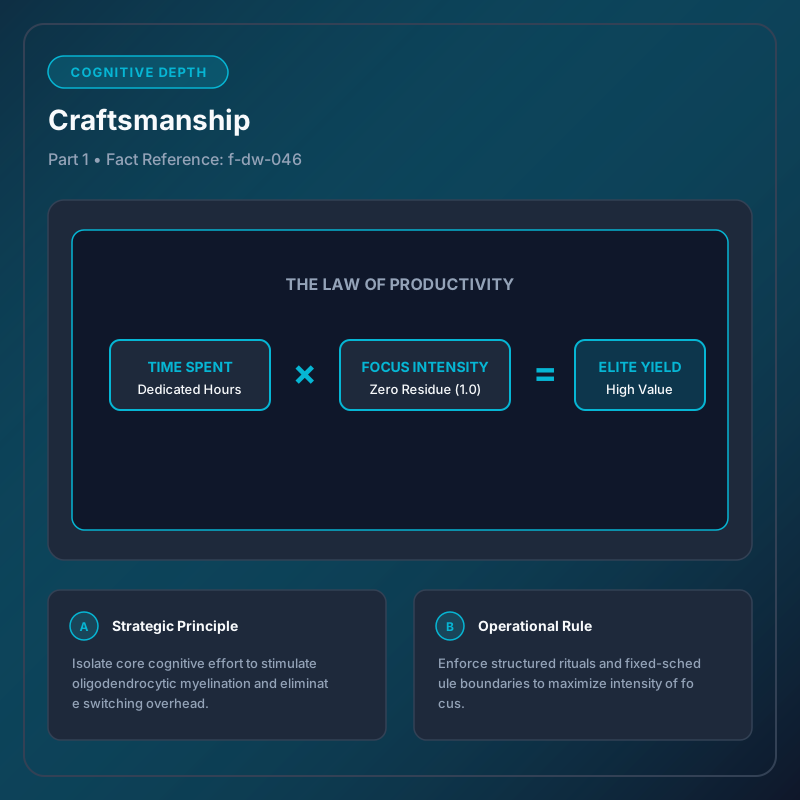
- Explain the mechanics of Attention Residue and the High-Productivity Law (High-Quality Work Produced = Time Spent x Intensity of Focus).
- Analyze why real-time messaging and the Metric Black Hole reward busyness as a proxy for genuine productivity.
- Explain the neurological, psychological, and philosophical case for deep work through Gallagher's attention research, flow, and craftsmanship.
- Compare the four deep work scheduling philosophies: Monastic, Bimodal, Rhythmic, and Journalistic.
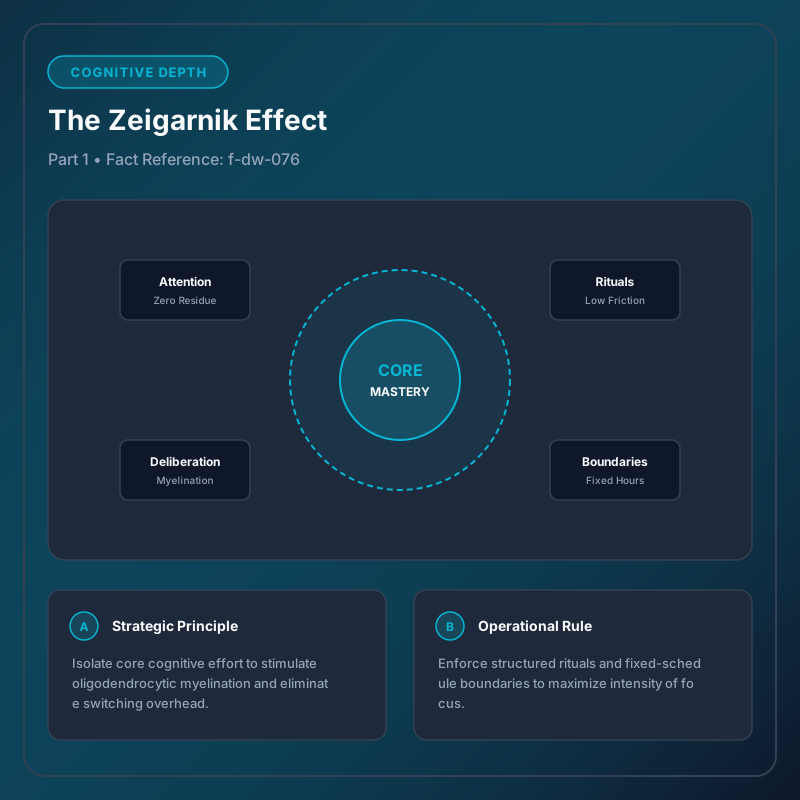
- Apply the 4DX execution framework (lead measures, scoreboard, cadence of accountability) and implement a shutdown ritual to counter the Zeigarnik Effect.
- Explain why Newport schedules breaks from focus, not distraction, how Nass's multitasker study backs it, and how a Roosevelt Dash works.
- Define Productive Meditation, practice its steps while avoiding the looping trap, and explain how Kilov's memory-palace training builds concentration.
- Contrast the Craftsman Approach with the Any-Benefit Mindset, audit tools against your goals in three steps, and apply the Law of the Vital Few (80/20).
- Run the 30-Day Network Tool Elimination Test (quit quietly, then ask if life got worse) and plan structured active leisure after Arnold Bennett.
- Plan the day on a time-block grid with task batching, classify shallow work with the College Graduate Test, and agree a Shallow Work Budget (typically 30-50%).
- Set a firm end time and prune commitments backward from it (Nagpal), and cut email with sender filters, the Do Not Reply Rule, and process-centric emails.
Study guide.
The same study guide as in the app, one page for each lesson, with its key facts and a self-test.
- 01The Deep Work Hypothesis and High-Value Knowledge Economy
- 02The Scarcity, Psychology, and Philosophical Meaning of Focus
- 03Rule #1: The Four Deep Work Philosophies and Execution Rituals
- 04Rule #2: Cognitive Training, Roosevelt Dashes, and Productive Meditation
- 05Rule #3: The Craftsman Approach to Tools and Intentional Leisure
- 06Rule #4: Draining the Shallows, Time Blocking, and Fixed-Schedule Productivity
Built from 1 source.
253 of its 314 cards cite a source. These are the sources it cites.
Hover over a photo, or tap its i, to see where it came from. All 6:
- Lesson 1: Pexels · Tara Winstead · Pexels License ↗
- Lesson 2: Pexels · Mikhail Nilov · Pexels License ↗
- Lesson 3: Pexels · Magda Ehlers · Pexels License ↗
- Lesson 4: Pexels · Markus Spiske · Pexels License ↗
- Lesson 5: Pexels · Fotoğrafınruhu . · Pexels License ↗
- Lesson 6: Pexels · Antoni Shkraba · Pexels License ↗
- Deep Work by Cal Newport · on Amazon ↗
These are affiliate links: if you buy a book through one, FlashFeed may earn a small commission at no extra cost to you. The commission helps pay for FlashFeed's servers.
As an Amazon Associate we earn from qualifying purchases.
Independent study notes, not affiliated with the author or publisher.
- Cards
- 314
- Lessons
- 6
- Version
- 1.0.22
- Language
- English
The whole pack is one file. Read the pack file ↗
FlashFeed is on the App Store and Google Play.
FlashFeed is free on iPhone and Android, and needs no account.