
Deep Work study guide · Lesson 1 of 6
The Deep Work Hypothesis and High-Value Knowledge Economy
The Deep Work Imperative and Deliberate Practice · Attention Residue and the High-Productivity Law
Unofficial study guide for Deep Work: Rules for Focused Success in a Distracted World by Cal Newport. FlashFeed is not affiliated with the author or publisher.
This is the lesson's study guide from the FlashFeed app, plus its key facts and a self-test.
What you'll be able to do
- Distinguish high-value deep work from cognitively undemanding shallow work and explain how deliberate practice drives skill mastery.
- Explain the mechanics of Attention Residue and the High-Productivity Law (High-Quality Work Produced = Time Spent x Intensity of Focus).
The Deep Work Imperative and Deliberate Practice
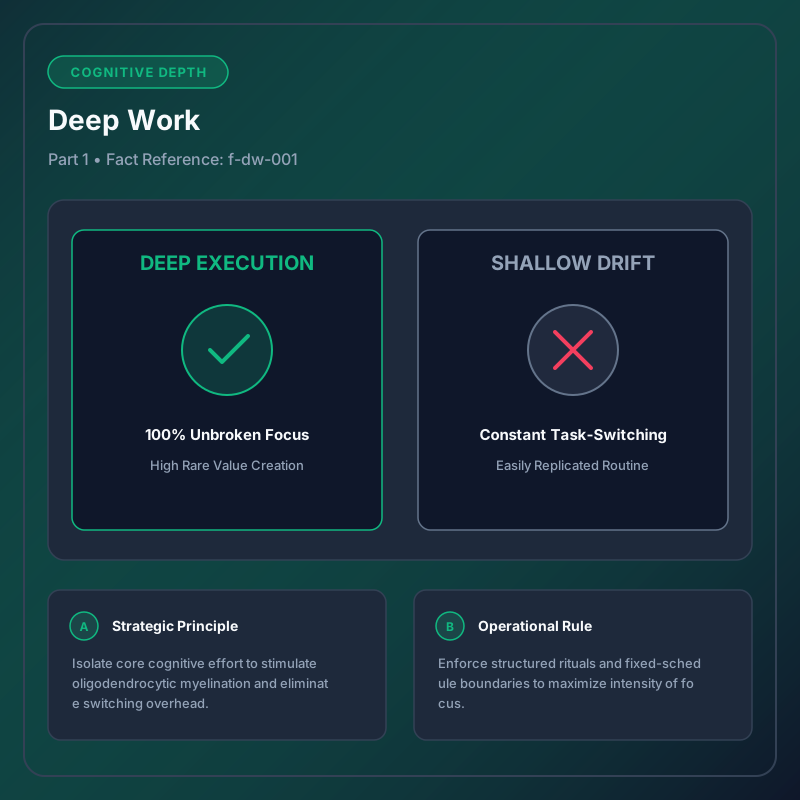
In contemporary knowledge work, the fundamental division between tasks is not dictated by occupational prestige, corporate seniority, or superficial difficulty, but by the neurological state and cognitive depth required to perform them. Deep Work is formally defined as professional activities performed in a state of distraction-free concentration that push cognitive capabilities to their absolute limit. These efforts create new value, improve human skill, and are exceedingly difficult to replicate in an automated or globalized marketplace.
Conversely, Shallow Work encompasses non-cognitively demanding, logistical, administrative, or communicative tasks, often performed while distracted. These activities tend not to create much new value in the world and are easy to replicate. In modern enterprises, shallow work includes routine email correspondence, attending informational meetings without decision rights, managing scheduling logistics, browsing social intranets, and filling out standard reporting forms. While shallow work is necessary to keep an organization functioning, allowing it to dominate a career prevents the acquisition of rare and valuable skills and leaves a professional vulnerable to economic obsolescence.
The profound economic thesis uniting Cal Newport's investigation is The Deep Work Hypothesis: the ability to perform deep work is becoming increasingly rare at exactly the same time it is becoming increasingly valuable in our economy. As a consequence, the few who cultivate this skill, and then make it the core of their working life, will thrive. This hypothesis rests on two distinct pillars: the scarcity of deep focus due to workplace culture and digital distractions, and the exploding premium placed on elite cognitive craftsmanship by modern economic restructuring.
Drawing upon MIT economists Erik Brynjolfsson and Andrew McAfee in their groundbreaking work Race Against the Machine, the rapid restructuring of the information economy driven by digital technologies, intelligent machines, and global networking is polarizing the labor force. Rather than benefiting all knowledge workers equally, this restructuring creates three distinct groups that will reap outsized rewards:
- High-Skilled Workers: Individuals capable of mastering, orchestrating, and creatively deploying increasingly complex intelligent machines, abstract data architectures, and advanced technological systems. As machines become more sophisticated, the gap between ordinary operators and those who can genuinely coax breakthrough performance from complex systems widens exponentially.
- Superstars: Elite performers at the absolute peak of their respective fields who, enabled by global digital connectivity, capture the vast majority of market share in winner-take-all markets. When access to talent is democratized globally, the difference between the 1st-ranked programmer, writer, or consultant and the 10th-ranked professional results in massive revenue divergence.
- Owners: Capital investors, entrepreneurs, and equity holders who possess the resources to fund, own, and scale transformative digital technologies, automated platforms, and production architectures.
To join either of the first two winning categories—high-skilled workers or superstars—an individual must master two core abilities:
- The Ability to Quickly Master Hard Things: Rapid cognitive skill acquisition in a constantly shifting technological landscape. If you cannot master complex frameworks like advanced machine learning, esoteric programming paradigms, or sophisticated financial modeling quickly, you will be replaced by those who can.
- The Ability to Produce at an Elite Level: Translating cognitive mastery into tangible, high-quality, high-speed output. Knowing how to program or write is insufficient; you must generate definitive, bug-free, and transformative deliverables. Both abilities depend entirely on the capacity for deep work.
The rapid mastery of complex skills is anchored in the science of Deliberate Practice, pioneered through decades of empirical research by cognitive psychologist K. Anders Ericsson at Florida State University. Ericsson established that elite performance across chess, music, athletics, and mathematics is not a consequence of innate talent, but of thousands of hours of deliberate practice. Deliberate practice requires two core components:
- Directing attention tightly and relentlessly toward a specific sub-skill being improved or abstract idea being mastered.
- Receiving immediate, precise, and corrective feedback to calibrate performance iteratively.
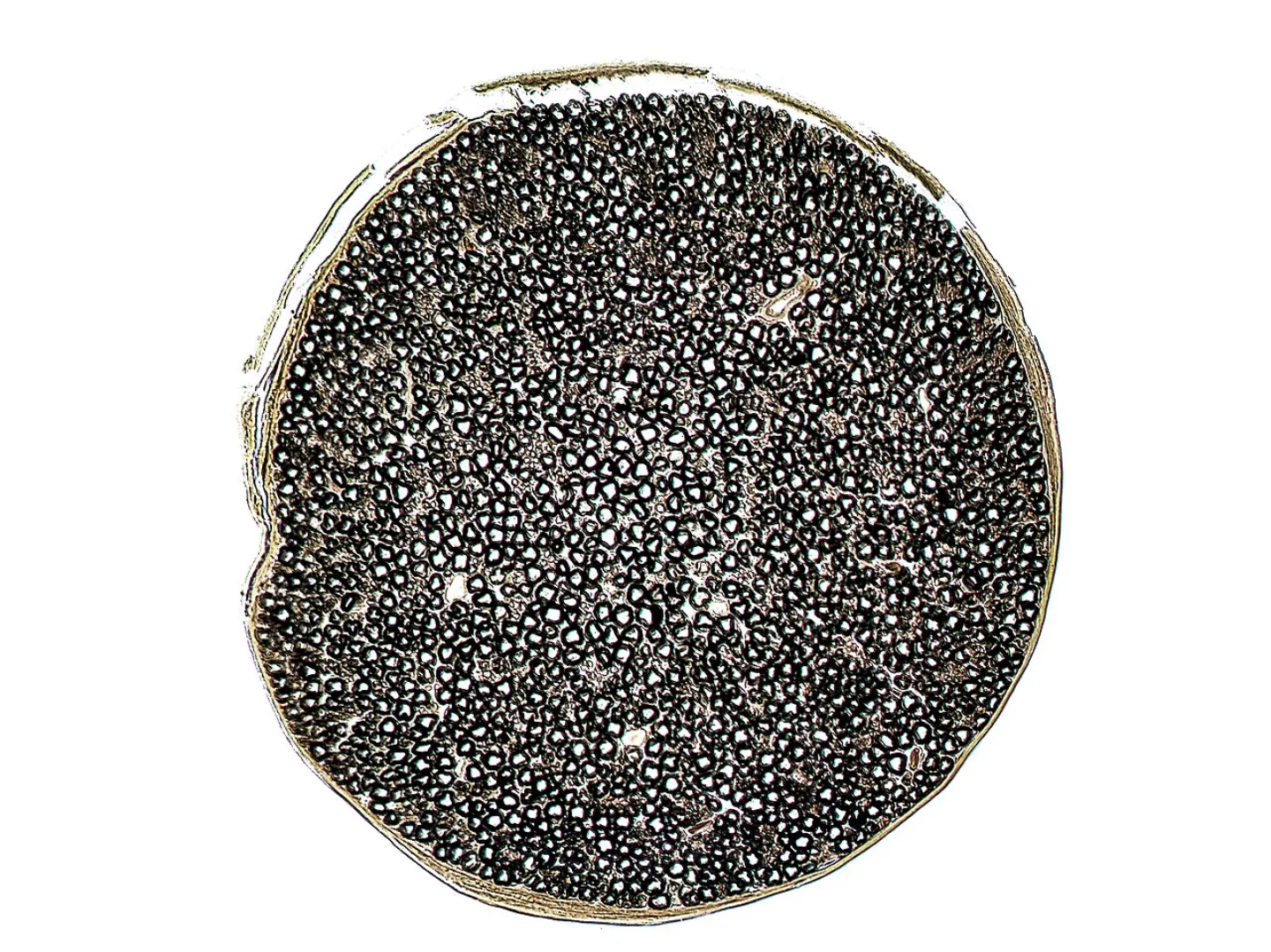
Neurologically, deliberate practice drives the physical transformation of neural architecture through the process of myelination. As synthesized by science writer Daniel Coyle in The Talent Code, when a brain circuit fires in focused repetition, specialized glial cells in the central nervous system called oligodendrocytes wrap layers of microscopic fatty tissue known as myelin around the axonal fibers of the active neurons. Myelin functions as a high-performance electrical insulator, preventing electrical leakage and dramatically increasing the speed, bandwidth, and precision of action potentials traveling along that specific neural pathway. The thicker the myelin sheath, the more effortless, rapid, and accurate the cognitive operation becomes.
Crucially, oligodendrocytes respond to the intensity and repetition of the electrical signal. When attention is fragmented by distractions, multitasking, or superficial scanning, diffuse and irrelevant circuits fire simultaneously across the brain. This dispersion dilutes the localized electrical signal, preventing robust oligodendrocytic myelination. To maximize skill acquisition and cognitive mastery, an individual must isolate the relevant neural circuit by focusing intensely without interruption for extended durations, triggering localized myelination.
A striking empirical illustration of this principle in modern career economics is the case of Jason Benn. Finding himself stuck in a low-mobility financial consulting career consisting primarily of shallow spreadsheet manipulation and administrative tasks, Benn recognized that the emerging economic landscape rewarded software engineers. However, he had zero background in programming and had never written a line of professional code. To overcome this deficiency, Benn realized that casual evening tutorials would never suffice. He purchased textbooks on computer architecture and locked himself in a room without internet access or electronic distractions for hours each day. By systematically cultivating deliberate focus, he trained his mind to absorb abstract computer science concepts. When his focus wandered, he forced himself back to the text, systematically strengthening his attentional stamina. Benn subsequently entered Dev Bootcamp, graduated at the top of his cohort, and successfully transitioned into a lucrative software engineering role. His trajectory demonstrated that deep work is not merely a philosophical preference, but an actionable, learnable engine for radical socioeconomic mobility and intellectual transformation.
Attention Residue and the High-Productivity Law
A persistent, damaging misconception of modern office life is that knowledge workers can rapidly switch back and forth between different cognitive tasks without experiencing meaningful performance degradation. This fallacy was empirically dismantled by business professor Dr. Sophie Leroy (at the University of Minnesota and later the University of Washington) in her landmark 2009 study, "Why is it so hard to do my work? The challenge of attention residue when switching between work tasks."
Leroy conducted controlled laboratory experiments in which subjects worked on an initial task (Task A), such as a set of word puzzles, and were then moved to a different task (Task B), such as reading resumes and making hypothetical hiring decisions. In some trials, they were moved before they could finish Task A. Leroy measured performance on Task B, as well as how accessible thoughts about Task A remained, using a lexical decision task.
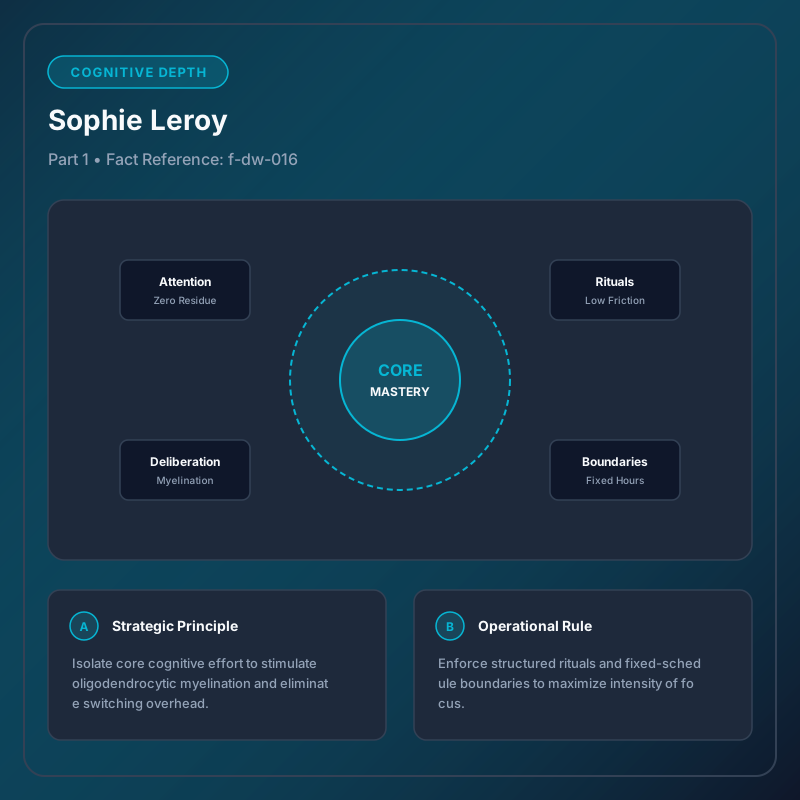
The findings were definitive: when an individual transitions from Task A to Task B, their attentional focus does not cleanly follow. Instead, a cognitive shadow—which Leroy formally coined Attention Residue—remains stuck thinking about Task A. The residue is especially thick and disruptive if Task A was left unfinished. Consequently, when attempting to execute Task B, the worker operates with compromised cognitive bandwidth, reduced working memory, and diminished executive control.
Even seemingly harmless micro-checks—such as glancing at an email inbox, a Slack channel, or a phone notification—can trigger attention residue. The brief glance activates a cascade of unresolved social obligations, pending requests, and secondary thoughts that linger and contaminate the mind's attentional workspace well after the glance ends. Knowledge workers who check communication tools every ten minutes spend their entire professional lives in a state of permanent attention residue, never allowing their prefrontal cortex to achieve full cognitive clarity.
To formalize the mathematical relationship between focused time and cognitive output, Newport formulates The Law of Productivity: High-Quality Work Produced equals Time Spent multiplied by Intensity of Focus.
Traditional corporate management has historically focused almost exclusively on the first variable: Time Spent. Organizations measure hours logged at desks, attendance in offices, and duration of project shifts. However, if Intensity of Focus is diminished through task-switching, fragmented environments, and chronic attention residue, total high-quality output collapses.
Working with full, undistracted intensity for a much shorter block can outproduce a far longer day diluted by constant task-switching and email-checking. Maximizing output requires driving intensity of focus to its absolute ceiling by eliminating all secondary inputs and isolating single cognitive challenges.
Research across cognitive neuroscience and neuropsychology confirms that the human brain does not process multiple cognitively demanding tasks in parallel. Instead, the prefrontal cortex executes rapid, sequential task-switching. Each switch incurs real metabolic and cognitive switching costs, and degrades output quality. Deep work rejects the shallow ethos of multitasking in favor of sustained, unbroken monotasking.
By allocating protected cognitive blocks of at least 90 minutes to a single intellectual task, knowledge workers allow the prefrontal cortex to clear competing cognitive schemas. In this state of cognitive isolation, working memory is fully committed to the target problem, enabling breakthrough synthesis, deep problem-solving, and the rapid generation of non-trivial intellectual property. Eliminating attention residue is the single most potent intervention for elevating intellectual throughput in the modern knowledge economy. To achieve elite performance, one must treat attention not as an infinite stream to be divided, but as a laser that delivers transformative power only when focused on a single point.
Key terms
- Superstars
- Elite performers at the peak of their fields who capture massive market share in winner-take-all markets.
- Oligodendrocytes
- Specialized glial cells that generate insulating myelin sheaths around repeatedly fired neural circuits.
- Task Switching
- The costly cognitive process of reconfiguring executive mental models when alternating between distinct activities.
Key facts
Deep Work
Deep Work is professional activity performed in a state of distraction-free concentration that pushes cognitive limits, creating new value, improving skill, and proving hard to replicate.
Shallow Work
Shallow Work covers the non-cognitively demanding, logistical, administrative, or communicative tasks that fill a modern office day — routine email, status meetings without decision rights, scheduling logistics, and standard reporting forms. These tasks are often performed while distracted, create little new value, and are easy to replicate. Shallow work isn't something to abolish — it's necessary to keep an organization running — but letting it dominate a career blocks the acquisition of rare, valuable skills and leaves a professional economically vulnerable.
The Deep Work Hypothesis
Cal Newport's central claim is The Deep Work Hypothesis: the ability to perform deep work is becoming increasingly rare in the economy at exactly the same time it is becoming increasingly valuable. Workplace culture and digital distraction make sustained concentration scarcer, while economic restructuring keeps raising the premium on elite cognitive craftsmanship. Newport's conclusion follows directly: the few people who cultivate deep work as the core of their working life will thrive.
The Three Winning Groups
Drawing on economists Erik Brynjolfsson and Andrew McAfee (Race Against the Machine), Newport argues the digital economy is polarizing into three groups that capture outsized rewards. High-Skilled Workers master and creatively deploy increasingly complex intelligent machines and data systems. Superstars are elite performers who use global digital connectivity to capture the lion's share of winner-take-all markets. Owners are the capital investors and entrepreneurs who fund and scale the technology platforms themselves.
Deliberate Practice
Deliberate Practice, the research program pioneered by cognitive psychologist K. Anders Ericsson at Florida State University, is Newport's explanation for how elite skill gets built. Ericsson found that elite performance in chess, music, athletics, and mathematics comes not from innate talent but from thousands of hours of a specific kind of practice, made up of two components: directing attention tightly and relentlessly at a specific sub-skill, and receiving immediate, precise, corrective feedback.
Myelination
Deliberate practice physically reshapes the brain through myelination. As science writer Daniel Coyle describes in The Talent Code, when a neural circuit fires in focused repetition, glial cells called oligodendrocytes wrap layers of fatty myelin around the active axons. Myelin insulates the fibers, increasing the speed, bandwidth, and precision of the signal — the thicker the sheath, the more effortless and accurate the skill becomes. Fragmented, distracted attention dilutes the signal across many circuits at once, which is why multitasking undermines this process.
Jason Benn's Career Transformation
Jason Benn was stuck in a low-mobility financial consulting job built on shallow spreadsheet work when he decided to become a software engineer — despite having never written a line of code. Rather than rely on casual evening tutorials, he bought computer-architecture textbooks and locked himself in a room with no internet access for hours a day, forcing his focus back to the material whenever it wandered. Benn went on to graduate at the top of his class at Dev Bootcamp and land a software engineering role, showing that deep work is a learnable engine for real socioeconomic mobility.
The Two Core Abilities
To become a High-Skilled Worker or Superstar, Newport argues you need two abilities, and both depend on deep work. The first is the ability to quickly master hard things — rapidly acquiring complex skills via deliberate practice and myelination as the technological landscape keeps shifting. The second is the ability to produce at an elite level — translating that mastery into tangible, high-quality, high-speed output, since knowing how to do something is worthless without shipping it.
Attention Residue
Attention Residue is the cognitive impairment occurring when switching from Task A to Task B, where a portion of attentional bandwidth remains stuck on the prior task, degrading performance.
Sophie Leroy's Attention Residue Study
The idea that knowledge workers can switch tasks without a performance hit was dismantled by business professor Dr. Sophie Leroy, whose foundational 2009 study — at the University of Minnesota — coined the term attention residue. Leroy gave subjects an initial task (Task A, a word puzzle or resume evaluation), interrupted them mid-task, and moved them to an unrelated Task B, measuring Task B's speed and accuracy and how much Task A still occupied their thoughts. Her results were definitive: a cognitive shadow of the first task follows workers into the second, degrading performance.
The Law of Productivity
Newport formalizes the payoff of focus in The Law of Productivity: High-Quality Work Produced equals Time Spent multiplied by Intensity of Focus. Most organizations manage only the first variable — hours logged at a desk — while ignoring the second. Working with full, undistracted intensity for a shorter block can outproduce a much longer day diluted by constant task-switching and email-checking.
Task-Switching Has a Cost
The human brain cannot run two cognitively demanding tasks in parallel — cognitive neuroscience shows the prefrontal cortex instead performs rapid, sequential Task Switching, reconfiguring its executive mental model each time it moves between activities. Every switch carries a real cost, degrading the quality of the output that follows. Deep work rejects multitasking's shallow ethos in favor of sustained, unbroken monotasking.
Micro-Checks Trigger Long Attention Residue
A glance at an email inbox, a Slack channel, or a phone notification is enough to trigger significant attention residue. That brief glance activates a cascade of unresolved social obligations and pending requests that can linger and contaminate the mind's attentional workspace well after the glance ends. A knowledge worker who checks communication tools every ten minutes, in other words, spends their entire working life in a state of permanent attention residue.
Monotasking Beats Multitasking
Because task-switching carries a real cognitive cost, monotasking — committing 100% of working memory to a single problem — produces the highest attentional throughput available. Fragmented intervals between meetings and messages cannot reliably produce high-quality intellectual output, no matter how many of them accumulate, because complex conceptual synthesis needs sustained, unbroken immersion. Multitasking, by contrast, cycles open communications and tasks in a way that keeps switching costs and attention residue constantly active.
Cognitive Isolation
To run an uninterrupted deep work block, Newport's method is to select one high-priority problem, sever every secondary communication channel and notification, and hold unbroken concentration for at least 90 minutes before recording progress and clearing working memory. This is the state of cognitive isolation: total immersion reached only by eliminating external interruptions, since even one open channel can fragment working memory and let attention residue back in.
Attention Residue Is Thickest
Not all attention residue is equal. Leroy's research found the residue left behind is especially thick and disruptive when the task you're leaving was unfinished. A task that was fully completed and formally checked off leaves far less of a cognitive shadow: it's the open loops that keep bleeding into the next task.
Matched pairs
Each item on the left goes with the one on the right.
- Quickly Master Hard Things
- Rapid skill acquisition via deliberate practice and myelination
- Produce at an Elite Level
- Translating mastery into high-quality and high-speed output
Step by step
Execute an Uninterrupted Deep Work Block
- Select a single high-priority cognitive problem and define its completion milestone.
- Sever all secondary communication channels, notifications, and internet access.
- Engage in unbroken concentration for at least 90 minutes without switching tasks.
- Record session progress and clear working memory before transitioning.
Maintaining cognitive isolation prevents attention residue from fragmenting working memory.
Self-test
Answer each question from memory, then check your work against the answer key.
1. What actually determines whether a task counts as deep work or shallow work?
- ASuperficial difficulty of the task
- BOccupational prestige of the role
- CThe corporate seniority level of the person performing it
- DNeurological state and cognitive depth required
2. Which of these is NOT one of the three groups that reap outsized rewards in Newport's polarized economy?
- AOwners
- BMiddle Managers
- CSuperstars
- DHigh-Skilled Workers
3. Jason Benn's shift into software engineering illustrates deliberate practice because he...
- AStudied only during free moments between meetings
- BTook casual evening tutorials on his normal schedule
- CLocked himself away with textbooks, free of distractions
- DHired an experienced developer to write all of his code for him
4. Per K. Anders Ericsson, deliberate practice pairs focused attention on a sub-skill with what?
- AImmediate, precise corrective feedback
- BRandomized practice schedules
- CFinancial incentives for improvement
- DStructured group collaboration sessions with several peers
5. Which cellular process, described by Daniel Coyle, speeds neural signals during deliberate practice?
- ADendritic branching by astrocytes
- BMyelination by oligodendrocytes
- CSynaptic pruning by microglia
- DNeurogenesis in the hippocampus
6. Which researcher coined the term 'Attention Residue' in a 2009 study?
- ADr. K. Anders Ericsson
- BCal Newport
- CDaniel Coyle
- DDr. Sophie Leroy
7. In Newport's Law of Productivity, High-Quality Work Produced equals Time Spent multiplied by what?
- AIntensity of Focus
- BLevel of Deadline Pressure
- CNumber of Tasks Completed
- DTotal Meetings Attended
8. Which of these is true of attention residue?
- AIt fades the moment you start the next task
- BIt's thickest after a task is fully completed
- CIt's thickest when the prior task was left unfinished
- DIt comes from long tasks, never from quick glances
9. Newport's cognitive isolation method calls for unbroken concentration on one problem for at least how long?
- A15 minutes
- B30 minutes
- C90 minutes
- D3 hours
10. What occurs neurologically when a worker quickly switches from an unfinished task to a new project?
- AWorking memory expands to process both tasks at once with equal efficiency
- BAttention residue from the first task continues to degrade working memory bandwidth
- CDopaminergic pathways are fully replenished by the rapid change in stimulus
- DThe prefrontal cortex immediately resets and operates at full cognitive capacity
Go deeper
- ReadDeep Work by Cal Newport · on Amazon ↗
- StudyDeep Work in the FlashFeed app
These are affiliate links: if you buy a book through one, FlashFeed may earn a small commission at no extra cost to you. The commission helps pay for FlashFeed's servers.
As an Amazon Associate we earn from qualifying purchases.
Answer key
- 1. D Neurological state and cognitive depth requiredThe divide is defined by the neurological state and cognitive depth a task requires; prestige, seniority, and superficial difficulty are explicitly ruled out as the determining factor.
- 2. B Middle ManagersBrynjolfsson and McAfee's three winning groups are High-Skilled Workers, Superstars, and Owners; Middle Managers is not one of them.
- 3. C Locked himself away with textbooks, free of distractionsBenn rejected casual, distracted learning and instead isolated himself with textbooks for focused, undistracted study, the essence of deliberate practice.
- 4. A Immediate, precise corrective feedbackEricsson's deliberate practice requires tightly focused attention plus immediate, precise feedback to calibrate performance, not incentives or randomness.
- 5. B Myelination by oligodendrocytesCoyle's The Talent Code describes oligodendrocytes wrapping myelin around repeatedly fired axons, insulating them and speeding signal transmission.
- 6. D Dr. Sophie LeroySophie Leroy's 2009 study at the University of Minnesota coined 'attention residue' after measuring lingering focus on Task A during Task B.
- 7. A Intensity of FocusThe Law of Productivity is Time Spent multiplied by Intensity of Focus; most organizations track only time and neglect the focus multiplier.
- 8. C It's thickest when the prior task was left unfinishedLeroy found residue is especially thick when the prior task was left unfinished, while a completed, checked-off task leaves far less. Even a quick glance at an inbox can trigger it.
- 9. C 90 minutesCognitive isolation requires holding unbroken focus on a single high-priority problem for at least 90 minutes before recording progress.
- 10. B Attention residue from the first task continues to degrade working memory bandwidthAttention residue leaves a cognitive shadow on prior uncompleted tasks, impairing subsequent focus.
Sources
- Deep Work — Cal Newport
- Deep Work, Chapter 1 — calnewport.com/books/deep-work/
Image credits
- Deep Work: FlashFeed · CC-BY-4.0
- Myelination: Малишко Анастасія · CC BY 4.0 — commons.wikimedia.org/wiki/File:%D0%9F%D0%BE%D0%BF%D0%B5%D1%80%D0%B5%D1%87%D0%BD%D0%B8%D0%B9_%D0%BD%D0%B5%D1%80%D0%B2.jpg
- Attention Residue: FlashFeed · CC-BY-4.0
