
Deep Work study guide · Lesson 2 of 6
The Scarcity, Psychology, and Philosophical Meaning of Focus
The Metric Black Hole and the Cult of Busyness · Neurological, Psychological, and Philosophical Meaning
Unofficial study guide for Deep Work: Rules for Focused Success in a Distracted World by Cal Newport. FlashFeed is not affiliated with the author or publisher.
This is the lesson's study guide from the FlashFeed app, plus its key facts and a self-test.
What you'll be able to do
- Analyze why real-time messaging and the Metric Black Hole reward busyness as a proxy for genuine productivity.
- Explain the neurological, psychological, and philosophical case for deep work through Gallagher's attention research, flow, and craftsmanship.
The Metric Black Hole and the Cult of Busyness
In industrial manufacturing, measuring productivity is straightforward: one calculates the input costs of raw materials and labor hours against the precise quantity and quality of physical goods produced on an assembly line. In contrast, knowledge work is plagued by what Newport terms The Metric Black Hole: the profound difficulty of directly measuring the bottom-line financial impact of individual behaviors, organizational tools, and cognitive habits.
As software engineering pioneers Tom DeMarco and Timothy Lister observed in their classic text Peopleware: Productive Projects and Teams, measuring individual knowledge work output is notoriously complex and fraught with unintended incentives. Because organizations cannot easily calculate the financial cost of an interrupted hour or the exact economic value of an uninterrupted morning of deep focus, they default to policies, workflows, and technologies that prioritize short-term administrative convenience over long-term cognitive depth.
Operating within this metric vacuum, workplace culture is governed by The Principle of Least Resistance: in a business setting, without clear feedback on the impact of various behaviors to the bottom line, we will tend toward behaviors that are easiest in the moment.
The clearest manifestation of this principle is the culture of constant digital connectivity. When employees can instantly message colleagues on Slack or email, they no longer need to plan their days, structure requirements in advance, or manage their time with discipline. Instead, they operate reactively, creating an environment of perpetual crisis management where long-term deep work becomes structurally impossible. Reaching for whatever reactive response is quickest in the moment crowds out deep intellectual production in the long term, favoring the fleeting ease of an unplanned reply over the sustained concentration and advance planning that produce real value.
When true cognitive productivity cannot be measured quantitatively, workers and managers seek alternative signals to demonstrate value and justify organizational existence. This dynamic generates Busyness as a Proxy for Productivity: in the absence of clear indicators of what it means to be productive and valuable in their jobs, many knowledge workers turn back toward an industrial indicator of productivity: doing lots of stuff in a visible manner.
Knowledge workers send hundreds of emails, attend continuous meetings, and maintain constant chat presence because these visible, shallow actions create an outward illusion of tireless diligence, even as their substantive cognitive contributions stagnate. This performative busyness becomes culturally self-reinforcing, as managers reward responsiveness over depth, mistaking the speed of communication for the quality of insight. In such environments, the employee who spends four quiet hours crafting an essential algorithm is viewed with suspicion, while the colleague firing off forty superficial chat replies is praised as a dedicated collaborator.
The unquestioned adoption of network tools in modern business is further fueled by what social critic Neil Postman termed Technopoly in his 1992 treatise Technopoly: The Surrender of Culture to Technology. Technopoly describes a cultural state wherein society unconditionally assumes that any new technological innovation is inherently beneficial, eliminating the need to weigh its subtle, destructive trade-offs.
In the modern office, tools like ubiquitous instant messaging, open-plan social intranets, and collaborative wikis are celebrated uncritically, while their devastating toll on deep concentration and sustained thought is completely ignored. Technopoly blinds organizations to the reality that high-tech connectivity can simultaneously be a high-cost distraction. Overcoming this cultural blindness requires recognizing that tools must be judged by their net cognitive contribution rather than their technological novelty, and that depth is a rare competitive advantage in an enterprise landscape seduced by superficial connectivity and performative busyness.
To dismantle the cult of busyness, forward-thinking leaders and individual professionals must establish explicit boundaries that insulate core intellectual work from the tide of reactive chatter. When an organization refuses to measure the true cost of distraction, the individual knowledge worker must take personal sovereignty over their schedule, rejecting visible motion in favor of tangible, high-value cognitive achievement.
Neurological, Psychological, and Philosophical Meaning
Beyond economic utility, deep work is essential to human flourishing, emotional resilience, and subjective well-being. Science writer Winifred Gallagher discovered this profound truth following a devastating cancer diagnosis. Faced with an advanced, life-threatening illness, Gallagher realized that her daily emotional experience was not determined by her objective circumstances, but by what she chose to pay attention to.
As detailed in her book Rapt: Attention and the Focused Life, Gallagher concluded: "Who you are, what you think, feel, and do, what you love—is the sum of what you focus on." Neurologically, the brain constructs our perceived reality based on the stimuli we select for focus. When our attention is consumed by shallow trivia, administrative anxieties, and digital chatter, the brain perceives life as fragmented, stressful, and superficial.
Conversely, when we immerse our attention deeply in demanding, high-skill intellectual problems, our neurobiology constructs a reality imbued with meaning, mastery, and emotional resilience. Focus is a neurological filtering mechanism that shapes the quality of conscious experience, shielding consciousness from trivial emotional storms, anxiety spirals, and cultivating sustained mental equanimity.
The psychological case for deep work rests on the research of Mihaly Csikszentmihalyi, who developed the concept of Flow—a state of intense, effortless absorption in an activity that stretches one's skills to their limits.
Using the Experience Sampling Method (ESM), Csikszentmihalyi and Reed Larson signaled participants via pagers at random intervals throughout the day to record their activities and emotional states. The data revealed a striking paradox: human beings are consistently happier, more energized, and more fulfilled when engaged in structured, challenging work that demands deep focus than when idling in unstructured, passive leisure. Work provides clear goals, immediate feedback, and cognitive challenge, facilitating flow states. Deep work is the direct operational gateway to experiencing regular, sustained states of flow in modern intellectual life.
Philosophers Hubert Dreyfus and Sean Dorrance Kelly, in their book All Things Shining: Reading the Western Classics to Find Meaning in a Secular Age, trace how the post-Enlightenment world lost the sense of inherent sacredness in daily life. When modern secularism placed the autonomous individual at the center of the universe, it generated an existential crisis where meaning had to be arbitrarily invented. Dreyfus and Kelly argue that the solution is to cultivate Craftsmanship.
In craftsmanship, the practitioner does not impose arbitrary personal will upon the universe, but instead cultivates the discernment to draw out the latent quality and excellence inherent in the task itself. Newport illustrates this through master blacksmith Ric Furrer, who hand-forges ancient Viking Ulfberht swords from raw crucible steel using intense, meditative focus. Furrer does not view his work as a tedious chore; his deep focus reveals beauty and nobility in physical labor.
Deep work allows the modern computer programmer, writer, or scholar to experience the exact same sacredness, transforming knowledge work from a stressful logistical grind into a dignified, noble craft. A deep life is not merely economically productive; it is an inherently rich, meaningful, and flourishing way to live in the modern world, anchoring human consciousness in excellence, purpose, and mastery. By treating intellectual labor as a craft that demands reverence, care, and total immersion, knowledge workers reclaim a profound sense of human dignity amid a culture of superficial distraction.
Ultimately, living deeply aligns our neurological faculties, psychological motivations, and philosophical aspirations into a coherent, purposeful whole. The commitment to depth protects the mind from existential drift and transforms routine tasks into monuments of human excellence and personal fulfillment.
Key terms
- The Principle of Least Resistance
- The tendency in business settings to default to whatever behaviors are easiest in the immediate moment.
- Flow
- An optimal psychological state of intense absorption where an individual stretches their skills on a clear challenge.
- Experience Sampling Method (ESM)
- A research technique signaling subjects at random intervals to capture real-time emotional states and activities.
Key facts
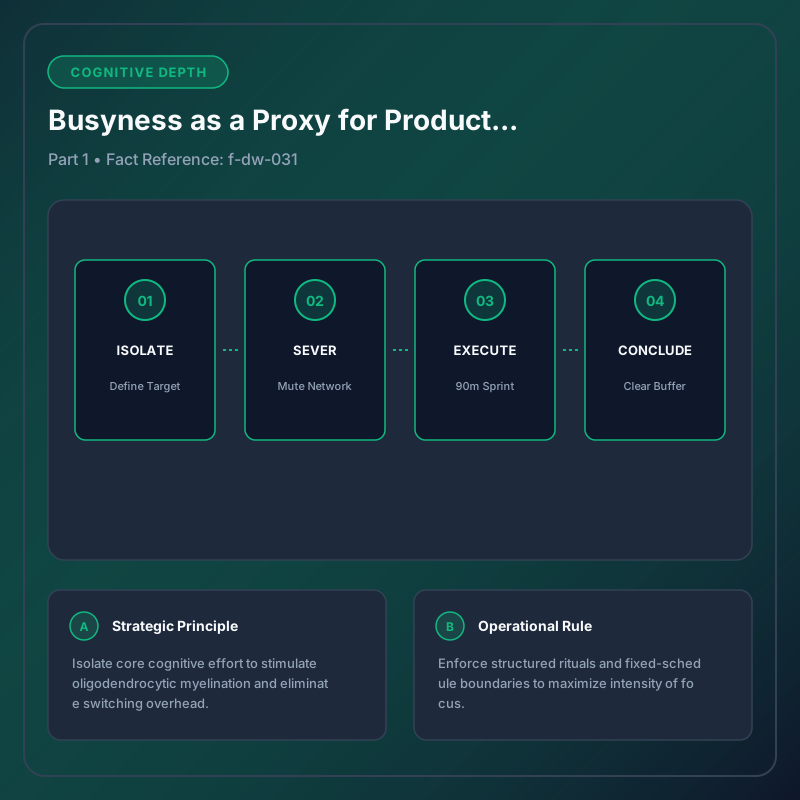
The Metric Black Hole
The Metric Black Hole describes the profound difficulty of directly measuring the bottom-line financial impact of knowledge work habits, interruptions, and collaborative tools.
The Principle of Least Resistance
Because knowledge work sits in a metric black hole, workplace culture defaults to The Principle of Least Resistance: without clear feedback on what helps the bottom line, people gravitate toward whatever is easiest in the moment. Constant Slack and email access is the clearest example — it lets employees skip planning ahead, trading a sender's momentary convenience for a disproportionate disruption to the recipient's attention. Overcoming this takes deliberate counter-measures: identifying reactive channels, setting fixed windows for handling them, and stating turnaround expectations.
The Busyness Proxy
When true cognitive output can't be measured, workers and managers reach for a substitute signal: Busyness as a Proxy for Productivity — doing lots of visible stuff to look diligent. Sending hundreds of emails, attending continuous meetings, and staying constantly present on chat creates an illusion of hard work even as substantive output stagnates, because visible responsiveness is an easy stand-in for value that's hard to measure. The result: four quiet hours on an essential algorithm draw suspicion, while forty superficial chat replies get praised as dedicated collaboration.
Technopoly
Social critic Neil Postman coined the term Technopoly in his 1992 book Technopoly: The Surrender of Culture to Technology to describe a culture that unconditionally assumes any new technology is beneficial, without weighing its trade-offs. In the modern office this shows up as instant messaging, open-plan social intranets, and collaborative wikis being celebrated uncritically while their toll on deep concentration goes unexamined. Escaping Technopoly means judging a tool by its net cognitive contribution, not its technological novelty.
Peopleware and Interruption
Software engineering pioneers Tom DeMarco and Timothy Lister documented the hidden cost of interruption in their 1987 management classic Peopleware: Productive Projects and Teams. Their research showed that quiet, protected space is vital to software engineer productivity — a finding that anticipated the metric black hole problem, since organizations still struggle to put a dollar figure on an interrupted hour versus an uninterrupted morning of focus.
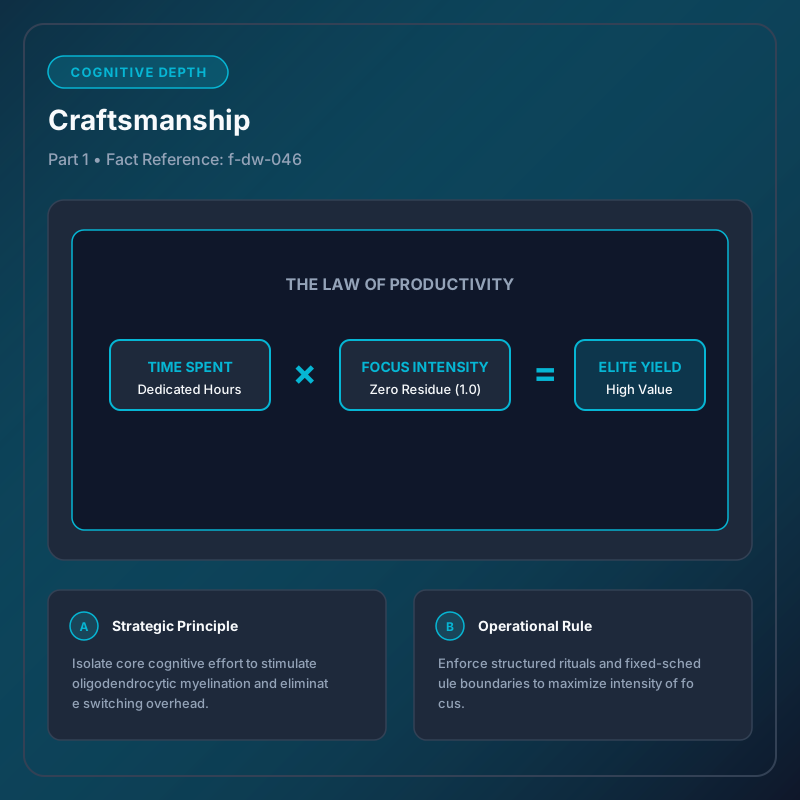
Neurology of Attention
Science writer Winifred Gallagher proved that subjective reality is defined by what we pay attention to: 'Who you are, what you think, feel, and do, what you love—is the sum of what you focus on.'
Flow
Psychologist Mihaly Csikszentmihalyi developed the concept of Flow: a state of intense, effortless absorption in an activity that stretches one's skills to their limits. Flow requires a clear, challenging task — one demanding enough to engage fully without tipping into overwhelming anxiety — plus clear goals and immediate feedback. Deep work is, in Newport's framing, the direct operational gateway to experiencing flow regularly in intellectual life.
The Experience Sampling Method
To study flow empirically, Mihaly Csikszentmihalyi and Reed Larson developed the Experience Sampling Method (ESM): signaling participants via pagers at random intervals throughout the day to record their current activity and emotional state. The data revealed a striking paradox — people report being consistently happier, more energized, and more fulfilled during structured, challenging work than during unstructured, passive leisure, because work supplies clear goals, immediate feedback, and a skill-stretching challenge that passive idling doesn't.
The Sacredness of Craftsmanship
Philosophers Hubert Dreyfus and Sean Dorrance Kelly argue that post-Enlightenment secularism stripped daily life of inherent sacredness, and that Craftsmanship is the way back: the practitioner doesn't impose arbitrary will on the world, but cultivates the discernment to draw out the quality already latent in the task itself. Newport extends this to knowledge work directly — approaching a problem with a craftsman's reverence and mastery restores a sense of sacredness to programming, writing, or research that would otherwise feel like a stressful logistical grind.
Ric Furrer's Craftsmanship
Newport illustrates craftsmanship through master blacksmith Ric Furrer, who hand-forges historically accurate Viking Ulfberht swords from raw crucible steel using intense, meditative focus. Furrer doesn't treat the work as a tedious chore — his deep focus reveals beauty and nobility in physical labor, exactly the sacredness Newport argues knowledge workers can reclaim through their own craft.
All Things Shining
Philosophers Hubert Dreyfus and Sean Dorrance Kelly trace the loss of inherent meaning in modern life in their book All Things Shining: Reading the Western Classics to Find Meaning in a Secular Age. They argue that once secularism placed the autonomous individual at the center of the universe, meaning had to be invented rather than found — and that craftsmanship is one durable answer to that existential gap.
Attention as a Neurological Filter
Beyond Gallagher's psychological insight, the brain's construction of reality has a neurological mechanism: focus works by amplifying attended stimuli and dampening background noise. When attention is consumed by shallow trivia, administrative anxiety, and digital chatter, the brain perceives life as fragmented and stressful; when attention is immersed in demanding, high-skill problems, it constructs a reality of meaning and mastery instead. Focus functions as a filter that shields consciousness from trivial emotional noise.
Gallagher's Cancer Diagnosis
Science writer Winifred Gallagher arrived at her insight about attention after a devastating cancer diagnosis, when she realized her daily emotional experience wasn't fixed by her circumstances but by what she chose to focus on. She detailed the discovery in her book Rapt: Attention and the Focused Life, the source of her line that who you are and what you love 'is the sum of what you focus on.'
A Deep Life Is Meaningful
Newport's synthesis across neuroscience, psychology, and philosophy is that a life organized around deep work is not an anxious, overloaded existence — it's the opposite. A deep life organizes conscious experience around meaning, order, and mastery, anchoring the mind in purpose rather than leaving it adrift in the fragmented, superficial pull of constant distraction.
Matched pairs
Each item on the left goes with the one on the right.
- Tom DeMarco & Timothy Lister
- Authors of Peopleware, studying workplace interruption costs
- Hubert Dreyfus & Sean Dorrance Kelly
- Authors of All Things Shining, exploring craftsmanship and sacredness
- All Things Shining
- Philosophical exploration of craftsmanship and sacredness in modern secular life
Step by step
Overcome the Principle of Least Resistance in Personal Workflow
- Identify reactive communication channels that generate continuous micro-interruptions.
- Establish predefined, structured windows for processing inquiries and administrative tasks.
- Communicate turnaround expectations explicitly to colleagues and collaborators.
- Protect dedicated deep work blocks on your calendar as non-negotiable commitments.
Replacing reactive responsiveness with intentional structure defeats the default pull of least resistance.
Self-test
Answer each question from memory, then check your work against the answer key.
1. Which term describes the difficulty of directly measuring the financial impact of knowledge work habits and tools?
- AThe Metric Black Hole
- BBusyness as a Proxy for Productivity
- CTechnopoly
- DThe Principle of Least Resistance
2. Under the Principle of Least Resistance, what do workers default to without clear feedback on what helps the bottom line?
- AThe option maximizing long-term output
- BWhatever a manager explicitly mandates
- CThe industrial productivity metric
- DThe easiest option in the moment
3. Which of these is NOT a form of visible busyness used as a proxy for productivity?
- AAttending continuous meetings
- BMaintaining constant chat presence
- CFour hours crafting an algorithm
- DSending hundreds of emails
4. Who coined the term 'Technopoly' in his 1992 book on culture's surrender to technology?
- ACal Newport
- BNeil Postman
- CTom DeMarco
- DTimothy Lister
5. Which pair of authors documented in Peopleware that quiet, protected space is vital to programmer productivity?
- AMihaly Csikszentmihalyi & Reed Larson
- BTom DeMarco & Timothy Lister
- CHubert Dreyfus & Sean Dorrance Kelly
- DNeil Postman & Cal Newport
6. What does Cal Newport's term 'The Metric Black Hole' primarily describe in knowledge-work organizations?
- ADifficulty measuring knowledge work's value
- BAutomated monitoring of every keystroke
- CAssembly-line quotas applied to office work
- DAn outright ban on messaging tools at work
7. Winifred Gallagher's insight that experience is the sum of what you focus on followed what event?
- AA meditation retreat
- BA near-fatal car accident
- CA cancer diagnosis
- DA career layoff
8. Which of the following is NOT a condition Csikszentmihalyi ties to entering a state of flow?
- AImmediate feedback
- BA clear, challenging task
- CHaving a clear and specific set of goals
- DUnstructured, passive leisure
9. What research method did Csikszentmihalyi and Reed Larson use, paging subjects at random intervals to record their state?
- AExperience Sampling Method
- BRandomized Controlled Trial
- CStructured Clinical Interview
- DLongitudinal Cohort Study
10. Which named figure does Newport cite as hand-forging Viking Ulfberht swords with meditative focus?
- AWinifred Gallagher
- BRic Furrer
- CHubert Dreyfus
- DMihaly Csikszentmihalyi
11. Per Newport's synthesis, what does a life organized around deep work do to the mind?
- ARelies on multitasking to reduce boredom
- BRemoves all sources of challenge from a person's daily life
- CEliminates the need for goals or feedback
- DAnchors the mind in meaning, order, and mastery
Go deeper
- ReadDeep Work by Cal Newport · on Amazon ↗
- StudyDeep Work in the FlashFeed app
These are affiliate links: if you buy a book through one, FlashFeed may earn a small commission at no extra cost to you. The commission helps pay for FlashFeed's servers.
As an Amazon Associate we earn from qualifying purchases.
Answer key
- 1. A The Metric Black HoleThe Metric Black Hole names knowledge work's inability to measure the bottom-line impact of habits and tools, unlike manufacturing's clear output metrics.
- 2. D The easiest option in the momentWithout clear feedback on what helps the bottom line, culture drifts toward whatever behavior is easiest right now — the Principle of Least Resistance.
- 3. C Four hours crafting an algorithmEmails, meetings, and chat presence are visible busyness signals; quietly crafting an algorithm for hours is deep, invisible work viewed with suspicion instead.
- 4. B Neil PostmanNeil Postman coined 'Technopoly' in 1992 to describe blind faith that new technology is always beneficial. DeMarco, Lister, and Newport did not coin the term.
- 5. B Tom DeMarco & Timothy ListerTom DeMarco and Timothy Lister documented interruption's cost to programmers in their 1987 book Peopleware. The other pairs study flow and craftsmanship, not interruption.
- 6. A Difficulty measuring knowledge work's valueThe Metric Black Hole names the near-impossibility of measuring the bottom-line value of knowledge work, unlike the countable output of industrial labor.
- 7. C A cancer diagnosisGallagher's realization that experience is shaped by attention, not circumstance, followed her cancer diagnosis, recounted in Rapt: Attention and the Focused Life.
- 8. D Unstructured, passive leisureFlow requires a challenging task, clear goals, and immediate feedback — the opposite of unstructured, passive leisure, which people report as less fulfilling.
- 9. A Experience Sampling MethodCsikszentmihalyi and Reed Larson used the Experience Sampling Method, paging subjects at random moments to record their activity and mood in real time.
- 10. B Ric FurrerNewport uses blacksmith Ric Furrer, who hand-forges Viking Ulfberht swords with meditative focus, as his model of craftsmanship. Csikszentmihalyi, Dreyfus, and Gallagher study flow, meaning, and attention, not blacksmithing.
- 11. D Anchors the mind in meaning, order, and masteryNewport argues deep work anchors the mind in meaning, order, and mastery rather than leaving it fragmented — the opposite of what shallow attention produces.
Sources
- Deep Work — Cal Newport
- Deep Work, Chapters 2-3 — calnewport.com/books/deep-work/
Image credits
- The Metric Black Hole: FlashFeed · CC-BY-4.0
- Neurology of Attention: FlashFeed · CC-BY-4.0