
Deep Work study guide · Lesson 3 of 6
Rule #1: The Four Deep Work Philosophies and Execution Rituals
The Four Scheduling Philosophies and Environmental Rituals · 4DX Execution Architecture and Shutdown Rituals
Unofficial study guide for Deep Work: Rules for Focused Success in a Distracted World by Cal Newport. FlashFeed is not affiliated with the author or publisher.
This is the lesson's study guide from the FlashFeed app, plus its key facts and a self-test.
What you'll be able to do
- Compare the four deep work scheduling philosophies: Monastic, Bimodal, Rhythmic, and Journalistic.
- Apply the 4DX execution framework (lead measures, scoreboard, cadence of accountability) and implement a shutdown ritual to counter the Zeigarnik Effect.
The Four Scheduling Philosophies and Environmental Rituals
Deep work cannot be sustained on willpower alone; it requires a systematic scheduling philosophy aligned with an individual's professional constraints and psychological disposition. Willpower is a finite cognitive resource that depletes rapidly throughout the day. Attempting to decide in the moment whether to resist distraction and concentrate invites executive failure. Newport identifies four distinct depth philosophies:
The Monastic Philosophy:
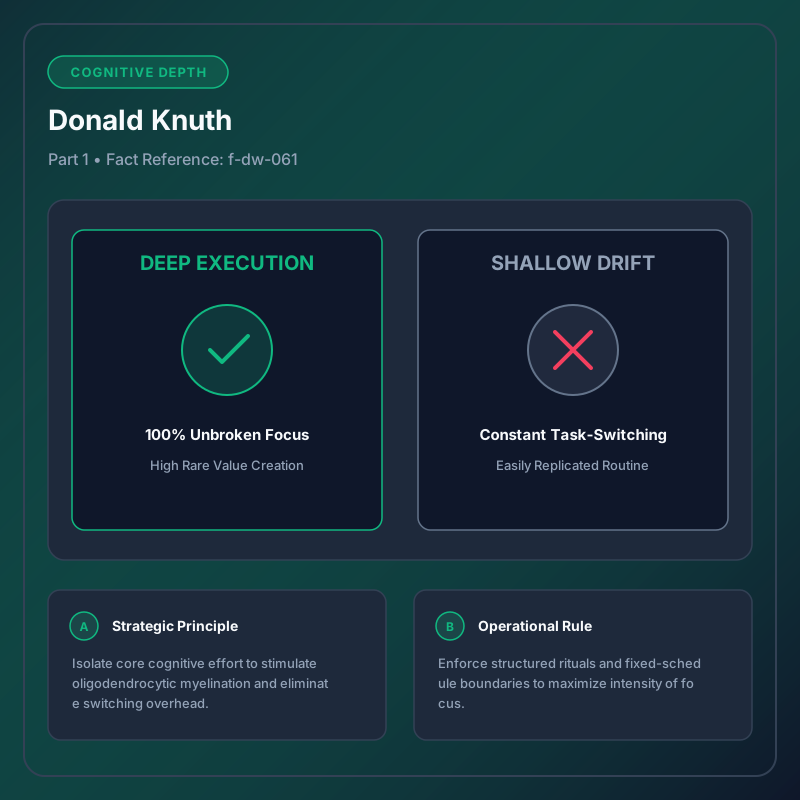
- Core Concept: Completely eliminates or radically minimizes all shallow obligations, cutting off digital connectivity to dedicate 100% of working time to deep efforts.
- Exemplars: Computer science pioneer Donald Knuth, who famously eliminated his personal email address in 1990 to focus on writing The Art of Computer Programming; sci-fi novelist Neal Stephenson, who authored the essay "Why I Am a Bad Correspondent" to explain why he rejects email and social correspondence to protect his novel-writing capacity.
The Bimodal Philosophy:
- Core Concept: Divides time into clearly segregated blocks: long, unbroken stretches dedicated strictly to monastic deep work (days, weeks, or months), while the remaining time is allocated to shallow obligations and administrative duties.
- Exemplars: Psychoanalyst Carl Jung, who retreated periodically to his rustic stone tower in Bollingen without electricity to write transformative psychological treatises, while maintaining an active clinical practice in Zurich; Wharton professor Adam Grant, who batched all his university teaching into one intense semester, leaving the alternate semester exclusively for uninterrupted academic research.
The Rhythmic Philosophy:
- Core Concept: Transforms deep work into a steady, daily habit by anchoring it at the same time each day (e.g., a 90-minute block from 6:00 AM to 7:30 AM), removing the cognitive friction of deciding when to go deep.
- Exemplar: The "Don't Break the Chain" calendar method — writing jokes and marking a red X on the calendar every single day — is popularly attributed to comedian Jerry Seinfeld, though Seinfeld has publicly said he did not originate the technique and has not confirmed using it himself.
The Journalistic Philosophy:
- Core Concept: Shifts into deep work mode spontaneously on a moment's notice whenever a free window of time appears in the schedule.
- Exemplar: Biographer and journalist Walter Isaacson, who possessed the rare mental discipline to sit down with his typewriter during a spare 20-minute gap between editorial meetings and instantly produce paragraphs of high-quality biography. (Note: Highly demanding and not recommended for novices).
To prevent willpower depletion from sabotaging deep work sessions, practitioners must establish explicit Rituals that address three essential logistical dimensions:
- Where You'll Work and for How Long: Specifying a dedicated, distraction-free physical location (a library carrel, a private office, a secluded cafe) with a defined timeframe.
- How You'll Work Once You Start: Setting operational boundaries, such as banning all internet access, turning off phones, and setting explicit word-count or proof-completion milestones.
- How You'll Support Your Work: Providing physical and environmental support, such as having adequate coffee, healthy snacks, physical comfort, and organized reference materials ready beforehand.
Historical figures established rigid environmental rituals: Charles Darwin followed a strict walking and writing schedule; Robert Caro worked for years in a rented, spartan basement office to research and write his biographies; Maya Angelou famously rented a bare hotel room with only a dictionary, a Bible, a deck of cards, and a bottle of sherry to write.
When ordinary routines fail to break through inertia, Newport recommends deploying The Grand Gesture: making a radical, high-cost investment of time, money, or effort to signal to the subconscious mind that the task at hand is of monumental importance.
- J.K. Rowling: When struggling to complete Harry Potter and the Deathly Hallows amid household distractions, checked into a luxurious suite at the 5-star Balmoral Hotel in central Edinburgh. The financial investment and historic grandeur created a profound psychological commitment that enabled her to finish the manuscript.
- Bill Gates: Conducted famous semi-annual "Think Weeks", locking himself in an isolated lakeside cottage in the Pacific Northwest for seven uninterrupted days with stacks of academic papers and books.
- Peter Shankman: Entrepreneur and author booked a business-class round-trip flight from the United States to Tokyo, Japan, solely to write his entire book manuscript in 30 hours of uninterrupted high-altitude focus, immediately flying back upon arrival.
By establishing rigorous environmental rituals and leveraging grand gestures, knowledge workers overcome the friction of starting, turning deep work from a sporadic aspiration into a reliable, high-yield operational reality.
4DX Execution Architecture and Shutdown Rituals
Authoring deep work plans is simple; executing them in a distracted organization is difficult. Newport adapts the management framework from Chris McChesney, Sean Covey, and Jim Huling's The 4 Disciplines of Execution (4DX) to bridge the execution gap:
- Discipline 1: Focus on the Wildly Important: Identify a small number of ambitious, high-leverage goals (Wildly Important Goals or WIGs) rather than attempting to juggle dozens of diffuse priorities. As the authors note, the more you try to do, the less you actually accomplish.
- Discipline 2: Act on Lead Measures: Distinguish between Lag Measures (outcomes you want to achieve, such as papers published or revenue earned, which arrive too late to alter) and Lead Measures (the new behaviors that drive success on the lag measures). In deep work, the ultimate lead measure is Hours of Deep Work Logged in pursuit of the wildly important goal.
- Discipline 3: Keep a Compelling Scoreboard: Maintain a physical, visual scoreboard tracking cumulative deep work hours. The visual tracking provides immediate emotional feedback, gamifies focus, and reinforces the habit.
- Discipline 4: Create a Cadence of Accountability: Conduct regular weekly reviews to assess the scoreboard, analyze deep work successes and failures, and establish concrete commitments for the upcoming week.
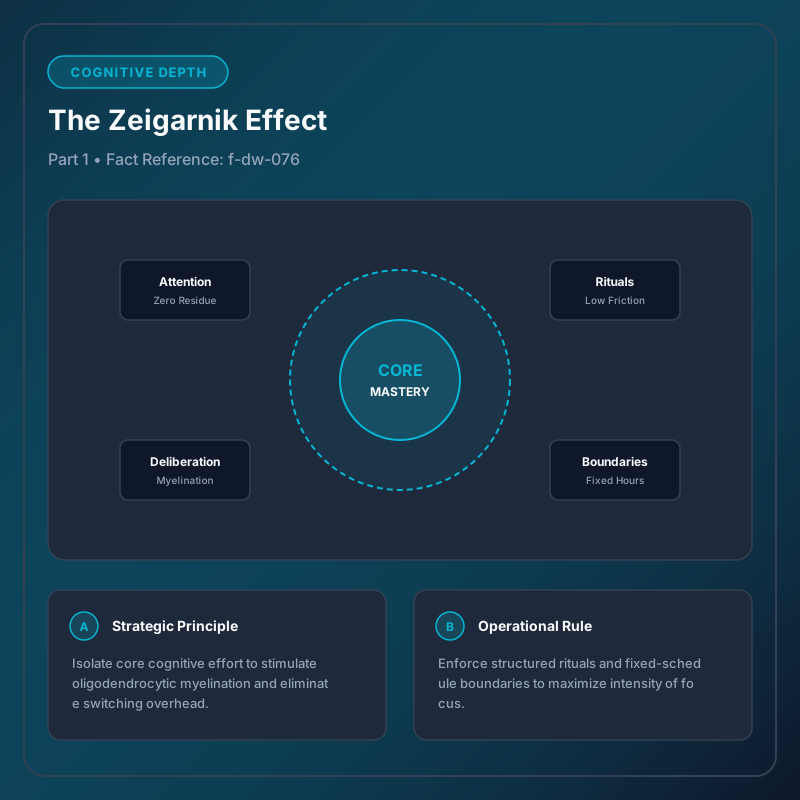
To protect the brain's restorative downtime, a practitioner must implement a strict, formal Shutdown Ritual at the end of each workday. The psychological necessity of the shutdown ritual is rooted in The Zeigarnik Effect, discovered by Soviet psychologist Bluma Zeigarnik in 1927. Zeigarnik found that people remember unfinished, interrupted tasks better than completed ones; in Newport's account, such incomplete tasks keep pulling at our attention long after we stop working on them.
However, as psychologists E.J. Masicampo and Roy Baumeister proved in 2011, the Zeigarnik Effect can be deactivated without completing the task, provided the individual creates a specific, trusted plan for when and how the task will be addressed.
The shutdown ritual involves four systematic steps:
- Reviewing the email inbox and project lists to ensure no urgent obligations are missed.
- Updating the master task list with next actions for unfinished work.
- Looking ahead at the calendar for the next two days to eliminate surprises.
- Concluding with a distinct, vocal phrase (such as "Shutdown complete"), which acts as a cognitive trigger instructing the brain to release all professional concerns until the next morning. After the ritual, the worker must strictly refrain from checking work email or contemplating professional tasks.
Cognitive downtime in the evening is not an indulgence; it is a neurological necessity for memory consolidation, replenishment of prefrontal energy reserves, and next-day creative synthesis. Attempting to squeeze out extra emails late at night only produces low-quality output while compromising the executive energy required for deep work tomorrow.
By executing a bulletproof shutdown ritual, you draw a sharp boundary between work and rest, enabling your brain to rejuvenate fully and approach each morning with peak cognitive clarity and unwavering focus. The shutdown ritual transforms rest into an active partner of high-performance deep execution. Furthermore, establishing a strict boundary between work and personal life preserves mental well-being, protects relationships, and sustains creative energy over a multi-decade career.
Key terms
- The Bimodal Philosophy
- Dividing time into clearly segregated blocks: multi-day monastic deep periods and distinct shallow periods.
- The Journalistic Philosophy
- Shifting into deep work mode spontaneously on short notice whenever an unexpected free window appears.
- The Grand Gesture
- A radical, high-cost investment of time, money, or effort that breaks mental inertia and signals importance.
- Lead Measure in Deep Work
- The controllable behavioral metric—specifically, hours of deep work logged in pursuit of a wildly important goal.
- Deep Work Scoreboard
- A prominent physical tally displaying cumulative deep hours to sustain emotional engagement and focus momentum.
Key facts
Monastic Depth Philosophy
The Monastic Philosophy completely eliminates or radically minimizes all shallow obligations, cutting off digital connectivity to dedicate 100% of working time to deep efforts.
The Bimodal Philosophy
The Bimodal Philosophy divides time into clearly segregated blocks: long, unbroken stretches of monastic-style deep work, alternating with periods reserved for shallow obligations. Psychoanalyst Carl Jung practiced this by retreating periodically to his stone tower in Bollingen, without electricity, to write his psychological treatises, while maintaining an active clinical practice in Zurich. Wharton professor Adam Grant applies the same logic per semester, batching all teaching into one term so the alternate term is reserved exclusively for research.
The Rhythmic Philosophy
The Rhythmic Philosophy turns deep work into a steady daily habit by anchoring it at the same time every day — for example, a 90-minute block from 6:00 to 7:30 AM — which removes the cognitive friction of deciding when to go deep. This is the same logic behind the 'Don't Break the Chain' method popularly attributed to comedian Jerry Seinfeld: the only daily requirement is to write jokes and mark an X on the calendar, turning the habit itself into the source of motivation.
The Journalistic Philosophy
The Journalistic Philosophy means shifting into deep work mode spontaneously, the moment a free window opens in the schedule — no ritual, no warm-up. Biographer Walter Isaacson exemplified this rare discipline, fitting substantive writing into whatever brief gaps his journalism career left open rather than waiting for a dedicated block. Newport flags this approach as highly demanding and not recommended for beginners, since it requires a level of mental discipline most people haven't built yet.
Monastic Exemplars: Knuth and Stephenson
Two figures show what full monastic commitment looks like in practice. Computer science pioneer Donald Knuth eliminated his personal email address in 1990 so he could focus entirely on writing The Art of Computer Programming. Novelist Neal Stephenson wrote the essay 'Why I Am a Bad Correspondent' to explain why he rejects email and social correspondence altogether, protecting the concentration his novel-writing demands.
The Grand Gesture
When ordinary routines fail to break through inertia, Newport recommends The Grand Gesture: a radical, high-cost investment of time, money, or effort that signals to the subconscious that a task matters enormously. J.K. Rowling checked into a suite at Edinburgh's 5-star Balmoral Hotel to finish Deathly Hallows away from home distractions. Bill Gates ran semi-annual, week-long 'Think Weeks' alone in a lakeside cottage with stacks of papers. Peter Shankman booked a round-trip business-class flight to Tokyo solely to write a manuscript in 30 hours of high-altitude focus.
Designing a Deep Work Ritual
Because willpower depletes across the day, Newport has practitioners lock in a Ritual before they ever sit down to focus: where they'll work and for how long, how they'll work once they start (banning internet access, silencing phones, setting concrete milestones), and how they'll support the work (coffee, snacks, and reference materials ready in advance). Deciding these logistics ahead of time removes the in-the-moment willpower cost of choosing whether to resist distraction.
4DX Framework
The 4 Disciplines of Execution (4DX) framework translates deep work into daily habit: 1) Focus on the Wildly Important, 2) Act on Lead Measures, 3) Keep a Scoreboard, 4) Create a Cadence of Accountability.
Focus on the Wildly Important
The first discipline of Newport's adapted 4 Disciplines of Execution (4DX) framework, drawn from Chris McChesney, Sean Covey, and Jim Huling, is to identify a small number of ambitious, high-leverage Wildly Important Goals (WIGs) rather than juggling dozens of diffuse priorities. As the original authors put it, the more you try to do, the less you actually accomplish — so execution starts by ruthlessly narrowing the target.
Lead Measures vs. Lag Measures
4DX's second discipline distinguishes two kinds of metrics. Lag Measures are the outcomes you ultimately want — papers published, revenue earned — but they arrive too late to adjust course. Lead Measures are the controllable behaviors that drive those outcomes; in deep work, the key lead measure is hours of deep work logged toward the wildly important goal. Newport recommends tracking hours rather than the eventual lag outcome precisely because hours are something you can influence directly, every single day.
Scoreboard and Cadence of Accountability
4DX's third discipline calls for a prominent, physical Scoreboard tallying cumulative deep work hours — the visual tracking provides immediate emotional feedback and gamifies the habit. The fourth discipline, a Cadence of Accountability, closes the loop with a regular weekly review to check the scoreboard, analyze what worked and what didn't, and commit to concrete actions for the coming week.
The Zeigarnik Effect
Soviet psychologist Bluma Zeigarnik reported in 1927 that people remember unfinished or interrupted tasks better than completed ones, a finding now called the Zeigarnik Effect. In Newport's account, such incomplete tasks keep pulling at our attention: it's the reason an unresolved work problem keeps resurfacing in your mind at dinner or in bed, long after you've stopped actively working on it.
The Shutdown Ritual
To protect the brain's restorative downtime, Newport prescribes a formal Shutdown Ritual: review the inbox and project lists for anything urgent, update the master task list with next actions, look ahead at the calendar for the next two days, then close with a distinct vocal phrase like 'Shutdown complete' — a cognitive trigger telling the brain to release work until morning. Checking email late at night undoes this: it reactivates attention residue and damages the restorative sleep the brain needs for next-day focus.
Planning Deactivates the Zeigarnik Effect
In 2011, psychologists E.J. Masicampo and Roy Baumeister showed that the Zeigarnik Effect can be switched off without finishing the task at all — the brain just needs a specific, trusted plan for when and how the work will get done. This finding is the psychological engine behind Newport's shutdown ritual: writing down a concrete next step lets the mind release the open loop instead of replaying it all evening.
Matched pairs
Each item on the left goes with the one on the right.
- Walter Isaacson
- Exemplar of journalistic scheduling, shifting instantly into deep writing
- Bill Gates Think Weeks
- Seven-day isolated retreats in a cabin with stacks of papers and books
- Bluma Zeigarnik
- Found that people remember unfinished tasks better than finished ones
Step by step
Author a Complete Deep Work Ritual
- Specify a dedicated, distraction-free physical location and precise session timeframe.
- Establish operational rules, including banning internet access and muting phones.
- Define concrete output milestones (e.g. proof pages, word count, or code modules).
- Prepare physical support beforehand, including coffee, hydration, and reference texts.
Addressing all four logistical dimensions removes willpower friction when initiating deep sessions.
Execute the Evening Shutdown Ritual
- Review your email inbox and task lists to ensure no urgent obligations are missed.
- Update your master task list with explicit next physical actions for unfinished work.
- Look ahead at the calendar for the next two days to eliminate unexpected surprises.
- Utter a specific vocal termination phrase (e.g. 'Shutdown complete') and close work apps.
Creating concrete plans deactivates the Zeigarnik Effect, enabling full evening cognitive detachment.
Self-test
Answer each question from memory, then check your work against the answer key.
1. Which philosophy divides time into segregated blocks of monastic deep work and shallow work?
- ABimodal Philosophy
- BMonastic Philosophy
- CRhythmic Philosophy
- DJournalistic Philosophy
2. Which of these is NOT one of Newport's four depth philosophies?
- ARhythmic Philosophy
- BJournalistic Philosophy
- CSequential Philosophy
- DMonastic Philosophy
3. The 'Don't Break the Chain' method — marking an X daily, popularly attributed to comedian Jerry Seinfeld — exemplifies which philosophy?
- AJournalistic Philosophy
- BRhythmic Philosophy
- CBimodal Philosophy
- DMonastic Philosophy
4. Which figure exemplifies the Bimodal Philosophy by retreating to a stone tower without electricity?
- ADonald Knuth
- BWalter Isaacson
- CNeal Stephenson
- DCarl Jung
5. Which computer scientist eliminated his personal email address in 1990 to protect his monastic focus on a multivolume book series?
- ANeal Stephenson
- BCarl Jung
- CWalter Isaacson
- DDonald Knuth
6. Which comedian is popularly credited with the 'Don't Break the Chain' calendar method (marking a red X after each day of writing) that exemplifies the Rhythmic philosophy?
- AJerry Seinfeld
- BEllen DeGeneres
- CSteve Martin
- DChris Rock
7. In 4DX applied to deep work, what is the key 'lead measure'?
- ARevenue earned
- BHours of deep work logged
- CNumber of meetings attended
- DPapers published
8. Which of the following is NOT one of the four disciplines of 4DX?
- AFocus on the Wildly Important
- BAct on Lead Measures
- CEliminate All Distractions
- DKeep a Compelling Scoreboard
9. In what year did Bluma Zeigarnik discover that the brain generates persistent thoughts about unfinished tasks?
- A2011
- B1954
- C1990
- D1927
10. Masicampo and Baumeister's 2011 study found the Zeigarnik Effect can be deactivated without finishing the task by:
- AMaking a specific, trusted plan
- BWorking on it for five more minutes
- CDeleting the task from the to-do list
- DAssigning the task to someone else
11. Which of these is a step in Newport's formal Shutdown Ritual?
- AChecking work email one final time after 9 PM
- BRecording total deep work hours on the visual scoreboard
- CLooking ahead at the calendar for the next two days
- DSetting a new Wildly Important Goal
Go deeper
- ReadDeep Work by Cal Newport · on Amazon ↗
- StudyDeep Work in the FlashFeed app
These are affiliate links: if you buy a book through one, FlashFeed may earn a small commission at no extra cost to you. The commission helps pay for FlashFeed's servers.
As an Amazon Associate we earn from qualifying purchases.
Answer key
- 1. A Bimodal PhilosophyThe Bimodal Philosophy alternates long monastic-style deep stretches with separate shallow periods, unlike Rhythmic's daily habit or Journalistic's spontaneous shifts.
- 2. C Sequential PhilosophyNewport's four philosophies are Monastic, Bimodal, Rhythmic, and Journalistic — 'Sequential Philosophy' is not one of them.
- 3. B Rhythmic PhilosophyThis daily-habit method anchors deep work at the same time every day, the defining trait of the Rhythmic Philosophy; the story is popularly credited to Jerry Seinfeld, though Seinfeld has said he did not originate or personally use it.
- 4. D Carl JungCarl Jung retreated to his Bollingen tower for bimodal deep stretches while still running his Zurich practice; Knuth and Stephenson are monastic, Isaacson is journalistic.
- 5. D Donald KnuthDonald Knuth dropped email in 1990 to focus on The Art of Computer Programming; Stephenson avoids correspondence differently, Isaacson is journalistic, Jung is bimodal.
- 6. A Jerry SeinfeldThis 'Don't Break the Chain' method turns deep work into a daily habit anchored to a fixed routine, the core of the Rhythmic philosophy; it is popularly attributed to Jerry Seinfeld, though he has said he did not originate or personally use it.
- 7. B Hours of deep work loggedLead measures are controllable behaviors driving results; hours of deep work logged is the lead measure, while revenue, papers published, and meeting counts are lag or shallow-work metrics.
- 8. C Eliminate All DistractionsThe four disciplines are Focus on the Wildly Important, Act on Lead Measures, Keep a Compelling Scoreboard, and Cadence of Accountability — not 'Eliminate All Distractions.'
- 9. D 1927Zeigarnik made her discovery in 1927; 1990 is when Knuth dropped email, and 2011 is when Masicampo and Baumeister showed how to deactivate the effect.
- 10. A Making a specific, trusted planTheir study showed a specific, trusted plan — not completion, delegation, or deletion — quiets intrusive thoughts about the unfinished task.
- 11. C Looking ahead at the calendar for the next two daysThe Shutdown Ritual includes reviewing the inbox, updating the task list, and looking ahead two days on the calendar — late-night email checking is what it prevents.
Sources
- Deep Work — Cal Newport
- Deep Work, Chapter 4 — calnewport.com/books/deep-work/
Image credits
- Monastic Depth Philosophy: FlashFeed · CC-BY-4.0
- 4DX Framework: FlashFeed · CC-BY-4.0