
Deep Work study guide · Lesson 4 of 6
Rule #2: Cognitive Training, Roosevelt Dashes, and Productive Meditation
Training Focus and Embracing Boredom · Productive Meditation and Structured Memory Mechanics
Unofficial study guide for Deep Work: Rules for Focused Success in a Distracted World by Cal Newport. FlashFeed is not affiliated with the author or publisher.
This is the lesson's study guide from the FlashFeed app, plus its key facts and a self-test.
What you'll be able to do
- Explain why Newport schedules breaks from focus, not distraction, how Nass's multitasker study backs it, and how a Roosevelt Dash works.
- Define Productive Meditation, practice its steps while avoiding the looping trap, and explain how Kilov's memory-palace training builds concentration.
Training Focus and Embracing Boredom
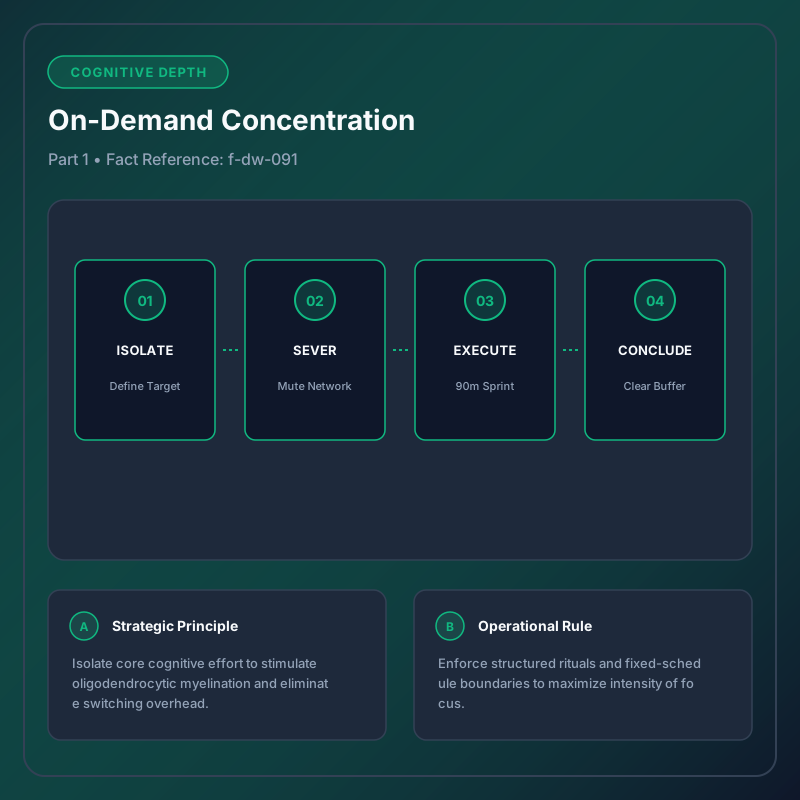
A core fallacy of modern culture is the belief that one can indulge in constant digital distraction throughout the day and then smoothly switch into a state of deep concentration when necessary. Newport argues that attentional control functions like a physical muscle: if you train your brain to seek instant novelty every time you feel a hint of boredom, you weaken your capacity for sustained concentration.
When an individual glances at their phone while waiting in a line, during commercial breaks, or while a webpage loads, they train their mind to expect constant novelty. As a result, Newport argues, when they sit down to write code, compose an essay, or analyze financial models, low-stimulus intellectual work becomes hard to tolerate, and the pull toward distraction is strong.
Rather than scheduling occasional "digital detoxes" while living in perpetual distraction, Newport proposes an inverted rule: Don't take breaks from distraction. Instead, take breaks from focus.
Practitioners must schedule their internet usage in advance using Internet Blocks:
- Determine specific, pre-allocated time windows when internet access is permitted (e.g., 10:00–10:30 AM and 3:00–3:30 PM).
- Outside of these designated blocks, internet use is strictly forbidden, even if required to look up a quick piece of information.
- If a work task stalls without internet access, the worker must switch to an offline task or wait until the next scheduled block, training the brain to tolerate cognitive friction without reaching for a quick distraction.
This training discipline is underscored by the research of Stanford communications professor Dr. Clifford Nass. In a landmark 2009 study, Nass examined heavy media multitaskers, expecting to find superior cognitive filtering or switching abilities. Instead, the data revealed the opposite: chronic multitaskers were chronically worse at filtering out irrelevant distractors, worse at managing working memory, and significantly worse at task switching. Newport takes this as a warning: once your brain grows used to on-demand distraction, it is hard to shake the habit even when you want to concentrate.
To aggressively expand cognitive intensity, Newport introduces Theodore Roosevelt Dashes. While an undergraduate at Harvard, young Theodore Roosevelt pursued a multitude of extracurricular passions (boxing, naturalism, writing) while maintaining stellar grades. He achieved this by slashing the time allocated to study sessions to a fraction of the normal expectation, forcing himself to read and write with blistering, unyielding intensity to beat the artificial deadline.
To execute a Roosevelt Dash:
- Select a high-priority cognitive task.
- Estimate the time normally required to complete it.
- Radically compress the deadline (e.g., reducing a 2-hour task to 50 minutes).
- Set a visible countdown timer and work with relentless intensity, refusing all secondary interruptions to beat the clock.
Newport presents the dash as a training exercise: a deadline that leaves no room for distraction makes you practice concentrating with real intensity.
Developing this discipline requires gradual conditioning: start with shorter isolated focus sessions and steadily build toward longer, multi-hour blocks of unbroken deep execution as your attentional stamina improves.
Productive Meditation and Structured Memory Mechanics
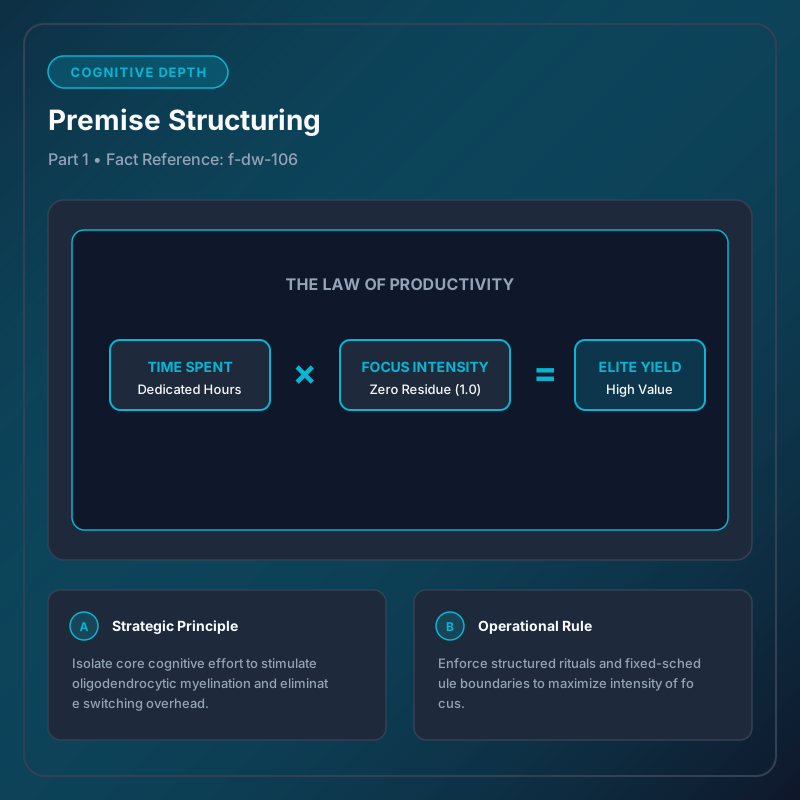
To build mental stamina during physically routine periods, Newport prescribes Productive Meditation: the practice of taking a period in which you are occupied physically (walking, jogging, biking, driving, showering) but not mentally, and focusing your attention entirely on a single, well-defined professional problem.
Newport gives this advice as two suggestions (be wary of distraction and looping; structure your deep thinking) rather than as a numbered protocol. This lesson sums it up as four steps:
- Define the Target Problem: Clearly articulate the specific intellectual question (e.g., the outline of a chapter, the architecture of a software module, or a mathematical proof).
- Hold Focus and Watch for Traps: Maintain mental focus on the problem while walking or commuting, guarding against two common cognitive pitfalls:
- Looping: Replaying the facts already known in a repetitive, unproductive loop rather than advancing the analysis. When you notice yourself looping, redirect your attention to identifying the next logical step.
- Distraction: Letting the mind wander into unrelated personal anxieties, administrative chores, or daydreaming. Acknowledge the distraction and gently return focus to the core problem.
- Structure Your Thinking: Systematically review the known premises, identify the core unknown variable, and deliberate toward a logical resolution.
- Consolidate Your Gains: Once you reach an answer, review it clearly in your mind before moving on to the next question.
To demonstrate that deep focus can be trained from scratch, Newport highlights memory athlete Daniel Kilov. Despite possessing an ordinary natural memory, Kilov trained himself to become a champion memorizer capable of memorizing multiple shuffled decks of cards in minutes.
Kilov accomplished this by constructing Memory Palaces (the ancient Greek Method of Loci), translating abstract information into vivid, bizarre visual images and mentally placing them along a familiar spatial journey. The significance of Kilov's feat is not the practical utility of memorizing cards, but the profound attentional discipline required: maintaining a memory palace demands total, unbroken mental focus. Attentional control is a malleable cognitive capability that expands through rigorous practice.
By practicing productive meditation during walks and commutes, knowledge workers turn time that would otherwise go unused into training for deep work.
Over weeks and months of sustained practice, Newport argues, productive meditation strengthens your ability to resist distraction and to concentrate deeply on a single problem.
Key terms
- Breaks from Focus Rule
- Scheduling dedicated focus blocks and confining internet access strictly to pre-allocated windows.
- Looping Trap
- The cognitive trap of repeatedly reviewing already known facts instead of advancing to the next logical step.
- Memory Palace (Method of Loci)
- An ancient mnemonic technique mapping abstract data onto vivid visual imagery placed along a spatial journey.
- Attentional Stamina
- The ability to keep your focus on one hard problem for a long stretch without losing the thread.
Key facts
Focus as a Muscle
Newport argues that attentional control works like a physical muscle: seeking novelty at every hint of boredom weakens your capacity for sustained concentration.
Take Breaks From Focus
Newport inverts the usual advice with a simple rule: don't take breaks from distraction; take breaks from focus. In practice, this means scheduling specific Internet Blocks (say, 10:00–10:30 AM and 3:00–3:30 PM) and staying strictly offline outside them, even if you just need to look something up quickly. If a task stalls without internet access, you switch to an offline task or wait for the next block, training yourself to tolerate friction instead of reaching for a quick distraction.
The Cost of Multitasking
Stanford communications professor Dr. Clifford Nass expected his landmark 2009 study of heavy media multitaskers to reveal superior cognitive filtering. Instead, he found the opposite: chronic multitaskers were worse at filtering out irrelevant distractors, worse at managing working memory, and worse at task-switching itself. Newport takes this as a warning: once your brain grows used to on-demand distraction, it is hard to shake the habit even when you want to concentrate.
The Theodore Roosevelt Dash
As a Harvard undergraduate, Theodore Roosevelt juggled boxing, naturalism, and writing alongside stellar grades by slashing his study time and forcing himself to work with blistering intensity to beat the clock. Newport turns this into a drill, the Roosevelt Dash: pick a demanding task, radically compress its deadline (say, cutting a 2-hour task to 50 minutes), set a visible countdown timer, and work with total intensity to beat it.
Productive Meditation
Productive Meditation is the practice of focusing attention entirely on a single, well-defined professional problem while occupied physically with routine transit like walking or driving.
Productive Meditation vs. Mindfulness Meditation
Productive Meditation differs sharply from traditional mindfulness practice. Where mindfulness asks you to clear the mind and observe breath and sensation, productive meditation directs intense, active conscious thought toward solving one specific professional problem — during a period when you're physically occupied (walking, driving, showering) but not mentally occupied. It borrows the setting of meditation but not its passive-observation goal.
Productive Meditation in Four Steps
Newport's advice for productive meditation, summarized here as four steps: define the target problem clearly (a chapter outline, a software module's architecture, a proof), hold focus on it while watching for the looping and distraction traps, structure the thinking by reviewing known premises toward the unknown, and consolidate your gains: once you reach an answer, review it clearly in your mind before moving on to the next question.
Looping and Distraction
Two failure modes threaten a productive meditation session. Looping is replaying facts you already know in a repetitive, unproductive circle instead of advancing the analysis — the fix is redirecting attention to the next logical step. Distraction is letting the mind wander into unrelated personal anxieties, chores, or daydreaming; the fix there is simply acknowledging it and gently returning to the problem.
Kilov's Memory Palace
Memory athlete Daniel Kilov, despite an ordinary natural memory, trained himself to memorize a shuffled deck of cards in minutes using Memory Palaces — the ancient Greek Method of Loci — translating abstract information into vivid, bizarre images and placing them along a familiar spatial journey via spatial visual encoding. The point isn't the parlor trick of memorizing cards; it's that maintaining a memory palace demands total, unbroken mental focus, proving attentional control is a trainable skill.
Structuring Your Thinking
The structuring stage of productive meditation works like solving a proof: systematically review what you already know (the premises), identify the specific unknown variable you're solving for, and deliberate toward a resolution. Breaking a complex intellectual problem into manageable sub-questions this way lets the session make verifiable progress instead of just circling the topic.
Building Attentional Stamina
Attentional Stamina is the ability to keep your focus on one hard problem for a long stretch without losing the thread. Newport presents productive meditation, done while walking, jogging or driving, as one way to build it: each session is practice in resisting distraction and steering your attention back to the problem.
Matched pairs
Each item on the left goes with the one on the right.
- Theodore Roosevelt
- Compressed study hours at Harvard to achieve high grades and diverse hobbies
- Clifford Nass Study
- Stanford experiments proving chronic multitaskers suffer severe cognitive deficits
- Premise Structuring
- Reviewing known facts and isolating the core unknown variable in productive meditation
- Spatial Visual Encoding
- Translating abstract concepts into vivid visual landmarks in memory palaces
Step by step
Execute a Theodore Roosevelt Dash
- Select a demanding cognitive task with a clear, verifiable completion milestone.
- Estimate the time normally required and radically compress the deadline (say, cutting a 2-hour task to 50 minutes).
- Set a visible countdown timer on your desk and eliminate all secondary inputs.
- Work with fierce, unyielding concentration to finish before the timer reaches zero.
Newport presents the dash as training: a deadline that leaves no room for distraction makes you practice concentrating with real intensity.
Run a productive meditation session
- Define the target professional problem and state its core question clearly.
- Hold focus during physical transit while watching for looping and distraction traps.
- Structure your thinking by reviewing premises and identifying the next step.
- Consolidate your gains: once you reach an answer, review it clearly before moving on.
Newport pairs it with time that occupies you physically but not mentally, such as walking, jogging, driving or showering.
Self-test
Answer each question from memory, then check your work against the answer key.
1. What rule does Newport propose in place of periodic digital detoxes?
- ASchedule a weekly digital detox day
- BTake breaks from focus, not distraction
- CTake breaks from distraction, not focus
- DAlternate daily between detox and immersion
2. Which researcher's 2009 study found heavy media multitaskers were worse at filtering distractions?
- AClifford Nass
- BDaniel Kilov
- CCal Newport
- DTheodore Roosevelt
3. In Newport's Roosevelt Dash example, a 2-hour task's deadline is compressed to how long?
- A120 minutes
- B90 minutes
- C50 minutes
- D30 minutes
4. Which of these was NOT something Dr. Nass's study found in heavy media multitaskers?
- AWorse task-switching ability
- BWorse working memory management
- CWorse filtering of irrelevant distractors
- DSuperior cognitive filtering ability
5. Under the Internet Blocks approach, what is internet access outside the scheduled windows?
- AStrictly forbidden
- BAllowed with supervisor approval
- CAllowed after finishing early
- DAllowed for quick lookups
6. What is Productive Meditation?
- AClearing the mind while seated in silence
- BListening to educational podcasts while walking
- CReviewing daily to-do lists during a commute
- DFocusing on one problem during physical routine tasks
7. How does Productive Meditation differ from traditional mindfulness meditation?
- AIt focuses on observing the breath
- BIt directs active thought at solving one problem
- CIt requires sitting motionless in silence
- DIt requires clearing the mind of all thought
8. Which is NOT one of the four steps this lesson uses to sum up productive meditation?
- AConsolidate your gains
- BDefine the target problem
- CReward yourself with a break
- DStructure your thinking
9. Replaying facts you already know instead of advancing your analysis describes which trap?
- AStructuring
- BDistraction
- CConsolidation
- DLooping
10. What technique did memory athlete Daniel Kilov use to memorize shuffled card decks?
- ARoosevelt Dash
- BMemory Palace (Method of Loci)
- CInternet Blocks
- DProductive Meditation
Go deeper
- ReadDeep Work by Cal Newport · on Amazon ↗
- StudyDeep Work in the FlashFeed app
These are affiliate links: if you buy a book through one, FlashFeed may earn a small commission at no extra cost to you. The commission helps pay for FlashFeed's servers.
As an Amazon Associate we earn from qualifying purchases.
Answer key
- 1. B Take breaks from focus, not distractionNewport inverts common advice: stay off distraction by default and only take scheduled breaks from focused work, rather than occasional detoxes.
- 2. A Clifford NassStanford's Dr. Clifford Nass ran the 2009 study; he expected superior filtering in multitaskers but found the opposite.
- 3. C 50 minutesNewport's example compresses a 2-hour task down to a 50-minute sprint to force intense focus.
- 4. D Superior cognitive filtering abilityNass expected superior filtering but found the opposite: multitaskers were worse at filtering, working memory, and task-switching.
- 5. A Strictly forbiddenNewport requires staying offline outside the scheduled windows, even to look up a quick piece of information.
- 6. D Focusing on one problem during physical routine tasksProductive Meditation directs focused thought at a single professional problem during physically-occupied but mentally-free time like walking or driving.
- 7. B It directs active thought at solving one problemMindfulness asks you to clear the mind and observe sensation; productive meditation instead directs intense active thought at a specific problem.
- 8. C Reward yourself with a breakThis lesson sums up Newport's advice as four steps: define the problem, hold focus while watching for looping and distraction, structure your thinking, and consolidate your gains. Rewarding yourself with a break isn't one of them.
- 9. D LoopingLooping is repetitively reviewing known facts instead of progressing; distraction is mind-wandering to unrelated concerns.
- 10. B Memory Palace (Method of Loci)Kilov used Memory Palaces — the ancient Method of Loci — placing vivid images along a familiar spatial journey to memorize cards.
Sources
- Deep Work — Cal Newport
- Deep Work, Chapter 5 — calnewport.com/books/deep-work/
Image credits
- Focus as a Muscle: FlashFeed · CC-BY-4.0
- Productive Meditation: FlashFeed · CC-BY-4.0