
Die With Zero
Bill Perkins argues for spending deliberately instead of dying with unspent savings, using the memory dividend that makes early experiences compound, time buckets matched to what the body can still do, and the net worth peak where saving turns to spending.
235 cards6 lessonsFree
Already have FlashFeed?Open this pack
Get this pack on your phone
Scan with your phone's camera.
flashfeedlearningapp.com/packs/die-with-zero
Part of the Master Your Money collection.
 Pexels · RDNE Stock project · Pexels License ↗
 Unsplash · Shutter Speed · Unsplash License ↗
 FlashFeed original diagram · CC-BY-4.0
6 lessons.
Each lesson has a study guide to read and objectives you can test yourself on. Its cards and games show up in your feed. Try one of its cards right here. Play a few of its games here too.
-
Unsplash · Shutter Speed · Unsplash License ↗01
Net Fulfillment & Life Energy Foundations
Maximizing Life Fulfillment & Life Energy · The Memory Dividend & Compounding ROI
Lesson 1 · 7 cardsUnsplash · Shutter Speed · Unsplash License ↗Experiences as True Currency
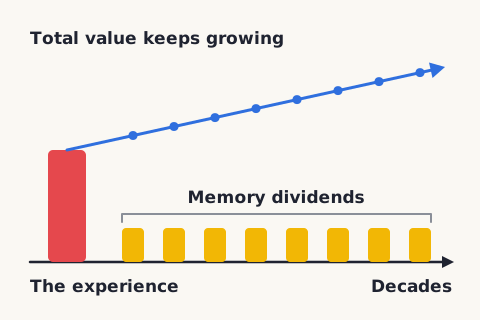
Experiences are the ultimate currency of human life, defining personal identity and shaping retrospective life satisfaction.
 FlashFeed original diagram · CC-BY-4.0
Experiential Compounding
Like financial capital invested in compound assets, experiential investments compound through decades of recurring memory dividends.
 Pexels · A man in traditional attire enjoys a meal outdoors with family, emphasizing cultural lifestyle. ↗
Multi-Party Memory Dividends
Shared experiences with close friends and family pay compounding memory dividends to all participants across multiple generations.
 Pexels · Side view of young cheerful diverse couple of tourists in casual clothes and with rucksacks standing near wooden wall in light room and looking away ↗
Capital Allocation in Youth
Investing in travel, skill acquisition, and relationships in young adulthood is a high-return capital allocation strategy.
 Pexels · Kampus Production · Pexels License ↗
The True Measure of Wealth
The ultimate measure of a rich life is the density and quality of compounded memory dividends at life's conclusion.
1 / 7What does Bill Perkins identify as the true objective of a well-lived life?
Perkins argues life's true objective function is maximizing Net Fulfillment across one's lifespan, not net worth, balance sheets, or asset piles left behind at death.
Lesson 1 has 38 cards. Keep going in the free app.
Question -
 Pexels · Kampus Production · Pexels License ↗02
The True Cost of Over-Saving and Longevity Risk
Working for Free & Wasted Life Energy · Longevity Risk, Actuarial Reality & Annuities
Lesson 2 · 8 cardsPexels · Kampus Production · Pexels License ↗EBRI Decumulation Findings
Studies by the Employee Benefit Research Institute (EBRI) show most retirees spend only a small fraction of their nest egg.
 Pexels · From below of Federal Reserve building exterior against USA flags and staircase under cloudy sky in town ↗
Federal Reserve SCF Data
Data from the Federal Reserve Survey of Consumer Finances shows household net worth remains elevated into late old age.
 Unsplash · Spencer Liao · Unsplash License ↗
The Irretrievable Cost of Hoarding
Unspent wealth at death represents sacrificed vacations, foregone family time, and deferred passions that can never be recovered.
 Pexels · RUN 4 FFWPU · Pexels License ↗
True Financial Success
True financial success is optimizing total lifetime utility, reaching the finish line having spent every dollar on purpose.
 Pexels · Kampus Production · Pexels License ↗
Actuarial Longevity Mapping
Actuarial life expectancy calculators convert unknown mortality into concrete probabilistic distributions.
 Pexels · Close-up image of two people signing an insurance policy document on a wooden desk. ↗
Guilt-Free Spending Liberation
Securing a guaranteed income floor via annuities frees remaining portfolio assets for guilt-free experiential spending.
 Pexels · A nurse helps a patient in a wheelchair down a hospital corridor, reflecting care and medical professionalism. ↗
Ring-Fenced Healthcare Reserves
Ring-fencing a dedicated healthcare reserve eliminates the need to hoard millions in unallocated general savings.
 Pexels · RDNE Stock project · Pexels License ↗
Actuarial Certainty
Actuarial science solves the uncertainty problem of Die With Zero by converting individual mortality uncertainty into a priced, poolable probability distribution.
1 / 8Earning $100/hr, dying with $1,000,000 unspent equals working how many hours for free?
$1,000,000 divided by $100/hr equals 10,000 hours, roughly 5 years of 40-hour workweeks given away for free.
Lesson 2 has 40 cards. Keep going in the free app.
Question -
Pexels · RDNE Stock project · Pexels License ↗03
Strategic Giving and Peak Inheritance
Peak Utility of Inheritance (Ages 26-35) · Three-Bucket Wealth Allocation
Lesson 3 · 10 cardsPexels · RDNE Stock project · Pexels License ↗The Age 60 Diminished Utility Problem
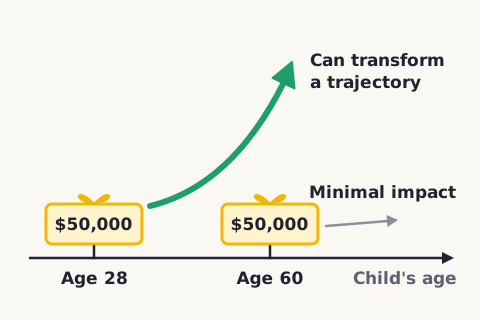
By age 60, adult children are established in their careers, have paid off mortgages, and experience lower marginal utility from money.
 FlashFeed original diagram · CC-BY-4.0
Catalytic Financial Impact
A $50,000 gift at age 28 can transform a child's financial trajectory, whereas $50,000 at age 60 produces minimal impact.
 Pexels · Ron Lach · Pexels License ↗
Generational Memory Dividends
Transferring wealth early allows children to build their own memory dividends with their young children.
 Unsplash · Melinda Gimpel · Unsplash License ↗
Probate and Tax Inefficiencies
Post-mortem bequests are often subjected to substantial estate taxation, probate delays, and family disputes.
 Unsplash · Hand holding door keys new house real estate stairs ↗
Shared Milestone Celebrations
Witnessing your children buy their first home or start a business generates powerful shared memory dividends for parents.
 Pexels · Kindel Media · Pexels License ↗
Estate Utility Maximization
The goal of estate planning should be maximizing the utility of transferred capital, not maximizing post-mortem estate size.
 Unsplash · Sasun Bughdaryan · Unsplash License ↗
Eliminating Vague Rationalizations
Separating wealth into distinct goals for yourself, your kids, and charity prevents using any of them as a vague rationalization for endless accumulation.
 Pexels · Rustic hand water pump surrounded by lush green field, representing traditional irrigation. ↗
The Compounding ROI of Curing Suffering
A dollar spent curing disease or building infrastructure today prevents compounding suffering in future decades.
 Pexels · wutthichai charoenburi · Pexels License ↗
Critique of Foundation Hoarding
Many private foundations hoard endowment assets rather than actively disbursing grants to solve immediate crises.
 Pexels · Pavel Danilyuk · Pexels License ↗
Active Philanthropic Mentorship
Active philanthropic participation during life allows donors to evaluate outcomes, iterate grants, and mentor leaders.
1 / 10Which of these is NOT one of the life transitions Perkins links to the ages 26-35 window?
Perkins ties 26-35 to homeownership, career leaps, and family support, not to consolidating an already-mature retirement account.
Lesson 3 has 40 cards. Keep going in the free app.
Question -
 Pexels · Close-up of a to-do list notepad with 'So Many Things' written, providing copyspace for text. ↗04
Time Buckets and Health Span Realities
Time-Bucketing & Age-Dependent Activities · Health Span, Mobility Decay & FUs
Lesson 4 · 10 cardsPexels · Close-up of a to-do list notepad with 'So Many Things' written, providing copyspace for text. ↗The Flaw of Traditional Bucket Lists
Traditional bucket lists are flawed because they treat an 80-year-old human as biologically identical to a 25-year-old.
 Pexels · Detailed image of a physiotherapy session focusing on knee massage treatment. ↗
Physical Expiration Dates
Activities have physical expiration dates based on joint health, cardiovascular endurance, and balance.
 Pexels · Heartwarming portrait of a cute toddler girl holding an adult's hand outside. ↗
The Impermanence of Childhood Stages
Relational windows with young children are strictly time-bound: you only have a toddler or elementary child for a few years.
 Pexels · Comfortable hostel dorm room with clean bunk beds and a cozy ambiance. ↗
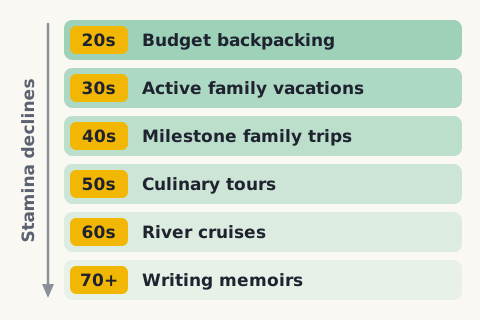
The Evolution of Travel Character
Travel experiences change in character across decades: budget hosteling in 20s vs cultural luxury tours in 50s.
 Unsplash · Mark Timberlake · Unsplash License ↗
The Irrevocable Nature of Closed Windows
Activities postponed past their biological window cannot be repurchased at any financial price later in life.
 Pexels · A weary office worker leans over a desk in a modern indoor setting, reflecting fatigue. ↗
Preventing Mid-Life Burnout
Balancing career milestones with time-bucketed personal experiences prevents mid-life burnout and regret.
 FlashFeed original diagram · CC-BY-4.0
Biological Window Alignment
Time-bucketing aligns financial expenditures with biological windows to maximize lifetime Fulfillment Units.
 Pexels · Strong senior man focusing on strength training with dumbbells in a vibrant gym. ↗
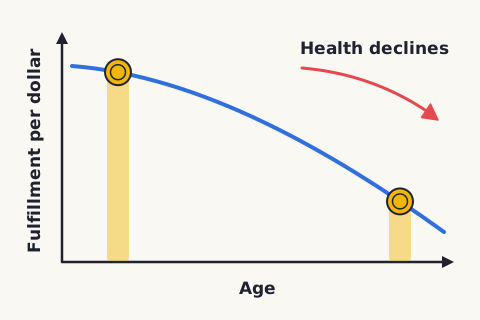
Health as the Ultimate Multiplier
Physical health serves as an indispensable multiplier on the conversion of wealth into Fulfillment Units (FUs).
 FlashFeed original diagram · CC-BY-4.0
Experiential Purchasing Power Depreciation
The fulfillment-purchasing power of a dollar steadily depreciates over time as physical health declines.
 Pexels · Mehmet Turgut Kirkgoz · Pexels License ↗
Expanding the Fulfillment Integral
Extending health span by even three to five years significantly expands the total lifetime area under the fulfillment curve.
1 / 10What does the Time-Bucketing framework ask individuals to do?
Time-Bucketing sequences experiences into 5-to-10-year windows matched to biological feasibility, not a financial or scheduling split.
Lesson 4 has 40 cards. Keep going in the free app.
Question -
 FlashFeed original diagram · CC-BY-4.005
Net Worth Peak and Intentional Decumulation
Finding the Net Worth Peak & Decumulation · Retiring Autopilot & Intentional Living
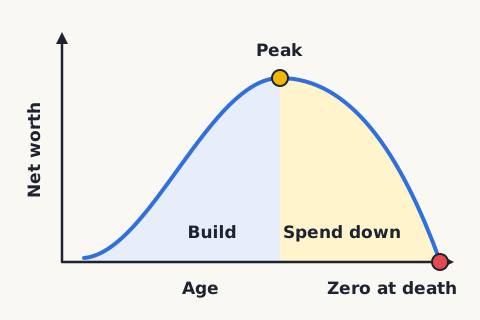
Lesson 5 · 10 cardsFlashFeed original diagram · CC-BY-4.0The Inverted Parabolic Wealth Arc
Net worth should follow an inverted parabolic arc that peaks and intentionally decumulates toward zero at death.
 Pexels · Kampus Production · Pexels License ↗
Overcoming Decumulation Anxiety
Drawing down principal causes intense psychological anxiety for lifelong savers accustomed to balance growth.
 Unsplash · JUNHØ · Unsplash License ↗
The Cost of Delayed Decumulation
Delayed decumulation forces individuals to spend money when their physical capacity to enjoy it is lowest.
 Pexels · cottonbro studio · Pexels License ↗
Tracking Net Fulfillment
Tracking net fulfillment points alongside net worth ensures spending decisions align with experiential goals.
 Pexels · David Iglesias · Pexels License ↗
Societal Conditioning of Accumulation
Societal conditioning promotes endless wealth accumulation as a proxy for personal worth and moral virtue.
 Pexels · Close-up of a person mowing a sunlit lawn with a push mower, showcasing summertime yard care. ↗
The False Economy of Menial Chores
High earners often spend hours performing menial chores to 'save money,' destroying high-value personal time.
 Pexels · A line of identical suburban houses with red roofs and beige exteriors, perfectly aligned under a clear blue sky. ↗
Rejecting Social Comparison
Breaking free from social comparison and lifestyle competition is essential to halting unnecessary accumulation.
 Pexels · Ketut Subiyanto · Pexels License ↗
Declining Overtime to Protect Family Windows
Deliberately turning down promotions or overtime work can protect precious irreplaceable family windows.
1 / 10What age range does Perkins identify as the optimal window for the Net Worth Peak?
Perkins calculates the optimal Net Worth Peak falls between ages 45 and 60, before health and remaining years decline sharply.
Lesson 5 has 38 cards. Keep going in the free app.
Question -
FlashFeed original diagram · CC-BY-4.006
Asymmetric Risk and Life Optimization
Asymmetric Risk & Early Boldness · The Tri-Curve Harmony & Deathbed Regrets
Lesson 6 · 10 cardsFlashFeed original diagram · CC-BY-4.0Peak Asymmetry of Youth
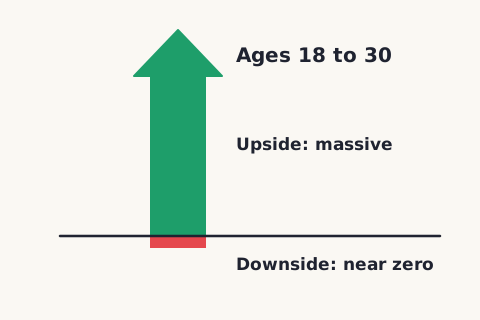
Young adulthood (ages 18-30) is the most asymmetric period of life: downside is near zero and upside is massive.
 Pexels · Spacious office floor with rows of empty cubicles and computer monitors. ↗
The Trap of Premature Risk Aversion
Premature risk aversion causes young people to choose stagnant corporate jobs out of exaggerated fears of failure.
 Wikimedia Commons · Noah Willman · CC BY-SA 4.0 ↗
Mentorship Under John Arnold
Learning under legendary trader John Arnold taught Perkins the mathematical value of taking calculated asymmetric bets.
 Pexels · Karolina · Pexels License ↗
The Optimal Lifecycle Risk Strategy
Being bold when you have little to lose and conservative when you have everything to lose is the optimal strategy.
 Unsplash · a man working on a machine in a garage ↗
Foundational Leaps and Grit
Pursuing creative, entrepreneurial, or travel leaps in one's twenties creates foundational lifetime memories and grit.
 Unsplash · Vitaly Gariev · Unsplash License ↗
Compounding Career Momentum
Early boldness generates compound career momentum that pays personal and financial dividends for decades.
 FlashFeed original diagram · CC-BY-4.0
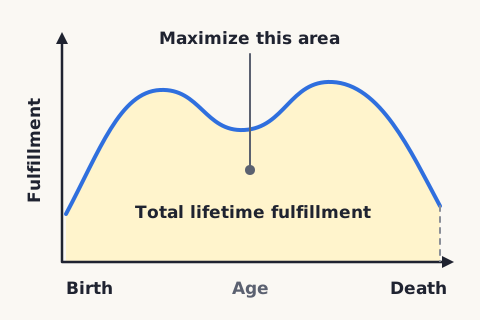
The Fulfillment Integral
The central goal of life optimization is maximizing the total integrated area under the fulfillment curve.
1 / 10Which term names an opportunity with capped downside and virtually limitless upside?
Asymmetric Risk is defined as capped, minimal downside paired with limitless upside, unlike symmetric or market-wide risk types.
Lesson 6 has 39 cards. Keep going in the free app.
Question

What you'll be able to do 12 objectives, from the pack's lessons
- Define life energy as converted time and explain how maximizing lifetime fulfillment units takes precedence over hoarding net worth.
- Explain the Memory Dividend and calculate how early experiential investments yield compounding fulfillment dividends over decades.
- Analyze why dying with unspent surplus equates to working for free without receiving compensation or experiential utility.
- Evaluate longevity risk and explain how actuarial longevity annuities eliminate excessive self-insurance and wasteful hoarding.
- Identify the peak financial utility window for child inheritances (ages 26 to 35) versus receiving wealth upon parental death.
- Identify Perkins's Three-Bucket wealth split — Your Money (self), Kids' Money, and Charity's Money — and how each is deployed.
- Construct 5-to-10-year Time Buckets to align desired life experiences with age-dependent physical capabilities and relational windows.
- Explain how biological health span and mobility decay constrain the ability to convert financial capital into fulfillment units.
- Calculate the optimal Net Worth Peak window (typically ages 45 to 60) where savings must pivot to net decumulation.
- Identify frugality inertia and conduct annual resource audits to deliberately buy back time and retire financial autopilot.
- Explain asymmetric risk in youth (ages 18 to 30) where high upside and negligible downside make bold career bets optimal.
- Harmonize the Health, Wealth, and Time curves to prevent Bronnie Ware's top palliative deathbed regrets.
Study guide.
The same study guide as in the app, one page for each lesson, with its key facts and a self-test.
Built from 3 sources.
168 of its 235 cards cite a source. These are the sources it cites.
Hover over a photo, or tap its i, to see where it came from. All 6:
- Lesson 1: Unsplash · Shutter Speed · Unsplash License ↗
- Lesson 2: Pexels · Kampus Production · Pexels License ↗
- Lesson 3: Pexels · RDNE Stock project · Pexels License ↗
- Lesson 4: Pexels · Close-up of a to-do list notepad with 'So Many Things' written, providing copyspace for text. ↗
- Lesson 5: FlashFeed original diagram · CC-BY-4.0
- Lesson 6: FlashFeed original diagram · CC-BY-4.0
- Die With Zero by Bill Perkins · on Amazon ↗
These are affiliate links: if you buy a book through one, FlashFeed may earn a small commission at no extra cost to you. The commission helps pay for FlashFeed's servers.
As an Amazon Associate we earn from qualifying purchases.
Independent study notes, not affiliated with the author or publisher.
- Cards
- 235
- Lessons
- 6
- Version
- 1.0.20
- Language
- English
The whole pack is one file. Read the pack file ↗
FlashFeed is on the App Store and Google Play.
FlashFeed is free on iPhone and Android, and needs no account.