
Die With Zero study guide · Lesson 6 of 6
Asymmetric Risk and Life Optimization
Asymmetric Risk & Early Boldness · The Tri-Curve Harmony & Deathbed Regrets
Unofficial study guide for Die With Zero: Getting All You Can from Your Money and Your Life by Bill Perkins. FlashFeed is not affiliated with the author or publisher.
This is the lesson's study guide from the FlashFeed app, plus its key facts and a self-test.
What you'll be able to do
- Explain asymmetric risk in youth (ages 18 to 30) where high upside and negligible downside make bold career bets optimal.
- Harmonize the Health, Wealth, and Time curves to prevent Bronnie Ware's top palliative deathbed regrets.
Lesson 6: Asymmetric Risk and Life Optimization
Welcome to the final lesson of Die With Zero by Bill Perkins. This lesson explores asymmetric risk-taking in young adulthood, synthesizes the Health-Money-Time triad, and examines how to eliminate universal deathbed regrets.
Asymmetric Risk & Early Boldness
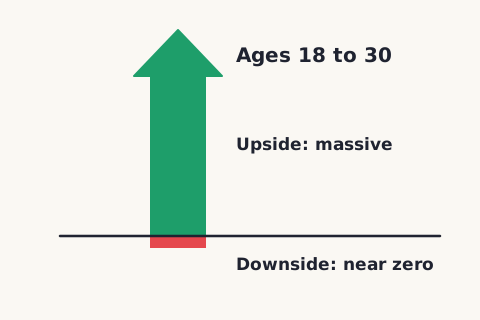
In financial trading and professional poker, an Asymmetric Risk is an opportunity where the potential downside is strictly capped and minimal, while the potential upside is virtually limitless.
The Peak Asymmetry of Youth (Ages 18–30)
Bill Perkins demonstrates that young adulthood is the most economically asymmetric period of human existence. When a 22-year-old takes a bold risk—such as moving to a new city, founding a startup, taking an entry-level position in a high-growth sector, or pursuing creative passions:
- Downside is Near Zero: A 22-year-old typically has no dependents, no mortgage, and low living expenses. If the venture fails completely, they can live with roommates, eat simple food, and rebound financially within twelve to twenty-four months.
- Upside is Transformative: If the venture succeeds, it can fundamentally alter their entire career trajectory, build elite networks, and generate lifelong optionality.
- Multi-Decade Recovery Runway: A young person has forty or fifty years of working life to recover from any temporary financial setback.
       UPSIDE (Unlimited Career Growth, Equity, Lifelong Network, Mastery)
          ▲
          │      * (High-Upside Creative/Entrepreneurial Risk)
          │     /
          │    /
──────────┼───/──────────────────────────────────────────► Time / Age
          │  /
          ▼ /
       DOWNSIDE (Capped: Sleep on Couch, Eat Cheap, Fast Rebound in 1 Year)
The Tragedy of Premature Risk Aversion
Despite the extreme mathematical asymmetry favoring boldness in youth, most young people suffer from Premature Risk Aversion. Paralyzed by societal expectations and exaggerated fears of failure, they choose stagnant corporate paths that offer low downside but strictly capped upside.
Perkins shares his own experience leaving conventional paths to work on the volatile trading floor of the New York Mercantile Exchange (NYMEX). Under the mentorship of legendary trader John Arnold, Perkins took calculated risks that built his career managing multi-billion-dollar energy portfolios at Centaurus Advisors. Had he succumbed to premature risk aversion, his extraordinary career would never have materialized.
The Risk Inversion of Old Age
Crucially, Perkins points out that the risk equation completely inverts in old age:
- At age 75, an individual has a short recovery runway and fixed medical requirements. Taking speculative financial gambles that could wipe out 80% of their savings is reckless.
- The optimal life strategy is boldness when you have little to lose and decades to recover, transitioning to calculated preservation and decumulation as you age.
The Tri-Curve Harmony & Deathbed Regrets
A well-lived life requires the dynamic, conscious harmonization of three core life variables: Health, Money, and Time.
The Tri-Variable Life Optimization Model
The tragedy of human existence is that throughout the standard lifecycle, these three variables are rarely abundant simultaneously:
- Youth (Ages 18–30): Abundant Health, Abundant Time, but Low Money.
- Middle Age (Ages 30–60): Abundant Health (declining gradually), Abundant Money, but Extremely Low Time.
- Old Age (Ages 75+): Abundant Money, Abundant Time, but Severely Diminished Health.
Variable    Youth (20s)       Middle Age (40s)    Old Age (75+)
───────────────────────────────────────────────────────────────
Health      ██████████ (High)  ████████░░ (Med)    ██░░░░░░░░ (Low)
Time        ██████████ (High)  ██░░░░░░░░ (Low)    ██████████ (High)
Money       ██░░░░░░░░ (Low)   ██████████ (High)   ██████████ (High)
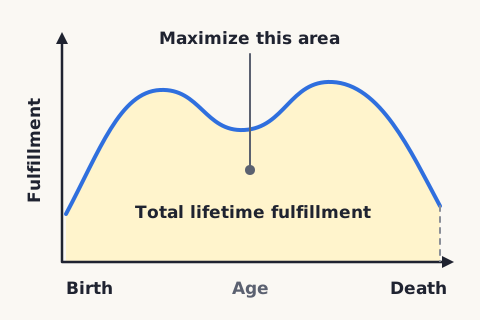
The objective of Die With Zero is to actively break this historical curse: using money to buy back time during middle age, and spending money boldly to enjoy experiences before health deteriorates in old age. The ultimate mathematical goal is maximizing the total integrated area under your life fulfillment curve:
$\text{Maximize Total Fulfillment} = \int_{0}\text{Death} \text{Fulfillment}(t) , dt$
Bronnie Ware's Palliative Care Research and Deathbed Regrets
To underscore the existential urgency of his message, Perkins cites the palliative care research of Australian palliative carer Bronnie Ware, author of The Top Five Regrets of the Dying.
Ware cared for hundreds of patients during the final twelve weeks of their lives, recording their deepest reflections. Notably, not a single dying patient ever wished they had worked more hours, attended more meetings, or died with a larger bank account.
The top two regrets expressed by the dying were:
- "I wish I'd had the courage to live a life true to myself, not the life others expected of me." (Surrendering one's personal dreams to societal autopilot and external expectations).
- "I wish I hadn't worked so hard." (Sacrificing youth, family milestones, and personal passions on the treadmill of unneeded corporate labor).
Die With Zero provides the concrete operating system to systematically eliminate these regrets. By aligning your health, money, and time, refusing to work for free, and intentionally converting your life energy into enduring memory dividends, you ensure that when you reach the finish line of life, you die with zero regrets, zero wasted labor, and a rich legacy of lived human experiences.
The Mathematics of Expected Value in Youth Risk-Taking
In probability theory and decision science, the Expected Value (EV) of an opportunity is calculated as: $\text{Expected Value} = (P_{\text{success}} \times \text{Gain}{\text{success}}) - (P{\text{failure}} \times \text{Loss}_{\text{failure}})$
In young adulthood, the loss component (\text{Loss}{\text{failure}}) is mathematically bounded near zero. If a 23-year-old takes an aggressive entrepreneurial gamble and the venture goes bankrupt, the tangible loss is minimal: a modest amount of savings and a period of simple living. However, the gain component (\text{Gain}{\text{success}}) is virtually infinite: founding a transformative enterprise, acquiring elite industry skills, building a high-value network, and achieving financial independence decades ahead of schedule.
Because the loss is capped and the gain is boundless, the expected value of bold risk-taking in young adulthood is overwhelmingly positive. Failing to take risks when young is not safe; it is an irrational miscalculation of expected value.
Youth Risk (Age 22):  [ Min Loss (Capped) ] ◄──────────► [ Unlimited Upside Potential ] ──► Massively Positive EV
Old Age Risk (Age 75): [ Catastrophic Loss ] ◄──────────► [ Capped Upside Potential ] ──► Strongly Negative EV
The Inversion of the Risk Curve in Maturity
As an individual progresses through middle age into retirement, the variables in the expected value equation undergo a complete inversion:
- At age 75, an individual has no labor market runway to earn back lost capital. A 50% drawdown in a speculative venture permanently destroys their standard of living.
- Therefore, life optimization mandates a clean, rational pivot: embrace maximum asymmetric upside in youth, transition to balanced wealth generation in middle age, and enforce strict capital preservation and decumulation in retirement.
Eliminating the Shadow of Deathbed Regrets
The ultimate triumph of the Die With Zero operating framework is arriving at the final chapter of human existence with absolute peace of mind. By systematically dismantling the cultural scripts of endless accumulation, overcoming longevity fears through actuarial risk transfers, giving generously to children and charities with a warm hand, and intentionally filling each time bucket with rich memories, an individual eliminates the universal deathbed regrets identified by palliative care researchers.
When you die with zero, you leave no unlived dreams, no unspent life energy, and no regrets. You cross the finish line having fully lived, fully loved, and fully experienced the miraculous gift of human existence.
The Tri-Curve Life Diagnostic Worksheet
To maintain continuous alignment across the lifespan, Perkins encourages individuals to regularly plot their personal curves on a normalized 0-to-10 scale:
- Health Index: Aerobic fitness, mobility, freedom from chronic pain, sleep quality, and daily vitality.
- Wealth Index: Liquid capital, passive income, and coverage of baseline survival needs.
- Time Index: Unencumbered weekly hours available for creative, relational, and leisure pursuits.
Whenever one index drops into an extreme deficit (such as Time dropping to 1 in a grueling corporate job despite Wealth rising to 9), life design mandates immediate corrective action to rebalance the triad before health or relationships suffer permanent degradation.
Key terms
- Asymmetric Risk
- An opportunity where the potential downside is strictly capped and minimal, while the potential upside is limitless.
- The Tri-Curve Harmony
- The active synchronization of Health, Money, and Free Time across life to maximize cumulative fulfillment.
Key facts
Peak Asymmetry of Youth
Young adulthood (ages 18-30) is the most asymmetric period of life: downside is near zero and upside is massive.
The Trap of Premature Risk Aversion
Premature risk aversion causes young people to choose stagnant corporate jobs out of exaggerated fears of failure.
Bill Perkins' NYMEX Risk Leap
Bill Perkins took massive career risks leaving conventional paths to trade energy on the NYMEX trading floor.

Mentorship Under John Arnold
Learning under legendary trader John Arnold taught Perkins the mathematical value of taking calculated asymmetric bets.
The Optimal Lifecycle Risk Strategy
Being bold when you have little to lose and conservative when you have everything to lose is the optimal strategy.
Foundational Leaps and Grit
Pursuing creative, entrepreneurial, or travel leaps in one's twenties creates foundational lifetime memories and grit.
The Mediocrity Trap
A life without bold calculated risks results in a narrow, regret-filled existence constrained by mediocrity.
Compounding Career Momentum
Early boldness generates compound career momentum that pays personal and financial dividends for decades.
The Fulfillment Integral
The central goal of life optimization is maximizing the total integrated area under the fulfillment curve.
Bronnie Ware's #1 Deathbed Regret
Palliative carer Bronnie Ware documented that the #1 deathbed regret is not having the courage to live a life true to oneself.
Bronnie Ware's #2 Deathbed Regret
The #2 deathbed regret documented by Bronnie Ware is 'I wish I hadn't worked so hard,' sacrificing youth and relationships.
The Antidote to Regrets
Die With Zero provides the practical operating system to systematically eliminate the top deathbed regrets.
Healthy Urgency of Mortality
Recognizing mortality creates healthy urgency to experience life fully rather than deferring joy indefinitely.
The True Measure of Legacy
True wealth is measured at the end of life by the richness of memories created with people you love.
The Courage to Reject Scripts
Living deliberately requires ongoing courage to reject conventional societal scripts in favor of personal fulfillment.
Die With Zero Mastery
Dying With Zero is the ultimate expression of living fully, leaving nothing on the table of human existence.
By the numbers
- Within how many months can a 22-year-old typically rebound from a failed entrepreneurial venture?
- 24
Matched pairs
Each item on the left goes with the one on the right.
- Early Career Boldness
- Builds elite technical skills, expansive networks, and lifelong career optionality
- Youth Resource Profile (20s)
- Abundant Health and Free Time paired with Low Financial Capital
- Old Age Resource Profile (75+)
- Abundant Money and Free Time paired with Severely Diminished Health
Step by step
Evaluate bold life opportunities via expected value
- Quantify the worst-case downside scenario and assess your recovery runway
- Model the realistic upside potential in equity, skills, networks, and memories
- Execute aggressively if expected value is overwhelmingly positive
Align daily resource spending with authentic core values
- Define your top personal life values and core relationship priorities
- Audit calendar and financial statements to eliminate expenditures that contradict values
- Direct capital aggressively toward activities that create enduring shared memories
Self-test
Answer each question from memory, then check your work against the answer key.
1. Which term names an opportunity with capped downside and virtually limitless upside?
- AAsymmetric Risk
- BDiversifiable Risk
- CSymmetric Risk
- DSystematic Risk
2. Fill in: fear of embarrassment or modest debt is often vastly ___ to the real downside of youthful risk-taking.
- Aproportional
- Binconsequential
- Cdisproportionate
- Dirrelevant
3. Within about how long can a 22-year-old typically rebound from a failed venture, per Perkins?
- A36 to 48 months
- B3 to 6 months
- C5 to 10 years
- D12 to 24 months
4. How does the optimal risk strategy change between a 22-year-old and a 75-year-old, per Die With Zero?
- ACapital preservation at 22; bold risk at 75
- BBold risk at 22; capital preservation at 75
- CCapital preservation is optimal at both ages
- DBold risk is optimal at both ages
5. What does early career boldness build, according to Die With Zero?
- AGuaranteed pension benefits
- BImmediate salary stability
- CElite skills, networks, and optionality
- DReduced need for future learning
6. What is the 'Tri-Curve Harmony' in Die With Zero?
- ASynchronizing Health, Money, and Time for fulfillment
- BAligning sleep, diet, and exercise schedules
- CBalancing stocks, bonds, and cash allocations
- DCoordinating income, taxes, and insurance
7. Fill in: the tragedy is not dying with zero dollars, but with unlived dreams and unspent ___ energy.
- Afinancial
- Blife
- Ccreative
- Dphysical
8. Which resource profile matches a person in their 20s, per the Tri-Curve model?
- AAbundant Health and Money, Low Time
- BAbundant Money and Time, Low Health
- CLow Health, Money, and Time
- DAbundant Health and Time, Low Money
9. Which age group has abundant Money and Time but severely diminished Health, per Perkins?
- AMiddle age (40s)
- BYouth (20s)
- CAdolescence (teens)
- DOld age (75+)
10. Which deathbed regret did Bronnie Ware document as most common among dying patients?
- AWishing to have earned more money
- BWishing to have stayed closer to friends
- CWishing to have lived true to oneself
- DWishing to have worked more hours
Go deeper
- ReadDie With Zero by Bill Perkins · on Amazon ↗
- StudyDie With Zero in the FlashFeed app
These are affiliate links: if you buy a book through one, FlashFeed may earn a small commission at no extra cost to you. The commission helps pay for FlashFeed's servers.
As an Amazon Associate we earn from qualifying purchases.
Answer key
- 1. A Asymmetric RiskAsymmetric Risk is defined as capped, minimal downside paired with limitless upside, unlike symmetric or market-wide risk types.
- 2. C disproportionatePerkins argues the perceived fear is disproportionate to the actual, minimal downside young risk-takers actually face.
- 3. D 12 to 24 monthsA young person can rebound financially within twelve to twenty-four months of a failed venture.
- 4. B Bold risk at 22; capital preservation at 75Perkins argues the risk equation inverts with age: boldness pays off when young with decades to recover, while old age demands preservation and decumulation.
- 5. C Elite skills, networks, and optionalityEarly boldness builds elite technical skills, expansive networks, and lifelong career optionality.
- 6. A Synchronizing Health, Money, and Time for fulfillmentTri-Curve Harmony is the active synchronization of Health, Money, and Time to maximize cumulative fulfillment.
- 7. B lifeThe true tragedy is specifically unspent 'life' energy, not financial, creative, or physical energy.
- 8. D Abundant Health and Time, Low MoneyYouth (20s) has abundant health and free time but low financial capital, per the Tri-Curve resource profile.
- 9. D Old age (75+)Old age (75+) has abundant money and time but severely diminished health, completing the Tri-Curve's tragic pattern.
- 10. C Wishing to have lived true to oneselfWare's top regret was not living authentically; no patient ever wished for more money, work hours, or meetings.
Sources
- Die With Zero — Bill Perkins
- Bill Perkins, Die With Zero, Chapter 8; Bill Perkins, Die With Zero, Chapter 9; Bronnie Ware, The Top Five Regrets of the Dying (2012) — www.diewithzerobook.com
- Bronnie Ware, The Top Five Regrets of the Dying (2012)
Image credits
- Peak Asymmetry of Youth: FlashFeed original diagram · CC-BY-4.0
- Mentorship Under John Arnold: Wikimedia Commons · Noah Willman · CC BY-SA 4.0 — commons.wikimedia.org/wiki/File:John_Arnold,_Arnold_Ventures.jpg
- The Fulfillment Integral: FlashFeed original diagram · CC-BY-4.0
- Healthy Urgency of Mortality: Wikimedia Commons · Wellcome Collection · CC BY 4.0 — commons.wikimedia.org/wiki/File:A_gold_memento_mori_pendant_Wellcome_L0035563.jpg

