
Die With Zero study guide · Lesson 5 of 6
Net Worth Peak and Intentional Decumulation
Finding the Net Worth Peak & Decumulation · Retiring Autopilot & Intentional Living
Unofficial study guide for Die With Zero: Getting All You Can from Your Money and Your Life by Bill Perkins. FlashFeed is not affiliated with the author or publisher.
This is the lesson's study guide from the FlashFeed app, plus its key facts and a self-test.
What you'll be able to do
- Calculate the optimal Net Worth Peak window (typically ages 45 to 60) where savings must pivot to net decumulation.
- Identify frugality inertia and conduct annual resource audits to deliberately buy back time and retire financial autopilot.
Lesson 5: Net Worth Peak and Intentional Decumulation
Welcome to Lesson 5 of Die With Zero by Bill Perkins. This lesson examines the determination of the Net Worth Peak, the mechanics of intentional wealth decumulation, and the psychological discipline required to retire financial autopilot.
Finding the Net Worth Peak & Decumulation
In conventional wealth management, net worth is modeled as an ever-increasing exponential curve that peaks on the day of death. Bill Perkins proves that for any rational optimizer seeking to maximize lifetime fulfillment, net worth must follow an inverted parabolic arc that reaches a distinct peak and intentionally declines toward zero.
Defining the Net Worth Peak
The Net Worth Peak is the exact calendar date when an individual's net worth reaches its maximum absolute dollar value. From that day forward, the individual must transition permanently from net accumulation (saving more than spending) to net decumulation (spending more than their annual earnings, drawing down both investment returns and principal).
Net Worth ($)
     ▲
     │                  OPTIMAL NET WORTH PEAK (Ages 45-60)
     │                       ╭───────╮
     │                      ╭╯       ╰╮
     │                     ╭╯         ╰╮  Active Decumulation Phase
     │                    ╭╯           ╰╮ (Spending > Earnings)
     │  Accumulation     ╭╯             ╰╮
     │     Phase        ╭╯               ╰╮
     │                 ╭╯                 ╰╮
     │                ╭╯                   ╰► DIE WITH ZERO ($0)
     └────────────────┴─────────────────────┴──────────────────► Age
                     25                    50                  85
Calculating the Optimal Peak Window
Determining the Net Worth Peak is less a formula than a judgment call informed by three factors: how much life you likely have left (your health and family longevity), your baseline living costs, and how quickly your physical capacity to enjoy money is declining.
For the vast majority of earners, Perkins calculates that the optimal Net Worth Peak occurs between ages 45 and 60. Continuing to accumulate wealth past age 60 is almost always a catastrophic planning error:
- The individual has less than 20 to 25 years of life remaining.
- Their physical health multiplier is beginning its steepest biological decline.
- Every additional year spent working at an intense job sacrifices precious remaining vitality to add numbers to an account that will never be converted into utility.
Reframing Decumulation Anxiety
Transitioning from saving to spending is one of the most difficult psychological transitions in human life. For forty years, savers are conditioned to feel pride when their balances increase and anxiety when their balances drop.
When retirees begin drawing down principal, they often feel an irrational panic of failure. Perkins argues that drawing down principal according to plan is not financial failure — it is the successful, intended execution of the life plan, since capital that outlives its owner represents life energy that was never converted into experience.
Retiring Autopilot & Intentional Living
In early adulthood, developing habits of hard work, discipline, frugality, and automatic saving is essential to building an initial foundation. However, Perkins identifies a subtle human tragedy: the very behavioral traits that make someone successful in their twenties and thirties become toxic liabilities in their fifties and sixties if left on autopilot.
The Trap of Financial Autopilot
Financial Autopilot occurs when an individual continues to accumulate wealth compulsively without questioning the purpose of the labor. Driven by habit, social status comparison, and fear of identity loss, high-achieving professionals grind through eighty-hour workweeks, skip family milestones, and hoard capital well after they have achieved sufficient wealth to fund all their lifetime goals.
Conducting an Annual Resource Audit
To escape the autopilot trap, Perkins mandates conducting an annual resource audit evaluating the dynamic balance between Health, Money, and Time:
- Am I still trading my finite life energy for money that I no longer need?
- What experiences am I currently postponing that will become physically impossible in five years?
- How can I use my money right now to buy back time and reduce daily friction?
Buying Back Time and the Concept of "Enough"
Perkins emphasizes that high earners often make the mistake of performing low-value menial chores (such as spending four hours mowing the lawn, cleaning, or enduring multi-layover flights) to "save money." This destroys irreplaceable high-value personal time. True wealth is having complete autonomy over your finite daily schedule. Mastering the art of living requires knowing when you have "Enough" and intentionally pivoting your focus from wealth accumulation to experiential living.
Decumulating with Purpose, Not a Fixed Formula
Perkins does not prescribe an exact day-by-day spending formula. Instead, he frames decumulation qualitatively: spend more assertively during your "go-go" years, while health and mobility are at their peak, then taper discretionary spending as your capacity to enjoy experiences naturally declines. Rather than attempting to guess the exact day of death, Perkins recommends pairing this tapering discretionary spending with a guaranteed lifetime annuity floor, so essential income continues no matter how long you live.
By accelerating decumulation during the go-go years, retirees maximize their experiential ROI while their physical health multiplier is highest. Waiting too long to spend risks leaving a large, unused surplus once physical capacity has already declined.
The Behavioral Antidotes to Frugality Inertia
For individuals who spent thirty or forty years practicing strict frugality, learning to spend money on oneself is deeply counter-intuitive. Perkins provides practical behavioral nudges to overcome frugality inertia:
- Establish Non-Negotiable Experiential Budgets: Treat experiential spending as a mandatory line item rather than an optional luxury. If an experiential budget is unspent at the end of the year, it cannot be rolled into savings; it must be deployed.
- Automate Upgrades: Automatically book direct flights, premium accommodations, and convenient transportation to eliminate physical friction and fatigue.
- Hire Personal Coaches and Curators: Work with travel designers, personal trainers, and lifestyle concierges who specialize in organizing unique, high-yield life experiences.
Redefining Success: The Freedom of Time Autonomy
The ultimate dividend of wealth is not luxury possessions or social prestige; it is complete Time Autonomy—the ability to wake up every morning and decide exactly how to spend your finite hours. When individuals retire financial autopilot, they stop measuring success by the size of their balance sheet and begin measuring success by the alignment of their daily calendar with their deepest personal values.
Practical Steps to Execute Net Decumulation
Executing intentional decumulation requires concrete financial workflows:
- Transition from Total Return to Cash Flow Distribution: Set up automatic monthly distributions from investment accounts to checking accounts that exceed annual dividend income, systematically spending down principal.
- Dynamic Spending Adjustments: Maintain spending flexibility by establishing discretionary expenditure tiers that can be dialed up in bull markets and moderated in bear markets, while keeping core experiential baselines intact.
- Overcoming Heirs Guilt: Engage in transparent family discussions confirming that children's inheritances have already been decoupled and funded, liberating parents from the false moral burden of perpetual wealth conservation.
Intentional Living as an Ongoing Discipline
Ultimately, intentional decumulation is not merely a financial technique; it is a profound philosophical discipline. It forces individuals to confront the reality of their mortality and take active ownership of their remaining days on earth. By embracing the Net Worth Peak and spending down assets on meaningful experiences, one transforms passive accumulation into an active, glorious celebration of human life.
Key terms
- Net Worth Peak
- The exact calendar date when an individual's net worth reaches its maximum dollar value and active net decumulation begins.
- Net Decumulation
- The financial phase where annual spending intentionally exceeds annual labor income and investment returns, systematically drawing down principal.
- Financial Autopilot
- The unexamined psychological state where an individual continues accumulating wealth out of routine without purpose.
- Time Autonomy
- The ultimate dividend of wealth: having total freedom over how you spend your finite daily calendar.
Key facts
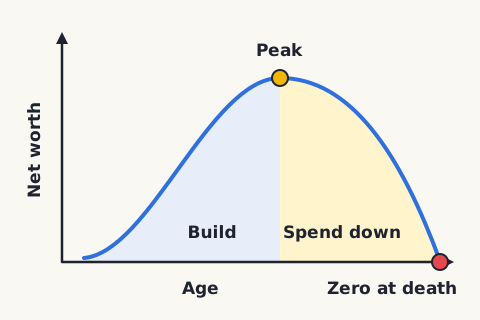
The Inverted Parabolic Wealth Arc
Net worth should follow an inverted parabolic arc that peaks and intentionally decumulates toward zero at death.
Overcoming Decumulation Anxiety
Drawing down principal causes intense psychological anxiety for lifelong savers accustomed to balance growth.
The Cost of Delayed Decumulation
Delayed decumulation forces individuals to spend money when their physical capacity to enjoy it is lowest.
Tracking Net Fulfillment
Tracking net fulfillment points alongside net worth ensures spending decisions align with experiential goals.
Mathematical Efficiency of Zero
Hitting zero at death represents perfect mathematical efficiency in the conversion of life energy into fulfillment.
The Frugality Trap on Autopilot
Habits of frugality and hard work that drive success in youth become toxic liabilities if continued on autopilot.
Societal Conditioning of Accumulation
Societal conditioning promotes endless wealth accumulation as a proxy for personal worth and moral virtue.
The False Economy of Menial Chores
High earners often spend hours performing menial chores to 'save money,' destroying high-value personal time.
Rejecting Social Comparison
Breaking free from social comparison and lifestyle competition is essential to halting unnecessary accumulation.
Declining Overtime to Protect Family Windows
Deliberately turning down promotions or overtime work can protect precious irreplaceable family windows.
Overcoming Consumer Guilt
Spending money on experiences that bring joy requires overcoming deeply ingrained feelings of consumer guilt.
The Art of Enough
Mastering the art of living requires knowing when you have 'enough' and pivoting focus to experiencing life.
Matched pairs
Each item on the left goes with the one on the right.
- Ages 20 to 45
- Aggressive saving, debt elimination, and wealth building
- Buying Back Time
- Hiring house cleaners, meal services, and direct flights to expand daily bandwidth
Step by step
Deploy automated spending targets in decumulation
- Establish mandatory annual experiential spending budgets that cannot roll over
- Automate premium upgrades for travel, seating, and logistics to eliminate friction
- Partner with travel curators and coaches to execute signature life experiences
Conduct an annual Health, Money, and Time resource audit
- Audit weekly hours to identify low-value tasks traded for unneeded income
- Evaluate physical vitality markers and schedule time-sensitive adventures
- Reallocate financial capital to buy back personal time and reduce friction
Cultivate rich experiential interests prior to retirement
- Experiment actively with creative arts, musical instruments, and sports in middle age
- Build active social communities outside corporate professional circles
- Establish seasonal travel routines that transition smoothly into decumulation
Self-test
Answer each question from memory, then check your work against the answer key.
1. What age range does Perkins identify as the optimal window for the Net Worth Peak?
- AAges 30 to 40
- BAges 45 to 60
- CAges 65 to 75
- DAges 20 to 35
2. According to Perkins, what does the term 'Net Worth Peak' refer to?
- AThe point when all debt is eliminated
- BThe age when someone retires from work
- CThe year discretionary spending is highest
- DThe exact date net worth reaches its maximum value
3. Why does Perkins consider it a planning error to keep accumulating wealth past age 60?
- ARemaining life expectancy actually increases after 60
- BPhysical health typically improves again in retirement
- CRemaining life expectancy and vitality are both declining
- DFamily time naturally expands once children are grown
4. Which term describes spending that intentionally exceeds income after the Net Worth Peak?
- ANet Decumulation
- BNet Accumulation
- CCompound Reinvestment
- DCapital Preservation
5. What are the 'go-go' years in Perkins' decumulation framework?
- AThe final years right before death
- BEarly retirement, when mobility is highest
- CLate retirement, when travel is difficult
- DThe initial wealth-accumulation years
6. What does Perkins mean by 'Financial Autopilot'?
- ATotal freedom over your daily schedule
- BContinually comparing your lifestyle to others
- CUsing up your experiential budget yearly
- DAccumulating wealth compulsively without questioning why
7. What three forces does Perkins say drive high-achievers to stay stuck on Financial Autopilot?
- AFamily pressure, media hype, and inheritance planning
- BDebt, taxes, and inflation
- CHabit, social status comparison, and fear of identity loss
- DBoredom, loneliness, and burnout
8. What kinds of tasks does 'Buying Back Time' involve outsourcing, per Perkins?
- AHouse cleaning, meal prep, direct flights
- BGrocery shopping and bill pay
- CChildcare and homeschooling
- DInvestment research and tax filing
9. Perkins' annual resource audit balances which three factors?
- ACareer, Family, and Leisure
- BHealth, Money, and Time
- CAssets, Liabilities, and Equity
- DIncome, Expenses, and Savings
10. What does Perkins mean by having 'Enough'?
- APaying off all debt including a mortgage
- BAchieving a 40-hour work-life balance
- CPivoting focus from accumulation to experiential living
- DReaching a net worth target set by an advisor
Go deeper
- ReadDie With Zero by Bill Perkins · on Amazon ↗
- StudyDie With Zero in the FlashFeed app
These are affiliate links: if you buy a book through one, FlashFeed may earn a small commission at no extra cost to you. The commission helps pay for FlashFeed's servers.
As an Amazon Associate we earn from qualifying purchases.
Answer key
- 1. B Ages 45 to 60Perkins calculates the optimal Net Worth Peak falls between ages 45 and 60, before health and remaining years decline sharply.
- 2. D The exact date net worth reaches its maximum valueThe Net Worth Peak is defined as the exact calendar date net worth hits its maximum dollar value, after which decumulation begins.
- 3. C Remaining life expectancy and vitality are both decliningPerkins ties the age-60 cutoff to biology: under 20-25 years typically remain and the physical health multiplier is already declining, not to health improving or family time expanding.
- 4. A Net DecumulationNet Decumulation is the phase where spending exceeds annual earnings and investment returns, systematically drawing down principal.
- 5. B Early retirement, when mobility is highestPerkins says decumulation should accelerate during the go-go years of early retirement, when mobility and health are at their peak.
- 6. D Accumulating wealth compulsively without questioning whyFinancial Autopilot is the unexamined habit of accumulating wealth out of routine; the distractors describe Time Autonomy, social comparison, and the mandatory experiential-budget rule instead.
- 7. C Habit, social status comparison, and fear of identity lossHigh-achievers grind on "driven by habit, social status comparison, and fear of identity loss," well past the point of sufficient wealth.
- 8. A House cleaning, meal prep, direct flightsPerkins pairs Buying Back Time with hiring house cleaners, meal services, and direct flights to expand daily bandwidth.
- 9. B Health, Money, and TimeThe annual resource audit evaluates the dynamic balance between Health, Money, and Time to escape the autopilot trap.
- 10. C Pivoting focus from accumulation to experiential livingThe Art of Enough means knowing when to stop accumulating and intentionally pivot toward experiential living.
Sources
- Die With Zero — Bill Perkins
- Bill Perkins, Die With Zero, Chapter 7; Bill Perkins, Die With Zero, Chapter 8; Bill Perkins, Die With Zero, Chapter 6 — www.diewithzerobook.com
Image credits
- The Inverted Parabolic Wealth Arc: FlashFeed original diagram · CC-BY-4.0