
Die With Zero study guide · Lesson 4 of 6
Time Buckets and Health Span Realities
Time-Bucketing & Age-Dependent Activities · Health Span, Mobility Decay & FUs
Unofficial study guide for Die With Zero: Getting All You Can from Your Money and Your Life by Bill Perkins. FlashFeed is not affiliated with the author or publisher.
This is the lesson's study guide from the FlashFeed app, plus its key facts and a self-test.
What you'll be able to do
- Construct 5-to-10-year Time Buckets to align desired life experiences with age-dependent physical capabilities and relational windows.
- Explain how biological health span and mobility decay constrain the ability to convert financial capital into fulfillment units.
Lesson 4: Time Buckets and Health Span Realities
Welcome to Lesson 4 of Die With Zero by Bill Perkins. This lesson presents the Time-Bucketing methodology, examines the biological divergence between life span and health span, and details the role of health as the ultimate wealth multiplier.
Time-Bucketing & Age-Dependent Activities
The traditional concept of a "Bucket List" is an unstructured collection of dreams, destinations, and activities that an individual hopes to accomplish before they die. Bill Perkins demonstrates that traditional bucket lists are dangerous illusions because they ignore the non-linear physics of human aging.
The Flaw of Traditional Bucket Lists
A standard bucket list treats an 80-year-old human as biologically and physically identical to a 25-year-old human. In reality, human experiences have strict Physical Expiration Dates. If you defer high-stamina adventures (such as hiking the Inca Trail, backcountry skiing, or scuba diving in remote reefs) to your retirement years, you will arrive at age 70 only to discover that joint pain, cardiovascular limits, or spinal degradation have permanently closed those experiential windows.
The 5-to-10-Year Time Bucket Framework
To replace the flawed bucket list, Perkins designs the Time-Bucketing Framework. Individuals map their remaining adult life into discrete 5-year or 10-year age intervals, assigning desired experiences to the exact temporal window where they are physically, socially, and emotionally optimal:
| Time Bucket | Biological & Life Stage Profile | Optimal Activity Archetypes | Sub-Optimal Deferrals |
|---|---|---|---|
| Ages 20–29 | Peak physical resilience, high time flexibility, low financial capital | Budget backpacking, extreme sports, high-altitude trekking, shared group travel | Luxury cruises, static golf resorts |
| Ages 30–39 | High physical stamina, rising career capital, young children | Active family vacations, foundational career leaps, adventure travel with kids | Deferring all vacations for 80-hr workweeks |
| Ages 40–49 | Strong physical capability, peak earning power, teenage children | High-end experiential travel, cultural immersions, milestone multi-generational trips | Waiting until empty-nest to travel with kids |
| Ages 50–59 | Moderate stamina, high wealth, empty nest | Luxury trekking, sailing, culinary tours, mastering complex creative arts | High-impact extreme sports |
| Ages 60–69 | Declining physical endurance, maximum free time | River cruises, scenic train expeditions, cultural city tours, mentorship | Strenuous backcountry hiking |
| Ages 70+ | Low physical mobility, vulnerability to fatigue | Accessible resort travel, writing memoirs, family reunions, contemplative arts | Multi-flight international itineraries |
The Impermanence of Relational Windows
Time-bucketing also forces individuals to confront the fleeting nature of relationships. You do not have your children for a lifetime; you only have them for brief, non-repeatable stages:
- You have a toddler for only three or four years.
- You have an elementary school child for six years.
- You have a teenager living under your roof for only six or seven years.
Once a stage passes, it is gone forever. Postponing a family camping trip or trip to an amusement park until you reach "financial independence" at age 55 means your children are now 25 and will never experience that trip as children. The experience cannot be repurchased at any financial price later in life.
The same logic applies to parents and older relatives. Perkins describes spending heavily on a weeklong 45th birthday celebration on St. Barts, the Caribbean island where he and his wife had honeymooned, gathering family and friends from every stage of his life. He held it at 45 rather than at a later round-number birthday such as 50 because his mother was already old and he wanted her to be able to fly in and fully enjoy it; his father was already too debilitated to travel.
Health Span, Mobility Decay & FUs
A cornerstone of the Die With Zero philosophy is understanding the biological divergence between Life Span and Health Span.
The Life Span vs. Health Span Gap
- Life Span: The chronological number of years an individual remains biologically alive.
- Health Span: The number of years an individual lives free from chronic disease, debilitating pain, and physical limitations.
In modern society, medical advancements have extended life span significantly, but health span has lagged behind. Estimates vary by country and method, but commonly cited figures put the average gap at 12 to 15 years at the end of life characterized by mobility limitations, chronic illness, and cognitive fatigue.
Chronological Age: 0 ───────────────────────── 65 ──────── 75 ──────── 85 (Death)
Health Span:       [    Robust Physical Vitality     ] ──► [ Mobility Decay ] ──► Frailty
                                                            ▲
                                                 12-15 Year Health Gap
Health as the Essential Multiplier of Wealth
Perkins describes health as the single biggest multiplier on your lifetime fulfillment curve: even a permanent reduction in health sharply cuts how much fulfillment your money and time can generate. This guide represents that idea as an illustrative model, converting financial capital into Fulfillment Units (FUs):
$\text{Fulfillment Units Generated} = \text{Dollars Spent} \times \text{Health Multiplier } (H_t)$
- When H_t = 1.0 (peak physical vitality in youth and early adulthood), $1,000 spent on an active adventure converts into maximum fulfillment.
- When H_t = 0.1 (severe mobility limitations in advanced age), spending 1,000 (or even 100,000) generates only a tiny fraction of that experiential joy.
Because health declines inexorably with age, the fulfillment-purchasing power of money steadily depreciates over time. A dollar in your thirties possesses far greater fulfillment purchasing power than a dollar in your eighties.
Aggressive Health Span Investment
Because health is the ultimate multiplier of wealth, Perkins argues that the highest-ROI investment any person can make is spending money and time early in life to preserve and extend their health span. This includes hiring personal trainers, eating premium nutrition, prioritizing sleep, undergoing preventative medical screenings, and taking time off to mitigate chronic stress. Every additional year of physical vitality added to your fifties and sixties vastly expands your total lifetime fulfillment.
The Granular Architecture of 5-Year Time Buckets
To execute the Time-Bucketing Framework with maximum precision, Bill Perkins recommends breaking life into 5-year chronological increments from one's current age through age 85+:
[ Ages 20-24 ] ──► [ Ages 25-29 ] ──► [ Ages 30-34 ] ──► [ Ages 35-39 ] ──► [ Ages 40-44 ]
[ Ages 45-49 ] ──► [ Ages 50-54 ] ──► [ Ages 55-59 ] ──► [ Ages 60-64 ] ──► [ Ages 65-69 ]
[ Ages 70-74 ] ──► [ Ages 75-79 ] ──► [ Ages 80-84 ] ──► [ Ages 85+   ]
Within each 5-year bucket, an individual should place three to five major signature experiences, alongside smaller seasonal rituals. This structured visualization immediately reveals the finite number of buckets remaining in a human life. An individual at age 45 realizes they have only two 5-year buckets remaining before age 55—a realization that shatters complacency and instills healthy experiential urgency.
Quantifying the Biological Cost of Deferral
Consider the physiological demands of popular bucket-list experiences:
- Backcountry Alpine Skiing / High-Altitude Trekking: Requires high VO2 max, knee cartilage integrity, and rapid altitude acclimation. Optimal Window: Ages 20–45. Biological feasibility drops rapidly after age 55.
- Scuba Diving in Remote Marine Sanctuaries: Requires ear barotrauma resistance, physical strength to navigate strong ocean currents, and stamina for heavy gear. Optimal Window: Ages 25–55.
- Cultural Immersions & Historical Walking Tours: Requires moderate walking stamina (5–8 miles daily on cobblestone streets) and heat tolerance. Optimal Window: Ages 40–70.
- Scenic River Cruises, Literary Retreats & Culinary Masterclasses: Requires low physical exertion, high aesthetic appreciation, and reflective mental focus. Optimal Window: Ages 65–85+.
By mapping activities to biological capacity, an individual ensures that they never experience the heartbreaking regret of arriving at a destination with the financial means to participate, but without the physical capability to do so.
Health as an Active Capital Asset
In traditional balance sheets, financial capital is listed under assets, while health is ignored. In the Die With Zero operating system, health is recognized as an active capital asset that requires continuous maintenance and reinvestment.
Every dollar invested in preventative wellness—such as functional movement training, high-quality organic nutrition, restorative sleep optimization, and comprehensive biomarker testing—yields an astronomical financial return by extending the high-multiplier health span window. Protecting your mobility into your sixties and seventies is the single most effective way to maximize the lifetime conversion efficiency of your wealth.
Key terms
- Time-Bucketing
- The framework of segmenting remaining adult life into 5-to-10-year intervals to sequence experiences by biological feasibility.
- Health Span
- The period of human life lived in robust physical vitality, free from chronic debilitating limitations and pain.
Key facts
The Flaw of Traditional Bucket Lists
Traditional bucket lists are flawed because they treat an 80-year-old human as biologically identical to a 25-year-old.
Physical Expiration Dates
Activities have physical expiration dates based on joint health, cardiovascular endurance, and balance.
The Impermanence of Childhood Stages
Relational windows with young children are strictly time-bound: you only have a toddler or elementary child for a few years.
The Evolution of Travel Character
Travel experiences change in character across decades: budget hosteling in 20s vs cultural luxury tours in 50s.
The Irrevocable Nature of Closed Windows
Activities postponed past their biological window cannot be repurchased at any financial price later in life.
Preventing Mid-Life Burnout
Balancing career milestones with time-bucketed personal experiences prevents mid-life burnout and regret.
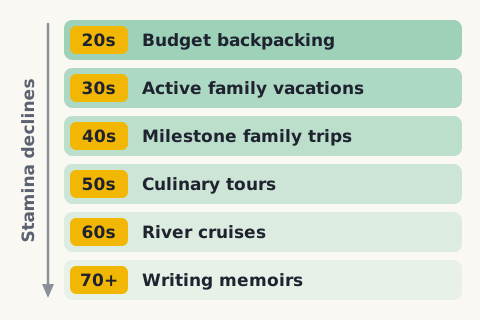
Biological Window Alignment
Time-bucketing aligns financial expenditures with biological windows to maximize lifetime Fulfillment Units.
Health as the Ultimate Multiplier
Physical health serves as an indispensable multiplier on the conversion of wealth into Fulfillment Units (FUs).
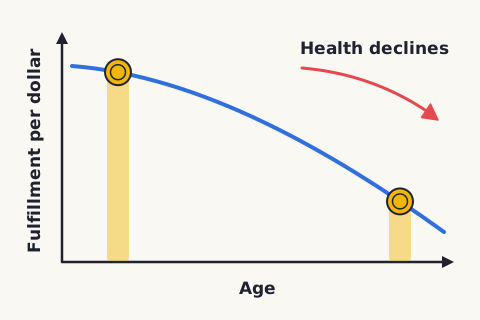
Experiential Purchasing Power Depreciation
The fulfillment-purchasing power of a dollar steadily depreciates over time as physical health declines.
Expanding the Fulfillment Integral
Extending health span by even three to five years significantly expands the total lifetime area under the fulfillment curve.
The Biological Limits of Long-Haul Travel
Chronic joint pain, cardiovascular decline, and fatigue make international long-haul travel exhausting in advanced age.
Cognitive and Physical Preservation
Preserving cognitive sharpness and physical mobility allows continued generation of memory dividends into later life.
Health Optimization Leverage
Health optimization is the primary leverage point for maximizing the experiential return on all accumulated wealth.
By the numbers
- In modern society, what is the upper end, in years, of the commonly cited gap between the end of health span and biological death?
- 15
Matched pairs
Each item on the left goes with the one on the right.
- High-Stamina Time Buckets (20s-40s)
- Backcountry skiing, high-altitude trekking, and intense physical sport
- Low-Stamina Time Buckets (60s-80+)
- Scenic river cruises, deep writing, memoirs, and contemplative retreats
- High-Yield Health Investments
- Personal training, premium nutrition, preventative screening, and restorative sleep
- Health and Time
- Strictly non-renewable biological resources that diminish continuously
Step by step
Construct and maintain 5-year time buckets
- List all lifetime dream experiences, adventures, and milestones
- Filter experiences by physical endurance, mobility, and relational windows
- Assign each experience to a specific 5-year chronological bucket from now to age 85
Self-test
Answer each question from memory, then check your work against the answer key.
1. What does the Time-Bucketing framework ask individuals to do?
- ASegment daily hours into productivity blocks
- BSegment life into 5-to-10-year age intervals
- CSegment income into fixed savings tiers
- DSegment net worth into liquid/illiquid buckets
2. Per the Time Bucket table, which activities best fit the Ages 60-69 bucket?
- AHigh-end cultural immersions and multigenerational trips
- BBackcountry skiing and high-altitude trekking
- CRiver cruises, scenic train expeditions, and mentorship
- DExtreme sports and budget backpacking
3. How long do you typically have a teenager living under your roof?
- AOne to two years
- BThree to four years
- CEight to nine years
- DSix to seven years
4. Time-bucketing is designed to overcome the illusion of what kind of future time?
- AInfinite future time
- BGuaranteed future time
- CFlexible future time
- DRecoverable future time
5. Which factors are cited as creating 'Physical Expiration Dates' for high-stamina activities?
- ASleep quality, screen time, and stress hormones
- BVision, hearing, and reaction time
- CJoint pain, cardiovascular limits, and spinal degradation
- DMuscle mass, bone density, and flexibility
6. Perkins says you typically have a child living at home as a teenager for about how long?
- A6 to 7 years
- B3 to 4 years
- C8 to 9 years
- D10 to 12 years
7. What does Perkins mean by the 'relational windows' inside a Time Bucket?
- AThe Health Multiplier value assigned to each age range
- BWeekly hours reserved for family phone calls
- CThe five-year activity brackets used in the Time-Bucketing framework
- DChildhood stages that pass and never return
8. How is 'Health Span' defined?
- ATotal years an individual remains biologically alive
- BYears free from chronic disease and physical limits
- CYears marked by mobility decay and chronic illness
- DYears spent working before retirement
9. What is the commonly cited gap, in years, between the end of health span and death?
- A5 to 8 years
- B2 to 3 years
- C12 to 15 years
- D20 to 25 years
10. In the Fulfillment Units formula, what role does the Health Multiplier (Ht) play?
- AAdds to dollars spent for total fulfillment
- BMultiplies dollars spent into fulfillment
- CDivides fulfillment units by years remaining
- DCaps the maximum dollars spendable per year
11. Why does a dollar's 'fulfillment-purchasing power' depreciate over time?
- AInflation erodes the dollar's value each year
- BTaxes on withdrawals increase with age
- CInvestment returns diminish as markets mature
- DDeclining health lowers fulfillment per dollar
12. Which is named as a high-yield health investment for extending health span?
- APreventative medical screening
- BExtreme fasting protocols
- COver-the-counter supplements
- DCosmetic surgery consultations
Go deeper
- ReadDie With Zero by Bill Perkins · on Amazon ↗
- StudyDie With Zero in the FlashFeed app
These are affiliate links: if you buy a book through one, FlashFeed may earn a small commission at no extra cost to you. The commission helps pay for FlashFeed's servers.
As an Amazon Associate we earn from qualifying purchases.
Answer key
- 1. B Segment life into 5-to-10-year age intervalsTime-Bucketing sequences experiences into 5-to-10-year windows matched to biological feasibility, not a financial or scheduling split.
- 2. C River cruises, scenic train expeditions, and mentorshipAges 60-69 pairs declining endurance with low-exertion activities like river cruises; skiing and extreme sports belong to earlier, higher-stamina buckets.
- 3. D Six to seven yearsA teenager lives at home for only six or seven years; three to four years describes the toddler stage instead.
- 4. A Infinite future timeTime-bucketing creates urgency by dispelling the illusion of infinite future time to do things later.
- 5. C Joint pain, cardiovascular limits, and spinal degradationBy age 70, "joint pain, cardiovascular limits, or spinal degradation have permanently closed those experiential windows."
- 6. A 6 to 7 yearsPerkins states a teenager lives under your roof for only six or seven years before that stage closes forever.
- 7. D Childhood stages that pass and never returnRelational windows are the non-repeatable stages of a child's life, like toddlerhood, that close permanently once passed.
- 8. B Years free from chronic disease and physical limitsHealth Span is years of robust vitality free of chronic limitation; 'biologically alive' describes Life Span, and 'mobility decay' describes the gap that follows Health Span.
- 9. C 12 to 15 yearsThe commonly cited gap is 12 to 15 years of mobility limitations and chronic illness at the end of life.
- 10. B Multiplies dollars spent into fulfillmentFulfillment Units equal Dollars Spent times the Health Multiplier, so Ht scales fulfillment rather than adding to or capping spending.
- 11. D Declining health lowers fulfillment per dollarThe book's logic is health-driven: as the health multiplier falls, the same dollar converts to less fulfillment, not inflation or taxes.
- 12. A Preventative medical screeningPreventative screenings are named as a high-yield health investment, alongside training, nutrition, and sleep.
Sources
- Die With Zero — Bill Perkins
- Manas J. Saloi, Die with Zero - Bill Perkins (book summary) — manassaloi.com/booksummaries/2021/03/14/die-zero-perkins.html
- EM-V, Die With Zero by Bill Perkins (book notes) — www.em-v.com/book-notes/die-with-zero-by-bill-perkins
- Bill Perkins, Die With Zero, Chapter 6; Bill Perkins, Die With Zero, Chapter 7 — www.diewithzerobook.com
Image credits
- Biological Window Alignment: FlashFeed original diagram · CC-BY-4.0
- Experiential Purchasing Power Depreciation: FlashFeed original diagram · CC-BY-4.0