
Die With Zero study guide · Lesson 3 of 6
Strategic Giving and Peak Inheritance
Peak Utility of Inheritance (Ages 26-35) · Three-Bucket Wealth Allocation
Unofficial study guide for Die With Zero: Getting All You Can from Your Money and Your Life by Bill Perkins. FlashFeed is not affiliated with the author or publisher.
This is the lesson's study guide from the FlashFeed app, plus its key facts and a self-test.
What you'll be able to do
- Identify the peak financial utility window for child inheritances (ages 26 to 35) versus receiving wealth upon parental death.
- Identify Perkins's Three-Bucket wealth split — Your Money (self), Kids' Money, and Charity's Money — and how each is deployed.
Lesson 3: Strategic Giving and Peak Inheritance
Welcome to Lesson 3 of Die With Zero by Bill Perkins. This lesson explores the optimal timing for generational wealth transfers, the tragedy of the age-60 inheritance mismatch, and the Three-Bucket Wealth Allocation model.
Peak Utility of Inheritance (Ages 26-35)
One of the most common justifications individuals offer for accumulating excess wealth and dying with millions of dollars is the desire to leave a substantial inheritance to their children. Bill Perkins strongly affirms the noble instinct of parental generosity, but demonstrates that the conventional mechanism of transferring wealth through a post-mortem will is deeply flawed, inefficient, and counter-productive.
The Age-60 Inheritance Tragedy
In modern developed economies, the median life expectancy is between 80 and 85 years old. Consequently, when parents pass away and their wills are executed, the average age of their inheriting adult children is 60 years old.
Perkins analyzes the economic and biological profile of a 60-year-old heir:
- By age 60, adult children are established in their careers, their own children have completed college, their home mortgages are largely amortized, and their own physical vitality is beginning to decline.
- Receiving a 100,000 or 500,000 inheritance at age 60 provides relatively low marginal utility. The money is simply deposited into an already mature retirement portfolio that the child will likely struggle to spend down before their own death.
The Golden Window of Peak Utility (Ages 26 to 35)
In contrast, Perkins identifies the exact biological and financial window where money commands its absolute highest marginal utility in a human life: Ages 26 to 35.
During this pivotal decade, young adults experience critical foundational life transitions:
- First-Time Homeownership: Securing a mortgage down payment in a safe neighborhood with good schools.
- Career & Entrepreneurial Leaps: Having the financial runway to launch a business, pursue advanced professional training, or take high-upside career risks without crippling debt.
- Young Family Support: Managing the high costs of childcare, infant healthcare, and early education during cash-constrained years.
- Peak Vitality for Memory Dividends: Having the physical energy to travel and create foundational memories with young grandchildren.
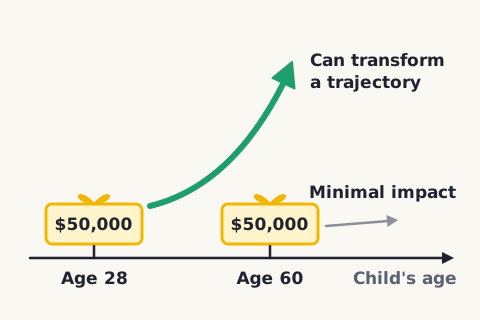
A financial gift of 50,000 transferred to a child at age 28 can fundamentally alter their entire life trajectory, relieving immense stress and unlocking opportunities. That same 50,000 received at age 60 produces virtually zero noticeable impact on their lifestyle.
Age 28 Transfer ($50k):  [ Relieves Debt + Home Down Payment + Catalyzes Career ] ──► Massive Life Trajectory Shift
Age 60 Transfer ($50k):  [ Added to Existing 401(k) Ledger ] ──► Negligible Daily Impact
Giving with a Warm Hand vs. A Cold Grave
Perkins advocates for "Giving with a Warm Hand"—transferring wealth to children deliberately while you are alive, rather than waiting for a "Cold Grave" distribution upon death.
Giving with a warm hand offers two profound advantages:
- Maximized Utility for Heirs: Capital arrives when children need it most, empowering them during their formative years.
- The Joy of Shared Witness: Parents experience the deep emotional joy of seeing their children buy homes, start ventures, and thrive, creating shared family memories. Post-mortem bequests rob parents of ever witnessing the fruits of their generosity.
Three-Bucket Wealth Allocation
To eliminate confusion, guilt, and the tendency to use children or charity as a vague rationalization for endless accumulation, this lesson organizes Perkins's giving philosophy into three practical allocations.
Uncoupling the Three Destinations of Capital
Perkins instructs individuals to formally segment their net worth into three distinct, independently managed pools:
- Bucket 1: Personal Life Fulfillment (Your Money): The capital allocated exclusively to funding your own life experiences, health maintenance, baseline survival, and longevity annuities until biological death. This is the bucket that must be targeted to reach exactly zero.
- Bucket 2: Children & Heirs (Their Money): The specific, predetermined dollar sum you intend to provide to your children. Once established, this capital should be disbursed according to the optimal peak utility timeline (ages 26–35) or placed in structured trusts.
- Bucket 3: Philanthropy & Charity (World Money): The capital dedicated to social causes, non-profit institutions, and community impact, deployed actively during life.
                    TOTAL ACCUMULATED WEALTH
                               │
       ┌───────────────────────┼───────────────────────┐
       ▼                       ▼                       ▼
   BUCKET 1                BUCKET 2                BUCKET 3
  Your Money              Kids' Money             World Money
(Target: $0 at Death)   (Disbursed: Ages 26-35) (Active Lifetime Giving)
The Power of Defined Caps and Psychological Clarity
By uncoupling these three buckets, an individual achieves total psychological clarity:
- You eliminate the ambiguous excuse: "I'm working eighty hours a week for the kids." If Bucket 2 is already fully funded with the target sum, continuing to over-work is revealed as pure inertia.
- You can spend Bucket 1 with zero guilt, knowing that your children's inheritance and charitable commitments are already ring-fenced and secure.
- Setting a defined inheritance cap fosters self-reliance and emotional maturity in adult children, preventing generational entitlement.
The Mathematics of Active Lifetime Philanthropy
Perkins applies the identical logic of peak utility to charitable giving. Just as individuals have peak utility windows, societal crises have urgent compounding timelines. A dollar deployed today to provide clean water, cure infectious diseases, or fund educational scholarships prevents compounding suffering and generates decades of human flourishing. Hoarding philanthropic capital in an estate until death delays vital interventions needlessly.
The Psychology of Parental Generosity and Generational Timing
A central insight in Die With Zero is that parental generosity is heavily time-dependent. When parents write a traditional will leaving their assets to their children upon death, they are abdicating responsibility for the timing of that gift. They allow the random date of their biological demise to dictate when their children receive financial help.
By taking active control of generational wealth transfer, parents can match their gifts to their children's specific developmental stages. When a 28-year-old child receives $50,000, it can eliminate high-interest student loans, provide the seed capital to launch a business venture, or allow a young mother or father to take extended parental leave to bond with a newborn. The psychological relief and reduction in marital stress during these high-pressure foundational years is immeasurable.
Structured Lifetime Trusts and Educational Milestones
For parents concerned that transferring significant wealth to young adults in their twenties might undermine their work ethic or lead to financial mismanagement, Perkins recommends utilizing structured lifetime trusts with age-gated distribution tranches.
For example, a parent might structure distributions across three distinct milestone ages:
- Tranche 1 (Age 26): A foundational distribution of $25,000 to assist with graduate education, relocation, or debt elimination.
- Tranche 2 (Age 30): A catalytic distribution of $50,000 to assist with a home down payment or business formation.
- Tranche 3 (Age 35): A growth distribution of $75,000 to support family expansion, career investments, or creative ventures.
This structured approach provides capital during the highest-utility window while allowing young adults to develop financial maturity and career momentum progressively.
The Compounding Urgency of Charitable Philanthropy
In philanthropy, time is the ultimate leverage multiplier. When high-net-worth individuals establish charitable foundations that disburse only the statutory 5% minimum annual payout while hoarding 95% of their endowment, they are delaying critical interventions.
Consider an environmental conservation project, a global health initiative to eradicate malaria, or a childhood literacy program. Every dollar deployed today prevents irreversible damage, saves lives, and empowers communities immediately. The positive social benefits generated by solving a crisis today compound exponentially over future decades. Deferred post-mortem giving allows preventable problems to metastasize needlessly. Giving with a warm hand transforms philanthropy from a passive estate tax strategy into an active, joyful mission of human flourishing.
Key terms
- Giving With a Warm Hand
- Transferring wealth to children and charitable causes while still alive to maximize utility and witness impact.
- Three-Bucket Allocation
- A practical way to organize wealth into three parts: Your Money (self), Kids' Money, and Charity's Money.
Key facts
The Age 60 Diminished Utility Problem
By age 60, adult children are established in their careers, have paid off mortgages, and experience lower marginal utility from money.
Catalytic Financial Impact
A 50,000 gift at age 28 can transform a child's financial trajectory, whereas 50,000 at age 60 produces minimal impact.
Generational Memory Dividends
Transferring wealth early allows children to build their own memory dividends with their young children.
Probate and Tax Inefficiencies
Post-mortem bequests are often subjected to substantial estate taxation, probate delays, and family disputes.
Shared Milestone Celebrations
Witnessing your children buy their first home or start a business generates powerful shared memory dividends for parents.
Estate Utility Maximization
The goal of estate planning should be maximizing the utility of transferred capital, not maximizing post-mortem estate size.
Eliminating Vague Rationalizations
Separating wealth into distinct goals for yourself, your kids, and charity prevents using any of them as a vague rationalization for endless accumulation.
The Compounding ROI of Curing Suffering
A dollar spent curing disease or building infrastructure today prevents compounding suffering in future decades.
Critique of Foundation Hoarding
Many private foundations hoard endowment assets rather than actively disbursing grants to solve immediate crises.
Active Philanthropic Mentorship
Active philanthropic participation during life allows donors to evaluate outcomes, iterate grants, and mentor leaders.
Independent Timeline Optimization
Optimizing each of the three financial goals independently ensures that every dollar serves its highest possible purpose on its own timeline.
By the numbers
- What is the average age at which adult children in developed nations receive inheritances via post-mortem wills?
- 60
Matched pairs
Each item on the left goes with the one on the right.
- Peak Utility Capital (Ages 26-35)
- Home down payments, business launches, and young child support
- Your Money (Self)
- Funds personal life experiences, healthcare, and longevity annuities to zero
- Kids' Money
- Predetermined fixed sum disbursed during peak utility years (ages 26-35)
- Charity's Money
- Philanthropic capital deployed actively during life to tackle urgent crises
Step by step
Execute structured lifetime inheritance transfers to adult children
- Determine the exact fixed sum intended for each child's total inheritance
- Establish milestone age distribution gates (such as ages 26, 30, and 35)
- Disburse capital directly or via lifetime trusts to empower early family formation
Structure age-gated milestone trusts for heirs
- Establish an irrevocable lifetime trust funded with the target inheritance amount
- Specify release tranches aligned with developmental ages (e.g. 26, 30, and 35)
- Empower trustees to distribute funds for homeownership, business, and education
Self-test
Answer each question from memory, then check your work against the answer key.
1. What is the average age at which adult children receive an inheritance through a post-mortem will?
- A45
- B60
- C50
- D70
2. Which age range does Perkins identify as the window of peak financial utility for a child receiving money?
- AAges 55 to 65
- BAges 40 to 50
- CAges 26 to 35
- DAges 18 to 25
3. Which of these is NOT one of the life transitions Perkins links to the ages 26-35 window?
- ARetirement account consolidation
- BCareer or entrepreneurial leaps
- CFirst-time homeownership
- DYoung family support
4. What term does Perkins use for deliberately transferring wealth to children while still alive?
- ACold Grave Distribution
- BStrategic Bequest Planning
- CDeferred Gifting Model
- DGiving With a Warm Hand
5. A parent plans to gift a child $50,000. Per Perkins's peak-utility argument, at which age would the gift have the greatest life impact?
- A28
- B72
- C45
- D60
6. What are the three buckets Perkins recommends dividing all wealth into?
- ASavings, Investments, and Cash
- BHousing, Retirement, and Education
- CYour Money, Kids' Money, Charity's Money
- DIncome, Assets, and Liabilities
7. Which of the three buckets should be targeted to reach exactly zero at death?
- AKids' Money (Heirs)
- BEmergency Reserve Fund
- CCharity's Money (Philanthropy)
- DYour Money (Personal Fulfillment)
8. Which of the three buckets is meant to be disbursed as a predetermined fixed sum during a child's peak-utility years, ages 26 to 35?
- ALegacy Trust Fund
- BKids' Money
- CCharity's Money
- DYour Money
9. Leaving wealth in undefined, merged accounts creates what psychological effect that paralyzes spending and giving decisions?
- AAmbiguity
- BGuilt
- CAnxiety
- DOverconfidence
10. Perkins critiques foundations that disburse only the statutory minimum. What share of their endowment do such foundations typically hoard?
- A80%
- B95%
- C99%
- D50%
Go deeper
- ReadDie With Zero by Bill Perkins · on Amazon ↗
- StudyDie With Zero in the FlashFeed app
These are affiliate links: if you buy a book through one, FlashFeed may earn a small commission at no extra cost to you. The commission helps pay for FlashFeed's servers.
As an Amazon Associate we earn from qualifying purchases.
Answer key
- 1. B 60Perkins notes the average heir is 60 when a will is executed, well past the years when money has the most impact.
- 2. C Ages 26 to 35Perkins pinpoints ages 26-35 as the golden window for home down payments, career leaps, and young family support.
- 3. A Retirement account consolidationPerkins ties 26-35 to homeownership, career leaps, and family support, not to consolidating an already-mature retirement account.
- 4. D Giving With a Warm Hand"Giving With a Warm Hand" is Perkins's term for living transfers, contrasted with the "Cold Grave" of a post-mortem will.
- 5. A 28Perkins's example shows $50,000 at 28 can transform a life trajectory, while the same sum at 60 has negligible impact.
- 6. C Your Money, Kids' Money, Charity's MoneyPerkins's model uncouples wealth into Your Money, Kids' Money, and Charity's Money so each can be optimized independently.
- 7. D Your Money (Personal Fulfillment)Bucket 1, Your Money, funds personal experiences and survival and is the one meant to hit zero, unlike the ring-fenced Kids' and Charity's buckets.
- 8. B Kids' MoneyBucket 2, Kids' Money, is a fixed sum earmarked for heirs and paid out during the ages 26-35 window, unlike Your Money (spent to zero) or Charity's Money (deployed to causes).
- 9. A AmbiguityUndefined accounts create psychological ambiguity, whereas uncoupling the three buckets brings clarity.
- 10. B 95%Foundations that pay out just the 5% statutory minimum end up hoarding the other 95% instead of deploying it to urgent causes.
Sources
- Die With Zero — Bill Perkins
- Bill Perkins, Die With Zero; Bill Perkins, Die With Zero, Chapter 5 — www.diewithzerobook.com
Image credits
- Catalytic Financial Impact: FlashFeed original diagram · CC-BY-4.0