
Die With Zero study guide · Lesson 1 of 6
Net Fulfillment & Life Energy Foundations
Maximizing Life Fulfillment & Life Energy · The Memory Dividend & Compounding ROI
Unofficial study guide for Die With Zero: Getting All You Can from Your Money and Your Life by Bill Perkins. FlashFeed is not affiliated with the author or publisher.
This is the lesson's study guide from the FlashFeed app, plus its key facts and a self-test.
What you'll be able to do
- Define life energy as converted time and explain how maximizing lifetime fulfillment units takes precedence over hoarding net worth.
- Explain the Memory Dividend and calculate how early experiential investments yield compounding fulfillment dividends over decades.
Lesson 1: Net Fulfillment & Life Energy Foundations
Welcome to the foundational study guide for Die With Zero by Bill Perkins. This lesson establishes the core philosophical and economic framework of life optimization, reframing money from an end in itself into an intermediate token purchased with finite life energy.
Maximizing Life Fulfillment & Life Energy
The central thesis of Bill Perkins is that human existence is finite, and the true objective function of human life is maximizing Net Fulfillment across one's entire lifespan, rather than maximizing Net Worth at the moment of biological death. In conventional society, financial advice suffers from an ingrained, unexamined pathology: an obsessive focus on asset accumulation, balance sheet growth, and net worth milestones, completely detached from the ultimate purpose of capital.
The True Nature of Money and Life Energy
To understand the Die With Zero operating framework, one must first recognize the fundamental economic exchange underlying all labor. When you work at a job, build an enterprise, or practice a profession, you are trading away a strictly non-renewable, irreplaceable asset: your Life Energy. Life energy represents the finite hours, physical vitality, mental focus, and bodily stamina allotted to you during your lifetime.
Money, therefore, possesses zero intrinsic utility. A stack of paper currency or a digital balance in a brokerage account cannot generate happiness, meaning, or fulfillment on its own. Money only acquires value at the precise moment it is converted into life experiences, personal security, health preservation, or meaningful gifts. When an individual hoards capital past the point where it can be converted into life experiences, they are committing a catastrophic optimization error: converting irreplaceable life energy into financial tokens that will be permanently abandoned upon death.
In neoclassical economics, the Law of Diminishing Marginal Utility dictates that each additional unit of wealth consumed yields progressively less subjective satisfaction. In the context of human aging, this effect is compounded dramatically by biological decline. A dollar spent at age 25 to fund a thrilling cross-country expedition delivers massive experiential utility; that same dollar spent at age 85, when mobility is severely restricted, delivers only a negligible fraction of that fulfillment.
Re-Evaluating Aesop's Fable of the Ant and the Grasshopper
Cultural conditioning regarding work, thrift, and savings is deeply rooted in the ancient moral fable of The Ant and the Grasshopper. In the traditional telling, the industrious Ant labors relentlessly all summer storing grain, while the carefree Grasshopper sings, dances, and starves when winter arrives. Society holds up the Ant as the moral ideal of prudence and self-discipline.
However, Bill Perkins poses an essential, disruptive question: When does the Ant ever get to play?
If the Ant labors compulsively through spring, summer, and autumn, amasses ten times the food required for survival, and continues working until it collapses dead in the anthill, the Ant has not lived wisely—it has lived a life of unexamined, neurotic labor. Perkins emphasizes that one should not become the foolish Grasshopper who faces winter destitution; rather, a mature life design synthesizes both archetypes. One must work like an Ant during calculated seasons to accumulate the resources necessary to enjoy deliberate, timely Grasshopper experiences throughout life.
Conventional Path:   [ Labor Like an Ant (Ages 20-65) ] ──► [ Exhausted Ant (65+) ]
Die With Zero Path:  [ Focused Labor (Ant) ] ──► [ Timely Experiences (Grasshopper) ] ──► Net Fulfillment
Case Study: Jason's High-Yield Experiential Loan
To ground this principle in concrete reality, Perkins recounts the choice of his early roommate Jason Ruffo: in his early twenties, earning a modest entry-level salary, Jason borrowed roughly $10,000 from a loan shark — the only lender who would front him that much — to spend three months backpacking across Europe. Conventional financial orthodoxies would condemn this as reckless consumer debt. Yet, evaluated through experiential economics, Jason's decision was extraordinarily high-yield: he possessed the physical resilience to sleep on train floors, stay in youth hostels, walk for miles a day, and forge lifelong friendships with peers in his exact life stage. Years later, there was no discernible difference between their incomes — but Jason was infinitely richer for the stories and memories the trip gave him.
The Memory Dividend & Compounding ROI
In standard financial theory, capital invested in equities, real estate, or compound interest generates ongoing financial dividends. One of Bill Perkins' most transformative conceptual breakthroughs is proving that life experiences generate an identical psychological return: the Memory Dividend.
The Mechanics of Experiential Compounding
When you participate in an extraordinary life event—such as trekking through Patagonia, attending a legendary musical festival with close friends, learning to surf, or taking your young children on a summer road trip—the experiential value does not terminate when the event ends. Instead, the event enters your permanent cognitive and emotional ledger, producing an ongoing stream of psychological returns known as Memory Dividends.
Every time you recall the memory, recount the adventure at a dinner party, browse through photographs, or draw upon the personal growth forged during that experience, you experience a fresh burst of joy and fulfillment. Consequently, the true return on investment (ROI) of an experience is not merely the direct joy felt during the event (U_{\text{direct}}), but the integrated sum of all future memory dividends generated across the remaining decades of your life:
$\text{Total Experiential Value} = U_{\text{direct}} + \sum_{t=1}N \text{Memory Dividend}_t$
Why Early Experiential Investments Yield Maximum ROI
The compounding mathematics of the Memory Dividend leads directly to a counter-intuitive principle: experiences enjoyed early in young adulthood yield far higher lifetime returns than identical experiences deferred to old age.
Consider the chronological comparison:
- Experience at Age 20: An adventure undertaken at age 20 produces sixty full years of memory dividends by age 80. The memory is shared across college reunions, family gatherings, quiet reflections, and career milestones, compounding in emotional value over six decades.
- Experience at Age 75: That same adventure deferred until age 75 produces direct enjoyment, but only yields five remaining years of memory dividends before biological death.
Therefore, even when an individual has limited financial capital in their twenties, allocating modest funds toward transformative experiences produces a lifetime return that dwarf the financial interest lost by not saving those few dollars.
Age 20 Event:  [ Direct Joy ] ══════════════════════════════════════════════► 60 Years of Memory Dividends
Age 75 Event:  [ Direct Joy ] ════► 5 Years of Dividends
The Three Phases of the Experiential Lifecycle
To maximize the total yield of any experience, Perkins identifies three distinct phases that must be cultivated intentionally:
- The Anticipation Phase: The forward-looking joy, excitement, research, and planning that precedes the event. Anticipation itself contributes meaningfully to overall enjoyment, independent of the event's outcome.
- The Direct Execution Phase: The sensory immersion, presence, and engagement experienced during the actual event.
- The Memory Dividend Phase: The lifelong retrospective recollection, storytelling, photographic review, and emotional warmth generated whenever the memory is revisited.
Quantifying Life: Experience Points
Perkins introduces the concept of Experience Points as the true metric of a successful life. Unlike net worth, which measures static fiat currency, Experience Points measure the subjective depth, richness, and variety of lived human experiences.
Material goods suffer from rapid Hedonic Adaptation—a new luxury sports car or designer watch provides a brief dopamine spike before quickly becoming the new baseline, depreciating in both financial value and psychological satisfaction. In contrast, experiential memories appreciate over time, becoming more treasured as the years pass. By actively cataloging and celebrating past memories through reunions, photo albums, and storytelling, individuals unlock and compound their memory dividends throughout their entire lifetime.
Key terms
- Life Energy
- The finite quantity of hours, physical vitality, and mental focus traded in exchange for financial compensation.
- Experiential Capacity
- An individual's biological, cognitive, and social capability to fully absorb, participate in, and enjoy specific life activities at a given age.
- The Memory Dividend
- The continuous stream of psychological and emotional returns generated by recalling, sharing, and reliving past life experiences.
- Experience Points
- The quantitative unit Perkins uses to measure and compare the subjective depth, richness, and variety of positive life experiences.
Key facts
The Net Fulfillment Objective
The primary objective of life is maximizing total lifetime fulfillment rather than maximizing net worth at death.
Experiences as True Currency
Experiences are the ultimate currency of human life, defining personal identity and shaping retrospective life satisfaction.
Bill Perkins' Career Shift
Bill Perkins transitioned from an electrical engineering degree at the University of Iowa to trading natural gas derivatives on the NYMEX floor.
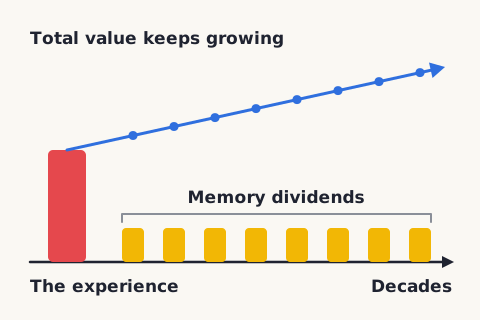
Experiential Compounding
Like financial capital invested in compound assets, experiential investments compound through decades of recurring memory dividends.
Multi-Party Memory Dividends
Shared experiences with close friends and family pay compounding memory dividends to all participants across multiple generations.
Capital Allocation in Youth
Investing in travel, skill acquisition, and relationships in young adulthood is a high-return capital allocation strategy.
The True Measure of Wealth
The ultimate measure of a rich life is the density and quality of compounded memory dividends at life's conclusion.
By the numbers
- How many years of memory dividends does an experience enjoyed at age 20 produce by age 80?
- 60
Matched pairs
Each item on the left goes with the one on the right.
- Pure Grasshopper Lifestyle
- Immediate gratification leading to financial destitution in winter
- Diminishing Marginal Utility in Aging
- Each dollar spent in frailty yields far less satisfaction than in youth
- Active Memory Catalysts
- Photographs, journals, and reunions that unlock recurring dividends
Step by step
Optimize the conversion rate of money into fulfillment points across the lifespan
- Calculate the real after-tax life energy cost of your hourly labor
- Map desired lifetime experiences to biological age windows
- Allocate financial capital boldly to high-yield experiential windows
Cultivate the three distinct phases of the experiential lifecycle
- Savor the anticipation phase through forward-looking research and planning
- Immerse fully in the direct execution phase with sensory presence
- Harvest memory dividends through retrospective storytelling and photos
Self-test
Answer each question from memory, then check your work against the answer key.
1. What does Bill Perkins identify as the true objective of a well-lived life?
- AMaximizing Net Fulfillment over a lifetime
- BMaximizing net worth at death
- CMaximizing asset accumulation
- DMaximizing balance sheet growth
2. In Die With Zero, which term names the finite hours, vitality, and mental focus traded for money?
- AExperiential Capacity
- BHedonic Adaptation
- CLife Energy
- DDiminishing Marginal Utility
3. In Perkins' reframing of the Ant and the Grasshopper, what is the mature life-design strategy?
- ALabor like an Ant until collapse
- BWork like an Ant to fund Grasshopper experiences
- CDelay all experiences until retirement
- DLive purely as a carefree Grasshopper
4. Which of these is NOT one of the pathological obsessions Perkins critiques in conventional financial advice?
- ABalance sheet growth
- BAsset accumulation
- CNet worth milestones
- DConverting capital into life experiences
5. Per the Law of Diminishing Marginal Utility applied to aging, a dollar spent on adventure at age 25 versus age 85 delivers:
- AEqual fulfillment at both ages
- BFulfillment that rises with age
- CFar greater fulfillment at 25
- DFar greater fulfillment at 85
6. What term describes the ongoing stream of psychological returns from recalling a past experience?
- AHedonic Adaptation
- BDiminishing Marginal Utility
- CExperience Points
- DMemory Dividend
7. According to Perkins' chronological comparison, an experience enjoyed at age 20 yields how many years of memory dividends by age 80?
- A90 years
- B60 years
- C40 years
- D5 years
8. According to Perkins, what do 'Experience Points' measure?
- ADepth, richness, and variety of experiences
- BFrequency of major purchases per year
- CStatic net worth in fiat currency
- DTotal money spent on memorable trips
9. Which of these is NOT one of Perkins' three phases of the experiential lifecycle?
- ADirect Execution Phase
- BAnticipation Phase
- CRecovery Phase
- DMemory Dividend Phase
10. What term describes a new luxury good quickly becoming the new baseline after its initial appeal fades?
- AHedonic Adaptation
- BDiminishing Marginal Utility
- CMemory Dividend
- DExperience Points
Go deeper
- ReadDie With Zero by Bill Perkins · on Amazon ↗
- StudyDie With Zero in the FlashFeed app
These are affiliate links: if you buy a book through one, FlashFeed may earn a small commission at no extra cost to you. The commission helps pay for FlashFeed's servers.
As an Amazon Associate we earn from qualifying purchases.
Answer key
- 1. A Maximizing Net Fulfillment over a lifetimePerkins argues life's true objective function is maximizing Net Fulfillment across one's lifespan, not net worth, balance sheets, or asset piles left behind at death.
- 2. C Life EnergyLife Energy is Perkins' term for the finite time and vitality spent earning income; the others describe aging capacity, fading appeal of goods, and utility decline.
- 3. B Work like an Ant to fund Grasshopper experiencesPerkins says one should work like an Ant in calculated seasons to fund deliberate Grasshopper experiences, rather than living purely carefree, laboring until death, or deferring all joy.
- 4. D Converting capital into life experiencesPerkins critiques obsessive asset accumulation, balance sheet growth, and net worth milestones; converting capital into experiences is the healthy goal, not the pathology.
- 5. C Far greater fulfillment at 25Diminishing marginal utility compounds with biological decline, so identical spending yields far greater fulfillment at 25 than in frail old age at 85.
- 6. D Memory DividendThe Memory Dividend is the recurring emotional payoff from reliving a memory; Experience Points measure life richness, while the other terms describe fading appeal and utility decline.
- 7. B 60 yearsPerkins contrasts an adventure at 20, which pays memory dividends for 60 years until 80, versus the same experience at 75, which pays only about 5 years before death.
- 8. A Depth, richness, and variety of experiencesExperience Points measure the subjective depth, richness, and variety of lived experiences, unlike net worth, which tracks static fiat currency.
- 9. C Recovery PhasePerkins' three phases are Anticipation, Direct Execution, and the Memory Dividend phase; a separate Recovery Phase is not part of his framework.
- 10. A Hedonic AdaptationHedonic Adaptation is the rapid fading of a material good's novelty, unlike experiences, which appreciate over time via memory dividends.
Sources
- Die With Zero — Bill Perkins
- Bill Perkins, Die With Zero, Chapter 1; Bill Perkins, Die With Zero, Chapter 2 — www.diewithzerobook.com
Image credits
- Experiential Compounding: FlashFeed original diagram · CC-BY-4.0