
Tips for Living Your Best Life study guide · Lesson 3 of 12
Focus & Deep Work
Deep work vs. shallow work · The four rules · Putting it into practice
This is the lesson's study guide from the FlashFeed app, plus its key facts and a self-test.
What you'll be able to do
- Distinguish deep work from shallow work and state the Deep Work Hypothesis about its rising value.
- Match Newport's four depth-scheduling philosophies (monastic, bimodal, rhythmic, journalistic) to their descriptions.
- Define the shutdown ritual, productive meditation, and the craftsman approach to tools.
- Recall the practical numbers of Newport's starter kit: daily deep-work capacity, block lengths, and the social-media embargo.
Deep work vs. shallow work
The knowledge economy rewards two abilities above almost all others: the ability to learn hard things quickly, and the ability to produce at an elite level. Both require sustained concentration — precisely the capacity most modern workers are allowing to atrophy.
The focus superpower
Cal Newport, a computer science professor at Georgetown, coined the term deep work in his 2016 book of the same name: professional activity performed in a state of distraction-free concentration that pushes your cognitive capabilities to their limit and creates lasting value. Its opposite is shallow work — logistical, easily replicated tasks like email and routine meetings that can be done while distracted and create little lasting value.
Newport's central claim is called the Deep Work Hypothesis: the ability to do deep work is becoming rarer at the same moment it is becoming more valuable — so the few who cultivate it will thrive. Open-plan offices, always-on chat tools, and the social media reflex have eroded the average worker's capacity to focus for even an hour without interruption. Yet the value of a single concentrated hour on a hard problem can outstrip an entire day of reactive busyness. The competitive implication is stark: if you can produce deep work and most of your peers cannot, you hold a durable edge that no commodity tool can replicate.
The four rules
Newport does not just name the problem — he prescribes a structured program. The four rules move from philosophy to scheduling to attention training to ruthless prioritization.
The four rules of deep work
Newport's program is built on four rules. Work Deeply means building a deliberate habit around concentrated work rather than relying on motivation. He identifies four scheduling philosophies: monastic (eliminate or radically minimize all shallow work); bimodal (long stretches of deep work alternating with open, ordinary periods); rhythmic (do deep work at the same time every day until it becomes a habit); and journalistic (drop into deep work whenever you can grab a free moment — hardest to sustain, but viable for practiced concentration).
Embrace Boredom is counterintuitive: Newport argues you must train attention outside work sessions by resisting the reflex to reach for your phone in idle moments. A related tactic is productive meditation — focusing on a single professional problem while doing something physical, such as walking or running, rather than letting your mind wander.
Use Digital Media Selectively means applying the craftsman approach to tools: adopt a network or social tool only if its positive impact on things you truly care about substantially outweighs its negative impact. Scroll past the "any benefit" fallacy.
Drain the Shallows involves scheduling and constraining low-value work. The capstone habit is the shutdown ritual: a fixed end-of-workday routine in which you review tomorrow's plan, confirm nothing is dangling, then say "Shutdown complete" aloud — a circuit-breaker that stops work bleeding into rest.
Putting it into practice
Rules are only useful when translated into daily habit. Newport's two most concrete tactics — scheduling every hour and deliberately sitting with boredom — are where the theory becomes a practice you can start this week.
Drain the shallows
Time-blocking means scheduling your entire day in advance, including the shallow work, so nothing runs on autopilot. Newport's heuristic for judging a task: "How many months would it take to train a smart recent college graduate to do this?" A low answer — days or weeks — marks it as shallow work, which means it is a candidate to cut, delegate, or batch into a tightly constrained slot. Newport suggests that for most knowledge workers, four hours is near the upper limit of genuinely deep work in a single day; the rest of the day can then be organized around that constraint. The average person attempting to install this practice cold is advised to start with a single ninety-minute morning deep work block completed before opening email, then add a second afternoon block of sixty to ninety minutes as the habit firms up.
Embrace boredom
Every time you reach for your phone during a dull moment — a queue, a red light, a slow elevator — you teach your brain that discomfort demands immediate stimulation. Over time the threshold drops and you can't focus even when you want to, because the brain has been conditioned to exit discomfort reflexively. Newport suggests a concrete experiment: take a thirty-day break from optional social media use. The experiment is not about quitting permanently; it is diagnostic — after thirty days, judge whether the absence hurt things you care about. Most people find the honest answer is no. Sitting with boredom, and occasionally practicing productive meditation, rebuilds attention as a trainable muscle rather than a fixed trait.
Key terms
- Deep work
- Professional activity performed in a state of distraction-free concentration that pushes your cognitive capabilities to their limit and creates lasting value. — Deep Work, Cal Newport
- Shallow work
- Logistical, easily replicated tasks like email and routine meetings that can be done while distracted and create little lasting value. — Deep Work, Cal Newport
- The Deep Work Hypothesis
- The ability to do deep work is becoming rarer at the same moment it is becoming more valuable — so the few who cultivate it will thrive.
- The shutdown ritual
- A fixed end-of-workday routine: review tomorrow's plan, then say "Shutdown complete" and stop, so work doesn't bleed into your rest. — Deep Work, Cal Newport
- Productive meditation
- Focusing your attention on a single professional problem while doing something physical — walking, running, showering — instead of letting your mind wander.
- The craftsman approach to tools
- Adopt a network or social tool only if its positive impact on the things you truly care about substantially outweighs its negative impact.
Key concepts
Monastic Philosophy
- One of Cal Newport's four ways to schedule concentrated work — and the most extreme of the set.
- It eliminates or radically minimizes all shallow work, walling off nearly all your time for depth.
- Named for a cloistered, hermit-like withdrawal from worldly distraction — you seal yourself away to guard the work.
Bimodal Philosophy
- One of Newport's four scheduling styles for focused work, splitting your life into two clearly separated kinds of time.
- You devote long stretches — days at a stretch — entirely to deep work, then alternate with open, ordinary periods.
- Its name literally means 'two modes': big blocks of pure depth, kept strictly apart from everything else.
Rhythmic Philosophy
- One of Newport's four ways to structure deep work — the easiest of them to harden into a lasting habit.
- You do your concentrated work at the very same time every single day until it runs on autopilot, no motivation required.
- Its name comes from settling into a steady, repeating daily beat or cadence for going deep.
Journalistic Philosophy
- One of Newport's four scheduling styles — the hardest to sustain, viable only once your concentration is well practiced.
- You drop into deep work whenever you can grab a free moment, fitting focus into unpredictable gaps in the day.
- Its name borrows from reporters who must produce on deadline anywhere, the instant a window opens.
Key facts
Deep work
Cal Newport defines deep work as distraction-free concentration that pushes your cognitive capabilities to their limit. It's a measure of the quality of your attention, not the number of hours you put in.

Shallow work
Answering routine email and sitting through logistical meetings are classic examples of shallow work — logistical tasks that are easily replicated and doable even while distracted.
The distraction difference
Work that can be done while distracted and creates little lasting value is shallow work — the opposite of deep work, which is distraction-free, pushes your abilities, and creates real value.
Where the term began
Cal Newport, a Georgetown computer science professor, coined the term deep work in his 2016 book of the same name.
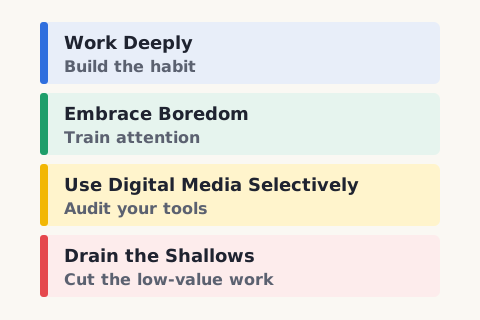
The four rules of deep work
Newport's program is four rules: Work Deeply (build the habit), Embrace Boredom (train attention), Use Digital Media Selectively (audit your tools), and Drain the Shallows (cut the low-value work). — Deep Work, Cal Newport
The journalistic style
Newport calls the journalistic scheduling philosophy the hardest to sustain — dropping into deep work in any spare moment. Switching focus that abruptly only works once your concentration is already well trained.
The monastic approach
Newport's monastic scheduling philosophy eliminates or radically minimizes shallow work to protect long stretches of deep work, unlike philosophies that alternate, schedule, or opportunistically fit deep work in around everything else.
The shutdown ritual
Newport's shutdown ritual is a fixed end-of-workday routine that finishes with saying 'Shutdown complete' out loud, acting as a circuit-breaker so work stops bleeding into the rest of the evening.
The any-benefit fallacy
The craftsman approach to tools rejects the 'any benefit' fallacy — the idea that a tool deserves a place in your life just because it helps somehow. A tool must have a positive impact that substantially outweighs its negatives.
Drain the shallows
Time-block your entire day, including shallow work. To judge a task, ask: "How many months would it take to train a smart recent grad to do this?" A low answer means it's shallow — and a candidate to cut. — Deep Work, Cal Newport
Embrace boredom
If you reach for your phone at every dull moment, you train your brain to crave distraction — and then you can't focus even when you want to. Sitting with boredom is how you rebuild attention as a muscle. — Deep Work, Cal Newport
The four-hour ceiling
Cal Newport puts roughly four hours as the upper limit of genuinely deep work most knowledge workers can sustain in a single day. The rest of the day gets organized around protecting that block.

The social media embargo
Newport's social media embargo experiment is a thirty-day break from optional platforms. It's diagnostic — after thirty days, you judge whether their absence actually hurt anything you care about.
The starter kit
Once the morning deep-work habit firms up, Newport's starter kit adds a second afternoon block of sixty to ninety minutes.
By the numbers
- Maximum deep work capacity the average person can sustain in a day
- 4 hours
- Length of the morning deep work block in Newport's starter kit, done before opening email
- 90 minutes
- Upper end of the second, afternoon deep work block in the starter kit
- 90 minutes
- Length of Newport's social media embargo experiment
- 30 days
Matched pairs
Each item on the left goes with the one on the right.
- Monastic philosophy
- Eliminate or radically minimize all shallow work
- Bimodal philosophy
- Long stretches of deep work alternating with open, ordinary periods
- Rhythmic philosophy
- Do deep work at the same time every day until it becomes a habit
- Journalistic philosophy
- Drop into deep work whenever you can grab a free moment
Step by step
Run a deep-work day using Newport's starter kit
- Open the day with a 90-minute deep work block — before you touch email.
- Move into a midday shallow window for email, meetings, and logistics.
- Run a second deep work block of 60–90 minutes in the afternoon.
- Close with the shutdown ritual: review tomorrow and say "Shutdown complete."
- Write your MIT list — the most important tasks — for tomorrow.
The point of the shutdown ritual is to let your mind fully release work until the next morning.
Self-test
Answer each question from memory, then check your work against the answer key.
1. How does Cal Newport define deep work?
- ACollaborating in constant real-time chat
- BDistraction-free concentration that pushes your cognitive capabilities to their limit
- CClearing your inbox to zero every morning
- DWorking long hours, regardless of focus
2. Which of these is an example of shallow work?
- AWorking out a proof for a hard mathematical problem
- BDrafting a difficult chapter of a book from scratch
- CAnswering routine email and attending logistical meetings
- DLearning an unfamiliar programming language deeply
3. What does the Deep Work Hypothesis claim about the ability to do deep work?
- AIt is becoming easier as tools automate concentration for us
- BIt matters less each year as collaboration replaces solo focus
- CIt is fixed at birth and cannot be trained or improved
- DIt is becoming rarer just as it becomes more valuable, so those who cultivate it thrive
4. Which trait is NOT part of Newport's definition of deep work?
- AIt can be done while distracted and creates little lasting value
- BIt creates lasting value
- CIt pushes your cognitive capabilities to their limit
- DIt is performed in distraction-free concentration
5. Who coined the term 'deep work' and in what year?
- ACal Newport, in his 2016 book of the same name
- BDaniel Kahneman, in Thinking, Fast and Slow
- CJames Clear, in Atomic Habits
- DMihaly Csikszentmihalyi, in his work on flow
6. Which of Newport's deep-work scheduling philosophies is the hardest to sustain, viable only with practiced concentration?
- ARhythmic
- BBimodal
- CMonastic
- DJournalistic
7. Which scheduling philosophy eliminates or radically minimizes all shallow work?
- ARhythmic
- BMonastic
- CBimodal
- DJournalistic
8. Doing deep work at the same time every day until it becomes a habit describes which philosophy?
- AJournalistic
- BBimodal
- CRhythmic
- DMonastic
9. Which statement best describes the bimodal philosophy?
- ALong stretches of deep work alternating with open, ordinary periods
- BDoing deep work at the same time every single day
- CDropping into deep work whenever you can grab a free moment
- DEliminating or radically minimizing all shallow work
10. A professor blocks out entire weeks for pure research, then returns to normal teaching and admin. Which philosophy is this?
- AMonastic
- BBimodal
- CRhythmic
- DJournalistic
11. Under the craftsman approach to tools, when should you adopt a new app or platform?
- AWhenever your peers are using it
- BNever — avoid all digital tools
- COnly if its benefits to your core goals substantially outweigh its harms
- DWhenever it offers any benefit at all
12. What is the shutdown ritual?
- APowering down all devices for a full 24-hour period each week
- BA morning warm-up that primes your brain before deep work
- CDeleting all social media apps from your phone permanently
- DA fixed end-of-workday routine ending with saying 'Shutdown complete' so work stops bleeding into rest
13. What is productive meditation?
- AMeditating on your calendar to plan the day ahead
- BFocusing on a single professional problem while doing something physical like walking
- CListening to a guided meditation app during work breaks
- DSitting silently and clearing your mind of all thoughts
14. Under the craftsman approach to tools, which fallacy should you scroll past?
- AThe gambler's fallacy — expecting a streak to reverse
- BThe sunk-cost fallacy — keeping a tool because you paid for it
- CThe 'any benefit' fallacy — adopting a tool because it offers any upside at all
- DThe planning fallacy — underestimating how long tasks take
15. You think through a thorny work problem while on a long run instead of letting your mind drift. Which practice is this?
- AThe shutdown ritual
- BTime-blocking
- CThe craftsman approach to tools
- DProductive meditation
16. According to Newport, roughly how many hours of genuinely deep work can most knowledge workers sustain in a single day?
- A4 hours
- B6 hours
- C8 hours
- D2 hours
17. In the starter kit, how long is the morning deep work block, done before opening email?
- A30 minutes
- B3 hours
- C90 minutes
- D45 minutes
18. How long is Newport's social media embargo experiment?
- A90 days
- B14 days
- C7 days
- D30 days
19. As the habit firms up, what is the length of the second, afternoon deep work block in the starter kit?
- A30 to 45 minutes
- B60 to 90 minutes
- C2 to 3 hours
- D90 to 120 minutes
20. Which figure does NOT match Newport's starter-kit guidance?
- AA three-hour morning deep work block
- BRoughly four hours of deep work capacity per day
- CA thirty-day social media embargo
- DA sixty-to-ninety-minute afternoon block
Go deeper
Answer key
- 1. B Distraction-free concentration that pushes your cognitive capabilities to their limitDeep work is about quality of attention, not quantity of hours: distraction-free concentration at the edge of your ability.
- 2. C Answering routine email and attending logistical meetingsShallow work is logistical, easily replicated, and doable while distracted — email and routine meetings fit. The other options require distraction-free concentration, so they are deep work.
- 3. D It is becoming rarer just as it becomes more valuable, so those who cultivate it thriveNewport's hypothesis pairs rising scarcity with rising value: because most workers are losing the capacity to focus, the few who keep it hold a durable edge.
- 4. A It can be done while distracted and creates little lasting valueBeing doable while distracted and creating little lasting value describes shallow work — the opposite of deep work. Deep work is distraction-free, limit-pushing, and value-creating.
- 5. A Cal Newport, in his 2016 book of the same nameCal Newport, a Georgetown computer science professor, coined 'deep work' in his 2016 book Deep Work. The others wrote on related but distinct ideas like flow and habits.
- 6. D JournalisticJournalistic means dropping into deep work in any free moment. Switching focus on a whim demands trained concentration, so Newport calls it the hardest philosophy to sustain.
- 7. B MonasticThe monastic philosophy strips away shallow work almost entirely to protect deep work. The others alternate, schedule, or opportunistically fit in deep work rather than eliminating the shallow.
- 8. C RhythmicThe rhythmic philosophy relies on a fixed daily slot to turn deep work into a routine. Monastic eliminates shallow work, bimodal alternates long blocks, journalistic grabs any free moment.
- 9. A Long stretches of deep work alternating with open, ordinary periodsBimodal splits time into two modes: extended deep-work stretches and open, ordinary periods. The distractors describe the journalistic, monastic, and rhythmic philosophies respectively.
- 10. B BimodalAlternating long deep-work stretches with ordinary open periods is the bimodal approach. It is not monastic (shallow work remains) nor rhythmic (no fixed daily slot).
- 11. C Only if its benefits to your core goals substantially outweigh its harmsThe any-benefit mindset justifies almost anything. The craftsman approach demands a tool earn its place by clearly serving what matters most.
- 12. D A fixed end-of-workday routine ending with saying 'Shutdown complete' so work stops bleeding into restThe shutdown ritual reviews tomorrow's plan, confirms nothing is dangling, then says 'Shutdown complete' aloud — a circuit-breaker separating work from rest.
- 13. B Focusing on a single professional problem while doing something physical like walkingProductive meditation directs attention onto one professional problem during physical activity such as walking or running, rather than letting the mind wander.
- 14. C The 'any benefit' fallacy — adopting a tool because it offers any upside at allThe craftsman approach rejects the 'any benefit' mindset; a tool must have positive impact that substantially outweighs its negatives on what you truly care about.
- 15. D Productive meditationFocusing on one professional problem during physical activity is productive meditation. The shutdown ritual ends the workday, the craftsman approach audits tools, and time-blocking schedules the day.
- 16. A 4 hoursNewport puts about four hours as the upper limit of genuine deep work per day; the rest of the day is organized around that constraint.
- 17. C 90 minutesThe starter kit begins with a single ninety-minute morning deep work block completed before opening email, then adds a second afternoon block later.
- 18. D 30 daysNewport suggests a thirty-day break from optional social media; it is diagnostic — after thirty days you judge whether the absence hurt things you care about.
- 19. B 60 to 90 minutesThe starter kit adds a second afternoon block of sixty to ninety minutes once the morning habit firms up.
- 20. A A three-hour morning deep work blockThe starter kit's morning block is ninety minutes, not three hours. The four-hour daily cap, thirty-day embargo, and sixty-to-ninety-minute afternoon block are all correct figures.
Sources
- The Ultimate Knowledge Pack: Productivity Tips & Life Hacks (18 books) — research compilation
Image credits
- Shallow work: AI-generated (gpt-image-1.5)
- The four rules of deep work: FlashFeed original diagram · CC-BY-4.0
- The social media embargo: AI-generated (gpt-image-1.5)