
Tips for Living Your Best Life study guide · Lesson 2 of 12
Habits & Daily Routines
The Atomic Habits system · The habit loop (Duhigg) · Getting Things Done
This is the lesson's study guide from the FlashFeed app, plus its key facts and a self-test.
What you'll be able to do
- Define an atomic habit and the two-minute rule, and explain how 1% daily gains compound over a year.
- Match Clear's four laws of behavior change to their tactics (Make it Attractive, Make it Satisfying).
- Explain the cue-routine-reward habit loop, rewire a habit via Duhigg's Golden Rule, and define a keystone habit.
- Identify the five categories of cue that trigger a habit and match each to an example.
- Explain GTD's premise, open loops, the Mind Sweep, and the two-minute rule for next actions.
The Atomic Habits system
James Clear builds the entire architecture of Atomic Habits on a single structural argument: outcomes are a lagging measure of your systems, not your ambitions.
You fall to the level of your systems
Clear's central claim reverses the motivational cliché — you don't rise to the level of your goals, you fall to the level of your systems. A goal is a destination; a system is the engine. Two athletes can share the same goal and only one wins, which means the goal explains nothing. What differs is the practice structure beneath it.
The mathematics behind his argument is compound growth: a 1% improvement every day multiplies to roughly 37.78× better over a year, while a 1% daily decline leaves you near zero. Small habits are not small outcomes — they are the units from which large outcomes are built.
Clear packages this into four laws — Make it Obvious, Make it Attractive, Make it Easy, Make it Satisfying — each targeting one stage of the habit loop. "Make it Attractive" means pairing a habit with something you enjoy (temptation bundling), not rewarding yourself after the fact. "Make it Satisfying" means the reward comes immediately, not weeks later when the result appears.
The two-minute rule operationalizes "Make it Easy." Any new habit is scaled down until it can be performed in under two minutes — not as a permanent version, but as the starting ritual that removes the activation barrier. Running becomes putting on your shoes. Journaling becomes opening the notebook. The identity shift, Clear argues, happens through repetition of small acts, not through grand gestures.
An atomic habit is therefore precisely defined: a tiny, routine behavior that is the building block of a remarkable result — small enough to feel trivial, but compounding into outsized change over time.
Source: Atomic Habits, James Clear (2018).
The habit loop (Duhigg)
Charles Duhigg's The Power of Habit introduced the neurological framework that made habit science mainstream: a three-stage loop you can't delete but can deliberately reprogram.
The Golden Rule of Habit Change
The habit loop is the cycle behind every automatic behavior: a cue triggers a routine that delivers a reward, and a craving drives the whole cycle to repeat. Cues come in five forms — location, time, emotional state, other people, and preceding action. Sitting down at your desk (location) triggers checking email; 3 p.m. (time) triggers reaching for coffee; a friend lighting up (other people) triggers the urge to smoke.
Duhigg's Golden Rule of Habit Change follows directly from the loop's structure: you cannot erase a bad habit, but you can rewire it. Keep the same cue and the same reward — the craving stays satisfied — and swap in a new routine in between. The old neurological pathway weakens; the new one strengthens with each repetition. This is why cold-turkey approaches often fail: they try to eliminate the reward rather than redirect the route.
A keystone habit is a single habit that, once established, triggers a cascade of other positive changes — exercise being the most studied example, because it tends to improve sleep, diet, and mood without those being targeted directly.
Willpower is a muscle
Duhigg reviews evidence treating willpower as a finite resource that is depleted through use across the day — a finding sometimes called ego depletion. The practical implication: protect it by scheduling your most demanding work in the morning, before the reserve is drawn down by smaller decisions and social friction.
His research also shows that accountability groups significantly outperform solo effort. Belief in the possibility of change is easier to sustain inside a community that embodies it — which is why recovery programs, writing groups, and training partners work when willpower alone does not.
Source: The Power of Habit, Charles Duhigg (2012).
Getting Things Done
David Allen's Getting Things Done (2001) is not a time-management book — it is a cognitive-load book. Its premise is that the mind is for having ideas, not holding them.
Open loops live rent-free in your head
Allen identifies the real source of workplace anxiety as open loops: unfinished commitments, tasks, and half-formed ideas that the brain keeps involuntarily re-surfacing because they aren't captured anywhere reliable. Every time your mind re-surfaces "I should call the dentist," it is spending attention on storage rather than thinking.
The Mind Sweep is GTD's first move: in a single session, write down every open loop — every task, commitment, idea, and worry — and get it all into one external system. The point is not organization yet; it is evacuation. Once the brain trusts that nothing will be forgotten, it stops re-running the list. Time magazine called Getting Things Done the defining self-help business book of its era.
What's the next physical action?
Allen's most practical tool is one clarifying question. Vague tasks stall because there is nothing to do with them. "What's the next physical action?" converts "handle the website" into "email the designer with feedback on the homepage draft" — concrete, startable, and completable in a single session. GTD's two-minute rule adds a threshold: if the next action takes less than two minutes, do it immediately rather than capturing it. The cost of re-processing it later exceeds the cost of doing it now.
The Friday weekly review
The weekly review is the maintenance routine that keeps the whole system honest. Allen specifies a weekly review every Friday: clear the inbox to zero, review every active project, and identify the three most important tasks for next week. Without it, the trusted system quietly becomes an unexamined backlog. The review is what makes the Mind Sweep a sustainable practice rather than a one-time purge.
Source: Getting Things Done, David Allen (2001).
Key terms
- Atomic habit
- A tiny, routine behavior that is the building block of a remarkable result — small enough to feel trivial, but compounding into outsized change over time.
- The two-minute rule
- Scale a new habit down until it can be done in under two minutes, so starting is effortless. It reduces the friction of beginning — the hardest part of any habit.
- The habit loop
- The neurological cycle behind every habit: Cue triggers a Routine that delivers a Reward, with a Craving driving repetition. — The Power of Habit, Charles Duhigg
- Keystone habit
- A single habit that triggers a cascade of other positive changes. Exercise is the classic example, improving diet, productivity, and patience at once. — The Power of Habit, Charles Duhigg
- Open loop
- Any unfinished commitment, task, idea, or worry your mind keeps re-surfacing because it isn't captured anywhere reliable. Open loops drain attention until they're externalized into a trusted system.
- The Mind Sweep
- GTD's first move: write down every open loop — every task, commitment, idea, and worry — and capture it all externally in one place. This alone dramatically reduces mental overhead.
Key concepts
The Four Laws of Behavior Change
- James Clear's framework for engineering any new routine, with one part aimed at each stage of the habit loop.
- Its members: make it obvious, make it attractive, make it easy, and make it satisfying.
- This quartet of rules comes from Atomic Habits; 'make it easy' is the one the two-minute rule serves.
Keystone Habit
- Charles Duhigg's term for a single routine that, once locked in, triggers a cascade of other positive changes.
- You never target sleep, diet, or mood directly — establishing this one behavior improves all three as side effects.
- Exercise is its most-studied example; its name evokes the central wedge-shaped stone that locks an arch together.
The Golden Rule of Habit Change
- Charles Duhigg's core principle for why you can't simply erase an automatic behavior, only redirect it.
- Keep the same cue and the same reward so the craving stays satisfied, and slot a new routine into the middle.
- It borrows its lofty, precious-metal name from the 'do unto others' maxim, here applied to rewiring an ingrained behavior.
The Mind Sweep
- The very first move in David Allen's Getting Things Done system — and it's about evacuation, not organization.
- In one sitting you write down every open loop — every task, commitment, idea, and worry — into a single trusted external system.
- Once your brain trusts nothing will be forgotten, it stops re-running the list; the name pictures clearing your head with a broom.
Key facts

You fall to your systems
James Clear's central claim: you don't rise to the level of your goals — you fall to the level of your systems. Goals set direction; systems are what actually carry you there. A 1% improvement every day compounds into a result roughly 37.78x better over a single year. — Atomic Habits, James Clear
The atomic habit
James Clear defines an atomic habit as a tiny, routine behavior — not a big goal or challenge — that acts as the building block of a remarkable result over time.

37 times better
Improving just 1 percent each day compounds to roughly 37.78 times better after a year. A 1 percent daily decline, by the same math, compounds down toward zero.

Make it Attractive
James Clear's 'Make it Attractive' law works through temptation bundling — pairing a new habit with something you already enjoy. That's different from 'Make it Satisfying,' which rewards you immediately after the habit instead.
Make it Satisfying
Clear's 'Make it Satisfying' law means the reward for a habit should come immediately, not weeks later. Pairing the habit with something enjoyable beforehand is a separate law, 'Make it Attractive.'
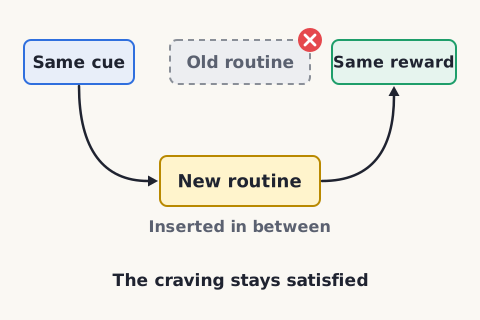
The Golden Rule of Habit Change
You can't erase a bad habit — but you can rewire it. Duhigg's Golden Rule: keep the same cue and the same reward, and insert a new routine in between. The craving stays satisfied; the behavior changes. — The Power of Habit, Charles Duhigg
The keystone habit
A keystone habit is a single habit that sets off a cascade of other positive changes. Exercise is the classic example — it tends to improve sleep, diet, and mood without any of them being targeted directly.

What keeps the loop spinning
In Duhigg's habit loop, it's the craving that drives the cycle to repeat. The cue simply triggers the routine that delivers the reward the craving is actually after.
Anxiety as a cue
Reaching for your phone every time you feel anxious is an emotional-state cue in Duhigg's framework — the habit is triggered by a mood, not by a location or the clock.
Open loops live rent-free
David Allen's GTD targets the real source of workplace anxiety: open loops — unfinished commitments your brain keeps re-surfacing. Get them out of your head and into a trusted system, and the anxiety drains away. Time called it the defining self-help business book of its era. — Getting Things Done, David Allen
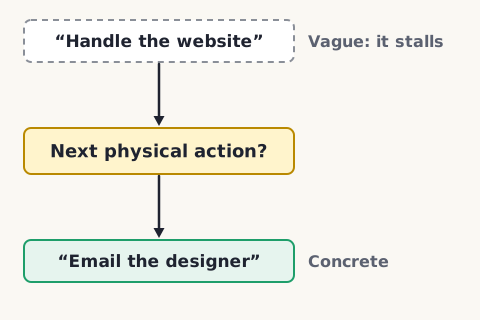
What's the next physical action?
GTD's most practical question. Vague tasks like 'handle the website' stall because there's nothing to do. Ask 'What's the next physical action?' and you get 'email the designer with feedback' — concrete, startable, done. — Getting Things Done, David Allen

The Friday weekly review
Do a weekly review every Friday: clear your inbox, review your projects, and name the three most important tasks for next week. This single habit is what keeps the whole GTD system from quietly collapsing. — Getting Things Done, David Allen
A mind for ideas
David Allen's Getting Things Done rests on one premise: the mind is for having ideas, not holding onto them. Keeping tasks stored in your head wastes the attention that should go toward actually thinking.
The Mind Sweep
GTD's first move is the Mind Sweep: writing down every open commitment, task, idea, and worry into one external system in a single session, instead of trying to hold it all in your head.
By the numbers
- Improving just 1% every day for a year leaves you roughly how many times better?
- 37.78 x
- Under the two-minute rule, a new habit should be scaled down to take no more than how long?
- 2 minutes
Matched pairs
Each item on the left goes with the one on the right.
- Make it Attractive
- Pair the habit with something you enjoy
- Make it Satisfying
- Reward yourself immediately
- Cue: location
- Snacking every time you walk into the kitchen
- Cue: time
- Reaching for coffee at 3pm every day
- Cue: emotional state
- Scrolling your phone whenever you feel anxious
- Cue: other people
- Lighting up because a friend you smoke with is around
- Cue: preceding action
- Checking email the instant you sit down at your desk
- GTD's two-minute rule
- If it takes under 2 minutes, do it now — don't file it
Step by step
Apply the Four Laws of Behavior Change to build a good habit (Atomic Habits)
- Make it Obvious — put the cue in plain sight and design your environment around it.
- Make it Attractive — pair the habit with something you already enjoy.
- Make it Easy — use the two-minute rule and reduce friction.
- Make it Satisfying — reward yourself immediately so the loop closes.
To break a bad habit, invert each law: make it invisible, unattractive, hard, and unsatisfying.
Run the five-step Getting Things Done workflow
- Capture — collect everything demanding attention into one trusted inbox.
- Clarify — process each item: what is it, and is it actionable?
- Organize — file it where it belongs: calendar, next actions, someday/maybe, or reference.
- Reflect — review the system weekly so it stays current and trusted.
- Engage — simply do, executing from your organized lists.
If an action takes less than two minutes during Clarify, just do it — don't put it in the system.
Self-test
Answer each question from memory, then check your work against the answer key.
1. In Atomic Habits, the two-minute rule is the practical tool for which of the four laws?
- AMake it Obvious
- BMake it Attractive
- CMake it Satisfying
- DMake it Easy
2. How does James Clear define an atomic habit?
- AA tiny, routine behavior that is the building block of a remarkable result
- BA demanding daily challenge meant to test your willpower
- CA once-a-week ritual that resets your motivation
- DA large goal broken into monthly milestones
3. Under the two-minute rule, a new habit should be scaled down so it takes no more than how long?
- ATwo hours
- BTen minutes
- CTwo minutes
- DThirty seconds
4. Improving just 1% every day for a year leaves you roughly how many times better?
- A12x
- B37.78x
- C100x
- D3.65x
5. Applying the two-minute rule, what should 'go for a run' be scaled down to as a starting ritual?
- APutting on your running shoes
- BSigning up for a marathon
- CRunning for the full planned distance
- DBuying new running gear
6. In Clear's four laws, which tactic corresponds to 'Make it Attractive'?
- AReward yourself immediately
- BScale the habit to under two minutes
- CPair the habit with something you enjoy
- DPut the cue in plain sight
7. Which tactic matches Clear's law 'Make it Satisfying'?
- AMake the cue obvious in your environment
- BPair the habit with something you enjoy
- CShrink the habit to two minutes
- DReward yourself immediately
8. Which of these is NOT one of Clear's four laws of behavior change?
- AMake it Satisfying
- BMake it Difficult
- CMake it Obvious
- DMake it Attractive
9. You let yourself listen to a favorite podcast only while doing the dishes. Which of Clear's four laws does this temptation-bundling tactic use?
- AMake it Obvious
- BMake it Easy
- CMake it Satisfying
- DMake it Attractive
10. Right after each workout you drop a marble into a jar so your progress feels good in that instant. Which of Clear's four laws does this use?
- AMake it Obvious
- BMake it Satisfying
- CMake it Easy
- DMake it Attractive
11. To change a bad habit using Duhigg's Golden Rule, what do you swap out?
- AThe routine — keeping the same cue and reward
- BAll three at once
- CThe cue — keeping the same routine and reward
- DThe reward — keeping the same cue and routine
12. What is the correct order of the three stages in Duhigg's habit loop?
- ARoutine → Cue → Reward
- BCue → Reward → Routine
- CCue → Routine → Reward
- DReward → Cue → Routine
13. What is a keystone habit?
- AA goal you set at the start of each year
- BThe reward stage at the end of the habit loop
- CA habit that can only be done in under two minutes
- DA single habit that triggers a cascade of other positive changes
14. Which habit does Duhigg cite as the most-studied example of a keystone habit?
- AJournaling
- BExercise
- CWaking up early
- DFlossing
15. In the habit loop, what drives the cycle to repeat?
- AA craving
- BAn accountability group
- CThe cue's location
- DWillpower depletion
16. Reaching for coffee at 3 p.m. every day is an example of which type of cue?
- ALocation
- BOther people
- CTime
- DEmotional state
17. Snacking every time you walk into the kitchen is triggered by which category of cue?
- ALocation
- BTime
- CPreceding action
- DOther people
18. Scrolling your phone whenever you feel anxious is an example of which cue type?
- ATime
- BEmotional state
- CPreceding action
- DLocation
19. Lighting up because a friend you smoke with is around illustrates which cue?
- ATime
- BEmotional state
- CLocation
- DOther people
20. Which of the following is NOT one of Duhigg's five categories of cue?
- APreceding action
- BLocation
- CReward size
- DTime
21. What is the core premise of David Allen's Getting Things Done?
- AThe mind works best under tight deadline pressure
- BThe mind is for having ideas, not holding them
- CProductivity comes from doing more tasks faster
- DThe mind can reliably track a dozen priorities at once
22. How does GTD define an open loop?
- AAn unfinished commitment your mind keeps re-surfacing because it isn't captured reliably
- BA task you have already completed and filed away
- CA reward delivered at the end of a habit
- DA meeting that runs longer than scheduled
23. What is the Mind Sweep in GTD?
- ADeleting your inbox without reading it
- BScheduling demanding work for the morning
- CRewarding yourself after finishing a project
- DWriting down every open loop into one external system in a single session
24. Under GTD's two-minute rule, what should you do with a next action that takes under two minutes?
- ADelegate it to someone else
- BFile it for the weekly review
- CDo it immediately rather than capturing it
- DBreak it into smaller steps
25. GTD's clarifying question turns 'handle the website' into a startable task by asking what?
- AWho should own this task?
- BHow long will the whole project take?
- CWhat's the next physical action?
- DWhy does this matter to me?
Go deeper
- WatchWhy Open Loops Nag You Your brain keeps saying "call the dentist." That is storage, not thinking.
- StudyTips for Living Your Best Life in the FlashFeed app
Answer key
- 1. D Make it EasyThe two-minute rule scales a habit down so starting is effortless, removing the activation barrier — that is exactly the third law, Make it Easy.
- 2. A A tiny, routine behavior that is the building block of a remarkable resultAn atomic habit is a tiny, trivial-feeling behavior that compounds into outsized change — the building block of a remarkable result, not a big challenge or a goal.
- 3. C Two minutesThe two-minute rule scales a habit down until it can be done in under two minutes, removing the friction of starting.
- 4. B 37.78xCompound growth of 1% daily over a year multiplies to about 37.78x better; a 1% daily decline leaves you near zero.
- 5. A Putting on your running shoesThe two-minute rule reduces a habit to its smallest starting act — running becomes just putting on your shoes — so the activation barrier disappears.
- 6. C Pair the habit with something you enjoy'Make it Attractive' means temptation bundling — pairing the habit with something you enjoy. Rewarding immediately is 'Make it Satisfying'.
- 7. D Reward yourself immediately'Make it Satisfying' means the reward comes immediately, not weeks later. Pairing with something enjoyable is 'Make it Attractive'.
- 8. B Make it DifficultThe four laws are Make it Obvious, Attractive, Easy, and Satisfying. 'Make it Difficult' is not one — the third law is actually Make it Easy.
- 9. D Make it AttractiveTemptation bundling — enjoying something in the moment you do the habit — is Clear's 'Make it Attractive.' 'Make it Satisfying' would instead be an immediate reward after finishing.
- 10. B Make it SatisfyingAn immediate, in-the-moment reward after the habit is 'Make it Satisfying.' 'Make it Attractive' instead makes the habit appealing beforehand via temptation bundling.
- 11. A The routine — keeping the same cue and rewardThe Golden Rule keeps the cue and reward intact and replaces only the routine in the middle, so the craving is still satisfied by a better behavior.
- 12. C Cue → Routine → RewardThe habit loop runs Cue → Routine → Reward, with a craving driving the cycle to repeat.
- 13. D A single habit that triggers a cascade of other positive changesA keystone habit sets off a cascade of other improvements — exercise is the classic example, improving sleep, diet, and mood without targeting them directly.
- 14. B ExerciseExercise is the classic keystone habit because it tends to improve sleep, diet, and mood without those being targeted directly.
- 15. A A cravingA craving is what drives the loop to repeat; the cue merely triggers the routine that delivers the reward the craving seeks.
- 16. C TimeA fixed clock trigger like 3 p.m. is a time cue. Location would be a place; emotional state would be a feeling.
- 17. A LocationBeing triggered by a place — the kitchen — is a location cue, one of Duhigg's five cue types.
- 18. B Emotional stateAnxiety is a feeling, so this is an emotional-state cue — the habit is triggered by a mood, not a place or clock.
- 19. D Other peopleThe trigger is the presence of a particular person, so it is the 'other people' cue category.
- 20. C Reward sizeThe five cue types are location, time, emotional state, other people, and preceding action. 'Reward size' is not among them.
- 21. B The mind is for having ideas, not holding themAllen's whole system rests on offloading commitments: the mind is for having ideas, not holding them. Storing tasks in your head wastes the attention meant for thinking.
- 22. A An unfinished commitment your mind keeps re-surfacing because it isn't captured reliablyOpen loops are unfinished commitments, tasks, or worries the brain involuntarily re-surfaces because they aren't stored in a trusted system.
- 23. D Writing down every open loop into one external system in a single sessionThe Mind Sweep is GTD's first move: evacuate every task, commitment, idea, and worry out of your head into one trusted external system.
- 24. C Do it immediately rather than capturing itIf a next action takes under two minutes, do it now — the cost of re-processing it later exceeds the cost of doing it immediately.
- 25. C What's the next physical action?'What's the next physical action?' converts a vague task into something concrete and startable, like 'email the designer with feedback on the homepage draft'.
Sources
- The Ultimate Knowledge Pack: Productivity Tips & Life Hacks (18 books) — research compilation
Image credits
- You fall to your systems: Wikimedia Commons · Duesseljan · CC0 — commons.wikimedia.org/wiki/File:Staircase_at_Palazzo_Trabucco.jpg
- 37 times better: Wikimedia Commons · L rempe - Dr. Lasse Rempe · CC BY 3.0 — commons.wikimedia.org/wiki/File:Exponential_Parameter_Space.png
- Make it Attractive: AI-generated (gpt-image-1.5)
- The Golden Rule of Habit Change: FlashFeed original diagram · CC-BY-4.0
- What keeps the loop spinning: AI-generated (gpt-image-1.5)
- What's the next physical action?: FlashFeed original diagram · CC-BY-4.0
- The Friday weekly review: AI-generated (gpt-image-1.5)
- The Mind Sweep: Wikimedia Commons · OilAndViniger · CC BY-SA 4.0 — commons.wikimedia.org/wiki/File:SSNB2994.jpg


