
Tips for Living Your Best Life study guide · Lesson 1 of 12
Mindset & Mental Performance
Growth mindset & two systems · Finding your why (Frankl) · Values & present-moment awareness
This is the lesson's study guide from the FlashFeed app, plus its key facts and a self-test.
What you'll be able to do
- Distinguish a growth mindset from a fixed mindset and identify how to reinforce it (praise process/effort, add "yet").
- Distinguish Kahneman's System 1 (fast, intuitive) from System 2 (slow, deliberate) thinking and recognize substitution bias.
- Explain Frankl's logotherapy and the three concrete avenues through which meaning is found.
- Apply Tolle's pain body and Manson's three questions to direct attention toward what matters.
- Match the landmark mindset books to their authors (Dweck, Kahneman, Manson).
Growth mindset & two systems
Two ideas from two landmark books underpin everything else in this course: Carol Dweck's finding that ability is trainable, and Daniel Kahneman's map of the two systems your brain thinks with. Master these and the later habits, finance, and negotiation moves all have somewhere to stand.
The most useful word: "yet"
Dweck's research at Stanford split people into two camps. A fixed mindset treats intelligence and talent as set at birth, so every challenge becomes a referendum on who you are and every failure a permanent verdict. A growth mindset treats ability as something effort and learning expand, so obstacles are just information. The hinge between them is one word: "I can't do this" is a closed verdict; "I can't do this yet" is an open trajectory. Reinforce it by praising process over outcome — judge your work by strategy, effort, and progress, not the raw score. Children praised for effort rather than cleverness, in Dweck's studies, later chose harder problems and recovered better from setbacks.
Failure is data, not a verdict
The practical engine of a growth mindset is how you metabolize mistakes. Every setback carries usable information if you mine it, so after one, ask two questions: What did I learn? How will I apply this next time? That turns a loss into a lesson instead of a label. The deeper move is to seek discomfort on purpose — growth happens at the edge of your comfort zone, not inside it, so people who improve fastest deliberately take on tasks they might fail. A fixed mindset avoids those tasks precisely because failure would feel like exposure.
Sleep on it
Kahneman's Thinking, Fast and Slow describes two modes of thought. System 1 is fast, intuitive, automatic, and emotional — it runs the show most of the day. System 2 is slow, deliberate, effortful, and logical — and it's lazy, happy to rubber-stamp whatever System 1 hands it. Most everyday errors come from letting System 1 answer a question that needed System 2. The cheapest fix is time: before any significant decision — money, relationships, career — delay your answer by at least one night. The pause lets deliberate thinking catch what intuition glossed over, which is why "sleep on it" is more than folk wisdom.
Finding your why (Frankl)
Kahneman gives you one last tool for protecting your best thinking; then Viktor Frankl — psychiatrist and survivor of four Nazi concentration camps — supplies the deepest answer to why you'd bother. His school of thought, logotherapy, is the only major psychology built on meaning-seeking as the primary human drive.
Decision fatigue is real
Every minor choice you make spends from the same limited pool of mental energy that important choices draw on. Kahneman's lesson is that System 2 — your deliberate mind — tires as it works, so by evening a depleted brain defaults to lazy System 1 judgments. The move is to standardize the trivial: pre-decide meals, outfits, and your morning routine so willpower is rested when a decision that matters arrives. A related trap is anchoring — the first number you see skews your sense of value — so research prices before any negotiation rather than letting a listing set your reference point.
"He who has a Why..."
"He who has a Why to live for can bear almost any How." Frankl borrowed Nietzsche's line to name the spine of Man's Search for Meaning. In the camps he watched who survived and who gave up, and concluded that it was rarely the strongest body but the person who still had something to live for — a task unfinished, a person to return to. Meaning, not conditions, determined endurance. That is the claim logotherapy is built on.
What does life expect of ME?
Frankl's great inversion flips the question everyone asks. Stop asking "What do I expect from life?" and ask "What does life expect of me?" The reframing moves you from a passive consumer of circumstances to an active respondent to them — the first step out of helplessness. Frankl taught that meaning is found concretely: in work or a deed, in love for another person, and in the stance we take toward unavoidable suffering. The question makes those avenues visible.
The last human freedom
"Everything can be taken from a man but one thing," Frankl wrote, "the last of the human freedoms — to choose one's attitude in any given set of circumstances." Stripped of family, profession, and even his name, he found that the freedom to choose a response remained. You can practice it daily: when something goes wrong, pause before reacting and ask, "What's the most useful response I can choose here?" Attitude is the one variable circumstance can't seize.
Values & present-moment awareness
Where Frankl asks what your life is for, Mark Manson and Eckhart Tolle ask where your attention goes day to day. One trims the list of things you let matter; the other pulls you out of compulsive thinking and back into the present.
Care about less, on purpose
Manson's counterintuitive claim in The Subtle Art of Not Giving a F*ck is that your problem isn't that you don't care enough — it's that you care about too many things indiscriminately. Attention is finite, so spreading it across every minor slight and stranger's opinion leaves nothing for what actually matters. Happiness comes from intentional action toward a short list of real values. Treat stress and overwhelm as a signal: usually it means your actions have drifted out of line with your top values, and the fix is to subtract, not add.
Choose your suffering
Every worthwhile goal comes packaged with difficulty, so Manson argues the useful question isn't "What do I want?" — almost everyone wants the reward — but "What am I willing to suffer for?" The body you want comes with the gym; the business comes with the risk and long hours. Pick the struggle you'll genuinely accept and the goal sorts itself out; refuse the struggle and the want was never real. A corollary: stop spending energy managing strangers' opinions of you. That energy is simply stolen from your own goals.
You are not your thoughts
Tolle's core move in The Power of Now is to observe your mind without becoming it. When a thought appears, notice it and let it pass — you are not the thought, you are the awareness watching it. Much of the mind's internal commentary is just noise: repetitive, unnecessary, unproductive replaying of past and rehearsing of future. Recognizing it as noise, rather than as you, is the first step to reclaiming your mental energy from it. (Tolle calls the stored residue of old emotional hurt the pain body — it gets re-activated by present situations and hijacks your reaction.)
Breath is the anchor
The simplest, most accessible meditation there is: whenever you feel overwhelmed, take three slow breaths and return attention to physical sensation. The breath is always available and always in the present, so it pulls you out of the thought-stream and into now. You can extend the practice into ordinary life — washing dishes, walking, driving — any activity usually treated as a means to an end becomes a presence practice the moment you bring full attention to the sensations involved.
Key terms
- Growth mindset
- The belief that intelligence, talent, and ability are not fixed but can grow with effort and learning — so obstacles are information, not verdicts.
- Fixed mindset
- The belief that your abilities are set at birth — so challenges feel like a test of who you are, and failure reads as a permanent verdict rather than feedback.
- System 1
- Your fast, intuitive, emotional mode of thinking. It runs automatically and effortlessly — great in familiar settings, but the source of most daily errors when it handles problems that need deliberation.
- System 2
- Your slow, deliberate, logical mode of thinking. It is effortful and easily lazy — but it's the one you want engaged for significant financial, relational, or career decisions.
- Logotherapy
- Viktor Frankl's school of psychology — the only one built on meaning-seeking as the primary human drive. It holds that purpose, not circumstance, determines psychological survival.
- The pain body
- Tolle's term for accumulated emotional pain that gets re-activated by current situations. When you feel disproportionately upset, it may be old stored pain being triggered — not the present moment itself.
Key concepts
Thinking, Fast and Slow
- A landmark psychology book mapping the two mental systems behind every decision you make.
- It labels one system automatic, intuitive, and emotional, and the other deliberate, effortful, and prone to laziness.
- Daniel Kahneman's classic; its title pairs a speedy pace of reasoning with an unhurried one, and gives us the 'sleep on it' rule.
Key facts

The most useful word: "yet"
Swap "I can't do this" for "I can't do this yet." That single word turns a closed verdict into an open trajectory — improvement becomes possible and imminent. Pair it with praising process over outcome: judge your work by strategy, effort, and progress, not the raw result.
— Mindset, Carol S. Dweck
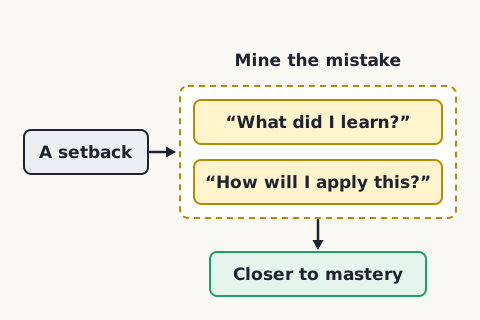
Failure is data, not a verdict
Every mistake moves you closer to mastery — if you mine it. After a setback, ask two questions: What did I learn? How will I apply this next time? People with a growth mindset also seek uncomfortable situations on purpose, because growth happens at the edge of the comfort zone, not inside it.
— Mindset, Carol S. Dweck
Sleep on it
Most daily errors come from letting System 1, your fast and intuitive thinking, handle problems that need System 2, your slow and deliberate thinking. The fix is cheap: before any significant decision — financial, relational, or career — delay your answer by at least one night. The pause gives slow, deliberate thinking time to catch what intuition missed.
— Thinking, Fast and Slow, Daniel Kahneman
The praise experiment
Psychologist Carol Dweck's research found that children praised for their effort, strategy, and progress went on to choose harder problems and recover better from setbacks than children praised for being clever. Praising the process builds a growth mindset; praising raw ability doesn't.
— Mindset, Carol S. Dweck
System 1
Kahneman calls this System 1: fast, intuitive, automatic, and emotional, and it runs most of the day. System 2 is the opposite — slow, deliberate, effortful, and logical.

Decision fatigue is real
Every minor choice you make drains the mental energy available for important ones. Kahneman's practical move: standardize the trivial. Pre-decide meals, outfits, and your morning routine so System 2 is rested when a decision that matters actually arrives. And anchor prices mindfully — a listed number skews your sense of value, so research before any negotiation.
— Thinking, Fast and Slow, Daniel Kahneman

"He who has a Why..."
"He who has a Why to live for can bear almost any How." Nietzsche's line, quoted by Frankl, is the spine of Man's Search for Meaning. Frankl survived four Nazi concentration camps on a single insight: meaning — not conditions — determines whether a person endures.
— Man's Search for Meaning, Viktor Frankl
What does life expect of ME?
Frankl's great inversion: stop asking "What do I expect from life?" and ask "What does life expect of me?" The flip moves you from a passive consumer of circumstances to an active creator of response — the first step out of helplessness.
— Man's Search for Meaning, Viktor Frankl
The last human freedom
Everything can be taken from a person except one thing: the freedom to choose your response in any situation. Practice it daily — when something goes wrong, pause and ask, "What's the most useful response I can choose here?" Attitude is the one variable circumstance can't seize.
— Man's Search for Meaning, Viktor Frankl
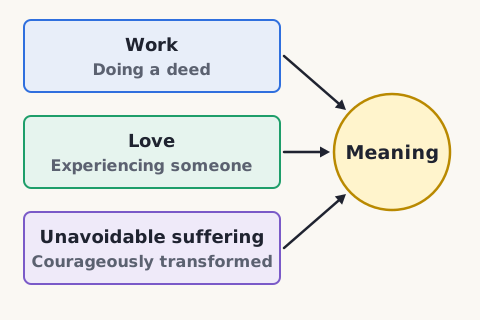
Frankl's three paths
Viktor Frankl argued meaning can be found in three ways: through work (doing a deed), through love (experiencing someone or something), and through the courageous transformation of unavoidable suffering. Wealth and status aren't on that list.

Care about less, on purpose
Manson's counterintuitive claim: the problem isn't that you don't care enough — it's that you care about too many things indiscriminately. Happiness comes from intentional action toward what truly matters. Stress and overwhelm are usually a signal your actions have drifted out of line with your top values.
— The Subtle Art of Not Giving a F*ck, Mark Manson
Choose your suffering
Every worthwhile goal comes with difficulty, so the real question isn't "What do I want?" — it's "What am I willing to suffer for?" Pick the struggle you'll actually accept, and the goal sorts itself out. And stop spending energy managing strangers' opinions; that energy is stolen from your real goals.
— The Subtle Art of Not Giving a F*ck, Mark Manson

You are not your thoughts
Tolle's core move: observe your mind without becoming it. When a thought appears, notice it and let it go — you are not the thought, you are the awareness watching it. Much internal commentary is just noise: repetitive, unnecessary, unproductive. Recognizing it as noise is the first step to reclaiming your mental energy.
— The Power of Now, Eckhart Tolle

The pain body
Eckhart Tolle calls it the 'pain body': accumulated old emotional pain that gets re-activated by present situations and hijacks your reaction. It's stored emotional residue, not a physical or physiological condition.
Matched pairs
Each item on the left goes with the one on the right.
- Mindset
- Carol S. Dweck
- Thinking, Fast and Slow
- Daniel Kahneman
- Man's Search for Meaning
- Viktor Frankl
- The Subtle Art of Not Giving a F*ck
- Mark Manson
- The Power of Now
- Eckhart Tolle
Self-test
Answer each question from memory, then check your work against the answer key.
1. To reinforce a growth mindset, Dweck's research says you should praise a child for what?
- ATheir natural cleverness and talent
- BThe final grade or score they achieved
- CTheir effort, strategy, and progress
- DHow quickly they finished the task
2. In a fixed mindset, how does a person interpret failure?
- AAs useful information to mine and apply
- BAs a permanent verdict about who they are
- CAs a temporary trajectory that effort can change
- DAs a normal step on the road to mastery
3. According to Dweck, adding the word "yet" to "I can't do this" changes it how?
- AFrom a growth statement into a fixed one
- BFrom effort-praise into outcome-praise
- CFrom a goal into an excuse to quit
- DFrom a closed verdict into an open trajectory
4. After a setback, which two questions turn the loss into a lesson?
- AWhat did I learn? How will I apply this next time?
- BWho is to blame? How do I hide it?
- CAm I smart enough? Should I just quit?
- DWhat do I want? Why can't I have it?
5. Which behavior best reflects a growth mindset in practice?
- AAvoiding challenges that risk exposure
- BJudging your work by the raw final score
- CSticking only to what you already do well
- DDeliberately taking on tasks you might fail
6. Which is an example of letting System 1 answer a question that needed System 2?
- ASleeping on a job offer before you reply
- BOrdering your usual coffee on autopilot
- CSigning a big loan on a quick gut feeling
- DResearching prices before opening a negotiation
7. Which description best fits Kahneman's System 1?
- AThe mode reserved for major life decisions
- BFast, intuitive, automatic, and emotional
- CSlow, deliberate, effortful, and logical
- DRested and rational only in the morning
8. Which mode of thinking should you want engaged for a major financial or career decision?
- ASystem 2
- BSystem 1
- CAnchoring
- DThe availability heuristic
9. Why does "sleep on it" before a big decision actually work, per Kahneman?
- AIt removes the need for logical thinking
- BSleep permanently speeds up System 1
- CThe pause lets deliberate System 2 catch what intuition glossed over
- DIt resets any anchoring number automatically
10. Which is NOT a feature of System 1?
- ASlow and effortful
- BEmotional
- CFast and automatic
- DIntuitive
11. Frankl says meaning is found in three ways. Which is NOT one of them?
- ATransforming unavoidable suffering into growth
- BCreating something or doing a deed
- CExperiencing something or loving someone
- DAccumulating wealth and status
12. Logotherapy is the only major psychology built on which primary human drive?
- APower-seeking
- BMeaning-seeking
- CSafety-seeking
- DPleasure-seeking
13. Watching who endured the camps, Frankl concluded survival depended most on what?
- ANothing but random luck
- BBeing younger than other prisoners
- CHaving a Why — something to live for
- DSheer physical strength
14. Frankl's "great inversion" replaces "What do I expect from life?" with which question?
- AWhat does life expect of me?
- BWhen will life finally reward me?
- CWhat can I take from life?
- DWhat do other people expect of me?
15. Which IS one of Frankl's three concrete avenues to meaning?
- AAccumulating wealth and status
- BWinning strangers' approval
- CAvoiding all discomfort
- DThe stance we take toward unavoidable suffering
16. You feel constantly stressed and overwhelmed. According to Manson, what is the most useful fix?
- ACare more about every single item on your plate
- BSubtract what is out of line with your top values
- CAdd more goals so that every priority is covered
- DWin over the strangers who disapprove of your choices
17. Manson argues your real problem with caring is that you...
- ADon't care enough about anything
- BFeel too little emotion overall
- CCare about too many things indiscriminately
- DCare only about yourself
18. Manson says the more useful question than "What do I want?" is which?
- AWhat will other people think?
- BHow do I avoid all struggle?
- CHow fast can I win?
- DWhat am I willing to suffer for?
19. Tolle's "pain body" refers to what?
- AAccumulated old emotional pain re-activated by current situations
- BPhysical injury caused by chronic stress
- CMuscular tension built up from anxiety
- DThe body's fight-or-flight alarm response
20. In Tolle's practice, recognizing repetitive mental commentary as "noise" helps you...
- ASuppress every thought permanently
- BReclaim mental energy by not identifying with it
- CSolve all your problems faster
- DProve the thoughts are actually true
21. You snap angrily at your partner over a tiny comment, way out of proportion. What does Tolle's pain body suggest is happening?
- AOld stored pain is being re-activated now
- BSystem 2 is overriding your intuition
- CYou're finally admitting your true feelings
- DYour partner deliberately tried to hurt you
22. A tiny comment triggers a reaction way bigger than the moment deserves. What should you recognize, per Tolle?
- AThe other person is manipulating you
- BThis is the pain body being triggered, not the moment
- CEscalate until the real issue comes out
- DSuppress the feeling and change the subject
23. Who wrote the book Mindset?
- ADaniel Kahneman
- BMark Manson
- CCarol Dweck
- DViktor Frankl
24. Thinking, Fast and Slow was written by whom?
- ACarol Dweck
- BMark Manson
- CEckhart Tolle
- DDaniel Kahneman
25. The Subtle Art of Not Giving a F*ck was written by whom?
- AMark Manson
- BEckhart Tolle
- CViktor Frankl
- DCarol Dweck
26. Who wrote Man's Search for Meaning?
- ADaniel Kahneman
- BEckhart Tolle
- CViktor Frankl
- DMark Manson
27. Which book-author pairing is INCORRECT?
- AMindset — Carol Dweck
- BThe Subtle Art of Not Giving a F*ck — Mark Manson
- CMan's Search for Meaning — Viktor Frankl
- DThe Power of Now — Daniel Kahneman
Go deeper
- WatchWhat Are You Willing to Suffer For? The body you want comes with the gym. The business comes with risk and long hours.
- StudyTips for Living Your Best Life in the FlashFeed app
Answer key
- 1. C Their effort, strategy, and progressDweck: children praised for effort rather than cleverness later chose harder problems and recovered better — praise the process (strategy, effort, progress), not the raw score.
- 2. B As a permanent verdict about who they areA fixed mindset treats ability as set at birth, so failure reads as a permanent verdict rather than feedback. The other options describe the growth-mindset view of failure as data.
- 3. D From a closed verdict into an open trajectory"I can't do this" is a closed verdict; "I can't do this yet" is an open trajectory where improvement is still possible. That single word is the hinge between the two mindsets.
- 4. A What did I learn? How will I apply this next time?The growth-mindset engine is mining the setback: ask what you learned and how you'll apply it next time. That converts a loss into a lesson instead of a label.
- 5. D Deliberately taking on tasks you might failGrowth happens at the edge of the comfort zone, so people who improve fastest seek discomfort and risk failure on purpose. The other options describe fixed-mindset avoidance.
- 6. C Signing a big loan on a quick gut feelingMost everyday errors come from letting fast, intuitive System 1 answer a question that needed slow, deliberate System 2 — here, a big money decision made on a gut feeling. Your usual coffee order needs no System 2; sleeping on it and researching prices bring it in.
- 7. B Fast, intuitive, automatic, and emotionalSystem 1 is the fast, intuitive, automatic, emotional mode that runs most of the day. The slow, deliberate, effortful, logical description belongs to System 2.
- 8. A System 2System 2 is the slow, deliberate, logical mode you want for significant decisions. System 1 is the lazy default that causes most everyday errors; anchoring and the availability heuristic are cognitive biases, not thinking modes.
- 9. C The pause lets deliberate System 2 catch what intuition glossed overDelaying at least one night gives slow, deliberate System 2 time to catch what fast System 1 missed. It's more than folk wisdom because it engages the deliberate mind.
- 10. A Slow and effortfulSystem 1 is fast, automatic, intuitive, and emotional. "Slow and effortful" describes System 2, not System 1.
- 11. D Accumulating wealth and statusFrankl's three sources of meaning are work (doing a deed), love (experiencing someone or something), and the courageous transformation of unavoidable suffering. Wealth and status aren't on the list.
- 12. B Meaning-seekingFrankl's logotherapy is unique in placing meaning-seeking as the primary human drive, holding that purpose, not circumstance, determines psychological survival.
- 13. C Having a Why — something to live for"He who has a Why to live for can bear almost any How." Frankl found it was rarely the strongest body but the person with something to live for who endured.
- 14. A What does life expect of me?The reframing shifts you from a passive consumer of circumstances to an active respondent — the first step out of helplessness. The other options keep you passive.
- 15. D The stance we take toward unavoidable sufferingFrankl's three avenues are work/a deed, love for another person, and the stance we take toward unavoidable suffering. Wealth, comfort, and approval are not among them.
- 16. B Subtract what is out of line with your top valuesManson treats stress and overwhelm as a signal that your actions have drifted out of line with your top values, and the fix is to subtract, not add. Caring about everything, adding goals, or chasing strangers' approval all spread your attention thinner.
- 17. C Care about too many things indiscriminatelyManson's counterintuitive claim: attention is finite, and spreading it across every minor slight leaves nothing for what matters. The fix is to subtract, caring about a short list of real values.
- 18. D What am I willing to suffer for?Almost everyone wants the reward; the goal sorts itself out once you pick the struggle you'll genuinely accept. Refuse the struggle and the want was never real.
- 19. A Accumulated old emotional pain re-activated by current situationsThe pain body is stored residue of old emotional hurt that gets re-triggered by present situations and hijacks your reaction — not a physical or physiological condition.
- 20. B Reclaim mental energy by not identifying with itYou are the awareness watching the thought, not the thought. Seeing the commentary as noise rather than as you is the first step to reclaiming mental energy from it.
- 21. A Old stored pain is being re-activated nowTolle: a reaction this outsized often means old stored emotional pain (the pain body) is being triggered by the present moment, not the moment itself.
- 22. B This is the pain body being triggered, not the momentWhen you feel disproportionately upset, it may be old stored pain (the pain body) being triggered — not the present situation itself.
- 23. C Carol DweckMindset is Carol Dweck's book on fixed vs. growth mindsets. Kahneman wrote Thinking, Fast and Slow; Manson wrote The Subtle Art; Frankl wrote Man's Search for Meaning.
- 24. D Daniel KahnemanDaniel Kahneman wrote Thinking, Fast and Slow, which maps System 1 and System 2. The distractors authored Mindset, The Power of Now, and The Subtle Art respectively.
- 25. A Mark MansonMark Manson wrote The Subtle Art of Not Giving a F*ck. Tolle wrote The Power of Now, Frankl wrote Man's Search for Meaning, and Dweck wrote Mindset.
- 26. C Viktor FranklViktor Frankl, the psychiatrist and camp survivor who founded logotherapy, wrote Man's Search for Meaning. The others authored different books.
- 27. D The Power of Now — Daniel KahnemanThe Power of Now was written by Eckhart Tolle, not Daniel Kahneman (who wrote Thinking, Fast and Slow). The other three pairings are correct.
Image credits
- The most useful word: "yet": Wikimedia Commons · No machine-readable author provided. MPF assumed (based on copyright… · CC BY 2.5 — commons.wikimedia.org/wiki/File:Picea_sitchensis5.jpg
- Failure is data, not a verdict: FlashFeed original diagram · CC-BY-4.0
- System 1: Wikimedia Commons · Zeynoxxx · CC BY-SA 4.0 — commons.wikimedia.org/wiki/File:3x3x3_Speed_cube.jpg
- Decision fatigue is real: AI-generated (gpt-image-1.5)
- "He who has a Why...": AI-generated (gpt-image-1.5)
- Frankl's three paths: FlashFeed original diagram · CC-BY-4.0
- Care about less, on purpose: Wikimedia Commons · Douglaspperkins · CC BY 3.0 — commons.wikimedia.org/wiki/File:Sunrise_seto14.jpg
- You are not your thoughts: AI-generated (gpt-image-1.5)
- The pain body: AI-generated (gpt-image-1.5)


