
Tips for Living Your Best Life study guide · Lesson 4 of 12
Work & Career
Covey's 7 Habits · Essentialism · Think and Grow Rich · Prioritizing your work
This is the lesson's study guide from the FlashFeed app, plus its key facts and a self-test.
What you'll be able to do
- Explain Covey's private-victory habits (proactivity, Quadrant II, Eisenhower Matrix) and match Habits 2, 5, and 6.
- Define essentialism and apply its "if you don't prioritize, someone else will" logic to incoming requests.
- Explain Hill's core success principles: Definiteness of Purpose, the Master Mind, and Desire vs Decision.
- Recall the scope of Hill's research behind Think and Grow Rich (years, people, steps).
- Apply the Eisenhower Matrix and Manson's values test to prioritize which work is worth your effort.
Covey's 7 Habits
Two books anchor this part: Covey's comprehensive framework for effectiveness and Carnegie's timeless guide to people skills. Together they cover both the inner architecture of high performance and its outward expression in professional relationships.
The arc of the 7 Habits
Stephen Covey's The 7 Habits of Highly Effective People (1989) is structured as a deliberate progression, not a menu. The first three habits — be proactive, begin with the end in mind, and put first things first — form the private victory: mastering yourself before you try to lead others. Being proactive (Habit 1) means focusing your energy on your circle of influence rather than your circle of concern, choosing responses rather than reacting. Habit 2 is Begin With the End in Mind: every project begins with a mental picture of the desired outcome. Habit 3 maps to the Eisenhower Matrix, which sorts tasks by urgent vs. important; Covey's central prescription is to live in Quadrant II — important but not yet urgent — doing planning, relationships, and self-development before they become crises.
Habits 4–6 form the public victory: think win/win, Habit 5 (Seek First to Understand, Then to Be Heard), and Habit 6 (Synergize — combining differences to reach solutions neither party could reach alone). Habit 7, sharpen the saw, is renewal: maintaining the physical, mental, social, and spiritual reserves that make the rest possible. The sequence is the point: private mastery enables public trust; renewal sustains both.
Two Carnegie moves for the office
Dale Carnegie's How to Win Friends and Influence People (1936) predates modern behavioural science yet anticipates many of its findings. Two principles translate directly to management. First, ask questions instead of giving orders: framing a directive as an inquiry — "How do you think we could solve this?" — generates genuine buy-in because people commit more fully to solutions they helped shape. Second, give people a reputation to live up to: explicitly naming someone's capability or character before they demonstrate it activates a desire to be consistent with that label. Both techniques work because they respect autonomy, which Carnegie understood was the deepest human want in professional settings.
Essentialism
Greg McKeown's Essentialism: The Disciplined Pursuit of Less (2014) is a direct rebuttal to the modern productivity cult that treats busyness as a virtue. Its central argument is that doing less — but better — is a strategy, not a compromise.
Someone will prioritize for you
Essentialism is McKeown's term for the disciplined pursuit of less but better: doing only what is truly essential and systematically eliminating everything else. The book's core creed — "If you don't prioritize your life, someone else will" — describes a real dynamic: as your reputation grows, so does the volume of demands on your time, and without active filtration, the most urgent voices (not the most important ones) fill the calendar. The Essentialist asks of every opportunity: Is this the very most important use of my time right now? Most things fail that test. McKeown argues this selective approach is not selfishness but the only way to make a genuinely significant contribution.
Subtract before you add
McKeown's practical discipline mirrors what surgeons call trade-off thinking: before any new commitment lands on your plate, name explicitly what you will stop doing to make room. Saying yes without a corresponding no does not add capacity — it fragments existing capacity. The corollary is learning to give a slow yes and a fast no: most requests deserve a brief, decisive decline, reserving the deliberate yes for the genuine few. This habit requires practice because social pressure pushes toward vague deferral rather than a clean refusal.
Sleep is an Essentialist act
McKeown frames sleep as the highest-leverage Essentialist investment, not a concession to biology. The reasoning is instrumental: you are the asset through which all other work flows, so degrading your cognitive function, creativity, and judgment through sleep deprivation directly cuts the quality of your highest-value output. Research consistently links sleep deprivation to impaired decision-making and reduced impulse control — exactly the capacities an Essentialist needs most. Treating sleep as negotiable is the most common form of false economy in knowledge work.
Think and Grow Rich
Napoleon Hill's Think and Grow Rich (1937) is one of the best-selling self-help books ever published. Its claims were built on an unusually ambitious research project for its time, and several of its core principles have since found empirical support in goal-setting and motivation research.
Where Think and Grow Rich came from
Hill spent 25 years interviewing roughly 500 of the most successful Americans of his era — including Henry Ford, Thomas Edison, Andrew Carnegie, and John D. Rockefeller — and sought the common patterns beneath their divergent paths. The result was 13 principles, which Hill called the laws of success.
Three of the most tested principles are worth knowing in detail. Definiteness of Purpose is Hill's first principle: success begins with knowing exactly what you want, stated precisely, with a deadline. Vague wishes produce vague effort. Desire is Hill's name for the emotional fuel behind that purpose — not a passive wish but a burning, obsession-level commitment to the goal. Hill's distinction matters: Desire means "Turning a wish into a burning, obsession-level commitment," while Decision means "Decide quickly and change your mind slowly." Hill observed that successful people make decisions quickly and change them reluctantly, while unsuccessful people do the reverse.
The Master Mind principle holds that two or more people working toward a common goal in harmony create a "third mind" more powerful than any individual's — an emergent intelligence that neither participant possesses alone. Hill's formula for accumulating money runs to six steps; the most often cited distillation is: fix the amount, decide what you'll give in return, establish a date, create a plan, write it down, and read it aloud twice daily. The repetition is deliberate: Hill believed sustained mental focus shapes behaviour at a level below conscious decision-making, prefiguring what later researchers would call implementation intentions and self-efficacy theory.
Prioritizing your work
This part brings together two frameworks for deciding what deserves your energy at work: Manson's values-first filter and McKeown's subtraction discipline, both of which converge on the same structural tool — the Eisenhower Matrix.
The Subtle Art, applied to work
Mark Manson's The Subtle Art of Not Giving a F*ck (2016) is not primarily a career book, but its framework maps directly onto professional decisions. Manson's test for defining your professional values is deliberately uncomfortable: which problems are you willing to suffer through? Every career involves difficulty; the question is whether your difficulties are the ones you've chosen or ones you've drifted into. The fields where you'll tolerate the grind point toward your genuine calling more reliably than questions about passion.
His practical tools translate cleanly: subtract before you add — name what you'll stop doing before you say yes to anything new — and embrace being wrong faster — ship early, collect real feedback, and iterate rather than perfecting in private. Manson frames willingness to be wrong as a competitive advantage because most people avoid public failure long enough to fall badly behind.
The Eisenhower Matrix sits beneath both frameworks as the operational grid. It sorts every task by two axes: urgent vs. not urgent, and important vs. not important. The dangerous quadrant is urgent-but-not-important — calls, interruptions, most email — which creates the sensation of productivity without advancing anything that matters. Quadrant II is the payoff zone: work that is important but not yet urgent — relationships, planning, skill development, strategic thinking. Both Covey and McKeown argue that almost everyone under-invests in Quadrant II because it carries no deadline pressure, and over-invests in urgent-but-trivial tasks because they shout.
Subtract before you add
Before taking on any new project or role, identify what you will stop doing to make room for it. Energy is finite; a yes without a corresponding no just thins out everything you already do. The discipline applies equally to calendar slots, mental bandwidth, and relationships: addition without subtraction produces dilution, not growth. This principle from Essentialism and Manson's framework both land on it independently, which is the surest sign it reflects something structural about how attention works.
Key terms
- Being proactive (Habit 1)
- Focusing your energy on what you can actually control, rather than fretting over what you cannot. The first private victory and the foundation of the other six habits.
- Quadrant II
- Work that is important but not yet urgent — relationships, planning, self-development. Covey's Habit 3, 'Put First Things First,' means deliberately living here before crises force your hand.
- The Eisenhower Matrix
- A grid that sorts every task by urgent vs. important. The power move: eliminate Quadrant IV (not urgent, not important) entirely, and live in the important-but-not-urgent quadrant.
- Essentialism
- The disciplined pursuit of less but better: doing only what is truly essential and saying no to everything else. — Essentialism, Greg McKeown
- Definiteness of Purpose
- Hill's first principle: success begins with knowing exactly what you want. Vague goals produce vague results, so write your burning desire in specific, measurable terms.
- The Master Mind principle
- Two or more people working toward a common goal in harmony create a 'third mind' more powerful than any individual's. Hill's advice: build your personal board of advisors deliberately.
- Defining your professional values
- Manson's test: which problems are you willing to suffer through? The work whose struggles you'll happily endure points toward your real calling, far better than chasing what merely looks good.
Key concepts
How to Win Friends and Influence People
- A 1936 classic on interpersonal skills that predates modern behavioral science yet anticipates much of it.
- Two of its office moves: ask questions instead of issuing orders, and give someone a reputation to live up to.
- Dale Carnegie's bestseller; its title promises to help you earn allies and sway others.
Think and Grow Rich
- One of the best-selling self-help books ever, built on an unusually ambitious research project for its era.
- Its author spent 25 years studying about 500 of the most successful Americans — Ford, Edison, Carnegie, Rockefeller — to distill 13 principles.
- Napoleon Hill's 1937 classic; its title promises that disciplined mental focus alone can make you wealthy.
The Subtle Art of Not Giving a F*ck
- A bluntly, even profanely titled 2016 bestseller whose framework maps cleanly onto career decisions.
- Its test for finding your real work: which problems are you willing to suffer through? Plus a rule to embrace being wrong faster.
- Mark Manson's book; its title advises caring less — sparingly and on purpose — about most things, using one crude four-letter word.
Key facts
The arc of the 7 Habits
Covey's framework moves through three stages: private victory (habits 1–3, mastering yourself), public victory (habits 4–6, working with others), and renewal (habit 7, keeping the saw sharp). You earn the public wins by securing the private ones first. — The 7 Habits of Highly Effective People, Stephen Covey
Two Carnegie moves for the office
Carnegie's people skills apply straight to managing: ask questions instead of giving orders — 'How could we solve this?' generates buy-in that directives never can. And give people a reputation to live up to — tell someone you believe they're capable of excellence, and watch them rise to it. — How to Win Friends and Influence People, Dale Carnegie
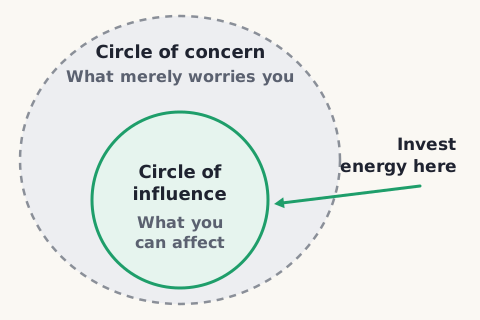
Circle of influence
Covey's Habit 1, Be Proactive, means investing your energy in your circle of influence — what you can actually affect — rather than your circle of concern, the wider set of things that merely worry you.
Quadrant II
In Covey's framework, Quadrant II covers work that's important but not yet urgent — planning, relationships, self-development. Habit 3, Put First Things First, means living there deliberately before those things turn into crises.
Synergize
Habit 6, Synergize, means combining differences between people to reach solutions that neither party could have reached alone.
Someone will prioritize for you
The Essentialist creed: 'If you don't prioritize your life, someone else will.' The more successful you get, the more options appear — and without discipline those options become distractions that dilute the very focus that made you successful. — Essentialism, Greg McKeown
Subtract before you add
Before taking on any new project or role, identify what you will stop doing to make room for it. Energy is finite; a yes without a corresponding no just thins out everything you already do. — Essentialism, Greg McKeown
Essentialism
Greg McKeown defines Essentialism as the disciplined pursuit of less but better — doing only what's truly essential and eliminating the rest. It's a direct rebuttal to treating busyness itself as a virtue.

Two different speeds
McKeown advises Essentialists to handle incoming requests with a slow yes and a fast no — reserving deliberate agreement for the genuine few, while giving most requests a brief, decisive no.
Think and Grow Rich's origins
Napoleon Hill spent 25 years interviewing 500 of history's most successful people — from Henry Ford to Thomas Edison — and distilled 13 repeating principles of success. Published in 1937, it predates modern psychology yet lines up strikingly with today's research on goal-setting. — Think and Grow Rich, Napoleon Hill
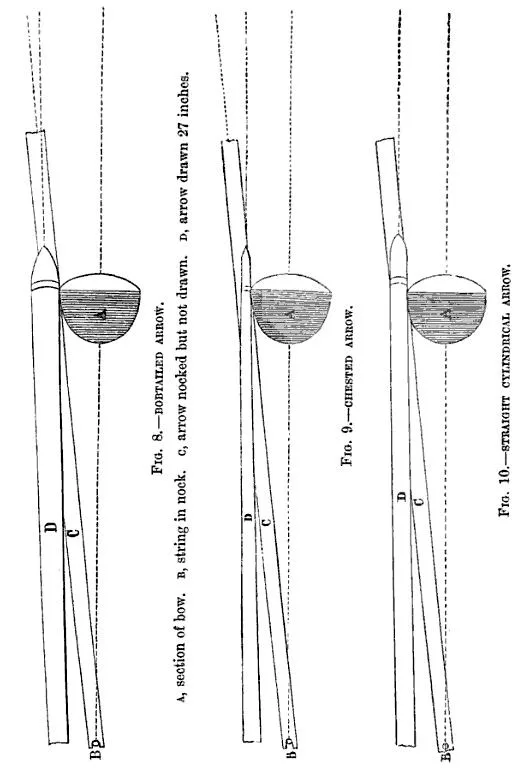
Definiteness of Purpose
Napoleon Hill's Definiteness of Purpose principle means knowing exactly what you want, stated precisely and backed by a deadline. Vague wishes, Hill argued, only ever produce vague effort.
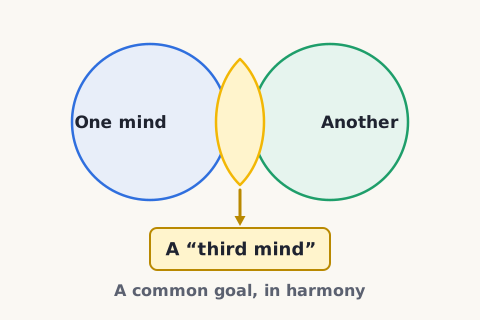
The third mind
Napoleon Hill's Master Mind principle holds that two or more people working toward a common goal in harmony create an emergent 'third mind' more powerful than either person possesses alone.

The decisiveness pattern
Napoleon Hill found that wealthy, successful people decide quickly and then change their minds slowly, while unsuccessful people tend to do the reverse. Hill considered decisiveness a trainable skill.
Hill's six steps
Napoleon Hill's formula for accumulating money runs to six steps: fix the amount you want, decide what you'll give in return, set a date, make a plan, write it down, and read it aloud twice daily.
The Subtle Art, applied to work
Manson's filter for career: subtract before you add — ask what you'll stop doing before saying yes. Define your professional values by asking which problems you're willing to suffer through; that answer points toward your calling. And embrace being wrong faster — ship, get feedback, improve. — The Subtle Art of Not Giving a F*ck, Mark Manson
False productivity
In the Eisenhower Matrix, urgent-but-not-important tasks — calls, interruptions, email — create a false sense of productivity: they shout for attention and feel busy, but advance nothing that actually matters.

The payoff zone
Quadrant II of the Eisenhower Matrix — important work that isn't yet urgent, like relationships and skill development — is the real payoff zone that people under-invest in because it carries no deadline pressure.

Wrong faster
Manson's phrase 'embrace being wrong faster' means shipping work early, collecting real feedback, and iterating instead of trying to perfect it in private. He frames the willingness to fail publicly as a competitive advantage most people avoid.
By the numbers
- How many years Napoleon Hill spent researching Think and Grow Rich
- 25 years
- How many successful people Hill interviewed for his research
- 500 people
- How many steps are in Hill's money formula
- 6 steps
Matched pairs
Each item on the left goes with the one on the right.
- Habit 2
- Begin With the End in Mind
- Habit 5
- Seek First to Understand, Then to Be Understood
- Habit 6
- Synergize
- Desire
- Turning a wish into a burning, obsession-level commitment
- Decision
- Decide quickly and change your mind slowly
Step by step
Walk through Covey's 7 Habits in order
- Be Proactive — focus on what you can control.
- Begin With the End in Mind — define success before you start.
- Put First Things First — live in Quadrant II.
- Think Win-Win — aim for everyone leaving better off.
- Seek First to Understand, Then to Be Understood — listen fully first.
- Synergize — leverage diverse perspectives.
- Sharpen the Saw — renew yourself physically, mentally, emotionally, spiritually.
Habits 1–3 are the private victory, 4–6 the public victory, and 7 is renewal that powers all of them.
Run the 3-phase Essentialist framework
- Explore & Evaluate — protect time to ask: is this the most important use of my energy right now?
- Eliminate — decide what to say no to, and refuse gracefully but clearly.
- Execute — remove obstacles and build systems that make the essential almost effortless.
Explore → Eliminate → Execute. You can't execute well on things you never filtered.
Apply Hill's 6-step money formula to any goal
- Fix in your mind the exact outcome you desire.
- Determine exactly what you will give in return — there's no something for nothing.
- Set a definite date for achieving it.
- Create a definite plan and begin immediately — don't wait for the 'perfect time.'
- Write a clear, concise statement of the first four points.
- Read the statement aloud with full conviction, once each morning and once each night.
Specificity is the engine: an exact outcome, an exact price, a definite date, an immediate start.
Self-test
Answer each question from memory, then check your work against the answer key.
1. In Covey's Habit 1 (Be Proactive), where should you focus your energy?
- AYour circle of comfort — what feels safe
- BYour circle of influence — what you can actually affect
- CYour circle of concern — everything that worries you
- DYour circle of competence — what you know best
2. In Covey's framework, which best describes Quadrant II (the focus of Habit 3, 'Put First Things First')?
- ANeither urgent nor important — idle distractions
- BUrgent but not important — calls, interruptions, most email
- CUrgent and important — genuine crises to firefight
- DImportant but not yet urgent — planning, relationships, self-development
3. What two axes does the Eisenhower Matrix use to sort every task?
- AUrgent vs. important
- BShort-term vs. long-term
- CPersonal vs. professional
- DHard vs. easy
4. Which of these habit-to-summary pairings is NOT correct?
- AHabit 6 — Synergize
- BHabit 2 — Begin With the End in Mind
- CHabit 5 — Synergize
- DHabit 5 — Seek First to Understand, Then to Be Understood
5. Habit 6, Synergize, is best described as which of the following?
- ACombining differences to reach solutions neither party could reach alone
- BFocusing energy on your circle of influence
- CPicturing the desired outcome before starting a project
- DMaintaining physical, mental, social, and spiritual reserves
6. How does McKeown advise Essentialists to handle incoming requests?
- AA fast yes and a slow no
- BA fast yes and a fast no
- CA slow yes and a slow no
- DA slow yes and a fast no
7. How does McKeown define Essentialism?
- ADoing more things in less time
- BThe disciplined pursuit of less but better
- CTreating busyness as a mark of virtue
- DSaying yes to every promising opportunity
8. Complete the Essentialist creed: 'If you don't prioritize your life, ___.'
- Anothing will get done
- Byou will burn out
- Csomeone else will
- Dyou will fall behind
9. Under McKeown's 'subtract before you add' discipline, what must you name before accepting a new commitment?
- AWho else could take it on
- BWhat you will stop doing to make room for it
- CHow long it will take to finish
- DHow much it will pay
10. Faced with a new opportunity, what question does McKeown say the Essentialist asks of it?
- AIs this the very most important use of my time right now?
- BCould I squeeze this in somewhere on my calendar?
- CIs this a good opportunity others would jump at?
- DWill turning this down disappoint the person asking?
11. According to Hill, how do successful people make decisions?
- ADecide slowly and change their minds quickly
- BAvoid deciding until all risk is gone
- CDecide quickly and change their minds slowly
- DLet the Master Mind decide for them
12. What is Hill's first principle, Definiteness of Purpose?
- ADeciding quickly and changing your mind slowly
- BBuilding a personal board of advisors in harmony
- CTurning a wish into a burning, obsession-level commitment
- DKnowing exactly what you want, stated precisely, with a deadline
13. What does Hill's Master Mind principle hold?
- AA burning desire is the fuel behind all achievement
- BReading your goal aloud twice daily reshapes behavior
- CTwo or more people in harmony create a 'third mind' more powerful than any individual's
- DA single decisive genius outperforms any committee
14. Which of Hill's principle-to-meaning pairings is NOT correct?
- ADecision — turning a wish into a burning, obsession-level commitment
- BThe Master Mind — two or more minds in harmony forming a 'third mind'
- CDesire — a burning, obsession-level commitment to the goal
- DDefiniteness of Purpose — knowing exactly what you want, with a deadline
15. Which statement correctly distinguishes Hill's 'Desire' from his 'Decision'?
- ABoth simply mean setting a firm deadline
- BDesire is deciding quickly; Decision is a burning commitment
- CDesire is a detailed plan; Decision is a vague wish
- DDesire is burning obsession-level commitment; Decision is deciding quickly and changing slowly
16. How many years did Napoleon Hill spend researching Think and Grow Rich?
- A6 years
- B25 years
- C50 years
- D13 years
17. Roughly how many of the most successful Americans did Hill interview for his research?
- ARoughly 1,000
- BRoughly 50
- CRoughly 100
- DRoughly 500
18. How many principles — which Hill called the laws of success — did his research produce?
- A6 principles
- B25 principles
- C13 principles
- D7 principles
19. How many steps are in Hill's formula for accumulating money?
- A6 steps
- B13 steps
- C25 steps
- D3 steps
20. Which figure did Hill actually interview for Think and Grow Rich?
- AStephen Covey
- BHenry Ford
- CDale Carnegie
- DGreg McKeown
21. In the Eisenhower Matrix, which tasks create a false sense of productivity — feeling busy without advancing what matters?
- AUrgent and important (genuine crises)
- BNeither urgent nor important (idle distractions)
- CImportant but not urgent (planning, relationships)
- DUrgent but not important (calls, interruptions, email)
22. Manson's test for defining your professional values asks which uncomfortable question?
- AWhat are you naturally best at?
- BWhat are you most passionate about?
- CWhich problems are you willing to suffer through?
- DWhich work pays the most?
23. In the Eisenhower Matrix, which quadrant is the 'payoff zone' that both Covey and McKeown say almost everyone under-invests in?
- AImportant but not urgent (Quadrant II)
- BUrgent and important
- CNeither urgent nor important
- DUrgent but not important
24. According to both Manson and McKeown, a 'yes' without a corresponding 'no' produces what?
- AMore total capacity
- BDilution, not growth
- CSharper focus
- DFaster progress
25. What does Manson mean by 'embrace being wrong faster'?
- AShip early, collect real feedback, and iterate rather than perfecting in private
- BAvoid public failure at all costs
- CAdmit fault quickly to avoid being blamed
- DMake decisions slowly so you make fewer errors
Go deeper
Answer key
- 1. B Your circle of influence — what you can actually affectBeing proactive means investing energy in your circle of influence (what you can actually affect) rather than your circle of concern (what merely worries you).
- 2. D Important but not yet urgent — planning, relationships, self-developmentQuadrant II is important-but-not-yet-urgent work. Covey urges living here deliberately before crises force your hand. The urgent-but-not-important quadrant only feels productive.
- 3. A Urgent vs. importantThe Eisenhower Matrix sorts tasks by urgent vs. important. Covey maps Habit 3 to it, prescribing life in Quadrant II (important but not urgent).
- 4. C Habit 5 — SynergizeHabit 5 is Seek First to Understand; Synergize is Habit 6. Habits 2, 5, and 6 map to Begin With the End in Mind, Seek First to Understand, and Synergize respectively.
- 5. A Combining differences to reach solutions neither party could reach aloneSynergize (Habit 6) means combining differences to reach solutions neither party could reach alone. The other options describe Habits 1, 7, and 2 respectively.
- 6. D A slow yes and a fast noReserve the deliberate yes for the genuine few and give most requests a brief, decisive no. A reflexive yes without a matching no just fragments your capacity.
- 7. B The disciplined pursuit of less but betterEssentialism is the disciplined pursuit of less but better — doing only what is truly essential and eliminating the rest. It is a direct rebuttal to the busyness-as-virtue productivity cult.
- 8. C someone else willThe creed is 'If you don't prioritize your life, someone else will.' Without active filtration, the most urgent voices — not the most important ones — fill your calendar.
- 9. B What you will stop doing to make room for itTrade-off thinking means naming explicitly what you'll stop doing. A yes without a corresponding no fragments existing capacity rather than adding any.
- 10. A Is this the very most important use of my time right now?The Essentialist asks of every opportunity, 'Is this the very most important use of my time right now?' Most things fail that test — merely being a good opportunity, or fitting on the calendar, isn't enough.
- 11. C Decide quickly and change their minds slowlyHill found the wealthy decide quickly and change their minds slowly; the poor do the reverse. Decisiveness is a trainable skill.
- 12. D Knowing exactly what you want, stated precisely, with a deadlineDefiniteness of Purpose means knowing exactly what you want, stated precisely with a deadline. Vague wishes produce vague effort. The other options describe Master Mind, Desire, and Decision.
- 13. C Two or more people in harmony create a 'third mind' more powerful than any individual'sThe Master Mind principle holds that two or more people working toward a common goal in harmony create an emergent 'third mind' that neither participant possesses alone.
- 14. A Decision — turning a wish into a burning, obsession-level commitmentDecision means 'decide quickly and change your mind slowly.' The burning, obsession-level commitment is Desire, not Decision. The other three pairings match Hill's definitions.
- 15. D Desire is burning obsession-level commitment; Decision is deciding quickly and changing slowlyDesire is the burning, obsession-level commitment behind a goal; Decision is Hill's observation that successful people decide quickly and change their minds slowly.
- 16. B 25 yearsHill spent 25 years interviewing successful Americans before distilling his 13 principles of success.
- 17. D Roughly 500Hill interviewed roughly 500 of the most successful Americans of his era — including Henry Ford, Thomas Edison, and Andrew Carnegie.
- 18. C 13 principlesHill distilled his research into 13 principles, which he called the laws of success. (6 is the number of steps in his money formula; 25 is the years of research.)
- 19. A 6 stepsHill's money formula runs to six steps: fix the amount, decide what you'll give, set a date, make a plan, write it down, and read it aloud twice daily.
- 20. B Henry FordHill interviewed Henry Ford (along with Thomas Edison, Andrew Carnegie, and John D. Rockefeller). Dale Carnegie, Covey, and McKeown are other authors, not his interviewees.
- 21. D Urgent but not important (calls, interruptions, email)Urgent-but-not-important tasks shout and feel productive but advance nothing that matters. Real progress lives in Quadrant II: important but not yet urgent.
- 22. C Which problems are you willing to suffer through?Manson asks which problems you're willing to suffer through. The fields whose grind you'll tolerate point toward your calling more reliably than questions about passion.
- 23. A Important but not urgent (Quadrant II)Quadrant II — important but not yet urgent (relationships, planning, skill development) — is the payoff zone. People under-invest in it precisely because it carries no deadline pressure.
- 24. B Dilution, not growthEnergy is finite: addition without subtraction thins out everything you already do, producing dilution rather than growth. That's why you must name what you'll stop doing first.
- 25. A Ship early, collect real feedback, and iterate rather than perfecting in privateEmbracing being wrong faster means shipping early and iterating on real feedback. Manson frames willingness to fail publicly as a competitive advantage most people avoid.
Sources
- The Ultimate Knowledge Pack: Productivity Tips & Life Hacks (18 books) — research compilation
Image credits
- Circle of influence: FlashFeed original diagram · CC-BY-4.0
- Two different speeds: AI-generated (gpt-image-1.5)
- Definiteness of Purpose: Wikimedia Commons · Horace A. Ford, W. Butt · Public domain — commons.wikimedia.org/wiki/File:19th_century_knowledge_archery_of_the_arrow.jpg
- The third mind: FlashFeed original diagram · CC-BY-4.0
- The decisiveness pattern: AI-generated (gpt-image-1.5)
- The payoff zone: AI-generated (gpt-image-1.5)
- Wrong faster: AI-generated (gpt-image-1.5)
