
Tips for Living Your Best Life study guide · Lesson 5 of 12
Finance & Wealth Building
The Rich Dad mindset · Directed desire (Hill) · Avoiding money traps
This is the lesson's study guide from the FlashFeed app, plus its key facts and a self-test.
What you'll be able to do
- Distinguish an asset from a liability using Kiyosaki's cash-flow test.
- Apply the "pay yourself first" discipline and the Rich Dad money-mindset shifts.
- Explain Hill's directed desire: definiteness of purpose, naming the exact number, the Master Mind, and deciding quickly.
- Identify the cognitive money traps (loss aversion, availability heuristic) and the 24-hour rule that counters them.
The Rich Dad mindset
Robert Kiyosaki's Rich Dad, Poor Dad argues that the gap between the wealthy and everyone else is philosophical before it is financial — a difference in how people think about money, not merely how much they earn.
Eight paradigm shifts
Kiyosaki structures his book around the contrast between two father figures: his educated but financially struggling biological father ("Poor Dad") and his school-dropout but wealthy friend's father ("Rich Dad"). The central lesson is that the middle class work for money while the rich let money work for them. This distinction drives every other shift.
At the core of Kiyosaki's framework are two definitions. An asset is anything that puts money into your pocket — rental income, dividends, a business that runs without you. A liability is anything that takes money out of your pocket — a car payment, consumer debt, even a mortgage you can't rent out. Most people, he argues, spend their lives accumulating liabilities they mistake for assets.
The book's most quoted principle is pay yourself first: before paying bills or discretionary spending, route a portion of every paycheck to income-generating investments. This reverses the default order (earn → spend → save whatever remains) and forces the financial system to work around your investment habit rather than crowding it out.
Kiyosaki also criticizes the phrase "I can't afford it" as a thought-stopper. He recommends replacing it with "How can I afford it?" — a question that keeps the brain problem-solving rather than surrendering. The shift is small linguistically and significant psychologically.
Financial education, in Kiyosaki's framing, is the highest-return investment available — understanding accounting, investing, and markets before deploying capital. The rich prioritize it; the conventionally educated often skip it in favour of credential accumulation.
Directed desire (Hill)
Napoleon Hill spent 25 years interviewing 500 of history's most successful people — from Henry Ford to Thomas Edison — and distilled their patterns into Think and Grow Rich (1937). His thesis is that wealth is not mainly a matter of circumstance but of specific, disciplined mental habits applied to specific targets.
Directed desire
Hill's opening claim is that desire — not luck or inheritance — is the starting point for all achievement. The distinction he insists on is between a vague wish and a definiteness of purpose: a precise, emotionally charged intention backed by a concrete plan. Wishing to be "rich" produces nothing; committing to a specific outcome with organised action produces a plan the mind can actually execute. This is the book's foundational idea and the concept all later chapters build on.
Know the exact number
Hill's method requires writing down the precise amount of money you want, the exact date by which you will have it, what you will give in return, and a clear plan for proceeding. Specificity matters because the brain's reticular activating system (RAS) — the neural filter that decides what to notice — is tuned by clear targets. A vague goal gives the RAS nothing to calibrate on; a precise one causes you to start seeing relevant opportunities, contacts, and resources that were present all along but previously filtered out.
The most expensive habit
Hill found a consistent pattern among the wealthy people he studied: they decided quickly once they had enough information, and they changed their minds slowly even under social pressure. The inverse — chronic indecision — carries a compounding cost. Delaying an investment decision by even a few years forfeits years of compound growth, a loss that cannot be recovered. Procrastination, Hill argued, is the most expensive financial habit most people maintain.
Go deep before you diversify
Hill distinguished specialised knowledge from general education. General education broadens you; specialised knowledge — deep mastery of a single domain such as real estate, equities, or a specific industry — is what generates exceptional returns. His advice is to pick one vehicle, study it until you understand it better than most practitioners, and only then consider expanding. The Master Mind principle extends this: surround yourself with people whose specialised knowledge complements your own, creating a group intelligence — what Hill called a "third mind" — that exceeds any individual's capacity.
Avoiding money traps
Daniel Kahneman's Thinking, Fast and Slow (2011) is not a personal-finance book, but its findings about how the brain makes decisions apply directly to money. Financial decisions are among the places where automatic mental shortcuts most reliably misfire.
Money is a System 1 minefield
Kahneman's central framework divides cognition into System 1 (fast, automatic, emotional, pattern-matching) and System 2 (slow, deliberate, effortful, logical). Most financial decisions arrive under conditions that favour System 1: urgency, novelty, or social pressure. The problem is that System 1 is riddled with predictable errors when applied to numbers and probability.
The most financially costly of these is loss aversion: the tendency to feel the pain of a loss roughly twice as intensely as the pleasure of an equivalent gain. Loss aversion drives investors to sell falling assets too early (to stop the pain) and hold losing positions too long (to avoid crystallising the loss) — both destructive patterns.
The availability heuristic compounds this. The brain judges the probability of an event by how easily examples come to mind, not by base rates. After a market crash, the next crash feels imminent; after a bull run, gains feel inevitable. Recent vivid events are overweighted; quiet long-run statistics are underweighted. This is why retail investors systematically buy high and sell low.
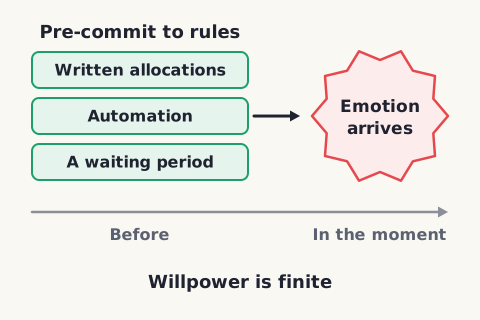
Kahneman's prescription is not to trust yourself to reason clearly in the moment. Instead, pre-commit to rules before emotion arrives: set your asset allocation in writing, automate contributions, and impose a mandatory 24-hour waiting period before any non-essential purchase. The delay lets System 2 catch up and check whether the impulse survives scrutiny. Willpower is a finite resource; rules and structure are not.
Key terms
- Asset
- Anything that puts money into your pocket. Building wealth means acquiring assets and letting them buy your luxuries. — Rich Dad, Poor Dad, Robert Kiyosaki
- Liability
- Anything that takes money out of your pocket. Kiyosaki argues your own house is a liability, not the asset most people assume. — Rich Dad, Poor Dad, Robert Kiyosaki
- Pay yourself first
- Before bills or discretionary spending, route money to income-generating investments. You invest first and live on the rest. — Rich Dad, Poor Dad, Robert Kiyosaki
- The Master Mind principle
- Two or more people working toward a common goal in harmony create a 'third mind' more powerful than any individual's. Hill's advice: build your personal board of advisors deliberately.
- Loss aversion
- The tendency to feel losses more intensely than equivalent gains. Checking your portfolio too often amplifies it and leads to poor timing. — Thinking, Fast and Slow, Daniel Kahneman
- The availability heuristic
- A mental shortcut that judges how likely something is by how easily examples come to mind, so recent crashes or booms feel more probable than they are. — Thinking, Fast and Slow, Daniel Kahneman
Key concepts
Pay Yourself First
- Robert Kiyosaki calls this the most-quoted principle in Rich Dad, Poor Dad.
- It flips the usual sequence of earn, then spend, then save whatever happens to be left.
- Before a single bill or discretionary purchase, route a slice of every paycheck straight into income-generating investments — you come ahead of the creditors.
Definiteness of Purpose
- Napoleon Hill's foundational claim, and the idea every later chapter of Think and Grow Rich builds on.
- It's the gap between a vague wish to be 'rich' and a precise, emotionally charged target backed by a concrete plan.
- Fix the exact amount, the exact date, and what you'll give in return — an aim pinned down with total precision, never a fuzzy one.
The Master Mind
- Napoleon Hill's principle for multiplying your capability by surrounding yourself with exactly the right people.
- Two or more people working toward a common goal in harmony create an emergent 'third intelligence' that no individual possesses alone.
- Assemble allies whose specialized knowledge complements yours; the name casts this pooled brain-trust as one commanding, expert intellect.
Loss Aversion
- Kahneman names this the single most financially costly of the automatic mental errors that wreck money decisions.
- You feel the sting of a setback about twice as intensely as the pleasure of an equal-sized gain.
- It pushes investors to dump falling assets too early and cling to sinking positions too long; its name is the strong dislike of giving up what you already hold.
The Availability Heuristic
- A mental shortcut Kahneman blames for retail investors systematically buying high and selling low.
- Your brain judges how likely something is by how easily examples spring to mind, not by the actual base rates.
- After a crash the next crash feels imminent; after a bull run, gains feel inevitable — recent, vivid events dominate because they spring so readily to mind and are close at hand.
Key facts
Eight paradigm shifts
Robert Kiyosaki's Rich Dad, Poor Dad argues the gap between the rich and everyone else is mental, not arithmetic. The rich make money work for them, buy assets before luxuries, and treat financial education as the highest-return move they can make.
— Rich Dad, Poor Dad, Robert Kiyosaki

House as liability
Robert Kiyosaki calls the home you live in a liability, not an asset, because it drains money through payments and upkeep while generating no rental income. His test is about the direction cash flows, not the home's appreciation in value.
The affordability reframe
Kiyosaki advises replacing the thought-stopping phrase 'I can't afford it' with the question 'How can I afford it?' The shift keeps the brain actively problem-solving instead of shutting down — a small linguistic change with a large psychological effect.
The Rich Dad distinction
Kiyosaki's central Rich Dad distinction is that the middle class works for money while the rich make money work for them instead. He frames the gap between the two as philosophical before it is financial.

The highest-return investment
Kiyosaki calls financial education — understanding accounting, investing, and markets — the highest-return investment available, best acquired before deploying any capital. He says the rich prioritize it while the credential-focused often skip it.
Directed desire
Napoleon Hill's Think and Grow Rich isn't about greed — it's about directed desire with organized action. Vague wishes do nothing; a precise target, a deadline, and a circle of sharp people turn desire into a plan.
— Think and Grow Rich, Napoleon Hill
Know the exact number
Don't say "I want to be wealthy." Say "I want $10,000/month in passive income by [a specific date]." Specificity activates your reticular activating system — your brain starts noticing the opportunities that match the target.
— Think and Grow Rich, Napoleon Hill
The most expensive habit
Hill found that wealthy people decide quickly and change their minds slowly. Procrastination is the most expensive financial habit there is — delaying your investments by even five years carries an enormous compound-interest cost.
— Think and Grow Rich, Napoleon Hill
Go deep before you diversify
Hill prized specialized knowledge over general knowledge. Pick one domain — real estate, equities, or small business — and master it before you spread yourself across everything. Depth first, breadth later.
— Think and Grow Rich, Napoleon Hill

The Master Mind principle
Napoleon Hill's Master Mind principle describes a deliberate group of complementary specialists whose combined intelligence — a 'third mind' — exceeds what any individual member could produce alone.
Money is a System 1 minefield
Daniel Kahneman's Thinking, Fast and Slow shows that money decisions are riddled with System 1 errors — fast, emotional, and often wrong. The fix isn't more willpower; it's pre-committing to rules before emotion shows up.
— Thinking, Fast and Slow, Daniel Kahneman
Twice as painful
Kahneman's research on loss aversion found that people feel a financial loss roughly twice as intensely as an equally sized gain. That asymmetry drives investors to sell falling assets too early and hold losing ones too long.
The availability heuristic
The availability heuristic is judging how likely something is by how easily examples come to mind. A recent market crash or boom ends up feeling more probable than the actual base rates warrant.
The 24-hour rule
Kahneman-inspired money rules impose a mandatory 24-hour waiting period before any non-essential purchase, giving slow, deliberate System 2 thinking time to catch up and test whether the impulse survives scrutiny.
Rules over willpower
Kahneman's actual fix for money traps is to pre-commit to rules before emotion arrives, since willpower is finite — written allocations, automation, and a waiting period, rather than trusting your gut in the moment.
By the numbers
- How long should you wait before any non-essential purchase, per Kahneman's impulse-killing rule?
- 24 hours
Matched pairs
Each item on the left goes with the one on the right.
- "I can't afford it."
- "How can I afford it?"
- Work for money
- Make money work for you
- Buy luxuries first
- Buy assets; let assets buy luxuries
- Decide quickly
- Change your mind slowly
Step by step
Build wealth the Rich Dad way
- Pay yourself first — route money to investments before bills or spending.
- Use that money to buy income-producing assets.
- Reinvest the income those assets generate to acquire more assets.
- Once the asset income is large enough, let it buy your luxuries.
- Keep investing in financial education to compound the whole loop.
The order is the point: assets buy luxuries, never the other way round.
Self-test
Answer each question from memory, then check your work against the answer key.
1. In Kiyosaki's Rich Dad framework, which of these counts as an ASSET?
- AA rental property that puts monthly income in your pocket
- BA car you're still making monthly payments on
- CA mortgage on a home you live in but can't rent out
- DCredit-card debt from a vacation
2. How does Kiyosaki define an asset?
- AAnything you have fully paid off
- BAnything that takes money out of your pocket
- CAnything you own that has resale value
- DAnything that puts money into your pocket
3. Which of these is a LIABILITY under Kiyosaki's cash-flow test?
- AA small business that runs and profits without you
- BConsumer debt from a vacation on your credit card
- CA stock that pays quarterly dividends
- DAn apartment you rent out for income
4. Why does Kiyosaki call the home you live in a liability?
- AIt always loses resale value over time
- BMortgages are legally barred from counting as assets
- CIt takes money out of your pocket and you can't rent it out
- DHomes can never appreciate in value
5. You buy a rental condo, but its mortgage, taxes, and upkeep cost more each month than the rent it brings in. Under Kiyosaki's cash-flow test, what is it right now?
- AAn asset — rental real estate counts as an asset by definition
- BA liability — it takes more money out of your pocket than it puts in
- CNeither — it only counts once the mortgage is fully paid off
- DAn asset — you hold the title, so it adds to your net worth
6. What does Kiyosaki's 'pay yourself first' discipline mean?
- APay off every debt before you invest a single dollar
- BGive yourself a cash bonus after each paycheck
- CPay your bills first, then invest whatever remains
- DRoute money to income-generating investments before bills or spending
7. Kiyosaki says to replace 'I can't afford it' with which phrase?
- A'How can I afford it?'
- B'I'll just save up for it.'
- C'I don't really need it.'
- D'I'll afford it someday.'
8. According to Kiyosaki, what most separates the rich from the middle class?
- AThe rich simply earn much higher salaries
- BThe rich avoid taking on any debt at all
- CThe rich make money work for them; the middle class work for money
- DThe rich inherit wealth while the middle class earn it
9. In Kiyosaki's approach, what is the right order for acquiring luxuries?
- ABuy luxuries and assets at the same time
- BBuy assets first and let the assets buy the luxuries
- CBuy luxuries first to stay motivated to earn
- DNever buy luxuries under any circumstances
10. In Kiyosaki's Rich Dad framework, what does he call the highest-return investment available?
- APaying off all high-interest debt first
- BRental real estate bought with leverage
- CFinancial education — understanding accounting, investing, and markets
- DA diversified portfolio of index funds
11. Per Hill, which goal is most likely to actually produce wealth?
- A"I want to be wealthy someday."
- B"I want to never worry about money again."
- C"I want more money than I have now."
- D"I want $10,000/month in passive income by next December."
12. What distinguishes Hill's 'definiteness of purpose' from an ordinary wish?
- AA precise, emotionally charged target backed by a deadline and a plan
- BA strong general feeling of wanting to be rich
- CConsistent positive thinking about money
- DA broad goal to improve your finances over time
13. What is Hill's Master Mind principle?
- AMeditating daily to sharpen your financial desire
- BMastering one subject better than any other person alive
- CTwo or more people in harmony toward a goal create a 'third mind'
- DMemorizing your written financial plan every morning
14. Which decision habit did Hill find common among the wealthy people he studied?
- AThey decide quickly and change their minds slowly
- BThey decide slowly and change their minds quickly
- CThey avoid deciding until they are fully certain
- DThey let their advisors make the decisions for them
15. Which is NOT one of the things Hill says to write down when naming your goal?
- AThe exact amount of money you want
- BKeep the target amount secret from everyone you know
- CThe exact date by which you will have it
- DWhat you will give in return for it
16. According to loss aversion (Kahneman), how does the pain of a loss compare to the pleasure of an equal-sized gain?
- AAbout three times as intense
- BAbout half as intense
- CAbout equally intense
- DAbout twice as intense
17. An investor sells a fund the instant it dips below what she paid, yet clings for years to another holding that keeps falling, hoping to break even. Which trap is this?
- ASunk cost fallacy
- BLoss aversion
- CThe availability heuristic
- DConfirmation bias
18. What is the availability heuristic?
- ACopying whatever the crowd is currently doing
- BChoosing whichever option is cheapest and easiest to get
- CAnchoring your estimate on the first number you see
- DJudging how likely something is by how easily examples come to mind
19. How long is the waiting period Kahneman-inspired rules impose before a non-essential purchase?
- A1 hour
- B48 hours
- C24 hours
- D1 week
20. Which is NOT part of Kahneman's prescription for avoiding money traps?
- ARely on willpower and trust your gut when the moment comes
- BWait 24 hours before any non-essential purchase
- CSet your asset allocation in writing ahead of time
- DAutomate your investment contributions
Go deeper
Answer key
- 1. A A rental property that puts monthly income in your pocketKiyosaki defines an asset as anything that puts money INTO your pocket — rental income, dividends, a business. Anything that takes money out (a car payment, consumer debt, a home you can't rent) is a liability, however people mislabel it.
- 2. D Anything that puts money into your pocketKiyosaki's cash-flow test defines an asset purely by direction of cash flow: it puts money INTO your pocket. Something that takes money out is a liability, regardless of resale value or whether it's paid off.
- 3. B Consumer debt from a vacation on your credit cardConsumer debt takes money out of your pocket, so it's a liability. Dividend stocks, rental property, and a self-running business all put money in — they're assets.
- 4. C It takes money out of your pocket and you can't rent it outBy the cash-flow test, your own home drains money (payments, upkeep) and generates no rental income, so it's a liability — not the asset most people assume. It's about cash direction, not appreciation.
- 5. B A liability — it takes more money out of your pocket than it puts inKiyosaki's test looks only at cash direction, not category. A rental that drains more than it earns is a liability right now — real estate isn't automatically an asset, and paying it off later doesn't change today's negative cash flow.
- 6. D Route money to income-generating investments before bills or spending'Pay yourself first' reverses the default order: you invest first and live on the rest, forcing the system to work around your investing habit rather than crowding it out.
- 7. A 'How can I afford it?''I can't afford it' is a thought-stopper. 'How can I afford it?' keeps the brain problem-solving — a small linguistic shift with a large psychological effect.
- 8. C The rich make money work for them; the middle class work for moneyThe central Rich Dad shift is that the middle class work for money while the rich let money work for them. Kiyosaki frames the gap as philosophical before it is financial.
- 9. B Buy assets first and let the assets buy the luxuriesKiyosaki says building wealth means acquiring assets and letting the income they produce pay for luxuries — rather than buying liabilities you mistake for treats.
- 10. C Financial education — understanding accounting, investing, and marketsKiyosaki frames financial education — learning accounting, investing, and markets before deploying capital — as the highest-return move. The rich prioritize it; the credential-focused often skip it.
- 11. D "I want $10,000/month in passive income by next December."A precise number plus a deadline activates the reticular activating system, so your brain starts spotting matching opportunities. Vague wishes give it nothing to aim at.
- 12. A A precise, emotionally charged target backed by a deadline and a planHill insists desire only works when it becomes definiteness of purpose: a specific outcome with a deadline and organized action. A vague wish to be 'rich' produces nothing the mind can execute.
- 13. C Two or more people in harmony toward a goal create a 'third mind'The Master Mind principle is a deliberate group of complementary specialists whose combined intelligence — Hill's 'third mind' — exceeds any individual's capacity.
- 14. A They decide quickly and change their minds slowlyHill found the wealthy decided quickly once they had enough information and changed course slowly under pressure. Chronic indecision — procrastination — was the most expensive habit.
- 15. B Keep the target amount secret from everyone you knowHill's method requires writing the exact amount, the exact date, what you'll give in return, and a clear plan. Secrecy isn't part of it — specificity is what tunes the RAS to spot opportunities.
- 16. D About twice as intenseLoss aversion means we feel a loss roughly twice as intensely as an equivalent gain. That asymmetry drives investors to sell falling assets too early and hold losing ones too long — both value-destroying patterns.
- 17. B Loss aversionLoss aversion makes losses hurt about twice as much as equal gains, driving investors to sell falling assets too early and hold losers too long — exactly this pattern. The 24-hour rule and System 2 are remedies, not traps.
- 18. D Judging how likely something is by how easily examples come to mindThe availability heuristic judges probability by ease of recall, so a recent crash or boom feels more likely than base rates warrant. Anchoring and herding are different biases.
- 19. C 24 hoursA mandatory 24-hour delay lets slow, deliberate System 2 catch up and test whether the impulse survives scrutiny before you buy.
- 20. A Rely on willpower and trust your gut when the moment comesKahneman's fix is to pre-commit to rules before emotion arrives, because willpower is finite. Written allocation, automation, and a 24-hour wait are the tools; trusting your gut in the moment is the trap.
Sources
- The Ultimate Knowledge Pack: Productivity Tips & Life Hacks (18 books) — research compilation
Image credits
- House as liability: Wikimedia Commons · Ledetian · Public domain — commons.wikimedia.org/wiki/File:Qidong_ordinary_suburban_residential_housing.JPG
- The Rich Dad distinction: Wikimedia Commons · Pistilla · CC BY-SA 4.0 — commons.wikimedia.org/wiki/File:BPER_-_Cassaforte_bancaria.jpg
- The highest-return investment: Wikimedia Commons · MarvinBikolano · CC BY-SA 4.0 — commons.wikimedia.org/wiki/File:Talisay_Seeds.jpg
- The Master Mind principle: Wikimedia Commons · Chenspec · CC BY-SA 3.0 — commons.wikimedia.org/wiki/File:Wiki_Women_Editors_Project_-_Opening_Meeting_(15).jpg
- Twice as painful: Wikimedia Commons · Robert Fludd · Public domain — commons.wikimedia.org/wiki/File:Fotothek_df_tg_0006536_Theosophie_%5E_Philosophie_%5E_Judentum_%5E_Kabbala.jpg
- Rules over willpower: FlashFeed original diagram · CC-BY-4.0


