
Tips for Living Your Best Life study guide · Lesson 6 of 12
Negotiation & Influence
Tactical empathy, mirroring & labeling · Calibrated questions & No is Power · The FM DJ voice & Black Swans
This is the lesson's study guide from the FlashFeed app, plus its key facts and a self-test.
What you'll be able to do
- Define Voss's tactical empathy, mirroring, and labeling, including the 1-3 word mirroring rule.
- Match each empathy tool to its purpose and explain why compromise is the worst outcome.
- Use calibrated "How/What" questions and understand why inviting a comfortable "No" builds cooperation.
- Define the Late-Night FM DJ voice and the Black Swan, and apply Black Swan tactics to a real negotiation.
Tactical empathy, mirroring & labeling
The standard negotiation advice — stay rational, find common ground, split the difference — runs exactly backward. Chris Voss's approach begins with the emotions in the room, not the spreadsheet on the table.
Negotiation is emotional, not rational
Chris Voss spent 24 years as the FBI's lead international kidnapping negotiator before writing Never Split the Difference. His central claim: every negotiation, even a salary discussion, is driven by emotion first and logic second. The other person's brain is working to feel safe, respected, and heard long before it computes costs. Tactical empathy is the method — show you understand the other person's perspective before you try to influence them. It disarms defensiveness and opens the channel to real problem-solving. Understanding is not agreement; it is the prerequisite to being heard yourself.
Two micro-skills make tactical empathy concrete. Mirroring means repeating the last one to three words the other person said, then going quiet. It signals attention, invites elaboration, and keeps the other side talking without signaling your own position. The rule of thumb: repeat their last 1–3 words. Labeling means naming the emotion you observe — "It sounds like you're frustrated" or "It seems like this matters a lot to you." Labeling defuses the emotion by making it visible; an unnamed feeling has far more grip than one that's been acknowledged.
Used in sequence — mirror to get more information, label to defuse tension — these two tools replace the scripted talking points most people rehearse.
Why "split the difference" is the trap
The book's title is its core lesson: compromise is the worst outcome, not a safe landing zone. When two parties each start at an extreme and meet in the middle, both sides wind up with something neither actually wanted. A shoe bought half a size wrong still doesn't fit. Voss argues the goal is a solution that fully works — ideally for both sides — not one that merely halves the discomfort. Tactical empathy, mirroring, and labeling create the conditions where that better outcome becomes visible, because you actually understand what the other person needs rather than just what they've demanded.
Calibrated questions & No is Power
Once the emotional temperature is managed, Voss introduces two precision tools: the questions that make the other side do your problem-solving, and the counterintuitive value of hearing "No."
"No" is power
Most negotiators chase "Yes" at every turn, but Voss inverts this. "No" gives people safety — it sets a boundary they're comfortable inside, so they're willing to keep talking. A forced or hollow "Yes" feels like a trap, and the other person will spend the rest of the conversation looking for an exit. "No," by contrast, signals control: I have a choice, and I'm still at the table.
The practical move: ask questions that invite a comfortable "No" rather than creating obligation. "Is now a bad time to talk?" beats "Is this a good time?" because the No-friendly version lets the other person feel they're in charge. The same logic applies to salary negotiation — letting the other side anchor first with their number gives you information; pressing hard for an early "Yes" just raises defenses.
A calibrated question extends this principle. These are open "How" or "What" questions that hand your problem to the other person to solve: "How am I supposed to do that?" or "What would make this work for you?" They are not rhetorical; they are genuine requests for the other side to engage their problem-solving mind. Replacing accusatory "Why" questions — which feel like an interrogation — with calibrated How/What questions keeps collaboration alive. When facing a difficult colleague, labeling their frustration first and then following with a How question is a reliable sequence: defuse the emotion, then redirect the energy toward a solution.
From Never Split the Difference, Chris Voss.
The FM DJ voice & Black Swans
Voss's final two concepts are about delivery and discovery — how you say things, and what hidden facts can change everything.
Slow, low, and downward
The human nervous system reads vocal cues before it processes words. A clipped, high, fast voice signals urgency or threat; a slow, low, smooth voice signals safety. Voss calls the deliberate version the Late-Night FM DJ voice: drop your pitch, slow your pace, and end statements with a slight downward inflection. Downward inflection reads as calm certainty; upward inflection reads as a question or as anxiety.
Use it precisely when you have a hard message to deliver — a price, a deadline, a firm "no." Rather than softening the words and muddying the meaning, deliver the message plainly in the FM DJ voice. The tone does the emotional work, letting the content land without triggering a defensive spike in the other person. When negotiating a purchase price, this voice combined with tactical empathy keeps the conversation from becoming adversarial.
Black Swans are the counterpart: what you don't yet know that would change everything. In Nassim Taleb's original sense, a Black Swan is a high-impact surprise that seems obvious in hindsight; Voss borrows the term for negotiation. Every negotiation contains hidden information — a constraint, a deadline, a fear, a competing offer — that neither party knows the other has. The goal is to surface them. Extended listening, calibrated questions, and silence after a label are the tools: people fill silence, and what they fill it with is often the Black Swan.
Voss considers finding Black Swans the highest-value activity in any negotiation. Once you know the hidden constraint, you can structure a solution around it — frequently making a deal possible that looked impossible before.
From Never Split the Difference, Chris Voss.
Key terms
- Tactical empathy
- Showing the other person you understand their perspective before trying to influence them. It's acknowledgment, not agreement, and it disarms defensiveness. — Never Split the Difference, Chris Voss
- Mirroring
- Repeating the last one to three words the other person said. It costs nothing, signals attention, and invites them to elaborate. — Never Split the Difference, Chris Voss
- Labeling
- Naming the other person's emotion out loud, as in "It sounds like you're frustrated." Putting a name to a negative emotion deactivates it. — Never Split the Difference, Chris Voss
- Calibrated question
- An open "How" or "What" question that makes the other person solve your problem, replacing accusatory "Why" questions. — Never Split the Difference, Chris Voss
- The Late-Night FM DJ voice
- A slow, low, smooth tone with a slight downward inflection, used to deliver hard messages. It activates the parasympathetic nervous system and creates a calm, cooperative mood instead of a confrontational one.
- Black Swan
- Hidden, game-changing information in a negotiation that neither party knows the other has. Deep listening and calibrated questions surface it. — Never Split the Difference, Chris Voss
Key concepts
Mirroring
- A listening tool from Chris Voss's playbook for keeping the other side talking without revealing your own position.
- You do it by staying silent right after you speak, which invites the person to keep elaborating.
- The move: repeat back only the last one to three words someone just said, then go quiet.
Labeling
- One of two micro-skills Chris Voss uses to make tactical empathy concrete in a negotiation.
- It defuses a feeling by making it visible — an unnamed emotion has far more grip than an acknowledged one.
- You say aloud what you observe: 'It sounds like you're frustrated' or 'It seems like this matters a lot.'
Calibrated Questions
- A precision tool Chris Voss uses to hand your problem to the other side to solve.
- They replace accusatory 'Why' openers — which feel like an interrogation — with collaborative 'How' and 'What' prompts.
- Genuine, open requests like 'How am I supposed to do that?' that make the other person engage their problem-solving mind.
Late-Night FM DJ Voice
- A delivery tool built on the fact that the nervous system reads how you sound before it processes your words.
- Chris Voss prescribes it precisely when you must deliver a hard message — a price, a deadline, a firm refusal.
- Drop your pitch, slow your pace, and end statements with a slight downward inflection that reads as calm certainty.
Black Swans
- Chris Voss borrows this term from Nassim Taleb for the hidden facts inside a negotiation.
- They're the high-impact surprises — a constraint, a deadline, a fear, a competing offer — neither party knows the other holds.
- Voss calls surfacing these unknowns the highest-value activity; silence after a label and calibrated questions draw them out.
Key facts
Compromise is the trap
The title is the lesson: compromise is the worst possible outcome. Meeting in the middle of two unsatisfying extremes leaves both sides unhappy. The goal isn't a halfway deal — it's a solution that fully works.
— Never Split the Difference, Chris Voss
Tactical empathy
In Chris Voss's negotiation framework, tactical empathy means demonstrating that you understand the other person's perspective before attempting to influence them. It's acknowledgment, not agreement, and it disarms defensiveness.
Mirroring
In Voss's negotiation method, mirroring means repeating the last few words the other person said and then staying quiet. The silence invites them to keep talking and elaborate further.
Labeling
The purpose of labeling in Voss's negotiation framework is to name an emotion you sense in the other person out loud. Making an unnamed feeling visible like this drains its grip on the conversation.
"No" is power
Voss inverts the usual advice: getting to "No" is often more valuable than getting to "Yes." "No" makes people feel safe — it sets a boundary they're comfortable working inside. So ask "Is now a bad time to talk?" (invites a comfortable No) instead of "Is this a good time?" (creates obligation).
— Never Split the Difference, Chris Voss
The bad-time question
Voss recommends opening with 'Is now a bad time to talk?' rather than 'Is this a good time?' The bad-time framing lets the other person safely say No, which makes them feel in control instead of pressured.
The calibrated question
A calibrated question is a genuinely open 'How' or 'What' question that hands your problem to the other side to help solve — it engages their problem-solving mind and replaces accusatory 'Why' questions.
The trouble with 'why'
Calibrated 'How' and 'What' questions are meant to replace accusatory 'Why' questions, which feel like an interrogation and raise defenses. How/What questions keep collaboration alive by inviting problem-solving instead.
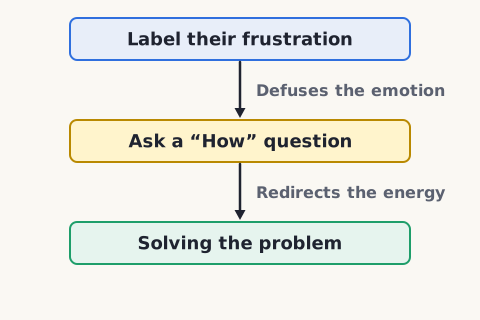
Label first, then ask
Voss's reliable sequence for handling a difficult colleague is to label their frustration first, defusing the emotion, and then follow up with a 'How' question that redirects the energy toward solving the problem.
Slow, low, and downward
Delivering a hard message — a price, a deadline, a rejection? Drop into the Late-Night FM DJ voice: slow down, lower your pitch, smooth it out, and end with a slight downward inflection. It calms the other person's nervous system and turns a confrontation into a conversation.
— Never Split the Difference, Chris Voss
The Black Swan
In Chris Voss's negotiation framework, a Black Swan is hidden information one side holds that would change the whole negotiation if it came out. Deep listening and calibrated questions exist to surface these facts before you commit to a position.

The sound of certainty
Voss notes that ending a sentence on a downward inflection reads to listeners as calm, settled certainty, while an upward lilt reads instead as an open question or anxiety.
Save calm for hard messages
Voss recommends using the Late-Night FM DJ voice precisely when delivering a hard message — a price, a deadline, or a firm no. Stating the content plainly and letting the calm tone do the emotional work avoids triggering a defensive spike.
What silence draws out
Voss recommends surfacing a Black Swan through extended listening, calibrated questions, and silence held after a label. People instinctively fill silence, and what they fill it with is often the hidden information you need.
By the numbers
- Years Chris Voss spent as the FBI's lead international kidnapping negotiator
- 24 years
- Most words you repeat back when mirroring
- 3 words
Matched pairs
Each item on the left goes with the one on the right.
- Tactical empathy
- Show you understand before you influence
- Mirroring
- Repeat their last 1–3 words to draw out more
- Labeling
- Name their emotion to defuse it
- Salary negotiation
- Calibrated questions + let them anchor first
- Difficult colleague
- Label their frustration + "How" questions
- Disagreement with your partner
- Labeling + Mirroring
- Negotiating a purchase price
- "No is power" + tactical empathy
Step by step
Run a tough conversation the Chris Voss way
- Open with tactical empathy: "It seems like you're concerned about…" — acknowledge, don't agree.
- Mirror their last 1–3 words to keep them talking and reveal more.
- Label the emotion you hear: "It sounds like you're frustrated…" to deactivate it.
- Ask a calibrated "How" or "What" question so they help solve your problem.
- Use the Late-Night FM DJ voice when you deliver anything hard.
- Listen for the Black Swan — the hidden fact that changes everything — before committing.
Empathy and listening come first; the ask comes last. The whole sequence is built to surface the Black Swan.
Self-test
Answer each question from memory, then check your work against the answer key.
1. In Voss's framework, what is tactical empathy?
- AAgreeing with the other person's demands to build goodwill
- BHiding your real position until you make a final offer
- CShowing you understand the other person's perspective before you try to influence them
- DMeeting the other side halfway to appear reasonable
2. In Voss's method, what does mirroring consist of?
- ANaming the emotion you sense the other person is feeling
- BCopying the other person's posture and hand gestures
- CRestating your own position in fresh words
- DRepeating the last few words the other person said, then going quiet
3. Voss's rule of thumb is to mirror by repeating how many of the other person's words?
- AThe entire final sentence
- BThe last one to three words
- CA single keyword only
- DThe last five to seven words
4. Which is an example of labeling?
- AIt seems like this timeline is really stressing you.
- BWhy is the date such a problem?
- CA hard stop, you said?
- DLet's just split the difference.
5. A counterpart says, "This delay has completely wrecked our schedule." Which reply is a mirror?
- A"Let's meet in the middle on the timeline."
- B"It sounds like you're overwhelmed."
- C"Why didn't you plan for the delay?"
- D"Wrecked your schedule?"
6. Which phrase is a label — naming the other person's emotion?
- A"You're wrong about how this was handled."
- B"It sounds like you're frustrated about how this was handled."
- C"Let's just split the difference."
- D"Why did you handle it that way?"
7. What is the primary purpose of mirroring?
- ADraw out more information by getting the other side to elaborate
- BForce the other person to commit to a quick Yes
- CDefuse an emotion by naming it out loud
- DDeliver a hard message in a calm tone
8. What is the purpose of labeling?
- ALet the other side anchor the price first
- BRepeat their last words to keep them talking
- CName an emotion to defuse it
- DEnd statements with a downward inflection
9. Why does Voss call splitting the difference the worst outcome?
- ABoth sides end up with something neither actually wanted
- BIt takes far longer than making a firm offer
- CIt reveals your bottom line too early
- DIt always favors the wealthier party
10. Which everyday example does Voss use to show why compromise fails?
- AA watch set five minutes fast
- BA coat two sizes too large
- CA bridge that meets exactly halfway across
- DA shoe bought half a size wrong still doesn't fit
11. Which question is designed to invite a comfortable "No"?
- A"Can we agree on this today?"
- B"Is this a good time?"
- C"Is now a bad time to talk?"
- D"You're free now, right?"
12. What is a calibrated question?
- AA rhetorical question with an obvious answer
- BAn open "How" or "What" question that hands your problem to the other side to solve
- CA "Why" question that pinpoints who is to blame
- DA yes/no question that forces a firm commitment
13. Why does Voss say hearing "No" is powerful?
- AIt gives people a sense of safety and control, so they keep talking
- BIt forces the other side to counter with a Yes
- CIt always reveals the other side's exact bottom line
- DIt ends the negotiation quickly on your terms
14. Calibrated How/What questions are meant to replace which kind of question?
- AA closed yes/no question
- BEmotional labels
- COpen "How" questions
- DAccusatory "Why" questions
15. Facing a difficult colleague, what is Voss's reliable sequence?
- AAsk "Why did you do this?" then propose a compromise
- BAnchor your number first, then split the difference
- CLabel their frustration first, then follow with a "How" question
- DPress for a quick "Yes," then mirror their words
16. In Voss's framework, what is a "Black Swan"?
- AThe moment the other side says "Yes"
- BHidden information that would change the whole negotiation
- CA deadline you should never reveal
- DA rare, unbeatable closing argument
17. What defines the Late-Night FM DJ voice?
- AA fast, upbeat tone that projects confidence
- BA high, clipped tone that conveys urgency
- CA loud, firm tone that dominates the room
- DA slow, low, smooth tone ending with a slight downward inflection
18. According to Voss, how do downward and upward inflection read to a listener?
- ADownward reads as boredom; upward reads as excitement
- BDownward reads as doubt; upward reads as authority
- CDownward reads as calm certainty; upward reads as a question or anxiety
- DDownward reads as aggression; upward reads as agreement
19. When is the FM DJ voice meant to be used?
- AWhen delivering a hard message like a price, deadline, or firm "no"
- BWhen you want to speed a stalling negotiation up
- CWhen agreeing to everything the other side asks for
- DWhen making small talk to build early rapport
20. Which tools does Voss recommend for surfacing a Black Swan?
- ARepeating your own position firmly and often
- BExtended listening, calibrated questions, and silence after a label
- CSplitting the difference early to build trust
- DMaking the first aggressive offer to set the terms
21. You sense the other side is hiding a constraint that could change the whole deal. How do you surface this Black Swan?
- AOffer your best price immediately
- BDemand they disclose every constraint upfront
- CAsk calibrated questions, then sit in silence
- DAssume there's nothing hidden and move to close
22. Mid-negotiation you uncover a hidden constraint the other side never mentioned. What should you do with it?
- AIgnore it and stick to your original offer
- BUse it to publicly embarrass the other side
- CEnd the negotiation immediately
- DRestructure your solution around that constraint
Go deeper
Answer key
- 1. C Showing you understand the other person's perspective before you try to influence themTactical empathy is acknowledgment, not agreement: you demonstrate understanding first, which disarms defensiveness and opens the channel to influence.
- 2. D Repeating the last few words the other person said, then going quietMirroring is repeating their final few words then staying silent, which invites elaboration. Naming an emotion is labeling, a different tool.
- 3. B The last one to three wordsThe 1-3 word rule keeps the mirror light: enough to signal attention and draw them out without revealing your own position.
- 4. A It seems like this timeline is really stressing you.Labeling names the emotion you observe ("It seems like…"). A mirror repeats their words back, the "why" is accusatory, and splitting the difference is a lazy compromise.
- 5. D "Wrecked your schedule?"A mirror repeats their last few words then pauses. "It sounds like..." is a label, the Why question is accusatory, and the last is a compromise.
- 6. B "It sounds like you're frustrated about how this was handled."A label names the emotion you're sensing ("It sounds like you're frustrated…"). Naming a negative emotion deactivates it and shows you've been listening.
- 7. A Draw out more information by getting the other side to elaborateMirror to get information; label to defuse tension. Naming an emotion is labeling's job, not mirroring's.
- 8. C Name an emotion to defuse itLabeling makes an unnamed feeling visible, which drains its grip. Repeating last words is mirroring; anchoring and inflection belong to other tools.
- 9. A Both sides end up with something neither actually wantedWhen two extremes meet in the middle, both parties get a result neither wanted. The goal is a solution that fully works, not one that halves the discomfort.
- 10. D A shoe bought half a size wrong still doesn't fitThe half-size-wrong shoe still doesn't fit, illustrating that a halfway deal satisfies no one. The goal is a solution that fully works.
- 11. C "Is now a bad time to talk?""Is now a bad time?" lets the other person say No safely, which makes them feel in control. "Is this a good time?" creates obligation and pressure.
- 12. B An open "How" or "What" question that hands your problem to the other side to solveCalibrated questions are genuine open How/What requests that engage the other side's problem-solving mind, replacing accusatory Why questions.
- 13. A It gives people a sense of safety and control, so they keep talking"No" sets a boundary the other person feels comfortable inside, signaling control. A forced "Yes" feels like a trap they'll try to escape.
- 14. D Accusatory "Why" questions"Why" questions feel like an interrogation and raise defenses; How/What questions keep collaboration alive by inviting problem-solving.
- 15. C Label their frustration first, then follow with a "How" questionDefuse the emotion with a label, then redirect the energy with a How question. The other options rely on tactics Voss warns against.
- 16. B Hidden information that would change the whole negotiationBlack Swans are hidden, game-changing facts one side holds. Deep listening and calibrated questions exist to surface them before you commit to a position.
- 17. D A slow, low, smooth tone ending with a slight downward inflectionThe FM DJ voice is slow, low, and smooth with a downward inflection, signaling calm certainty that calms the other person's nervous system.
- 18. C Downward reads as calm certainty; upward reads as a question or anxietyEnding on a downward inflection signals settled certainty, while an upward lilt reads as an open question or anxiety.
- 19. A When delivering a hard message like a price, deadline, or firm "no"Use it precisely for hard messages: deliver the content plainly and let the calm tone do the emotional work, avoiding a defensive spike.
- 20. B Extended listening, calibrated questions, and silence after a labelPeople fill silence, and what they fill it with is often the Black Swan. Deep listening and calibrated questions draw hidden information out.
- 21. C Ask calibrated questions, then sit in silenceVoss: extended listening, calibrated questions, and silence after a label are the tools that surface a hidden Black Swan.
- 22. D Restructure your solution around that constraintVoss considers finding Black Swans the highest-value negotiation activity because you can structure a solution around the hidden constraint once you know it.
Sources
- The Ultimate Knowledge Pack: Productivity Tips & Life Hacks (18 books) — research compilation
Image credits
- Label first, then ask: FlashFeed original diagram · CC-BY-4.0
- The sound of certainty: AI-generated (gpt-image-1.5)