
The Psychology of Money study guide · Lesson 3 of 6
Wealth Preservation and the Power of Asymmetric Tails
Getting Wealthy vs. Staying Wealthy & The Survival Mindset · Long Tails, Rare Events, and the Law of Large Outcomes
Unofficial study guide for The Psychology of Money: Timeless lessons on wealth, greed, and happiness by Morgan Housel. FlashFeed is not affiliated with the author or publisher.
This is the lesson's study guide from the FlashFeed app, plus its key facts and a self-test.
What you'll be able to do
- Distinguish getting wealthy from staying wealthy: why survival, Berkshire's cash fortress, and barbell paranoia beat Livermore's one bad year.
- Explain the Law of Long Tails: how a rare 1% of bets, like Berggruen's art and Disney's Snow White, drive nearly all returns.
Lesson 3: Wealth Preservation and the Power of Asymmetric Tails
Welcome to Lesson 3 of The Psychology of Money. This lesson examines the psychological dichotomy between acquiring capital and preserving it, and reveals how rare, extreme tail events dominate the long-term returns of capitalism.
Getting Wealthy vs. Staying Wealthy & The Survival Mindset
Getting money and keeping money are two completely different disciplines requiring opposite psychological temperaments. Getting Wealthy requires taking calculated risks, maintaining aggressive optimism, and putting yourself out there to capture economic opportunities. Staying Wealthy requires the exact opposite: humility, healthy paranoia, frugal discipline, and an acute fear of losing what you have.
Chapter 5 contrasts the fates of two prominent Wall Street investors during the 1929 market crash: Jesse Livermore and Abraham Germansky. Jesse Livermore was one of the greatest speculative traders in history. In October 1929, as the market collapsed and panic swept Wall Street, Livermore held massive short positions. On October 29, 1929, Livermore walked home to find his family weeping, believing they were ruined. Livermore informed his wife that he had just made 100 million in a single day (equivalent to over 1.4 billion today), making him one of the richest men on Earth.
Yet Livermore's aggressive leverage and trading addiction continued unchecked. Within four years, Livermore lost his entire fortune in bad trades, fell into deep insolvency, and committed suicide in a Manhattan hotel in 1940. Abraham Germansky, a multimillionaire real estate developer in New York, also lost everything in the 1929 crash, walked out of his house in despair, and was never seen again.
Both men knew how to get wealthy, but neither understood how to stay wealthy. They failed to appreciate that Survival is the foundational prerequisite of compounding. Any investment strategy that does not guarantee long-term survival carries an eventual terminal return of zero.
The danger of the 0% Multiplier is absolute: no matter how high your returns are in years 1 through 20, multiplying by zero in year 21 eliminates everything. If you take on enough leverage, eventually a market downturn will wipe out your equity, ending your ability to participate in subsequent recoveries.
The legendary risk scholar Nassim Nicholas Taleb emphasized that having an edge and surviving are two completely different disciplines, and survival must always precede the exploitation of an edge. To stay wealthy, an investor must cultivate a Barbell Personality: being aggressively optimistic about long-term economic growth while remaining intensely paranoid about short-term hazards.
Berkshire Hathaway exemplifies this philosophy by maintaining a permanent cash fortress of tens of billions of dollars. Warren Buffett and Charlie Munger intentionally sacrifice higher short-term returns on their cash reserves to guarantee that Berkshire can survive any unforeseen black swan crisis without relying on lenders or government bailouts. A financial plan is only useful if it can survive reality. Cash held in a bank account earning modest interest is not a drag on performance; it is the insurance policy that prevents you from panic-selling equities at market bottoms.
The Barbell Strategy for Solvency and Survival
The dichotomy between Getting Wealthy and Staying Wealthy requires a dual psychological architecture known as the Barbell Personality. On one side of the barbell, an investor maintains unwavering, aggressive optimism about human ingenuity, economic productivity, and the multi-decade growth of global capitalism. This optimism provides the courage to invest capital in productive equities and hold them through frightening recessions.
On the other side of the barbell, the investor maintains healthy, acute paranoia regarding short-term hazards, liquidity shocks, and black swan events. They recognize that if debt or illiquidity forces them into insolvency during a 40% market crash, their long-term optimism is rendered completely useless. By maintaining a fortress of liquid cash reserves and eliminating unmanageable leverage, the investor ensures that no short-term crisis can trigger the dreaded 0% Multiplier, preserving their ability to compound wealth across an entire lifetime.
Long Tails, Rare Events, and the Law of Large Outcomes
In business, investing, and economics, Long Tails—the tiny fraction of rare, high-impact events—drive the vast majority of all historical outcomes. When you understand the mathematics of long tails, you realize that you can be wrong half the time (or more) and still build an extraordinary fortune.
Consider the story of Heinz Berggruen, one of the most successful art collectors of the 20th century. Berggruen accumulated an astonishing collection of masterworks by Pablo Picasso, Paul Klee, Henri Matisse, and Georges Braque, eventually selling a portion of it to the German government in 2000 for 250 million marks (a fraction of its multi-billion-dollar market value).
How did Berggruen achieve such staggering success? Author Morgan Housel explains that Berggruen bought massive quantities of art throughout his life. Roughly 99% of the art he purchased turned out to be of modest or negligible value. But the 1% long-tail masterpieces he acquired—the Picassos and Matisses—appreciated so astronomically that they compensated for every mediocre purchase and generated his entire fortune.
The exact same distribution governs public equity markets. Longboard Asset Management analyzed the Russell 3000 Index from 1980 to 2014 and discovered that 40% of all public companies suffered catastrophic losses of 70% or more from their peak and never recovered. Effectively all of the Russell 3000's total net gains over 34 years were driven by just 7% of public companies that generated massive outsized returns (such as Apple, Amazon, Microsoft, and Walmart).
In the venture capital industry, the dominance of tails is even more stark. Industry data shows that 65% of startup investments lose money or barely break even, 2.5% return 10x to 20x, and just 0.5%—about 100 companies—return 50x or more, and that tiny 0.5% cohort accounts for virtually all venture fund profits.
At Berkshire Hathaway's 2013 annual shareholder meeting, Warren Buffett stated that he had owned 400 to 500 stocks in his lifetime, but made most of his money on just 10 of them. Charlie Munger added: "If you remove just a few of Berkshire's top investments, our long-term track record is pretty average."
Walt Disney produced over 400 cartoon shorts before 1937 that lost money or barely broke even, leaving him deeply in debt. But in 1937, Disney released Snow White and the Seven Dwarfs, which became a massive tail event, grossing $8 million in six months and single-handedly funding the creation of the modern Disney studio empire.
Long tails explain why broad market index funds succeed: owning the entire market ensures you never miss the rare 7% of super-performers that generate market returns. When you accept that tails drive everything, you realize that experiencing frequent small losses and mistakes is normal, expected, and necessary. As billionaire investor George Soros summarized: "It's not whether you're right or wrong, but how much money you make when you're right and how much you lose when you're wrong."
Navigating Asymmetric Long-Tail Distributions
The dominance of Long Tails across economics, venture capital, and public equity markets carries profound implications for everyday investors. In a world where 7% of public companies generate 100% of net market returns and 40% of public companies suffer catastrophic failure, attempting to pick individual winning stocks is extraordinarily hazardous. Missing just two or three top-performing mega-caps over a decade can permanently cripple an equity portfolio's returns.
This structural asymmetry is the primary mathematical reason why low-cost broad market Index Funds consistently outperform active stock pickers over multi-decade horizons. An index fund automatically owns 100% of the public market, guaranteeing that the investor captures every rare long-tail super-performer (the next Apple, Amazon, or Microsoft) while effortlessly absorbing the inevitable failures of the bottom 40%. Embracing long tails frees investors from the stressful delusion of needing to be right on every single decision.
Key terms
- The 0% Multiplier
- The mathematical reality that no matter how high returns are in years 1-20, multiplying by zero in year 21 eliminates all accumulated wealth.
- The Barbell Personality
- The duality of being aggressively optimistic about long-term economic growth while remaining intensely paranoid about short-term solvency.
- The Germansky Disappearance
- The tragedy of real estate developer Abraham Germansky, who lost everything in the 1929 crash, walked out of his home, and vanished.
- The Berggruen 1% Law
- The principle that in vast creative and financial portfolios, a tiny 1% cohort of rare winners accounts for virtually all net profits.
- The 7% Index Driver
- The empirical reality that effectively all net gains of the Russell 3000 Index from 1980 to 2014 were generated by just 7% of public companies.
- The Disney Snow White Tail
- The 1937 animated film that grossed $8 million in six months, rescuing Walt Disney from debt and funding his global studio empire.
- The 1937 Snow White Rescue
- The $8 million box office gross of Snow White during the Great Depression that transformed Walt Disney Productions into an entertainment powerhouse.
Key facts
Getting Wealthy
Getting Wealthy requires aggressive risk-taking and optimism, whereas Staying Wealthy requires humility, paranoia, and fear of ruin.
Survival as the Supreme Prerequisite
Survival is the foundational prerequisite of compounding: any strategy that does not guarantee survival carries a terminal return of zero.
Planning for Reality vs. Optimization
A financial plan is only useful if it can survive reality: plans must incorporate large buffers for severe recessions and emergencies.
Cash as Psychological Insurance
Cash earning modest interest is not a drag on performance; it is the insurance policy that prevents panic-selling equities at market bottoms.
Insulating from Emotional Panic
True wealth protection means insulating your financial plan from being destroyed by your own emotional panic during downturns.
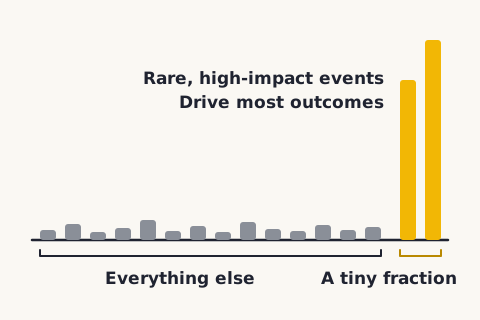
The Law of Long Tails
In business, investing, and economics, long tails—the tiny fraction of rare, high-impact events—drive the vast majority of all outcomes.

Buffett's 10 Core Winners
Warren Buffett owned 400 to 500 stocks in his lifetime, but made the vast majority of his fortune on just 10 of them.
Being Wrong Half the Time and Winning
You can be wrong half the time (or more) and still build an immense fortune if your winning tail investments are allowed to compound.

Charlie Munger on Berkshire's Averages
Charlie Munger noted that removing just a few top investments leaves Berkshire Hathaway's multi-decade track record looking average.
The Normality of Small Mistakes
In a tail-driven world, experiencing frequent small losses and setbacks is normal, expected, and mathematically necessary.
Step by step
Building an Unshakeable Financial Fortress
- Establish an emergency reserve of liquid cash covering 6 to 12 months of living expenses
- Pay off all high-interest consumer debt and avoid trading equities on margin leverage
- Diversify across broad index funds to eliminate single-company bankruptcy risks
- Adopt a barbell mindset: aggressively bullish on decades, intensely paranoid on months
Harnessing Long Tails Through Broad Market Indexing
- Acknowledge that 40% of individual public companies will suffer catastrophic unrecoverable losses
- Invest in total stock market index funds to guarantee ownership of the rare 7% of super-performers
- Resist the temptation to sell winning compounders prematurely to take quick profits
- Accept frequent small portfolio drawdowns as the unavoidable noise of a tail-driven economy
Self-test
Answer each question from memory, then check your work against the answer key.
1. What does 'Getting Wealthy' require, in contrast to 'Staying Wealthy'?
- AFrugal discipline and conservative caution
- BIntense fear of losing what you have
- CAggressive risk-taking and optimism
- DHumility and healthy paranoia
2. Which concept describes multiplying by zero in year 21 erasing 20 years of high returns?
- AThe 0% Multiplier
- BThe Barbell Personality
- CThe Survival Prerequisite
- DThe Cash Fortress Strategy
3. Jesse Livermore made $100 million in a single day during the 1929 crash. What ultimately happened to him?
- AHe used the profits to found a hedge fund empire
- BHe retired comfortably and became a philanthropist
- CHe doubled his winnings by staying short for years
- DHe lost his entire fortune within four years
4. An investor stays optimistic about long-term growth while keeping large cash reserves against short-term shocks. Which concept is this?
- AThe 0% Multiplier
- BThe Barbell Personality
- CThe Survival Prerequisite
- DThe Cash Fortress Strategy
5. Why does Berkshire Hathaway hold tens of billions of dollars in cash instead of investing it for higher returns?
- ATo meet minimum regulatory reserve requirements
- BTo maximize short-term returns on idle capital
- CTo fund aggressive stock buybacks in bull markets
- DTo guarantee survival through any black swan crisis
6. Longboard Asset Management's study of the Russell 3000 (1980-2014) found what share of public companies suffered catastrophic 70%+ losses?
- A40%
- B99%
- C7%
- D65%
7. Longboard found that just 7% of Russell 3000 companies were responsible for what share of the index's net gains (1980-2014)?
- AAbout half of the gains
- BRoughly one-third of the gains
- CEffectively all of the gains
- DOnly a small sliver of the gains
8. Heinz Berggruen bought massive quantities of art, and most purchases were mediocre. What explains his eventual fortune?
- AHe diversified into real estate to offset losses
- BA tiny 1% of purchases became priceless masterpieces
- CHe specialized only in guaranteed blue-chip artists
- DHe resold everything quickly for modest profits
9. Which artist is NOT mentioned as part of Heinz Berggruen's masterwork collection in the lesson?
- APablo Picasso
- BVincent van Gogh
- CPaul Klee
- DGeorges Braque
10. According to George Soros, what actually determines investing success?
- AAvoiding all investment losses entirely
- BTiming the exact market tops and bottoms
- CBeing right more often than being wrong
- DHow much you make when right versus lose when wrong
Go deeper
- ReadThe Psychology of Money by Morgan Housel · on Amazon ↗
- StudyThe Psychology of Money in the FlashFeed app
These are affiliate links: if you buy a book through one, FlashFeed may earn a small commission at no extra cost to you. The commission helps pay for FlashFeed's servers.
As an Amazon Associate we earn from qualifying purchases.
Answer key
- 1. C Aggressive risk-taking and optimismGetting Wealthy demands risk-taking optimism; the other options describe the opposite trait set needed to Stay Wealthy.
- 2. A The 0% MultiplierThe 0% Multiplier means one ruinous year can wipe out decades of gains; the others are related but distinct survival concepts.
- 3. D He lost his entire fortune within four yearsDespite his historic trading win, Livermore's unchecked leverage led him to lose everything within four years.
- 4. B The Barbell PersonalityThe Barbell Personality combines aggressive long-term optimism with acute short-term paranoia about liquidity and solvency.
- 5. D To guarantee survival through any black swan crisisBuffett and Munger sacrifice yield on cash to ensure Berkshire can survive any crisis without relying on lenders or bailouts.
- 6. A 40%Longboard found 40% of Russell 3000 companies suffered catastrophic losses of 70% or more and never recovered.
- 7. C Effectively all of the gainsThe '7% Index Driver' shows effectively all of the Russell 3000's net gains came from just 7% of companies, like Apple and Amazon.
- 8. B A tiny 1% of purchases became priceless masterpiecesBerggruen's fortune came from the rare 1% of purchases, like Picassos, that appreciated astronomically and outweighed all mediocre buys.
- 9. B Vincent van GoghThe lesson names Picasso, Klee, Matisse, and Braque as Berggruen's masterworks; van Gogh is not mentioned.
- 10. D How much you make when right versus lose when wrongSoros argued success depends on the magnitude of gains when right and losses when wrong, not how often you're right.
Sources
- The Psychology of Money — Morgan Housel
- Morgan Housel, The Psychology of Money, Chapter 5
- Morgan Housel, The Psychology of Money, Chapter 6
Image credits
- The Law of Long Tails: FlashFeed original diagram · CC-BY-4.0
- Buffett's 10 Core Winners: Good-investing · CC0 — commons.wikimedia.org/wiki/File:Berkshire_Hathaway_Annual_Meeting_2025.jpg
- Charlie Munger on Berkshire's Averages: Wikimedia Commons · Nick · CC BY 2.0 — commons.wikimedia.org/wiki/File:Charlie_Munger_(cropped).jpg

