
The Psychology of Money study guide · Lesson 6 of 6
Market Psychology, Narrative Fallacies, and Personal Philosophy
The Volatility Fee, Game Clashes, and Pessimism's Seduction · Financial Narratives, Postscript Consumer History, and Core Rules
Unofficial study guide for The Psychology of Money: Timeless lessons on wealth, greed, and happiness by Morgan Housel. FlashFeed is not affiliated with the author or publisher.
This is the lesson's study guide from the FlashFeed app, plus its key facts and a self-test.
What you'll be able to do
- Analyze market volatility as an admission fee rather than a fine, and identify the seductive psychological pull of financial pessimism.
- Explain how comforting narratives blinded banks to the 2008 crisis, how the GI Bill and post-1980 debt shaped spending, and why Housel paid off his mortgage.
Lesson 6: Market Psychology, Narrative Fallacies, and Personal Philosophy
Welcome to Lesson 6 of The Psychology of Money. This lesson investigates the price of investing success, the clashes between different financial games, the seduction of pessimism, and the timeless core rules of personal financial stewardship.
The Volatility Fee, Game Clashes, and Pessimism's Seduction
Chapter 15 establishes that everything in life has a price, but the price of investing success is not denominated in dollars; it is paid in Volatility, Fear, Uncertainty, and Regret.
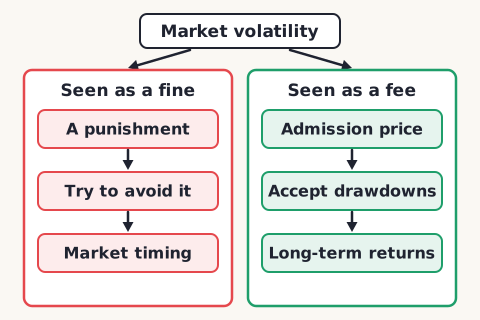
Market drawdowns and volatility should be viewed as an admission Fee for long-term compound returns, not as a Fine for doing something wrong. When you view market crashes as a fine, you try to avoid paying it through market timing, which usually leads to buying high and selling low. Disneyland charges a $100 ticket fee to enter the park, and no one views it as a punishment; long-term equity returns require paying the emotional fee of enduring 20% to 50% drops.
Chapter 16 warns investors against taking financial cues from people playing a fundamentally different game. In the late 1990s Dot-com Bubble, day traders flipping internet stocks for 10-minute momentum gains were rational within their game, but long-term investors copying them suffered ruin. An asset price that looks completely rational to a short-term momentum trader can be completely toxic and irrational for a 30-year retirement saver. Clearly defining the specific financial game you are playing prevents you from being misled by market noise.
Chapter 17 analyzes why Pessimism sounds smarter, more intellectually serious, and more persuasive than optimism. If a commentator predicts an imminent market crash and economic collapse, they are hailed as a brilliant visionary; if someone predicts long-term prosperity, they are dismissed as naive.
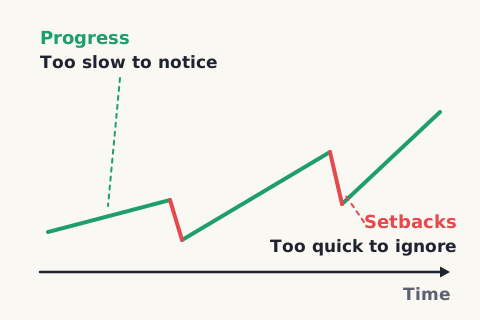
Progress happens too slowly to notice through compounding daily improvements, while setbacks happen too quickly to ignore through sudden acute disasters. The Wright Brothers made the first powered airplane flight in 1903 with virtually zero initial media coverage, while plane crashes immediately dominate global headlines. Over the past century, the US economy survived the Great Depression, World War II, double-digit inflation, and the 2008 crash, yet living standards expanded more than twentyfold. Real Optimism is not the belief that bad things will never happen; it is the statistical conviction that the odds of human problem-solving and progress favor success over time. Enduring short-term volatility while staying anchored in long-term optimism is the fundamental psychological formula for wealth creation.
The Admission Fee and the Trap of Short-Term Games
Reframing market volatility from an emotional Fine into an admission Fee is the single most transformative mindset shift in equity investing. When an investor views a 20% or 30% market drop as a punishment for bad timing, their instinctive reaction is to flee the market, sell their holdings, and attempt to buy back in when conditions feel safe—a strategy that almost always results in selling at market bottoms and missing the subsequent rapid rebounds.
Similarly, recognizing that different market participants are playing fundamentally different Games prevents catastrophic peer imitation. A day trader or momentum algorithmic fund flipping tech equities over a 48-hour window is playing a completely different game than a 30-year retirement saver. When long-term investors take pricing cues from short-term momentum traders during speculative bubbles (such as the 1999 Dot-com craze), they import toxic risks that destroy their long-term compounding plans. Define your specific financial game and ignore external market noise.
Cognitive Asymmetry in Financial News
The human brain is evolutionarily wired to prioritize threats over opportunities. In ancestral environments, failing to notice a predator meant death, whereas missing an opportunity for fruit merely meant foraging longer. Consequently, financial media outlets heavily exploit this negativity bias: terrifying headlines warning of impending market crashes generate exponentially higher clicks and viewer engagement than calm analyses of long-term economic growth. Recognizing this structural media distortion is essential for protecting your emotional equanimity as a long-term investor.
Financial Narratives, Postscript Consumer History, and Core Rules
Chapter 18 explores the power of financial stories: the more you want something to be true, the more likely you are to believe a narrative that overestimates the odds of it happening. In 2007, virtually all major investment banks and economic forecasting agencies failed to predict the looming subprime mortgage collapse due to narrative blindness. We create coherent stories to explain complex, chaotic economic systems because the illusion of understanding is comforting to our intuitive mind.
The Postscript provides a historical analysis of modern American consumer culture. Following World War II, the United States experienced an extraordinary period of broad-based economic growth fueled by the GI Bill, suburban expansion, and expanding manufacturing. Income inequality narrowed significantly, and the standard of living was relatively uniform across the middle class. Between 1945 and 1980, the average American lived in modest homes and drove similar cars, creating a social baseline where Keeping Up with the Joneses was easily achievable.
Beginning in the 1980s, income inequality expanded dramatically, yet middle-class consumption expectations continued to benchmark against top-tier earners, fueled by cheap consumer credit and mortgage borrowing. The explosion of consumer debt in the 1990s and 2000s was an attempt by the middle class to maintain the illusion of lifestyle parity.
In Chapter 20, Morgan Housel shares his personal financial philosophy: he paid off his 30-year fixed-rate mortgage completely, acknowledging it was mathematically sub-optimal but psychologically priceless. Housel and his family maintain a 20% to 30% cash allocation and invest the rest in low-cost index funds, aiming entirely for independence rather than maximizing net worth.
The book synthesizes timeless rules for personal finance:
- Humility and Grace: Go out of your way to find humility when things go right and forgiveness/compassion when they go wrong.
- Less Ego, More Wealth: Saving money is the difference between your ego and your income, and wealth is what you don't see.
- Sleep-at-Night Metric: Manage your money in a way that helps you sleep at night; peace of mind always supersedes mathematical elegance.
- Time Horizon Expansion: If you want to do better as an investor, the single most powerful thing you can do is increase your time horizon.
- Comfort with Volatility: Become comfortable with a lot of things going wrong; you can be wrong half the time and still make an immense fortune through long tails.
- Time Autonomy: Use money to gain control over your time, because not having control of your time is the single greatest drag on human happiness.
Consumer History and the Timeless Principles of Wealth
Housel's historical analysis of post-WWII American consumer culture reveals how the collapse of middle-class income equality after 1980 sparked an explosion of consumer debt as households struggled to keep up with top-tier luxury standards. Understanding this historical context frees modern individuals from the cultural expectation of competitive spending.
By anchoring personal finance in timeless principles—humility in success, grace in failure, less ego, high savings rates, schedule autonomy, and patience across multi-decade horizons—learners can build enduring wealth that serves their genuine happiness. True wealth is not measured by the luxury assets you display to impress strangers; it is measured by the peace of mind you feel when your head hits the pillow and the freedom to spend your days doing what matters most to you.
Key terms
- The Disneyland Admission Analogy
- Disneyland charges a ticket fee to enter the park without guests feeling punished; equities require paying the emotional fee of market drops.
- The Seduction of Pessimism
- The psychological bias where pessimistic predictions sound smarter, more intellectually serious, and more persuasive than optimistic forecasts.
- The 1903 Wright Flight Silence
- The first successful powered airplane takeoff received virtually zero media coverage at the time, while plane crashes immediately dominate global news.
- The 2007 Narrative Blindness
- The failure of major investment banks and forecasting agencies to predict the 2008 subprime crisis due to comforting economic stories.
- Debt-Fueled Lifestyle Parity
- The explosion of credit cards and subprime debt after 1980 used by the middle class to maintain the illusion of luxury lifestyle parity.
- Core Rule 2: Less Ego, More Wealth
- Saving money is the difference between your ego and your income, and true wealth is what you do not see.
Key facts
Market Volatility as a Fine
Viewing volatility as a fine treats market crashes as punishments to avoid through market timing. Viewing it as a fee means accepting drawdowns as the unavoidable admission price for long-term equity returns.
The Fine-Framing Trap
When you view market crashes as a fine, you try to avoid paying it through market timing, which usually leads to buying high and selling low.
Beware of Playing Different Games
Beware of taking financial cues from people who are playing a fundamentally different game than you are.
The Relativism of Price Rationality
An asset price that is completely rational for a short-term momentum trader can be toxic and destructive for a 30-year retirement saver.
The Asymmetry of Financial Commentary
Commentators predicting economic collapse are hailed as brilliant visionaries, while those predicting long-term prosperity are dismissed as naive.
The Velocity Asymmetry of Progress
Progress happens too slowly to notice through daily compounding, while setbacks happen too quickly to ignore through sudden crises.
Statistical Optimism Defined
Real optimism is not assuming bad events won't happen; it is the statistical conviction that human problem-solving drives net progress over time.
The Comfort of Coherent Stories
Humans create coherent stories to explain complex economic systems because the illusion of understanding provides emotional comfort.

The 1950s Egalitarian Baseline
Between 1945 and 1980, average Americans lived in similar modest homes and drove similar cars, making keeping up with peers easily achievable.
1950-1970 Consumer Era
From 1950 to 1970, Americans benchmarked their lifestyle against modest neighborhood peers who earned similar wages. After 1980, that benchmark shifted to top-tier luxury lifestyles sustained by cheap consumer credit rather than comparable income.
Housel's 20-30% Cash Rule
Housel maintains 20% to 30% of his assets in liquid cash and the rest in low-cost index funds, aiming for schedule independence.
Core Rule 1: Humility and Grace
Go out of your way to find humility when things go right and forgiveness/compassion when they go wrong.
Core Rule 3: The Sleep-at-Night Metric
Manage your money in a way that helps you sleep peacefully at night; emotional peace always supersedes mathematical elegance.
Core Rule 5: Comfort with Things Going Wrong
Become comfortable with things going wrong; you can be wrong half the time and still make an immense fortune through long tails.
Step by step
Enduring Market Volatility with Confidence
- Reframe every 20% to 30% market correction as an unavoidable admission fee for equity growth
- Define your personal investment time horizon and refuse to copy short-term traders
- Filter out alarmist financial media designed to exploit ancestral threat-detection biases
- Anchor your long-term expectations in the historical power of compounding and innovation
The Timeless Psychology of Money Framework
- Cultivate humility in success and grace in setbacks, acknowledging the role of luck and risk
- Define an internal ceiling of sufficiency to prevent moving goalposts and social comparison
- Harness compounding longevity through broad index funds and uninterrupted time horizons
- Use accumulated wealth to buy complete autonomy over your time and live life on your terms
Self-test
Answer each question from memory, then check your work against the answer key.
1. Chapter 15 argues market volatility should be understood as what kind of price?
- AAn admission fee
- BA late fee
- CA penalty fine
- DA processing charge
2. Which everyday example does the book use to explain paying an emotional 'fee' willingly?
- ASix Flags admission
- BUniversal Studios admission
- CA Broadway show ticket
- DDisneyland admission
3. Which historical episode does Chapter 16 use to show investors following the wrong 'game'?
- AThe 2008 subprime crisis
- BThe dot-com bubble
- CThe 2020 pandemic crash
- DThe 1929 crash
4. Which of these is NOT how the book defines real optimism?
- AConfidence despite setbacks
- BLong-term problem-solving faith
- CIgnoring that bad things happen
- DStatistical odds favor progress
5. Per Chapter 17, why does pessimism often sound smarter than optimism?
- AIt requires more data to prove
- BIt matches historical base rates
- CIt is usually more accurate
- DIt seems more serious and credible
6. What caused most major banks to miss the coming 2008 subprime crisis, per Chapter 18?
- AGovernment regulation gaps
- BBelief in a comforting narrative
- CLack of financial data
- DUnusually low interest rates
7. Which post-WWII program helped narrow income inequality and fuel suburban growth?
- AThe New Deal
- BThe Marshall Plan
- CThe GI Bill
- DThe Homestead Act
8. What changed in middle-class spending behavior after 1980, per the Postscript?
- ADebt funded luxury lifestyles
- BHomes grew more modest
- CWages matched top earners
- DSavings rates rose sharply
9. What did Housel do with his own mortgage, despite it being mathematically sub-optimal?
- APaid it off completely
- BConverted it to adjustable-rate
- CTook out a second mortgage
- DRefinanced to a 15-year term
10. Which core rule holds that true wealth is what you don't see?
- ATime Horizon Expansion
- BLess Ego, More Wealth
- CThe Sleep-at-Night Metric
- DTime Autonomy
Go deeper
- ReadThe Psychology of Money by Morgan Housel · on Amazon ↗
- StudyThe Psychology of Money in the FlashFeed app
These are affiliate links: if you buy a book through one, FlashFeed may earn a small commission at no extra cost to you. The commission helps pay for FlashFeed's servers.
As an Amazon Associate we earn from qualifying purchases.
Answer key
- 1. A An admission feeHousel frames volatility as the fee paid to access long-term returns, not a fine for doing something wrong.
- 2. D Disneyland admissionDisneyland's ticket price is paid without feeling punished, just as investors must accept market drops as equity's admission fee.
- 3. B The dot-com bubbleThe late-1990s dot-com bubble shows day traders' short-term game misleading long-term retirement savers who copied them.
- 4. C Ignoring that bad things happenReal optimism isn't the belief bad things never happen — it's confidence that progress wins out over time despite setbacks.
- 5. D It seems more serious and credibleThe book argues pessimism simply sounds more intellectually serious and persuasive, not that it is more accurate.
- 6. B Belief in a comforting narrativeNarrative blindness — banks believed reassuring stories rather than confronting the warning signs before the crisis.
- 7. C The GI BillThe GI Bill funded suburban expansion and manufacturing growth, helping compress income inequality between 1945 and 1980.
- 8. A Debt funded luxury lifestylesAfter 1980, cheap consumer credit let the middle class chase top-tier lifestyles despite widening income inequality.
- 9. A Paid it off completelyHousel paid off his 30-year fixed mortgage in full, valuing psychological peace of mind over the higher expected return of investing.
- 10. B Less Ego, More WealthCore Rule 2 states saving is the gap between ego and income, and true wealth is the unspent money you never see.
Sources
- The Psychology of Money — Morgan Housel
- Morgan Housel, The Psychology of Money, Chapter 15
- Morgan Housel, The Psychology of Money, Chapter 16
- Morgan Housel, The Psychology of Money, Chapter 17
- Morgan Housel, The Psychology of Money, Chapter 18
- Morgan Housel, The Psychology of Money, Postscript
- Morgan Housel, The Psychology of Money, Chapter 20
- Morgan Housel, The Psychology of Money, Chapter 19
Image credits
- Market Volatility as a Fine: FlashFeed original diagram · CC-BY-4.0
- The Velocity Asymmetry of Progress: FlashFeed original diagram · CC-BY-4.0
- The 1950s Egalitarian Baseline: Wikimedia Commons · Unknown author · Public domain — commons.wikimedia.org/wiki/File:LevittownPA.jpg
