
Mindset: The New Psychology of Success study guide · Lesson 6 of 6
Cultivating Growth: The Journey to Changing Mindsets
Recognizing Triggers and The Four-Step Persona Roadmap · Concrete Action Plans, The Power of 'Yet', and Lifelong Growth
Unofficial study guide for Mindset: The New Psychology of Success by Carol S. Dweck. FlashFeed is not affiliated with the author or publisher.
This is the lesson's study guide from the FlashFeed app, plus its key facts and a self-test.
What you'll be able to do
- Sequence the four-step roadmap to tame fixed-mindset personas and avoid false growth mindset traps.
- Implement the Power of 'Yet' and if-then implementation intentions to sustain lifelong behavioral growth.
Lesson 6: Cultivating Growth: The Journey to Changing Mindsets
Recognizing Triggers and The Four-Step Persona Roadmap
Transitioning to a growth mindset is not an instantaneous intellectual epiphany or a simplistic collection of positive affirmations. Every individual carries a hybrid blend of fixed and growth mindsets. Achieving genuine mindset change requires recognizing your specific Fixed Mindset Triggers—environmental stressors such as undertaking a daunting new responsibility, receiving sharp performance critique, experiencing an unexpected failure, or observing a peer excel effortlessly.
To navigate these triggers constructively, consider this four-step approach:
- Step 1: Acknowledge and Embrace: Accept that you possess an internal fixed mindset persona. Recognize that this persona developed as a self-protective defense mechanism to shield your ego from humiliation. Attempting to suppress, deny, or shame your fixed persona only drives it underground, where it continues to dictate your behavior unconsciously.
- Step 2: Become Aware of Triggers: Cultivate acute metacognitive awareness of the physical sensations, emotional spikes, and defensive internal self-talk that occur when your persona takes control. Notice when your stomach tightens, your shoulders tense, or your mind whispers: "You don't belong here; they're going to find out you're a fraud."
- Step 3: Name the Persona: Assign a vivid, distinct, or humorous name to your fixed mindset persona (e.g., 'The Perfectionist', 'The Fragile Critic'). Naming the persona can create psychological distance, separating your core identity from reactive panic.
- Step 4: Educate and Guide: Actively dialogue with your persona when it is triggered. Acknowledge its protective concerns, reassure it with growth-mindset principles, and invite it along on the learning journey ("I know this feels terrifying, but our goal is to communicate value and learn from the feedback, not to look flawless").
A critical modern danger that Dweck has warned about is the False Growth Mindset. This widespread misunderstanding occurs when educators, parents, or managers equate growth mindset solely with praising unguided effort ("Good job trying!"), praising effort that is not leading to learning while ignoring actual learning strategies, mentorship, and outcome mastery. True growth mindset requires marrying effort with strategic agility—analyzing why an approach failed, abandoning dead-end methods, and testing novel techniques. Another false growth mindset trap is self-righteously proclaiming that one possesses a 100% pure growth mindset, which blinds individuals to their own unconscious triggers and stymies genuine self-reflection. True growth pairs perseverance with coaching, agile pivoting, and honest outcome accountability. By understanding that mindsets are dynamic states, we can actively manage our internal personas and choose growth in every challenging moment.
A subtle and pervasive pitfall in contemporary education and organizational management is the False Growth Mindset. As the concept of mindset gained worldwide prominence, many teachers and corporate managers began equating a growth mindset merely with being open-minded or praising effort alone ("Great effort, you tried your best!"). Dweck warned that praise given to students who are putting forth effort but not learning, without evaluating study strategies, offering mentorship, or demanding real competence, is a hollow distortion of the theory. Effort is not the goal; effort is the vehicle that powers strategic innovation and cognitive development. When a student or employee fails after trying hard, the growth-oriented mentor does not simply praise the effort; they say: "Your effort was admirable, but your current strategy didn't produce the result we need. Let's analyze where the process broke down and test two new approaches tomorrow."
Furthermore, individuals frequently deceive themselves by declaring: "I have a 100% pure growth mindset; I am completely open to learning." In reality, no human being possesses a pure growth mindset across all situations. Fixed-mindset reactions such as defensiveness or envy tend to surface when our competence is questioned, our pride is wounded, or our status is threatened. Genuine personal transformation requires embracing the reality that we are all a mixture of fixed and growth mindsets—humbly accepting that our fixed-mindset persona will be triggered throughout our lives, and maintaining the daily vigilance to recognize its activation, name its voice, and guide it constructively toward growth.
Concrete Action Plans, The Power of 'Yet', and Lifelong Growth
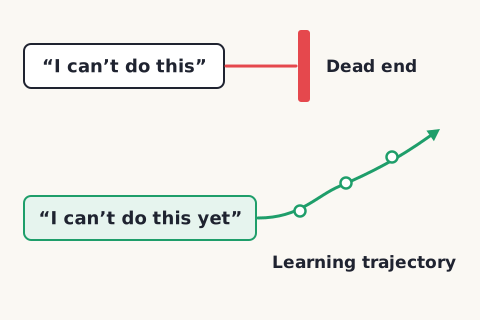
Sustained mindset transformation requires moving beyond abstract intentions and locking in concrete behavioral routines. A transformative linguistic tool is The Power of Yet. Appending the word "yet" converts defeatist, fixed statements into active developmental continuums ("I can't code in Python" → "I can't code in Python yet"). In her TED talk, Dweck describes a Chicago high school that replaced a failing grade with the grade 'Not Yet', signaling to students that they are on a learning curve and still have to keep practicing until they meet the standard.
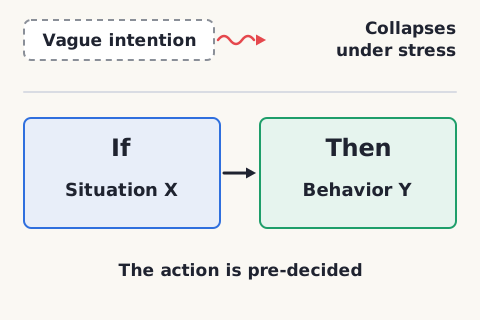
To translate growth mindset into daily habit execution, psychologist Dr. Peter Gollwitzer developed the idea of Implementation Intentions. Research by Gollwitzer and colleagues found that formulating concrete plans in the format 'If [Situation X occurs], then [I will execute Behavior Y]' improves goal attainment by pre-deciding the exact when, where, and how of an action. Under high stress or mental fatigue, vague intentions ("I'm going to stay positive and study hard") collapse into fixed-mindset avoidance. In contrast, an if-then growth plan ("If I encounter a programming bug that takes more than 20 minutes to solve, then I will take a five-minute walk, diagram the logic on paper, and consult the documentation before asking a peer") automates constructive action.
Brainology is a computer-based program built by Dweck and colleagues from their growth-mindset workshop. In the original in-person workshop for seventh graders (Blackwell, Trzesniewski and Dweck, 2007), teaching students that the brain grows with effort reversed a decline in their math grades. When confronting high-stakes evaluations (such as standardized exams or executive board meetings), growth-mindset individuals practice Process Focus Under Pressure, concentrating entirely on present tactical execution and letting the outcome take care of itself.
Maintaining a growth mindset over a lifetime requires establishing a Daily Growth Audit Protocol, reflecting each evening on where fixed-mindset defensiveness arose and formulating if-then plans for tomorrow. Ultimately, shifting to a growth mindset transforms life from a judge-and-be-judged framework into a learn-and-help-learn framework, turning every obstacle into fuel for continuous human expansion. Lifelong growth is not a destination, but a daily commitment to embrace friction, celebrate discovery, and expand human potential.
Translating a growth mindset into daily reality requires constructing robust psychological and behavioral scaffolding. The linguistic power of The Power of Yet acts as an instant cognitive reframe. When a learner catches themselves uttering a defeatist fixed statement ("I am terrible at public speaking", "I can't understand multivariate calculus", or "I don't have the discipline to exercise"), adding the single word "yet" fundamentally reorients the brain from a closed dead-end into an open developmental trajectory ("I haven't mastered public speaking yet"). The 'Not Yet' grade works the same way: it tells students they are on a learning curve, not at a dead end.
To ensure that growth intentions are not derailed by stress or fatigue, individuals rely on Dr. Peter Gollwitzer’s Implementation Intentions. By establishing explicit If-Then Growth Plans, individuals pre-commit to constructive actions before emotional triggers occur ("If my supervisor gives me harsh feedback on my project, then I will take three deep breaths, ask two clarifying questions about how to improve the deliverable, and spend thirty minutes reviewing the guidelines"). Additionally, instituting a Daily Growth Audit Protocol at the end of each day allows individuals to review their decisions, forgive their defensive lapses, and set strategic intentions for tomorrow. Ultimately, living with a growth mindset transforms struggle from a painful threat into the very essence of a vibrant, deeply meaningful human life.
In addition to individual transformation, cultivating an intergenerational growth mindset creates profound cultural ripple effects across families and communities. When parents and community leaders openly share their own struggles, failures, and ongoing learning curves with young people, they demystify success and remove the paralyzing terror of making mistakes. Families can practice this at home by making struggle and learning part of everyday conversation, for example by asking at dinner what each person found hard that day and what they learned from it. Rather than pursuing external status symbols or seeking the fragile approval of others, growth-oriented individuals orient their lives around authentic contribution, creative expression, and lifelong learning.
Key terms
- False Growth Mindset
- A widespread misunderstanding that equates growth mindset solely with praising unguided effort, ignoring the necessity of teaching effective strategies and demanding real competence.
- Implementation Intentions
- A cognitive action planning protocol formulated by Peter Gollwitzer in the format 'If [Situation X occurs], then [I will execute Behavior Y]'.
Key concepts
Universal Mindset Hybridity
- The psychological reality that no human being possesses a pure growth mindset across all situations
- Recognizes that all people possess internal fixed-mindset personas that are activated by acute stressors
- Requires continuous daily vigilance and self-compassion rather than self-righteous claims of purity
Trigger Awareness
- The practice of noticing bodily sensations, like a tightening stomach or tensed shoulders, when a fixed-mindset trigger fires
- Involves catching defensive self-talk in the moment, such as 'they're going to find out you're a fraud'
- Allows individuals to catch the fixed persona in the act before reactive behaviors are executed
Dr. Peter Gollwitzer
- Renowned cognitive psychologist who formulated the science of Implementation Intentions
- Proved that pre-deciding situational triggers ('If-Then plans') automates goal execution under stress
- Demonstrated that concrete situational planning bridges the gap between intention and daily action
The Upward Learning Spiral
- The philosophical culmination of Carol Dweck's mindset framework
- Transforms struggle from a painful threat into the core heartbeat of meaningful human engagement
- Replaces the judge-and-be-judged paradigm with a learn-and-help-learn orientation
Key facts
The False Growth Mindset: Praising Effort Without Strategy
A widespread misunderstanding called the False Growth Mindset equates growth mindset with simply praising unguided effort ("good job trying!") while ignoring actual strategy, mentorship, and real competence. True growth mindset instead pairs sustained perseverance with the agile willingness to abandon a dead-end tactic, analyze exactly why an approach failed, and test new methods. Carol Dweck warned about the false version: praising effort that isn't leading to learning may make students feel good in the moment while they still aren't learning.
No One Is 100% Growth Mindset
No one holds a pure growth mindset in every situation: Dweck notes we are all a mixture of fixed and growth mindsets, and an internal fixed-mindset persona gets triggered whenever competence is questioned or pride is wounded. She cautions that the path to a growth mindset is a journey, not a proclamation. Claiming a 'pure' growth mindset can blind a person to their own triggers and block genuine self-reflection.
Recognizing Your Fixed Mindset Triggers
A Fixed Mindset Trigger is an environmental stressor — a daunting new responsibility, sharp criticism, an unexpected failure, or watching a peer excel — that activates the defensive fixed persona, for example turning envy at a colleague's promotion into a feeling of personal inadequacy. Building this awareness means noticing the physical and emotional signs as they happen: a tightening stomach, tensed shoulders, or self-talk like "they're going to find out you're a fraud" — catching the fixed persona in the act before it drives your behavior.
The Power of Yet
The Power of Yet is a linguistic cognitive tool that converts the defeatist statement 'I can't do this' into the actionable learning trajectory 'I can't do this yet', instantly transforming a static dead end into an active developmental continuum.
Implementation Intentions: If-Then Growth Plans
Cognitive psychologist Peter Gollwitzer formulated Implementation Intentions: concrete plans in the format "If [Situation X occurs], then [I will execute Behavior Y]." Under stress or fatigue, vague intentions like "I'm going to stay positive and study hard" tend to collapse into fixed-mindset avoidance, while a specific if-then plan — such as "If I encounter a programming bug that takes more than 20 minutes to solve, then I will take a five-minute walk, diagram the logic on paper, and consult the documentation before asking a peer" — pre-decides the action and automates it.
Replacing 'F' With 'Not Yet'
In her TED talk, Carol Dweck describes a high school in Chicago where students who did not pass a course got the grade "Not Yet" instead of a failing grade. The grade signals that they are on a learning curve, not permanently failed.
Brainology and the Growth-Mindset Workshop
Brainology is a computer-based program built by Dweck and colleagues from their growth-mindset workshop. In the original in-person workshop for seventh graders (Blackwell, Trzesniewski and Dweck, 2007), teaching students that the brain grows with effort reversed a decline in their math grades.
Growth Mindset Doesn't Promise Identical Outcomes
A growth mindset does not claim everyone starts with identical genetic gifts, or that anyone can effortlessly become a genius in any field. It acknowledges that people differ in their initial talents and temperaments — its real claim is narrower and still powerful: that a person's ultimate potential is an unknown quantity that can only be revealed through years of sustained, focused effort, not predicted in advance.
From Judge-and-Be-Judged to Learn-and-Help-Learn
Shifting to a growth mindset transforms life from a judge-and-be-judged framework into a learn-and-help-learn framework, turning every obstacle into fuel for growth instead of a threat to one's status. Every difficult moment presents a daily choice: take the fixed path of ego-defense and comfort, or the growth path of challenge and continuous renewal. Over a lifetime, this reorientation transforms struggle from a painful threat into the very core of a meaningful life.
Process Focus Under Pressure
When facing a high-stakes evaluation — a standardized exam, an executive board meeting — growth-mindset individuals practice Process Focus Under Pressure: concentrating entirely on present tactical execution and preparation, and letting the outcome take care of itself rather than agonizing over it.
The Daily Growth Audit Protocol
To sustain a growth mindset over a lifetime, individuals can run a Daily Growth Audit Protocol: reflecting each evening on where fixed-mindset defensiveness showed up during the day, and formulating concrete if-then plans for handling similar moments tomorrow.
Why Mentors Should Share Their Own Failures
When parents, educators, and leaders openly share their own past mistakes and ongoing learning curves with young people, it demystifies success and removes the paralyzing fear of making a mistake in front of others. That shared vulnerability builds the psychological safety younger people need to take their own risks.
Matched pairs
Each item on the left goes with the one on the right.
- Strategic Effort Pairing
- Combines sustained perseverance with the agile willingness to abandon dead-end tactics and seek coaching
- 'Not Yet' Grading
- Replaces a failing grade with one that signals the student is on a learning curve and still has work to do
- Linguistic Transformation of 'Yet'
- Transforms defeatist 'I can't do this' into active developmental continuum 'I can't do this yet'
Step by step
If-Then Growth Action Planning Protocol
- Identify the specific fixed-mindset trigger, obstacle, or study task to be conquered
- Define the exact situational condition ('When it is 7:00 PM at my study desk')
- Specify the immediate growth behavior to execute ('I will outline the chemistry chapter using active flashcards')
- Pre-decide a contingency recovery rule ('If I get stuck on a problem for 15 minutes, I will consult notes before asking the TA')
Self-test
Answer each question from memory, then check your work against the answer key.
1. Why did Carol Dweck warn educators against adopting a false growth mindset?
- ABecause it leads schools to sort students into fixed ability groups.
- BBecause praising effort that isn't leading to learning feels good but builds no real competence.
- CBecause it leads students to give up trying as soon as a task gets difficult.
- DBecause it lets students blame outside factors instead of adjusting their own study strategies.
2. Which of the following is NOT identified as a Fixed Mindset Trigger?
- AUndertaking a daunting new responsibility
- BWatching a peer excel effortlessly
- CReceiving sharp performance criticism
- DCompleting a routine, well-practiced task
3. A manager tells an employee who missed a deadline, 'Great effort, you tried your best!' and moves on. Which trap is this?
- AFalse Growth Mindset
- BPerson Praise
- CProcess Focus Under Pressure
- DStrategic Effort Pairing
4. In Dweck's four-step roadmap for taming a fixed-mindset persona, what is the correct step order?
- ABecome Aware of Triggers, Acknowledge & Embrace, Educate & Guide, Name the Persona
- BName the Persona, Acknowledge & Embrace, Become Aware of Triggers, Educate & Guide
- CAcknowledge & Embrace, Become Aware of Triggers, Name the Persona, Educate & Guide
- DEducate & Guide, Name the Persona, Become Aware of Triggers, Acknowledge & Embrace
5. In the four-step persona roadmap, what is the purpose of Step 3, giving the fixed-mindset persona a name?
- AIt pinpoints which situations trigger the persona
- BIt permanently deletes the persona so it never resurfaces
- CIt moves the blame for past mistakes onto the persona
- DIt creates distance between you and the reactive persona
6. Growth-mindset language reframes a defeatist statement like 'I can't code in Python' by appending which single word?
- AAlways
- BYet
- CNever
- DAlready
7. What is the correct format of Peter Gollwitzer's Implementation Intentions?
- AIf X occurs, then I will do Y
- BWhen Y occurs, then X will follow
- CUnless X occurs, I will avoid Y
- DBecause X occurred, I already did Y
8. A student plans: 'If a coding bug takes over 20 minutes, then I will take a walk and diagram the logic.' Which tool is this?
- AThe Power of Yet
- BProcess Focus Under Pressure
- CAn Implementation Intention
- DA Daily Growth Audit Protocol
9. In the original workshop that Dweck's Brainology program was built from, what did teaching seventh graders that the brain grows with effort do for their math grades?
- AHad no measurable effect on academic performance
- BReversed a decline in their math grades
- CIncreased standardized test anxiety in students
- DImproved reading scores but not math scores
10. In Dweck's example of a Chicago high school, what grade did students get when they did not pass a course?
- ANot Yet
- BIncomplete
- CNo Credit
- DWithdrawal
Go deeper
- ListenLesson 6 episode
- WatchGood Job Trying? Good job trying. It sounds like a growth mindset, but it can miss the point.
- WatchNot Yet One Chicago high school replaced a failing grade with two words: not yet.
- ReadMindset by Carol S. Dweck · on Amazon ↗
- StudyMindset: The New Psychology of Success in the FlashFeed app
These are affiliate links: if you buy a book through one, FlashFeed may earn a small commission at no extra cost to you. The commission helps pay for FlashFeed's servers.
As an Amazon Associate we earn from qualifying purchases.
Answer key
- 1. B Because praising effort that isn't leading to learning feels good but builds no real competence.False growth mindset praises effort that isn't leading to learning, ignoring the necessity of strategic adaptation and mastery.
- 2. D Completing a routine, well-practiced taskRoutine, already-mastered tasks don't provoke defensiveness; daunting challenges, sharp criticism, and peer success do.
- 3. A False Growth MindsetPraising effort alone without addressing strategy or competence is the False Growth Mindset trap Dweck warned against.
- 4. C Acknowledge & Embrace, Become Aware of Triggers, Name the Persona, Educate & GuideDweck: first accept that you have a fixed-mindset persona, then learn what triggers it, then give it a name, then educate it and take it along on the journey.
- 5. D It creates distance between you and the reactive personaNaming the persona separates your core identity from its defensive reactions, so you can recognise it and talk back to it. Spotting triggers is Step 2, and Dweck says the persona never fully goes away.
- 6. B YetAppending 'yet' turns a closed, defeatist statement into an open developmental trajectory; 'never' and 'always' reinforce fixed thinking.
- 7. A If X occurs, then I will do YGollwitzer's format pre-commits an action to a trigger situation: If X occurs, then I will execute Y.
- 8. C An Implementation IntentionThis If-Situation-then-Behavior plan is Gollwitzer's Implementation Intention, pre-deciding action before a trigger hits.
- 9. B Reversed a decline in their math gradesIn the 2007 workshop that Brainology was built from, learning that the brain grows with effort reversed a decline in students' math grades.
- 10. A Not YetInstead of a failing grade, students got 'Not Yet', a signal that they were on a learning curve.
Sources
- Mindset: The New Psychology of Success — Carol S. Dweck
- Carol S. Dweck, 'Carol Dweck Revisits the Growth Mindset', Education Week, September 2015 — www.edweek.org/leadership/opinion-carol-dweck-revisits-the-growth-mindset/2015/09
- Carol S. Dweck, Mindset, Chapter 8: Changing Mindsets — www.penguinrandomhouse.com/books/44337/mindset-by-carol-s-dweck-phd/
- Carol S. Dweck, 'What Having a Growth Mindset Actually Means', Harvard Business Review, January 2016; Education Week, September 2015; Mindset, Chapter 8 — hbr.org/2016/01/what-having-a-growth-mindset-actually-means
- Carol S. Dweck, Mindset, Chapter 8: Changing Mindsets
- Carol S. Dweck, 'The power of believing that you can improve', TED talk — www.ted.com/talks/carol_dweck_the_power_of_believing_that_you_can_improve
- Blackwell, Trzesniewski & Dweck (2007), Child Development 78(1), 246-263; Dweck, Mindset, Chapter 8 — www.penguinrandomhouse.com/books/44330/mindset-by-carol-s-dweck-phd/
Image credits
- The Power of Yet: FlashFeed original diagram · CC-BY-4.0
- Implementation Intentions: If-Then Growth Plans: FlashFeed original diagram · CC-BY-4.0