
Mindset: The New Psychology of Success study guide · Lesson 4 of 6
Leadership, Corporate Culture, and Organizational Mindsets
CEO Mindsets: Hubris vs. Level 5 Leadership · Organizational Mindset: Groupthink, Psychological Safety, and Innovation
Unofficial study guide for Mindset: The New Psychology of Success by Carol S. Dweck. FlashFeed is not affiliated with the author or publisher.
This is the lesson's study guide from the FlashFeed app, plus its key facts and a self-test.
What you'll be able to do
- Differentiate fixed-mindset CEO talent cults (Enron) from growth-mindset Level 5 leadership (Lou Gerstner, Anne Mulcahy).
- Formulate organizational strategies that eliminate Groupthink and establish psychological safety for continuous innovation.
Lesson 4: Leadership, Corporate Culture, and Organizational Mindsets
CEO Mindsets: Hubris vs. Level 5 Leadership
The health, culture, and long-term viability of business enterprises are direct reflections of the mindsets held by their executive leaders. In his landmark five-year research study published in Good to Great, management scholar Jim Collins investigated the distinguishing characteristics of companies that made the transition from mediocre performance to sustained, market-beating greatness. Collins discovered that every single great company was led by what he designated as a Level 5 Leader. Level 5 executives are defined by a paradoxical blend of extreme personal humility and ferocious, uncompromising professional will. They are not flamboyant, celebrity CEOs seeking to build personal monuments or project infallible brilliance; instead, Level 5 leaders channel their ambition into the company instead of themselves, building lasting enterprise capability and setting up their successors for even greater success.
In stark contrast, corporate titans who embody the Fixed Mindset frequently orchestrate catastrophic corporate collapses. Executive leadership at Enron, led by Ken Lay and Jeffrey Skilling, established a corporate 'talent cult' rooted in McKinsey’s 'War for Talent' philosophy. Enron hired graduates from elite business schools based strictly on perceived raw intellectual pedigree and paid exorbitant bonuses to reinforce their status as natural geniuses. To institutionalize this fixed mindset, Enron established the brutal Rank and Yank review protocol (a Performance Review Committee that met twice a year), which forced managers to rank all employees on a rigid curve and push out the bottom 15% of staff.
The consequences of Enron's talent cult were disastrous. Because the corporate culture equated admitting a mistake with admitting intellectual inadequacy, employees were terrified of surfacing operational errors or unprofitable trades. Instead of correcting bad investments, Enron executives and traders created off-the-books shell companies to conceal billions of dollars in losses, manipulated energy markets, and falsified balance sheets, culminating in what was then the largest corporate bankruptcy in US history (December 2001).
Similarly, corporate raiders like Albert Dunlap (notoriously nicknamed 'Chainsaw Al') operated with an extreme fixed mindset. Dunlap treated executive management as a ruthless campaign of mass layoffs, slashing thousands of jobs at Scott Paper and Sunbeam to artificially inflate short-term quarterly earnings before cashing out millions in stock options. In the process, Dunlap hollowed out research and development, crushed employee morale, and ultimately destroyed the operational capacity of the companies he led. At Chrysler, Lee Iacocca engineered a brilliant initial turnaround in the early 1980s through immense energy and personal leadership; however, Iacocca subsequently succumbed to fixed-mindset hubris, turning his attention to his own celebrity while Chrysler's product line fell behind its Japanese competitors.
Transformational CEOs who embody the growth mindset achieve historic corporate turnarounds by replacing executive arrogance with operational humility and continuous learning:
- Lou Gerstner took command of a crumbling IBM in 1993, rejected the existing culture of arrogant intellectual elitism and reoriented the company around client collaboration and integrated enterprise services.
- Anne Mulcahy rescued Xerox from $17 billion in debt by walking factory floors, listening intently to frontline technicians and customers, confronting brutal accounting deficits, and fiercely protecting the company’s R&D innovation budget even during deep operational cuts.
- Jack Welch transformed General Electric by eliminating corporate bureaucracy and instituting the 'Boundaryless Organization', empowering assembly line workers to share operational improvements directly with senior management. Dweck holds him up as a growth-minded leader, though his own forced ranking of employees, which marked the lowest-rated tenth for dismissal, cut the other way.
Collins found that egocentric leaders in his comparison companies often left weak successors, whether by design or neglect, and the company faltered after their departure. Level 5 growth leaders do the opposite, mentoring genuinely strong leaders to ensure the organization thrives for decades to come. Executive leadership is ultimately about cultivating the collective intelligence of the entire enterprise.
The contrast between growth-minded leaders (in the spirit of Collins's Level 5 leaders) and fixed-mindset imperial CEOs is vividly illustrated in the corporate turnaround of Xerox under Anne Mulcahy. When Mulcahy took over as CEO in 2001, Xerox was teetering on the edge of bankruptcy with $17 billion in debt, SEC accounting investigations, and cratering employee morale. Wall Street advisors urged Mulcahy to declare Chapter 11 bankruptcy. Instead, Mulcahy traveled to every major Xerox facility worldwide, meeting directly with assembly workers, sales representatives, and skeptical customers. Rather than cutting research and development to manufacture artificial short-term quarterly profits, Mulcahy fiercely protected the company's innovation pipeline while eliminating executive perks and bureaucratic overhead. Through operational discipline, transparent communication, and personal humility, Mulcahy restored Xerox to profitability and cut its debt roughly in half.
In contrast, the decline of Chrysler under Lee Iacocca illustrates the insidious trap of executive hubris. After engineering a brilliant government-backed turnaround of Chrysler in the early 1980s through the introduction of the minivan and K-car platform, Iacocca became captivated by his own celebrity status. He appeared constantly on national talk shows, authored bestselling autobiographies, and considered running for President of the United States. While Iacocca basked in public adulation, Chrysler's engineering quality deteriorated and Japanese competitors introduced superior, fuel-efficient models. A fixed-mindset executive views the enterprise as an instrument for personal self-glorification, whereas a Level 5 growth leader views the enterprise as a trust to be developed for future generations.
Organizational Mindset: Groupthink, Psychological Safety, and Innovation
Organizations as collective entities embody distinct cultural mindsets that govern how employees collaborate, communicate risks, and execute innovation. Organizational psychology research on fixed-mindset cultures shows that they suffer from severe political friction, defensiveness, and paralysis whenever market disruptions occur. In a fixed-mindset culture, employees feel that individual genius is the only currency; consequently, they hoard proprietary data, withhold assistance from peers, and engage in cutthroat zero-sum politics to ensure their colleagues look less competent. In contrast, growth-mindset corporate cultures view human potential as developable, fostering cross-functional collaboration, psychological safety, and collective problem-solving.
A catastrophic pathology of fixed-mindset organizations is Groupthink, developed into a psychological theory by social psychologist Irving Janis (1972). Groupthink is a psychological drive for consensus and conformity within a cohesive team that overrides the realistic appraisal of alternative courses of action. In fixed-mindset executive teams, subordinates are terrified of challenging the CEO’s pet ideas or surfacing uncomfortable data because dissent is treated as disloyalty or stupidity. Historic disasters such as the Bay of Pigs Invasion and the Space Shuttle Challenger Disaster have been analysed as cases of organizational cultures that suppressed technical warnings and critical dissent (Janis studied the Bay of Pigs; applying groupthink to Challenger is more contested).
Growth-mindset organizations systematically eradicate Groupthink by formally appointing a rotating Devil's Advocate whose explicit responsibility is to challenge strategic assumptions, highlight operational vulnerabilities, and present worst-case failure scenarios before major capital investments are approved. By structuring disagreement into the decision-making process, teams stress-test strategic hypotheses without creating personal animosity.
Furthermore, empirical research conducted by Dr. Amy Edmondson of Harvard Business School linked Psychological Safety to how well teams learn from their mistakes. Psychological safety is a shared organizational belief that the team is safe for interpersonal risk-taking, where employees can ask naive questions, report operational anomalies, and admit mistakes without fear of humiliation or retribution. In her 1996 study of hospital teams, Edmondson found that the best-rated teams actually reported more errors than the other teams. Her explanation was that they probably did not make more mistakes. Their psychological safety let them bring errors into the open, where problems can be raised and fixed early.
To cultivate continuous innovation, growth-mindset companies establish policies that actively reward Prudent Risk-Taking. Companies like 3M instituted the iconic 15% Innovation Rule, allowing engineers to dedicate 15% of their paid working hours to speculative personal research projects, which produced global innovations such as Post-it Notes. When an experimental project fails commercially, growth-mindset organizations do not terminate the project team; they conduct a blameless post-mortem that identifies flawed assumptions without assigning individual blame, extracting organizational learnings from the experimental attempt.
Managerial mindsets also dramatically influence employee performance appraisals. Research by Heslin, Latham and VandeWalle (2005) found that managers holding a fixed mindset were less likely to notice and acknowledge changes in an employee's performance. In contrast, managers with a growth view were better at recognizing both improvement and decline in an employee's performance, and fixed-mindset managers trained toward a growth view acknowledged more improvement. In a later study by Heslin, VandeWalle and Latham (2006), managers trained in the growth mindset gave a poorly performing employee more and better suggestions for improvement.
The necessity of cultivating a growth-mindset corporate culture is underscored by the tragic history of the Space Shuttle Challenger and Columbia disasters at NASA. In the official Rogers Commission investigation following the Challenger explosion in 1986, investigators discovered that Morton Thiokol engineers had explicitly warned management that cold overnight temperatures could cause the rocket booster O-ring seals to fail. However, facing intense pressure from NASA and a rigid internal culture of conformity, Morton Thiokol's own senior management pressured the company's engineers to reverse their recommendation — Senior Vice President Jerry Mason asking Vice President of Engineering Robert Lund to take off his engineering hat and put on his management hat, according to the Rogers Commission record. Management reversed the engineers' recommendation and the launch went ahead, resulting in catastrophic structural failure and loss of life.
Growth-mindset corporate cultures proactively prevent such tragedies by formally appointing a rotating Devil's Advocate to challenge assumptions and by rewarding Psychological Safety. At companies like Pixar Animation Studios, co-founder and president Ed Catmull has described the famous 'Braintrust' review sessions, where directors and animators present early, unfinished film scenes to their peers for unvarnished, ego-free critique. In the Braintrust, notes and criticisms are directed strictly at the project rather than the creator's competence, and directors are empowered with complete autonomy to implement solutions. Furthermore, progressive corporations celebrate a blameless post-mortem process when experimental initiatives fail commercially. By treating failed product launches as informative market experiments rather than career-ending crimes, organizations foster the bold risk-taking and psychological safety required for disruptive technological innovation.
Key terms
- Level 5 Leadership
- The pinnacle executive leadership paradigm identified by Jim Collins, combining extreme personal humility with an unyielding dedication to organizational greatness.
- Groupthink
- A psychological drive for consensus and conformity within a cohesive group that overrides realistic appraisal of alternative courses of action.
Key concepts
Enron Talent Cult
- Corporate culture engineered by Ken Lay and Jeffrey Skilling based on the War for Talent
- Forced employees to project effortless brilliance while treating mistakes as career suicide
- Incentivized staff to conceal billions in losses and forge accounting records, causing massive bankruptcy
Lou Gerstner
- Transformational CEO who took command of a crumbling IBM in 1993
- Rejected the company's culture of arrogant intellectual elitism
- Reoriented the company's workforce around client collaboration and integrated solutions
Amy Edmondson
- Harvard Business School professor who pioneered the science of Psychological Safety
- Found in her 1996 hospital study that the best-rated teams reported more errors, which she read as a sign that they felt safe to speak up
- Argued that a unit's recorded error count reflects both how many errors occur and how willing people are to report them
Blameless Post-Mortem
- A structured post-mortem protocol utilized by growth-mindset organizations
- Investigates failed product initiatives by identifying flawed assumptions without personal blame
- Converts commercial disappointments into valuable institutional learning assets
Key facts
Jim Collins and Level 5 Leadership
In his five-year study published in Good to Great, Jim Collins discovered that every great company was led by a Level 5 Leader who paired profound personal humility with ferocious professional will, channeling ego into institutional capability rather than personal monuments.
Enron's Talent Cult and Rank-and-Yank
Enron executives Ken Lay and Jeffrey Skilling built a corporate "talent cult" around McKinsey's "War for Talent" philosophy, hiring elite MBA graduates on perceived pedigree and paying huge bonuses to reinforce their genius status. To enforce it, Enron instituted Rank and Yank: a twice-yearly review that forced managers to rank employees on a rigid curve and pushed out the bottom 15% — a culture so afraid of admitting mistakes that employees hid trading losses and falsified records, contributing to what was then the largest corporate bankruptcy in US history (December 2001).

Lou Gerstner's Turnaround of IBM
Lou Gerstner took command of a crumbling IBM in 1993 and rejected its culture of arrogant intellectual elitism. He reoriented the company's workforce around client collaboration and integrated enterprise services, turning the company around.
Anne Mulcahy's Turnaround of Xerox
When Anne Mulcahy took over as Xerox CEO in 2001, the company was teetering on bankruptcy with $17 billion in debt. Rather than take Wall Street's advice to file for Chapter 11, Mulcahy traveled to Xerox facilities worldwide to listen to frontline workers and customers, protected the R&D budget instead of cutting it, and eliminated executive perks and bureaucracy — restoring Xerox to profitability.
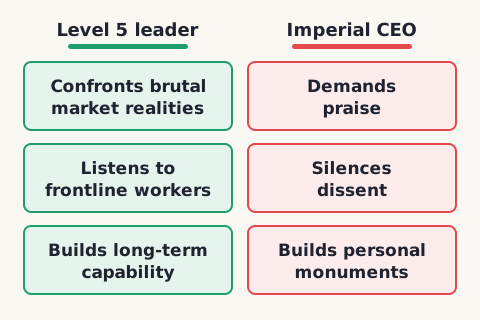
Level 5 Leaders vs. Imperial CEOs
A Level 5 growth-mindset CEO confronts brutal market realities, listens to frontline workers, and builds long-term institutional capability. An imperial, fixed-mindset CEO instead demands sycophantic praise, silences dissent, and spends company resources on personal monuments. Selecting a CEO purely for flamboyant charisma is a dangerous governance trap for the same reason: charismatic leaders often chase personal prestige over the unglamorous work of building lasting institutions.
Albert Dunlap: Short-Term Gains, Long-Term Ruin
Corporate raider Albert Dunlap, nicknamed "Chainsaw Al," ran executive management as a campaign of mass layoffs at Scott Paper and Sunbeam, slashing thousands of jobs to artificially inflate short-term earnings before cashing out his stock options. In the process, he gutted research and development, crushed morale, and destroyed the companies' long-term operating capacity rather than investing in sustainable growth.
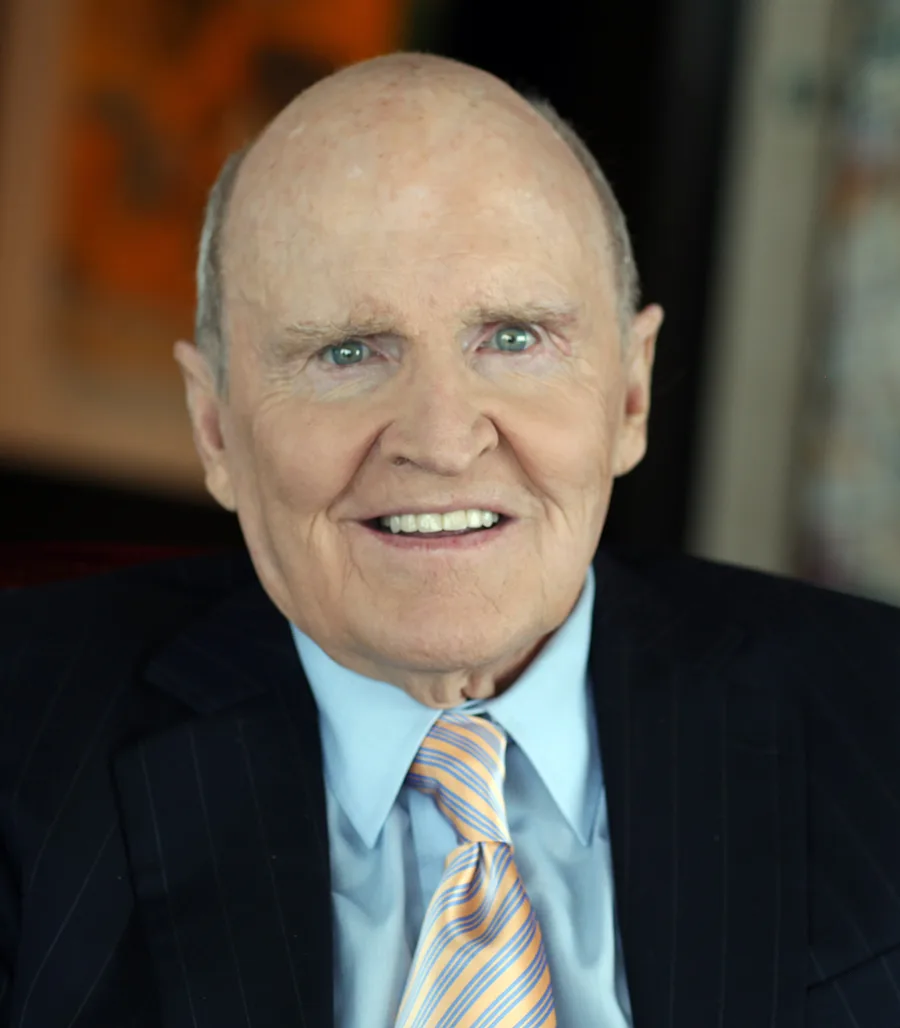
Jack Welch's Boundaryless Organization
Jack Welch transformed General Electric by tearing down corporate bureaucracy and instituting the "Boundaryless Organization" — a structure that empowered assembly-line workers to share operational improvements directly with senior management, rather than having ideas get lost in a rigid hierarchy. Dweck holds him up as a growth-minded leader, though his own forced ranking of employees, which marked the lowest-rated tenth for dismissal, cut the other way.

Lee Iacocca's Fall Into Hubris at Chrysler
Lee Iacocca engineered a brilliant government-backed turnaround of Chrysler in the early 1980s. But he later became absorbed in his own celebrity, appearing constantly on talk shows and writing bestselling autobiographies, while Chrysler's engineering quality slipped and Japanese competitors introduced better, more fuel-efficient models.
Weak Succession vs. Strong Succession Stewardship
A fixed-mindset CEO often leaves weak successors, whether by design or neglect, and the company falters after they leave. Level 5 growth leaders do the opposite, investing years in mentoring genuinely strong successors so the organization keeps thriving for decades after they're gone.
Organizational Mindsets and Collective Culture
Organizations embody collective mindsets: fixed-mindset cultures operate as 'cultures of genius' where employees hoard data and point fingers during market disruption, while growth-mindset cultures foster psychological safety, cross-functional collaboration, and development.
Groupthink and the Challenger Disaster
Social psychologist Irving Janis developed the theory of Groupthink (1972) — a drive for consensus and conformity within a cohesive group so strong it overrides realistic appraisal of alternatives. Janis studied the Bay of Pigs invasion. Later analysts have applied the idea to the Space Shuttle Challenger disaster, where engineers had warned that cold could make the booster O-ring seals fail and managers overrode them — but that reading is contested; Diane Vaughan stressed normalization of deviance instead.

Psychological Safety and Why Good Teams Report More Errors
Harvard Business School professor Amy Edmondson showed that teams learn from mistakes more readily when they have Psychological Safety — a shared belief that the team is safe for interpersonal risk-taking, where people can admit mistakes without fear of humiliation. In her 1996 study of hospital teams, the best-rated teams reported more errors than mediocre teams. They probably did not make more mistakes; safety let them talk about errors openly. In fixed-mindset cultures without that safety, employees conceal problems, and small defects can grow into large failures.
3M's 15% Innovation Rule
To reward prudent, structured risk-taking, 3M instituted the 15% Innovation Rule, allowing engineers to spend 15% of their paid working hours on speculative personal research projects. That policy of protected exploration time produced breakthrough innovations, including the Post-it Note.
How Mindset Shapes Manager Feedback
A fixed-mindset manager is less likely to notice and acknowledge changes in an employee's performance. Managers with a growth mindset are better at recognizing both improvement and decline, and managers trained in the growth mindset give struggling employees more developmental feedback.
The Devil's Advocate and Constructive Dissent
Growth-mindset organizations fight Groupthink by formally appointing a rotating Devil's Advocate whose explicit job is to challenge strategic assumptions and present worst-case failure scenarios before a major investment is approved — stress-testing the plan without turning disagreement into personal animosity.
Rewarding Risk and the Blameless Post-Mortem
Growth-mindset companies deliberately reward Prudent Risk-Taking, because celebrating well-designed experiments, even ones that fail, signals that calculated innovation is valued rather than punished. When a project does fail commercially, these organizations conduct a Blameless Post-Mortem: a structured review that identifies flawed assumptions without assigning individual blame, turning a commercial disappointment into an institutional lesson.
Matched pairs
Each item on the left goes with the one on the right.
- Anne Mulcahy's Turnaround of Xerox
- Rescued Xerox from $17 billion in debt by walking factory floors and protecting R&D innovation budgets
- Level 5 Leaders and Succession Planning
- Level 5 leaders invest years in grooming strong successors to ensure sustained institutional greatness
- 3M 15% Innovation Rule
- Allocated 15% of paid work time for speculative exploration, resulting in breakthrough innovations like Post-it Notes
- Amy Edmondson's Psychological Safety Finding
- Best-rated hospital teams reported more errors, which she read as openness about flaws
Step by step
Enron Rank and Yank Performance Protocol
- Hire elite MBA graduates based strictly on perceived raw intellectual pedigree
- Force department managers to rank staff twice a year on a rigid forced grading curve
- Push out the bottom 15% of employees at each review
- Incentivize widespread accounting fraud, blame-shifting, and concealment of trading losses
The Devil's Advocate Protocol
- Formulate strategic corporate initiative or major product development hypothesis
- Formally assign a rotating Devil's Advocate whose explicit duty is to find operational vulnerabilities
- Present alternative worst-case failure scenarios and contradictory evidence to the executive committee
- Refine strategic operational plans based on rigorous stress-testing before committing capital investments
Self-test
Answer each question from memory, then check your work against the answer key.
1. What destructive dynamic occurs in corporate executive suites when a CEO berates subordinates who report bad news?
- AAn information vacuum is created where lower management falsifies reports, blinding the CEO to catastrophic risks
- BThe leadership team stops voicing dissent and simply rubber-stamps every plan the CEO proposes.
- CMiddle managers begin inflating their own results while quietly shifting blame for failures onto rival teams.
- DSkilled employees quietly resign for rivals that reward candid reporting, draining institutional knowledge.
2. Which pair of executives built Enron's fixed-mindset 'talent cult'?
- ALee Iacocca and Anne Mulcahy
- BAlbert Dunlap and Lee Iacocca
- CJack Welch and Lou Gerstner
- DKen Lay and Jeffrey Skilling
3. Under Enron's 'Rank and Yank' protocol, what share of staff was pushed out at each twice-yearly review?
- ABottom 50 percent
- BBottom 15 percent
- CBottom 5 percent
- DBottom 25 percent
4. In 1993 Lou Gerstner took command of a crumbling IBM. Around what did he reorient the company after rejecting its culture of arrogant intellectual elitism?
- AMainframe hardware sales alone
- BA breakup into separate companies
- CClient-focused integrated services
- DPersonal-computer manufacturing
5. Which action was NOT part of Anne Mulcahy's turnaround of Xerox?
- AProtecting the R&D budget
- BTouring factories to hear workers
- CCutting executive perks and overhead
- DSlashing R&D for quick profits
6. How do growth-mindset executive teams conduct blameless post-mortems after a major product launch fails?
- ABy launching aggressive public relations campaigns that blame customers for misunderstanding.
- BBy quietly firing the lead product engineer to show Wall Street decisive, no-nonsense leadership.
- CBy assembling cross-functional teams to identify flawed assumptions without assigning individual blame
- DBy expunging all financial records of the failed product launch from corporate accounting.
7. What occurs in fixed-mindset corporate environments when employees encounter technical near-misses?
- AEmployees conceal near-misses out of fear of punishment, allowing small defects to compound into catastrophic failures
- BEmployees hastily patch the visible symptom without investigating what actually caused the near-miss.
- CEmployees openly log every near-miss in a shared file so other teams can learn from it immediately.
- DEmployees publicly blame faulty equipment or outside vendors rather than examine their own procedures.
8. Why do employees in fixed-mindset organizations frequently hoard information and withhold help from colleagues?
- ABecause a rigid seniority ladder promotes whichever employee appears to need the least outside help.
- BBecause they view workplace status as a zero-sum contest where helping peers threatens their own genius reputation
- CBecause many were taught in business school that sharing know-how erodes a firm's competitive edge.
- DBecause their compensation plans reward only individual output, giving them no formal reason to help peers.
9. Which social psychologist developed the influential research and theory of Groupthink?
- AAmy Edmondson
- BIrving Janis
- CJim Collins
- DSolomon Asch
10. Which structured practice do growth-mindset organizations use to challenge assumptions before major investments?
- ARank and Yank
- BBoundaryless Organization
- CDevil's Advocate Protocol
- D15 Percent Innovation Rule
Go deeper
- ListenLesson 4 episode
- WatchHumble and Fierce What did the great companies in Jim Collins's research have in common? Each was led by what he called a Level 5 leader.
- WatchMore Errors, Better Teams In Amy Edmondson's hospital research, the best-rated teams reported more errors, not fewer.
- ReadMindset by Carol S. Dweck · on Amazon ↗
- StudyMindset: The New Psychology of Success in the FlashFeed app
These are affiliate links: if you buy a book through one, FlashFeed may earn a small commission at no extra cost to you. The commission helps pay for FlashFeed's servers.
As an Amazon Associate we earn from qualifying purchases.
Answer key
- 1. A An information vacuum is created where lower management falsifies reports, blinding the CEO to catastrophic risksShooting the messenger creates an information vacuum where subordinates hide defects until systemic collapse occurs.
- 2. D Ken Lay and Jeffrey SkillingKen Lay and Jeffrey Skilling built Enron's talent cult on McKinsey's 'War for Talent' philosophy, hiring on pedigree and paying bonuses to reinforce genius status.
- 3. B Bottom 15 percentRank and Yank forced managers to rank employees on a curve at a twice-yearly review and push out the bottom 15%, fueling a fear-driven fixed-mindset culture.
- 4. C Client-focused integrated servicesGerstner rejected IBM's arrogant, elitist culture and reoriented the company around client collaboration and integrated enterprise services; the other options are not what the lesson describes.
- 5. D Slashing R&D for quick profitsMulcahy protected R&D and toured facilities to listen to staff; slashing R&D for short-term profit is the fixed-mindset move Dunlap and Iacocca made, not Mulcahy.
- 6. C By assembling cross-functional teams to identify flawed assumptions without assigning individual blameGrowth leaders conduct blameless post-mortems to extract systemic organizational lessons from commercial failures.
- 7. A Employees conceal near-misses out of fear of punishment, allowing small defects to compound into catastrophic failuresIn fixed cultures, employees hide mistakes to avoid punishment, allowing small flaws to compound into disasters.
- 8. B Because they view workplace status as a zero-sum contest where helping peers threatens their own genius reputationFixed cultures create zero-sum competition, leading employees to suppress data so peers appear less competent.
- 9. B Irving JanisIrving Janis developed the theory of Groupthink (1972), a drive for consensus so strong it overrides realistic appraisal of alternatives; he studied the Bay of Pigs invasion. The term itself was coined earlier by William H. Whyte.
- 10. C Devil's Advocate ProtocolGrowth-mindset teams use a Devil's Advocate protocol, appointing someone to challenge assumptions before major investments; Rank and Yank, Boundaryless Organization, and the 15% Rule are unrelated corporate programs from other companies.
Sources
- Mindset: The New Psychology of Success — Carol S. Dweck
- Carol S. Dweck, Mindset, Chapter 5: Business: Mindset and Leadership
- Carol S. Dweck, Mindset, Chapter 5: Business: Mindset and Leadership — www.penguinrandomhouse.com/books/44337/mindset-by-carol-s-dweck-phd/
- Irving Janis, Victims of Groupthink (1972); Rogers Commission Report (1986), Chapter V; Diane Vaughan, The Challenger Launch Decision (1996); Irving Janis, Victims of Groupthink (1972); Rogers Commission Report (1986), Chapter V — www.nasa.gov/history/rogersrep/v1ch5.htm
- Amy C. Edmondson (1996), Journal of Applied Behavioral Science; Edmondson (1999), Administrative Science Quarterly; Amy C. Edmondson, 'Learning from Mistakes Is Easier Said Than Done', Journal of Applied Behavioral Science (1996) — doi.org/10.1177/0021886396321001
- Jim Collins, Good to Great (2001), Level 5 Leadership
Image credits
- Lou Gerstner's Turnaround of IBM: Wikimedia Commons · Kenneth C. Zirkel · CC BY-SA 3.0 — commons.wikimedia.org/wiki/File:Lou_Gerstner_IBM_CEO_1995.jpg
- Level 5 Leaders vs. Imperial CEOs: FlashFeed original diagram · CC-BY-4.0
- Jack Welch's Boundaryless Organization: Hamilton83 · CC BY-SA 3.0 — en.wikipedia.org/wiki/Jack_Welch
- Lee Iacocca's Fall Into Hubris at Chrysler: Library of Congress · Lee Iacocca [Chrysler] · No known restrictions (verify at source) — www.loc.gov/item/2020731289/
- Psychological Safety and Why Good Teams Report More Errors: Wikimedia Commons · Evgenia Eliseeva · CC BY-SA 2.0 — commons.wikimedia.org/wiki/File:Amy_Edmondson._Photo_Credit-_Evgenia_Eliseeva_(2018_photo;_cropped_2022).jpg

