
Mindset: The New Psychology of Success study guide · Lesson 2 of 6
Ability, Achievement, and the Classroom
The Truth About Ability, Potential, and Achievement · High Standards, Nurturing Environments, and Stereotype Threat
Unofficial study guide for Mindset: The New Psychology of Success by Carol S. Dweck. FlashFeed is not affiliated with the author or publisher.
This is the lesson's study guide from the FlashFeed app, plus its key facts and a self-test.
What you'll be able to do
- Examine how mindsets determine academic trajectories in junior high, remedial language adoption, and pre-med performance.
- Evaluate how high educator standards and growth framing counteract stereotype threat in underrepresented students.
Lesson 2: Ability, Achievement, and the Classroom
The Truth About Ability, Potential, and Achievement
The divergence between fixed and growth mindsets becomes especially pronounced during critical academic transitions where scholastic difficulty escalates rapidly and prior effortless habits no longer suffice. In a longitudinal study of 373 students entering junior high school, Lisa Blackwell, Kali Trzesniewski, and Dr. Carol S. Dweck (2007) measured students' implicit self-theories upon entry and tracked their mathematical achievement over two full years. Both groups entered junior high with similar earlier math scores, yet their grades pulled apart. Students with a Fixed Mindset saw their grades stay flat across seventh and eighth grade. Entity theorists tended to read the increased difficulty as a sign of low ability. In contrast, students with a Growth Mindset showed an upward trajectory in grades, viewing increased academic rigor as a challenge that demanded refined study methods and greater effort.
This psychological dynamic was mirrored in an international field study at the prestigious University of Hong Kong. At this elite institution, all lectures, textbooks, and examinations are conducted strictly in English. However, many incoming freshmen possessed weak English proficiency, placing their academic careers in severe jeopardy. Researchers asked students whether they would take a course to improve their English if the university offered one. Students holding a Fixed Mindset were much less willing, apparently because admitting a skill deficiency felt threatening, even though weak English put their studies at risk. Students holding a Growth Mindset were much more willing, seeing language as a learnable skill.
A parallel study conducted with pre-med university students enrolled in notoriously difficult organic chemistry courses demonstrated the vital difference between rote studying and strategic learning. Pre-med students holding a Fixed Mindset only remained engaged with the course when they scored high marks on the first examination. When they received a disappointing grade, their motivation collapsed, they abandoned study routines, and their grades spiraled downward. Growth-mindset pre-med students responded to poor initial exam scores by diagnosing that their study tactics—primarily passive reading and rote memorization—were inadequate for organic chemistry. They changed how they studied, moving from rote memorization toward deeper understanding, and went on to higher final grades.
A pervasive misconception in modern education is treating standardized test percentiles or early IQ scores as permanent ceilings on student capability. Standardized tests measure an individual's accumulated knowledge and current test-taking strategies at a single isolated moment in time; they reveal nothing about what an individual can achieve through years of dedicated instruction and passionate curiosity. In her landmark work Drawing on the Right Side of the Brain, art educator Betty Edwards demonstrated that representational drawing is not an innate genetic gift reserved for a chosen few, but a learnable optical and perceptual skill set. Edwards argued that adults who believed they could not draw could learn to produce recognizable representational drawings in her five-day workshop.
When educators teach students the Brain-as-Muscle Metaphor—explaining that the brain forms new connections when students work through difficult problems—students' motivation and math grades improved compared with a control group (Blackwell et al., 2007). Conversely, early labeling of children as 'gifted' can backfire: children praised for natural genius often develop a fragile, perfectionist fixed mindset, becoming terrified of undertaking ambitious projects that might puncture their aura of effortless brilliance. In contrast, a growth-mindset educator treats a test as one snapshot of current understanding rather than a verdict on permanent ability, using the results to guide what to study next. Growth-mindset students who hit a hard problem read the difficulty as a cue to try harder, not as proof they lacked ability—a reframing that helps them build unshakeable academic resilience.
High Standards, Nurturing Environments, and Stereotype Threat
Educational excellence is not achieved by lowering standards to protect student self-esteem, nor is it achieved through authoritarian sorting and tracking. True educational transformation occurs in high-demand, high-support environments where teachers combine uncompromising academic rigor with fierce, unconditional belief in their students' capacity to grow. The preeminent historical exemplar of this growth-oriented pedagogy was Marva Collins, the visionary educator who established the Westside Preparatory School in the impoverished Garfield Park neighborhood of inner-city Chicago.
Collins opened the school in 1975 for children whom the public schools had labeled learning disabled. She paired high standards with warmth, and she placed the blame for their struggles on how they had been taught rather than on the children. By her own account, her students were reading well above grade level and taking on classic authors such as Shakespeare, although critics have questioned her results. Collins paired uncompromising academic standards with unconditional warmth, treating a child's mistakes as part of learning and never as a cause for shame.
Similarly, mathematics teacher Jaime Escalante transformed Garfield High School in East Los Angeles by building an elite AP Calculus program for disadvantaged Latino students. Escalante rejected the administrative assumption that his students lacked the innate talent for advanced mathematics. Through before-school tutorials, weekend practice sessions, and relentless encouragement, Escalante showed that students from his East Los Angeles neighborhood could master university-level calculus when given effective strategies, high standards, and steady support.
A critical dimension of educational inequality is the psychological phenomenon of Stereotype Threat, discovered by social psychologists Dr. Claude Steele and Dr. Joshua Aronson. Stereotype threat is a disruptive psychological state where members of a stereotyped group fear confirming a negative cultural stereotype about their group's intellectual ability, creating anxiety that, researchers propose, uses up working memory during high-stakes testing. In their landmark experiments, Steele and Aronson administered difficult verbal GRE questions to Black and White college students under two conditions:
- In the Ability-Diagnostic Condition, students were told the test was diagnostic of intellectual ability. This framing triggered acute stereotype threat in Black students, causing their test performance to drop significantly.
- In the Non-Diagnostic Condition, the identical test was presented simply as a problem-solving research task. Under this framing, Black students' performance rose and, after adjusting for prior SAT scores, matched that of their White peers. Later replications and meta-analyses have found the effect smaller and less consistent than these early results suggested, so it is best read as one influential finding about how framing can affect performance, not a settled law.
Research by Aronson, Catherine Good and colleagues, which Dweck discusses in Mindset, found that teaching students an incremental theory of intelligence can buffer them against stereotype threat. When female and minority students understand that the brain is a malleable muscle that expands with effort, they reframe test anxiety and challenging questions not as a threat of racial or gender inferiority, but as standard mental resistance. A separate field experiment in a high-level university calculus course (Good, Aronson and Harder, 2008) tested stereotype threat directly rather than teaching a growth mindset. Women's scores were equivalent to men's when threat was present and rose above men's when it was negated. Great teachers pair rigorous feedback with an explicit statement of belief in the student's capacity to meet high standards, which lets students accept criticism without feeling it as a verdict on their worth. By demystifying the learning process, educators empower students to transcend societal biases and achieve intellectual mastery.
Furthermore, the practice of early academic tracking—sorting elementary school students into rigid 'gifted' versus 'remedial' tracks based on one-off standardized test scores—institutionalizes fixed mindset assumptions across entire school districts. Tracking deprives students assigned to lower tiers of rich, challenging curricula and communicates an implicit message that their intellectual capacity is permanently capped. When schools treat ability as an expanding reservoir rather than a fixed container, every child is given the opportunity to reach extraordinary levels of scholastic competence.
Key terms
- Deep Conceptual Learning
- The active study strategy of extracting underlying principles, synthesizing complex ideas, and self-testing comprehension rather than passive rote reading.
- Stereotype Threat
- A disruptive psychological state where awareness of negative social stereotypes about one's group can impair intellectual performance.
Key concepts
Betty Edwards
- Renowned author of 'Drawing on the Right Side of the Brain'
- Argued that representational drawing is not an innate genetic gift but a learnable optical skill
- Held that adults who believed they could not draw could produce recognizable drawings in her five-day workshop
Jaime Escalante
- Renowned mathematics educator at Garfield High School in East Los Angeles
- Built an elite AP Calculus program for disadvantaged Latino students through rigorous preparation
- Showed that high expectations and growth-mindset coaching helped his students master advanced mathematics
Marva Collins
- Founder of Westside Preparatory School in the inner city of Chicago
- Refused to lower standards for children the public schools had labeled learning disabled
- By her own account, had her students reading well above grade level by pairing fierce rigor with unconditional warmth
Key facts
Junior High Academic Trajectory Divergence
In a longitudinal study of students entering junior high school, Blackwell, Trzesniewski, and Dweck (2007) found that students with similar earlier math achievement diverged: fixed-mindset grades stayed flat while growth-mindset grades climbed.
Rote Memorization vs. Deep Conceptual Learning
Fixed-mindset students tend to rely on passively rereading notes and rote memorization, assuming repetition alone is enough without testing real comprehension. Deep Conceptual Learning takes the opposite approach: actively extracting underlying principles, synthesizing complex ideas, and self-testing understanding rather than just re-reading.
Betty Edwards: Drawing Is a Learnable Skill
Art educator Betty Edwards, author of Drawing on the Right Side of the Brain, argued that representational drawing is not an innate genetic gift reserved for a chosen few — it's a learnable optical and perceptual skill. She held that adults who believed they could not draw could learn to produce recognizable representational drawings in her five-day workshop.
The University of Hong Kong English Course Study
At the University of Hong Kong, where all instruction is in English, many incoming freshmen had weak English skills that jeopardized their degrees. Asked whether they would take a course to improve their English if the university offered one, fixed-mindset freshmen were much less willing, apparently because admitting a deficiency felt threatening. Growth-mindset freshmen were much more willing, seeing English as a learnable skill.
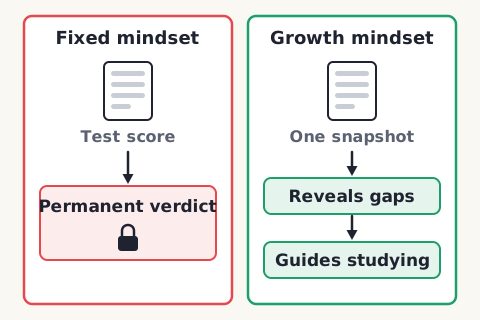
A Test Is One Snapshot, Not a Final Verdict
A growth mindset treats a test or evaluation as one snapshot of current understanding — a tool that reveals knowledge gaps and guides the next round of studying. A fixed mindset instead treats a test score as a permanent verdict on a person's intellectual capacity.
Organic Chemistry: Two Ways to Handle a Bad Grade
Pre-med students in a notoriously difficult organic chemistry course diverged sharply after a disappointing first exam. Fixed-mindset students lost interest and abandoned their study routines entirely, letting their motivation and grades collapse. Growth-mindset students instead diagnosed their passive reading and rote memorization as ineffective, then rebuilt their approach around active conceptual synthesis, drawing out reaction pathways, and forming study groups — ultimately earning high final grades.
The Brain-as-Muscle Metaphor Boosts Motivation
When educators explicitly teach students that the brain works like a muscle — that struggling with difficult problems makes neural synapses grow denser and fire faster — student motivation and academic performance rise significantly. Framing intellectual struggle as productive exercise, rather than proof of inadequacy, changes how students respond to difficulty.
A Standardized Test Score Is Not a Permanent Ceiling
A standardized test measures a student's accumulated knowledge and current test-taking strategy at one isolated moment — nothing more. It reveals nothing about what that person could achieve after years of dedicated instruction and curiosity, which is why treating an early test score as a permanent ceiling on ability is a fundamental misconception.
The Danger of the 'Gifted' Label
Labeling a child "gifted" early on can backfire. Praise for effortless brilliance can create a fragile, perfectionist fixed mindset: the child becomes terrified of undertaking ambitious projects that might puncture their reputation for genius, so they avoid the very challenges that would help them grow.

Marva Collins and High Academic Rigor
Marva Collins opened Westside Preparatory School in Chicago in 1975 for children the public schools had labeled learning disabled. By her own account, her students read well above grade level and took on classic authors such as Shakespeare, through uncompromising high standards paired with radical warmth.

Stereotype Threat: The Steele-Aronson Experiment
Social psychologists Claude Steele and Joshua Aronson identified Stereotype Threat — worry about confirming a negative stereotype about one's group, which can hurt performance on a hard test (one proposed mechanism is that it takes up working memory). In their experiment, Black and White students took the same difficult verbal questions from the Graduate Record Examination (GRE): framed as diagnostic of intellectual ability, Black students scored lower; framed as a non-diagnostic problem-solving task, their scores, adjusted for prior SAT scores, matched White students'.

Jaime Escalante's AP Calculus Program
Mathematics teacher Jaime Escalante built an elite AP Calculus program for disadvantaged Latino students at Garfield High School in East Los Angeles. Rejecting the assumption that his students lacked the innate talent for advanced math, Escalante ran before-school tutorials and weekend practice sessions, showing that students from his East Los Angeles neighborhood could master university-level calculus given effective strategies, high standards, and steady support.

Marva Collins' Nurturing Yet Rigorous Classroom
At Marva Collins' Westside Preparatory School, mistakes were treated as part of learning rather than cause for shame. Collins paired uncompromising academic standards with unconditional warmth, refusing to let a single error become a verdict on a child's ability.
High Standards, Not Sorting or Coddling
Educational excellence doesn't come from lowering standards to protect self-esteem, or from authoritarian sorting into "gifted" and "remedial" tracks. Genuine self-esteem is earned by conquering real challenges, not from unearned praise. A growth-oriented educator instead sets uncompromising standards while actively coaching students on explicit strategies to reach them, because rigid early tracking institutionalizes fixed-mindset labels and deprives lower-tier students of the rich, challenging curricula they need to grow.
Growth Mindset as a Buffer Against Stereotype Threat
Teaching students that intelligence expands like a muscle with practice acts as a psychological buffer against stereotype threat: when students believe the brain is malleable, they reinterpret a hard test as standard mental resistance rather than proof of a negative stereotype. In longitudinal studies of women in advanced university calculus, women with a fixed mindset suffered severe grade drops in gender-biased classrooms, while women with a growth mindset maintained stellar performance despite the same hostile environment.
Pairing High Standards With Belief
Great mentors pair a tough critique with an explicit statement of belief in the student's capacity to meet high standards — making clear that the criticism comes from high expectations, not doubt. This framing lets students receive rigorous feedback without feeling like their fundamental worth is being judged.
Matched pairs
Each item on the left goes with the one on the right.
- Fixed Mindset at University of Hong Kong
- Much less willing to take a course to improve their English, apparently to avoid exposing a deficiency
- Growth Mindset at University of Hong Kong
- Much more willing to take a course to improve their English, seeing it as a learnable skill
- Marva Collins' Classroom Error Culture
- Treated mistakes as part of learning rather than a source of shame, pairing rigor with unconditional warmth
- Jaime Escalante's AP Calculus Program
- Taught university-level calculus to disadvantaged East LA students through relentless practice and high standards
Step by step
Growth Mindset Pre-Med Chemistry Recovery Process
- Receive disappointing low grade on the initial organic chemistry examination
- Diagnose passive textbook reading and rote memorization as ineffective study strategies
- Shift to active conceptual synthesis, drawing reaction pathways, and forming collaborative review groups
- Test personal understanding relentlessly with novel practice problems to achieve top final marks
Steele-Aronson Stereotype Threat Experimental Protocol
- Administer difficult verbal Graduate Record Examination (GRE) questions to Black and White university students
- Frame Condition A as a test diagnostic of intellectual ability, to trigger stereotype threat
- Frame Condition B as a laboratory problem-solving task that is non-diagnostic of ability
- Observe Black student scores drop significantly under Condition A but match White peers of equal prior SAT scores under Condition B
Self-test
Answer each question from memory, then check your work against the answer key.
1. Which study methodology is typically utilized by students operating with a fixed mindset?
- AFormulating novel practice problem sets to challenge their personal grasp of abstract concepts.
- BConducting collaborative peer tutoring sessions to explain the underlying logic of complex theorems
- CDiagramming conceptual systems and actively identifying contradictions in the textbook arguments.
- DPassively reading class notes repeatedly and relying on rote memorization without testing deep comprehension
2. When asked whether they would take a course to improve their English, how did growth-mindset freshmen at the University of Hong Kong respond?
- AThey were much more willing and saw English as a learnable skill.
- BThey said their English was already good enough for their studies.
- CThey said they would turn it down to avoid exposing a weakness.
- DThey asked the university to drop its English exams instead.
3. A 2007 study tracked students entering junior high with similar earlier math scores. What happened to fixed-mindset students' grades?
- AGrades rose steadily each semester
- BGrades declined sharply through seventh and eighth grade
- CGrades stayed roughly flat through seventh and eighth grade
- DGrades fluctuated with no clear pattern
4. After a disappointing first exam in organic chemistry, how did growth-mindset pre-med students respond?
- AKept rereading old notes without changing any methods
- BDiagnosed weak habits and switched to active study
- CAbandoned their study routine entirely
- DDropped the pre-med track for another major
5. Which of the following is NOT characteristic of Deep Conceptual Learning as a study strategy?
- APassive rereading of notes without self-testing
- BExtracting underlying principles from material
- CSynthesizing complex ideas across topics
- DSelf-testing to confirm real comprehension
6. In the 2007 junior high study, how did fixed-mindset students' math grades trend across seventh and eighth grade?
- AThey declined sharply despite harder material
- BThey rose steadily alongside growth-mindset peers
- CThey fluctuated with no clear pattern
- DThey stayed flat despite similar starting scores
7. What academic trajectory did growth-mindset students show after entering junior high, according to the 2007 study?
- AA brief dip before returning to baseline
- BAn upward climb in math grades over two years
- CA decline across seventh and eighth grade
- DA flat trajectory matching their sixth-grade level
8. How did women holding a growth mindset respond when encountering gender-stereotyping environments in advanced calculus?
- AThey withdrew from the mathematics department and switched their degree requirements to introductory humanities
- BThey refused to attend laboratory lecture sections and attempted to memorize the textbook in total isolation
- CThey maintained stellar academic performance and resilience, viewing difficulty as standard cognitive training
- DThey demanded that the university administration replace all male mathematics professors with female instructors
9. Which educator opened Westside Preparatory School in Chicago in 1975 for children the public schools had labeled learning disabled?
- ACarol Dweck
- BJaime Escalante
- CMarva Collins
- DBetty Edwards
10. In the Steele and Aronson experiment, what happened when the test was framed as diagnostic of intellectual ability?
- APerformance was unaffected by the framing
- BBlack students' performance dropped significantly
- CBlack students' performance rose to match White peers
- DPerformance improved slightly for all groups
11. Which approach did Jaime Escalante use to build his AP Calculus program for disadvantaged students at Garfield High?
- ARelying on natural math talent with little outside help
- BSorting students by prior test scores into ability tracks
- CA slower, remedial-style course in place of calculus
- DBefore-school tutorials and relentless high standards
12. According to growth-mindset mentors, what should tough critique be paired with so a student doesn't feel threatened by it?
- AHigh standards plus belief in their capacity
- BA comparison to other students in the class
- CAn apology for giving harsh criticism
- DA promise the criticism won't affect their grade
Go deeper
- ListenLesson 2 episode
- WatchSame Start, Different Paths Two groups of students started junior high with almost the same math scores. Over two years, their grades pulled apart.
- WatchWelcome to Success In Chicago, Marva Collins opened Westside Preparatory School for children the public schools had written off.
- ReadMindset by Carol S. Dweck · on Amazon ↗
- StudyMindset: The New Psychology of Success in the FlashFeed app
These are affiliate links: if you buy a book through one, FlashFeed may earn a small commission at no extra cost to you. The commission helps pay for FlashFeed's servers.
As an Amazon Associate we earn from qualifying purchases.
Answer key
- 1. D Passively reading class notes repeatedly and relying on rote memorization without testing deep comprehensionFixed mindset students rely heavily on passive rote reading, assuming memorization alone will suffice without conceptual synthesis.
- 2. A They were much more willing and saw English as a learnable skill.Growth-mindset students were much more willing to take a course to improve their English because they prioritized skill acquisition over ego protection.
- 3. C Grades stayed roughly flat through seventh and eighth gradeDespite similar starting scores, fixed-mindset students' grades stayed flat across seventh and eighth grade, while growth-mindset students' grades climbed over the same period.
- 4. B Diagnosed weak habits and switched to active studyGrowth-mindset students diagnosed that passive rereading was inadequate and shifted to active strategies like diagramming reactions and group testing, unlike fixed-mindset students who disengaged.
- 5. A Passive rereading of notes without self-testingDeep Conceptual Learning means actively extracting principles and self-testing comprehension; passively rereading notes without testing understanding is the fixed-mindset habit it replaces.
- 6. D They stayed flat despite similar starting scoresDespite similar earlier scores, fixed-mindset students' grades stayed flat through seventh and eighth grade, while growth-mindset students' grades climbed.
- 7. B An upward climb in math grades over two yearsGrowth-mindset students treated harder math as a challenge, producing an upward grade trajectory across two years.
- 8. C They maintained stellar academic performance and resilience, viewing difficulty as standard cognitive trainingGrowth-mindset women remained highly resilient in hostile STEM environments, buffering them from stereotype-induced drops.
- 9. C Marva CollinsMarva Collins opened Westside Preparatory School in Chicago, pairing uncompromising academic rigor with radical warmth. Her account of her students' results has been questioned by critics.
- 10. B Black students' performance dropped significantlyFramed as diagnostic of ability, the test triggered stereotype threat and Black students' performance dropped; under the non-diagnostic framing, their scores matched White students' once prior SAT scores were taken into account.
- 11. D Before-school tutorials and relentless high standardsEscalante ran before-school tutorials and weekend practice, showing that his students could master university-level calculus with high standards and steady support.
- 12. A High standards plus belief in their capacityPairing tough critique with an explicit statement of high standards and belief in the student's capacity to meet them lets them accept rigor without feeling threatened.
Sources
- Mindset: The New Psychology of Success — Carol S. Dweck
- Carol S. Dweck, Mindset, Chapter 3: Ability and Achievement
- Carol S. Dweck, Mindset, Chapter 3: Ability and Achievement — www.penguinrandomhouse.com/books/44337/mindset-by-carol-s-dweck-phd/
- Carol S. Dweck, Mindset, Chapter 3: Ability and Achievement; Steele & Aronson (1995), Journal of Personality and Social Psychology 69(5); Carol S. Dweck, Mindset, Chapter 3 — www.penguinrandomhouse.com/books/44330/mindset-by-carol-s-dweck-phd/
- Marva Collins (Wikipedia); Carol S. Dweck, Mindset, Chapter 3: Ability and Achievement — en.wikipedia.org/wiki/Marva_Collins
Image credits
- A Test Is One Snapshot, Not a Final Verdict: FlashFeed original diagram · CC-BY-4.0
- Marva Collins and High Academic Rigor: White House Photo Office, George W. Bush Administration (National Archives) · Public domain — commons.wikimedia.org/wiki/File:President_George_W._Bush_and_Mrs._Laura_Bush_with_National_Medal_of_Humanities_Recipient_Marva_Collins_in_the_Oval_Office.jpg
- Stereotype Threat: The Steele-Aronson Experiment: Albeiro Rodas - albeiror24@gmail.com · Public domain — en.wikipedia.org/wiki/Exam
- Jaime Escalante's AP Calculus Program: Wikimedia Commons · Los Angeles Times · CC BY 4.0 — commons.wikimedia.org/wiki/File:Jaime_Escalante_teaching,_1983_(cropped).jpg
- Marva Collins' Nurturing Yet Rigorous Classroom: Series: Photographs Related to the George W. Bush Administration, 1/20/2001 - 1/ · Public domain — commons.wikimedia.org/wiki/File:President_George_W._Bush_and_Mrs._Laura_Bush_with_National_Medal_of_Humanities_Recipient_Marva_Collins_in_the_Oval_Office.jpg

