
Never Split the Difference: Negotiating As If Your Life Depended On It study guide · Lesson 6 of 8
Guaranteeing Execution & Detecting Tells
The 7-38-55 Rule and the Rule of Three · Spotting Deception and The Pinocchio Effect
Unofficial study guide for Never Split the Difference: Negotiating As If Your Life Depended On It by Chris Voss, Tahl Raz. FlashFeed is not affiliated with the author or publisher.
This is the lesson's study guide from the FlashFeed app, plus its key facts and a self-test.
What you'll be able to do
- Apply the 7-38-55 Rule to trust tone and body language over words, label incongruence, and use the Rule of Three to filter out insincere agreement.
- Spot deception through the Pinocchio Effect, third-person pronouns, and signals that contradict a verbal promise, and read a modest 'we' as real authority.
Comprehensive study guide for Guaranteeing Execution & Detecting Tells from Never Split the Difference: Negotiating As If Your Life Depended On It by Chris Voss with Tahl Raz.
The 7-38-55 Rule and the Rule of Three
Foundational Insights and Behavioral Architecture
1. Albert Mehrabian's 7-38-55 Rule states that in emotional communication, only 7% of meaning is conveyed by words, 38% by vocal tone, and 55% by body language.
Focusing solely on what someone says while ignoring how they sound and move blinds negotiators to 93% of the real message. UCLA psychologist Albert Mehrabian's 7-38-55 Rule establishes that emotional communication is divided into: 7 percent literal words, 38 percent vocal tone, and 55 percent body language.
2. When there is a mismatch between a person's spoken words and their vocal tone or body language, humans instinctively trust tone and non-verbal cues over literal text.
If someone says 'Yes, I'm thrilled to do this' with flat vocal pitch and crossed arms, their non-verbal cues reveal deep hesitation or deceit. When verbal content conflicts with vocal tone or physical demeanor, human beings overwhelmingly and correctly trust the non-verbal and tonal signals.
3. Incongruence between verbal agreement and vocal inflection indicates hidden reservations, lack of authority, or an impending failure of execution.
A deal signed with vocal hesitation is a deal destined to collapse during operational execution unless the hidden reservation is surfaced and solved. Incongruence between verbal assent and non-verbal cues is an infallible diagnostic indicator of hidden reservations, organizational resistance, or execution failure.
4. When you detect non-verbal incongruence, immediately label it: 'I heard you say yes, but there was hesitation in your voice.'
Calling out the subtle hesitation gives the counterpart permission to voice their underlying concern before it sabotages the project. Upon identifying a tonal or physical incongruity, address it immediately with an affect label: 'I heard you say yes, but it sounds like there is some hesitation.'
5. The Rule of Three is the discipline of getting a counterpart to reaffirm their agreement three separate times in a single conversation.
It is easy for someone to give one counterfeit 'Yes' to end a meeting; maintaining consistent agreement three times across different angles filters out insincerity. The Rule of Three requires securing three distinct, authentic confirmations of commitment within a single interaction to guarantee operational execution.
6. The first confirmation in the Rule of Three is secured when the counterpart agrees to the initial proposal or term.
This establishes the baseline agreement from which deeper commitment must be built. The first touchpoint of the Rule of Three is achieved when the counterpart gives their initial verbal assent to the proposed framework.
7. The second confirmation in the Rule of Three is secured by labeling or summarizing what the counterpart said, prompting them to respond: 'That's right.'
Probing implementation feasibility tests whether they have actually thought through what executing the deal requires. The second confirmation is obtained by labeling or summarizing what the counterpart said, prompting them to respond: 'That's right.'
8. The third confirmation in the Rule of Three is secured when the counterpart explains how they will overcome internal obstacles or achieve execution.
When the counterpart explains how they will deliver, they take full psychological ownership of the outcome. The third confirmation is locked in when the counterpart articulates in their own words exactly how they will execute the agreement and navigate internal roadblocks.
9. Negotiators must identify behind-the-scenes decision-makers—the 'deal-killers'—who are not at the table but hold veto power over implementation.
Negotiating a brilliant deal with someone who lacks the authority to implement it is a total waste of time and resources. Master negotiators actively map the absent stakeholders—the hidden deal-killers—who hold informal veto power over contract execution.
10. Asking calibrated questions about implementation (e.g., 'How will this affect the rest of your team?') uncovers hidden stakeholders and internal friction.
These questions help your counterpart sell the agreement internally to their colleagues and bosses, ensuring smooth execution. Calibrated queries such as 'How does this affect the rest of your team?' and 'What will your board say about this?' immediately surface hidden organizational stakeholders.
Practical Application and Strategic Takeaways
Spotting Deception and The Pinocchio Effect
Foundational Insights and Behavioral Architecture
1. The Pinocchio Effect refers to the behavioral phenomenon where individuals who are lying or being deceptive use significantly more words and elaborate sentence structures.
Liars feel an unconscious compulsion to over-explain and fabricate details in an effort to appear convincing. The Pinocchio Effect identifies that deceptive speakers use significantly more words, complex linguistic acrobatics, and convoluted explanations than truth-tellers.
2. Deceptive negotiators tend to use third-person pronouns ('they', 'them', 'the company') to create psychological distance from their deceit.
Shifting from 'I decided' to 'management believes' allows the speaker to evade direct personal accountability for false claims. Deceptive communicators instinctively adopt third-person pronouns and passive voice to create subconscious psychological distance between themselves and the lie.
3. In contrast, authentic and confident communicators speak with concise clarity, direct syntax, and appropriate first-person pronouns.
Honesty requires no embellishment; truth-tellers state their position simply and comfortably allow silence to follow. Truthful, confident negotiators communicate with concise brevity, straightforward syntax, and natural first-person pronouns without defensive embellishment.
4. The 7-38-55 rule helps detect deception when verbal promises are contradicted by micro-expressions, throat-clearing, or evasive eye contact.
The autonomic nervous system leaks the truth through micro-behaviors that the conscious mind cannot fully suppress. Applying Mehrabian's framework exposes deception whenever smooth verbal assurances clash with physiological tells such as micro-expressions or vocal pitch spikes.
5. Using your own name in conversation humanizes you and breaks down the impersonal barrier that adversaries use to justify harsh treatment.
It is easy to abuse an anonymous representative; it is psychologically painful to mistreat 'Chris' or 'Sarah' once a human connection is made. Introducing and strategically referencing your own personal name humanizes you, dismantling the impersonal barrier that enables counterparts to treat you harshly.
6. Introducing yourself by first name and playfully asking whether there's a friendly, personal discount available uses humor and personalization to disarm rigid corporate pricing policies.
This kind of playful, name-based ask brings a smile, removes tension, and invites the other person to treat you as a friend rather than a transaction, without needing to be framed as a verbatim script.
7. True decision-makers often use plural pronouns ('we', 'our team') to remain modest and protect their flexibility, while weak intermediaries boast of their power.
A person who boasts 'I make all the final decisions here' is usually insecure, while the true boss often sits quietly saying 'We need to consider this carefully.' Authentic power players frequently speak in modest plural pronouns ('we', 'the team'), whereas low-level intermediaries boast of their solitary decision-making authority.
8. Spotting deception is not about pointing fingers, but about asking calibrated questions that lead the deceptive party back to verifiable reality.
Accusing someone of lying triggers defensive warfare; asking 'How does that align with our previous data?' lets them correct the discrepancy without losing face. Detecting a lie is not an invitation to accuse the counterpart; it is a tactical signal to deploy calibrated questions that gently steer them back to reality.
9. When dealing with extreme aggression, responding with calm curiosity strips the aggressor of their emotional leverage.
Bullying requires a reactive victim; by remaining serene and analytical, you make their aggression feel awkward and useless. Facing aggressive posturing with unshakeable calm and polite curiosity disarms the attacker's momentum and leaves them emotionally stranded.
10. Ensuring execution requires confirming that the counterpart has both the organizational authority and the technical capability to deliver on promises.
A deal is only as good as the counterpart's operational capacity; verifying internal alignment prevents post-signing disasters. Guaranteeing execution demands continuous verification that the counterpart possesses both legitimate organizational authority and practical capability to fulfill the deal.
Practical Application and Strategic Takeaways
Key terms
- Verbal-Tonal Incongruence
- Incongruence between verbal agreement and vocal inflection indicates hidden reservations, lack of authority, or an impending failure of execution.
- Authentic, Confident Communication Style
- In contrast, honest, secure communicators speak with concise clarity, direct syntax, and appropriate first-person pronouns.
Key facts
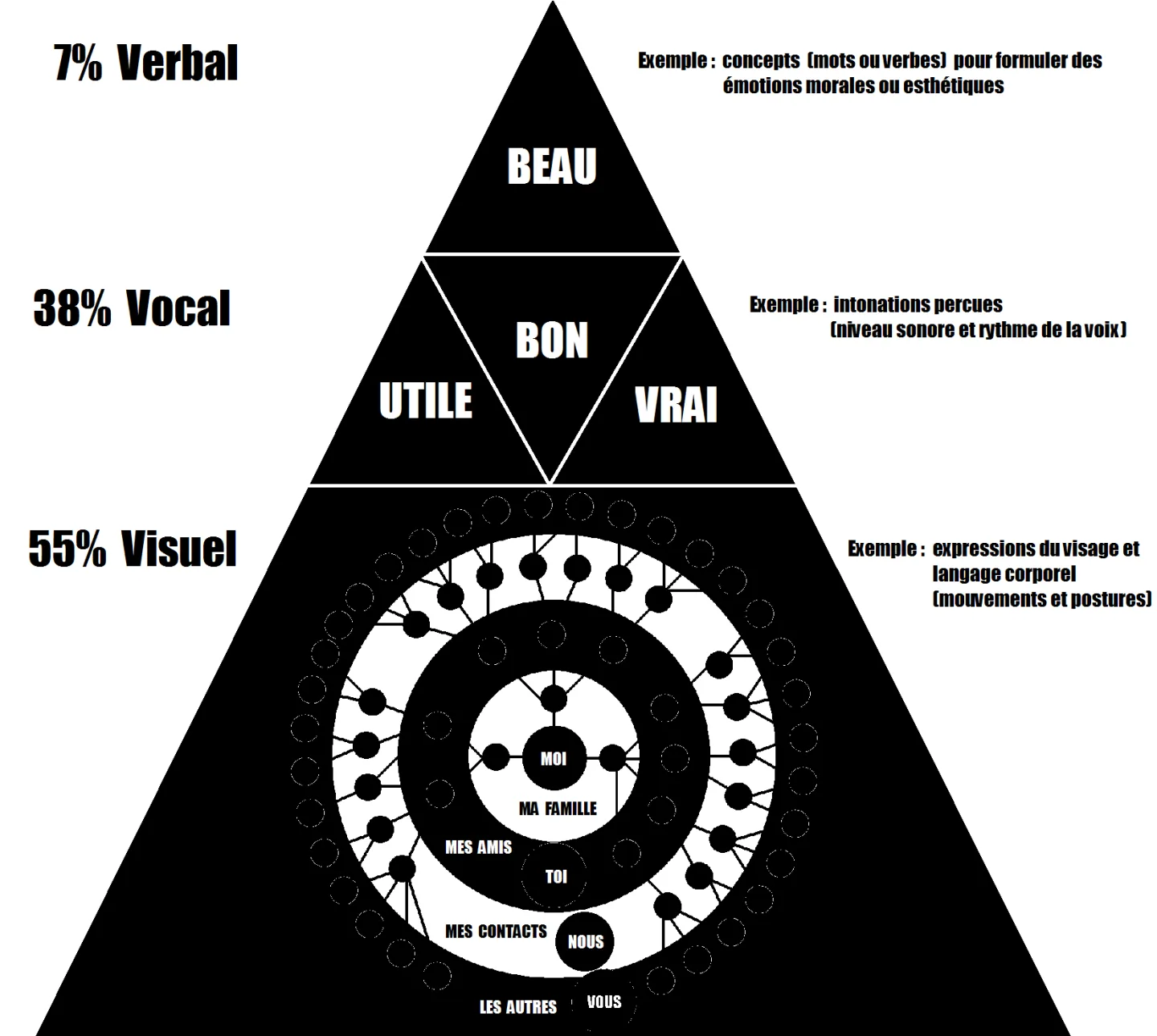
Albert Mehrabian's 7-38-55 Rule sta
Albert Mehrabian's 7-38-55 Rule states that in emotional communication, only 7% of meaning is conveyed by words, 38% by vocal tone, and 55% by body language. Focusing solely on what someone says while ignoring how they sound and move blinds negotiators to 93% of the real message.
The Rule of Three is the disci
It is easy for someone to give one counterfeit 'Yes' to end a meeting; maintaining consistent agreement three times across different angles filters out insincerity.
Compare tactical execution versus conventional bargaining:
Tactical Empathy — The third confirmation in the Rule of Three is secured when the counterpart explains how they will overcome internal obstacles or achieve execution.
Conventional Bargaining — Relying on rigid positions, positional bargaining, and premature compromises.
Summary: Asking calibrated questions ab
Asking calibrated questions about implementation (e.g., 'How will this affect the rest of your team?') uncovers hidden stakeholders and internal friction. These questions help your counterpart sell the agreement internally to their colleagues and bosses, ensuring smooth execution.
The Pinocchio Effect
The Pinocchio Effect refers to the behavioral phenomenon where individuals who are lying or being deceptive use significantly more words and elaborate sentence structures. Liars feel an unconscious compulsion to over-explain and fabricate details in an effort to appear convincing.
Using your own name in convers
It is easy to abuse an anonymous representative; it is psychologically painful to mistreat 'Chris' or 'Sarah' once a human connection is made.
Compare tactical execution versus conventional bargaining:
Tactical Empathy — Spotting deception is not about pointing fingers, but about asking calibrated questions that lead the deceptive party back to verifiable reality.
Conventional Bargaining — Relying on rigid positions, positional bargaining, and premature compromises.
Summary: Ensuring execution requires co
Ensuring execution requires confirming that the counterpart has both the organizational authority and the technical capability to deliver on promises. A deal is only as good as the counterpart's operational capacity; verifying internal alignment prevents post-signing disasters.
Matched pairs
Each item on the left goes with the one on the right.
- Core Insight
- The second confirmation in the Rule of Three is secured by labeling or summarizing what the counterpart said, prompting a genuine 'That's right.'
- Operational Focus
- Using an affect label or mirrored summary of the counterpart's own words to earn a genuine 'That's right.'
- Core Insight
- True decision-makers often use plural pronouns ('we', 'our team') to remain modest and protect their flexibility, while weak intermediaries boast of their power.
- Operational Focus
- A person who boasts 'I make all the final decisions here' is usually insecure, while the true boss often sits quietly saying 'We need to consider this carefully.'
Step by step
Protocol: Negotiators Application
- Assess counterpart psychological posture and emotional drivers.
- Deploy active listening instruments without premature judgment.
- Articulate the counterpart's perspective to achieve alignment.
- Guide the dialogue toward a collaborative breakthrough.
Protocol: Spotting Deception
- Recognize an accusation of being 'unfair' as a pressure tactic, not a factual claim.
- Label the emotion behind it: 'It seems like you feel this isn't fair.'
- Ask them to define their own standard: 'What would you consider fair?'
- Hold your position and require them to justify the claim with specifics before conceding anything.
Self-test
Answer each question from memory, then check your work against the answer key.
1. According to Albert Mehrabian's 7-38-55 Rule, what percentage of meaning in emotional communication comes from body language?
- A7%
- B65%
- C55%
- D38%
2. Which of these is NOT one of the three components in Mehrabian's 7-38-55 Rule?
- AFacial symmetry
- BVocal tone
- CBody language
- DLiteral words
3. When someone's spoken words conflict with their tone and body language, which does Chris Voss say people instinctively trust?
- AThe literal words
- BOnly body language
- COnly vocal tone
- DTone and body cues
4. What does the Rule of Three help filter out in a negotiation?
- AAmbiguous contract wording
- BInsincere agreement
- CAggressive pricing tactics
- DA weak BATNA
5. In the Rule of Three, what secures the SECOND confirmation of commitment?
- AThe counterpart's initial verbal assent
- BA calibrated question about implementation
- CA mirrored restatement of the terms
- DAn explanation of how they'll execute it
6. What is the Pinocchio Effect?
- ALiars speaking in short, clipped sentences
- BLiars avoiding eye contact only
- CLiars repeating the same phrase
- DLiars using more words and elaborate sentences
7. Which is NOT a trait of an authentic, confident communicator?
- AConcise clarity
- BElaborate over-explanation
- CAppropriate first-person pronouns
- DDirect syntax
8. A counterpart gives a long, detail-heavy explanation for a simple yes/no question. What does the Pinocchio Effect suggest this indicates?
- APossible deception
- BHigh confidence
- CStrong negotiating leverage
- DFull authority to decide
9. Verbal promises contradicted by which signals suggest deception, per the 7-38-55 rule?
- ARelaxed posture, steady breathing
- BFirm handshake, steady eye contact, relaxed open shoulders
- CLoud tone, confident posture
- DMicro-expressions, throat-clearing, evasive eye contact
10. Which pronoun usage tends to signal a counterpart genuinely holds decision-making authority?
- AFrequent use of they
- BFrequent use of you
- CFrequent use of we
- DFrequent use of I
Go deeper
- ReadNever Split the Difference by Chris Voss, Tahl Raz · on Amazon ↗
- StudyNever Split the Difference: Negotiating As If Your Life Depended On It in the FlashFeed app
These are affiliate links: if you buy a book through one, FlashFeed may earn a small commission at no extra cost to you. The commission helps pay for FlashFeed's servers.
As an Amazon Associate we earn from qualifying purchases.
Answer key
- 1. C 55%Mehrabian's rule assigns 55% of emotional meaning to body language, 38% to vocal tone, and only 7% to the literal words spoken.
- 2. A Facial symmetryThe rule's three components are literal words (7%), vocal tone (38%), and body language (55%). Facial symmetry isn't part of the rule.
- 3. D Tone and body cuesVoss teaches that when words conflict with tone and body language, people correctly trust the combined tonal and non-verbal signals, not just one channel or the words themselves.
- 4. B Insincere agreementSecuring three separate, authentic confirmations filters out a single counterfeit 'yes' given just to end a meeting.
- 5. C A mirrored restatement of the termsThe second confirmation comes from a mirrored restatement of the terms — a label or summary that earns a genuine 'That's right'; the initial assent is the first confirmation, and a calibrated question about implementation secures the third.
- 6. D Liars using more words and elaborate sentencesLiars feel an unconscious compulsion to over-explain and fabricate details, leading them to use more words and elaborate sentence structures.
- 7. B Elaborate over-explanationAuthentic communicators speak with concise clarity and direct syntax. Elaborate over-explanation is instead a sign of the Pinocchio Effect.
- 8. A Possible deceptionThe Pinocchio Effect holds that over-explaining and fabricating extra detail is a behavioral tell of deception, not confidence or authority.
- 9. D Micro-expressions, throat-clearing, evasive eye contactThe 7-38-55 rule helps detect deception when verbal promises are contradicted by micro-expressions, throat-clearing, or evasive eye contact, unlike confident, steady nonverbal signals.
- 10. C Frequent use of weTrue decision-makers tend to use plural pronouns like 'we,' reflecting organizational backing, while someone insisting 'I make all the decisions' often overstates their authority.
Sources
- Never Split the Difference: Negotiating As If Your Life Depended On It — Chris Voss with Tahl Raz
- Never Split the Difference (Chris Voss & Tahl Raz)
Image credits
- Albert Mehrabian's 7-38-55 Rule sta: Wikimedia Commons · 2007_distance_attraction.PNG : Daniel Rodet derivative work: Copyleft… · CC BY-SA 3.0 — commons.wikimedia.org/wiki/File:2011_pyramide_des_besoins_de_communication_d_apres_Albert_Mehrabian.png
