
Ham Radio Technician License study guide · Lesson 3 of 15
Operating Procedures
Choosing frequencies and making calls · Repeater operating and access tones · Public service and emergency operation
This is the lesson's study guide from the FlashFeed app, plus its key facts and a self-test.
What you'll be able to do
- Identify common repeater offsets, the 2-meter FM simplex calling frequency, and what simplex, repeater offset and band plans mean
- Explain what CQ means and how an operator answers one, calls a known station, or announces listening, on a repeater or without one
- Explain how repeater access works, including tones, squelch, reverse and offset, and how to fix common access and audio problems
- Describe DMR talkgroups and color codes, how to share frequencies and simplex channels, and what common Q signals mean
- Describe net operation and formal message handling: net control duties, net practice, traffic, preambles, check and phonetics
- Explain emergency operation: how FCC rules apply, what RACES and ARES are, and how Winlink relays messages by email
This lesson covers how a licensee operates on the air day to day: where to transmit, how to call and answer other stations, how repeaters are reached, and how organized groups handle messages and emergencies. A new licensee who knows these habits can make a first contact without confusion or interference. The Federal Communications Commission (FCC) rules still apply the whole time, so the lesson ends with how emergency work fits under them.
Choosing frequencies and making calls
Repeater offsets
A repeater offset is the difference between a repeater's transmit and receive frequencies. A repeater listens on one frequency and retransmits on another, and the gap between the two is the offset. Each band has a common offset.
- In the 2-meter band, a common repeater offset is plus or minus 600 kilohertz (kHz).
- In the 70-centimeter band, a common repeater offset is plus or minus 5 megahertz (MHz).
The two bands differ here. Plus or minus 600 kHz belongs to 2 meters, and plus or minus 5 MHz belongs to 70 centimeters.
Simplex and the calling frequency
An amateur station that transmits and receives on the same frequency is operating simplex. Nothing is retransmitted, so only stations within range of each other can talk. This is the opposite of repeater operation, where the transmit and receive frequencies differ by the offset.
The national calling frequency for frequency modulated (FM) simplex operation in the 2-meter band is 146.520 MHz. A new licensee who wants a first simplex contact can start there.
Band plans
A band plan is a voluntary guideline for using different modes or activities within an amateur band. It goes beyond the privileges the FCC establishes. The FCC sets which frequencies a license class may use. A band plan is a courtesy agreement about how operators share those frequencies.
Calling another station
How an operator calls depends on whom the operator wants to reach. The procedural signal CQ means calling any station. An operator who sends it invites anyone who hears it to answer.
Four situations come up.
- Answering a CQ. The responding operator transmits the other station's call sign followed by his or her own call sign.
- Calling a known station on a repeater. The operator says that station's call sign, then identifies with his or her own call sign.
- Announcing availability on a repeater. A customary way to show that a station is listening and looking for a contact is to say the station's own call sign followed by the word listening. Anyone hearing it may then call.
- Seeking any phone contact without a repeater. An effective way is to repeat CQ a few times, followed by the words this is and the operator's call sign. The operator then pauses to listen and repeats as necessary.
Taken together, a CQ is an open invitation and the answer to it is a direct reply. A call to a known station goes straight to that station's call sign. In both cases the call sign of the station being addressed comes first, and the caller's own call sign follows it.
Sources
Repeater operating and access tones
Getting into a repeater
On the very high frequency (VHF) and ultra high frequency (UHF) bands, reaching a repeater means getting the radio frequency (RF) offset right, and often a tone or code as well. When an operator can hear a repeater's output but cannot get into it, any of three things could be the cause:
- an improper transceiver offset;
- the wrong Continuous Tone-Coded Squelch System (CTCSS) tone;
- the wrong Digital Coded Squelch (DCS) code.
CTCSS is a sub-audible tone. It is transmitted along with normal voice audio to open the squelch of a receiver. DCS is a related code that serves a similar access purpose.
Dual-Tone Multi-Frequency (DTMF) is a different kind of signaling to a repeater. It uses two simultaneous audio tones. CTCSS is a single sub-audible tone sent with voice. DTMF is two tones sent together.
The reverse function
Many VHF/UHF transceivers have a reverse function. It lets the operator listen on a repeater's input frequency. The input frequency is the one on which the repeater receives.
Squelch and audio problems
The purpose of squelch is to mute the receiver audio when a signal is not present. A CTCSS tone can open the squelch so that the receiver speaks only for the right signals.
An operator whose FM transmission audio drops out on voice peaks is talking too loudly. The fix is to speak at a lower level.
Linked repeaters
A linked repeater network is a network of repeaters in which signals received by one repeater are transmitted by all the repeaters in the network. A call made into one reaches users of every other.
Digital Mobile Radio talkgroups and color codes
Digital Mobile Radio (DMR) is a digital system with its own access terms.
- A talkgroup is an identifier used by DMR to organize radio traffic, so that those who want to hear the group are not bothered by other radio traffic. An operator joins a digital repeater's talkgroup by programming the radio with the group's ID or code.
- The digital color code is an access code that must be programmed into a DMR transmitter to access a specific repeater.
Sharing frequencies and simplex channels
Simplex channels are designated in the VHF/UHF band plans so that stations within range of each other can communicate without tying up a repeater.
When two stations transmitting on the same frequency interfere with each other, the stations should negotiate continued use of the frequency.
Q signals
Two Q signals matter here: QRM (interference from other stations) and QSY (changing frequency).
- QRM indicates that an operator is receiving interference from other stations.
- QSY indicates that an operator is changing frequency.
A station that finds a repeater busy, for instance, might use QSY to tell a friend to move to a simplex channel.
Sources
- 2026-2030 Technician Class (Element 2) Question Pool and Syllabus, public release of February 19, 2026 (errata applied)
- 47 CFR § 97.3 Definitions
Public service and emergency operation
FCC rules always apply
The FCC's Part 97 rules for the Amateur Radio Service always apply to the operation of an amateur station. They keep applying when a station operates under Radio Amateur Civil Emergency Service rules, Amateur Radio Emergency Service rules, or the rules of the Federal Emergency Management Agency (FEMA). The station licensee is responsible for the proper operation of the station under the FCC Rules. When the control operator is a different amateur operator than the licensee, both persons are equally responsible for proper operation.
One narrow exception concerns frequency privileges. A control operator may operate outside the frequency privileges of his or her license class, but only in situations involving the immediate safety of human life or protection of property.
Emergency organizations
Two groups serve in emergencies, and they are different.
- The radio amateur civil emergency service (RACES) is an FCC Part 97 amateur radio service for civil defense communications during national emergencies. The definition in § 97.3 reaches further, to periods of local, regional or national civil emergencies. RACES requires certification by a civil defense agency.
- The Amateur Radio Emergency Service (ARES) is a group of licensed amateurs who have voluntarily registered their qualifications and equipment for communications duty in the public service.
Nets and traffic
The net control station calls the net to order and directs communications between stations checking in.
A participant follows standard practice. Unless reporting an emergency, a participant transmits only when directed by the net control station.
In net operation, traffic means formal messages exchanged by net stations.
The preamble of a formal traffic message contains information needed to track the message. The word check in a radiogram header means the number of words or word equivalents in the text portion of the message.
Phonetics and Winlink
To make sure voice messages containing unusual words are received correctly, the operator spells the words using a standard phonetic alphabet.
Winlink relays messages using email addresses based on amateur callsigns.
Sources
Key terms
- CQ
- Procedural signal meaning an operator is calling any station
- RF
- Short for radio frequency, as defined in the Federal Communications Commission (FCC) rules
- QRM
- Q signal meaning an operator is receiving interference from other stations
- QSY
- Q signal meaning an operator is changing frequency
Key facts
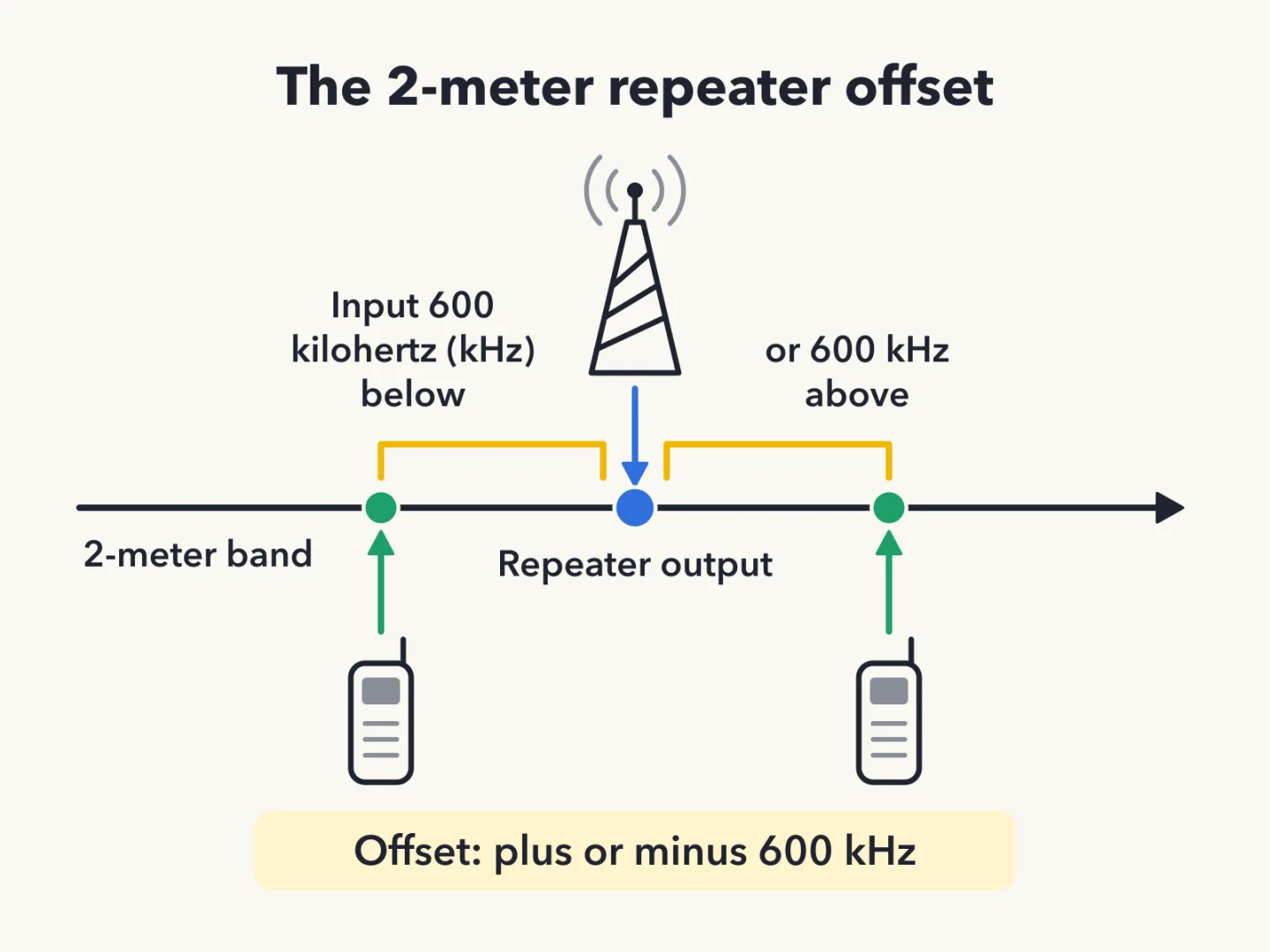
2-Meter Repeater Offset
A common repeater offset in the 2-meter band is plus or minus 600 kilohertz (kHz).
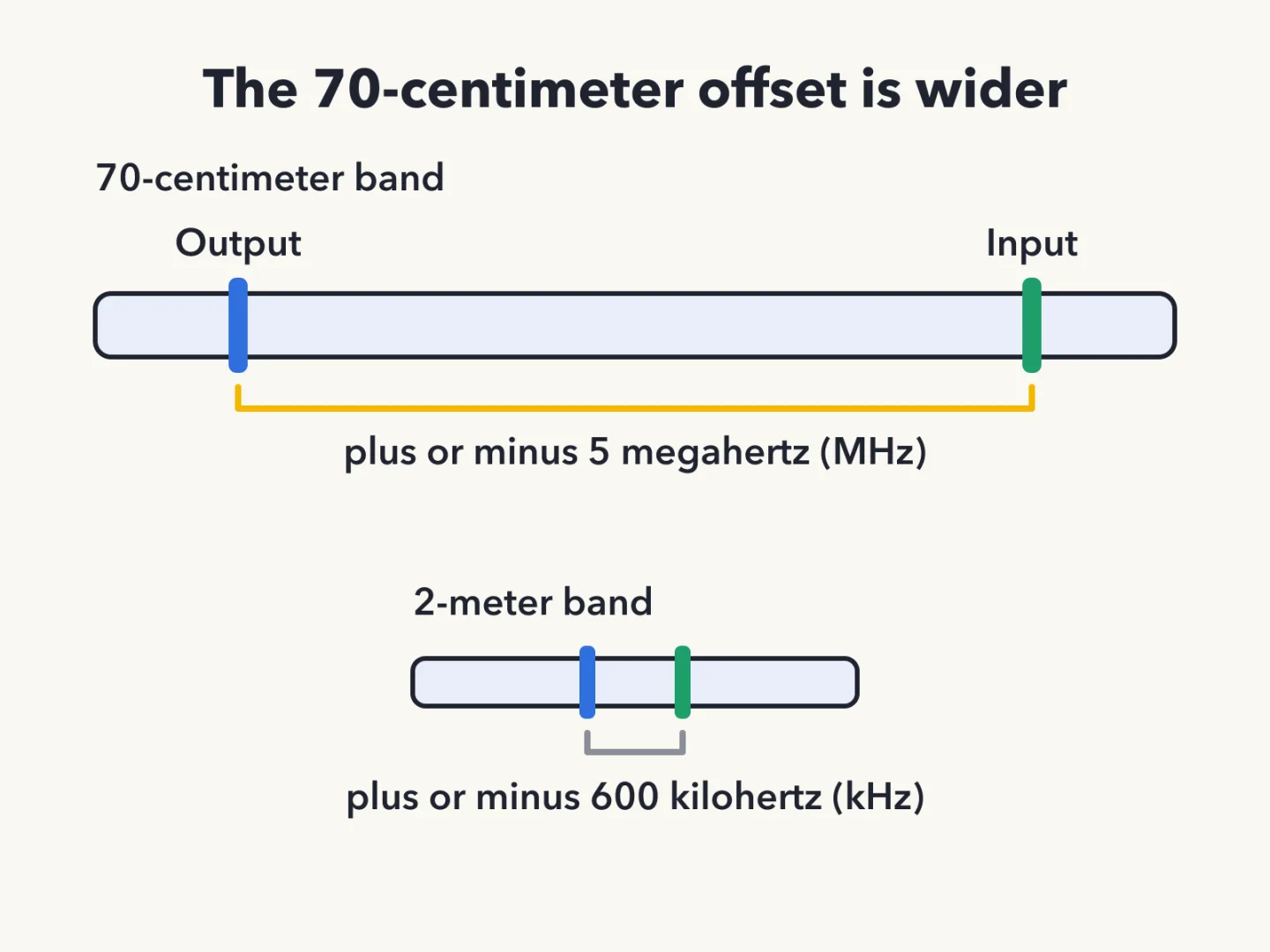
70-Centimeter Repeater Offset
A common repeater offset in the 70-centimeter band is plus or minus 5 megahertz (MHz). The plus or minus 600 kilohertz (kHz) offset belongs to the 2-meter band instead.
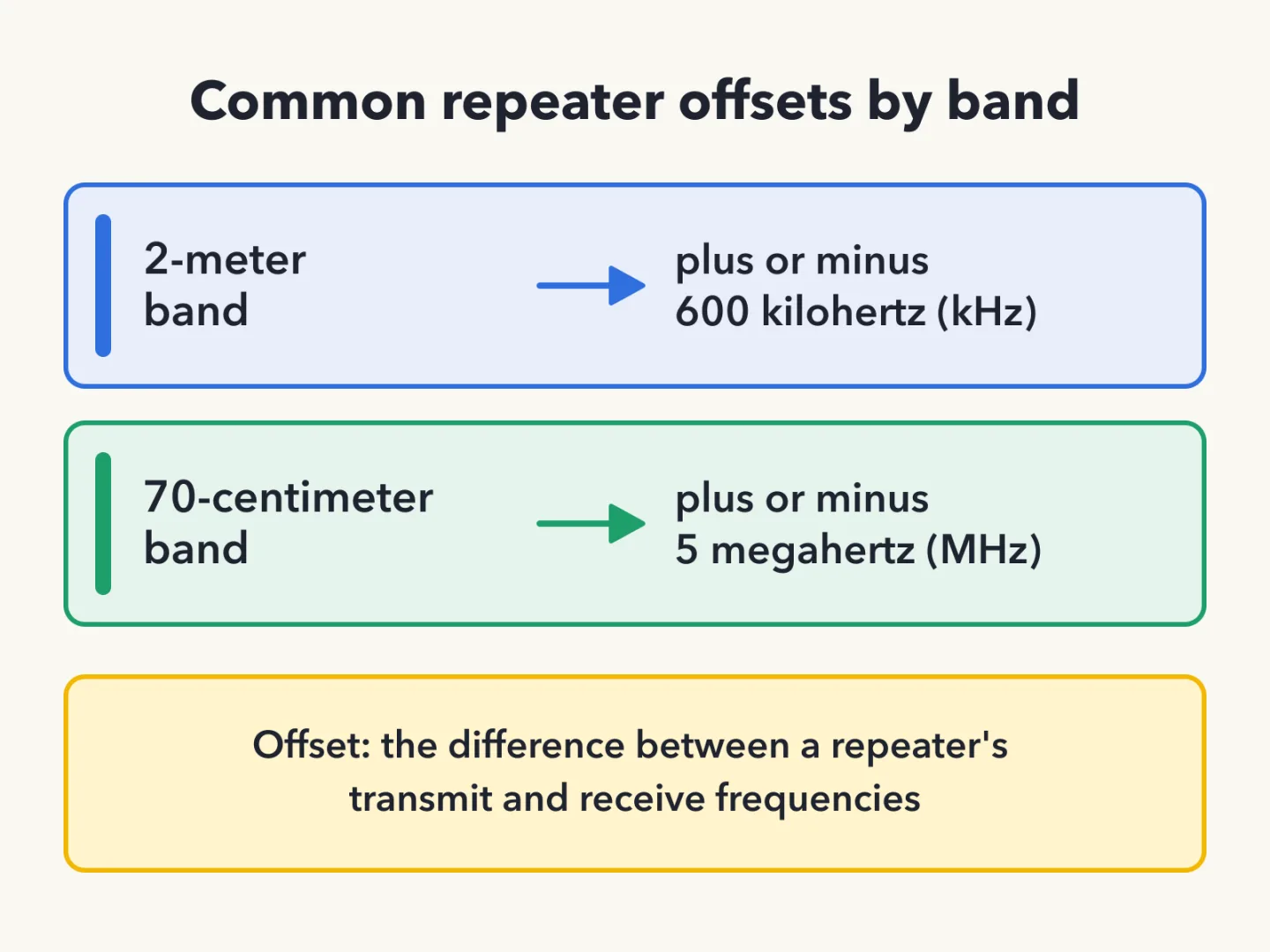
What a Repeater Offset Is
A repeater offset is the difference between a repeater's transmit and receive frequencies. A repeater listens on one frequency and retransmits on another, and the gap between the two is the offset.
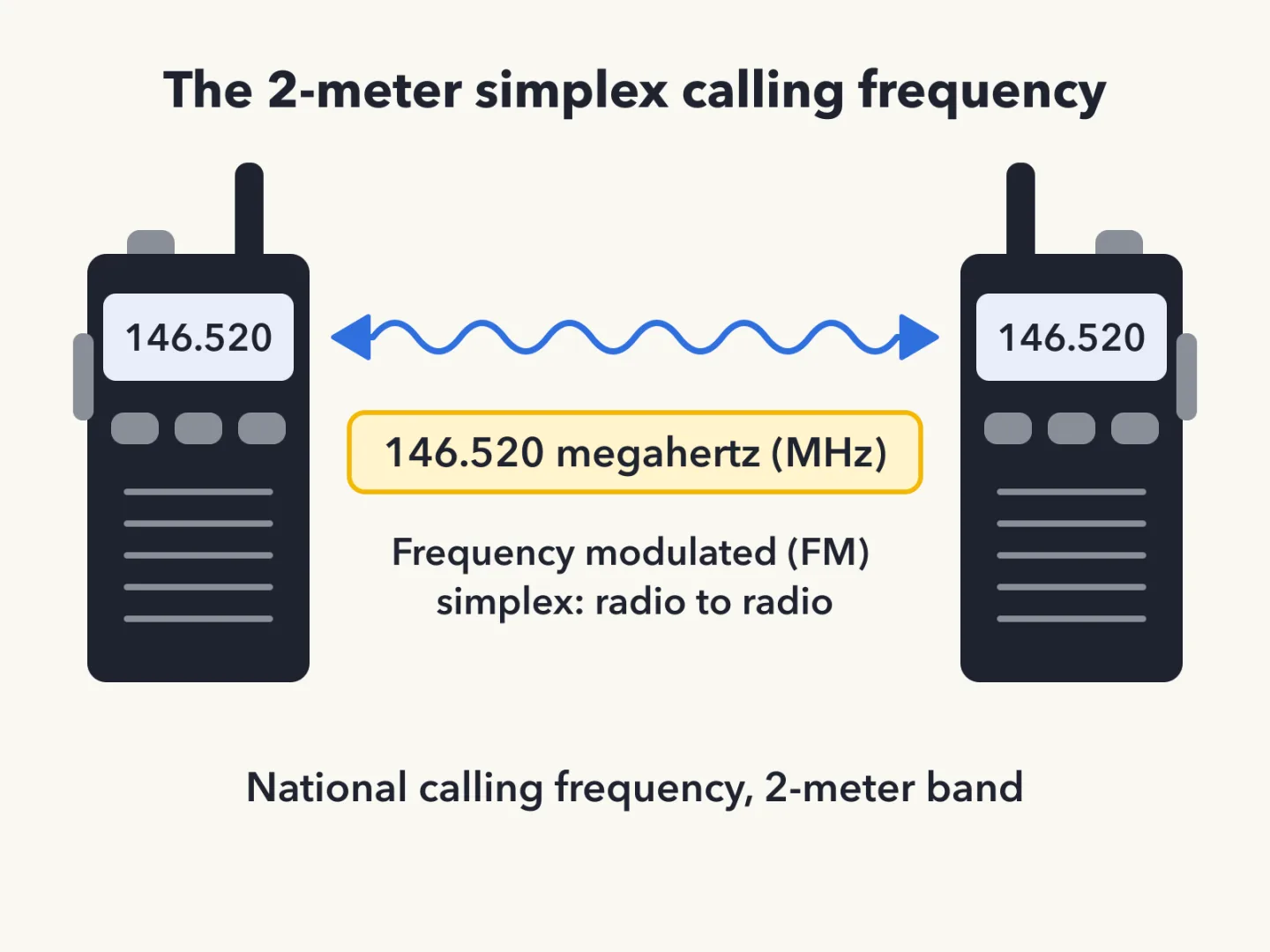
2-Meter Simplex Calling Frequency
The national calling frequency for frequency modulated (FM) simplex operation in the 2-meter band is 146.520 megahertz (MHz). A new licensee who wants a first simplex contact can start there.
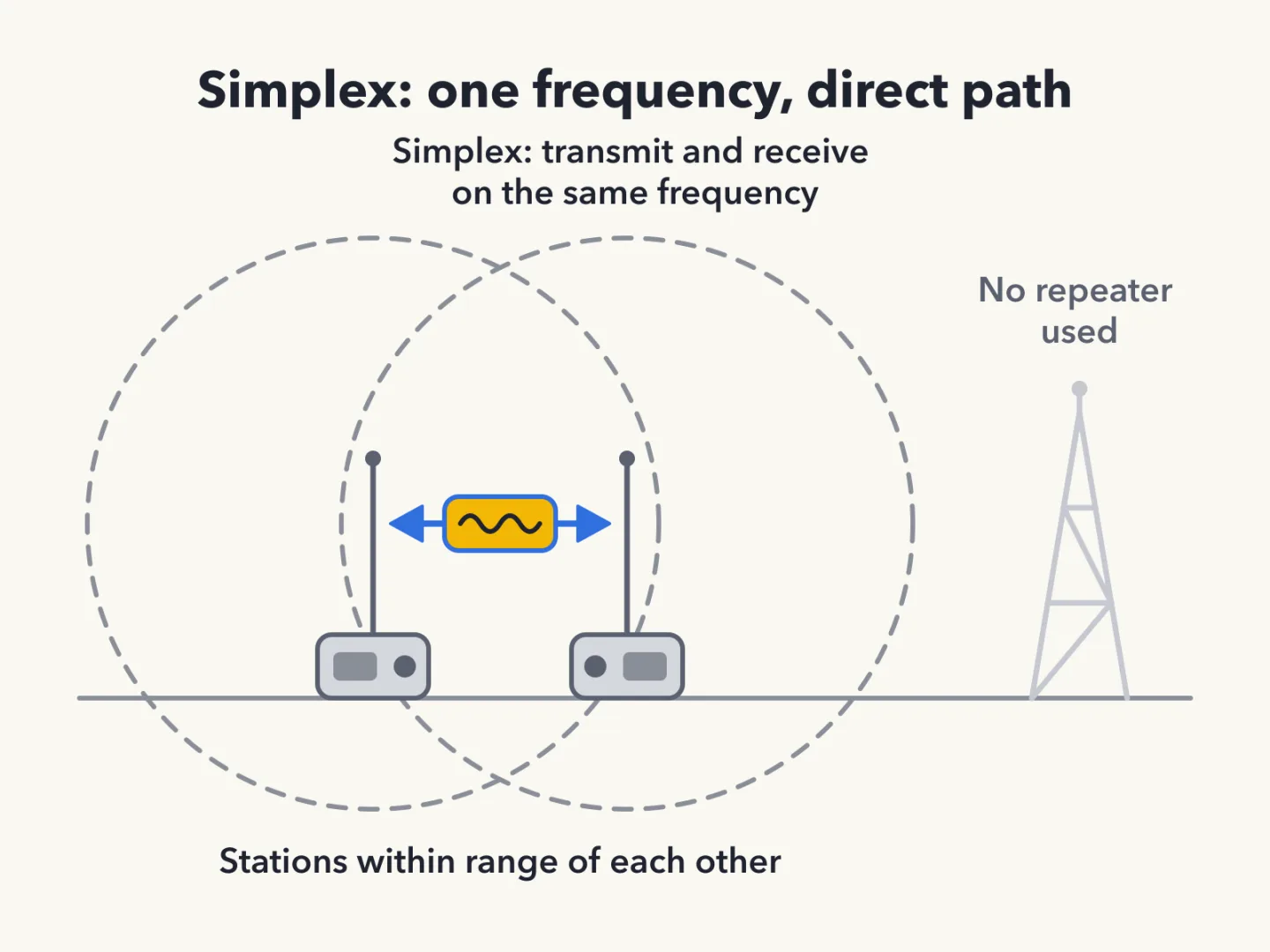
Simplex Operation
A station that transmits and receives on the same frequency is operating simplex. Nothing is retransmitted, so only stations within range of each other can talk.
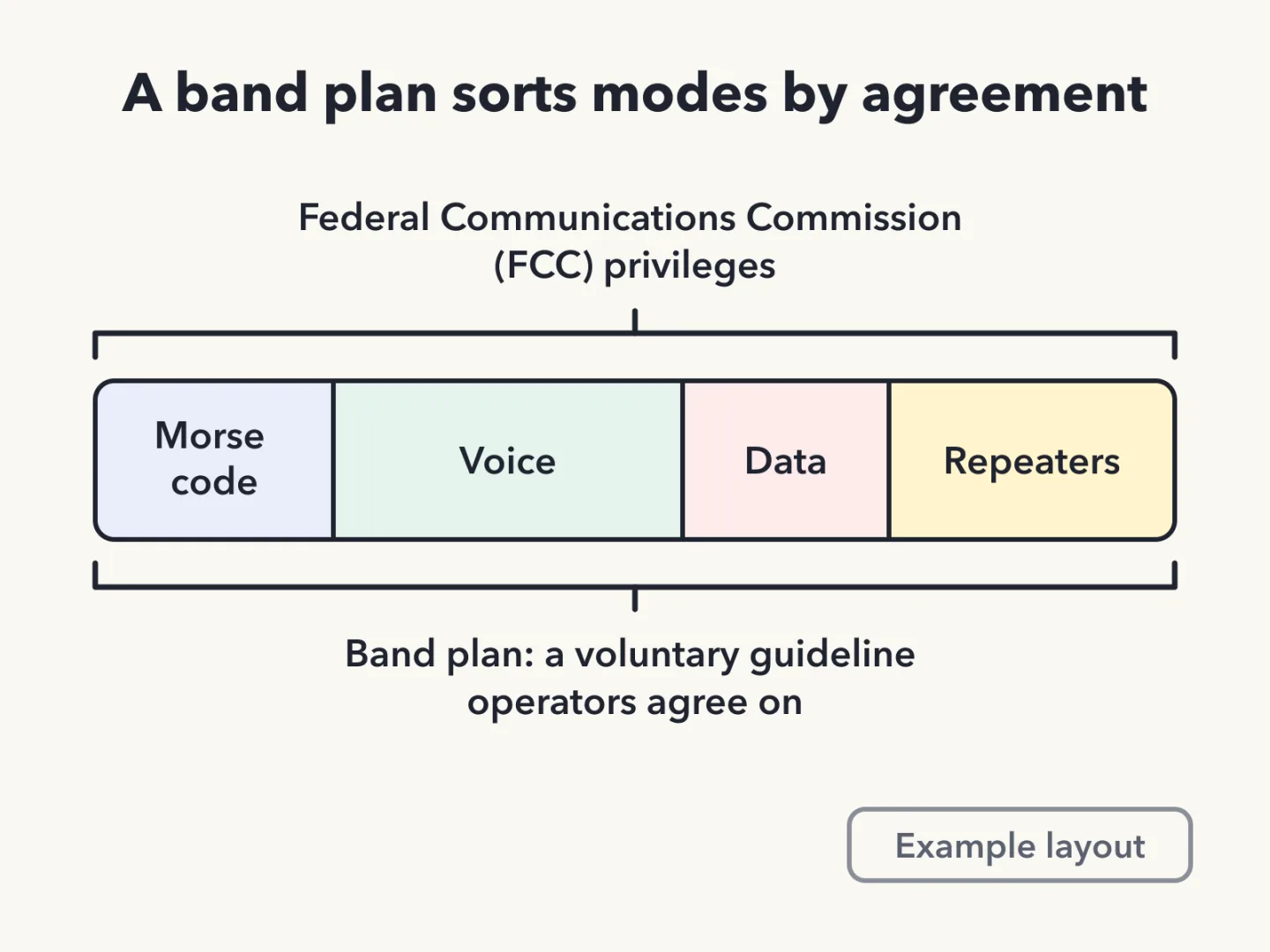
What a Band Plan Is
A band plan is a voluntary guideline for using different modes or activities within an amateur band. It goes beyond the privileges the Federal Communications Commission (FCC) establishes, and it is a courtesy agreement among operators.
What CQ Means
The signal CQ means calling any station. An operator who sends it invites anyone who hears it to answer.
Answering a CQ
The responding operator transmits the other station's call sign followed by his or her own call sign.
Calling a Known Station
To call a known station on a repeater, the operator says that station's call sign, then identifies with his or her own call sign.
Announcing You Are Listening
On a repeater, a customary way to show that a station is looking for a contact is to say its own call sign followed by the word listening. Anyone hearing it may then call.
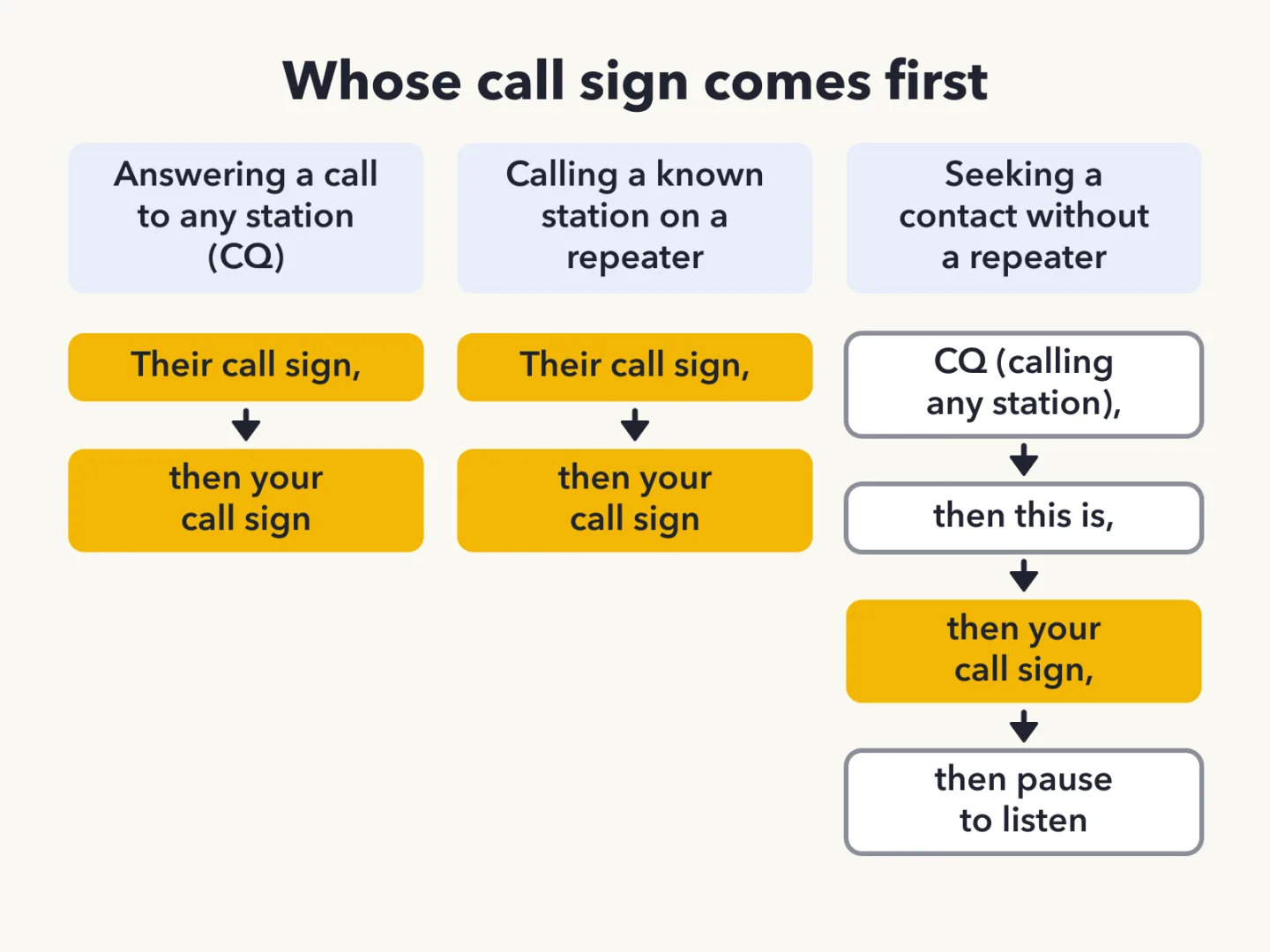
Seeking a Contact Without a Repeater
To seek any phone contact without a repeater, an effective way is to repeat CQ a few times, followed by the words this is and the operator's call sign. The operator then pauses to listen and repeats as necessary.
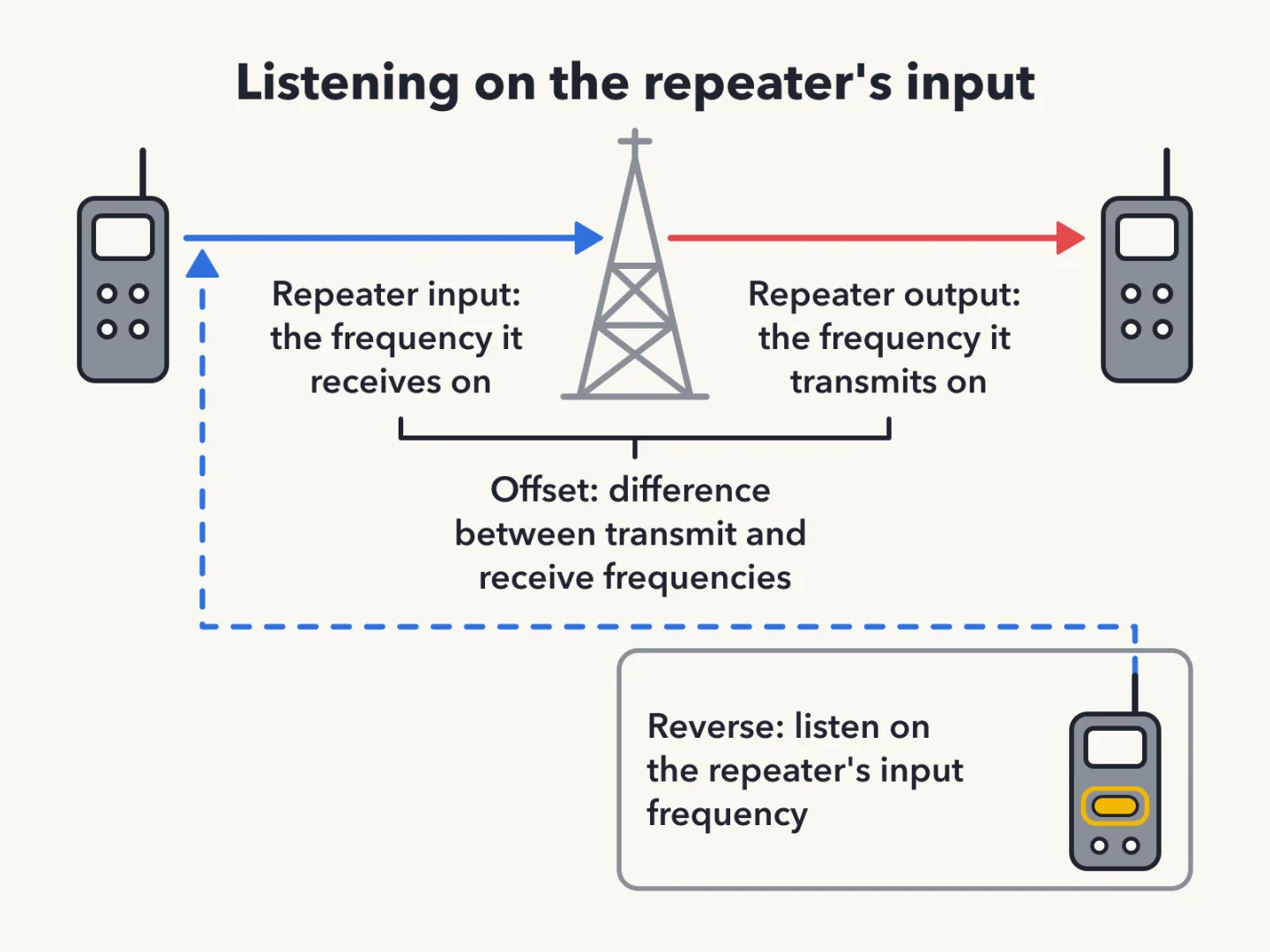
The Reverse Function
Many very high frequency (VHF) and ultra high frequency (UHF) transceivers have a reverse function. It lets the operator listen on a repeater's input frequency, the one on which the repeater receives.
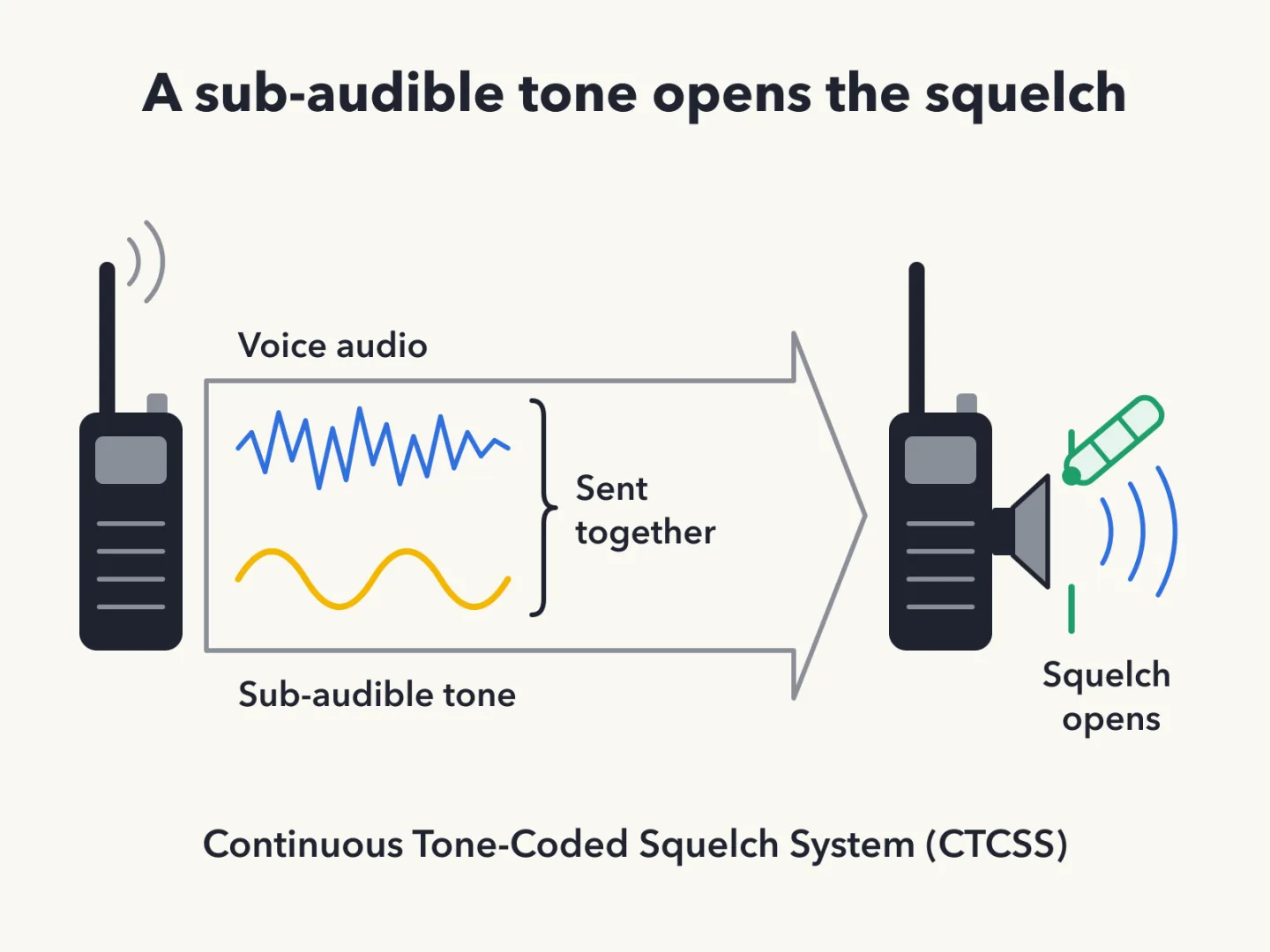
CTCSS Sub-Audible Tone
The Continuous Tone-Coded Squelch System (CTCSS) is a sub-audible tone. It is transmitted along with normal voice audio to open the squelch of a receiver.
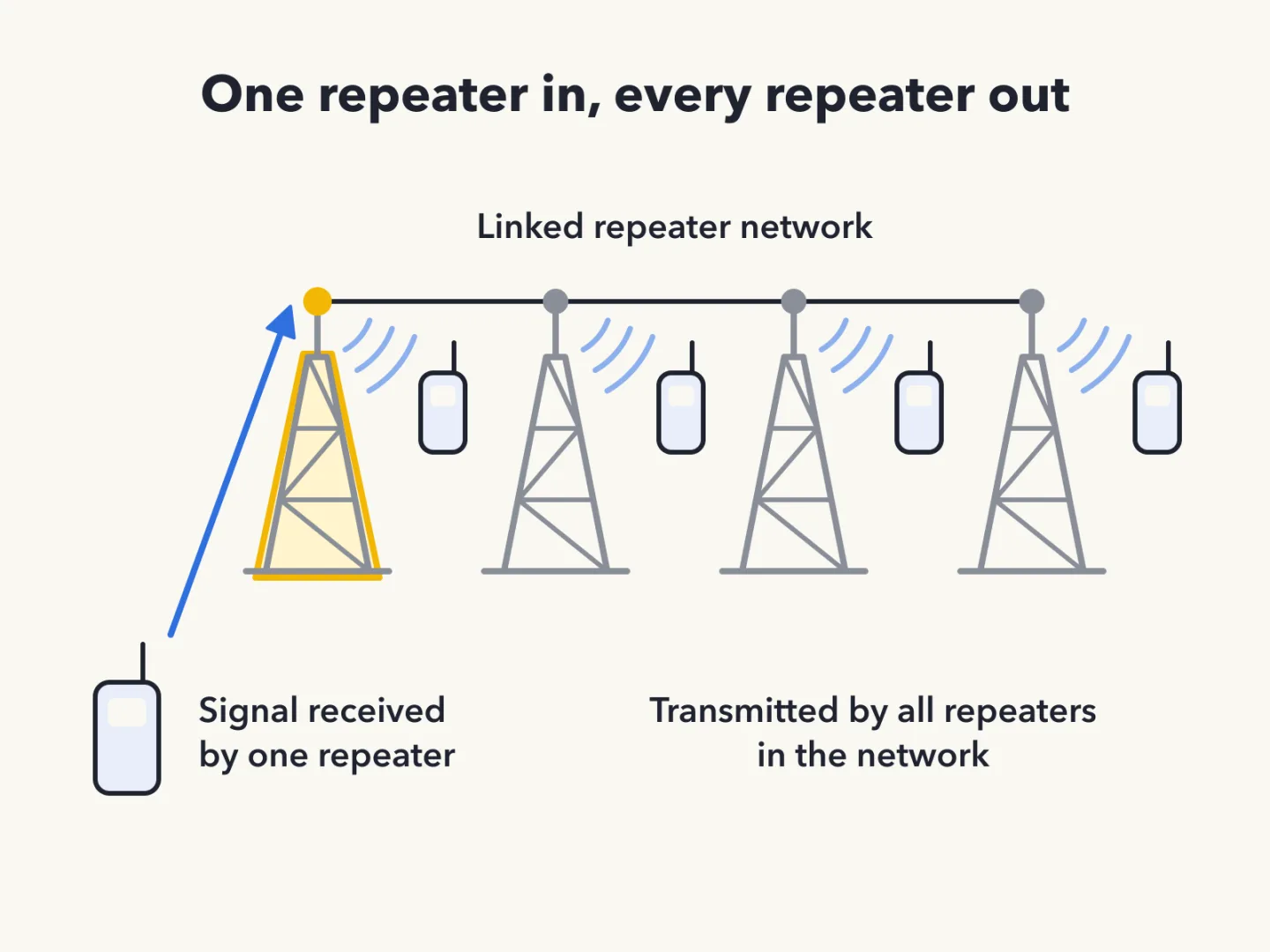
Linked Repeater Networks
A linked repeater network is a network of repeaters in which signals received by one repeater are transmitted by all the repeaters in the network. A call into one reaches the users of every other.
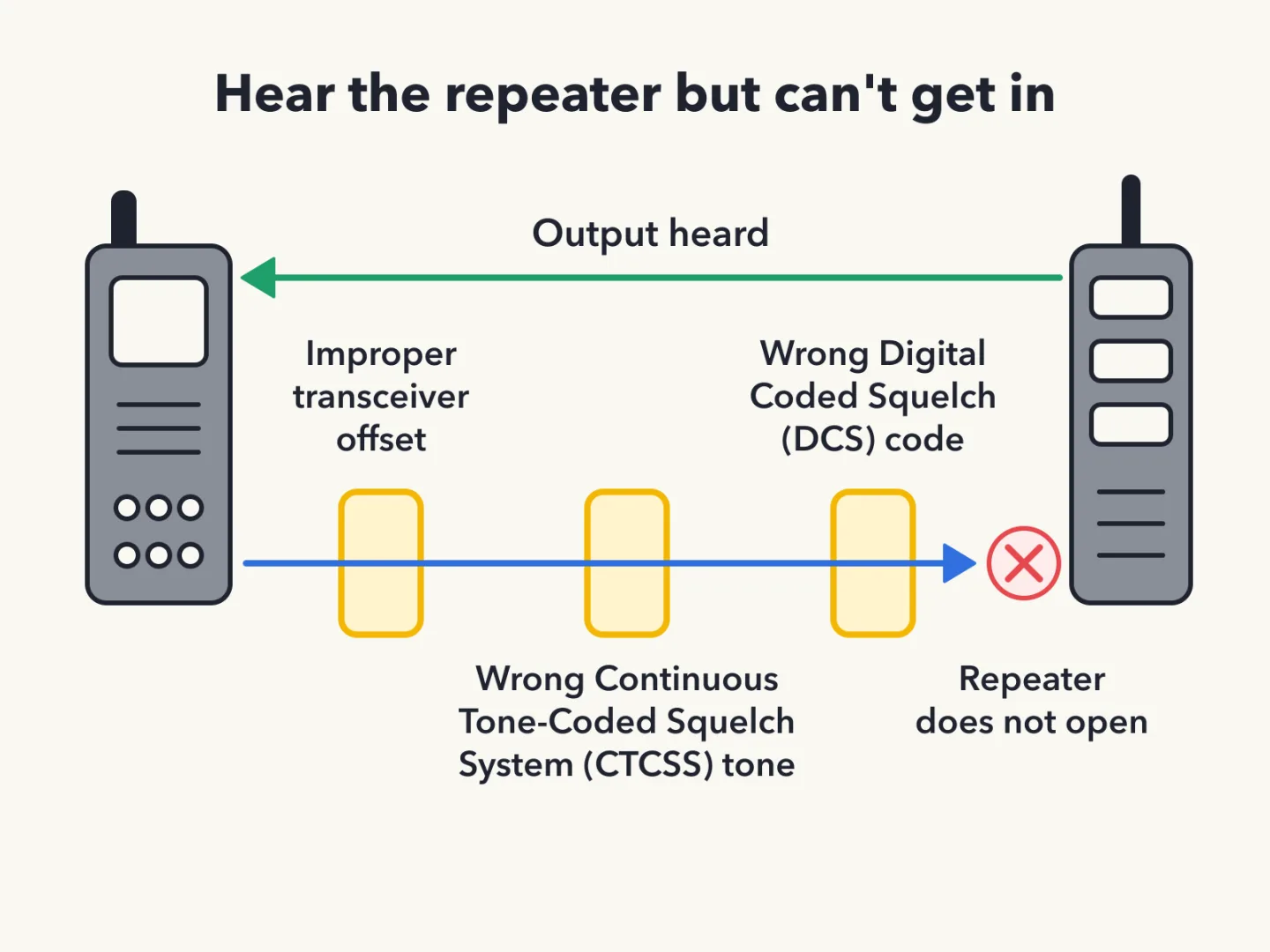
Why a Repeater Won't Open
An operator who can hear a repeater's output but cannot get in may have an improper transceiver offset. The wrong Continuous Tone-Coded Squelch System (CTCSS) tone or the wrong Digital Coded Squelch (DCS) code can cause the same problem.
Audio Dropping Out on Peaks
When frequency modulated (FM) transmission audio drops out on voice peaks, the operator is talking too loudly. The fix is to speak at a lower level.
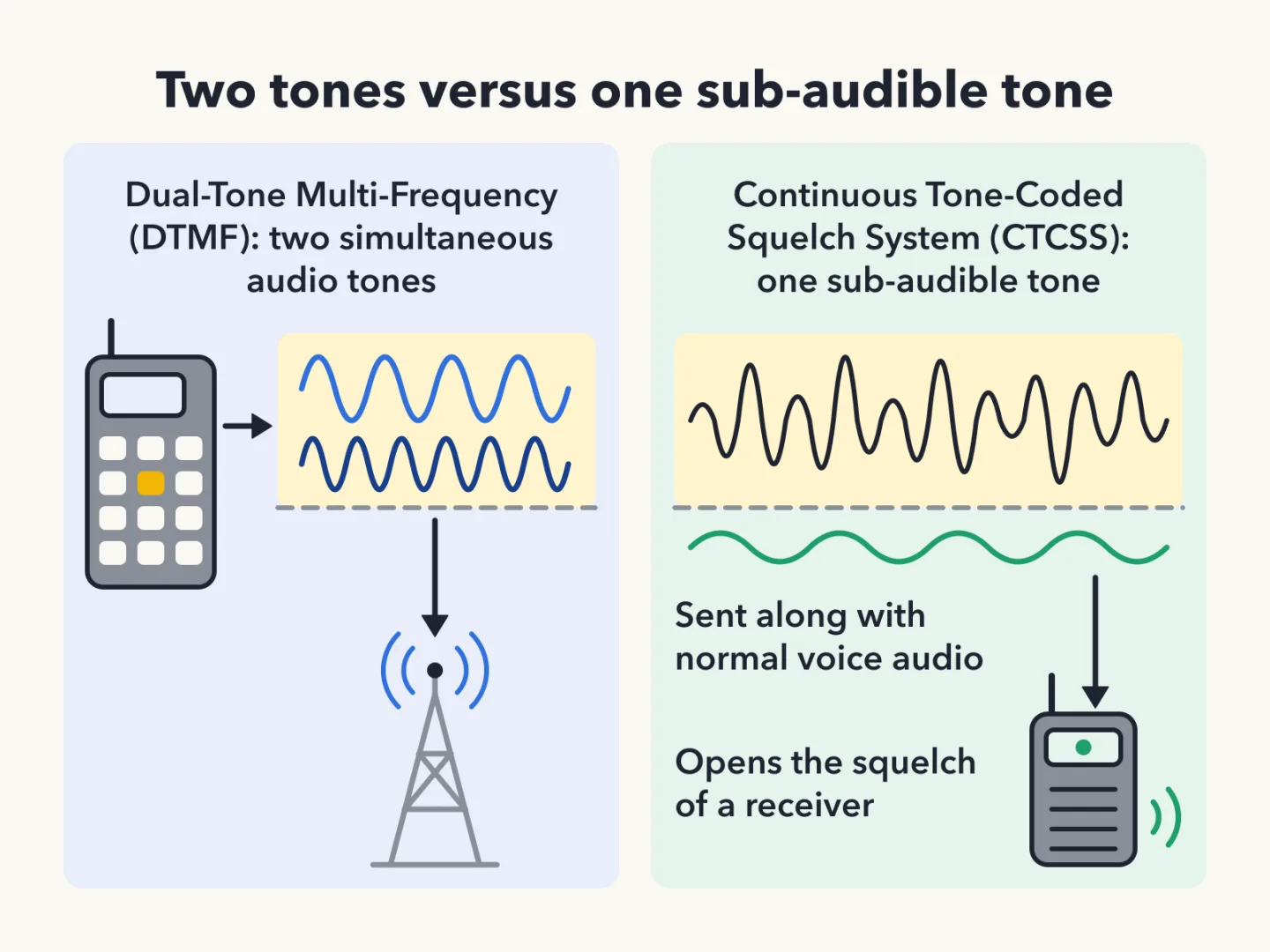
Two-Tone Signaling to Repeaters
Dual-Tone Multi-Frequency (DTMF) signaling to a repeater uses two simultaneous audio tones. A Continuous Tone-Coded Squelch System (CTCSS) tone is one sub-audible tone sent with voice.
Joining a Talkgroup
An operator joins a digital repeater's talkgroup by programming the radio with the group's ID or code.
Sharing a Contested Frequency
When two stations transmitting on the same frequency interfere with each other, the stations should negotiate continued use of the frequency.
Why Simplex Channels Exist
Simplex channels are designated in the very high frequency and ultra high frequency band plans so that stations within range of each other can communicate without tying up a repeater.
The Q Signal QRM
QRM is a Q signal. It indicates that an operator is receiving interference from other stations.
The Q Signal QSY
QSY is a Q signal. It indicates that an operator is changing frequency. A station might use it to tell a friend to move to a simplex channel.
The DMR Color Code
On Digital Mobile Radio (DMR) systems, the digital color code is an access code that must be programmed into a DMR transmitter to access a specific repeater.
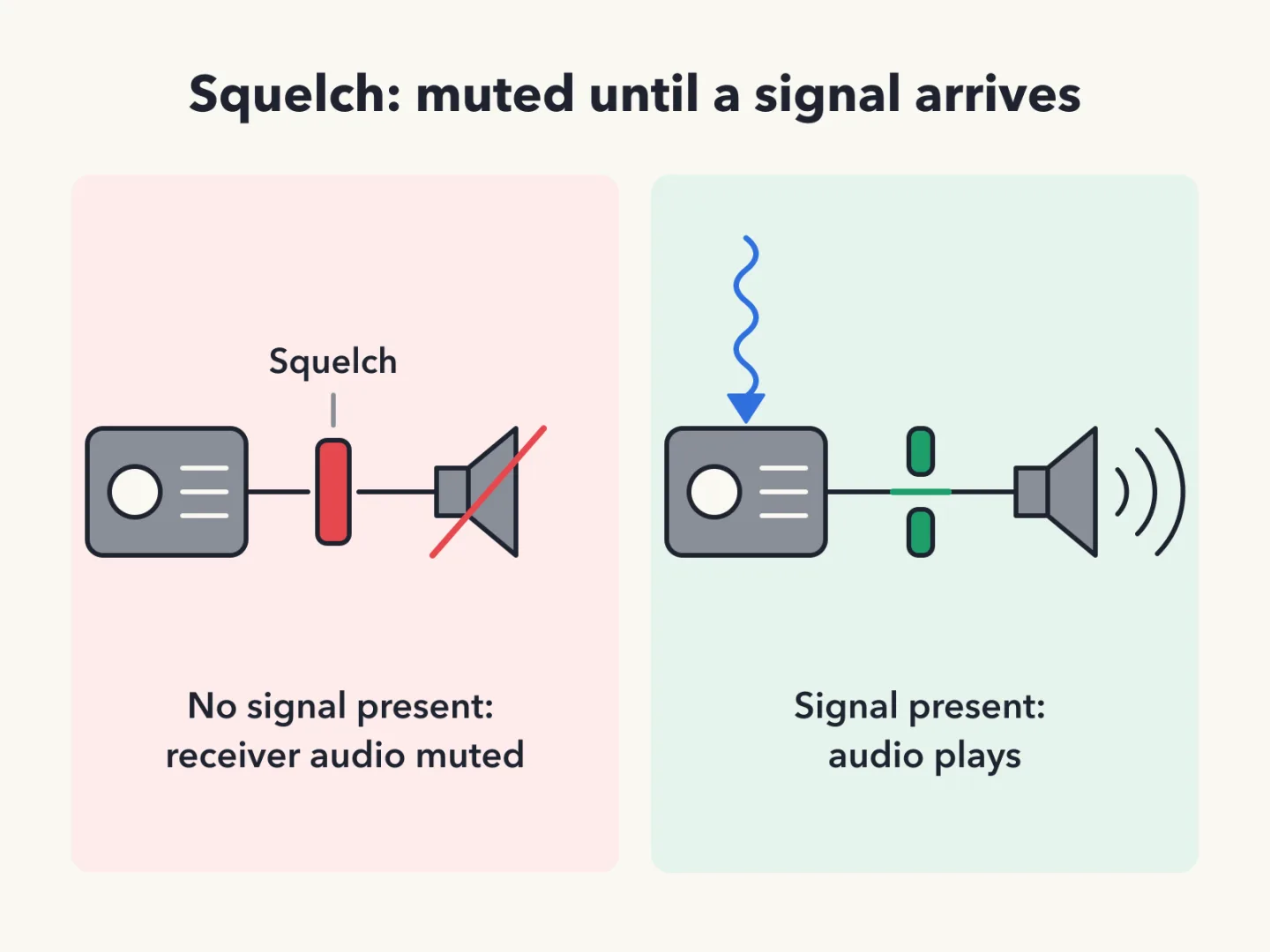
What Squelch Does
The purpose of squelch is to mute the receiver audio when a signal is not present.
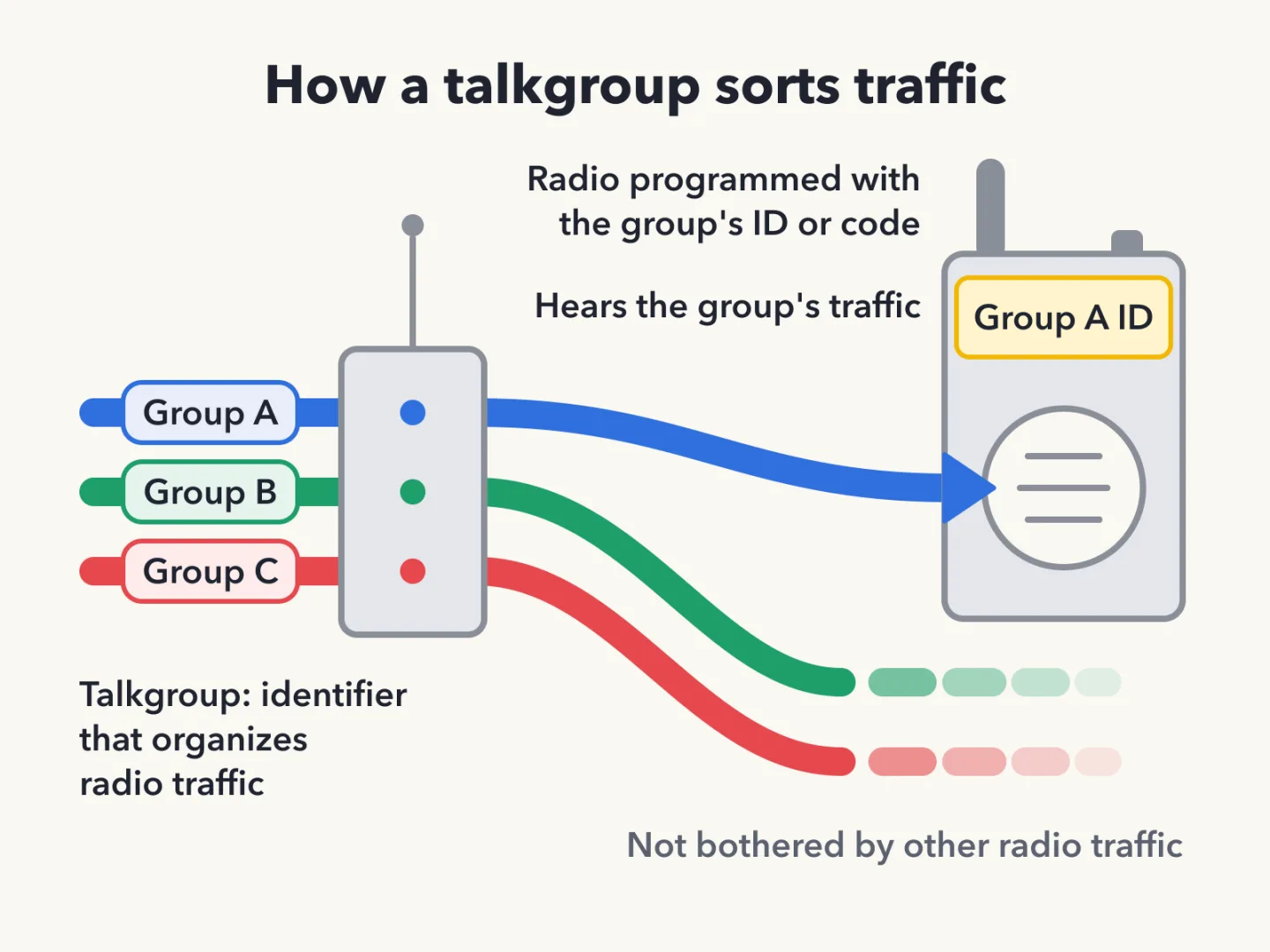
What a Talkgroup Is
A talkgroup is an identifier used by Digital Mobile Radio (DMR) to organize radio traffic, so that those who want to hear the group are not bothered by other radio traffic.
FCC Rules Always Apply
The Federal Communications Commission (FCC) Part 97 rules always apply to an amateur station. They do not stop applying under Radio Amateur Civil Emergency Service, Amateur Radio Emergency Service, or Federal Emergency Management Agency rules.
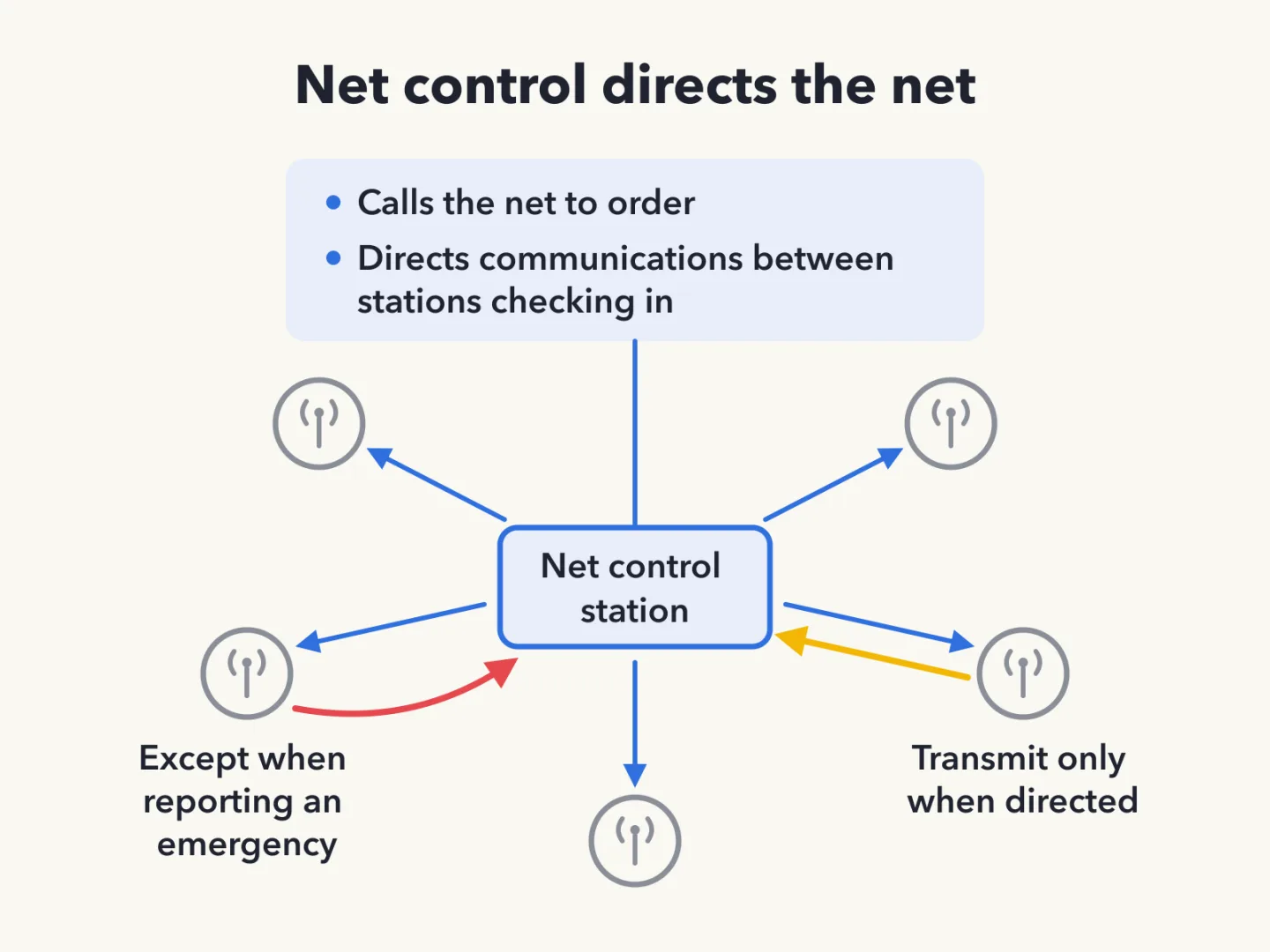
Net Control Duties
The net control station calls the net to order and directs communications between stations checking in.
Phonetics for Unusual Words
To make sure a voice message with unusual words is received correctly, the operator spells the words using a standard phonetic alphabet.
What RACES Is
The radio amateur civil emergency service (RACES) is a Federal Communications Commission (FCC) Part 97 amateur radio service for civil defense communications during national emergencies. It requires certification by a civil defense agency.
What Traffic Means
In net operation, traffic means formal messages exchanged by net stations.
What ARES Is
The Amateur Radio Emergency Service (ARES) is a group of licensed amateurs who have voluntarily registered their qualifications and equipment for communications duty in the public service.
Standard Net Practice
Unless reporting an emergency, a net participant transmits only when directed by the net control station.
Winlink Email Relay
Winlink relays messages using email addresses based on amateur callsigns.
Operating Outside Privileges
A control operator may operate outside the frequency privileges of his or her license class, but only in situations involving the immediate safety of human life or protection of property.
The Message Preamble
The preamble of a formal traffic message contains information needed to track the message.
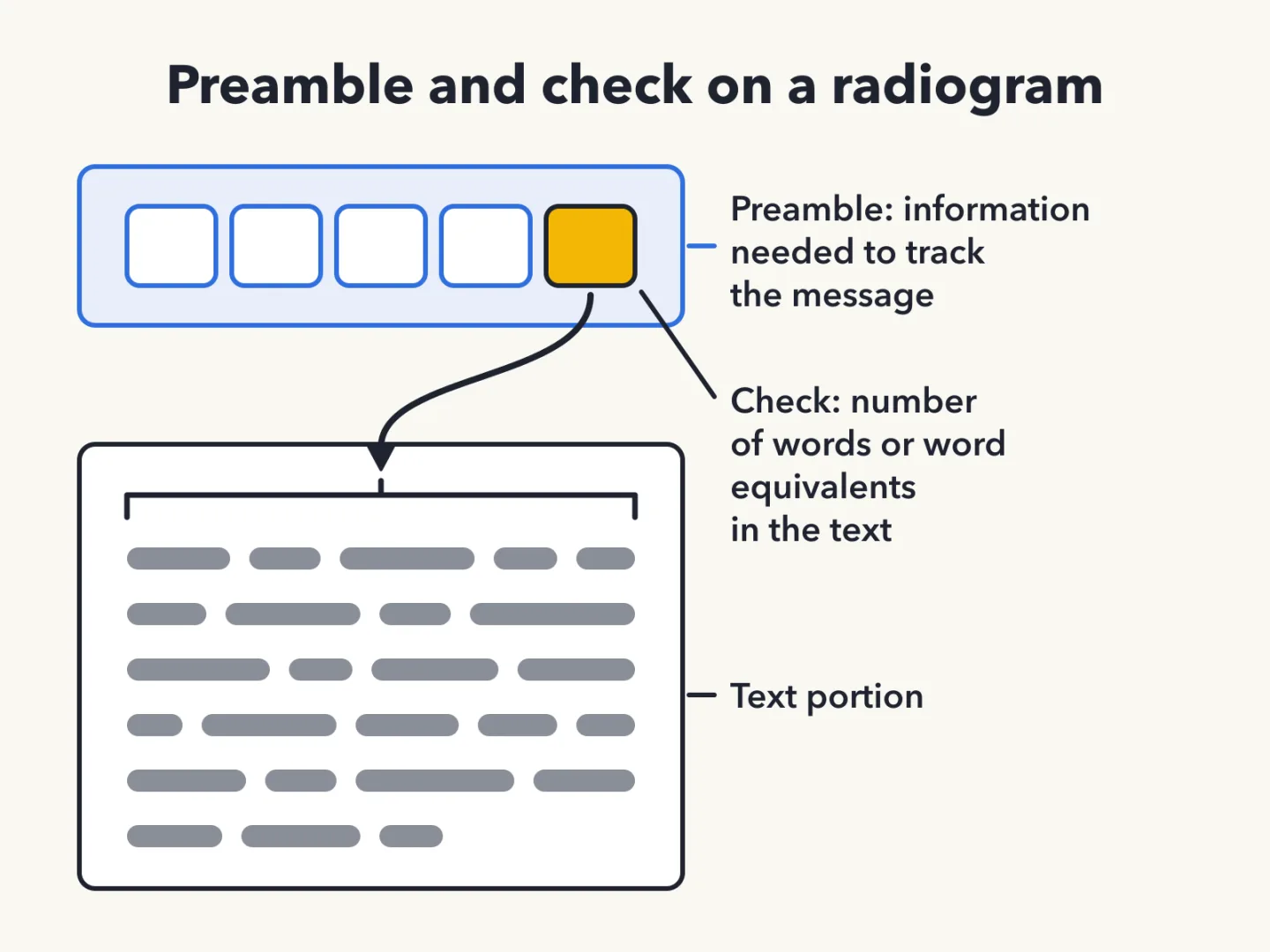
What Check Means
The word check in a radiogram header means the number of words or word equivalents in the text portion of the message.
Certification by Civil Defense
The radio amateur civil emergency service (RACES) requires certification by a civil defense agency. The Amateur Radio Emergency Service (ARES) is a voluntary registration instead.
Matched pairs
Each item on the left goes with the one on the right.
- Signal CQ
- Calling any station
- Q signal QRM
- Interference from other stations
- Winlink
- Relays email via amateur callsigns
Self-test
Answer each question from memory, then check your work against the answer key.
1. What is a common repeater frequency offset in the 2-meter band?
- APlus or minus 500 kHz
- BPlus or minus 1 MHz
- CPlus or minus 600 kHz
- DPlus or minus 5 MHz
2. What is a common repeater frequency offset in the 70-centimeter band?
- APlus or minus 5 MHz
- BPlus or minus 1 MHz
- CPlus or minus 500 kHz
- DPlus or minus 600 kHz
3. What does the term "repeater offset" mean?
- AThe repeater has a time delay to prevent interference
- BThe fee charged by the repeater owner or club to provide for maintenance
- CThe approximately half-second delay to allow for the “squelch tail” to be removed
- DThe difference between a repeater’s transmit and receive frequencies
4. What is the national calling frequency for FM simplex operations in the 2-meter band?
- A145.000 MHz
- B146.520 MHz
- C446.000 MHz
- D432.100 MHz
5. What term describes an amateur station that is transmitting and receiving on the same frequency?
- AMultiplex
- BSimplex
- CFull duplex
- DDiplex
6. What is a band plan, beyond the privileges established by the FCC?
- AA plan devised by a club to indicate frequency band usage
- BA list of operating schedules
- CA list of available net frequencies
- DA voluntary guideline for using different modes or activities within an amateur band
7. How should you respond to a station calling CQ?
- ATransmit the other station’s call sign followed by your call sign
- BTransmit a signal report followed by your call sign
- CTransmit your call sign followed by the other station’s call sign
- DTransmit "CQ" followed by the other station’s call sign
8. What is the meaning of the procedural signal “CQ”?
- AOnly the called station should transmit
- B“Communication Quality,” used to indicate transmitted audio clarity
- CCalling any station
- DA shortened form of the term “Contest QSO”
9. What is an appropriate way to call another station on a repeater if you know the other station's call sign?
- ASay "CQ" three times, then the other station's call sign, followed by your call sign
- BSay the station's call sign, then identify with your call sign
- CWait for the station to call CQ, then answer with your call sign
- DSay "break, break," then the other station’s call sign, followed by your call sign
10. Which of the following is a customary way to indicate a station is listening on a repeater and looking for a contact?
- AThe station’s call sign followed by the word “listening”
- B“CQ CQ” followed by the repeater’s call sign
- C“QSY” followed by your call sign
- DThe repeater’s call sign followed by the station’s call sign
11. What is an effective way to seek a call from any phone station when not using a repeater?
- ASend unmodulated carrier ~10 seconds, then “this is” and call sign; listen; repeat
- BSign call once, then “listening for a call;” if no answer, change frequency and repeat
- CSay “QTC,” then “this is” and your call sign; if no answer, change frequency and repeat
- DRepeat “CQ” a few times, “this is” and your call sign, then listen; repeat as needed
12. What is the purpose of the reverse function on a VHF/UHF transceiver?
- ATo listen on a repeater’s output frequency
- BTo reduce power output
- CTo listen on a repeater’s input frequency
- DTo increase power output
13. Which of the following describes a linked repeater network?
- ARepeaters in a network all transmit the signals received by any one repeater
- BA single repeater with more than one receiver
- CA system of repeaters linked by APRS
- DMultiple repeaters with the same control operator
14. Which of the following could be the reason you are unable to access a repeater whose output you can hear?
- AYou are using the wrong CTCSS tone
- BYou are using the wrong DCS code
- CImproper transceiver offset
- DAll these choices are correct
15. What term describes the use of a sub-audible tone transmitted along with normal voice audio to open the squelch of a receiver?
- ADTMF
- BCarrier squelch
- CCTCSS
- DTone burst
16. What type of signaling to a repeater uses two simultaneous audio tones?
- ACTCSS
- BDTMF
- CD-STAR
- DGMRS
17. Which of the following would cause your FM transmission audio to drop out on voice peaks?
- AYou are talking too loudly
- BYour repeater offset is inverted
- CYour FM deviation is too low
- DYour transmit power is too high
18. What is the purpose of a squelch function?
- AReduce interference from impulse noise
- BReduce a CW transmitter's key clicks
- CMute the receiver audio when a signal is not present
- DEliminate parasitic oscillations in an RF amplifier
19. How can you join a digital repeater’s “talkgroup”?
- AProgram your radio with the DTMF tone used by the talkgroup
- BRegister with the local Frequency Coordinator
- CRegister with the digital repeater control operator
- DProgram your radio with the group’s ID or code
20. What is the digital color code used on DMR repeater systems?
- AA code which automatically programs the repeater offset to a frequency chosen by the user
- BAn access code programmed into a DMR transmitter to access a specific repeater
- CA code transmitted by the repeater to indicate health and status of the equipment
- DA code identifying the CODEC used so the repeater can properly decode the audio
21. Which of the following is a “talkgroup”?
- AThe members of a net organized for amateur radio operators with a specific common interest
- BA DMR identifier that organizes traffic so listeners aren't bothered by other traffic
- CA group of amateur radio operators who share email on a specific amateur radio topic
- DAutomatically alerts all members to the frequency where any member is transmitting
22. Which of the following applies when two stations transmitting on the same frequency interfere with each other?
- AThe stations should negotiate continued use of the frequency
- BWhichever station was on the frequency first has preemptive rights to the frequency
- CBoth stations should choose another frequency to avoid conflict
- DUse subaudible tones so both stations can share the frequency
23. Why are simplex channels designated in the VHF/UHF band plans?
- ASo stations with simple transmitters can access the repeater without automated offset
- BFor working DX only
- CSo stations within range of each other can communicate without tying up a repeater
- DFor contest operation
24. Which Q signal indicates that you are receiving interference from other stations?
- AQSB
- BQTH
- CQRN
- DQRM
25. Which Q signal indicates that you are changing frequency?
- AQSY
- BQSL
- CQRU
- DQRZ
26. Which of the following are typical duties of a Net Control Station?
- AChoose the regular net meeting time and frequency
- BAll these choices are correct
- CCall the net to order and direct communications between stations checking in
- DEnsure all stations checking in are properly licensed for the net frequency
27. Which of the following is standard practice when you participate in a net?
- AOn first response, give call sign, name, and address as in the FCC database
- BRecord the time of each of your transmissions
- CAll these choices are correct
- DUnless reporting an emergency, transmit only when directed by the net control station
28. What does the term “traffic” refer to in net operation?
- AA count of the number of activations of the net each month
- BFormal messages exchanged by net stations
- COperation by mobile or portable stations
- DThe number of stations checking in and out of a net
29. What information is contained in the preamble of a formal traffic message?
- AThe address of the intended recipient
- BInformation needed to track the message
- CThe telephone number of the addressee
- DThe email address of the originating station
30. What is meant by “check” in a radiogram header?
- AA box on the message form that indicates that the message was received and/or relayed
- BThe call sign of the originating station
- CA list of stations that have relayed the message
- DThe number of words or word equivalents in the text portion of the message
31. What technique is used to ensure that voice messages containing unusual words are received correctly?
- AAll these choices are correct
- BUse the Q-code “QSR” to ask the receiving station to repeat the words back
- CSpell the words using a standard phonetic alphabet
- DSend the words by voice and Morse code
32. When do the FCC Part 97 Amateur Radio Service rules NOT apply to the operation of an amateur station?
- AFCC rules always apply
- BWhen operating under ARES rules
- CWhen operating under FEMA rules
- DWhen operating under RACES rules
33. Are amateur station control operators ever permitted to operate outside the frequency privileges of their license class?
- AYes, but only when part of a RACES emergency plan
- BNo
- CYes, but only when part of a FEMA emergency plan
- DYes, but only for the immediate safety of human life or protection of property
34. What is RACES?
- AAn emergency organization combining amateur and citizens band operators and frequencies
- BAn international radio experimentation society
- CAn FCC Part 97 amateur service for civil defense communications in national emergencies
- DA radio contest held in a short period, sometimes called a “sprint”
35. What is the Amateur Radio Emergency Service (ARES)?
- ALicensed amateurs who registered qualifications and equipment for public service duty
- BLicensed military amateurs who volunteered message handling service in an emergency
- CA training program offering license courses for those wanting a license for emergencies
- DA training program certifying operators to join the Radio Amateur Civil Emergency Service
36. Which of the following requires certification by a civil defense agency?
- AARES
- BRACES
- CSKYWARN
- DMARS
37. Which of the following relays messages using email addresses based on amateur callsigns?
- AFT8
- BWinlink
- CAMTOR
- DPSK31
Go deeper
- ListenLesson 3 episode
- WatchRepeater Offsets on Two Bands A repeater listens on one frequency and retransmits on another. How far apart are the two?
- WatchEmergencies Don't Switch Off the Rules In an emergency, do the amateur radio rules switch off at all?
- StudyHam Radio Technician License in the FlashFeed app
Answer key
- 1. C Plus or minus 600 kHzPlus or minus 600 kHz is the common repeater offset on 2 meters. Plus or minus 5 MHz belongs to 70 centimeters.
- 2. A Plus or minus 5 MHzPlus or minus 5 MHz is the common repeater offset on 70 centimeters. The 600 kHz figure is the 2-meter offset.
- 3. D The difference between a repeater’s transmit and receive frequenciesA repeater listens on one frequency and retransmits on another. The gap between them is the offset.
- 4. B 146.520 MHz146.520 MHz is the national calling frequency for frequency modulated (FM) simplex operation on the 2-meter band.
- 5. B SimplexA station that sends and receives on the same frequency is operating simplex.
- 6. D A voluntary guideline for using different modes or activities within an amateur bandA band plan is a voluntary guideline for modes and activities within a band. It goes beyond the privileges the Federal Communications Commission (FCC) grants.
- 7. A Transmit the other station’s call sign followed by your call signThe responder sends the other station's call sign first, then their own. They do not repeat CQ (calling any station) or start with a report.
- 8. C Calling any stationCQ means calling any station. It invites anyone who hears it to answer. QSO means communicating directly with a station.
- 9. B Say the station's call sign, then identify with your call signTo call a known station on a repeater, say its call sign and then identify with your own. No CQ (calling any station) or break is needed.
- 10. A The station’s call sign followed by the word “listening”Saying your own call sign followed by the word listening is the customary way to show you are available on a repeater. QSY means changing frequency.
- 11. D Repeat “CQ” a few times, “this is” and your call sign, then listen; repeat as neededRepeat CQ (calling any station) a few times, say this is and your call sign, then pause to listen. Repeat as necessary. QTC means messages to send.
- 12. C To listen on a repeater’s input frequencyReverse lets the operator listen on the repeater's input frequency. It does not change power output.
- 13. A Repeaters in a network all transmit the signals received by any one repeaterIn a linked network, signals received by one repeater are transmitted by all the repeaters in it. APRS stands for Automatic Packet Reporting System.
- 14. D All these choices are correctAn improper offset, the wrong Continuous Tone-Coded Squelch System (CTCSS) tone and the wrong Digital Coded Squelch (DCS) code are each real causes of being unable to access a repeater you can hear, so all choices are correct.
- 15. C CTCSSContinuous Tone-Coded Squelch System (CTCSS) is a sub-audible tone sent with normal voice audio to open a receiver's squelch. DTMF stands for Dual-Tone Multi-Frequency.
- 16. B DTMFDual-Tone Multi-Frequency (DTMF) uses two simultaneous audio tones. Continuous Tone-Coded Squelch System (CTCSS) is a single sub-audible tone. GMRS stands for General Mobile Radio Service and D-STAR stands for Digital Smart Technologies for Amateur Radio.
- 17. A You are talking too loudlyAudio that drops out on voice peaks means the operator is talking too loudly. A wrong offset does not cause it. FM stands for frequency modulated.
- 18. C Mute the receiver audio when a signal is not presentSquelch mutes the receiver audio when no signal is present. CW stands for continuous wave and RF stands for radio frequency.
- 19. D Program your radio with the group’s ID or codeA talkgroup is joined by programming the radio with the group's ID or code. No registration is needed. DTMF stands for Dual-Tone Multi-Frequency.
- 20. B An access code programmed into a DMR transmitter to access a specific repeaterThe color code is an access code programmed into a Digital Mobile Radio (DMR) transmitter to reach a specific repeater. It does not set the offset. CODEC stands for coder-decoder.
- 21. B A DMR identifier that organizes traffic so listeners aren't bothered by other trafficA talkgroup is an identifier Digital Mobile Radio (DMR) uses to organize traffic, so listeners are not bothered by other traffic.
- 22. A The stations should negotiate continued use of the frequencyInterfering stations on one frequency should negotiate continued use. Arriving first gives no preemptive rights.
- 23. C So stations within range of each other can communicate without tying up a repeaterSimplex channels let stations within range talk without tying up a repeater. DX means long distance.
- 24. D QRMQRM means receiving interference from other stations. The other choices are QRN (troubled by static), QTH (location) and QSB (fading signals).
- 25. A QSYQSY means changing frequency. The other choices are QRU (have you anything for me?), QSL (acknowledging receipt) and QRZ (who is calling me?).
- 26. C Call the net to order and direct communications between stations checking inThe net control station calls the net to order and directs communications between stations checking in.
- 27. D Unless reporting an emergency, transmit only when directed by the net control stationUnless reporting an emergency, a participant transmits only when directed by net control. FCC stands for Federal Communications Commission.
- 28. B Formal messages exchanged by net stationsIn net operation, traffic means formal messages exchanged by net stations, not a count of check-ins.
- 29. B Information needed to track the messageThe preamble holds the information needed to track the message.
- 30. D The number of words or word equivalents in the text portion of the messageCheck is the number of words or word equivalents in the text portion of the message.
- 31. C Spell the words using a standard phonetic alphabetSpelling unusual words with a standard phonetic alphabet is the technique. Adding Morse code is not.
- 32. A FCC rules always applyFederal Communications Commission (FCC) Part 97 rules always apply to an amateur station, including under radio amateur civil emergency service (RACES), Amateur Radio Emergency Service (ARES) or Federal Emergency Management Agency (FEMA) rules.
- 33. D Yes, but only for the immediate safety of human life or protection of propertyOperating outside license frequency privileges is allowed only for the immediate safety of human life or protection of property. FEMA stands for Federal Emergency Management Agency and RACES stands for radio amateur civil emergency service.
- 34. C An FCC Part 97 amateur service for civil defense communications in national emergenciesRACES is a Federal Communications Commission (FCC) Part 97 amateur radio service for civil defense communications during national emergencies.
- 35. A Licensed amateurs who registered qualifications and equipment for public service dutyARES is a group of licensed amateurs who voluntarily registered their qualifications and equipment for public service communications duty.
- 36. B RACESRadio amateur civil emergency service (RACES) requires certification by a civil defense agency. Amateur Radio Emergency Service (ARES) is voluntary registration. MARS is the Military Auxiliary Radio System; SKYWARN is the National Weather Service's volunteer severe weather spotter program.
- 37. B WinlinkWinlink relays messages using email addresses based on amateur callsigns. AMTOR stands for Amateur Teleprinting Over Radio.
Sources
- NCVEC Question Pool Committee — 2026–2030 Technician question pool — ncvec.org/index.php/2026-2030-technician-question-pool
- FCC — 47 CFR § 97.3 Definitions — www.ecfr.gov/current/title-47/section-97.3
Image credits
- 2-Meter Repeater Offset: FlashFeed original diagram · CC-BY-4.0
- 70-Centimeter Repeater Offset: FlashFeed original diagram · CC-BY-4.0
- What a Repeater Offset Is: FlashFeed original diagram · CC-BY-4.0
- 2-Meter Simplex Calling Frequency: FlashFeed original diagram · CC-BY-4.0
- Simplex Operation: FlashFeed original diagram · CC-BY-4.0
- What a Band Plan Is: FlashFeed original diagram · CC-BY-4.0
- Seeking a Contact Without a Repeater: FlashFeed original diagram · CC-BY-4.0
- The Reverse Function: FlashFeed original diagram · CC-BY-4.0
- CTCSS Sub-Audible Tone: FlashFeed original diagram · CC-BY-4.0
- Linked Repeater Networks: FlashFeed original diagram · CC-BY-4.0
- Why a Repeater Won't Open: FlashFeed original diagram · CC-BY-4.0
- Two-Tone Signaling to Repeaters: FlashFeed original diagram · CC-BY-4.0
- What Squelch Does: FlashFeed original diagram · CC-BY-4.0
- What a Talkgroup Is: FlashFeed original diagram · CC-BY-4.0
- Net Control Duties: FlashFeed original diagram · CC-BY-4.0
- What Check Means: FlashFeed original diagram · CC-BY-4.0