
Ham Radio Technician License study guide · Lesson 2 of 15
The Rules: Operating a Station
Authorized and prohibited transmissions · The control operator and control types · Identification, repeaters and third parties
This is the lesson's study guide from the FlashFeed app, plus its key facts and a self-test.
What you'll be able to do
- Identify which communications an amateur station may not transmit, including broadcasting, coded messages, music and indecent language
- Explain when a station may be used for sale of equipment, paid operation or news support, what an auxiliary station does, and when it must identify
- Explain who must be the control operator of a station, who designates one, and who is responsible for its operation
- Describe how license class sets privileges, what a control point is, and how automatic and remote control differ
- Explain when, how and in what language a station must identify, and when it must be open for FCC inspection
- Describe third-party communications, repeater responsibility and the requirement for a club station license
This lesson covers what an amateur station may and may not transmit, who must be in charge of a station, and how a station identifies itself. It also covers who answers for a repeater, how third-party messages work, and what a club needs for a station license. Rules like these apply from the first time a new licensee keys a microphone. The Federal Communications Commission (FCC) makes them, and they are set out in Part 97 of Title 47 of the Code of Federal Regulations (CFR). Every operator is expected to follow them. They are stated here as of 2026, for the 2026–2030 Technician exam.
Authorized and prohibited transmissions
Countries and international contacts
An amateur station may transmit what is needed to exchange messages with other stations in the amateur service. One exception covers other countries. FCC-licensed stations may not exchange communications with any country whose administration has notified the International Telecommunication Union (ITU) that it objects to such communications. The FCC issues public notices of current arrangements for international communications.
Only an objection notified to the ITU creates this ban.
Broadcasting and one-way transmissions
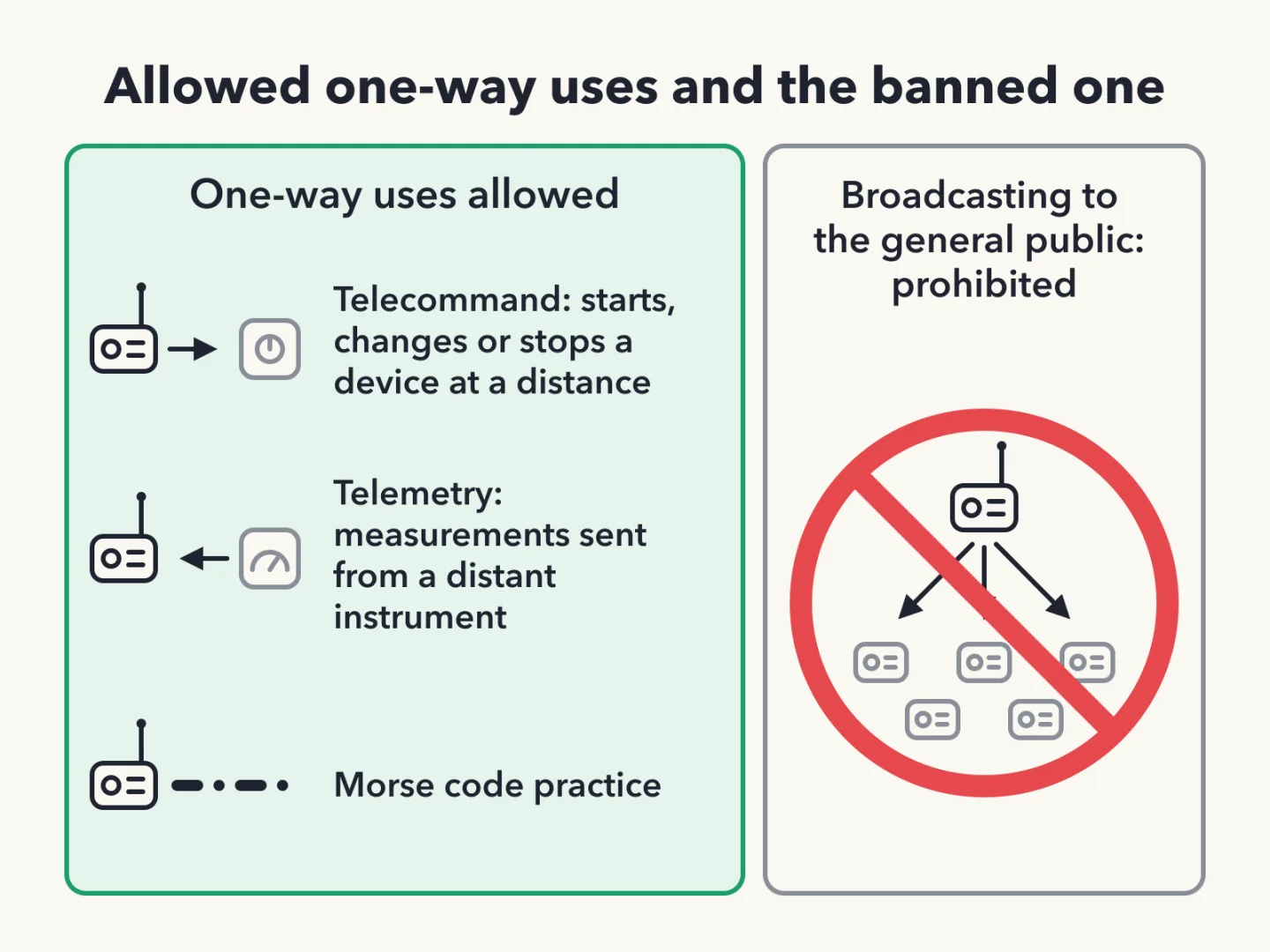
Broadcasting means transmissions intended for reception by the general public, either direct or relayed. An amateur station may not engage in any form of broadcasting. It also may not send one-way communications except where the rules specifically provide.
The rules do provide for several kinds of one-way transmission:
- brief transmissions needed to make adjustments to the station;
- brief transmissions needed to establish two-way communications with other stations;
- telecommand, a one-way transmission to initiate, modify, or terminate functions of a device at a distance;
- transmissions needed to provide emergency communications;
- transmissions that help people learn, or improve their skill in, international Morse code;
- transmissions needed to disseminate information bulletins;
- telemetry, a one-way transmission of measurements at a distance from the measuring instrument.
International Morse code is a dot-dash code that the rules define by reference to an ITU recommendation. Broadcasting stays prohibited even though these other one-way uses are allowed.
Codes, music and indecent language
An amateur station may not send messages encoded to obscure their meaning, except as the rules provide. The exception covers control commands to space stations or model craft. A telecommand station may send special codes meant to obscure its commands to a station in space. Signals that control a model craft are not considered codes or ciphers.
A phone emission may not carry music, except as the rules provide elsewhere. The exception is music incidental to an authorized retransmission of manned spacecraft communications. In general, no station may retransmit programs or signals from any radio station other than an amateur station. The exceptions are:
- propagation and weather forecast information meant for the general public and originating from United States Government stations;
- communications, including incidental music, between a manned spacecraft and its Earth stations on United States Government frequencies.
Manned spacecraft retransmissions need prior approval from the National Aeronautics and Space Administration. They must be for the exclusive use of amateur radio operators. They may happen only occasionally, as an incident of normal amateur communications, and never on a regular basis.
Obscene or indecent words or language are prohibited, with no exception. The rule is a flat ban on any such language. Communications meant to help commit a crime are prohibited too, as are false or deceptive messages, signals or identification.
Selling, pay and news gathering
An amateur may use the station to tell others that apparatus normally used in an amateur station is for sale or trade. This is allowed only when it is not done on a regular basis.
A control operator generally may not accept pay for operating. One exception is a teaching position. A control operator may accept compensation as an incident of teaching when the teacher uses the station as part of classroom instruction at an educational institution.
Amateur stations may not do program production or news gathering for broadcasting. The one exception is communications directly related to the immediate safety of human life or the protection of property. An amateur station may provide these to broadcasters for dissemination to the public. This applies only where no other means of communication is reasonably available before or at the time of the event.
Auxiliary stations
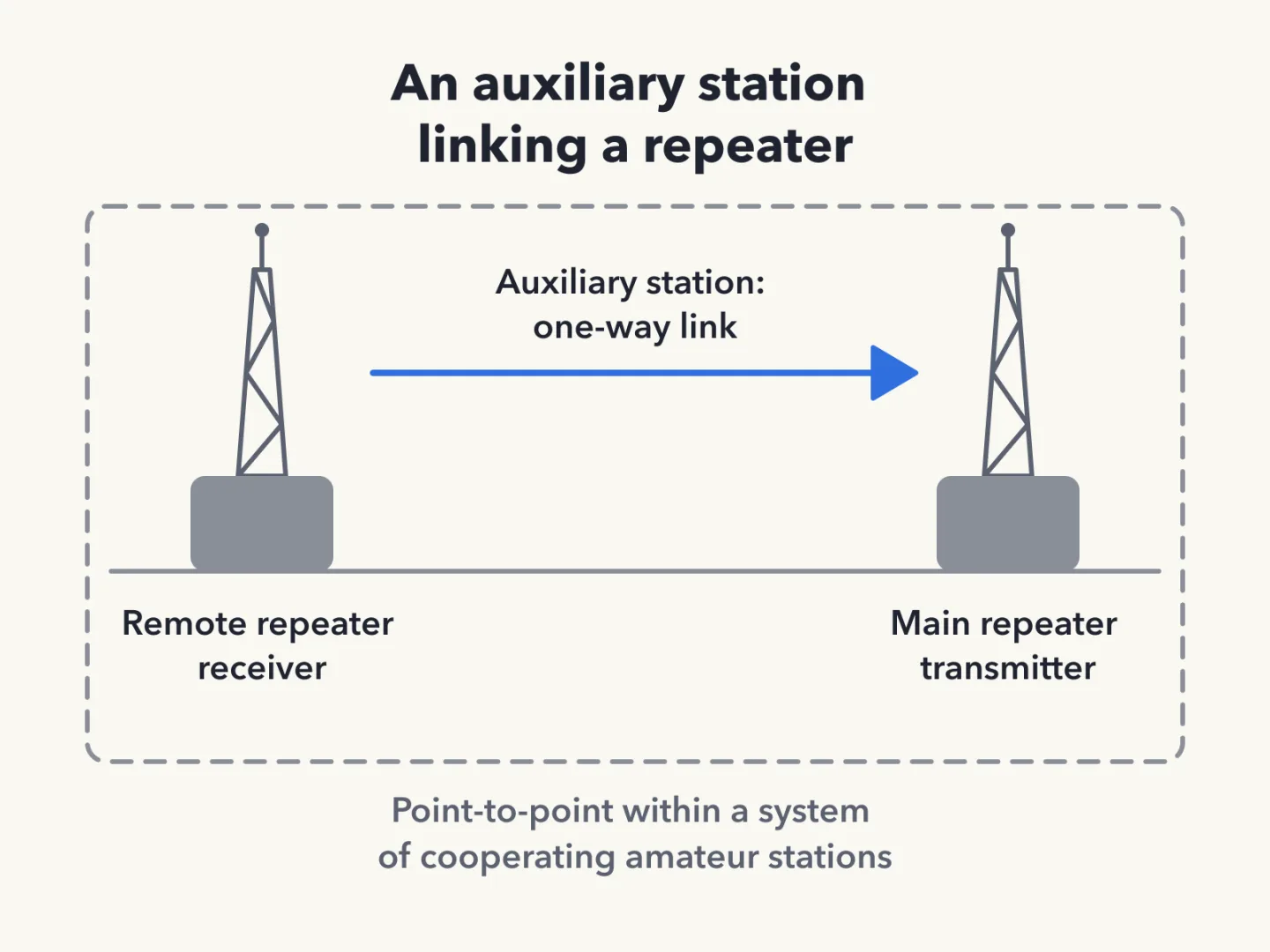
An auxiliary station is an amateur station, other than in a message forwarding system, that transmits communications point-to-point within a system of cooperating amateur stations. One example is a station sending one-way transmissions between a remote repeater receiver and the main repeater transmitter. An auxiliary station may transmit one-way communications.
Automatic retransmission of other amateur stations' signals is limited to auxiliary and repeater stations, and to space stations, which the next section describes.
Identification during tests
Test transmissions on the air must identify the transmitting station. One exception covers signals that control a model craft. Identification is not required for transmissions directed only to the model craft. A label with the station call sign and the licensee's name and address must be affixed to the transmitter, and the transmitter power must not exceed 1 watt (W).
Sources
- NCVEC Question Pool Committee — 2026–2030 Technician question pool
- FCC — 47 CFR § 97.111 Authorized transmissions
- FCC — 47 CFR § 97.113 Prohibited transmissions
- FCC — 47 CFR § 97.119 Station identification
- FCC — 47 CFR § 97.201 Auxiliary station
- FCC — 47 CFR § 97.211 Space telecommand station
- FCC — 47 CFR § 97.215 Telecommand of model craft
- FCC — 47 CFR § 97.3 Definitions
The control operator and control types
What a control operator is
A control operator is an amateur operator designated by the licensee of a station to be responsible for the transmissions from that station and for compliance with the FCC rules. The licensee's designation is what makes someone the control operator.
An amateur station may never transmit without a control operator. None of these removes the requirement:
- automatic control, as with a repeater;
- the licensee being away while another licensed amateur uses the station;
- the station being an auxiliary station.
Who designates and who is responsible
The station licensee must designate the station control operator. A frequency coordinator is an entity, recognized in a local or regional area by amateur operators whose stations are eligible to be auxiliary or repeater stations. It recommends transmit and receive channels and related operating and technical parameters for such stations, to avoid or minimize interference.
The FCC presumes the licensee is also the control operator, unless documentation to the contrary is in the station records.
The licensee is responsible for the proper operation of the station under the FCC rules. When the control operator is a different amateur from the licensee, both are equally responsible for proper operation.
Privileges follow the control operator
The control operator's license class determines the transmitting frequency privileges of the station.
The same principle bars a Technician from an Amateur Extra Class band segment. Apart from an emergency, a Technician class licensee may never be the control operator of a station operating in such a segment. The rule holds even if an Amateur Extra Class licensee designates the Technician.
Satellites and space stations
A space station is an amateur station located more than 50 km above the Earth's surface. Any amateur allowed to transmit on the satellite uplink frequency may be the control operator of a station communicating through an amateur satellite or space station.
The control point
A control point is the location at which the control operator function is performed.
Automatic and remote control
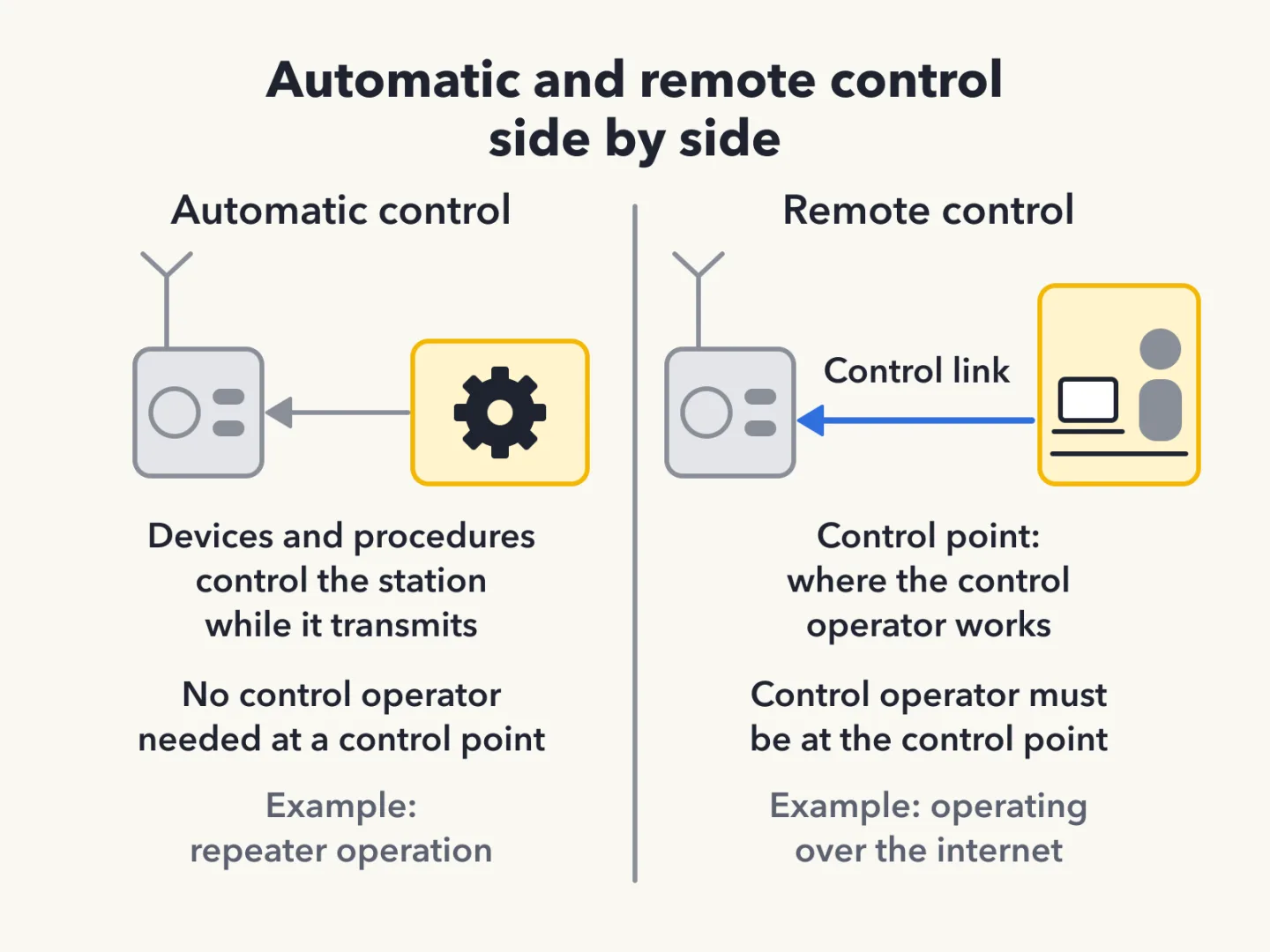
Under automatic control, devices and procedures control a station while it transmits. Compliance with the FCC rules is achieved without the control operator being present at a control point. Repeater operation is the standard example, and a repeater may be automatically controlled.
Under remote control, a control operator indirectly manipulates the station's operating adjustments through a control link, to achieve compliance with the FCC rules. Operating a station over the internet is an example.
The two types differ in where the control operator is. Under automatic control, no control operator needs to be at a control point. When a station is remotely controlled, the control operator must be at the control point. Any station may be remotely controlled.
Sources
- NCVEC Question Pool Committee — 2026–2030 Technician question pool
- FCC — 47 CFR § 97.7 Control operator required
- FCC — 47 CFR § 97.103 Station licensee responsibilities
- FCC — 47 CFR § 97.109 Station control
- FCC — 47 CFR § 97.205 Repeater station
- FCC — 47 CFR § 97.207 Space station
- FCC — 47 CFR § 97.301 Authorized frequency bands
- FCC — 47 CFR § 97.3 Definitions
Identification, repeaters and third parties
Inspection
The station licensee must make the station and the station records available for inspection upon request by an FCC representative. That means at any time upon request.
When to identify
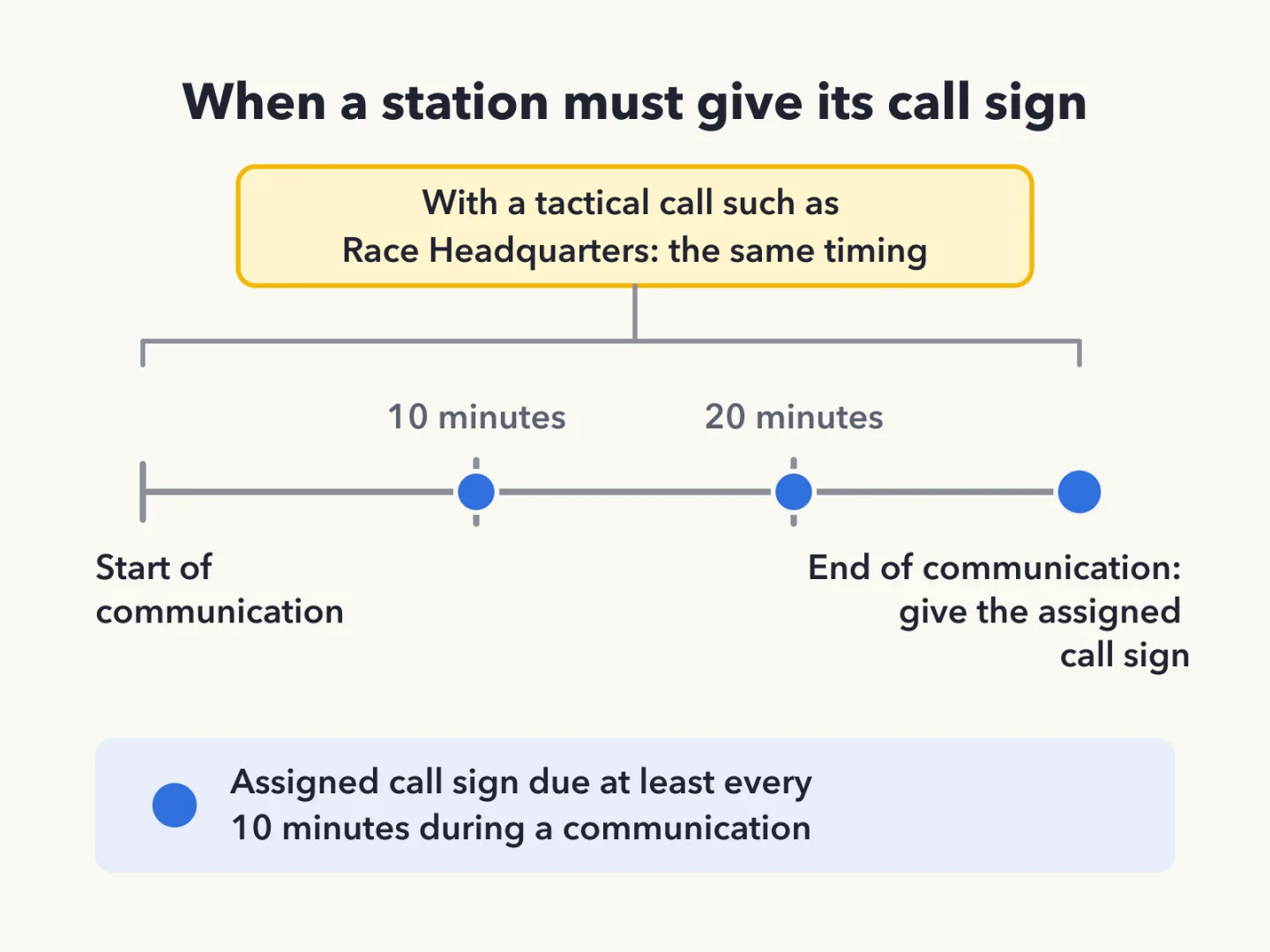
Each amateur station must transmit its assigned call sign at the end of each communication and at least every 10 minutes during a communication. The purpose is to make clear to listeners where the transmissions come from. Space stations and telecommand stations are exempt from this rule.
A station may not transmit unidentified communications or signals. It also may not transmit as its call sign any call sign not authorized to the station.
A tactical call such as "Race Headquarters" does not change this. The station must still give its FCC-assigned call sign at least every 10 minutes during the communication and at its end. The tactical call is not sufficient alone.
How and in what language
A station transmitting phone signals may send its call sign using a CW or phone emission. CW means international Morse code telegraphy emissions. A phone identification must be in the English language. The rules encourage using a phonetic alphabet as an aid to correct identification.
Indicators
An indicator is words, letters or numerals appended to and separated from the call sign during identification. An indicator must be separated from the call sign by the slant mark (/) or by any suitable word that denotes it. On a phone transmission, "KL7CC stroke W3", "KL7CC slant W3" and "KL7CC slash W3" are all acceptable.
A self-assigned indicator must be included before the call sign, after it, or on both sides. It may not conflict with any other indicator specified by the FCC rules or with any prefix assigned to another country.
Third-party communications
Third-party communications are messages from the control operator (the first party) of an amateur station to another amateur station's control operator (the second party) on behalf of another person (the third party).
An unlicensed person may speak to a foreign amateur station through a station under an FCC-licensed control operator. The foreign station must then be in a country with which the United States has a third-party agreement. The rules put it this way: the foreign country's administration has made arrangements with the United States for such international communications. Emergency or disaster relief communications are also permitted. The prohibition does not apply to a message for a third party who is eligible to be a control operator of the station.
Repeaters and accountability
A repeater is an amateur station that simultaneously retransmits the transmission of another amateur station on a different channel or channels. It is a different thing from a beacon. A beacon is an amateur station transmitting communications to observe propagation and reception, or for other related experimental activities.
Suppose a repeater inadvertently retransmits communications that violate the FCC rules. The control operator of the originating station is accountable.
Club stations
A club station license grant may be held only by the license trustee, a person designated by an officer of the club. The trustee must hold an operator/primary station license grant. The club must be composed of at least four persons, and it must have:
- a name;
- a document of organization;
- management;
- a primary purpose devoted to amateur service activities consistent with the rules.
Sources
- NCVEC Question Pool Committee — 2026–2030 Technician question pool
- FCC — 47 CFR § 97.103 Station licensee responsibilities
- FCC — 47 CFR § 97.115 Third party communications
- FCC — 47 CFR § 97.119 Station identification
- FCC — 47 CFR § 97.205 Repeater station
- FCC — 47 CFR § 97.5 Station license required
- FCC — 47 CFR § 97.3 Definitions
Key terms
- Telecommand
- A one-way transmission to initiate, modify, or terminate functions of a device at a distance
- Telemetry
- A one-way transmission of measurements at a distance from the measuring instrument
- Frequency coordinator
- A locally recognized entity that recommends channels and parameters for repeater and auxiliary stations to minimize interference
- Space station
- An amateur station located more than 50 km above the Earth's surface
- Beacon
- An amateur station transmitting to observe propagation and reception, or for related experimental activities
- Indicator
- Words, letters or numerals appended to and separated from the call sign during identification
Key facts
Countries That Object to Contact
Stations licensed by the Federal Communications Commission (FCC) may not exchange communications with any country whose administration has notified the International Telecommunication Union (ITU) that it objects to such communications.
Broadcasting Is the Banned One-Way Use
An amateur station may not send one-way communications except where the rules provide. Allowed one-way uses include brief adjustment transmissions, Morse code practice, telecommand and telemetry. Broadcasting stays prohibited even though these other one-way uses are allowed.
Coded Messages and Their Exception
An amateur station may not send messages encoded to obscure their meaning. The exception covers control commands to space stations or model craft. A telecommand station may send special codes meant to obscure its commands to a station in space. Signals controlling a model craft are not considered codes or ciphers.
Music on a Phone Emission
A phone emission may not carry music, except as the rules provide. The exception is music incidental to an authorized retransmission of manned spacecraft communications. These retransmissions need prior approval from the National Aeronautics and Space Administration (NASA). They may happen only occasionally, never on a regular basis.
Selling Equipment on the Air
An amateur may use the station to tell others that apparatus normally used in an amateur station is for sale or trade. This is allowed only when it is not done on a regular basis.
Indecent Language Is Banned
Obscene or indecent words or language are prohibited, with no exception. The rule is a flat ban on any such language.
An Example of an Auxiliary Station
An auxiliary station transmits point-to-point within a system of cooperating amateur stations. One example is a station sending one-way transmissions between a remote repeater receiver and the main repeater transmitter.
When a Control Operator Gets Paid
A control operator generally may not accept pay for operating. One exception is a teaching position. Compensation is allowed when the teacher uses the station as part of classroom instruction at an educational institution.
News Gathering and Its One Exception
Amateur stations may not do program production or news gathering for broadcasting. The one exception is communications directly related to the immediate safety of human life or the protection of property. This applies only where no other means of communication is reasonably available before or at the time of the event.
What Broadcasting Means
In the Amateur Radio Service, broadcasting means transmissions intended for reception by the general public, either direct or relayed. An amateur station may not engage in any form of it.
Transmitting Without Identifying
Identification is not required for transmissions directed only to a model craft. A label with the station call sign and the licensee's name and address must be affixed to the transmitter. The transmitter power must not exceed 1 watt (W).
Identifying During On-Air Tests
Test transmissions on the air must identify the transmitting station.
A Control Operator Is Always Required
An amateur station may never transmit without a control operator. Automatic control, as with a repeater, does not remove the requirement.
Control Operators for Satellite Stations
Any amateur allowed to transmit on the satellite uplink frequency may be the control operator of a station communicating through an amateur satellite or space station.
The Licensee Designates the Operator
The station licensee must designate the station control operator. The Federal Communications Commission (FCC) presumes the licensee is also the control operator, unless documentation to the contrary is in the station records.
Privileges Follow the Control Operator
The control operator's license class determines the transmitting frequency privileges of the station.
The Control Point
A control point is the location at which the control operator function is performed.
Technicians and Extra Class Segments
Apart from an emergency, a Technician class licensee may never be the control operator of a station in an Amateur Extra Class band segment. The rule holds even if an Amateur Extra Class licensee designates the Technician.
Who Is Responsible for the Station
The licensee is responsible for the proper operation of the station. When the control operator is a different amateur, both are equally responsible.
Automatic Control and Repeaters
Under automatic control, devices and procedures control a station while it transmits. Compliance is achieved without the control operator being present at a control point. Repeater operation is the standard example.
Any Station May Be Remote
Any station may be remotely controlled. When a station is remotely controlled, the control operator must be at the control point.
What Counts as Remote Control
Under remote control, a control operator indirectly adjusts the station through a control link. Operating a station over the internet is an example.
What a Control Operator Is
A control operator is the amateur designated by the licensee to be responsible for transmissions and for compliance with the Federal Communications Commission (FCC) rules.
Inspection on Request
The station licensee must make the station and the station records available for inspection upon request by a Federal Communications Commission (FCC) representative. That means at any time.
Identify at Least Every 10 Minutes
A station must give its assigned call sign at the end of each communication and at least every 10 minutes during it. A tactical call such as "Race Headquarters" does not change this, because the tactical call is not sufficient alone.
English for Phone Identification
A phone identification must be in the English language. The rules encourage a phonetic alphabet as an aid to correct identification.
How a Phone Station Identifies
A station transmitting phone signals may send its call sign using a CW or phone emission. CW means international Morse code telegraphy emissions.
Acceptable Phone Indicators
An indicator must be separated from the call sign by the slant mark (/) or by a suitable word that denotes it. On a phone transmission, "KL7CC stroke W3", "KL7CC slant W3" and "KL7CC slash W3" are all acceptable.
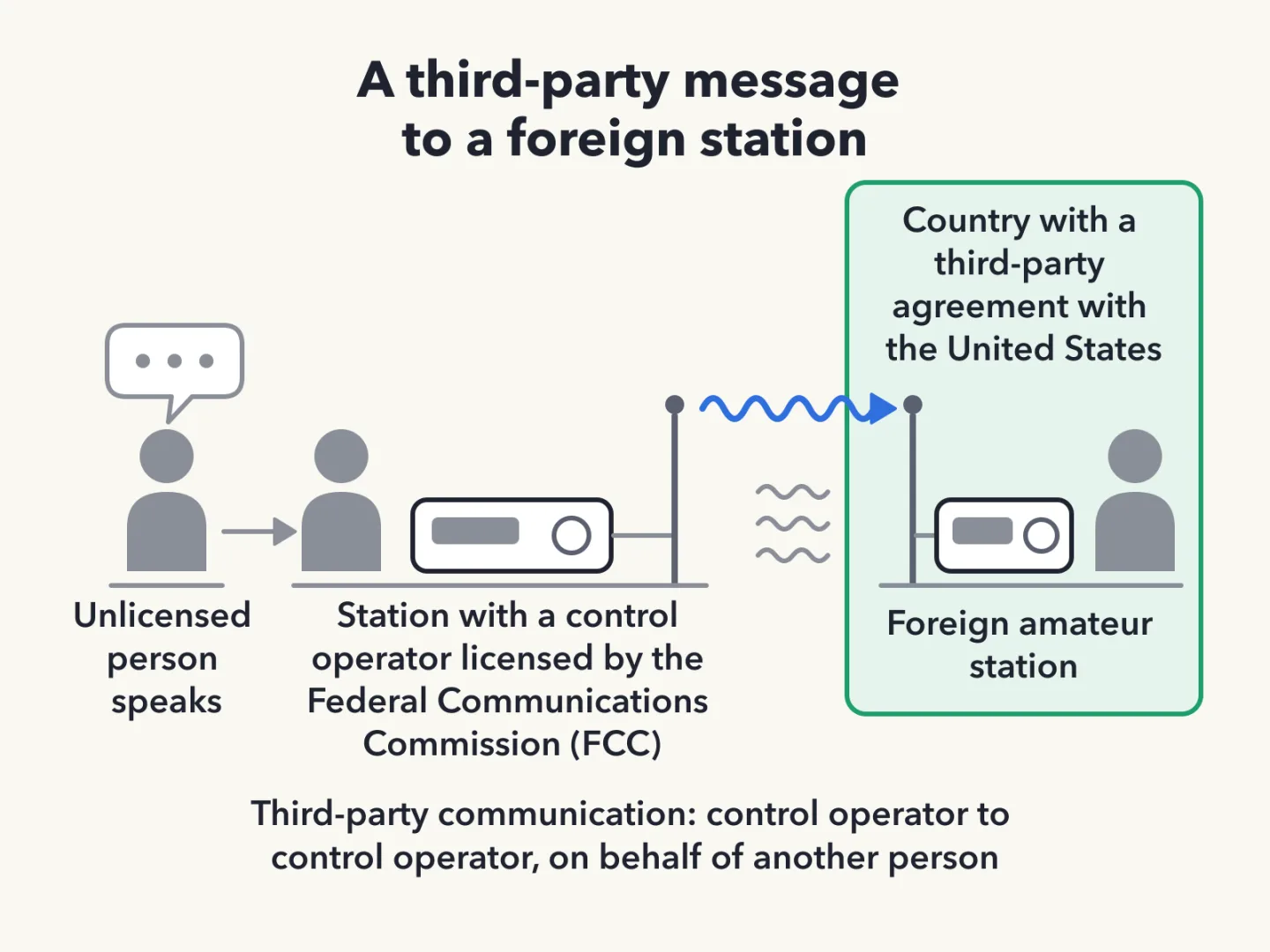
Unlicensed Speakers and Foreign Stations
An unlicensed person may speak to a foreign amateur station through a station whose control operator is licensed by the Federal Communications Commission (FCC). The foreign station must be in a country with which the United States has a third-party agreement.
What Third-Party Communications Are
Third-party communications are messages from one control operator to another station's control operator on behalf of another person.
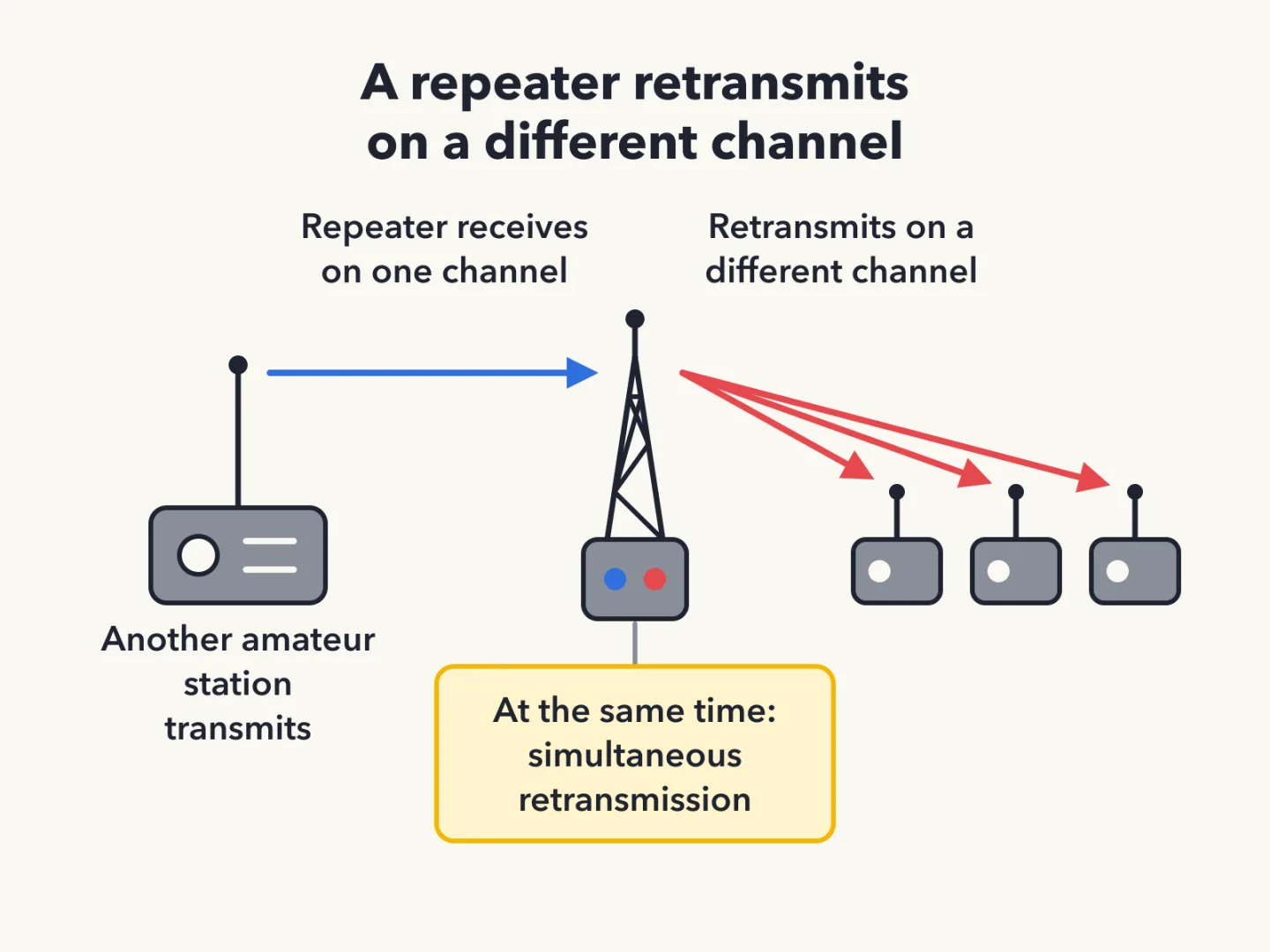
Repeaters Retransmit on Another Channel
A repeater simultaneously retransmits the transmission of another amateur station on a different channel or channels. That is what sets it apart from stations with other jobs.
Who Answers for Repeater Violations
If a repeater inadvertently retransmits communications that violate the rules, the control operator of the originating station is accountable.
Requirements for a Club License
A club station license grant may be held only by the license trustee. The club must be composed of at least four persons.
Matched pairs
Each item on the left goes with the one on the right.
- Music on phone
- Only incidental to manned spacecraft relay
- Control point
- Where the control operator function is done
- Repeater violation
- Originating station's control operator
Self-test
Answer each question from memory, then check your work against the answer key.
1. With which countries are FCC-licensed amateur radio stations prohibited from exchanging communications?
- AAny country banned from such communications by the IARU
- BAny country that has notified the ARRL that it objects to such communications
- CAny country that has notified the ITU that it objects to such communications
- DAny country banned from such communications by the ARRL
2. Under which of the following circumstances are one-way transmissions by an amateur station prohibited?
- ABroadcasting
- BTelecommand or transmissions of telemetry
- CAnnouncements of upcoming ham radio operating events
- DInternational Morse Code Practice
3. How does the FCC define broadcasting for the Amateur Radio Service?
- ATransmission of messages directed only to amateur operators
- BAny transmission made by the licensed station
- CTwo-way transmissions by amateur stations
- DTransmissions intended for reception by the general public
4. When is it permissible to transmit messages encoded to obscure their meaning?
- ANever
- BOnly when transmitting control commands to space stations or model craft
- COnly when transmitting certain approved digital codes
- DOnly when using a remote station during a contest
5. Under what conditions is an amateur station authorized to transmit music using a phone emission?
- AWhen incidental to an authorized retransmission of manned spacecraft communications
- BWhen the music is transmitted above 1280 MHz
- CWhen transmissions are limited to less than three minutes per hour
- DWhen the music produces no spurious emissions
6. What, if any, are the restrictions concerning transmission of language that may be considered indecent or obscene?
- AThe FCC maintains a list of words that are not permitted to be used on amateur frequencies
- BThere is no such prohibition
- CAny such language is prohibited
- DThe International Telecommunications Union lists words not allowed on amateur frequencies
7. When may amateur radio operators use their stations to notify other amateurs of the availability of equipment for sale or trade?
- AWhen no profit is made on the sale
- BWhen selling amateur radio equipment and not on a regular basis
- CWhen not the personal property of the licensee, control operator, or close relatives
- DNever
8. In which of the following circumstances may the control operator of an amateur station receive compensation for operating that station?
- AWhen made to obtain emergency information for a local broadcast station
- BWhen related to the sale of amateur equipment by the control operator's employer
- CAll these choices are correct
- DWhen the communication is a part of classroom instruction at an educational institution
9. When may amateur stations transmit information in support of broadcasting, program production, or news gathering, assuming no other means is available?
- AWhere non-commercial programming is supplied only to the National Public Radio network
- BWhen broadcasting communications to or from the space shuttle
- CNever
- DWhen directly related to the immediate safety of human life or protection of property
10. Which of the following is an example of an auxiliary station?
- AA backup radio for emergency use in case the main station radio fails
- BA station sending one-way signals between remote repeater receiver and main transmitter
- CA Military Auxiliary Radio System station linking government and amateur stations
- DA second station utilized in multi-operator contest stations
11. When may an amateur station transmit without identifying on the air?
- AWhen the transmitted power level is below 0.1 watt
- BWhen the transmissions are of a brief nature to make station adjustments
- CWhen transmitting signals to control model craft
- DWhen the transmissions are unmodulated
12. Which of the following is required when making on-the-air test transmissions?
- AIdentify the transmitting station
- BConduct tests only between 10 p.m. and 6 a.m. local time
- CAll these choices are correct
- DNotify the FCC of the transmissions
13. When may an amateur station transmit without a control operator?
- ANever
- BWhen the station licensee is away and another licensed amateur is using the station
- CWhen using automatic control, such as in the case of a repeater
- DWhen the transmitting station is an auxiliary station
14. What is a control operator as defined in Part 97?
- AThe person speaking or otherwise communicating messages over an amateur station
- BThe person who is the licensee of an amateur station
- CAmateur designated by licensee responsible for transmissions and FCC rules at station
- DAmateur in FCC database responsible for transmissions and FCC rules at license location
15. Who must designate the station control operator?
- AThe FCC
- BThe station licensee
- CThe frequency coordinator
- DAny licensed operator
16. When the control operator is not the station licensee, who is responsible for the proper operation of the station?
- AAll licensed amateurs who are present at the operation
- BOnly the station licensee
- COnly the control operator
- DThe control operator and the station licensee
17. Who may be the control operator of a station communicating through an amateur satellite or space station?
- AA General class or higher licensee with a satellite operator certification
- BOnly an Amateur Extra Class operator who is also an AMSAT member
- COnly an Amateur Extra Class operator
- DAny amateur allowed to transmit on the satellite uplink frequency
18. What determines the transmitting frequency privileges of an amateur station?
- AThe frequency authorized by the frequency coordinator
- BThe frequencies printed on the license grant
- CThe class of operator license held by the control operator
- DThe highest class of operator license held by anyone on the premises
19. When, other than during an emergency, may a Technician class licensee be the control operator of a station operating in an Amateur Extra Class band segment?
- AAt no time
- BWhen using a club station whose trustee holds an Amateur Extra Class license
- CAs part of a multi-operator contest team
- DWhen designated as the control operator by an Amateur Extra Class licensee
20. What is an amateur station’s control point?
- AThe mailing address of the station licensee
- BThe location at which the control operator function is performed
- CThe location of the station’s transmitting antenna
- DThe location of the station’s transmitting apparatus
21. Which of the following is an example of automatic control?
- ARepeater operation
- BUsing a computer or other device to send CW automatically
- CControlling a station over the internet
- DUsing a computer or other device to identify automatically
22. Which amateur stations may be remotely controlled?
- AOnly digital stations
- BAny station
- COnly repeater stations
- DOnly automatically controlled stations
23. Which of the following is an example of remote control as defined in Part 97?
- AEarth-Moon-Earth (EME) communication
- BControlling a model aircraft, boat, or car by amateur radio
- CA software defined radio (SDR)
- DOperating the station over the internet
24. When must the station licensee make the station and the station records available for inspection?
- AOnly when presented with a valid warrant by an FCC official or government agent
- BAt any time ten days after notification by the FCC of such an inspection
- CAt any time upon request by an FCC representative
- DAt any time after a written notification by the FCC of such inspection
25. How often must you identify with your FCC-assigned call sign when using tactical call signs such as “Race Headquarters”?
- AOnce every hour
- BNever, the tactical call is sufficient
- CAt least every 10 minutes during and at the end of a communication
- DAt the end of every transmission
26. When are you required to transmit your assigned call sign?
- AAt least every 10 minutes during and at the end of a communication
- BAt the beginning of each contact, and every 10 minutes thereafter
- CAt least once during each transmission
- DAt least every 15 minutes during and at the end of a communication
27. What language must you use for identification when using a phone emission?
- AAny language recognized by the ITU
- BAny language recognized by the United Nations
- CEnglish, French, or Spanish
- DEnglish
28. What method of call sign identification is required for a station transmitting phone signals?
- ASend the call sign using only a phone emission
- BSend the call sign using a CW or phone emission
- CSend the call sign followed by the indicator RPT
- DSend the call sign followed by the indicator R
29. Which of the following self-assigned indicators are acceptable when using a phone transmission?
- AKL7CC stroke W3
- BKL7CC slant W3
- CKL7CC slash W3
- DAll these choices are correct
30. Which of the following restrictions apply when a non-licensed person speaks to a foreign amateur radio station via a station under the control of an FCC-licensed amateur radio operator?
- AThe licensed control operator must do the station identification
- BThe person must be a U.S. citizen
- CThe foreign station must be in a country with which the U.S. has a third-party agreement
- DAll these choices are correct
31. What is the definition of third-party communications?
- AAmateur radio communications where three stations are in communications with one another
- BA message from a control operator to another control operator on behalf of another person
- COperation when equipment is licensed to a person other than the control operator
- DTemporary authorization for an unlicensed person to transmit for technical experiments
32. What type of amateur station simultaneously retransmits the signal of another amateur station on a different channel or channels?
- ARepeater station
- BRemote control station
- CMessage forwarding station
- DBeacon station
33. Who is accountable if a repeater inadvertently retransmits communications that violate the FCC rules?
- ABoth the originating station and the repeater owner
- BThe control operator of the originating station
- CThe control operator of the repeater
- DThe owner of the repeater
34. Which of the following is a requirement for the issuance of a club station license grant?
- AAll these choices are correct
- BThe trustee must have an Amateur Extra Class operator license grant
- CThe club must have at least four members
- DThe club must be registered with the American Radio Relay League (ARRL)
Go deeper
- ListenLesson 2 episode
- WatchWhen a Ham Station Can Skip Identifying Ham stations must give their call sign on the air. So when can a station skip it?
- WatchTactical Calls and the Call Sign A station signs on as Race Headquarters and never gives its own call sign. Is that enough?
- StudyHam Radio Technician License in the FlashFeed app
Answer key
- 1. C Any country that has notified the ITU that it objects to such communicationsOnly an objection notified to the International Telecommunication Union (ITU) bans contact with a country. A notice to the American Radio Relay League (ARRL), or a ban by the ARRL or International Amateur Radio Union (IARU), does not. FCC stands for Federal Communications Commission.
- 2. A BroadcastingBroadcasting stays prohibited even though other one-way uses, like telecommand and telemetry, are allowed.
- 3. D Transmissions intended for reception by the general publicBroadcasting is defined by its audience: transmissions intended for reception by the general public. FCC stands for Federal Communications Commission.
- 4. B Only when transmitting control commands to space stations or model craftCoded messages are barred except control commands to space stations or model craft.
- 5. A When incidental to an authorized retransmission of manned spacecraft communicationsMusic on phone is allowed only when incidental to an authorized retransmission of manned spacecraft communications.
- 6. C Any such language is prohibitedAny obscene or indecent language is prohibited. No word list is involved. FCC stands for Federal Communications Commission.
- 7. B When selling amateur radio equipment and not on a regular basisSale or trade notices are allowed when not done on a regular basis. It is not a flat ban, and profit does not decide it.
- 8. D When the communication is a part of classroom instruction at an educational institutionPay is allowed as an incident of teaching with the station in classroom instruction. Employer sales and broadcaster news gathering are not exceptions.
- 9. D When directly related to the immediate safety of human life or protection of propertyThe only news-support exception is communications directly related to immediate safety of life or protection of property.
- 10. B A station sending one-way signals between remote repeater receiver and main transmitterAn auxiliary station sends point-to-point one-way links within a system, such as between a remote repeater receiver and the main transmitter.
- 11. C When transmitting signals to control model craftTransmissions directed only to a model craft need no identification, if the transmitter is labeled and power is within 1 watt.
- 12. A Identify the transmitting stationOn-air tests must identify the transmitting station. No Federal Communications Commission (FCC) notice or set hours are required.
- 13. A NeverA control operator is always required. Automatic control, an absent licensee or auxiliary status does not remove that.
- 14. C Amateur designated by licensee responsible for transmissions and FCC rules at stationA control operator is designated by the licensee and is responsible for transmissions and rules compliance. It is not simply the speaker or licensee. FCC stands for Federal Communications Commission.
- 15. B The station licenseeThe station licensee designates the control operator. The Federal Communications Commission (FCC), a frequency coordinator or any licensed operator does not.
- 16. D The control operator and the station licenseeWhen the control operator differs from the licensee, both are equally responsible. Bystanders are not.
- 17. D Any amateur allowed to transmit on the satellite uplink frequencyAny amateur allowed to transmit on the uplink frequency may be control operator. No Extra Class license, certification or membership is needed. AMSAT stands for Radio Amateur Satellite Corporation.
- 18. C The class of operator license held by the control operatorThe control operator's license class sets the station's privileges, not the license grant, a coordinator or others present.
- 19. A At no timeApart from an emergency, a Technician may never be control operator in an Extra Class segment, even if designated by an Extra Class licensee.
- 20. B The location at which the control operator function is performedThe control point is where the control operator function is performed, not the antenna, apparatus or mailing address.
- 21. A Repeater operationRepeater operation is the standard example of automatic control. Internet control is remote control. CW stands for continuous wave.
- 22. B Any stationAny station may be remotely controlled, not only repeaters, automatic or digital stations.
- 23. D Operating the station over the internetOperating a station over the internet is remote control. Model craft control, an SDR and EME are not.
- 24. C At any time upon request by an FCC representativeThe station and records must be available at any time on a Federal Communications Commission (FCC) representative's request. No notice period or warrant applies.
- 25. C At least every 10 minutes during and at the end of a communicationA tactical call does not replace the call sign assigned by the Federal Communications Commission (FCC). That call sign is due at least every 10 minutes and at the end.
- 26. A At least every 10 minutes during and at the end of a communicationThe call sign is due at the end of each communication and at least every 10 minutes during it, not every 15 minutes or each transmission.
- 27. D EnglishA phone identification must be in English, not another language recognized by the UN or International Telecommunication Union (ITU).
- 28. B Send the call sign using a CW or phone emissionA phone station may send its call sign by continuous wave (CW) or phone emission. RPT or R indicators are not the required method.
- 29. D All these choices are correctAn indicator may be set off by the slant mark or a word denoting it, so stroke, slant and slash are all acceptable.
- 30. C The foreign station must be in a country with which the U.S. has a third-party agreementThe foreign station must be in a country with a third-party agreement with the United States. Citizenship is not a restriction. FCC stands for Federal Communications Commission.
- 31. B A message from a control operator to another control operator on behalf of another personThird-party communication is a message between control operators on behalf of another person, not three stations talking.
- 32. A Repeater stationA repeater simultaneously retransmits another station's transmission on a different channel or channels.
- 33. B The control operator of the originating stationThe originating station's control operator is accountable. The repeater's control operator and owner are not for an inadvertent retransmission. FCC stands for Federal Communications Commission.
- 34. C The club must have at least four membersA club must be composed of at least four persons. The trustee need not be Extra Class, and ARRL registration is not required.
Sources
- FCC — 47 CFR § 97.111 Authorized transmissions — www.ecfr.gov/current/title-47/section-97.111
- FCC — 47 CFR § 97.113(b) Prohibited transmissions; FCC — 47 CFR § 97.113 Prohibited transmissions — www.ecfr.gov/current/title-47/section-97.113
- FCC — 47 CFR § 97.211 Space telecommand station (see also §§ 97.113 Prohibited transmissions and 97.215 Telecommand of model craft) — www.ecfr.gov/current/title-47/section-97.211
- FCC — 47 CFR § 97.201 Auxiliary station — www.ecfr.gov/current/title-47/section-97.201
- FCC — 47 CFR § 97.3 Definitions — www.ecfr.gov/current/title-47/section-97.3
- FCC — 47 CFR § 97.215 Telecommand of model craft — www.ecfr.gov/current/title-47/section-97.215
- FCC — 47 CFR § 97.119 Station identification — www.ecfr.gov/current/title-47/section-97.119
- NCVEC Question Pool Committee — 2026–2030 Technician question pool — ncvec.org/index.php/2026-2030-technician-question-pool
- FCC — 47 CFR § 97.7 Control operator required — www.ecfr.gov/current/title-47/section-97.7
- FCC — 47 CFR § 97.103 Station licensee responsibilities — www.ecfr.gov/current/title-47/section-97.103
- FCC — 47 CFR § 97.301 Authorized frequency bands — www.ecfr.gov/current/title-47/section-97.301
- FCC — 47 CFR § 97.109 Station control — www.ecfr.gov/current/title-47/section-97.109
- FCC — 47 CFR § 97.115 Third party communications — www.ecfr.gov/current/title-47/section-97.115
- FCC — 47 CFR § 97.5 Station license required — www.ecfr.gov/current/title-47/section-97.5
- FCC — 47 CFR § 97.205 Repeater station — www.ecfr.gov/current/title-47/section-97.205
Image credits
- Broadcasting Is the Banned One-Way Use: FlashFeed original diagram · CC-BY-4.0
- An Example of an Auxiliary Station: FlashFeed original diagram · CC-BY-4.0
- What Counts as Remote Control: FlashFeed original diagram · CC-BY-4.0
- Identify at Least Every 10 Minutes: FlashFeed original diagram · CC-BY-4.0
- Unlicensed Speakers and Foreign Stations: FlashFeed original diagram · CC-BY-4.0
- Repeaters Retransmit on Another Channel: FlashFeed original diagram · CC-BY-4.0