
Ham Radio Technician License study guide · Lesson 1 of 15
The Rules: Licenses, Bands and Call Signs
Purpose, license grants and key terms · Frequency allocations, modes and power · License classes, call signs and terms
This is the lesson's study guide from the FlashFeed app, plus its key facts and a self-test.
What you'll be able to do
- Explain the purpose of the Amateur Radio Service, who regulates it, what it prohibits or encourages, and what counts as a space station
- Describe how a license grant is issued and proven, and how beacons, frequency coordinators and RACES operation work
- Identify the bands and band segments where a Technician may operate, including phone, digital and ISS contacts
- Explain CW-only segments, secondary allocations, band-edge practice, SSB use and the power limits for Technicians
- Identify the license classes the FCC issues, vanity and valid call signs, and the rules for international contacts and operating on vessels
- Explain when a new licensee may transmit, the license term, renewal and its grace period, and what follows if the FCC can't reach a licensee by email
This lesson covers the rules that decide who may operate an amateur station, where on the radio spectrum, and under what call sign. It has three parts. The first covers the purpose of the service, license grants and the terms the rules use. The second covers bands, modes and power. The third covers license classes, call signs and keeping a license current. A new licensee works under these rules from the first transmission.
Purpose, license grants and key terms
The Amateur Radio Service in the United States is regulated and enforced by the Federal Communications Commission (FCC). The FCC writes its amateur rules in Part 97 of its regulations.
Purpose of the service
The rules give the service a fundamental purpose, expressed in five principles:
- Recognition of the service's value to the public as a voluntary noncommercial communication service, particularly for emergency communications.
- Continuation and extension of the amateur's proven ability to contribute to the advancement of the radio art.
- Encouragement and improvement of the service through rules that advance skills in both the communication and technical phases of the art.
- Expansion of the existing reservoir of trained operators, technicians and electronics experts.
- Continuation and extension of the amateur's unique ability to enhance international goodwill.
So advancing skills in the technical and communication phases of the radio art is part of the service's basis and purpose.
Operators, stations and control operators
An amateur station is a station in an amateur radio service consisting of the apparatus necessary for carrying on radiocommunications. An amateur operator is a person named in an amateur operator/primary station license grant on the consolidated licensee database to be the control operator of an amateur station. That database is the Universal Licensing System (ULS). The ULS is the consolidated database, application filing system and processing system for all Wireless Telecommunications Services.
A control operator is an amateur operator designated by the licensee of a station to be responsible for the transmissions from that station. The control operator assures compliance with the FCC rules. When transmitting, each amateur station must have a control operator. That person must have an operator/primary station license grant on the ULS database. The other way to qualify is to be authorized for alien reciprocal operation under a separate rule.
Notice and proof of a license grant
After a candidate passes the exam, the official notice of the new license and call sign is an email from the FCC. The email has a link to download the license grant.
What proves that the FCC has issued an operator/primary license grant is that the license appears in the ULS database.
Phonetics and station identification
A station may identify itself by a phone emission in the English language. Phone means speech and other sound emissions, and it also covers incidental tones used for selective calling or alerting. The rules encourage a phonetic alphabet as an aid for correct station identification when using phone emissions.
Beacons
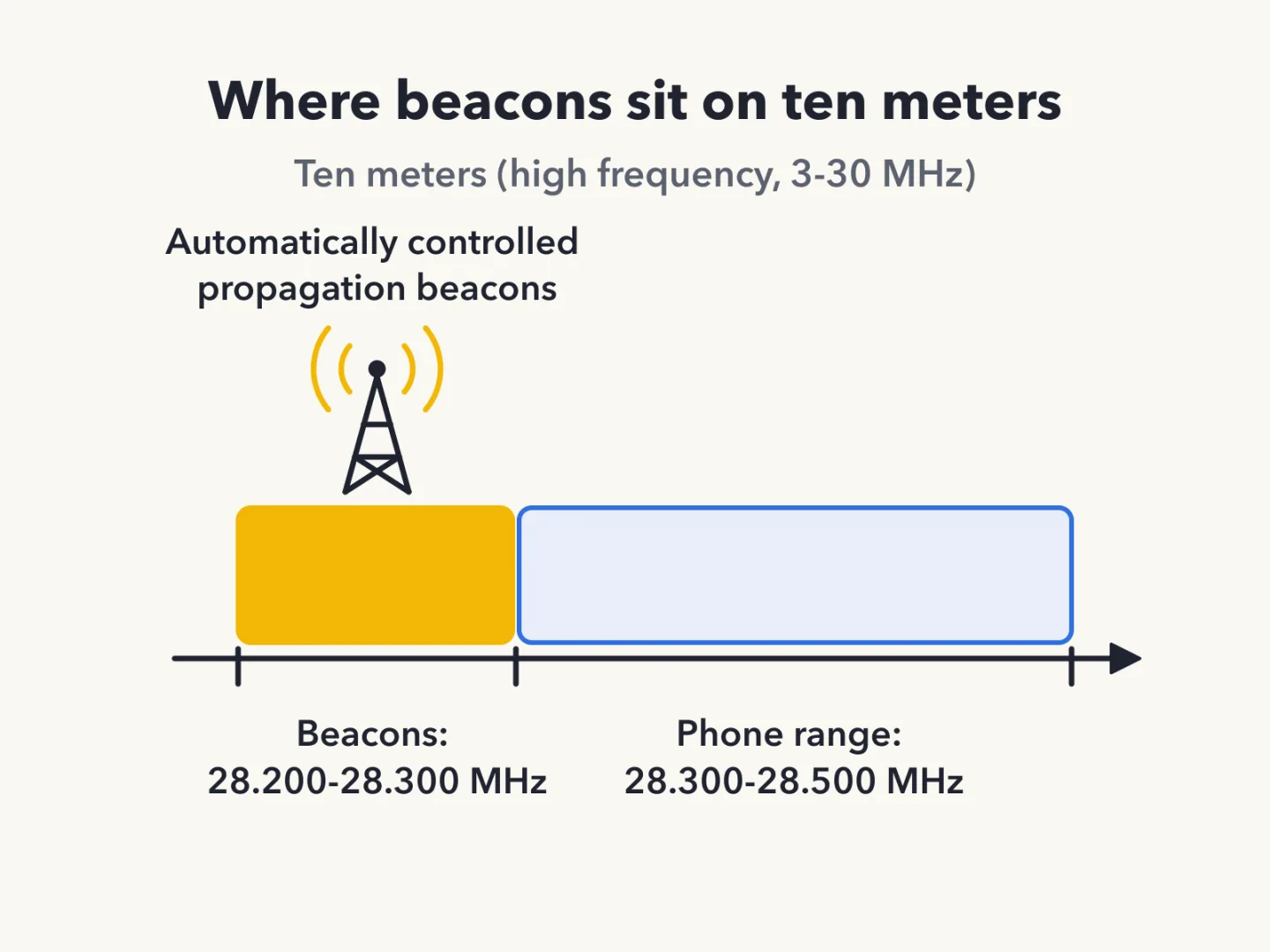
The rules allow a beacon to be automatically controlled while it transmits on certain segments. These segments are 28.20-28.30 megahertz (MHz), 50.06-50.08 MHz, 144.275-144.300 MHz, 222.05-222.06 MHz and 432.300-432.400 MHz. Beacons may also be automatically controlled on the 33 cm and shorter wavelength bands. Among the high frequency (HF) bands, the range of 3-30 MHz, the segment is on ten meters. Automatically controlled amateur propagation beacons are found there, between 28.200 MHz and 28.300 MHz.
Space stations
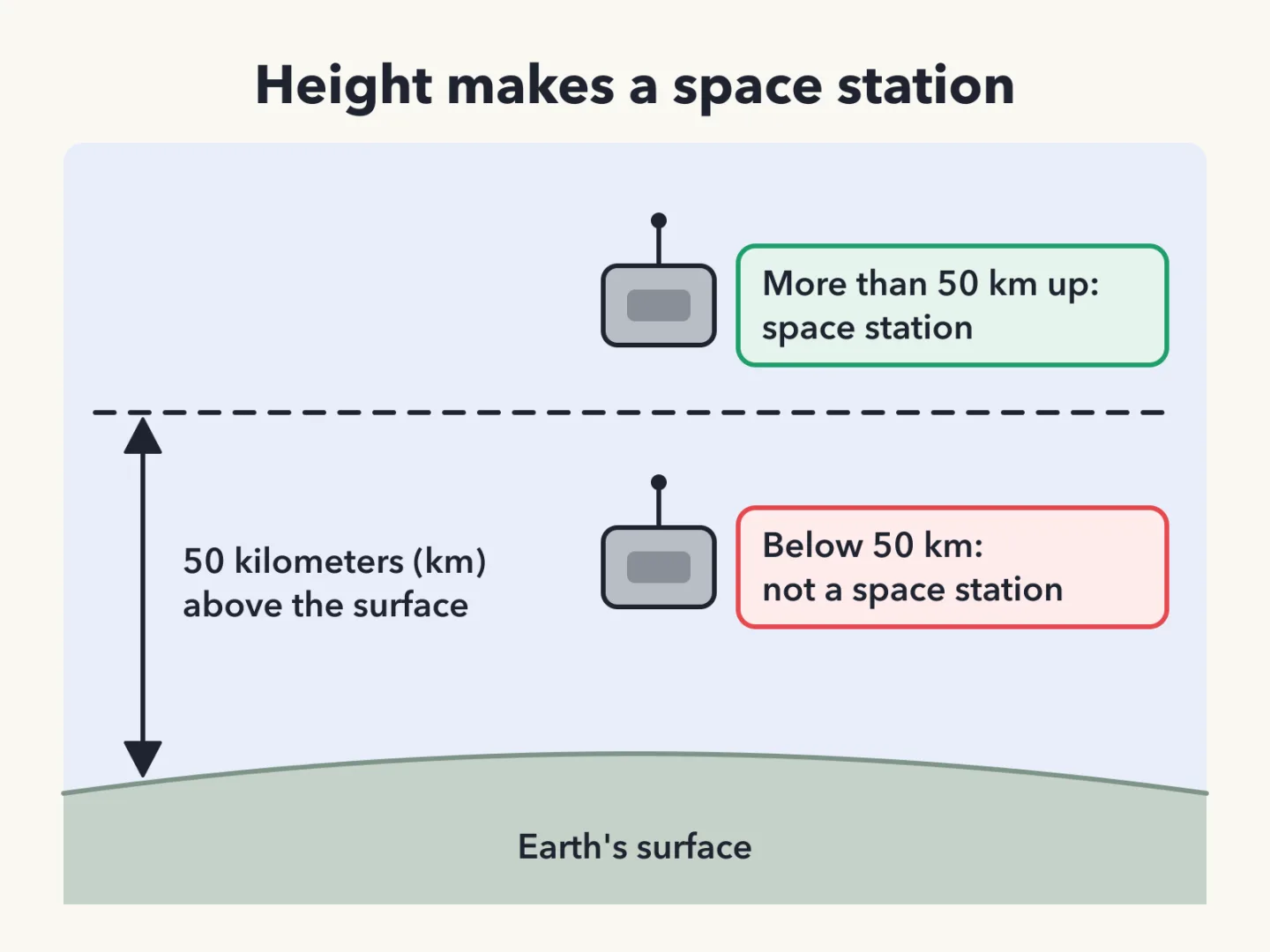
A space station is an amateur station located more than 50 kilometers (km) above the Earth's surface. Height above the Earth's surface decides it.
Frequency coordinators and repeaters
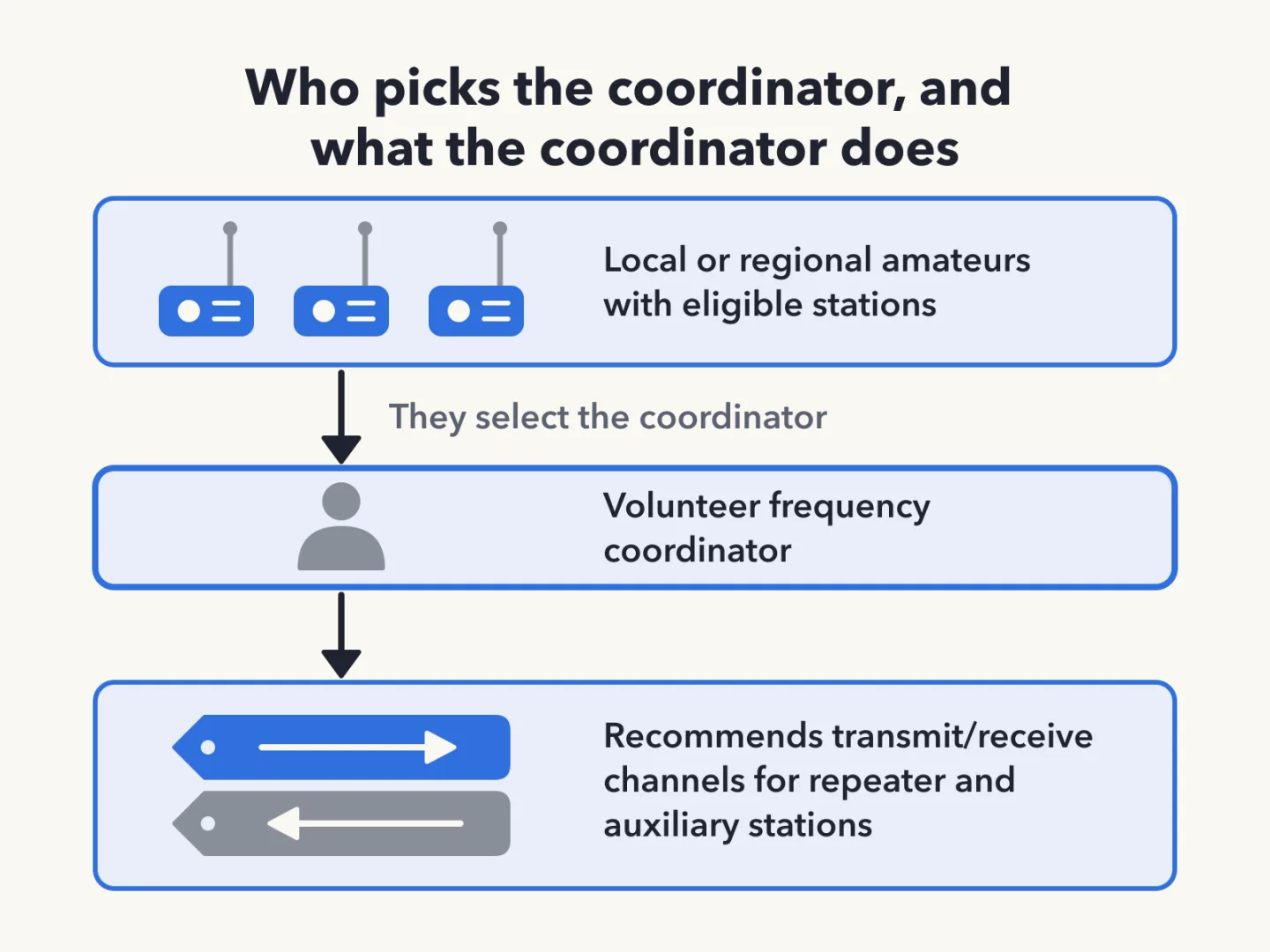
A repeater is an amateur station that simultaneously retransmits the transmission of another amateur station on a different channel or channels. A frequency coordinator recommends transmit/receive channels and associated operating and technical parameters for repeater and auxiliary stations. The purpose is to avoid or minimize potential interference. A Volunteer Frequency Coordinator recognized by local amateurs does this. Amateur operators in a local or regional area whose stations are eligible to be repeater or auxiliary stations select the coordinator.
Emergency service and prohibited acts
The Radio Amateur Civil Emergency Service (RACES) is a radio service using amateur stations for civil defense communications during periods of local, regional or national civil emergencies. To be a control operator in RACES, a person needs an FCC-issued amateur operator license. The person also needs certification by a civil defense organization of current enrollment in that organization.
Willful or malicious interference with any radio communication or signal is prohibited. No amateur operator shall willfully or maliciously interfere with or cause interference to any radio communication or signal.
Sources
- 2026-2030 Technician Class (Element 2) Question Pool and Syllabus, public release of February 19, 2026 (errata applied)
- 47 CFR § 97.1 Basis and purpose
- 47 CFR § 97.101 General standards
- 47 CFR § 97.119 Station identification
- 47 CFR § 97.203 Beacon station
- 47 CFR § 97.23 Mailing and email addresses
- 47 CFR § 97.3 Definitions
- 47 CFR § 97.407 Radio amateur civil emergency service
- 47 CFR § 97.7 Control operator required
Frequency allocations, modes and power
Technician licensees may use certain slices of the spectrum, with limits on how those slices are used and on power. The ranges below are those the rules give for each band.
Bands and frequencies to recognize
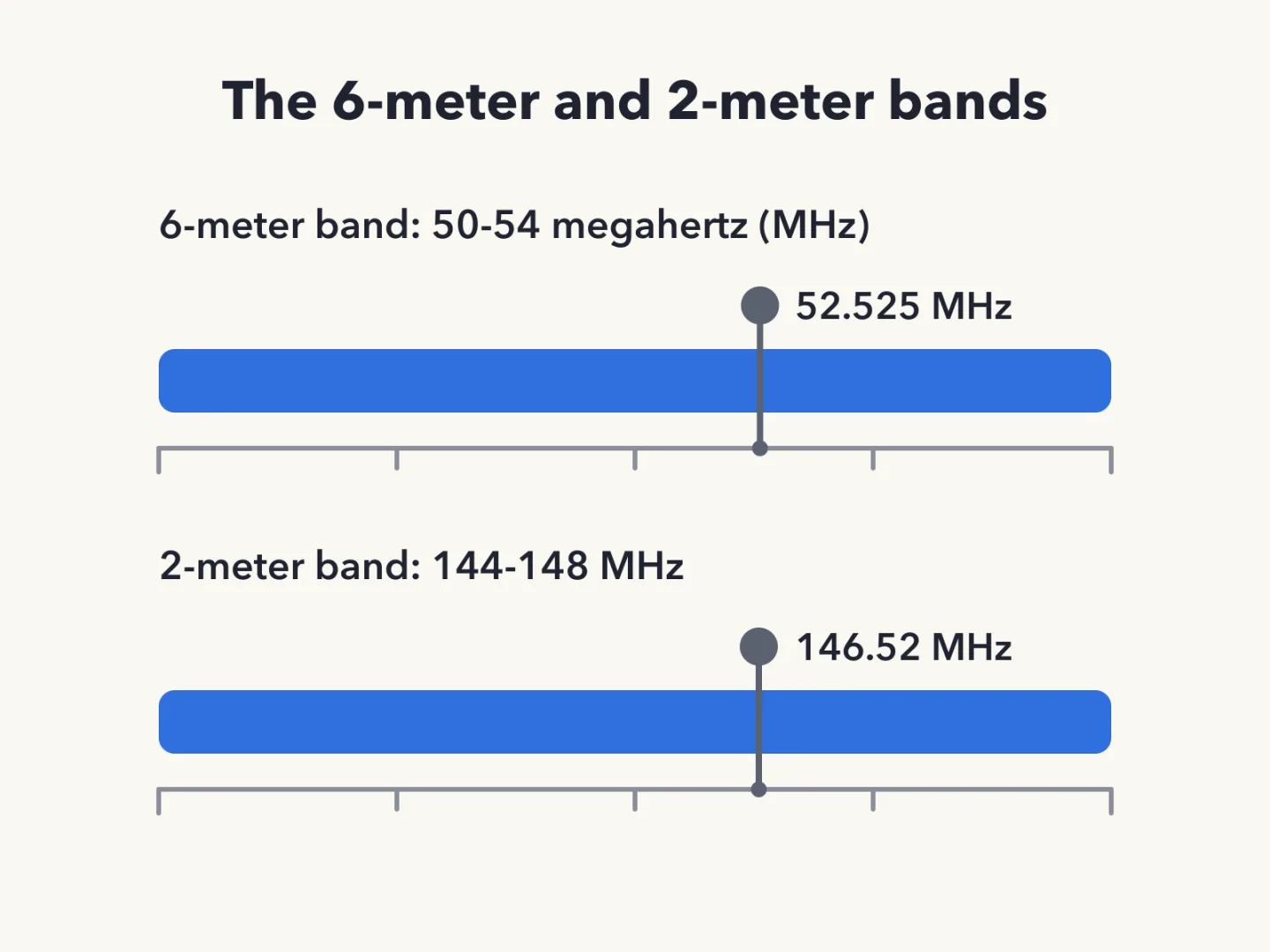
The 6-meter band spans 50-54 MHz, so 52.525 MHz is in it. The 2-meter band spans 144-148 MHz, and it includes 146.52 MHz.
HF privileges for Technicians
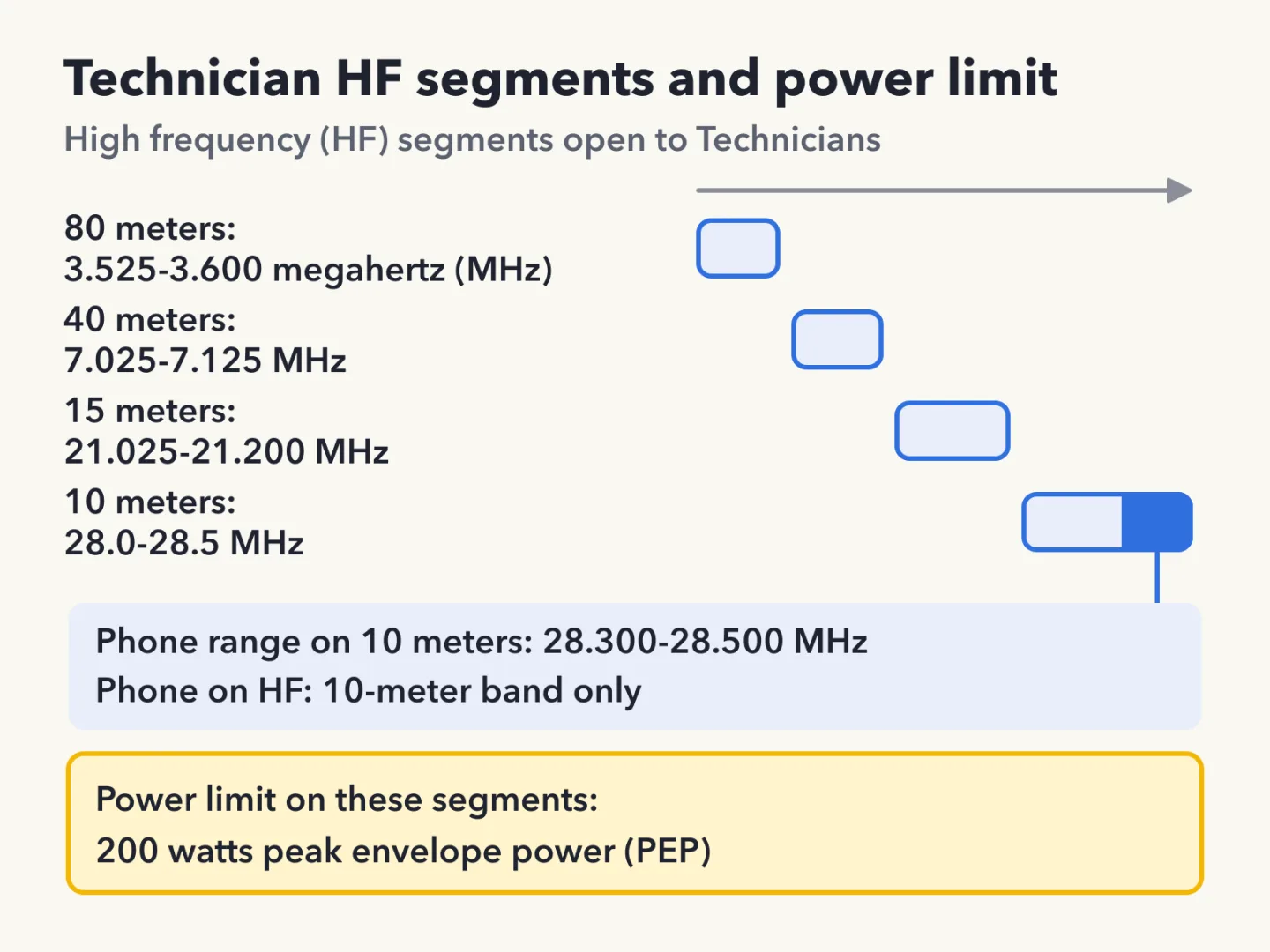
Technician licensees have only a few HF segments. They are:
- 80 meters: 3.525-3.600 MHz
- 40 meters: 7.025-7.125 MHz
- 15 meters: 21.025-21.200 MHz
- 10 meters: 28.0-28.5 MHz
Phone privileges on HF are on the 10-meter band only. The phone range available to Technician licensees is 28.300 MHz to 28.500 MHz.
Digital modes
Technicians may use digital modes such as FT8 on frequencies in the 10-meter band. They may also use them on the 6-meter band and the 2-meter band. All three of those bands include such frequencies.
Contacting the International Space Station
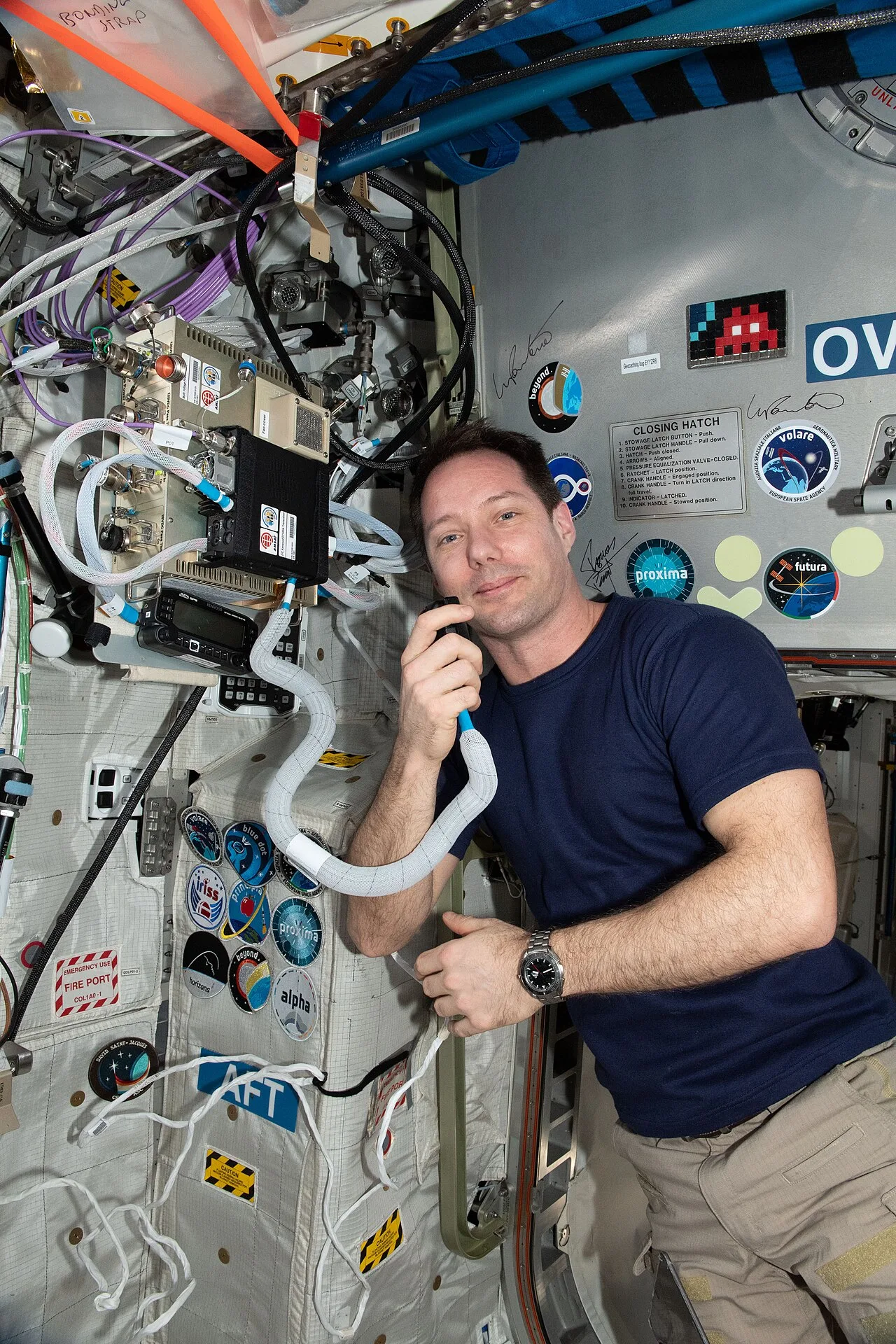
The International Space Station (ISS) is a space station. Space stations are authorized in the 144-146 MHz segment, which lies in the 2-meter band. Any amateur with a Technician class or higher license may contact the ISS on very high frequency (VHF) bands. VHF is the range 30-300 MHz.
CW-only segments and single sideband
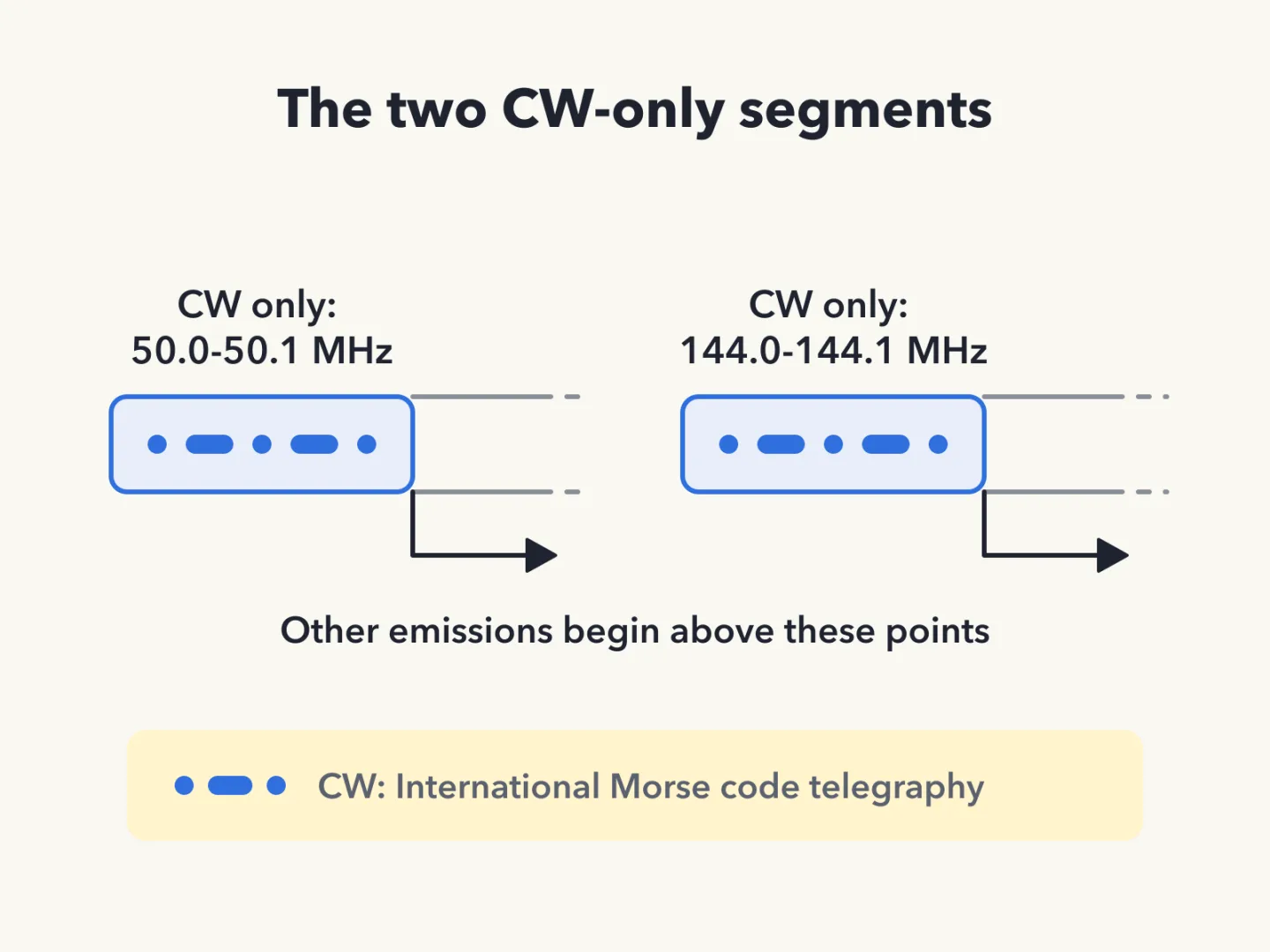
CW means International Morse code telegraphy emissions, together with certain defined designators. An amateur station may transmit CW on any frequency authorized to its control operator. Two segments in the VHF and ultra high frequency (UHF) ranges are limited to CW only: 50.0 MHz to 50.1 MHz and 144.0 MHz to 144.1 MHz. UHF is the range 300-3000 MHz. Other emissions begin above those points. On 6 meters, other emissions begin at 50.1 MHz, and on 2 meters, at 144.1 MHz.
Single sideband (SSB) phone may be used in at least some segment of every amateur band above 50 MHz.
Secondary segments
In each band segment, the Amateur Radio Service is designated either a secondary service or a primary service. A station in a secondary service must not cause harmful interference to stations in a primary service. It must also accept interference from them. So in segments where the Amateur Radio Service is secondary, U.S. amateurs may find non-amateur stations. They must avoid interfering with them.
Staying off the band edge
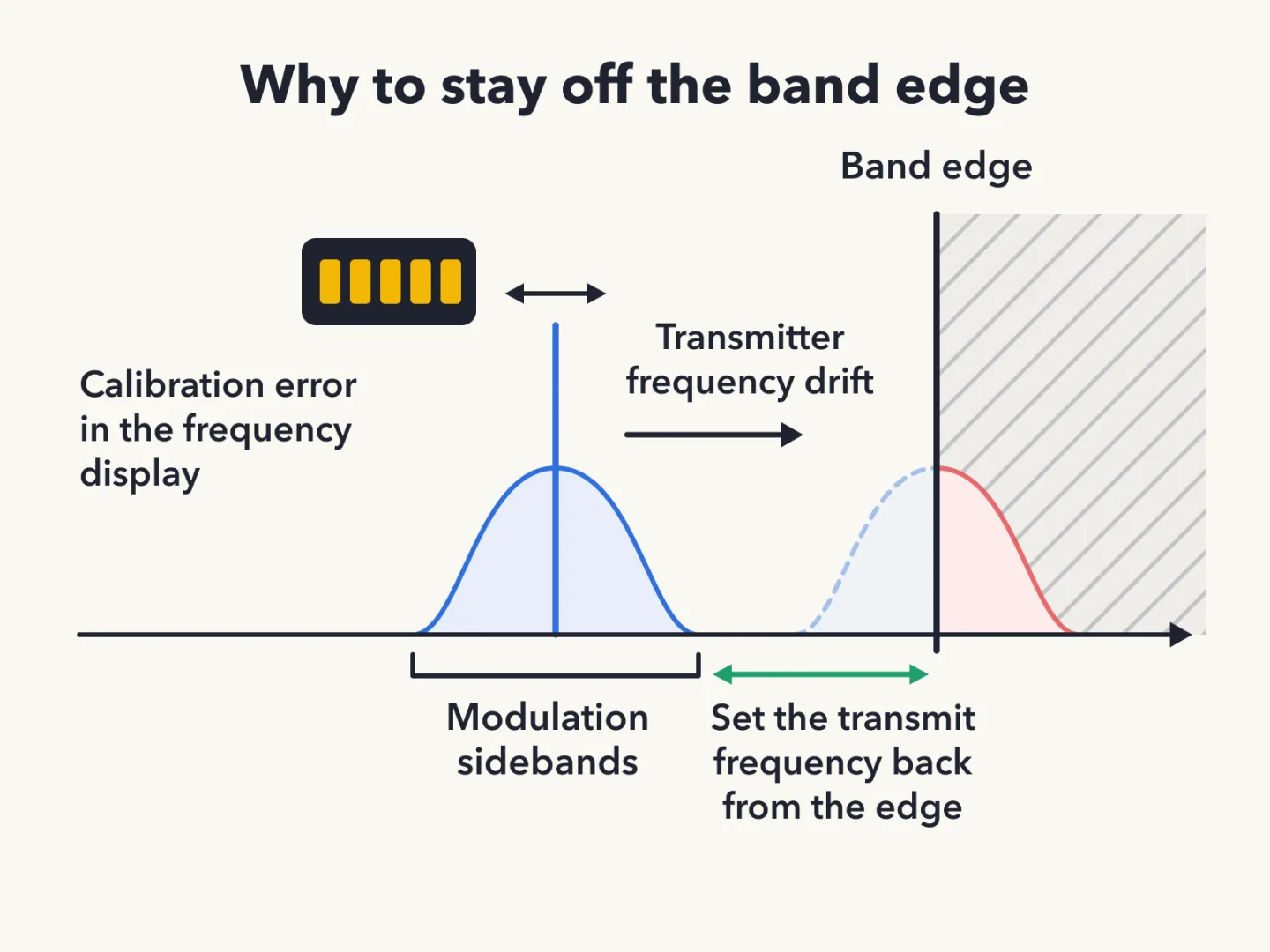
A station should not set its transmit frequency exactly at the edge of an amateur band or sub-band, for three reasons:
- The transmitter's frequency display may have calibration error.
- Modulation sidebands could extend beyond the band edge.
- The transmitter frequency may drift.
These reasons follow the rule that each station must be operated in accordance with good engineering and good amateur practice.
Power limits
An amateur station must use the minimum transmitter power necessary to carry out the desired communications. Peak envelope power (PEP) is the average power supplied to the antenna transmission line by a transmitter during one radio frequency (RF) cycle at the crest of the modulation envelope, under normal operating conditions.
In their HF segments, Technician class operators may not exceed 200 watts PEP. The rule applies on 3.525-3.60 MHz, 7.025-7.125 MHz, 21.025-21.20 MHz and 28.0-28.5 MHz.
Above 30 MHz, Technicians may use up to 1500 watts PEP (1.5 kilowatts), except for some specific restrictions. This limit covers UHF as well as VHF. One example of a restriction is the 219-220 MHz segment of the 1.25 m band. No station may exceed 50 watts PEP there.
Sources
- 2026-2030 Technician Class (Element 2) Question Pool and Syllabus, public release of February 19, 2026 (errata applied)
- 47 CFR § 97.101 General standards
- 47 CFR § 97.207 Space station
- 47 CFR § 97.3 Definitions
- 47 CFR § 97.301 Authorized frequency bands
- 47 CFR § 97.303 Frequency sharing requirements
- 47 CFR § 97.305 Authorized emission types
- 47 CFR § 97.313 Transmitter power standards
License classes, call signs and terms
A license ties a person to a class, a call sign and a term. This part covers which classes the FCC issues, how call signs are chosen, and how a license is started, kept current and renewed.
License classes
The operator license classes in the rules are Novice, Technician, General, Advanced and Amateur Extra. As of 2026, the FCC issues new licenses only for Technician, General and Amateur Extra. No new license grant is issued for a Novice or Advanced Class operator/primary station. An application to renew a Technician Plus Class license is processed as a renewal of a Technician Class license. The person named in the grant may be the control operator of an amateur station with the privileges of the class on the license.
Call signs
A vanity call sign is a call sign the licensee requests through the vanity call sign system. The licensee lists up to 25 call signs in order of preference, and the FCC assigns the first one that can be assigned. Any licensed amateur may use the vanity rules to request a desired call sign.
A valid Group D call sign format for a Technician class is KF1XXX. That is two letters, a digit and three letters.
International communications
Transmissions to a different country, where permitted, are limited to communications incidental to the purposes of the amateur service and to remarks of a personal character.
Operating aboard a vessel
A station may transmit from any place within 50 km of the Earth's surface aboard a vessel or craft documented or registered in the United States. The station apparatus must be under the physical control of a person named in an amateur station license grant. Operation on a ship or aircraft must be approved by the ship's master or the aircraft's pilot in command. So a licensee may operate from a US-documented vessel with the master's permission.
Starting to transmit
A new licensee may transmit as soon as the operator/station license grant appears in the FCC's license database. A certificate of successful completion of an examination (CSCE) shows that a candidate passed the exam.
Keeping contact details current
Each license grant must show the grantee's correct name, mailing address and email address. The email address must be one where the grantee can receive electronic correspondence. A licensee must apply to the FCC to modify the grant as necessary to show correct addresses. If correspondence from the FCC is returned as undeliverable because the grantee did not provide the correct email address, revocation of the station license or suspension of the operator license may result.
Term, renewal and grace period
An amateur service license is normally granted for a 10-year term. A renewal application must be filed no later than the expiration date and no sooner than 90 days before it. A renewal request therefore may be made 90 days before expiration. For a primary station license, when the FCC receives the application on or before the expiration date, the license operating authority continues until the application is finally decided.
A license that has expired can still be renewed during a grace period of 2 years. The renewal application must be received before that period ends. Unless and until the license grant is renewed, no privileges are conferred. A licensee whose license has expired may not transmit during the grace period.
Sources
- 2026-2030 Technician Class (Element 2) Question Pool and Syllabus, public release of February 19, 2026 (errata applied)
- 47 CFR § 1.949 Application for renewal of authorization
- 47 CFR § 97.11 Stations aboard ships or aircraft
- 47 CFR § 97.117 International communications
- 47 CFR § 97.17 Application for new license grant
- 47 CFR § 97.19 Application for a vanity call sign
- 47 CFR § 97.21 Application for a modified or renewed license grant
- 47 CFR § 97.23 Mailing and email addresses
- 47 CFR § 97.25 License term
- 47 CFR § 97.3 Definitions
- 47 CFR § 97.5 Station license required
- 47 CFR § 97.9 Operator license grant
Key terms
- Control operator
- An amateur operator the station's licensee designates to be responsible for its transmissions and rule compliance
- Repeater
- A station that simultaneously retransmits another amateur station's signal on a different channel or channels
- PEP
- Peak envelope power: average power fed to the antenna line during one radio frequency (RF) cycle at the modulation crest
- CW
- International Morse code telegraphy emissions, together with certain defined designators
- CSCE
- Certificate of successful completion of an examination; it shows that a candidate passed the exam
- Vanity call sign
- A station identifier the licensee requests by listing up to 25 in order of preference; the Federal Communications Commission assigns the first assignable one, and any licensed amateur may apply
Key facts
Proof of a License Grant
After a candidate passes the exam, the official notice is an email from the Federal Communications Commission (FCC) with a link to download the license grant. What proves the grant exists is the license appearing in the Universal Licensing System (ULS) database.
Phonetic Alphabet Is Encouraged
A station may identify itself by a phone emission in the English language. The rules encourage a phonetic alphabet as an aid for correct station identification when using phone emissions.
Beacons on Ten Meters
The rules allow a beacon to be automatically controlled on certain segments. Among the high frequency (HF) bands, the range of 3-30 megahertz (MHz), automatically controlled amateur propagation beacons are found on ten meters, from 28.200 MHz to 28.300 MHz.
Who Picks Repeater Channels
A frequency coordinator recommends transmit/receive channels for repeater and auxiliary stations, to avoid or minimize potential interference. Amateur operators in the local or regional area whose stations are eligible select the coordinator.
The FCC Regulates Amateur Radio
The Amateur Radio Service in the United States is regulated and enforced by the Federal Communications Commission (FCC).
Who Controls a RACES Station
A control operator in the radio amateur civil emergency service (RACES) needs a Federal Communications Commission (FCC) amateur operator license. The person also needs certification by a civil defense organization of current enrollment in that organization.
Purpose of the Service
Advancing skills in the technical and communication phases of the radio art is part of the basis and purpose of the Amateur Radio Service. Other principles include recognizing the service's value to the public as a voluntary noncommercial communication service, particularly for emergency communications.
What Is a Space Station
A space station is an amateur station located more than 50 kilometers (km) above the Earth's surface. Height decides it.
Interference Is Prohibited
Willful or malicious interference with any radio communication or signal is prohibited. No amateur operator shall willfully or maliciously interfere with or cause interference to any radio communication or signal.
HF Phone Only on 10 Meters
Technician licensees have phone privileges on high frequency (HF) only on the 10-meter band. The phone range available to them is 28.300 megahertz (MHz) to 28.500 MHz.
The 6-Meter and 2-Meter Bands
The 6-meter band spans 50-54 megahertz (MHz), so 52.525 MHz is in it. The 2-meter band spans 144-148 MHz, and it includes 146.52 MHz.
200 Watts PEP on HF
In their high frequency (HF) segments, Technician class operators may not exceed 200 watts of peak envelope power (PEP). The limit applies on 3.525-3.60, 7.025-7.125, 21.025-21.20 and 28.0-28.5 megahertz (MHz).
Contacting the Space Station
Any amateur with a Technician class or higher license may contact the International Space Station (ISS) on very high frequency (VHF) bands. VHF is the range 30-300 megahertz (MHz). The ISS is a space station.
Secondary Segments
In each band segment, the Amateur Radio Service is designated a secondary service or a primary service. A station in a secondary service must not cause harmful interference to stations in a primary service, and it must accept interference from them.
Digital Modes for Technicians
Technicians may use digital modes such as FT8 on frequencies in the 10-meter band. They may also use them on the 6-meter band and the 2-meter band. All three bands include such frequencies.
CW-Only Segments
Two segments in the very high frequency (VHF) and ultra high frequency (UHF) ranges are limited to CW (International Morse code telegraphy emissions) only: 50.0 megahertz (MHz) to 50.1 MHz and 144.0 MHz to 144.1 MHz. Other emissions begin above those points.
Stay Off the Band Edge
A station should not transmit exactly at a band or sub-band edge. The transmitter's frequency display may have calibration error, modulation sidebands could extend beyond the edge, and the transmitter frequency may drift.
SSB Above 50 MHz
Single sideband (SSB) phone may be used in at least some segment of every amateur band above 50 megahertz (MHz).
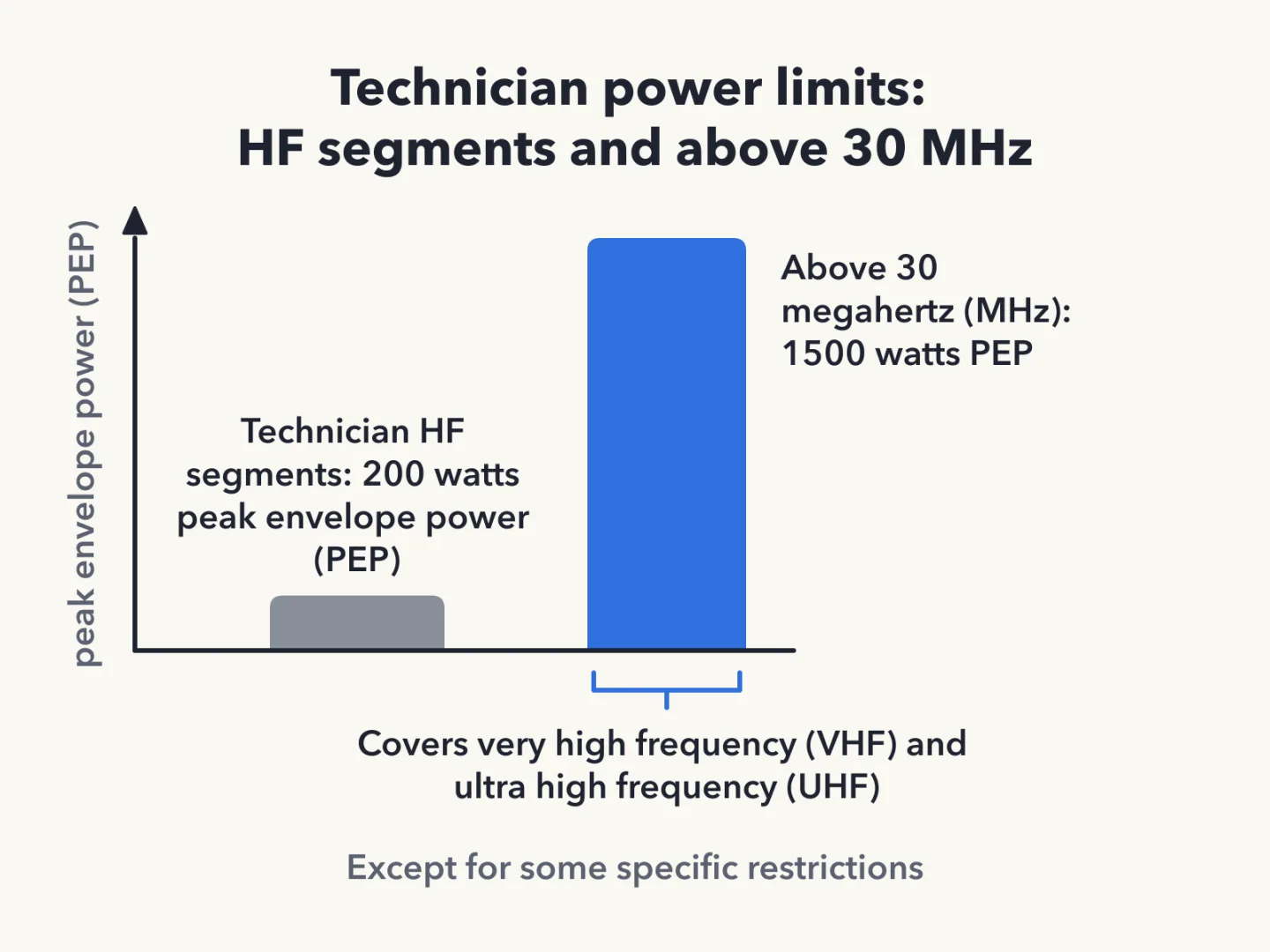
1500 Watts Above 30 MHz
Above 30 megahertz (MHz), Technicians may use up to 1500 watts of peak envelope power (PEP), except for some specific restrictions. This limit covers ultra high frequency (UHF) as well as very high frequency (VHF).
Classes Issued as of 2026
As of 2026, the Federal Communications Commission (FCC) issues new licenses only for Technician, General and Amateur Extra. No new license grant is issued for a Novice or Advanced Class operator/primary station.
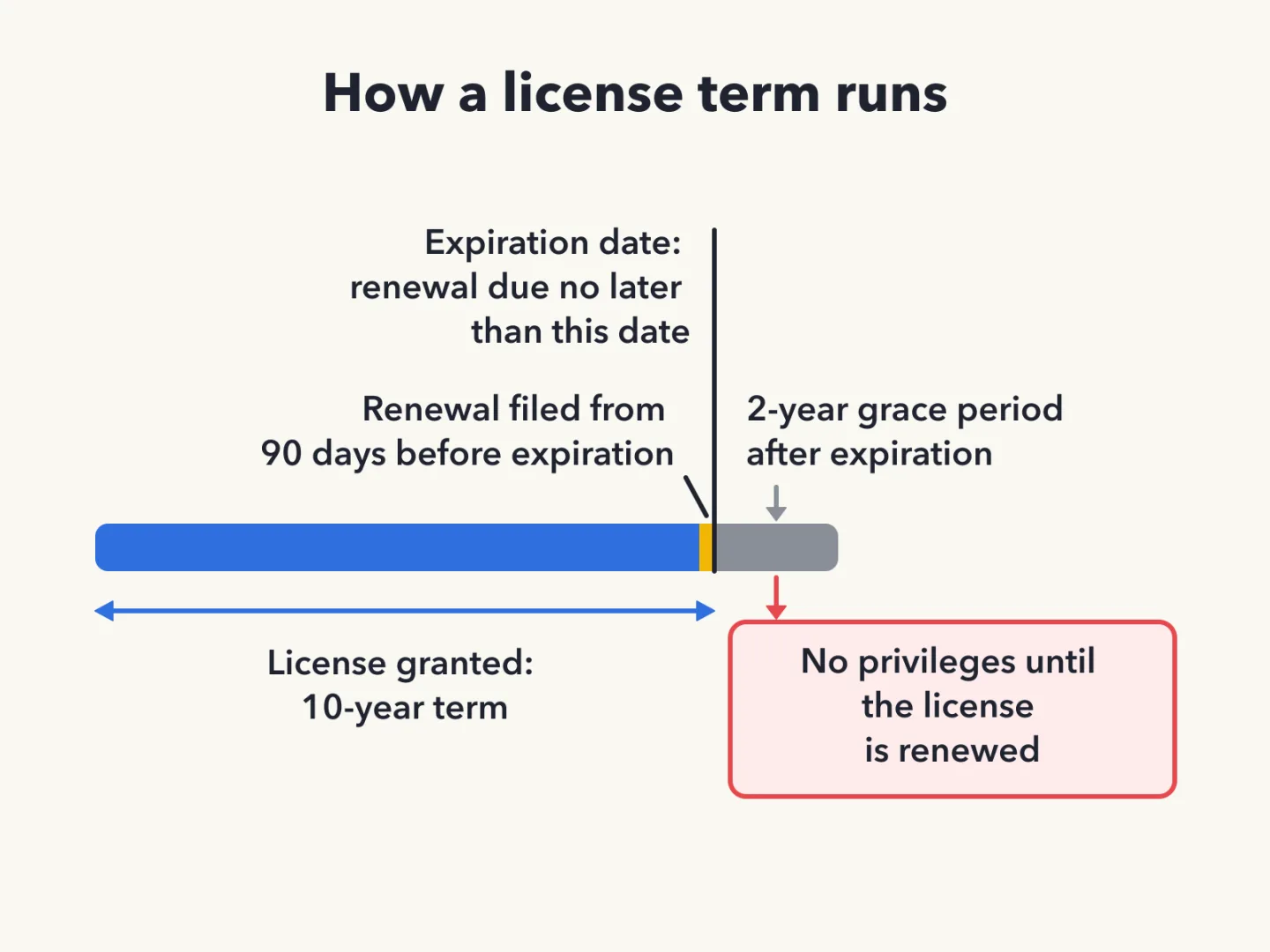
Ten-Year Term, 90-Day Window
An amateur service license is normally granted for a 10-year term. A renewal application must be filed no later than the expiration date and no sooner than 90 days before it.
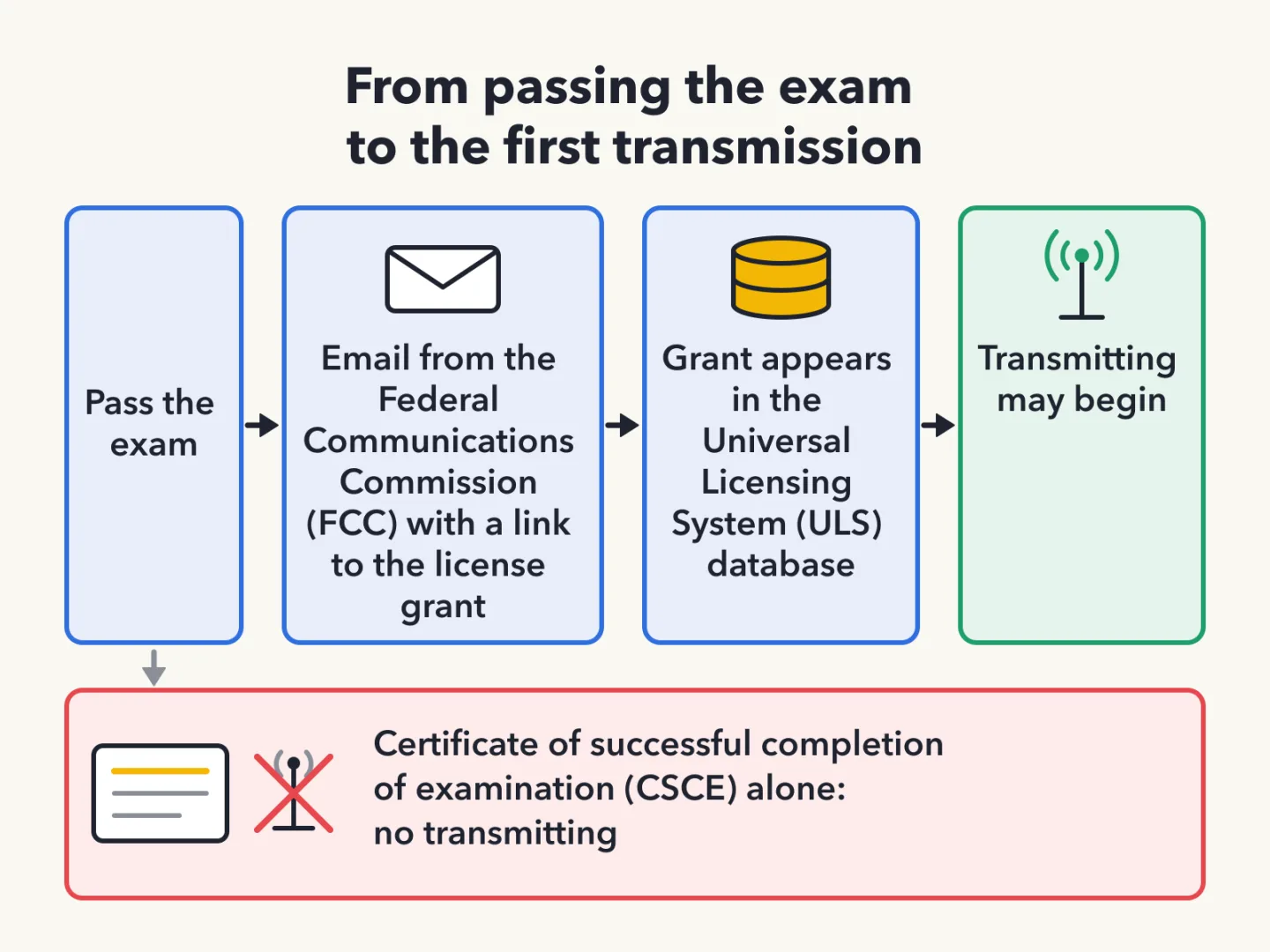
When Transmitting May Begin
A new licensee may transmit as soon as the license grant appears in the license database of the Federal Communications Commission (FCC).
No Operating in the Grace Period
An expired license can still be renewed during a 2-year grace period. No privileges are conferred until the grant is renewed, so a licensee whose license has expired may not transmit during the grace period.
Operating Aboard a Vessel
A licensee may operate from a US-documented vessel with the master's permission. Operation of an amateur station on a ship or aircraft must be approved by the ship's master or the aircraft's pilot in command.
Keep a Valid Email Address
Each license grant must show the grantee's correct name, mailing address and email address. If correspondence from the Federal Communications Commission (FCC) is returned undeliverable because of an incorrect email address, revocation of the station license or suspension of the operator license may result.
International Communications
Transmissions to a different country, where permitted, are limited to communications incidental to the purposes of the amateur service and to remarks of a personal character.
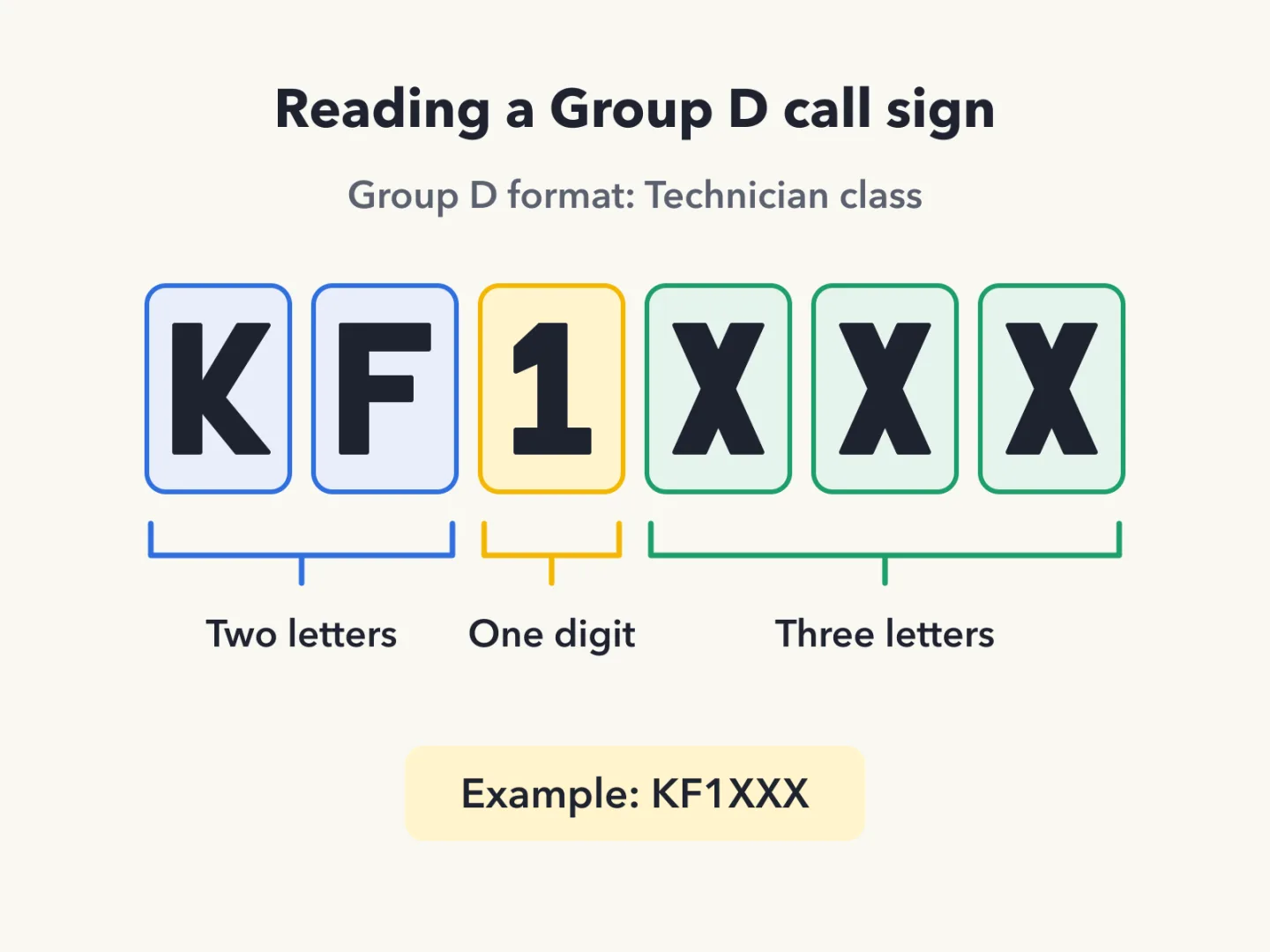
A Valid Group D Format
A valid Group D call sign format for a Technician class is KF1XXX: two letters, a digit and three letters.
Matched pairs
Each item on the left goes with the one on the right.
- Space station
- Station over 50 kilometers up
- 6 m segment limited to Morse code (CW)
- 50.0 to 50.1 megahertz
- Valid Group D format
- KF1XXX
Self-test
Answer each question from memory, then check your work against the answer key.
1. Which of the following is part of the Basis and Purpose of the Amateur Radio Service?
- AProviding communications for international contesting
- BAdvancing skills in the technical and communication phases of the radio art
- CAll these choices are correct
- DProviding personal radio communications for as many citizens as possible
2. Which agency regulates and enforces the rules for the Amateur Radio Service in the United States?
- AHomeland Security
- BAll these choices are correct
- CARRL
- DThe FCC
3. Which of the following is prohibited?
- AInternational communications on VHF bands and higher frequencies
- BThird-party traffic using digital modes
- CWillful or malicious interference
- DAll these choices are correct
4. What do the FCC rules state regarding the use of a phonetic alphabet for station identification in the Amateur Radio Service?
- AIt is encouraged when using phone emissions
- BIt is required when in contact with foreign stations
- CAll these choices are correct
- DIt is required when transmitting emergency messages
5. What is the FCC Part 97 definition of a space station?
- AAn amateur station using amateur radio satellites for relay of signals
- BAny satellite orbiting Earth
- CAn amateur station located more than 50 km above Earth's surface
- DA manned satellite orbiting Earth
6. How do you receive official notification of your new license and call sign after passing the exam?
- AUSPS First-Class Mail from the lead volunteer examiner
- BEmail from the FCC with a link to download the license grant
- CEmail from the lead volunteer examiner
- DUSPS First-Class Mail from the FCC
7. What proves that the FCC has issued an operator/primary license grant?
- AAll these choices are correct
- BA printed copy of the certificate of successful completion of examination
- CAn email notification from the NCVEC granting the license
- DThe license appears in the FCC ULS database
8. On which of the following HF frequencies can automatically controlled amateur propagation beacons be found?
- AOn ten meters, between 28.200 MHz and 28.300 MHz
- BIn a specific portion of each of the HF Technician bands
- CAnywhere, if they are registered with the FCC
- DAnywhere in the Technician portion of 10 meters
9. Who recommends transmit/receive channels for repeater and auxiliary stations?
- AA Frequency Spectrum Manager appointed by the FCC
- BAn FCC Regional Field Office
- CThe International Telecommunication Union
- DA Volunteer Frequency Coordinator recognized by local amateurs
10. Who selects a Frequency Coordinator?
- ALocal or regional amateurs whose stations are eligible as repeater or auxiliary stations
- BThe FCC Office of Spectrum Management and Coordination Policy
- CThe FCC Regional Field Office
- DThe local chapter of the Office of National Council of Independent Frequency Coordinators
11. Besides an FCC-issued amateur operator license, what is required to be the control operator of a Radio Amateur Civil Emergency Service (RACES) Station?
- AMembership in the Amateur Radio Emergency Service (ARES)
- BCertification of current enrollment by a civil defense organization
- CNothing
- DA written recommendation by the local ARRL Emergency Coordinator
12. Which frequency is in the 6-meter amateur band?
- A28.50 MHz
- B222.15 MHz
- C52.525 MHz
- D49.00 MHz
13. Which amateur band includes 146.52 MHz?
- A20 meters
- B2 meters
- C70 centimeters
- D6 meters
14. Which of the following frequency ranges are available for phone operation by Technician licensees?
- A28.300 MHz to 28.500 MHz
- B28.050 MHz to 28.150 MHz
- C28.100 MHz to 28.300 MHz
- D28.500 MHz to 28.600 MHz
15. On which HF bands does a Technician class operator have phone privileges?
- A30-meter band only
- B80-meter, 40-meter, 15-meter, and 10-meter bands
- CNone
- D10-meter band only
16. Which of the following bands include frequencies where Technicians are authorized to use digital modes such as FT8?
- A10 meters
- B2 meters
- CAll these choices are correct
- D6 meters
17. Which of the following U.S. amateur radio operators are allowed to contact the International Space Station (ISS) on VHF bands?
- AAny amateur with a Technician class or higher license
- BOnly amateurs with a General class or higher license
- CAny amateurs with a Technician class or higher license, and NASA approval
- DOnly amateurs with a General class or higher license, and NASA approval
18. Which of the following VHF/UHF band segments are limited to CW only?
- A902.0 MHz to 902.1 MHz
- BAll these choices are correct
- C219 MHz to 220 MHz and 420.0 MHz to 420.1 MHz
- D50.0 MHz to 50.1 MHz and 144.0 MHz to 144.1 MHz
19. Where may SSB phone be used in amateur bands above 50 MHz?
- AOn any band if the power is limited to 25 watts
- BIn at least some segment of all these bands
- COnly on repeaters
- DOnly in sub-bands allocated to General class or higher licensees
20. How are US amateurs restricted in segments of bands where the Amateur Radio Service is secondary?
- ADigital transmissions are not permitted in those segments
- BInternational communications are not permitted in those segments
- CU.S. amateurs may find non-amateur stations there and must avoid interfering with them
- DU.S. amateurs must give foreign amateur stations priority in those segments
21. Why should you not set your transmit frequency to be exactly at the edge of an amateur band or sub-band?
- ATo allow for transmitter frequency drift
- BSo that modulation sidebands do not extend beyond the band edge
- CAll these choices are correct
- DTo allow for calibration error in the transmitter frequency display
22. What is the maximum peak envelope power output for Technician class operators in their HF band segments?
- A50 watts
- B100 watts
- C10 watts
- D200 watts
23. Except for some specific restrictions, what is the maximum peak envelope power output for Technician class operators using frequencies above 30 MHz?
- A1500 watts
- B50 watts
- C100 watts
- D500 watts
24. For which classes of amateur radio licenses does the FCC currently issue new licenses?
- ANovice, Technician, General, Amateur Extra
- BTechnician, General, Amateur Extra
- CNovice, Technician Plus, General, Advanced
- DTechnician, Technician Plus, General, Amateur Extra
25. Who may select a desired call sign under the vanity call sign rules?
- AOnly a licensed amateur with an Amateur Extra Class license
- BOnly a licensed amateur who has been licensed continuously for more than 10 years
- CAny licensed amateur
- DOnly a licensed amateur with a General or Amateur Extra Class license
26. Which of the following is a valid Group D call sign format for Technician class?
- AKF1XXX
- BKA1X
- CAll these choices are correct
- DW1XX
27. What types of international communications are FCC-licensed amateur radio stations permitted to make?
- AAny communications that would be permitted by an international broadcast station
- BCommunications incidental to amateur radio purposes and remarks of a personal character
- CCommunications incidental to conducting business or remarks of a personal nature
- DOnly communications incidental to contest exchanges; all others are prohibited
28. Which of the following statements is true about using your amateur radio license when operating aboard a vessel or craft in international waters?
- AYou need special FCC authorization for maritime mobile operation
- BYou may only operate during maritime emergencies
- CAmateur operation is prohibited in international waters
- DYou may operate from a US-documented vessel with the master's permission
29. How soon after passing the examination for your first amateur radio license may you transmit on the amateur radio bands?
- AImmediately on receiving your Certificate of Successful Completion of Examination (CSCE)
- BAs soon as your operator/station license grant appears in the FCC’s license database
- CAs soon as you receive your license in the mail from the FCC
- DAs soon as your operator/station license grant appears on the ARRL website
30. What is the normal term for an FCC-issued amateur radio license?
- AFive years
- BEight years
- CLife
- DTen years
31. How long before the expiration date may an amateur radio license renewal be requested?
- A30 days
- B1 year
- C90 days
- D6 months
32. What is the grace period for renewal if an amateur license expires?
- ATwo years
- BTen years
- CFive years
- DThree years
33. If your license has expired and is still within the allowable grace period, may you continue to transmit on the amateur radio bands?
- AYes, for up to two years
- BYes, as soon as you apply for renewal
- CNo, you must wait until the license has been renewed
- DYes, for up to one year
34. What may happen if the FCC is unable to reach you by email?
- ARevocation of the station license or suspension of the operator license
- BRevocation of access to the license record in the FCC system
- CFine and suspension of operator license
- DNothing; there is no such requirement
Go deeper
- ListenLesson 1 episode
- WatchTechnician Phone on High Frequency A Technician can use high frequency (HF) radio on a few segments. But how many of those bands allow phone?
- WatchExpired License and the Grace Period Your amateur radio license expired yesterday. Can you still transmit while you renew it?
- StudyHam Radio Technician License in the FlashFeed app
Answer key
- 1. B Advancing skills in the technical and communication phases of the radio artAdvancing skills in the technical and communication phases of the radio art is one of the service's stated principles. The other options are not among them.
- 2. D The FCCThe Federal Communications Commission (FCC) regulates and enforces the amateur rules. Homeland Security does not. ARRL stands for American Radio Relay League.
- 3. C Willful or malicious interferenceWillful or malicious interference with any radio communication or signal is prohibited. VHF stands for very high frequency.
- 4. A It is encouraged when using phone emissionsA phonetic alphabet is encouraged on phone to aid correct identification. It is not required for emergency messages or foreign contacts. FCC stands for Federal Communications Commission.
- 5. C An amateur station located more than 50 km above Earth's surfaceHeight decides it: a space station is an amateur station more than 50 km above Earth's surface. FCC stands for Federal Communications Commission.
- 6. B Email from the FCC with a link to download the license grantThe official notice is a Federal Communications Commission (FCC) email with a link to download the license grant. USPS stands for United States Postal Service.
- 7. D The license appears in the FCC ULS databaseThe license appearing in the Universal Licensing System (ULS) database proves the grant. A printed examination certificate does not. FCC stands for Federal Communications Commission and NCVEC stands for National Conference of Volunteer Examiner Coordinators.
- 8. A On ten meters, between 28.200 MHz and 28.300 MHzAutomatically controlled propagation beacons are on ten meters, 28.200 to 28.300 MHz. HF stands for high frequency and FCC stands for Federal Communications Commission.
- 9. D A Volunteer Frequency Coordinator recognized by local amateursA Volunteer Frequency Coordinator recognized by local amateurs recommends repeater and auxiliary channels, not the Federal Communications Commission (FCC).
- 10. A Local or regional amateurs whose stations are eligible as repeater or auxiliary stationsAmateur operators in the local or regional area whose stations are eligible to be repeater or auxiliary stations select the coordinator. FCC stands for Federal Communications Commission.
- 11. B Certification of current enrollment by a civil defense organizationA RACES control operator needs a Federal Communications Commission (FCC) amateur license plus civil defense certification of current enrollment. ARRL stands for American Radio Relay League.
- 12. C 52.525 MHzThe 6-meter band spans 50-54 MHz, so 52.525 MHz is in it.
- 13. B 2 metersThe 2-meter band spans 144-148 MHz and includes 146.52 MHz.
- 14. A 28.300 MHz to 28.500 MHzThe Technician phone range on 10 meters is 28.300 to 28.500 MHz. Ranges starting lower or ending higher are not it.
- 15. D 10-meter band onlyTechnician high frequency (HF) phone privileges are on the 10-meter band only, not on 80, 40 or 15 meters.
- 16. C All these choices are correctTechnicians may use digital modes such as FT8 on 10 meters, 6 meters and 2 meters, so all three are correct.
- 17. A Any amateur with a Technician class or higher licenseAny Technician or higher licensee may contact the ISS on very high frequency (VHF) bands. No General license or NASA approval is needed.
- 18. D 50.0 MHz to 50.1 MHz and 144.0 MHz to 144.1 MHz50.0 to 50.1 MHz and 144.0 to 144.1 MHz are the segments for continuous wave (CW) only. The other ranges listed are not.
- 19. B In at least some segment of all these bandsSingle sideband (SSB) phone may be used in at least some segment of every amateur band above 50 MHz.
- 20. C U.S. amateurs may find non-amateur stations there and must avoid interfering with themWhere amateur service is secondary, amateurs may find non-amateur stations and must avoid interfering with them.
- 21. C All these choices are correctDisplay calibration error, sidebands past the edge and frequency drift are all reasons to stay off the band edge.
- 22. D 200 wattsIn their high frequency (HF) segments, Technician operators may not exceed 200 watts peak envelope power (PEP).
- 23. A 1500 wattsAbove 30 MHz, Technicians may use up to 1500 watts peak envelope power (PEP), except for specific restrictions.
- 24. B Technician, General, Amateur ExtraAs of 2026, the Federal Communications Commission (FCC) issues new licenses only for Technician, General and Amateur Extra; no new Novice or Advanced grants are issued.
- 25. C Any licensed amateurAny licensed amateur may select a call sign under the vanity rules, whatever the class.
- 26. A KF1XXXKF1XXX, two letters, a digit and three letters, is a valid Group D format for a Technician. KA1X and W1XX are not.
- 27. B Communications incidental to amateur radio purposes and remarks of a personal characterInternational transmissions are limited to communications incidental to the purposes of the service and personal remarks. FCC stands for Federal Communications Commission.
- 28. D You may operate from a US-documented vessel with the master's permissionA licensee may operate from a US-documented vessel with the master's permission. No special Federal Communications Commission (FCC) authorization is needed.
- 29. B As soon as your operator/station license grant appears in the FCC’s license databaseA new licensee may transmit once the grant appears in the license database of the Federal Communications Commission (FCC), not on holding a CSCE or receiving mail. ARRL stands for American Radio Relay League.
- 30. D Ten yearsAn amateur license is normally granted for a 10-year term. FCC stands for Federal Communications Commission.
- 31. C 90 daysRenewal may be requested no sooner than 90 days before the expiration date.
- 32. A Two yearsAn expired license can be renewed during a 2-year grace period, provided the application is received before it ends.
- 33. C No, you must wait until the license has been renewedNo privileges are conferred until the license is renewed, so transmitting is not allowed during the grace period.
- 34. A Revocation of the station license or suspension of the operator licenseIf Federal Communications Commission (FCC) mail is returned undeliverable because of a wrong email address, the station license may be revoked or the operator license suspended.
Sources
- NCVEC Question Pool Committee — 2026–2030 Technician question pool; NCVEC Question Pool Committee — 2026–2030 Technician question pool (T1C07, T1C08); 47 CFR § 97.25, § 1.949 — ncvec.org/index.php/2026-2030-technician-question-pool
- FCC — 47 CFR § 97.119 Station identification — www.ecfr.gov/current/title-47/section-97.119
- FCC — 47 CFR § 97.203 Beacon station — www.ecfr.gov/current/title-47/section-97.203
- FCC — 47 CFR § 97.3 Definitions — www.ecfr.gov/current/title-47/section-97.3
- FCC — 47 CFR § 97.1 Basis and purpose — www.ecfr.gov/current/title-47/section-97.1
- FCC — 47 CFR § 97.407 Radio amateur civil emergency service — www.ecfr.gov/current/title-47/section-97.407
- FCC — 47 CFR § 97.101 General standards — www.ecfr.gov/current/title-47/section-97.101
- FCC — 47 CFR § 97.301 Authorized frequency bands — www.ecfr.gov/current/title-47/section-97.301
- FCC — 47 CFR § 97.313 Transmitter power standards — www.ecfr.gov/current/title-47/section-97.313
- FCC — 47 CFR § 97.305 Authorized emission types — www.ecfr.gov/current/title-47/section-97.305
- FCC — 47 CFR § 97.303 Frequency sharing requirements — www.ecfr.gov/current/title-47/section-97.303
- FCC — 47 CFR § 97.17 Application for new license grant — www.ecfr.gov/current/title-47/section-97.17
- FCC — 47 CFR § 97.5 Station license required — www.ecfr.gov/current/title-47/section-97.5
- FCC — 47 CFR § 97.21 Application for a modified or renewed license grant — www.ecfr.gov/current/title-47/section-97.21
- FCC — 47 CFR § 97.19 Application for a vanity call sign — www.ecfr.gov/current/title-47/section-97.19
- FCC — 47 CFR § 97.25 License term — www.ecfr.gov/current/title-47/section-97.25
- FCC — 47 CFR § 1.949 Application for renewal of authorization — www.ecfr.gov/current/title-47/section-1.949
- FCC — 47 CFR § 97.11 Stations aboard ships or aircraft — www.ecfr.gov/current/title-47/section-97.11
- FCC — 47 CFR § 97.23 Mailing and email addresses — www.ecfr.gov/current/title-47/section-97.23
- FCC — 47 CFR § 97.117 International communications — www.ecfr.gov/current/title-47/section-97.117
Image credits
- Beacons on Ten Meters: FlashFeed original diagram · CC-BY-4.0
- Who Picks Repeater Channels: FlashFeed original diagram · CC-BY-4.0
- What Is a Space Station: FlashFeed original diagram · CC-BY-4.0
- HF Phone Only on 10 Meters: FlashFeed original diagram · CC-BY-4.0
- The 6-Meter and 2-Meter Bands: FlashFeed original diagram · CC-BY-4.0
- Contacting the Space Station: Wikimedia Commons · NASA Johnson Space Center · Public domain — commons.wikimedia.org/wiki/File:Thomas_Pesquet_and_Amateur_Radio_on_ISS_(ARISS)_(iss066e031742).jpg
- CW-Only Segments: FlashFeed original diagram · CC-BY-4.0
- Stay Off the Band Edge: FlashFeed original diagram · CC-BY-4.0
- 1500 Watts Above 30 MHz: FlashFeed original diagram · CC-BY-4.0
- Ten-Year Term, 90-Day Window: FlashFeed original diagram · CC-BY-4.0
- When Transmitting May Begin: FlashFeed original diagram · CC-BY-4.0
- A Valid Group D Format: FlashFeed original diagram · CC-BY-4.0
