
Ham Radio Technician License study guide · Lesson 12 of 15
Signals and Emissions: Modes and Satellites
Modulation modes and bandwidth · Amateur satellite operation
This is the lesson's study guide from the FlashFeed app, plus its key facts and a self-test.
What you'll be able to do
- Identify the modulation used for SSB, FM, packet and repeaters, the sideband for weak-signal VHF and UHF work, and how SSB compares with FM
- Compare the bandwidths of CW, SSB, FM voice and fast-scan TV, and name a disadvantage of FM versus SSB
- Explain what satellite beacons, telemetry and tracking programs provide, and how to set uplink power properly
- Describe satellite modes, bands, orbits, Doppler shift and spin fading, and who may receive telemetry
A new licensee has several ways to put a voice or data signal on the air, and each suits a different job. This lesson covers which type of signal fits repeaters, packet radio and long-distance work. It also covers how much room each signal takes on a band. The second half turns to amateur satellites: what they send, how operators track them, and how to use them without crowding out other stations.
Modulation modes and bandwidth
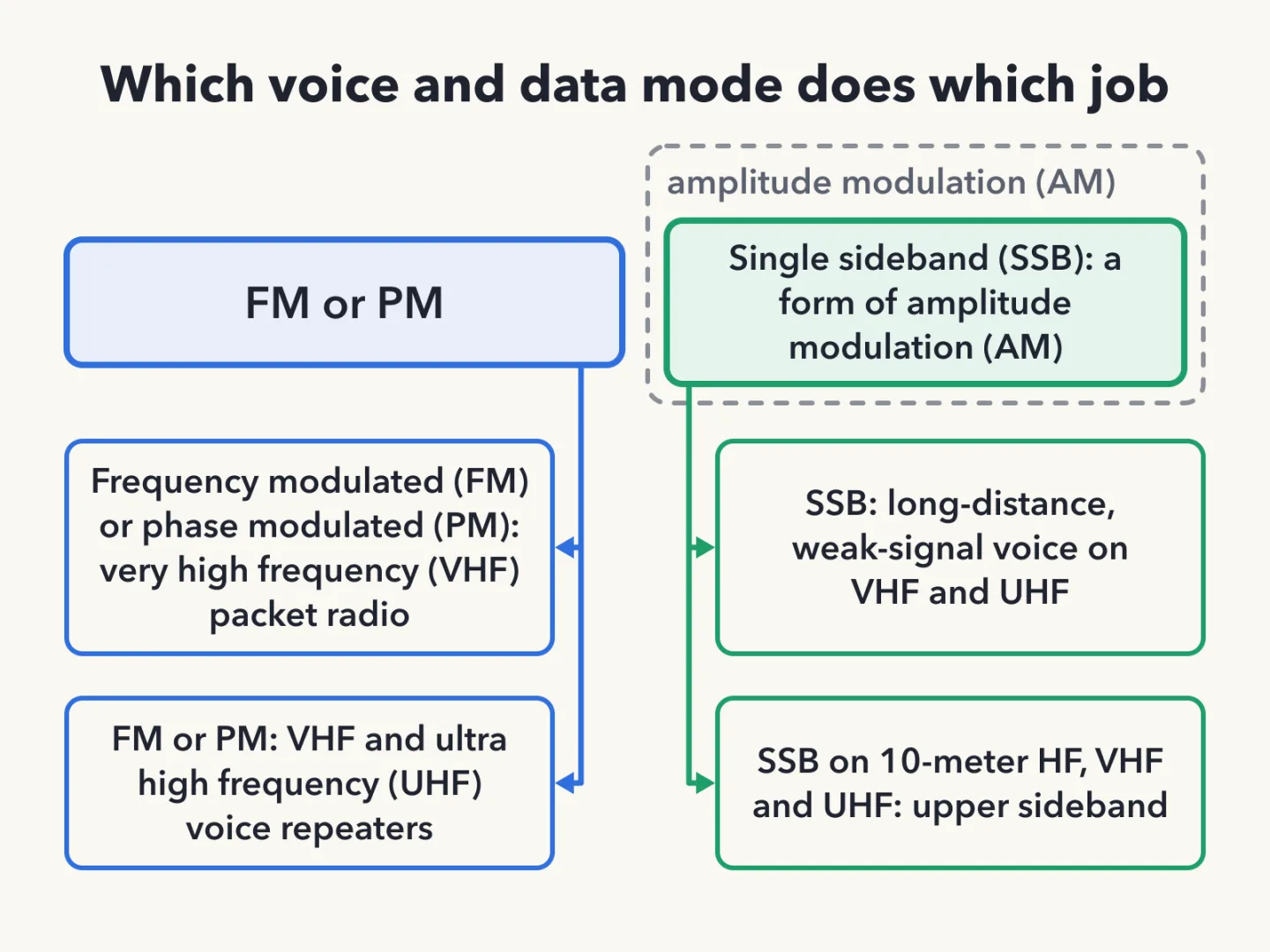
Single sideband (SSB) is a form of amplitude modulated (AM) signal.
Frequency modulated (FM) is paired here with phase modulated (PM). FM or PM is the type of modulation commonly used for two jobs. One is very high frequency (VHF) packet radio. The other is VHF and ultra high frequency (UHF) voice repeaters.
SSB is the voice mode often used for long-distance, weak-signal contacts on the VHF and UHF bands. A licensee chasing a distant station on VHF or UHF therefore turns to SSB. The same licensee uses FM or PM for a local repeater.
Upper sideband is the one normally used for SSB communications on 10-meter high frequency (HF), VHF and UHF.
Why SSB differs from FM
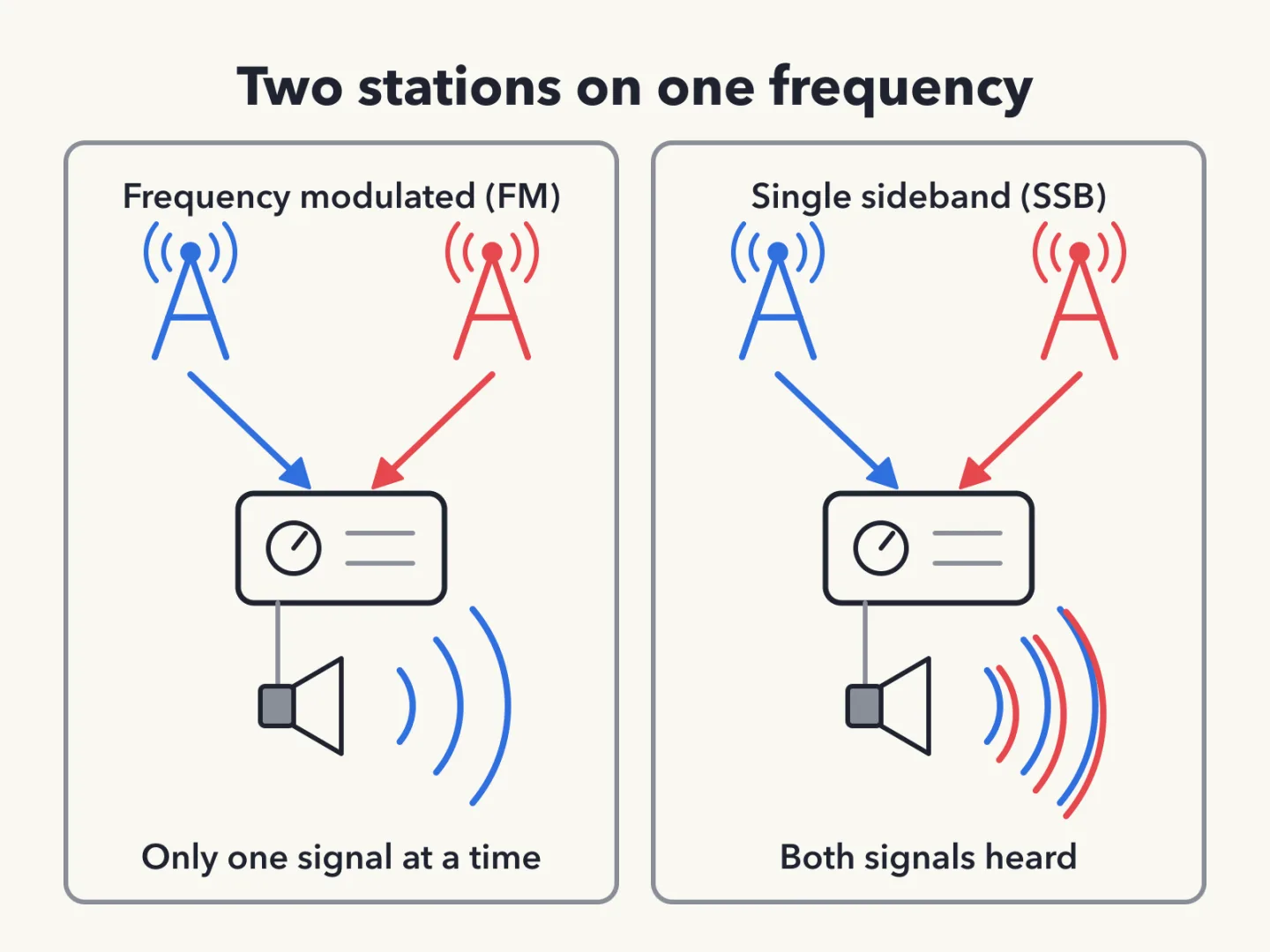
One characteristic of SSB compared to FM is that SSB signals have narrower bandwidth. Bandwidth, taught in an earlier lesson, is the measure compared here. FM has a matching disadvantage compared with single sideband: only one signal can be received at a time.
Comparing bandwidths
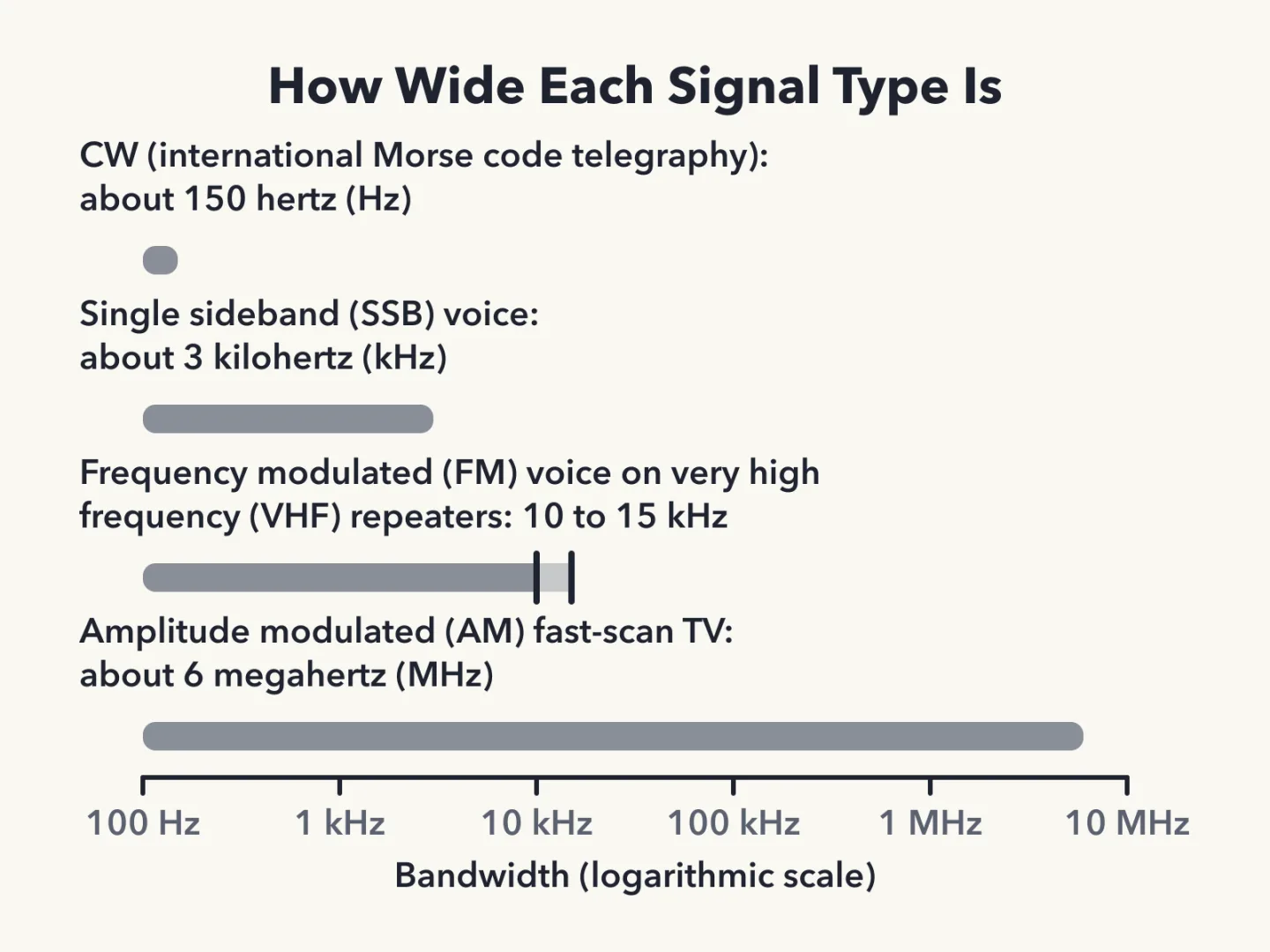
The approximate bandwidths below run from the narrowest signal to the widest.
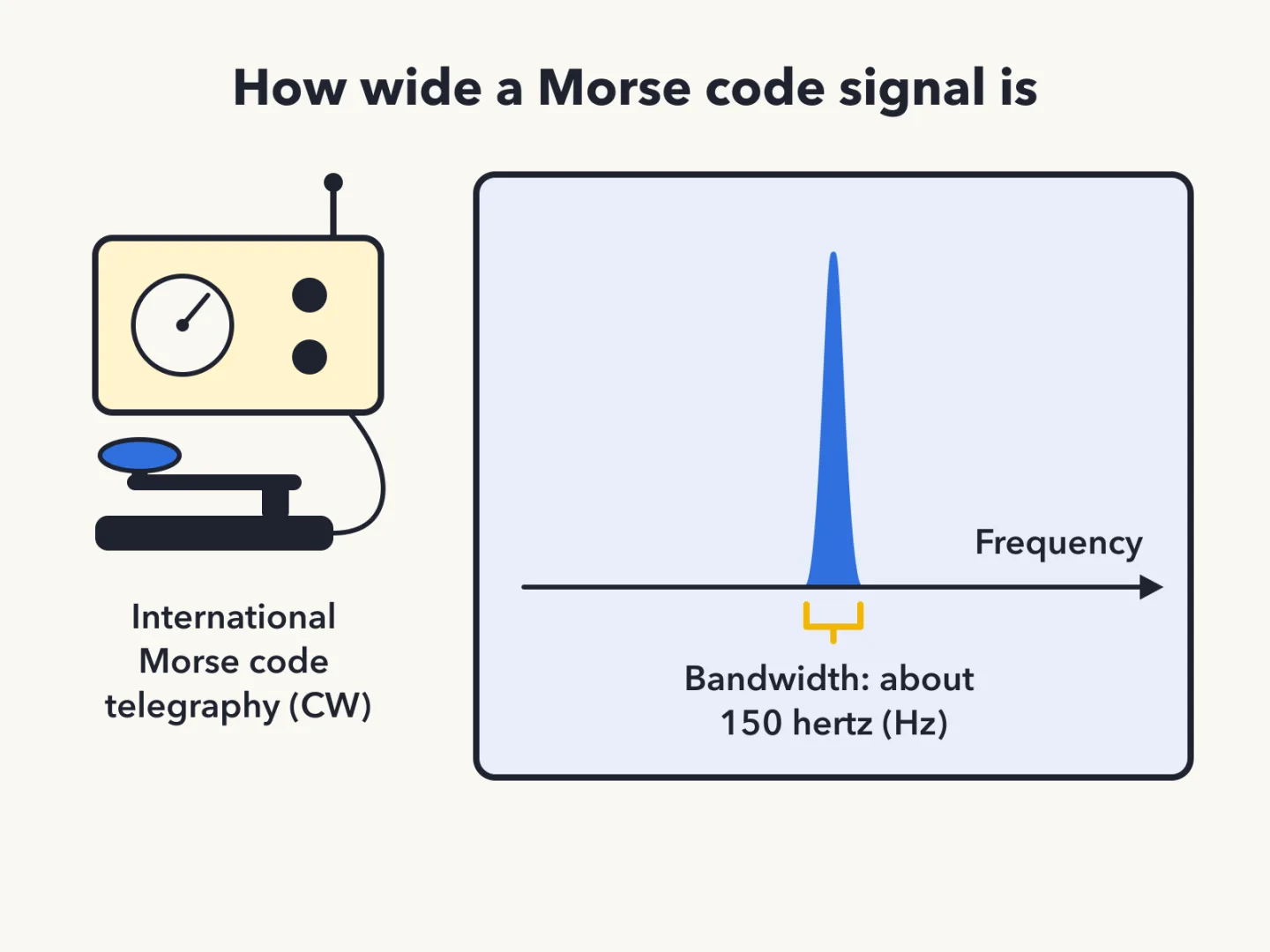
- International Morse code telegraphy (CW) needs about 150 hertz (Hz). CW is international Morse code telegraphy, and it has the narrowest bandwidth of the signal types compared.
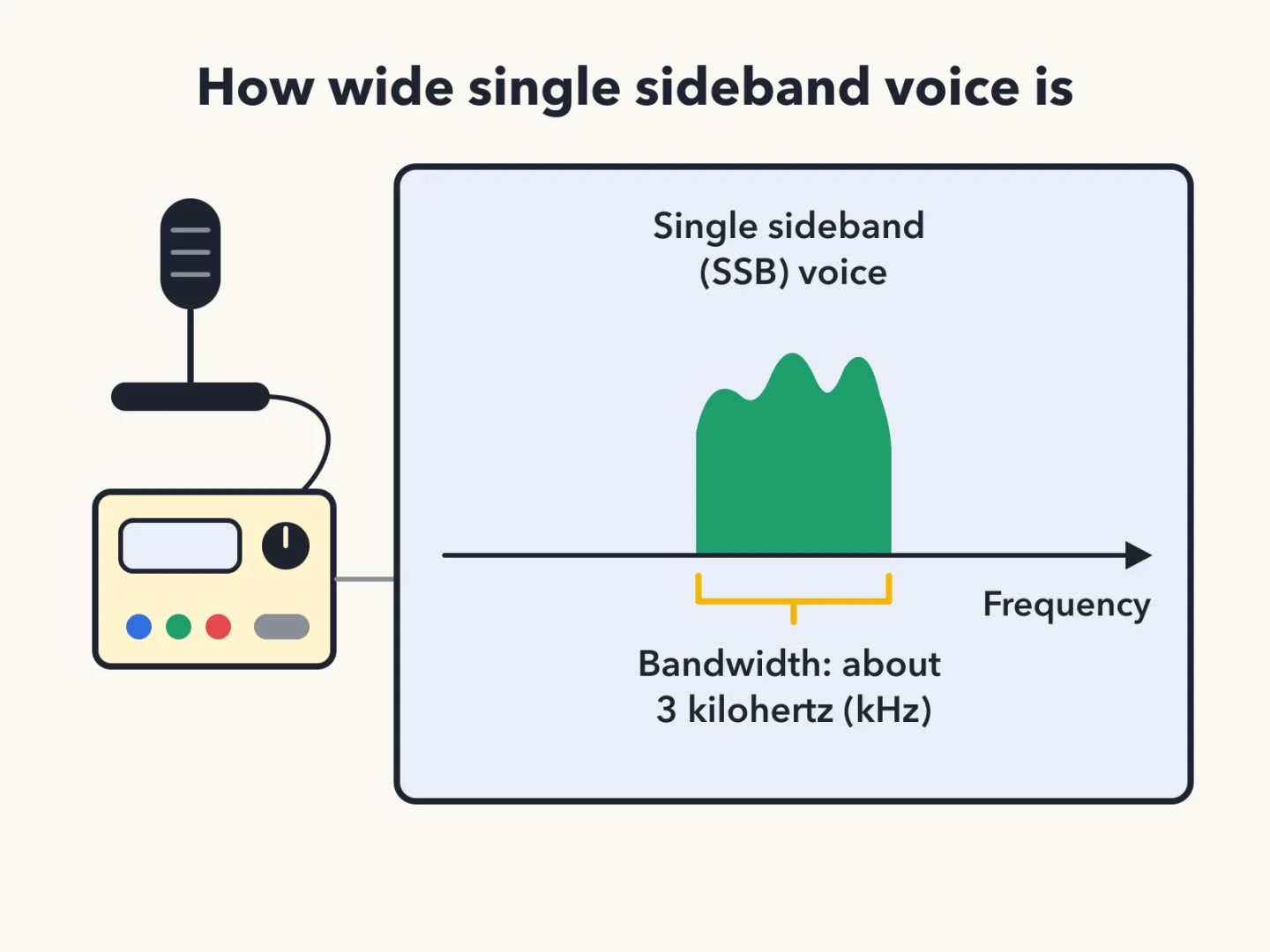
- A typical SSB voice signal is about 3 kilohertz (kHz) wide.
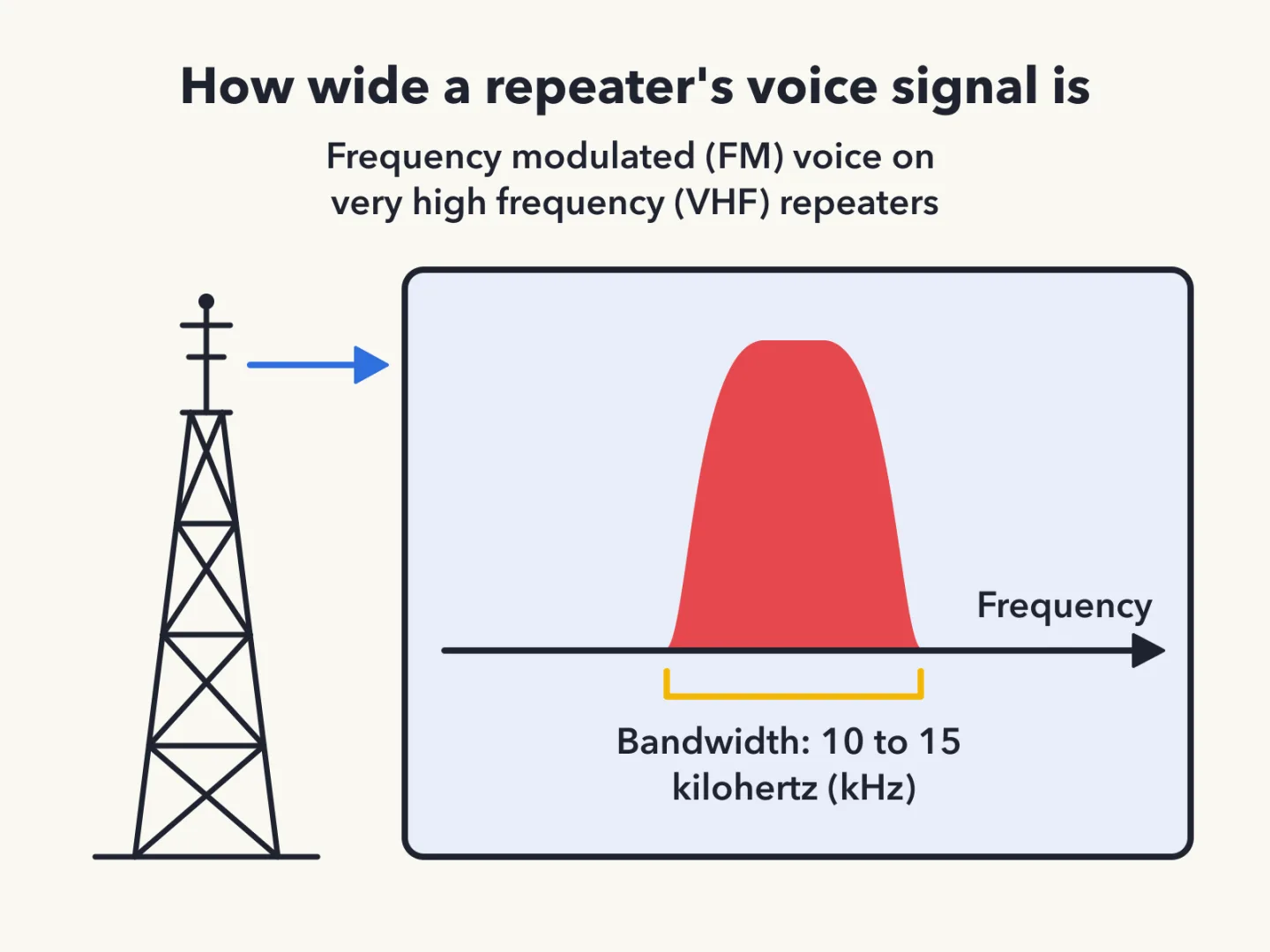
- An FM voice signal on VHF repeaters is between 10 and 15 kHz wide.
- AM fast-scan TV transmissions are about 6 megahertz (MHz) wide.
These figures show why SSB is called narrower than FM: a typical SSB voice signal is about 3 kHz wide, while FM voice on repeaters is 10 to 15 kHz.
Sources
Amateur satellite operation
Amateur radio satellites carry their own transmitters, and many operators work them from the ground. The Federal Communications Commission (FCC) defines an Earth station as an amateur station located on, or within 50 km of, the Earth's surface. It is intended for communications with space stations, or with other Earth stations by means of one or more other objects in space.
Beacons and telemetry
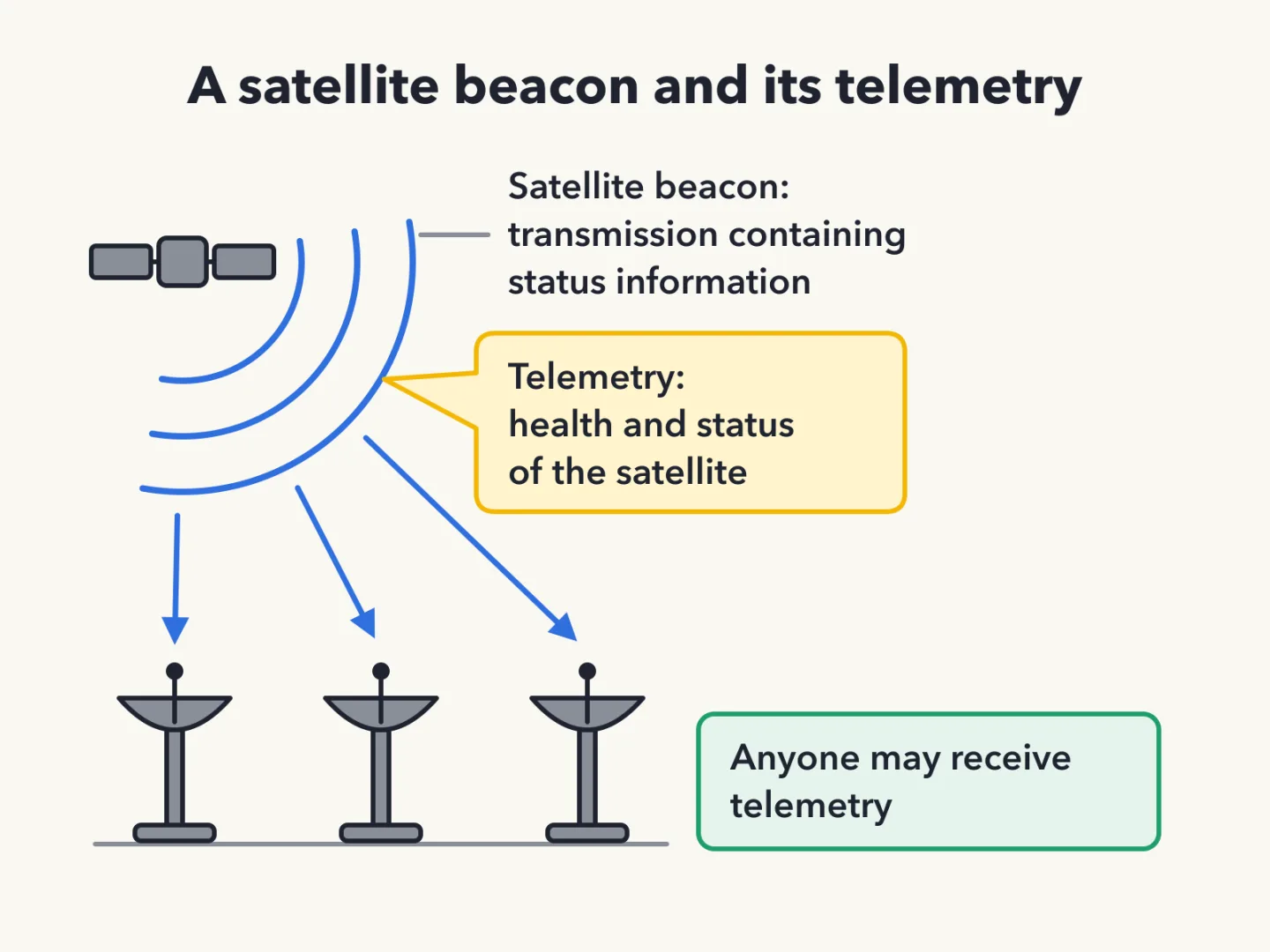
A satellite beacon is a transmission from a satellite that contains status information. The telemetry that beacons typically send is the health and status of the satellite. Anyone is permitted to receive telemetry from an amateur radio satellite.
Doppler shift and spin fading
Doppler shift is an observed change in signal frequency caused by relative motion between the satellite and the Earth station.
Spin fading of satellite signals is caused by rotation of the satellite and its antennas. It is a separate effect from Doppler shift, which comes from relative motion.
Tracking programs
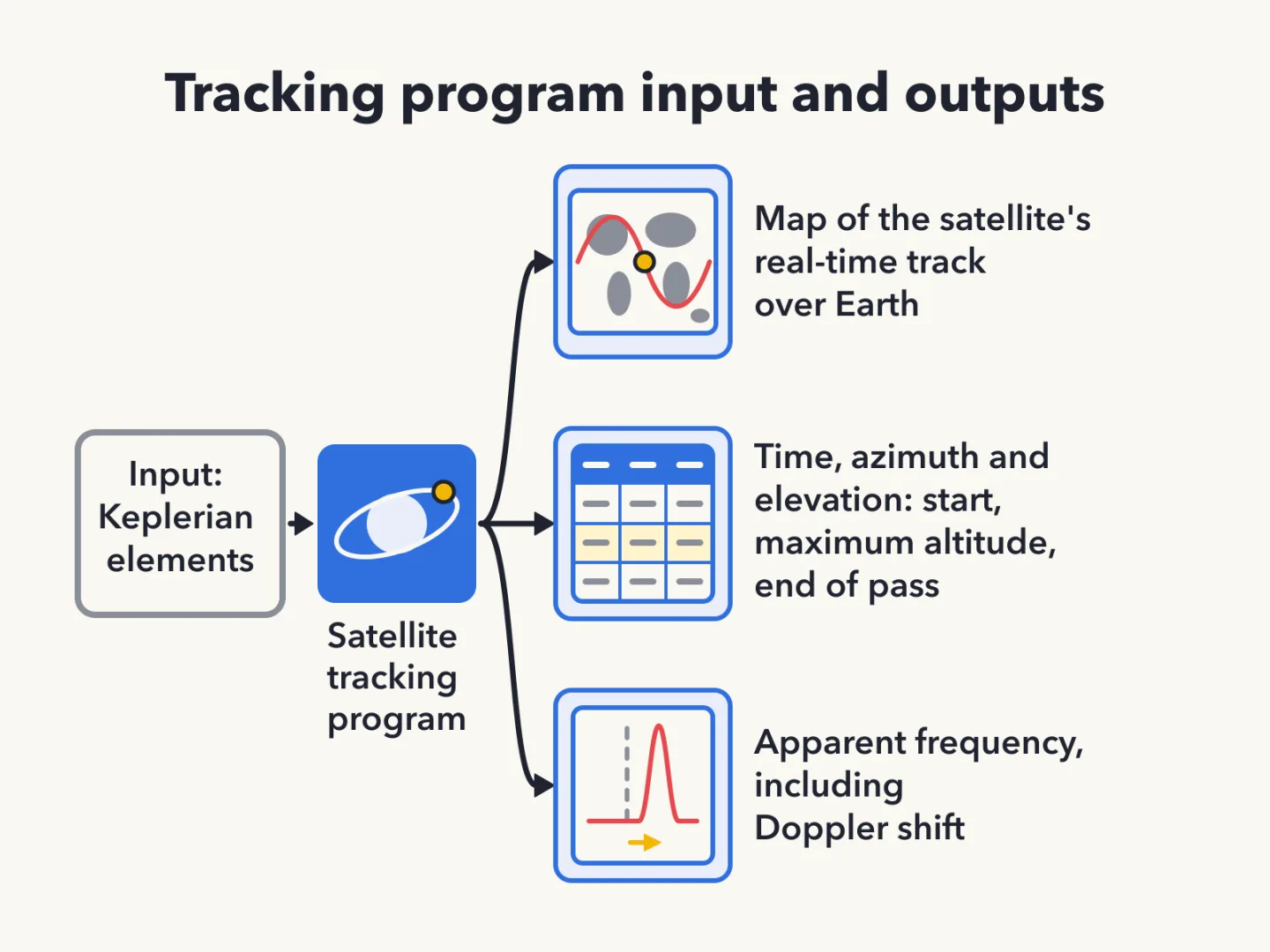
Satellite tracking programs take the Keplerian elements as their input. In return, a tracking program provides all of the following:
- maps showing the real-time position of the satellite track over Earth;
- the time, azimuth and elevation of the start, maximum altitude and end of a pass;
- the apparent frequency of the satellite transmission, including the effects of Doppler shift.
This is why a tracking program shows an apparent frequency rather than a fixed one.
Modes, bands and orbits
Amateur radio satellites commonly use SSB, FM and CW/data.
A satellite operating in U/V mode has its uplink in the 70-centimeter band and its downlink in the 2-meter band.
A Low Earth Orbit (LEO) has a period of around 100 minutes.
Setting uplink power
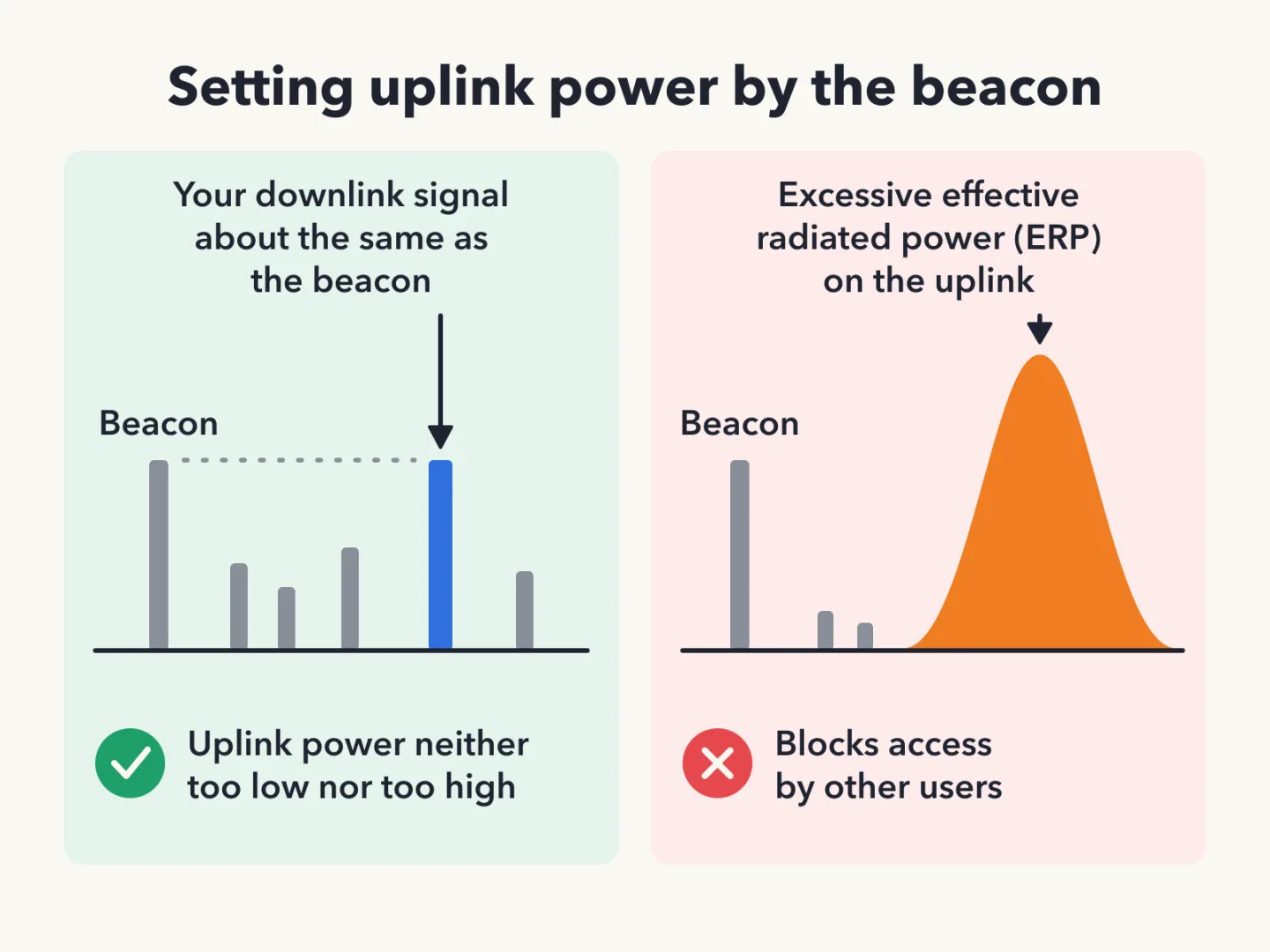
A satellite uplink can be overdriven. Using excessive effective radiated power (ERP) on a satellite uplink blocks access by other users.
ERP is the product of the power supplied to the antenna and its gain relative to a half-wave dipole in a given direction. Multiplying ERP by 1.64 converts it to equivalent isotropically radiated power (EIRP). A stronger antenna gain raises ERP just as more transmitter power does.
For a linear transponder satellite, the uplink power is neither too low nor too high when the operator's signal strength on the downlink is about the same as the beacon. Together these points give the order of a pass. The operator loads the Keplerian elements into a tracking program and reads the pass times. During the pass the operator expects Doppler shift and spin fading. The operator sets uplink power by matching the downlink signal to the beacon, so other users keep their access.
Sources
Key terms
- Earth station
- An amateur station on, or within 50 km of, Earth's surface, intended for communications with space stations or with other such stations via objects in space
- ERP
- Effective radiated power: the power supplied to the antenna times its gain relative to a half-wave dipole in a given direction
Key facts
SSB Is Amplitude Modulation
Single sideband (SSB) is a form of amplitude modulation (AM).
FM or PM for Packet and Repeaters
FM or PM is the modulation commonly used for two jobs: very high frequency (VHF) packet radio, and VHF and ultra high frequency (UHF) voice repeaters. Here FM means frequency modulated and PM means phase modulated.
SSB for Weak-Signal Contacts
Single sideband (SSB) is the voice mode often used for long-distance, weak-signal contacts on the very high frequency (VHF) and ultra high frequency (UHF) bands.
Upper Sideband Is the Norm
Upper sideband is normally used for single sideband (SSB) communications on 10-meter high frequency (HF), very high frequency (VHF) and ultra high frequency (UHF).
SSB Is Narrower Than FM
Compared with frequency modulated (FM) signals, single sideband (SSB) signals have narrower bandwidth.
The Drawback of FM
A disadvantage of frequency modulated (FM) compared with single sideband is that only one signal can be received at a time.
CW Is the Narrowest Signal
International Morse code telegraphy (CW) has the narrowest bandwidth of the signal types compared.
CW Bandwidth: About 150 Hz
An international Morse code telegraphy (CW) signal needs about 150 hertz (Hz) of bandwidth.
SSB Voice Is About 3 kHz
A typical single sideband (SSB) voice signal is about 3 kilohertz (kHz) wide.
FM Repeater Voice Is 10–15 kHz
A frequency modulated (FM) voice signal on very high frequency (VHF) repeaters is between 10 and 15 kilohertz (kHz) wide.
Fast-Scan TV Is About 6 MHz
Amplitude modulated (AM) fast-scan TV transmissions are about 6 megahertz (MHz) wide.
What Beacons Send
The telemetry that satellite beacons typically send is the health and status of the satellite.
A Satellite Beacon Defined
A satellite beacon is a transmission from a satellite that contains status information.
What Tracking Programs Provide
A satellite tracking program provides all of these: maps showing the real-time position of the satellite track over Earth; the time, azimuth and elevation of the start, maximum altitude and end of a pass; and the apparent frequency of the transmission, including Doppler shift effects.
Keplerian Elements Feed Trackers
Satellite tracking programs take the Keplerian elements as their input.
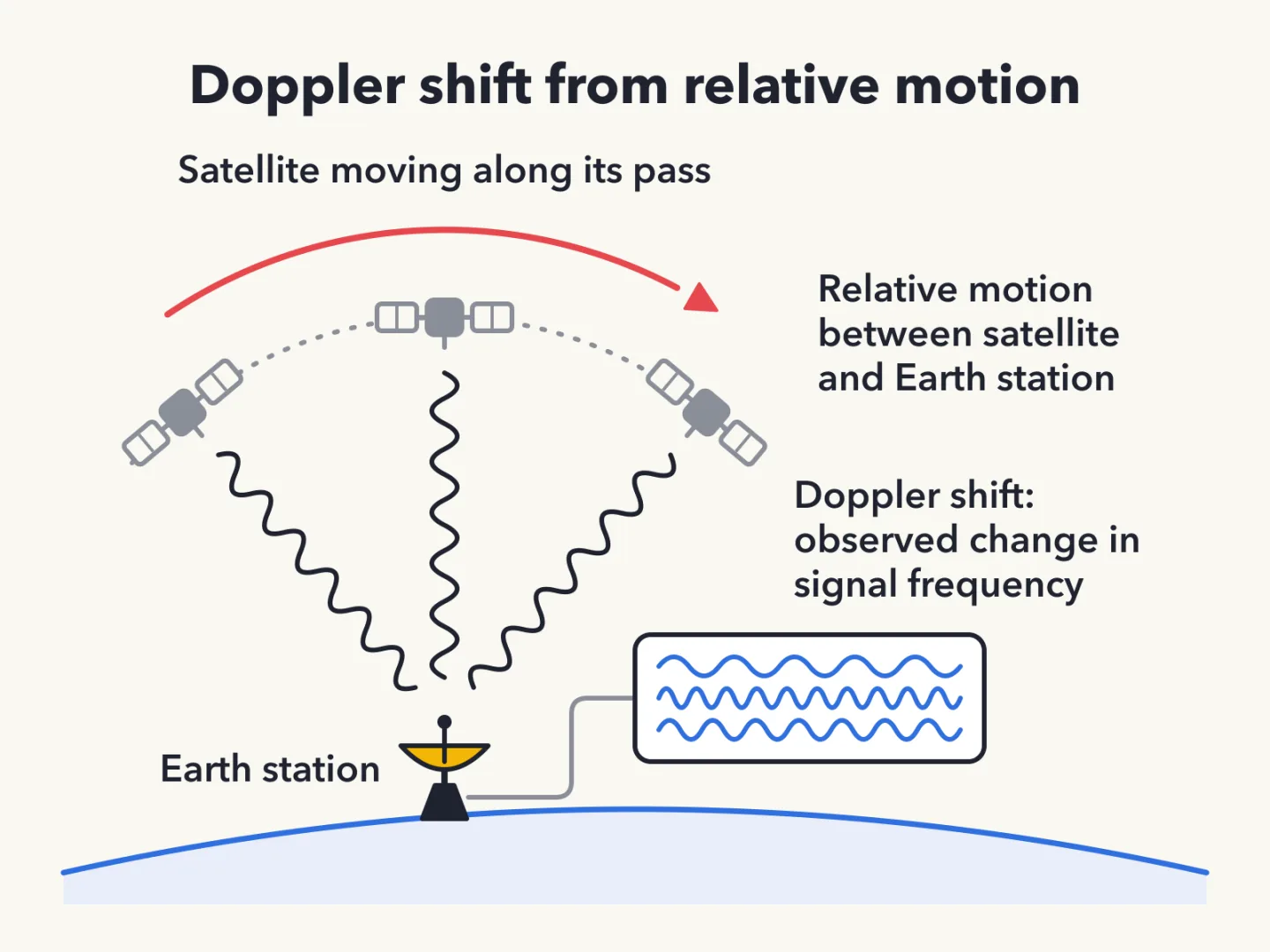
Doppler Shift Explained
Doppler shift is an observed change in signal frequency caused by relative motion between the satellite and the Earth station.
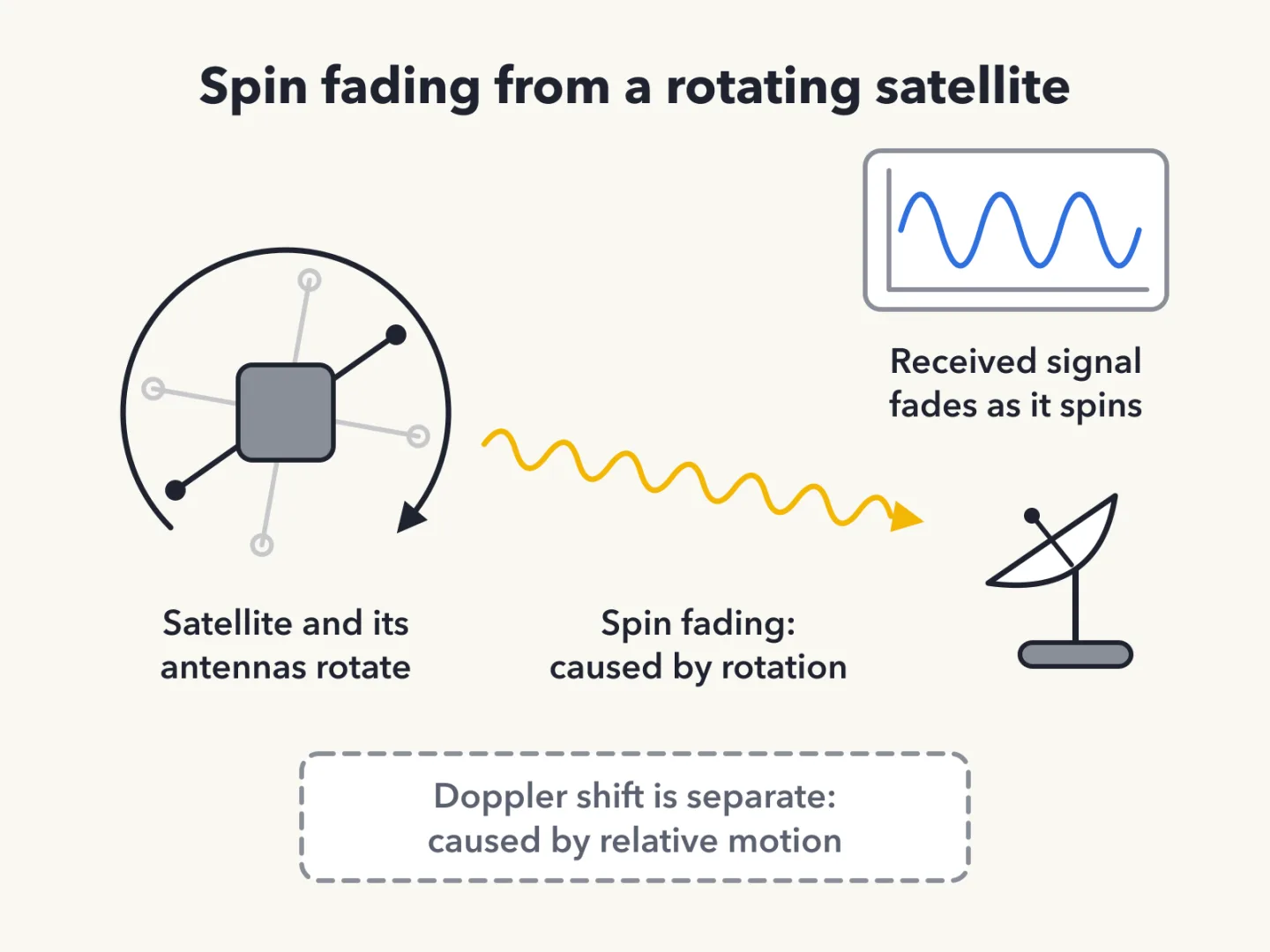
What Causes Spin Fading
Spin fading of satellite signals is caused by rotation of the satellite and its antennas. It is a separate effect from Doppler shift, which comes from relative motion.
Modes Satellites Commonly Use
Amateur radio satellites commonly use single sideband (SSB), frequency modulated (FM) and international Morse code telegraphy (CW)/data.
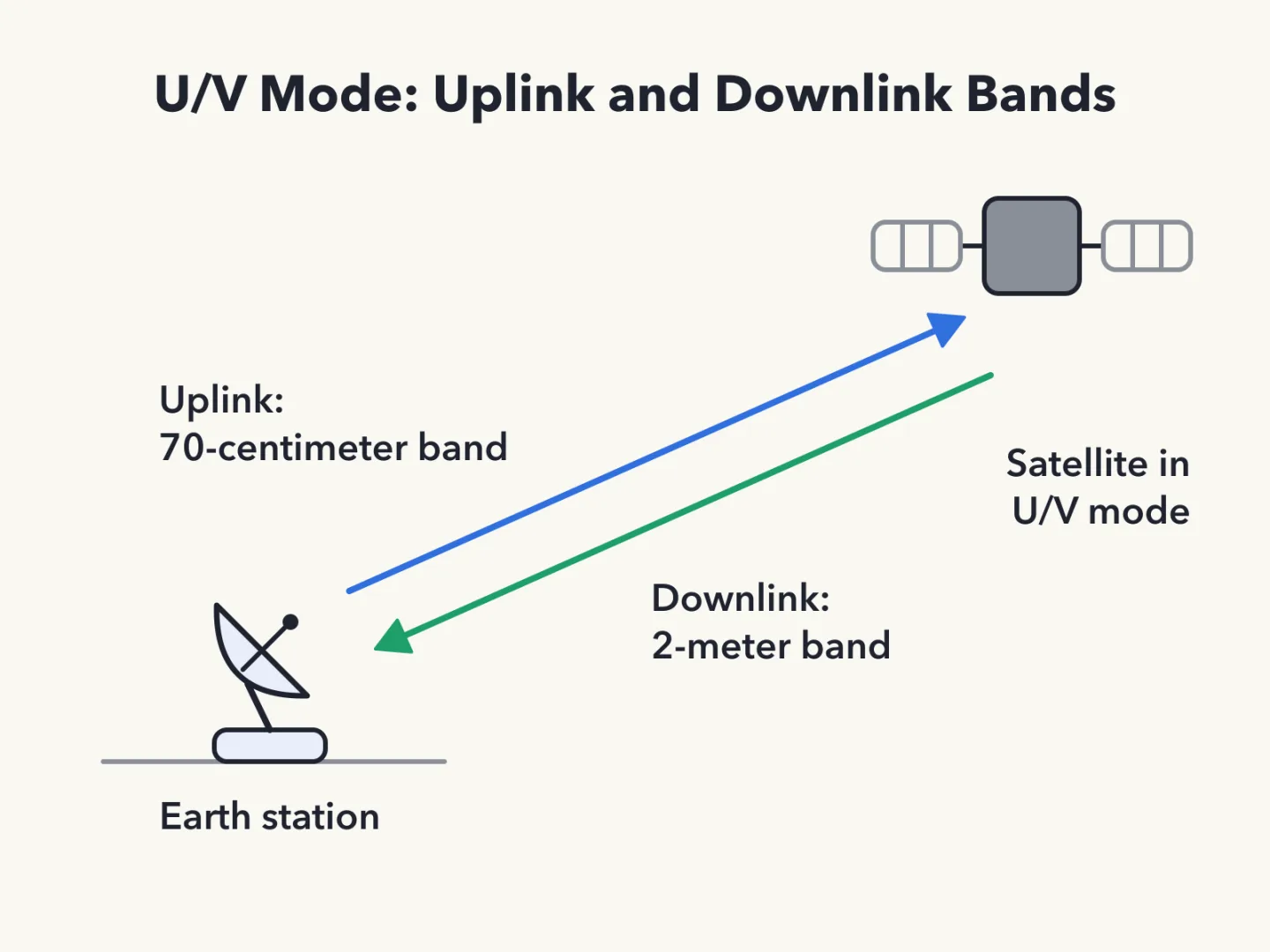
U/V Mode Bands
A satellite operating in U/V mode has its uplink in the 70-centimeter band and its downlink in the 2-meter band.
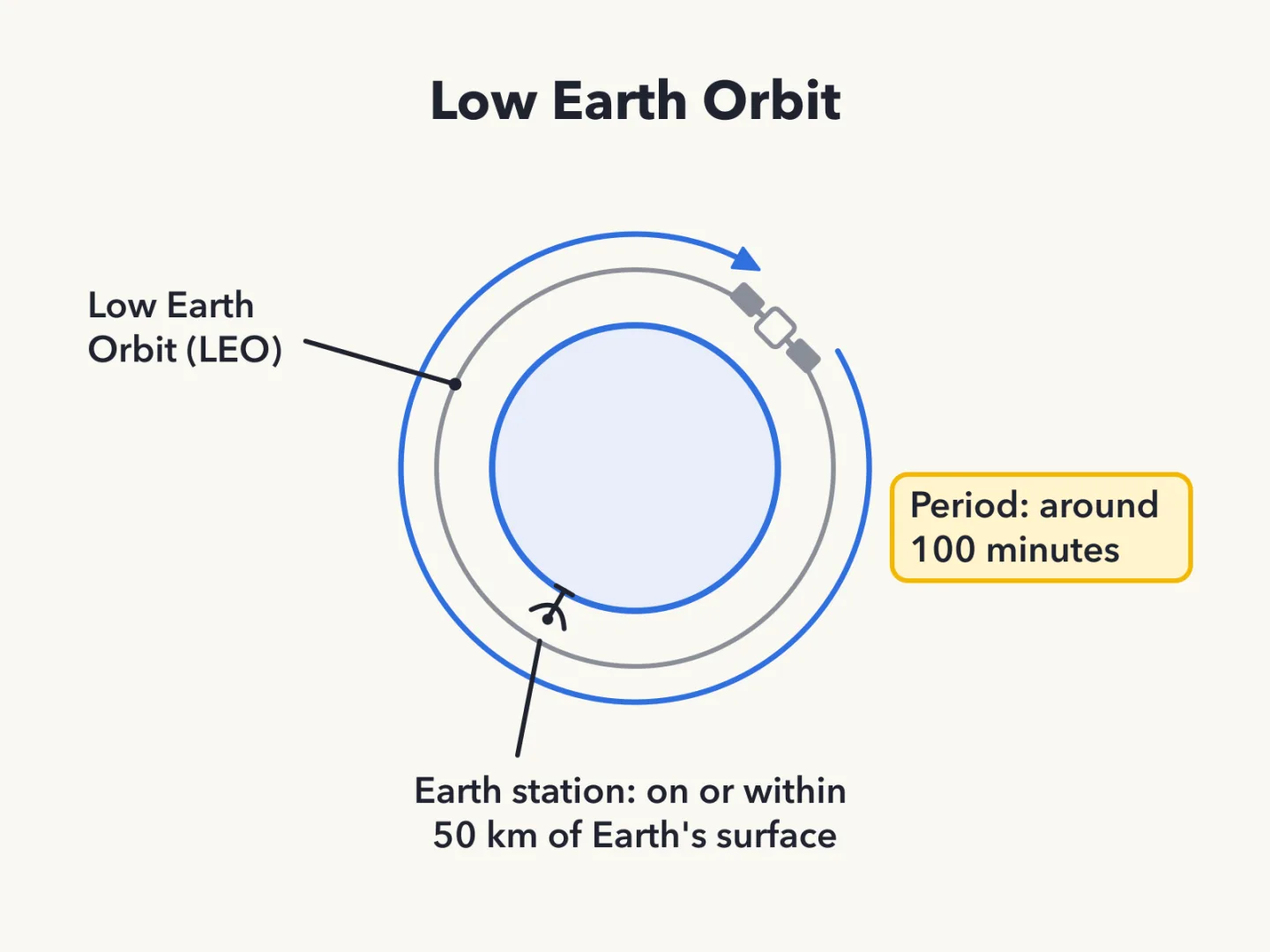
LEO: Low Earth Orbit
Low Earth Orbit (LEO) has a period of around 100 minutes.
Anyone May Receive Telemetry
Anyone is permitted to receive telemetry from an amateur radio satellite.
Excess Uplink Power Blocks Others
Using excessive effective radiated power (ERP) on a satellite uplink blocks access by other users.
Matching the Beacon
On a linear transponder satellite, uplink power is neither too low nor too high when the operator's signal strength on the downlink is about the same as the beacon.
Matched pairs
Each item on the left goes with the one on the right.
- Frequency modulated (FM) voice signal on very high frequency (VHF) repeaters
- Between 10 and 15 kilohertz (kHz) wide
- Spin fading
- Rotation of satellite and its antennas
Self-test
Answer each question from memory, then check your work against the answer key.
1. Which of the following is a form of amplitude modulation?
- APhase shift keying (PSK)
- BSingle sideband
- CSpread spectrum
- DPacket radio
2. What type of modulation is commonly used for VHF packet radio transmissions?
- AAM
- BSSB
- CPSK
- DFM or PM
3. Which type of modulation is commonly used for VHF and UHF voice repeaters?
- AFM or PM
- BSSB
- CAM
- DPSK
4. Which type of voice mode is often used for long-distance (weak signal) contacts on the VHF and UHF bands?
- ADRM
- BFM
- CSSB
- DPM
5. Which sideband is normally used for 10-meter HF, VHF, and UHF single-sideband communications?
- ALower sideband
- BUpper sideband
- CSuppressed sideband
- DInverted sideband
6. What is one characteristic of single sideband (SSB) compared to FM?
- ASSB signals are less susceptible to interference
- BSSB signals are less susceptible to high SWR
- CSSB signals are easier to tune in correctly
- DSSB signals have narrower bandwidth
7. Which of the following signal types has the narrowest bandwidth?
- AFM voice
- BSSB voice
- CCW
- DSlow-scan TV
8. What is the approximate bandwidth of a typical single sideband (SSB) voice signal?
- A3 kHz
- B15 kHz
- C1 kHz
- D6 kHz
9. What is the approximate bandwidth required to transmit a CW signal?
- A1000 Hz
- B15 kHz
- C2.4 kHz
- D150 Hz
10. What is the approximate bandwidth of an FM voice signal on VHF repeaters?
- ALess than 500 Hz
- BAbout 150 kHz
- CBetween 10 and 15 kHz
- DBetween 50 and 125 kHz
11. What is the approximate bandwidth of AM fast-scan TV transmissions?
- AAbout 1 MHz
- BAbout 6 MHz
- CMore than 10 MHz
- DAbout 3 MHz
12. Which of the following is a disadvantage of FM compared with single sideband?
- AOnly one signal can be received at a time
- BFM signals are more susceptible to high SWR
- CFM signals are harder to tune
- DVoice quality is poorer
13. What telemetry information is typically transmitted by satellite beacons?
- ATime of day accurate to plus or minus 1/10 second
- BAll these choices are correct
- CHealth and status of the satellite
- DThe signal strength of received signals
14. What is a satellite beacon?
- AAn indicator light that shows where to point your antenna
- BThe primary transmit antenna on the satellite
- CA reflective surface on the satellite
- DA transmission from a satellite that contains status information
15. Which of the following are provided by satellite tracking programs?
- AAll these choices are correct
- BThe apparent frequency of the satellite transmission, including effects of Doppler shift
- CMaps showing the real-time position of the satellite track over Earth
- DThe time, azimuth, and elevation of the start, maximum altitude, and end of a pass
16. Which of the following are inputs to a satellite tracking program?
- AThe satellite transmitted power
- BThe Keplerian elements
- CThe last observed time of zero Doppler shift
- DAll these choices are correct
17. What is the impact of using excessive effective radiated power on a satellite uplink?
- ABlocking access by other users
- BPossibility of rebooting the satellite control computer
- COverloading the satellite batteries
- DPossibility of commanding the satellite to an improper mode
18. Which of the following is a way to determine whether your satellite uplink power into a linear transponder satellite is neither too low nor too high?
- AListen for distortion on your downlink signal
- BCompare your signal to others on the downlink using an internet SDR receiver
- CCheck your signal strength report in the telemetry data
- DYour signal strength on the downlink should be about the same as the beacon
19. What mode of transmission is commonly used by amateur radio satellites?
- ASSB
- BAll these choices are correct
- CCW/data
- DFM
20. What does it mean if a satellite is operating in U/V mode?
- AThe satellite operates using ultraviolet frequencies
- BThe satellite uplink is in the 15-meter band and the downlink is in the 10-meter band
- CThe satellite uplink is in the 70-centimeter band and the downlink is in the 2-meter band
- DThe satellite frequencies are usually variable
21. What does the term LEO mean in reference to communication satellites?
- ALow Energy Orbit, which conserves battery power
- BLow Earth Orbit, which has a period of around 100 minutes
- CLow Elevation Orbit, which appears close to the horizon from the earth station
- DLow Equilibrium Orbit, which has a slightly unstable period
22. What is Doppler shift in reference to satellite communications?
- AA special digital communications mode for some satellites
- BA mode where the satellite receives signals on one band and transmits on another
- CAn observed change in signal frequency from relative motion of satellite and Earth station
- DA change in the satellite orbit
23. What causes spin fading of satellite signals?
- ARotation of the satellite and its antennas
- BInterfering signals within the satellite uplink band
- CCircular polarized noise interference radiated from the sun
- DDoppler shift of the received signal
24. Who is permitted to receive telemetry from an amateur radio satellite?
- AOnly control operator or a licensed amateur given the encryption key by that operator
- BOnly a licensed radio amateur who has received the encryption key from AMSAT
- COnly the satellite control operator
- DAnyone
Go deeper
- ListenLesson 12 episode
- WatchMorse Code or Fast-Scan TV: Which Takes More Room? Which takes more room on a band: a Morse code signal, or a fast-scan TV signal?
- WatchWhy Too Much Satellite Power Hurts Others More power is not always better on a satellite uplink.
- StudyHam Radio Technician License in the FlashFeed app
Answer key
- 1. B Single sidebandSingle sideband is a form of amplitude modulation. Spread spectrum, packet radio and PSK are not.
- 2. D FM or PMFrequency modulation (FM) or phase modulation (PM) is commonly used for very high frequency (VHF) packet radio. Single sideband (SSB), amplitude modulation (AM) and Phase Shift Keying (PSK) are not the common choice.
- 3. A FM or PMVery high frequency (VHF) and ultra high frequency (UHF) voice repeaters commonly use frequency modulation (FM) or phase modulation (PM), not amplitude modulation (AM), single sideband (SSB) or Phase Shift Keying (PSK).
- 4. C SSBSingle sideband (SSB) is the voice mode often used for long-distance weak-signal contacts on very high frequency (VHF) and ultra high frequency (UHF). FM stands for frequency modulated, DRM stands for Digital Radio Mondiale, and PM stands for phase modulated.
- 5. B Upper sidebandUpper sideband is the one normally used for single sideband (SSB) on 10 meters, very high frequency (VHF) and ultra high frequency (UHF). HF stands for high frequency.
- 6. D SSB signals have narrower bandwidthSSB signals have narrower bandwidth than frequency modulated (FM) signals. The other claims about SSB are wrong. SWR stands for standing wave ratio.
- 7. C CWContinuous wave (CW) has the narrowest bandwidth; frequency modulated (FM) voice, single sideband (SSB) voice and slow-scan TV are all wider.
- 8. A 3 kHzA typical SSB voice signal is about 3 kHz wide.
- 9. D 150 HzA continuous wave (CW) signal needs about 150 Hz, the narrowest of the signal types.
- 10. C Between 10 and 15 kHzFrequency modulated (FM) voice on very high frequency (VHF) repeaters is between 10 and 15 kHz wide.
- 11. B About 6 MHzAmplitude modulated (AM) fast-scan TV is about 6 MHz wide.
- 12. A Only one signal can be received at a timeWith frequency modulated (FM) operation, only one signal can be received at a time. Voice quality, tuning and standing wave ratio (SWR) are not the drawbacks.
- 13. C Health and status of the satelliteBeacons typically send the health and status of the satellite as telemetry.
- 14. D A transmission from a satellite that contains status informationA beacon is a satellite transmission containing status information, not an antenna, light or reflector.
- 15. A All these choices are correctTracking programs provide maps of the track, pass times with azimuth and elevation, and apparent frequency with Doppler shift. All are correct.
- 16. B The Keplerian elementsTracking programs take the Keplerian elements as input; transmitted power and zero-Doppler time are not inputs.
- 17. A Blocking access by other usersExcessive effective radiated power (ERP) on an uplink blocks access by other users.
- 18. D Your signal strength on the downlink should be about the same as the beaconUplink power is about right when the downlink signal strength is about the same as the beacon. SDR stands for software defined radio.
- 19. B All these choices are correctSatellites commonly use single sideband (SSB), frequency modulated (FM) and continuous wave (CW) or data, so all three choices are correct.
- 20. C The satellite uplink is in the 70-centimeter band and the downlink is in the 2-meter bandU/V mode means uplink in the 70-centimeter band and downlink in the 2-meter band.
- 21. B Low Earth Orbit, which has a period of around 100 minutesLEO means Low Earth Orbit, with a period of around 100 minutes.
- 22. C An observed change in signal frequency from relative motion of satellite and Earth stationDoppler shift is an observed frequency change caused by relative motion between satellite and Earth station.
- 23. A Rotation of the satellite and its antennasSpin fading is caused by rotation of the satellite and its antennas.
- 24. D AnyoneAnyone may receive amateur satellite telemetry; no control operator role or encryption key is needed. AMSAT stands for Radio Amateur Satellite Corporation.
Sources
- NCVEC Question Pool Committee — 2026–2030 Technician question pool — ncvec.org/index.php/2026-2030-technician-question-pool
- FCC — 47 CFR § 97.3 Definitions — www.ecfr.gov/current/title-47/section-97.3
Image credits
- FM or PM for Packet and Repeaters: FlashFeed original diagram · CC-BY-4.0
- The Drawback of FM: FlashFeed original diagram · CC-BY-4.0
- CW Bandwidth: About 150 Hz: FlashFeed original diagram · CC-BY-4.0
- SSB Voice Is About 3 kHz: FlashFeed original diagram · CC-BY-4.0
- FM Repeater Voice Is 10–15 kHz: FlashFeed original diagram · CC-BY-4.0
- Fast-Scan TV Is About 6 MHz: FlashFeed original diagram · CC-BY-4.0
- A Satellite Beacon Defined: FlashFeed original diagram · CC-BY-4.0
- What Tracking Programs Provide: FlashFeed original diagram · CC-BY-4.0
- Doppler Shift Explained: FlashFeed original diagram · CC-BY-4.0
- What Causes Spin Fading: FlashFeed original diagram · CC-BY-4.0
- U/V Mode Bands: FlashFeed original diagram · CC-BY-4.0
- LEO: Low Earth Orbit: FlashFeed original diagram · CC-BY-4.0
- Matching the Beacon: FlashFeed original diagram · CC-BY-4.0