
Education Theory & Learning Technology study guide · Lesson 3 of 10
Bloom's Taxonomy & Mastery Learning
Bloom's taxonomy · The verb ladder · The 2 Sigma Problem & mastery learning
This is the lesson's study guide from the FlashFeed app, plus its key facts and a self-test.
What you'll be able to do
- Explain Bloom's Taxonomy and the 2001 revision, including the renaming to verbs and the Synthesis→Create swap at the summit.
- Identify the five levels of Bloom's affective domain (Receiving, Responding, Valuing, Organizing, Characterizing).
- Match the revised Bloom levels to their action verbs and identify Create as the highest level.
- Explain the 2 Sigma Problem and mastery learning, including why the result was economically unscalable and how a student's failure is reframed.
- Rank Bloom's alterable instructional variables by effect size, from one-to-one tutoring down to classroom morale.
Bloom's taxonomy
Bloom's Taxonomy is the most widely used framework for classifying cognitive learning objectives. Understanding both the original 1956 structure and the 2001 revision — including its less-discussed affective companion — is essential for anyone designing instruction or assessments.
Bloom's Taxonomy
Benjamin Bloom and colleagues at the University of Chicago published the Taxonomy of Educational Objectives: Cognitive Domain in 1956, sorting cognitive skills into six hierarchical levels: Knowledge, Comprehension, Application, Analysis, Synthesis, and Evaluation. The hierarchy runs from lower-order thinking (simple recall) to higher-order thinking (complex judgment). Its enduring value is operational: once you attach a level to a learning objective, you know what kind of task to assign and what kind of assessment to write. The taxonomy gave educators a shared vocabulary that persists in virtually every curriculum-design conversation today.
The 2001 Revision
In 2001, Lorin Anderson (a former student of Bloom) and David Krathwohl published a revised taxonomy. Two structural changes matter most. First, the level names became verbs — Remember, Understand, Apply, Analyze, Evaluate, Create — making them directly actionable when drafting objectives. Second, the top two levels were swapped: Synthesis (1956) became Create (2001) and moved to the summit; Evaluation (1956) became Evaluate (2001) and dropped one rung. The verb shift is not cosmetic — saying "the student will analyze" forces a clearer choice of evidence than "the student will demonstrate Analysis."
The Affective Domain
The cognitive taxonomy gets most of the attention, but Bloom's team also produced a second handbook in 1964 covering the affective domain — the realm of attitudes, values, emotions, and motivations. Its five levels are Receiving, Responding, Valuing, Organizing, and Characterizing. Receiving is simply attending to a stimulus; Characterizing means a value system has become integrated into a person's identity. Edtech tends to sideline this framework, but engagement design — whether someone bothers to open the app — operates squarely in the affective domain. Ignoring it means optimizing cognition while the motivational preconditions go unaddressed.
The 2 Sigma Problem & mastery learning
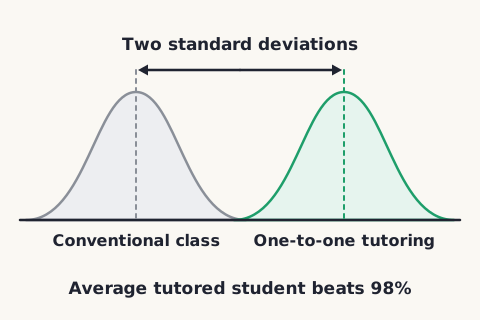
In 1984 Benjamin Bloom published the most provocative benchmark in educational research: individual tutoring outperforms conventional classroom instruction by a full two standard deviations. He called it a problem because no one could afford the solution.
The 2 Sigma Problem
In 1984, Bloom reported a controlled comparison of three instructional conditions: conventional classroom teaching, mastery learning in a classroom, and one-to-one tutoring with mastery techniques. The tutored group scored two standard deviations higher than the conventional group — meaning the average tutored student outperformed roughly 98% of the control class. Mastery learning alone produced about 1 sigma gain. Bloom labelled this the "2 Sigma Problem" because the solution was economically unscalable: hiring a personal tutor for every student is fantasy. The challenge he issued to the field: find a group-based method that replicates the tutored result.
His paper also catalogued alterable variables — instructional inputs a teacher can actually change — ranked by effect size. One-to-one tutorial instruction topped the list at 2 sigma. Reinforcement came second at 1.2 sigma. Mastery learning with feedback-corrective cycles and student time on task each reached 1 sigma. Cooperative learning and graded homework landed at 0.8 sigma. Classroom morale contributed 0.6 sigma. The ranking matters because it tells practitioners where to spend limited effort.
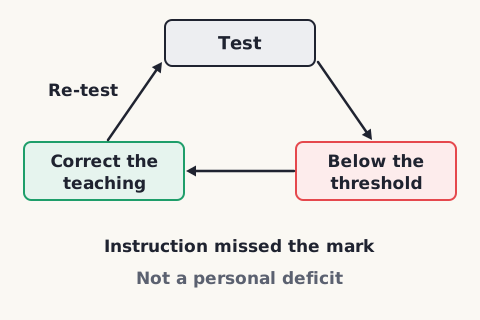
Mastery learning — developed earlier by John Carroll and expanded by Bloom — holds that most students can achieve a high threshold of mastery if given sufficient time and corrective feedback. When a student falls short, that outcome is treated as an instructional gap to correct, not a fixed student deficit. The diagnosis shifts from "this student can't" to "this unit wasn't taught effectively enough yet." That reframing has concrete consequences: re-teaching is the response, not remediation-as-punishment. The 2 Sigma result demonstrated what happens when mastery logic is taken to its logical extreme with unlimited one-to-one attention.
Key terms
- Bloom's Taxonomy
- A hierarchy of six cognitive skill levels, from lower-order to higher-order: in the revised version, Remember, Understand, Apply, Analyze, Evaluate, Create.
- The 2 Sigma Problem
- Bloom's 1984 challenge: one-to-one mastery tutoring lifts achievement by about two standard deviations, but is too costly to scale — so find a group method that matches it.
- Mastery learning
- An approach where students must reach a threshold (e.g. 90% on a test) before advancing; failures are treated as instructional gaps to correct, not student deficits.
Key concepts
Remember
- The lowest rung of Bloom's six-level cognitive hierarchy.
- It represents lower-order thinking — the simple recall of information.
- In the 1956 original this bottom level was called 'Knowledge'; the 2001 revision renamed it with an action verb.
Evaluate
- This is one of the two highest levels in Bloom's revised taxonomy.
- It concerns complex judgment, near the summit of higher-order thinking.
- In the 2001 revision it was knocked down one rung, surrendering the top spot to the level about creating.
Create
- This occupies the very summit of Bloom's revised taxonomy.
- It sits at the top of higher-order thinking, above the level concerned with judgment.
- In the 1956 original it was called 'Synthesis'; the 2001 revision renamed it and promoted it to the peak.
Key facts
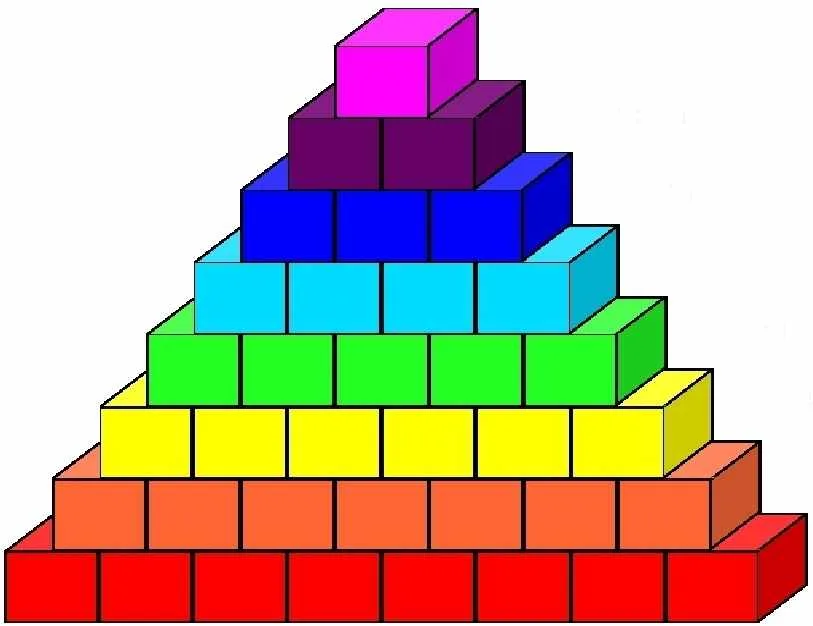
Bloom's Taxonomy
Bloom's Taxonomy (Benjamin Bloom and colleagues, University of Chicago, 1956) sorts cognitive skills into six levels, from lower-order recall up to higher-order thinking. It's the backbone of how we write learning objectives, design assessments, and calibrate difficulty.
The 2001 Revision
In 2001, Lorin Anderson and David Krathwohl revised Bloom's Taxonomy. They turned the noun levels into verbs (Knowledge became Remember), swapped the top two, and moved Create to the summit. The verbs make objectives and assessments far more actionable.
The Affective Domain
A second handbook (1964) covered the affective domain — attitudes, values, and motivations — across five levels: Receiving, Responding, Valuing, Organizing, Characterizing. Less discussed in edtech than the cognitive domain, but central to engagement design.
The Original 1956 Taxonomy
Benjamin Bloom and colleagues at the University of Chicago published the original Taxonomy of Educational Objectives: Cognitive Domain in 1956, decades before the 2001 revision led by Anderson and Krathwohl.

Bloom's Original Summit
In the 1956 taxonomy, Evaluation sat at the very top of the hierarchy, following Synthesis. The 2001 revision swapped the order, dropping Evaluate one rung below the new top level, Create.
The 2 Sigma Problem
In 1984, Bloom reported that students tutored one-to-one with mastery techniques scored two standard deviations higher than conventionally taught peers — the average tutored student beat 98% of the control class. The catch: 1:1 tutoring doesn't scale.
Instructional Gap, Not Deficit
In mastery learning, a student who doesn't reach the threshold is treated as evidence the instruction missed the mark, not as a personal deficit — the fix is to correct the teaching and re-test.
Before Bloom: John Carroll
Mastery learning wasn't Bloom's original idea — John Carroll developed the model first, and Bloom later expanded it.
Reinforcement's 1.2 Sigma
Among Bloom's ranked alterable variables, reinforcement placed second at 1.2 sigma — well behind one-to-one tutoring's top effect size of 2 sigma.
Two Ways to 1 Sigma
Two of Bloom's alterable variables each produced a 1-sigma effect: mastery learning built on feedback-corrective cycles, and simply increasing a student's time on task.
By the numbers
- Effect size of one-to-one tutorial instruction (Bloom's alterable variables)
- 2 sigma
- Effect size of reinforcement (Bloom's alterable variables)
- 1.2 sigma
- Effect size of mastery learning, feedback-corrective (Bloom's alterable variables)
- 1 sigma
- Effect size of student time on task (Bloom's alterable variables)
- 1 sigma
- Effect size of cooperative learning (Bloom's alterable variables)
- 0.8 sigma
- Effect size of graded homework (Bloom's alterable variables)
- 0.8 sigma
- Effect size of classroom morale (Bloom's alterable variables)
- 0.6 sigma
Matched pairs
Each item on the left goes with the one on the right.
- Knowledge (1956)
- Remember (2001)
- Comprehension (1956)
- Understand (2001)
- Synthesis (1956)
- Create (2001)
- Evaluation (1956)
- Evaluate (2001)
- Remember
- define, list, recall, identify
- Apply
- use, execute, implement, solve
- Create
- design, produce, construct, invent
Step by step
Climb Bloom's revised (2001) cognitive ladder from lowest to highest order
- Remember — recall facts and basic concepts
- Understand — explain ideas in your own words
- Apply — use knowledge in a new situation
- Analyze — break material into parts and see how they relate
- Evaluate — judge, defend, or critique against criteria
- Create — combine parts into something new and original
The 2001 revision swapped the top two levels and put Create — not Evaluate — at the summit.
Self-test
Answer each question from memory, then check your work against the answer key.
1. Who published the original Taxonomy of Educational Objectives: Cognitive Domain, and in what year?
- ALorin Anderson and David Krathwohl, 1956
- BLorin Anderson and David Krathwohl, 2001
- CBenjamin Bloom and colleagues, 2001
- DBenjamin Bloom and colleagues, 1956
2. Which mapping from a 1956 level to its 2001 counterpart is correct?
- AKnowledge to Understand
- BAnalysis to Evaluate
- CSynthesis to Create
- DComprehension to Apply
3. What did the 2001 revision do to the number of levels in the cognitive taxonomy?
- AIt cut the taxonomy from six levels to five
- BIt kept the taxonomy at its original six levels
- CIt kept the taxonomy at its original five levels
- DIt expanded the taxonomy from five levels to six
4. In the original 1956 taxonomy, which level sat at the very top of the hierarchy?
- AEvaluation
- BApplication
- CSynthesis
- DAnalysis
5. An instructor rewrites 'the student will demonstrate Analysis' as 'the student will break down the argument.' Which 2001 change does this reflect?
- AThe affective domain was folded in, making attitudes a cognitive level
- BThe top two levels were swapped, making judgment the final rung
- CLevel names became verbs, making objectives directly actionable
- DThe hierarchy was flattened, making every level equally rigorous
6. Which set of five levels belongs to Bloom's affective domain?
- AReceiving, Responding, Valuing, Organizing, Characterizing
- BImitation, Manipulation, Precision, Articulation, Naturalization
- CKnowledge, Comprehension, Application, Analysis, Synthesis
- DAnalyzing, Designing, Developing, Implementing, Evaluating
7. Which is the lowest level of Bloom's affective domain — simply attending to a stimulus?
- AResponding
- BReceiving
- COrganizing
- DValuing
8. In the affective domain, which level describes a value system that has become integrated into a person's identity?
- AOrganizing
- BResponding
- CValuing
- DCharacterizing
9. Which of these is one of the five levels of Bloom's affective domain?
- AFeeling
- BValuing
- CBelieving
- DTrusting
10. In what year did Bloom's team publish the second handbook covering the affective domain?
- A1964
- B2001
- C1956
- D1984
11. What is the highest level of the revised (2001) Bloom's Taxonomy?
- AEvaluate
- BAnalyze
- CRemember
- DCreate
12. Which set of action verbs belongs to the Apply level?
- Adesign, produce, construct, invent
- Brecognize, describe, summarize, explain
- Cuse, execute, implement, solve
- Ddefine, list, recall, identify
13. An objective reads 'the student will design and produce an original experiment.' Which revised level do those verbs place it at?
- ACreate
- BAnalyze
- CEvaluate
- DApply
14. The verbs 'define, list, recall, identify' correspond to which revised Bloom level?
- AAnalyze
- BApply
- CUnderstand
- DRemember
15. In the revised taxonomy, which level sits directly below the summit?
- ACreate
- BEvaluate
- CRemember
- DAnalyze
16. Which level was moved to the summit of the revised Bloom's Taxonomy?
- AEvaluate
- BUnderstand
- CCreate
- DAnalyze
17. Which verb-level ranks highest in the 2001 Bloom's revision, above Evaluate?
- ARemember
- BAnalyze
- CApply
- DCreate
18. Why did Bloom frame the two-sigma result as a 'problem'?
- AThe design lacked a conventional-classroom control
- BOne-to-one tutoring is economically unscalable
- CThe tutored gain appeared only among strong students
- DMastery learning in classrooms fell well short of a sigma
19. In mastery learning, how is a student's failure to reach the threshold treated?
- AAs an instructional gap to correct, not a student deficit
- BAs a bar set too high, not a student unable to clear it
- CAs a need for more time on task, not more re-teaching
- DAs a flaw in the unit's sequencing, not in its teaching
20. In Bloom's 1984 study, the average tutored student outperformed roughly what share of the conventionally taught control class?
- A50%
- B84%
- C98%
- D68%
21. Which three instructional conditions did Bloom compare in his 1984 study?
- AClassroom mastery learning, cooperative learning, and peer tutoring in pairs
- BConventional teaching, programmed instruction, and computer-assisted drill
- CLecture-based teaching, small-group seminars, and peer tutoring in pairs
- DConventional teaching, classroom mastery learning, and one-to-one tutoring
22. Mastery learning was developed earlier by whom, before Bloom expanded it?
- ADavid Krathwohl
- BLorin Anderson
- CJohn Carroll
- DRobert Gagne
23. Which alterable variable topped Bloom's list with the largest effect size?
- ACooperative learning in small groups
- BOne-to-one tutorial instruction
- CFeedback-corrective mastery learning
- DReinforcement in the classroom
24. What effect size did Bloom report for reinforcement?
- A1.2 sigma
- B1.0 sigma
- C0.8 sigma
- D2.0 sigma
25. Which two alterable variables each reached 1 sigma?
- AOne-to-one tutorial instruction, and student time on task
- BMastery learning with feedback-corrective cycles, and student time on task
- CCooperative learning, and one-to-one tutorial instruction
- DReinforcement, and mastery learning with feedback-corrective cycles
26. What effect size did Bloom assign to classroom morale?
- A0.6 sigma
- B0.8 sigma
- C1.2 sigma
- D1 sigma
27. Which list ranks alterable variables correctly from largest effect size to smallest?
- ATime on task, reinforcement, graded homework
- BMastery learning, reinforcement, cooperative learning
- CReinforcement, cooperative learning, classroom morale
- DClassroom morale, graded homework, time on task
28. Among Bloom's alterable instructional variables, which tops the ranking by effect size?
- AReinforcement
- BCooperative learning
- CMastery learning, feedback-corrective
- DOne-to-one tutorial instruction
29. What effect size did one-to-one tutorial instruction reach in Bloom's ranking?
- A1.2 sigma
- B2 sigma
- C1 sigma
- D0.6 sigma
30. Which alterable variable sits at the bottom of Bloom's effect-size ranking?
- AStudent time on task
- BCooperative learning
- CClassroom morale
- DGraded homework
31. What effect size does classroom morale contribute, per Bloom's ranking?
- A0.6 sigma
- B2 sigma
- C0.8 sigma
- D1.2 sigma
Go deeper
Answer key
- 1. D Benjamin Bloom and colleagues, 1956Bloom and colleagues at the University of Chicago published the original cognitive taxonomy in 1956. Anderson and Krathwohl published the 2001 revision, not the original, and 2001 is the revision's date rather than the taxonomy's.
- 2. C Synthesis to CreateSynthesis was renamed Create and moved to the summit. Each wrong pairing slips one rung too high: Knowledge became Remember, Comprehension became Understand, and Analysis became Analyze.
- 3. B It kept the taxonomy at its original six levelsThe revision renamed the levels and reordered the top two but kept all six. Five is the level count of the affective domain, not the cognitive taxonomy, and nothing was added or cut.
- 4. A EvaluationIn 1956 the order ended Synthesis then Evaluation, so Evaluation was the summit. The 2001 revision swapped them, dropping Evaluate one rung below Create.
- 5. C Level names became verbs, making objectives directly actionableThe verb shift forces a clearer choice of evidence than the noun form. The top-two swap put Create, not Evaluate, at the summit; the levels still rank, and the affective domain stayed a separate 1964 handbook.
- 6. A Receiving, Responding, Valuing, Organizing, CharacterizingThe affective domain (1964) runs Receiving to Characterizing, charting how attitudes and values deepen.
- 7. B ReceivingReceiving is the entry level: merely attending to a stimulus. Responding is the next rung, where the learner actively reacts rather than just notices.
- 8. D CharacterizingCharacterizing is the top level, where a value system is integrated into identity. Valuing and Organizing are lower rungs on the same ladder, short of that full internalization.
- 9. B ValuingThe affective five are Receiving, Responding, Valuing, Organizing, Characterizing. Reflecting, Believing and Committing sound affective but name no level in the 1964 handbook.
- 10. A 1964The affective handbook came in 1964. 1956 was the original cognitive taxonomy, 1984 the 2 Sigma paper, and 2001 the Anderson and Krathwohl revision.
- 11. D CreateThe revision moved Create to the summit, ahead of Evaluate, to emphasize original production as the peak cognitive skill.
- 12. C use, execute, implement, solveApply is about putting knowledge to use: use, execute, implement, solve. 'define, list, recall, identify' are Remember verbs — lower-order retrieval, not use.
- 13. A CreateDesign and produce are Create verbs — original production, the summit of the revised ladder. Apply verbs (use, execute, implement, solve) work an existing method rather than making something new.
- 14. D RememberThese are retrieval verbs, so they sit at Remember, the lowest rung. Understand would require explaining or summarizing rather than simply recalling.
- 15. B EvaluateThe revision put Create at the summit with Evaluate one rung below. Create is the summit itself, not the level beneath it, and Analyze sits two rungs down, above Apply.
- 16. C CreateThe 2001 revision swapped the top two levels, moving Create above Evaluate to the summit of the hierarchy.
- 17. D CreateSynthesis (1956) became Create (2001) and took the top spot, ranking above Evaluate in the revised hierarchy.
- 18. B One-to-one tutoring is economically unscalableThe gain is huge but tutoring everyone 1:1 is unaffordable — Bloom challenged researchers to find a scalable group method that matches it. This is now the core pitch for AI tutoring.
- 19. A As an instructional gap to correct, not a student deficitMastery learning reframes failure as a feedback-corrective signal: the instruction missed, so fix the instruction and re-test.
- 20. C 98%A two standard deviation gain puts the average tutored student above about 98% of the control class. 84% would correspond to a one-sigma gain, the level mastery learning alone reached.
- 21. D Conventional teaching, classroom mastery learning, and one-to-one tutoringBloom's 1984 comparison had three arms: conventional classroom teaching, mastery learning in a classroom, and one-to-one tutoring with mastery techniques.
- 22. C John CarrollJohn Carroll developed mastery learning and Bloom expanded it. Anderson and Krathwohl are associated with the 2001 taxonomy revision, not mastery learning.
- 23. B One-to-one tutorial instructionOne-to-one tutorial instruction led at 2 sigma. Reinforcement was second at 1.2 sigma — large, but only about half the tutoring effect.
- 24. A 1.2 sigmaReinforcement came second at 1.2 sigma. The 2 sigma figure belongs to one-to-one tutorial instruction, which topped the list.
- 25. B Mastery learning with feedback-corrective cycles, and student time on taskFeedback-corrective mastery learning and time on task each hit 1 sigma. One-to-one tutorial instruction sits at 2 sigma, reinforcement at 1.2 and cooperative learning at 0.8, so every pair containing one of those misses the mark.
- 26. A 0.6 sigmaClassroom morale sat at the bottom of the ranking at 0.6 sigma. 0.8 sigma belongs to cooperative learning and graded homework, the next rung up.
- 27. C Reinforcement, cooperative learning, classroom moraleReinforcement 1.2, cooperative learning 0.8, classroom morale 0.6 — a correct descending order. Every other option puts a smaller effect ahead of a larger one.
- 28. D One-to-one tutorial instructionOne-to-one tutorial instruction topped Bloom's ranking of alterable variables at 2 sigma, the largest effect size measured.
- 29. B 2 sigmaBloom's alterable-variables ranking put one-to-one tutorial instruction at 2 sigma — the top of the list.
- 30. C Classroom moraleClassroom morale contributed the smallest effect, 0.6 sigma, placing it at the bottom of Bloom's ranking of alterable variables.
- 31. A 0.6 sigmaClassroom morale reached only 0.6 sigma — the smallest effect size in Bloom's ranking of alterable instructional variables.
Image credits
- Bloom's Taxonomy: Wikimedia Commons · Gorkaazk · CC0 — commons.wikimedia.org/wiki/File:Piramide_koloretsua.jpg
- Bloom's Original Summit: AI-generated (gpt-image-1.5)
- The 2 Sigma Problem: FlashFeed original diagram · CC-BY-4.0
- Instructional Gap, Not Deficit: FlashFeed original diagram · CC-BY-4.0
