
Education Theory & Learning Technology study guide · Lesson 2 of 10
Learning Theories: Behaviorism to Constructivism
Behaviorism · Cognitivism · Constructivism
This is the lesson's study guide from the FlashFeed app, plus its key facts and a self-test.
What you'll be able to do
- Identify behaviorism's founders (Skinner, Pavlov, Watson) and match each to their stimulus-response contribution.
- Explain operant conditioning and how shaping reinforces successive approximations toward a target behavior.
- Distinguish assimilation, accommodation, and equilibration as Piaget's schema-change processes, and why mild surprise aids memory.
- Define a schema and explain how chunking works within George Miller's 7±2 working-memory limit.
- Explain constructivism through the Zone of Proximal Development, scaffolding, and the roles of Vygotsky and Dewey.
Behaviorism
The oldest major learning theory treats the mind as a black box and focuses entirely on what can be observed: inputs, outputs, and the consequences that connect them. Its logic runs through almost every modern training system, often without acknowledgment.
Behaviorism
Behaviorism holds that learning is observable behavior change produced by stimulus-response conditioning. Its early-20th-century founders — B.F. Skinner, Ivan Pavlov, and John Watson — argued that internal mental states (beliefs, feelings, attention) are unmeasurable and therefore scientifically irrelevant. Pavlov demonstrated classical conditioning with dogs: pair a bell with food enough times and the bell alone triggers salivation. Watson extended this to humans, treating all behavior as conditioned reflexes. The framework was radical and productive: it forced researchers to specify observable outcomes rather than theorize about invisible minds.
Behaviorism, gamified
B.F. Skinner introduced operant conditioning: behavior is shaped by its consequences — reinforcement increases a behavior, punishment decreases it. Unlike Pavlov's passive conditioning, operant conditioning involves the learner's own actions. Skinner's key insight was that when a reward arrives matters as much as whether it arrives — different reinforcement schedules produce different response rates and extinction curves. This mechanics is directly behind modern gamification: Duolingo's streaks, badges, leaderboards, and immediate-feedback loops are applied Skinnerian schedules. The ADDIE instructional-design model — still the dominant military and corporate training framework — has direct roots in this operant tradition.
The behaviorist toolkit
Behaviorism produced a precise vocabulary for intervention design. Shaping rewards successive approximations toward a target behavior, which lets instructors teach complex skills by reinforcing small steps rather than waiting for the whole performance. Stimulus generalization describes how a learned response transfers to stimuli that resemble the original — useful when you want training to carry over to real-world contexts. Discrimination is the flip side: learning to respond only to the correct stimulus, not its neighbors. Together these concepts give designers handles for sequencing difficulty, calibrating feedback timing, and planning transfer. The limitation behaviorism never escaped is that it cannot explain latent learning, language acquisition, or anything that happens between stimulus and response.
Cognitivism
Where behaviorism refused to look inside the skull, cognitivism made the mind's internal processes the whole subject. The shift, crystallizing in the 1950s–70s, reframed learning as information processing rather than behavior shaping.
Cognitivism
Cognitivism put the mind back in the picture. Jean Piaget, Jerome Bruner, Albert Bandura, and George Miller studied the internal machinery: how people attend, encode, store, and retrieve information. The mind is not a passive receiver of stimuli but an active system that constructs understanding. George Miller's landmark 1956 paper established that working memory holds roughly 7 ± 2 chunks of information at once — a hard capacity limit that shapes every instructional design decision since. Chunking exploits this limit: grouping raw items into meaningful units (the digits 1-4-9-2 become "1492") reduces the number of slots occupied and dramatically improves encoding.
Piaget gave cognitivism its richest vocabulary for knowledge structure. A schema is a cognitive framework — a stored pattern of understanding — used to interpret new information. When new information fits an existing schema it is absorbed through assimilation: the schema stays intact. When it contradicts the schema, the learner must revise it through accommodation — a more effortful process that produces genuine conceptual change. The tension between old schemas and new experience creates disequilibrium; the drive to resolve it is equilibration, Piaget's engine of cognitive development. Equilibration is why mildly surprising information tends to be better remembered than information that simply confirms what you already know.
Cognitivism's practical legacy is large: it underlies spaced repetition, worked-example research, dual-coding theory, and the entire cognitive load tradition that shapes modern instructional design. Its weakness is that it sometimes treats the individual mind in isolation, downplaying social and cultural context — the opening that constructivism moved through next.
Constructivism
Constructivism argues that knowledge is not transmitted from teacher to student but actively built by the learner through experience, reflection, and social interaction. It is less a single theory than a family sharing one core claim: meaning-making is the learner's job.
Constructivism
Constructivism holds that knowledge is built, not delivered. Context, culture, and collaboration shape what is learned and how durable it is. Three poles define the tradition. Piaget (cognitive constructivism) emphasized the individual mind's encounter with the physical world — schemas built through direct manipulation and exploration. Lev Vygotsky (social constructivism) argued that higher mental functions arise first between people before they become internal — learning is inherently social. John Dewey (pragmatic constructivism) insisted that genuine learning requires "learn by doing": authentic problems, real consequences, reflection on action. All three converge on the idea that passive reception of information is the least reliable route to durable understanding. Constructivist classrooms emphasize projects, problems, and discussion over lecture.
Scaffolding and fading
Vygotsky's most influential concept is the Zone of Proximal Development (ZPD): the gap between what a learner can do independently and what they can achieve with guidance from a more knowledgeable other — a teacher, peer, or structured tool. Learning is most efficient when a task falls inside this zone: too easy and no growth occurs; too hard and frustration blocks progress. Scaffolding is the practical application — temporary instructional support (hints, prompts, models, worked examples, partially completed problems) that allows a learner to operate in the ZPD. The critical design constraint is that scaffolding must be temporary by design: as competence grows, support is progressively withdrawn through fading. Scaffolds that are never removed create dependency rather than independence. This fading principle distinguishes effective scaffolding from simply making a task easier and explains why well-designed AI tutors gradually reduce the hints they offer as a learner's accuracy improves.
Key terms
- Operant conditioning
- Skinner's principle that behavior is shaped by its consequences — reinforcement and punishment — rather than by internal mental states.
- Schema
- A cognitive framework or category used to organize and interpret information.
- Assimilation
- Integrating new information into an existing schema without changing the schema itself.
- Accommodation
- Modifying an existing schema to incorporate contradictory new information.
- Equilibration
- The drive to balance assimilation and accommodation, resolving the tension between old schemas and new information.
- Chunking
- Breaking complex information into smaller, more manageable units to reduce cognitive load and improve encoding.
- Zone of Proximal Development (ZPD)
- Vygotsky's gap between what a learner can do independently and what they can achieve with guidance from a 'more knowledgeable other'.
- Scaffolding
- Temporary instructional support — hints, prompts, models, worked examples — that helps a learner progress through their ZPD, withdrawn as competence grows.
Key concepts
Schema
- Piaget gave cognitivism its richest vocabulary for knowledge structure, and this is its basic building block.
- It is a cognitive framework — a stored pattern of understanding — used to interpret new information.
- New information that fits one is absorbed intact; information that clashes forces the learner to revise it.
Assimilation
- One of Piaget's two complementary processes for fitting new information to an existing mental framework.
- It is the easier of the pair: the incoming information already fits, so the framework stays intact.
- When new digits slot neatly into a pattern you already hold, that effortless absorption is this process.
Accommodation
- This is the more effortful of Piaget's two adaptation processes.
- It kicks in when new information contradicts an existing schema.
- The learner must revise the framework itself, producing genuine conceptual change rather than a simple fit.
Equilibration
- Piaget called this the engine of cognitive development.
- It is the drive to resolve the tension between an outdated framework and a new, conflicting experience.
- This balancing process pushes a learner from mental conflict back toward a stable, updated understanding.
Key facts
Behaviorism
Behaviorism holds that learning is observable behavior change produced by stimulus-response conditioning, reinforcement, and punishment. Its early-20th-century champions — B.F. Skinner, Ivan Pavlov, and John Watson — treated internal mental states as irrelevant: only what you can see and measure counts.
The behaviorist toolkit
Beyond reinforcement, behaviorism gave us reinforcement schedules (when rewards arrive), shaping (rewarding successive approximations toward a target behavior), and stimulus generalization (a response learned to one stimulus transfers to similar ones).
Skinner: Operant Conditioning
B.F. Skinner is behaviorism's pioneer of operant conditioning — the principle that behavior is shaped by its consequences, distinct from Pavlov's classical conditioning or Watson's early behaviorism.
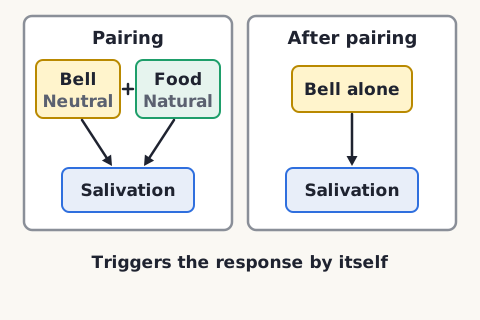
Pavlov's Bell and Drool
Pavlov paired a bell with food until dogs salivated at the bell alone — demonstrating classical conditioning, in which a neutral stimulus paired with a natural one comes to trigger the response by itself.
Cognitivism
Cognitivism put the mind back in the picture. Where behaviorism saw a black box, cognitivists — Jean Piaget, Jerome Bruner, Albert Bandura, George Miller — studied the internal processes: schemas, attention, encoding, storage, retrieval. The mind actively constructs understanding.
Assimilation: Same Old Schema
When a child who already knows 'dog' sees a new breed and simply calls it a dog too, that's assimilation — fitting new information into an existing schema without changing it.
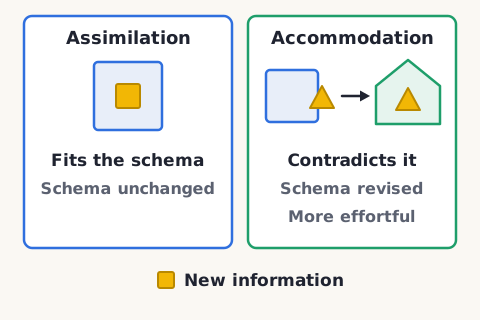
Accommodation: Schema Under Revision
Accommodation is the opposite move: when new information contradicts an existing schema, the schema itself gets revised to fit it — a more effortful process than simply assimilating.
Working Memory's Hard Limit
George Miller's landmark 1956 paper established that working memory holds only about 7 plus-or-minus 2 chunks at once — a hard capacity limit that has shaped instructional design ever since.
Four Digits Become One Chunk
Turning the digits 1-4-9-2 into the single meaningful unit '1492' is chunking: it frees up working-memory slots by grouping raw items into one chunk instead of several.
Constructivism
Constructivism holds that knowledge is built by the learner through active experience, not transmitted by a teacher. Context, culture, and social interaction shape what is learned. Its three poles: Piaget (cognitive), Lev Vygotsky (social), and John Dewey (pragmatic).
Scaffolding and fading
Good scaffolding is temporary by design. As competence grows, the support is progressively withdrawn — a process called fading. Learning is optimized when a task falls within the ZPD: hard enough to need support, not so hard it causes frustration.
The More Knowledgeable Other
In Vygotsky's zone of proximal development, a 'more knowledgeable other' — a teacher, parent, or more capable peer — supplies the scaffolding that lets a learner accomplish more than they could alone.
Dewey: Learn By Doing
John Dewey's pragmatic constructivism is defined by 'learn by doing' — authentic problems, real consequences, and reflection on action.
Vygotsky vs. Piaget
Vygotsky's social constructivism holds that higher mental functions first arise between people and only later become internal — learning is inherently social, unlike Piaget's focus on the individual's encounter with the physical world.
Matched pairs
Each item on the left goes with the one on the right.
- B.F. Skinner
- Operant conditioning
- Ivan Pavlov
- Stimulus-response conditioning
- John Watson
- Early behaviorism
- George Miller
- Chunking / 7±2 rule
- Lev Vygotsky
- Zone of Proximal Development
- John Dewey
- Learn by doing
Step by step
Order Piaget's four stages of cognitive development
- Sensorimotor
- Preoperational
- Concrete Operational
- Formal Operational
Piaget's framework established that learners aren't passive recipients but active constructors of knowledge.
Self-test
Answer each question from memory, then check your work against the answer key.
1. Which behaviorism founder is correctly paired with his contribution?
- AIvan Pavlov — conditioned reflexes in humans
- BB.F. Skinner — operant conditioning
- CJohn Watson — classical conditioning with dogs
- DIvan Pavlov — reinforcement schedules
2. Pavlov paired a bell with food until the bell alone triggered salivation in dogs. What did this demonstrate?
- AOperant conditioning
- BStimulus generalization
- CClassical conditioning
- DStimulus discrimination
3. Which school of learning theory counts John Watson among its founders?
- ACognitivism
- BConnectivism
- CConstructivism
- DBehaviorism
4. How did behaviorism's founders regard internal mental states such as beliefs and attention?
- AAs unmeasurable and therefore scientifically irrelevant
- BAs unmeasurable yet still central to explaining learning
- CAs measurable yet too unreliable to be worth studying
- DAs measurable and therefore fit for scientific study
5. A trainer treats all human behavior as conditioned reflexes, extending a method first shown with dogs to people. Whose stance is this?
- AIvan Pavlov's
- BAlbert Bandura's
- CB.F. Skinner's
- DJohn Watson's
6. In the behaviorist toolkit, what does shaping describe?
- ALearning to respond to the correct stimulus alone and disregard its neighbors
- BReinforcing successive approximations toward a target behavior
- CPairing a neutral stimulus with a reward until it alone triggers the response
- DTransferring a learned response to new stimuli that resemble the original
7. How does operant conditioning define what drives behavior change?
- ABehavior is shaped by its consequences — reinforcement and punishment
- BBehavior is built between people, then within — culture and collaboration
- CBehavior changes as mental schemas adjust — assimilation and accommodation
- DBehavior is evoked by paired stimuli — a neutral cue and a natural one
8. A coach rewards a beginner first for gripping the bat correctly, then for a partial swing, then for full contact. Which principle is this?
- APairing
- BFading
- CShaping
- DChunking
9. What was Skinner's key insight about reinforcement schedules?
- AA behavior persists as well without its rewards as with them
- BRewarding only a finished skill works as well as rewarding its steps
- CPunishment strengthens a behavior as much as reinforcement does
- DWhen a reward arrives matters as much as whether it arrives
10. What most clearly distinguishes Skinner's operant conditioning from Pavlov's conditioning?
- AOperant conditioning begins with the learner's reflex to a cue
- BOperant conditioning hinges on the learner's own actions
- COperant conditioning tracks the learner's beliefs and attention
- DOperant conditioning relies on the learner's social interaction
11. In Piaget's account, why is mildly surprising information often remembered better than information that merely confirms what you already know?
- AIt compresses into a single meaningful chunk, and the freed working-memory slots make it easier to recall
- BIt overloads working memory's limited slots, and the strain of rehearsing it etches the material in deeper
- CIt contradicts an existing schema, and the drive to resolve that disequilibrium forces effortful accommodation
- DIt fits an existing schema, and the ease of assimilating it into place leaves a stronger memory trace
12. A child who knows 'dog' sees a new breed and calls it a dog without changing what 'dog' means. Which process is this?
- AAssimilation
- BAccommodation
- CDisequilibrium
- DEquilibration
13. Which Piagetian process involves modifying an existing schema to incorporate contradictory new information?
- AAccommodation
- BEquilibration
- CAssimilation
- DDisequilibrium
14. In Piaget's account, what is equilibration?
- AThe tension between a stored schema and new experience that contradicts it
- BThe stored pattern that assimilation preserves and accommodation revises
- CThe effortful revision of a schema so that surprising new experience fits it
- DThe drive to balance assimilation and accommodation and resolve schema tension
15. Which sequence correctly orders Piaget's engine of cognitive development?
- ANew information fits a schema → assimilation → equilibration then drives accommodation
- BNew information conflicts with a schema → disequilibrium → equilibration drives accommodation
- CAccommodation revises a schema → disequilibrium → assimilation restores the original pattern
- DEquilibration produces a schema → new information contradicts it → disequilibrium drives assimilation
16. Which best describes what a schema is?
- AA reinforcement schedule or timing pattern that governs response rate and extinction
- BA grouping of raw items into meaningful units that occupy fewer memory slots
- CA cognitive framework or category used to organize and interpret information
- DA temporary support or prompt that is withdrawn as the learner's competence grows
17. George Miller's landmark 1956 paper established what capacity for working memory?
- ARoughly 3 ± 1 chunks
- BRoughly 7 ± 2 chunks
- CRoughly 9 ± 3 chunks
- DRoughly 5 ± 2 chunks
18. Why does turning the digits 1-4-9-2 into '1492' help memory?
- AIt reduces the number of working-memory slots occupied by grouping items into one meaningful unit
- BIt sends the digits straight to long-term storage by skipping working memory altogether
- CIt raises working memory's capacity by training it to hold more chunks at once
- DIt lowers the cognitive load of each digit by spreading the four across separate slots
19. A diner handles an unfamiliar restaurant using a stored pattern — be seated, read the menu, order, pay. What is that stored pattern called?
- AA chunk
- BA stimulus
- CA schema
- DA scaffold
20. Which is NOT an accurate description of chunking?
- AIt lets each occupied slot carry far more meaning than a raw item
- BIt sharply reduces the number of slots occupied and improves encoding
- CIt always groups multiple raw items into larger meaningful units
- DIt permanently raises the number of chunks working memory can hold
21. In Vygotsky's ZPD, which source of guidance lets a learner exceed what they could do alone?
- AA peer at the same level
- BUnaided trial and error
- CA less experienced novice
- DA more knowledgeable other
22. According to Vygotsky, learning is most efficient when a task sits where?
- AInside the gap between independent ability and guided ability
- BInside the gap between a peer's ability and a trained teacher's ability
- CJust beyond what a more knowledgeable other could guide the learner through
- DInside the range the learner already handles confidently on their own
23. What design constraint separates effective scaffolding from simply making a task easier?
- AScaffolds must be increased step by step as the learner's accuracy improves
- BScaffolds must be pitched at the level the learner already reaches alone
- CScaffolds must be temporary and progressively withdrawn through fading
- DScaffolds must be supplied by a trained teacher acting as the more knowledgeable other
24. Which theorist is matched with 'learn by doing' — authentic problems, real consequences, and reflection on action?
- AAlbert Bandura
- BJohn Dewey
- CLev Vygotsky
- DJean Piaget
25. How does Vygotsky's social constructivism differ from Piaget's cognitive constructivism?
- AIt emphasizes the individual mind's encounter with the physical world through exploration
- BIt treats reflection on authentic problems with real consequences as the engine of learning
- CIt holds that higher mental functions arise between people before becoming internal
- DIt holds that higher mental functions mature within the individual before they are shared socially
Go deeper
Answer key
- 1. B B.F. Skinner — operant conditioningSkinner is credited with operant conditioning — behavior shaped by its consequences — and with the insight that reinforcement schedules matter. Pavlov demonstrated classical conditioning with dogs; Watson extended conditioning to humans, treating all behavior as conditioned reflexes.
- 2. C Classical conditioningThis is classical conditioning: a neutral stimulus paired with a natural one until it alone triggers the response. Operant conditioning (Skinner) depends on the learner's own actions and their consequences; generalization and discrimination concern transfer to other stimuli.
- 3. D BehaviorismWatson, with Skinner and Pavlov, is counted among behaviorism's early-20th-century founders; he extended conditioning to humans, treating all behavior as conditioned reflexes.
- 4. A As unmeasurable and therefore scientifically irrelevantSkinner, Pavlov, and Watson argued that beliefs, feelings, and attention are unmeasurable and therefore scientifically irrelevant, so they treated the mind as a black box and studied only observable stimulus-response conditioning.
- 5. D John Watson'sWatson extended conditioning to humans, treating all behavior as conditioned reflexes. Pavlov's demonstrations stayed with dogs, Skinner's operant conditioning turns on consequences rather than reflexes, and Bandura, a cognitivist, studied the internal processes behaviorism set aside.
- 6. B Reinforcing successive approximations toward a target behaviorShaping reinforces successive approximations toward a goal, so instructors can teach complex skills by rewarding small steps. The wrong options describe discrimination, stimulus generalization, and classical conditioning respectively.
- 7. A Behavior is shaped by its consequences — reinforcement and punishmentSkinner's operant conditioning holds that consequences — reinforcement increases a behavior, punishment decreases it — shape it. Pairing two stimuli is Pavlov's classical conditioning; schema revision is Piaget's accommodation.
- 8. C ShapingShaping rewards successive approximations toward a target behavior, teaching complex skills in small reinforced steps. Fading withdraws support as competence grows, pairing links a neutral stimulus to a natural one, and chunking groups items into larger units for encoding.
- 9. D When a reward arrives matters as much as whether it arrivesSkinner showed that timing matters: different reinforcement schedules produce different response rates and extinction curves, so one schedule does not sustain a behavior as well as another and when a reward arrives counts as much as whether it does.
- 10. B Operant conditioning hinges on the learner's own actionsUnlike Pavlov's passive stimulus pairing, in which a cue comes to trigger a reflex, operant conditioning is driven by the learner's own actions and their consequences.
- 11. C It contradicts an existing schema, and the drive to resolve that disequilibrium forces effortful accommodationA clash between an old schema and new experience creates disequilibrium; equilibration, the drive to resolve it, produces effortful accommodation and a stronger memory.
- 12. A AssimilationAssimilation integrates new information into an existing schema without altering it. Accommodation would be required only if the new case contradicted the schema and forced it to be revised.
- 13. A AccommodationAccommodation revises the schema itself when new information contradicts it — a more effortful process that produces genuine conceptual change. Assimilation leaves the schema intact; disequilibrium is the tension the contradiction creates, and equilibration the drive to resolve it.
- 14. D The drive to balance assimilation and accommodation and resolve schema tensionEquilibration is the drive to resolve the tension between old schemas and new information by balancing assimilation and accommodation. The tension itself is disequilibrium, the stored pattern is the schema, and the effortful revision is accommodation.
- 15. B New information conflicts with a schema → disequilibrium → equilibration drives accommodationConflict between an existing schema and new experience creates disequilibrium; equilibration is the drive to resolve it, often via accommodation. Information that fits is simply assimilated with the schema intact, and accommodation is the resolution of conflict rather than its trigger.
- 16. C A cognitive framework or category used to organize and interpret informationA schema is a cognitive framework — a stored pattern of understanding — used to organize and interpret information. Grouping items into meaningful units is chunking; temporary support is scaffolding.
- 17. B Roughly 7 ± 2 chunksMiller's 1956 paper established that working memory holds roughly 7 ± 2 chunks at once — a hard capacity limit that has shaped instructional design ever since.
- 18. A It reduces the number of working-memory slots occupied by grouping items into one meaningful unitChunking groups raw items into meaningful units, so fewer of working memory's ~7±2 slots are occupied and encoding improves. Chunking works within the capacity limit rather than raising it.
- 19. C A schemaA schema is the cognitive framework used to organize and interpret new information. A chunk groups raw items into one memory unit, a scaffold is temporary instructional support, and a stimulus is the input that triggers a response, not the stored pattern that interprets it.
- 20. D It permanently raises the number of chunks working memory can holdChunking exploits the ~7±2 limit by packing more meaning into each slot; it does not raise the limit itself. The other three statements correctly describe chunking.
- 21. D A more knowledgeable otherThe 'more knowledgeable other' (MKO) — a teacher, parent, or more capable peer — provides the scaffolding that lets the learner operate within their zone of proximal development.
- 22. A Inside the gap between independent ability and guided abilityA task inside the ZPD is hard enough to need support but not so hard it frustrates: too easy and no growth occurs, too hard and progress blocks. The zone is measured against the learner's own independent and guided ability, not against what a peer or teacher can do.
- 23. C Scaffolds must be temporary and progressively withdrawn through fadingScaffolding is temporary by design: support fades as competence grows. Scaffolds never removed create dependency, a 'more knowledgeable other' can be a peer or structured tool, not only a teacher, and pitching the task at what the learner already does alone produces no growth.
- 24. B John DeweyDewey's pragmatic constructivism insisted on 'learn by doing'. Vygotsky is matched with the ZPD and social constructivism, Piaget with cognitive constructivism, and Bandura with the cognitivist study of the mind's internal processes.
- 25. C It holds that higher mental functions arise between people before becoming internalVygotsky argued higher mental functions arise first between people, then become internal — learning is inherently social. The individual's encounter with the physical world is Piaget's emphasis, and learning by doing through authentic problems is Dewey's.
Sources
- Education Theory & Learning Technology — research compilation (Perplexity)
Image credits
- Pavlov's Bell and Drool: FlashFeed original diagram · CC-BY-4.0
- Accommodation: Schema Under Revision: FlashFeed original diagram · CC-BY-4.0