
Education Theory & Learning Technology study guide · Lesson 1 of 10
How Humans Learn
Three modes of learning · The forgetting curve & spaced repetition · Retrieval practice (the testing effect)
This is the lesson's study guide from the FlashFeed app, plus its key facts and a self-test.
What you'll be able to do
- Explain Hebbian learning: how repeated co-activation strengthens synaptic connections
- Distinguish passive, active, and interactive learning, and identify which mode forces the deepest retrieval and schema negotiation.
- Describe Ebbinghaus's forgetting curve and quantify how much unreviewed information is lost within 30 minutes and 24 hours.
- Explain spaced repetition over expanding intervals and how SRS tools like Anki schedule reviews at the optimal moment.
- Explain retrieval practice (the testing effect), cite its key studies, and state the practical implication for frequent low-stakes quizzing.
Three modes of learning
Learning is not a single act but a spectrum of engagement, grounded in biology. Understanding the three modes helps you structure study sessions that actually produce durable knowledge rather than a temporary impression.
Neurons that fire together, wire together
At the cellular level, every skill or memory is a pattern of synaptic connections between neurons. The principle, formalized as Hebbian learning, is that repeated co-activation makes those connections structurally stronger — the synapse thickens and signals travel faster. This is why passive exposure to material rarely produces mastery: if the neurons encoding new information never fire in the context of retrieval or use, the connection doesn't strengthen. Practice, repetition, and varied application are not motivational advice — they are the literal mechanism by which biological change occurs. Passive learning (re-reading, re-watching) keeps activation low and connection-building weak. Active learning demands retrieval, which fires the target neurons and begins to wire them.
Exposure, retrieval, application
Effective learning cycles through three distinct stages. Exposure introduces the material — a lecture, a reading, a demonstration. On its own, exposure is the weakest of the three. Retrieval forces the brain to reconstruct what was stored, which both tests the connection and strengthens it; this is why quizzing yourself outperforms re-studying by a wide margin. Application takes the knowledge into increasingly complex, novel contexts — solving problems, teaching others, debating. Interactive learning (teaching, debating) demands the deepest retrieval and schema negotiation: you must not only recall a fact but integrate it, defend it, and adapt it. That layered demand produces the most robust encoding. The progression is not linear; strong learners loop back through exposure after encountering gaps during retrieval, and use application failures as diagnostic signals that point to specific knowledge holes.
The forgetting curve & spaced repetition
Memory is not stable storage — it decays on a predictable schedule unless actively maintained. Understanding that schedule is what lets you intervene at the right moment rather than wasting time reviewing material you still know or losing material you've already forgotten.
The forgetting curve (Ebbinghaus, 1885)
In the 1880s, German psychologist Hermann Ebbinghaus ran meticulous self-experiments memorizing and testing himself on nonsense syllables. What he found was a consistent exponential decay: without review, popular summaries of his results put the loss at about 50% of new information within 30 minutes and roughly 75% within 24 hours. (Those are round, popularised figures. His own relearning-savings measurements were gentler: savings of about 58% after 20 minutes and about a third after a day.) This pattern is the forgetting curve. The shape of the curve is important — decay is steepest immediately after learning, which means the first review is most valuable when it happens soon. Ebbinghaus also showed the flip side: each successful review flattens the curve, so the next forgetting episode is slower. The practical implication is that the timing of review matters as much as the duration.
Spaced repetition & SRS
Spaced repetition is the scheduling strategy that exploits the forgetting curve directly: instead of cramming all study into one sitting, you distribute sessions over expanding intervals. Reviewing material just before you would forget it produces far stronger retention than the same total time spent in a single block. The mechanism is straightforward — you are forcing retrieval at the moment the memory is weakest, which triggers a more effortful encoding process and resets the decay clock. SRS (Spaced Repetition Software) like Anki and SuperMemo automate this by algorithmically scheduling each card review at the optimal interval — typically based on how confidently you recalled it last time. Easier cards get longer gaps; harder cards are reviewed sooner. The result is that a fixed daily study budget covers far more material at far higher retention than unstructured review.
Retrieval practice (the testing effect)
Re-reading feels productive because the material becomes familiar, but familiarity is not retention. The distinction matters enormously for how you design a study session.
The testing effect
Retrieval practice — actively pulling information out of memory rather than re-exposing yourself to it — produces dramatically stronger long-term retention than passive review. This finding, known as the testing effect, is among the most replicated results in cognitive psychology. The key studies: Karpicke & Roediger (2008) showed that students who practiced retrieval (self-testing) retained significantly more after one week than those who restudied the same material the same number of times. Roediger & Butler (2011) confirmed retrieval practice's critical role in long-term retention across a range of material types, not just vocabulary. The mechanism is often explained by the retrieval effort hypothesis: the effort required to reconstruct an answer — when retrieval is difficult but successful — strengthens the memory trace more than effortless re-reading. Conversely, re-reading only confirms that the information is accessible from the page, not from your own memory. MIT Open Learning draws a direct practical implication: administer low-stakes quizzes frequently, because the act of being tested is itself the learning event, not merely an assessment of prior learning.
Retrieval practice is most valuable when it is difficult but successful — easy retrieval produces smaller gains. This is why flashcard systems that retire cards too early, or re-read rather than self-test, fail to capture the full benefit of the effect.
Key terms
- Hebbian learning
- The principle that synaptic connections between neurons strengthen when they activate together — 'neurons that fire together, wire together.'
- Forgetting curve
- Ebbinghaus's finding that memory of new information decays exponentially over time without review, losing most of it within a day.
- Spaced repetition
- Distributing study sessions over expanding intervals, which produces far better retention than the same time spent cramming in one sitting.
- SRS (Spaced Repetition Software)
- Software like Anki and SuperMemo that algorithmically schedules each review at the moment of maximum forgetting — the optimal interval.
- Retrieval practice
- Strengthening memory by actively recalling information rather than re-exposing yourself to it; the mechanism behind the testing effect.
Key concepts
Passive learning
- The weakest of the three modes of engagement, it keeps the brain only lightly activated.
- Its typical activities are re-reading a chapter or re-watching a lecture.
- Because the target neurons never fire during retrieval or use, the synaptic connection barely strengthens.
Active learning
- This mode sits above the weakest one because it demands effortful mental work.
- It requires the learner to reconstruct stored information rather than re-expose themselves to it.
- By forcing retrieval, it fires the target neurons and begins to wire them together.
Interactive learning
- The deepest of the three modes, it produces the most robust encoding.
- Its signature activities are teaching others and debating.
- It demands 'schema negotiation' — you must integrate, defend, and adapt a fact, not merely recall it.
Hebbian learning
- This principle works at the cellular level, describing how a skill or memory physically takes hold.
- It holds that repeated co-activation thickens the synapse so signals travel faster.
- It is famously summed up as 'neurons that fire together, wire together.'
Key facts
Neurons that fire together, wire together
Learning is biological. At the cellular level, acquiring knowledge means forming and strengthening synaptic connections between neurons — the principle summarized as "neurons that fire together, wire together," known as Hebbian learning.
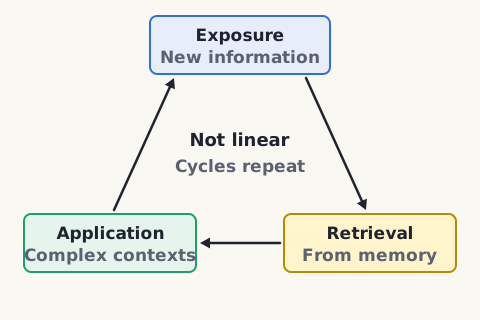
Exposure, retrieval, application
Effective learning requires three stages of engagement: exposure to new information, retrieval of that information from memory, and application in progressively complex contexts. It isn't linear — strong learning cycles through these repeatedly.
Re-reading Isn't Studying
Re-reading a chapter you've already highlighted counts as passive learning, not active or interactive — flashcards count as active retrieval, while teaching or debating the material counts as interactive.
Synapses Thicken With Practice
When repeated co-activation strengthens a learned pattern, the change is physical: the synapse connecting the neurons thickens and the signal between them travels faster.
Weak Wiring Without Recall
A student who rewatches a lecture five times but never quizzes herself builds only weak connections — without retrieval, the relevant neurons never fire, so the wiring stays weak.
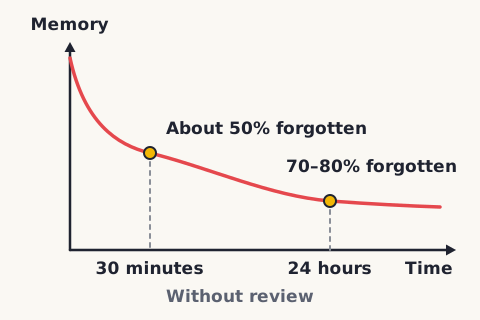
The forgetting curve (Ebbinghaus, 1885)
German psychologist Hermann Ebbinghaus was among the first to study memory decay scientifically. Without review, we forget about 50% of new information within 30 minutes and 70–80% within 24 hours. This exponential decay is the forgetting curve.
The First 30 Minutes
Without any review, roughly half of what you just learned is gone within 30 minutes — the steep opening plunge of the forgetting curve.
A Day Without Review
Left unreviewed, about 75% of newly learned information is gone within 24 hours — the forgetting curve's decay continues well past the first half hour.

Time Your First Review
Because the forgetting curve drops fastest right after learning, your first review is most valuable when it happens soon afterward — timing matters as much as total study time, and it's the basis for spaced repetition's expanding intervals.
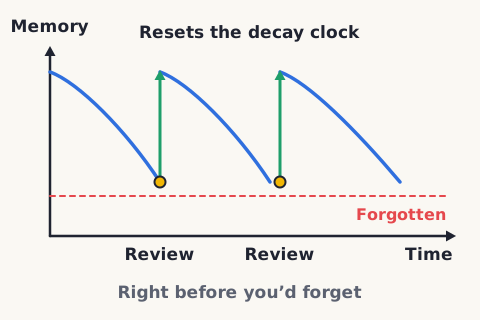
Beat Cramming With Timing
Reviewing material right before you'd forget it beats cramming the same amount of time in, because retrieving a memory at its weakest point forces more effortful encoding and resets the decay clock.
MIT's Low-Stakes Quiz Rule
MIT Open Learning draws a simple, practical implication from the testing effect: give students frequent low-stakes quizzes, since each one triggers retrieval and helps solidify learning.

A Week Later, Retrieval Wins
Karpicke and Roediger's 2008 study found that students who practiced retrieval retained significantly more material a week later than students who simply restudied the same material the same number of times.
Retrieval Works Everywhere
A 2011 study by Roediger and Butler confirmed that retrieval practice plays a critical role in long-term retention across a wide range of material types, not just vocabulary.

The Sweet Spot for Recall
Under the production effect, retrieval practice produces its biggest memory gains when the recall is difficult but ultimately successful — easy retrieval builds far weaker memory traces.
By the numbers
- Share of new information forgotten within 30 minutes, without review
- 50 %
- Share of new information forgotten within 24 hours, without review
- 75 %
Matched pairs
Each item on the left goes with the one on the right.
- Passive learning
- Observing, watching, reading — weak for retention
- Active learning
- Recalling, practicing, testing — reinforces neural pathways
- Interactive learning
- Teaching, debating, contributing — the deepest retrieval
- Anki / SuperMemo
- SRS apps that schedule reviews at the optimal interval
- Roediger & Butler (2011)
- Retrieval practice's critical role in long-term retention
- Karpicke & Roediger (2008)
- Science paper: the critical importance of retrieval for learning
Step by step
Schedule spaced-repetition reviews after first learning something
- Study the material once, actively, on day 0.
- Review after 1 day.
- Review again after 3 days.
- Review again after 7 days.
- Review again after 14 days, extending intervals as recall strengthens.
Each review slows the forgetting curve. SRS apps automate this by timing reviews to the optimal interval — the moment you're about to forget.
Self-test
Answer each question from memory, then check your work against the answer key.
1. Which principle states that synaptic connections between neurons strengthen when those neurons activate together?
- APiagetian assimilation
- BSkinnerian shaping
- CHebbian learning
- DPavlovian conditioning
2. At the cellular level, what physically changes when repeated co-activation strengthens a learned pattern?
- AThe neuron is replaced and a new one takes over the pattern
- BThe cell body enlarges and holds the pattern itself
- CThe firing threshold rises and signals slow down
- DThe synapse thickens and signals travel faster
3. Why does passive exposure to material rarely produce mastery, according to the Hebbian account?
- AThe neurons encoding it fire in the wrong order, so each exposure weakens the connection instead
- BThe neurons encoding it never fire during retrieval or use, so the connection doesn't strengthen
- CThe neurons encoding it fire too often during exposure, so the synapse fatigues and cannot strengthen
- DThe neurons encoding it fire in isolation, so there is no partner neuron for a synapse to form
4. Which is NOT an accurate statement about practice and repetition in the Hebbian view?
- APractice and repetition are merely motivational advice
- BRepeated co-activation makes connections structurally stronger
- CVaried application helps strengthen connections
- DPassive learning keeps activation low and connection-building weak
5. A student re-watches a lecture five times but never quizzes herself. Applying Hebbian learning, what best predicts her outcome?
- AWeak connection-building, because activation stays low without retrieval
- BStrong mastery, because each re-watch fires the encoding neurons again
- CGradual mastery, because exposure strengthens synapses as reliably as retrieval
- DNo lasting trace, because each re-watch overwrites the previous encoding
6. Which pair of activities defines the interactive mode of learning?
- ARecalling and practicing
- BRe-reading and re-watching
- CListening and observing
- DTeaching and debating
7. Recalling, practicing, and self-testing are the defining behaviors of which mode of learning?
- AInteractive learning
- BPassive learning
- CActive learning
- DExposure learning
8. Which activity belongs to passive learning rather than active or interactive learning?
- AQuizzing yourself with flashcards you wrote
- BRe-reading a chapter you already highlighted
- CDebating a claim with a classmate who disagrees
- DTeaching the concept to a peer who missed class
9. Ranked from weakest to strongest for retention, what is the correct order of the three modes?
- AInteractive → active → passive
- BInteractive → passive → active
- CPassive → active → interactive
- DActive → passive → interactive
10. What extra demand does interactive learning place on the learner beyond simply recalling a fact?
- ASpaced repetition — resting, recalling, and re-testing the fact
- BChunking — splitting, grouping, and relabeling the fact
- CDual coding — visualizing, verbalizing, and pairing the fact
- DSchema negotiation — integrating, defending, and adapting the fact
11. The forgetting curve decays steepest immediately after learning. What does Ebbinghaus's finding imply for how you should review?
- ALater reviews should come closer together as each one slows the decay
- BThe first review is most valuable when it happens soon after learning
- CA review adds the most once the material has decayed to a stable floor
- DEach review works best when spaced at the same interval as the last
12. Roughly what share of new information is lost within 30 minutes when it is never reviewed?
- A50%
- B90%
- C75%
- D25%
13. Without any review, approximately how much new information is gone after 24 hours?
- AAbout 50%
- BAbout 75%
- CAbout 30%
- DAbout 95%
14. Which researcher established the forgetting curve, and using what material?
- AHermann Ebbinghaus, using nonsense syllables
- BHermann Ebbinghaus, using foreign-language vocabulary
- CHenry Roediger, using nonsense syllables
- DHenry Roediger, using foreign-language vocabulary
15. According to Ebbinghaus, how does the rate of forgetting change across the first day after learning?
- AIt starts slow for several hours, then accelerates sharply
- BIt rises steadily and peaks around the end of the first day
- CIt holds one constant pace from the first minute onward
- DIt is steepest right after learning and slows thereafter
16. Spaced repetition distributes study sessions over what kind of intervals?
- AContracting intervals
- BUniform intervals
- CExpanding intervals
- DRandomized intervals
17. Why does reviewing material just before you would forget it beat the same total time spent cramming?
- ARetrieval at the memory's weakest point lets the old trace lapse and stores the answer as a brand-new memory
- BWaiting until the memory is nearly gone shrinks the amount that has to be re-encoded, so each pass is cheaper
- CRetrieval at the memory's weakest point forces effortful encoding and resets the decay clock
- DSpacing lets each trace consolidate before the next exposure, so passive re-reading lands on a settled memory
18. Which pair of tools is named as SRS (Spaced Repetition Software)?
- AAnki and Quizlet
- BSuperMemo and Duolingo
- CDuolingo and Quizlet
- DAnki and SuperMemo
19. On what basis does an SRS typically decide when to schedule a card's next review?
- AHow confidently you recalled it last time
- BHow long you spent answering it last time
- CHow recently the card was added to the deck
- DHow many other cards in the deck share its topic
20. You recall a card easily and another only with great difficulty. How should an SRS schedule them?
- ASooner review for the easy card, longer gap for the hard one
- BLonger gap for the easy card, sooner review for the hard one
- CSame gap for both cards, with the hard one shown first next session
- DSooner review for both cards, until each is recalled twice in a row
21. What practical implication does MIT Open Learning draw from the testing effect?
- AAdminister low-stakes quizzes frequently
- BWeight every quiz heavily in the final grade
- CReplace short quizzes with guided re-reading
- DKeep quiz questions easy for everyone
22. Retrieval practice is defined as strengthening memory by doing what?
- ARe-reading until it feels familiar rather than stopping after one pass
- BActively recalling information rather than re-exposing yourself to it
- CHighlighting key passages on each pass rather than reading every line
- DSpacing exposure across sessions rather than massing it into one block
23. What did Karpicke & Roediger (2008) show about students who practiced retrieval versus those who restudied?
- ARestudiers retained significantly more after one week
- BBoth groups retained roughly the same amount after one week
- CRetrieval practicers retained significantly more after one week
- DRestudiers retained significantly more after one day
24. Which study confirmed retrieval practice's critical role in long-term retention across a range of material types?
- AMIT Open Learning (2019)
- BKarpicke & Roediger (2008)
- CEbbinghaus (1885)
- DRoediger & Butler (2011)
25. When does retrieval practice produce its largest memory gains?
- AWhen retrieval is quick and successful
- BWhen retrieval is difficult but successful
- CWhen retrieval is difficult but unsuccessful
- DWhen retrieval is quick and unsuccessful
26. Per the testing effect, how often should low-stakes quizzes be given?
- AFrequently — the testing itself drives learning
- BRarely, so quizzes stay high-stakes
- CNever; re-reading works just as well
- DOnly once, right before the final
27. Why does frequent testing (not just re-reading) drive learning gains, per the testing effect?
- ATesting only works when high-stakes and graded
- BQuizzes mainly motivate through fear of failure
- CFrequent testing eliminates need for spaced repetition
- DBeing tested is itself the learning event
Go deeper
Answer key
- 1. C Hebbian learningHebbian learning is the principle summarized as 'neurons that fire together, wire together.' Pavlovian conditioning pairs stimuli, Skinnerian shaping rewards successive approximations, and Piagetian assimilation absorbs new information into an existing schema — none describes synaptic co-activation.
- 2. D The synapse thickens and signals travel fasterRepeated co-activation makes connections structurally stronger — the synapse thickens and signals travel faster. Learning strengthens existing connections rather than growing replacement neurons.
- 3. B The neurons encoding it never fire during retrieval or use, so the connection doesn't strengthenPassive learning keeps activation low, so the target neurons don't fire in the context of retrieval and the connection never wires. Exposure doesn't erase prior synapses — it simply fails to strengthen new ones.
- 4. A Practice and repetition are merely motivational advicePractice, repetition, and varied application are not motivational advice — they are the literal mechanism of biological change. The other three statements are all accurate.
- 5. A Weak connection-building, because activation stays low without retrievalRe-watching is passive: activation stays low and the neurons never fire in a retrieval context, so wiring is weak. Repetition only builds connections when the target neurons actually fire during recall or use.
- 6. D Teaching and debatingInteractive learning — teaching, debating, contributing — forces the deepest retrieval and negotiates your schema against other mental models.
- 7. C Active learningActive learning is defined as recalling, practicing, and testing — it reinforces neural pathways. Interactive learning goes further, adding teaching and debating.
- 8. B Re-reading a chapter you already highlightedPassive learning is observing, watching, and reading — re-reading fits squarely. Flashcards are active retrieval; teaching and debating are interactive.
- 9. C Passive → active → interactivePassive learning is weakest for retention, active learning reinforces neural pathways, and interactive learning demands the deepest retrieval — producing the most robust encoding.
- 10. D Schema negotiation — integrating, defending, and adapting the factTeaching and debating force schema negotiation: you must not only recall a fact but integrate it, defend it, and adapt it. That layered demand is what produces the most robust encoding.
- 11. B The first review is most valuable when it happens soon after learningDecay is fastest right after learning, so an early first review flattens the curve the most. Ebbinghaus showed the timing of review matters as much as total duration — the whole basis for spaced repetition's expanding intervals.
- 12. A 50%Ebbinghaus found about 50% of new information is gone within 30 minutes without review. Roughly 75% is the 24-hour figure, not the 30-minute one.
- 13. B About 75%Ebbinghaus's curve shows roughly 75% lost within 24 hours. About 50% is the 30-minute figure — the decay continues well past the first half hour.
- 14. A Hermann Ebbinghaus, using nonsense syllablesEbbinghaus ran self-experiments in the 1880s memorizing nonsense syllables — chosen precisely because they carried no prior meaning. Roediger and Karpicke are associated with the testing effect instead.
- 15. D It is steepest right after learning and slows thereafterEbbinghaus's curve is exponential, not linear: forgetting is fastest in the minutes and hours right after learning and slows from there. That early steepness is why a first review pays off most when it comes soon.
- 16. C Expanding intervalsSpaced repetition distributes sessions over expanding intervals, so each successful review buys a longer gap before the next. Fixed intervals ignore how the curve flattens with each review.
- 17. C Retrieval at the memory's weakest point forces effortful encoding and resets the decay clockYou are forcing retrieval at the moment the memory is weakest, which triggers a more effortful encoding process and resets the decay clock. Cramming isn't harmful in itself — it simply wastes the timing advantage.
- 18. D Anki and SuperMemoAnki and SuperMemo are the SRS pair — both algorithmically schedule each card at its optimal interval.
- 19. A How confidently you recalled it last timeSRS scheduling is typically based on how confidently you recalled the card last time: easier cards get longer gaps, harder cards come back sooner. Card length and topic grouping don't drive the interval.
- 20. B Longer gap for the easy card, sooner review for the hard oneEasier cards get longer gaps; harder cards are reviewed sooner. Identical gaps would waste time on material you already know while letting shaky material decay.
- 21. A Administer low-stakes quizzes frequentlyMIT Open Learning summarizes the implication simply: give students frequent low-stakes quizzes, which trigger retrieval and solidify learning.
- 22. B Actively recalling information rather than re-exposing yourself to itRetrieval practice means actively pulling information out of memory instead of re-exposing yourself to it — the mechanism behind the testing effect. Re-reading only confirms the information is accessible from the page.
- 23. C Retrieval practicers retained significantly more after one weekKarpicke & Roediger (2008) found self-testing students retained significantly more after a week than those who restudied the same material the same number of times — equal exposure, unequal retention.
- 24. D Roediger & Butler (2011)Roediger & Butler (2011) extended the finding beyond vocabulary to a range of material types. Karpicke & Roediger (2008) was the one-week restudy comparison; Ebbinghaus studied forgetting, not testing.
- 25. B When retrieval is difficult but successfulThis is the retrieval effort hypothesis: the effort of reconstructing an answer, when retrieval is difficult but successful, strengthens the memory trace most. Easy retrieval yields smaller gains, and a failed attempt lacks the successful reconstruction the effect depends on.
- 26. A Frequently — the testing itself drives learningMIT Open Learning's practical implication: frequent low-stakes quizzing works because being tested is itself the learning event, not just an assessment.
- 27. D Being tested is itself the learning eventMIT's practical implication: frequent low-stakes quizzing works because the act of being tested is itself the learning event, not merely an assessment of prior learning.
Image credits
- Exposure, retrieval, application: FlashFeed original diagram · CC-BY-4.0
- The forgetting curve (Ebbinghaus, 1885): FlashFeed original diagram · CC-BY-4.0
- Time Your First Review: AI-generated (gpt-image-1.5)
- Beat Cramming With Timing: FlashFeed original diagram · CC-BY-4.0
- A Week Later, Retrieval Wins: AI-generated (gpt-image-1.5)
- The Sweet Spot for Recall: AI-generated (gpt-image-1.5)