
Education Theory & Learning Technology study guide · Lesson 4 of 10
The Cognitive Science of Learning
Flow & dual coding · Connectivism & Gagné's events · UDL & memory techniques · Cognitive load
This is the lesson's study guide from the FlashFeed app, plus its key facts and a self-test.
What you'll be able to do
- Explain flow and the challenge-skill balance — including boredom, anxiety, autotelic engagement, and its 1975 origin.
- Explain Paivio's Dual Coding Theory and its two interconnected verbal and visual memory systems.
- Explain Sweller's Cognitive Load Theory: working memory's limit, the three load types of the 1998 formulation, and the 2010 recasting of germane load.
- Explain connectivism's 'know-where' claim and the gap it named, plus Gagné's five learning outcomes and first event of instruction.
- Explain UDL's three principles and the mnemonic techniques (Method of Loci, Keyword Method) that exploit dual coding.
Flow & dual coding
Two cognitive principles — one about emotional engagement, one about memory architecture — explain why the same learner can absorb material effortlessly in one context and struggle in another.
The challenge-skill balance
Mihaly Csikszentmihalyi described flow in 1975 as a state of complete psychological immersion: intense focus, effortless concentration, intrinsic enjoyment. The condition for reaching it is precise — task challenge must match the learner's skill. Tip the balance too far either way and flow collapses: too easy produces boredom; too hard produces anxiety. When the match is right, the activity becomes autotelic — rewarding in itself, not for any external payoff. Practically, this means calibrating difficulty in real time: a fixed syllabus delivered identically to every learner leaves most people in the wrong zone.
Dual Coding Theory, proposed by Allan Paivio in 1971, adds a second lever. Paivio's model holds that humans operate with two interconnected memory systems — verbal (language, text, narrative) and visual (imagery, spatial layout). Each system can encode information independently, but when both are engaged simultaneously, learning improves. A diagram paired with an explanation encodes in two channels; a wall of text encodes in one. Mnemonic images — vivid, concrete pictures linked to what you're trying to remember — are a deliberate exploitation of this dual-channel architecture.
Flow and dual coding are complementary: flow governs the motivational conditions under which learning happens at all; dual coding governs how information is encoded once attention is secured. Together they argue for lessons that are emotionally calibrated and multimodal.
Connectivism & Gagné's events
Two frameworks from opposite ends of the 20th-to-21st century transition — one a structured instructional sequence from the pre-digital era, one a network theory built for the internet age — together map the full range of what teaching has to manage.
Know-where beats know-that
Connectivism, developed by George Siemens and Stephen Downes in 2004–05, is sometimes called "the learning theory for the digital age." Its core move: learning is the process of creating connections between nodes in a network — people, books, databases, tools, AI systems. What you currently know matters less than knowing where to find information and being able to evaluate it critically. Older theories (behaviorism, cognitivism, constructivism) were built around learning stored inside the human mind; connectivism argued they failed to account for learning that occurs outside the mind, distributed across systems. In the AI era, the theory reads as prescient: educational value increasingly shifts toward know-where — accessing and evaluating sources — rather than memorizing content that's a search away.
Five kinds of learning outcome
Robert Gagné's Conditions of Learning (first published in 1965, with later editions) made a claim that sounds obvious once stated: different outcomes require different instruction. He named five categories — verbal information, intellectual skills, cognitive strategies, motor skills, and attitudes — and insisted each demands its own teaching approach. His Nine Events of Instruction operationalized this into a lesson sequence; the first event is to gain attention before any content is delivered, because unattended information is not encoded. Gagné's framework remains a backbone of instructional design precisely because it is modular: designers diagnose which outcome type a lesson targets and then select the corresponding event sequence, rather than applying a one-size method.
Together, Connectivism and Gagné span the theoretical and the procedural — what learning is, and how instruction should be built.
UDL & memory techniques
Curriculum design and memory encoding are often treated as separate concerns. They aren't — how a course is built determines whether students can access it, and how information is encoded determines whether it survives past the lesson.
Why vivid images stick
Mnemonic images — concrete, vivid mental pictures tied to target information — are far more durable in memory than abstract verbal representations. The reason connects back to Paivio: a vivid image activates the visual memory system while the linked word or concept activates the verbal system, encoding the item in two channels simultaneously. That is dual coding in action.
Two classic techniques exploit this. The Method of Loci (Memory Palace) originated in ancient Greece and Rome and works by placing items to be memorized at specific locations along a familiar mental route — a walk through your home, a commute. Retrieval is spatial: you walk the path and the items appear in sequence. The mechanism it exploits is spatial-episodic memory, a system humans evolved for navigation and that is exceptionally robust. The Keyword Method is a language-learning mnemonic that links a foreign word's sound to a memorable image which then bridges to its translation — "fork" in French is fourchette; picture a four (quatre) on a fork. Both methods work for the same reason: concrete, narrative, spatial material sticks; abstract lists don't.
Universal Design for Learning (UDL), developed by David Rose at CAST, addresses the access side. UDL is a neuroscience-based curriculum framework that builds flexibility in from the outset rather than retrofitting accommodations. Its three principles are Representation (how content is delivered), Action & Expression (how learners demonstrate knowledge), and Engagement — the principle that addresses the why of learning: motivation, relevance, and sustained effort. UDL treats variability as the norm, not the exception.
Cognitive load
Lesson 2 introduced working memory's capacity limit and chunking. Cognitive Load Theory (CLT) turns that limit into rules for designing instruction, and its central terms have been revised since they were first set out.
Sweller's theory
John Sweller gave the first full description of Cognitive Load Theory in a 1988 Cognitive Science article, "Cognitive Load During Problem Solving: Effects on Learning." He argued that schemas held in long-term memory are what separate experts from novices, and that conventional problem solving uses so much processing capacity that little is left for acquiring them. The theory's premise is that novel information is first processed by a working memory limited in capacity and duration, then stored in an unlimited long-term memory; once stored, those limits effectively disappear. George Miller's 1956 paper estimated working memory at about 7 ± 2 chunks. Nelson Cowan (2001) reviewed later evidence and argued that the limit averages nearer four chunks, so the exact figure remains debated.
Three types of load (the 1998 formulation)
In 1998, Sweller, van Merriënboer and Paas set out three categories of cognitive load in Educational Psychology Review. Intrinsic load comes from the complexity of the information itself: how many elements must be processed together, which also depends on what the learner already knows. Better presentation cannot reduce it; only changing what is to be learned, or the learner's expertise, can. Extraneous load comes from how information is presented and what the instruction makes the learner do, so redesign can cut it. Most of the theory's instructional effects, such as studying worked examples instead of solving conventional problems, work by reducing extraneous load. Germane load was defined as the mental resources devoted to building and automating schemas. In this classic formulation, germane load counted toward the total, and the prescription was to reduce extraneous load first, then promote germane load while keeping total load within working memory's limits.
The revision
Sweller revised the account in 2010. He argued that element interactivity, the number of elements that must be processed together, underlies extraneous load as well as intrinsic load, and that germane load can be defined in terms of intrinsic load. In the current formulation (Sweller, van Merriënboer and Paas, 2019), germane load is not a separate load that adds to the total. It refers to the working-memory resources devoted to intrinsic load rather than extraneous load, so only intrinsic and extraneous load remain as basic categories. The design advice survives in revised form: the more working memory extraneous load takes up, the less is left for the material's intrinsic complexity, and the less is learned.
Key terms
- Flow
- An optimal experience of complete psychological immersion in a task, marked by intense enjoyment and effortless concentration.
- Autotelic activity
- An activity that is intrinsically rewarding — done for its own sake, not for an external payoff. Central to Csikszentmihalyi's concept of flow, the peak state of full absorption when challenge matches skill.
- Dual Coding Theory
- Paivio's idea that humans have two interconnected memory systems — verbal and visual — and learning improves when both are engaged at once.
- Connectivism
- Siemens and Downes's 'learning theory for the digital age': learning is the process of creating connections between nodes in a network.
- Universal Design for Learning (UDL)
- A neuroscience-based curriculum framework (Rose, CAST) that builds flexibility into learning from the outset rather than adding accommodations afterward.
- Method of Loci (Memory Palace)
- An ancient technique that places items to be memorized at spatial locations along a familiar mental journey; walking the path retrieves them in sequence.
- Keyword Method
- A language-learning mnemonic that links a foreign word's sound to a memorable image which bridges to the translation.
- Cognitive Load Theory
- Sweller's theory (1988) that working memory has limited capacity, so instruction must manage how much mental load the material imposes.
- Intrinsic load
- The load that comes from the material's inherent complexity, which also depends on the learner's prior knowledge; design cannot remove it.
- Extraneous load
- Cognitive load created by poor instructional design — unnecessary complexity that should be eliminated.
- Germane load
- In CLT's 1998 formulation, mental resources devoted to building schemas, the load to promote; Sweller later recast it as resources spent on intrinsic load.
Key concepts
Allan Paivio
- This researcher's 1971 theory explains why a diagram paired with an explanation beats a wall of text.
- He proposed that humans run two interconnected memory systems — one verbal, one visual.
- His dual-coding model says engaging both channels at once improves learning; mnemonic images exploit it.
Stephen Downes
- This thinker co-created a framework billed as 'the learning theory for the digital age.'
- Working with a collaborator in 2004-05, he cast learning as forming connections between nodes in a network.
- His theory prized 'know-where' — locating and evaluating information — over memorizing content a search away.
Robert Gagné
- This theorist's 1965 book argued that different learning outcomes each need a different teaching approach.
- He named five outcome categories — verbal information, intellectual skills, cognitive strategies, motor skills, and attitudes.
- His 'Nine Events of Instruction' start by gaining attention before any content is delivered.
David Rose
- This researcher built a neuroscience-based curriculum framework at an organization called CAST.
- His approach designs in flexibility from the outset instead of retrofitting accommodations, treating learner variability as normal.
- Universal Design for Learning — Representation, Action & Expression, and Engagement — is his framework.
Key facts
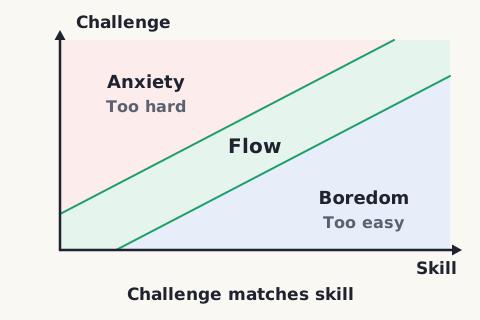
The challenge-skill balance
Mihaly Csikszentmihalyi described flow in 1975. Its condition is precise: task challenge must match the learner's skill. Too easy breeds boredom; too hard breeds anxiety; the balance produces flow.
Flow Is Autotelic
Flow theory calls an activity 'autotelic' when it's pursued purely because doing it is rewarding, with no outside payoff — like a student who keeps practicing piano long after the assignment is finished, simply because playing itself feels good.
Dual Coding's Origin
Allan Paivio proposed Dual Coding Theory in 1971 — distinct from Sweller's later Cognitive Load Theory (1988) and Gagné's earlier Conditions of Learning (1965).
Verbal Plus Visual
Dual Coding Theory holds that humans operate with two interconnected memory systems: a verbal system for language, text, and narrative, and a visual system for imagery and spatial layout.
Know-where beats know-that
Connectivism holds that knowing where to find information matters more than what you currently know. Knowledge is distributed across networks — people, books, databases, AI — not stored only in one mind. Prescient for the LLM era.
Five kinds of learning outcome
Gagné's Conditions of Learning named five outcome categories: verbal information, intellectual skills, cognitive strategies, motor skills, and attitudes. His point — each kind requires a different type of instruction.
Learning Outside the Mind
Connectivism's founders argued that behaviorism, cognitivism, and constructivism all locate learning inside the individual mind — missing the learning that happens in networks, organizations, and digital systems.
Gagné's First Event
Gagné's Nine Events of Instruction open by gaining the learner's attention, before informing them of objectives — the sequence ends by building retention and transfer.
Connectivism's Two Founders
George Siemens and Stephen Downes developed connectivism, 'the learning theory for the digital age,' around 2004–05 — after Gagné's 1965 Conditions of Learning and Sweller's 1988 load theory.
Why vivid images stick
Mnemonic images — concrete, vivid mental pictures — are far easier to recall than abstract words. Linking a target word to a similar-sounding or similar-meaning image fires both the verbal and visual systems at once: dual coding in action.
The Why of Learning
Universal Design for Learning organizes its three principles around what (Representation), how (Action & Expression), and why (Engagement) — the why being learner motivation and interest.
Loci and Spatial Memory
The method of loci works by exploiting the brain's strong spatial-episodic memory — placing facts along a familiar mental route, which is how memory champions manage to memorize thousands of digits.
The Keyword Method
The Keyword Method is a language-learning mnemonic that links a foreign word's sound to a bridging image — for example, picturing a four (quatre) on a fork to remember the French word fourchette.
An Ancient Memory Trick
The method of loci, or memory palace, originated in ancient Greece and Rome, where orators used it to hold long speeches in sequence — long before its Renaissance revival.
By the numbers
- Roughly how many chunks can working memory hold at once, per Miller's 1956 paper?
- 7 chunks
Matched pairs
Each item on the left goes with the one on the right.
- Allan Paivio (1971)
- Dual Coding Theory
- Siemens & Downes (2004–05)
- Connectivism
- Robert Gagné
- Nine Events of Instruction
- Representation (UDL)
- The 'what' — multiple means of presenting content
- Action & Expression (UDL)
- The 'how' — multiple ways to demonstrate knowledge
- Engagement (UDL)
- The 'why' — multiple means of motivation and interest
- Ancient Greece and Rome
- Origin of the method of loci
Step by step
Run Gagné's Nine Events of Instruction in order
- Gain attention (reception)
- Inform learners of objectives (expectancy)
- Stimulate recall of prior learning (retrieval)
- Present the content (selective perception)
- Provide learning guidance (semantic encoding)
- Elicit performance (responding)
- Provide feedback (reinforcement)
- Assess performance (retrieval)
- Enhance retention and transfer (generalization)
Gagné's nine events read like a design checklist for a well-architected tutoring session — each can be orchestrated by an LLM tutor at scale.
Self-test
Answer each question from memory, then check your work against the answer key.
1. In flow theory, what happens when a task's challenge far exceeds the learner's skill?
- AApathy
- BControl
- CAnxiety
- DBoredom
2. Mihaly **Csikszentmihalyi** described flow in ___. Its condition is precise: task **challenge must match the learner's skill**. Too easy breeds **boredom**; too hard breeds **anxiety**; the balance produces flow.
- A1975
- B1985
- C1971
- D1980
3. A student keeps practicing piano long after the assignment is finished, purely because playing itself is rewarding. Flow theory calls this kind of activity:
- AVicarious
- BExotelic
- CHabitual
- DAutotelic
4. In flow theory, what results when a task's challenge falls far below the learner's skill?
- AAnxiety
- BBoredom
- CBurnout
- DAutotelic engagement
5. Which state does Csikszentmihalyi's flow theory link to a task that is too easy?
- ACognitive load
- BAnxiety
- CAutotelic reward
- DBoredom
6. Who proposed Dual Coding Theory, and in what year?
- ARobert Gagné, 1965
- BAllan Paivio, 1971
- CJohn Sweller, 1988
- DGeorge Siemens, 2004
7. Dual Coding Theory holds that humans operate with which two interconnected memory systems?
- AEpisodic and semantic
- BImplicit and explicit
- CVerbal and visual
- DWorking and long-term
8. In Paivio's Dual Coding Theory, how do the verbal and visual memory systems relate to each other?
- AInterconnected, with each able to encode information on its own
- BInterconnected, with just the verbal system able to encode alone
- CInterconnected, with just the visual system able to encode alone
- DInterconnected, with both required to encode any information
9. A lesson pairs a labeled diagram with a spoken explanation. Under Dual Coding Theory, why does this pairing help learning?
- AIt encodes the material through both memory channels at once
- BIt merges the two channels into one stronger trace
- CIt splits the material so each channel encodes only half
- DIt encodes the material in the two channels one after the other
10. Per Dual Coding Theory, which of these encodes information in only ONE channel?
- AA captioned photograph
- BA wall of unbroken text
- CA labeled anatomy diagram
- DA mnemonic image for a word
11. In Cognitive Load Theory's classic 1998 formulation, which type of load should designers try to INCREASE?
- AGermane load
- BIntrinsic load
- CExtraneous load
12. Cognitive Load Theory — that working memory's limited capacity must be managed by instruction — was proposed by whom, and when?
- AAllan Paivio, 1971
- BGeorge Miller, 1956
- CJohn Sweller, 1988
- DRobert Gagné, 1965
13. In Miller's classic 1956 estimate, roughly how many items can working memory hold at once?
- A4
- B14
- C7
- D10
14. A slide is crammed with decorative animations and off-topic text that make the point harder to find. Which kind of cognitive load has the designer added?
- AIntrinsic load
- BGermane load
- CPerceptual load
- DExtraneous load
15. In Cognitive Load Theory, what sets the amount of intrinsic load a topic carries?
- AThe effort a learner spends building schemas
- BThe inherent complexity of the material
- CThe capacity of the learner's working memory
- DThe quality of the instructional design
16. Which technique exploits working memory's limit by grouping raw items into meaningful units?
- AChunking
- BScaffolding
- CSpaced repetition
- DMethod of Loci
17. Working memory's hard capacity limit is counted in which units?
- ASchemas
- BNodes
- CChannels
- DChunks
18. Per connectivism, where does educational value shift in the AI era?
- AToward know-why — explaining the causes behind each fact
- BToward know-where — accessing and evaluating information
- CToward know-how — building skills that transfer across tools
- DToward know-that — retaining facts a model might get wrong
19. What gap did connectivism claim older theories failed to address?
- ALearning that occurs outside the human mind, in networks and systems
- BLearning that arises from emotion, in feelings and motivation
- CLearning that is carried in the body, in movement and gesture
- DLearning that stays tacit, in habits too automatic to describe
20. Which is one of Gagné's five categories of learning outcomes?
- APerceptual abilities
- BVerbal reasoning
- CCognitive strategies
- DInterpersonal skills
21. What is the first of Gagné's Nine Events of Instruction?
- APresent content
- BGain attention
- CState objectives
- DStimulate recall
22. Connectivism, 'the learning theory for the digital age,' was developed by which pair, and in what year?
- ASiemens & Downes, 2004
- BAnderson & Krathwohl, 2001
- CGagné & Briggs, 1965
- DSweller & Chandler, 1988
23. Per connectivism, what matters most in the AI era compared to memorized facts?
- AMemorizing more facts than before
- BRelying solely on classroom instruction
- CAvoiding AI tools during study
- DKnowing where to find and evaluate information
24. What gap did Siemens and Downes say older learning theories missed?
- AHow motivation affects retention
- BThe difference between short- and long-term memory
- CLearning that happens outside the mind, across networks
- DThe role of feedback in classroom instruction
25. Gagné's Conditions of Learning named five outcome categories. Which is one?
- AMastery learning
- BAutotelic engagement
- CMotor skills
- DDual coding
26. What is the very first step in Gagné's Nine Events of Instruction?
- AProvide learning guidance
- BGain attention
- CAssess performance
- DEnhance retention and transfer
27. Which UDL principle addresses the 'why' of learning?
- AEngagement
- BRetention
- CRepresentation
- DAction & Expression
28. What memory strength does the method of loci exploit?
- APhonological working memory
- BProcedural motor memory
- CVerbal-semantic memory
- DSpatial-episodic memory
29. Which of these is NOT one of UDL's three principles?
- AAction & Expression
- BEngagement
- CRepresentation
- DReinforcement
30. What does the Keyword Method have a learner do?
- ALink a foreign word's sound to an image that bridges to its translation
- BMatch a task's difficulty to the learner's current skill so focus holds
- CPlace each item at a spot along a familiar mental route and walk it to recall
- DGroup a long list of words into a few meaningful units so working memory copes
31. Where did the Method of Loci (Memory Palace) originate?
- AAncient Babylon and Assyria
- BAncient Greece and Rome
- CAncient India and China
- DAncient Egypt and Persia
32. The Keyword Method links a foreign word's sound to which of these to aid recall?
- AA grammar conjugation pattern
- BA rote repetition drill
- CA vivid image that bridges to the translation
- DA spatial route through a familiar building
33. Which example illustrates the Keyword Method for learning a French word?
- ARepeating the word aloud ten times
- BWalking a familiar route to recall items in order
- CPicturing a four on a fork to remember "fourchette"
- DPairing a diagram with a spoken explanation
Go deeper
Answer key
- 1. C AnxietyChallenge above skill produces anxiety; challenge below skill produces boredom. Flow lives in the balance between the two.
- 2. A 1975
- 3. D AutotelicAutotelic means rewarding in itself, with no external payoff — the mark of flow. Exotelic describes activity pursued for an outside reward, the opposite case; vicarious describes learning by watching someone else act; habitual describes a routine done from repetition, not a reward structure.
- 4. B BoredomWhen challenge is far below skill, engagement collapses into boredom — the mirror-image failure mode to anxiety, which occurs when challenge exceeds skill.
- 5. D BoredomFlow theory holds that a task far easier than the learner's skill produces boredom, while one far harder produces anxiety.
- 6. B Allan Paivio, 1971Allan Paivio proposed Dual Coding Theory in 1971. Sweller (1988) gave us Cognitive Load Theory and Gagné (1965) the Conditions of Learning — different theories entirely.
- 7. C Verbal and visualPaivio's model pairs a verbal system (language, text, narrative) with a visual system (imagery, spatial layout). Episodic/semantic, working/long-term and implicit/explicit are all real memory distinctions, but none is the pair Dual Coding Theory is built on.
- 8. A Interconnected, with each able to encode information on its ownPaivio describes the verbal and visual systems as interconnected: each can encode information independently, and learning improves when both are engaged at once. They remain two systems rather than one merged trace, and neither recodes for or directs the other.
- 9. A It encodes the material through both memory channels at onceThe diagram engages the visual system while the spoken explanation engages the verbal one, so the same material is encoded twice, at the same time. The channels stay distinct: the material is neither split between them, merged into one trace, nor passed through them one after the other.
- 10. B A wall of unbroken textText alone engages just the verbal system. The other three each combine imagery with language, engaging both channels — the whole point of dual coding.
- 11. A Germane loadIn 1998, germane load was the resources spent building schemas, to promote once extraneous load (from poor design) was cut; intrinsic load comes from the material. Sweller later (2010) recast germane load as resources spent on intrinsic load.
- 12. C John Sweller, 1988Sweller advanced Cognitive Load Theory in 1988, building on the working-memory limit George Miller had quantified in 1956. Paivio's 1971 work is Dual Coding Theory, and Gagné's 1965 Conditions of Learning is an instructional-design framework.
- 13. C 7Miller's 1956 paper put working memory at about 7 ± 2 chunks. Cowan (2001) later argued the true limit is nearer 4, so the figure is debated, but 4 is the later estimate, not Miller's. 10 and 14 overshoot Miller's range.
- 14. D Extraneous loadExtraneous load is unnecessary complexity from poor instructional design, and should be cut. Germane load (1998 sense) is schema-building effort, intrinsic load comes from the material, and perceptual load is an attention-research term, not a CLT load type.
- 15. B The inherent complexity of the materialIntrinsic load comes from the inherent complexity of the material, relative to what the learner already knows; better design cannot remove it. Design quality governs extraneous load, schema-building effort is 1998-sense germane load, and working memory's limit is why load matters.
- 16. A ChunkingChunking exploits working memory's limit: grouping raw items into meaningful units (1-4-9-2 becomes 1492) reduces the slots they occupy. Spaced repetition spreads reviews over expanding intervals, scaffolding is temporary support, and the Method of Loci places items along a mental route.
- 17. D ChunksWorking memory holds a limited number of chunks of information at once, the meaningful units chunking creates. A schema is a stored framework for interpreting information, verbal and visual are dual coding's two channels, and nodes are the points in connectivism's network.
- 18. B Toward know-where — accessing and evaluating informationConnectivism argues the capacity to know where to find, evaluate, and contextualize information outweighs memorized facts — especially when an LLM can answer anything instantly.
- 19. A Learning that occurs outside the human mind, in networks and systemsSiemens and Downes argued behaviorism, cognitivism, and constructivism all locate learning inside the individual, missing learning that happens in networks, organizations, and digital systems.
- 20. C Cognitive strategiesGagné's five outcome categories are verbal information, intellectual skills, cognitive strategies, motor skills, and attitudes — each requiring a different type of instruction.
- 21. B Gain attentionThe sequence opens by gaining attention (reception), then informs learners of objectives, and ends by enhancing retention and transfer.
- 22. A Siemens & Downes, 2004George Siemens and Stephen Downes developed connectivism in 2004–05, starting from Siemens's 2004 paper. Anderson and Krathwohl's 2001 revision of Bloom's taxonomy, Gagné's 1965 Conditions of Learning and Sweller's 1988 load theory all predate the network framing.
- 23. D Knowing where to find and evaluate informationConnectivism's core claim is that knowing where to find information — the 'know-where' — outweighs knowing the facts themselves, especially now that AI can answer instantly.
- 24. C Learning that happens outside the mind, across networksConnectivism argued behaviorism, cognitivism, and constructivism only accounted for learning inside an individual mind, missing learning distributed across networks and systems.
- 25. C Motor skillsGagné's five learning-outcome categories are verbal information, intellectual skills, cognitive strategies, motor skills, and attitudes.
- 26. B Gain attentionGagné's sequence opens by gaining attention, since information that goes unattended is never encoded in the first place.
- 27. A EngagementUDL's three principles map to what (Representation), how (Action & Expression), and why (Engagement) — the why being motivation and interest.
- 28. D Spatial-episodic memoryBy placing information along a familiar route, the method of loci leverages the brain's strong spatial-episodic memory — which is why memory champions use it to memorize thousands of digits.
- 29. D ReinforcementUDL's three principles are Representation (the what), Action & Expression (the how), and Engagement (the why). Reinforcement belongs to behaviorism, not UDL.
- 30. A Link a foreign word's sound to an image that bridges to its translationThe Keyword Method is a language mnemonic — e.g. picturing a four (quatre) on a fork for fourchette. Placing items along a route is the Method of Loci, a different technique.
- 31. B Ancient Greece and RomeThe Method of Loci comes from ancient Greece and Rome, where orators used it to hold long speeches in sequence. It long predates the Renaissance revival of the technique.
- 32. C A vivid image that bridges to the translationThe Keyword Method links a foreign word's sound to a memorable image that then bridges to its translation — a different mechanism than the Method of Loci's spatial route.
- 33. C Picturing a four on a fork to remember "fourchette"This Keyword Method example links the sound of "fourchette" (fork) to a picture of a four (quatre) on a fork, bridging sound to translation via imagery.
Sources
- Sweller (1988), Cognitive Load During Problem Solving: Effects on Learning, Cognitive Science 12(2):257-285 — doi.org/10.1207/s15516709cog1202_4
- Sweller, van Merriënboer & Paas (1998), Cognitive Architecture and Instructional Design, Educational Psychology Review 10:251-296 — doi.org/10.1023/A:1022193728205
- Sweller (2010), Element Interactivity and Intrinsic, Extraneous, and Germane Cognitive Load, Educational Psychology Review 22:123-138 — doi.org/10.1007/s10648-010-9128-5
- Sweller, van Merriënboer & Paas (2019), Cognitive Architecture and Instructional Design: 20 Years Later, Educational Psychology Review 31:261-292 — doi.org/10.1007/s10648-019-09465-5
- Cowan (2001), The magical number 4 in short-term memory, Behavioral and Brain Sciences 24(1):87-114 — doi.org/10.1017/S0140525X01003922
- Debue & van de Leemput (2014), What does germane load mean? Frontiers in Psychology — pmc.ncbi.nlm.nih.gov/articles/PMC4181236/
- Lavie et al. (2004), Load theory of selective attention and cognitive control (PubMed) — pubmed.ncbi.nlm.nih.gov/15355143/
- Education Theory & Learning Technology — research compilation (Perplexity)
- Positive Psychology — Flow Theory (Autotelic Experience) — positivepsychology.com/flow-theory/
- Miller (1956), The Magical Number Seven, Plus or Minus Two, Psychological Review 63(2):81-97 — doi.org/10.1037/h0043158
Image credits
- The challenge-skill balance: FlashFeed original diagram · CC-BY-4.0