
Education Theory & Learning Technology study guide · Lesson 5 of 10
Instructional Design Frameworks
The ADDIE model · ID frameworks & the Socratic method
This is the lesson's study guide from the FlashFeed app, plus its key facts and a self-test.
What you'll be able to do
- Identify ADDIE's origin and sequence its five phases, matching Analyze, Design, and Develop to their functions.
- Explain how the Evaluate phase threads through all of ADDIE rather than acting as a final gate.
- Match the major instructional-design frameworks (Dick & Carey, SAM, Merrill, UbD) to their defining approach.
- Distinguish backward design (Wiggins & McTighe's UbD) from Cathy Moore's Action Mapping.
- Explain the Socratic method and how Khanmigo embodies it through guided questioning rather than direct answers.
The ADDIE model
ADDIE is the bedrock framework of instructional systems design (ISD) — a structured, repeatable process that has shaped how training is built across military, corporate, and academic settings for fifty years.
Where ADDIE came from
ADDIE was developed in 1975 at Florida State University's Center for Educational Technology, commissioned by the U.S. Army to bring engineering-style rigor to training production. The acronym maps to five sequential phases: Analyze, Design, Develop, Implement, and Evaluate. In the Analyze phase you identify goals, audience, prior knowledge, and constraints. Design is where you define objectives, assessment strategy, sequencing, and modalities. Develop is the build phase — you produce the actual content, activities, and assessments. Implement is delivery; Evaluate is the continuous quality check. Crucially, Evaluate is not a final gate — it threads through all phases, surfacing problems early rather than waiting until after delivery.
The rigidity criticism
ADDIE's dominant critique is that its linear structure is too rigid for the rapid, AI-enabled content cycles that modern teams run. Moving sequentially through five phases can mean weeks pass before any learner interaction surfaces a design flaw. That friction is exactly what pushed the field toward more iterative alternatives — most notably SAM (Successive Approximation Model), which shortens feedback loops by cycling through prototyping and revision earlier. ADDIE still dominates when stakes are high and thorough documentation is required — government and compliance training, for example — but for shorter-horizon projects the rigidity cost is real. Knowing the critique matters: it tells you which context ADDIE fits and which calls for something faster.
ID frameworks & the Socratic method
Beyond ADDIE, the instructional design field has produced a cluster of influential frameworks — each a different answer to "what should drive the design process?" — and the Socratic method offers a contrasting philosophical anchor for how learning actually happens.
Khanmigo, by design
Sal Khan built Khanmigo to operationalize Socratic principles at scale: the AI tutor guides students through problems with probing questions rather than surfacing the answer directly. That design choice is not aesthetic — it reflects a well-supported constructivist finding: knowledge a learner constructs through guided questioning encodes more durably than knowledge merely received. The Socratic method, formally, is teaching through strategic questions that force the learner to surface and examine their own reasoning, yielding the insight independently. Khanmigo is one of the clearest recent attempts to embed that dynamic in an AI product.
The broader landscape of ID frameworks the quizzes draw from:
- Dick & Carey Model (1978) — a systems view that treats instruction as nine interacting components rather than phases.
- SAM (2012) — Michael Allen's iterative counterpoint to ADDIE; rapid prototyping, short cycles.
- Merrill's Principles of Instruction (2002) — task-centered "first principles" of effective design: problem-centered, activation, demonstration, application, integration.
- Understanding by Design / UbD (1998) — Wiggins and McTighe's backward design approach: start from the desired learning outcomes, then work back to assessments, then to instruction.
- Action Mapping (2008) — Cathy Moore's performance-focused method that strips out "nice to know" content and designs entirely around what learners must actually do on the job.
The clearest differentiator to hold: backward design belongs to Wiggins and McTighe's UbD; Action Mapping belongs to Cathy Moore.
Key terms
- ADDIE
- An instructional systems design framework structured as five phases: Analyze, Design, Develop, Implement, and Evaluate.
- Backward design
- Wiggins and McTighe's approach in Understanding by Design: start from the desired learning outcomes, then work back to assessments and instruction.
- Action Mapping
- Cathy Moore's 2008 performance-focused method that strips out 'nice to know' content and designs around what learners must actually do.
- The Socratic method
- Teaching through guided, probing questions rather than direct answers, so the learner constructs the insight independently — yielding deeper encoding.
Key concepts
SAM (Successive Approximation Model)
- Michael Allen built this framework in 2012 as a direct counterpoint to a decades-old linear model.
- It attacks the rigidity of phase-by-phase design by cycling through prototyping and revision far earlier.
- Its entire selling point is rapid prototyping and short, repeated feedback loops.
Dick & Carey Model
- This 1978 framework takes a systems view of instruction.
- Rather than sequential phases, it treats instruction as a set of interacting components.
- Precisely, it models instruction as nine interacting components working together as a system.
Merrill's Principles of Instruction
- Published in 2002, this framework distills effective teaching into a short set of 'first' fundamentals.
- It is task-centered and problem-centered at its core.
- Its five pillars: problem-centered, activation, demonstration, application, and integration.
Understanding by Design (UbD)
- Wiggins and McTighe introduced this framework in 1998.
- Its signature move is 'backward design': begin from the desired learning outcomes.
- You work back from target outcomes to assessments, and only then to the instruction itself.
Action Mapping
- Cathy Moore introduced this performance-focused method in 2008.
- It ruthlessly strips out 'nice to know' content.
- It designs a course entirely around what learners must actually do on the job.
Key facts
Where ADDIE came from
ADDIE was developed in 1975 at Florida State University's Center for Educational Technology — for the U.S. Army. Decades later it remains the dominant instructional systems design (ISD) framework worldwide. The name is just an acronym for its five phases.
The rigidity criticism
ADDIE's main knock: some consider it too rigid for the rapid, AI-enabled content cycles teams now run. The linear roots show. That critique is exactly what spawned faster, more iterative alternatives like SAM.
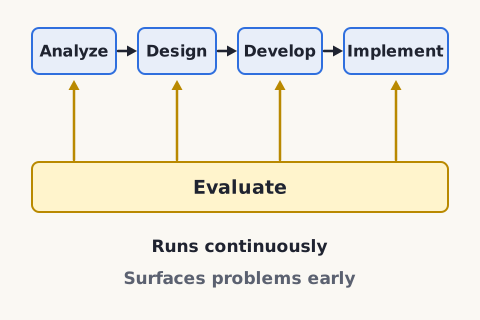
Evaluate Never Stops
ADDIE's Evaluate phase isn't a final gate — it runs continuously through Analyze, Design, Develop, and Implement, surfacing problems early instead of waiting until after delivery.
ADDIE Starts With Analyze
ADDIE's front-end Analyze phase is where a team identifies goals, audience, prior knowledge, and constraints — before Design sets objectives, assessment, and sequencing.
ADDIE's Build Phase
In ADDIE's Develop phase, a team produces the actual videos, activities, and quiz items planned during Design — turning objectives and sequencing into finished material.

Khanmigo, by design
Sal Khan built Khanmigo to embody Socratic principles: it guides students through their learning rather than just handing over answers. That operationalizes a constructivist insight — knowledge a learner builds is more durable than knowledge merely received.
Start From the End
Understanding by Design (Wiggins & McTighe, 1998) is the framework built on 'backward design' — starting from the outcomes learners should achieve and working back from there.

ADDIE's Agile Answer
SAM — Michael Allen's Successive Approximation Model (2012) — is the iterative counterpoint to ADDIE, built on rapid, agile prototyping and short revision cycles.
Merrill's First Principles
Merrill's Principles of Instruction (2002) offer task-centered 'first principles' of design — problem-centered, activation, demonstration, application, and integration — rather than a systems view of instruction.
Nine Parts, Not Phases
The Dick & Carey Model (1978) treats instruction as nine interacting components rather than a set of sequential phases, making it a more prescriptive systems view than ADDIE.
Matched pairs
Each item on the left goes with the one on the right.
- Analyze (ADDIE)
- Identify goals, audience, prior knowledge, and constraints
- Design (ADDIE)
- Define objectives, assessment, sequencing, and modalities
- Develop (ADDIE)
- Build the content, activities, and assessments
- Dick & Carey Model (1978)
- Systems-theory approach; more prescriptive than ADDIE
- SAM (2012)
- Rapid, agile prototyping; explicitly iterative
- Merrill's Principles (2002)
- Task-centered 'first principles' of effective design
- Understanding by Design (1998)
- Backward design — start from desired outcomes
Step by step
Work through the five ADDIE phases in order
- Analyze — identify learning goals, audience, existing knowledge, and constraints.
- Design — define objectives, assessment strategy, content sequencing, and modalities.
- Develop — build the actual content, activities, and assessments.
- Implement — deliver the instruction to learners.
- Evaluate — assess effectiveness, both during development and after delivery.
In modern practice, evaluation feeds back into every other phase rather than waiting until the end.
Self-test
Answer each question from memory, then check your work against the answer key.
1. Where and in what year was ADDIE developed?
- AUniversity of Pittsburgh's Learning Research and Development Center, 1985
- BIndiana University's Department of Instructional Systems Technology, 1978
- CSyracuse University's Center for Instructional Development, 1972
- DFlorida State University's Center for Educational Technology, 1975
2. Which organization commissioned the work that produced ADDIE?
- AThe U.S. Army
- BThe Marine Corps
- CThe Air Force
- DThe U.S. Navy
3. Which ADDIE phase is where you identify goals, audience, prior knowledge, and constraints?
- ADesign
- BDevelop
- CAnalyze
- DImplement
4. A team has just finished ADDIE's Analyze phase. Which phase comes next, and what does it involve?
- ADesign — produce the content, activities, and assessments
- BDesign — define objectives, assessment strategy, sequencing, and modalities
- CDevelop — define objectives, assessment strategy, sequencing, and modalities
- DDevelop — produce the content, activities, and assessments
5. A team has finished planning objectives and sequencing, and is now producing the actual videos, activities, and quiz items. Which ADDIE phase is this?
- AAnalyze
- BDesign
- CDevelop
- DImplement
6. How does the Evaluate phase function in the ADDIE model?
- AIt threads through all five phases, surfacing problems early rather than only at the end
- BIt replaces the Analyze phase in modern iterative versions
- CIt is optional and usually skipped for high-stakes compliance training
- DIt is a single final gate performed only after the course is delivered
7. What is the main benefit of running ADDIE's Evaluate phase continuously?
- AThe five phases blend into one cycle rather than a sequence
- BLearner delivery starts earlier rather than after the build phase
- CThorough documentation becomes optional rather than required
- DDesign flaws surface early rather than after delivery
8. Which of ADDIE's five phases is described as the continuous quality check rather than a discrete step?
- ADevelop
- BEvaluate
- CAnalyze
- DImplement
9. A team builds a full course and collects no feedback of any kind until after launch day. Which ADDIE principle did they violate?
- AEvaluate should thread through every phase, not act as a final gate
- BImplement should run as a continuous loop, not as a discrete delivery step
- CDevelop should begin before objectives are set, not wait for Design
- DAnalyze should repeat at the end of every phase, not run once up front
10. How does ADDIE's Evaluate differ from a conventional final quality gate?
- AIt is cumulative, carrying its findings forward into the next project
- BIt is continuous, feeding findings back into the earlier phases
- CIt is prototype-led, testing rough drafts with learners before the build
- DIt is front-loaded, scoping audience and constraints before any design
11. Which framework is defined by rapid, agile prototyping and explicitly iterative cycles?
- AUbD (1998)
- BADDIE (1975)
- CARCS (1987)
- DSAM (2012)
12. Merrill's Principles of Instruction (2002) is best described as which of the following?
- APerformance-focused design that strips out 'nice to know' content
- BSystems-based view of instruction as interacting components
- CTask-centered 'first principles' of effective design
- DPrototype-driven process built on rapid, short revision cycles
13. Which framework treats instruction as nine interacting components rather than a set of phases?
- AMoore's Action Mapping
- BDick & Carey Model
- CMerrill's Principles
- DUnderstanding by Design
14. A team wants to begin from the outcomes learners should achieve, then work back to assessments and only then to instruction. Which framework fits?
- AMerrill's First Principles
- BDick and Carey Model
- CUnderstanding by Design
- DSuccessive Approximation Model
15. Which framework-to-approach pairing is NOT correct?
- ASAM (2012) — a linear, phase-by-phase process built for thorough documentation
- BMerrill's Principles (2002) — a task-centered process built on first principles of effective design
- CUnderstanding by Design (1998) — a backward-design process built back from desired outcomes
- DDick & Carey Model (1978) — a systems process built from nine interacting components
16. Which framework is built on 'backward design'?
- AFirst Principles of Instruction (Merrill)
- BSystematic Design of Instruction (Dick & Carey)
- CSuccessive Approximation Model (Allen)
- DUnderstanding by Design (Wiggins & McTighe)
17. Action Mapping (2008) is the work of which designer?
- ACathy Moore
- BMichael Allen
- CGrant Wiggins
- DRobert Gagné
18. Which describes Action Mapping's defining move?
- ACycle through 'successive approximations' of a prototype in short, repeated loops
- BBuild every lesson on task-centered 'first principles' of effective design
- CStrip out 'nice to know' content and design around what learners must do on the job
- DStart from desired learning outcomes and work 'backward' to assessments, then instruction
19. A designer names the outcomes learners should achieve, then writes the assessments that would prove them, then plans the lessons. Which approach is this?
- APerformance-led design
- BPrototype-led design
- CTask-centered design
- DBackward design
20. Which statement correctly distinguishes the two approaches?
- ABackward design starts from on-the-job performance; Action Mapping starts from desired learning outcomes
- BBackward design starts from desired learning outcomes; Action Mapping starts from on-the-job performance
- CBackward design starts from rapid prototypes; Action Mapping starts from nine interacting components
- DBackward design starts from nine interacting components; Action Mapping starts from rapid prototypes
21. The Socratic method teaches primarily by which means?
- ACollaborative projects in which learners negotiate a shared interpretation
- BWorked examples that model expert reasoning before learners attempt their own
- CReflective journals in which learners record and revisit their own reasoning
- DStrategic questions that make learners surface and examine their own reasoning
22. Who built Khanmigo to operationalize Socratic principles at scale?
- ANick Pelling
- BDavid Rose
- CSal Khan
- DJohn Warner
23. How is Khanmigo designed to respond when a student is stuck on a problem?
- ASet a similar problem for them to attempt on their own
- BGuide them through it with probing questions
- CShow the worked solution, then let them retry it unaided
- DLet them pick a hint, an example, or the full answer
24. Khanmigo's question-first design reflects which constructivist finding?
- AKnowledge constructed through guided questioning encodes more durably than knowledge merely received
- BLearners retain more when content matches their preferred modality
- CGiving answers immediately lowers cognitive load and so improves retention
- DRetention depends mainly on total time spent on task
25. Which is NOT characteristic of the Socratic method?
- APressing the learner with a run of pointed, strategic questions
- BMaking the learner reach the insight through their own effort
- CDelivering the conclusion directly so the learner can memorize it
- DForcing the learner to expose the gaps in their own reasoning
Go deeper
Answer key
- 1. D Florida State University's Center for Educational Technology, 1975ADDIE was developed in 1975 at Florida State University's Center for Educational Technology. 1978 is the Dick & Carey Model's date, not ADDIE's.
- 2. A The U.S. ArmyThe U.S. Army commissioned ADDIE to bring engineering-style rigor to training production. The other services were not the commissioning body.
- 3. C AnalyzeAnalyze is the front-end phase that establishes goals, audience, prior knowledge, and constraints. Design comes next and instead defines objectives, assessment, and sequencing.
- 4. B Design — define objectives, assessment strategy, sequencing, and modalitiesDesign follows Analyze, and it is where objectives, assessment strategy, sequencing, and modalities are set. Producing the actual content is Develop, the phase after Design.
- 5. C DevelopDevelop is the build phase — producing the content, activities, and assessments. Implement would be delivering that finished material to learners.
- 6. A It threads through all five phases, surfacing problems early rather than only at the endADDIE's Evaluate is not a final gate — it runs continuously through Analyze, Design, Develop, and Implement, catching design flaws early instead of waiting until after delivery.
- 7. D Design flaws surface early rather than after deliveryContinuous evaluation catches problems while they are still cheap to fix, instead of waiting until learners have already received the course. It does not merge or reorder the other four phases, and it does not lighten the documentation ADDIE is valued for.
- 8. B EvaluateEvaluate is ADDIE's continuous quality check — it threads through the other phases instead of running once. Implement, by contrast, is the discrete delivery step.
- 9. A Evaluate should thread through every phase, not act as a final gateDeferring all feedback to after launch treats Evaluate as a final gate, which is exactly what ADDIE says it is not. The other options are not ADDIE principles at all: Analyze runs once up front, Develop waits for Design's objectives, and Implement is the discrete delivery step.
- 10. B It is continuous, feeding findings back into the earlier phasesA final gate runs once at the end; ADDIE's Evaluate runs throughout and returns findings to earlier phases of the same project. It is not a one-off front-end step, and it is not limited to compliance work.
- 11. D SAM (2012)SAM, Michael Allen's Successive Approximation Model, is the iterative counterpoint to ADDIE, built on rapid prototyping and short revision cycles.
- 12. C Task-centered 'first principles' of effective designMerrill's Principles are task-centered 'first principles' — problem-centered, activation, demonstration, application, integration. The nine-component systems view is Dick & Carey.
- 13. B Dick & Carey ModelThe Dick & Carey Model (1978) takes a systems view of instruction as nine interacting components, and is more prescriptive than ADDIE.
- 14. C Understanding by DesignUnderstanding by Design (1998) is built on exactly this outcome-first, work-backward sequence. The Successive Approximation Model (SAM) would instead push them toward early prototyping.
- 15. A SAM (2012) — a linear, phase-by-phase process built for thorough documentationSAM is rapid, agile, explicitly iterative prototyping; the linear, documentation-heavy description belongs to ADDIE, the model SAM was built as a counterpoint to.
- 16. D Understanding by Design (Wiggins & McTighe)Understanding by Design (1998) is the framework that defines backward design — starting from desired learning outcomes and working back.
- 17. A Cathy MooreAction Mapping is Cathy Moore's performance-focused method. Michael Allen created SAM, Grant Wiggins co-created Understanding by Design with Jay McTighe, and Robert Gagné's contribution is the Nine Events of Instruction.
- 18. C Strip out 'nice to know' content and design around what learners must do on the jobAction Mapping is performance-focused: cut the 'nice to know' and design around real on-the-job actions. Starting from outcomes and working back is backward design (UbD); task-centered first principles are Merrill's; successive-approximation prototype loops are SAM's.
- 19. D Backward designThis outcomes → assessments → instruction order is backward design, from Wiggins and McTighe's Understanding by Design. Performance-focused design (Action Mapping) would instead start from required on-the-job performance; task-centered design is Merrill's and rapid prototyping is SAM's.
- 20. B Backward design starts from desired learning outcomes; Action Mapping starts from on-the-job performanceBackward design (Wiggins & McTighe, UbD 1998) works back from desired learning outcomes; Action Mapping (Cathy Moore, 2008) starts from required on-the-job performance.
- 21. D Strategic questions that make learners surface and examine their own reasoningThe Socratic method is teaching through probing questions so learners reach the insight themselves. Journals, worked examples and group projects are other ways to engage reasoning, but none is the Socratic method's means.
- 22. C Sal KhanSal Khan built Khanmigo. Chrisman Frank founded Synthesis, a rival AI tutor; Stephen Downes co-developed connectivism; John Warner is the critic who reviewed Brave New Words.
- 23. B Guide them through it with probing questionsKhanmigo guides students through problems with probing questions rather than surfacing the answer — that is the Socratic design choice. Walking them through a worked solution, swapping in an easier task or re-explaining the concept all hand over what Khanmigo withholds.
- 24. A Knowledge constructed through guided questioning encodes more durably than knowledge merely receivedThe design rests on the finding that knowledge a learner constructs through guided questioning encodes more durably than knowledge simply handed over. Modality preference is not the supported claim here.
- 25. C Delivering the conclusion directly so the learner can memorize itHanding over the conclusion is the opposite of the Socratic method, which presses the learner with questions, forces them to examine their own reasoning and leaves them to reach the insight themselves.
Image credits
- Evaluate Never Stops: FlashFeed original diagram · CC-BY-4.0
- Khanmigo, by design: AI-generated (gpt-image-1.5)
- ADDIE's Agile Answer: AI-generated (gpt-image-1.5)