
Education Theory & Learning Technology study guide · Lesson 7 of 10
The Modern EdTech Landscape
The AI platform taxonomy · Platform deep-dives · Does AI tutoring work? · The adaptive-learning market
This is the lesson's study guide from the FlashFeed app, plus its key facts and a self-test.
What you'll be able to do
- Classify AI-in-education products into the seven functional categories by what each actually does.
- Describe how the flagship platforms work — Khanmigo's Socratic method and scale, Duolingo BirdBrain, Synthesis's origin — and define adaptive learning.
- Evaluate the RCT evidence for AI tutoring, comparing LearnLM, human-tutor, and static-hint success rates and who benefits most.
- Quantify the adaptive-learning market and the major 2025 EdTech deals and investment.
- Match each named platform (Khanmigo, Duolingo, MagicSchool, Synthesis, NotebookLM) to its edtech category.
The AI platform taxonomy
The AI-in-education space has fragmented into at least seven distinct functional categories — and which category a product belongs to matters more than any surface-level "AI tutor" label.
Mapping the AI-in-education space
The easiest way to cut through the hype is to ask what a product actually does rather than what it claims to be. The seven categories break down by audience and function. AI Tutors (Khanmigo, Synthesis, LearnLM) offer adaptive, conversational 1:1 instruction — the closest digital analog to a personal teacher. Teacher Tools (MagicSchool, Diffit) target lesson planning, rubric generation, and administrative reduction, keeping the human educator central. Language Learning (Duolingo, Lingokids) uses adaptive vocabulary sequencing and conversation practice to replace rote flashcards and grammar drills. Research Assistants (NotebookLM, Perplexity) perform document synthesis and multi-source knowledge retrieval — Google NotebookLM is the canonical example in this category. Enterprise / Workforce platforms (Sana, Coursera, Udemy, Multiverse) focus on upskilling and corporate training where measurable job-readiness matters to the buyer. Assessment & Analytics tools (Gradescope, Eedi, MagicQuizzes) handle progress tracking and formative assessment, surfacing where a class is collectively lost. Micro / Game Learning (Kahoot, Blooket, Synthesis Teams) delivers game-based, challenge-driven engagement — primarily as a consolidation or motivation layer rather than primary instruction. Knowing which bucket a tool belongs to tells you what evidence to demand before adopting it, because each category has different quality benchmarks, failure modes, and instructional design assumptions.
Platform deep-dives
Five platforms illustrate the range of bets being placed on AI in education — from a Socratic K-12 tutor to a document-synthesis tool that anyone can wire into a custom learning assistant.
Khanmigo
Khanmigo is Khan Academy's AI tutor, powered by GPT-4. Its defining pedagogical choice is the Socratic method: the system is deliberately designed to refuse direct answers, instead responding with guiding questions that push students to construct understanding themselves. This approach aligns with decades of evidence that retrieval and generation outperform passive answer-reading. It's the only AI tool integrated with Khan Academy's full content library across math, humanities, coding, and social studies, and by the 2024–25 academic year it was serving 700,000 K-12 students. Khan Academy is explicit that Khanmigo is positioned as a teacher assistant, not a replacement.
Duolingo: BirdBrain and Max
Duolingo's proprietary BirdBrain model is an adaptive learning system — software that adjusts content, sequence, and difficulty in real time based on each learner's performance history. BirdBrain orchestrates the full lesson experience; the freemium Duolingo Max tier (GPT-4 powered) sits on top of it, adding roleplay scenarios, an 'Explain My Answer' feature, and a Lily chat mode for open conversation practice. The strategic payoff beyond personalization is throughput: AI lets Duolingo expand its language library without hitting the human-content bottleneck that constrained older courseware companies.
MagicSchool AI
MagicSchool AI is a teacher-tools platform that reached 2+ million educators and 4,000+ schools within its first year of operation — fast adoption relative to most edtech cycles. A $45M Series B (2025) is funding the transition from a loose "collection of tools" into a connected teaching system, with Studio Mode, MagicQuizzes, Class Writing Feedback, and a Knowledge layer forming the backbone. Its competitive differentiation comes from safety and district-level trust: the integrations with LMS platforms and alignment to district policies are what get it through procurement, not just feature count.
Synthesis
Synthesis was built for the SpaceX employee school and founded by Chrisman Frank. It is an adaptive K-6 math platform with a voice-guided interface and visual math representations, deliberately favoring conceptual understanding over rote drilling. A family subscription runs ~99/year. By 2025 it was on pace for 10M+ in revenue, with subscribed students up 4.5x year-over-year — growth that suggests strong retention, not just trial-driven spikes. The SpaceX origin is notable because it explains Synthesis's design DNA: the platform was built around problem-solving and collaboration, not test prep.
Google NotebookLM
NotebookLM occupies the Research Assistants category. It ingests documents — PDFs, YouTube videos, web pages — and builds a source-grounded knowledge base that users can query for synthesis, chat, and multi-modal output including text summaries, audio podcasts, and slide outlines. The key technical characteristic is that responses are grounded in the provided sources, which substantially reduces hallucination risk compared to general-purpose LLM chat for domain-specific work. Builders use it to spin up custom learning assistants around proprietary material without needing to fine-tune a model — making it unusually accessible for institutions that can't afford custom AI development.
Does AI tutoring work?
The evidence base is growing faster than it can be properly synthesized — but three rigorous studies from 2024–2026 and one broad meta-analysis give the clearest picture so far.
What the meta-analysis shows
Broad meta-analyses of adaptive AI systems find that they can cut learning time by 30–50% while improving outcomes by 15–25% compared with traditional instruction. Some analyses report larger gains where adaptive systems can switch representation formats, which a single teacher presenting to thirty students cannot easily do, though evidence that matching instruction to a learner's preferred style helps is weak. The important caveat: most underlying studies are short-term and subject-specific. The long-term effects of AI tutoring on motivation, metacognition, and transfer learning — whether students can apply skills in new contexts — remain open questions that current research does not yet establish.
The LearnLM RCT
In a 2025 randomized controlled trial run by Google and Eedi Labs, 165 students aged 13–15 were assigned to one of three conditions: a human tutor, an AI tutor (Google's LearnLM), or static hints. Human tutors reviewing LearnLM's responses approved 76.4% with little or no edits — a quality signal. On subsequent harder topics, LearnLM students achieved a 66% success rate, compared with 61% for the human-tutor group and 56% for the static-hints group. An intelligent tutoring system — software that models both the subject and the learner's evolving understanding to deliver individualized feedback — is what makes this performance possible.
Stanford's Tutor CoPilot
Stanford's 2024 Tutor CoPilot RCT took a different lever: instead of replacing human tutors, it coached them in real time. Across 900 tutors and 1,800 K-12 students, those whose tutors received AI assistance were 4 percentage points more likely to reach topic mastery. The effect was not uniform — students paired with lower-rated tutors saw gains of 9 percentage points. The mechanism is meaningful: AI coaching raised the floor of tutor quality, compressing the skill gap between novice and experienced tutors. The study suggests the highest ROI from AI may be in human augmentation rather than human replacement.
The Brookings finding
A 2026 Brookings Institution analysis found that students using an AI tutor achieved more than double the learning gains relative to their pre-test baseline compared with the control group — a large effect by educational research norms. This aligns with a 2025 Scientific Reports RCT in which AI tutoring outperformed in-class active learning at an effect size of 0.73, which is high by the standards of education research (where effects above 0.4 are typically considered meaningful). Together the Brookings and Scientific Reports results suggest the signal is not limited to a single study design or subject area.
The adaptive-learning market
Beneath the product demos is a capital market making large directional bets — and the size and shape of 2025 funding reveals which problems investors think are real.
The adaptive-learning market
The adaptive learning platform market was valued at 1.72 billion in 2025 and is projected to reach 5.47 billion by 2032 — roughly a 3× expansion over seven years. That growth rate implies sustained double-digit annual expansion, which historically requires either a persistent technology unlock (AI plausibly qualifies) or a regulatory mandate driving adoption. Global EdTech investment hit $2.6 billion in 2025, up roughly 11% over 2024. The growth is not broad-based: capital is concentrating in AI-enabled products and workforce-aligned platforms, while traditional courseware companies without clear AI integration are finding the fundraising environment tighter.
Where the 2025 money went
By deal volume, 2025 EdTech investment split across four segments: workforce training 38%, K-12 36%, post-secondary 22%, and early childhood 4%. The two largest deals of the year illustrate the workforce-training dominance. Workday acquired Sana for 1.1 billion, embedding an AI-native learning platform directly into the enterprise HR stack — the clearest sign that corporate upskilling is converging with the broader HCM software market. In December 2025, Coursera agreed to acquire Udemy in an all-stock deal that values the combined company at about 2.5 billion, creating a combined platform with 290 million learners and 18,000 enterprise customers.
The 2026 outlook
Capital in 2026 is expected to stay disciplined, shifting away from raw engagement metrics toward products that demonstrate measurable outcomes — completion rates, job placement, skill-assessment gains. The architectural preference is for workflow-embedded, agentic AI: tools that sit inside the systems people already use (LMSs, HCMs, IDE-style environments) rather than standalone apps requiring separate logins. The long backdrop is substantial: Owl Ventures projects the global education market will surpass $10 trillion by 2030, which means even a small share of a digitized, AI-mediated slice of that market represents a large absolute opportunity and justifies the current platform-building sprint.
Key terms
- Adaptive learning system
- Software that adjusts the content, sequence, and difficulty of instruction in real time based on each learner's performance history.
- Intelligent tutoring system
- A computer system that delivers individualized instruction and feedback, modeling both the subject and the learner's evolving understanding to guide them like a one-on-one tutor.
Key concepts
Khanmigo
- An AI tutor deliberately built to refuse direct answers, instead responding with guiding questions that push students to construct understanding.
- Powered by GPT-4, it is integrated with a full K-12 content library spanning math, humanities, coding, and social studies.
- Positioned as a teacher assistant, not a replacement, by 2024–25 it was serving 700,000 K-12 students.
Duolingo
- A popular language-learning app whose proprietary adaptive model orchestrates the entire lesson experience.
- That adaptive engine is called BirdBrain; a GPT-4-powered premium tier adds roleplay and an 'Explain My Answer' feature.
- Its premium tier, Max, includes a 'Lily' chat mode for open-ended conversation practice.
MagicSchool AI
- A teacher-tools platform for lesson planning, rubric generation, and cutting administrative work, keeping the educator central.
- It reached over 2 million educators and 4,000+ institutions within its first year — fast adoption by edtech standards.
- A $45M Series B in 2025 funds its shift from a loose collection of tools into a connected teaching system, winning procurement via safety and district-policy alignment.
Synthesis
- An adaptive K-6 math platform with a voice-guided interface that favors conceptual understanding over rote drilling.
- Founded by Chrisman Frank, it was originally built for the SpaceX employee school.
- A ~$99/year family subscription; by 2025 it was on pace for $10M+ revenue, with subscribed students up 4.5x year-over-year.
Google NotebookLM
- The canonical example of the 'Research Assistants' category in the AI-in-education taxonomy.
- It ingests documents — PDFs, YouTube videos, web pages — to build a source-grounded knowledge base you can query.
- Because its answers stay grounded in your provided sources, builders use it to spin up custom learning assistants without fine-tuning; outputs include audio podcasts and slide outlines.
Key facts
Research Assistants category
Google NotebookLM ingests documents to build a research-grounded knowledge base, placing it in the Research Assistants category alongside Perplexity.
Teacher Tools category
MagicSchool and Diffit lead the Teacher Tools category, which keeps the human educator central by handling lesson planning, rubric generation, and administrative reduction.
Enterprise/Workforce learning platforms
Sana, Coursera, Udemy, and Multiverse are named players in the Enterprise / Workforce category, which focuses on upskilling and corporate training where measurable job-readiness matters to the buyer.
AI Tutors category
AI Tutors is the category defined as adaptive, conversational one-to-one instruction — the closest digital analog to a personal teacher.
MagicSchool AI
MagicSchool AI reached 2+ million educators and 4,000+ schools within its first year, backed by a $45M Series B (2025). It is evolving from a 'collection of tools' into a 'connected teaching system' — Studio Mode, MagicQuizzes, Class Writing Feedback, and Knowledge. Safety, district alignment, and LMS integrations are its core differentiators.
Synthesis
Synthesis was built for the SpaceX employee school and founded by Chrisman Frank. It's an adaptive K-6 math platform with a voice-guided interface and visual math representations, favoring conceptual understanding over rote drilling. A family subscription runs ~99/year. It's on pace for 10M+ revenue in 2025, with subscribed students up 4.5x year-over-year.
Google NotebookLM
NotebookLM ingests documents — PDFs, YouTube, web pages — and builds a research-grounded knowledge base for chat, synthesis, and multi-modal output (text, audio podcasts, slides). Its key trait: outputs are grounded in the provided sources, which reduces hallucination for domain-specific synthesis. Builders use it to spin up custom learning assistants without fine-tuning a model.
What the meta-analysis shows
Broad meta-analysis finds that adaptive AI systems can cut learning time by 30–50% while improving outcomes by 15–25% versus traditional instruction. Visual and kinesthetic learners show the most substantial gains. The big caveat: most studies are short-term and subject-specific — long-term effects on motivation, metacognition, and transfer are still open questions.
The LearnLM RCT
In Google/Eedi Labs' 2025 randomized trial, 165 students aged 13–15 were assigned to a human tutor, an AI tutor (LearnLM), or static hints. Human tutors approved 76.4% of LearnLM's responses with little or no edits. LearnLM students hit a 66% success rate on subsequent harder topics — versus 61% (human tutor) and 56% (static hints).
Stanford's Tutor CoPilot
Stanford's 2024 Tutor CoPilot RCT put an AI tool coaching 1,000 elementary students' human tutors in real time. Students with AI-assisted tutors were 4 percentage points more likely to reach topic mastery — and gains rose to 9 points for students paired with less-experienced tutors. The AI raised the floor of tutor quality.
The Brookings finding
A 2026 Brookings Institution analysis reported that students using the AI tutor achieved more than double the learning gains relative to the pre-test baseline compared with the control group. Pair this with a 2025 Scientific Reports RCT where AI tutoring outperformed in-class active learning at an effect size of 0.73 — high by educational standards.
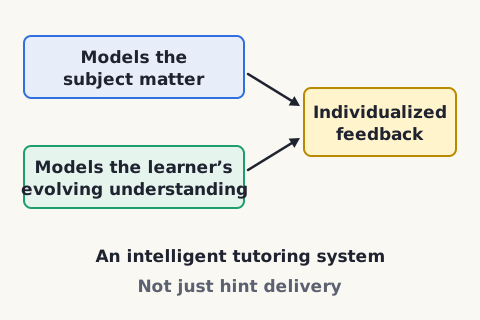
Intelligent tutoring's dual model
An intelligent tutoring system distinguishes itself from a simple hint-delivery tool by modeling both the subject matter and the learner's evolving understanding, enabling individualized feedback.
The adaptive-learning market
The adaptive learning platform market was valued at 1.72 billion in 2025 and is expected to reach 5.47 billion by 2032. Global EdTech investment hit $2.6 billion in 2025, up roughly 11% over 2024, with capital concentrating in AI-enabled products and workforce-aligned platforms.
Where the 2025 money went
By deal volume, 2025 EdTech investment split: workforce training 38%, K-12 36%, post-secondary 22%, and early childhood 4%. Notable deals: Workday acquired Sana for 1.1B, and Coursera's 2.5B all-stock acquisition of Udemy created a combined platform of 290 million learners and 18,000 enterprise customers.
The 2026 outlook
Capital in 2026 is expected to stay disciplined — favoring workflow-embedded, agentic AI and solutions that deliver measurable outcomes over raw engagement. Owl Ventures projects the global education market will surpass $10 trillion by 2030, the long backdrop against which today's AI-platform race is playing out.
EdTech investment hits $2.6B
Global EdTech investment reached $2.6 billion in 2025, up roughly 11% over 2024, with capital concentrating in AI-enabled and workforce-aligned products.
2025's two headline deals
The year's two biggest EdTech deals were Workday's 1.1 billion acquisition of Sana and Coursera's 2.5 billion all-stock acquisition of Udemy.
By the numbers
- K-12 students using Khanmigo in the 2024–25 academic year
- 700000 students
- LearnLM students' success rate on harder follow-up topics (2025 RCT)
- 66 %
- Human-tutor group's success rate in the LearnLM RCT
- 61 %
- Static-hints group's success rate in the LearnLM RCT
- 56 %
- Value of the adaptive learning platform market in 2025
- 1720000000 USD
- Projected adaptive learning platform market value by 2032
- 5470000000 USD
- Total global EdTech investment in 2025
- 2600000000 USD
- Price Workday paid to acquire Sana
- 1100000000 USD
- Value of the Coursera–Udemy all-stock acquisition (Dec 2025)
- 2500000000 USD
Matched pairs
Each item on the left goes with the one on the right.
- AI Tutors
- Adaptive, conversational 1:1 instruction (Khanmigo, Synthesis, LearnLM)
- Teacher Tools
- Lesson planning, rubric generation, admin reduction (MagicSchool, Diffit)
- Language Learning
- Adaptive vocabulary and conversation practice (Duolingo, Lingokids)
- Research Assistants
- Document synthesis, multi-source knowledge (NotebookLM, Perplexity)
- Enterprise / Workforce
- Upskilling and corporate training (Sana, Coursera+Udemy, Multiverse)
- Assessment & Analytics
- Progress tracking, formative assessment (Gradescope, Eedi, MagicQuizzes)
- Micro / Game Learning
- Game-based, challenge-driven learning (Kahoot, Blooket, Synthesis Teams)
- Duolingo BirdBrain
- Proprietary AI that sequences and personalizes lessons from performance history
Self-test
Answer each question from memory, then check your work against the answer key.
1. Which function defines the Teacher Tools category, whose leading players include MagicSchool and Diffit?
- ADocument synthesis, source grounding, and knowledge retrieval
- BLesson planning, rubric generation, and admin reduction
- CProgress tracking, formative assessment, and class analytics
- DAdaptive dialogue, one-to-one tutoring, and pace adjustment
2. Sana, Coursera, Udemy, and Multiverse are the named players in which category?
- AEnterprise / Workforce
- BMicro / Game Learning
- CAssessment & Analytics
- DResearch Assistants
3. Which three products fall in the AI Tutors category — adaptive, conversational 1:1 instruction?
- ADuolingo, Lingokids, and Kahoot
- BGradescope, Eedi, and MagicQuizzes
- CKhanmigo, Synthesis, and LearnLM
- DMagicSchool, Diffit, and Perplexity
4. What function does the Assessment & Analytics category (Gradescope, Eedi, MagicQuizzes) serve?
- AAdaptive vocabulary sequencing that replaces rote grammar drills
- BGame-based challenges that consolidate lessons after instruction
- CDocument synthesis that grounds answers in the provided sources
- DProgress tracking that surfaces where a class is collectively lost
5. A school adopts Kahoot and Blooket for quick, competitive review rounds after direct instruction. Which category is that, and what role does it serve?
- AAI Tutors — a primary instruction and adaptive dialogue layer
- BTeacher Tools — a lesson-planning and admin-reduction layer
- CMicro / Game Learning — a consolidation and motivation layer
- DEnterprise / Workforce — a job-readiness and upskilling layer
6. What teaching approach does Khanmigo use?
- ADirect explanation with immediate answers
- BThe Socratic method of questioning
- CWorked examples followed by graded drills
- DThe jigsaw method of peer teaching
7. Where did Synthesis originate?
- ABuilt for the SpaceX employee school
- BSpun out of the Khan Academy content team
- CDeveloped inside a Google research lab
- DGrown from a Duolingo internal project
8. How many K-12 students was Khanmigo serving by the 2024–25 academic year?
- A250,000
- B2,000,000
- C1,500,000
- D700,000
9. Which of these is handled by Duolingo's proprietary BirdBrain model rather than by the GPT-4-powered Max tier?
- AExplaining why a learner's submitted answer was right or wrong
- BRunning open conversation practice through a chat character
- CStaging roleplay scenarios for situational language practice
- DSequencing and personalizing lessons from performance history
10. Which definition matches an adaptive learning system?
- ASoftware that drafts lesson plans, rubrics, and quizzes to cut a teacher's administrative load
- BSoftware that scores work, tracks progress, and shows where a class is collectively lost
- CSoftware that adjusts content, sequence, and difficulty in real time from performance history
- DSoftware that grounds every answer in user-supplied documents and returns summaries or audio
11. What is the name of Duolingo's proprietary adaptive learning model?
- ALily
- BBirdBrain
- CLearnLM
- DMax
12. What does Duolingo's BirdBrain system primarily do?
- AAdjusts content, sequence, and difficulty in real time
- BGrades essays against a rubric
- CGenerates audio podcasts from documents
- DProvides roleplay scenarios via GPT-4
13. Synthesis, the K-6 math platform, was originally built for which organization's employee school?
- AOpenAI
- BKhan Academy
- CSpaceX
- DGoogle
14. Who founded Synthesis, the K-6 math platform?
- AMartin Dougiamas
- BNick Pelling
- CSalman Khan
- DChrisman Frank
15. Who benefited most from Stanford's Tutor CoPilot?
- AStudents paired with less-experienced tutors
- BStudents paired with the most experienced tutors
- CStudents working with the AI tutor on their own
- DStudents whose tutors were coached only after sessions
16. In the 2025 Google/Eedi Labs RCT, what success rate did LearnLM students reach on subsequent harder topics?
- A61%
- B66%
- C56%
- D76%
17. In the LearnLM RCT, what did the 76.4% figure measure?
- ALearnLM responses human tutors approved with little or no edits
- BStudents who completed the full trial
- CStudents who preferred the AI tutor to a human tutor
- DQuestions LearnLM answered without a factual error
18. What distinguishes an intelligent tutoring system from a simple hint-delivery tool?
- AIt routes each learner's question to a human tutor and stores the reply
- BIt models the subject and infers each learner's level from the class average
- CIt models both the subject and the learner's evolving understanding
- DIt times each learner's responses and reorders a shared hint sequence to match
19. Rank the three LearnLM RCT conditions from highest to lowest success rate on harder follow-up topics.
- AHuman tutor, AI tutor, static hints
- BAI tutor, human tutor, static hints
- CHuman tutor, static hints, AI tutor
- DAI tutor, static hints, human tutor
20. By deal volume, which segment captured the largest share of 2025 EdTech investment?
- AK-12 education
- BEarly childhood
- CPost-secondary
- DWorkforce training
21. What was the adaptive learning platform market valued at in 2025, and what is it projected to reach by 2032?
- A$1.72 billion → $5.47 billion
- B$2.6 billion → $5.47 billion
- C$1.72 billion → $10.7 billion
- D$2.6 billion → $10.7 billion
22. Global EdTech investment in 2025 hit $2.6 billion. Roughly how much was that up over 2024?
- AAbout 22%
- BAbout 38%
- CAbout 11%
- DAbout 4%
23. Which pairing of 2025's two headline deals with their values is correct?
- AWorkday–Sana $2.5B; Coursera–Udemy $1.1B
- BWorkday–Sana $1.72B; Coursera–Udemy $2.6B
- CWorkday–Sana $2.6B; Coursera–Udemy $1.72B
- DWorkday–Sana $1.1B; Coursera–Udemy $2.5B
24. The Coursera–Udemy acquisition created a combined platform of what scale?
- A290 million learners and 28,000 enterprise customers
- B290 million learners and 18,000 enterprise customers
- C180 million learners and 28,000 enterprise customers
- D180 million learners and 18,000 enterprise customers
25. What was global EdTech investment in 2025?
- A$2.6 billion
- B$1.1 billion
- C$1.72 billion
- D$5.47 billion
26. By roughly how much did global EdTech investment grow in 2025 versus 2024?
- A25%
- B50%
- C30%
- D11%
27. Which category does Google NotebookLM belong to?
- ALMS Infrastructure
- BTeacher Tools
- CResearch Assistants
- DAI Tutors
28. Synthesis is categorized under AI Tutors. Which category does Synthesis Teams fall under?
- AEnterprise / Workforce
- BMicro / Game Learning
- CAssessment & Analytics
- DResearch Assistants
29. MagicSchool AI sits in the same category as which other named platform?
- AEedi
- BDiffit
- CSana
- DKahoot
30. A parent wants an app that adapts vocabulary from their child's performance history and replaces rote grammar drills with conversation practice. Which platform fits?
- ADuolingo — Language Learning
- BGradescope — Assessment & Analytics
- CSana — Enterprise / Workforce
- DBlooket — Micro / Game Learning
31. Which platform-to-category pairing is correct?
- AGradescope — Teacher Tools
- BKahoot — Assessment & Analytics
- CPerplexity — Research Assistants
- DDuolingo — Micro / Game Learning
Go deeper
Answer key
- 1. B Lesson planning, rubric generation, and admin reductionTeacher Tools keep the human educator central by handling lesson planning, rubrics, and administrative load. Adaptive one-to-one tutoring is the AI Tutors category, progress tracking is Assessment & Analytics, and source-grounded document synthesis is Research Assistants.
- 2. A Enterprise / WorkforceEnterprise / Workforce platforms focus on upskilling and corporate training where measurable job-readiness matters to the buyer. Assessment & Analytics is Gradescope, Eedi, and MagicQuizzes.
- 3. C Khanmigo, Synthesis, and LearnLMThe AI Tutors category covers Khanmigo, Synthesis, and LearnLM: adaptive, conversational 1:1 instruction, the closest digital analog to a personal teacher.
- 4. D Progress tracking that surfaces where a class is collectively lostAssessment & Analytics tools handle progress tracking and formative assessment, surfacing where a class is collectively lost. Adaptive vocabulary sequencing is Language Learning, source-grounded synthesis is Research Assistants, and game-based challenges are Micro / Game.
- 5. C Micro / Game Learning — a consolidation and motivation layerKahoot, Blooket, and Synthesis Teams are Micro / Game Learning: game-based, challenge-driven engagement used primarily as a consolidation or motivation layer, not as primary instruction.
- 6. B The Socratic method of questioningKhanmigo uses the Socratic method, guiding students with questions rather than supplying the answer.
- 7. A Built for the SpaceX employee schoolSynthesis was built for the SpaceX employee school and founded by Chrisman Frank.
- 8. D 700,000Khanmigo served 700,000 K-12 students by 2024–25. The 2+ million figure belongs to MagicSchool AI — but that counts educators, not students.
- 9. D Sequencing and personalizing lessons from performance historyBirdBrain is the proprietary adaptive engine that sequences and personalizes lessons from each learner's performance history. Roleplay scenarios, 'Explain My Answer', and the Lily open-conversation chat mode are GPT-4-powered Max-tier features layered on top of it.
- 10. C Software that adjusts content, sequence, and difficulty in real time from performance historyAn adaptive learning system adjusts content, sequence, and difficulty in real time based on each learner's performance history — Duolingo's BirdBrain is the example. Source-grounded responses describe NotebookLM instead.
- 11. B BirdBrainBirdBrain is Duolingo's proprietary adaptive model; Max is the GPT-4 tier built on top of it, and Lily is a chat mode within Max.
- 12. A Adjusts content, sequence, and difficulty in real timeBirdBrain is an adaptive system that adjusts content, sequence, and difficulty in real time based on learner performance history.
- 13. C SpaceXSynthesis was built for the SpaceX employee school, which is said to explain its design focus on problem-solving over test prep.
- 14. D Chrisman FrankSynthesis was founded by Chrisman Frank, built originally for the SpaceX employee school.
- 15. A Students paired with less-experienced tutorsGains reached up to 9 points for students with less-experienced tutors — the AI raised the floor of tutor quality.
- 16. B 66%LearnLM students hit 66%, ahead of the human-tutor group's 61% and static hints' 56%. The 76% option rounds the 76.4% share of LearnLM responses human tutors approved with little or no edits — a quality signal, not the outcome.
- 17. A LearnLM responses human tutors approved with little or no editsHuman tutors reviewing LearnLM's responses approved 76.4% with little or no edits — a quality signal, not an outcome or preference measure. The outcome measure was the 66% success rate.
- 18. C It models both the subject and the learner's evolving understandingAn intelligent tutoring system models both the subject and the learner's evolving understanding to deliver individualized feedback — that dual model is what a static-hints tool lacks.
- 19. B AI tutor, human tutor, static hintsThe AI tutor (LearnLM) led at 66%, the human-tutor group followed at 61%, and static hints trailed at 56% — a 10-point spread between best and worst.
- 20. D Workforce training2025 EdTech deal volume split workforce training 38%, K-12 36%, post-secondary 22%, and early childhood 4%. Workforce narrowly led — mirrored by the year's two biggest deals, Workday–Sana and Coursera–Udemy.
- 21. A $1.72 billion → $5.47 billionThe adaptive learning platform market was $1.72B in 2025, projected to $5.47B by 2032 — roughly 3x over seven years. The $2.6B figure is total 2025 global EdTech investment, a different measure.
- 22. C About 11%2025 global EdTech investment reached $2.6B, up roughly 11% over 2024, with capital concentrating in AI-enabled and workforce-aligned products. The 38%, 22%, and 4% figures are 2025 deal-volume shares (workforce, post-secondary, early childhood), not growth rates.
- 23. D Workday–Sana $1.1B; Coursera–Udemy $2.5BWorkday acquired Sana for $1.1B, and Coursera's all-stock acquisition of Udemy was $2.5B (Dec 2025). The $1.72B and $2.6B figures are the 2025 adaptive-learning market size and total EdTech investment, not deal values.
- 24. B 290 million learners and 18,000 enterprise customersThe $2.5B all-stock Coursera–Udemy deal combined into 290 million learners and 18,000 enterprise customers. The other pairings each swap in an incorrect figure for one or both numbers.
- 25. A $2.6 billionGlobal EdTech investment hit $2.6 billion in 2025 — distinct from the $1.72B/$5.47B adaptive-learning market-size figures.
- 26. D 11%Global EdTech investment rose roughly 11% over 2024 — a different statistic from the 30-50% learning-time and 15-25% outcome figures.
- 27. C Research AssistantsNotebookLM ingests documents to build a research-grounded knowledge base — a research assistant, alongside Perplexity.
- 28. B Micro / Game LearningSynthesis itself is the K-6 adaptive math tutor and sits under AI Tutors with Khanmigo and LearnLM; Synthesis Teams appears under Micro / Game Learning alongside Kahoot and Blooket, as a game-based consolidation and motivation layer rather than primary instruction.
- 29. B DiffitMagicSchool and Diffit are both Teacher Tools — lesson planning, rubric generation, admin reduction. Kahoot is Micro / Game Learning, Eedi is Assessment & Analytics, and Sana is Enterprise / Workforce.
- 30. A Duolingo — Language LearningDuolingo is the flagship of Language Learning (with Lingokids), where adaptive vocabulary sequencing and conversation practice replace rote drills. The other three platforms are correctly paired but serve different functions.
- 31. C Perplexity — Research AssistantsPerplexity is filed with NotebookLM under Research Assistants — document synthesis and multi-source retrieval. Duolingo and Lingokids anchor Language Learning, not game learning or AI tutoring, and Gradescope sits in Assessment & Analytics rather than Teacher Tools.
Image credits
- Intelligent tutoring's dual model: FlashFeed original diagram · CC-BY-4.0