
Education Theory & Learning Technology study guide · Lesson 8 of 10
LMS, Standards & Gamification
LMS history & leaders · Interoperability standards · Gamification & motivation
This is the lesson's study guide from the FlashFeed app, plus its key facts and a self-test.
What you'll be able to do
- Sequence the milestone years of LMS evolution — Pressey's machine, PLATO, SCORM, and Moodle.
- Recognize the major LMS platforms (PLATO, Moodle, Canvas, Blackboard) and Canvas's rise over Blackboard.
- Distinguish SCORM from xAPI and explain the role of the Learning Record Store, including xAPI's Actor-Verb-Object statements.
- Define gamification and match its key thinkers to their works, including the mechanic that reframes failure as information.
- Explain Self-Determination Theory's three needs and autotelic, intrinsic motivation.
LMS history & leaders
The Learning Management System didn't appear with the web — its roots are mechanical, and its evolution tracks every major shift in educational technology across a century.
A century of teaching machines
The LMS lineage begins with Sidney Pressey's mechanical teaching machine in 1924: a typewriter-sized device that presented multiple-choice questions and advanced only when the learner answered correctly, embedding the idea of immediate corrective feedback decades before it had a name. The next landmark arrived in 1960 when Donald Bitzer launched PLATO (Programmed Logic for Automated Teaching Operations) at the University of Illinois — a mainframe-based system that supported simultaneous users, touchscreen interaction, and early forms of online community, anticipating every major feature of modern e-learning by thirty years.
The public web brought the first generation of web-based course systems in the 1990s, but interoperability was chaos until SCORM (Sharable Content Object Reference Model) debuted as version 1.0 in 2000, with the widely-adopted SCORM 1.2 arriving in 2001 — together giving vendors a common language for packaging and tracking learning content across platforms. A year later, in 2002, Martin Dougiamas released Moodle as open-source software, shifting power toward institutions that couldn't or wouldn't pay enterprise licensing fees. Moodle's constructivist design philosophy and zero cost made it the dominant LMS in international higher education.
The 2010s brought cloud and SaaS consolidation. Canvas (Instructure), noted for its clean, instruction-friendly interface, steadily took market share from the long-entrenched Blackboard, whose reputation for clunky UX and aggressive pricing created openings for nimbler competitors. The subsequent xAPI (Tin Can) era extended tracking beyond the LMS boundary — logging learning activity in simulations, mobile apps, and the physical world. AI-integrated systems in the 2020s use that data for adaptive pathways and predictive analytics.
The through-line: every era's LMS reflects the dominant delivery technology — mechanical, mainframe, web, cloud, AI — and each transition reshuffled the vendor landscape.
Interoperability standards
Learning platforms need shared rules for exchanging content and records. SCORM and xAPI define most of that exchange, and xAPI adds a separate store for the records it produces.
SCORM and xAPI
SCORM (Sharable Content Object Reference Model), introduced as version 1.0 in 2000 and widely adopted as version 1.2 in 2001, gave vendors a common language for packaging and tracking learning content across LMS platforms. Its keeper is the Advanced Distributed Learning (ADL) Initiative of the U.S. Department of Defense. When ADL asked for ideas for the next generation of SCORM, the research effort Project Tin Can, delivered by Rustici Software, produced what was first called the Tin Can API and is now the Experience API (xAPI); version 1.0.0 was released on April 26, 2013. In 2023 the IEEE approved xAPI as a standard (IEEE 9274.1.1-2023) for tracking data about the experiences a person has, online and offline: in a course, in a simulation or mobile app, or on the job.
Statements and the Learning Record Store
xAPI records each experience as a statement. Every statement must contain an actor, a verb and an object: the "I", "did" and "this" in "I did this", as in "a learner completed a fire-drill simulation." The application that tracks the experience, called a Learning Record Provider, sends statements to a Learning Record Store (LRS): a server responsible for receiving, storing and providing access to learning records. Other authorized systems then read those records from the LRS for reporting and analytics. An LRS can stand alone or sit inside an LMS, and one LRS can share statements with another. The contrast with SCORM is scope: SCORM packages and tracks content across LMS platforms, while xAPI statements can come from any learning context and collect in an LRS.
Gamification & motivation
Gamification is younger as a buzzword than as a practice — and understanding the motivation theory underneath it matters more than collecting points and badges.
Older than the buzzword
Nick Pelling coined the term gamification in 2002, but the intellectual groundwork was laid earlier. Thomas Malone's 1980 research asked what made early computer games intrinsically engaging and identified challenge, fantasy, and curiosity as the core drivers — arguably the first academic attempt to reverse-engineer game motivation for instructional use. Jesse Schell's 2010 DICE conference talk predicted game elements would penetrate everyday life far beyond entertainment. Jane McGonigal's Reality Is Broken (2011) made the cultural case that games were better at motivating people than real-world institutions, and that mastery framing — treating failure as information rather than judgment — is what keeps players returning after defeat. Karl Kapp codified the instructional design angle in The Gamification of Learning and Instruction (2012). The rules layer comes from Salen & Zimmerman's Rules of Play (2003), the canonical game-design text that defined games as systems in which players engage in artificial conflict defined by rules.
Self-Determination Theory and autotelic activity
The most durable motivational account behind gamification is Self-Determination Theory (SDT), developed by Edward Deci and Richard Ryan in 1985. SDT names three basic psychological needs that sustain intrinsic motivation: autonomy (feeling in control of one's actions), competence (feeling effective), and relatedness (feeling connected to others). Well-designed game mechanics address all three — choice of path satisfies autonomy, progressive difficulty satisfies competence, cooperative or competitive play satisfies relatedness.
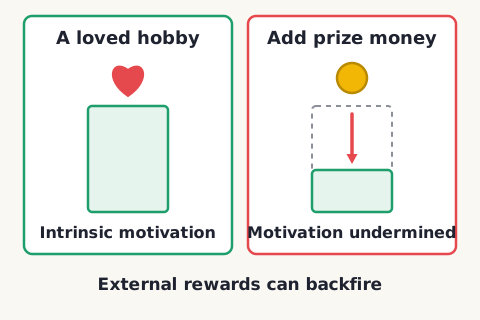
An autotelic activity is one that is intrinsically rewarding — done for its own sake, not for an external payoff. Csikszentmihalyi's concept of flow describes the peak state that emerges from autotelic engagement: full absorption when challenge matches skill. The cautionary corollary is the overjustification effect: introducing external rewards (points, prizes) for an already-intrinsically-motivating task can undermine that intrinsic motivation. External rewards do not reliably increase intrinsic motivation — this is one of the most replicated findings in motivational psychology and a known risk in shallow gamification implementations.
Key terms
- SCORM
- The 2001 interoperability standard that gave vendors a common language for packaging and tracking learning content across platforms.
- xAPI / Tin Can API
- A learning-data interoperability standard that captures experience statements across all learning contexts, not just the LMS.
- LRS (Learning Record Store)
- The server that receives, stores and gives access to xAPI statements; it can stand alone or sit inside an LMS.
- Gamification
- The application of game design elements — points, badges, leaderboards, levels, narrative, challenges — to non-game contexts to increase engagement and motivation. Term coined by Nick Pelling in 2002.
- Self-Determination Theory (SDT)
- Deci & Ryan's theory (1985) naming three basic psychological needs for intrinsic motivation: autonomy, competence, and relatedness. A framework for engagement and gamification design.
- Autotelic activity
- An activity that is intrinsically rewarding — done for its own sake, not for an external payoff. Central to Csikszentmihalyi's concept of flow, the peak state of full absorption when challenge matches skill.
Key concepts
PLATO
- Launched in 1960 at the University of Illinois, a mainframe system that anticipated modern e-learning by roughly thirty years.
- Created by Donald Bitzer, it supported simultaneous users, touchscreen interaction, and early online community.
- Its name is an acronym: Programmed Logic for Automated Teaching Operations.
Moodle
- Released in 2002 as open-source software, it shifted power toward institutions unwilling to pay enterprise licensing fees.
- Created by Martin Dougiamas, its constructivist design philosophy and zero cost drove wide adoption.
- It became the dominant learning management system in international higher education.
Canvas
- A cloud- and SaaS-era learning platform noted for its clean, instruction-friendly interface.
- Made by Instructure, it steadily gained market share during the 2010s consolidation.
- It won share from a long-entrenched incumbent whose clunky UX and aggressive pricing left openings.
Blackboard
- For years the long-entrenched, dominant learning management system before cloud-era rivals emerged.
- Its reputation for clunky UX and aggressive pricing created openings for nimbler competitors.
- During the 2010s it steadily lost market share to Instructure's cleaner, instruction-friendly platform.
Key facts
A century of teaching machines
The LMS lineage runs back further than the web. It starts with Sidney Pressey's mechanical teaching machine (1924), continues through PLATO computer-based training (1960, Dr. Donald Bitzer), web-based systems in the 1990s, Moodle's open-source release (2002), the cloud/SaaS era (2010s), the xAPI/analytics era, and AI-integrated systems in the 2020s.
Canvas overtakes Blackboard
Canvas has earned a reputation as instruction-friendly and has been steadily taking market share from Blackboard, even as Moodle remains the leading open-source LMS and Brightspace holds its own.
PLATO's 1960 debut
Donald Bitzer launched PLATO at the University of Illinois in 1960 — a mainframe system with simultaneous users and touchscreens, anticipating modern e-learning by thirty years.
LMS history, in sequence
The LMS timeline runs Pressey's machine (1924), then PLATO (1960), then SCORM (2001), then Moodle (2002) — SCORM arrives decades after PLATO, not before it.
Canvas's maker: Instructure
Canvas is built by Instructure — not to be confused with Blackboard Inc., which makes the rival product, or Moodle, which came from Martin Dougiamas.
Older than the buzzword
Nick Pelling coined gamification in 2002, but its educational roots are older: Thomas Malone's 1980 study on intrinsically motivating computer games asked what actually makes games engaging. Jesse Schell's 2010 DICE talk predicted game elements would invade everyday life; Jane McGonigal's Reality Is Broken (2011) argued we should harness gamer motivation for real-world problems.
Failure as feedback
Mastery framing is the core game mechanic that reframes failure as information rather than judgment — treating a wrong answer as feedback, not a verdict on the learner.
What gamification really means
Gamification means applying game design elements — points, badges, leaderboards, levels, narrative — to non-game contexts to boost engagement, not building actual games.
SDT's three core needs
Self-Determination Theory names autonomy, competence, and relatedness as its three basic psychological needs — not points and badges, which are surface mechanics, not needs.
The overjustification effect
Adding prize money to a hobby someone already loves can backfire — the overjustification effect describes how external rewards for an already-intrinsically-motivating task can undermine that intrinsic motivation.
By the numbers
- Year Sidney Pressey built his mechanical teaching machine
- 1924 year
- Year PLATO computer-based training launched (Donald Bitzer)
- 1960 year
- Year the SCORM interoperability standard was introduced
- 2001 year
- Year Moodle was released as an open-source LMS
- 2002 year
Matched pairs
Each item on the left goes with the one on the right.
- SCORM
- Packaging and tracking content across platforms
- xAPI
- Tracking beyond the LMS, in simulations and apps
- LRS
- Backend store for xAPI statements
- Jesse Schell
- 2010 DICE talk: game elements will invade everyday life
- Jane McGonigal
- Reality Is Broken (2011)
- Karl Kapp
- The Gamification of Learning and Instruction (2012)
- Salen & Zimmerman
- Rules of Play (2003)
Step by step
Trace the evolution of the learning management system, earliest to latest
- Pressey's mechanical teaching machine (1924)
- PLATO computer-based training (1960, Donald Bitzer)
- Web-based LMS (1990s)
- Moodle open-source LMS (2002)
- Cloud / SaaS LMS era (2010s)
- xAPI / analytics era (mid-2010s)
- AI-integrated systems (2020s)
The throughline is the same instinct across a century: automate the delivery, tracking, and adaptation of instruction.
Self-test
Answer each question from memory, then check your work against the answer key.
1. In what year did Sidney Pressey build his mechanical teaching machine?
- A1954
- B1924
- C1912
- D1938
2. Donald Bitzer launched PLATO at the University of Illinois in which year?
- A1970
- B1950
- C1960
- D1980
3. In what year did Martin Dougiamas release Moodle as open-source software?
- A1998
- B2006
- C2011
- D2002
4. Which sequence puts the LMS milestones in correct chronological order?
- APressey's machine → PLATO → SCORM → Moodle
- BPLATO → Pressey's machine → SCORM → Moodle
- CPLATO → Pressey's machine → Moodle → SCORM
- DPressey's machine → PLATO → Moodle → SCORM
5. Roughly how many years separate Pressey's teaching machine from the launch of PLATO?
- A22 years
- B61 years
- C48 years
- D36 years
6. Which LMS is noted for being instruction-friendly and gaining market share from Blackboard?
- ASchoology
- BMoodle
- CCanvas
- DBrightspace
7. Which LMS was released as open-source software and became dominant in international higher education?
- ACanvas
- BMoodle
- CBlackboard
- DPLATO
8. Which platform's reputation for clunky UX and aggressive pricing created openings for nimbler competitors?
- ABlackboard
- BPLATO
- CCanvas
- DMoodle
9. Which company makes Canvas?
- AMcGraw Hill
- BBlackboard
- CPowerSchool
- DInstructure
10. Which delivery-technology era does PLATO belong to?
- AThe public-web era
- BThe mechanical era
- CThe mainframe era
- DThe cloud/SaaS era
11. What did the xAPI (Tin Can) era add that SCORM did not track?
- AImmediate corrective feedback on every multiple-choice answer
- BLearning activity in simulations, apps, and the physical world
- CA common language for packaging content across different LMS platforms
- DSimultaneous users and touchscreen interaction on a mainframe
12. What does SCORM stand for?
- ASharable Content Object Reference Model
- BSharable Content Object Runtime Manifest
- CSharable Content Organization Reference Manifest
- DSharable Content Organization Runtime Model
13. What did SCORM give the LMS field once version 1.2 was widely adopted in 2001?
- AA common language for packaging and tracking content across LMSs
- BSimultaneous users and touchscreen interaction on a mainframe
- CImmediate corrective feedback on every multiple-choice answer
- DOpen-source course software free of enterprise licensing fees
14. Which era extended LMS tracking beyond the LMS boundary itself?
- AThe Pressey teaching-machine era
- BThe xAPI (Tin Can) era
- CThe PLATO mainframe era
- DThe SCORM era
15. A firefighter completes a live drill with no LMS involved and the activity is logged. Which standard makes this possible?
- AMoodle
- BSCORM
- CCanvas (Instructure)
- DxAPI (Tin Can)
16. Which of these did SCORM track?
- ALearning activity tracked in the physical world
- BLearning activity logged in simulations and mobile apps, beyond the LMS
- CContent packaged and tracked consistently across different LMSs
- DA three-need theory behind intrinsic motivation
17. Which scenario best fits what the xAPI (Tin Can) era added?
- AA course package copied from one LMS to another
- BA workshop simulation completed away from any LMS
- CA quiz score recorded inside a single course module
- DA completion flag set when a course module finishes
18. A flight simulator sends xAPI statements about each training run. Which component receives and stores them?
- AA Learning Record Store
- BA SCORM content package
- CA PLATO terminal
- DThe Learning Record Provider
19. Every xAPI statement must contain which three parts?
- AActor, result and context
- BPackage, manifest and score
- CProvider, store and LMS
- DActor, verb and object
20. Which core game mechanic reframes failure as information rather than judgment?
- ANarrative framing
- BScaffolded difficulty
- CMastery framing
- DSocial connection
21. Who coined the term "gamification," and in what year?
- AThomas Malone, 1980
- BKarl Kapp, 2012
- CNick Pelling, 2002
- DJane McGonigal, 2011
22. Gamification is best defined as which of the following?
- ADesigning systems in which players engage in artificial conflict defined by rules
- BIdentifying which features make computer games intrinsically engaging
- CBuilding full-fledged video games to deliver instruction in classrooms
- DApplying game design elements to non-game contexts to boost engagement
23. Match the thinker to the work: who wrote Reality Is Broken (2011)?
- AJane McGonigal
- BNick Pelling
- CJesse Schell
- DKarl Kapp
24. Which pairing of thinker and contribution is INCORRECT?
- AJane McGonigal — Reality Is Broken (2011)
- BThomas Malone — Rules of Play (2003)
- CJesse Schell — DICE conference talk (2010)
- DDeci & Ryan — Self-Determination Theory (1985)
25. Who developed Self-Determination Theory, and in what year?
- AMalone, 1980
- BDeci & Ryan, 1985
- CSalen & Zimmerman, 2003
- DPelling, 2002
26. Which trio names SDT's three basic psychological needs?
- APoints, badges, leaderboards
- BChallenge, fantasy, curiosity
- CAttention, relevance, satisfaction
- DAutonomy, competence, relatedness
27. Letting a learner choose their own path through a course primarily satisfies which SDT need?
- AAutonomy
- BCompetence
- CRelatedness
- DCuriosity
28. What is an autotelic activity?
- AOne that is externally rewarded, pursued for a points or prize payoff
- BOne that is automatically adjusted, scaled to the learner's skill
- COne that is intrinsically rewarding, done for its own sake
- DOne that is cooperatively pursued, done alongside other learners
29. Adding prize money to a hobby someone already loves can reduce their desire to do it. What is this called?
- AThe overjustification effect
- BThe mastery-framing mechanic
- CThe reinforcement schedule
- DThe challenge-skill balance
Go deeper
Answer key
- 1. B 1924Pressey's typewriter-sized machine appeared in 1924, presenting multiple-choice questions and advancing only on a correct answer. The other years bracket it but are not the milestone.
- 2. C 1960PLATO (Programmed Logic for Automated Teaching Operations) launched in 1960 — a mainframe system with simultaneous users and touchscreens, anticipating modern e-learning by thirty years.
- 3. D 2002Moodle arrived in 2002, a year after SCORM, shifting power toward institutions unwilling to pay enterprise licensing fees. 1998 predates the open-source release; 2006 and 2011 fall too late, into the web and cloud LMS eras.
- 4. A Pressey's machine → PLATO → SCORM → MoodleThe order is 1924 (Pressey), 1960 (PLATO), 2001 (SCORM), 2002 (Moodle). Pressey's mechanical machine came 36 years before Bitzer's mainframe, and SCORM arrived the year before Moodle, not the year after.
- 5. D 36 years1960 minus 1924 is 36 years, mechanical era to mainframe era. The other gaps each swap a wrong year in for one milestone — 22 years counts from 1938, 48 from 1912 (or to 1972), 61 to 1985.
- 6. C CanvasCanvas is instruction-friendly and has been taking market share from Blackboard. Moodle is the open-source global leader; Brightspace is another current leader.
- 7. B MoodleMoodle's constructivist design and zero cost made it the global open-source leader. Canvas and Blackboard are commercial; PLATO was a 1960 mainframe system.
- 8. A BlackboardBlackboard was the long-entrenched incumbent whose clunky UX and pricing let Canvas take share. Moodle competed on cost, and Canvas is the one praised for a clean interface.
- 9. D InstructureCanvas is built by Instructure. Blackboard Inc. sells the rival product Canvas took share from, while PowerSchool and McGraw Hill are other education-technology vendors with no hand in Canvas.
- 10. C The mainframe eraPLATO was Bitzer's 1960 mainframe-based system at the University of Illinois, with simultaneous users and touchscreens. Pressey's 1924 machine belongs to the mechanical era; Moodle arrived with the web, and Canvas and Blackboard fought it out in the cloud/SaaS era.
- 11. B Learning activity in simulations, apps, and the physical worldThe xAPI (Tin Can) era extended tracking beyond the LMS into simulations, mobile apps and the physical world. A common packaging language is SCORM, immediate corrective feedback is Pressey's 1924 teaching machine, and simultaneous touchscreen users is PLATO.
- 12. A Sharable Content Object Reference ModelSCORM is the Sharable Content Object Reference Model, introduced in 2001 to give vendors a common language for packaging and tracking content across LMSs. The other expansions keep the initials but swap in look-alike words; none is the standard's name.
- 13. A A common language for packaging and tracking content across LMSsSCORM (v1.0 in 2000, widely adopted as v1.2 in 2001) gave vendors a common language for packaging and tracking content across LMSs. Immediate corrective feedback is Pressey's teaching machine, free open-source course software is Moodle, and touchscreen users sharing a mainframe is PLATO.
- 14. B The xAPI (Tin Can) eraThe xAPI (Tin Can) era extended tracking beyond the LMS boundary into simulations, mobile apps, and the physical world. The SCORM era packaged and tracked content across LMS platforms, and the PLATO mainframe and Pressey teaching-machine eras came decades earlier.
- 15. D xAPI (Tin Can)xAPI (Tin Can) extended tracking beyond the LMS boundary, logging learning activity in simulations, mobile apps, and the physical world. SCORM gave vendors a common language for packaging and tracking content across platforms; Moodle and Canvas are LMS platforms.
- 16. C Content packaged and tracked consistently across different LMSsSCORM (2001) gave vendors a common language for packaging and tracking content across different LMSs. Activity logged in simulations, mobile apps, or the physical world belongs to the later xAPI (Tin Can) era; the three-need theory is Self-Determination Theory.
- 17. B A workshop simulation completed away from any LMSxAPI (Tin Can) extended tracking beyond the LMS boundary to simulations, mobile apps, and the physical world — exactly this kind of off-platform activity. A quiz score, a completion flag, and a package copied between LMSs all stay inside SCORM's LMS-bound tracking.
- 18. A A Learning Record StoreA Learning Record Store (LRS) is the server that receives, stores and gives access to xAPI statements. The simulator itself is the Learning Record Provider that sends them, a SCORM package is content, and PLATO was a 1960 teaching system.
- 19. D Actor, verb and objectThe xAPI spec requires every statement to use an actor, a verb and an object: the 'I did this' of 'a learner completed a fire-drill simulation.' Result and context are optional extras, and the provider and store are the systems that send and hold statements.
- 20. C Mastery framingMastery framing treats failure as feedback, not a verdict. Narrative framing supplies the fantasy Malone identified; scaffolded difficulty implements the ZPD; social connection drives leaderboards and co-op.
- 21. C Nick Pelling, 2002Nick Pelling coined gamification in 2002. Malone's 1980 research predates the term; McGonigal and Kapp wrote later books but did not name the concept.
- 22. D Applying game design elements to non-game contexts to boost engagementGamification applies game elements — points, badges, leaderboards, levels, narrative — to non-game contexts. What makes games engaging was Malone's 1980 question, building actual games is a different practice, and rule-defined conflict is Salen & Zimmerman's definition of games.
- 23. A Jane McGonigalMcGonigal's Reality Is Broken argued games motivate better than real-world institutions. Kapp wrote The Gamification of Learning and Instruction (2012); Schell gave the 2010 DICE talk.
- 24. B Thomas Malone — Rules of Play (2003)Rules of Play (2003) is Salen & Zimmerman's. Malone's 1980 research identified challenge, fantasy, and curiosity as what makes games engaging. McGonigal, Schell, and Deci & Ryan are each paired correctly.
- 25. B Deci & Ryan, 1985Edward Deci and Richard Ryan developed SDT in 1985. Malone researched game motivation, Pelling coined gamification, and Salen & Zimmerman wrote the game-design rules text.
- 26. D Autonomy, competence, relatednessSDT names autonomy, competence, and relatedness. Challenge, fantasy, and curiosity are Malone's game-motivation drivers; points and badges are surface mechanics, not needs.
- 27. A AutonomyAutonomy is feeling in control of one's actions, which choice of path directly serves. Competence comes from progressive difficulty; relatedness from cooperative or competitive play. Curiosity is one of Malone's game-motivation drivers, not an SDT need.
- 28. C One that is intrinsically rewarding, done for its own sakeAutotelic means intrinsically rewarding — done for itself, not an external payoff, and the engagement from which flow emerges. Chasing points or prizes is the extrinsic opposite.
- 29. A The overjustification effectThe overjustification effect: external rewards for an already-intrinsically-motivating task can undermine intrinsic motivation. The challenge-skill balance is flow's precondition, reinforcement schedules are Skinner's reward timing, and mastery framing treats failure as data.
Sources
- xAPI overview (Rustici Software, xapi.com) — xapi.com/overview/
- ADL xAPI Specification, Part One: About (GitHub) — github.com/adlnet/xAPI-Spec/blob/master/xAPI-About.md
- ADL xAPI Specification, Part Two: Data (GitHub) — github.com/adlnet/xAPI-Spec/blob/master/xAPI-Data.md
- IEEE 9274.1.1-2023 (xAPI) standard page — standards.ieee.org/ieee/9274.1.1/7321/
- Self-Determination Theory — official theory overview — selfdeterminationtheory.org/theory/
- Positive Psychology — Flow Theory (Autotelic Experience) — positivepsychology.com/flow-theory/
Image credits
- The overjustification effect: FlashFeed original diagram · CC-BY-4.0