
Astronomy & Space study guide · Lesson 4 of 13
Mercury and Venus
Mercury, the Extreme Small World · Venus, the Runaway · Why Neither Kept Water
This is the lesson's study guide from the FlashFeed app, plus its key facts and a self-test.
What you'll be able to do
- Contrast Mercury and Venus, and say why neither kept liquid water
The two planets inside Earth's orbit are the nearest worlds to us and the least like us. One is a metal ball with no air, its surface swinging 600 degrees between noon and midnight. The other is almost exactly Earth's size and the hottest place in the Solar System. Neither holds liquid water, and they failed for opposite reasons.
Mercury, the Extreme Small World
Mercury is small. Its mean radius is 2,439 km — about 4,879 km across, a little more than a third of Earth's width. Diagrams that line the four rocky planets up at roughly equal size mislead: the inner four fall into two classes, two Earth-sized and two much smaller.
Small does not mean weak. Mercury's equatorial surface gravity is 3.70 m/s², essentially identical to Mars's 3.71 even though Mars is nearly 1.4 times wider. Surface gravity depends on mass and radius together, and Mercury is dense: a metallic iron core of about 2,074 km radius, roughly 85 percent of the planet's own radius, leaves a rocky shell only a few hundred kilometers thick — the largest iron core relative to size of any planet. Mercury is not a shrunken Earth; it is a metal ball with a thin rocky skin.
It also moves fastest: the shortest year of any planet, 88 Earth days, at nearly 47 kilometers per second, because it is the closest planet to the Sun.
Its spin is stranger. Mercury turns once every 58.65 Earth days, exactly two-thirds of that 88-day year — a 3:2 spin-orbit resonance, three turns for every two orbits. Astronomers long believed Mercury kept one face permanently toward the Sun, as the Moon does to Earth. Radar observations in 1965 proved otherwise.
So a rotation and a day are not the same thing. One solar day on Mercury, sunrise to sunrise, lasts 176 Earth days, about two Mercury years, with daylight alone running for 88 of them.
With no atmosphere to hold the heat, the ground follows the sunlight: about 430 degrees C in daylight, about −180 degrees C at night. What Mercury has instead is an exosphere — a wisp of oxygen, sodium, hydrogen, helium and potassium knocked off the surface by the solar wind and meteoroid strikes, so sparse its atoms essentially never collide. That is not a thin atmosphere. It is atmosphere on its way out.
Which makes the next fact the one to keep. Mercury's spin axis is almost exactly upright, so the floors of deep craters at its poles never receive sunlight, and NASA's MESSENGER orbiter found those permanently shadowed deposits to be dominantly water ice. The planet closest to the Sun holds ice, because sunlight rather than distance sets a local temperature. The 430 degrees is an equatorial daytime peak, not a reading beside the ice; ESA still treats confirming the deposits as an open question.
Its largest scar, the Caloris Basin, is about 1,550 km wide — a third of the planet's own diameter.
Venus, the Runaway
Venus rules out the easy explanation first. Its equatorial diameter is about 12,104 km against Earth's 12,756 — 95 percent as wide. Whatever went wrong here, it was not that the planet came out the wrong size.
Its spin is the oddest in the Solar System. Venus turns once every 243 Earth days, and turns backwards, so from the surface the Sun would rise in the west. Its year is only 225 Earth days, so one turn on its axis takes longer than one trip around the Sun. That is the source of the line "a day on Venus is longer than its year", and it compares the wrong things. Sunrise to sunrise, a solar day is about 117 Earth days, half the rotation period, because a retrograde spin and a forward orbit add together instead of partly canceling as on Earth.
The surface averages about 464 degrees C — NASA's own figure is 467, so call it about 465 — hot enough to melt lead. That is a mean, not a noon peak: Venus is that hot day and night, pole to equator. Surface pressure is about 93 times Earth's at sea level, comparable to being more than 900 meters underwater.
The gas responsible is not exotic. It is carbon dioxide, the same gas that drives the greenhouse effect on Earth — Venus simply holds about 154,000 times more of it than Earth's atmosphere does, and 19,000 times more than Mars's.
Above that sits the reason Venus is the brightest planet in our sky. Its geometric albedo is 0.65 — a measure of how brightly it shines back at us rather than the share of sunlight it absorbs — against Mercury's 0.106, bare rock about as dark as worn asphalt. The reflector is a deck of sulphuric acid droplets between about 45 and 70 km up.
That deck is opaque, so no camera can photograph the ground. The surface had to be mapped by radar, which passes through cloud and bounces off rock: NASA's Magellan orbiter took coverage to 98 percent between 1990 and 1994. Every image you have seen of that surface is a radar map, not a photograph.
What radar found was a young planet. Venus carries only about a thousand impact craters, far fewer than Mercury, Mars or the Moon, so volcanism has repaved it. Estimates of the average surface age are genuinely unsettled and cluster between roughly 150 and 600 million years; whether the repaving was one global event or a long piecemeal process is still argued.
It is survivable for about an hour. The Soviet Venera program landed ten probes, and Venera 7 made the first transmission ever from the surface of another planet in December 1970. They lasted from 23 minutes to about two hours, Venera 13 managing 127 minutes against a design life of 32.
Why Neither Kept Water
One number sorts the planets that could hold on to air from the ones that could not: escape velocity, the speed something needs to leave a planet for good. It is 11.19 km/s at Earth, 10.36 km/s at Venus, 5.03 km/s at Mars and 4.25 km/s at Mercury. It does not depend on what is trying to escape — mass and radius set it, and nothing else.
The other side of the race is how fast the gas is moving, and heat is molecular motion. Weak gravity with a hot surface is the worst combination available, and Mercury has both: the lowest escape velocity of the four rocky planets, and a dayside near 430 degrees C. The solar wind did not blow Mercury's atmosphere away. Mercury could never hold one.
A global magnetic field is neither necessary nor sufficient for keeping an atmosphere. Venus has no internally generated field at all — only an induced magnetic field — and holds 92 atmospheres of air. Mercury does have a global field, at about 1 percent of Earth's surface strength, and holds essentially nothing. Escape speed and temperature are the levers here; how much a magnetic field changes the loss rate is not settled by anything cited.
Venus never had Mercury's problem — at 10.36 km/s its escape velocity is nearly Earth's. Venus did not lose its air. It lost its water, and the order of events is the whole lesson.
Sunlight evaporated the surface water. Ultraviolet light broke the water molecules apart. Hydrogen, the lightest thing there is, escaped to space. And with no liquid water left to lock carbon into rock, carbon dioxide accumulated with nothing to remove it. That is the runaway greenhouse: the effect feeding itself with nothing left to check it.
Read that chain in the right direction. The carbon dioxide did not arrive first and boil the water off; the water had to leave before the CO₂ could build up. Losing the water is what disabled Venus's ability to bury its own carbon — which is why Venus is hotter than Mercury while orbiting nearly twice as far from the Sun. What a planet is wrapped in beats where it sits.
Whether Venus ever had oceans at all is answered by models, not observation. NASA GISS climate modeling published in 2016 suggests a shallow liquid-water ocean and habitable surface temperatures for up to 2 billion years of its early history, helped by the slow rotation. That is a modeled upper bound, not a measurement, and other models keep the water in the atmosphere rather than in oceans. What is not in doubt is that Venus lost a great deal of water.
Earth is the next planet out, and it kept its oceans. That is what the next lesson is about.
Key terms
- Exosphere
- The outermost gas of a world, so thin its atoms almost never collide — on Mercury it is knocked straight off the rock and never dense enough to be held
- Retrograde
- Motion running opposite to the usual direction in a system — a backwards spin, which on Venus puts sunrise in the west
- Runaway greenhouse
- A greenhouse effect that feeds itself: warming drives water into the air, the vapor traps more heat, and the ocean is lost — taking with it the rain that would have buried carbon in rock
Key facts
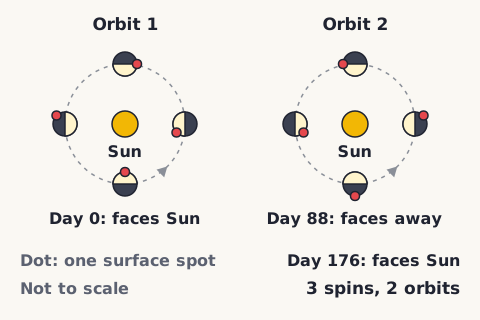
Mercury's 176-Day Day
Mercury turns exactly three times on its axis for every two trips around the Sun — a 3:2 spin-orbit resonance. One rotation takes 58.65 Earth days, but because the planet is also racing along its orbit, sunrise to sunrise takes 176 Earth days. A day on Mercury lasts two of its years.
A Core Wearing a Planet
Mercury's iron core has a radius of about 2,074 km inside a planet whose own radius is 2,439 km. The core reaches roughly 85 percent of the way to the surface, leaving a rocky shell only a few hundred kilometers thick. By mass Mercury is about 70 percent metal — proportionally far more than any other planet.
Six Hundred Degrees of Swing
Mercury's surface reaches about 430 °C in daylight and falls to about −180 °C at night — a swing of roughly 610 °C. Nothing holds the heat: Mercury has no atmosphere to move warmth around, so the night side becomes one of the coldest surfaces in the inner Solar System.
Sunrise in the West
Venus turns once every 243 Earth days, and it turns backwards — from the surface the Sun would rise in the west. Its year is only 225 Earth days, so one turn on its axis takes longer than one trip around the Sun. But sunrise to sunrise is just 117 Earth days, half the rotation period: a backwards spin and a forward orbit add together instead of partly canceling as they do on Earth.
Lead Melts, Air Crushes
Venus's surface averages about 464 °C — NASA's own figure is 467, so call it about 465 — hot enough to melt lead. That is a mean, not a noon peak: Venus is that hot day and night, pole to equator. The air above it presses down at about 92 times Earth's sea-level pressure, comparable to being more than 900 meters underwater.
A Deck of Acid
Venus is the brightest planet in our sky, and the reason sits on top of it. Its geometric albedo is 0.65 — a measure of how brightly it shines back at us, not the share of sunlight it absorbs — against Mercury's 0.106, bare rock about as dark as worn asphalt. The reflector is a deck of sulphuric acid droplets between about 45 and 70 km up.
The Speed to Get Out
Escape velocity — also called escape speed — is the speed something needs to leave a planet for good: 11.19 km/s at Earth, 10.36 km/s at Venus, 5.03 km/s at Mars and 4.25 km/s at Mercury. It does not depend on what is trying to escape — a hydrogen atom and a rocket face the same number. Mass and radius set it, and nothing else does.
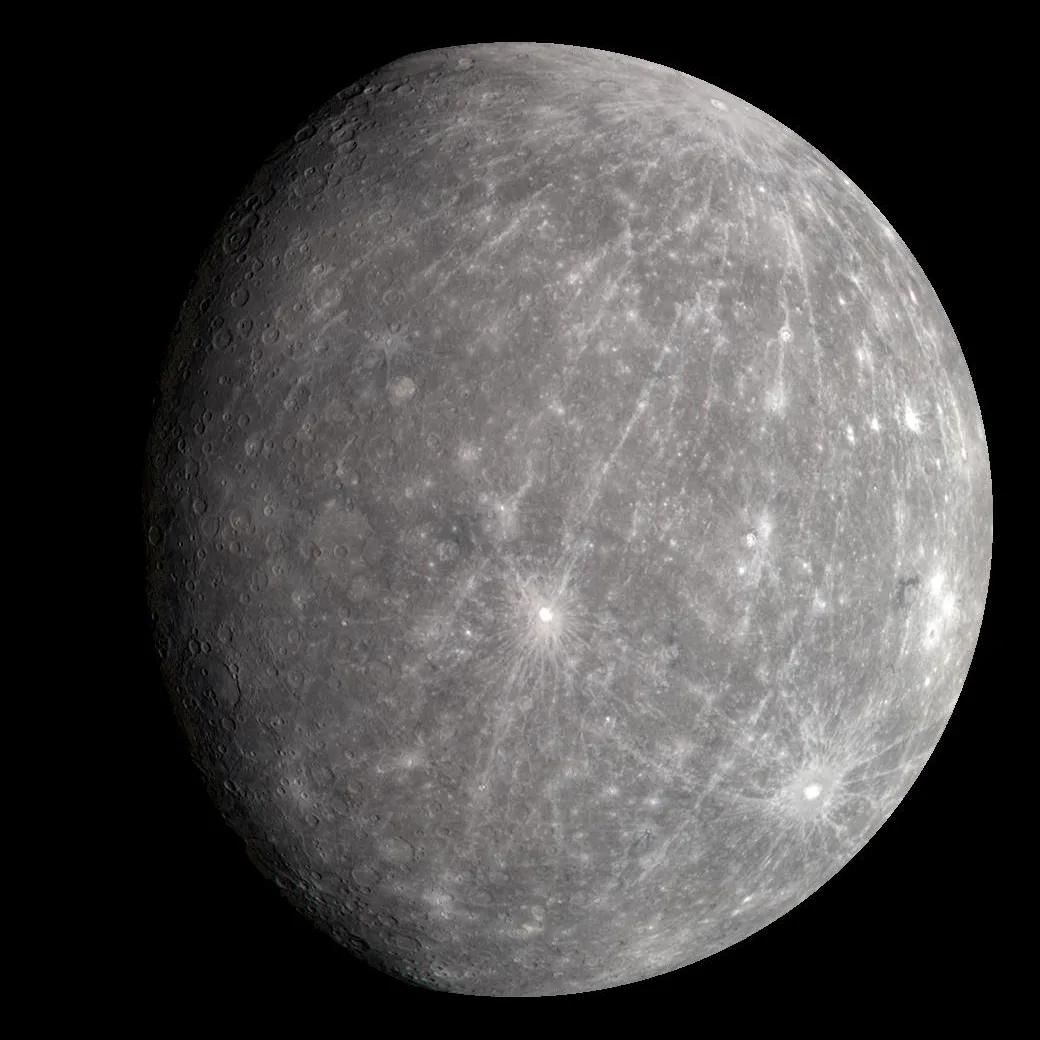
Never Had a Chance
Mercury loses the escape race twice over. It has the lowest escape velocity of the four rocky planets at 4.25 km/s, and its dayside reaches about 430 °C — and heat is molecular motion, so its gas moves fastest exactly where the grip is weakest. Weak gravity with a hot surface is the worst combination available. The solar wind did not blow Mercury's atmosphere away; Mercury could never hold one.
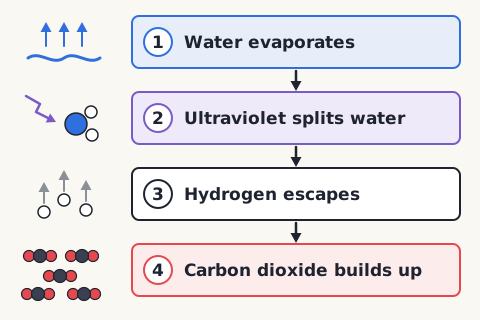
Water Left First
Sunlight evaporated Venus's surface water. Ultraviolet light broke the water molecules apart. Hydrogen, the lightest thing there is, escaped to space. And with no liquid water left to lock carbon into rock, carbon dioxide piled up with nothing to remove it — a runaway greenhouse. Read the chain in that order: losing the water is what disabled Venus's ability to bury its own carbon, which is why Venus is hotter than Mercury while orbiting nearly twice as far from the Sun.
A Field Is No Shield
A global magnetic field is neither necessary nor sufficient for keeping an atmosphere. Venus has no internally generated field at all — only an induced magnetic field — and holds 92 atmospheres of air. Mercury does have a global field, at about 1 percent of Earth's surface strength, and holds essentially nothing. Escape speed and temperature are the levers here.
Matched pairs
Each item on the left goes with the one on the right.
- Caloris Basin
- A 1,550 km impact scar, a third of Mercury across
- Mercury's year
- 88 Earth days — the shortest of any planet
- Carbon dioxide on Venus
- About 154,000 times what Earth's air holds
- Venus's surface age
- Unsettled — estimates run 150 to 600 million years
- Venus's early ocean
- Modeled, not observed — up to 2 billion habitable years
Self-test
Answer each question from memory, then check your work against the answer key.
1. Why does Mercury's night side get so cold?
- AIt reflects most sunlight away
- BIts core has frozen solid
- CIts polar ice chills the ground
- DIt has no air to hold the heat
2. How far does Mercury's metal core reach toward the surface?
- AAbout 15 percent of the way
- BAbout 85 percent of the way
- CAbout 55 percent of the way
- DAbout 30 percent of the way
3. Which planet pulls at almost exactly Mercury's surface gravity?
- AEarth
- BNeptune
- CMars
- DVenus
4. Why does Venus outshine every other planet?
- AIts clouds bounce back sunlight
- BIt glows from its own heat
- CIt is the largest planet we see
- DIt sits nearest the Sun of all
5. Why did the Venera landers stop working so quickly?
- AAcid dissolved their cameras
- BTheir batteries were undersized
- CHeat and pressure destroyed them
- DThey sank into soft ground
6. Which gas makes up most of Venus's atmosphere?
- ACarbon dioxide
- BSulfur dioxide
- CAmmonia
- DMethane
7. What had to happen before carbon dioxide could pile up on Venus?
- AIts magnetic field had to die
- BIts clouds had to thicken first
- CIts spin had to slow down
- DIts water had to be lost
8. What sets the basic physical limit on whether a planet can hold an atmosphere?
- AA global magnetic field
- BEscape speed and temperature
- CThe length of its year
- DThe number of moons
9. Which rocky planet is easiest to leave for good?
- AEarth
- BMars
- CMercury
- DVenus
Go deeper
- WatchIce on the Planet Nearest the Sun Mercury is the closest planet to the Sun. Its days reach about 430 °C. Its nights fall to about −180.
- WatchEarth's Size, Furnace Heat Venus is almost Earth's twin in size: 95% as wide.
- WatchVenus Lost Its Water First Mercury could never hold an atmosphere. Its gravity is weak, and its dayside is near 430°. Hot gas escapes easily.
- StudyAstronomy & Space in the FlashFeed app
Answer key
- 1. D It has no air to hold the heatMercury has no atmosphere to redistribute warmth. Its ice sits only in shadowed polar craters and warms nothing; its rotation is slow, not fast, at 58.65 days; and it is the closest planet to the Sun, not the farthest.
- 2. B About 85 percent of the wayThe core's radius is 2,074 km inside a 2,439 km planet, leaving a rocky shell only a few hundred kilometers thick. Earth's core reaches roughly half way — the 55, 30 and 15 percent figures would all describe a far more ordinary rocky world.
- 3. C MarsMercury pulls at 3.70 m/s² and Mars at 3.71 — nearly identical, even though Mars is almost 40 percent wider. Venus (8.87) and Earth (9.80) are more than twice as strong. Width alone does not set surface gravity; mass and radius together do.
- 4. A Its clouds bounce back sunlightMercury sits closest to the Sun and reflects barely a tenth of the light falling on it. Venus is indeed the hottest planet and it does spin backwards, but neither heat nor spin sends light back. Its acid cloud deck returns two-thirds of it — albedo 0.65.
- 5. C Heat and pressure destroyed themTen probes reached the surface; the shortest lasted 23 minutes and the longest about two hours — Venera 13 managed 127 minutes against a 32-minute design life. At 464 °C and 92 atmospheres, days, weeks and months are out of reach for armored hardware.
- 6. A Carbon dioxideIt is the same gas that drives Earth's greenhouse effect — Venus simply holds about 154,000 times more of it. Methane and ammonia are not what fills that air, and sulfur dioxide is not either: Venus's sulfur shows up as acid droplets in cloud, 45 to 70 km up.
- 7. D Its water had to be lostSunlight evaporated the surface water, ultraviolet split the molecules and hydrogen escaped; only then, with nothing left to lock carbon into rock, did the gas accumulate. Venus has no internal field to lose, and its slow spin is not part of the chain.
- 8. B Escape speed and temperatureVenus has no internal magnetic field and holds 93 atmospheres; Mercury has a field and holds nothing. Neither moons nor year length enter it: mass and radius alone fix the speed needed to leave, and heat drives molecules to reach it.
- 9. C MercuryMercury needs only 4.25 km/s, the lowest of the four. Mars asks 5.03, Venus 10.36 and Earth 11.19 — Venus is nearly as hard to get away from as Earth. The figure does not depend on what is escaping; a planet's mass and radius fix it.
Sources
- ESO — Day and Night on Mercury — www.eso.org/public/outreach/eduoff/vt-2004/mt-2003/mt-mercury-rotation.html
- NASA Science — Mercury: Facts — science.nasa.gov/mercury/facts/
- JPL Solar System Dynamics — Planetary Physical Parameters — ssd.jpl.nasa.gov/planets/phys_par.html
- NASA GISS — Climate Modeling Suggests Venus May Have Been Habitable — science.nasa.gov/earth/climate-change/nasa-climate-modeling-suggests-venus-may-have-been-habitable/
- ESA — Venus's surface — www.esa.int/Science_Exploration/Space_Science/Venus_Express/Venus_s_surface
- NASA Science — Magellan mission page — science.nasa.gov/mission/magellan/
- NASA Science — 10 Things: Planetary Atmospheres — science.nasa.gov/solar-system/10-things-planetary-atmospheres/
- NASA Science — Venus: Facts — science.nasa.gov/venus/venus-facts/
- Wikipedia — Mercury (planet), Rotation — en.wikipedia.org/wiki/Mercury_(planet)
- Catling & Kasting — Atmospheric Evolution, Ch. 5 — sseh.uchicago.edu/doc/Catling_and_Kasting_ch_5.pdf
- Wikipedia — Atmospheric escape — en.wikipedia.org/wiki/Atmospheric_escape
Image credits
- Mercury's 176-Day Day: FlashFeed original diagram · CC-BY-4.0
- Never Had a Chance: Wikimedia Commons · NASA/JHUAPL/Arizona State University/Carnegie Institution of Washington · Public domain — commons.wikimedia.org/wiki/File:Mercury_in_true_color.jpg
- Water Left First: FlashFeed original diagram · CC-BY-4.0
