
Astronomy & Space study guide · Lesson 2 of 13
The Earth, Moon and Sun
Why the Moon Has Phases · Why Eclipses Are Rare · Seasons and Tides
This is the lesson's study guide from the FlashFeed app, plus its key facts and a self-test.
What you'll be able to do
- Explain phases, eclipses, seasons and tides from the geometry of two orbits
Four things happen overhead often enough that almost everyone carries an explanation for them: the Moon changes shape, eclipses arrive, summer gets hot, the sea rises twice a day. The common explanations are not vague. They are wrong. All four come out of one piece of geometry — Earth orbits the Sun, the Moon orbits Earth, and the second orbit is tilted against the first.
Why the Moon Has Phases
The usual answer is Earth's shadow, creeping across the Moon and sliding off again. It fails a test you can run from memory: Earth's shadow touches the Moon only during a lunar eclipse, and those do not happen every month. Phases do.
The Sun always lights exactly half the Moon — one hemisphere in daylight, one in darkness, no exceptions. A phase is how much of that permanently lit half is turned toward you at that point in the orbit. Nothing about the Moon changes during the month; your line of sight does.
The names follow the geometry. Waxing means growing toward full, waning shrinking back toward new; a crescent is less than half lit, a gibbous more than half. The eight run in fixed order: new Moon, waxing crescent, first quarter, waxing gibbous, full Moon, waning gibbous, third quarter, waning crescent.
First quarter misleads. It does not mean a quarter of the disc is lit; it means a quarter of the cycle is complete, and half the disc is lit. The seventh phase has two correct names: NASA calls it third quarter, the US Naval Observatory last quarter.
Two months hide in that cycle. One orbit against the background stars takes 27.322 days — the sidereal month, the true orbital period. New Moon to new Moon takes 29.530589 days, the synodic month, 2.2 days longer. Phases are measured against the Sun, and Earth carries the Moon along its own orbit meanwhile, so after one lap of the stars the Moon still has further to go to line up with the Sun again.
The Moon is also rotating. It is tidally locked, turning once on its axis per orbit, which is why one face stays toward us. The far side is not a dark side: it gets as much sunlight as the near side.
The orbit is an ellipse. The Moon averages 384,400 km away, swinging between a mean perigee near 363,300 km and a mean apogee near 405,500 km. That 42,000 km range decides what kind of eclipse you get.
And the reason the sky is not busier: the orbit is tilted 5.16 degrees to the ecliptic. At the Moon's distance that small angle throws the shadow thousands of kilometers above or below Earth, so most new Moons produce nothing at all. The two crossing points are the nodes, the line between them the line of nodes. An eclipse needs the right phase and the Moon near a node — a coincidence confined to an eclipse season, midpoints 173.3 days apart, the Sun taking about 34.5 days to cross the 34-degree zone around each node.
Why Eclipses Are Rare
They are not rare globally. Between four and seven eclipses, solar and lunar together, occur in a typical year — solar ones only at new Moon, lunar ones only at full Moon. What is rare is standing in the right place.
A shadow has two parts: an umbra, where the light source is completely blocked, and a penumbra, where it is only partly blocked. In a solar eclipse the umbra lands as a narrow strip, the path of totality; only observers inside it see a total eclipse, and everyone in the surrounding penumbra sees a partial one. Totality is geography, not luck.
It is also brief: 10 seconds to about 7.5 minutes, because the umbra sweeps the ground at more than a thousand kilometers an hour. The partial phases last hours. Totality does not.
Sometimes the umbra never reaches the ground. With the new Moon at or near its farthest point from Earth, its disc looks smaller than the Sun's and leaves a bright ring: an annular eclipse. Not a partial eclipse, and not a total one seen from a bad spot — the alignment is exact, the Moon is simply too far away to cover the Sun.
That the two discs match at all is a coincidence. The Sun's diameter is about 400 times the Moon's, and the Sun is also about 400 times farther away, so both appear nearly the same size. Nothing in physics requires it.
Eclipses do repeat, on a cycle ancient astronomers found without computers. Two lunar clocks run at slightly different speeds: the synodic month, and the draconic month — node to node — of 27.212221 days, with the nodes themselves regressing westward 19.3 degrees a year. They come back into step after 223 synodic months, which is also 242 draconic months: the saros, about 6,585.3 days, or 18 years, 11 days and 8 hours.
Those 8 hours matter. The extra third of a day means Earth has turned a further 120 degrees before the eclipse returns, so each repeat lands a third of the way around the planet. A series runs 1,226 to 1,550 years and 69 to 87 eclipses before it ends.
Two rules about looking. Except during the brief total phase of a total solar eclipse, it is never safe to look directly at the Sun without a specialized solar filter meeting the ISO 12312-2 standard. Ordinary sunglasses do not qualify, and neither do stacked sunglasses, smoked glass, exposed film, or a heavily overcast sky.
The second rule catches careful people: never look through a camera lens, telescope or binoculars while wearing eclipse glasses. The optic concentrates the sunlight before it reaches the filter, the filter fails, and the concentrated beam enters your eye. The filter belongs in front of the optics, never between the optics and your eye.
Seasons and Tides
The injury those rules prevent has a name: solar retinopathy. Looking at the Sun unprotected, even briefly, can damage the retina permanently and can cause blindness. Take "even briefly" literally, and do not expect discomfort to warn you in time.
Seasons have their own bad explanation: summer is when Earth is closer to the Sun. The calendar settles it. Earth reaches aphelion, its farthest point, in early July — 6 July in 2026, at about 152.1 million km — and perihelion, its closest, in early January. The Northern Hemisphere has its summer at the moment Earth is farthest away.
The size of the swing settles it again. Perihelion is about 91.4 million miles and aphelion about 94.5 million, a spread of 3.1 million on an average of 93 million miles, or 150 million km. About 3 percent. Earth's orbit is very nearly circular, whatever school diagrams suggest.
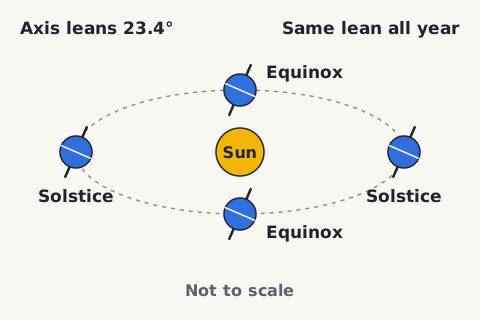
Seasons come from axial tilt: Earth's rotation axis leans 23.4 degrees away from the perpendicular to its orbital plane. That changes the angle at which sunlight strikes the ground, and it changes the length of the day — both concentrating or diluting the same sunlight over more or less area. (NASA gives 23.4 degrees, NOAA pages 23.45 and 23.5. Rounding, not a dispute.)
Four moments in the cycle have names. An equinox is a point where the ecliptic crosses the celestial equator; there the axis leans neither toward nor away from the Sun, and daylight and darkness are nearly equal at all latitudes. A solstice is the moment that lean is at its maximum, giving the longest and shortest days. Neither is the hottest or coldest day: a solstice is the extreme of sunlight, and surface temperature lags it by weeks.
Tides get explained as the Moon pulling the sea up. That would give one high tide a day, underneath the Moon. Coasts get two high and two low tides every 24 hours and 50 minutes.
What raises a tide is the difference in the pull across the width of Earth. The near side is pulled hardest and bulges toward the Moon; on the far side the pull is weakest, inertia wins, and the water bulges outward, away from the Moon. Two bulges, and Earth turns through both.
The same reasoning explains why the Moon beats the Sun. Tide-generating force falls off as the cube of the distance, not the square, so the Sun — far more massive, but far farther off — raises a tide only about half the size of the Moon's.
The two pulls add and subtract. At new and full Moon they line up and reinforce, giving extra-large spring tides; near first and third quarter they sit at right angles and partly cancel, giving weak neap tides. Nothing to do with the season called spring — it happens twice a month, all year.
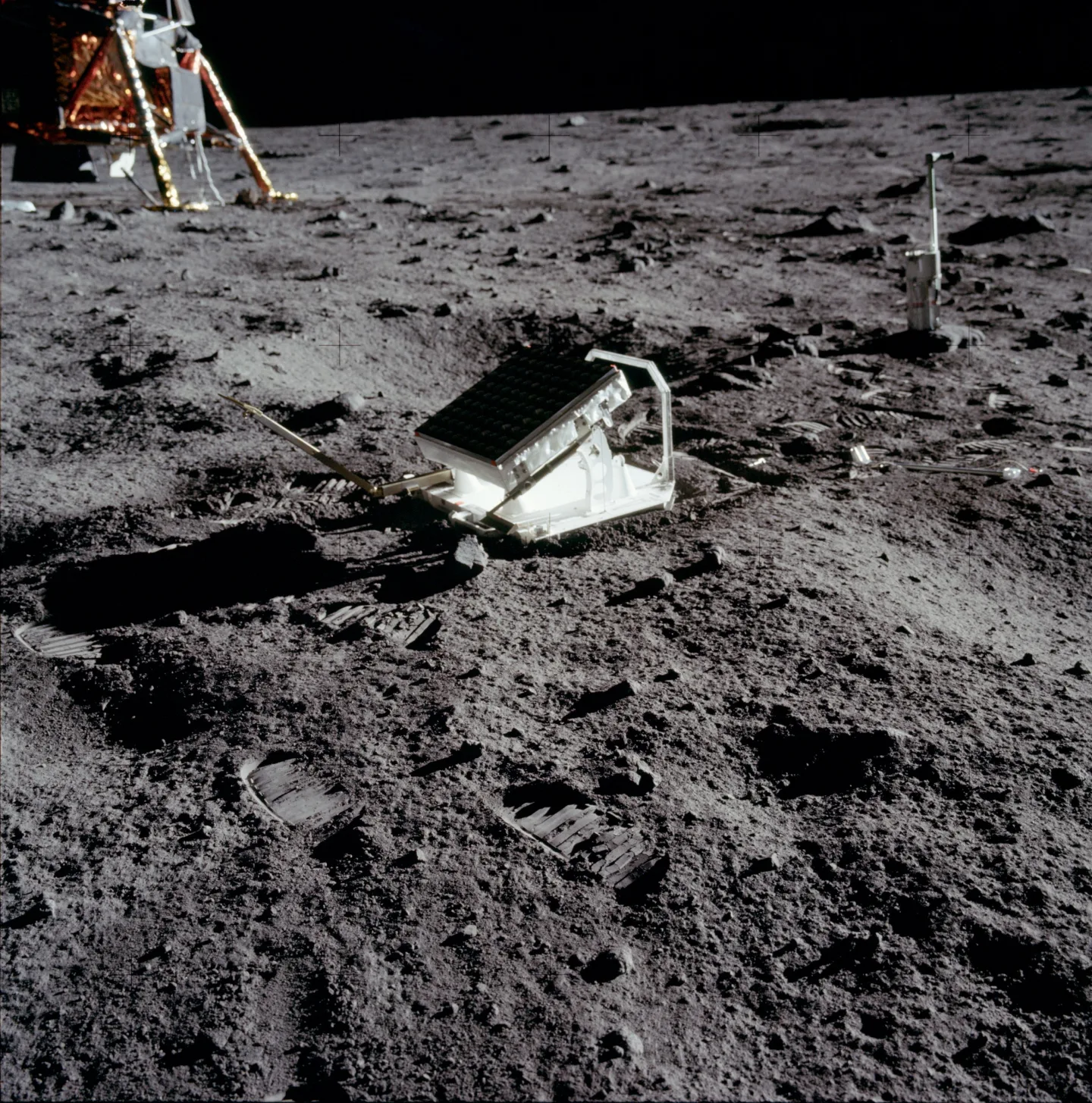
None of this is free. Lunar laser ranging off the retroreflector arrays left by Apollo 11, 14 and 15 shows the Moon receding about 3.8 centimeters a year — a direct measurement repeated for over fifty years, not an inference from theory. The same tidal friction is slowing Earth, lengthening the day by about 2.4 milliseconds per century. Angular momentum is conserved: what Earth's spin loses goes into the Moon's orbit and pushes it outward.
Which puts the 400-to-400 coincidence on a clock. The Sun has been the light source behind every mechanism here. Next it is the subject.
Key terms
- Synodic month
- The 29.53-day round trip from one new Moon to the next, timed against the Sun rather than against the background stars
- Penumbra
- The outer part of a shadow, where the light source is partly blocked rather than hidden completely
- Equinox
- A point where the ecliptic crosses the celestial equator, with the axis leaning neither toward nor away from the Sun — the balance between the solstices, not an extreme
Key facts
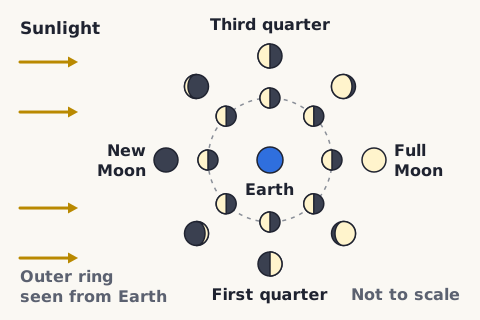
Half Lit, Always
The Sun lights exactly half the Moon at every moment — one hemisphere in daylight, one in darkness, no exceptions. A phase is simply how much of that permanently lit half is turned toward you. Earth's shadow has nothing to do with it: the shadow reaches the Moon only during a lunar eclipse, and those do not happen every month. Phases do.
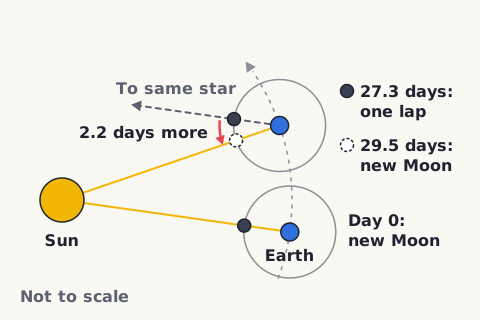
Two Months, One Orbit
One lap of the Moon against the background stars takes 27.322 days — the sidereal month, its true orbital period. New Moon to new Moon takes 29.530589 days, about 2.2 days longer. Phases are measured against the Sun, and Earth carries the Moon along its own orbit meanwhile, so after one full lap the Moon still has further to travel before it lines up with the Sun again.
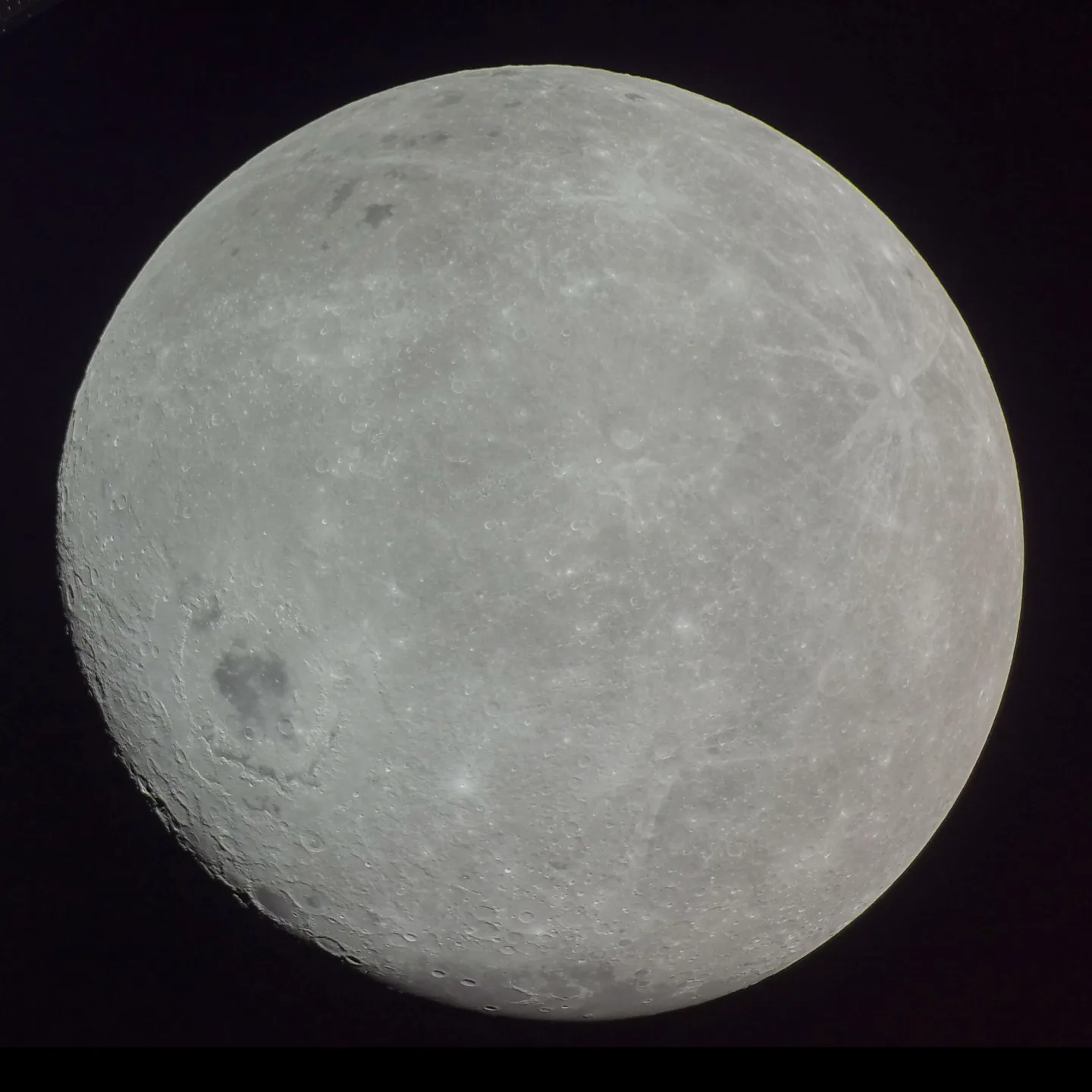
The Far Side Is Sunlit
The Moon is tidally locked: it turns once on its axis for every orbit of Earth, which is exactly why the same face stays pointed at us. It is rotating, not frozen. And the far side is not a dark side — it gets as much sunlight as the near side does. We simply never see it from here.
Five Degrees Off Target
The Moon's orbit is tilted 5.16 degrees to Earth's orbital plane. At the Moon's distance that small angle throws its shadow thousands of kilometers above or below Earth, so most new Moons produce nothing at all. The two points where the tilted orbit crosses are the nodes, and an eclipse needs the right phase and the Moon near a node — a coincidence confined to an eclipse season, with midpoints 173.3 days apart.
Totality Never Lasts
A total solar eclipse gives between about 10 seconds and 7.5 minutes of totality, and no more. The umbra sweeps across the ground at more than a thousand kilometers an hour, so no single spot stays inside it for long. The partial phases either side of it last hours; totality does not. Totality is the one and only phase that is safe to watch unfiltered — the moment the bright disc returns, the filter must be back on.
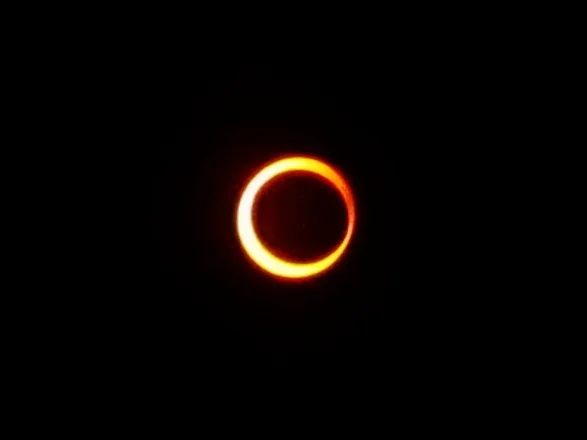
Four Hundred by Four Hundred
The Sun's diameter is about 400 times the Moon's — and the Sun happens to sit about 400 times farther away. The two ratios cancel, so the discs look almost exactly the same size from Earth, which is why totality lasts minutes rather than hours, and why a Moon near apogee leaves a ring instead. Nothing in physics requires the match.
Predicted Without Computers
Two lunar clocks run at slightly different speeds: the synodic month of 29.530589 days, and the draconic month — node to node — of 27.212221 days. They come back into step after 223 synodic months, which is also 242 draconic months: the saros, about 6,585.3 days, or 18 years, 11 days and 8 hours. Those extra 8 hours turn Earth a further 120 degrees, so each repeat lands a third of the way around the planet.
Sunlight at an Angle
Seasons come from axial tilt: Earth's rotation axis leans 23.4 degrees away from the perpendicular to its orbital plane. That lean changes the angle at which sunlight strikes the ground and the length of the day, concentrating the same sunlight into a smaller area or spreading it thin. Its extremes are the solstices, the longest and shortest days — the extreme of sunlight, not of heat, which lags by weeks.
Summer at Our Farthest
Earth reaches aphelion, its farthest point from the Sun, in early July — 6 July in 2026, at about 152.1 million km — and perihelion, its closest, in early January. The Northern Hemisphere therefore has its summer at the moment Earth is farthest away. The whole swing is only about 3 percent of the average distance: the orbit is very nearly circular, whatever school diagrams suggest.
Two Bulges, Not One
What raises a tide is the difference in the Moon's pull across the width of Earth, not the pull itself. The near side is pulled hardest and bulges toward the Moon; on the far side the pull is weakest, inertia wins, and the water bulges outward the other way. Earth turns through both, which is why coasts get two high and two low tides every 24 hours and 50 minutes.
Measured by Laser
Lunar laser ranging off the retroreflector arrays left by Apollo 11, 14 and 15 shows the Moon receding about 3.8 centimeters a year — a direct measurement repeated for over fifty years, not an inference from theory. The same tidal friction is slowing Earth, lengthening the day by about 2.4 milliseconds per century. What Earth's spin loses, the Moon's orbit gains.
Matched pairs
Each item on the left goes with the one on the right.
- Tidally locked
- One turn on its axis for every trip around Earth
- Perigee
- The Moon's closest approach, a mean 363,300 km
- Annular eclipse
- A bright ring left uncovered by a too-distant Moon — never safe to view unfiltered
- ISO 12312-2
- The standard a safe solar filter has to meet
- Spring tide
- Extra-large water rise when Sun and Moon align
- Solar retinopathy
- Permanent eye damage from one unprotected look
Self-test
Answer each question from memory, then check your work against the answer key.
1. At first quarter, how much of the Moon's visible face is lit?
- AHalf
- BOne quarter
- CAll of it
- DThree quarters
2. What decides the Moon's shape on a given night?
- AIts dark side rotating into view
- BThe Sun moving round behind it
- CEarth's shadow crossing it
- DHow much of the lit half shows
3. A solar eclipse can only happen at which phase?
- AFull Moon
- BNew Moon
- CFirst quarter
- DWaning crescent
4. Why is looking through binoculars while wearing eclipse glasses unsafe?
- AThey focus ultraviolet only
- BThey polarize the incoming light
- CThey concentrate the sunlight
- DThey shift the light to infrared
5. What makes the Northern Hemisphere warm in July?
- AIts axis leans toward the Sun
- BEarth is closest to the Sun
- CThe Sun gives out more light
- DIt climbs higher than in January
6. Why does the Moon beat the far more massive Sun at raising tides?
- AThe Sun pulls on us more weakly
- BIt falls off as distance cubed
- CThe Moon orbits us, not the Sun
- DWater answers the nearer body
Go deeper
- WatchIt's Not Earth's Shadow Many people think the Moon's phases come from Earth's shadow. But that shadow touches the Moon only during a lunar eclipse. Phases happen every month.
- WatchTotality Is Geography Eclipses aren't rare: 4 to 7 in a typical year, solar and lunar together. What's rare is standing in the right place.
- WatchSummer, Farthest from the Sun Summer isn't when Earth is closest to the Sun. Earth is farthest from the Sun in early July, in northern summer.
- StudyAstronomy & Space in the FlashFeed app
Answer key
- 1. A HalfThe name counts the orbit, not the disc: one quarter of the cycle is complete while exactly half the face is lit. A quarter-lit face and a three-quarter-lit face are the crescent and gibbous phases, and a fully lit face is the full Moon.
- 2. D How much of the lit half showsEarth's shadow reaches the Moon only at a lunar eclipse, not every month; cloud hides the Moon rather than reshaping it; and there is no permanently dark side to rotate into view. Only your line of sight on the lit half changes.
- 3. B New MoonThe Moon has to pass between Earth and the Sun, and that is exactly what a new Moon is. A full Moon sits on the opposite side, so it can only give a lunar eclipse; at first quarter and waning crescent the three bodies are nowhere near a line.
- 4. C They concentrate the sunlightBinoculars gather light over a wide front lens and bring it to a point — far more energy than the filter was designed to stop. They do not shift wavelength, polarize, or select ultraviolet; the filter must sit in FRONT of the optics, never behind it.
- 5. A Its axis leans toward the SunEarth is farthest from the Sun in early July, so distance gets the sign backwards, and the Sun's output barely changes. Climbing higher IS what July does — but that is the tilt showing its effect, not a rival cause. The lean is the cause; the rest follows from it.
- 6. B It falls off as distance cubedTide-generating force depends on the difference in pull across Earth, and that difference drops as the cube of distance — so the Sun's huge mass loses to its huge distance and raises about half the tide. Its gravity is not weak, moonlight has no pull, and nothing is blocked.
Sources
- NASA — Moon Phases — science.nasa.gov/moon/moon-phases/
- JPL Solar System Dynamics — Planetary Satellite Mean Elements — ssd.jpl.nasa.gov/sats/elem/
- NASA — Why Do Eclipses Happen? — science.nasa.gov/eclipses/geometry/
- NASA GSFC — Periodicity of Solar Eclipses — eclipse.gsfc.nasa.gov/SEsaros/SEperiodicity.html
- USNO Astronomical Almanac Glossary — umbra; USNO Astronomical Almanac Glossary — equinox — aa.usno.navy.mil/faq/asa_glossary
- NASA — Eclipse Frequently Asked Questions — science.nasa.gov/eclipses/faq/
- NASA — Total Solar Eclipse 2024: The Moon's Moment in the Sun — science.nasa.gov/solar-system/skywatching/eclipses/solar-eclipses/2024-solar-eclipse/total-solar-eclipse-2024-the-moons-moment-in-the-sun/
- NASA — Types of Solar Eclipses — science.nasa.gov/eclipses/types/
- NASA — Eclipse Safety — science.nasa.gov/eclipses/safety/
- NASA — Eclipses and the Moon — science.nasa.gov/moon/eclipses/
- NASA — Earth Facts — science.nasa.gov/earth/facts/
- USNO Astronomical Applications — Earth's Seasons and Apsides, 2026 — aa.usno.navy.mil/calculated/seasons?year=2026&tz=0&tz_sign=-1&tz_label=false&dst=false&submit=Get+Data
- NOAA National Ocean Service — Gravity, Inertia, and the Two Bulges — oceanservice.noaa.gov/education/tutorial_tides/tides03_gravity.html
- NASA JPL — The Apollo Experiment That Keeps on Giving — www.jpl.nasa.gov/news/the-apollo-experiment-that-keeps-on-giving/
- NOAA National Ocean Service — Tidal Variations: the Influence of Position and Distance — oceanservice.noaa.gov/education/tutorial_tides/tides06_variations.html
- American Academy of Ophthalmology — Solar Eclipse Eye Safety — www.aao.org/eye-health/tips-prevention/solar-eclipse-eye-safety
- NOAA National Ocean Service — What Causes Tides? — oceanservice.noaa.gov/education/tutorial_tides/tides02_cause.html
Image credits
- Half Lit, Always: FlashFeed original diagram · CC-BY-4.0
- Two Months, One Orbit: FlashFeed original diagram · CC-BY-4.0
- The Far Side Is Sunlit: Wikimedia Commons · NASA · Public domain — commons.wikimedia.org/wiki/File:Far_side_of_the_Moon.png
- Four Hundred by Four Hundred: Ken Lund from Reno, Nevada, USA · CC BY-SA 2.0 — commons.wikimedia.org/wiki/File:The_%22Ring_of_Fire%22_-_Annular_Solar_Eclipse,_Mesquite,_Nevada_(3)_(7239346576).jpg
- Sunlight at an Angle: FlashFeed original diagram · CC-BY-4.0
- Measured by Laser: Wikimedia Commons · NASA · Public domain — commons.wikimedia.org/wiki/File:Apollo_11_Lunar_Laser_Ranging_Experiment.jpg


