
Astronomy & Space study guide · Lesson 1 of 13
What You Are Actually Looking At
Points and Discs · Things That Move · How Bright Is Bright
This is the lesson's study guide from the FlashFeed app, plus its key facts and a self-test.
What you'll be able to do
- Tell a planet, a star, a satellite and the ISS apart, and say what each difference reveals
Go outside on a clear night and the sky offers you a few hundred white dots. They look like the same kind of thing. They are not. Some are suns; some are rock and gas lit by our sun; one or two are machines we built. You can tell them apart without owning a telescope, because every visible difference between them is evidence about distance, size, or motion.
That is what this lesson is for. Not a tour of the sky — a way of reading it.
Points and Discs
Start with the oldest observation anyone makes: stars twinkle, planets mostly do not.
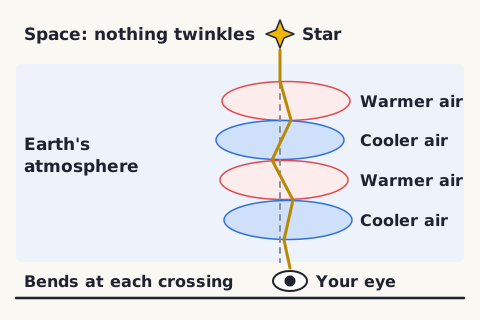
The reason is not that stars are restless. Twinkling — properly scintillation — happens entirely in Earth's atmosphere. Pockets of air at slightly different temperatures bend starlight by slightly different amounts, and the beam wanders and flickers on its way down.
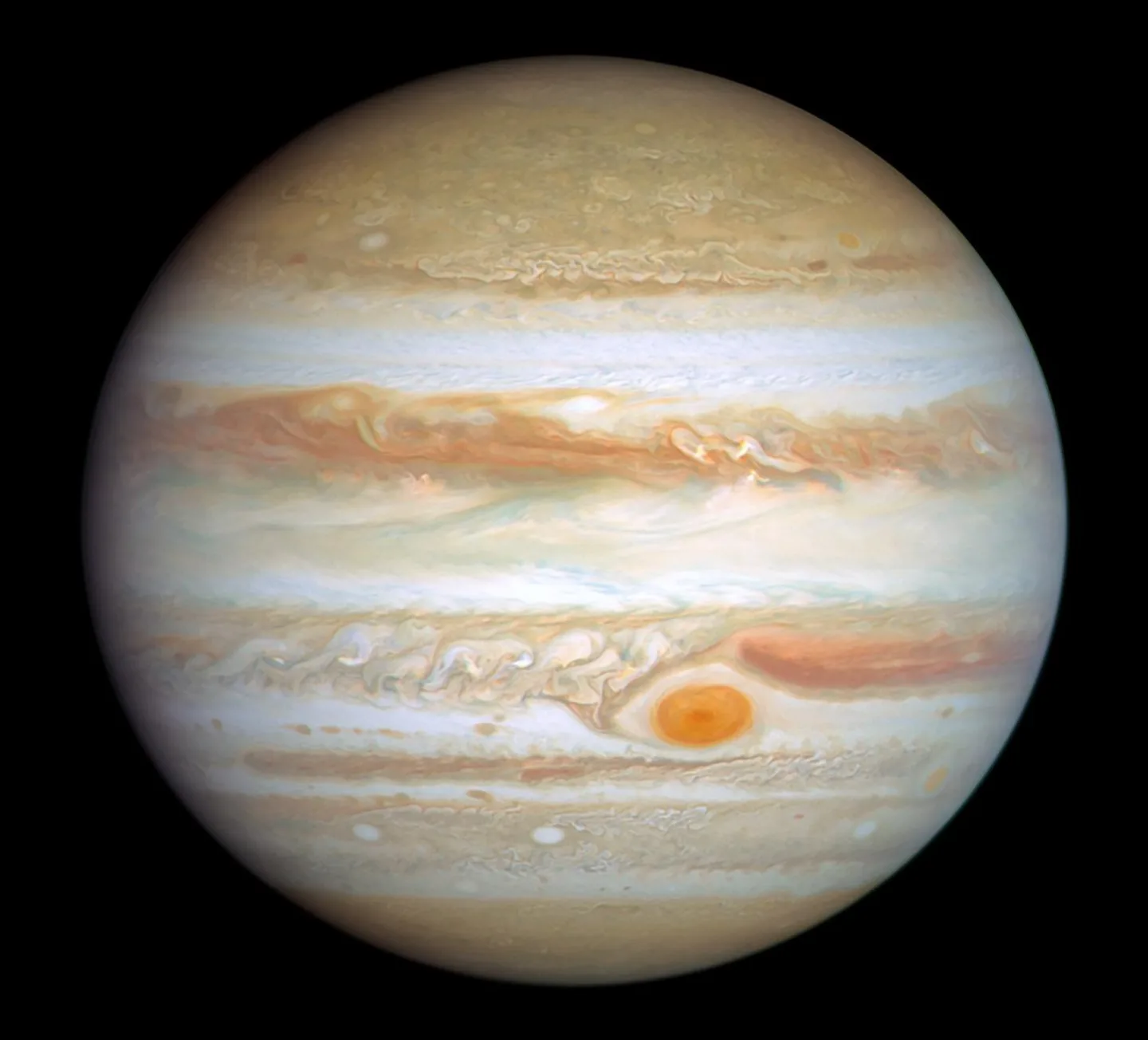
Why does a planet escape this? Because of what the two things look like from here. A star is so far away that no instrument on Earth resolves it into anything but a point. The nearest one, Proxima Centauri, is 4.25 light-years away. A planet is close enough to become a disc. The naked-eye planets subtend roughly 10 to 50 arcseconds; the largest stellar disc ever measured from Earth, the red giant R Doradus, is about 0.057 arcseconds across. A planet's disc is wide enough that light from one edge gets bent one way while light from the other edge is bent another, and the flickers average out before they reach you.
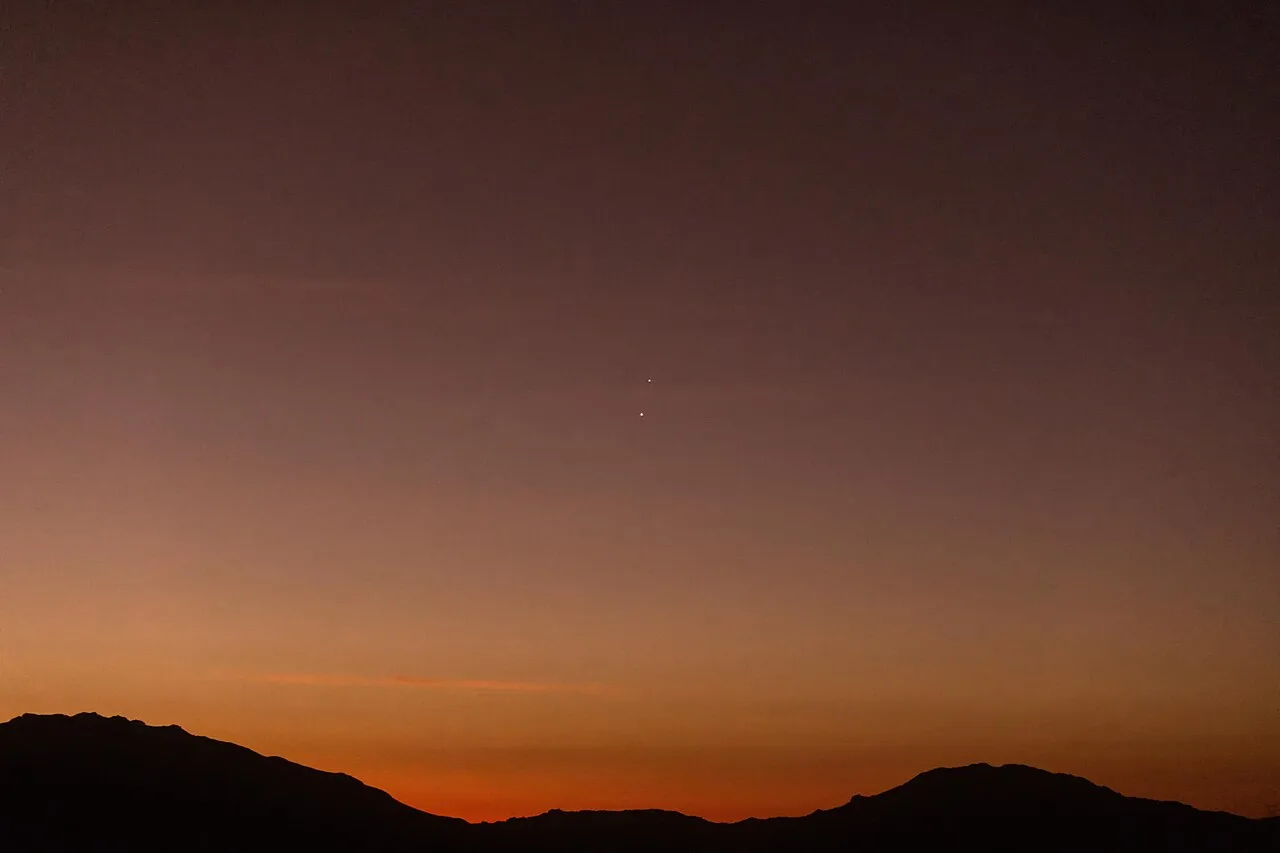
So a planet is a tiny disc — and yet you cannot see that it is a disc. Your eye separates detail about one arcminute apart, which is sixty arcseconds. A planet at 10 to 50 arcseconds sits below that limit, so it still looks like a point to you. It just does not behave like one. For scale: the Moon and the Sun are each about half a degree across, which is 30 arcminutes, or 1,800 arcseconds. A planet is a hundredth of that.
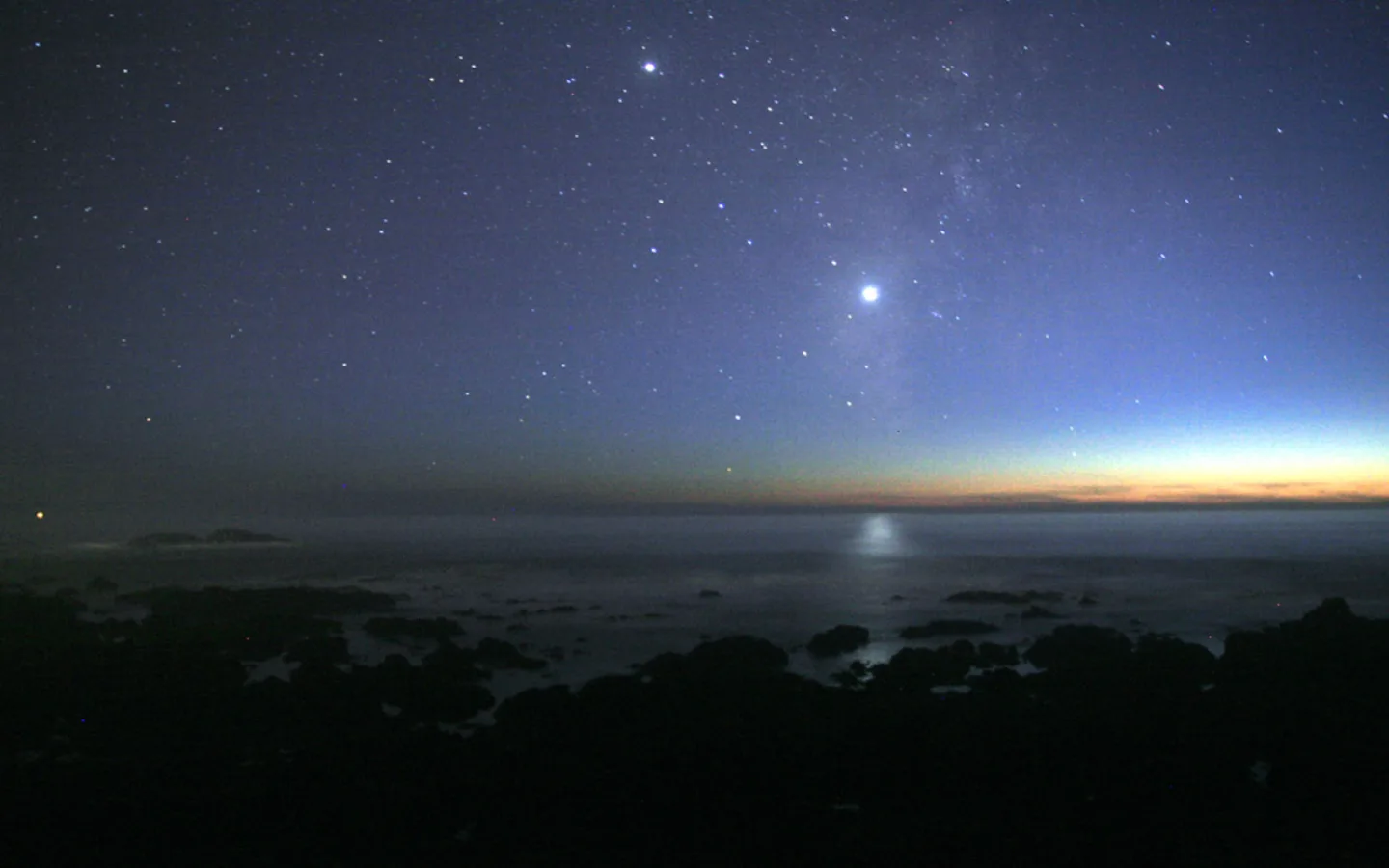
Two useful consequences. First, the rule has an exception, and it is worth knowing so it does not surprise you: a planet low in the sky can twinkle. Looking near the horizon means looking through more air — the airmass is 1 straight up and 2 at sixty degrees from vertical — and a long enough path overwhelms the averaging that a small disc gives you. Second, no amount of magnification turns a star into a disc. Even the Hubble Space Telescope separates detail only down to about 0.1 arcseconds. Point the largest amateur telescope in the world at a star and you get a brighter point.
Things That Move
Everything above drifts westward together. Anything that moves against that background is either close, or fast, or both — and what kind of motion it makes tells you which.
First, the basic division. Stars make their own light by fusion in their cores. Planets shine only by reflecting sunlight. Almost every moving light you can see is reflected sunlight; the exceptions, below, are the aircraft (its own bulbs) and the meteor (a streak of glowing air and vaporized grit).
A satellite reads as a point moving at a constant rate in a straight line, not changing course, crossing in a couple of minutes. Roughly 40,000 objects in Earth orbit are tracked, of which about 11,000 are working payloads, so this is a common sight.
The brightest of them is the International Space Station, and it is worth knowing on its own. It orbits about 400 kilometers up, traveling at roughly 28,000 kilometers per hour and circling the Earth in about 90 minutes. It is visible because it reflects sunlight — the same reason we can see the Moon — and its solar panels alone cover about an acre. That has a consequence you can watch happen: the station is visible only while it is still in sunlight and you are already in darkness, so a pass often ends with the ISS fading out mid-sky as it crosses into Earth's shadow. Nothing has switched off. It has simply run out of daylight.
An aircraft gives itself away by its lights. US rules put a red light on the left wing and a green one on the right, with white to the rear, so colored or regularly blinking lights mean aircraft. The reverse is not a safe inference — some satellites tumble and flash too.
A meteor is unmistakable because it is over in a second. It is a grain of dust or a small rock meeting the atmosphere at between 11 and 72 kilometers per second, burning about a hundred kilometers up. A meteor brighter than magnitude −4 — about as bright as Venus at its best — earns the name fireball.
How Bright Is Bright
Astronomers measure brightness on a scale that does two counterintuitive things at once, and both are worth getting straight before the numbers appear again later.
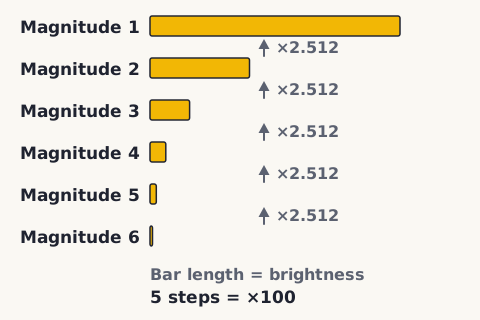
First, apparent magnitude runs backwards: the smaller the number, the brighter the object, and the brightest things carry negative numbers. The order is inherited: the Greek astronomer Hipparchus, working in the second century BC, is traditionally credited with giving the brightest stars he could see magnitude 1 and the dimmest magnitude 6, and the modern scale is based on his system. Second, it is logarithmic — one magnitude is a factor of about 2.512 in brightness, which means five magnitudes is a factor of exactly 100.
With those two rules the sky sorts itself out:
| Object | Magnitude |
|---|---|
| The Sun | −26.7 |
| The full Moon | −12.6 |
| The ISS at a good pass | ≈ −4.6 |
| Venus at a bright apparition | ≈ −4.4 (peaks near −4.9) |
| Sirius, the brightest night star | −1.46 |
| Vega | 0.0 |
| Naked-eye limit, dark sky | +6.0 to +6.5 |
The gaps are larger than they look. The Sun sits about 32.7 magnitudes above the naked-eye limit, which is a factor of roughly twelve trillion. The full Moon is around 400,000 times fainter than the Sun and still bright enough to wash out most of the sky. And Vega at 0.0 is not a coincidence — it is roughly where the modern zero point was set.
Only half the sky is above the horizon at once, so even under a genuinely dark sky the naked-eye limit puts only a few thousand stars in view — one estimate gives 2,600 to 4,500, depending on eyesight and conditions. Fewer than most people expect, and far fewer than most people ever see.
Two last motions to name, because everything later depends on them. The whole sky drifts east to west at about 15 degrees an hour — 360 degrees in 24 hours — and that is Earth turning, not the sky. And the Sun traces a path called the ecliptic, which is simply the plane of Earth's orbit, tilted 23.4 degrees to the celestial equator. The Moon and planets never stray far from it, which is why they always appear along the same broad line across the sky.
That line is where the next lesson happens.
Key terms
- Airmass
- How much atmosphere a beam crosses on its way down: 1 looking straight up, 2 at sixty degrees from vertical, far more at the horizon
- Fireball
- A meteor brighter than magnitude −4, about as bright as Venus at its best — and still over in seconds, so brightness alone never tells it from a satellite
- Apparent magnitude
- How bright a thing looks from Earth, on a ranking inherited from Hipparchus — a smaller number means brighter, negative means brighter still, and five steps is a factor of exactly 100
Key facts
The Flicker Is Our Air
Scintillation — twinkling — happens entirely in Earth's atmosphere. A ray of starlight bends slightly each time it crosses between warmer and cooler pockets of air; the pockets keep moving, and the narrow beam wanders in and out of your eye. Seen from space, nothing twinkles. The flicker is a measurement of our own air, not of the star.
Why a Disc Holds Steady
A planet is close enough to be a real disc: the naked-eye planets span roughly 10 to 50 arcseconds. Light from one edge is bent one way while light from the other edge is bent the other way at the same instant, so the wobbles average out before the light reaches you. Many independent paths cannot all dim at once.
A Disc You Cannot See
Your eye separates detail only about one arcminute — 60 arcseconds — apart, so a planet's 10-to-50-arcsecond disc is still a dot to you. For scale, the Moon and the Sun are each about half a degree across: 30 arcminutes, or 1,800 arcseconds. The averaging that stops the twinkle happens in the light before it arrives, not in your eye.
The Rule's Horizon Exception
Looking low in the sky means looking through more air: the airmass is 1 straight up and 2 at sixty degrees from vertical. A long enough path overwhelms the averaging a small disc gives you, so a planet near the horizon can twinkle — Venus low in the west often scintillates violently. Bright stars down there flash colors too, as the long air path splits their light like a prism.
Four Hundred Kilometers Up
The station orbits about 400 kilometers above the ground — closer to you than most countries are, a couple of hours' drive straight up. It travels at roughly 28,000 kilometers per hour and circles the Earth in about 90 minutes: sixteen circuits a day, and sixteen sunrises for the crew. Nothing is pushing it along. That is simply the speed a circular orbit at 400 km requires.
Over in a Second
A meteor is a grain of dust or a small rock meeting the atmosphere at between 11 and 72 kilometers per second, burning about 80 to 120 kilometers up. It is over in a few seconds — usually less — and that duration is what separates it from every other moving light. Most shooting stars are sand-grain debris that burns away entirely; only a rare, larger one drops anything to the ground.
Forty Thousand Tracked Objects
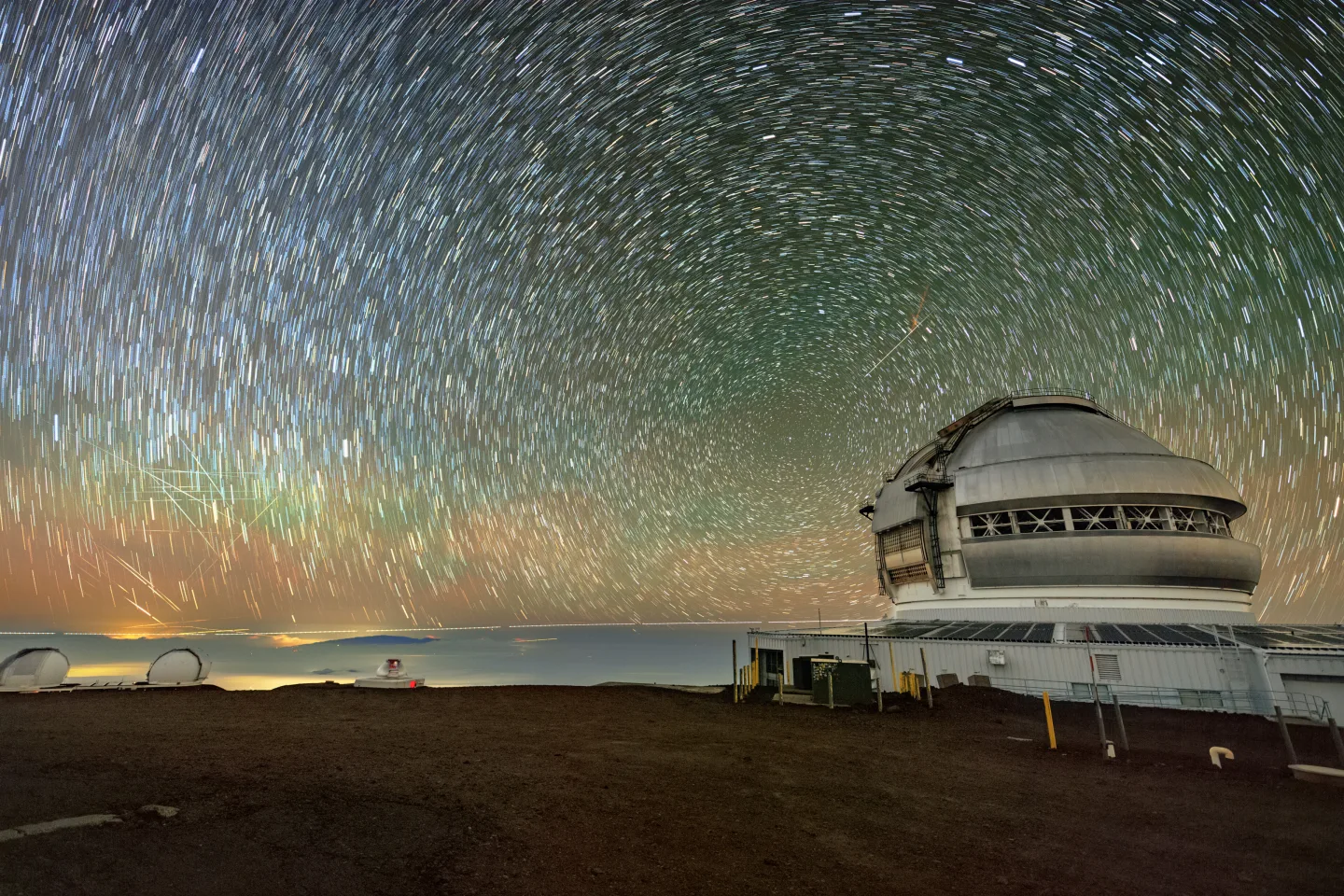
Space surveillance networks track about 40,000 objects in Earth orbit, of which roughly 11,000 are working payloads. Seeing several moving points in an hour is no longer unusual — under a dark sky it is the normal experience. The count keeps climbing, so treat these figures as dated rather than fixed.
A Scale Running Backwards
Apparent magnitude runs backwards: the smaller the number, the brighter the object, and the brightest things carry negative numbers. It is a two-thousand-year-old accident. Hipparchus called the brightest stars first magnitude and the faintest he could see sixth, and astronomy kept his ranking — so negative does not mean below zero brightness, only brighter than the old first rank.
Five Steps, One Hundred Times
The scale is logarithmic: one magnitude is a factor of about 2.512 in brightness, and five magnitudes is a factor of exactly 100. Each step is the same ratio, not the same amount — which is why the gaps are larger than they look. The Sun at −26.7 sits 32.7 magnitudes above the naked-eye limit of +6.0, a factor of roughly twelve trillion — and it is the one object on that scale you must never look at directly.
Fewer Stars Than You Think
Under a genuinely dark sky the naked-eye limit is around magnitude +6.0 to +6.5, which puts only a few thousand stars above your horizon at any moment — nowhere near the millions of popular imagination. Under city light the limit falls far enough that most of those stars simply vanish.
One Line, One Daily Turn
The whole sky drifts east to west at about 15 degrees an hour — 360 degrees in 24 hours — and that is Earth turning, not the sky. The Sun traces a path called the ecliptic: the plane of Earth's orbit, tilted 23.4 degrees to the celestial equator. The planets orbit near that plane, and the Moon's orbit is tipped only about 5 degrees, so they all appear along one broad line.
By the numbers
- The Sun — never view it directly, with or without optics
- -26.7 magnitude
- The full Moon
- -12.6 magnitude
- Venus at its brightest
- -4.4 magnitude
- Sirius, the brightest night star
- -1.46 magnitude
- Vega, the zero point of the scale
- 0 magnitude
- The naked-eye limit under a dark sky
- 6 magnitude
Matched pairs
Each item on the left goes with the one on the right.
- Proxima Centauri
- The nearest star after the Sun, 4.25 light years away
- R Doradus
- The widest stellar disc measured from Earth as of the 2020s, 0.057 arcseconds
- Aircraft light rules
- Red on the left, green on the right, white to the rear
- Satellite pass length
- About two minutes from one horizon to the other
Self-test
Answer each question from memory, then check your work against the answer key.
1. Why does one light in the night sky flicker while another holds steady?
- ABrighter, not fainter
- BA point, not a disc
- CHotter, not cooler
- DBurning, not reflecting
2. Aim the largest amateur telescope at a star. What do you get?
- AA disc with mottled markings
- BVisible surface detail
- CA small round disc
- DA brighter point of light
3. A bright pass of the space station fades to nothing halfway across the sky. Why?
- AIt flies into Earth's shadow
- BIts arrays turned from the Sun
- CIt has moved too far to see
- DIts own lights were switched off
4. A moving light crosses the sky. Which sign marks it as a satellite?
- AA streak gone in one second
- BRed and green flashes
- CA steady point, holding course
- DA brief hover, then a bank away
5. Which of these four sends the least light to your eye?
- AVenus, at −4.4
- BVega, at 0.0
- CNaked-eye limit, at +6.0
- DSirius, at −1.46
Go deeper
- WatchWhy Stars Twinkle Stars twinkle. Planets mostly don't. The twinkling happens in Earth's air, not in the star.
- WatchThe Station That Fades Mid-Sky A steady light crosses the sky in a straight line. It takes a couple of minutes. That's a satellite.
- WatchBrighter Means Smaller Astronomers rate brightness on a scale that runs backwards. The smaller the number, the brighter the object.
- StudyAstronomy & Space in the FlashFeed app
Answer key
- 1. B A point, not a discA point sends one narrow beam, which moving air bends in and out of your eye; a disc sends many, and they cannot all dim at once. Burning versus reflecting is a real difference but not this one. Brighter and hotter change nothing: a faint planet still holds steady.
- 2. D A brighter point of lightEven Hubble separates detail only to about 0.1 arcseconds, nearly twice the width of the largest stellar disc there is. So no small round disc appears, no surface detail resolves and no mottled markings show. Magnification adds brightness, not resolution.
- 3. A It flies into Earth's shadowIt is visible only because it reflects sunlight. Halfway across, it crosses into Earth's shadow and has nothing left to reflect. Nothing on board switched off or turned, and it is no farther away than a moment earlier — it has simply run out of daylight.
- 4. C A steady point, holding courseRed and green flashes are the position lights an aircraft must show at night. Hovering and then banking away is an aircraft turning as it passes. A streak gone in a second is a meteor burning up. Only an orbit gives an unblinking point on a straight track.
- 5. C Naked-eye limit, at +6.0Magnitude runs backwards: the larger the number, the fainter the object. +6.0 is the naked-eye limit and the faintest here. Vega at 0.0 defines the zero point, Sirius at -1.46 is the brightest star in the night sky, and Venus at -4.4 is brighter still.
Sources
- Las Cumbres Observatory — What is Apparent Magnitude?; Las Cumbres Observatory — Apparent Magnitude — lco.global/spacebook/distance/what-apparent-magnitude/
- NASA — Space Station Facts and Figures — www.nasa.gov/international-space-station/space-station-facts-and-figures/
- NASA — Spot the Station Frequently Asked Questions — www.nasa.gov/missions/station/spot-the-station-frequently-asked-questions/
- Love the Night Sky — How Many Stars Can I See at Night? — lovethenightsky.com/how-many-stars-can-i-see/
- University of Wisconsin–Madison — Why do stars appear to twinkle in the night sky? — news.wisc.edu/curiosities-why-do-stars-appear-to-twinkle-in-the-night-sky/
- Royal Museums Greenwich — What was the bright object I saw in the sky last night? — www.rmg.co.uk/stories/space-astronomy/what-was-bright-object-i-saw-sky-last-night
- Chandra X-ray Observatory — Scales and Angular Measurement — chandra.harvard.edu/photo/scale.html
- University of Sheffield PHY217 — Calibrating Photometric Data — vikdhillon.staff.shef.ac.uk/teaching/phy217/instruments/phy217_inst_photcal.html
- NASA Imagine the Universe — The Nearest Star — imagine.gsfc.nasa.gov/features/cosmic/nearest_star_info.html
- ESO — The Biggest Star in the Sky (eso9706) — www.eso.org/public/news/eso9706/
- ESA — Where is the International Space Station? — www.esa.int/Science_Exploration/Human_and_Robotic_Exploration/International_Space_Station/Where_is_the_International_Space_Station
- EarthSky — How high up are meteors when they begin to glow? — earthsky.org/space/at-what-altitude-do-meteors-become-incandescent/
- ESA — Space Environment Report 2025 — www.esa.int/Space_Safety/Space_Debris/ESA_Space_Environment_Report_2025
- Wikipedia — Fireball (meteor), citing the IAU definition — en.wikipedia.org/wiki/Fireball_(meteor)
- 14 CFR § 25.1385 — Position light system installation — www.law.cornell.edu/cfr/text/14/25.1385
- Penn State ASTRO 801 — The Magnitude System — courses.ems.psu.edu/astro801/content/l4_p5.html
- Case Western Reserve University ASTR 221 — The Magnitude Scale — burro.case.edu/Academics/Astr221/Light/magscale.html
- NASA — Basics of Space Flight, Chapter 2: Reference Systems — science.nasa.gov/learn/basics-of-space-flight/chapter2-2/
Image credits
- The Flicker Is Our Air: FlashFeed original diagram · CC-BY-4.0
- Why a Disc Holds Steady: Wikimedia Commons · NASA/STSCI (S.T.A.R.S) · Public domain — commons.wikimedia.org/wiki/File:Jupiter_OPAL_2024.png
- A Disc You Cannot See: Skatebiker · CC BY-SA 4.0 — commons.wikimedia.org/wiki/File:Venus-Jupiter-20230301.jpg
- The Rule's Horizon Exception: Brocken Inaglory · CC BY-SA 3.0 — en.wikipedia.org/wiki/Venus_in_culture
- Forty Thousand Tracked Objects: International Gemini Observatory/NOIRLab/NSF/AURA/J. Warner (Openverse) · by 4.0 — commons.wikimedia.org/w/index.php?curid=182244888
- Five Steps, One Hundred Times: FlashFeed original diagram · CC-BY-4.0

